



Abstract
Aims:
In this study I investigate whether child and adult Spanish heritage speakers (HS) use English-like strategies to repair word-external empty onsets preceded by consonants (e.g., e
Design:
Semi-spontaneous speech was elicited from a group of child HS (10 females (F), six males (M), mean age = 9.44 years, standard deviation (SD) = 0.69), adult HS (13 F, two M, mean age = 20.6 years, SD = 1.12), adult Spanish speakers in Mexico (six F, four M, mean age = 22.88 years, SD = 1.64), and long-term Mexican immigrants (seven F, two M, mean age = 45.16 years, SD = 9.49, mean age of arrival = 25.33 years, SD = 9.89).
Data and analysis:
Type of phonation (i.e., glottal or modal) was categorically coded and compared across groups and stress types. Acoustic measures, such as amplitude difference between the first two harmonic (H1*−H2*) and harmonics-to-noise ratio (HNR), were also analyzed to examine gradient group differences.
Findings/conclusions:
My findings show that child HS and adult HS present higher rates of glottal phonation than Spanish speakers in Mexico. The child HS, but not the adult HS, show higher rates of glottalization than those of long-term immigrants. Lastly, stressed syllables are more often glottalized than unstressed syllables.
Originality:
In this research I explore connected speech (i.e., word-external empty onsets), an understudied area in heritage language phonology. More specifically, this is the first study that examines empty onset repair strategies in both child and adult HS and analyzes the role of prosodic prominence.
Significance and implications:
I provide evidence for a greater pressure of the majority language during childhood than during adulthood. My results also show that divergent attainment in heritage language production is conditioned by quality of input.
Keywords
Introduction
In the United States, Spanish is the most-commonly spoken non-English language. It is spoken by more than 37 million speakers and transmitted inter-generationally at a rate of 85% (Brown & Lopez, 2013; Hugo Lopez et al., 2018). Nevertheless, Spanish is still a minority language lacking institutional support in the United States; thus, first-generation US-born Latinos are considered heritage speakers (HS) (Potowski, 2018). HS are classified as early sequential bilinguals if they are exposed to the heritage language at home and to the majority language upon schooling, or simultaneous bilinguals if they acquire the two languages in the household. In both cases, HS gain systematic contact with the societal language at the onset of schooling (Hurtado & Vega, 2004). Thus, the relative exposure to the heritage language diminishes during the school years and HS may shift their dominance to the majority language (Benmamoun et al., 2013). It is hence crucial to investigate HS speech production during school-age years so that we can better understand the effects of increased majority language input (Montrul, 2018).
In the phonological domain, extensive research has been conducted on the development of early bilingual grammars (child HS henceforth) through the frameworks of acceleration, deceleration and transfer (Fabiano-Smith & Goldstein, 2010; Goldstein et al., 2005; Lleó, 2016a, 2018a; Lleó & Kehoe, 2002; Lleó et al., 2003 among others). However, the scarcity of research on school-aged children (Lleó, 2016a) precludes the possibility of better understanding the effects of the majority language at later points of heritage language development. Adult heritage language phonology (HLP), on the contrary, has explored the outcomes of language acquisition by comparing heritage grammars to those of non-heritage baselines (e.g., monolingual speakers or long-term immigrants) (see Rao, 2019; Ronquest & Rao, 2018). Nonetheless, fewer studies in HLP have taken a developmental approach or directly examined whether child and adult HS differ in their speech production (Repiso-Puigdelliura & Kim, 2020). In particular, this study uses a cross-sectional design to examine majority-language influence in the production of word-external empty onsets (i.e., /C#V/ sequences such as in [e
Literature review
Differences and commonalities in heritage grammars
HS constitute a heterogenous linguistic community. They experience diverse situations of acquisition, and are therefore differentially affected by factors such as their overall exposure to their heritage language, the number of caregivers speaking their heritage language at home (Gollan et al., 2014), and the degree to which their formal educational circumstances support the maintenance of the heritage language. Even within this general context of variability, however, certain areas of heritage grammars are more likely to show variation and be subject to divergent attainment 1 when compared to monolingual baselines (e.g. fine-grained phonetic detail (Kang & Nagy, 2016; Kim, 2011; Kissling, 2018), production of prosody (Colantoni et al., 2016; Rao, 2016; Robles-Puente, 2014; Zárate-Sández, 2015)) than others (e.g. maintenance of phonemic contrasts (Einfeldt et al., 2019)). These commonalities suggest a presence of universal underlying processes in the heritage language, as well as possible common effects from the majority language (Polinsky & Scontras, 2020).
Studies on heritage grammars have mostly investigated how they differ from a baseline, which is generally a group of speakers from a monolingual society. However, other scholars have brought attention to the inappropriateness of this comparison. First, HS are bilinguals and, as such, it would be more adequate to compare them with Spanish-dominant bilinguals (Rao, 2019). Second, HS might be exposed to a language variety that does not contain the target linguistic property (Rothman, 2007). Thus, recent studies have begun to incorporate long-term immigrants as a comparison group because their speech is close to the input that they receive (Colantoni et al., 2016; Kissling, 2018; Robles-Puente, 2014). Another possibility is to examine HLP from a developmental perspective and establish comparisons with HS at different stages of language acquisition (Montrul, 2018; Polinsky, 2018). This approach bridges the gap between early bilingual acquisition and end-state heritage grammars and provides a developmental perspective to heritage language acquisition that will enrich our views on how these grammars mature and reach their end-states.
Child heritage phonology
During early acquisition, bilinguals may present different acquisitional patterns when compared to those of monolinguals (i.e., acceleration or deceleration), and transfer may occur between a bilingual’s two language systems (Paradis & Genesee, 1996). Deceleration occurs when a given linguistic property is acquired at a later stage in a bilingual grammar than in monolingual grammars. Fabiano-Smith and Goldstein (2010) found that Spanish–English bilinguals show deceleration in the production of Spanish trills, fricatives and glides and English stops and fricatives than respective monolingual groups. Acceleration occurs when a given property is acquired faster in bilingual than in monolingual grammars. For instance, Lleó et al. (2003) found that Spanish–German bilinguals produced syllabic codas at an earlier stage than Spanish monolinguals, possibly because bilinguals are exposed to an input with a larger number of codas (i.e., in German) than Spanish monolinguals.
While interaction between a child’s two phonological grammars in the form of acceleration and deceleration may produce only transient effects on the acquisition of the two language systems, transfer from one language into the other is more likely to have long-lasting effects on bilinguals’ speech production (Lleó, 2018b, p. 734). Transfer occurs when a sound or sound pattern of language A is replaced by a sound or sound pattern of language B. For example, Fabiano-Smith and Barlow (2010) examined the phonetic inventories of Spanish–English bilingual children (3;0–3;8) and found instances of the English fricative /ʒ/ in the Spanish inventory, and instances of Spanish /ɾ/ and [β] in the English inventory. Transfer can also apply to gradient acoustic properties (Kehoe et al., 2004) or to the application of phonological processes (Kehoe & Lleó, 2017; Lleó, 2018a). Many studies on child bilingualism (Fabiano-Smith & Barlow, 2010; Keffala et al., 2018; Kehoe & Lleó, 2017; Kehoe et al., 2004; Lleó et al., 2003, 2004) have challenged the view that early exposure to a language will lead to monolingual-like acquisition and suggested that being exposed to a language from early childhood is not enough to prevent cross-linguistic transfer (Lleó, 2016b).
Although a great deal of research has been conducted in early bilingualism, less is known about the effects of cross-linguistic interaction during late childhood, when bilinguals gain systematic contact with the majority language through school.
Adult heritage phonology: The influence of the majority language
A central question that emerges from the scholarship on early bilingualism is whether the effects of early transfer remain once a speaker’s two grammars have matured (Lleó, 2016b). Indeed, research on HLP has found that adult grammars present divergent attainment when compared to baselines of non-HS.
Spanish HS in the United States have recently caught the attention of scholars, who are interested in analyzing their vocalic, consonantal and prodic systems. With regards to the study of their vowel spaces, research has found that Spanish HS show phonetic properties of English (i.e., the majority language) (e.g., vowel fronting and greater dispersion in the vocalic space) and transfer of English-like vowel reduction (Alvord & Rogers, 2014; Elias & bMilla-Muñoz, 2017; Ronquest, 2013, 2016; Willis, 2005). Ronquest (2016) found, however, that a common characteristic shared by both monolingual and heritage grammars is the style-induced vowel shift; in general, more controlled speech presents greater vowel dispersion.
Regarding the production of consonants in the heritage language, HS show divergent patterns when they are compared to groups of monolinguals (Au et al., 2008; Kang & Nagy, 2016; Kim, 2011, among others), but they are more likely to show convergent patterns when compared to groups of long-term immigrants (Henriksen, 2015; Kissling, 2018). These findings call attention to the importance of including both monolinguals and long-term immigrants in research designs. Moreover, dominance in the majority language has also been found to predict heritage language consonant production (Amengual, 2018; Rao, 2015). For example, Amengual (2018) found that Spanish HS produce darker laterals (i.e., more English-like) as a function of English dominance.
As for the suprasegmental level, when compared to Spanish-dominant bilinguals or monolinguals, HS differ in their pitch accent and boundary tone inventories (Rao, 2016; Robles-Puente, 2014; Zárate-Sández, 2015), the phonetic realization of pitch accents (Colantoni et al., 2016), and the expression of prosodic prominence (Kim, 2019). Kim (2019), for instance, found that HS use both English-like and Spanish-like strategies to express prosodic prominence. Thus, HS choose from the repertoire of their two languages to produce prosodic prominence in the heritage language. In addition, differences between read speech and spontaneous speech have been shown to modulate majority language influence in the prosodic domain. Colantoni et al. (2016) showed that while HS produced Spanish-like alignment of fundamental frequency (f0) in pitch accents during spontaneous speech production (i.e., late f0 peak alignment of L+H*), read speech was produced with English-like f0 alignment (i.e., early alignment of L+H*).
Syllabification has generally been less studied (Shelton et al., 2017; Shelton & Grant, 2018). Shelton et al. (2017) found that Spanish HS break dipthongs into hiatuses more often in cognates (e.g., historia – history) than in non-cognates (e.g., aceite – oil) and in falling diphthongs (e.g., [ja] sucia ‘dirty’) than in rising diphthongs (e.g., [aj] baile ‘dance’), which indicates that HS transfer their metalinguistic knowledge about diphthongs from English to Spanish. To my knowledge, resyllabification remains unexplored in adult HS.
In sum, adult and child HS present aspects of majority language influence during heritage language production. While these speakers have been extensively compared to monolingual speakers and long-term immigrant control groups, very little of this research has taken a developmental perspective comparing groups of children to groups of adults (Repiso-Puigdelliura & Kim, 2020). A direct comparison between child and adult HS may shed some light into the strength of the majority language on their phonological systems during these speakers’ lifespan.
Empty onset repairs: Resyllabification or glottal stop epenthesis
Across languages, syllables tend to favor onsets (CV) and disprefer codas (VC) (Kahn, 1976; Selkirk, 1982). Syllables without onsets are repaired differently in Spanish and in English. In Spanish, a resyllabification process applies, in which the coda consonant attaches to the following nucleus and adopts the onset position (Colina, 1997; Harris, 1983; Hualde, 1991). For instance, in the sequence [e
English, by contrast, employs two strategies to resolve empty onsets. On the one hand, English speakers might choose to apply a resyllabification process that results in ambisyllabicity. In such cases, the coda consonant is both part of the coda and the onset (Kahn, 1976; Rubach, 1996). On the other hand, empty onsets might be repaired with the insertion of a glottal stop immediately preceding the nucleus position (e.g., an [ʔ]apple) (Scobbie & Pouplier, 2010). Such glottalization prevents misalignment in the syllabic structure and enhances recognition of prosodic word boundaries (Pompino-Marschall & Żygis, 2010), so that prominent vowels are more often glottalized than non-prominent vowels (Dilley et al., 1996; Garellek, 2014; Pierrehumbert, 1995; Redi & Shattuck-Hufnagel, 2001). As for the phonological consequences of this effect, Davidson and Erker (2014) posit that glottal stop epenthesis in prevocalic empty onsets (i.e., vowel-to-vowel sequences) is preferred only in prominent prosodic domains. Several acoustic measures have been employed to calculate the degree of glottalization (i.e., creaky phonation) in the speech signal. The difference between the first two harmonics (H1*−H2*) has been extensively used to explore creaky phonation (Garellek, 2014; Keating et al., 2015, Kreiman et al., 2012), as it correlates with voice quality parameters, such as the open quotient (Kreimen et al., 2012). Another set of measurements predicting creaky phonation are those related to the amount of noise in the speech signal. In particular, the harmonics-to-noise ratio (HNR) calculates the ratio of energy in the noise and the signal. A low HNR indicates that there is weaker periodicity in relation to glottal noise (De Krom, 1993; Garellek, 2014; Keating et al., 2015).
While some studies have found transfer of glottal stops from indigenous languages to child Spanish (Gynan & López Almada, 2020) and from Arabic to Spanish (Mohamed et al., 2019), to my knowledge, Lleó (2016a) is the only study showing cross-linguistic transfer of glottal stops in child Spanish HS. In Lleó’s (2016a) study the HS were German–Spanish bilinguals. In German, resyllabification is restricted to clitics and glottal-stop epenthesis is the more common strategy to repair empty onsets (Pompino-Marschall & Żygis, 2010). Her findings showed that Spanish–German bilinguals present greater rates of glottal stops than Spanish monolinguals during early language maturation (2–5;7 years). They also showed that the production of glottal stops persists in school-aged bilinguals (7-8 years old), which suggests that majority language transfer continues past early bilingualism.
Research questions
After having reviewed the existing literature on child and HLP and identifying the development of connected speech in heritage language as an empirical gap, the following research questions arise:
RQ1: Do child Spanish HS incorporate English-like strategies to repair empty onsets? If so, do the effects of transfer in early heritage grammars remain in adult HS, resulting in divergent attainment when compared to long-term immigrants and Spanish speakers in Mexico?
RQ2: Do child and adult HS glottalize more frequently in prosodically prominent positions (i.e., stressed syllables) than in non-prosodically prominent positions (i.e., unstressed syllables), as seen in previous results for English speakers?
RQ3: Can daily exposure to Spanish (i.e., amount of Spanish input/use and number of Spanish-speaking caregivers) explain variation in the use of strategies to repair empty onsets in child and adult HS?
Method
Participants
Groups of child Spanish HS (CHS) (10 F, six M, mean age = 9.44 years, SD = 0.69), adult Spanish HS (AHS) (13 F, two M, mean age = 20.6 years, SD = 1.12), adult Spanish speakers in Mexico (AMexS) (six F, four M, mean age = 22.88, SD = 1.64), and first-generation long-term immigrants (A1Gen) (seven F, two M, mean age = 45.16 years, SD = 9.49) participated in the study. Online Supplementary Tables S1 and S2 report the family background, language use (AHS) and amount of input (CHHS) for the HS. The AHS were all of Mexican descent English-dominant bilinguals based on their responses to the Bilingual Language Profile (BLP) (Birdsong et al., 2012) (mean (M) = 19.84, SD = 11.33) 2 . The AMexS were born and raised in the Central Mexican Plateau and reported to use only Spanish in their daily lives. The A1Gen were long-term immigrants who arrived in the United States from a Spanish-speaking country as adults (mean age of arrival = 25.33, SD = 9.89). Seven out of the nine A1Gen were from Mexico, one participant was from Ecuador and one from Colombia.
Procedures
Following the methodology in Lleó’s (2016a) study, semi-spontaneous speech was elicited using the wordless picture book Frog where are you (Mayer, 1969). This book is an adequate tool for eliciting /C#V/ sequences naturalistically because it contains several instances of stressed and unstressed content words beginning with a vowel (e.g., árbol ‘tree’, animal ‘animal’, hoyo ‘hole’, and abeja ‘bee’). The recording sessions of the adult and the child HS were conducted in private rooms at two schools, using an AKG C520 head-mounted microphone and a Zoom H4n handy portable digital recorder. The speech of the Spanish speakers in Mexico and long-term immigrants was collected remotely using Audacity and an external microphone connected to the participants’ computers. Recordings were made with a sampling rate of 44.1 kHz and a sample size of 16 bits.
Coding and acoustic measures
All semi-spontaneous speech elicited in the task was force-aligned using EasyAlign (Goldman, 2011) and Praat (Boersma & Weenink, 2020). All instances of consonant-final word followed by a multisyllabic vowel-initial word were extracted from the data (n = 514). 26 tokens were discarded for presenting a pause longer than 150 milliseconds (ms) at the word boundary or presenting global creakiness in the entirety of the word. The tokens were categorically classified as containing modal phonation, creaky phonation or full glottal stops, following Davidson and Erker’s (2014) guidelines. Modal phonation was defined as signal periodicity throughout the sequence of consonant and vowel (i.e., no glottalization between the consonant and the vowel) (see Figure 1A). Creaky phonation was defined as an aperiodic signal in the vowel and/or the consonant, demonstrating irregularity in the amplitude and duration of the glottal pulses (Davidson & Erker, 2014; Redi & Shattuck-Hufnagel, 2001) (see Figure 1B). A glottal stop was identified as a period of silence shorter than 150 ms between the consonant and the vowel. Glottal stops were often preceded or followed by a creak (see Figure 1C).
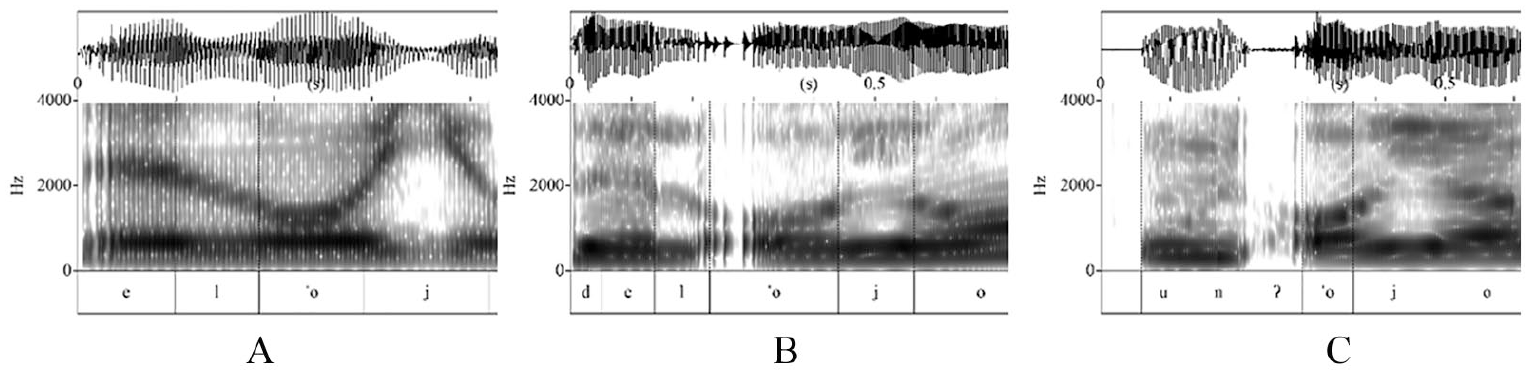
Modal phonation el hoyo ‘the hole’ (A); creaky phonation del hoyo ‘from the hole’ (B); and glottal stop un hoyo ‘a hole’ (C).
With regard to the acoustic measures, H1*−H2* and HNR below 500 Hz were extracted from the data using VoiceSauce (Shue et al., 2011). The values were standardized by participants using Z-score normalization. Tokens with values above or below 2.5 standard deviations away from the mean within each speaker were removed (for H1*−H2* n = 67, for HNR below 500 Hz n = 31).
Results
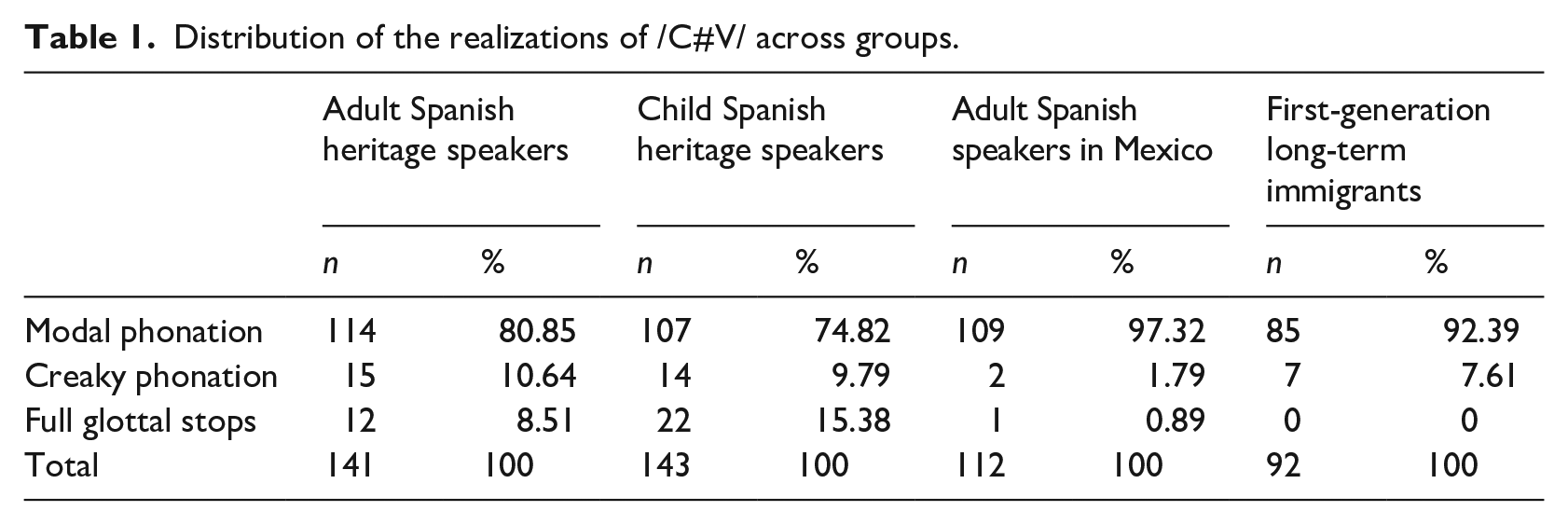
As demonstrated in Table 1, while all groups produced creaky phonation, the AHS (10.64%) and the CHS (9.79%) did so to a larger extent than the AMexS (1.79%) and the A1Gen (7.61%). Glottal stops were more present in the CHS (15.38%) than in AHS (8.51%), and they were absent or close to absent in AMexS (0.89%) and A1Gen (0%).
Distribution of the realizations of /C#V/ across groups.
The tokens containing glottalization (i.e., creaky phonation and full glottal stops) were collapsed into a single category in order to allow for a binary analysis of the data set (i.e., glottal phonation (reference level) vs. modal phonation). The data were modeled with a binomial logistic regression with mixed effects (Baayen et al., 2008) fitted in the lme4 package (Bates et al., 2015) in R (R Development Core Team, 2020). Post-hoc pairwise comparisons were conducted in the emmeans package (Lenth, 2020). GROUP (i.e., AHS, CHS, AMexS, and A1Gen) and STRESS (i.e., stressed and unstressed) were entered as fixed effects using simple coding and PARTICIPANT was entered as a random effect. Results showed that the CHS (i.e., reference level) produced a significantly higher proportion of glottal phonation (25.17%, standard error (SE) = 3.64%) than the A1Gen (7.61%, SE = 2.78%) (β = 1.49, SE = 0.57, z = 2.63, p < 0.01) and AMexS (2.67%, SE = 1.53%) (β = 2.56, SE = 0.72, z = 3.53, p < 0.01). Further comparisons across groups with Tukey’s adjustment showed that AHS produced a higher rate of glottal phonation than the AMexS (β = 2.21, SE = 0.73, z = 3.03, p < 0.05). No differences were found between the AHS (19.15%, SE = 3.32%) and the A1Gen. A main effect of STRESS was also found (β = 1.60, SE = 0.46, z = 3.46, p < 0.01), which indicates that tokens with an initial stressed syllable (i.e., reference level) were more likely to be glottalized (19.66%, SE = 2.58%) than tokens with an initial unstressed syllable (10.44%, SE = 1.94%). An interaction between STRESS and GROUP (A1Gen) was found (β = 1.48, SE = 0.50, z = 2.84, p < 0.01). Post-hoc comparisons showed that while the rate of glottal phonation in the CHS was significantly higher in stressed (38.80%, SE = 5.99%) than in unstressed conditions (13.16%, SE = 3.90%) (β = -1.60, SE = 0.46, z = −3.46, p < 0.01), these conditions did not yield a significant difference in the A1Gen (for stressed syllables: 4.00%, SE = 2.78%, for unstressed syllables: 11.90%, SE = 5.06%). Figure 2 shows the proportion of glottalization across groups and stress conditions.
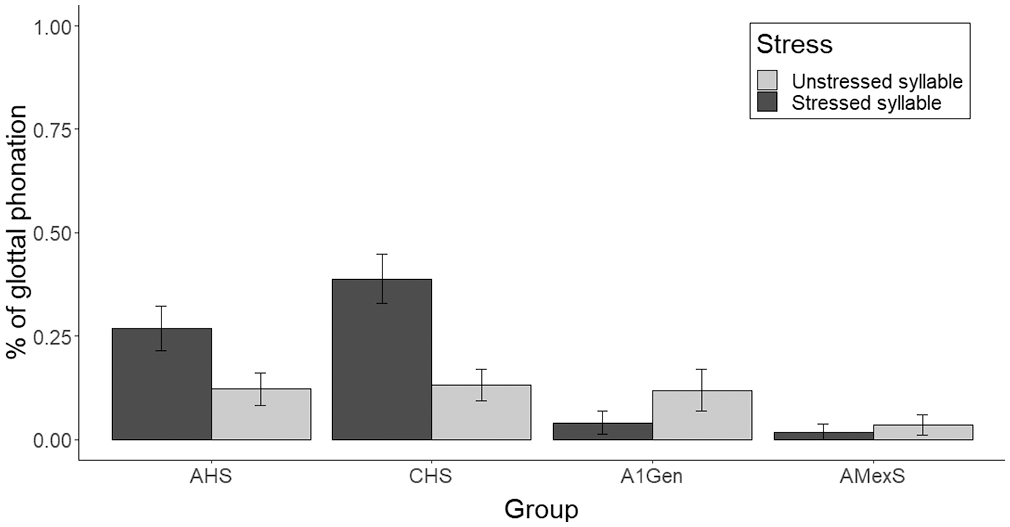
Proportion of glottal phonation.
Examining effect of daily exposure to Spanish
While the AMexS and A1Gen groups produced modal phonation in a consistent manner, the HS groups showed variation in the type of phonation produced. Table 2 shows that the CHS with one Spanish-speaking caregiver produced a higher amount of creakiness (10.67%) and glottal stops (21.33%) than those with two Spanish-speaking caregivers (creakiness: 8.82%, glottal stop: 8.82%). However, a Chi-square (χ2) to determine the relationship between group and phonation type turned out not significant (χ2 (2, n = 16) = 4.73, p = 0.097).
Frequency of phonation type per number of Spanish-speaking caregivers.

The amount of Spanish input for each family member (i.e., caregivers, siblings, and other significant adults) was calculated in a scale from 0 to 100% and was obtained from 14 CHS (see Online Supplementary Table S1). Given the small sample size, I collapsed the results of glottalization (i.e., creaky phonation and glottal stops) and examined the relationship between the amount of input and the rate of glottal phonation using a Pearson correlation. Results showed no significant correlation between amount of input and rate of glottal phonation (r(120) = −0.02, p = 0.81). For the AHS, I used the Spanish Language Use score from the BLP (Birdsong et al., 2012). The correlation between language use and rate of glottal phonation was also found non-significant (r(139) = −0.04, p = 0.58).
Acoustic measurements
Before analyzing the degree of glottalization, I examined whether the two acoustic measures (i.e., H1*−H2*, and HNR) were reliable proxies for glottalization. I ran two linear mixed effects models (lmer) with normalized H1*−H2* and HNR below 500 Hz (HNR <500 Hz) as dependent variables, and PHONATION TYPE (modal phonation, creaky phonation, and full glottal stops) as a fixed effect. For random effects I included PARTICIPANT and TYPE OF CODA. I included TYPE OF CODA as a random effect in order to control for possible coarticulation effects on the following vowels. Figure 3 demonstrates the distribution of H1*−H2* and HNR <500 Hz values across phonation types. For HNR <500, findings show a main effect of PHONATION TYPE. That is, tokens with modal phonation (i.e., reference level) (M = 29.50 dB, SD = 11.22 dB) showed significantly higher HNR <500 than tokens with creaky phonation (M = 14.26 dB, SD = 10.81 dB) (β = −1.22, SE = 0.13, t = −9.45, p < 0.01) and tokens with full glottal stops (M = 24.84 dB, SD = 11.35) (β = −0.49, SE = 0.14, t = −3.60 p < 0.01). A second lmer with creakiness as the reference level showed that creakiness is produced with lower HNR <500 values than tokens with glottal stops (β = 0.73, SE = 0.18, t = 4.08, p < 0.01).
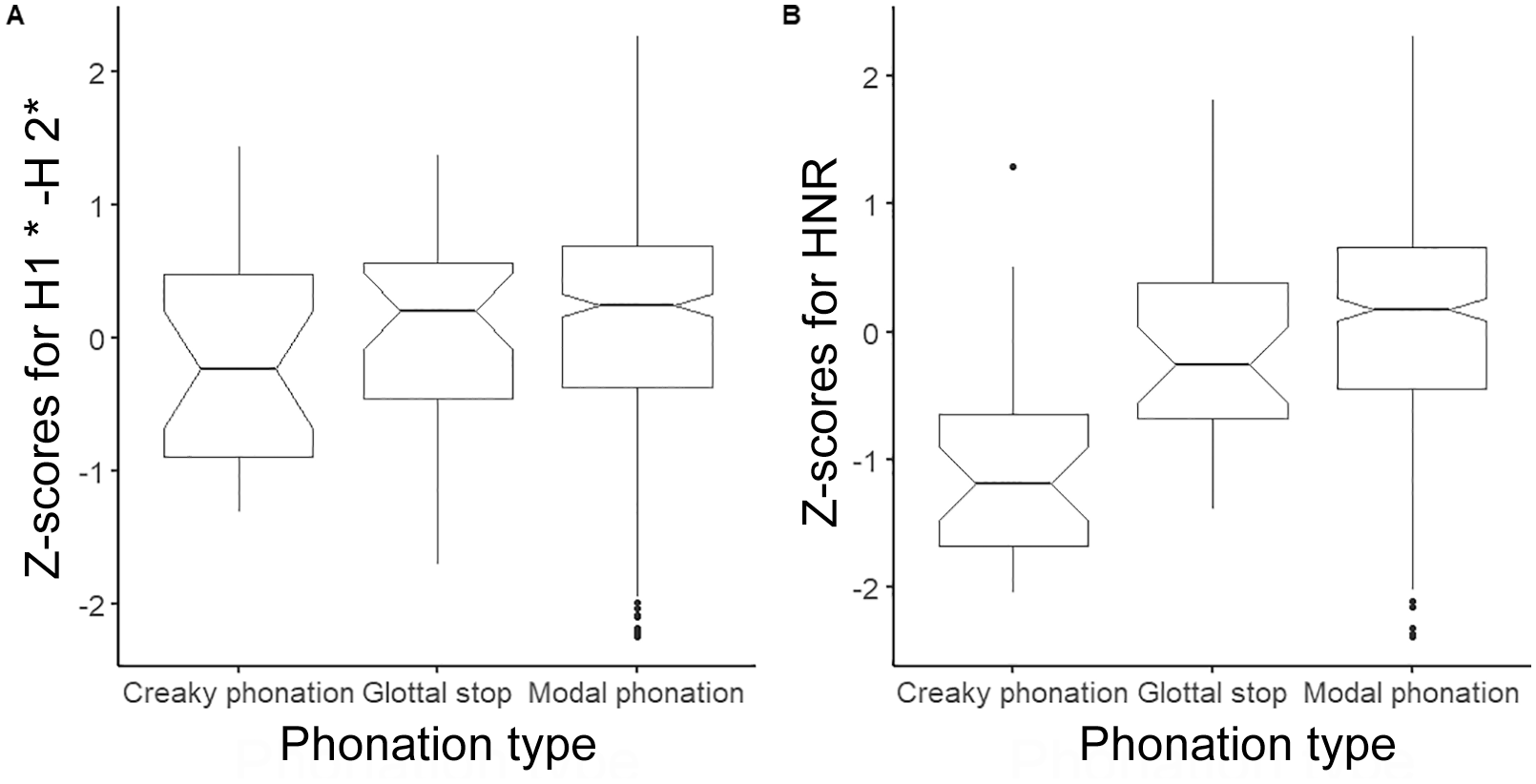
Z-scores for harmonics H1*–H2* (A); and harmonics-to-noise ratio (B).
For H1*−H2*, the results of the present study showed that modal phonation (i.e., reference level) (M = 4.56 dB, SD = 5.15 dB) is produced with higher values than tokens with creaky phonation (M = 1.91 dB, SD = 5.55 dB) (β = −0.50, SE = 0.18, t = −2.85, p < 0.01). The difference between modal phonation and tokens with full glottal stops (M = 4.41 dB, SD = 4.14 dB) was not significant 3 . Given that HNR <500 demonstrate a three-way significant difference between modal phonation, creaky phonation and tokens with full glottal stops, I considered HNR <500 appropriate to examine the degree of glottalization across the groups and stress conditions. Figure 3 shows the H1*−H2* and HNR <500 values for phonation type.
The HNR <500 was fitted in an lmer with GROUP (AHS, CHS; AMexS, and A1Gen) and STRESS (stressed and unstressed) and their interaction as fixed effects and PARTICIPANT and TYPE OF CODA as random effects. No significant effects were found in any of the measures.
Discussion
English-like strategies to repair empty onsets in Spanish
The first goal of this study was to determine whether CHS and AHS incorporate glottalization to repair empty onsets. The findings of this study demonstrate that while CHS and AHS use modal phonation (CHS: 74.82%, AHS: 80.85%) more often than glottalization (i.e., full glottal stops or creakiness) (CHS: 25.17%, AHS: 19.15%), CHS present higher rates of glottalization than the baseline groups (A1Gen: 7.61%, AMexS: 2.68%), and AHS show higher rates of glottal phonation than those of the AMexS. Crucially, the fact that AMexS produce almost inexistent rates of glottal phonation supports a majority-language-transfer account of the use of glottalization in /C#V/ junctures. Following this conclusion, a central finding of this study is that CHS produce a higher rate of glottal phonation than that found in their input (i.e., long-term immigrants), suggesting that the majority language exerts pressure on developing grammars past early stages of language maturation. Drawing from Polinsky and Scontras’ (2020) account on heritage language restructuring, it could be posited that maturing grammars might be highly taxed when inhibiting the majority language, even more so than adult heritage grammars. Thus, children may produce greater rates of glottal phonation than those found in the Spanish input in order to release processing pressure (Polinsky & Scontras, 2020, p. 11). While the effects of language transfer are carried into adulthood, the results of this study also show that AHS productions are not significantly different from those of A1Gen. Therefore, the divergent patterns found in AHS might be better accounted for as a result of exposure to a Spanish input already containing English-like strategies to repair empty onsets. The findings of the present study align with previous results on heritage language development. For instance, Repiso-Puigdelliura and Kim (2020) found that 9–10-year-old HS show delayed development in the production of the Spanish trill when compared to adult HS, yet, the Spanish trill of the adult HS is similar to that of long-term immigrants from previous research (Henriksen, 2015; Kissling, 2018). This restates the importance of incorporating a baseline of long-term immigrants when examining development in heritage grammars.
The second objective of the present study was to determine whether HS glottalize more frequently in prosodically prominent positions (i.e., stressed syllables), as is found in English. I found that stressed syllables were produced with higher rates of glottalization than unstressed syllables (Stressed: 19.66%, Unstressed: 10.44%). These findings are in keeping with the literature on English glottalization, which indicates that glottal stops are more likely to be found in prosodically prominent positions (Dilley et al., 1996; Garellek, 2014; Pierrehumbert, 1995; Redi & Shattuck-Hufnagel, 2001). The fact that stress did not show the same pattern in A1Gen needs further scrutiny with a larger sample size. My results add to the recent literature on HLP demonstrating that suprasegmental features constitute a site for majority-language influence (Bullock, 2009; Colantoni et al., 2016; Kim, 2015, 2019). In addition to prosodic prominence, cross-linguistic transfer of glottal phonation may be mediated by further linguistic variables. For instance, HS could show more glottal phonation in Spanish–English cognates, in sequences of words with low frequencies of co-occurrence or in novel words. Thus, future research should investigate variables such as cognate status and lexical frequency. While lexical frequency could be difficult to manipulate in experimental designs with children, I recommend comparing real words to novel words.
To sum up, while child HS mostly use resyllabification (i.e., modal phonation), they also optionally incorporate English-like strategies to repair empty onsets (i.e., glottalization in stressed syllables). Adding to the findings of Lleó (2016a), I have demonstrated that 9-to-10-year-olds still use glottal phonation to repair empty onsets and that majority-language transfer persists well into adulthood (i.e., after the grammar has matured). Moreover, the results of this study show that, during heritage language production, HS have access to their two phonological systems and are able to select repair strategies from both English and Spanish (Kim, 2019). The current study expands the incipient body of literature in HLP exploring heritage language acquisition from a developmental perspective (Repiso-Puigdelliura & Kim, 2020).
Examining variation
The third goal of the current study was to examine whether intra-group variation could be explained by extra-linguistic variables such as the amount of Spanish input (for the CHS), language use (for the AHS), or the number of Spanish-speaking caregivers (for the CHS). The findings of the present study do not show significant effects for number of caregivers or amount of Spanish input. However, due to the small number of speakers for whom I could obtain information about language input, I cannot completely rule out the possibility that the quantity of Spanish input might affect the strategies to repair empty onsets. Thus, future research should continue to explore this question with larger sample sizes. Another option to explore within-group variation is to compare the rate of glottal phonation in Spanish and English, as the rates at which HS produce glottal phonation in English may predict Spanish glottalization patterns. In other words, the rate of glottal phonation in English might better explain group variation in Spanish.
Acoustic measurements
While HNR <500 distinguished tokens with modal phonation from tokens with creakiness and glottal stops, H1*−H2* values only showed a significant difference between modal phonation and creaky phonation. These findings diverge from Garellek (2013)’s study, showing that vowels following full glottal stops showed lower H1*−H2* values than vowels not following glottal stops. I suggest that the glottalization that occurred in vowels following glottal stops paired with a small sample size might not have been strong enough to show a difference with modal phonation. Although I did not find group differences, I believe that the intrinsic variability of spontaneous speech, such as speech rate, and the age-intrinsic differences in voice quality might have masked any possible group effects. Therefore, future studies should include a group of child Spanish speakers in Mexico to match the groups in age.
Conclusion
The results of this study indicate that Spanish HS use both Spanish and English-like strategies to repair empty onsets in /C#V/ sequences (e.g., [u
Supplemental Material
sj-pdf-1-ijb-10.1177_13670069211016547 – Supplemental material for Empty onset repairs in the semi-spontaneous speech of Spanish child and adult heritage speakers
Supplemental material, sj-pdf-1-ijb-10.1177_13670069211016547 for Empty onset repairs in the semi-spontaneous speech of Spanish child and adult heritage speakers by Gemma Repiso-Puigdelliura in International Journal of Bilingualism
Footnotes
Declaration of conflicting interests
The author declared no potential conflicts of interest with respect to the research, authorship, and/or publication of this article.
Funding
The author received no financial support for the research, authorship, and/or publication of this article.

Supplemental material
Supplemental material for this article is available online.