




Abstract
Prestressed concrete girders with corrugated steel webs have received considerable attention in the past two decades due to their light self-weight and high prestressing efficiency. Most previous studies were focused on the static behavior of corrugated steel webs and simple beams with corrugated steel webs. The natural frequencies are very important characteristics when evaluating the dynamic responses of a bridge under external loads; however, very few studies have been conducted to investigate the dynamic behavior of full prestressed concrete girders or bridges with corrugated steel webs, and no simple formulas are available for estimating the natural frequencies of prestressed concrete girder bridges with corrugated steel webs. In addition, experimental work on full-scale bridges or scale bridge models is very limited. In this article, formulas for predicting the vertical bending vibration frequencies of prestressed concrete box girders with corrugated steel webs are proposed based on Hamilton’s energy variational principle. A one-tenth scale model is developed for an existing prestressed concrete box-girder bridge with corrugated steel webs. The frequencies predicted by the proposed formulas are compared to the finite element analysis results and also the experimental results from the scale bridge model. Good agreement is achieved between these results, indicating that the proposed formulas can provide a reliable and efficient tool to predict the vertical bending vibration frequencies of prestressed concrete box-girder bridges with corrugated steel webs.
Keywords
Introduction
In the past two decades, prestressed concrete (PC) girders with corrugated steel webs (CSWs) have provided an excellent alternative to conventional concrete girder bridges. This new type of PC girder bridges with CSWs is designed to take full advantages of the material properties of the concrete flanges, prestressed tendons, and steel webs. As shown in Figure 1 (Ji et al., 2012), the concrete flanges provide the required bending capacity, while the CSWs provide the desired shear capacity but have little contribution to the bending capacity.
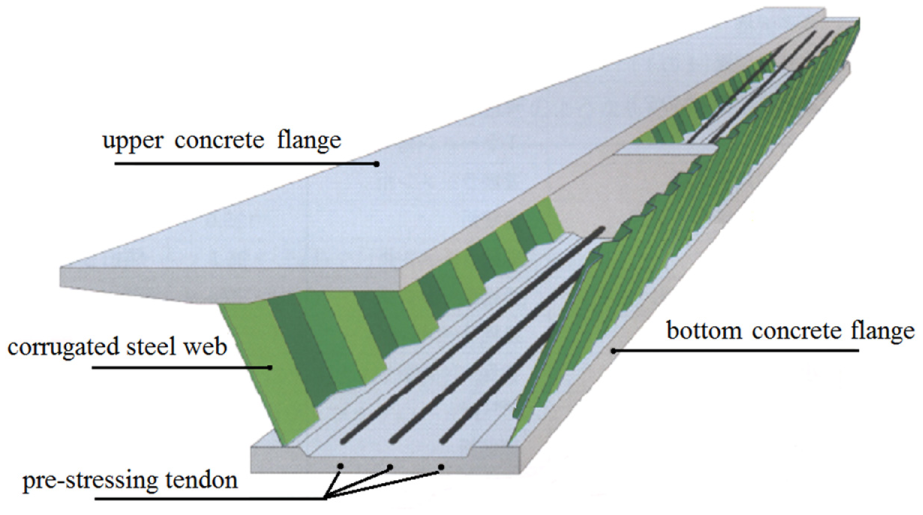
Main components of a PC box girder with corrugated steel webs (Ji et al., 2012).
However, the idea of replacing the concrete webs in conventional PC box girders with CSWs can not only substantially reduce the dead load of the girder but also speed up the construction process and therefore reduce the total construction cost. Moreover, the CSWs do not absorb much prestressing force in the concrete flanges and can thus achieve higher prestressing efficiency than conventional PC box girders. The Maupré Bridge in France (Hassanein and Kharoob, 2014) and the Caochanggou Bridge in China, shown in Figure 2, are two examples of bridge structures adopting such girders.
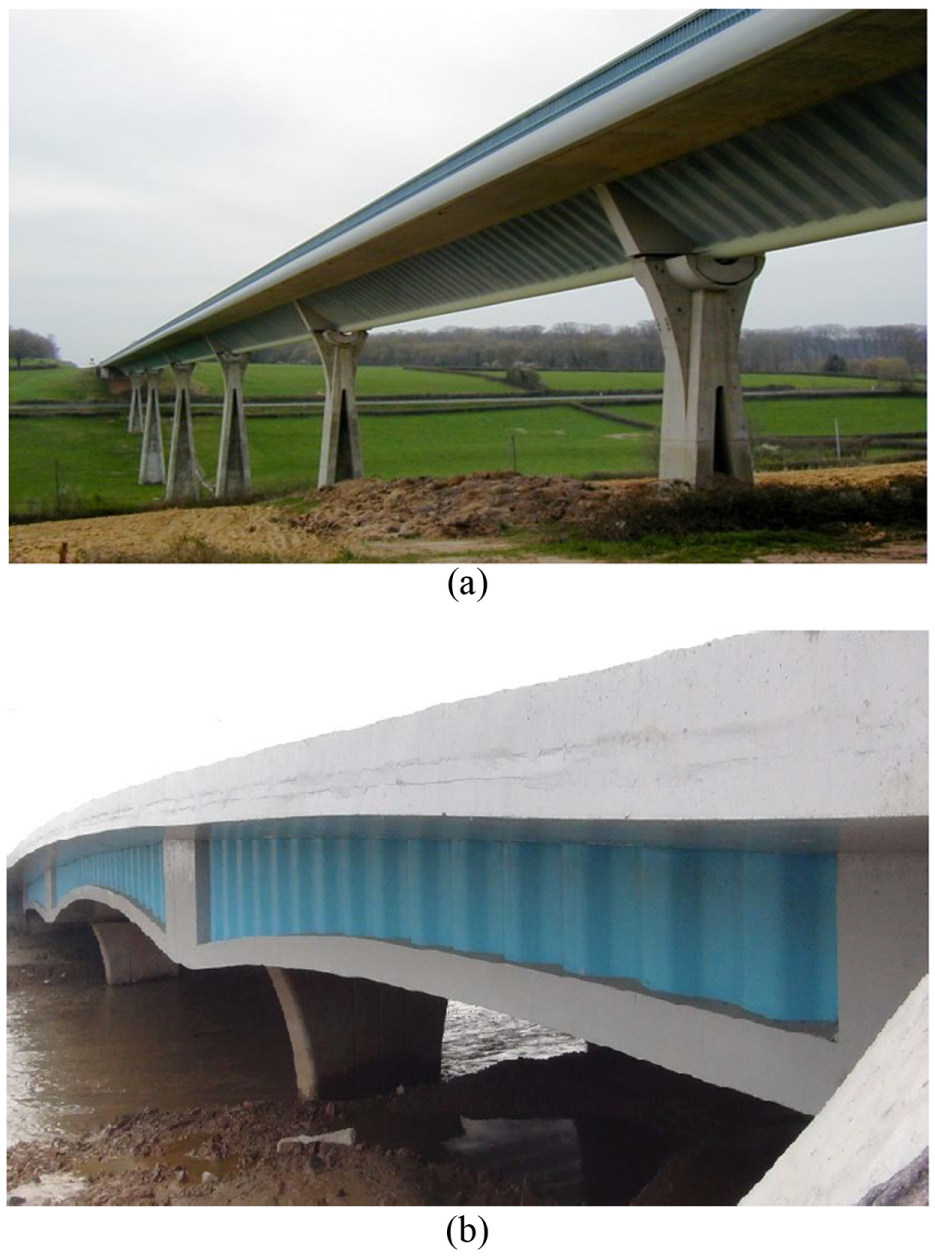
Concrete bridge girders with CSWs: (a) Maupré Bridge and (b) Caochanggou Bridge.
Most of previous studies focused on the shear buckling of CSWs (Driver et al., 2006; Easley and McFarland, 1969; Elgaaly et al., 1996; Moon et al., 2009; Yi et al., 2008) because the CSWs usually fail due to shear buckling or yielding. The flexural behavior of I-girders with CSWs has also been studied by many researchers (Abbas et al., 2007a, 2007b; Elgaaly et al., 1997; Nguyen et al., 2010; Sayed-Ahmed, 2005). In addition, the fatigue performance of girders with CSWs was also studied by Ibrahim (2001). Besides, the accordion effect of steel beams with CSWs was studied by Huang et al. (2004). Researchers also studied the orthotropic properties of corrugated webs and proposed equivalent orthotropic plate models (Bertagnoli et al., 2012). However, very few studies provided experimental verification of these orthotropic plate models.
However, most previous studies were focused on the behavior of CSWs or steel beams with CSWs rather than the performance of a full PC girder or a full bridge with CSWs, and very few experimental studies have been reported on the performance of PC girders with CSWs (Mo et al., 2000, 2003). In addition, the dynamic behavior of PC girders with CSWs received much less attention than the static behavior.
The dynamic characteristics of a bridge in terms of its vibration frequencies and mode shapes are very important when evaluating the dynamic performance of a bridge under external loads. For instance, the previous Ontario bridge design code (Ontario Ministry of Transportation and Communications (OMTC), 1983) and the current Chinese bridge design code (Ministry of Communication of the People’s Republic of China (MCPRC), 2004) both defined the dynamic impact factor as a function of the fundamental frequency of bridges. In practice, it is also important to have a good estimation of the fundamental frequency of a bridge to be constructed in order to avoid the possible resonance with heavy trucks which usually have a quite narrow range of frequencies between 1.5 and 4.5 Hz (Moghimi and Ronagh, 2008).
The main purpose of this article is to study the vertical bending vibration frequencies of continuous PC girders with CSWs. The governing differential equations of motion for the free vibration of continuous PC girders with CSWs are derived using Hamilton’s energy variational principle. Formulas for predicting the vertical bending vibration frequencies of PC box girders with CSWs are developed. The accuracy of the proposed formulas is verified against the experimental results on a scale bridge model and also the finite element (FE) analysis results. The results predicted by the proposed formulas are also compared to the results calculated using the Chinese bridge design code and existing research results.
Shear modulus of CSWs
The shear modulus of the CSWs used in this study is proposed by Samanta and Mukhopadhyay (1999) and is defined as

where G, Es, and vs are the shear modulus, Young’s modulus of elasticity, and Poisson’s ratio of the flat steel plates, respectively;
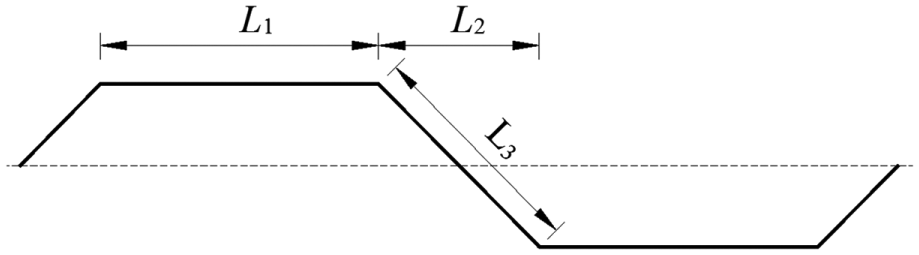
Corrugation configuration and geometric notation.
In order to investigate the effect of corrugation shape on the vertical bending vibration frequencies of continuous PC girders with CSWs, three types of corrugation shape, namely CW1, CW2, and CW3, respectively, are considered. The dimensions of the three corrugation shapes are shown in Table 1. These are most common dimensions used for the PC box girders with CSWs in China and Japan.
Dimensions of corrugated steel webs.

Governing equations based on Hamilton’s energy variational principle
Description of the problem and assumptions
The basic assumptions made for the PC box girders with CSWs investigated in this study are summarized as follows:
The flexural strength of the PC box girders with CSWs is solely provided by the concrete flanges while the CSWs have no contribution due to the accordion effect.
The materials of the girder are linear elastic, and the girder deflection and rotation are small.
The plane section assumption is adopted to calculate the stresses in the web of the box girder.
The geometry of the girder and the support conditions are symmetric. Also, the normal stress and displacement in the lateral direction are assumed to be zero.
Figure 4 shows a typical cross-section of the box girder with CSWs. Assuming that a simply supported PC box girder with CSWs is in a state of free vibration, as shown in Figure 5, the longitudinal displacement of the flanges can be described by a cubic-parabolic distribution, which is the modification of the conic-parabola proposed by Reissner (1946). Therefore, the longitudinal displacement of the box girder shown in Figure 5 at any point and any time can be expressed as follows (Luo et al., 2004)


where

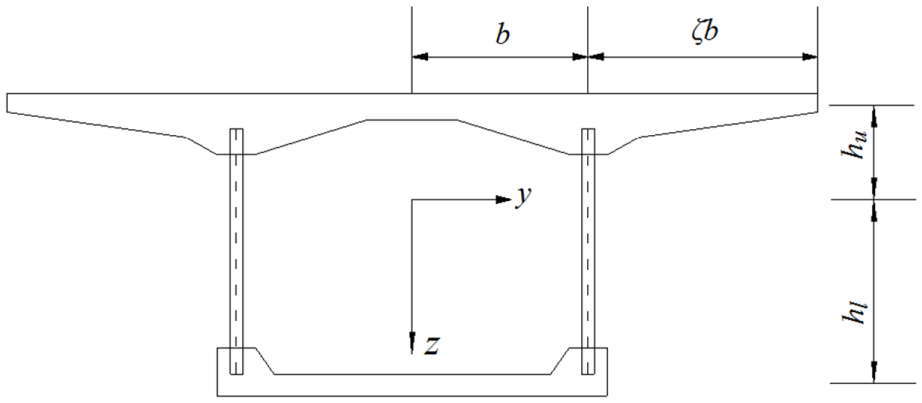
Cross-section of the box girder with CSWs.

The vertical deformation of a simply supported girder under free vibration.
From equation (3), it can be seen that the cross-sections of the box girder no longer remain planar because of the shear-lag-induced warp displacement
Considering the symmetry of shear strain, the normal strain and shear strain in the top and bottom flanges (


For the CSWs, the shear strain

The vertical strain
Governing differential equations
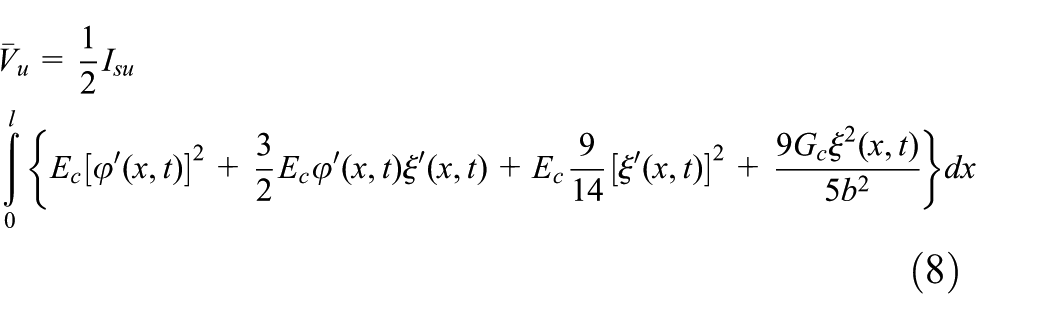
For the top flange, the strain energy can be calculated as follows
where
For the bottom flange, the strain energy can be calculated as follows

where
The strain energy in the CSWs is

where
Thus, the internal potential energy of the PC box girder with CSWs is the sum of the strain energy in the concrete flanges and steel webs and can be calculated as

The kinetic energy of a PC box girder with CSWs can be calculated as

where
The equations of motion and the boundary/continuity conditions are rigorously derived via Hamilton’s energy variational principle, which requires

According to equation (13), the governing differential equations and natural boundary conditions of the system are as follows






Free vibration
The terms



where
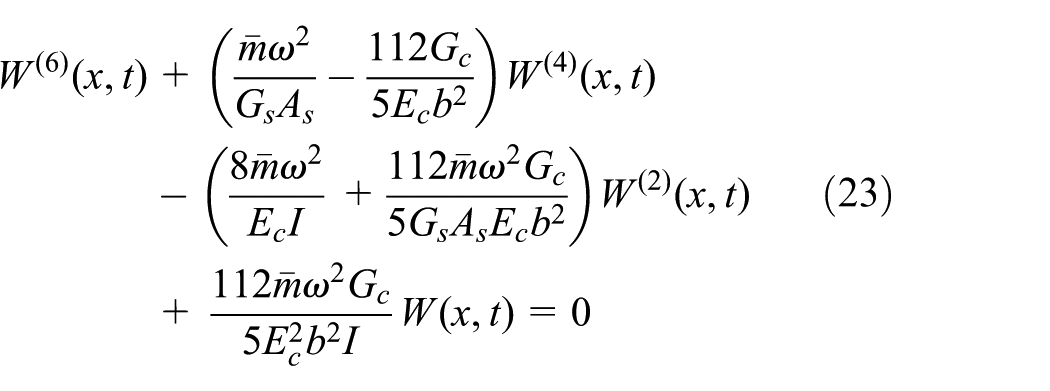
After substituting equations (20)–(22) into equation (14) and combining equations (15) and (16), the governing differential equation for the free vibration of the PC box girder with CSWs can be rewritten in terms of the vertical displacement
where
If equation (23) has non-zero solutions, then the term
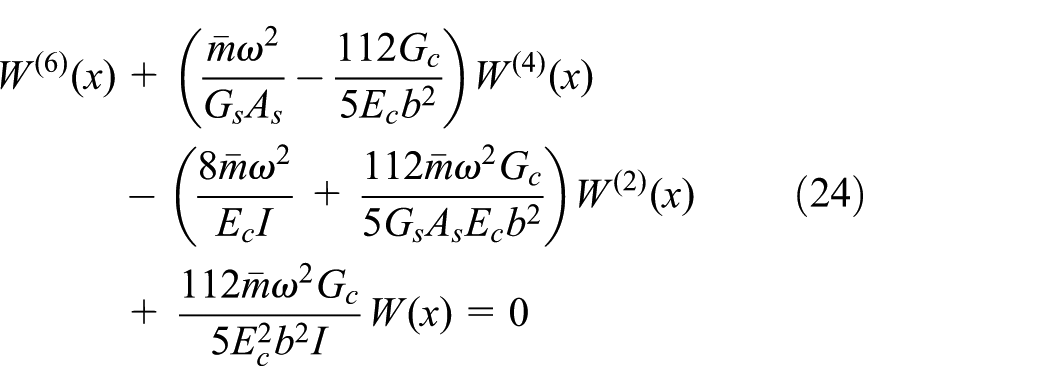
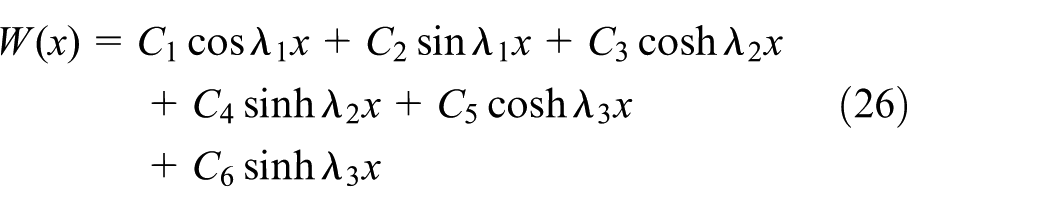
Equation (24) can be solved by first solving the following characteristic equation

From the relationship of roots and coefficients in equation (25), one can easily prove that the third-order equation about the variable
where
Subsection simultaneous method
A two-span continuous box girder with CSWs, as shown in Figure 6, was used as an example to verify the accuracy of the developed formulas for the vertical bending frequencies. The vertical displacement of the first span
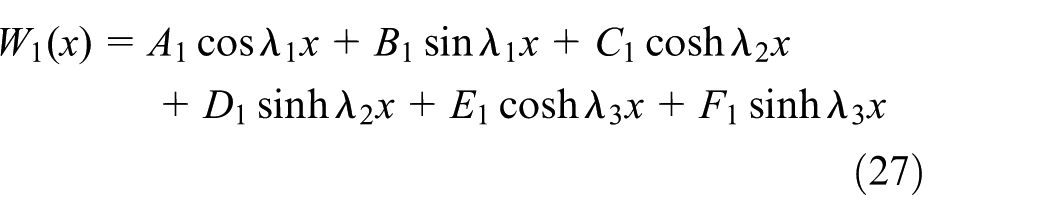
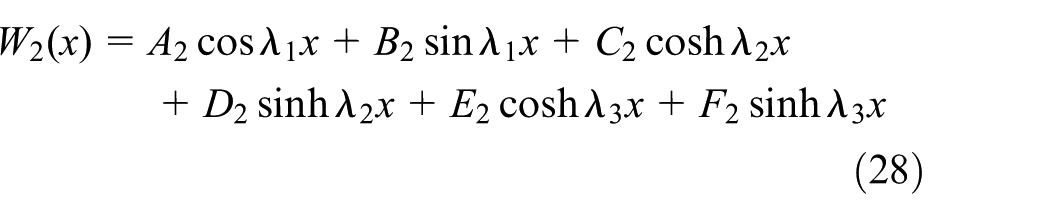
where

The geometry and boundary condition of a two-span continuous box girder with corrugated steel webs.
The angular rotation of the cross-section about the y-axis
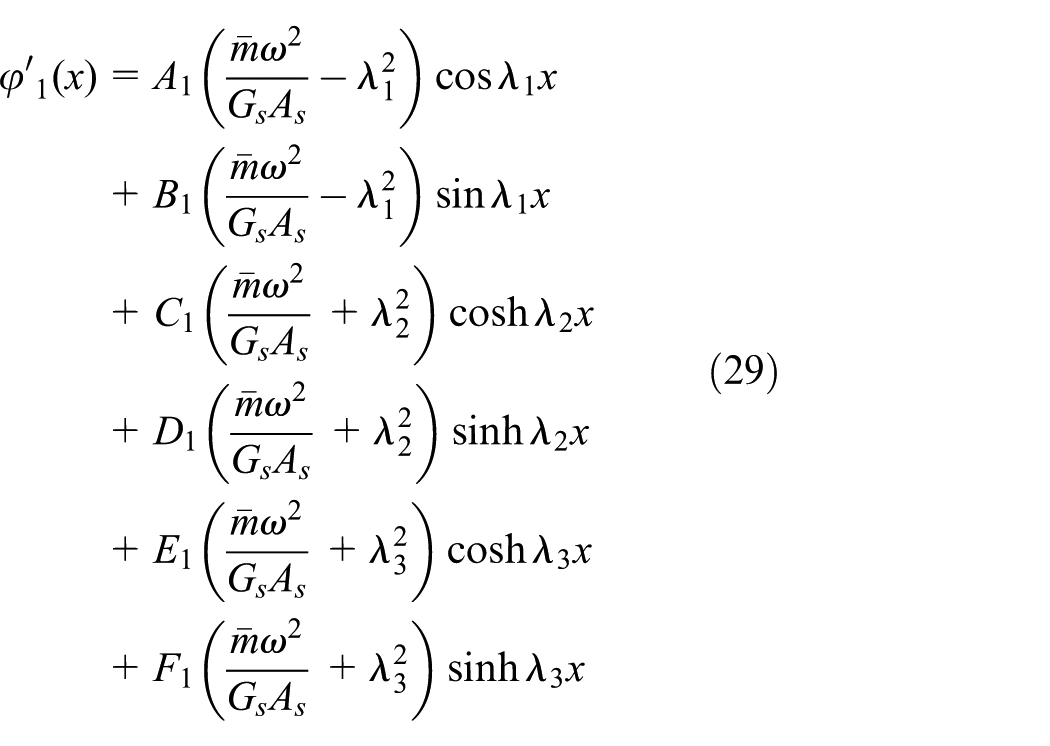
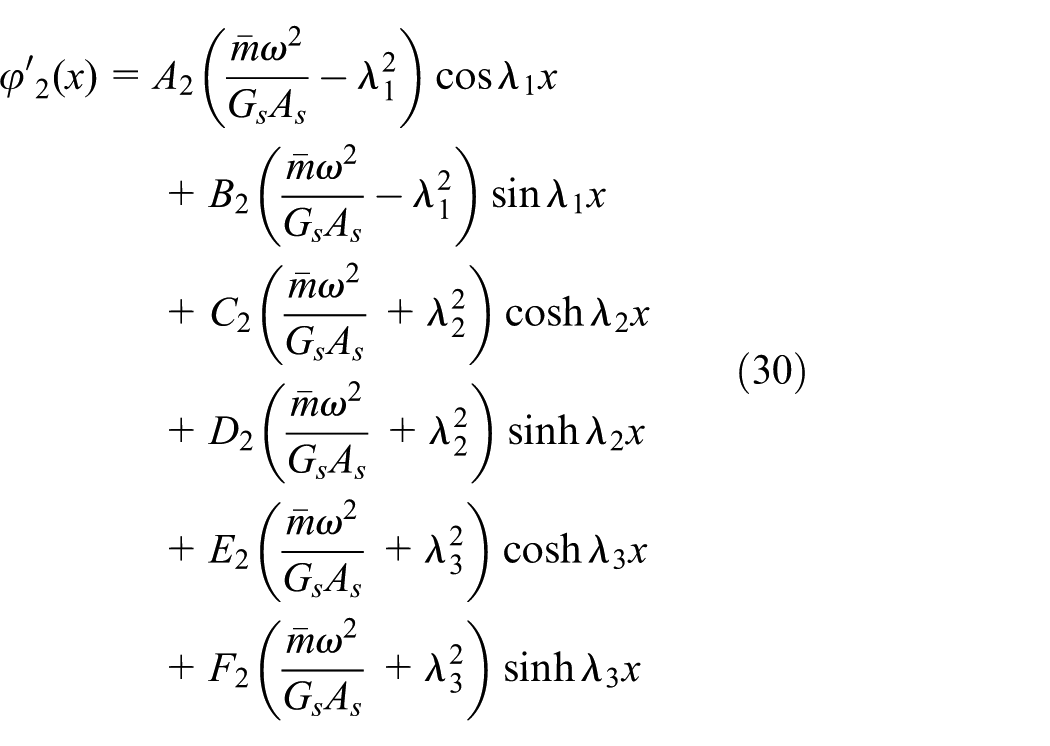
The additional maximum angular rotation of the flange sections of the box girder of the first span


The boundary conditions for the anti-symmetric mode shapes of two-span continuous box girders with CSWs can be written as follows:


Substituting equation (34) into equation (25), the natural frequencies of the anti-symmetric modes of the girder can be obtained as


The boundary conditions for symmetric mode shapes of two-span continuous box girders with CSWs can be written as follows:

Substituting equation (37) into equation (25), the natural frequencies of the symmetric modes of the girder can be obtained as


From the expressions of
Comparing the anti-symmetric and symmetric vibration modes of two-span continuous box girders with CSWs, it can be seen that the frequencies of the anti-symmetric modes are composed of odd-numbered frequencies, that is, the first, third, fifth frequencies, and so on, while the frequencies of the symmetric modes are composed of even-numbered frequencies, that is, the second, fourth, sixth frequencies, and so on.
Experimental study
Bridge model and test setup
The bridge model used in the experimental study is a one-tenth scale model built for the Juancheng Yellow River Bridge located in Shandong Province, China. This bridge model is a two-span continuous concrete box-girder bridge with CSWs. The length of the bridge model is 6 m in total. The CSWs of the bridge model have a thickness of 1.2 mm. The steel material has a yielding stress of fy = 296 MPa, Poisson’s ratio of vs = 0.3, and Young’s modulus of Es = 206 GPa. The compressive strength

Dimensions of the PC box-girder bridge model with CSWs: (a) cross-sectional view, (b) elevation view, and (c) corrugated steel web.
For the boundary condition, the bridge model is supported by a hinge in the middle and a roller support at each end. Two prestressing tendons were used in the bridge model, as shown in Figure 8, with the prestressing force monitored by the pressure sensors installed at the two ends of the bridge model. An effective prestressing force of 130 kN was applied on each prestressing tendon.

Layout of the prestressing tendons.
Modal test
Modal test was performed to obtain the natural frequencies and mode shapes of the bridge model. A total of 11 measurement points were selected on the bridge deck, as shown in Figure 9.

Measurement locations on the bridge deck in the modal test (unit: mm).
Both vertical and lateral accelerations were recorded at each measurement point and the sampling rate was set to 512 Hz. An impact hammer was used to excite the vibration of the bridge model. A sample of the measured vertical acceleration time history at Point 3 is plotted in Figure 10. The collected data were then processed using commercial software and the first two natural frequencies obtained were 61.94 and 75.94 Hz, respectively. The corresponding mode shapes of the first two modes are provided in Figure 11. It should be noted that the modal information of higher modes was not obtained due to the difficulty associated with exciting higher modes in the modal test.

Measured acceleration time history at Point 3.

The first two mode shapes obtained from the modal test: (a) mode 1 and (b) mode 2.
Results and discussion
The results obtained from both the experimental study and FE analysis (using the MIDAS software) were used to verify the accuracy of the proposed formulas for the vertical bending vibration frequencies of PC box girders with CSWs, as shown in Table 2. The FE model of the PC box girder with CSWs created using the MIDAS software is shown in Figure 12. In this model, the CSWs were modeled using the composite beam elements, the prestressed tendons were modeled by three-dimensional (3D) two-node spar elements. The end supports were constrained in both the vertical and lateral directions while the movements in the vertical, lateral, and longitudinal directions were constrained for the middle support. Based on the modal analysis in MIDAS, the natural frequencies of the model are summarized in Table 2 while the first six mode shapes are shown in Figure 13.
Comparison of modal test results.
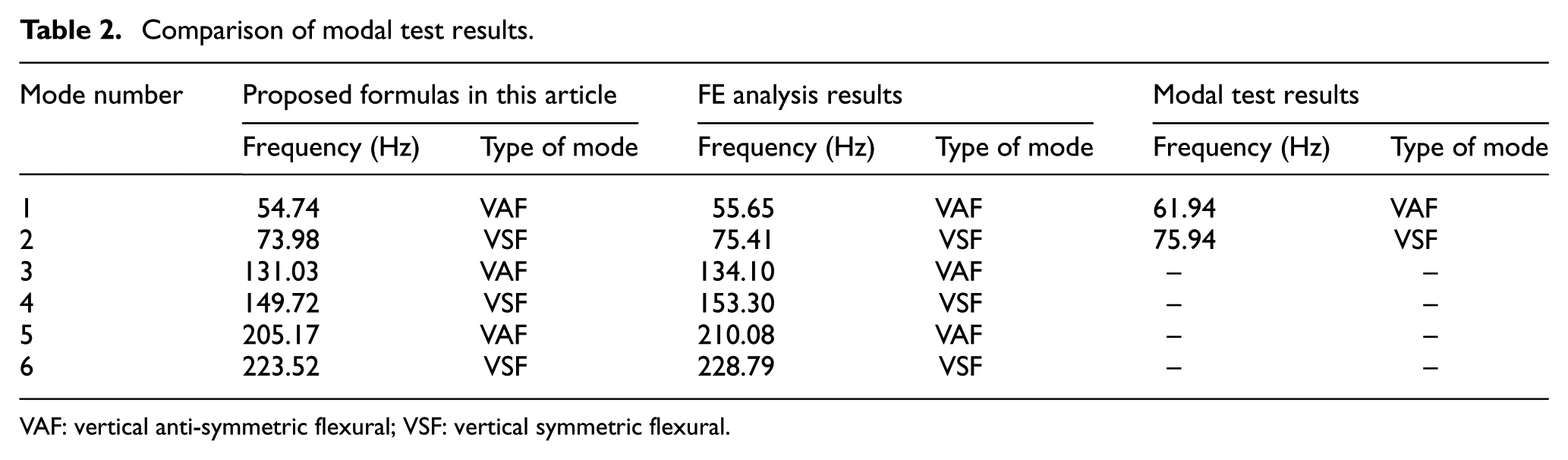
VAF: vertical anti-symmetric flexural; VSF: vertical symmetric flexural.
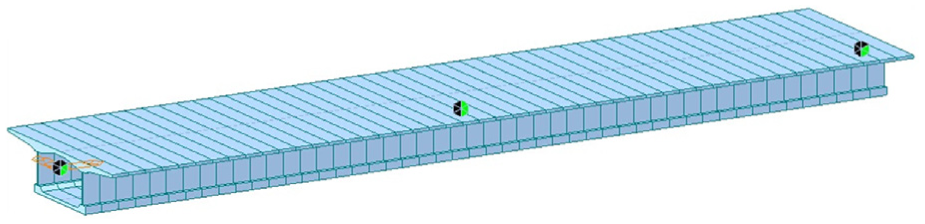
The finite element model of the tested girder model.

The first six mode shapes of the girder model: (a) mode 1, (b) mode 2, (c) mode 3, (d) mode 4, (e) mode 5, and (f) mode 6.
From Table 2, it can be observed that all six natural frequencies as well as the corresponding mode shapes obtained from proposed method agree very well with the results from the FE analysis. The second frequency obtained from the modal test on the bridge model also agrees with both the calculated frequency using the proposed formula and the FE analysis result very well; however, the fundamental natural frequency of the bridge model from the modal test is about 10% greater than the other two results. This could be due to the fact that the hinge at the middle of the girder is not perfectly smooth and therefore restraints the rotation of the girder to some degree and that the measured size of the girder is slightly larger than the designed.
In addition, it can also be observed that the calculated frequencies using the proposed formula are slightly smaller than FE analysis results. This is possibly due to the fact that the MIDAS software only considers the effect of shear deformation of steel webs while ignoring the shear-lag effect and the coupling effect.
The effect of shear modulus correction on the vibration of the bridge model was also investigated. The first six vertical bending vibration frequencies of the bridge model with CSWs, with and without considering the effect of shear modulus correction, were obtained using the proposed method in this article, and the results are shown in Figure 14.
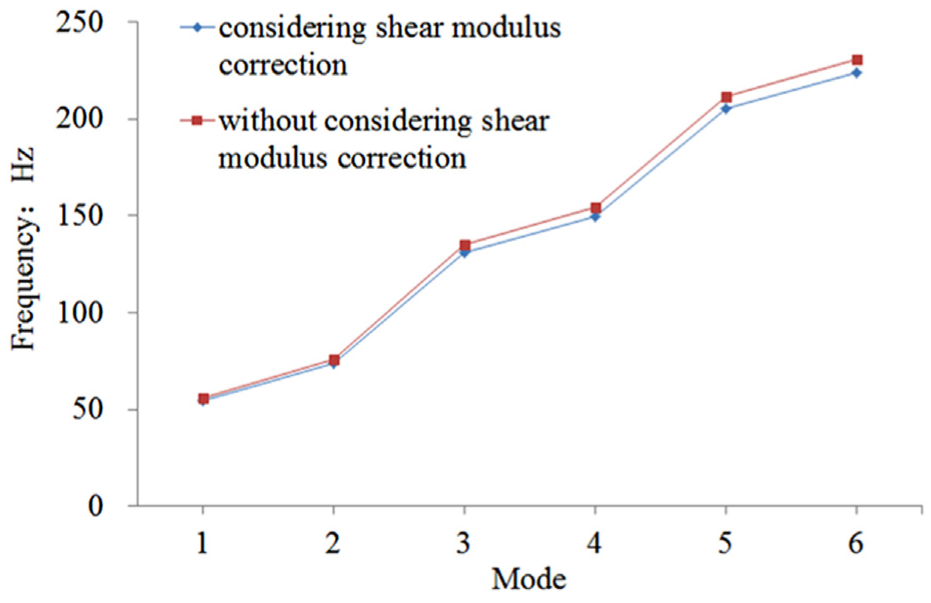
The vertical bending vibration frequencies with and without considering the shear modulus correction.
As can be seen from Figure 14, small differences are observed between the vibration frequencies of the girder with and without considering the effect of shear modulus correction of the CSWs.
The effect of different beam theories on the vibration of the girder was also investigated. The Euler–Bernoulli beam theory and Timoshenko beam theory were studied. The vertical bending vibration frequencies of the bridge model by adopting the Euler–Bernoulli beam theory and Timoshenko beam theory were obtained and compared to the results predicted by the proposed method in this study, as shown in Figure 15.
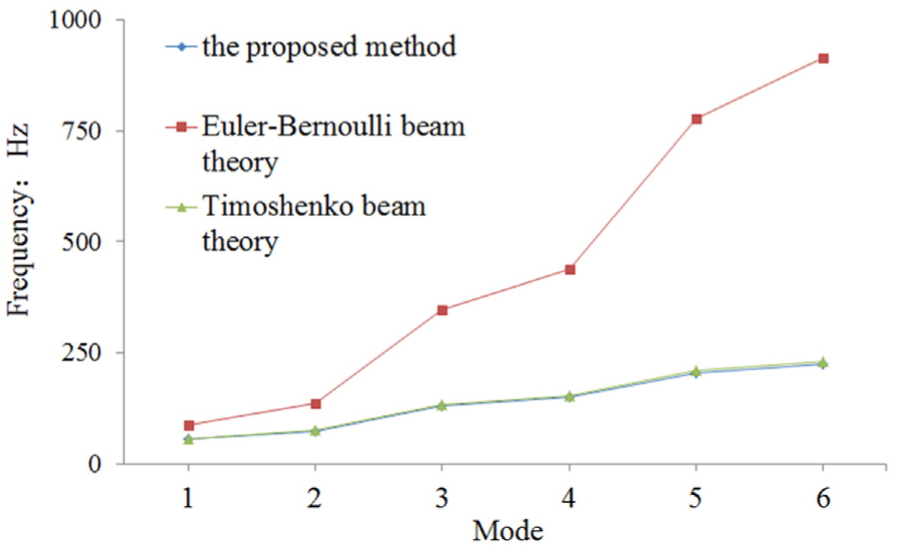
Comparison of vertical bending frequencies obtained by different methods.
It can be seen from Figure 15 that the frequencies predicted by the proposed method in this study agree very well with those calculated according to the Timoshenko beam theory while both are significantly smaller than the results obtained using the Euler–Bernoulli beam theory. Since the Timoshenko beam theory only considers the shear deformation of the CSWs, these observations indicate that the shear deformation of the CSWs has a significant influence on the vertical bending vibration frequencies of the bridge model with CSWs, while the shear-lag effect and the coupling effect have little influence on the vertical bending vibration frequencies of bridge model with CSWs.
Parametric study
In order to further evaluate the proposed formulas, a parametric study was conducted to investigate the effect of two important parameters, namely the width-to-span ratio and corrugation pattern, on the vibration of the girder with CSWs. The results obtained from the proposed formulas are compared to those obtained using other methods.
Effect of width-to-span ratio
The effect of the width-to-span ratio on the vertical bending vibration of the girder was studied through first changing the span length of the bridge model with CSWs. In order to make a fair comparison, the height of the bridge model was assumed as constant. Five bridge span lengths were investigated, namely, 2, 3, 4, 5, and 6 m for each span of the continuous bridge, respectively, which correspond to width-to-span ratios of 0.325, 0.217, 0.163, 0.130, and 0.108. The first six vertical bending vibration frequencies were obtained for these bridge models, as summarized in Table 3, where these results are compared to the results obtained using the Timoshenko beam theory (T-beam theory).
The first six vertical bending vibration frequencies of bridge models with different span lengths.
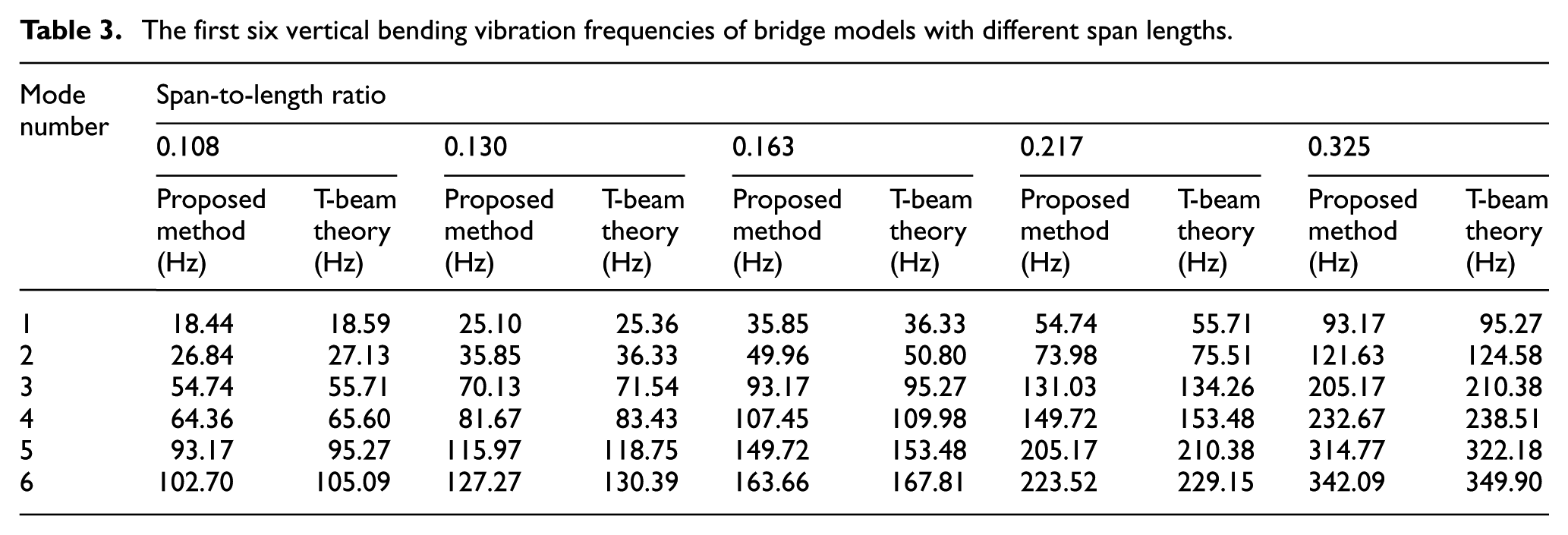
As can be seen from Table 3, for all different span lengths studied, the vertical bending vibration frequencies of the bridge model with CSWs obtained from the proposed method in this article and the Timoshenko beam theory are in good agreement. Therefore, the vertical bending vibration frequencies of bridge model with CSWs can be predicted using the Timoshenko beam theory in practice. In addition, it can also be observed that the calculated frequencies using the proposed formula are slightly smaller than the results obtained using the Timoshenko beam theory. This could be due to the fact that the Timoshenko beam theory only considers the effect of the shear deformation of the steel webs without considering the shear-lag effect and the coupling effect.
The effect of width-to-span ratio was also studied by varying the width of the girder while assuming constant girder height and span length. Different values of the width of the flat section, as denoted by
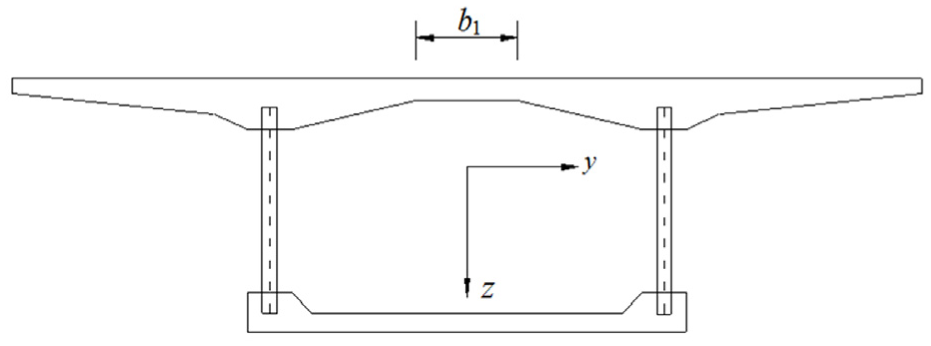
Geometric shape of flat section.
The first six vertical bending vibration frequencies of bridge models with different girder widths.
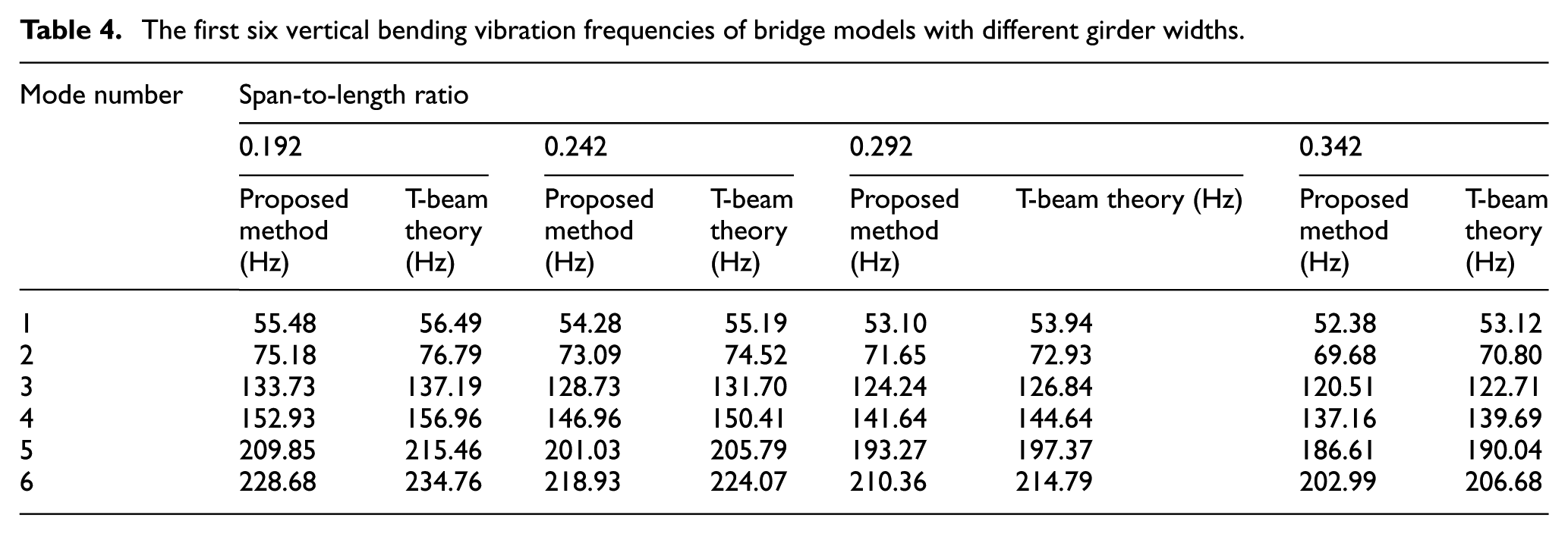
It can be seen from Table 4 that the vertical bending vibration frequencies of the bridge model with CSWs obtained from the proposed formulas agree well with the results from using the Timoshenko beam theory despite the varying width-to-span ratios due to the change of girder width.
Effect of corrugation pattern
Assuming the same web height and thickness, the effect of corrugation pattern on the vertical bending vibration frequencies of the bridge model with CSWs was studied. Three types of corrugation wave patterns, namely CW1, CW2, and CW3 with parameters provided in Table 1, were considered. The results for these three corrugation wave patterns are shown in Table 5.
The first six vertical bending vibration frequencies under different corrugation wave patterns.
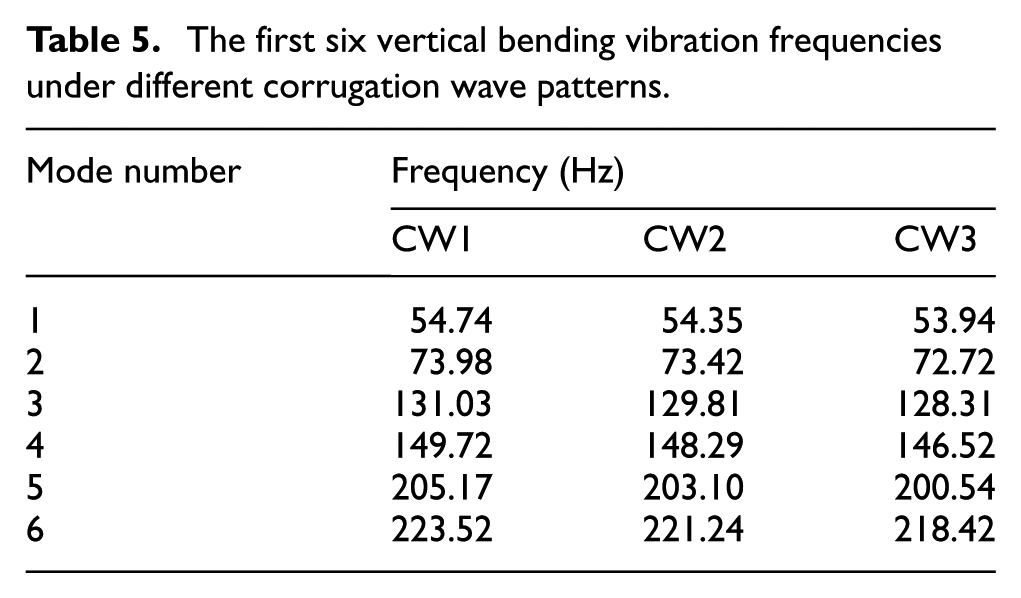
It can be seen from Table 5 that the difference of vertical bending vibration frequencies of the bridge model with CSWs caused by different corrugation wave patterns is very small.
Comparison with the Chinese code and other research results
The fundamental natural frequency is one of the most important dynamic characteristics of bridges and it plays a very important role in predicting the dynamic performance of the bridge structure under external loads, such as wind, earthquake, and moving vehicles. To the best knowledge of the authors, no bridge design code has yet provided any simple formula for calculating the natural frequencies of continuous PC girders with CSWs. Therefore, the best references available would be some bridge design codes or existing research results which provide such formulas for predicting the natural frequencies for continuous PC girders although such information is also very limited in the literature.
The current Chinese General Code for Design of Highway Bridges and Culverts (MCPRC, 2004) defines the dynamic impact factor as a function of the bridge fundamental frequency and provides the following formulas for estimating the fundamental frequency of continuous bridges


where E is Young’s modulus of the material, Ic is the moment of inertia of the structure cross-section, mc is the mass per unit length of the structure cross-section, and l is the span length. It is stated in the code that f11 should be used when calculating the impact factor for positive bending moment and shear, while f12 should be used when calculating the impact factor for negative bending moment.
Gao et al. (2012) proposed an improved method to estimate the fundamental frequency of continuous girder bridges and verified the accuracy of the proposed method by theoretical analysis combined with numerical simulations. In their study, the following expression was proposed for estimating the natural frequencies of two-span continuous girder bridges with uniform cross-section and uniform spans

The fundamental frequency of the scale bridge model predicted by equations (40) to (42) is 118.99, 206.69, and 86.25 Hz, respectively, while the value calculated using the proposed formula in this study is 54.74 Hz, indicating that the fundamental frequency obtained from the Chinese design code and Gao et al. (2012) is significantly larger than the frequency predicted by the proposed method in this study. These large differences clearly indicate the need for proposing specific formulas for accurately predicting the natural frequencies of PC box-girder bridges with CSWs.
Summary and conclusion
In this study, formulas for predicting the vertical bending vibration frequencies of PC box girders with CSWs were proposed based on Hamilton’s energy variational principle. To verify the accuracy of the formulas, a one-tenth scale model was developed for an existing PC box-girder bridge with CSWs. The results predicted from the proposed formulas were compared to the results obtained from the FE analysis and also the experimental results from the scale bridge model. Good agreement was achieved between these results, indicating that the proposed formulas can provide a reliable and efficient tool to predict the vertical bending vibration frequencies of the PC box-girder bridges with CSWs. Based on the results from the parametric study, the following conclusions can also be drawn:
The proposed method can be adopted in the analysis of a full girder bridge with confidence and can significantly reduce the modeling effort and computational effort in the FE analysis. The results obtained from the proposed method are more accurate than those obtained using theoretical methods.
The effect of shear deformation of the CSWs on the vertical bending vibration frequencies of bridges with CSWs is significant, while the shear-lag effect and the coupling effect between the shear lag and shear deformation have negligible influence on the vertical bending vibration frequencies of bridge with CSWs. In addition, the difference between the results with and without considering the shear modulus correction is very small.
The vertical bending vibration frequencies of bridges with CSWs predicted by the proposed formulas agree well with those calculated based on the Timoshenko beam theory for a wide range of width-to-span ratios considered.
The corrugation wave patterns considered in this study have little effect on the vertical bending vibration frequencies of bridges with CSWs.
The existing formulas for predicting the fundamental vibration frequency of continuous bridges provided in the Chinese design code (JTG D60-2004) and the available research results may significantly overestimate the fundamental frequency of PC continuous box-girder bridges with CSWs and should be used with caution.
It should be noted that the method proposed in this study is applicable for analyzing the global responses of PC box-girder bridges with CSWs, including the modal responses and global displacements. It is not suitable for the analysis of local responses such as local displacements and strains.
Footnotes
Declaration of Conflicting Interests
The author(s) declared no potential conflicts of interest with respect to the research, authorship, and/or publication of this article.
Funding
The author(s) disclosed receipt of the following financial support for the research, authorship, and/or publication of this article: The work described in this article was supported partially by two grants from the National Natural Science Foundation of China (Grant No. 51368032 and Grant No. 51208189) and partially by a grant from the Postdoctoral Science Foundation of China (2014M562103).