



Abstract
The carburizing and quenching process is a surface hardening technique employed to enhance durability, particularly wear resistance. In this process, only the surface of the steel material is carburized, resulting in a steel material with a hardened surface and a tough core. Measuring the depth of the hardened layer in carburized material is crucial for quality control. There are notable differences in the hysteresis magnetization curve and electrical conductivity between the carburized and non-carburized layers. Consequently, an electromagnetic inspection method is proposed to measure the depth of the carburized layer by detecting these differences in electromagnetic properties. This paper demonstrates the efficacy of the proposed method through 3D nonlinear finite element method (FEM) analysis using the play model method, which accounts for the hysteresis magnetization curves and conductivities of both the carburized and non-carburized layers. Additionally, a verification experiment is being conducted.
Keywords
Introduction
When gas carburizing is used to produce carburized hardened steel, non-uniformity of the carburizing depth may occur. Therefore, it is important for quality control to measure the carburizing depth of the carburized hardened steel. Currently, the Vickers hardness tester is the most common method for measuring carburizing depth, but since this is a destructive test, a nondestructive inspection method is necessary. Due to the lower permeability and conductivity in the carburized layer compared to the non-carburized layer, it may be possible to measure the depth of the carburized layer using an alternating magnetic field (Yoshioka & Gotoh, 2023; Yoshioka et al., 2019; Gotoh & Tanaka, 2014; Gotoh et al., 2010). In this paper, the efficacy of the play model method (Matsuo & Shimasaki, 2005; Matsuo, 2010) in electromagnetic nondestructive inspection for detecting the hardening depth of carburized steel. The flux density and eddy current distribution were analyzed by 3D nonlinear FEM analysis, taking into account the hysteresis magnetization curve and conductivity in both the carburized and non-carburized materials. The efficacy of the proposed method is demonstrated through 3D FEM analysis using the play model method and a verification experiment.
Carburizing Depth and Magnetic Properties of the Carburized Materials
Carburization Depth
In this research, three types of surface-carburized steel (25CrMo4) with different carburizing depths were prepared and evaluated. Figure 1 shows the internal hardness distribution of the three types of surface-carburized steel as measured by a Vickers hardness tester. According to the Japanese Industrial Standards (JIS), a carburized layer is defined as a region with a hardness greater than 550 HV. Based on this definition, the effective magnetization layer depths for the three types of carburized materials are 0.496 mm, 0.828 mm, and 1.15 mm.
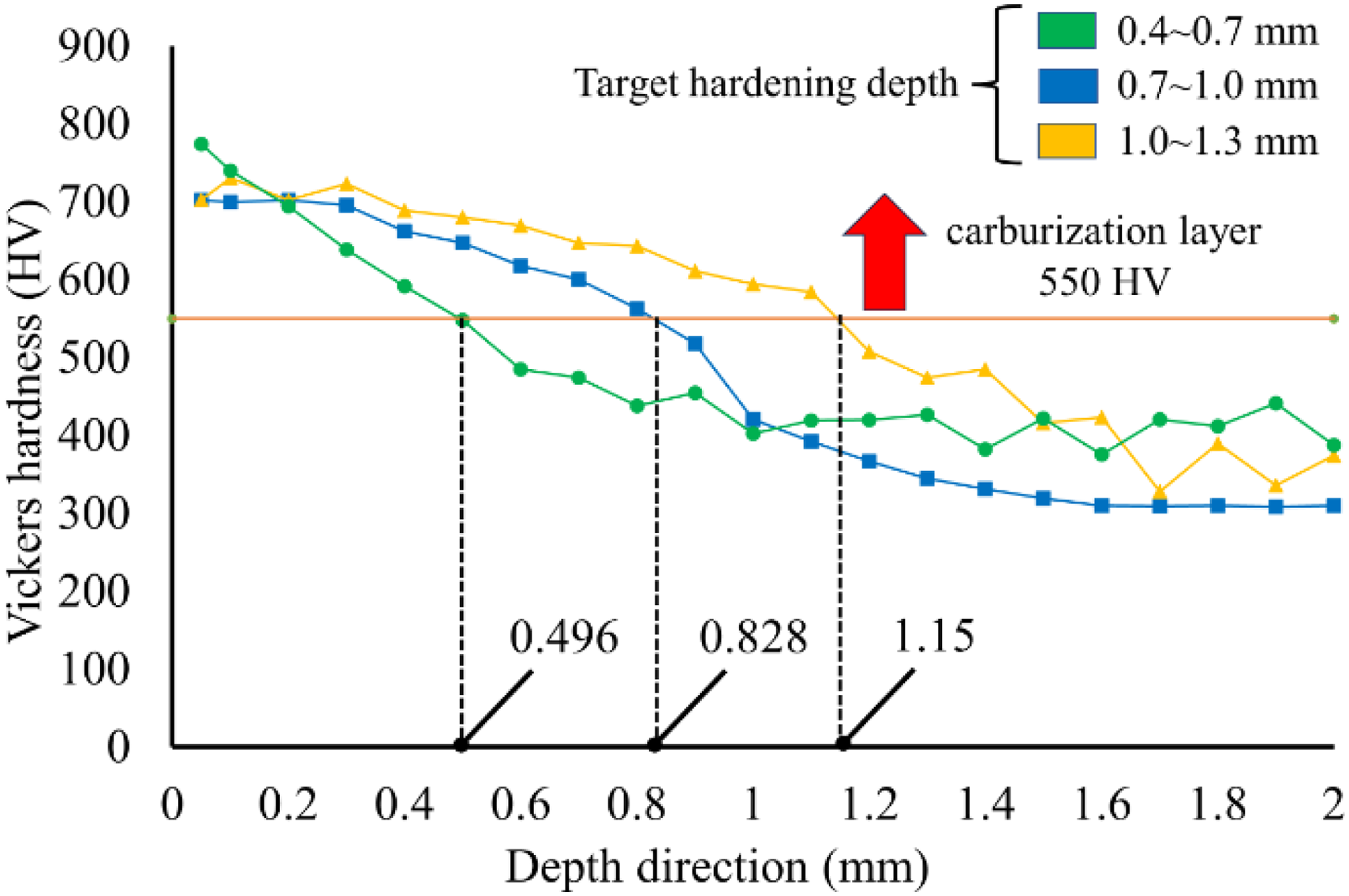
Hardness distribution of the carburized and hardened materials.
Magnetic Properties of the Carburized Materials
Figure 2 shows the hysteresis magnetization curves for the carburized and non-carburized steel (25CrMo4) used in this research. The figure shows that the maximum relative permeability and residual flux density of the carburized material (700 HV) are lower compared with those of the non-carburized material (300 HV). Conversely, the coercive force is higher in the carburized material. Additionally, the conductivities of the carburized (700 HV) and non-carburized materials (300 HV) are 3.08 × 10⁶ S/m and 4.52 × 10⁶ S/m, respectively. Using these electromagnetic properties, we propose an electromagnetic sensor for measuring carburizing depth using 3D nonlinear electromagnetic field FEM analysis and empirical experiments.
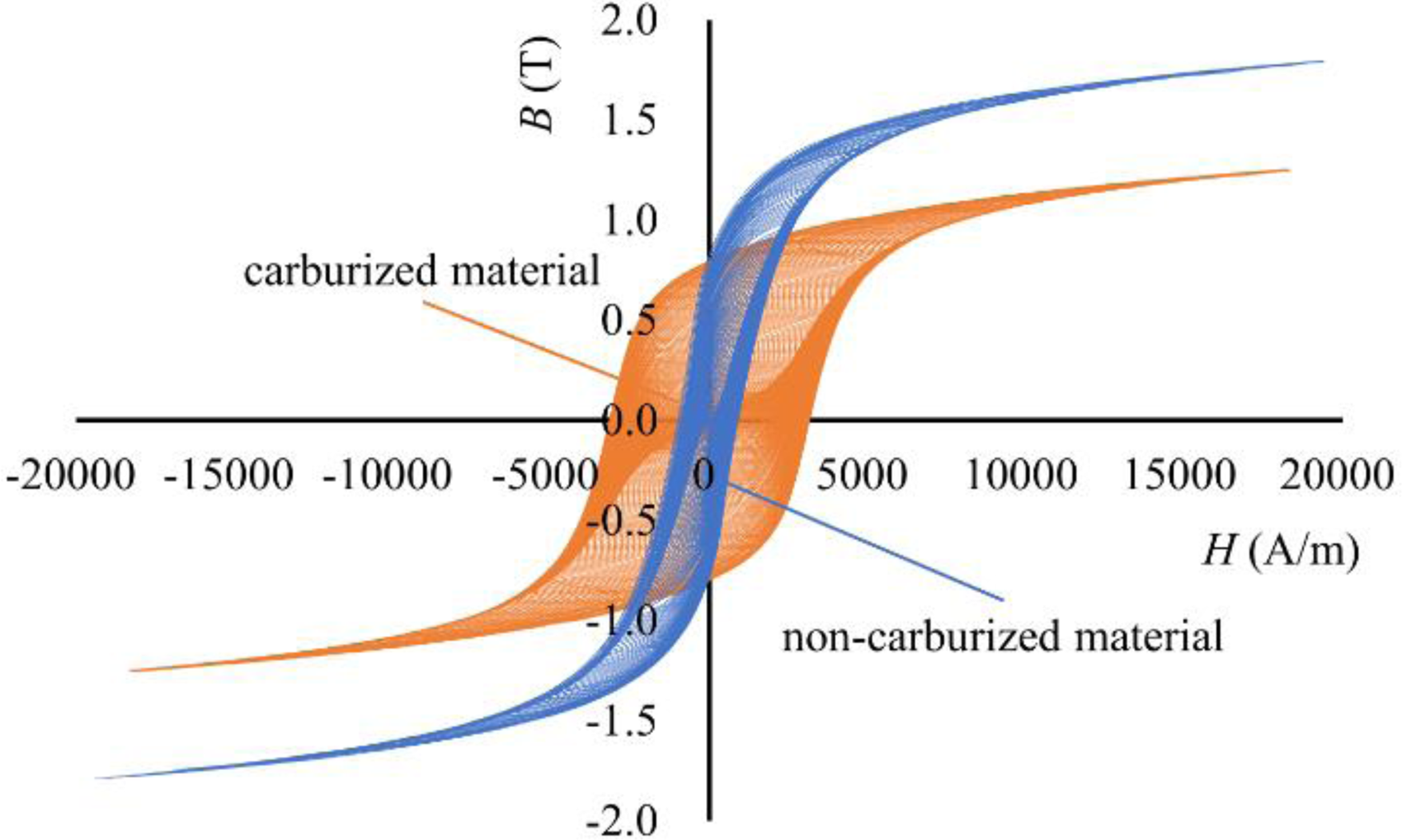
Hysteresis loops of carburized and non-carburized materials (0.1 Hz, 25CrMo4).
Inspection Model and Evaluation Method
Figure 3 shows a bird's-eye view of the inspection model for measuring the surface carburizing depth of a carburized material, along with a cross-sectional view in the x-z plane. The distance (Lift-off : Lo) between the carburized steel plate and the proposed electromagnetic sensor is 0.1 mm. The electromagnetic sensor comprises an electromagnetic yoke made of laminated silicon steel plates, an AC excitation coil (ϕ 0.5 mm, 80 turns), and a detection coil (ϕ 0.2 mm, 40 turns). A sinusoidal AC current is applied to the excitation coil, and the magnetic flux density Bz in the z-direction inside the magnetic yoke material is detected by the detection coil. The excitation frequency was set at 300 Hz because the enhance accuracy by increasing the skin depth to match the depth of the carburized layer. When the excitation frequency is 300 Hz, the skin depth is approximately 1.5 mm for the carburized layer and 0.7mm for the non-carburized layer. The excitation current was maintained constant at 0.5 A (peak-to-peak), which is the maximum current value for this sensor model.
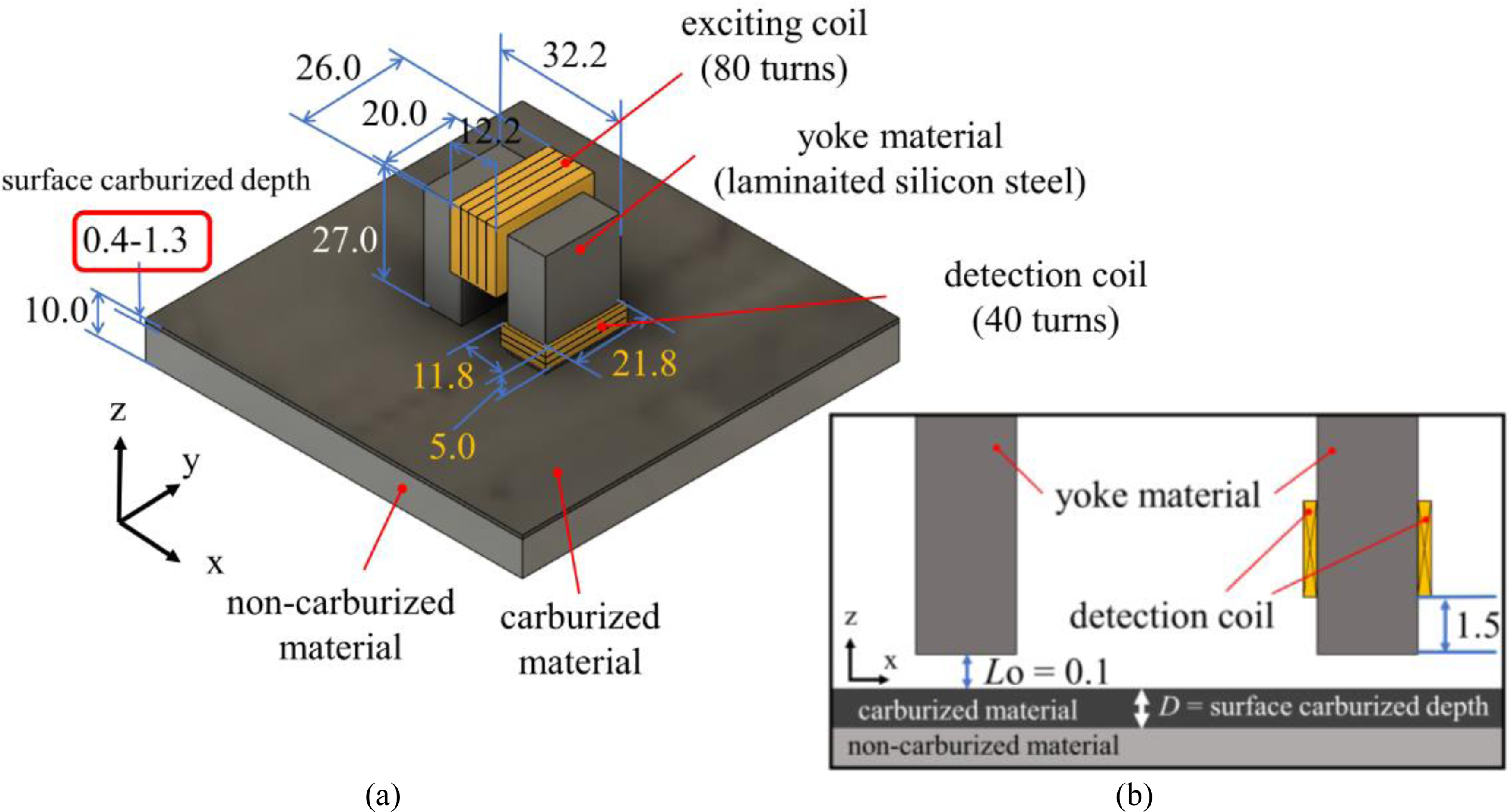
Electromagnetic sensor and inspection model for measuring the carburized depth.
Analysis Method and Magnetic Flux Density Distribution
Electromagnetic Field Analysis Considering Hysteresis Magnetization Characteristics and Eddy Current
Since a sinusoidal alternating current is used in this inspection method, it is necessary to taking into account the residual flux density and coercive force. Therefore, the analysis utilizes the “Play model method” to account for the hysteresis magnetization curves and conductivity in both carburized and non-carburized layers. The play model method can represent the hysteresis characteristics using the play hysteron shown in Figure 4. In this figure, Hs denotes the saturation magnetic field. The play hysteron is represented by equation (1), and the condition for the saturation magnetic field is given by equation (2). In equation (1), p0 denotes the value of p in the previous steps, and ζ denotes the intercept on each axis in Figure 4. Within the Play model method, the hysteresis loop is constructed by dividing the distance from the origin to the saturation field Hs into equal segments and stacking an equal number of play hysterons. The intercept ζ of each play hysteron can be calculated using equation (3).



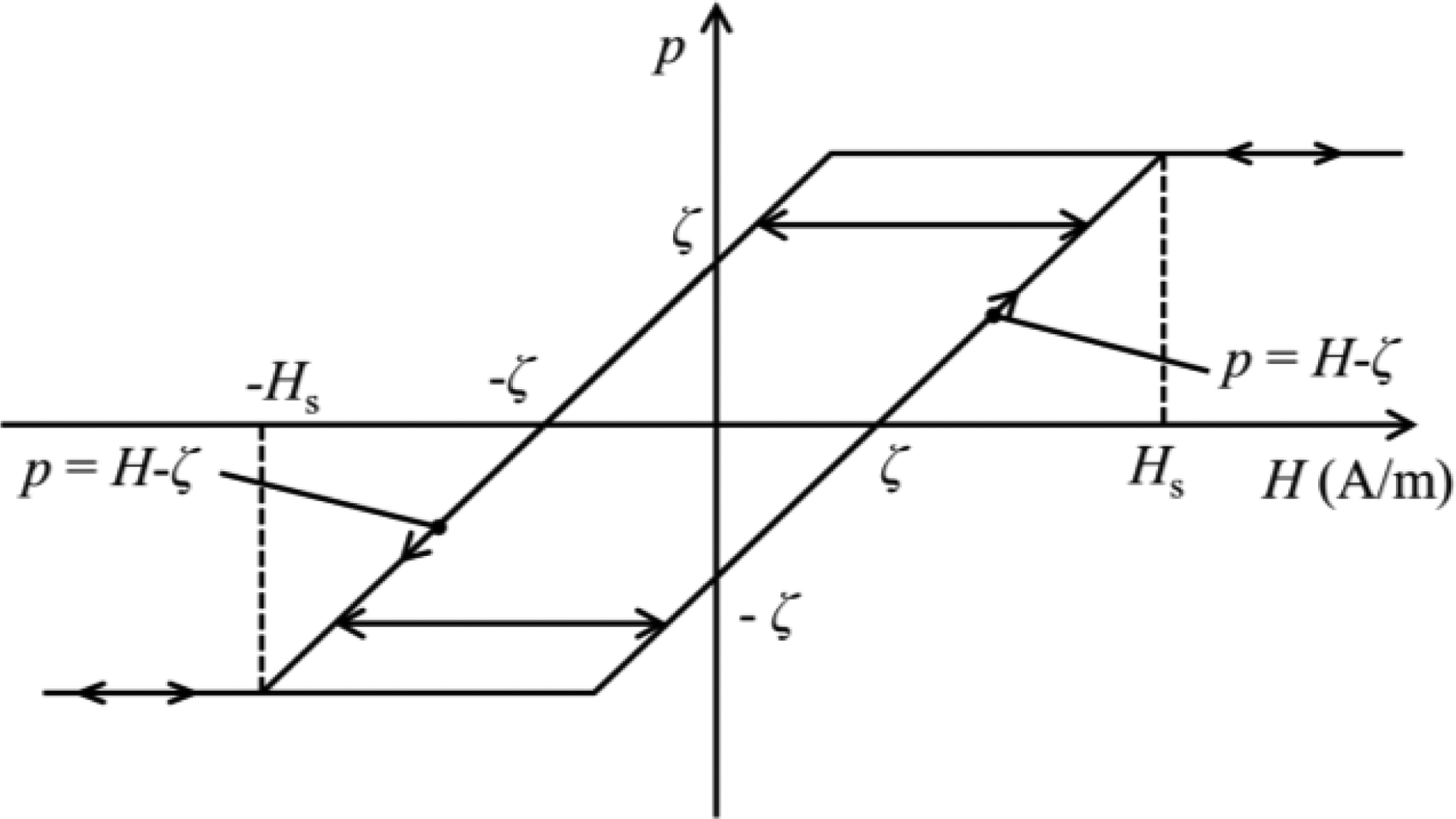
Play hysteron considering the saturated magnetic field.
In equation (3), ζn is the intercept in each loop and Np is the number of divisions. As the number of divisions Np increases, the hysteresis curve can be expressed more accurately. The play hysteron pn expressed from equations (1) and (3) is given by,




Magnetic Flux Density Distribution Inside the Carburized Material
The magnetic flux density distribution within the carburized material was evaluated through electromagnetic field FEM analysis using the Play model method, which incorporates the hysteresis magnetization curve and eddy currents. Figure 5 shows the magnetic flux density distribution in the surface layer of the carburized material. Figure 5(a) shows the display area of the flux density distribution inside the carburized material. Figure 5(b) to Figure 5(d) show the magnetic flux density distribution when the surface carburized depth is 0.5, 0.8, and 1.1 mm, respectively. The excitation current conditions were set to 300 Hz and 0.5 A0−p. These figures reveal that the maximum magnetic flux density inside the carburized material decreases as the carburized layer depth increases. This is attributable to the fact that the maximum relative permeability and residual flux density of the carburized layer are lower compared to those of the non-carburized layer, as shown in Figure 2.

Magnetic flux density distribution inside steel due to change in carburized depth (0.5 A0−p, 300 Hz) (D = surface carburized depth).(a) Display area of the flux density distribution. (b) D = 0.5 mm (
Inspection Results and Discussion
Figure 6 shows the flux density Bz inside the detection coil of the electromagnetic sensor for each carburizing depth. The figure also shows calculation and experimental results considering only the initial magnetization curves of the carburized and non-carburized layers. The calculation results show the average value inside the detection coil. This figure denotes that the flux density Bz decreases when the carburized depth is increased. This decrease is attributed to the increase in the region of low permeability and conductivity from the surface layer of the steel plate as the carburizing depth increases. Additionally, this figure shows that the calculated results of the play model method considering the hysteresis magnetization curve are closer to the measured values than the calculated results considering the initial magnetization curves of the carburized and non-carburized layers.
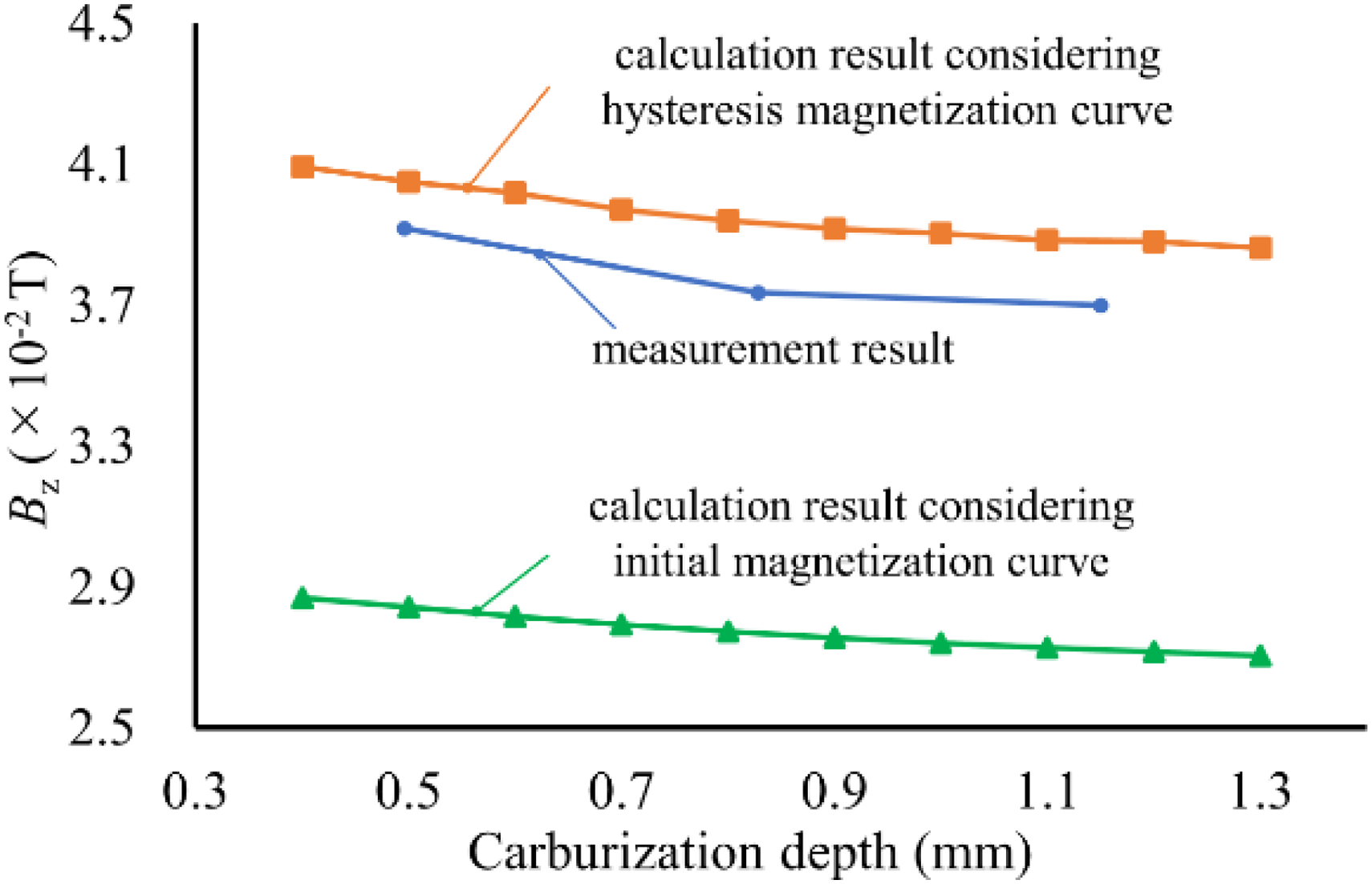
Measurement and analysis results.
Conclusions
The results obtained are summarized as follows:
The carburized material shows lower maximum relative permeability and residual flux density compared to the non-carburized material. Conversely, the coercive force is increased. Additionally, the conductivity of the carburized material is approximately 31.9% lower than that of the non-carburized material. It was found that the carburization depth can be measured using an electromagnetic sensor owing to the difference in electromagnetic properties between carburized and non-carburized materials. The analysis results that incorporated the hysteresis magnetization curve were closer to the measured values compared to those based solely on the initial magnetization curve. Thus, the Play model method, which accounts for hysteresis magnetization curves, proves to be effective.
Footnotes
Acknowledgements
The authors have no acknowledgments.

Funding
The authors received no financial support for the research, authorship, and/or publication of this article.
Declaration of conflicting interests
The authors declared no potential conflicts of interest with respect to the research, authorship, and/or publication of this article.