



Abstract
Background
The development and clinical use of biomarkers has dramatically changed the framework of Alzheimer's disease (AD) management, allowing the diagnosis at the mild cognitive impairment (MCI) stage. In 2015 we compared the prevalence and prognosis of AD at the MCI stage according to different criteria available at that time, and we found that the National Institute of Aging-Alzheimer Association (NIA-AA) criteria provided higher predictive accuracy for AD dementia after 3 years. Since then, we adopted these criteria in clinical practice.
Objective
To evaluate the long-term predictive accuracy of the ‘MCI due to AD - high likelihood’ criteria by taking advantage from an extended follow-up in a memory clinic setting.
Methods
Patients were diagnosed according to the ‘MCI due to AD - high likelihood’ criteria and followed up until conversion to dementia.
Results
One hundred and fourteen patients with ‘MCI due to AD - high likelihood’ were enrolled in the study and followed-up for 3.0 ± 1.8 [0.4–8.3] years. During the follow-up 106 (93.0%) patients progressed to dementia, 2 (1.8%) had stroke, 6 (5.3%) died, and none remained in MCI or reverted to normal cognitive status. The average survival time remaining in MCI, analyzed with Kaplan-Meier curve, was 3.2 (95% CI 2.9–3.6) years. Using a multivariate Cox proportional hazards regression model, patients with higher Mini-Mental State Examination kept the MCI status longer.
Conclusions
The diagnostic criteria of NIA-AA ‘MCI due to AD - high likelihood’ have an excellent long-term predictive accuracy in a memory clinic setting.
Introduction
In recent years, the development and clinical use of biomarkers has considerably changed the management of Alzheimer's disease (AD). It is now possible to diagnose the disease at the mild cognitive impairment (MCI) stage, that is, before the patient has symptoms severe enough to be considered demented. 1 Different criteria for the early diagnosis of AD have been advanced, 2 however the use of different guidelines for diagnosing AD may result in discordant diagnoses particularly when participants present only one positive biomarker for AD. 3
In 2015 we compared the prevalence and prognosis of AD at the MCI stage according to different criteria available at that time, namely from the International Working Group-1, 4 the International Working Group-2 5 and the National Institute of Aging-Alzheimer Association (NIA-AA). 6 We found that the NIA-AA criteria provided higher predictive accuracy for AD dementia after 3 years. 7 Since then, we adopted these criteria in clinical practice diagnosing ‘MCI due to AD - high likelihood’. 6
In the present study, by taking advantage from an extended follow-up, we evaluated in a memory clinic setting the long-term predictive accuracy of the AD diagnostic criteria based on biomarkers, specifically using the criteria advanced by the NIA-AA in 2021, ‘MCI due to AD - high likelihood’. 6
Methods
Participants
Participants were selected from the Cognitive Complaints Cohort (CCC), established in a prospective study at the Faculdade de Medicina da Universidade de Lisboa. 8 For the purpose of the present study, participants who were tested for biomarkers of brain amyloidosis and neuronal injury, from 2012 to 2019, and had the diagnosis of ‘MCI due to AD - high likelihood’ 6 were selected. Since the annual conversion rate of patients with MCI in clinical samples, independently of the diagnosis, is about 15%,9,10 the 6 years period established between the final recruitment and the data analysis would give the opportunity of most patients to convert to dementia. The flow chart of recruitment is shown in Figure 1. The study was approved by the local ethics committee and conducted according to the declaration of Helsinki. Informed consent was obtained from patients before any procedure.
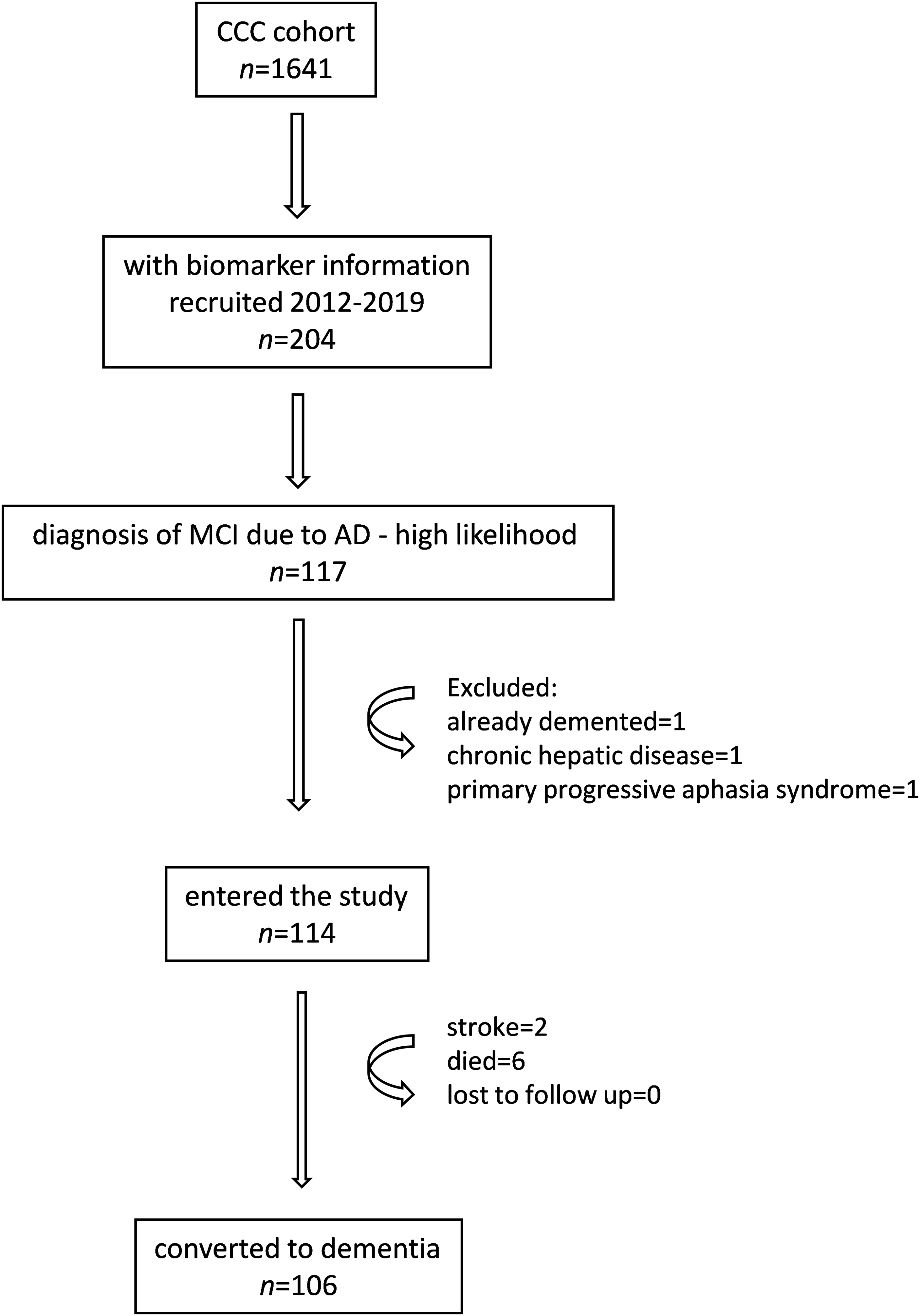
Flow-chart of patients in the study.
Diagnostic criteria
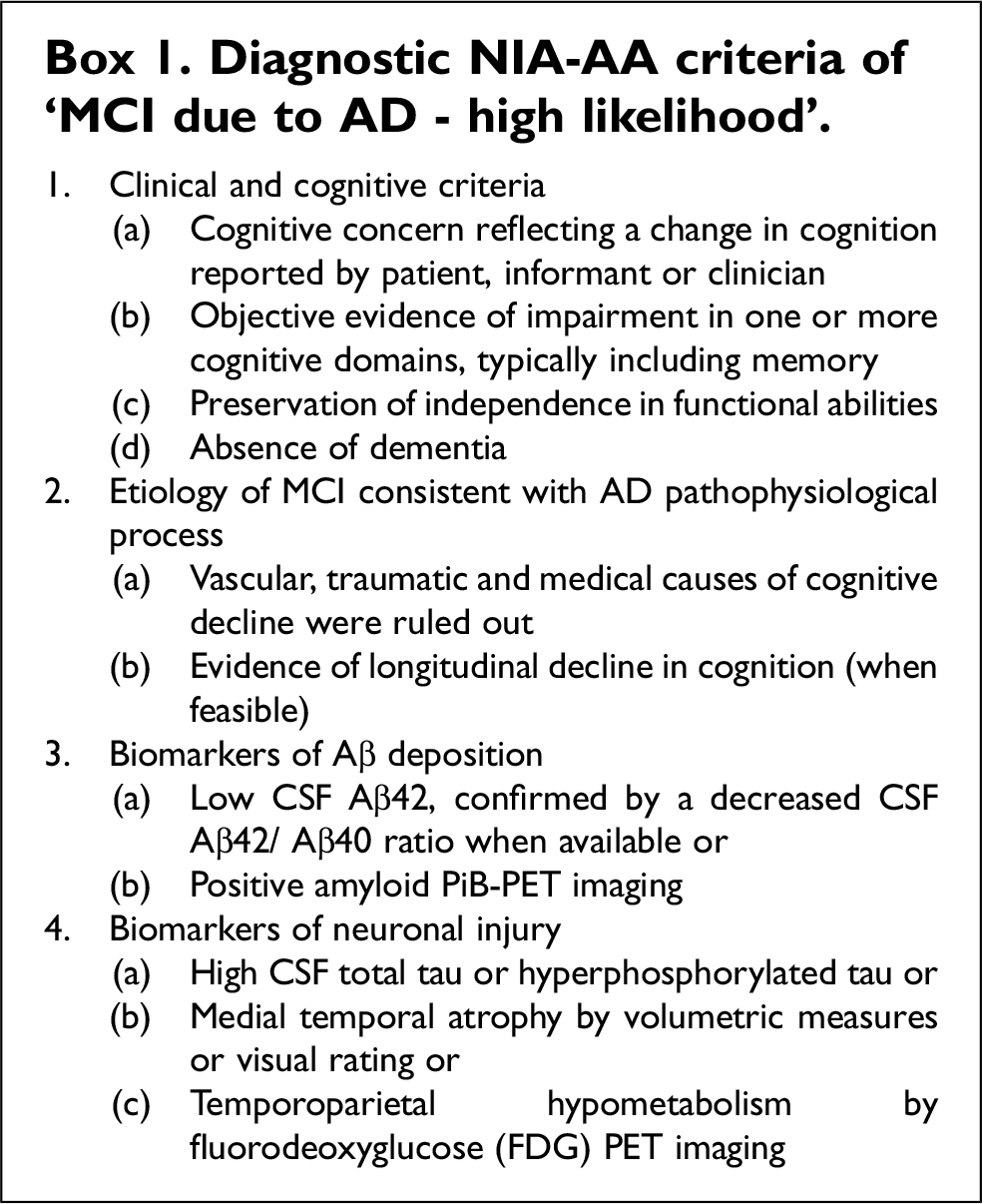
The diagnostic NIA-AA criteria of ‘MCI due to AD - high likelihood’ 6 were followed (Box 1). Objective evidence of impairment was operationalized according to the Jak-Bondi 11 comprehensive criteria, namely at least 2 tests within a cognitive domain fall more than 1 SD below age-appropriate norms. Preservation of independence in functional abilities was verified by a score ≤ 3 on the first part (items 1–8) of the Blessed Dementia Rating Scale (BDRS).12–14 Absence of dementia was determined by the American Psychiatric Association DSM-IV-TR criteria 15 and Mini-Mental State Examination (MMSE) 16 within normal values, that is, 27 for more than 11 years of education and 22 for 11 or less years of education. 17
Diagnostic NIA-AA criteria of ‘MCI due to AD - high likelihood’.
Amyloid status
A positive amyloid status was determined by low cerebrospinal fluid (CSF) Aβ42 concentrations (<620 pg/mL)18,19 or a positive brain amyloid Pittsburgh Compound B (11C-PIB) positron emission tomography (PET) scan. PIB scans were performed in the same scanner, preceded by a low-dose brain computed tomography (CT) acquisition for attenuation correction. Images were initially classified as amyloid positive or negative based on a support vector machines (SVM) local classifier, which uses the voxel wise brain grey matter standardized uptake value ratio (SUVR) and the cerebellar grey matter as reference region. 20 Final classification was confirmed by visual read from a nuclear medicine radiologist and a neurologist experienced in the field.
Conversion to dementia
Conversion to dementia was established according to the DSM-IV-TR criteria, 15 in a consensus meeting with the neurologist and neuropsychologists of the memory clinic.
Neuropsychological assessment
The baseline comprehensive neuropsychological assessment was carried out by the same team of trained neuropsychologists, following a standard protocol comprising the following instruments: MMSE,16,17 a brief screening instrument to assess global cognitive performance; the Battery of Lisbon for the Assessment of Dementia (BLAD),21,22 a neuropsychological battery that includes tests from the Wechsler Memory Scale 23 and has been validated for the Portuguese population; and the BDRS,12,13 a brief behavioral scale based on the interview of a close informant, the first part of the scale referring to daily life activities, the second part to habits and the third part to changes in personality.
Statistical analysis
Since the aim of the study was to describe the evolution of patients with the specific diagnosis of ‘MCI due to AD - high likelihood’, no comparisons were planned and thus no power calculation was performed.
The probability of remaining in MCI was analyzed with Kaplan-Meier curve. Survival time was calculated as the interval from the initial baseline evaluation to the diagnosis of dementia, stroke or death. To explore the possibility that previously described demographic and clinical factors, reflecting different points in the disease process, namely age and MMSE, might influence the survival time remaining in MCI, a Cox Proportional Hazards Regression model was fitted to the conversion data.
Statistical analyses were performed using IBM SPSS Statistics 28.0 for Windows (SPSS Inc., an IBM Company) package. The Kaplan-Meier curve was drawn in R with the ggplot2 package.
Results
One hundred and seventeen patients were included. Three participants were excluded, one was already demented, one suffered from chronic liver disease, and one had a primary progressive aphasia syndrome (Figure 1). Thus, one hundred and fourteen patients with ‘MCI due to AD - high likelihood’ were enrolled in the study. Baseline demographic and clinical data are reported in Table 1. The amyloid status was determined in 64 patients by both CSF Aβ42 and amyloid PiB-PET, in 21 by CSF Aβ42 only and in 29 by amyloid PiB-PET only.
Baseline demographic and clinical characteristics of patients with ‘MCI due to AD - high likelihood’.

SD: standard deviation; CSF: cerebrospinal fluid. CSF biomarker values were obtained in 85 patients.
It was possible to obtain follow-up information in all participants. During the follow-up period (3.0 ± 1.8 [0.4–8.3] years), 106 (93.0%) patients progressed to dementia, 2 (1.8%) had stroke, 6 (5.3%) died, and none remained in MCI or reverted to normal cognitive status. In 3 patients, causes for dementia other than AD were identified. A 73-year-old woman developed, within 3 years, a parkinsonian syndrome with falls and paresis of vertical eye movements, the magnetic resonance scan showed signs of mesencephalic atrophy, and the diagnosis of progressive supranuclear paresis was established. A 79-year-old man developed, within 4 years, a marked parkinsonian syndrome suggestive of the diagnosis of dementia with Lewy bodies. A 53-year-old woman had had an episode compatible with optic neuritis in young adulthood. Magnetic resonance imaging was normal at the baseline, without any demyelinating changes, and the positive amyloid status was confirmed by both CSF and PET PiB results. Within 6 months she suffered acute myelitis, and the diagnosis of multiple sclerosis was eventually established.
The probability of patients to remain in MCI was analyzed with a Kaplan-Meier curve (Figure 2). The average survival time remaining in MCI was 3.2 (95% CI 2.9–3.6) years. Previously described demographic and clinical factors known to have predictive ability for conversion to dementia, 24 namely age and MMSE, were analyzed in a multivariate Cox proportional hazards regression model as possible predictors of progression. Age at baseline was not associated with time to event (B = -0.010, SE = p = 0.014, Wald = 0.509, Exp(B) = 0.990, p = 0.475), whereas the MMSE at baseline was associated (B = -0.122, SE = 0.055, Wald = 4.952, Exp(B) = 0.885, p = 0.026), that is, patients with better cognition, evaluated by a higher MMSE, would keep the MCI status longer. In the subset of participants who underwent lumbar puncture the CSF biomarkers were not associated with survival time remaining in MCI.
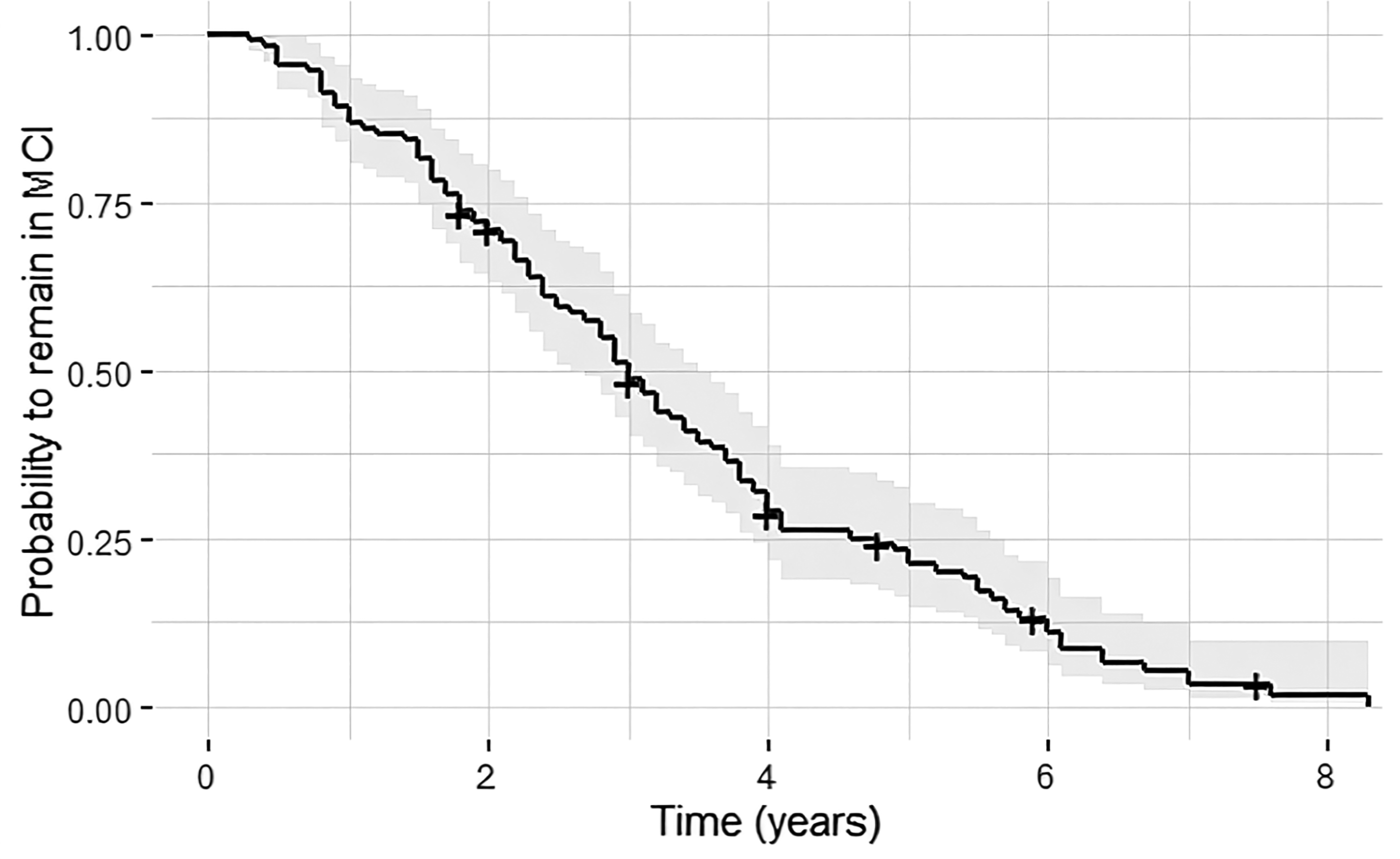
Kaplan-Meier curve of probability to remain in MCI. The shaded area shows 95% CI; +, censored cases, died or had stroke.
Discussion
The main finding of the present study is that the diagnostic criteria advanced by the National Institute of Aging-Alzheimer Association in 2011, ‘MCI due to AD - high likelihood’ 6 have an excellent long-term predictive accuracy in a memory clinic setting. All patients either converted to dementia, had a stroke or died. These findings reinforce the diagnostic and prognostic value of biomarker-based AD criteria previously obtained in studies with larger cohorts but usually followed less completely and for shorter periods of time.7,24,25
Noteworthy, not all patients who converted to dementia had the final diagnosis of AD. A few patients evolved to other disorders, namely progressive supranuclear palsy, Lewy body dementia and a demyelinating disorder. Biomarkers of AD may antedate the beginning of symptoms for many years 26 and thus patients could suffer from another neurodegenerative disorder and concomitantly be at a preclinical phase of AD that would eventually evolve years later to a symptomatic phase. Thus, even though AD might be diagnosed and confirmed by biomarkers, patients must still be surveyed attentively regarding the appearance of symptoms caused by another neurodegenerative disorder.
The diagnostic criteria for MCI used in the present work were operationalized according to the comprehensive criteria requiring that at least two tests within the memory domain fall below the established cut-off of 1 SD below the norms for age and education. 11 The comprehensive criteria represent a reasonable diagnostic approach, offering a balance of sensitivity and specificity for the detection of cognitive impairment. 11 We anticipate that the observed high predictive accuracy would not be maintained when using more liberal neuropsychological criteria for MCI. 27 Another comment refers to the establishing the amyloid status. CSF biomarkers and PiB-PET results show a high agreement. 18 The present study has the advantage that the majority of participants had both PET PiB imaging and CSF analysis, so that in infrequent cases where one biomarker was borderline (for instance focal deposits of PiB or CSF Aβ42 levels close to the cut-off), the other biomarker allowed a clear establishment of the amyloid status. In our hands, determination of the CSF Aβ42/40 ratio is also useful to mitigate eventual discordances between amyloid PET and CSF biomarkers.
There is still conceptual controversy regarding the diagnosis of AD, either considered an essentially biological entity, 28 or as a clinical-pathological disorder. 29 The present study shows that, in a clinical setting like a memory clinic, the careful integration of clinical and biomarker information allows for an accurate diagnosis of AD at an initial stage. This accuracy contrasts with the limited value of MCI criteria in general to predict conversion to dementia.30,31 In fact, patients with MCI who are amyloid-negative represent a rather heterogenous group, some may have another neurodegenerative disorder, mostly frontotemporal dementia, Lewy body disease, or a non-specified form of dementia, and in some cases a psychiatric condition might later become apparent.32,33 A proportion of patients with MCI who are amyloid-negative may remain stable throughout an extended follow-up. 34
It has certainly been a major progress to diagnose reliably AD at an early clinical stage. However, after the diagnosis of MCI due to AD, patients and families need to make important life decisions and plan the future, and expectedly wish to get a reliable estimation of the prognosis, that is, disease progression. 35 Some factors are known to have predictive ability for conversion to dementia, namely age, MMSE, CSF biomarkers and hippocampal volume. 24 Accordingly, in the present study patients with better cognition, evaluated by a higher MMSE, kept the MCI status for longer periods, in other words, they were presumably at an earlier phase of the disease process. The influence of age on the risk of conversion from MCI to dementia has been controversial. Some studies reported a higher risk of conversion from MCI to dementia for older patients, 36 others for younger patients. 37 In the present study, age did not influence the probability of patients to remain in MCI. Altogether, we should recognize that predictive modelling studies still have limitations, 38 making it difficult to anticipate the clinical evolution in the individual MCI patient reliably. 39 It is certainly important to improve risk models that can provide reliable prognostic information to the individual patient with MCI due to AD, in a precision medicine context.
The present study has some limitations. Since it was performed in just one center, replication of the present findings in other clinical settings would be needed. In second place, not all patients with MCI undergo the diagnostic procedures with biomarkers, thus the patients diagnosed with MCI due to AD may not be representative of the whole AD population in a memory clinic. To this regard, the detailed characterization of patients with MCI who do not fulfill the criteria for MCI due to a high likelihood of AD should be done in future studies. The major strengths of the present study are the uniform clinical procedures of diagnosis, the absence of patients lost during the study and the long follow-up that allowed to identify late converters to dementia.
In conclusion, the diagnostic criteria of NIA-AA ‘MCI due to AD - high likelihood’ have an excellent long-term predictive accuracy in a memory clinic setting.
Footnotes
Acknowledgements
The authors thank Memoclínica for the facilities provided.
Ethical considerations
The study was approved by the local ethics committee and conducted according to the Declaration of Helsinki.
Consent to participate
Written informed consent was obtained from patients before any procedure.
Author contributions
Funding
The authors disclosed receipt of the following financial support for the research, authorship, and/or publication of this article: The work was in part funded by the project Duas doenças de Alzheimer - Diagnóstico de tipos distintos de doença de Alzheimer no LCR e plasma, Ref. COMPETE2030-FEDER-00707500, co-funded by Lisboa2030, Programa Inovação e Transição Digital (COMPETE2030), Portugal2030 and the European Union, and by National Funds through Fundação para a Ciência e a Tecnologia, I.P.
Declaration of conflicting interests
The authors declared no potential conflicts of interest with respect to the research, authorship, and/or publication of this article.
Data availability statement
The data supporting the findings of this study are available on request from the corresponding author. The data are not publicly available due to privacy or ethical restrictions.