



Abstract
This article examines the extent to which coverage of immigration issues has featured in mainstream national news coverage of six UK General Elections between 1992 and 2015. The six-phase content analysis charts shifts in the scale of coverage over this period that cannot be explained by reference to external factors alone, such as increases in net migration and growing public attentiveness to the issue. We show that since 2005, a disconnect has emerged between media coverage of the issue and external indicators of its scale and importance. The analysis also reveals a shift in the ownership of the immigration issue in formal campaign settings, with the UK Independence Party becoming the most dominant issue associate in electoral coverage of immigration issues.
Introduction
The causes and consequences of international migration have become pressing concerns in numerous advanced capitalist democracies in recent years. In particular, public and political debate in most countries is focused upon ‘immigration’, that is, the domestic implications of the influx of people from different nations and cultures. These discussions have not emerged spontaneously: global migration is now at a level not seen since the Second World War, driven by political repression, military conflict, economic inequality, the effects of climate change and the liberalisation of the international labour market. Significantly, the majority of international migrants live in high-income countries (such as the United Kingdom), having arrived from middle-income countries (Menozzi and Hovy, 2016: 14).
The material increase in net migration is not, however, a sufficient explanation for the centrality of debates about immigration within diverse polities. Opinion poll evidence routinely shows the public misperceive levels of immigration. For example, a survey of 14 countries by Ipsos MORI (2014) found that respondents in all nations overestimated immigration levels (in the United Kingdom, it was by 11%). Across many nations, anxieties about this issue are being exploited by political insurgents to make significant electoral inroads. Indeed, this theme has become a defining feature of what Jägers and Walgrave (2007) label ‘thick’ populism. This is a political discourse that contains conventional appeals to the wishes of ‘the people’ (‘thin’ populism), but also ‘vents anti-establishment ideas and simultaneously excludes certain population categories’ (emphasis added, p. 322). An overview of populist political communication in Europe repeatedly identified anti-immigration rhetoric as a cornerstone of resurgent right-wing populist movements in numerous national contexts (Aalberg et al., 2017). Evidence also suggests that this has had a ‘contagion effect’ on the policies of mainstream parties (Van Spanje, 2010).
The key point is that public discussions about immigration are rarely measured debates and rarely just about immigration. Writing about the rise of anti-immigration sentiments in the United Kingdom in the 1960s and 1970s, Stuart Hall argued such anxieties were used to ‘thematise’ wider public concerns about growing political, social and economic uncertainty in British society. In this process, race became ‘the prism through which the British people are called upon to live through, then to understand, and then to deal with the growing crisis’ (Hall, 1978: 30). Hall’s analysis retains validity today, as immigration is once again used to view a myriad of different issues that have created ontological insecurities: from embitterment about economic austerity and inequality, to disdain for supranational governance and globalised capitalism, to anger about the erosion of the terms of the post-war social contract, to fears of international terrorism.
The mainstream media are influential in informing and framing the terms of this public debate. They also play a significant role in influencing the political careers of populist movements that ‘rely heavily on some kind of indirect (and direct) complicity with the mass media’ (Mazzoleni et al., 2003: 6). Krämer (2014) points to the tensions between media populism and populism per se and insists on the need to distinguish where the media act as ‘a substitute or competitor to populism’, exist in a state of ‘symbiosis or positive feedback’ or ‘contribute to its containment’ (p. 57). In developing this analysis, Deacon and Wring (2016) suggest labelling these responses as ‘competition’, ‘collaboration’ and ‘containment’ and propose a further distinction between ‘passive’ containment, where insurgents are excluded from news coverage, and ‘active’ containment, where journalists editorialise intensively against new political entrants.
In this article, we use this framework to conceptualise how the UK national news media have covered immigration and related issues in six General Election campaigns between 1992 and 2015. We contend that campaign analysis of this kind can make a valuable contribution to a broader understanding of changes in the mediation of immigration over time although some authors have questioned the extent to which wider inferences can be drawn on the basis of short-term studies of atypical political periods (e.g. Davis, 2002).
Our response is that, although questions about the typicality of election periods have validity, when consideration is given to their criticality then their wider political importance becomes evident. Elections are the denouements and departure points of legislative and, hence, executive power. But they are also important for what they reveal more broadly, in their ritual and content, about the wider and deeper concerns of the political and media classes.
To make these connections, it is important to locate this examination of trends in news coverage of immigration within broader discussion of changing electoral politics, public debates and policy developments on this issue in the United Kingdom. This is also needed because, however much immigration debates resonate across many national contexts, each will have its particular historical dynamic. Furthermore, the trajectory of the immigration debate in the United Kingdom has had far-reaching international implications. Immigration was one of the dominant issues in the UK 2016 European Union (EU) Referendum campaign and played a fundamental role in securing majority public support for the Leave vote. Much has been said about how the mainstream media, particularly the UK national press, focused public attention on immigration in the campaign (Deacon et al., 2016), suggesting that some displayed what might be labelled a ‘collaborative’ engagement with the increasingly populist stance of the Leave campaign. The analysis in this article shows that this marked a considerable departure from the election-on-election news trends prior to the referendum.
Policy trends, public opinion and party campaign strategies (1992–2015)
In the 1992 UK General Election, party campaigning on immigration-related issues only occurred late on in the campaign. Conservative strategists attempted to overturn their opponents’ lead in the polls in the final week by highlighting Labour’s opposition to a proposed Asylum Bill. This represented an attempt by the Conservatives to exploit their historic lead as the party considered ‘best’ on immigration going back to the 1970s (Saggar, 2003: 180). This campaigning initiative was set against the backdrop of a heightened magnitude of forced migration flows during this time despite persistent attempts to deter asylum seekers from making it to the United Kingdom (Schuster and Solomos, 1999: 60–61). Although the tactic was essentially a footnote to the 1992 General Election campaign, it foreshadowed how dominant and divisive the issue would often become in the politics of the next decades.
Following the Conservatives’ victory, asylum legislation was introduced in 1993 and 1996, amid an increasing political and media debate about ‘genuine’ and ‘bogus’ refugees. But neither immigration nor asylum featured to any substantial degree in the main parties’ election campaigning in the 1997 election (Law, 2002: 61–62), in part because net migration was then still relatively low and the issue was rarely cited in opinion polls as important to the public. These factors changed in Labour’s first term, as government policy liberalised on labour migration and asylum applications rose to more than 70,000 annually between 1999 and 2002 before falling to lower levels. These patterns came to form the basis for New Labour’s dual approach to ‘wanted’ labour migration and ‘unwanted’ asylum seekers and refugees between 1997 and 2010 (Mulvey, 2011).
In the lead up to the 2001 General Election, the main party leaders signed an anti-racism compact drawn up by the Commission for Racial Equality designed to delegitimise political actors seeking to encourage hostility for political gain (e.g. the British National Party). Despite this, with the 2001 election occurring against a backdrop of heightened asylum applications, the Conservative Party’s manifesto in this area was ‘entirely focused on asylum’, featuring criticism of ‘backlogs’, ‘costs’ and ‘chaos’ and a proposal to detain all asylum seekers – against no mention of other forms of immigration (Somerville, 2007: 128). For their part, Labour only dealt with immigration and asylum very briefly in their manifesto, detailing their putative achievements in these areas more extensively than their prospective intentions.
From 2002, Labour government policy moved towards the construction of a ‘managed migration’ approach. Previously, little attention had been paid to the economic consequences of immigration policy, but Labour adopted this more technocratic mode partly in order to assuage more populist appeals, but also to imbue the government’s approach with a sense of dispassionate legitimacy (Boswell, 2016).
Nonetheless, immigration became an increasingly politicised and populist issue during the 2000s. Having rarely ever been a prominent issue for many years, immigration rose as an important concern in polls from 2000 onwards (Ipsos MORI, 2016). This continued until 2008 when other issues such as the financial crisis came to the fore. The accession of the so-called ‘A8’ countries to the EU in 2004 led to a marked increase in the proportion of EU migrants coming to the United Kingdom under freedom of movement rules. Ireland and Sweden were the only other countries to impose no transitional controls on migrants from the A8 countries, as had been optional to all existing EU states. Initially, this decision generated little attention and the government publicly announced that it expected ‘minimal’ numbers of migrants to come to the United Kingdom for employment purposes (Lowther, 2013). However, this proved to be an underestimate and the link subsequently and repeatedly made by the right-wing press with the ensuing scale of EU A8 migration dogged Labour until the 2010 election. Even before the A8 accession, net migration had begun to rise and regularly totalled more than 200,000 people per year in the mid-2000s, eventually reaching more than 300,000 in 2014 (ONS, 2016).
Given these circumstances, and on the advice of strategist Lynton Crosby, the Conservatives placed immigration and asylum at the centre of their 2005 election manifesto. The party advocated withdrawing from the Geneva Convention on Refugees, processing asylum claims overseas, annual limits on immigration/asylum levels, 24-hour surveillance at ports and an ‘Australian-style’ points system for work permits. But it was the tone of the party’s campaign that attracted most attention and criticism. The party’s election literature prominently featured slogans such as ‘Are you thinking what we’re thinking?’ and ‘it’s not racist to impose limits on immigration’. Labour also outlined a points-based system, but largely dwelt upon more restrictive measures, placing immigration and asylum in the ‘Crime and Security’ chapter of its manifesto (Labour Party, 2005). Generally, though, the party focused on a centrist campaigning agenda, emphasising its policies on the economy and public services and avoiding the immigration issue at the start of the campaign. However, Tony Blair was persuaded a fortnight before polling to engage with the Conservative’s agenda in a keynote speech on 22 April. In this statement, he agreed that public concerns about these matters were not racist, explained Labour’s commitment towards tackling the challenges and challenged the Conservative’s ‘alarmist rhetoric’. In his view, ‘The Tory party have gone from being a one nation party to being a one-issue party’ (The Independent, 22 April 2005: 8).
The Conservatives’ election strategy in 2010 marked a significant change of direction. In a bid to shed a reputation as the ‘nasty party’, David Cameron’s Conservatives focused less on immigration and Europe and more on the kinds of centrist issues which had proven more successful in New Labour’s campaigning in previous elections (Carey and Geddes, 2010). On immigration, the party’s headline policy was its net migration limit to 1990s levels (i.e. tens of thousands a year, not hundreds of thousands). Meanwhile, Labour recapitulated its existing points-based system but with the intention of tightening its criteria, and pledged to expand the Migration Impact Fund, ensure that public-sector workers speak English to a minimum standard and break the link between residence and citizenship (Labour Party, 2010). Nevertheless, the party had lost the electorate’s trust on a number of fronts including immigration, resulting in its first election loss since 1992.
Despite initial declines in net migration as a result of a restrictive policy towards non-EU migrants, the increase in net figures in the second half of the 2010–2015 parliament came alongside a resurgence in perceptions of the importance of immigration as an issue among voters. This shift in public opinion was targeted by a revivified UK Independence Party (UKIP) in its bid to secure Britain’s exit from the EU. From 2009 onwards, UKIP developed a ‘fusion strategy’ in which EU membership was repeatedly identified as a principal cause of increased immigration (Dennison and Goodwin, 2015). UKIP had traditionally performed poorly in general elections but better in European elections, as was the case in 2014 when the party gained over a quarter of the popular vote and placed first nationally. As a consequence of this, the communication regulator OFCOM ruled that UKIP should be treated by broadcasters as a major party in England and Wales for the 2015 campaign, which guaranteed the party a General Election news platform that they had never achieved before (Deacon and Wring, 2016). On several occasions, the UKIP leader used this enhanced presence to make deliberately controversial statements about immigration that were intended to shore up UKIP’s core vote.
UKIP’s emphasis on immigration in 2015 contrasted with the campaigning of the two main parties, as neither had any strategic reason to dwell on the issue. Alongside fears of the UKIP threat, the failure of the Conservative party in coalition government to meet net migration targets set out in its 2010 manifesto made it particularly vulnerable on immigration and Labour was unable to shake perceptions of poor management of immigration when in government (Bale, 2014). In the event, the Conservatives ultimately won the 2015 election ‘in spite of, rather than because of, immigration’ (Dennison and Goodwin, 2015: 186).
In the sections that follow we address how the mainstream national news media presided over the changing terms and details of this debate during coverage of the campaigns. In particular, we assess the extent to which coverage more closely corresponded to material trends in migration and public concerns about immigration (which show marked increases) or followed the campaign logic of the main electoral protagonists, who for different reasons had reason to sequester public and media debate since the 2005 General Election. To borrow terms from Deacon and Wring’s typology outlined earlier, did election news coverage assist the main parties in ‘containing’ attention to the issue or is there evidence of ‘collaboration’ and cooperation with a populist insurgent party in forcing the issue to the foreground of electoral debate?
The data set
This article presents a secondary analysis of data from a series of six content analyses of UK General Election news reporting conducted by the Centre for Research in Communication and Culture, Loughborough University between 1992 and 2015. In total, this involves the scrutiny of more than 12,000 election news items and commentary pieces for immigration-related content. Each election study involved analysis of weekday, national news coverage in the last weeks of each formal campaign, which means the analysis represents a comparison of cross-sectional studies rather than a formal longitudinal design. Nevertheless, there remain strong grounds for making direct temporal comparisons across these data sets. The Loughborough studies have contained ‘close to repeated’ coding measures. Furthermore, when selecting data from each election study for inclusion in this analysis, we have standardised as far as is sensible the range of each sample. For example, we have excluded news content that has only been sampled intermittently (e.g. Scottish newspaper coverage) and standardised the sampling period for each election (the last 20 weekdays of the formal campaign, up to the eve of polling). The samples for each study are not completely identical (see Table 1) as we have balanced considerations of comparability with comprehensiveness. For example, it would be regrettable to exclude analysis of the quality press because they were not part of the original 1992 study.
Sampling details and differences in Loughborough’s Election news analyses (1992–2015).
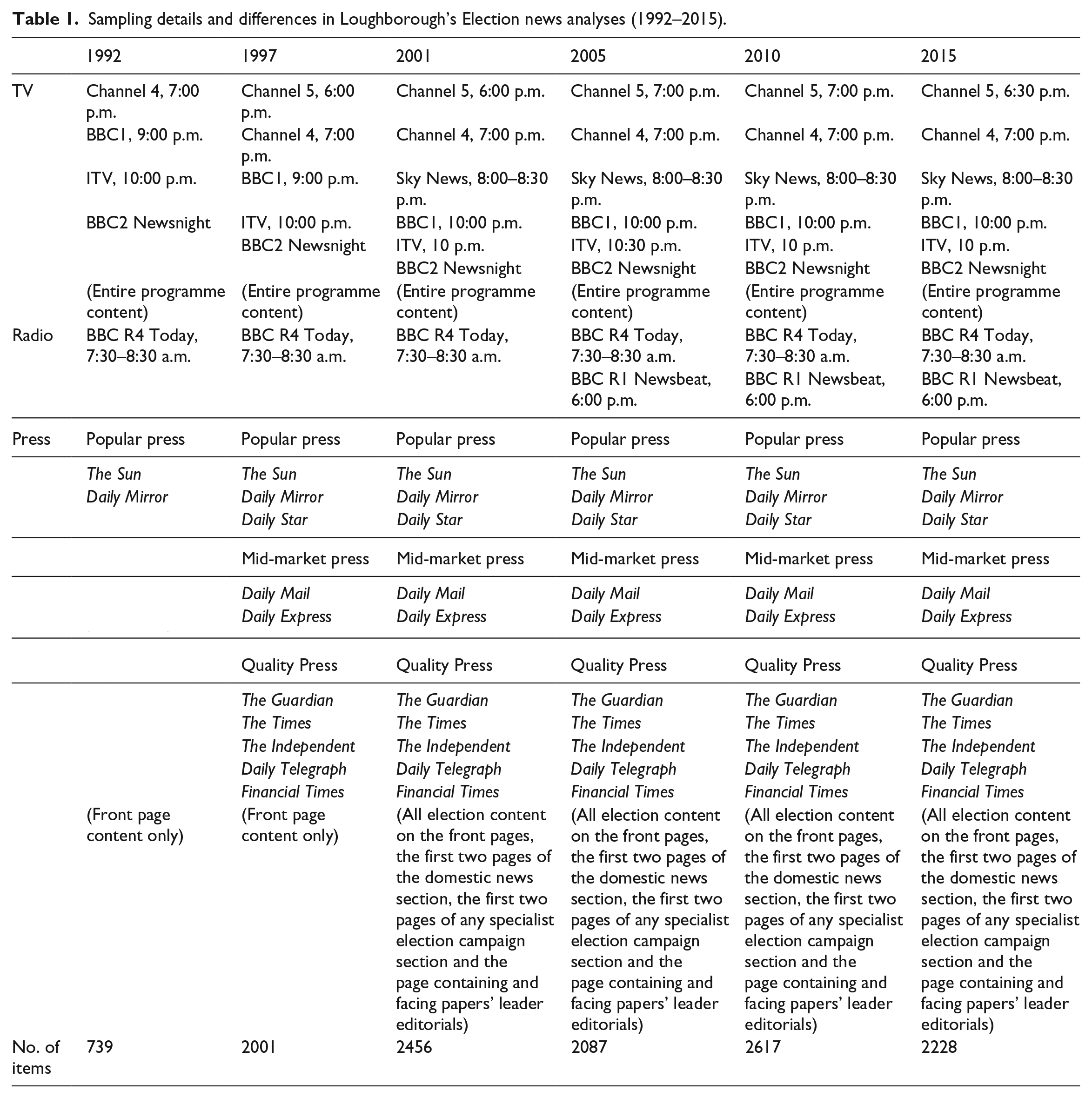
Our definition of ‘immigration coverage’ is broad. It includes any references made in election news and commentary to levels of immigration/migration; governmental/party policies and records on these matters; asylum seeking; multi-culturalism; and public attitudes to immigration. The figures presented below all relate to occasions where ‘immigration’ and related issues commanded a significant presence in a news item, editorial, interview or commentary. Up to three themes could be coded per item and to be counted as a theme, the issue needed to occupy at least two full sentences in a written article or 10 seconds of broadcast time.
The prominence of immigration in UK Election news coverage (1992–2015)
Figure 1 compares the prominence of immigration-related coverage (IRC) in each of the six UK General Elections since 1992. The results show that, despite the Conservatives’ late exploitation of the issue in the 1992 election, immigration was extremely marginalised in that campaign. There was a slight increase in levels of coverage in 1997, followed by a steep increase from 2001 to 2010. (NB. the 0.4% decline from 2005 to 2010 is negligible, as the 2010 percentage is derived from a larger number of news items than 2005, reflecting the greater amount of campaign news coverage in this more keenly contested election.) The 2015 results show a reversal in this trend. We consider the reasons for this in the ‘Discussion’ section.
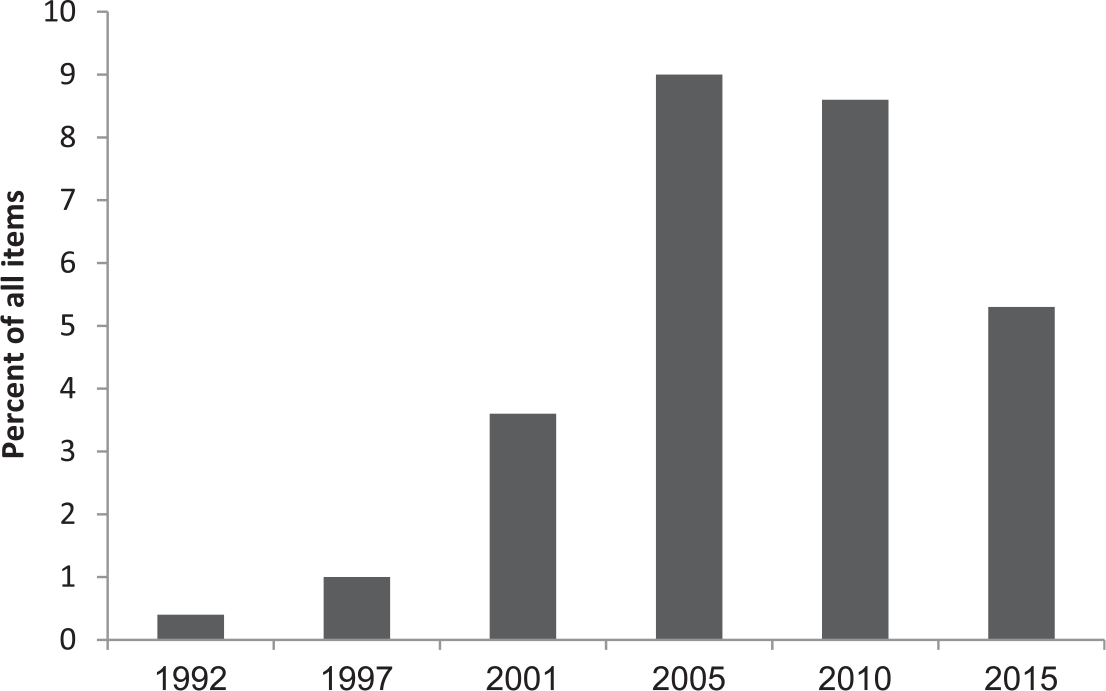
Immigration coverage as a proportion of election coverage overall (1992–2015).
Table 2 shows the prominence of immigration coverage by media sector. The details challenge any straightforward assumptions that a higher presence of immigration coverage is necessarily an indicator of greater populist tendencies within particular news sectors. For example, immigration issues were never most prominent in ‘red top’ tabloid coverage for any of the elections. 1 In contrast, the mid-market newspapers (the Daily Mail and Daily Express), themselves no strangers to populism, gave greatest prominence to immigration issues in 2010 and 2015. However, in 2001 and 2005, their levels of coverage were exceeded by those found in TV and Radio coverage.
Prominence of immigration coverage as a proportion of all election coverage by news sector (1992–2015).

IRC: immigration-related coverage.
Percentages = number of articles featuring IRC/total number of items coded × 100.
To understand this variation requires a more detailed analysis of the incidence of immigration coverage within each election. In the next section, we compare daily distributions in the 2005, 2010 and 2015 campaigns, as these contained the greatest critical mass of immigration news. For each election, we examine the dates where coverage peaked, enabling us to identify the specific campaign events and issues that stimulated each surge. This reveals distinct dynamics in each election.
The weekday distribution of immigration coverage 2005–2015
Figure 2 identifies four peaks in IRC during the weekdays of the 2005 campaign (11 April, 14 April, 19 April and 22 April). After the final surge, immigration receded for the last fortnight of the election. In all four instances, media attention was stimulated by campaign initiatives and interventions originating from the two main parties. As noted earlier, the Conservative party sought to exploit immigration as a major issue in its campaigning. On 11 April, Michael Howard, the Conservative party leader, launched his party’s manifesto by publicising press allegations that the Home Office had issued orders to admit people to the United Kingdom temporarily, even if their papers seemed suspicious. He followed this up on 14 April, with further attacks on the government’s record on immigration and asylum and on 19 April repudiated criticisms of his party’s rhetoric in their campaigning. As noted earlier, on 22 April, Tony Blair, the Prime Minister, delivered a keynote speech on immigration and asylum.
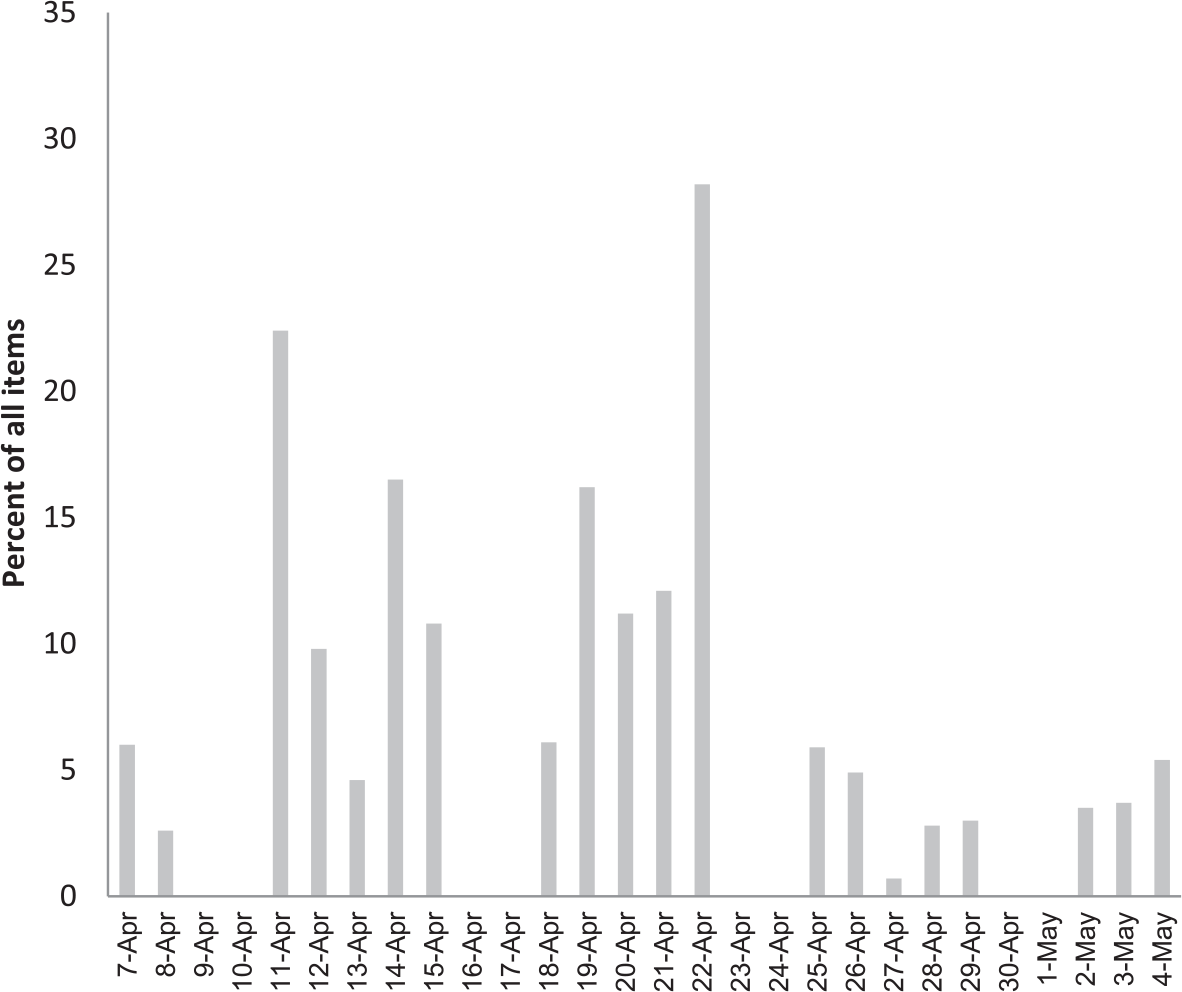
Daily immigration coverage as a proportion of all election coverage in the 2005 campaign (7 April–4 May).
This pattern of party-initiated coverage contrasts with the distribution of coverage in the 2010 election (Figure 3). Immigration failed to gain the prominence of 2005 until a sudden upsurge on 28–29 April. This was due to a faux-pas committed by the Prime Minister, Gordon Brown, following a walkabout in the North of England on 28 April. During this event, a member of the public voiced concern about levels of immigration in her community. Brown deflected her comments, but afterwards forgot to switch off his television microphone and was recorded complaining about having to deal with a ‘bigoted woman’. The error sparked a media-feeding frenzy: the voter was tracked down and played a recording of Brown’s comments and the Prime Minister’s pained response was filmed at a BBC Radio interview, as he listened to the audio feed for the first time.
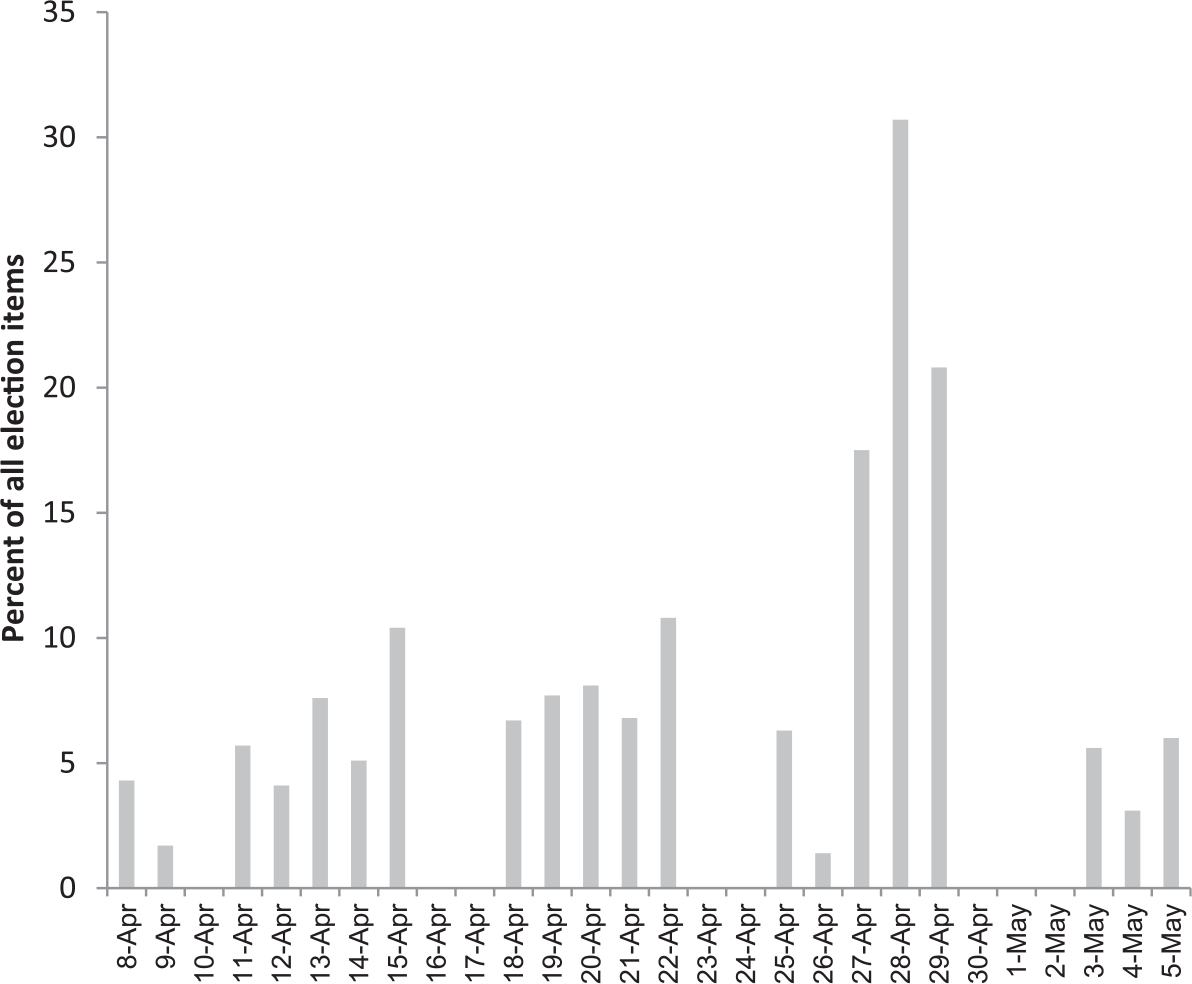
Daily immigration coverage as a proportion of all election coverage in the 2010 campaign (8 April–5 May).
Figure 4 provides the details of the variation in the 2015 campaign and identifies three (smaller) spikes in coverage. The first occurred on 16 April and was stimulated by responses to a televised ‘Challengers debate’ on BBC1, in which Nigel Farage, the leader of the UKIP, made a series of controversial remarks about the negative social effects of immigration. The second occurred between 22 and 24 April and was driven by a combination of events. On 22 April, the coalition leaders acknowledged they were mistaken to support the withdrawal of the EU naval and air operation designed to rescue migrants from the Mediterranean. This coincided with the scheduled televising on BBC1 of a ‘leaders interview’ with the UKIP leader. On 24 April, the Prime Minister and Labour leader made public statements on the immigration issue: David Cameron in an article in the Daily Mail and Ed Miliband in a speech at Chatham House. The final peak on 29 April was stimulated by the publication of a report by the anti-immigration pressure group, Migration Watch, and speeches by Farage and Miliband.

Daily immigration coverage as a proportion of all election coverage in the 2015 campaign (9 April–6 May).
These details reveal some distinctions in the coverage of immigration across these three elections. In particular, the apparent parity in the levels of immigration coverage in 2005 and 2010 masks the different drivers in each case. In 2005, the high points of coverage mirrored the choreographed sparring of main party leaders. In 2010, the main impetus was the campaigning misstep by the Prime Minister. This difference also explains why immigration coverage in broadcast coverage in TV and radio in 2001 and 2005 exceeded levels in all other sectors. By giving prominence to the topic in 2005, the broadcasters were reflecting the chosen platform of one of the main electoral contenders, which could be characterised as a manifestation of sacerdotal political reporting, where journalists report the campaign in a reactive and deferential manner (Blumler and Gurevitch, 1995). In contrast, the most intensive moments of immigration coverage in 2010 were media driven: a microphone ‘made’ the story and it was the journalists who developed it. In doing so, many media commentators saw the incident as emblematic of Brown’s troubled premiership and indicative of its probable termination. However, other journalists used Brown’s remarks to ‘expose’ an alleged conspiracy of silence on immigration by the major parties during the election period. Significantly, these claims were particularly evident in the reporting of Daily Mail and Daily Express (Deacon and Wring, 2011).
The trends in 2015 suggest a reversion to a ‘party led’ orientation, as coverage tended to follow staged and prescheduled events on the campaign trail. In doing so, however, the peaks of coverage in this election never matched those found in 2005 (see Figure 5). These moments were also dependent upon the electioneering of Nigel Farage and UKIP. To explore whether this was typical of the wider campaign coverage, we now consider which political parties were most frequently associated with the issue of immigration across the various elections.

A comparison of the daily prominence of immigration coverage in weekday election news (2005, 2010 and 2015).
Issue associates
Table 3 compares (a) the relative prominence of major and minor parties in immigration coverage for all six elections, and (b) the extent to which this varies from their presence in non-immigration coverage. Each variation is presented as a positive or negative number calculated by subtracting the percentage prominence of political parties in IRC from all other coverage. A positive value shows that a party had a higher proportional presence in immigration news than in coverage of other issues. A negative value shows that they featured less frequently.
The distribution of party political ‘issue associates’ in immigration coverage (1992–2015).

Percentages = (number of appearances/total appearances of all party representative) × 100.
The findings show the Conservatives dominated coverage of this issue up to and including the 2005 Election. Over the same period, Labour sources were consistently less likely to feature in coverage of this issue. The situation reversed in 2010, with Labour becoming more prominently featured than the Conservatives (due to Brown’s electioneering mishap). In the 2015 campaign, both parties were less likely to feature in immigration coverage than in other coverage. In contrast, the results confirm the arrival and dominance of UKIP in this aspect of campaign coverage. UKIP had failed to gain any significant media presence in General Elections prior to 2015 (Deacon and Wring, 2016), but this was always going to change in 2015 due to OFCOM’s ruling that they be deemed a major political party for this election. What these results show is the extent to which their presence and platform in the 2015 campaign was dominated by their views and policies on immigration.
A limitation of these results is that the comparisons for each campaign take no account of the differing amounts of immigration coverage across the elections. Consequently, the percentage differences for elections where immigration levels were low exaggerate the disparities in parties’ presence. To adjust for this, the statistics in Figure 6 provides a comparison of the three most prominent issue associates (Conservative, Labour and UKIP) weighted by the relative prominence of immigration coverage in each election. 2
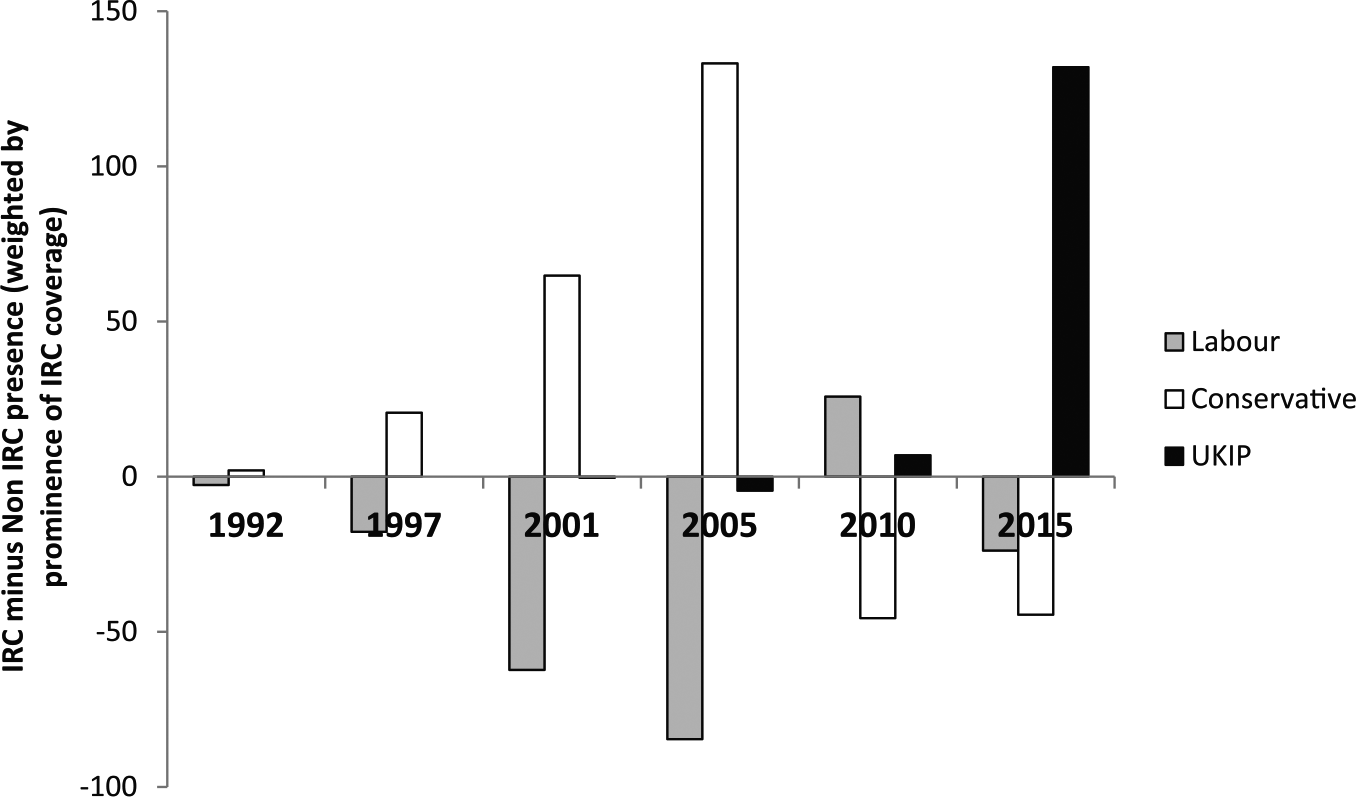
A comparison of political parties’ presence in IRC compared to their presence in non-immigration coverage (weighted by overall prominence of in each campaign) (1992–2015).
These results demonstrate the scale of UKIP’s capture of the immigration issue in 2015, as their relative dominance in this campaign matches that found for the Conservative party in 2005 (despite the higher weightings assigned to the latter because of the greater level of coverage in 2005).
Table 4 identifies the main politicians associated with immigration coverage in elections since 2001. (NB. These percentages indicate the proportion of all immigration items within which each politician appears and are calculated differently from the percentages in Table 3.)
The four most prominent politicians by news presence in immigration coverage per campaign (2001–2015).
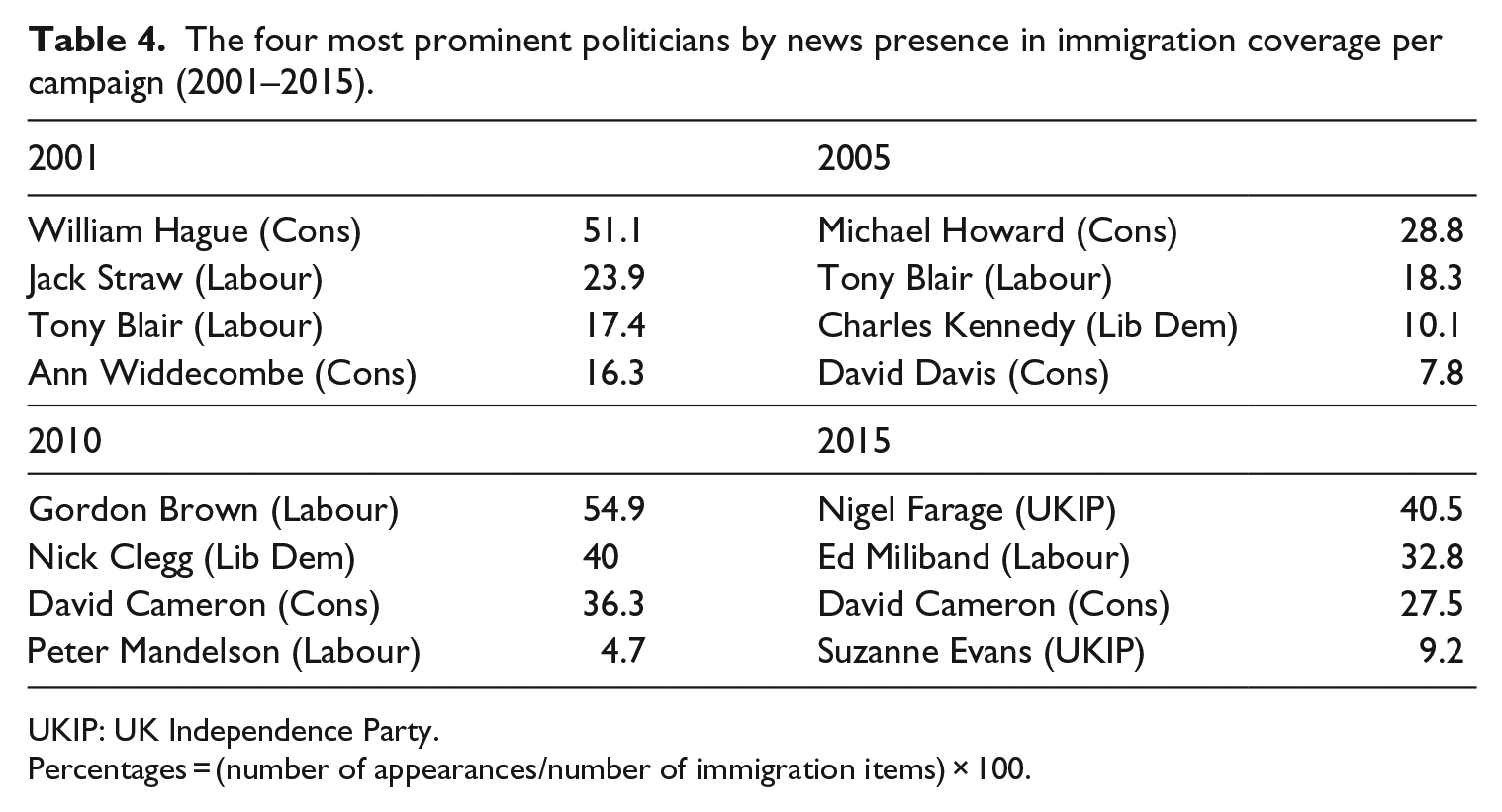
UKIP: UK Independence Party.
Percentages = (number of appearances/number of immigration items) × 100.
Aside from corroborating UKIP’s intentional dominance in 2015 and Brown’s inadvertent prominence in 2010, the results reveal other shifts in the patterning of issue associates over campaigns. In 2001, the Labour Home Secretary (Jack Straw) and the Conservative Shadow Home Secretary (Ann Widdecombe) were prominent, with Straw receiving more coverage than the Prime Minister. In 2005, David Davis, the Conservative shadow Home Secretary, made the top four, but was less prominent than previously. (The Labour Home Secretary was even less prominent.) In 2010 and 2015, neither the Home Secretary nor their shadow cabinet counterpart was amongst the most prominent figures in coverage. This is of interest because the Home Office is the lead government department for immigration-related matters. The progressive relegation of these politicians suggests that as the issue attained news value, it moved beyond the range of the Home Office, became more ‘presidentialised’ (i.e. focused around the party leaders) and consequently became associated with a wider range of other issues. To assess whether this is the case, our discussion now turns to compare what other issues were most regularly reported alongside immigration across the various elections.
Associated issues
Table 5 identifies the five most prominent substantive issues that appeared alongside immigration in the last four UK General Elections. It also indicates the extent to which the presence of an issue in immigration coverage matched its presence in non-immigration content. These figures are calculated using the same procedures as in Table 3 and should be read in the same way.
The association of other election issues with immigration coverage (2001–2015).

For this count, we have excluded ‘process coverage’ which tends to dominate election news (i.e. coverage of the conduct of the campaign, party strategies, fortunes and prospects, etc.). This means the number of cases for some of the elections is small. Nevertheless, the results suggest several transitions in the wider context within which immigration has been reported in election news over the four most recent campaigns.
In 2001 and 2005, ‘crime’ was the most frequently associated issue in immigration coverage, attaining levels of prominence that were not evident in the coverage of other issues. For example, crime accounted for a quarter of the associated issues in immigration coverage in 2005, compared with 7 per cent in non-immigration coverage. The association of crime with immigration is highly contentious (Lubbers et al., 1998), but these figures should not be taken as revealing a routinised stigmatising or stereotyping of immigrants as non-law abiding. Rather, they reflect the campaigning strategies of the Conservative opposition at the time, which sought to attack the Blair government separately on its record on rises in violent crime and increases in immigration, as components of a wider authoritarian discourse. (Both crime and immigration are within the Home Office remit, which offers a further explanation for the prominence of politicians with responsibilities in these areas in 2001 and 2005.)
In 2010 and 2015, crime did not feature as a prominent associated issue. In 2010, immigration was associated with wider debates about the performance of the economy and politicians’ probity and standards (in the months prior to the commencement of the campaign there had been a scandal about MPs’ abuse of their expenses). In 2015, ‘Europe’ leapt to prominence in this electoral domain, despite its signal marginalisation elsewhere (i.e. accounting for less than 4% of non-immigration coverage). This confirms the dominance of UKIP in this aspect of election coverage and demonstrates the implications of their seizure of this terrain and their deliberate strategy to fuse debates about European membership to wider concerns about immigration (Dennison and Goodwin, 2015).
The proportion of coverage of ‘other issues’ is also noteworthy. In 2001, the top five issues accounted for 80.5 per cent of the associated issues in coverage. By 2010, this had reduced to 61.3 per cent. These results tend to confirm our earlier conjecture that in recent campaigns immigration has become more readily associated with other, diffuse issues.
Concluding discussion
This article has mapped the changing features of UK General Election news coverage of immigration between 1992 and 2015. Our analysis reveals significant variations in election news coverage, both within elections and over time. One fundamental difference is the amount of attention given to immigration and related issues across the six elections. Between 1992 and 2005, the increase in coverage mapped consistently onto the trajectory of ‘real-world indicators’, such as increases in levels of immigration, asylum applications, policy initiatives and public attentiveness to the issue. This growth in media attention was given further impetus in 2001 and 2005 when the Conservative party exploited its historical ‘ownership’ of the immigration as a strategic push for power. As the topic gained news value, immigration coverage became presidentialised: the province of Prime Ministers and party leaders rather than cabinet ministers and shadow cabinet spokespersons.
At first sight, the high level of immigration coverage in 2010 seems to confirm the connection between levels of coverage and exogenous factors. However, our findings show that the largest share of coverage in this election was due to an unscripted accident. Had the Prime Minister remembered to switch off his TV microphone, there would have been a significant reduction in aggregate immigration coverage from 2005. In 2015, immigration coverage was half the levels found in 2005.
These findings suggest a growing disconnect between the amount of coverage given to immigration and external indicators of the scale of the ‘problem’ in the last two elections. The explanation for this appears to be the decisions taken by the main political parties to suppress debate on immigration for strategic reasons. In 2010, in particular, immigration was an issue without an issue entrepreneur, for, although UKIP had already developed its ‘fusion strategy’ (Ford and Goodwin, 2014) of using anti-immigration rhetoric to stoke Euroscepticism, the party was yet to be deemed a leadership arena of sufficient importance to warrant attention. This situation changed prior to the 2015 election, when UKIP’s official recognition as a major party provided a media platform from which it could disrupt the main parties’ containment of the immigration debate. It was only partially successful in doing so, but our results show how dramatically it took ownership of immigration coverage in 2015 and how it managed to implicate discussions of Europe in these appearances (another issue the Conservatives were keen to avoid). UKIP’s eventual return of only one MP might suggest this strategy was ineffective, but this would fail to appreciate how the rigours of the first-past-the-post-system worked to their disadvantage and to neglect their 9.5 per cent increase in vote share, placing them third in the party pecking order. The implications of this advance were to be appreciated more fully in the EU referendum in 2016, where UKIP support was not dissipated by its lack of a critical mass of support in specific constituencies.
If we accept that accentuated attention to immigration issues is an indicator of ‘thick populism’, this longitudinal study also provides some suggestive indications about the response of UK mainstream media to this kind of exclusionary rhetoric during this most crucial period of the political cycle. For example, our findings found no evidence that the most popular news tabloids were more likely than other news outlets to focus on the immigration issue, which fits with patterns identified previously in different time periods and national contexts (e.g. Boomgaarden and Vliegenthart, 2007; Mudde, 2006). Using Deacon and Wring’s (2016) categorisation of media responses to populism, we suggest differentiating between the UK media’s responses in reporting immigration in several ways. In 2001 and 2005, mainstream media inclined towards the ‘collaborative’ – at least to the extent that they reported this controversial aspect of the Conservative party’s electioneering. In 2010, there seems to have been a move towards a ‘containment’ strategy, up until Gordon Brown’s campaigning mistake. This provided the impetus for the media’s adoption of a ‘competitive’ strategy, using the controversy to push discussion of immigration to the foreground of electoral debate despite the preferences of the main parties. In 2015, a ‘containment’ position was more evident. Its passive manifestation was in the low levels of coverage given to the issue despite public concerns and net migration figures. Its active manifestation was in the widespread editorial censuring of Nigel Farage and UKIP for the tone and content of the party’s ‘shock and awful’ strategy.
These results suggest that the potency of thick populism in a UK electoral setting tends to be most evident in media coverage when it gains the endorsement of mainstream political parties and works to their political advantage. Where this is not the case, news organisations tend to defer to the strategically muted agenda set by the mainstream parties – at least for the duration of the last days of the campaign. The counter scenario seems to have been dramatically demonstrated in the 2016 EU referendum campaign. On this occasion, the ‘Leave’ campaign – led by senior political figures who initially sought to distance themselves from UKIP’s exclusionary rhetoric and then adopted its strategy wholesale – aligned with the Euroscepticism of significant sections of the national press to make immigration one of the dominant topics in the debate (Deacon et al., 2016).
Footnotes
Acknowledgements
The authors wish to acknowledge the contribution of Michael Billig John Downey, Peter Golding, Emily Harmer, James Stanyer and Dominic Wring to the assorted election studies analysed in this article.
Funding
This work was supported by British Academy/Leverhulme Trust (Grant ref: SG142216), The Electoral Commission and The Guardian Newspaper.