



Abstract
This article focuses on the 2014 Hong Kong protests (also known as the Occupy Central or the Umbrella Movement), which have been one of the most high-profile socio-political incidents since the handover of Hong Kong’s sovereignty to China in 1997. It investigates how the protests were represented in the translated Chinese-language news produced by selected media from China, the UK and the US, and how these news articles were ‘reframed’ (Baker, 2006) from their original English versions. The study proposes an analytical framework of corpus-based critical framing analysis, which combines critical discourse analysis, corpus analysis and framing analysis. It identifies some prominent news frames and several consistent framing patterns in the coverage of the protests: Reference News mainly adopts government and public frames and textual strategies of addition and omission; BBC Chinese employs social action and process frames, as well as a combination of framing strategies and devices at the textual, intratextual and paratextual levels; The New York Times Chinese (re)frames the events mostly through individual and geographical frames, and paratextual devices of news headlines and images. These news frames and framing patterns demonstrate the distinct political stances held by the media outlets towards the events.
Introduction
Translation in journalistic settings is invisible yet ubiquitous in today’s proliferation of information and cross-cultural communication (Bielsa and Bassnett, 2009). As Schäffner (2005: 154) notes, ‘translation is a regular phenomenon for news production, even if this is not always explicitly indicated’. This invisibility and ubiquity pose new questions for translation and journalism in the era of convergence (Davier and Conway, 2019), such as the source text (ST)–target text (TT) relationship and authorship attribution. Media and communication studies scholars often neglect the significance of language, and few of them consider the role of translation in news reports. However, journalistic translation plays an essential role in news production and dissemination. It has established itself as a sub-field under translation studies and attracted increasing scholarly attention in the past two decades (Valdeón, 2015, 2020a).
Journalistic translation is an elusive, imprecise and uncertain term, and the various terms used mean different things in different contexts. Some scholars refer to journalistic translation as transediting (Stetting, 1989), gatekeeping (Valdeón, 2020b; Vuorinen, 1995) or adaptation (Valdeón, 2014). These terms are frequently used, yet there is no consensus as to their definitions. The concept of translation held by journalists can be different from that held by translators or translation scholars. This study uses ‘translation’ in a broad sense, encompassing both linguistic and socio-cultural transformations.
Journalistic translation conducted in the Chinese context seems to be underexplored, and even fewer studies have covered the case of Hong Kong. As Lee and Chan (2018: 196) point out, the media have played a catalytic role in social mobilisation in postcolonial Hong Kong, specifically during the 2014 Hong Kong protests, a ‘critical event’ since the handover of sovereignty in 1997. There has been growing concern in recent years that media freedom in Hong Kong has been further eroded by tighter political control and economic pressures from the Chinese mainland since the handover (Frisch et al., 2018). Research on representations of the 2014 Hong Kong protests has examined specific aspects of the protests and how these events are framed in the local, national and global media (e.g. Du et al., 2018; Feng, 2017; Sparks, 2015). These studies focus on coverage of the protests in monolingual media, but their representations in transnational media have been ignored. The role played by translation in the coverage of the events has been almost entirely overlooked in academic study.
As the events occurred in Hong Kong, not only did news coverage of the protests flow from Chinese to English for a global audience but foreign news circulated backwards for domestic readers (Bielsa, 2016). This study focuses on the backward circulation of news. The three media outlets selected (Reference News, BBC Chinese and The New York Times Chinese) publish a combination of Chinese translations of news stories and opinion pieces, all taken from the English-language media. The study addresses the following research questions:
How do the translated news texts differ from their source texts?
How are the translated texts in the selected media outlets different in terms of news frames?
How is the original news (re)framed in the translations produced by the media outlets?
What are the salient framing patterns in the translated news articles produced by each media outlet?
How do these patterns differ between the selected media outlets? This study provides consistent analyses of news frames in both original and translated news articles as well as of framing patterns constructed at multiple levels. It begins by laying out the theoretical dimensions of framing analysis and its application in translation studies, as well as the analytical framework of critical framing analysis (CFA). The next section outlines the data and methodology used for this study. The subsequent section presents the findings of the study, focussing on the four key frames which are embedded in the coverage and the (re)framing strategies employed in the translation of news at multiple levels, before the article reaches a conclusion.
Frame, framing and framing analysis
The term ‘frame’ can be traced back to Bateson (1955/2004: 130) who used it to describe a psychological ‘spatial and temporal bounding of a set of interactive messages’. It has since been used in various disciplines with slightly different meanings. This rather broad and vague conception did not become popular until Goffman (1986) narrowed it down and linked it to sociology. He defines frames as ‘principles of organization which govern events – at least social ones – and our subjective involvement in them’ (Goffman, 1986: 10) and frame analysis as ‘the examination in these terms of the organization of experience’ (Goffman, 1986: 11). The term has since been used by various scholars to mean slightly different concepts. For example, Gamson (1989: 157) notes that ‘[a] frame is a central organizing idea for making sense of relevant events and suggesting what is at issue’. Tannen and Wallat (1993: 60) use the term ‘frame’ to refer to ‘a sense of what activity is being engaged in, how speakers mean what they say’.
Scholars suggest that the news contains not only static elements of news frames but that it can also be framed in a dynamic process. A news frame is a static theme which ‘connects different semantic elements of a story’ (Pan and Kosicki, 1993: 59), whereas news framing is a dynamic process which involves frame-building and frame-setting (de Vreese, 2005). The notion of framing is key in media and journalism studies. As D’Angelo and Kuypers (2010: 1) point out, ‘[n]ews is easily the most prominent discursive site in which communication researchers strive to understand what framing is and how framing works’. Similarly, Chong and Druckman (2007: 104) define framing as ‘the process by which people develop a particular conceptualisation of an issue or reorient their thinking about an issue’. As a socio-cognitive process, news framing plays a crucial role in the construction of socio-political reality (Johnson-Cartee, 2005; Tuchman, 1978).
Framing analysis has been widely adopted by communication scholars to analyse media and news discourse (e.g. Entman, 1991; Pan and Kosicki, 1993; Tankard, 2001). Most comparative research examines how media outlets frame the same event in different ways. Entman (1991: 6) argues that ‘[c]omparing media narratives of events that could have been reported similarly helps to reveal the critical textual choices that framed the story but would otherwise remain submerged in an undifferentiated text’. However, there is no agreed theoretical framework for the use of framing analysis in communication and media studies due to its vagueness as a research paradigm (Entman, 1993). Pan and Kosicki (1993: 63) identify four structural dimensions of framing devices in news discourse: syntactical, script, thematic and rhetorical. However, their system would have been more useful if these devices had been categorised into different dimensions to the ones chosen. A possible classification in journalistic settings would be framing through linguistic features, including lexical, syntactic and thematic structures, and through paralinguistic elements, such as images, headlines, leads and layout.
Tankard (2001: 97) notes that early research on framing relies mainly on qualitative methods such as text and content analysis to identify media frames, rendering it a subjective process. He posits several approaches such as the ‘media packages’ approach (Gamson and Modigliani, 1989: 3), the ‘multidimensional concept’ approach (Tankard, 2001: 99) and the ‘list of frames’ approach (Tankard, 2001: 100) as all having the potential to reduce subjectivity significantly. Framing studies normally conduct content analysis that depends on the researcher’s subjective interpretation. Coders are often required to code the same set of news articles separately using the same scheme, and their results need to achieve a high level of ‘intercoder agreement’ (Saldaña, 2021: 54) to be valid. Several studies (e.g. Gamson, 1989; Matthes and Kohring, 2008; Tankard, 2001) have highlighted the methodological issues that are associated with framing analysis to improve its reliability and validity. Van Gorp (2010) raises the issue of subjectivity in framing analysis when he argues that researchers need to follow specific steps when adopting both inductive and deductive approaches. A significant limitation with deductive (top-down) framing analysis is that the frames are often predetermined, thus precluding the possibility of identifying other marginalised frames during the analysis process (Semetko and Valkenburg, 2000).
Framing in journalistic translation research
Compared with social scientists, translation scholars have been latecomers to the notion of framing. Baker (2006) introduced the concept of framing to the application of translation and interpreting in areas of conflict and social movements. Baker (2006: 106, italics in original) defines frames as ‘structures of anticipation, strategic moves that are consciously initiated in order to present a movement or a particular position within a certain perspective’, and framing as ‘an active strategy that implies agency and by means of which we consciously participate in the construction of reality’. Baker (2006: 111) argues that framing processes can be realised through various ‘linguistic devices such as tense shifts, deixis, code switching, use of euphemisms’ and ‘paralinguistic devices such as intonation and typography to visual resources such as colour and image’. Four strategies – ‘temporal and spatial framing’, ‘selective appropriation’, ‘framing by labelling’ and ‘repositioning of participants’ (Baker, 2006: 112–139) – are employed by translators to accentuate, undermine or modify original narratives and to (re)frame their narratives in translation.
Baker (2006: 109) argues that framing is ‘subject to various types of constraint’ such as time and space, two essential features of narrativity. To overcome these limitations, the translator needs to resort to the strategy of temporal and spatial framing. This refers to choosing a text and embedding it in a new context which may be very different from its original one in terms of time and space. This process of recontextualisation occurs systematically in news translation (Kang, 2007). A new term, ‘transframing’, was coined by Liu (2019: 8) to mean ‘translation-mediated framing through translated news’ as a bridge between framing studies and journalistic translation. She argues that journalistic translation involves not only transediting but also transframing. However, a few scholars argue against the use of ‘transediting’ as it may ‘imply the existence of another form of translating news’ (Bielsa and Bassnett, 2009: 63−64), and that translation should not ‘be understood in a narrow sense of a purely word-for-word transfer process’ (Schäffner, 2012: 881).
Translation scholars regard journalistic translation as a process whereby already framed news stories are reframed through translation. There are mainly two types of framing research within journalistic translation research: those that adopt Baker’s (2006) model of framing strategies (e.g. Qin and Zhang, 2018; Valdeón, 2014; Wu, 2018) and those that draw on a broader concept of framing from communication studies (e.g. Liu, 2019; Van Doorslaer, 2012). However, existing research regarding journalistic translation mainly explores how the translated news has been reframed and neglects to examine which frames are salient, backgrounded, eliminated or changed in this process.
An analytical framework of critical framing analysis
This study proposes an innovative analytical framework of corpus-based CFA which incorporates critical discourse analysis, framing analysis and corpus analysis. It combines framing analysis (Baker, 2006) with corpus-based critical discourse analysis (Baker et al., 2008), and applies it to both original and translated news articles, using the 2014 Hong Kong protests as a case study. Previous researchers have drawn on critical discourse analysis and framing to examine news translation (e.g. Spiessens and Van Poucke, 2016), although they may not have called their approach CFA; few studies, however, have incorporated corpus analysis. As a few studies (e.g. Touri and Koteyko, 2015; Vu and Lynn, 2020) demonstrate, combining corpus techniques of keywords and concordances offers a systematic approach to frame identification. Corpus analysis is integrated at the textual level of the analytical framework to provide a macro-level view of recurrent language features by using the corpus toolkit, including word frequency and keyword analysis. At the micro level, framing analysis of news texts around the use of framing strategies such as selective appropriation, labelling and paratextual devices, which include headlines, photographs and layout, is examined through a detailed analysis of textual and paratextual shifts between the original news articles and their translated versions. This study is one of the first attempts to combine both approaches.
Figure 1 is adapted from Baker’s (2006) model of narrative theory and classifies various framing strategies into three levels, namely, textual, intratextual and paratextual. This classification highlights the linguistic shifts between the original news articles and their translated versions. These shifts are produced as a result of ideological factors related to either the individual translator or the media outlet. The corpus method of keyword analysis focuses only on frames that can be observed at the word level, while framing occurs at various levels above the word level as well. This study employs a computer-assisted approach to code the framing strategies that are used by the translators when they are reframing the original news. It also explores various framing strategies that the translator employs to accentuate, undermine or modify the narrative in a ST and to frame the news in translation, and identifies where linguistic and/or paralinguistic shifts occur. A revised typology of framing strategies and devices used in journalistic translation.
Baker’s (2006) model of framing analysis involves framing strategies from various aspects. Figure 1 provides a revised typology of framing analysis, including some of the primary framing strategies and devices, both verbal and visual, used in journalistic translation. Selective appropriation such as omission, addition and substitution of textual material can occur at both intratextual and paratextual levels. Framing at the intratextual level includes labelling through naming and the repositioning of participants through deixis and epithets, as well as explicitation, that is, ‘an overall tendency to spell things out’ (Baker, 1996: 180), and vice versa, implicitation, that is, the tendency to ‘leave them implicit in translation’ (Baker, 1996: 180). Other strategies such as the selective appropriation of news sources and repositioning are achieved at the paratextual level by the translator or editor. This ternary system, consisting of textual, intratextual and paratextual analyses, offers a systematic and dynamic approach to the application of framing analysis to news narratives.
Corpus and methodology
The media outlets selected for this study are Reference News (RN) from China, BBC Chinese from the UK and The New York Times (NYT) Chinese from the US. The data collected draws on Chinese-language translations of event coverage produced by these outlets between 28 September 2014, the date when the Occupy Central Movement was officially announced, and 16 December 2014, the date after the last protest camp was cleared by the police, along with their related STs published in a range of international mainstream media.
RN (Cankao Xiaoxi) is selected as the representative media outlet from the Chinese mainland because of its significance and influence. Run by the state-owned Xinhua News Agency, RN is a Chinese-language daily newspaper that claims to have the largest circulation in China. The newspaper selects news articles from mainstream global media and translates them into Chinese for both party officials and the general public (Pan, 2014; Wu, 2018; Xia, 2019). BBC Chinese (www.bbc.com/zhongwen) is a website run by the BBC Chinese Service as part of the multilingual BBC World Service platform. This study selected The NYT Chinese (cn.nytimes.com), the Chinese edition of the NYT website, as its media outlet from the US. The BBC and The NYT are selected as representative media outlets in their own country. Both have established a reputation for their news quality in China.
Number of news articles and words in the news corpus.
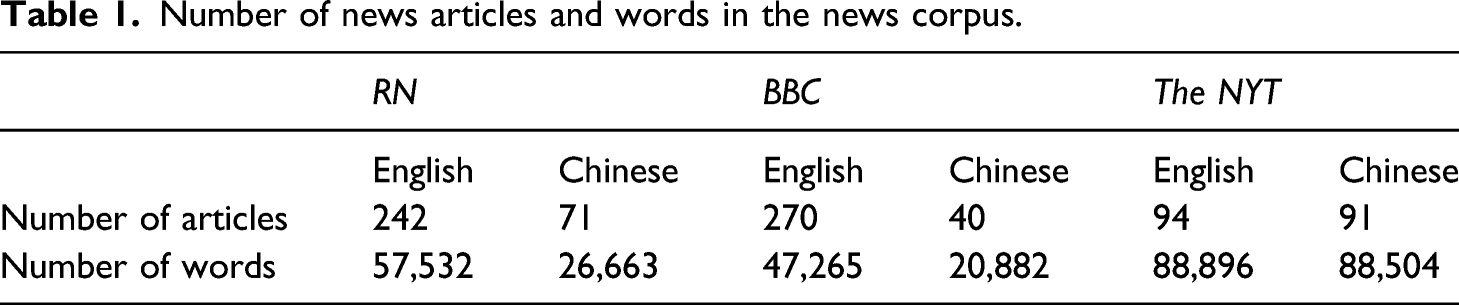
This study presents an inductive (bottom-up) approach by applying computer-assisted methods to framing analysis and suggests that these quantitative methods could systematically bolster the objectivity of the frame identification process.
Firstly, generic frames for the original and translated news articles were identified by applying keyword analysis as used in corpus linguistics. The keywords of the news corpora were compared with those of reference corpora. English Web corpus 2015 was selected as the reference corpus for the English corpora and Chinese Web corpus 2017 for the Chinese corpora. Keyword analysis revealed differences in recurrent thematic features between the original and the translated articles. Concordance searches of keywords were carried out afterwards to determine their specific contexts to generate news frames.
The top 25 keywords of each language pair from each media outlet were then tagged by using the English and Chinese semantic taggers of the Lancaster University Centre for Computer Corpus Research on Language’s Semantic Analysis System. A few keywords which could not be tagged automatically were tagged manually. These semantic tags were categorised into a taxonomy of news frames according to their general semantic fields as provided in the semantic tagsets. After these news frames were determined, a qualitative concordance analysis of these keywords in each category was conducted to see how they were used in different contexts.
Finally, the original and translated news texts were compared manually to assess whether there were any significant variations. The first step in this process was to identify the salient differences between the original and translated news. These shifts were annotated and coded according to a priori codes in the framework of CFA (as displayed in Figure 1) by using the NVivo software program. The next step was to determine whether these shifts occurred at the textual, intratextual or paratextual level. Statistics on framing strategies could then be generated. They gave an overview of the frequency of occurrence and could be used to identify patterns in the translated news texts.
Keyword analysis of news frames
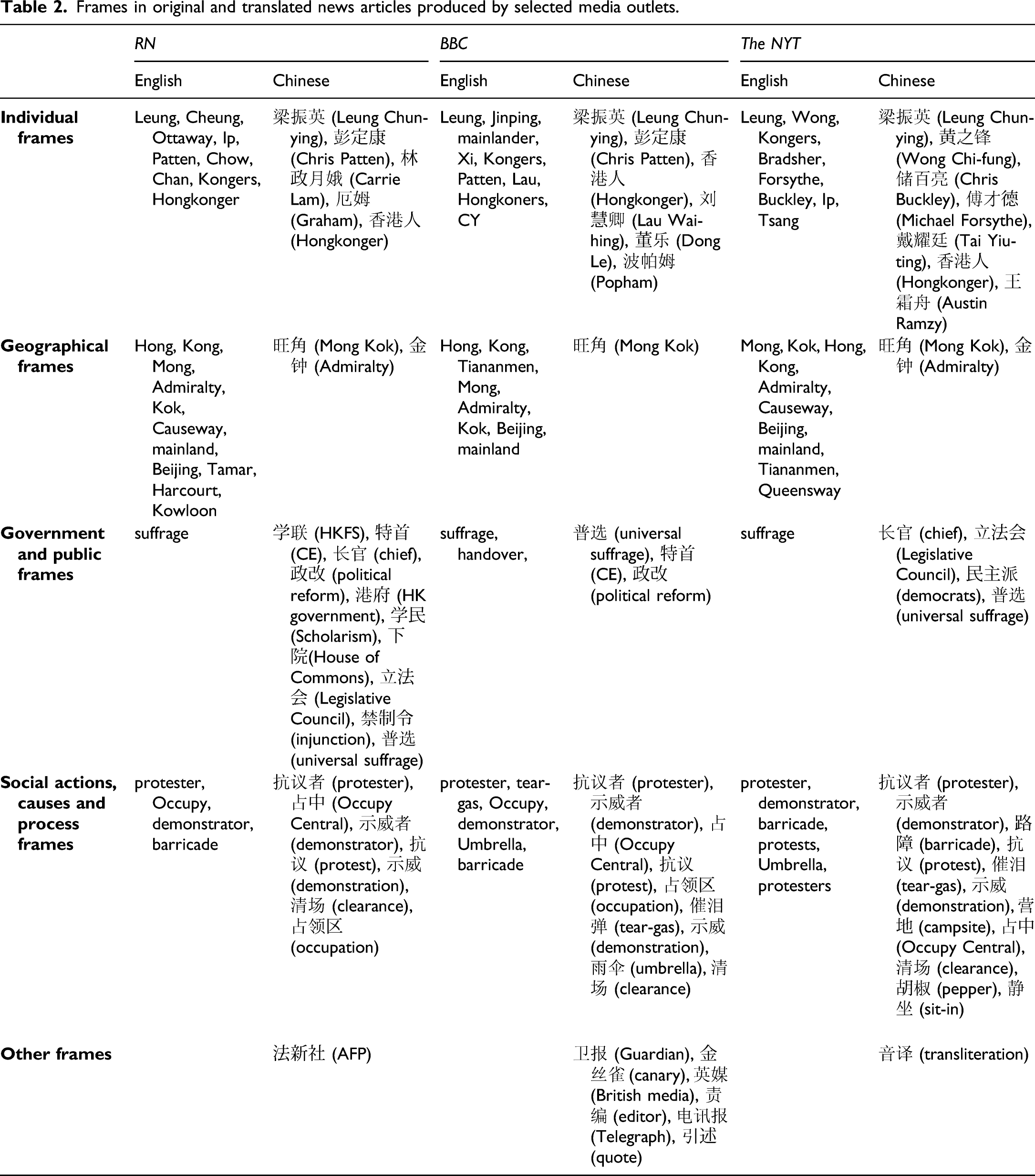
Frames in original and translated news articles produced by selected media outlets.
Individual frames
The media outlets reference many individuals by name. RN draws attention to a variety of political elites, including Leung Chun-ying and Carrie Lam from the Hong Kong Special Administrative Region (SAR) government, Chris Patten and the former British Prime Minister David Cameron. This suggests that the newspaper regards Hong Kong as an important political issue in the context of bilateral Sino-British relationships. Concordance searches of these pronouns in their specific contexts revealed that the newspaper describes how Carrie Lam, the then Chief Secretary for Administration, was appointed by the SAR government to negotiate with student protesters. It also explicitly criticises Patten for advocating democratic reform during his last term of office. Cameron is condemned for expressing his concern over the events, with his criticism of the Chinese government over its banning of a British parliamentary delegation from visiting Hong Kong also cited.
BBC Chinese features some personal narratives, such as that of Emily Lau Wai-hing, a pro-democratic politician who openly supported the protests. BBC Chinese mentions the Chinese president ‘习近平’ (Xi Jinping) 55 times, the most of any of the media outlets. Concordances of this keyword in the BBC Chinese corpus suggest that it principally collocates with words and phrases of negative connotations, and thus, the website portrays a negative image of the Chinese president in most circumstances.
The NYT Chinese relies heavily on its correspondents Chris Buckley, Mike Forsythe, Austin Ramzy and Alan Wong, as is evident from the relevant keywords. It also highlights ‘黄之锋’ (Joshua Wong), one of the student leaders of the Occupy Central Movement, and ‘戴耀廷’ (Benny Tai), one of the three initiators, with 78 and 27 occurrences, respectively. The website provides both English and Chinese equivalent names in its reports, which explains why they all remain prominent in the keyword list.
Geographical frames
Geographical names are frequent frames in both the original and translated news. Keywords referring to location names include ‘中环’ (Central), ‘金钟’ (Admiralty) and ‘旺角’ (Mong Kok). The Occupy Central Movement was officially launched outside the government headquarters in Admiralty and later spread to other areas of the city. Major sites of protests included Mong Kok, Admiralty and Causeway Bay. Each site had its distinctive characteristics regarding the protests. Admiralty was mainly occupied by student protesters and Mong Kok by people from all walks of life but mainly the working class. Causeway Bay hosted the smallest protests and was the last site to be cleared away on 15 December. Central is often associated with Occupy, given the naming of the series of protests as ‘Occupy Central’.
The NYT Chinese references more geographical names than the other news media. Of the three geographical names, Mong Kok appears to attract the most media attention. However, the Mong Kok site was the earliest to be cleared away, on 26 November. Mong Kok is a busy shopping area in Hong Kong with a high population density. The NYT Chinese frames that, throughout the protests, confrontations, sometimes violent, between police and protesters took place in Mong Kok and the police contended that gang members had infiltrated the protest, inciting violent confrontation.
Government and public frames
RN emphasises more frames concerning governance and the public sphere than BBC Chinese and The NYT Chinese. Nearly half of the keywords in RN relate to the government and the public sector, focussing on terms such as ‘港府’ (HK government) and ‘立法会’ (Legislative Council). The newspaper also draws attention to ‘特首’ and ‘行政长官’, both referring to the Chief Executive (CE), and used 41 and 42 times, respectively. Most cases of ‘行政长官’ (CE) indicate the central government’s support for the CE and express confidence in his SAR government’s management of the matter. This contrasts starkly with the protesters’ demand for his resignation. The government emphasises the rule of law and social order, mentioning law 76 times, and describes the Occupy Central Movement as an illegal activity. The translation is quite faithful to its original in this regard.
Social actions, causes and process frames
The selected media outlets share several keywords on social actions, including Occupy Central, demonstration, protest, demonstrators and protesters. These occur frequently in the RN, BBC Chinese and The NYT Chinese corpora.
RN and BBC Chinese relate the causes of the protests to the call for universal suffrage and mention political reform numerous times. RN raises the issues of ‘普选’ (universal suffrage) and ‘政改’ (political reform) 24 and 13 times, respectively. Concordances of both keywords suggest that the newspaper supports the then-current Beijing proposal to select the CE from an election committee. BBC Chinese also attributes the causes of the protests to demands for ‘普选’ (universal suffrage), a term which occurs 28 times, more than double the frequency of ‘政改’ (political reform) in the BBC Chinese corpus.
The outlets also lend differential emphasis to the activities of the movement’s participants. RN accentuates the likely negative consequences for the participants rather than focussing on their actual activities. Terms like ‘拘捕’ (arrest) and ‘禁制令’ (injunction) are prominent, emphasising the illegal nature of the protests. The BBC Chinese and NYT Chinese websites both foreground ‘雨伞’ (umbrella) as a symbol of the protests and keywords like ‘催泪弹/催泪瓦斯’ (tear-gas), which relate to methods used by the police to disperse the protesters. The NYT Chinese also stresses several keywords which describe aspects of the protest, such as ‘胡椒’ (pepper), ‘路障’ (barricade), ‘营地’ (campsite) and ‘清场’ (clearance), and focuses on events involving violent clashes between the police and the protesters near the end of the protests. The police are portrayed as brutal and violent, while the protesters are depicted as vulnerable and peaceful.
Framing patterns of strategies and devices
This section analyses how the news frames in the original news articles are (re)framed and the framing patterns constructed in the translated news articles. Some consistent patterns of framing emerged from the framing analysis of the translated articles. Figure 2, which was produced using statistics generated from Nvivo, gives a general overview of the specific framing strategies adopted by each media outlet on multiple levels. Number of framing strategies that fall into each general category used by the selected media outlets.
Textual framing
Framing at the textual level was the most common strategy used by RN and BBC Chinese. Their reliance on textual framing can be explained by the fact that transediting is a common practice at both outlets. Textual strategies such as addition and omission are mainly employed by RN to (re)frame its translated news about the protests. The Chinese mainland newspaper omits most references to police brutality, Hong Kong’s colonial history and criticism of the Chinese Communist Party (CCP). The large-scale and escalating character of the protests is rendered implicitly in the translated articles in RN, as is evident in Example 1. The epithets used to describe the CE as a stooge and the latter half of the sentence on police equipment are both omitted.
Example 1
ST: More than 3000 protesters gathered outside Leung Chun-ying’s office in the early hours, chanting for the chief executive – seen by critics as a Beijing stooge – to step down, while police equipped with riot helmets and shields stood firm behind barricades. (Agence France-Presse, 1 October 2014)
TT: 今晨,多名抗议者聚集在香港特区行政长官梁振英办公地点外, 要求他下台。(RN, 3 October 2014)
Gloss: This morning, many protesters gathered outside the office of the Chief Executive of the Hong Kong SAR, Leung Chun-ying, and asked him to step down.
Since the BBC Chinese website mostly selects a group of news articles from the British press and produces a translated summary of them, omission, addition and summarisation become the three most frequently used textual framing strategies. Few textual shifts occur between the original and translated news articles on The NYT Chinese website.
Intratextual framing
Framing by intratextuality is the second most used strategy by the media outlets. RN repeatedly includes frames on maintaining law and order and consequently criticises the illegal nature of Occupy Central and the trouble it has caused for local society. Critical epithets are employed to describe the protests as ‘非法’ (illegal), which reveals the newspaper’s firm stance against them. As Example 2 illustrates, the paper frequently adds the modifier ‘SAR’ before the names of the CE and the city. This strengthens the hierarchical sense of the local government being inferior to the national government and promotes the idea of a close bond between the mainland and the SAR.
Example 2
ST: The central government will ‘resolutely support’ the Hong Kong government’s efforts to safeguard the city’s rule of law which is the cornerstone of its future, President Xi Jinping told visiting Chief Executive Leung Chun-ying at their first meeting since the Occupy protest began. (South China Morning Post, 10 November 2014)
TT: 中国国家主席习近平对香港特别行政区行政长官梁振英说, 中央政府充分肯定、全力支持行政长官和特区政府依法施政。(RN, 11 November 2014)
Gloss: The Chinese President Xi Jinping told the Chief Executive of the Hong Kong Special Administrative Region, Leung Chun-ying, that the Central Government fully affirms and supports the Chief Executive and the SAR government in their administration of the law.
Intratextual framing is relatively less frequently resorted to by BBC Chinese because the journalists/translators provide an approximately faithful rendition of the selected news contents. The naming of the protests and various location references, such as to the Chinese mainland and Hong Kong, is repositioned in its translated articles. BBC Chinese uses both ‘占中’ (Occupy Central) and ‘雨伞运动’ (Umbrella Movement) in referring to the events, and ‘大陆’ (mainland) and ‘特区’ (SAR) in describing the Chinese mainland’s and Hong Kong’s political status, respectively. There are only five instances of shifts in naming and explicitation observed in the translated NYT Chinese articles.
Paratextual framing
Framing through paratextual devices is used less often than other strategies by the selected media, except for The NYT Chinese which mainly (re)frames its news stories through paratextual devices. The website primarily frames its news stories through changes of headlines and the addition of images in its translations. As the headlines in Examples 3 to 5 show, The NYT Chinese translators render leader into various Chinese equivalents including ‘特首’, ‘领袖’ and ‘领导人’ which denote their distinctive political status.
Example 3
ST: Politician who called for Hong Kong leader’s resignation is formally penalised (The NYT, 30 October 2014)
TT: 呼吁特首下台,香港议员被政协除名 (The NYT Chinese, 30 October 2014)
Gloss: Calling for the Chief Executive to step down, Hong Kong legislator was removed from the CPPCC
Example 4
ST: Some Chinese leaders claim U.S. and Britain are behind Hong Kong Protests (The NYT, 11 October 2014)
TT: 中国领导人称美英是‘占中’幕后推手 (The NYT Chinese, 11 October 2014)
Gloss: Chinese leaders claim that the US and Britain are behind the Occupy Central
Example 5
ST: Hong Kong student leaders consider whether to end protest camps (The NYT, 5 December 2014)
TT: 香港学运领袖将决定是否结束‘占中’(The NYT Chinese, 5 December 2014)
Gloss: Hong Kong student movement leaders will decide whether to end ‘Occupy Central’.
Besides, The NYT Chinese features images of violent confrontations between protesters and the police as well as protesters and anti-protest supporters. The website frequently posts images which depict protesters as vulnerable and victims of the police. This selection of images in the translated items reinforces the news outlet’s narratives (re)framed through translation.
BBC Chinese (re)frames its version of stories through the paratextual devices of headlines and leads at the beginning of translated articles. The website adds interrogative headlines and modifies original headlines from the British press: for example, ‘香港抗议将如何结束’? (How will Hong Kong protests end?) on 6 October 2014 and ‘香港大规模抗议之后又将如何’? (Fold or fight on? Choice facing Hong Kong’s young protesters) on 8 October 2014. The translated headlines depict the Chinese central and local SAR governments negatively in headlines such as ‘不满北京霸凌’ (Beijing bully) on 2 December 2014 and ‘中国对香港民主漠视引发抗议一代’ (China’s indifference to democracy in Hong Kong has spawned a protest generation) on 12 December 2014. These negative headlines have been foregrounded and strengthened from their original headlines.
Generally speaking, each media outlet adopts a different combination of framing strategies and devices. The NYT Chinese employs the greatest number of paratextual devices in framing its news on the protests. BBC Chinese (re)frames news stories through a considerable amount of framing at all three levels. RN adopts a combination of textual and intratextual framing strategies, though it seldom uses paratextual framing devices except with five instances of news headlines and images.
Conclusion
This study provides a comprehensive assessment of news framing in translation by adopting a corpus-based approach. It combines both objective quantitative and subjective qualitative research methods. Quantitative analytical findings from the corpus-based study are integrated with, and interpreted in the light of, qualitative framing analysis. This approach enhanced the characterisation of journalistic translation from the perspective of framing theory and suggested the potentiality of corpus-based methods for future studies of journalistic translation in the context of their cultural and political settings. This will prove to be useful, especially when original and translated news articles are not in parallel versions, as is typical in journalistic translation.
This study has identified several news frames in the coverage of the protests by the selected media, including individual, geographical, government and public, and social actions, causes and process. RN, as the mouthpiece of the CCP (Xia, 2019), employs predominantly government and public frames in its coverage of the politically sensitive issue of the Occupy Central Movement. This result partially corroborates the ideas of Kuang and Wei (2018), who suggested that party newspapers in China use leadership frames with greater frequency than non-party newspapers in their reporting of sensitive issues. BBC Chinese and The NYT Chinese utilise more geographical, action and process frames in relation to democracy, showcasing the violent conflicts between the brutal police and peaceful protesters.
Another significant finding that emerged from this study was that each media outlet adopted different framing strategies and devices at the textual, intratextual and paratextual levels to (re)frame their original news through translation in a way which is distinct from their original versions. This study analysed these in detail and compared them with one another. RN utilised the greatest number of textual and intratextual framing strategies of all the selected media outlets. This finding broadly supports previous studies (Wu, 2018; Xia, 2019) which indicate that RN employs framing strategies such as labelling and selective appropriation. It also suggests that paratextual devices of news headlines and images are other ways in which RN frames the news. BBC Chinese utilises a combination of textual, intratextual and paratextual framing strategies. Translations on BBC Chinese were (re)framed through a mixture of strategies and devices at all three levels. The NYT Chinese mainly framed their translations through the paratextual device of news headlines.
One implication of the framing analysis in this study is that it is both possible and productive to classify framing devices at the textual, intratextual and paratextual levels. Textual analysis of translated news articles implies that omission, addition, substitution and reorganisation are the most common framing strategies used in journalistic translation. The analysis of intratextual framing and epithets, in particular, suggests that framing theory still lacks a systematic framework for analysing the lexico-grammatical level. This calls for the integration of other linguistic models into the framing analysis, such as appraisal theory, which has been applied to analyse evaluative language in translation and interpreting that reflects ‘critical points’ (Munday, 2012: 40) in translators’ and interpreters’ decision-making processes. The findings emerging from the paratextual analysis of headlines, layouts, images and so on have important implications for developing a multimodal analytical framework within the framework of framing theory.
A limitation of corpus methods is that they have limited capacity to inform framing theory beyond the textual level. In general, corpus-based CFA can describe what and how frames change from original to translated texts, but it does not explain why such framing shifts occur. Thus, additional contextual analysis is required to uncover socio-cultural and other aspects in detail as well. Another limitation of this study is that the coding of various framing strategies was conducted manually by the researcher. It would be more accurate to employ more coders to test the validity of results. Scholarly interest in journalistic translation is primarily focused on framing. Further research could also be conducted to explore other intersections between translation studies and journalism, for example, ‘agenda setting’ and ‘priming’, two similar yet distinct concepts applied to analyses of news coverage that have so far been unexplored in translation studies.
Footnotes
Acknowledgements
The author would like to thank the editors, both reviewers, Professor Jeremy Munday and Professor Binhua Wang for their constructive comments and helpful suggestions.
Declaration of conflicting interests
The author(s) declared no potential conflicts of interest with respect to the research, authorship, and/or publication of this article.
Funding
The author(s) disclosed receipt of the following financial support for the research, authorship, and/or publication of this article: This work was supported by the China Scholarship Council–University of Leeds scholarship.
