



Abstract
‘Targeted Poverty Alleviation’ (TPA) is the Chinese government’s latest anti-poverty policy, aiming to lift the remaining 70 million Chinese citizens above the poverty line by 2020. The TPA scheme is novel in that every impoverished household is paired one-on-one with a local government official, who then bears responsibility for the eradication of their poverty. Despite being at the core of TPA, this pairing mechanism has received little academic attention. Based on an empirical case study of ten households across two villages in rural Shaanxi Province, China, this article aims to investigate this pairing mechanism at the micro level and its outcomes for poverty alleviation, in order to better understand how the notion of ‘precision’ is being realized through TPA. Two distinct traits that influence the TPA pairing system emerged: first, the ranking of the assigned local official is important in that higher-ranked officials have greater social and financial resources at their disposal, bringing about enhanced poverty alleviation outcomes for their households compared with lower-ranked officials. Secondly, the willingness and ability of impoverished households to actively participate in their poverty alleviation programme is beneficial within the TPA scheme, achieving better outcomes in the long-term compared with households who are passive receivers. TPA has the potential to work effectively and to achieve China’s poverty reduction goals; however, our analysis shows that some pairing mechanisms are more effective in achieving poverty alleviation goals than others.
Introduction
China has long favoured a state-led, top-down approach to poverty alleviation, where the onus for poverty alleviation lies with the central government (Donaldson, 2007). China’s battle against poverty spans decades, but not until recently did the central government elevate the priority of national poverty eradication to the highest accord, mobilizing extensive resources in an attempt to conclusively solve the problem. In November 2015, President Xi Jinping publicly declared that China would eradicate all poverty by 2020 through initiating a new poverty reduction scheme called ‘Targeted Poverty Alleviation’ (TPA 精准扶贫 jingzhun fupin) (Lu and Huang, 2016).
There is the expectation that TPA will fulfil a large part of the ‘Chinese dream’, lifting the remainder of the Chinese population living in poverty, approximately 70 million people, above the poverty line 1 , within this five-year period. TPA is perhaps the largest scheme of top-down poverty reduction to have ever been implemented. TPA is different from China’s previous poverty reduction schemes, as it has been devised to have the notion of precision at the heart of every step of the poverty reduction process; poor people should be precisely targeted at the household level, their unique cause of poverty identified, and then tailor-made access to anti-poverty projects that meet individual households’ circumstances and abilities should be granted (Lu and Huang, 2016). Furthermore, the Chinese government has made TPA remarkably different from other poverty reduction schemes in the world by putting the responsibility for a household’s poverty alleviation on government officials at the local level, with each poverty household being assigned a specific local official who is tasked with implementing TPA and monitoring the household’s progress (Lu and Huang, 2016).
TPA was introduced as a response to the increasing difficulties China faces in reducing the numbers of people living in poverty. China’s past poverty alleviation efforts have been extraordinarily successful, accounting for three-quarters of all poverty reduction in the world over the last century (Ang, 2017). For example, in the period from 1981 to 2001, the percentage of the Chinese population living below the poverty line fell from 53% to 8% (Ravallion and Chen, 2007). 2 The most significant contributions to this rapid decline in poverty include the exponential economic growth experienced by China under Deng Xiaoping after 1983, reforms to land and agricultural procurement, as well as an array of national anti-poverty schemes rolled out by the central government (ECU-CPAD, 2016). The majority of China’s past anti-poverty schemes have used regional targeting of impoverished populations at regional, township and village levels. However, there is consensus in the literature that these schemes failed to target those Chinese citizens truly living in poverty, due to misdirected funding, misaligned incentives for local officials and government corruption (Rogers, 2014; Zeng et al., 2015).
The purpose of TPA, therefore, is to address the shortcomings of China’s previous poverty reduction policies. The policy is conceptualized as “changing from flood-based irrigation (大水漫灌 dashui manguan) to drip irrigation (精准滴灌 jingzhun diguan)” (Lu and Huang, 2016). This article explores this innovative and highly focused style of poverty reduction. TPA is largely motivated by China’s socialist values: poverty is viewed as the nation’s largest roadblock that is hindering progress towards becoming a truly developed country, and every member of society must share some part of the nation’s wealth if China is to become a ‘moderately prosperous society’ (小康社会 xiaokang shehui) (Lu and Huang, 2016).
Officials responsible for implementing TPA face two major challenges. The first is the requirement to collect extensive information about poor households and visit them regularly. Officials have to maintain an information dossier about the poor households, called a jiandang lika (Ω®µµ¡¢ø®). This dossier must be displayed in every household’s living room and contains a detailed summary of the family’s demographic, income and living circumstances, outlining their anti-poverty plans for both the short and long-term future, as well as tracking their progress towards meeting the national poverty alleviation goals. The second is that the TPA programme makes local officials, not poor household members themselves, responsible for poverty reduction, but does not recognize that not every official has sufficient resources to do this.
We can see that TPA is a unique approach to poverty reduction, particularly in regard to the one-on-one pairings between responsible government cadres and impoverished households. The article aims to investigate the pairing mechanism and its outcomes, in order to better understand how the notion of ‘precision’ is being realized through TPA. It explores the different dynamics and working mechanisms that interact to facilitate TPA, as well as the implications of these dynamics for assessing the TPA scheme as a whole.
Investigations and fieldwork were undertaken in two rural villages identified as impoverished under TPA in Ankang Prefecture in Shaanxi Province. This region, located inland in western China, is one of the 14 ‘contiguous poverty-stricken areas’ identified by the government as experiencing persistent and reoccurring poverty (Liu et al., 2017). Data for this qualitative study were collected through in-depth, semi-structured interviews with nine local TPA officials (five village leaders and four TPA officials in village Q) and ten households (eight in village Q and two in village R) which were designated as poverty households under the government’s TPA scheme, as well as detailed observations in July 2017 and January 2018.
The evolution of TPA and the pairing mechanism
It is well known that over the past four decades, China has achieved rapid and unparalleled development, by undertaking a range of broad-based social and economic reforms. China’s gross domestic product (GDP) grew at an average of 9.4% annually from 1978 until 2003; this high economic growth combined with land reforms and liberalization of the agricultural market resulted in a dramatic reduction of poverty (Rozelle et al., 1998; Tao and Liu, 2007). However, China’s economic growth has perpetuated an increasing wealth disparity between rural/urban, and coastal/inland areas, and at different times, income growth and poverty reduction have plateaued in China’s rural areas (Rozelle et al., 1998; Tao and Liu, 2007).
As a result, China’s central government has also pursued specific strategies aimed at rural areas where poverty is most concentrated (Fan et al., 2016; Golan et al., 2014; Kuhn et al., 2016). Studies have concluded that 75%–80% of the decrease in poverty between 1981 and 2001 can be attributed to a reduction of extreme poverty in rural areas (Labar and Bresson, 2011; Ravallion and Chen, 2007). The precise factors driving these reductions at different points in time and the success or otherwise of different poverty alleviation programmes are the subject of much scholarly and other literature (Meng, 2013; Park and Wang, 2010; Ravallion and Chen, 2007; Rozelle et al., 1998; World Bank, 2009; Zhang et al., 2003). This literature points to the combined effect of agricultural reforms, sustained economic growth, rising rural incomes and a succession of massive poverty reduction efforts. While evolving over time, China’s poverty alleviation programmes have always been characterized by a top-down approach and the intensive involvement of the state at various scales.
Until the development of TPA, China’s anti-poverty programmes sought to address poverty using area-based approaches, operating at either the region, county, township or village level (Lu and Huang 2016). However, the rate of rural poverty alleviation in China had begun to slow significantly (Fan et al., 2016; Wang, 2017). On the one hand, efficacy was compromised by local officials’ behaviour and false reporting by the local government departments in order to meet targets, as well as a misdirection of funding, such that the poorest did not necessarily benefit (Rogers, 2014; Zeng et al., 2015). On the other hand, reaching the remaining impoverished population in China had become increasingly difficult and expensive (Lu and Huang, 2016).
TPA’s approach is to assign responsibility for individual poor people and households to specific local cadres, reflecting a determination to increase the accountability of local officials for poverty reduction. In doing so it seeks to resolve some of the issues arising from previous measures, including mistargeting of funds and the politicization of project selection (Kuhn et al., 2016; Rogers, 2014; World Bank, 2009) The one-to-one pairing mechanism between responsible government cadres and impoverished households in fact originated from local poverty reduction practices in Xinjiang, Guizhou and Sichuan before 2012. This practice was viewed as successful, and thus was officially introduced at a national level by the current President Xi Jinping in 2013.
Targeted poverty alleviation in the literature
In this section, we outline existing literature on TPA and related poverty alleviation initiatives. We discuss the major concerns of the literature and the extent to which the pairing mechanism has been analysed.
Initiated in 2013, TPA was cemented in 2015 with the fifth plenary of the 18th CPC Central Committee’s decision that all poor residents should be lifted out of absolute poverty by 2020 (Gao, 2018). TPA has become a very popular research topic in China; several thousand Chinese papers have been published since the programme was introduced, especially since 2016. A brief review suggests that the majority of Chinese studies focus on the necessity of TPA, the interpretation of the TPA concept itself or policy issues (see for instance Sun, 2015; Wang, 2017; Wang and Guo, 2015; Zheng and Wang, 2015). A characteristic of these papers is that they address general issues at a macro scale, rather than providing detailed analysis of particular places. Another cluster of studies discusses various modes of TPA support, such as backing by finances or industry, education and skill training, tourism and resettlement (Li, 2018). A third cluster evaluates TPA at a regional or village scale. There are very few studies which focus on the experiences of individual households (Chen et al., 2016; Sun, 2015).
Among a limited number of Chinese papers which address the ‘one helping one’ system (one local cadre is responsible for one poor household), some focus on the benefits of this approach, such as Tang et al. (2020), Wang (2016) and Liu (2017), while others develop an index system to evaluate poverty households’ satisfaction levels (Cai et al., 2019; Gu, 2019; Liu, 2017). Ding’s (2017) work is the most relevant for our purposes. The author reports that a cadre’s official ranking is important for the TPA result; the higher an assigned official’s ranking (also the more powerful their department, such as the Department of Finance, Development and Reform Commission, Department of Public Security), the richer the information resource and social capital which can be mobilized by the assigned official to assist the poor household. The poor households assisted by the most powerful cadres are then used as ‘model’ households by village and township governments. However, this two-page paper does not provide empirical evidence. There is no detail about how local cadres with different official rankings are paired with poverty households, nor how the poverty alleviation outcomes differ among these different pairings.
There is a growing body of English-language literature on TPA. Existing studies have considered the general approach and effect of TPA at the county and provincial scales (Gao 2018; Zhang et al., 2018; Zhu et al., 2018) or analysed the implications of livelihood clusters for effectively targeting poverty relief (Wang et al., 2019). Others have focused on the effect or implementation of specific initiatives that have arisen under TPA, such as pro-poor tourism (Liang and Bao, 2018; Lo et al., 2019) and land transfer (Zhou et al., 2018). Overall, there is a strong emphasis on the measurement and characterization of poverty at the national scale (Wang et al., 2018), particularly its spatial characteristics (Liu et al., 2017; Zhu et al., 2018).
A smaller number of studies take a more grounded, qualitative approach and begin to unpack questions of governance and local politics. Focused on dynamics on the ground, Li et al.’s (2016) survey of people in 22 counties examines the kind of assistance people would ideally like to receive from TPA, and the problems that local officials encounter. This study found that local officials and village committees have difficultly identifying who the ‘real’ poor households are, that identification is often based on subjective judgement and that rates of returning to poverty are quite high (up to 53% in certain regions). Rogers et al. (2019) focus on resettlement as a key plank in TPA. Their analysis finds similar issues on the ground: while improved practice has ameliorated many of the problems of previous poverty resettlement programmes, new tensions have arisen around who is identified as poor and who should get access to government-supported jobs.
At a more general level, Smith (2018) discusses the ideological underpinnings of China’s ‘war’ on poverty and its campaign style of governance. Zeng (2019) analyses the TPA campaign as a mode of governance, examining the key role played by bureaucrats in TPA. His discussion centres on local officials’ adaptive strategies in response to highly demanding targets often ill-matched with local conditions, as well as onerous paperwork and ad hoc inspections. While his discussion of bureaucracy does not include the pairing mechanism, Zeng’s study, nonetheless, highlights how the particular norms and practices of China’s hierarchical political system are so essential to understanding policy outcomes.
Therefore, TPA is gradually coming to be understood as an initiative whose conception, implementation and outcomes need to be understood as shaped by much broader political and economic trends in rural China. This is very much in keeping with earlier studies of China’s previous poverty alleviation and rural development strategies (Ahlers and Schubert, 2013; Looney, 2015; Loubere 2018; Rogers, 2014; Smith, 2009, 2010) that speak to much broader debates about the nature of Chinese governance. The one-on-one pairing mechanism has received surprisingly little attention, despite it being a key process through which TPA is supposed to achieve its precision and its aims, and through which we can better understand the local politics of poverty alleviation. It is acknowledged that half a million cadres are being sent to poor villages to ‘enhance the masses’ ability’ (Liu et al., 2018: 248), but what these cadres do and the implications for poor households are yet to be examined in detail. This article presents the first qualitative study of this mechanism. We do not seek to measure the overall effect of the pairing mechanism on poverty rates, but aim to delve into the micro-politics of TPA through an empirical case study in Ankang, Shaanxi Province.
Understanding TPA pairings
Site background
Ankang Prefecture is mountainous, with an extremely variable climate, where access to water, transport and employment opportunities can be restricted due to the remoteness of rural communities (Bowden, 2005; Fan et al., 2016; Lu and Huang, 2016). TPA is currently operating in Ankang, and the villages selected for our case study are involved in the scheme of ‘pro-poor tourism’—a strategy that aims to capitalize on the natural beauty of the area and generate income for impoverished communities through tourism revenue (Luo, 2016). Many of the households interviewed for this study are directly or indirectly involved in the operation of nongjiale (≈©º“¿÷)—a rural inn or guesthouse that forms the crux of this type of tourism experience. Nongjiale tourism originated in the early 1990s in Chengdu, Sichuan province, as a grassroots approach to poverty alleviation. Farmers opened up their homes to travellers passing through their village, providing accommodation and home-style meals to tourists, similar to the Western notion of a ‘bed and breakfast’ style accommodation (Su, 2013; Yang, 2015; Ye, 2015). It enables the household to generate additional income and improve their life circumstances (Su, 2013; Torres and Momsen, 2004).
In-depth, semi-structured interviews were conducted with 10 households participating in the TPA scheme. These households are located in two villages in Ankang in the southern part of Shaanxi Province. All of the participants are smallholder farmers, and the majority of household heads were educated up to a primary school or junior high school level. The demographics of the households interviewed were highly variable. The heads of households were aged between 40 and 70 years, and family sizes ranged from one to five members. The households’ ‘cause’ of poverty, according to the TPA dossier, were also variable, ranging from illness/disease, burden of education fees, insufficient labour to support the family and lack of quality housing. This diverse group of poor households forms the basis of our examination of the micro-scale mechanisms of TPA.
Assigning local officials to poverty households under TPA
Starting in 2014, local county government officials were paired with each of the households studied for this article. Officials were mostly employees of the Tourism Administration, with some from the Tax Bureau, holding a number of positions ranging from low-level clerks, all the way up to Director General. The detailed pairing procedure can be summarized as follows. In these two villages, when a household was identified as applicable for the TPA scheme, they were then paired with a local government official responsible for assisting and monitoring the household’s progress in eradicating poverty. As described during interviews with a TPA official, every public servant throughout the province is mobilized, including local officials from all different departments and bureaus, and are allocated to different impoverished households in their region.
The first step was to form village-level TPA ‘leading groups’. Each impoverished village has a poverty alleviation task force known as the leading group under the TPA scheme (∑ˆ∆∂π§◊˜∂”fupin gongzuodui). This leading group is generally composed of officials from county or prefectural levels of government, a local township official and village cadres, including the committee members of both the village-level Chinese Communist Party (CCP) branch and village committee. In the villages examined in this study, the leading group was composed of seven members: four local village cadres (i.e. Party Secretary, village head, clerks of the CCP’s village-level branch and village representative of women affairs), two senior officials from the local township and county government and one junior official from the prefectural government who were dispatched to the village. All significant decisions regarding the TPA scheme are made by this leading group.
The leading group is headed by the ‘Number One Secretary’ (µ⁄“ª Ⱥ« di yi shu ji), who is appointed by the township CCP committee. In this case, the Number One Secretary was the county government’s Deputy Director of Tourism Administration—because the county Tourism Administration had been assigned responsibility for overseeing anti-poverty efforts in our case study region.
The second step was the identification of households considered to be impoverished under the TPA scheme (see Li et al., 2016, for detail). Village Party Secretaries provided a list of all households in their village ordered by the severity of income poverty. In addition, the constraints on households that may lead them to experience poverty, such as illness, lack of labour or financial capital, were also detailed. The third step is pairing a local official with each impoverished household. In theory, households experiencing more severe poverty should be allocated to the most powerful and senior officials (Liu et al., 2018). The final pairing list was proposed after an initial discussion between the village Party Secretary and the Number One Secretary and is then approved by the leading group. Depending on their rank, officials can have more than one ‘pairing’. In Ankang, we found that one poor household is assigned at the office clerk level, two at the division chief level and three for an officer who is more senior than division chief.
The final step in this process is to publicly display the information about allocated households and paired local officials. For every household participating in TPA, a dossier openly displays all key information regarding the scheme, such as the demographics of the family, their reason for poverty, the name, position and phone number of their assigned local official, as well as the short- and long-term anti-poverty projects the household is involved in (Sun, 2018).
Figure 1 depicts the dossier of one of the households interviewed for this study. It states that the major reason for this household’s poverty is illness, that they were identified as a poor household in 2014, and that the original target date for lifting this family above the poverty line was 2017. But according to interview data, this household was lifted above the poverty line in 2016. The short-term poverty alleviation plans for this family was to allocate them an extra 2 mu (ƒ∂) 3 (1,333 m 2 ) of land to grow corn, and 1 mu (667 m 2 ) of soybeans. Their long-term poverty alleviation plan is a 1.5 mu (1,000 m 2 ) aquaculture breeding pond. In addition, the plan states that the family members will perform odd jobs around the village to generate income. The dossier also includes the name and phone number of their assigned local government official, stating that they are paired with the Tourism Administration’s Director General.
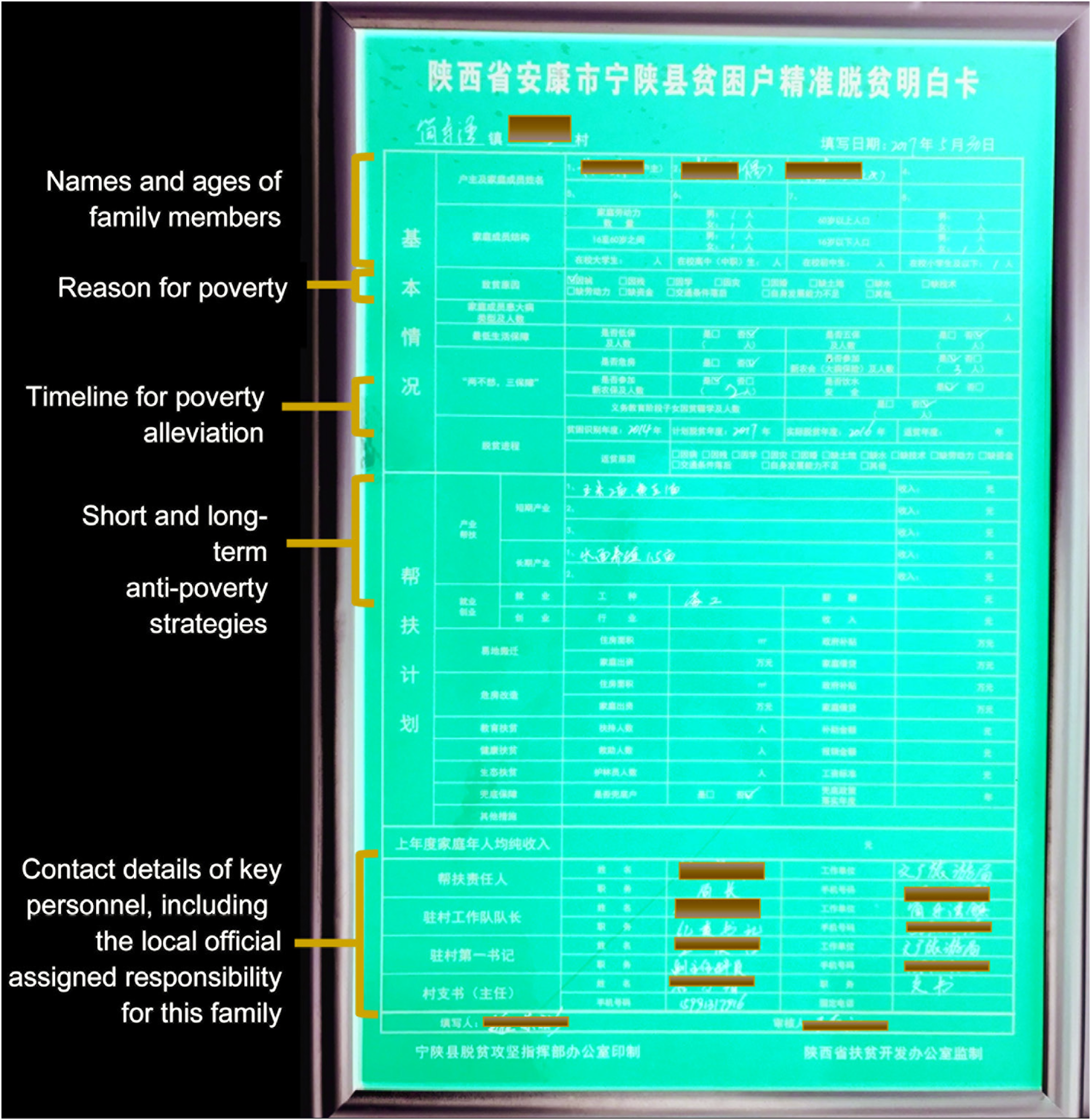
The rationale for this practice is that the central government reminds all relevant stakeholders about who is responsible for alleviating each household’s poverty and cements the proposed solutions in an official, highly visible format. It appears the government has devised such a system as a means to place pressure on lower-level officials, who are ultimately responsible for the success of the TPA scheme. From the perspective of the impoverished households themselves, some interviewees expressed that they were unhappy to be arbitrarily given a poverty ‘label’ by the government, and felt some shame and embarrassment regarding how publicly all information is displayed. Other reports have found similar sentiments, see Sun (2018) and Gao (2018).
In our analysis, two distinct traits in the TPA pairing system emerged. First, there is enormous difference in the ranking and subsequent political clout of local cadres assigned to impoverished households, ranging from lowly office clerks to the powerful Director of the Tourism Bureau. Secondly, there appeared to be significant variability in the characteristics of the impoverished households themselves, in terms of willingness and ability to actively participate in the TPA scheme. This section details how the analysis arising from our case study can be used to build a typology of TPA pairing. To be clear, the groupings outlined below did not inform participant selection: these are characteristics that emerged from our analysis.
There is consensus in the literature that active participation in one’s poverty alleviation plan is beneficial for the eventual outcome; participation fosters a sense of self-empowerment and allows for bottom-up approaches to emerge that tend to be better aligned with local conditions and capabilities of the impoverished population (Escobar, 1995; Laderichi et al., 2003; Lu and Huang, 2016; Strier, 2009). Moreover, active participation in poverty reduction efforts results in greater engagement and ownership of the strategies. The opposite can be said of those who are passively engaged with poverty alleviation efforts: when strategies are imposed from the top-down with little engagement with the recipients themselves, impoverished communities may be alleviated from poverty in the short-term, but lack the self-determination to ensure they remain out of poverty into the future (Wei, 2011).
Using the information on each household’s dossier, as well as key information extracted from interview transcripts, we placed each of the 10 households along a continuum from ‘passive’ to ‘active’ in terms of engagement with their own anti-poverty projects under TPA based on the following factors:
whether the members of the household members were of working age, or else dependent on support as either an elderly citizen, a child, or someone suffering from illness; the nature of support the poor households received: the plans implemented to lift the household out of poverty can be broadly divided into ‘passive’ (including simply receiving government poverty allowances, dibao
4
payments or allocating extra cropland to increase food consumption) and ‘active’ (including shifting from farming to animal husbandry or starting running rural inns, or undertaking migrant work, or taking employment in local agricultural cooperatives and small-scale enterprises to earn salary); whether the household expressed being motivated to improve their living standard in the future (active and optimistic) or were negative towards the future (passive and pessimistic); and whether the household was focused on meeting short-term needs or on their long-term family livelihood.
Households who were predominantly active in their approach to TPA were coded as group 1, while those who are more passive were coded as group 2. While somewhat crude, these two dichotomous categories allow us to characterize the household as a whole, with the aim of developing a typology of interactions. Variations certainly exist within the categories of groups 1 and 2, and within households themselves, which will impact how TPA is able to operate in specific household circumstances. For instance, it is important to consider the differences in needs and abilities between group 2 households that are ‘objectively passive’ (unable to proactively engage with TPA due to their age, mental or physical disability, or illness), and those who are ‘subjectively passive’, as demonstrated by a pessimistic outlook or an unwillingness to engage.
Since TPA mobilizes all local government officials, this study sought to explore if household outcomes were shaped by the relative position of the paired official.
Using the information on each household’s dossier about place of employment and position title, each local official was sorted into two primary groups: group A for highly ranked officials (e.g. ‘Director’, ‘Director General’) and group B for lower-ranked officials (e.g. ‘staff member’, ‘clerk’). Higher-ranked officials are assumed to have accumulated more social power, access to finance and experience compared with lower-ranked, less powerful cadres.
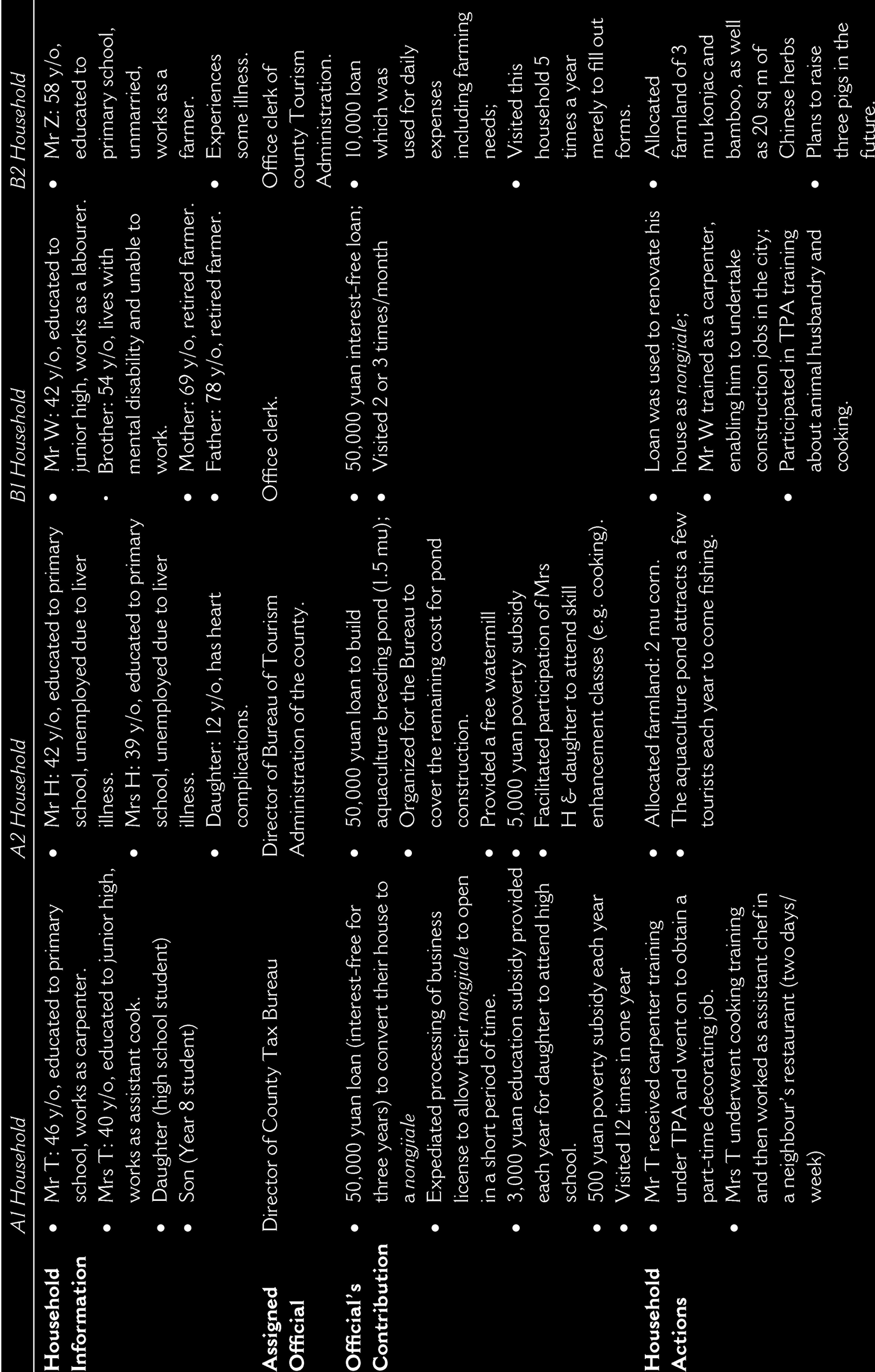
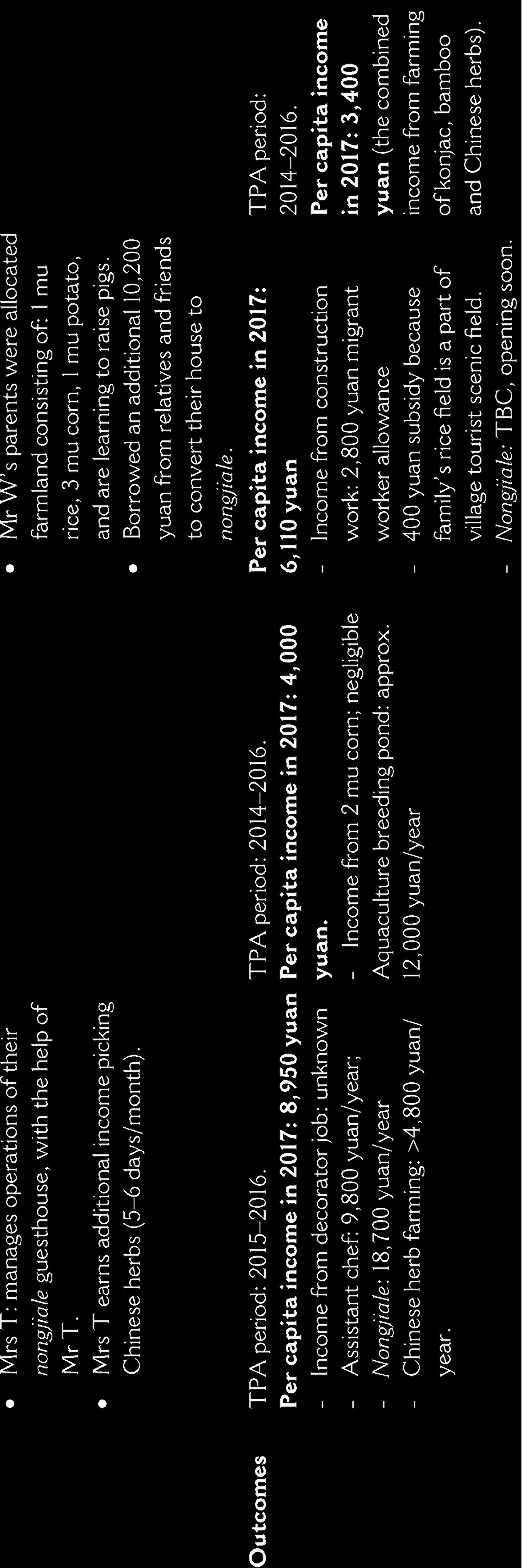
Figure 2 demonstrates the differences between each of the four pairing dynamics, coded as A1, A2, B1 and B2 and places all 10 households. Table 1 and the subsequent discussion looks at one household from each quadrant in more detail, describing specific interactions and outcomes.
Summary of four pairing actions and outcomes
Summary of four pairing actions and outcomes

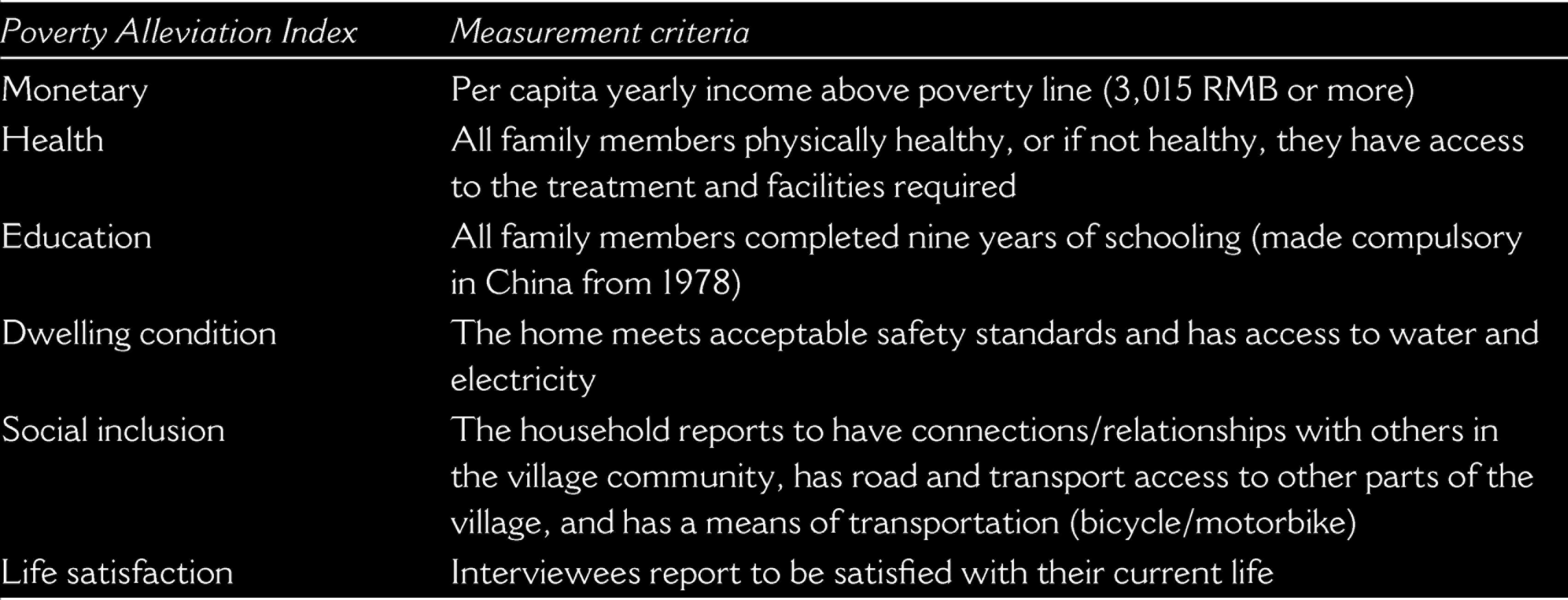
This research uses a multidimensional index of poverty, drawing on literature that conceptualizes poverty in a number of different, often coexisting, forms, including monetary poverty, capability poverty and social exclusion poverty (Kwadzo, 2015; Laderichi et al., 2003; Peet, 1975). Therefore, six measurements of poverty were chosen to determine the relative poverty status of each household in this study, including finances, health, education, dwelling condition, social inclusion and satisfaction with quality of life. Table 2 depicts the criteria against which each of these indices were measured in this study, based upon international standards for poverty explicated by the World Bank (2017), as well as China’s national policies on health, education and the provincially demarcated poverty line for Shaanxi (Donaldson, 2007; Lu and Huang, 2016).
Criteria for poverty alleviation across six different indices
The family of Mr and Mrs T typifies a poverty household operating under the A1 dynamic. This is the strongest ‘alliance’ among the four groups. The couple are aged 40 and 46 years old and are in good physical health. They are actively engaged in various skills training programmes under TPA. Mrs T is skilled in cooking, while Mr T is proficient in carpentry and other trades. These factors enable them to be active participants in their own poverty eradication process, taking on the labour-intensive and long-term project of constructing and operating a nongjiale. Moreover, we learned that they are not happy with their current life circumstances and so are actively trying to improve the family situation by focusing on giving their two children a good education. Unlike some rural parents who, due to traditional patriarchal influences and financial constraints, are not willing to pay for female offspring to complete high school education, Mr and Mrs T have chosen to send their daughter to high school as a means of increasing her human capital and chances of being able to generate income in the long-term. This is another indicator of their active engagement with their own poverty alleviation. In addition, they both have multiple jobs: Mr T works as a part-time decorator and family business assistant. Mrs T participated in the free skills training provided by the local government for cooking and nongjiale operation. Not only does she manage the family business, Mrs T also works as a part-time assistant chef in a nearby restaurant, as well as picking Chinese herbs at a farm for additional income.
This family’s jiandanglika dossier identifies their assigned local official to be the Director of the Local Tax Bureau—the most powerful position within the offices at any local government level (Ding, 2017). It was evident when interviewing the couple that the high rank of their assigned official was viewed as a key factor that enabled them to choose to construct a nongjiale under TPA, as this is a project that takes significant expertise, finances and resources to build. The Director of the Local Tax Bureau gave this household a 50,000 yuan three-year interest-free loan to convert their house into nongjiale, a 3,000 yuan education subsidy for their daughter, and a 500 yuan poverty subsidy (the last two items are not available for the majority of students from impoverished households). More importantly, the Director was able to expedite the usually time-consuming process of applying for a business licence, allowing the family’s nongjiale to open for business in a relatively short period of time. With help from the Director, the construction of the T family’s nongjiale was completed within the single year of 2015. In 2017, it created 18,700 yuan of income for the family.
This household was one of the first households in the village to overcome poverty from a purely financial perspective. In 2017, per capita income of this household reached 9,000 yuan, which is nearly three times the designated poverty line in Shaanxi Province. This is in large degree an outcome of merging the official’s social capital and resources with an active and hard-working household to quickly realize poverty reduction. It is clear that the poverty alleviation strategies resulting from this A1 pairing mechanism have also benefited Mr and Mrs T in achieving non-monetary indices of poverty reduction; the condition of their dwelling is improved (as they are able to reside in the bottom floor of the newly constructed nongjiale); social inclusion is boosted through interaction with lodgers; and the capabilities and social capital available to the family have improved, whereby Mrs T participates in the TPA skills training programme, and the education subsidies allow their children to attend school.
Dynamic A2: Powerful official with passive household
The A2 dynamic sees poor households that are passively engaged with their TPA plans, paired with high-level, more powerful government officials. Mr H’s household is one example of this dynamic. Unfortunately, all household members are physically unfit for manual labour, either suffering from illnesses that preclude them from working or attending school: Mr and Mrs H (39 and 42 years old) are both afflicted with liver disease, while their 12-year-old daughter has a myocardial illness. Therefore, no family member is able to actively participate in anti-poverty projects or undertake activities that may help to generate income. They also incur additional costs for regular medical bills.
The local cadre assigned to this household is the highest-ranked official in the local Tourism Administration, the Director General (therefore group A). Being a local official of this senior standing enables mobilization of finances and innovative capacity to devise a project that can generate income for the family, even though they cannot actively participate in TPA. Drawing on his own area of expertise and pool of fiscal resources, this official organized a 1.5 mu (1,000 square metres) aquaculture breeding pond which was built next to Mr H’s house. Mr H received a 50,000 yuan interest-free (for three years) loan from the government to cover the majority of the pond cost and, according to our interview, the remaining cost was paid by the local Tourist Bureau. The pond is complete with a large ornamental waterwheel (cost covered by the Bureau) that aims to beautify the countryside as part of the regional plan to promote rural tourism (see Fig. 3).

Using his connections within the Tourism Administration, this local official encourages tourists to visit this rural area, where they can pay a small fee to go fishing in the pond. The aquaculture pond had become self-sustaining and is a consistent source of food and income for this household. According to Mr H, the pond has attracted a few tourists to fish and it alone generated enough money for this family to overcome poverty (3,000 yuan/person). In this situation, a powerful officer used his social capital and resources to set up an income source (fishing pond) and village tourist attraction (waterwheel) next to Mr H’s house even though household members were unable to actively participate in the improvement of their living standards. When looking at the outcomes of this pairing from a multidimensional definition of poverty alleviation perspective, the A2 dynamic is not only effective at improving income poverty, the income level of this household was raised above the official poverty line in 2016, but also has impacted positively on securing their access to health care for their ongoing conditions and improved their social inclusion. According to our interviews, Mrs and Mrs H reported that they were satisfied with their quality of life as a result of the TPA interventions: despite having poor health, their assigned official has registered them for ongoing medical subsidies to cover bills; and the waterwheel and fishing pond initiative have enabled them to connect with the local community and tourists, improving their social inclusion index. Having a group A (powerful) local official is highly beneficial to households such as that of Mr and Mrs H, in that their underlying health conditions render them unable to engage in poverty reduction efforts, to the same extent as the aforementioned example of Mr and Mrs T.
Mr W is an example of the B1 dynamic. As the sole labourer in his household, Mr W was particularly driven to improve the living circumstances of his elderly parents and mentally disabled brother. Mr W is 42 years old and has a junior high school education. For him, improving living standards is an important condition for future marriage. He is not happy with his current life circumstances and is working hard to improve his family’s situation. Having undertaken some of the skills training classes provided under TPA, Mr W makes use of his carpenter skills working as a local handyman. He also works construction jobs in the city for additional income. His elderly parents can only earn a limited income, farming the 1 mu rice, 3 mu corn and 1 mu potato allocated to them under TPA.
Mr W’s long-term plans are to convert the old family home into a nongjiale. Drawing on the resources of his family and friends, Mr W borrowed an additional 10,200 yuan to renovate his house so that he can eventually turn it into a rural inn and participate in the ‘pro-poor tourism’ initiative. Mr W’s active engagement with TPA is made even more apparent when looking at the household’s dossier: operating a rural inn is not included in their official list of TPA plans—it is an additional goal that the interviewee has set for himself. Moreover, he is actively increasing his productive capacity and potential to generate income by attending skill-development classes in animal husbandry and cooking.
Mr W’s assigned government official is a very low-ranking cadre—a clerk from the county’s Tourism Administration. This official performs the basic task of informing the household which policies are available to them under TPA, but has not provided any additional resources or expertise, although he made two or three visits to this household every month.
Dynamic B2: Less powerful official with passive household
The B2 mechanism involves an inactive household paired with a low-level government official who has comparatively less power and resources. Mr Z’s experience with TPA exemplifies this B2 dynamic. The household is composed of a single farmer, Mr Z, living in isolation in an old earthen structure in a very hilly and remote area of the village. Aged 58, he was very shy in both speech and body language throughout the interview process. Mr Z expressed that he was not satisfied with his current living situation. Mr Z was given a 10,000 yuan interest-free loan from the government bank as TPA assistance, but he did not use the loan to create a new source of income. Instead, the money was used to cover his daily subsistence and farming needs. Under the TPA scheme, Mr Z was allocated some farmland on which to grow cash crops; he currently farms 3 mu of konjac and bamboo, and 20 square metres of zhuling (Chinese herb). His income from konjac farming is stable, but the return from zhuling is not: the price for zhuling in 2014 was 140 yuan/kg, but dropped to 40 yuan/kg in 2016.
Mr Z’s assigned official was a low-level personal assistant in the Tourism Administration, who demonstrated little interest or ability to help Mr Z beyond the bare minimum requirements. His assigned cadre only visited Mr Z approximately five times a year with the sole purpose of filling out the required paperwork.
Discussion
Our typology provides a number of insights into the implementation of TPA. This unique approach—devolving responsibility to lower-level officials but also strictly monitoring their activities and achievements—has the potential to work effectively and to achieve China’s poverty reduction goals. Compared with previous schemes, TPA’s precision makes it difficult to divert funding, promotes greater transparency, intensifies officials’ efforts to support households and, given the detailed process for identifying poor households, is more needs based.
However, despite its precision, our analysis shows that some of the existing problems discussed in relation to previous poverty alleviation schemes are reproduced by TPA, just at a micro-scale. First, good outcomes depend on resources and political will, which, having always differed at the regional and county scales (Kuhn et al., 2016; Rogers, 2014), are seen here to vary considerably at the level of individual officials. Poverty alleviation efforts under the A1 and A2 dynamics are the most effective, because higher-ranked officials have access to more resources and can therefore implement more complex and resource-intensive projects. Our interviews made clear that low-ranking officials did not have the resources available to them to initiate income-generating projects; instead, they merely informed the households of subsidies they are eligible for as a means of meeting income metrics. In 2019, amongst the 5 million officials mobilized nationwide under the TPA scheme, only 0.9 million were from the county or higher-level government offices (206,000 first secretaries of TPA village committees and 700,000 village-stationed officials) (Xi, 2019). The nature of the pairing fundamentally shapes the effectiveness of TPA and there is a relatively small ratio of officials available who are rich in social and financial resources.
Second, good outcomes depend on the most vulnerable being prioritized for support. While TPA is overall much better at targeting resources, the B2 dynamic shows that some of the most vulnerable are still marginalized through this scheme. Loubere’s (2018) study of China’s microcredit schemes also highlights the continued production of underdevelopment and marginalization. Paired with lower-level officials who do the minimum, elderly, disabled and unwell participants continue to have poor outcomes. The B2 dynamic resulted in a slight rise in household income, but this is likely to be temporary. This may ensure that a household is technically ‘out of poverty’ according to the official standards, but the individual or family is still poor in relative terms and in terms of non-monetary indicators, such as dwelling condition, social inclusion and social capital. It is also important to understand the nuanced differences between households who are ‘objectively passive’ due to illness or disability, and those who are ‘subjectively passive’ due to despondency or lack of opportunity to proactively engage with TPA. If China is to achieve its goal of a ‘moderately prosperous society for all’, both forms of ‘passive’ households require stronger support than those households who are able and willing to actively engage with TPA, and so we propose that more powerful local officials are paired with such households. However, the poverty reduction initiatives undertaken through TPA will need to be tailored to respond to these different definitions of passivity: ‘objectively passive’ households will need direct support for generating an income, as in the case of Mr and Mrs H and the waterwheel, or indirect support to encourage and facilitate the improvement of their social capital and education through participation in TPA skills workshops and education subsidies.
Third, the dynamics of the pairing mechanism suggest that China’s overall approach is still geared to quantifiable targets that once achieved, are assumed to be stable (see also Smith, 2018; Zeng, 2019). This makes sense in the context of measuring officials’ performance through data collected in the household dossiers and basing progress on simple indicators that separate the poor from the non-poor. It makes less sense if the nature of household poverty is understood to be cyclical and multidimensional. For instance, the A1 and A2 dynamics, while more successful, rely on sustained official support. Officials in China rotate frequently, so there is always the risk that some households will be left with large loans or failed projects and no further support (or simply no tourists). And for those households who, through stop-gap measures, have been lifted above the poverty line, it is unclear what will happen if paired officials have no further obligations after the 2020 deadline. The question of ‘returning to poverty’ post-2020 is therefore critical to assessing whether TPA’s achievements are short-lived or more sustainable. Further research is needed into this problem.
Conclusion
China’s TPA strategy aims to eliminate absolute poverty by 2020 through shifting away from regional targeting to focus on poor individuals and households. A crucial component of the strategy is the pairing of local officials with poor individuals and households. To date, there has been fairly limited analysis of this unique approach and how it is taking shape at the local level. Through an in-depth exploration of household-official dynamics in rural Shaanxi, this paper has shown how the TPA pairing mechanism is central to achieving ‘drip irrigation’ (greater precision in poverty targeting) and how the dynamics of household–official relations are producing varying outcomes.
From our empirical research, this paper concludes that the social capital and resources available to an official are important for how quickly a household can experience poverty reduction, while the extent to which individual poor households actively engage with TPA determines the sustainability of poverty reduction in the long term. Ideally, local officials should be paired by matching the suitable TPA initiatives and resources that are at their disposal, such as loans or income-generating projects, with the specific situations, needs and desires, of the impoverished households they are responsible for. However, the reality is that paired local officials compete for the poor households that they are responsible for to have access to the resources considered to be ‘low hanging fruit’, such as government-backed interest-free loans, or various financial subsidies, which make it comparatively easy to demonstrate an improved living condition on paper. This study has revealed that more senior officials with better access to these resources can lift poor households out of poverty quickly, in a purely financial sense. However, the longevity of this poverty alleviation for households and the impact it has on the multidimensional definition of poverty is largely dependent upon whether an individual household can actively participate in the scheme and take the initiative to build on this foundation. This inevitably disadvantages households that are ‘objectively passive’ and can lead to worse outcomes for those that are ‘subjectively passive’. This research makes clear the requirement for additional differentiated support for these two types of passive households; TPA initiatives must be attuned to the circumstances experienced by these households, taking into accounts their reasons for poverty and ensuring that non-monetary indices of poverty alleviation are also considered.
TPA is a highly capital-intensive scheme in terms of both fiscal input and human resources, and there is some evidence of significant levels of fatigue among the millions of TPA officials (Wang et al., 2018). The intensive political pressure and strict evaluation processes that local officials are subject to reflect the structures and norms of China’s hybrid Party-state. In this article, we have sought to better understand the micro-scale politics of TPA and its pairing mechanism. Now that the 2020 deadline of the 13th Five-Year Plan has passed, our analysis has highlighted some key concerns about the sustainability and fairness of TPA outcomes that stem from those same structures and norms and which warrant further investigation.
Footnotes
Declaration of Conflicting Interests
The authors declared no potential conflicts of interest with respect to the research, authorship and/or publication of this article.
Funding
The authors received no financial support for the research, authorship and/or publication of this article.