



Abstract
This study investigates determinants of happiness and job satisfaction of urban locals, first-generation migrants and new-generation migrants in China’s urban workforce. We present evidence to suggest that new-generation migrants are less satisfied with their jobs and lives than first-generation migrants, despite having higher income. This finding is consistent with aspirations rising faster than income in China’s fast-growing urban economy.
Introduction
China’s rural–urban migration has been described as the largest migration flow in history (Zhao, 1999). Rural–urban migrants have provided the cheap labour that has propelled China’s high rate of economic growth for over three decades. Recently, scholars have begun to distinguish between first-generation rural–urban migrants, born before 1980, and new-generation rural–urban migrants, born in 1980 or thereafter (Qin and Huang, 2011).
The new generation accounts for an increasing share of rural–urban migrants as the first generation age and return to the countryside to retire. Compared with first-generation migrants, new-generation migrants are better educated, more socially connected, and have a stronger tendency towards individualism and consumerism. While first-generation migrants remit more than half of their income back to their household in the countryside, new-generation migrants remit back approximately 37% of their income (National Bureau of Statistics of China, 2011). New-generation migrants also have stronger awareness of their legal and socioeconomic rights, which has resulted in more frequent job changes and workplace unrest (Zhou and Sun, 2010). Different from their predecessors, for whom return migration was the norm, many new-generation migrants aspire to settle in the cities and to be officially recognised as urban residents with the same rights as urban locals.
There is a growing literature on the determinants of happiness and job satisfaction in transition countries and in China in particular. A subset of this literature examines the determinants of wellbeing of rural–urban migrants (see e.g. Gao and Smyth, 2011; Knight and Gunatilaka, 2010a; Nielsen et al., 2010). However, each of these studies either focus on first-generation migrants or fail to distinguish between first- and new-generation migrants. The only extant study that compares first- and new-generation migrants is Wang et al. (2013). This study compares job satisfaction of first- and new-generation migrants in one inland city (Guiyang). It does not consider happiness more generally, does not compare first- and new-generation migrants with urban locals, nor does it sample first- and new-generation migrants in other cities.
In this paper we extend this literature to compare the determinants of happiness and job satisfaction of urban locals, first- and new-generation migrants in urban China across 29 provinces and municipalities. A methodological contribution of the study is that, given the potentially high correlation between happiness and job satisfaction, we use seemingly unrelated regression (SUR) to simultaneously model happiness and job satisfaction. We find that, after controlling for other factors potentially correlated with subjective wellbeing, new-generation migrants have lower levels of happiness and job satisfaction than first-generation migrants and lower levels of happiness than urban locals. Specifically, we find that relative to first-generation migrants the happiness and job satisfaction of new-generation migrants is 5.87% and 1.06% lower, respectively, and that relative to urban locals that the happiness of new-generation migrants is 5.6% lower.
Knight and Gunatilaka (2010a, 2012) found that happiness of rural–urban migrants in China was lower than both those remaining in rural areas and urban locals. Their explanation was that rural–urban migrants have false expectations about what their migration experience can deliver. Perhaps buoyed by a long period of sustained economic growth, our findings are consistent with the aspirations of new-generation migrants rising faster than income, relative to first-generation migrants, leading to frustration and lower happiness levels.
China’s first-generation and new-generation migrants
After three decades of contributing to the rapid development of the Chinese economy, the first-generation of rural-to-urban migrant workers are retiring while the new-generation migrant workers are taking their places in China’s cities. Table 1 shows the age composition of rural–urban migrants in 2009. New-generation migrants, aged 16–30, accounted for approximately 89 million people, or 62% of the 230 million rural–urban migrants. The number of new-generation migrant workers has been growing rapidly, increasing by approximately 9 million per year (National Bureau of Statistics of China, 2011).
Migrant workers by age, 2009.

The new-generation migrants are distinct from their predecessors (i.e. their mothers and fathers) who rarely considered settling down in cities permanently. Many new-generation migrants have a confused self-identity as to whether they are still part of the peasant class (Wang, 2001). This emerging psychological phenomenon was not apparent in the first-generation, who constituted the major proportion of migrant workers in the early 2000s. The two generations have different life experiences and social and political attitudes (Liu and Xu, 2007; Wang, 2010). In contrast to the first generation, who tended to return to their home villages to marry someone with a similar rural background (Zhang, 2009), a significant proportion of the new-generation migrants wish to marry urban residents (Xu, 2006).
More than one-third of the new-generation migrants were born and brought up in urban areas, received better education and occupational training than their parents, and many of them know nothing about farming or living in the countryside. Therefore, the new-generation migrants more actively seek better working conditions and more secure employment. More importantly, the new-generation migrants have stronger expectations with respect to social equity and want to be accepted as equals to those with an urban hukou (household registration). Several studies examine the new-generation migrants’ employment pattern and their desire for equity (Du and Zhang, 2008; Gao, 2008; Ge et al., 2009; Liu, 2007; Wu and Xie, 2006). Table 2 shows employment of the two generations of migrant workers by industry in 2009. The main point is that employment of first-generation migrants is more concentrated in construction while that of new-generation migrants is more predominant in manufacturing.
Employment of the two generations of migrant workers by industry, 2009.

However, just living in the city does not mean that one is an urban citizen, either by official classification or recognised as such in urban life. The hukou system, through which urban hukou holders enjoy exclusive citizen rights and benefits such as subsidised housing, education and healthcare, remains the most crucial institutional barrier for those holding a rural hukou to benefit from the urban-based economic boom and to be accepted as truly equal in China’s urban spaces. Figure 1 compares participation rates of new-generation migrants and those with an urban hukou in social insurance programmes in 2009. The participation rates of new-generation migrants were much lower than those who had an urban hukou.

Participation rates in social insurance programmes, 2009.
New-generation migrant workers have drawn significant attention. In January 2010 the Chinese Government issued its first national policy of the year, and emphasised the importance of ‘solving the problems for the new generation of migrant workers’ who are becoming the predominant source of industrial workers (Chinese Central Government, 2010). In mid 2010 Premier Wen Jiabao made a request that ‘[everyone in] government and society shall treat young migrant workers as their relatives’ (Li, 2010a). This appeal followed a string of suicides amongst young migrant workers in 2010. On 5 May, also Chinese Youth Day, three migrant workers under 20 years of age committed suicide together by poisoning themselves, because their jobs were too demanding and their wages insufficient (Sun, 2010). In early 2010, 13 migrant workers aged between 19 and 25 years and working at Foxconn – the world’s largest contract electronics manufacturer – attempted suicide. The action resulted in ten deaths and three severe injuries (Chan and Pun, 2010). Some news reports have suggested that these tragedies were attributable to underpaid, high-pressure and repetitive assembly-line work. The media reports on the suicides also point to workers having to endure indifferent interpersonal relationships in a workplace that discourages individuality through implementation of a semi-military management style (Li, 2010b; Liu, 2010). The first of the workers who committed suicide, for example, did not know the name of any of his nine flatmates after living together for seven months; three days before his suicide, he was seen by them consuming a suspicious quantity of pills, but no one bothered to investigate (Xie, 2010).
Despite the policies and concern at central level, local governments’ slow and reluctant progress towards genuine urban citizenship of migrant workers has created the phenomenon of ‘one country, two societies’, or de facto ‘apartheid’ (Chan and Buckingham, 2008; Whyte, 2010). Grievances and doubts are fermenting among these better-educated and more socially and politically active younger migrants. Perceiving strong inequality in reference to urban hukou holders, some of them aggressively demand the same treatment as locals in their host cities. Although recognising the economic value of migrant workers, few local policy-makers have shown genuine interest in offering urban citizenship to migrants.
Existing literature
There is a large literature on the economics of happiness (see e.g. Clark et al., 2009; Dolan et al., 2008 for reviews). This literature sits alongside an even larger literature in management and psychology on the correlates of subjective wellbeing and job satisfaction (see Diener, 1994; Erdogan et al., 2012). A growing subset of this literature has examined the determinants of job satisfaction and happiness in China (see e.g. Appleton and Song, 2008; Brockman et al., 2009; Gao and Smyth, 2010, 2011; Heywood et al., 2009; Knight and Gunatilaka, 2010a, 2010b, 2011, 2012; Knight et al., 2009; Mishra et al., 2013; Monk-Turner and Turner, 2012; Nielsen and Smyth, 2008; Smyth and Qian, 2008; Smyth et al., 2008, 2010).
However, the literature on the determinants of happiness among rural–urban migrants is relatively scant. According to a survey conducted by Fudan University less than 8% of rural–urban migrants are satisfied with their lives and most complain of discrimination, overwork and low wages (Center for Industrial Development, 2008). Other surveys of more than 2000 migrants across 20 cities conducted by Renmin University found that migrants feel like outsiders and that the predominant source of their happiness is their families (Research Group on Social Attitude of Migrant Workers, 2012, 2013). Nielsen et al. (2010) examined the happiness of a sample of rural–urban migrants in Fujian province using the Personal Wellbeing Index (PWI). Their main finding was that despite migrant workers leading hard lives, the PWI remained in the normative range expected for Chinese samples. Akay et al. (2012) examined the effect of reference income on the happiness of rural–urban migrants in China. Their main finding was that happiness was negatively affected by the income of other migrants, but a positive signal effect operated in relation to income of urban locals.
A couple of studies have considered the relationship between aspirations, expectations and happiness of rural–urban migrants. Knight and Gunatilaka (2010a, 2012) compare happiness levels of rural–urban migrants, those who remain in the countryside and urban locals, and find that the happiness levels of rural–urban migrants are lower than the other two groups. Their explanation is that the aspirations of rural–urban migrants rise in the cities and that their aspirations are too high for what they can reasonably expect to achieve. Gao and Smyth (2011) examine the relationship between expectations and happiness for a sample of rural–urban migrants using the China Urban Labour Survey. Their conclusion is that expectations of future income are an important determinant of happiness among rural–urban migrants.
To summarise, there is a large literature on the determinants of subjective wellbeing in China. This literature includes a subset of studies that have examined different aspects of the subjective wellbeing of rural–urban migrants. Knight and Gunatilaka (2010a, 2012) compare happiness levels of rural–urban migrants and urban locals. However, none of the studies of subjective wellbeing in China, including Knight and Gunatilaka (2010a, 2012), distinguish between first-generation and new-generation migrants, despite these two groups emerging as distinct categories in China’s urban labour market with, very likely, different aspirations. This is a gap in the literature which we seek to address in the current study.
Data and model
The data were collected from 29 provinces and municipalities in mainland China in 2008 through the Chinese General Social Survey (CGSS), which is jointly administrated by Renmin University and Hong Kong University of Science and Technology. The two project leaders, Bian and Li (2012), explain the sampling procedure and data quality in detail. The survey employs stratified sampling in which all regions in China are divided into five strata. The first stratum consists of 1200 urban households in Beijing, Shanghai and Tianjin municipalities. The second stratum consists of 1280 urban households in Chongqing municipality and 26 provincial capitals (excluding Lhasa in Tibet). The third, fourth and fifth strata consist of 3520 urban households and 4000 rural households in the eastern, central and western regions as defined by the Chinese government. The distribution of sampled households is proportional to the size of the targeted population for interviewing in each of the five strata.
A total of 125 primary sampling units (PSU) were selected for the national sample. Four secondary sampling units (SSU) were selected in each selected PSU. Two third-level sampling units (TSU) were selected in each selected SSU, and ten households were selected in each selected TSU. One person, aged 18 or over, was interviewed in each sampled household. In the CGSS, PSUs refer to counties (xian), county-level cities (xianji shi), and districts (qu) in prefecture (diji shi) or higher-level cities. SSUs refer to townships (xiang), towns (zhen), and city subdistricts (jiedao). TSUs refer to villages (cun) and city neighbourhood committees (juweihui). Confined to the fifth population census, there were 2801 PSUs from which 125 PSUs were selected by following a two-step procedure: first, within each stratum, all PSUs were ranked according to the percentage of eligible respondents and second, a given number of PSUs were selected proportionate to population size. The selection of SSUs and TSUs follow the same approach.
The CGSS used the fifth population census in sampling to ensure the representativeness of registered households. An additional advantage of the CGSS data is that they also used two different strategies to attempt to guarantee a representative sample of migrant population households in the cities. The first was to collect a list of all registered and unregistered households of the migrant population in all sampled communities including family units, collective households, or individual renters, and use the list to select a proportional number of migrant population households. The second was to use a street-mapping sampling strategy, which is a standard household survey method in Western countries. Recently this method has been applied in China to reach a representative sample of both permanent residents and migrants in urban areas (Treiman et al., 2012). Overall, the CGSS data is widely regarded by scholars as the one of the best data sets covering both migrants and locals in a unified sampling framework. 1 In 2008 CGSS, the response, missing value and logic error rates are 54%, 3% and 5%, respectively, implying that this is a very high-quality data set in the Chinese context. 2
There were 5617 valid responses in the 2008 GGSS survey to the questions of interest in this study. Of these 5617 responses, 2322 were first-generation migrants, 470 were new-generation migrants, and 2825 held an urban hukou. The overall happiness and job satisfaction of respondents were measured on a five-point Likert scale ranging from 1 = very unhappy/dissatisfied to 5 = very happy/satisfied. 3 The GGSS also collected data on the control variables that previous studies have suggested are correlated with subjective wellbeing.
Table 3 presents the mean hourly incomes as well as the mean happiness and job satisfaction scores for the three groups. The mean hourly income of new-generation migrants is lower than urban locals, but higher than first-generation migrants. The mean happiness scores of urban locals and new-generation migrants are statistically higher than first-generation migrants and the job satisfaction of urban locals is statistically higher than first-generation and new-generation migrants. However, the mean satisfaction levels in Table 3 do not control for demographic and socioeconomic characteristics correlated with satisfaction.
Summary statistics of happiness, job satisfaction, and hourly income.
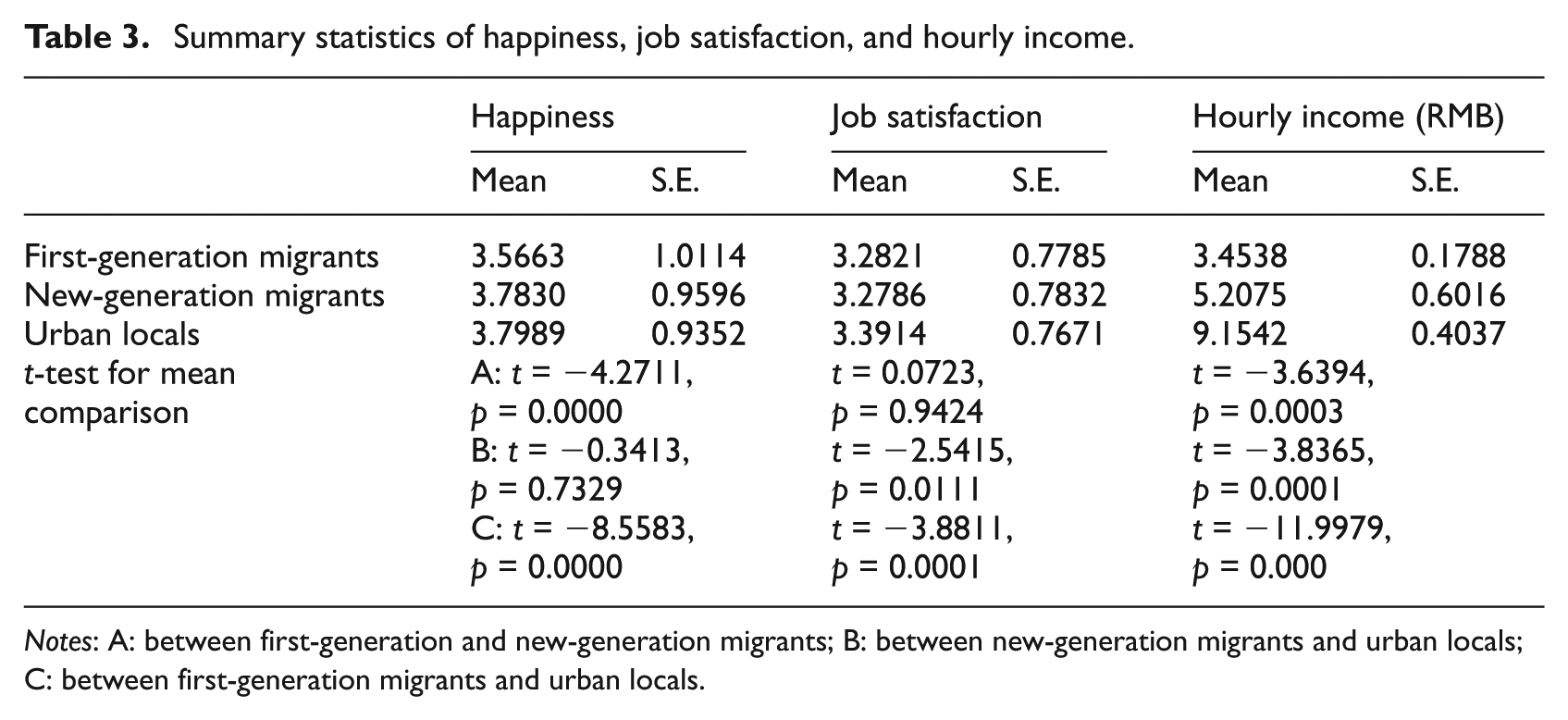
Notes: A: between first-generation and new-generation migrants; B: between new-generation migrants and urban locals; C: between first-generation migrants and urban locals.
Table 4 presents summary statistics for the full sample as well as subsamples of first-generation and new-generation migrants and those with an urban hukou. About half of the sample was male, the average age was 41 years and the average years of schooling were 8.8 years. In the sample, as well as being younger, new-generation migrants were better educated, more likely to be single, have better self-reported health, fewer children, more friends, perceive more upward social class mobility, were more likely to work in formal jobs and in the private sector, more likely to participate in social insurance, and more likely to work in the relatively developed eastern region than their first-generation counterparts. Compared with urban locals, new-generation migrants were younger, received less education, were more likely to be single, had fewer children and more friends. However, new-generation migrants were less likely to be trade union members, work in formal and white-collar jobs, work in the state- and collective-owned enterprises, participate in social insurance or work in the eastern region than urban locals. In sum, new-generation migrants have better human capital and labour markets outcomes than first-generation migrants, but there are still gaps between new-generation migrants and urban locals on many key performance indicators.
Summary statistics.

Health status was self-measured on a five-point scale from 1 (very unhealthy) to 5 (very healthy).
Social network was self-measured by the number of friends.
Change of social class was the difference in self-measured social class status on a ten-point scale from 1 (lowest) to 10 (highest) between the time of survey and 10 years previously; a positive difference implies upward social class mobility.
Social insurance participation was measured by the number of social insurance schemes in which the respondent participated.
Considering the potential high correlation between the measures of happiness and job satisfaction, we used SUR, allowing the error terms in the two equations to correlate. The two-equation system is in the form of:


where H and JS are happiness and job satisfaction for the ith respondent, respectively; X is a vector of personal characteristics; S is a vector of socioeconomic characteristics; W is a vector of employment characteristics; and μ and ε are error terms. The two-equation system was estimated simultaneously by applying simulated limited information maximum likelihood, which enabled us to observe the degree of correlation between the observables across equations.
Ferrer-i-Carbonell and Frijters (2004) found that the determinants of happiness are sensitive to standardisation for individual fixed effects in data sets, which lack variables controlling for personality. Standardisation tends to reduce the size of positive coefficients on income, health and marital status because having a personality that is conducive to happiness, is also associated with having a higher income, better health or being married. As we have cross-sectional data, this finding implies that we should control for personality and attempt to instrument for the problematic variables and, in particular, income.
In the robust checks below, we instrument for income, but we do not control for personality. We do not control for personality, not because we do not think it important to do so, but rather that we do not have any psychometrically valid measures of personality in the data set. In previous studies, economists have controlled for personality by using attitudes on social issues (Smyth et al., 2008), mood (Knight et al., 2009) or mental health indicators (Ferrer-i-Carbonell and Gowdy, 2007). The problem is that none of these variables measure personality traits as they are conceptualised in the psychology literature. We consider that using flawed measures of personality adds nothing over not controlling for personality at all. To properly account for the concerns of Ferrer-i-Carbonell and Frijters (2004), one needs a psychometrically valid measure of personality. One such measure would be the big-five personality traits (for a discussion of the big-five in the economics literature see Cobb-Clark and Schurer, 2012). However, very few large-scale surveys contain such psychometrically valid measures of personality and the data set being used in this study does not. 4
One further potential problem is omitted spatial error dependence, which is due to the fact that we do not observe variables, such as commuting distance, that could affect job satisfaction and happiness. For example, Wu (2013) finds that improved public commuting positively affects homeowners’ happiness in Beijing. This implies that commuting distance to work may also impact on happiness and job satisfaction. Several happiness studies consider spatially derived data (see e.g. Brereton et al., 2008; Luechinger, 2009; MacKerron and Mourato, 2009). However, only a few have been able to model spatial effects (Stanca, 2010). Relevant spatial models that might be applied include spatial explanatory variables models (in which subjective wellbeing is correlated with other observed characteristics of nearby individuals), spatial error models (in which subjective wellbeing is correlated with unobserved characteristics of nearby individuals), spatial lag models (in which subjective wellbeing is correlated with the subjective wellbeing of nearby individuals), and models accounting for spatial heterogeneity in the relationships between variables (MacKerron, 2011).
These spatial models, however, cannot be applied using the CGSS data, which do not provide information on spatial-related variables, such as respondents’ home and work addresses in the city. 5 As a result, one cannot compute a spatial lag that averages the neighbouring values of a location (such as the city or neighbourhood) to compare the neighbouring values with those of the location itself. Hence, we are unable to test for spatial dependence. As suggested by MacKerron (2011), the limited use of spatial models in the happiness literature can be explained by the scarcity of data that are spatially referenced at an appropriately high resolution. In this respect, spatial models will be more effective with panel data or census data which provide much richer information on spatial changes of respondents and characteristics of nearby individuals (see e.g. Ballas and Tranmer, 2012).
Main results
Table 5 reports the ordered probit results for the full sample as well as first-generation migrants, new-generation migrants and urban locals separately. We report the marginal effects which show the effect on the probability of being very unhappy on being unhappy, being unhappy on being so-so, being so-so on being happy and being happy on being very happy (and equivalent for job satisfaction). The correlation coefficient for the full sample as well as each of the subsamples is positive and significant. This rejects the null hypothesis that there is no correlation between the error terms, and indicates that unobserved characteristics are positively correlated with happiness and job satisfaction. The results of an F-test indicated that there were significant differences in the determinants of happiness between first- and new-generation migrants, and between new-generation migrants and urban residents, but there were no significant differences in the determinants of job satisfaction.
Ordered probit estimates for happiness and job satisfaction (marginal effects).

p < 0.1; **p < 0.05; ***p < 0.01.
Standard errors in parentheses.
The results from the full sample show that, relative to first-generation migrants, the happiness and job satisfaction of new-generation migrants is 5.87% and 1.06% lower, respectively. The results also suggest that the happiness of urban locals is 5.6% higher than new-generation migrants. Thus, new-generation migrants have the lowest level of subjective wellbeing among the three cohorts, despite having higher hourly income and performing better on other labour market outcomes than first-generation migrants.
An explanation for this result is that new-generation migrants have excessively high expectations of the conditions that they would experience in the cities. New-generation migrants have strong aspirations for better lives, career advancement and equal rights, but the opportunities to realise these ambitions in the cities are often limited. For instance, in the seminal 2010 Honda strike in Guangdong province that was the catalyst for an outbreak of labour unrest across the nation, new-generation migrant workers requested the employer to narrow their 50-fold wage gap with Japanese employees and to be able to elect their own trade union representatives. However, there is lack of support for unionisation efforts because of the party-state’s opposition to an independent labour movement (Chan and Hui, 2012).
Many new-generation migrants struggle to reshape their identity in the face of institutionalised discrimination associated with the hukou system (Wang and Fan, 2012). Many new-generation migrants have never engaged in agricultural work and, hence, feel no sense of belonging to the countryside. Instead, they aspire to be recognised as urban citizens, with all the benefits this entails. Many new-generation migrants regard urban workers, who enjoy more employee benefits in addition to higher wages, as their most important reference group (National Bureau of Statistics of China, 2011). Upward social class mobility significantly contributes to the happiness of first-generation migrants and urban locals, but it has no effect on new-generation migrants. This suggests that new-generation migrants have stronger aspirations than the other two groups in terms of improving their lot in the city and they may not be satisfied with improvement just within the group of rural hukou holders. In the words of a young migrant worker, they ‘want not only “bread” but also “face” similar to urban locals in the city’ (Banyuetan Survey Center, 2011b). The reality, though, is that many new-generation migrants are trapped in a state of limbo between peasant and urban citizen, meaning that their sense of identity becomes confused (Pun, 1999). Rural–urban migrants do jobs that urban locals do not want to do. Moreover, urban locals ‘look down’ on rural–urban migrants, making it challenging for the latter to adapt to urban life (Nielsen et al., 2010).
This explanation is consistent with the Easterlin (1974, 1995) paradox. Easterlin (1995) argues that happiness is a function of aspirations and income. As income rises, so do aspirations, meaning happiness does not change. Di Tella et al. (2010) find that happiness adapts completely to income changes within four years. However, if aspirations rise faster than income, happiness may actually fall (Knight and Gunatilaka, 2012). As the income of new-generation migrants rises, relative to first-generation migrants, new-generation migrants become more materialistic and their aspirations adapt to rising income. The mismatch between the aspirations of new-generation migrants and the realities they face in terms of living and working conditions results in frustration and lower subjective wellbeing compared with first-generation migrants. Compared with new-generation migrants, first-generation migrants have lower income and poorer labour market outcomes, but they also have lower aspirations and more realistic expectations. As such, they are happier with less.
The results for the control variables are generally consistent with prior expectations and findings from previous studies. Males report happiness levels between 2.6% and 6.5% lower than females and job satisfaction levels between 0.6% and 1% lower than females. This result is consistent with previous studies for rural–urban migrants in China (see e.g. Gao and Smyth, 2011; Smyth et al., 2009) and studies for other countries (Dolan et al., 2008). The marginal effect of gender on happiness for first- and new-generation migrants (3%) is about half that for urban locals (6%). An additional year of schooling is associated with about a 1% increase in happiness. The marginal effects are similar for the three cohorts. That education and happiness are positively correlated is consistent with findings for other countries (see e.g. Blanchflower and Oswald, 2004) and, in particular, low income countries (see e.g. Ferrer-i-Carbonell, 2004). An additional year of schooling is also positively correlated with job satisfaction for the full sample and urban locals, but the marginal effect is small (about 0.2%).
Rural–urban migrants who are single or divorced have lower levels of happiness than those who are married. Those who are single are between 6.7% and 10.5% less happy than those who are married, while those who are divorced are between 6.2% and 18.3% less happy than those who are married. The results are consistent with previous findings that those who are married are most happy, followed by those who are single, while those who are divorced are least happy (Dolan et al., 2008). However, generally, marital status has little effect on the job satisfaction of individuals. Exceptions are for the full sample and new-generation migrants, for which those who are single have 0.8% and 2.9% lower job satisfaction than those who are married, respectively.
Self-reported health is positively correlated with happiness and job satisfaction, with the marginal effects much higher for happiness than job satisfaction. Those who report having better health are between 4.7% (first-generation migrants) and 9.1% (new-generation migrants) happier and have 0.5–0.6% higher job satisfaction. The findings for the relationship between health and happiness are similar to previous studies for rural–urban migrants (Gao and Smyth, 2011) and for studies in other countries (Dolan et al., 2008).
Social insurance participation and having better social networks are positively correlated with subjective wellbeing, but the marginal effects are small (less than 1%). The small marginal effects for social insurance are consistent with previous studies for urban China (see e.g. Appleton and Song, 2008). Living space is positively correlated with the happiness of new-generation migrants and urban locals, but it has no effect on the happiness of first-generation migrants. This reflects the observation that new-generation migrants exhibit a strong demand for better housing and living environment (see e.g. Banyuetan Survey Center, 2011a, 2011b). One cannot read too much into this, however, given that the marginal effect for new-generation migrants and urban locals is still very small (0.1% or less).
Compared with the western region, living in the eastern and central regions has a positive impact on happiness and job satisfaction for the full sample. Those living in the eastern region are 3% happier than those in the western region and the job satisfaction of those in the eastern and central regions is 0.8% and 1.3% higher than in the western region, respectively. The region is insignificant in the happiness and job satisfaction specifications for first-generation migrants, while new-generation migrants in the eastern region are happier than in the western region. Official statistics in 2010 show that new-generation migrants prefer working in the eastern region more than first-generation migrants and that more than 70% new-generation migrants work in the eastern region (National Bureau of Statistics of China, 2011). A 2011 survey shows that, although since 2009 the Chinese Government has implemented preferential policies to encourage return migration and rural entrepreneurship, more than 80% of new-generation migrant workers still choose to work in the eastern region (Banyuetan Survey Center, 2011b).
However, similar to first-generation migrants, the region has no significant correlation with the job satisfaction of new-generation migrants. While living in the eastern cities may contribute to new-generation migrants’ overall happiness through the fulfilment of living in the most prosperous Chinese cities, their working lives remain difficult. Contributing to this phenomenon, several years after the implementation of the 2008 Labour Contract Law and 2010 Social Insurance Law, migrants remain underpaid, have wage arrears, unpaid overtime and unpaid employer social insurance contributions, and experience various other types of labour right violations. Urban locals, living in the eastern and central regions, have higher job satisfaction (and those in the eastern region are happier) than those in the western region. Urban locals have benefited from urban economic boom along the eastern seaboard.
For the full sample, as well as for first-generation migrants and urban locals, absolute income is positively correlated with happiness and job satisfaction, but the marginal effects are small (0.2% or less across the board). That the marginal effects are small is consistent with previous studies for China (see e.g. Knight et al. 2009; Mishra et al., 2013; Monk-Turner and Turner, 2012). Moreover, more generally they are consistent with a growing consensus in the economics literature that while absolute income matters for subjective wellbeing, it does not matter much (Clark et al., 2008). One surprising result was that absolute income is negatively correlated with the happiness of new-generation migrants, albeit only at the 10% level. This may reflect higher income being associated with excessive overtime, high work-related stress and deprivation of legal rights to which new-generation migrants attach importance.
First-generation migrants and urban locals’ happiness and urban locals’ job satisfaction follow a U-shaped pattern with age, with subjective wellbeing reaching a minimum at around age 40. This result is consistent with previous studies for urban China (see e.g. Appleton and Song, 2008; Gao and Smyth, 2011). Having a formal job increases the job satisfaction of first-generation migrants by 1.3%, indicating that they have a strong desire to avoid job insecurity; but it has no significant effects on new-generation migrants and urban locals. This result is consistent with the fact that first-generation migrants have lower human capital than either new-generation migrants or urban locals and, thus, less bargaining power in the urban labour market. It is also likely that urban locals are less concerned about job security because their labour market status is more protected by the urban labour market institutions.
Robust tests
Income is potentially endogenous. Knight and Gunatilaka (2010a) note that unobserved characteristics, such as personal energy, might increase happiness and income or happiness might increase income through higher productivity (the so-called happy-productive worker thesis). To address this point, following Knight et al. (2009) and Knight and Gunatilaka (2010a), we instrumented for income using father’s education. The ordered probit IV results instrumenting for income with father’s education are reported in Table 6. 6 The marginal effects for instrumented income are higher than in the results in Table 5. The results for each of the other variables are similar. The finding that the instrumented coefficient for income is higher is similar to previous studies for China (see e.g. Gao and Smyth, 2011; Knight and Gunatilaka, 2010a; Knight et al., 2009) and other countries (see e.g. Kingdon and Knight, 2007; Powdthavee, 2010). This result is consistent with workaholicism or willingness to accept hardship now for happiness in the future, which increases income but decreases happiness, or that instrumenting for income corrects downward bias in the income coefficient because of measurement error (Gao and Smyth, 2011; Kingdon and Knight, 2007; Knight et al., 2009).
Ordered probit IV estimates for happiness and job satisfaction (marginal effects).

p < 0.1; **p < 0.05; ***p < 0.01.
Standard errors in parentheses.
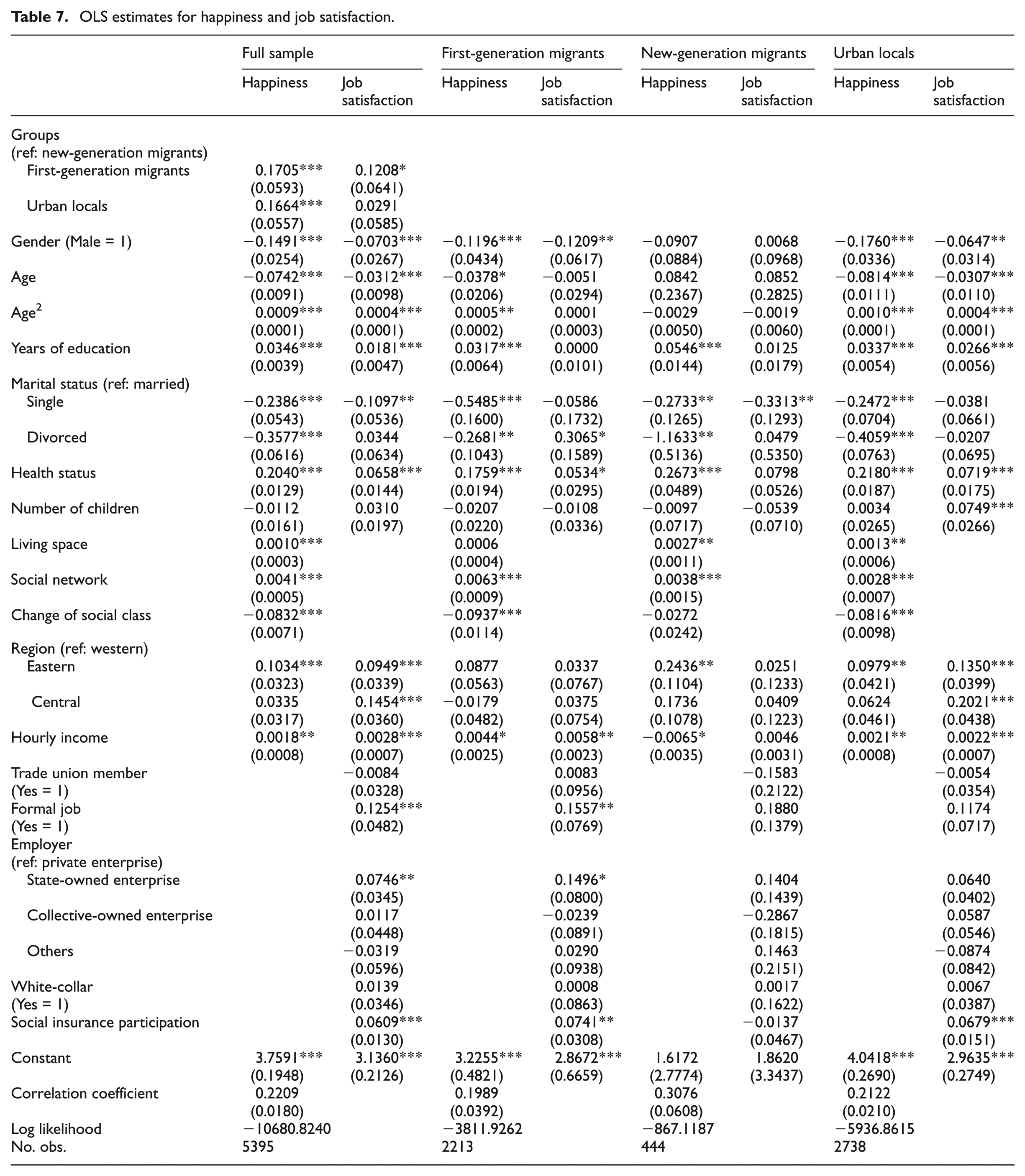
The results in Tables 5 and 6 treat happiness and job satisfaction as ordinal (as economists usually do). In Tables 7 and 8 we treat happiness and job satisfaction as cardinal (as psychologists generally do). Table 7 does not instrument for income so it is the cardinal equivalent of Table 5. Table 8 instruments for income so it is the cardinal equivalent of Table 6. The sign and significance of the coefficients in Table 7 are very similar to those in Table 5. The only difference is that the coefficient on number of children is not significant in the job satisfaction equation for the full sample in Table 7. Similarly, the sign and significance of the coefficients in Table 8 are very similar to those in Table 6 with a few exceptions (age, age-squared and urban locals in the job satisfaction equation for the full sample; gender in the job satisfaction equation for first-generation migrants; single, health status and formal job in the job satisfaction equation for the new-generation migrants). That the results are generally not sensitive to treating subjective wellbeing as ordinal or cardinal is consistent with one of the main findings in Ferrer-i-Carbonell and Frijters (2004) and with previous studies that have employed Chinese data (Gao and Smyth, 2011; Knight et al., 2009).
OLS estimates for happiness and job satisfaction.
2SLS estimates for happiness and job satisfaction.

Finally, one might be concerned that respondents had changed their hukou status from rural to urban and that this might have occurred in a non-random way. For example, it is generally easier to get an urban hukou in smaller cities, potentially biasing the happiness estimates. This is only a concern, however, if there are a sufficient number of migrants in the sample who have changed their hukou status to be problematic. Fortunately, we have data from the CGSS on which individuals in the sample changed their hukou status over the period from 2003 to 2008. Less than 1% of the sample had changed their rural hukou to urban hukou over this period. The three predominant reasons were urbanisation (i.e. acquisition and transformation of rural land to urban land), marriage and study (at university) in the cities. Only seven individuals had changed their rural hukou to urban hukou because of worker recruitment. Ability to change hukou status was extremely limited before 2003 (Chan and Buckingham, 2008), meaning that we can be reasonably confident that less than 1% of the sample has ever changed their hukou status. We re-ran the regressions excluding those individuals who had changed hukou status and the results were quantitatively the same.
Conclusion
The composition of China’s migrant workforce is changing. New-generation migrants are becoming an increasingly important presence in the Chinese urban landscape. Compared with first-generation migrants, new-generation migrants have higher human and social capital and are more aware of their legal rights. However, in urban China the hukou system continues to underpin labour and social stratification and suppress migrants’ socioeconomic rights. Previous research suggests that migrants in urban China have lower subjective wellbeing than urban locals because their expectations are not being fulfilled. Our results suggest that new-generation migrants have lower subjective wellbeing than both first-generation migrants and urban locals. A likely explanation is that new-generation migrants have higher aspirations than those migrants who preceded them and that these aspirations are not being realised, resulting in relatively lower levels of happiness and job satisfaction.
Footnotes
Funding
This research was financially supported by the East Asian Development Network Individual Research Grant.