



Abstract
Critics of political consumerism argue that it perpetuates a neoliberal belief that complex societal problems are best redressed through the market-coordinated choices and actions of socially responsible consumers. However, such critiques overlook how neoliberalism is actually enacted in particular socio-cultural contexts and the variegated ideological effects that result. To redress this gap, we analyze the “actually existing neoliberalism” manifest in a Slow Food network. This discursive system presents an intersection between a neoliberal discourse of passionate entrepreneurialism and a politicized therapeutic ethos that traces to the organization’s historical roots in Italian leftist politics. Through this actually existing neoliberalism, Slow Food enthusiasts constitute themselves as ethical agents who are sharing their passion and helping others gain autonomy from the corporate controlled, industrialized food system. This ideological framing buttresses the ethical authority of the Slow Food movement by countering the cultural condemnation that its politicized taste practices are elitist affectations.
What is so painfully evident here (i.e. Michael Pollan’s The Omnivore’s Dilemma) and in many other of the new food books, is how food politics has become a progenitor of a neoliberal anti-politics that devolves regulatory responsibility to consumers via their dietary choices.
(Guthman, 2007: 264)
Guthman’s commentary is illustrative of an expansive critical literature on food politics. These works argue that contemporary agro-food movements – such as Slow Food, locavorism, and community supported agriculture – perpetuate the neoliberal status quo by valorizing the market-coordinated actions of socially responsible consumers as the most efficacious means to redress systemic social problems (Alkon and Mares, 2012; Allen and Guthman, 2006; Blue, 2009; DuPuis et al., 2006; Guthman, 2008a, 2008b; Johnston, 2008; Johnston and Baumann, 2015; Lavin, 2009; Lockie, 2009; MacDonald, 2013). According to these critical theorists, “neoliberalized agro-food movements” (Guthman, 2008a: 1178) substitute a market-friendly image of the socially responsible consumer for the collective organizing and political mobilization needed to combat social injustices and ecological threats fostered by the transnational, corporatized system of agricultural production and distribution (DuPuis et al., 2006; Guthman, 2008a, 2008b; Lockie, 2009; McClintock, 2014; Myers, 2013). Owing to their imputed neoliberal motifs, alternative systems of food distribution and provision are further faulted for perpetuating anti-democratic class and racial hierarchies that favor socio-economically privileged consumers (Donati, 2005; Guthman, 2011; Johnston and Szabo, 2011; Laudan, 2004; Myers, 2013; Slocum, 2007; West and Domingo, 2012).
This neoliberal critique is also commonly directed at the still broader sphere of political consumerism, which Stolle and Micheletti (2013) define as “consumers’ use of the market as an arena for politics in order to change institutional or market practices found to be ethically, environmentally, or politically objectionable” (p. 39). While some theorists have lauded political consumerism as a means to overcome outmoded and counterproductive dualities between the public and the private spheres and between citizenship and consumption (Arnould, 2007; Connolly and Prothero, 2008; Schor, 2011; Soper, 2007; Ulver-Sneistrup et al., 2011; Willis and Schor, 2012), a prominent counter argument is that these market-oriented redefinitions of social activism are emblematic of an ongoing neoliberal colonization of the political field (Bakker, 2010; Bertilsson, 2015; Johnston, 2008; Johnston and Szabo, 2011; Szasz, 2007).
These social critics contend that political consumerism encourages a placating, and ultimately misleading, belief that purchasing goods with socially redemptive meanings (e.g. green, sustainable, fair trade, etc.) is a sufficient response to the environmental degradation and socio-economic inequities posed by corporate capitalism and carbon-intensive consumer lifestyles (Bossy, 2014; Giesler and Veresiu, 2014). Žižek (2011) further argues that the ubiquitous cultural designations of ethical consumers and sustainable consumption practices not only engender neoliberal identifications, they also constrain individuals’ imaginative capacities to envision a world beyond the prevailing capitalist order. Similarly, Simon (2011) contends that political consumerism encourages consumers to interpret the act of purchasing goods that exude an ethical aura (e.g. fair trade and organic) as a surrogate for sustained involvement in social causes. For example, rather than mobilizing for stricter water standards, responsibilized political consumers take it as a self-evident course of action that they should purchase bottled water (Wilk, 2006).
Shamir (2008) characterizes this neoliberal orientation as consumer responsibilization, which hails individuals to understand themselves as de facto risk managers, whose market actions are based on rational assessments of costs and benefits. From this standpoint, political consumerist discourses seek to expand consumers’ responsibilized deliberations to include matters related to sustainability and ecological externalities (Giesler and Veresiu, 2014). Once these normative guidelines are sufficiently established as governmental logics, the resulting market rationality is therefore presumed to guide the independent actions of responsibilized consumers toward socially beneficial ends. Commenting on the resulting ideological effect, Shamir (2008) concludes, Democratic politics, addressing structural conditions and redistributive arrangements, is in decline. Instead, we are ushered into ‘politics via markets’: politics mediated through market-based mechanisms that are based on the mobilization of consumers and the attempt to shape the behaviour of producers. (pp. 13–14)
In the following sections, we first provide a retrospective on Slow Food’s organizational history, its evolving political consumerist goals, and the elitist connotations that have long plagued it. We will show that several aspects of Slow Food that have been interpreted as signs of consumer responsibilization are more directly traceable to the organization’s history. This genealogical discussion sets the stage for our analysis of the actually existing neoliberalism that emerges in a Slow Food network of organizational leaders, consumers (or ethical eaters in the parlance of Slow Food), and producers (i.e. cheese makers, farmers, and producers of artisan meat) and their efforts to defend and buttress their culinary activism from charges of elitism and hypocrisy.
The lefist political roots of the Slow Food movement
Slow Food is a global, grassroots, non-profit and member-supported organization dedicated to preserving and strengthening local food cultures and traditions; rekindling consumers’ interest in the food they eat, rebuilding lost connections between consumers and producers; and combatting the ever accelerating pace of life demanded by the global capitalist system (Petrini, 2001). Over the course of its historical evolution, Slow Food has steadily expanded its political consumerist mission to forge alliances with other ideologically compatible social movements. This expanded sphere of concern now encompasses issues related to sustainability, biodiversity, social justice, fair trade, and animal welfare (Sassatelli and Davolio, 2010; van Bommel and Spicer, 2011).
Whereas critics portray Slow Food as a reflection of neoliberalism’s marketizing and responsibilizing ideological doctrines, historians such as Leitch (2003) argue that Slow Food emerged from a “uniquely Italian post-war cultural and political trajectory” marked by a generational fissure that divided the nation’s leftist political faction and, second, a growing disaffection among the Italian citizenry toward the formal political system, which in turn led to increased interests in alternative forms of political engagement (p. 457). During the 1970s and 1980s, these shifts were closely coupled with a transformation in the political meaning of consumption (particularly in its aestheticized forms). While long regarded by the Italian left as a debased and corruptive bourgeois spectacle, consumer culture came to be viewed as not only a legitimate arena of political struggle but also as a means of promoting social change in ways unattainable through gridlocked political institutions.
Nowhere was this shift in the political meanings of consumption more evident than in the case of food and eating. Historically, epicurean pleasures had been ideologically constructed as a province of the cultural elite and ideological supporters of Italy’s Fascist legacy, which had pitted the interests of industrialists, professionals, small business owners, land owners, and the Catholic church (among others threatened by the prospect of a socialist revolution) against those of the urban and rural working class (De Grand, 2000). By the 1970s, however, a new generation of Italian leftists, including Carlo Petrini, began to recalibrate their political views in relation to a rapidly changing Italian society. These seismic shifts were precipitated by the confluence of economic modernization, the diffusion of mass media (particularly television), rising dissatisfaction toward the institutions that had been charged with representing the interests of workers against those of capital (the Italian Communist Party and the trade unions), and the increasing centrality of consumption, and tastes in fashion, music, art and other spheres of popular culture, to social identity (Gundle, 2000; Leitch, 2003).
This ideological linkage between Italian leftist politics and consumption, and most particularly food, was further reinforced by the Autonomist Marxist conviction that acts of social resistance should embody, rather than merely represent revolutionary challenges to the capitalist control of labor (Negri, 2005). This anti-bureaucratic, post-Marxian project took shape in a new political aggregation, Autonomia Operaia (hereafter AO). AO sought to function as a diffuse network of activist collectives that could engage in diverse political struggles, using different strategies at different times and places (Negri, 2005). Their guiding premise was that such a decentralized and locally diversified form of resistance could not be co-opted by prevailing power structures.
Diverse AO factions variously mobilized to contest issues ranging from the rising costs of public transit, to governmental reductions in educational funding, to discriminatory practices, to wage reductions and layoffs. These self-organizing assemblages could then disperse before the organized power of the state could co-opt the resistance movement (an outcome which many in the AO believed had befallen the Italian communist party and workers’ trade unions). In the vernacular of the AO movement, it aimed to produce micro-machines that could disrupt and eventually overturn the macro-machine of state power and the capitalist system which it served. Principal among these micro-machines were underground radio broadcast, spontaneous work stoppages, sabotaging assembly lines, student occupations, and other forms of social protest and critique, often drawing inspiration from situationist writings on disruptive social performances (Wright, 2002).
By the early 1980s, AO had largely dissipated, owing to a combination of government crackdowns, the imprisonment of key organizers, and a broader public antipathy toward the violent acts propagated by some members of this activist coalition. The resulting political void afforded opportunities for new social movements to galvanize Italy’s fragmented political left around a diversity of causes (Schneider, 2008). One such offshoot movement was Arcigola, an organization supporting regional cuisine, founded in 1977 by Carlo Petrini and others affiliated with the Italian Communist Party.
This portmanteau combines the ARCI acronym for the Associazione Ricreativa e Culturale Italiana with the Italian phrase “gola” which has a dual connotation indicating both desires for food and political voice. In 1986, Arcigola would gain worldwide attention for its protests against the opening of a McDonald’s near Rome’s famed Piazza di Spagna. Petrini called on his fellow Italians to defend their culture of “Slow Food” from fast food’s colonizing encroachments. The phrase proved to be an ingenious branding strategy and became the movement’s nom de guerre when it developed into a formal organization in 1989 (Schneider, 2008).
In Petrini’s activist framing, the pursuit of culinary pleasure and diversity of tastes was an act of resistance that could preserve local food cultures threatened by McDonaldization (Ritzer, 1993) and re-embed social actions in a slower temporal rhythm that disrupted the accelerated pace of life (in the workplace, in social relations, and while eating), which had been naturalized by the capitalist system. And slowing down, in turn, would afford opportunities for critical reflections on the capitalist system, its societal effects, and the new kind of pleasures that could be created and democratically shared in opposition to the capitalist imperatives for speed, instrumentalism, and profit maximization.
Rather than directly confront sites of power with combative guerilla tactics, as in the heyday of AO, Arcigola leaders envisioned that the ongoing expansion, and even the long-term economic viability of the global system of corporate-controlled agriculture and McDonaldized fast food (including highly processed convenience foods) could be more effectively challenged by a widely dispersed community of responsible eaters, each of whom support local culinary traditions and Slow Food practices through their purchases and lifestyle choices (Schneider, 2008). Arcigola’s consumerist vision of political resistance and autonomous action also readily led to charges that it privileged hedonism over politics and presented a faux radicalism that glorified the esthetic tastes of the intelligentsia and left leaning cultural segment (e.g. Laudan, 2004) – a criticism that has often been levied at other lifestyle-oriented countercultural movements (e.g. Heath and Potter, 2004). This denigrating view of Arcigola carried forward as the organization re-branded itself as Slow Food and subsequently established itself in the United States.
Though far removed from the labor-centric politics of Italy’s leftist vanguard, the receptivity that middle-class American consumers have shown toward Slow Food discourses is also grounded in the cultural legacy of anti-capitalist, countercultural movements of the 1960s and 1970s (Andrews, 2008; Binkley, 2007; Petrini, 2001, 2015). Canonical arguments about the transformative pleasures afforded by Slow Food and, more generally the slow life, also exhibit ideological affinities with discourses promoting the personal and societal benefits that can accrue when consumers value quality of life over the accumulation of material goods and meet their provisioning needs through smaller-scaled, localized networks of production, exchange, and sharing (e.g. Gaytán, 2004; Schor, 2011).
Like its Italian progenitor, Slow Food USA’s public image has been plagued by the specter of elitism and the closely related economic conundrum that locally sourced, artisan produced foods generally tend to be more expensive than mass produced commercial alternatives. Hence, Slow Food’s culinary strain of political consumerism easily strikes an exclusionary and pretentious chord, as evinced by satirical representations of foodies’ supercilious pretensions (see Figure 1). This elitist indictment serves to undermine the ethical authority of Slow Food ideals and taste norms by suggesting that they are merely a disguised form of status signaling foodie-ism (Johnston and Baumann, 2015). Slow Food as an elitist affectation.
Research procedures
We conducted in-depth interviews with food producers and consumers affiliated with Slow Food chapters in a metropolitan area in the Midwestern United States. These chapters have no paid employees and function through the volunteer efforts of leaders, participants, and producers. The Slow Food network we study encompasses consumers who are dues-paying members as well as those who are not officially affiliated but participate in Slow Food events and activities and are thereby exposed to Slow Food’s political consumerist discourses. Accordingly, our analysis does not differentiate between dues paying and non-paying participants and considers them all as being affiliated with the Slow Food community. We recruited informants by distributing informational flyers, introducing ourselves as researchers and talking about the prospective research at Slow Food’s annual meeting. Subsequently, we snowballed from our initial set of informants.
Participants profile.
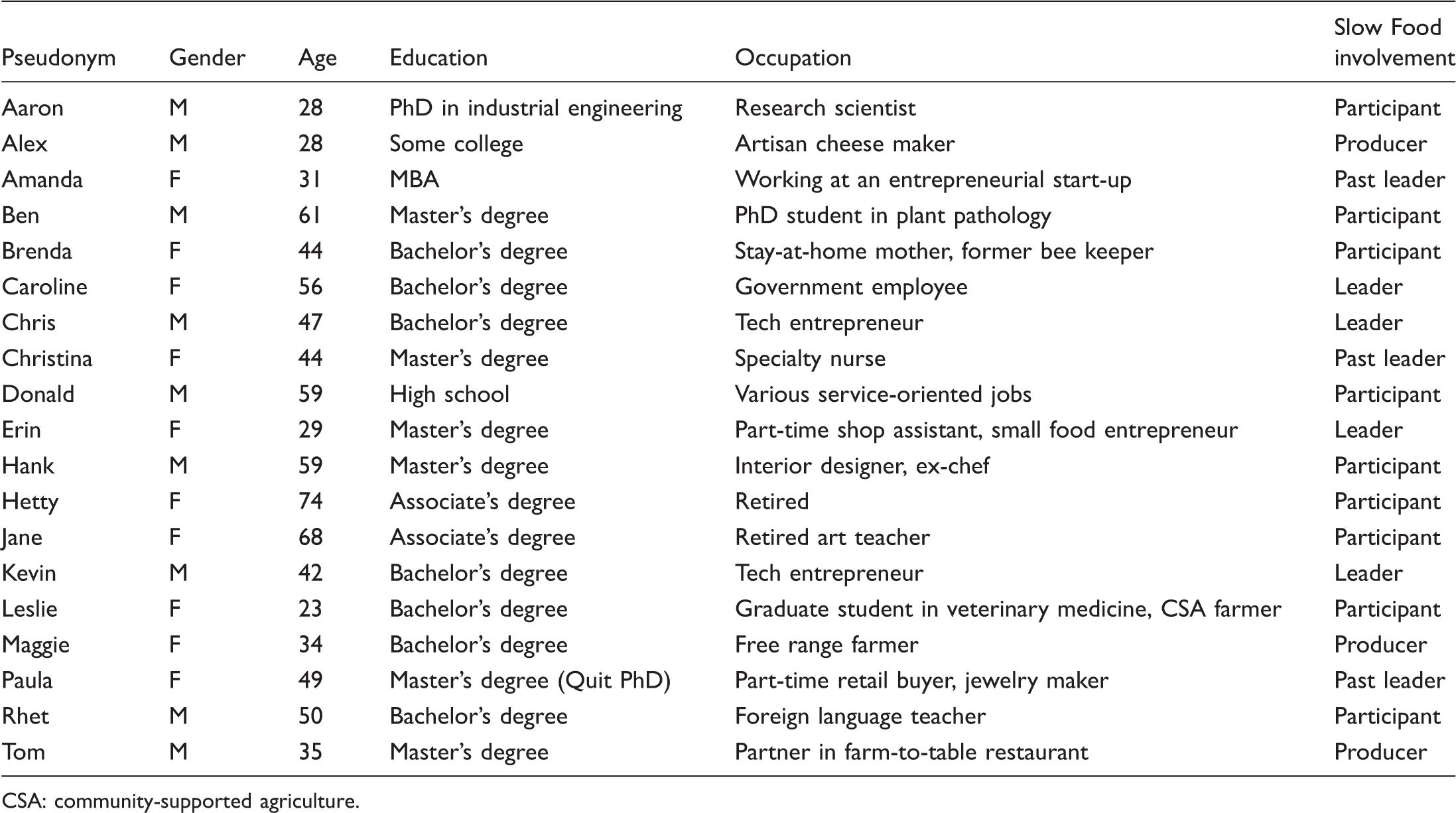
CSA: community-supported agriculture.
Following the conventions of in-depth phenomenological interviewing (Thompson et al., 1989), the course of dialog was largely determined by the informants. The interviewer took on a reflective role, employing probes and follow-up questions when necessary to elicit more detailed accounts of the roles and experiences in the Slow Food movement, the personal goals they hoped to accomplish, and the skills and relationships they had developed through their participation. We further queried on aspects of the movement’s philosophy and objectives informants found meaningful or problematic. We probed on their provisioning decisions such as where and what to buy, food preparation and eating out, food related travel and do it yourself (DIY) activities, and opinions about various food authors. The analysis of the qualitative data followed a hermeneutic approach (Thompson, 1997).
In conjunction with these interviews, we also engaged in a 12-month-long series of participant observations at Slow Food events, variously held at community centers, food pantries, and farms. Some of these events profiled the epicurean side of Slow Food, such as guided tours to local ethnic markets, breweries, wine and cheese tasting events and food swaps in which participants could trade homemade, homegrown, and foraged foods. Other chapter events expressed a more overt sense of social consciousness, such as a weekly gathering at which Slow Food volunteers prepare meals for lower-income patrons using ingredients available at a community food pantry. This Slow Food chapter also sponsored gatherings where participants could share experiences and cultivate new knowledge about a range of food production techniques, such as home canning, fermenting, gardening, and raising backyard chickens.
Actually existing neoliberalism as validation of Slow Food’s ethical authority
Almost from its inception, Slow Food’s ethical authority has been challenged by associations with social elitism, status signaling, and exclusionary taste (Donati, 2005; Hall, 2012; Laudan, 2004; West and Domingos, 2012). These elitist counter readings cast doubt on the ethical authority of the Slow Food movement by suggesting it is an ideological justification for pursing self-interested Epicureanism and signaling social superiority to consumers who favor industrialized fast food. To defend and buttress the ethical authority of their Slow Food commitments, our participants invoke a particular alignment of therapeutic narratives (Lears, 1983), and the neoliberal idealization of passionate entrepreneurialism (Dilts, 2011).
Politicizing the therapeutic ethos
The rise of the therapeutic ethos is generally interpreted as a historical by-product of industrialization, urbanization, and related forces of modernization that began to sweep across Western societies in the late 19th century (Illouz, 2003; Lears, 1983). In turn, therapeutic discourses portray a return to pre-modern lifestyle practices and the rekindling of connections to nature (and natural rhythms) as anodynes to the ills of modernity. Owing to its nostalgic portrayals of pre-modern culinary tradition and modes of agricultural production, as well as its romanticization of peasant diets, the Slow Food movement is commonly interpreted as a therapeutic system of discourses and practices that middle-class consumers use to interject a much-coveted sense of authenticity into their status conscious, materialistic lifestyles (Donati, 2005; Gaytán, 2004; Hall, 2012; Laudan, 2004). However, Slow Food discourses recast these therapeutic narratives in a more explicitly political direction that forges an alignment between two prominent (and parallel) critiques of the capitalist system. Boltanski and Chiapello (2007) discuss these critical narratives as the artistic (i.e. esthetic) critique and the social justice critique.
The former, often identified with a bohemian sensibility, condemns the capitalist system for engendering disenchantment, inauthenticity, and a mass-produced homogeneity that debases social life. Ritzer’s (1993) famed McDonaldization thesis exemplifies this esthetic critique. The social justice critique presents a Marxian-inspired concern over the socio-economic inequities and institutionalized forms of oppression (such as those between first world consumers and third world workers) that are imposed by capitalist modes of production. In its more contemporary instantiations, the scope of the social justice critique has expanded to encompass ecological and animal exploitation by the industrialized agro-food complex.
Paula’s reflection on her initial motivations for joining Slow Food illustrates this intertwining of the therapeutic ethos with esthetic and social justice critiques of the corporatized system of food production: Paula: I first started attending Slow Food meetings about 14 years ago. My daughter was three and I was, at that point I had this little girl, so I was very interested in having her grow up knowing what good food was and making good food for her. So, I wanted to get more involved in that … I love the idea that we are passing our food traditions on to our children, so you don’t lose them. I like that Slow Food is interested in saving certain breeds of animals, certain vegetable types, certain types of food, so that you are not just in this kind of mono eating pattern. That, you know, the whole world doesn’t end up eating hamburgers, that children know what their grandparents and great grandparents were eating and can continue to pass them on to their children. So, for me, keeping those cultural traditions alive through your food, is the most important. And also, kind of the sustainability aspect and the aspect of letting people have power over their own food choices and their own growing choices and seeds and all that.
In the following vignette, Jane invokes a childhood memory to personalize Slow Food’s normative imperative that producers should provide a good quality of life to domesticated animals. Her recollection expresses a nostalgic gloss on the traditional family farm and the pleasures of living in a simpler, slower time, which then allows her to forge a therapeutic link between the emotional well-being of farm animals and the emotional state of the eater: Jane: As a child growing up in England, it was the biggest delight to go out into the country with aunty or uncle on a picnic and spread our blanket in a field of sheep, knowing that those sheep were owned by Farmer Smith. And in some instances, we went and stayed on the farm and Clifford the Bull who had sired multiple generations of cows and calves, you know, they were all prancing around perfectly happily in the meadow and we’d have lovely beef stews. You know, Farmer Jones and his family had produced this and the milk on the table over our cornflakes was from the cow and those little kids going out to the milk barn and bringing back the steaming jugs and nothing was pasteurized in those days. We were all perfectly healthy. Now we have entered the age where there are ten million cows that never put their hooves on a piece of grass and are kept indoors all the time. A couple of years ago I was driving in South Texas and I was absolutely appalled at the acre upon acre, mile after mile after mile of big, muddy lots, all caged in with iron sensors, with cows packed in, crammed in together and they looked the sorriest, unhappiest cows that I’ve ever seen. I can’t help but think that unhappy cows make for unhappy meat, or chickens that are raised all in pens so that they’re not flapping around the farm yard being happy chickens. That makes a huge difference.
Passionate entrepreneurialism as ethical justification
Neoliberalism, as a representation of economic arrangements, ideologically erases the conventional boundary between workers and management. From a neoliberal world-view, workers are managers of their human capital who rationally respond to market incentives to enhance their stock of knowledge and skills. In turn, neoliberal free agents can utilize the market, in conjunction with their ever-developing entrepreneurial skills, to maximize the value of their accumulated human capital (Binkley, 2007; Foucault, 2008). This neoliberal discourse promises to not only unleash entrepreneurial initiative from the shackles of the welfare state and regulatory bureaucracies, it also hails entrepreneurial agents (aka workers) to seek out (or create) occupational opportunities that are synergistic with their personal interests and talents, rather than remaining encumbered in alienating bureaucratic work roles (McRobbie, 2015). To further elaborate, the neoliberal workplace (in its celebratory representations) is portrayed not only as providing the benefits of autonomy, flexibility, and opportunity but also as affording a felicitous alignment between the personal and the professional (Ross, 2009).
This aspect of neoliberalism engenders normative expectations that entrepreneurial actors (i.e. workers) are passionately committed to their occupational pursuits because they are means for creative self-expression and self-actualizing experiences. As Dilts (2011), discusses, neoliberal discourses ideologically “frame labor as an activity one chooses amongst others. To choose to work is to forgo some other activity that might be pleasurable, so why work?” (p. 134). The most immediate answer to Dilts’ rhetorical query is, of course, to earn income. But, neoliberalism goes further in positing that one can only enjoy continued success in these perpetual free-agent competitions when motivated by passion rather than pecuniary rewards per se (Aschoff, 2015; McRobbie, 2015).
However, this valorization of the enterprising self seldom corresponds to the institutional conditions that characterize many occupational fields, where the free-agent economy has produced a state of precarity which confronts workers with a new array of stresses, demands, and uncertainties about future prospects (Ross, 2009). While a small segment of the workforce is able to realize occupational outcomes that approximate this neoliberal ideal of entrepreneurial freedom (see, for example, Bardhi et al., 2012), the more structurally flexible and ideologically malleable field of consumption has provided a cultural space where the enterprising self can be more readily enacted (Dilts, 2011). In this spirit, the discourse of the enterprising self has dramatically transformed the self-help industry (Cederström and Spicer, 2015). Once an almost exclusive province of therapeutic narratives – offering guidelines for how social actors could rekindle a lost sense of authenticity or revitalize themselves from the travails of modern life – contemporary self-help narratives now propagate neoliberal ideals of potential maximization, continuous self-improvement, and cultivating and maintaining psychological attitudes conducive to life success; ideological imperatives which align consumers’ identity projects with the structural demands of a decentralized, globalized, outsourcing, and neoliberalized global economy (Miller and Rose, 2008).
As recontextualized in Slow Food’s discursive system, this neoliberal discourse of passionate entrepreneurialism also becomes a means to justify the ethical authority of its practitioners. By cultivating and performing a passion for a given endeavor, Slow Food aficionados not only gain an existential justification for their actions; they can also understand these endeavors as something akin to a calling or an intrinsically rewarding endeavor, rather than being imposed by technologies of domination (Foucault, 1988) – as in the case of consumers who are following trends or pursuing status or other instrumental aims (which subsumes them to a logic of domination and the reciprocal quest to dominate others).
As a case in point, Kevin, in his role as a local chapter leader, has initiated a number of Slow Food programs and outreach efforts that are directed toward lower income individuals who normally would not have exposure to Slow Food principles and practices. Kevin is also highly sensitized to the imbalances in socio-economic and cultural resources that are inherent to these outreach efforts and how such disparities can easily manifest themselves as a middle-class paternalism. To combat this tension between providing an opportunity for lower income individuals to experience the pleasures of Slow Food (and perhaps cultivate some useful culinary capital) and placing them in a subservient or demeaning position, Kevin aspires to create a communal relationship based on the goal of sharing passions, rather than helping those in need: Kevin: I think people who identify themselves as foodies are just in one of those particular things. There are golf nerds. There are food nerds. There are airplane buffs umm etc. etc. But it does seem like, you know, the Cooking Channel and so forth have crossed over and become pretty mainstream. And I am not sure if that’s a good thing or bad thing. Actually, I am pretty sure it’s a bad thing. Because I think it reflects a form of cultural domination and classism, where wealthy people lord it over not so wealthy people. But I do think, if you could set that aside, and it’s very difficult to set that aside, it’s an opportunity to make friends with people who are different than ourselves … So, that interests me a lot and I try to bring that particular strategy for forming a community into Slow Food. And I teach my colleagues as much as I can.
As passionate entrepreneurs, Slow Food aficionados are continuously seeking to expand their culinary capital. As they characterize these endeavors, the aim is not to gain economic or social advantages in a competitive sphere of the status system. Rather, it is to experience the joy of discovery and to acquire skills needed to assist passionate producers in their project of preserving besieged culinary traditions. In this spirit, Christina enthusiastically recounts her love for traveling and discovering new foods and modes of traditional production. Affirming her own beliefs about the value of Slow Food, Christina concludes that these local producers must also be equally passionate about the preservation of their culinary traditions: Interviewer: Do you like to try new foods when you travel? Christina: Oh, yeah. (Laughs). I will seek out whatever traditional food item exists, wherever I’m going and make sure I get my hands on one to try, whether it’s a cow stomach sandwich – I’ve had that in Italy – or some kind of fancy crepe, you know, whatever it is. I seek out food markets. I am always looking for ways I can visit the producers. We were touring all traditional food from the Modena area of Italy, so we went to a Parmigiano-Reggiano factory, totally family run. And then we went to a family run prosciutto maker and we went to a traditional balsamic vinegar producer. Again, it was a house, family run, small. Interviewer: What was the experience like? Christina: It was fantastic. That was my, like, my passion, I love visiting people who produce food that we eat and actually people who preserve traditions. I love the history or stories behind people and things. So being able to see and learn and understand how these traditional food items are made and how they’ve been made across the centuries is really fun. And I have dabbled in making cheese. So, it’s fun to see how that’s done. And I have dabbled in making my own prosciutto so it’s fun to see how they do it. Prosciutto di Parma, this is like the big one, you know, that everyone makes their standard and then the traditional balsamic too, it’s fascinating to see how that’s made … These are multi-generational businesses. I think people who do that are also passionate about the story as well and about preserving tradition because so much of our tradition is being lost in so many ways. It’s fun for me to go to the place of origin to see the people, feeling this is where that came from. I think that’s really interesting.
Discussion
Our analysis has offered a corrective to critical accounts of the Slow Food movement, and more broadly political consumerism, which portray these market-mediated approaches to social change as the Trojan horses of neoliberalism, producing responsibilized consumers. One notable limitation of this critique is that it collapses the genealogical differences among specific consumer movements, reducing them to the hegemonic operation of neoliberal discourses. By conflating these distinct but overlapping historical legacies, these sweeping criticisms of political consumerism also elide the more variegated ideological effects that result when neoliberal discourses are re-embedded in particular marketplace cultures and their respective socio-historical legacies.
In response to this theoretical shortcoming, we investigated how neoliberal discourses and practices are adapted and redeployed, as an actually existing neoliberalism, in the context of the Slow Food movement. The analysis highlights that several defining aspects of Slow Food that have been interpreted as signs of consumer responsibilization are more directly traceable to the organization’s history; most particularly its legacy of localized strategies of resistance (Deleuze and Guattari, 1987; Negri, 2005). This orientation, in turn, precipitated a philosophical-political preference for forms of collective resistance to the dominant order that are geographically dispersed, localized, autonomous, organized on a small scale, and heterogeneous in their orientations and tactics (Hardt and Negri, 2001). Building upon this political legacy, Carlo Petrini and his activist cohort, endorsed an alternative model of social resistance that encouraged individuals to rekindle a host of sensory and social pleasures that had been steadily displaced by economic imperatives for speed and efficiency and the corporate colonization of private life (see, for example, Sassatelli and Davolio, 2010; van Bommel and Spicer, 2011).
In this regard, Slow Food’s eco-gastronomic ethos offers an historical antecedent to a political consumerist orientation that Kate Soper (2007) characterizes as alternative hedonism. According to Soper (2007), alternative hedonism refers to a rediscovery of the simple pleasures that are being sacrificed to “high-speed, work-dominated, materialistic lifestyles” (p. 211). She posits that such experiences, in turn, can inspire a reflexive reconceptualization of the good life and future-oriented desires to protect and preserve these besieged sources of enjoyment (whether in the form of a relaxed walk in the woods, gazing at the sun setting over a pristine landscape, or family time spent in a park) (also, see Schor, 2011). Similarly, Slow Food discourses valorize meals that are traditionally prepared with fresh ingredients as a unique source of pleasurable experiences that, in turn, inspire a critical stance toward the industrialized system of food production (Petrini, 2001, 2015).
As Slow Food discourses and practices became reterritorialized in the American context, they have been modified and adapted to a nexus of cultural and marketplace exigencies – such as rustic Italian food and non-industrial modes of food production being coded as epicurean and artisan fare and hence, associated with displays of economic affluence and exclusionary tastes (Chrzan, 2004; Donati, 2005). These elitist connotations undermine the ethical authority of Slow Food’s normative principles by suggesting that they are merely a means to cast a virtuous light on conventional status competitions and quests for social distinctions.
Slow Food aficionados reinforce the ethical authority of this cultural system through a nostalgic appeal to pre-modern traditions and by incorporating the neoliberal discourse of passionate entrepreneurialism into their normative justifications and understandings of the Slow Food mission. By reframing Slow Food as a kind of ethical calling, more akin to a spiritual conversion, they place these culinary practices and discourses on a symbolic plane characterized by communal sharing, DIY sovereignty, revelatory experiences, and authenticating commitments to higher ideals (also, see Myers, 2013 for a parallel discussion of how the Slow Food movement has long struggled to resolve recurrent contradictions between a gift economy – which corresponds to their ethical ideals – and a market economy logic which tends to reproduce extant status hierarchies and socio-economic inequities).
For these reasons, Slow Food’s actual existing neoliberalism is not adequately addressed by assertions that it induces a state of consumer responsibilization that reduces social activism to an individuated process of making choices in the capitalist marketplace. Slow Food’s political consumerist principles overtly contest neoliberalizing demands for increased efficiency and allowing the market, via mechanisms of price and demand to be the ultimate adjudicators of societal value. Through its politicization of the therapeutic ethos, Slow Food enthusiasts use a nostalgic vision of pre-modern traditions to envision an alternative present. As Bonnet (2010) writes, “Modernity turns the past into an arena of provocation and danger. Attachments to the past and feelings of loss become … important resources for resistance and critique” (p. 164). From this standpoint, nostalgia – that is, a yearning for an idyllic past, often coupled with a sense of loss – can be, contrary to orthodox views, an important resource in the cultivation of a radical imagination. Nostalgic memories can provide an understanding of a better attainable world that challenges prevailing ideological closures and demands that there is no alternative to current socio-political trajectories.
In sum, the commercial marketplace has become a primary social field for engaging in ethical identity work (as well as many other types of identity projects) (Barnett et al., 2008; Bertilsson, 2015; Grosglik, 2017; Thompson, 2011). However, this structural condition does not mean that such endeavors are a direct reproduction of neoliberal mandates. In the case of Slow Food, its advocates reinforce the ethical authority of this cultural system through a nostalgic appeal to pre-modern traditions and by interpreting their culinary practices as passionate pursuits that can be shared and democratized. This interpolation of neoliberal discourses into Slow Food’s genealogical legacy does not produce responsibilized consumers, who see themselves as independent actors managing personal risk through self-interested cost-benefit calculations. Rather, it enjoins consumers to cultivate and share skills and knowledge that afford a collective autonomy from the corporate-controlled, industrialized food system.
Footnotes
Declaration of Conflicting Interests
The author(s) declared no potential conflicts of interest with respect to the research, authorship, and/or publication of this article.
Funding
The author(s) received no financial support for the research, authorship, and/or publication of this article.