



Abstract
Experience has become a primary means by which we understand post-industrial, consumer societies. Whilst we have learned much about consumption experiences, most studies have relied on theories whose underlying assumptions have restricted our understanding of this important topic. More specifically, whilst the experiential literature has expanded our perspective of the broader structures of consumption experiences, it has limited our understanding by ascribing a function(s) to these experiences. By interrogating not merely the empirical findings but also the theoretical (and methodological) assumptions underlying the extant literature, this article aims both to critique and to extend our current understanding of consumption experiences. Towards this end, we propose a framework that examines consumption experiences on the dimensions of structural relations and functional consequences. Based on the corresponding sub-dimensions of structure, anti-structure, function and anti-function, we identify four primary types of consumption experience: performance, liberatory, stochastic and adventure. A detailed description of each type of consumption experience is provided, with special emphasis given to anti-functional experiences, the nature of which both challenges and expands our understanding of experiential consumption.
Keywords
According to prevailing theory, as industrial economies transform into consumer societies (Baudrillard, 1998; Featherstone, 1991; Slater, 1997), consumers increasingly seek out and engage in consumption experiences as an essential aspect of their lives (Firat and Dholakia, 1998; Lindgreen et al., 2009; Pine and Gilmore, 1999). Given this fundamental economic and cultural shift, there has been an increased focus on understanding consumption experiences (Carù and Cova, 2007; Holbrook and Hirschman, 1982; Jantzen et al., 2012), especially regarding the production and consumption of market-based experiential offerings (Arnould and Price, 1993; Kozinets et al., 2004; Tumbat and Belk, 2011). Whilst we have learned much about various types of consumption experiences and their related experiential dimensions, our broader understanding of these experiences is somewhat restricted by a set of theoretical assumptions that underlies much of this research. The primary purpose of this article is to interrogate these assumptions and propose alternative ways of conceptualizing consumption experiences.
Although the literature on experiential consumption has existed for over three decades (e.g. Holbrook and Hirschman, 1982), only recently have scholars begun to argue that not all types of consumption experiences fit neatly within prevailing explanations (Carù and Cova, 2003; Tumbat and Belk, 2011). Whilst this research highlights the need for an expanded view of consumption experiences, the experiential literature continues to explore various theoretical aspects of consumption experiences rather than examine the theoretical assumptions that underlie the prevailing conceptualizations of these consumption experiences. More specifically, research has overlooked how the structural assumptions in this literature have produced functional conclusions regarding the nature of consumption experiences. For example, even though the literature recognizes both structural and anti-structural aspects of consumption experiences (e.g. Tumbat and Belk, 2011), it still views these experiences as ultimately functional.
In order to address this limitation, we refine the prevailing definitions of structure, anti-structure and function, and we propose a new concept of anti-function. We define structure as the relatively stable, consistent and orderly relations and anti-structure as the relatively unstable, inconsistent and disorderly relations among elements of a cultural form (e.g. a consumption experience). We define function as the apparent, explicable and intended consequences and anti-function as the ambiguous, inexplicable and unintended consequences of a cultural form. Whilst consumption experiences have been thoroughly examined in terms of their structural and anti-structural dimensions, as well as their functional consequences (Arnould and Price, 1993; Belk and Costa, 1998; Kozinets et al., 2004), they have not been readily examined in terms of their corresponding and nonetheless important anti-functional consequences. In fact, functional assumptions are so dominant in the experiential literature that even studies that address the anti-functional aspects of consumption experiences ultimately ascribe them a function (Arsel and Thompson, 2011; Belk et al., 2003; Goulding et al., 2009).
Given the meta-theoretical focus of this research, a secondary purpose of this article is to address the way that we conduct consumer research and how our theoretical and methodological approaches colour the specific findings of our research. For example, rather than critique the selection of experiential research contexts (i.e. extraordinary vs. ordinary) based on the researchers’ ideological assumptions (Carù and Cova, 2003), this article provides a critique of the interpretation of these contexts based on the functional assumptions (theoretical and methodological) underlying this research. In other words, as we attempt to describe aspects of a consumption experience, which is inherently a functional task, we may inadvertently focus on the functional aspects of the experience and ignore the anti-functional aspects simply due to our methodological approaches and theoretical lens. In fact, there are often emic glimpses of anti-functional consumption experiences in the extant literature that are etically interpreted so as to impute an overriding function. The challenge is to give voice to these particular experiences without restricting them to interpretations based on prevailing theoretical and methodological approaches. We propose that consumption experiences exist that are not adequately described by the prevailing functional interpretations in the extant literature and that a broader framework is needed in order to etically capture the richness of these emic experiences (Geertz, 1973).
This article is organized as follows. In the next two sections, we examine more specifically the structural and functional perspectives in the experiential consumption literature and explore the concepts of structure, anti-structure, function and anti-function. In the following section, we provide a conceptual framework based on these dimensions, which outlines four primary types of consumption experiences: (1) performance experiences, (2) liberatory experiences, (3) stochastic experiences and (4) adventure experiences. We then examine each of the four types of consumption experiences and their relationship to other experiential phenomena. Finally, we conclude with a discussion of the implications and limitations of this research.
The structural view of consumption experiences
Although consumption experiences have been explored from a variety of theoretical perspectives (Carù and Cova, 2003), the extant literature maintains the overall view that these experiences are embedded in some form of sociocultural structure. Whilst the meta-theoretical focus of this article is on the structural (and functional) assumptions that underlie consumption experience research rather than on any specific theory, the predominant use of Victor Turner’s (1920–1983) ritual theory dramatically highlights the structural approach taken in the literature.
In their review of the experiential literature, Tumbat and Belk (2011) argue that Turner’s (1969) structural theory, particularly his concepts of structure and anti-structure, underlies much of our understanding of consumption experiences (e.g. Arnould and Price, 1993; Belk and Costa, 1998; Celsi et al., 1993; Kozinets, 2002; O’Guinn and Belk, 1989). In fact, Turner’s structural theory, including the structural concepts of liminality and communitas, has been used by consumer researchers to explain many different types of consumption experiences (e.g. Belk et al., 1989; Cody and Lawlor, 2011; Denegri-Knott and Molesworth, 2010; Goulding and Saren, 2009; Sherry, 1990). Whilst the specifics of Turner’s theoretical perspective have been critiqued (Eade and Sallnow, 1991), its underlying structural assumptions still persist in the literature.
According to Turner (1974), structure refers to the ordered arrangement of society, including hierarchical roles, prescribed action patterns and normative categorical frames, whilst anti-structure refers to that which lies outside of, or in opposition to, the ordered arrangements of society, including undifferentiated community (i.e. communitas), ambiguous social positions (i.e. liminality) and transcendence of categorical frames (i.e. sacredness). Tumbat and Belk (2011) argue that the consumption literature tends to conceptualize ‘extraordinary’ consumption experiences as primarily anti-structural in nature, which embody aspects of the natural, communal, sacred, transcendent, authentic and romantic. These experiences are said to stand apart from ‘ordinary’ consumption experiences, which are primarily structural in nature and embody aspects of the commercial, individual, profane, mundane, inauthentic and pragmatic.
Based on their research of commercial climbers of Mount Everest, Tumbat and Belk (2011) challenge the received view that extraordinary consumption experiences are primarily anti-structural and provide evidence that they also exhibit strong structural elements. They found that whereas anti-structural consumption experiences emphasize transcendence of the commercial, liberation from boundaries, harmony with nature and communal goals (Arnould and Price, 1993; Belk and Costa, 1998; Kozinets, 2002), the experience of climbing Mount Everest exhibited strong structural elements such as exploitation of the commercial, maintenance of boundaries, conquest of nature and individual goals (Tumbat and Belk, 2011). Going a step further, these authors argue that most consumption experiences exhibit both structural and anti-structural features, and consumers must negotiate such dualities when co-creating the experience.
One of the major criticisms of the structural approach as exemplified by Turner is that it assumes an objective, overarching and unchanging structure to society (e.g. Weber, 1995). Post-structuralism argues that there is not a single universal structure of society but there exists multiple, conflicting and changing structures that are constantly negotiated (Barthes, 1972; Derrida, 1978; Foucault, 1980). Additionally, post-structuralism maintains that everything is situated within a structure and that nothing exists outside of a structure (i.e. there is no position that is not informed by some structure) (Derrida, 1978; Foucault, 1980). Consequently, post-structuralism would either deny the existence of anti-structure or redefine it simply as another (opposing) structure. At the same time, it does admit that some structures are more dominant than others and that structures exist in a dialectical relationship of dominance, resistance and co-optation (Foucault, 1977). The consumption literature has examined how consumers negotiate the tensions and conflicts among various structures in a variety of experiential contexts (Arsel and Thompson, 2011; Goulding et al, 2009; Thompson and Hirschman, 1995).
At a meta-theoretical level, post-structuralism is not without its own issues. The argument that everything exists and is organized within a structure makes it somewhat difficult to explain the presence of different structures and structural change. In the classic Parmenides argument (Ring, 1987), if everything is structure and nothing exists outside of structure, then everything collapses into a single structure in which change is simply an illusion. In other words, if multiple structures exist, then there must also exist a non-structural ‘space’ that separates these structures or they ultimately reduce to a single structure in which change is difficult to explain. Turner (1969) recognized this issue as he attempted to account for change in society through the presence of a non-structural space (i.e. anti-structure). Post-structuralism directly challenges this solution by embedding everything within structure. At the same time, post-structuralism admits that all structures have inconsistencies, contradictions and limitations that cannot be fully addressed or dismissed (Derrida, 1978; Foucault, 1977). The primary question is whether or not Turner’s well-used structure/anti-structure dichotomy is obsolete in the face of post-structuralism or whether there is a way to redefine these concepts in light of this newer theoretical perspective.
The functional view of consumption experiences
Whilst we have learned much about consumption experiences through the lens of both structuralism (Turner, 1969) and post-structuralism (Foucault, 1980), the underlying structural assumptions of these two theoretical perspectives have somewhat restricted our understanding of this important topic. That is, the utilization of structural-based theories to explore consumption experiences has forced researchers to accept the functional implications that these theories impose upon their research. The experiential literature assumes that consumption experiences have identifiable and interpretable consequences (e.g. feelings, fantasy and fun) (Holbrook and Hirschman, 1982) and that these consequences (i.e. functions) are often linked to the intentions (i.e. aims, motives or desires) of those involved (Arnould et al., 1999; Kozinets, 2002; Tumbat and Belk, 2011). The theories on which the literature is based reinforce this connection between structure and function, as we briefly explain subsequently.
In terms of structural theory, Turner’s (1969) perspective is based on ritual behaviours, which are highly scripted, tightly controlled and formally performed symbolic activities that both reflect and reinforce the broader social structures to which they belong (Rook, 1985). Whether these rituals are considered sacred or profane (Belk et al., 1989), they are ultimately functional in that they provide social cohesion and societal integration (Van Gennep, 1960) and facilitate the movement of meaning (McCracken, 1988). Likewise, although the liminal stage of social rituals is considered anti-structural, it still exists within the broader structural context of the pre-liminal and post-liminal stages and functionally contributes to the meaning of these other two (Turner, 1969). Additionally, whilst individuals in the liminal realm are granted freedoms not afforded to those outside of this realm, this situation does not ultimately undermine the social structure but rather contributes to its maintenance (Turner, 1969). In fact, the ultimate function of the anti-structural aspects of social rituals is to allow individuals to transition between established sociocultural roles within the existing social hierarchy (Van Gennep, 1960). Consequently, both structure and anti-structure have explicit consequences for the broader sociocultural order and implicitly support a functional view of experience. This is evident in the structural-based experiential literature that finds that consumption experiences allow consumers to cope with the demands of modern society, manage their socially embedded identities and develop meaningful lives (Arnould and Price, 1993; Belk and Costa, 1998; Kozinets, 2002). Likewise, despite bifurcating consumption experiences into their structural and anti-structural dimensions, Tumbat and Belk (2011) maintain clearly defined functional consequences for both of these dimensions in terms of their effect on interactions, goals, boundaries and community.
The post-structuralism perspective that all human existence is situated within discursive structures that organize and constitute human life necessarily imputes certain functions (i.e. consequences) to these structures. For Barthes (1972), the function of these discursive structures is to naturalize ideologically based cultural norms and practices. For Foucault (1980), the function of these discourses is to institutionalize and reinforce power through the establishment and maintenance of regimes of truth. For Derrida (1978), the function of his method of deconstruction is to uncover the contradictions and inconsistencies of these discursive structures in order to reveal the cultural manipulations of power. Consequently, post-structuralism does not deny the existence of function (though it does deny a universal and unchanging function); rather, it maintains and reproduces functional assumptions by attributing specific consequences to every structure and assumes that these functions, no matter how multiple, contested or changing, are a fundamental part of the structural discourse. This is evident in the post–structural-based experiential literature that is replete with interpretations of the functional consequences of various discursive structures on consumers experiences, such as shaping consumers’ body image (Thompson and Hirschman, 1995), providing personal transformation and spiritual enrichment (Thompson, 2004) or experiencing distinct forms of pleasure (Goulding et al., 2009). Whilst it is true that these functions are often contextual, heterogeneous and changing, this does not deny that functions exist or that the structures in which they embedded are functionally oriented.
As one of the foremost theorists on functionalism, Robert K. Merton (1910–2003) provides a means to examine and unpack the concept of function. He defines function as the objective consequences of a structure and distinguishes functions (i.e. positive consequences) from dysfunctions (i.e. negative consequences) (Merton, 1957). It is important to note that whilst Merton focuses on ‘objective’ consequences, he admits that the type of function is relative since the consequences of a structure (e.g. outsourcing) may be functional for some (e.g. owners) and dysfunctional for others (e.g. workers). In addition, he also acknowledges the existence of non-functions (i.e. consequences that are irrelevant to a particular structure), but views them primarily as historical anachronisms that were once functional (or even dysfunctional) but are now obsolete. Despite this seemingly relativistic view, Merton still maintains his objectivity by arguing that all types of functions can be identified and explained.
In addition to his typology of functions, Merton (1957) argues that the concept of function (i.e. the objective consequence of a structure) is often confused with the subjective dispositions (e.g. goals, motives and desires) of individuals within the structure. Undoubtedly, these two are often connected, as one often undertakes a task with a particular consequence in mind, but as Merton argues: it need not be assumed that the reasons advanced by people for their behaviour (‘we act for personal reasons’) are one and the same as the observed consequences of these patterns of behaviour. The subjective disposition may coincide with the objective consequence, but again, it may not. The two vary independently. (1957: 24–5, italics in original)
Classification of consumption experiences
Whilst the experiential literature has greatly improved our understanding of consumption experiences by expanding the focus to include both extraordinary and ordinary experiences and addressing a vast array of experiential aspects from a variety of theoretical perspectives, we contend that this understanding is still somewhat circumscribed by an overriding functional perspective. In order to extend our understanding even further, this article proposes that we reconsider consumption experiences from a broader two-dimensional perspective that explicitly examines the relationship between the structural and functional aspects of these experiences.
The first dimension, which we label structural relations, retains the structure/anti-structure dichotomy developed by Turner (1969), but redefines these concepts in light of more contemporary theoretical developments (e.g. post-structuralism). That is, rather than posit structure and anti-structure as opposing entities or discourses, they are subsumed into a broader dimension that focuses on the nature of the relations (e.g. material, symbolic or discursive) that underlie and constitute a specific cultural form. In terms of its sub-dimensions, structure refers to those internal relations that are relatively stable, consistent and orderly, and which contribute to the maintenance of the cultural form, and anti-structure refers to those internal relations that are relatively unstable, inconsistent and disorderly, and which contribute to the disruption of the cultural form. In keeping with Turner’s (1969) perspective, whilst structure often constrains human actions within the social order, anti-structure often liberates human behaviour from adherence to social norms. In keeping with post-structuralism, structure and anti-structure are not proposed as separate spheres of existence that stand in opposition to one another, but are relational characteristics of any given cultural form, which always contains elements of both.
The second dimension, which we label functional consequences, maintains the basic conceptualizations developed by Merton (1957), but proposes a new function/anti-function dichotomy. Whereas the structural dimension encompasses the nature of the relations underlying particular cultural forms, the functional dimension encompasses the nature of the consequences that result from these particular forms. In terms of its sub-dimensions, function refers to the consequences of a particular cultural form that are apparent, explicable and often intended, and anti-function refers to those consequences that are ambiguous, inexplicable and often unintended. That is, whilst there may be consumption experiences whose consequences are clearly identifiable and explainable (i.e. functional), there may be others whose consequences defy clear identification or explanation. For example, it is not uncommon for consumers to express that they have no idea what a particular experience means. In fact, the fan literature suggests that one of the primary things that contribute to the popularity and the rich experience of a ‘cult’ text is its irresolvable mystery (Hills, 2002). Consequently, whereas function facilitates the creation and movement of cultural meanings, anti-function disrupts this process. Likewise, whilst function facilitates the discrimination and classification of human behaviour, anti-function problematizes this process. As with structure and anti-structure, function and anti-function are not separate spheres of existence, but coexist within a cultural form.
Based on the two broader dimensions and their respective sub-dimensions, this article proposes a ‘2 × 2’ matrix that classifies four primary types of consumption experiences: performance experiences (i.e. structure/function), liberatory experiences (i.e. anti-structure/function), stochastic experiences (i.e. structure/anti-function) and adventure experiences (i.e. anti-structure/anti-function; see Figure 1). It is important to note that these consumption experiences are not mutually exclusive but represent different contextual positions within an experience. Similar to Burke’s (1966) terministic screens, classification of consumption experiences into their primary types depends upon which of the dimensions are considered dominant and subordinate. For instance, Goulding et al. (2009) interpret ‘clubbing’ as a functional experience because the anti-functional consequence (i.e. losing it) is subordinate to the overall functional consequence attributed to this experience (i.e. biosocial pleasure). Likewise, an experience may potentially encompass all four types of consumption experience, which is why various consumers can have totally different experiences within the same context. For example, Arnould et al. (1999) reveal that not everyone who goes white water rafting experiences ‘river magic’. In some cases, a consumption experience may change from one type of experience to another as aspects of (as well as one’s position within) the experience change. For example, the movie 127 Hours reveals how a performance experience (i.e. rock climbing), by way of a stochastic experience (i.e. slipping on the rocks), quickly became an adventure experience (i.e. cutting off one’s arm), which eventually leads to a liberatory experience (i.e. reflecting on one’s life).
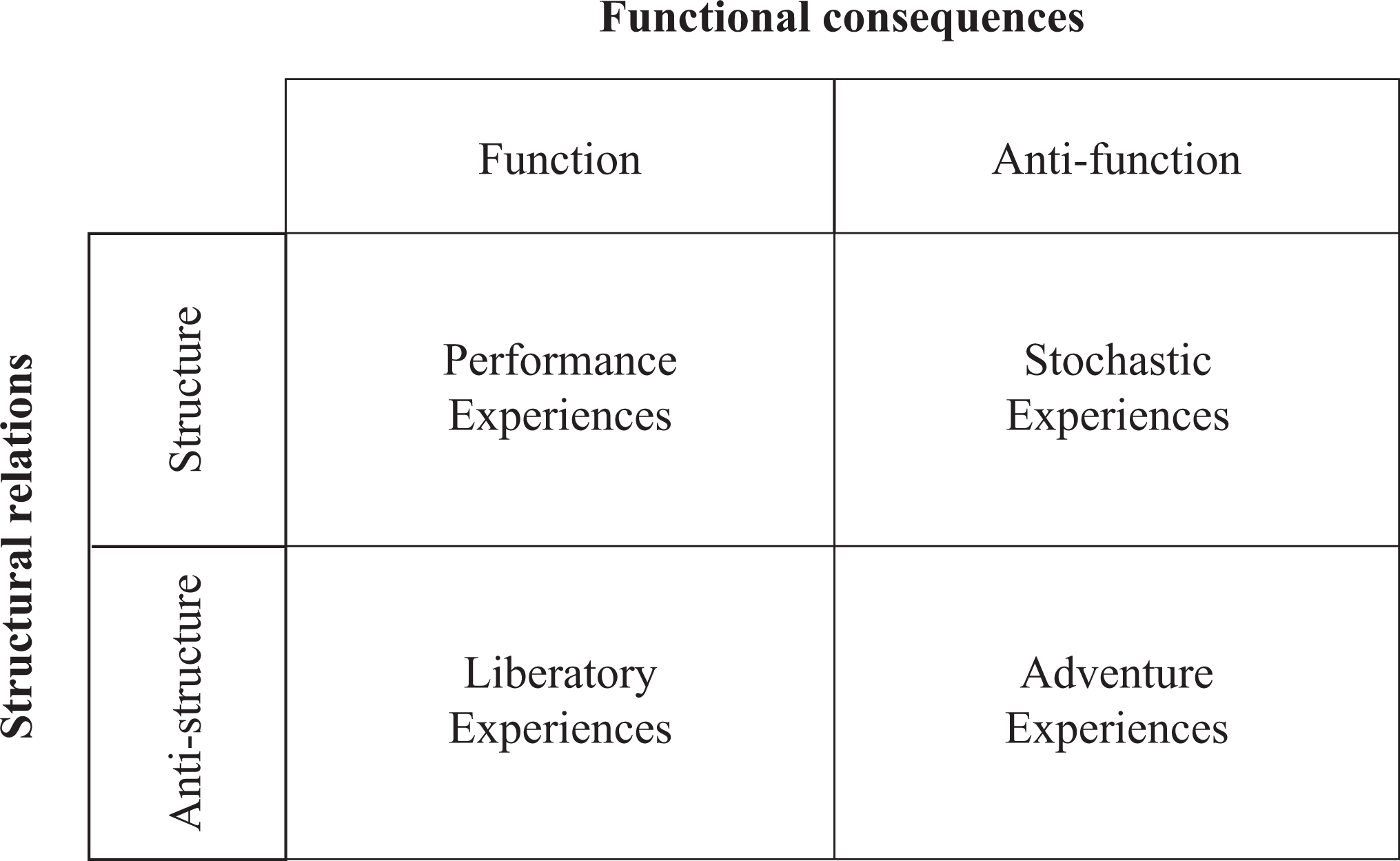
Classification of consumption experiences.
Liberatory experiences
Whilst research on consumption experiences cover a wide range of experiences, a major focus of the experiential literature has been on liberatory experiences (e.g. Arnould and Price, 1993; Belk and Costa, 1998; Celsi et al., 1993; Goulding and Saren, 2009; Kozinets, 2002; Schouten and McAlexander, 1995). Liberatory experiences are conceptualized as consumption experiences that directly address the anti-structural (i.e. unstable, inconsistent and disorderly) relations which underlie a cultural form(s) and which produce and promote functional (i.e. apparent, explicable and intended) consequences that attempt to resolve the anti-structural relations, often through a new or alternative structure. For example, Star Trek fans address the anti-structural aspects of modern society and promote a functional utopian future based on the vision of Gene Roddenberry and the various Star Trek texts (Kozinets, 2001).
In terms of their anti-structural dimension, liberatory experiences are often interpreted as extraordinary (Carù and Cova, 2003) since a key feature of these experiences is consumers’ overt (and often critical) engagement and transcendence of the structures in which they exist, be it the commercial nature of society, the drudgery of everyday life or even the limits of human understanding (Arnould and Price, 1993; Belk et al., 1989; Celsi et al., 1993). By directly confronting what are often perceived as restrictive, tedious and oppressive forces, consumers feel liberated to participate in what they consider more relevant and personal meanings, identities and values (Belk and Costa, 1998; Kozinets, 2002; Schouten and McAlexander, 1995). Given their functional nature, liberation is not achieved by situating the experience within the contradictions and inconsistencies of the structure being confronted, but within another structure that seemingly resolves these contradictions and inconsistencies (e.g. the Burning Man festival, mountain man rendezvous or natural health community). In fact, the anti-structural aspects (e.g. the problematic features) of these ‘alternative’ structures are often ignored as participants’ focus on resolving the tensions of the opposing structure (Canniford and Shankar, 2013).
In terms of their functional dimension, liberatory experiences are interpreted, at least etically, as having a definite and intended function in that they allow consumers to take on different perspectives, develop new skills, construct personal meanings and alter their identities (Arnould and Price, 1993; Goulding and Saren, 2009; Kozinets, 2002). Whilst it is true that the perspectives, meanings and identities that are facilitated through these experiences can be quite varied, this does not deny the broader functional nature of these experiences. In fact, one could argue that the functions of liberatory experiences are more homogeneous than heterogeneous in that similar types of consequences are found across contexts. In addition, despite their anti-structural nature, liberatory experiences reinforce and perpetuate their functional consequences through alternative structures that contain their own embedded rituals, cultural scripts and foundational myths (Arnould and Price, 1993; Belk and Costa, 1998; Kozinets, 2001). Likewise, whilst research suggests that liberatory experiences are primarily communal in nature, we contend that this is because of the need to establish an alternative structure to substantiate the functional consequences rather than any inherent egalitarian, communitarian and collaborative nature. This need to collectively embed these socially constructed meanings explains the focus in the experiential literature on consumer groups, including cultures of consumption, subcultures of consumption and consumer tribes (Cova and Cova, 2002; Kozinets, 2001; Schouten and McAlexander, 1995). This is not to suggest that these groups promote homogenous practices and meanings but that the differences among them may be due to their particular functions rather than the particular cultural context (Holt, 1997).
In addition to their anti-structural and functional dimensions, liberatory experiences are often associated with the experiential aspects of magic, fantasy, play and creativity (Arnould and Price, 1993; Belk and Costa, 1998; Kozinets, 2001). This is not surprising since all of these aspects are typically viewed as lying somewhat outside of the established structures of society, but whose function is to maintain a social order (Frazer, 1922; Huizinga, 1950; Tolkien, 1964). For example, liberatory experiences often utilize magic and fantasy to transcend mundane existence and construct invented traditions that reinforce romantic beliefs, which in turn supports the alternative meanings and identities associated with the experience (Arnould and Price, 1993; Belk and Costa, 1998). Whilst the general concept of play has been used to explain these experiences, liberatory experiences appear to manifest themselves more specifically as games of mimicry (Caillois, 1958), in which another world is created where participants assume identities and perpetuate meanings that differ from their everyday lives (Goulding and Saren, 2009). Whilst research on liberatory experiences claims that these factors are used to transcend the commercial, mundane and profane in order to experience the natural, sublime and sacred, we argue that these aspects are used primarily to create an experience that functionally addresses anti-structure.
Performance experiences
Although some argue that the experiential literature has focused entirely on liberatory experiences (Carù and Cova, 2003), considerable research has been done on performance experiences (e.g. Holt, 1995; Kozinets et al., 2004; Maclaran and Brown, 2005; Peñaloza, 2001; Sherry, 1998; Thompson and Hirschman, 1995). Performance experiences are conceptualized as consumption experiences that directly address the structural (i.e. stable, consistent and dominate) relations that underlie a cultural form(s) and that produce and promote functional (i.e. apparent, explicable and intended) consequences that ultimately reinforce and support these structural relationships. Whilst the literature has examined various characteristics of these experiences, only recently have attempts been made to classify them as a unique type of consumption experience. For example, Tumbat and Belk (2011) argue that not all consumers seek out anti-structural experiences, but often accept and directly engage the structural elements of a cultural form(s) in order to capitalize on and exploit the functional consequences of the experience for their own ends.
In terms of their structural dimension, performance experiences are often interpreted as ordinary in that what distinguishes these experiences, especially from liberatory experiences, is the acceptance of the structures of society, which are often associated with the commercial, mundane and profane. In fact, performance experiences are nothing if not a celebration of these various structural factors, be it brand stores (Sherry, 1998), retail environments (Maclaran and Brown, 2005), sporting events (Holt, 1995), television shows (Fitchett, 2004), video games (Denegri-Knott and Molesworth, 2010) and trade shows (Peñaloza, 2001). Whilst there may be some minor transgressions of the structures that make up the experience (e.g. cheaters), there is not the overt criticism or dismissal of these structures either entirely (e.g. spoilsports) or in favour of some countervailing structure (Campbell, 1987). For example, consumers who playfully subvert the games at ESPN Zone are not ultimately criticizing or revolting against the culturally embedded structures of professional sports (Kozinets et al., 2004).
In terms of their functional dimension, performance experiences, like liberatory experiences, are interpreted as having a definite function in that their particular consequences not only are apparent and intended but are also required and expected for the experience to be successful. For example, climbers are very aware of the consequences of reaching the summit of Mount Everest and expect to reap the rewards of a successful climb (Tumbat and Belk, 2011). Unlike liberatory experiences whose function is to create a new structure in order to facilitate alternative meanings and identities that may only have relevance to a particular subculture (e.g. Star Trek fans), the function of performance experience is to reinforce established meanings and enhance one’s current identity within the broader society (e.g. the 13-year-old American who summited Mount Everest basked in the limelight on many television talk shows). In addition, whilst research suggests that performance experiences are primarily individualistic in nature, with a focus on social hierarchy, direct competition and cultural capital (Holt, 1998; Kozinets et al., 2004; Tumbat and Belk, 2011), we contend that they are ultimately communal in that they require broad participation in mainstream values, norms and meanings in order for these functional consequences to be realized (e.g. structural brand communities vs. anti-structural consumer tribes) (Muniz and O’Guinn, 2001; Schouten and McAlexander, 1995).
Similar to research on liberatory experiences, this research has also examined the relationship between the nature of performance experiences and other experiential aspects such as utopia, fantasy, play and creativity (e.g. Fitchett, 2004; Kozinets et al., 2004; Maclaran and Brown, 2005). Unlike liberatory experiences, these aspects are usually employed in performance experiences to maintain and enhance established social structures and cultural meanings rather than promote their transcendence and subversion. Research even suggests that consumers are unfazed about the use of these seemingly unconventional aspects in a structural experience (e.g. the mix of fantasy in ‘reality’ television shows) (Rose and Wood, 2005). Whilst much of the research on performance experiences has focused on the role of play in these types of experiences (e.g. Kozinets et al., 2004), it has not explained how play fundamentally differs in performance experiences versus the other types of experiences. Utilizing Caillois’ (1958) classification of games, we contend that performance experiences manifest themselves more as agôn, or games of competition, in which the primary focus is on manifesting ones’ superior physical, mental and/or social skills relative to established social structures. For example, Holt’s (1995) description of baseball consumption clearly reflects the structures and functions of US society in the competition both on the field and in the stands, as fans compete with each other based on their superior mental, social and even physical skills.
Stochastic experiences
Despite the prevailing idea that the modern world is completely rationalized (i.e. functional) (e.g. Weber, 1904), we contend that the structural world is fraught with anti-functional experiences, one of which we label stochastic experiences. Stochastic experiences are conceptualized as consumption experiences that directly address the structural (i.e. stable, consistent and dominate) relations that underlie a cultural form(s), but which manifest anti-functional (i.e. ambiguous, inexplicable and unintended) consequences that actually reinforce and support these structural relationships. For example, whilst the consumption experience of gambling has been conceptualized (and ultimately rationalized) in a variety of ways (Cosgrave, 2006), another way to view gambling is that it provides an experience in which the rational (i.e. structural) and the irrational (i.e. anti-functional) not only coexist but depend upon each other for the success of the experience. Perhaps one of the reasons why gambling is cast in such a negative light (at least by the dominant social order) is not so much due to its destructive characteristics but because it reveals that the world cannot be completely rationalized. In fact, the widespread legalization of casino gambling (at least in the United States) and the corresponding increase in illegal and unregulated online forms of gambling (Cotte and LaTour, 2009) may be due more to attempts to functionalize and legitimize gambling (Humphreys, 2010) than with attempts to promote its anti-functional nature (e.g. what happens in Vegas stays in Vegas).
In terms of their structural dimension, stochastic experiences are embedded in and often controlled by established social structures (e.g. casinos, bars and clubs). In fact, there is no attempt by consumers to transcend these structures but rather to experience the inherent anti-functional consequences that occur within them (Goulding et al, 2009). Whilst one might argue that stochastic occurrences are due to the anti-structural aspects of a system, we contend that both types of structural relations (i.e. structural and anti-structural) are subject to these occurrences. In fact, rather than viewing stochastic experiences as somehow outside the flow of everyday life, most consumers view them as a fundamental part of existence (Fiske, 1989). Whilst it is true that the anti-structural aspects of an experience often lead to anti-functional consequences (e.g. a bad call made by a referee affecting the outcome of a sports event), for many, the structural aspects of many experiences cannot be completely functional without the experience losing all of its appeal (e.g. a sports game would be unappealing if the outcome was always foretold). In fact, the inexplicable and unpredictable outcome of an underdog team shutting out a favoured team is often more exciting than the expected and predictable outcome.
In terms of their anti-functional dimension, the consequences of stochastic experiences are inherently random, unpredictable and uncontrollable. This is not to suggest that the outcomes of these events are wholly unpredictable, but that there is a definite probability that the consequences will be different from what is expected and intended. Unlike those experiences in which consumers’ expectations are vague and reveal themselves over time (Arnould and Price, 1993), in stochastic experiences, consumers’ expectations are initially very clear, but are often thwarted by the experience. Rather than diminish the experience, this particular aspect actually enhances the enjoyment of stochastic experiences. For example, whilst casino gamblers’ expectations and desires are relatively straightforward (we assume most go there with the desire to win), it is the relatively unknown and unpredictable nature of the consequences that makes the experience appealing. In addition, whilst some consumers may utilize these experiences for functional reasons (e.g. the identity projects of professional sports fans), the very nature of stochastic experiences suggests that these functional consequences are more problematic than the literature suggests (e.g. fans’ meanings and identities are subject to the vagrancies of the team).
Given the functional tendencies in the experiential consumption literature, much of the research that addresses these types of experiences attempts to show how consumers try to manipulate these inherently stochastic events to make them more functional and controllable (Fitchett and Smith, 2002; Kim and McGill, 2011; Szmigin et al., 2008). In fact, consumer research even labels the deliberate enjoyment of stochastic experiences as infantile, deviant and pathological and argues that these experiences need to be identified, labelled and controlled (Belk, 2000; Fullerton, 2007; Rossiter and Foxall, 2008). Perhaps humans are predisposed towards functionality, which may explain the dominant focus on liberatory and performance experiences in the literature, but it appears that most consumers are at least tacitly aware of the anti-functional and stochastic aspects of life with some of those consumers wanting to actively engage these experiences. For example, one of the reasons why clubbing is not considered a stochastic experience is that one of its key features, ‘losing it’, is provided a definite and intended function in the end: biosocial pleasure (Goulding et al., 2009). Perhaps this is what distinguishes the performance-clubbing experience from the stochastic (i.e. the ‘untaxable, unstable and unpredictable’) nature of raves (p. 768).
Unlike liberatory and performance experiences, which are primarily communal in nature, we contend that stochastic experiences are primarily individualistic in nature in that the anti-functional consequences are often experienced at a deeper existential level (Sartre, 1956). For example, research suggests that many consumers engage in the stochastic experience of impulse purchases, which involve the ‘sudden, often powerful and persistent urge to buy something immediately’ (Rook, 1987: 191). These consumers feel like they cannot control the urge and must make the purchase despite the social consequences. These experiences differ from the more communal-based functional experiences in that these consequences are not to be managed or controlled (although there is considerable social pressure to do so), but to be directly engaged precisely because they are unmanageable and uncontrollable. In fact, imposing function may actually diminish, or fundamentally change, this type of experience. Many consumers enjoy stochastic experiences because it affects them at this deeply personal level (e.g. the loosening of inhibitions through alcohol consumption and the unexpected outcomes). Overlaying a night of partying with socially acceptable functions would likely alter (and even spoil) the experience.
The relationship between stochastic experiences and the other experiential aspects of consumption (e.g. magic, fantasy and authenticity) is relatively unknown. In terms of authenticity, it is likely that the authenticity of these experiences is determined more by what they do not include or represent versus what they do (e.g. gambling that is not ‘fixed’ is more likely to be considered authentic), which is not fully captured in the more functional typologies of authenticity (Grayson and Martinec, 2004). In terms of fantasy, rather than engage in a fully realized and somewhat predictable imaginary world (Belk and Costa, 1998), it may be the disorienting nature of stochastic experiences (e.g. the surreal atmosphere of casinos) that some consumers actually seek (Belk, 2000). Lastly, stochastic experiences appear to be related to a particular type of play, notably paidia, which is defined as a spontaneous and unreflective activity that seeks to destroy the stability of perception, versus ludus, which is defined as a rule-bound activity focused on achieving a goal (Caillois, 1958). These experiences are also related to alea (i.e. games of chance) in which the player has little control over the outcome of the game and which the capriciousness of luck actually constitutes the appeal of the game (Caillois, 1958).
Adventure experiences
If there is little consumer research into stochastic experiences, there is even less on adventure experiences. The concept of adventure, though, has not gone unexplored, and there exists research on adventure in the broader fields of psychology, sociology and anthropology (Csikszentmihalyi, 1990; Mitchell, 1983; Schmidt, 1979) and even more in the specific domains of tourism, travel and leisure (Ewert, 1989; Priest, 1992; Weber, 2001). Despite this extensive research, conceptualizations of adventure remain exceedingly divergent. For instance, adventure has been defined in the tourism and leisure journals as a performance experience (Jones et al., 2003), a liberatory experience (Walle, 1997), and a stochastic experience, albeit one that must be controlled or avoided at all cost (Martin and Priest, 1986).
In line with our aim to focus on the theoretical assumptions underlying our understanding of consumption experiences, this article draws upon a small group of theorists (e.g. Gurevitch, 1988; Schuetz, 1944; Simmel, 1997) who have examined adventure’s deeper and historical usage. They argue that adventure is not simply an aspect of an experience but is a specific type of experience that is distinguished by its ability to resist any attempt to subsume it into a structural form or functional consequence. For example, Simmel (1997) argues that adventure has four distinct characteristics: (1) it is set apart from everyday life; (2) it actively engages the indefinite, uncertain and indeterminate aspects of existence; (3) it transforms the person into an ahistorical person; and (4) it is a process rather than content. Based on this research, adventure experiences are conceptualized as consumption experiences that directly address the anti-structural (i.e. unstable, inconsistent and disorderly) relations that underlie a cultural form(s) and which manifest anti-functional (i.e. ambiguous, inexplicable and unintended) consequences that do not attempt to resolve these anti-structural issues in some alternative cultural form, but which maintain these issues in order to challenge all cultural forms. For example, unlike punk music, which developed a distinct, though heterogeneous, subculture of consumption (e.g. distinct practices, meanings and identities) in reaction to the harsh social conditions of its members (e.g. Hebdige, 1979), death metal does not seek to critique the structural aspects of society in favour of some ‘liberatory’ alternative, but instead seeks to intensify these issues, thus revealing the inherent anti-structural aspects of society and undermining not only the specific cultural forms being addressed, but all cultural forms, including their respective practices, meanings and identities (Phillipov, 2012).
In terms of their anti-structural dimension, adventure experiences are set apart from everyday life, though not necessarily in relation to the context of the experience (e.g. some exotic location), but in terms of the types of relations that they engage within these contexts (i.e. unstable, inconsistent and disorderly). As such, these experiences can take place as much on a remote mountain top as they can in one’s home. Adventure experiences can be considered extraordinary in that they directly engage those anti-structural relations that are usually ignored or avoided and that are often culturally inappropriate, prohibited or illegal. Consequently, they typically stand out from our ordinary lives and put us in situations that we normally do not encounter. Likewise, whilst social structures are often overtly transgressed (deliberately or not), this transgression is not meant to critique or even facilitate the structures in which these anti-structural relations are embedded (Turner, 1969); rather, it serves to undermine and subvert the very nature of all structures (Derrida, 1978). Unlike liberatory experiences, which attempt to resolve the anti-structural issues (within an alternative structure), adventure experiences leave these issues unresolved. For example, whilst some consumers may indeed seek to live abroad in order to assimilate into the local culture by managing the structural tensions among the various cultural forms in which they exist (Thompson and Tambyah, 1999), others seek to live abroad and not assimilate in order to deliberately experience these structural conflicts (Elsrud, 2001).
In terms of their anti-functional dimension, the consequences of adventure experiences, like stochastic experiences, are inherently random, unpredictable and uncontrollable and are often unintended. For example, whilst death metal is typically criticized for promoting violent, antisocial and destructive behaviour (leading to its ban in many countries), the deeper fear seems to be that the sanctioned authorities are uncertain about the social consequences of music that directly addresses patently taboo topics (Phillipov, 2012). In fact, whilst many art forms do address these issues, they typically resolve them in a manner that is socially acceptable (e.g. the ever popular police television programmes always solve their cases). Unlike stochastic experiences, which engage the anti-functional aspects of life within the safety of established structures, thus leaving cultural meanings and identities intact, adventure experiences engage anti-function in the void of anti-structure, potentially undermining any sense of meaning and identity. Whilst this is often the unintended consequence of a particular consumption experience, it can also be the intended consequence in which consumers deliberately seek out an adventure in order to potentially experience this total disruption of function. For example, long-term backpackers deliberately and constantly place themselves in unfamiliar, uncomfortable and potentially unsafe situations in order to challenge their particular meanings, identities and sense of control (Elsrud, 2001). Since there is no guarantee that these experiences will result, adventure experiences are more unpredictable and uncontrollable than stochastic experiences.
Like stochastic experiences, we contend that adventure experiences are primarily individualistic in nature. Whilst not denying the social component of all experiences, adventures are experienced at a deeply personal level. Likewise, even though adventure experiences share the anti-structural dimension with liberatory experiences, the difference is that adventure experiences are not ‘boundary open’ and ‘conflict-attenuated’ events that bring people together around deeper meanings and purpose (Arnould and Price, 1993) but are rather disruptive and disturbing events that destabilize people’s lives by challenging the very meaning and purpose of cultural forms and their corresponding communal functions (Novak, 1970). Although a simple binary classification of liberatory experiences as positive and adventure experiences as negative does not fully capture the nature of either of these experiences, adventure experiences involve an irresolvable existential anxiety that is often removed from liberatory experiences. For example, although Arnould et al. (1999) state that the confrontation of existential threats is important to the liberatory experience of river rafting, it is overcoming these threats that produces the coveted river magic. In fact, one researcher states, ‘I felt no nameless dread. I felt good. I felt aroused and calm at the same time. I felt connected to the environment. I felt connected to myself’ (p. 58).
Adventure experiences do not provide a safe passage through the existential threats embodied in the experience, but force the person to deal with them head on without some comfortable functional support to ease their anxiety. Whilst this situation seems to correspond with the notion of risk that is normally associated with adventure (Ewert, 1989), the risks of adventure are not physical or psychic phenomena that need to be controlled and managed (e.g. Celsi et al., 1993), which are actually performance risks, but are existential phenomena that can never be fully controlled or managed. For example, Kane and Zink’s (2004) study of heli-kayaking (i.e. flying by helicopter to a remote location and kayaking out) finds that attributions of function are usually made post hoc in order to interpret the event once the actual anti-functional adventure is over. The essence of adventure is the confrontation with anti-structural forces without any functional recourse other than one’s will in the immediacy of being (Nietzsche, 1968). Unlike liberatory or performance experiences, adventure is the realization that these existential threats ultimately cannot be managed or resolved but must be simply endured or even accepted, as all structural forms have intractable, inexplicable and irresolvable issues.
As with stochastic experiences, the relationship between adventure experiences and other experiential phenomena (e.g. authenticity, play and fantasy) is relatively unknown. For example, it is argued that whilst the commercialization (i.e. functionalization) of adventure is ultimately a contradiction, the experience can remain authentic if everyone accepts this deception (Fletcher, 2010). The problem with this argument is that it tries to reconcile adventure with traditional conceptualizations of authenticity rather than understand the authenticity of these experiences. In terms of play, there appears to be a link between adventure and ilinix (i.e. games of vertigo), in which the focus is on temporarily destroying stability of perception and inducing a sense of anxiety (Caillois, 1958). At a deeper level, there are indications in the more theoretical discussions on these topics (Huizinga, 1950; Frazer, 1922; Tolkien, 1964) that these experiential phenomena (e.g. play, magic and fantasy) play a major role not simply within the established structures and functions of society but also in their very constitution, perpetuation and destruction (Cox, 1969; Jung, 1969; Schlobin, 1979). Although we may be eternally plugged into some form of cultural code from which we cannot escape (Arnould, 2007), this code is far from perfect, absolute or all-powerful, as it is often turned in upon itself to reveal its flaws, boundaries and limits (Foucault, 1977). It is in these adventurous moments that the creative force of fantasy, magic and play can have dramatic results.
Discussion
Whilst it may be tempting to argue that all consumption experiences are embedded in some type of structure (e.g. material, symbolic or discursive) and therefore have a definite function, this article maintains that this is not an empirical fact but a theoretical assumption. No doubt, this assumption is foundational to Western philosophy and underlies much intellectual thought up to our present day. It may be, though, that the structural assumptions that underlie much of the research on consumption experiences naturally lend themselves to functional explanations. By examining the structural assumptions of this research and their functional equivalents, this article contends that not all consumption experiences can be explained by a purely functional approach. At the same time, recognizing the benefits of utilizing these assumptions and realizing the difficulty of any theoretical explanation that eschews them, we have sought to refine and extend the structural–functional framework to include not only anti-structural experiences but also anti-functional experiences. Just as anti-structure does not refute the deeper elemental relations that underlie a specific cultural form, anti-function does not deny the consequences of these forms but posits a completely different type of outcome. Going further, rather than interpret anti-function as a means of establishing alternative functions, which in effect would extend a function to anti-function, we argue that anti-function cannot be subsumed into function but coexists with its functional equivalent. As a result, the concept of anti-function not only takes us beyond the scope of the functional analysis in the literature but also forces us to reassess the anti-structural analysis of these experiences.
One of the implications of differentiating the various types of consumption experiences is that rather than being rare occurrences, anti-functional experiences may be just as prevalent as functional experiences. In this case, the literature may have led us a bit astray by focusing, at least etically, on idealistic rather than realistic experiences (i.e. focusing on experiences that lend themselves to coherent explanations and interpretations vs. those that do not). One has to wonder if all of the consumption experiences examined in the literature are inherently unproblematic (i.e. every aspect can be explained). Unfortunately, we never get to see the data that do not fit the proposed functional interpretations, but rather we are told that there are simply boundary conditions to the interpretation, with the added assumption that those things that lie beyond the boundaries are equally explainable or interpretable. The fact that many consumers have to engage in certain practices to smooth over the problems of particular experiences (Canniford and Shankar, 2013) suggests that this is not the case. Whilst it is certainly possible that some consumers find anti-functional experiences unappealing, this should not imply that all consumers necessarily view them as unattractive. It may be that our lives are filled with anti-functional consumption experiences that we neither try to deliberately avoid nor try to actively resolve, but which we embrace despite, or perhaps because of, their particular nature. As researchers, we would be extremely remiss if we discount a whole realm of human experience simply to focus on what we can explain or interpret based on accepted theoretical perspectives.
Another implication of this research is that not only may anti-functional experiences be more prevalent than we think but they may also be increasing in our rapidly expanding consumer culture. As a result, it is important to understand the role that marketing plays in these types of experiences. In this age of co-optation (Thompson and Coskuner-Balli, 2007), it appears that marketing cannot fully appropriate anti-functional experiences into its structural–functional logic without destroying or fundamentally changing them from anti-functional to functional experiences. Some researchers have argued that if consumers at least think they are getting an anti-functional experience, then this is all that matters (Fletcher, 2010). Even these researchers, though are forced to admit that consumers know the difference between these types of experiences and that the effect of a simulated anti-functional experience is not the same as a genuine anti-functional experience. In fact, anti-functional experiences may arise as the unintended result of marketing’s co-opting forces. That is, the more the marketplace tries to co-opt anti-functional experiences, the more it creates experiences that are beyond its control, creating a vicious circle that stresses its underlying structure and reveals its limits (Russo, 2009).
Less of an implication than a cautionary note, this research contends that it is very important that researchers do not associate a type of consumption experience with a specific context. For example, gambling is not necessarily a stochastic experience any more than river rafting is a liberatory experience or climbing Mount Everest is a performance experience. Simmel (1997) made it very clear that the content of an experience does not make it an adventure, though most researchers have ignored this admonition as they enumerate various adventure activities (Ewert, 1989). Whilst certain contexts may lend themselves to one type of experience over another, the experience is neither guaranteed by nor limited to these contexts. As a result, just because researchers can empirically find consumers that engage in gambling for functional reasons does not preclude the fact that there may be others who engage in gambling for anti-functional reasons. At the same time, even though there are river rafting consumers who did not have a ‘magical’ liberatory experience (Arnould et al., 1999), this does not undermine the experience of those who did. We need to make sure that we do not discount any consumer experiences merely due to the context.
A limitation of this article is that it does not directly address how consumers actually consume experiences. The primary purpose of the article is not to provide a micro-level analysis of consumer practices in regards to these experiences, but to provide a macro-level theoretical perspective on the broader nature of these experiences. With that said, how consumers consume these experiences is a very important topic that needs to be explored. For example, in his study of baseball fans, Holt (1995) outlines four types of consumption practices based on the dimensions of structure and purpose. His focus on purpose naturally leads him to provide functional explanations of these consumptions practices. Whilst this typology is very valuable in describing functional experiences, it does not capture the essence of consuming anti-functional experiences. Alternatively, research into media fandom (e.g. Fiske, 1989; Jenkins, 1992; Sandvoss, 2006) may provide rich insights into anti-functional consumption practices. Whilst some fans certainly consume media products for functional purposes (e.g. Kozinet’s, 2001, ‘meanings’ of Star Trek), other fans are known for their anti-functional practices of opposing, subverting and even exploding the meanings of media texts (Pearson, 2010). In fact, many fans balk at efforts by producers and other fans to stabilize and contain this process (Lothian, 2009).
A deeper limitation is that whilst the proposed framework has provided a means to distinguish anti-functional from functional experiences, it could be critiqued as having committed the same error that is perpetuated in the broader literature. That is, by conceptualizing anti-function in terms of the deeply rationalized concepts of structure and function and situating it in a matrix, the article has inadvertently functionalized anti-function, thus contributing to the problem. We contend that our approach was not to rationalize anti-function or provide a definitive explanation of this dimension of consumption experiences but simply to utilize the language of existing theory to expose an aspect of life that has been virtually ignored in the literature. The bigger question is whether we can research these types of experiences without forcing them into a particular explanation or interpretation. The challenge will be to develop an approach that does not attempt to impose function on anti-functional experiences. Perhaps, this can be done by focusing on the potential rather than the actual, as well as the unintentional versus the intentional, consequences of consumption experiences. In addition, rather than simply state the boundary conditions of our functional explanations, we could speculate on what we may have overlooked based on data that have been discarded from our interpretations as a result of the inherent functional nature of our research.
Conclusion
If we assume that there are no un-interpreted facts (Nietzsche, 1907) and that data do not speak for themselves (Geertz, 1973), then it is imperative for researchers not only to apply their theoretical lenses to interpret consumer experiences but also to interrogate the theoretical lenses themselves to determine what they are and are not allowing us to see. These theoretical lenses may be severely limiting our perspective of consumption experiences to only functional experiences that are amenable to coherent interpretations. Whilst we accept the idea that there is no privileged position from which to interrogate these lenses, we feel that there is value in examining one lens through another lens to see what it both hides and reveals. This article has attempted to show that whilst the predominant structural lens (which includes both structure and anti-structure) has allowed us to learn much about various consumption experiences, it has also restricted our understanding to primarily functional interpretations. By interrogating this lens and its structural and functional assumptions, this article has proposed a framework to classify consumption experiences based on a novel conceptualization of the factors underlying these assumptions. The resulting framework identified two types of consumption experience (i.e. stochastic experience and adventure experience) that have gone underexplored in the experiential literature. In fact, we contend that research that has come close to addressing these experiences (e.g. Arsel and Thompson, 2011; Belk et al., 2003; Goulding et al., 2009) has been prevented from doing so due to the limitations of the inherent structural–functional assumptions underlying the experiential consumption literature. A major contribution of this article has been to provide a new language to help us transcend these limitations and broaden our understanding of experiential consumption and the specific types of consumption experience.
Through this new perspective, this article has proposed an alternative means that allows us not only to explore stochastic and adventure experiences in more depth but also to refine our understanding of both performance and liberatory experiences. In addition, this theoretical classification may help to expand our understanding of the related experiential aspects of consumption (e.g. authenticity, fantasy, magic, play and creativity). Rather than operate similarly across each type of experience, we believe that these aspects manifest themselves differently in the four types of consumption experience. Thus, rather than view these aspects as singular and adhering to a single set of assumptions, they may be more pluralistic and take on fundamentally different forms depending on the underlying nature of each type of consumption experience. The endurance of these concepts suggests that they are very robust and are not constrained by any particular context or theoretical approach.
If we are truly in an experience economy in which the dominant mode of consumption is experienced based (Pine and Gilmore, 1999), then it is important for us as researchers to constantly push the boundaries of our theoretical understanding of this important phenomenon. In the 1950s, Levy (1959) proposed that there was a whole experiential side of consumption that we were missing. In the 1980s, Holbrook and Hirschman (1982) provided us a framework for exploring various aspects of consumption experiences. More recently, Carù and Cova (2003) argued that consumption experiences are not merely extraordinary but are often quite ordinary and not confined to the commercial realm. This article continues in this vein by suggesting that there are some consumption experiences that cannot be wholly explained or interpreted by the current theoretical lens being used in the experiential literature. We provide a starting point from which to examine these consumption experiences and encourage more theoretical and empirical investigation into the exceedingly vast and complex nature of consumption experiences.