



Abstract
Practice and experience are central concepts in service logic (SL), and research has provided increasingly sophisticated accounts of their role within value creation. However, to date, they have been largely treated separately and despite acknowledgement that they are intertwined, the precise nature of their relationship remains unclear. To respond to this problem, we introduce Bourdieu’s recursive triad of practice–habitus–field as a theoretical lens to articulate how sensemaking processes incorporate an explicit link between practice and experience. We then utilize the theoretical lens to examine value creation for participants of a self-reliance training course. Our article contributes to the theorization of value creation by showing how it is dependent upon the temporal intertwining of practice and experience; how the unconscious or anticipated/foreseen nature of practice and experience become manifested in value creation and how zooming in and zooming out can be simultaneously achieved to acknowledge the individual and contextual influences upon value creation. We present a dynamic model of practice-experience links in value creation, which both extends the theory of SL and provides a basis for further work. The article concludes with managerial implications.
Keywords
Introduction
Both service-dominant logic (SDL) and service logic (SL) recognize the crucial importance of experience and practice in value creation. In terms of experience, SDL argues that value is always uniquely and phenomenologically determined by the beneficiary (Vargo and Lusch, 2008), whilst SL states that value is based upon an experientially accumulating process and is both perceived and determined by customers (Gronroos, 2011). Both perspectives recognize the importance of practice, SDL positing that the customer is always a co-creator of value, whilst SL acknowledges that co-creation occurs between service provider and customer but contends that customers also create value independently in their own sphere (Gronroos, 2011). Gronroos and Voima (2013) defined the locus of value creation as the customer’s physical, mental or possessive activities, practices and experiences in multiple individual and collective social contexts (p. 39, emphasis added), thereby indicating the centrality of both practice and experience to value creation.
Helkkula et al. (2012) note that service research has tended to treat practice and experience separately but contend that they are intertwined, ‘neither of them solely can interpret and identity new possibilities for value co-creation’ (p. 564). Yet, precisely how they are intertwined remains unclear. This lack of clarity represents an important gap in the developing theorization of value creation in SLs and forms the central question of this article: How are practice and experience intertwined in value creation? Failing to engage with this question risks the possibility that research will continue to focus on either practice or experience, or foreground one over the other, and may therefore offer an incomplete account of the complex phenomenon of value creation.
To address the central question above, we draw upon Bourdieu’s theory of practice (Bourdieu, 1977, 1990). Bourdieu is often cited in value research but usually only as a general reference to practice theory (Echeverri and Skålén, 2011; Gummerus, 2013; Helkkula and Kelleher, 2010; Helkkula et al., 2012). We provide a fuller engagement with his recursive triad of practice–habitus–field to develop the notion of habitus-mediated and habitus-forming sensemaking processes and utilize these to investigate value creation. This engagement is important because to date phenomenology and practice theory have been positioned as separate from each other (Helkkula et al., 2012). However, Bourdieu’s theory of practice incorporates both a structuralist position, which focuses on objective relations and how this influences practice, and a constructivist position, which focuses on subjectively created phenomenological experience. Therefore, this existing sociological framework incorporates phenomenology within practice theory and thus provides a way of examining how, whilst separate phenomena, experience and practice are inextricably linked and indeed reciprocally intertwined.
Research has grappled with theorizing how different phenomena within value creation influence each other. For example, scholars have focused on the circularity of customers’ experiences and their perception of value (Helkkula and Kelleher, 2010) and on linking value processes and value outcomes through experience (Gummerus, 2013). Here, experience is explicitly investigated, but practice remains implicit or in the background. Similarly, others have focused upon contextualized value creation practices (Chandler and Vargo, 2011), specifically the social context (Edvarsson et al., 2011) or cultural context (Akaka et al., 2013). In these studies, practice is explicitly investigated, but experience remains implicit or in the background. Our article contributes to these increasingly sophisticated accounts of value creation by examining both experience and practice and revealing their interaction. In doing so, we contribute to literature in three key ways: (1) we provide insights into the inherently temporal nature of value creation, and how practice experience intertwinement is embedded temporally; (2) we articulate how the unconscious or anticipated/foreseen nature of practice and experience become manifested in value creation via customer sensemaking processes and (3) we present an analysis that simultaneously ‘zooms in’ and ‘zooms out’ to highlight the individual and social contexts and their importance for understanding the connection between objective practice and subjective experience.
The article commences by reviewing value creation from a service perspective. The following section first discusses how practice and experience have been investigated in existing literature and then outlines how their separation prompts three key themes for investigation. Bourdieu’s theory of practice is introduced as a conceptual apparatus for theorizing connections between practice and experience through sensemaking processes. Next, we outline the methodology of our fieldwork, which we use to explore and illustrate our conceptualization. Finally, we propose a model that informs service research about the dynamic interplay between a customer’s practice and experience in value creation processes in any given context. The article concludes by outlining the contributions of the analysis and its practical implications.
Value creation in SL and SDL
In this study, we adopt the SL definitions of value, value-in-use and value creation as outlined by Grönroos and Gummerus (2014: 209). Value from a service is a contribution to a customer’s well-being from the customer’s perspective. Value is the same as value-in-use, that is, ‘the value [increased well-being] for customers, created by them during their usage of resources’, whilst value creation is defined as ‘the customer’s process of extracting value from resources’. This definition means that value is cumulative over time and is both created and determined by customers. We emphasize that value may be instrumentally created or it may emerge out of integrating new resources with existing resources, whilst applying previously held knowledge and skills (Gronroos and Voima, 2013), and that value is uniquely and contextually perceived and determined by users (Grönroos and Voima, 2013; Vargo and Lusch, 2014). We now consider briefly the development of value conceptualizations in service literature.
Early service researchers focussed predominantly on customer perceived value, generally expressed and measured in terms of the cognitive assessment of benefits compared to sacrifices (Zeithaml, 1988). Woodruff (1997) emphasized the importance of understanding value in terms of customer perceptions at different points of time and in different circumstances. Value has retained this emphasis on customer perceived ‘benefits’ in the service literature but, over time, debates and commentaries have recognized diverse and more complex conceptualizations, for example, value as a hierarchy of dimensions (Rintamäki et al., 2007) and as the accumulation of extra benefits (Khalifa, 2004). Earlier, Normann and Ramirez (1993) had emphasized value in terms of customers accessing and using increasingly ‘dense’ resources to leverage their own value creation, where density is a measure of the amount of information, knowledge and other means that an economic actor has at hand at any moment in time. Normann and Ramirez (1993: 66) also recognized the need to focus on the value-creating system ‘within which different actors work together to co-produce value’, later advocated by Prahalad and Ramaswamy (2004: 5) who stated ‘Increasingly, consumers engage in the processes of both defining and creating value. The co-creation experience of the consumer becomes the very basis of value’ (emphasis added). Recent studies highlight the central role of this co-creation experience in value creation (Akaka et al., 2015; Jaakkola et al., 2015). These advances demonstrate a shift in thinking about value creation, from firm actions to customer actions and experiences, the individual’s interpretation of meaning in their own value-generating context and the accumulation of value over time.
The idea of consumers leveraging their own unique value creation is fundamental to the theory of SDL and SL. In these logics, customers use resource integration to create value which not only incorporates the actions and context of customers but also their phenomenological interpretation of outcomes (Gummerus, 2013; Vargo and Lusch, 2004). However, as noted in our Introduction, SL scholars define value co-creation differently to SDL proponents and, in so doing, separate it from other value-generating activity, namely, independent value creation and value co-creation in the customer’s ecosphere. In this study, we adopt the SL definition of value co-creation, that is, ‘value co-creation is a joint directly interactive process in which the actors’ processes merge into one collaborative, dialogical process, such that a co-creation platform forms’ (Grönroos and Gummerus, 2014: 214). This definition emphasizes the critical role of customer involvement in value creation, also highlighted by discourse on customer dominant logic (CDL) (Heinonen et al., 2010), customer needing (Strandvik et al., 2012) and customer activity (Mickelsson, 2013). Further, as noted above, the locus of value creation includes ‘the customer’s physical, mental, or possessive activities, practices, and experiences in multiple individual and social contexts’ (Gronroos and Voima, 2013: 138).
Despite the differences between SDL and SL, both schools recognize that value is created, perceived and assessed by consumers in their own processes and lifeworlds, the importance of networks and constellations and the building of value on past experience (Grönroos and Gummerus, 2014; Vargo and Lusch, 2008). Further, both SDL and SL take as their starting point that customers (or any users or beneficiaries of service) integrate resources, as services that render value for them or others (Chen et al., 2012; Grönroos and Gummerus, 2014). Hence, the fundamental consistency between SL and SDL enables us to contribute to both logics when pursuing our research aim of exploring practice and experience in value creation. In accessing and using resources, customers engage in practices, which provide them with lived-through experiences, that they interpret within their own individual situations and wider social contexts. However, the precise intertwining of practice and experience requires clarification. Practice-focused and experience-focused investigations of value creation are discussed next.
Practice and experience in existing value creation literature
This section contends that increasingly sophisticated accounts of both practice and experience have emerged in the literature, through explorations of their connections to other phenomena within value creation. However, given that practice and experience have largely been studied separately, we consider Helkkula et al.’s (2012) outline of the challenges and opportunities for research on them, in relation to our review, to identify themes for investigation that incorporate both.
Practice
Research that investigates the practice aspect of value creation has tended to draw upon work by Reckwitz (2002) and Warde (2005). Reckwitz (2002: 250) defines practice as ‘routinized behaviour, consisting of several interconnected and essential elements: bodily activities, mental activities, “things” and their use, background knowledge and understanding, know-how, states of emotion and motivation’. Warde (2005) emphasizes that whilst practice is routine ‘doing’, it also involves mental processes and builds on the past. Thus, we define practice as what customers ‘do’ using service offerings and personal resources, including mental activities, to create value in their everyday lives.
A central concern of practice-based studies of value creation is context or the situatedness of practice. Korkman et al. (2010) argue that practice theory provides a conceptual tool to investigate resource integration and value creation. They state that actors engage in contextually embedded practices (doings) and integrate sociocultural resources to create value and that firms extend and enhance value creation by providing resources that ‘fit’ into customers’ practice constellations. However, Korkman et al. (2010) also contend that there are still very few attempts within service as a perspective, regardless of logic, to understand the actual practical process of resource integration, and how value stems from this integration. One exception is the work of McColl-Kennedy et al. (2012) who use social practice theory as a theoretical frame for identifying customer value co-creation practice styles. They considered a cycle of potential change involving representational practices, normalizing practices and integrating practices, thereby incorporating mental processes, physical actions and interactions.
Returning to context as well as practice representing the practical doings of people over time, practice theorists highlight the importance of the social setting and the multiple influences on individuals. Scholars emphasize that all activity is contextually and socially bound and note the underpinning of consumer culture theory in shifting our focus to address value creation as a social phenomenon whereby meaning is co-created and shared (Arnould, 2006; Chandler and Vargo, 2011; Payne et al., 2008). Others note that people live in and are influenced by networks (Chandler and Vargo, 2011; Schau et al., 2009) and that these social forces and structures shape consumer perceptions and actions (Edvardsson et al., 2011). In summary, these perspectives and the definition above reflect practice as behavioural and likely consisting of essentially routine actions, but it is situated in the customer’s lifeworld and includes mental processes, which provide meaning and the basis for change over time.
Experience
In the doing of a practice, customers have a personal ‘experience’; or as Gummerus (2013) notes, the customer has a dual role in service, both as active contributor to and interpreter of, experiences. Literature uses the term experience broadly. When an individual ‘experiences’ (a verb) or ‘has practical acquaintance with facts or events’, that person is said to have had ‘the experience’ (a noun), meaning ‘the knowledge or skill resulting from it’ or ‘the fact or process of being affected by it’ (Australian Concise Oxford Dictionary, 1992: 393). That is, the term experience must have an object and reflect experience ‘of something’. In this discussion, we explore ‘experience of practice’, which we interpret as living through and finding meaning from certain patterns of action to create value. The value creation experience also involves individual customer’s unique responses and phenomenological assessment of that ‘living through’. This phenomenological approach, which characterizes experience as internal and subjective, is the basis of value experience in service literature (Helkkula, 2011) and supported by marketing scholars. Hence, consistent with other service researchers, we adopt a phenomenological approach to experience.
We define experience as experience of practice, that is, the individual’s unique and context-bound, phenomenological interpretation of value creation activity. However, we acknowledge that in experiences, the element of ‘lived’ draws ‘attention to the conditions under which these experiences unfold, conditions that are not necessarily experienced, per se’ but are manifest in life conditions (Askegaard and Linnet, 2011: 397). These multiple layers represent a complexity that influences both the context in which an activity occurs and an individual’s attitudes and interests. Scholars who embrace an experiential approach to value formation agree that experience is individual, dynamic, cumulative and context-bound (e.g. Chandler and Vargo, 2011). The individual and phenomenological aspect appears to be attributed originally to Holbrook and Hirschman (1982: 132) who alleged that the ‘Experiential perspective is phenomenological in spirit and regards consumption as a primarily subjective state of consciousness’. Others reinforce this view. For example, Schembri (2006) introduced the idea that all individuals are experiencing subjects in social experience networks; Meyer and Schwager (2007) defined experience in terms of the customer’s internal and subjective response to contact with a company and Ramaswamy (2011) argued that value is not a function of service but is embedded within human experiences. Thus, the personal and subjective elements of experience appear undisputed, and, additionally, there is agreement that customer experience is built on the individual’s prior state of mind and previous interactions, thereby providing a foundation for the future (Helkkula and Kelleher, 2010; Vargo and Lusch, 2008).
In addition to the individual, dynamic and cumulative nature of experience, there is consensus in the literature that experience is context bound at individual and sociocultural levels and involves social groups, many interactions, multi-stakeholder networks and ‘uncountable’ influences (see, for e.g. Akaka et al., 2015; Helkkula, 2011; Ramaswamy, 2011).
Themes and questions for investigation
In this section, we propose three key themes for investigation in value creation: its inherently temporal nature, the scope and complexity of practice and experience and the individual and social perspective. In each case, we discuss the origin of the theme and consider it in relation to Helkkula et al.’s (2012) possibilities and challenges for future research with respect to practice and experience in value creation, and we reflect on the challenges in relation to previous research. In the following section, we consider Bourdieu’s theory of practice and explain how sensemaking processes elucidate our analysis of the key themes. Table 1 provides a brief summary of these two sections.
Themes and questions for investigation.

The first theme concerns the temporal nature of value creation. We contend that value creation must be temporal: it draws from the past, is situated in the present and influences the future. Relevant literature has long recognized temporal aspects of value. For example, building on Gardial et al.’s (1994) work, which showed that customers perceive value differently at the time of purchase compared to perceptions during use, Woodruff (1997; 142) developed a framework built on the assumption that ‘value stems from customers’ learned perceptions, preferences and evaluations’. Thus, value perceptions likely evolve. Whilst Woodruff (1997) emphasized the organization learning about changes in what customers value, his model highlights the need for a longitudinal approach involving a customer value information loop. Helkkula et al. (2012) also emphasize the importance of a longitudinal understanding of value, raising the question of whether to focus on a single or multiple service events. Other scholars have identified the need to focus on the change in the customer, for example, Kumar et al. (2006: 91) stated that ‘our models and theories need to include the notion that customers change over time’. Similarly, Heinonen et al. (2013) contend that value is embedded and formed in the highly dynamic and multi-contextual reality and life of the customer, which necessitates looking to the invisible and mental life of the customer and extending the temporal scope, from exchange and use, to accumulated experiences in the customer’s life and ecosystem. This discussion demonstrates that value creation is based upon a process of experiential accumulation (or destruction) over time (Gronroos and Voima, 2013), in which the customer both creates value and assesses value, thus confirming that practice and experience are inherently temporal and based on multiple service events. Thus, to more fully understand the dynamics of value creation, we must not simply focus on the temporal nature of the process but also investigate the more important (and difficult) challenge of how value creation activity (practices) and experience are linked. Therefore, our first theme leads to the question: How are practices and experiences temporally intertwined in value creation?
The second major theme concerns the precise nature of practice and experience. Helkkula et al. (2012) argue that in attempting to understand value creation practices and experiences, challenges arise in relation to the observation that practices are unconscious and mental (concerned with repeated behaviours in a social context) and that experiences may be imaginary (concerned with individual and subjective responses). We prefer the terminology of anticipated/foreseen to imaginary as the former better captures the possibility of them being actualized in the future and therefore the temporal nature of value creation. Both these issues are important because they are directly implicated in whether value is instrumentally created or whether it emerges during value-in-use (Gronroos and Gummerus, 2014). We therefore propose the following questions: How do unconscious practices become conscious?; How do anticipated/foreseen experiences relate to practice? and How are these characteristics of practice and experience implicated in value creation? These questions underlie value-in-use and highlight our need to understand how the unconscious and anticipated/foreseen may be incorporated into value-in-use and the accumulation of value over time.
The third theme concerns ‘zooming in’ to the individual perspective and ‘zooming out’ to the social context and acknowledges that value creation takes place both individually and in networks. Whilst scholars have developed increasingly erudite assessments of context, especially in practice-focused studies, experience-focused research appears more illuminating for the individual nature of value creation (for a recent exception see Akaka et al., 2015). Vargo (2008, 2009) has emphasized the importance of zooming out, but Leroy et al. (2013) suggest that zooming out on the macro level of value creation should be balanced with zooming in to acknowledge and investigate the complexity of phenomena at the micro level of analysis. This combining of a micro and macro approach, with a simultaneous focus on practice and experience, prompts a final question: How can we simultaneously zoom in and zoom out to recognize the individual and contextual influences within the intertwining of practice and experience in value creation?
In summary, the intertwinement of practice and experience is acknowledged in extant literature, for example: our sense making in relation to value experiences from a phenomenological perspective cannot (and should not) be divorced from the experience of value-creation practice itself. At a conscious and unconscious level, we experience ourselves and indeed others partaking and engaging in value co-creation practices (Helkkula et al., 2012: 563).
Bourdieu’s theory of practice: Theorizing the intersection between experience and practice in value processes
Bourdieu’s theory of practice conceptualizes the intersection between practice and experience and enables a simultaneous zooming in on subjective, phenomenologically determined experience of practice and zooming out on the structural, objective context of practice. This linking of subjective experience and objective practice reflects the position that ‘social reality exists, so to speak, twice, in things and in minds, in fields and in habitus, outside and inside social agents’ (Bourdieu and Wacquant, 1992: 127). Crucially, phenomenology is therefore not positioned against or outside practice theory (as suggested by Helkkula et al., 2012), but rather incorporated within it, alongside and in relation to, a structuralist approach. Next we introduce Bourdieu’s theory of practice, which provides a conceptual pathway through the themes and questions articulated in the previous section.
Key concepts: The recursive triad of field, habitus and practice
Bourdieu’s theory of practice is based upon the recursive triad of three concepts: practice, habitus and field (Bourdieu, 1977; 1990) (Figure 1). Field refers to a social space, which can relate to smaller and more specialized fields, such as a particular organization or industry, or to broader fields such as education, politics or consumption. Every field involves ‘objective structures’ composed of rules, roles and systems of classification, which determine what is acceptable (or not) and also how objects and activities are valued relative to each other. Objective structures organize the dynamics of a field in that they influence what is possible and acceptable. Habitus provides a mental template for human action and involves ‘subjective structures’ in the form of dispositions, attitudes, perceptions and interests, which are both transposable and durable. It is through practice that field and habitus are mutually constituted and everyday life takes shape. Habitus–field–practice is referred to as a recursive triad because the objective structures of a field, such as systems of classification, are incorporated and reflected in the subjective structures of habitus. In turn, the subjective structures of habitus, such as attitudes and dispositions, influence and inform practice. Finally, through recurrent patterns of action, a field is constituted, either by reproducing its objective structures or by changing them.
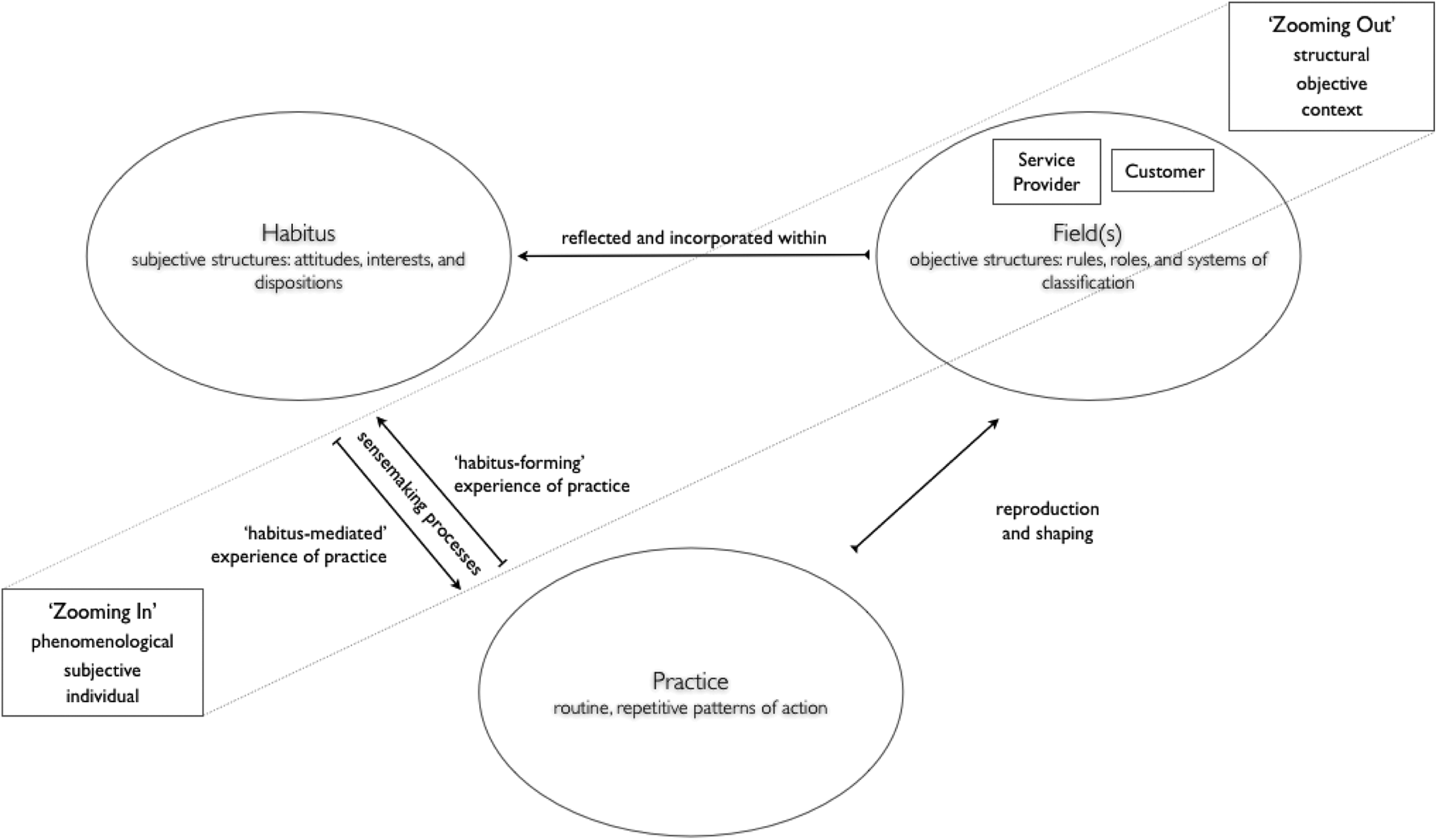
Bourdieu’s framework as a conceptual lens for linking practice and experience.
As illustrated in Figure 1, Bourdieu’s theory of practice involves an explicit link between practice and experience based upon sensemaking processes, which connect habitus and practice. As noted previously, experience must have an object and reflect experience of something. Thus, experience of practice refers to any form of practical activity, event or occurrence, which is situated within a given social context (represented by the concept of field).
The ‘habitus-mediated’ experience of practice
An individual’s experience of practice is always mediated through habitus and therefore is uniquely and subjectively determined. However, because habitus has been shaped from and reflects the objective structures of field, an individual always makes sense of their experience of practice in relation to field(s). The sensemaking process associated with the habitus-mediated experience of practice therefore acknowledges an individual’s subjective and phenomenologically determined experience of the objective and routine patterns of practical action being shaped by and shaping field.
Experience of practice may be more implicit or explicit in any given situation. When our habitus operates within a familiar context, our dispositions and attitudes are attuned to it and reflect field. Our experience of practice may therefore become ‘taken for granted’, as it appears natural and normal to us, and may remain largely implicit or unconscious; for example, consider a male creative writer who has been using a standard word-processing software programme for some time. On each occasion that the writer uses the software to develop his manuscript, it facilitates value creation, either by enabling him to continue his practical activity of writing (value as practice) or because he experiences satisfaction from a particular function of the software (value as experience). His familiarity with the software suggests that value creation most likely centres on how it facilitates his writing practice, because his habitus becomes attuned to its features and therefore his experience of practice becomes natural and taken for granted (implicit). In contrast, in a new domain of activity, or faced with a new situation within an existing field, experience of practice is likely to be more explicit because one is unfamiliar or unaccustomed to it.
The habitus-forming experience of practice: Reproduction or shaping
Figure 1 shows that experience of practice involves a second ‘habitus-forming’ sensemaking process because it either reproduces or shapes an individual’s habitus. If the writer decides to try a competitor’s software package on a free 14-day trial and he finds that any processes are more complex, or omitted, then his habitus, predisposed to the existing package in the field of writing software, will likely interpret the experience of using the new package (practice) negatively. This sensemaking process involves habitus reproduction, because his previous disposition and attitude towards using his existing software are reproduced. In this instance, he will continue to create value but his writing practice will be more conscious as he realizes the superiority of his software over the alternative, and this experience of practice will become explicit and linked to a value assessment that reproduces his current view.
In contrast, if the new software has new features or a simpler user interface, the practice of using the new package is more likely to be characterized by a sensemaking process that involves habitus shaping, resulting in a revised attitude towards the regular software and a reduced predisposition to continue using it. Here the writer not only creates value through his use of the software (practice) but also determines the experience to be more valuable than his previous experience of his existing software. Moreover, his experience of practice, and value creation and determination, will now be mediated through his newly shaped habitus. However, additional experience of practice may reveal disadvantages or drawbacks with the new software, which may trigger a return to his original software, reflecting habitus reproduction. Thus, experience of practice always involves habitus-forming sensemaking processes (reproduction or shaping), which affect future practice and experience related to value creation.
Summary of experience of practice and its influence upon value processes
We create value from both the practice of resource integration (service) and the experience (pleasure, satisfaction and insights) of doing so which influence future value determination based upon habitus-forming and habitus-mediating processes and potential changes in practice. Habitus-linked sensemaking processes help explain when experience is likely to be more unconscious and how it becomes explicit. By extension, habitus-linked sensemaking processes help explain when value will tend to be associated with either practice or experience, how conscious experiences linked to value may prompt changes in how value is experienced and how it may be assessed differently in the future. Finally, sensemaking processes associated with conscious experiences are valuable in themselves but also explain how future changes in value-creating practices may emerge.
It is important to note that the above example has only considered experience of practice within a single field. Involvement or engagement in a new field will often involve particularly rich opportunities for sensemaking processes. Experience of practice in the new field will be habitus mediated in relation to existing field(s). This may result in habitus reproduction, in instances where individuals’ experience encourages them not to explore the new field further or to remain aligned to their original field. Alternatively, experience of practice may be habitus shaping, creating potential alignment between habitus and the new field. Importantly, this experience of practice may also create a misalignment between a developing habitus and the previous field of practice. This illustrates the temporal intertwining of practice and experience, and its implications within value creation, assessment and determination, in which value may either be intentionally directed or emerge in situ in a single or multiple fields.
Methodology
To explore the intertwining of practice and experience in value creation, and to conceptualize a theoretical framework in a lived situation, we conducted an interpretive case study. In this section, we first explain our research design and objectives, paying particular attention to how the empirical study was planned to inform the overall research question. We then report the site of the research, recruitment of participants and the processes of data collection and analysis.
Research design and objectives
In designing our empirical study, we have taken account of several key gaps in previous theory. First, whilst both practice and experience have been recognized as important in service research, value creation does not appear to have been investigated from a perspective that incorporates both objective practice and subjective experience and their intersection. Hence, our first objective in the study was to ensure that we consistently explored each approach to value creation. This meant that data collection needed to include both observation of practice and group discussions and individual interviews to explore participants’ responses and experiences. Second, we recognized that value creation always has a temporal basis; we have argued that it draws from the past, is situated in the present and influences the future and we sought to explore how these time-based aspects of value might be conceived and realized by participants. To do so, we explored participants’ habitus-mediated and habitus-forming sensemaking processes with respect to value creation practices and experiences.
The third theoretical gap informing our research design concerns the complexity and broad scope of value creation. Having adopted Gronroos and Voima’s (2013) locus of value creation, which includes the customer’s physical, mental or possessive activities, practices and experiences in multiple individual and collective social contexts, we aimed to explore value creation in the field, in a circumstance that involved individual and collective practice, and with the opportunity to seek ‘before and after’ insights. We aimed to distinguish between value anticipated and value emerging, the nature and type of value and how practice is continually constituted and reconfigured. Finally, we sought to zoom in to the individual perspective and zoom out to the social perspective of value creation. That is, we aimed to investigate how individuals’ attitudes and dispositions contribute to their perceptions of value and how practice is influenced by and simultaneously reproduces broader structures.
To accommodate the objectives outlined above, the research design used a qualitative case study approach involving observation of and interviews with individuals and small groups. This design is based on a dialogic paradigm, which involves an emergent approach to the origin of concepts and problems and a dynamic approach to the nature of relationships (Tronvoll et al., 2011). A dynamic approach recognizes that value creation processes involve a complex configuration of involvement and interactions. We attempted to capture this complexity by examining interactions between participants and service providers ‘in situ’ during a 4-day sustainable living training program. An emergent approach aims to obtain phenomenological insights by examining meanings that emerge from the narratives produced by and with participants. The research was emergent because participants’ narratives and group discussions revealed explicit links between practice and experience that were not proposed before commencing the research.
Research site
Fieldwork was conducted at Pun Pun, 1 a Sustainable Living and Learning Centre located in Chiang Mai, Thailand. The philosophy of Pun Pun is based upon simplicity, self-reliance and experiential learning. The data are based upon observation of a 4-day self-reliance course, which included building natural adobe (earthen) shelter, organic gardening, cooking and taking care of health naturally. The course was delivered in Thai and included accommodation and organic meals in a communal environment. The course leader and founder of Pun Pun was Jon, whose TEDxDoiSuthep talk on YouTube, ‘Life is Easy’, has received over 1 million views.
Recruitment and characteristics of the sample
Prior to observation, all guests were informed of the goals of the study and introduced to the researchers. Neither the chief investigator nor the research assistant had a previous relationship with any of the participants. During the data collection (discussed below), 10 training sessions involving approximately 25 participants per session were observed by the chief investigator and the research assistant. All trainees were involved in ‘experience sharing’ sessions before and after training. At the conclusion of these sessions, trainees were invited to participate in individual interviews, and those who volunteered were interviewed personally, or were agreed to by respondents, in small groups. Overall, 13 interviews were conducted involving a total of 14 participants on the course. There were six males and eight females, with ages ranging from 18 to 60.
Data collection
The dynamic emergent nature of the research was enabled by and reflected in the data construction methods used. Non-participant observation of all practical training sessions emphasized interactions between participants and the trainer, which were recorded through field notes. All group experience sharing sessions, where Jon and participants discussed their experience and shared their thoughts, concerns or ideas, were observed and tape recorded.
Informal semi-structured interviews (15) were conducted with Jon, two other community members and participants. Some interviews were conducted in groups of two or three people, which encouraged the development of a shared dialogue. All interviews aimed to create an informal and comfortable setting within which to explore the four major objectives of data collection (see questions below). All tape-recorded sessions and interviews were transcribed, with those involving Thai language thereafter translated into English. The chief investigator has an intermediate grasp of spoken Thai language, and the research assistant is a native Thai speaker, so participants were able to decide whether to converse in Thai or English, depending upon their individual preference and language proficiency.
The non-participant observation of practice involved noting what participants did, how they responded in terms of questions and actions and how they interacted with the trainer and with one another. Particular note was taken of their comments and interactions in the group experience sharing sessions, to explore the idea of value as objective and structuralist and to glean the meaning of value from their experience of practice. During semi-structured interviews, participants were first asked to introduce themselves (background, work experience) and to outline their reason(s) and motivation for attending the course (why they decided to attend, what or who influenced them). Their experiences on the course (what training they had done, why; what they liked/disliked, why; how they felt, why) were then sought, and the interviews concluded by pursuing their opinions on sustainable living and their possible plans for the future (what had changed, why; what the changes meant for them and in their lives, why). In this way, the researchers aimed to capture the dynamism of value creation, that is, how participants’ value creation was built on the past, situated in the present, and likely to influence the future.
Method of analysis
Because the research design followed an interpretive paradigm, the process of analysis was iterative, involving both dynamic and emergent approaches, as discussed previously. Also, as noted above, we pursued a dynamic approach that involved a complex configuration of involvement, individual context and phenomenological understandings. By examining meanings that emerged from the narratives produced by and with participants, the interviews enabled insights into practice, habitus, experience of practice and their surrounding fields. Bourdieu’s lens of field, practice and habitus was used to interpret comments made in individual interviews or groups and to build understanding of connections and influences between practice and experience within value creation.
Findings
The first subsection below examines sensemaking processes before participants attended the training to provide insights into how predispositions to value processes and service offerings emerge. The second subsection examines sensemaking processes in relation to participants’ experiences of self-reliance practices during the training course.
Becoming predisposed to value in self-reliance
When asked how they found out about Pun Pun and why they decided to attend the self-reliance course, each participant referred to past events or current situations in their lives, described their experiences and shared their interests, concerns or hopes (column 1, Table 2).
Value creation before Pun Pun.

Table 2 shows that participants provided insights into their experience of practice, the fields in which they were situated, and their habitus. In recalling these stories, the temporal intertwinement of practice and experience was revealed as participants’ experience of practice within fields triggered habitus-shaping sensemaking processes, which lead to an emerging misalignment between their developing habitus and existing fields. This corresponded to a decreasing interest in aspects of existing fields and therefore in the potential value offered by or associated with them (column 2, Table 2). Thus, habitus-shaping sensemaking involved revised attitudes and interests. In turn, this sensemaking influenced the habitus-mediated experience of practice, represented by participants’ dissatisfaction and disenchantment as they began to perceive existing practices, fields or situations in a new way. Their responses stimulated further habitus shaping, represented by a desire to change aspects of their life through an imagined future and an interest in the new field of self-reliance and sustainable living, reflected in an emerging predisposition to the potential value in the course offered by Pun Pun and its activities and philosophy (column 3, Table 2). The following example elaborates upon these processes in relation to the three themes of temporality, unconscious and anticipated/foreseen practices and experiences, and the individual and contextual levels, as they relate to how value is perceived, assessed and created. In the example, Nook reflects upon his experience of practice in the field of low-paid service work, demonstrating habitus shaping as he began to change his perception of the realities and opportunities offered by his employment, and his imaginings of the longer term impact it might have upon him. This process created misalignment between his developing habitus and that field, reflected in his decision to quit the job and linked to further habitus shaping through an emerging interest in self-reliance and the service provider: I was a server at [a nationwide chain of restaurants]. I trained for 2 months and then worked there for another 4 months, so about half a year. On busy days, holidays, with lots of customers, the company gave free food and energy drinks for us so we could work harder, so whoever wants to drink it, however many you want as long as you can keep working … If I worked there longer then my health wouldn’t be good. My mum recommended that I should come here. I watched some videos of P. Jon and really liked them. My mum sent me there to learn how to start a farm and build a house, so my mum and dad in Bangkok could come back there to spend our life together. My mum wants to come back, but she can’t because she is looking after my dad, he has encephalitis, which slows down his mental capability (voice wavering).
In summary, Table 2 shows that experience of practice was contextually situated in fields, from which participants drew comparisons as a basis for assessing the relative value offered by those fields. Specifically, habitus-shaping sensemaking processes led to habitus-field misalignment, indicating a decreasing interest and belief that a previous or current field held value-creating potential for all individuals (low-paid service work, existing urban employment, social environment at work and corporate nature of work) relative to the self-reliance field and imagined futures. Therefore, value creation commenced before participants had direct engagement with specific practices of training, that is, it was built on their past experience of practice in specific fields and their resultant predisposition to new forms of value.
Engaging self-reliance practices and experiencing the field
This subsection extends the previous analysis of the temporal nature of practice experience intertwinement by moving into the present to examine participants’ experiences during the training course. We analyse value creation arising from participants’ direct engagement with self-reliance practices, their associated experiences of them and their broader exposure to the objective structures of the self-reliance and sustainable living field. Table 3 provides a summary, based on narratives from four participants.
Value creation at Pun Pun.

Gig highlighted influences based on both the importance of listening to Jon and the actual engagement with adobe building practices. As illustrated below, Gig’s decision to attend the course was based upon an imagined future project, so she intentionally creates value through learning the specialized practices of natural brick construction but value also emerges from a habitus-forming experience of practice, which is her realization of its simplicity and therefore her increased confidence in being able to use it: It’s about confidence, when you can start its very beneficial just to listen to him (Jon), and yes he has got a lot of cool philosophy … but when you can really put your hands on the dirt so it’s much, much better than reading from the books. And I was second guessing myself if I could do it before I came here, I mean I spent about two years running about doing the research about natural building and just like this course I think, well now I know, I’m going to build this type of building and we will be able to do it. And if I can really build the house myself … complete independence.
There was also evidence that value creation was related to both practice and the broader experience of field. As noted, all fields involve systems of classification linked to objective structures, which define the relative desirability, importance and therefore value of particular activities. In self-reliance, confidence, independence, balance and mindfulness are key structures that define the field of practice. Whilst realized confidence and imagined independence were evident in the previous excerpt, there was also evidence that the value had emerged in terms of the mental practice of seeking balance and being mindful: By trying to find a balance between working in an environment (pause) that I might not like (laughs) and then I can still do something that really enriches my soul.
The value emerging from the mental practice of increased confidence was also evident in Boon’s comment about the course, where she highlighted the importance of direct engagement with practice and also the founder’s inspirational sharing of his stories: It helps … like build your confidence to see that it actually works. It was just an idea in my head before I came here I had so many doubts and just to see that it’s actually that simple. What I like most about the course is when he talks, when Jon tells us about his story … and like doing stuff is really nice like digging and getting dirty. And when he talks about his experience it really helps, it’s really inspiring. And the things that he says sounds really easy but I know that there might be some kind of struggle and journey he must have gone through. I like that he doesn’t focus on the bad things only the good things.
Discussion: Examining value creation from a practice experience perspective
The motivation for investigating how practice and experience are connected arose from their separation by existing value research and the observation that they are intertwined. The associated tendency of service literature to foreground one concept or leave another implicit when examining value creation also revealed the need to explicitly consider both practice and experience and their interaction. We identified three key themes for investigation and engaged with these by outlining habitus-mediated and habitus-forming sensemaking processes within Bourdieu’s theory of practice and then by applying them to empirical examples of value creation. The purpose of this section is to discuss the implications and insights arising from the analysis (Table 1). Drawing upon these insights, we present a model (Figure 2) of the intertwining of practice and experience in value creation. This model reveals the temporal nature of value creation (theme 1), acknowledges the complexity and the unconscious/anticipated/foreseen nature of practice/experience in value creation (theme 2) and simultaneously recognizes the individual and social contexts (theme 3). Following some brief comments to introduce the model, we then discuss the theoretical implications of the findings using the framework of the three themes.

Dynamic model of practice and experience in value creation.
In Figure 2, customers’ integration of resources to create value (box 3) is observable as practice, that is, what they do, but the boundary of practice will overlap with their individual interpretation and feelings about the meaning of the experience of practice (box 4). These aspects have a concurrent and inseparable dimension in real time. However, a collective practice has clearly defined start and end points, whereas a customer’s sensemaking with respect to that practice leads to value assessments that are more enduring and provide a basis for future decisions and actions. Figure 2 demonstrates the contribution of practice, and experience of practice, to different forms of value creation (boxes 3 and 4), which may be instrumentally planned or intended, or emergent through the process. Habitus is proposed as a means of linking individual, subjective interpretation of the experience of practice in the current field, to likely future expectations of value processes in that field or alternative fields. The model depends upon these processes being embedded in socially constructed fields that may be exposed or evaluated during experience of practice (box 5). That is, value creation may be habitus-shaping, shifting perception or/and disposition towards different objects or service offerings within a field or prompting misalignment with the field; or habitus reproducing, whereby experience of practice reinforces current attitudes and dispositions (box 5). In either case, the experience of practice will determine likely future motivations and responses to stimuli (boxes 1 and 2). We now link the model shown in Figure 2 to the themes that elucidate our central question of how practice and experience are intertwined in value creation.
The temporal intertwining of practice and experience in value creation
We defined value as a benefit perceived by customers, something that contributes to their well-being, from their own perspective, and the creation of value in terms of the customer’s process of extracting value from the usage of resources. To capture the dynamic element of value creation, Figure 2 is divided horizontally into present and past/future, with the stimulus of a ‘service offering’ (box 2) separating these zones. However, we note that the placement of boxes into zones in the figure is arbitrary because the model is dynamic and based on a repeating cycle. Box 1, ‘predisposition to value potential’ (of a familiar or new offering within a field), reflects customers being receptive to an offering (which influences their likelihood of responding; box 2). When they engage with resources, value co-creation and value creation occur (or emerges; Box 3), practice can be observed and customers experience that practice. The boundary of value creation during ‘routinized practice’ becomes blurred because individuals subjectively interpret and their experience of practice through sensemaking processes, whereby they perceive and evaluate the present based upon the past. But their experience of practice also either reproduces their habitus or shapes it (box 4). In the latter case, individuals may revise their existing, past-influenced understanding, which leads to a modified habitus and different perception and evaluation of practice into the future and also influences changes in practice (box 5). This effect demonstrates that what customers do and how they experience it are inextricably linked and mutually constituting. Without recognition of this explicit analysis of practice and experience, we cannot appreciate their dynamic interplay in the temporal nature of value creation.
As theorization of value creation has developed in complexity in the literature, the language used to communicate it has become problematic. Gronroos and Voima (2013) acknowledge the alternative terminology of value emergence or formation (see Echeverri and Skalen, 2011; Gronroos 2011; Korkman, 2006) and also reflected in the observation that value is not always instrumentally created but may emerge as value-in-use and is also perceived and determined by individuals (Gronroos and Gummerus, 2014). The concept of habitus, and experience being mediated through or shaping it, is useful in this respect because it helps to distinguish, firstly between instrumental value creation, based upon attitudes, interests and dispositions to engaging in certain practices, and secondly through one’s experience of practice whereby value can emerge through reflection upon experience and existing practices and fields, changed attitudes or interests, and therefore different practices. In this respect, we can retain the terminology of value creation whilst acknowledging that it involves complex temporal processes where value is created, emerges or forms and provide insights into the dynamics of those processes.
Unconscious and anticipated/foreseen nature of practices and experiences
Our analysis demonstrates that the second theme about the (possibly unconscious or anticipated/foreseen) inseparable nature of practice and experience is implicated in the complex temporal emergence and creation of value. Specifically, habitus and its role and manifestation in sensemaking processes provide a conceptual lens for understanding this complexity. Habitus shows that much practice is routinized and unconscious and therefore that our experience of practice often remains implicit. Habitus also indicates in what circumstances practice, through our experience of it, becomes more conscious, such as being indirectly exposed to the value offered by a new field or by directly engaging in practice, or in relation to a triggering event, situation or circumstance. Here, experience of practice becomes conscious, which may result in either reproducing or shaping of habitus. It is in such circumstances that individuals begin to see and reflect upon their existing practices or field (Figure 2, boxes 4 and 5). This scrutiny provides insights into the emergent nature of value creation and shows that it will not always be explicitly experientially accumulating or continuously assessed, but rather will involve an overall process that is punctuated by episodes and events, in situations or circumstances where value is more or less explicitly created, perceived and assessed.
Zooming in and out on the individual and contextual
The third key challenge to which we have responded is concerned with the belief that value must have a social context; it is created individually and in networks, with actors interacting and influencing one another (Vargo, 2008), and embedded in a broader context of society and life (Askegaard and Linnet, 2011; Gummesson, 2008; Heinonen et al., 2010). Bourdieu’s concept of field enables this more comprehensive value space to be incorporated into our model. That is, we are able to ‘zoom in’ and ‘zoom out’ to explore the link and mutual influence between individual subjective experiences and collective objective practices. Zooming in recognizes that value determination (outcomes) occurs in an individual’s lifeworld whilst zooming out recognizes its occurrence at network level, with each customer one node in the network (Chandler and Vargo, 2011). Zooming in on a customer’s individual experience must be understood first in relation to their existing habitus and the field(s) from which it was formed, and second, with respect to the field of the service provider’s current offering, that is, by a simultaneous process of zooming out.
By incorporating practice, experience and their relationship, within a model that takes account of the mutual constitution of individual action and situated context, we have shown the usefulness of habitus and how Bourdieu’s circuit of reproduction in practice theory informs a deeper understanding of value creation. We have demonstrated that value is filtered through habitus and also argued that value only makes sense to customers in relation to field and to their existing field-specific actions, which include thinking, considering, imagining and reflecting. Similarly, we have shown that experiences trigger changes or modifications in practice, reproduction of existing activities and engagement in existing or new fields of practice. Thus, value creation concerns both new and existing activities and the consequences of them. Our findings support the ideas underlying value-in-context, which aims to include the sociocultural situation (Chandler and Vargo, 2011) and the mutual influence of individually determined value that is connected to broader ‘global experiences’ (Grönroos, 2011). However, we suggest that future research may wish to take further account of the social constraints and cultural continuities, which are manifest in and inseparable from practice (Askegaard and Linnet, 2011).
In her call for investigation into the role of experience as the common denominator for value creation processes and value outcomes, Gummerus (2013: 34) stated ‘If and when unreflected experiences become reflected, the customer comes to make sense of the experience in a new way. The important question is how unreflected becomes reflected’. We have responded by demonstrating how experience becomes more explicit. The important consideration is how unreflected attitudes and dispositions become reflected upon through experiences, which we show occurs through sensemaking processes, usually triggered by events, situations or circumstances. Thus, our model better represents value creation processes and outcomes than does the linear representation by Gummerus (2013: 33), in which engagement in processes leads to outcomes, one of which may be experience.
Before concluding the discussion, and in support of the theoretical lens of Bourdieu, we return briefly to two issues discussed by Helkkula et al. (2012) and two concerns of Heinonen et al. (2010). First, we would like to qualify the statement that ‘practice theory takes an anti-subjective and anti-individualistic stance’ (Helkkula et al., 2012: 557, citing Korkman, 2006). Bourdieu’s theory of practice is not so much anti-subjective (or anti-structuralist), rather it recognizes and incorporates both the individual subjective position and objective structuralist position and theorizes their relationship as being recursive based upon their mutual influence. Gummerus (2013) similarly suggests two parallel value activities exist for customers in SL: co-creation (through resource integration) and determination (as phenomenological). We contend that practice and experience exist in relation to each other and can only be made sense of through this relationship. Using Bourdieu’s ‘circuit of reproduction’, we envisage and present a circular and dynamic, multi-level model that incorporates both experience and practice in value creation.
The second issue concerns our view that there is a place for ‘practice as mental’. Helkkula et al. (2012: 557) stated that ‘for practice theorists, the locus of analysis is not the mind or individual interpretations of practices or behaviours; rather, it is the complex amalgam that is, in and of itself, a practice’. Bourdieu’s theory enables analysis of practice as it relates both to the individual and subjective interpretations, attitudes and motives of agents and to the broader social structures and settings within which agents’ objective practices and actions are situated (Askegaard and Linnet, 2011). Therefore, practice cannot be analysed without incorporating mental processes.
In their articulation of CDL, Heinonen et al. (2010) had two main concerns; first, that the discussion of SL has been based upon philosophical reasoning rather than upon empirical data or application, and second, that a shift in focus is required to incorporate the customer’s perspective into what is perceived as a provider-dominant focus of SDL. Figure 2 addresses both these concerns. We contend that, rather than adopting a dualism between provider/customer-focus, or SDL/SL and CDL, our model acknowledges their bases and is broadly applicable.
In conclusion, we have sought to theorize the complex links between the more objective routine practice (using service offerings/resources to create value) and each individual’s subjectively and individually determined experience (interpreting and gaining meaning from value activity) in value creation. We propose that our theoretical model helps to account for individual responses to experience (of reinforcement, or change, of customer mindsets over time), the social context of multiple influences and contexts, and importantly, the connections between the customer’s experience and ongoing practice. The model provides a customer-centric view of value formation and demonstrates the broad scope of the value creation space as emphasized by scholars in SLs and illustrated by examples drawn from fieldwork. We believe future researchers can utilize, build upon and adapt this model.
Managerial implications
This article has been primarily conceptual, but our framework and the richness of the qualitative data suggest a number of implications for service providers, developed below.
First, service providers need to familiarize customers with the potential value of a particular service or product by situating it within the broader field. In Figure 2, firm activity is input for customer processes and the model highlights the limited access that service providers have to those processes. Boxes 2 and 3 are open to input by providers, but everything else is within the customer’s sphere and closed to providers, unless the customer specifically invites them to share the space (Grönroos, 2011). In developing and presenting a service offering (box 2), the firm has the opportunity to zoom out to differentiate the potential value of its service, relative to options within the field (or in other fields). This positioning reflects an understanding of customers’ potential resource integration that will help to solve specific problems in customers’ everyday lives. For example, in our case study, participants classified value relative to other objects, activities or ways of thinking and doing both within a field (e.g. adobe building versus straw bale) and between fields (conventional living vs. self-reliant living).
Second, service providers should take opportunities to interact with customers to demonstrate the scope of existing or new fields. Box 3 in Figure 2 represents value co-creation and independent value creation using available resources. Obviously service providers need to facilitate access to resources, and during co-creation, they should establish a collaborative platform to foster interactive dialogue and problem-solving, thereby increasing their access to customers’ perspectives on value.
Third, service providers need to ask the crucial question of what sensemaking opportunities they provide to customers and how possibly they can be improved. Sensemaking occurs both inside and outside the space shared with service providers. Companies should explicitly be thinking, from a design perspective, of how to embed sensemaking experiences into value propositions and their likely impact on customers’ attitudes and interests. Participants in our study referred not only to learned practices but also to experience of that practice and the broader field of the service offering. Value can relate both to techniques or skills, which are learned or immediately enabled by a service, and also to ways of thinking, beliefs and attitudes, that endure. Hence, it is necessary to introduce those features that may foster meaning for customers. For example, building one’s own house from sustainable materials, or organic gardening, is not just valuable because they involved learned skills and provide shelter and food, but because they relate to becoming more confident and self-reliant, which are both mental states whose value is desirable, important and beneficial in the field of self-reliance.
Fourth, the dynamic aspects of value formation are important. Experience is not a fleeting or temporary phenomenon, but it is habitus forming and will affect future recursive practices. SLs are recognized as unequivocally relational and relationships require maintenance. A relationship focus points towards both the design of offerings and facilitation of practices that will enable customers to generate value in a manner that sustains the connection. This recommendation reflects a preoccupation both with the customer’s perspective (Heinonen et al., 2013) and on identifying and understanding the importance of customer activities outside of the boundaries of interaction with the service provider (Mickelsson, 2013).
Finally, we suggest that new means of gauging customer responses are warranted. More specifically, a broader perspective on measuring and evaluating customer perceptions and satisfaction is necessary. Customer narratives would assist service providers to understand how service influences customers’ habitus (interests, attitudes anddispositions) and to identify potential effects on their value-generating practices. This approach is an important distinction from asking about conventional, firm-driven, metrics such as service quality, satisfaction or customer experience, towards attempting to examine how their experience of practice affected their thinking, if at all, and how they may have replaced, replicated or modified their existing practices. Further, it pursues the meaning with respect to future intentions within and outside the field of practice. Therefore, we recommend that managers seek to better understand how customers’ emergent interests, attitudes and dispositions are generative in terms of changing their behaviour, or what they seek to gain, within a particular domain of practice. This understanding provides a deeper knowledge of customers’ value creation.
Footnotes
Declaration of Conflicting Interests
The author(s) declared no potential conflicts of interest with respect to the research, authorship and/or publication of this article.
Funding
The author(s) disclosed receipt of the following financial support for the research, authorship, and/or publication of this article: The fieldwork component of this research was supported by a Mahidol University International College Seed Grant.