




Abstract
In this article, we draw upon Weber’s concept of charismatic authority to unpack the appeal that YouTube video bloggers have galvanized among their fan communities. We explore how followers interact to articulate the appeal of British YouTube personalities and consequently, how they contribute to the nature of these ‘new cults of personality’. By observing the content of seven of Britain’s most popular ‘YouTubers’ and engaging in a sustained non-participant netnography of responses to these videos, we argue new cults of personality differ from their traditional counterparts through collaborative, co-constructive and communal interdependence between culted figure and follower. While Weber maintained charismatic authority has its source in the innate and exceptional qualities of an individual’s personality, we submit that in consumer culture’s current era of consent, the ‘culting’ of social actors becomes a participatory venture. We shed light on the fading and routinization of charisma and the dissipation of the relationship between the culted figure and followers.
Introduction
I sell the things you need to be. I’m the smiling face on your TV; I’m the cult of personality. I exploit you, still you love me. I tell you one and one makes three.
In what some have referred to as the ‘era of consent’ (see Pringle, 2004) whereby consumers have acquired ostensibly more control over the messages they receive than previous generations through new media tools, the generation of wholesale interest in a single social actor has become problematized. Rather than achieving states of near-divinization among large populations, we see a fluidity – or continuum – of different levels of engagement including actors who are now only capable of achieving concentrated states of ‘celebrity’ status among a few. While we do not go as far as to suggest that some wholesale mass disenchantment or renunciation of the media has reduced ‘the future of charisma to the personal “presence” of an individual before a small circle of personal followers’ – an argument which has been critiqued by Turner (2003: 20) – we do argue that within the era of consent, the persuasion and enchantment of consumers are permitted rather than imposed, and we are seeing the emergence of more concentrated states of celebrity status among what consumer culture theory (CCT) scholars have considered tribal formations or micropockets of consumers (Cova et al., 2007).
Within this context, our research is guided by the following questions: how do followers interact to articulate the appeal of British YouTube personalities and consequently, how do they contribute to the nature of these ‘new cults of personality’? To help us address these questions, we draw upon the celebrity literature as well as sociologist Max Weber’s concept of charismatic authority in a critical deconstruction of followers’ conversations around the popularity of British YouTube personalities. We contribute to marketing and celebrity studies literature by highlighting the co-creative, deliberative and sometimes antagonistic role of followers in determining how the charismatic authority of micro-celebrities is read as well how commercialization efforts around this kind of authority are met. We submit that new cults of personality differ from their predecessors through the collaborative and communal interdependence between the contemporary culted figure and his/her community of followers.
Theoretical underpinnings
Cult of the consumer celebrity and new routes to fame
Although celebrity is often described as a natural and innate ‘star quality’ or ‘presence’ (see Turner, 2014: 4) and the result of an individual’s ability to differentiate their own personality from others (e.g. Boorstin, 1961), it is now generally agreed upon in the academic literature that celebrity is ‘not a property of specific individuals. Rather, it is constituted discursively, by the way in which the individual is represented’ (Turner et al., 2000: 11). According to Rojek (2001: 18), a celebrity can be credited with ‘glamorous or notorious status’ (p. 10) and celebrity status can be ‘ascribed’ (i.e. predetermined and based on lineage), ‘achieved’ (i.e. as a result of accomplishments, talent or skills) or ‘attributed’ (i.e. the ‘result of concentrated representation of an individual as noteworthy or exceptional by cultural intermediaries’). Within marketing scholarship, literature from the CCT tradition has typically focused on the production and consumption of celebrities with achieved and/ or attributed status (Hamilton and Hewer, 2010; Hewer and Hamilton, 2012; O’Guinn, 1991; Schau and Muñiz, 2007). Much of this work conceptualizes celebrity brands as constructed through the organized promotion and commoditization of aspirational glamour, allure and personality (Cocker et al., 2015; Kerrigan et al., 2011) with their routes to fame typically managed carefully and cultivated strategically through traditional mass-aggregate media channels and ‘celebrity industries’ (including publicists, agents and managers) (Turner, 2004). In some cases, the so-called ‘commodity celebrity’ can be engineered in such a way that they are represented as a form of sacred authority (Hackley et al., 2012) and consumers even credit the celebrified subject with some believed sense of divinity (see Caldwell and Henry, 2006; O’Guinn, 1991). Turner (2004) and Rojek (2001) submit that the commodity celebrity manages to innervate and provoke consumers into awe for them by virtue of the wide impact that mass-media machineries are capable of generating.
Nevertheless, beyond the plethora of work that focuses on the appeal of the commodity celebrity and the managed construction of their aspirational greatness, there has been little empirical work in marketing which has examined how more ‘ordinary’ individuals – or what Britpop rocker Jarvis Cocker infamously proclaimed as ‘the common people’ – have galvanized interest and achieved celebrity status through alternative, less-aggregate forms of communication such as social media platforms (Page, 2012). These individuals are set apart from the achieved and ascribed forms of celebrity noted by Rojek (2001) in the sense that they are often not involved in the same forms of monumental production we see with commodity celebrity categories such as musicians or television stars (Schau and Muñiz, 2007). Rather, their day to day actions, thoughts and opinions; purchases and experiences; and interactions with others are packaged and communicated to audiences as their ostensible product. A case in point being the wide swathe of vloggers who have colonized and set up shop on YouTube (Morris and Anderson, 2015); a cottage industry of both amateur and professional contributors referred to emically as YouTubers. These new forms of celebrity occupy the space somewhere between the ‘renown’ and celebrity categories identified by Rojek (2001). While the fame of the celebrity is omnipresent or ubiquitous, renown individuals stand out due to their personality, beauty or accomplishments within a particular social assemblage meaning their fame is much more localized or field-specific and dependent on some level of interaction between them and their community.
While the fame and status of these people of renown, or seemingly ‘ordinary’ celebrities (Turner, 2010), may operate within more constrained, specific or niche fields (Scaraboto and Fischer, 2013), their popularity is becoming more abundant and evident in Pringle’s (2004) Web 2.0 enabled era of consent. In this era, social media has given consumers the ability to quickly and efficiently bypass the strategic engineering of mass-media and elect celebrities of their choice (Deighton and Kornfield, 2010). This seemingly consensual production of the ordinary celebrity has been called the ‘demotic turn’ (Turner, 2006) whereby ordinary consumers develop a charismatic-like appeal that attracts others to follow and cohere around them. Importantly, Turner (2006: 158) argues that the ‘demotic turn is not producing democracy’ in any true sense, however, because commercialism, self-interest and, to some extent, manipulation underpin all our forms of media which overrides potential for any genuine social and cultural inclusion. Nevertheless, there is at least some semblance that barriers between extraordinariness and plain ordinariness are elided. The demotic turn may suggest a ‘new’ culting of celebrity may be understood whereby willing audiences empathize with and catapult ordinary consumers into fame and extraordinariness. Furthermore, the new culting of celebrity via platforms like YouTube appears to be subjected to popular critique, fallibility, pseudo-democratic discussion and social deconstruction among consumers. Although recent work in celebrity studies has alluded to the process of celebrification on YouTube, the focus of these studies has been on the conscious efforts of the YouTubers themselves (see Smith, 2014, 2016), and little is known about the nature of these ‘new cults of consumer celebrity’ or the role of fans or followers in this process. To begin developing insight into these arenas, we now depart to consider Max Weber’s charismatic authority thesis.
Charismatic authority
Weber originally introduced the term ‘charismatic authority’ in response to inherited and systematic, bureaucratic, ‘flat’ approaches to achieving power and influence over others. His work critically suggests that the organic realities of establishing credible and impassioned cults of personality depend heavily on the vagueness of an individual’s charisma. While charisma has often been considered a conceptual anomaly, as a non-rational, non-empirical ‘folk’ concept to signify the otherwise inexplicable (Kantola, 2009; Turner, 2003), we can extract from Weber’s ([1922] 1978: 241) writings that the term loosely refers to a ‘certain quality of individual personality by virtue of which he is considered extraordinary and treated as endowed with supernatural, superhuman or at least specifically exceptional powers or qualities.’ Of most importance to Weber is the notion that ‘followers’ or ‘disciples’ respond holistically to the charismatic individual rather than to the specific qualities of the individual that trigger these responses (p. 242). For charismatic authority to exist, charisma must first be detected and internalized by other individuals and then somehow be demonstrated to this audience to concretize, legitimize and ensure that it does not disappear (Weber, ([1922]1978).
Weber’s theorization of charisma is grounded to the personal appeal of a special figure but is operationalized through external actors’ own participation, call and response to the summons such figures might make. In contrast to the ‘traditional/rational-legal’ forms of authority that bring about stability and order, Weber’s charismatic authority is typically critical of extant institutions and strives instead to bring about change, renewal, revolution and even disorder in society: It is, by definition, a kind of authority which is specifically in conflict with the bases of legitimacy of an established, fully institutionalised order. (Weber, 1947: 64)
The usefulness of Weber’s notion of charisma for understanding traditional representations of celebrity has been discussed by Turner (2003), but there has been little application, or even problematization, of this concept in the context of the new demotic or participatory forms of celebrity. In terms of the traditional celebrity, Turner suggests that Madonna’s charismatic appeal rests on her ‘cultural originality, success, adulation, and in this sense, a kind of devotion as well as metanoia among her devotees’, but in a departure from Weber’s writings emphasizes how Madonna has achieved this ‘without any trace of obligation or command’ (p. 15). In the demotic turn, it is arguable whether command has equally dissipated or whether it has been rebirthed in the domain of the empowered audience. With this uncertainty in mind, we apply Weber’s thinking to the context of YouTubers and their followers.
Method
This study focused on seven of the United Kingdom’s most popular YouTuber channels: fashion and beauty vloggers Zoe Sugg (Zoella), Tanya Burr, Louise Pentland (SprinkleofGlitter), Estée Lalonde and Fleur Bell (FleurDeForce) and satirists/lifestyle commentators Alfie Deyes (PointlessBlog) and Marcus Butler. As of the first quarter of 2016, Zoe Sugg has over 10 million subscribers, followed by Alfie Deyes and Marcus Butler, each with over 4 million. Tanya Burr has over 3 million subscribers, Louise Pentland has over 2 million subscribers and Estée Lalonde and Fleur Bell have over 1 million subscribers each. As further evidence of their popularity, each of these YouTubers have released their own books; Zoe Sugg, Tanya Burr and Fleur Bell have recently launched their own make-up collections; and Louise Pentland has introduced a signature clothing range for fashion brand Simply Be.
The first author subscribed to the channels of 10 British YouTubers and from autumn 2013 to summer 2015 observed and kept record of the efforts by which these YouTubers grew their channels and the various tensions that arose as a result of their elevated status and growing number of subscribers. Both authors committed to a more focused round of data collection beginning in autumn 2015. We concentrated our attention on channels which had over 1 million subscribers (or at this point of data collection were very close to hitting the 1 million subscribers mark) resulting in 7 of the 10 channels being sampled for analysis. We undertook participant observation of a selection of videos posted to YouTube after 2013. A timeframe of the past 2 years allowed for a more manageable sample (Smith et al., 2012) but also ensured that we were able to focus on the popularity and appeal of the YouTubers and capture the increasing commercialization evident on their channels. Participant observation involved watching each video (amounting to over 190 minutes of video footage) and writing detailed notes relating to the content of each video. We then engaged in a netnographic analysis (Kozinets, 2010) of the YouTube comments responding to these videos.
The 17 videos selected for detailed interrogation were deemed to be most relevant for this study as they responded to issues such as YouTube culture and the idolizing of YouTubers, sponsored or paid-for content, a change in the YouTubers content or direction, the launch of YouTuber product lines and merchandise and reaching landmark numbers of subscribers (see Table 1). Following Kozinets’ (2010) guidance, these 17 videos were selected due to their relevance to our research questions as well as the quantity and/or quality of the comments posted to these videos. YouTube comments on each of the 17 videos were filtered via ‘top comments’ rather than ‘newest first’. We then began the process of transferring the comments into a blank document, using open and axial coding techniques (Strauss and Corbin, 1990) to analyse and interpret the data. Coding of data was driven both inductively by searching for emergent themes but also deductively by issues/concepts identified in the Weberian and consumer research literatures. As the process of data analysis progressed, the coding became driven by the key theoretical concepts guiding this study. We ceased transferring comments when we reached the point of theoretical saturation. A detailed, microanalytic approach (Strauss and Corbin, 1990) was used for analysing a selection of top comments for each video; on average, between 50 and 150 comments per video.
The 17 videos selected for detailed analysis.
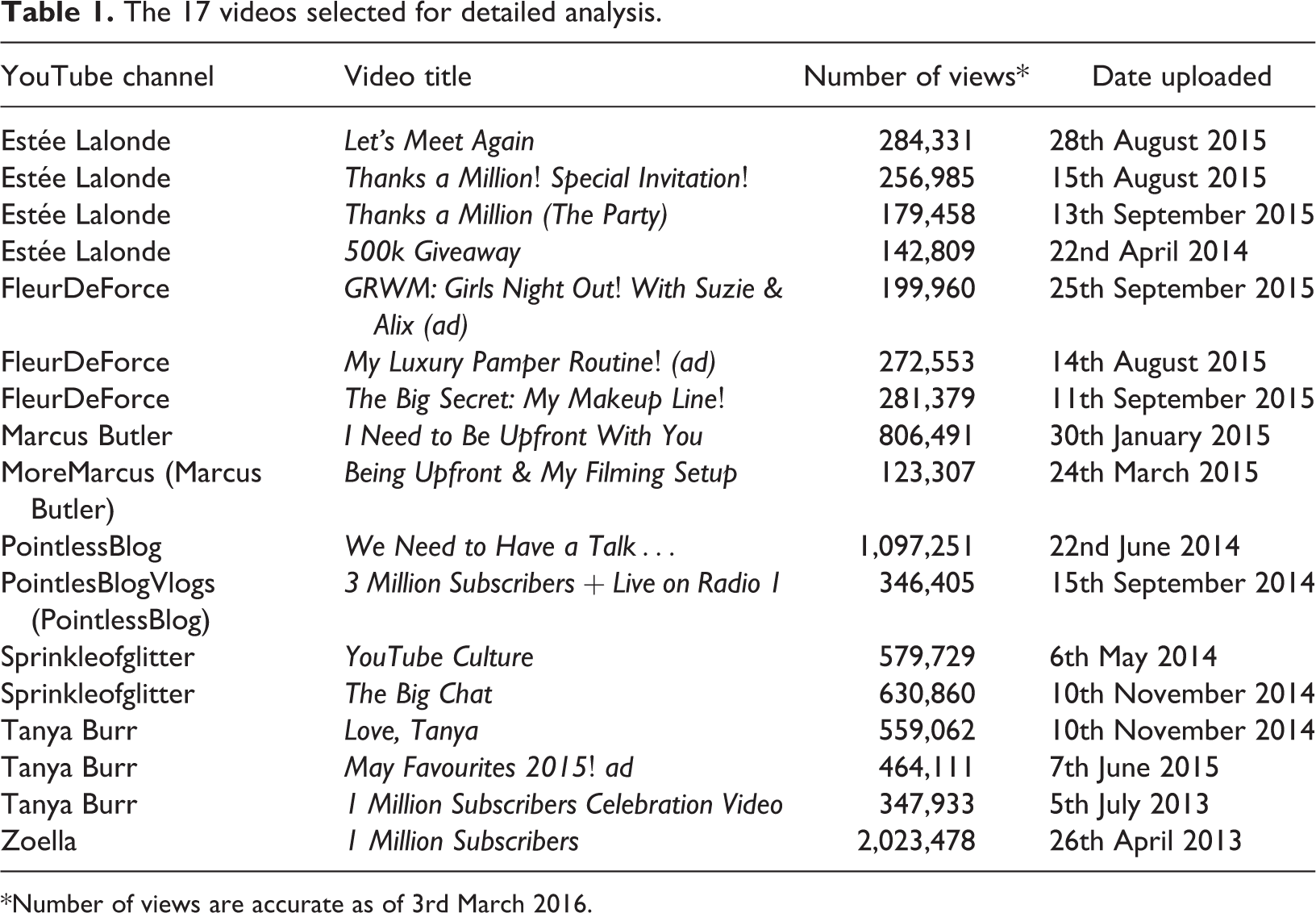
*Number of views are accurate as of 3rd March 2016.
Following the Association for Internet Researchers’ ethical-decision-making guidelines (Markham and Buchanan, 2012), we first considered the expectations set by YouTube’s terms of service – which disclaim that the site cannot ‘guarantee any confidentiality with respect to content’ posted by a user (YouTube, 2016). Second, we worked within the boundaries of the open-access nature of YouTube and the publicly available comments posted (Langer and Beckman, 2005; Lewis et al., 2012) when deciding to draw upon user commentary in our analysis. Although other studies have identified individuals using their YouTube usernames (Antony and Thomas, 2010), we decided as a provision of additional anonymity to not include usernames in the presentation of our findings (Reilly, 2015).
As an added layer of data collection, our observation of YouTubers’ video materials and netnographic analyses of viewers’ comments were supplemented with regular and immersive reading of relevant media output in the UK national newspapers. We employed the use of the Nexis database to search for articles from the previous 5 years which featured ‘YouTuber’ (180 articles), ‘YouTube Personalities’ (12 articles), ‘YouTube Stars’ (843 articles) and ‘Vlogger’ (398 articles) in their headlines. We also searched for articles which featured the names of our seven selected YouTubers in the headlines and a total of 518 articles were returned, with Zoella/Zoe Sugg by far the most talked about in the UK press (416 articles), reflecting her much higher subscriber count. These articles were used to contextualize and situate our interpretations of YouTubers’ popularity within broader cultural narratives, and we draw on our reading of these articles to support our analysis.
Findings
According to Weber ([1922]1978), the personal qualities of an individual are what contribute to their holistic sense of charismatic authority. Our findings first consider the ‘charismatic community’ and the co-construction of the charismatic personality. Second, we unpack the processes by which YouTubers’ legitimize their craft through replacing archaic systems of authority with avant-garde and neoteric systems of representation. Within this theme, we especially consider how followers bask in the reflected glory of YouTubers being on the precipices of revolution and change. Third, we discuss how charisma dissipates when the individual seeks out more permanent and formal structures or when various rules and institutions emerge to guide and determine it.
The charismatic community and the co-construction of a charismatic personality
A resounding message that emerged early in our analysis is the collectively felt sentiment that it is the followers themselves who are not just the recipients, but the custodians, of their favourite YouTubers’ personalities. Without followers’ continued and active social deconstruction and endorsement of their authorial intent, simulacra and self-presentation, YouTubers’ personalities could never be realized and confirmed, thus forever negating the presence and operation of charisma. Unlike, for instance, the fashion bloggers explored by McQuarrie et al. (2013) who acquire and accumulate an audience through displays of aesthetic discrimination, popular YouTubers seem to galvanize interest among consumer audiences largely due to the participatory meaning-making and sense-making around the personal qualities they (choose to) convey through their videos. It is here that personality (Boorstin, 1961) rather than talent or skill (Rojek, 2001) is what initially grabs the attention of followers and must be refracted through a communal process of demotic evaluation.
The relationships between YouTubers’ personalities and audiences’ allegiance are repeatedly articulated, disarticulated and rearticulated. This can be simple, direct and confirmatory such as one of Estée Lalonde’s followers who writes: ‘Your personality is what brought me here and kept me watching,’ followed by another who responds with ‘so true I started watching because of your personality!’ Or the process may be more mosaic and bound up in particular evidential testimonies such as a follower who draws upon Estée’s efforts to meet fans at a party as a signal of her continued humility and solicitude: She’s THANKING US in a really great way. How many other YouTubers throw a party for their subscribers, much less acknowledge them? Instead of being appreciative of Essie, most people are complaining about how “she’s changed”. Quite frankly, I still see the same cheerful, intelligent and genuine Estee I saw years ago.
Followers were observed to engage in play and social interaction with one another through extended conversations (Ritson and Elliott, 1999) punctuated with emoticons and emojis and styled with circumlocution in the comments section of YouTubers’ videos that playfully and performatively discuss, mimic and deliberate a YouTuber’s personalities. This is evident where one of Marcus Butler’s followers takes to the comments section to creatively coin a neologism to brand and legitimize the YouTuber’s personality as ‘spontaneous, with your crazy moments of Marcusness’ (emphasis added). Charismatic appeal here is reified and made real through a creative interpretive labelling process (i.e. ‘Marcusness’) and the communal sharing of ideas among like-minded followers.
Weber ([1922]1978) suggests ‘An organized group subject to charismatic authority will be called a charismatic community (Gemeinde). It is based on an emotional form of communal relationship (Vergemeinschaftung)’ (p. 243). It is within this charismatic community that the YouTuber stands as a kind of cheval glass for the ‘charismatic quality of its members’ (p. 243). However, deeper than Weber’s imaginings of a united ‘gemeinde’ which reflects the glory of its leader, our analysis demonstrates that YouTubers were mainly experienced by their followers as a receptacle or refraction point for collective self-admiration. Rather than pay unilateral homage to their culted figure, followers recognize that they together with their source of admiration are co-constituting and they vocalize consciousness of their own part in the spectacle – as displayed below by one of Tanya Burr’s followers: Tanya – you are the happiest, most positive woman I have ever seen. (…) I love how involved you are with you [sic] viewers and I am a proud BurrBear. You seriously have the most beautiful subscribers! And what’s super cute is that I can tell they’re inspired by you in some way with either their sense of style or hair or makeup. It’s really sweet. No more “hello everybody” facing the camera? I mean, this looks like a reality show, we just would like to see candid talks to the camera. Nothing too crazy fancy. Makes me uncomfortable. I like it when you start your videos by saying Hellooo I feel like you don’t do it as much and idk I just really liked it and I’m just giving you my opinion idk if anyone agrees with me or not but that’s how I feel.
Unlike the fortress behaviour of traditional figureheads of cults of personality, the sense of ‘co-presence’ on YouTube (Turner, 2010: 144), the space for positive and critical commentary and the greater possibilities for ‘direct para-social contact’ (Rojek, 2001:12) with the YouTuber are critical in building and maintaining charismatic authority and a sense of community.
Creating and institutionalizing new orders
Weber asserts that charismatic individuals characteristically innovate, initiate and reorientate, forcibly bringing about change to existing ways of being or doing: ‘charismatic authority repudiates the past, and is in this sense a specifically revolutionary force’ ([1922]1978: 244). This is reflected in media reports which describe the new wave of YouTube personalities as revolutionizing the entertainment industry and posing a significant threat to the dominance of traditional mass-media technologies: Meet the self-made stars who are taking on TV – and winning: The revolution will not be televised but who cares? It’s already online, as a new generation of ‘YouTubers’ threaten traditional TV with their sharp video blogs…(Lewis, The Guardian, 2013). I think for example like take Alfie for instance: he started in his attic making funny videos because he was bored, and now he has his own book!(…)so feel like to admire (I wouldn’t say idolize) but to love and admire someone who has come THAT FAR is completely fine! Alfie’s been making videos since he was 15. He made his first in his bedroom on a small, bad quality, family digital camera, balanced on a stack of books. Made on a rainy day, it was called What to Do on a Rainy Day (Glass, 2014)
Finite appeal: The fading and routinization of charisma
Weber ([1922]1978) is keen to articulate that ‘in its pure form, charismatic authority may be said to exist only in statu nascendi. It cannot remain stable, but becomes either traditionalized or rationalized, or a combination of both’ (p. 246, original italics). Our analysis is consistent with the transitory flux of charismatic authority as we found that once the task of creating and institutionalizing new orders has been accomplished, quite often charisma can fade or become routinized. Charisma dissipates when the individual seeks out more permanent and formal structures or when various rules and institutions emerge to guide it. In the case of this study, a whole industry has cohered around YouTubers ‘from talent agencies like Gleam to multichannel networks like BroadbandTV, Maker Studios and Fullscreen that sign up YouTubers and devise new shows and commercial deals for them’ (Dredge, 2016b). Many of the more popular YouTubers have been able to capitalize on their popularity, routinize their broadcasts and generate large amounts of capital through selling merchandise and promoting products and brands. There is also a ‘growing sense of commercialization’ evident on the platform with YouTubers’ videos becoming more ‘polished’ with many opting to become a ‘YouTube partner’ allowing advertisements shown alongside their videos (Lewis, 2013). However, the commercialization of their personality and the routinization of their content are a double edge sword, it does not just stabilize and guarantee their outputs for the charismatic community but also brings with it the stifling and impersonal bureaucracies and rationalities of commerce that consumers naturally try to injunct (Kozinets, 2002). One of Louise Pentland’s followers explains the changes that have occurred in the YouTube community that have left her with feelings of disenchantment: I find it harder to think of YouTubers as “average people sitting in front of the camera” when all of them now seem to be signed up to a major company, some have people doing all the behind the stage work taking away from the realness of their videos. (…) The fact is when YouTube first came around it was fun, it was a community, and I know when people find something they love they want to do it 24/7 and make it their job, but now YouTube seems to be an actual career where people depend solely on this money from YouTube that they can’t deviate away from YouTube culture. (…) If I see another Audio book advertisement in another YouTubers favourites I may in fact scream. The whole thing has just become generic honestly.
Social media talent agencies such as Gleam Futures have emerged in order to manage, guide and hegemonize the careers of charismatic personalities who have built significant audiences and influence on YouTube. Zoe Sugg, Alfie Deyes, Louise Pentland and Marcus Butler have all signed to Gleam Futures to help generate publicity and facilitate and negotiate deals with companies/advertisers. While this has proven to be a financially lucrative move for YouTubers, this has also contributed to the dissipation of the charismatic relationship between them and their original subscribers. Weber (1947: 361) asserts that charismatic authority exists ‘outside the realm of everyday routine and the profane sphere’ and in line with the circumvention of charisma by the routine or ‘profane’, a number of original subscribers attribute the loss of appeal and vigour to the institutionalization and commercialization of YouTube, with many YouTubers now seeing the platform as a career choice rather than a hobby. What was once neoteric and frenetic has seemingly become bureaucratized through the contaminating influence of the market and altered the product into a form of labour that is more scripted, managed and commoditized. A reply to Marcus Butler’s ‘I need to be upfront with you
1
‘ video equates marketization with the routinization of charisma: I feel like YouTube started off as a hobby thing for everyone and now suddenly everyone is making it their ‘job’. (…) If you feel like you personally like your old style videos more than the current, scripted ones, then do more old style videos!… Humble and down to earth…. while secretly collecting a big fat paycheck that comes out of the pockets of his viewers. I thought YouTube was a hobbie so why start charging your viewers to watch your videos, if it wasn’t for them you wouldn’t be where you are:/ That’s true, I mean all of a sudden she starts to sponsor all of these products without really saying anything about them to her viewers (…). Estee is usually chill in that matter, and wouldn’t seem to be the type of person to be sponsoring a ton of products without mentioning the sponsor itself. She has lost down to earth vibes from her older videos, if she took a moment to acknowledge the sponsors, then maybe it wouldn’t be that bad.
Discussion
Following our analysis, we submit that in consumer culture’s current era of consent, it is the co-constructed and socially activated nature of ‘consumer charisma’ that has allowed YouTubers to enhance their level of authority, disrupt orthodoxies and spark interest in a new order. However, once these new orders have been established, various rules and institutions emerge to guide their influence, ultimately leading to the routinization and fading of charisma.
Our analysis is particularly useful in isolating the points of difference between the role of audience/followers in traditional cults of personality versus the new tribal self-selecting formations. Importantly, the use of ‘new’ and ‘traditional’ is to signify that we cannot assume a stable referent or construct called cult of personality. In this article, we have studied an emergent social phenomenon that shares a lot, but also differs significantly, with an earlier comparable social phenomenon. In traditional formations, followers were subjected to the adulation of culted figures through the anonymous and technocratic efforts of promoters, propagandists and specialists of mass-media technologies, and followers had little involvement in negotiating the imposed personality of these figures. Conversely, personality becomes an item of co-creation in new cults, and adulation becomes elective as contact is made through ostensibly intimate, amateur and do-it-yourself (DIY) technologies. This deepens conversation around and provides an alternative explanation to recent conceptualizations of the influence and power of media personalities in marketing scholarship. For instance, our findings depart noticeably from Hackley et al.’s (2012) application of Turner’s (1969) trickster figure to explain the Simon Cowell media phenomenon. The authors suggest that Cowell is ‘invested with mystical qualities and an awesome authority’ allowing him to orchestrate and enforce strict control over the liminal process of the X Factor and those involved in it (Hackley et al., 2012: 463). In these respects, the trickster figure shares more with traditional cults of personality and the beguiling authoritative strictures of mass-media than with the pseudo-democracy and neoterica of the context of our study. While Hackley et al. suggest that ‘the trickster’s authority is absolute’ and exists within a ‘liminal process’ (2012: 455), our current analysis implies that there is a more nuanced strain of authority at play among new cults of personality in the online era of consent – one which is not ‘awesome’ or unconditional in so much as it tenuously hinges on followers’ own complicity, collective self-admiration and neoliberal agency. Where Hackley et al. suggest that the mass-media TV personality ‘is a coalescence, a composite, a conflation of primal prototypes’ (2012: 464), we suggest that the YouTuber vlogging personality is a careful and outwardly transparent or (seemingly) authentic refraction, emulation and bastardization of followers’ own sense of self, normalcy and centeredness. Our view of new cults of personality perhaps fits closer with Johnson’s (2007) estimation of ‘fantagonists’ than with Turnerean tricksterdom or shamanism. In such a conceptualization, the YouTubers authority is not ‘absolute’ or confined to a liminal ritual and unlike traditional cults of personality; both sides of the new cult of personality – the celebrity figure and fan – can subject each other to more or less equal demands creating a zero sum game. Specifically, while followers might be dependent on these celebrities for identity purposes, followers themselves can challenge ‘discursive and productive monopolies’ and ‘delegitimize institutional authority’ if they feel these figures or the market itself threaten or destabilize their identity investments (Johnson, 2007: 291). For as much adulation followers have for the cult-like figure, there is an equal measure of frustration and antagonism on reserve if needed.
Our analysis also clarifies and extends insights from recent celebrity studies scholarship such as Smith’s theorization of the YouTube persona as ‘self-celebratized’ through conscious appeals to aspects of identity. For Smith (2014, 2016: 272), YouTube celebrities are ‘meta-celebrities’, as they become acutely self-aware of the surrounding conditions of their celebrity persona and knowingly emphasize, or sell, certain qualities of theirs in the content they produce (Smith, 2014: 272). Our analysis highlights the active role of the audience in this process and argues that for these personal qualities to be realized and confirmed, they need to be endorsed and socially deconstructed by fans or followers. In other words, while Smith accounts for a kind of introspective-performative or meta-conscious ‘cult of the individual’ (2014: 256), our Weberian outlook casts attention to the wider social currents of the charismatic community that actualize this cult and receive and promote the longevity of the central personality. Furthermore, the socially activated and co-constructed nature of these new cults of personality helps to accumulate an impassioned audience for the YouTuber but also contributes to the fragility and instability of their charismatic appeal. As Belk (2013: 488) suggests, the self in a digital age is a ‘joint project resulting in an aggregate self that belongs as much to the others who have helped to form it as it does to oneself’.
While viewership metrics indicate bureaucratization and routinization do not appear to be fuelling a fall in overall audience numbers that would lead to the ultimate demise of celebrity brands/cult-like appeal (c.f. Parmentier and Fischer, 2015), the combination of market-led changes and followers’ subsequent venting and ‘states of berserk’ nevertheless seems to be stimulating the fading of charismatic authority and the dissipation of the charismatic community. This is not to suggest that this will necessarily result in the short-lived, here-today-gone-tomorrow sort of fame typical of Rojek’s (2001) ‘celetoids’. Rather, these YouTubers seem to be migrating further along the continuum from renown towards ‘celebrity status as the level of proximity and interaction between they and their followers diminishes. Our findings also contrast with McQuarrie et al. (2013) who defend commercialization and overt marketing on successful fashion blogs as acceptable proof of bloggers’ taste leadership by their followers. This contrast perhaps owes to a systemic and irreconcilable difference in culture between blogging and vlogging contexts or might hint further at the instability of a referent such as cult of personality and the incongruity and indeterminacy of charismatic authority. For our YouTubers, displays of aesthetic discrimination would nullify the demotic, participatory and ludic co-construction efforts by the charismatic community, and any threat of commercialization of charismatic leaders conflicts with Weber’s ([1922]1978) cautionary writings that: Charisma knows no formal and regulated appointment or dismissal, no career, advancement or salary, no supervisory or appeals body, no local or purely technical jurisdiction, and no permanent institutions in the manner of bureaucratic agencies, which are independent of the incumbents and their personal charisma. (p. 1112)
Footnotes
Acknowledgements
The authors wish to extend their gratitude to the associate editor (AE) and the three anonymous reviewers for their thoughtful and constructive suggestions that greatly contributed to improving this article.
Declaration of Conflicting Interests
The author(s) declared no potential conflicts of interest with respect to the research, authorship, and/or publication of this article.
Funding
The author(s) received no financial support for the research, authorship, and/or publication of this article.