



Abstract
With the advent of the digital era, red culture communication faces the problems of insufficient coverage and single transmission path. By integrating online social media data and offline audience behavior data of Red Culture Museum, the research constructs a set of influence evaluation model and optimizes communication strategy through social network analysis and influence diffusion model. The results show that the optimized transmission path has expanded the coverage, the user interaction rate of the online platform has increased by about 15.6%, and the offline participation rate has also increased by 58.2%. This study provides support for the dissemination of red culture and lays a foundation for the research in the field of cultural communication.
Introduction
As an integral part of China’s revolutionary history, red culture holds significant spiritual value and serves as a key medium for promoting patriotism and preserving revolutionary ideals. In the context of modern societal development, the question of how to effectively disseminate red culture in today’s era has become increasingly important. With the rapid advancement of digitization, social media and Internet of Things (IoT) technologies offer new avenues for cultural dissemination. Traditional offline red cultural venues, while crucial for education and cultural communication, face limitations in coverage due to geographic and time constraints. However, the rise of social media platforms, along with tools like short videos and text notifications, has transcended these spatial limitations, turning them into widely influential communication channels. The challenge now lies in how to integrate the strengths of both online and offline platforms, analyze and optimize communication pathways using IoT big data, and ultimately enhance the social influence of red culture. By employing accurate big data analysis, researchers can provide robust support for refining red culture communication strategies, ensuring that its cultural significance is spread more broadly and has a lasting impact on a wider audience.
The research should more clearly specify its goals by outlining the integration of IoT data from offline venues like the Red Culture Museum with social media platforms such as Weibo and Douyin to assess and enhance the dissemination of red culture. The objective should focus on identifying high-impact communication nodes, optimizing transmission paths, and evaluating the social influence across platforms. By doing so, the study will clarify how this data integration improves user engagement online and boosts participation in offline cultural activities, ultimately ensuring a more effective and widespread communication strategy for red culture. This targeted approach will help expand the scope and impact of red culture dissemination.
Lv and Singh highlighted the significance of big data analysis in sot systems, emphasizing the role of big data technology in enhancing the efficiency and broadening the application scope of sot systems. 1 Shang et al. introduced a big data mining early warning model for corporate financial risk, using fuzzy association rules, and demonstrated its effectiveness in an Internet of Things environment. 2 Alseady et al. focused on the security challenges related to IoT, addressing security issues at the big data, network, and application levels, and proposed corresponding solutions. 3 Cevallos et al. examined the use of sot and big data in organic banana production, showcasing the potential of smart agriculture in this sector. 4 Chai and Li explored the influence of red culture on external communication within the context of big data and IoT, offering insights on how to optimize international communication strategies for red culture using new technologies. 5 Zhou et al. discussed the role of red cultural atmospheres in tourist destinations, highlighting how it boosts tourists’ confidence in Chinese culture and contributes to cultural confidence building. 6 Yi developed a red culture retrieval system utilizing multi-modal data fusion and innovated new strategies for red culture communication paths. 7 Feng et al. assessed the impact of internet communication on public culture and red tourism, proposing a time series evolution model for the dissemination of red tourism culture. 8 Tang et al. investigated whether red tourism could foster red memories, revealing the psychological experiences of tourists at Jinggangshan. 9
While offline red culture centers and memorials serve as vital educational hubs, their influence remains geographically restricted, limiting broader societal reach. Despite the rise of social media increasing digital communication of red culture, the absence of systematic communication path analysis and optimization has led to suboptimal communication outcomes. The key challenge is identifying critical communication nodes, accurately targeting audiences, and expanding the communication chain. In a rapidly shifting public opinion landscape, red culture dissemination is prone to disruption, and a lack of real-time monitoring and dynamic adjustment mechanisms weakens its impact. This study aims to systematically analyze the bottlenecks in red culture communication through big data and IoT technology, optimize communication pathways, enhance the synergy between online and offline efforts, and ensure red culture maintains a lasting and effective presence among a broader audience.
The introduction can be expanded by providing more background on the historical and cultural significance of red culture in China, which plays a crucial role in promoting patriotism and the revolutionary spirit. Red culture is not only a reflection of China’s revolutionary history but also a vital part of national identity and cultural confidence. As the country modernizes, there is an increasing need to ensure that the values and heritage of red culture reach a broader and younger audience. In the digital era, traditional offline dissemination methods are limited by geographic and temporal constraints. Meanwhile, the rise of social media and the Internet of Things (IoT) offers new opportunities to bridge these gaps. This study’s importance lies in leveraging these digital platforms to optimize the communication of red culture, ensuring its relevance in modern society. By utilizing big data, this research seeks to enhance the coverage and engagement of red culture across different audience segments.
This study employs methodologies such as Internet of Things (IoT) big data analysis, social network analysis, and influence diffusion models. By integrating IoT device data from offline red culture museums with data from online social media platforms, the research constructs a systematic model for assessing and promoting influence. The study leverages these technologies to identify high-impact communication nodes, quantify the effectiveness of various communication pathways, and monitor platform-specific communication dynamics in real time. Big data technology is utilized to deliver tailored communication content and dynamically adjust strategies based on user behavior. The significance of this research lies in its provision of quantitative analysis tools and optimization strategies for red culture dissemination. It not only supports research in other areas of cultural communication but also fosters the broader application and development of IoT and big data technologies in cultural dissemination.
Materials and methods
Data collection and re-processing
Description of data sources
Data sources for this study include sot device data, social media data, and cultural event participation data. The data of the Internet of Things device comes from the intelligent monitoring equipment in Beijing A Red Cultural Museum, which can record the daily number of visitors, visit duration and route selection. Statistics from January to May 2024 show that the average daily number of visitors to the A Red Cultural Center is 312.89, the peak number of holidays is 482, and the average stay time of visitors is 1.73 hours.
Data source categories.

When discussing IoT technology, specific case studies can be introduced to illustrate its practical applications in red culture communication. For example, in the Beijing A Red Cultural Museum, IoT sensors are deployed to monitor visitor behavior, including their routes, time spent in each exhibition, and peak visiting times. These sensors help to collect real-time data on visitor engagement, allowing the museum to adjust exhibit placements and promotional content accordingly. Additionally, data from IoT devices can be integrated with social media platforms like Douyin and Weibo, where visitor feedback, sharing, and interactions with online red culture content are tracked. This integrated approach enables a dynamic communication strategy that is responsive to both online user behaviors and physical engagement patterns in offline settings. Such real-time data-driven adjustments ensure that both the digital and physical experiences are optimized, maximizing the spread of red culture through a seamless online and offline connection.
Data cleaning and feature extraction
In the data cleaning process, information from the sot devices of the Beijing A Red Cultural Center, social media platforms (Weibo, Douyin, WeChat, and XiaoHongshu), and cultural activity records were initially screened to eliminate invalid entries and outliers. Visitors who stayed longer than 8 hours were classified as outliers and removed. For social media data, irrelevant tags and interaction data from fake accounts were filtered out to ensure accuracy. After cleaning, key metrics such as visit frequency, interaction depth, and comment sentiment distribution were extracted through feature extraction. 10 Time series analysis was applied to IoT data to identify patterns like daily visitor numbers and route selections. For social media data, important characteristics such as interaction volume, comment sentiment polarity (analyzed using natural language processing algorithms), and activity participation data (including participation frequency and registration channels) were extracted. These steps ensure that the data used in subsequent analyses is both representative and reliable.
In the data processing stage, specific methods are used to handle noise and outliers to ensure data accuracy. For IoT data, outliers such as extreme durations of visits (e.g., visitors staying longer than 8 hours) are automatically flagged and removed, as these are not reflective of typical visitor behavior. Additionally, sensor malfunction data, like inconsistent visitor counts from malfunctioning devices, is filtered out. For social media data, fake accounts and bot interactions are identified through abnormal interaction patterns, such as unusually high activity rates or repetitive behaviors, and removed using filtering algorithms. Noise in natural language data from social media platforms, such as irrelevant comments or off-topic discussions, is addressed through keyword filtering and sentiment analysis tools. This step ensures that the cleaned data used in the analysis represents genuine visitor behaviors and interactions, both online and offline, providing a reliable foundation for evaluating the social influence of red culture communication strategies.
Analysis of red culture transmission path and audience characteristics
In the analysis of red culture transmission path, through the Internet of Things data of Beijing A Red Culture Center, the typical visit route of visitors is analyzed.
Audience characteristics analysis.

Model construction
Model selection
This study adopts a social impact assessment model based on big data from the Internet of Things to quantify the communication effect of red culture. The model’s core theoretical foundation combines social network analysis (SNA) and the influence diffusion model (IDM). By integrating these two approaches, the model effectively evaluates the transmission pathways and influence of red culture across both social networks and offline activities. SNA is employed to analyze the relationships between nodes (users) and edges (interaction behaviors) within social networks, calculating key metrics such as node centrality and propagation potential. IDM is applied to examine the diffusion of information within the network, particularly how red cultural content is forwarded, shared, and disseminated through platforms like Weibo and Douyin. This dual approach allows for a comprehensive assessment of red culture’s social communication and influence.
Based on this theory, the following core formula is introduced into the social impact assessment model of this study. For the evaluation of communication effect, the influence scoring formula is adopted, as shown in formula (1).
I is the total influence, 
The combination of social network analysis and influence diffusion models was chosen because they provide a comprehensive and accurate assessment of social influence from the perspective of network structure and information dissemination mechanisms. Compared to other models, such as relying only on traditional statistical models or simple time series analysis, SNA and IDM have the following advantages:
Multi-dimensional analysis of the communication structure
SNA identifies key nodes within social networks and evaluates their influence, which is crucial for assessing the effectiveness of red culture transmission. Unlike traditional linear regression or static statistical methods, SNA dynamically represents the relationships between nodes and the distribution of influence throughout the propagation process, revealing hidden pathways of dissemination. By calculating metrics such as degree centrality and betweenness centrality, high-potential user groups on platforms like Weibo and TikTok are identified.
Simulate the actual propagation process
The influence diffusion model (IDM) simulates the dynamics of information transmission in the network, capturing the spread of red cultural content across various platforms by applying weighted parameters to different communication channels. 12 Unlike a simple exposure accumulation model, IDM accounts for time delays in information diffusion and differences in individual acceptance within the network. This allows the model to quantify the transmission effects and identify critical factors influencing both the speed and breadth of the diffusion process.
Adapt to multi-platform data analysis
In contrast to models limited to a single platform (e.g., a single-platform public opinion analysis model), the combination of SNA and IDM is well-suited for analyzing multi-platform data. Red culture dissemination occurs across several platforms, such as Weibo, Douyin, and WeChat, each with distinct data characteristics. Traditional models struggle to account for these differences, whereas SNA and IDM harmonize interaction data across platforms by analyzing the relationships between nodes and edges, ensuring comprehensive analysis. This combined model offers dynamic insights into the communication process and facilitates simultaneous analysis across multiple platforms, providing enhanced explanatory and predictive capabilities, especially in evaluating the social influence of red culture.
Design of social impact assessment model
The central focus of this study is to develop a social impact assessment model for red culture dissemination, integrating IoT big data with social media data to quantify the social influence of red cultural content. The model is structured into two main components: node influence calculation and propagation path evaluation, which together determine the overall influence. In the node influence calculation, a method based on node degree centrality is used. Each communication node (e.g., a social media user) has its influence quantified by the number of connections it maintains within the social network. This formula allows the identification of key communicators by analyzing high-impact users on platforms like Weibo and Douyin.
For the propagation path evaluation, the influence diffusion model (IDM) is employed to assess the effectiveness of each communication chain. The communication effect, denoted as I, is defined as the weighted sum of the communication effect across all channels. To ensure the model’s applicability across various platforms, data is drawn from multiple sources, including Weibo, Douyin, and WeChat. The weight assigned to each platform is based on user activity and communication efficiency. In this model, Weibo is weighted at 0.38, TikTok (Douyin) at 0.42, and WeChat at 0.20, reflecting the varying levels of impact and engagement across these platforms.
In the path evaluation, in order to measure the breadth and speed of information transmission, the average number of transmission (RT) and the average propagation chain length (PL) are introduced.
13
The average number of forwarding is calculated, as shown in formula (3).

The social influence evaluation model in this study quantifies the communication impact of red culture by combining node influence calculation and communication path evaluation. The node influence calculation uses social network analysis (SNA) to identify high-influence communication nodes, analyzing each user’s connections and interaction frequency within the social network. These key nodes, often active social media users or opinion leaders, play a crucial role in spreading red cultural content. The propagation path evaluation, on the other hand, simulates the dissemination of red cultural content across major social media platforms using the influence diffusion model (IDM).
The model evaluates both the breadth of communication (e.g., the number of individuals reached) and the depth (e.g., the length of the information transmission chain) along with its speed. By applying different weights to platforms like Weibo, Douyin, and WeChat, the model distinguishes the communication effects specific to each platform, ensuring a comprehensive and accurate analysis. 14 This model design enables a thorough evaluation of red culture’s social influence and provides a robust quantitative foundation for developing promotion strategies. It holds significant practical value in integrating multi-platform data and optimizing the overall communication effect.
While the model demonstrates effectiveness in enhancing red culture dissemination, its limitations must also be considered. One key limitation is that the model heavily relies on high-quality data from IoT devices and social media platforms. Any discrepancies in data quality or inconsistencies in the availability of data across platforms could impact the accuracy of the influence assessment. Additionally, the model may face challenges when applied to smaller or less active platforms where user interactions are lower, making it harder to capture meaningful insights. There is also the risk that the model’s efficiency may decrease in environments where public opinion is highly volatile or influenced by external factors such as trending topics or unforeseen events. Lastly, the model’s dependence on real-time data requires constant monitoring and adjustment, which could increase the complexity and resource demands for smaller institutions or projects.
Configuration of the data processing layer and analysis layer
In the social impact assessment model presented in this study, the configuration of the data processing layer and analysis layer is crucial. The data processing layer is responsible for collecting raw data from various sources (including sot devices, social media platforms, and cultural event participation records) and then cleaning, organizing, and re-processing the data. This step involves removing invalid or abnormal entries, such as extreme behavior records or interactions from fake accounts, to maintain the accuracy of the analysis. 15 Through feature extraction, key metrics such as user visiting behavior, interaction frequency, and comment sentiment are identified and organized, forming the basis for subsequent analyses.
The cleaned and processed data is stored in a multi-dimensional database that allows for unified storage and efficient querying of diverse data types. The analysis layer, built on top of this database, performs calculations and model analyses, primarily focusing on node influence assessment, transmission path analysis, and comparison of communication effects across different platforms. A specially configured algorithm module in this layer calculates indicators such as degree centrality, information diffusion paths, and communication efficiency. The results from this analysis provide a comprehensive assessment of the social impact across different communication platforms and channels. The seamless integration of the two layers, from data collection to analysis, ensures a reliable foundation for optimizing future communication strategies.
Implementation of the influence enhancement model driven by big data of sot
In order to realize the red culture influence promotion model driven by sot big data, this study optimized the communication strategy based on the multi-dimensional data collected before, combined with the evaluation model of node influence and communication path. A table of data needs to be constructed, including the weights and exposures of each transmission channel, and the data will be fed into the evaluation formula for calculation.

Channel weights and exposure.

Bring in the specific value for calculation, as shown in formula (6).
Through calculation, as shown in formula (7).
The final result shows that the total influence value is 317122.66, which represents the total social influence of each platform under the current communication strategy. On the basis of node influence, in order to improve the communication effect of red culture, it is necessary to optimize the weight distribution of high-influence nodes. This part of the analysis focuses on how to expand the propagation range and maximize the propagation effect by adjusting the weight of nodes.
The centrality of the node is analyzed. 16 Central nodes play a key communication role in social networks, mainly because they are more connected (they are able to reach more users). On high-level interactive platforms such as Weibo and TikTok, such high-minded users are big V, opinion leaders or active users. Through the effective use of nodes, the speed and breadth of information dissemination can be improved. For a microbiology node, its degree centrality is 0.45, while the degree centrality of the last high school node on Douyin is 0.52. In order to better achieve the promotion of influence, its weight is adjusted to:

Adjusted weights for high centrality nodes.
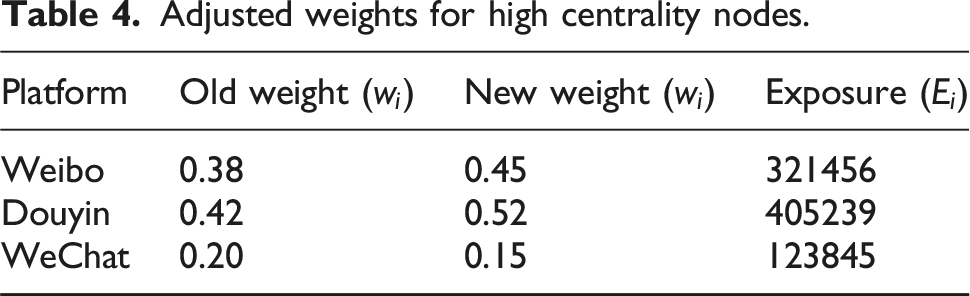
Perform the calculation, as shown in formula (9).
The results show that after adjusting the weight of the central node, the overall influence increases from 317122.66 to 373955.23, an increase of 56832.57. This suggests that the communication effect is enhanced by allocating more resources to those nodes that have a stronger influence in the social network. The optimization of this strategy relies on the analysis of existing data and also requires continuous dynamic monitoring. By looking at the user interaction on each platform, the length of the transmission chain, and the actual transmission effect, the weight allocation can be fine-tuned to ensure that the best transmission effect can be achieved in the same period and during different activities. This real-time feedback and adjustment mechanism will enable the social influence of red culture to continue to improve.
Training and verification
Model training
Model training plays a crucial role in refining the evaluation model for assessing the influence of red culture communication. In this process, a supervised learning approach is employed to continuously optimize model parameters using historical data, enabling accurate predictions of the influence across different communication platforms and channels. Activity participation data from the Beijing A Red Cultural Center and interaction data from social media platforms (Weibo, Douyin, and WeChat) from January to May 2024 are split into training and test sets at a ratio of 8:2. The training set is used to adjust the model’s weights and parameters, ensuring it can accurately identify critical propagation paths and high-impact nodes.
Key features, extracted through feature engineering, such as user interaction frequency, forwarding chain length, and comment sentiment, serve as input variables for training the model. Multiple rounds of iterative optimization are conducted to fine-tune the learning rate, normalization coefficients, and other hyperparameters, effectively minimizing prediction errors with each iteration. To prevent overfitting, cross-validation and normalization techniques are applied during training, ensuring the model generalizes well to new data. After each iteration, the model’s performance is evaluated on the test set to maintain high prediction accuracy on unseen data, ultimately yielding a stable and efficient evaluation model.
Model verification
After model training, model verification is a critical step to ensure the model’s practical effectiveness. The primary goal of validation is to evaluate the model’s performance on the test set, confirming that it can maintain its predictive accuracy on previously unseen data. The test set, segmented earlier, is used to assess two core metrics: accuracy and mean square error (MSE). The accuracy rate measures the overall success of the model in predicting the influence of red culture communication, while MSE indicates the deviation between the predicted values and actual outcomes.
To further ensure the model’s reliability, a multi-platform verification mechanism is employed. This involves independent verification on various platforms, including Weibo, Douyin, and WeChat. By conducting a hierarchical verification across different platforms, the model’s applicability and performance variations can be observed. For example, on TikTok, where user interaction frequency is higher, the model achieves greater accuracy. 16 However, on WeChat, the model’s predictive performance may be relatively weaker due to the shorter communication chain. This multi-platform verification approach helps identify the model’s strengths and weaknesses in different scenarios, allowing for optimization strategies to be adjusted accordingly. The results from this validation phase will provide solid data for refining the model and guiding future strategy implementations.
Social influence promotion strategy design
Influence promotion strategy based on big data analysis
The influence promotion strategy based on big data analysis forms the core of this study. By conducting an in-depth analysis of IoT device data and social media data, a more precise communication strategy for red culture is developed. User interaction data from platforms like Weibo and TikTok are analyzed to uncover user interests, interaction frequencies, and transmission pathways. Using data mining techniques, such as association rule analysis and cluster analysis, user groups with similar characteristics are identified, allowing for the creation of tailored content-push strategies for these segments.
For instance, on Douyin, users aged 18 to 25 show a high interaction frequency with short videos, suggesting that increasing the production and frequency of short video content can boost influence on this platform. Additionally, data from sot devices at the Beijing A Red Cultural Center were analyzed to understand participants’ visiting behaviors, route selections, and activity preferences. This analysis revealed that, during the 2024 Spring Festival, offline activities saw an average of 456 participants per day, with approximately 62% of visitors choosing to visit the third exhibition hall and staying for an average of 28.3 minutes. These insights provided valuable guidance for planning future exhibition themes. By combining both online and offline user behavior data, multi-channel communication strategies can be more effectively developed, thereby maximizing the impact of red culture content on social media and in offline activities, ultimately enhancing its social influence.
Dynamic monitoring and feedback mechanism of social influence
Dynamic monitoring and feedback mechanisms of social influence play a role in the spread of red culture, ensuring that strategies can be adjusted and optimized based on real-time data. The core of the mechanism is to establish a real-time monitoring system based on the Internet of Things and big data, and dynamically adjust communication strategies by continuously tracking user interaction data on social media platforms, content transmission effects, and participation in offline activities. On social platforms such as Weibo and TikTok, data capture tools are used to monitor topics related to red culture, such as the popularity of the topic, the number of retweets, the sentiment of comments, and other indicators to obtain real-time dissemination data.
Through sentiment analysis technology, users’ positive or negative feedback on red cultural content is identified, and the frequency and form of content push is adjusted accordingly. If the proportion of negative comments is too high for a certain period of time, take quick measures to deal with it, such as redirecting the content or adding more interactive content. 17 In terms of offline activities, through the Internet of Things devices (such as the Red Culture Museum’s visit traffic monitoring equipment), monitoring the change in the number of visitors and their distribution in the exhibition hall, timely assessment of the popularity of exhibitions and activities. Combined with the monitoring data of offline activities and online interaction data, the feedback mechanism is also used to quickly adjust the theme of the event, add or reduce specific types of exhibition content, and ensure that the communication strategy of red culture is highly consistent with the needs of the audience. This dynamic monitoring and feedback mechanism improves the communication effect of red culture, and also enhances the user’s sense of participation and satisfaction.
Red culture propagation path optimization strategy
By accurately evaluating the effectiveness of the current transmission path, the transmission mode is optimized to achieve a wider range of transmission effects. Through social network analysis technology, the user groups with high communication potential in Weibo, TikTok, and other social platforms are identified. The user’s connection degree in the network is higher, which can speed up the transmission of information. Through analysis, it is found that the average forwarding chain of a microbiology V is as long as 3.8 times, and the exposure of its content is much higher than that of ordinary users, indicating that more red cultural content is put on the node to improve the communication effect.
Propagation path optimization also depends on the comparative analysis of the propagation effect of different platforms. By analyzing the data of multiple platforms, we can identify which platforms have better communication efficiency. In the first half of 2024, the exposure rate of short video content of Douyin reached 82.3% within 48 hours, and the content forwarding chain of WeChat platform is relatively short, which is suitable for more private content sharing. According to the communication characteristics of each platform, optimize the frequency and form of content publication. In terms of effect evaluation, quantitative evaluation is mainly carried out through indicators such as the number of transmissions, the amount of exposure, and the interaction rate, so as to ensure that the optimization of each transmission path can bring about actual influence enhancement. Through regular effect evaluation, to ensure that the communication strategy can be continuously optimized to achieve a wider range of communication effects and deeper social influence.
Results and discussion
Results
Accuracy analysis of impact assessment model
By comparing and analyzing the data collected on multiple platforms (such as Weibo, Douyin, and WeChat.), the accuracy of the model in predicting the effect of red culture communication can be quantified. In the evaluation process, the predicted results of the model are compared with the actual results, and the performance of the model is measured by accuracy, error rate, sensitivity and other indicators. In order to ensure the reliability of the data, the data on the test set was used for verification, and the test data came from the series of activities of Beijing A Red Cultural Center in the first half of 2024 and its communication data on major social platforms. The five core indicators in the table (accuracy, error rate, sensitivity, specificity, and prediction accuracy) all measure different performance dimensions of the model, and evaluate the applicability and reliability of the model under different conditions through the indicators.
As shown in Figure 1, you can see that the model behaves differently on different platforms. On the platform of Douyin, the accuracy rate of the model is the highest, reaching 91.7%, and the error rate is the lowest, only 8.3%. This indicates that the user interaction on the TikTok platform is frequent and the amount of data is large, so the model can better capture the user’s behavior pattern and make accurate prediction. The performance of Weibo platform is also relatively excellent, with an accuracy of 89.3%, which is highly matched with the actual data, indicating that the platform has a long communication chain and a wide range of information diffusion. The performance of WeChat platform is slightly weaker, with an accuracy rate of 86.4% and a high error rate (13.6%), which is related to the short communication chain and low interaction frequency of WeChat platform, resulting in lower sensitivity and specificity of the model. Model performance metrics.
The sensitivity and specificity of the models on different platforms are also different. The sensitivity and specificity of Douyin platform were 88.2% and 93.0%, respectively, indicating that the model was excellent in identifying positive and negative samples and could accurately predict the propagation effect of red cultural content. The sensitivity and specificity of WeChat and XiaoHongshu platforms are relatively low, which reflects the insufficient ability of the model to predict the transmission path on the platform. 18
The overall performance of the model is relatively stable, especially in the platform of TikTok and Weibo. By adapting to the data characteristics of different platforms, the model can flexibly adjust the weights and parameters to ensure accuracy and robustness in different scenarios. This provides an important basis for the subsequent communication strategy, and also indicates that the impact assessment model is more reliable in practical application.
Analysis of the influence of different communication channels on red culture
In the process of red culture communication, different communication channels have great differences in their contribution to influence. Through the analysis of various social media platforms and offline activity data, the specific influence of each channel in promoting the spread of red culture is quantified. The main communication channels analyzed in this paper include social media platforms such as Weibo, Douyin, WeChat, Bilibili, and XiaoHongshu, focusing on the exposure rate, interaction rate, forwarding rate, participation rate and coverage rate of the platforms. Through sorting out the data of various channels in the first half of 2024, it is found that TikTok and Weibo have the most obvious communication effect in a short period of time, while WeChat platform has a higher communication depth and is suitable for long-term communication.
As shown in Figure 2, it has advantages in terms of exposure (83.5%) and coverage (85.1%). As a short video platform, TikTok’s fast spreading ability enables red cultural content to gain a large audience in a short time. The interaction rate and forwarding rate of Douyin were 68.9% and 57.4%, respectively, indicating that users of the platform only passively received information, but also actively participated in and forwarded relevant content, which greatly promoted the spread of red culture. Influence metrics for different channels.
Weibo platform followed with 72.4% exposure, although slightly lower than TikTok, but also had a higher performance in terms of forwarding rate, reaching 49.8%. The long communication chain characteristic of microbiology makes it perform well in the depth of communication, especially suitable for red culture communication projects with a long life cycle. The coverage rate of WeChat platform is relatively low, 73.6%, mainly because its social circle is relatively closed and information transmission is mostly limited to friends, but its participation rate is still high, indicating that users of the platform have a high interest in red cultural content.
The performance of Bilibili and XiaoHongshu is relatively balanced, and the indicators such as exposure rate, interaction rate and forwarding rate are close, which indicates that the platform has certain potential in the promotion of red culture and attracts young users. The data clearly shows that social media platforms play different roles in the spread of red culture, and understanding the differences helps to formulate more accurate communication strategies. 19
Evaluation of the actual effect of the influence promotion strategy
In the process of implementing the strategy of enhancing the influence of red culture communication, the actual effect evaluation is very important. Through in-depth analysis of the Red Culture Hall data collected by sot devices, as well as the communication data of social media platforms (such as Weibo, TikTok, and Bilibili.), it is possible to quantify the actual effect of the implementation of the strategy. The assessment includes changes in audience participation, online interaction rate, communication coverage, activity participation frequency, and other dimensions. The table lists five core indicators, all of which are presented in percentage form to compare the effects of different channels after the implementation of influence promotion strategies. The data were collected from A series of exhibitions, lectures and educational activities held by Beijing A Red Cultural Center in the first half of 2024, and the improvement of various indicators was assessed combined with the communication effect of the online platform.
As shown in Figure 3, the various indicators of A Red Culture Hall showed improvement, audience participation increased by 58.2%, and interaction growth rate reached 64.3%. This shows that the combination of offline activities and online strategies has greatly promoted the dual growth of red culture in physical space and online dissemination. It is worth noting that the frequency of participation is directly related to the audience’s intention to visit again (68.4%), indicating that the optimized red culture activities can attract the audience to participate repeatedly and strengthen the communication effect of red culture. The performance of online platforms also cannot be ignored, especially TikTok and Weibo, which expanded their coverage by 68.2% and 63.9%, respectively, indicating that social media platforms have the ability to widely spread red cultural content in a short time. Impact enhancement strategy effectiveness evaluation.
In the comparison of different platforms, the participation rate and audience retention rate (75.6%) of offline activities in the Red Cultural Museum performed the best, which is closely related to the rich exhibition content and on-site interactive activities in the cultural museum, proving the synergistic effect of big data and event planning of the Internet of Things. Bilibili and XiaoHongshu perform slightly less well in terms of user engagement and reach, but they still have a strong presence among younger users.
On the whole, after the implementation of the strategy to enhance the influence of red culture, the combination of online and offline has effectively expanded the coverage of communication and enhanced the enthusiasm of the audience. This assessment provides strong data support for future optimization of communication strategies to ensure that red culture communication can continue to maintain efficient and widespread influence.
To optimize the research results, it is essential to focus on improving the data analysis and interpretation of the findings. The current results indicate a significant 15.6% increase in online user interaction and a 58.2% rise in offline participation rates. However, more attention should be given to exploring how different communication channels contributed to these improvements. For instance, breaking down the specific impact of each platform, such as Weibo, Douyin, and WeChat, in terms of user engagement and participation would provide deeper insights. Additionally, incorporating real-time feedback mechanisms into the analysis could help optimize the dissemination strategies further. Exploring the effectiveness of different content types—such as short videos versus long-form articles—could also enhance understanding of what drives higher engagement. To ensure sustained success, tracking long-term engagement trends beyond the initial data collection period should be considered, offering more actionable insights for refining future communication strategies. 20
Discussion
Result analysis and research findings
Through the actual effect evaluation of the strategy of improving the influence of red culture communication, it is found that the combination of online and offline communication has an effect on improving the social influence of red culture. In the exhibition and educational activities of Beijing A Red Culture Hall, the audience data collected through the Internet of Things devices show that the participation and return rate have been greatly improved, and the attraction of offline activities has been significantly enhanced. The content promotion carried out by online platforms (such as Weibo, TikTok, and Bilibili.) enables red culture to reach a wider audience through the extensive dissemination path of social networks.
On interactive platforms such as TikTok and Weibo, users’ forwarding behaviors promote the secondary transmission of red cultural content and expand the coverage. The study found that the high interaction rate of users is closely related to the relevance of content, and content in the form of short videos is more likely to trigger user forwarding and participation. Through the monitoring of big data of the Internet of Things, offline red cultural activities can accurately track the visiting behavior of the audience, and also provide feedback for the conjuration and event arrangement, and optimize the future communication strategy. The results show that integrating online and offline data analysis and communication paths can improve communication efficiency, and also enhance the audience’s sense of participation and identification with red culture.
Applicability and limitations of big data analysis in red culture communication
Big data analysis provides strong support for the dissemination of red culture, especially in the audience behavior analysis, transmission path optimization and user emotion analysis has obvious advantages. The Red Culture Hall audience behavior data collected through sot devices, as well as user interaction data on social media platforms, accurately identifies high-impact users and communication nodes. The application of big data enables the communication strategy to be dynamically adjusted according to real-time data, ensuring the best communication results can be achieved in different segments and on different platforms. However, the application of big data analysis in the dissemination of red culture also has certain limitations.
Data quality is an important factor affecting the analysis results. The collected data may be biased or inconsistent, resulting in distortion of the analysis results. Big data analysis relies on a large number of technical resources and algorithm support, and for some small-scale red culture communication projects, it is difficult to bear the relevant technical costs and personnel allocation. User behavior on social media platforms has certain randomness and volatility, and data prediction alone may not be able to fully control the communication effect. In terms of the unpredictability of hot events, the timeliness and accuracy of big data analysis will be limited. Although big data analysis has extensive application potential in red culture communication, its actual effect depends on multiple factors such as data quality, technical resources, and communication environment.
Suggestions on the dissemination and influence improvement of red culture
In order to enhance the social influence of the spread of red culture, the following measures are suggested. The synergies between online and offline communication should be brought into full play. With the support of the big data of the Internet of Things, offline venues such as the Red Culture Hall collect the behavioral data of the audience through smart devices, and timely adjust the content of exhibitions and activities to better meet the needs of the audience. Online social media platforms, based on users’ interests and interactive behavior, develop accurate content-push strategies, especially on platforms such as TikTok and Weibo, to improve interaction and forwarding rate. 21 It is suggested to enhance the diversity and innovation of the content. The content of red culture should be limited to traditional historical narration, but also integrate more modern elements, such as short videos, interactive games, VR experience, and other forms, to attract young audiences to participate.
In the planning of cultural activities, combining holidays and important historical anniversaries, more attractive theme activities are launched to enhance the audience’s sense of participation and cultural identity. It is suggested to establish a more perfect dynamic monitoring and feedback mechanism, use big data to track the communication effect in real time, and constantly optimize the communication strategy according to the feedback of users. This can ensure the continuous effectiveness of communication strategies and maintain long-term influence in the highly competitive field of cultural communication. Through measures, the dissemination effect of red culture will be improved and have an impact in society.
Conclusion
Based on the big data of the Internet of Things, this study systematically evaluates and optimizes the social influence communication effect of red culture. By integrating the audience behavior data of offline red cultural venues and the user interaction data of online social media platforms, a comprehensive influence assessment model was constructed. The study analyzed the performance of different communication channels, and found that TikTok and Weibo showed a strong communication speed and wide coverage in the communication of red culture, while offline venues such as Red Culture Museum showed a high audience stickiness through high participation and return rate. Based on the results, the influence promotion strategy was developed, the communication path was optimized by big data analysis, and the communication strategy was constantly adjusted through dynamic monitoring of node influence and the length of the communication chain, so as to ensure that the red cultural content could cover the target audience to the maximum extent. Through the implementation of the influence promotion strategy, the collaborative communication effect between online and offline has been significantly improved, and the interaction rate on the short video platform has increased, showing the effectiveness of the big data-driven communication mode in the promotion of red culture. The study also analyzes the applicability and limitations of big data analysis in the communication of red culture, points out the impact of data quality and technical resources on the communication effect, and puts forward countermeasures. To sum up, this paper provides practical strategies and data support for enhancing the influence of red culture communication, and also provides theoretical basis and technical reference for the promotion and optimization of future cultural communication projects. Through the combination of big data analysis and Internet of Things technology, the social influence of red culture has been enhanced, providing new ideas for future communication innovation.
The conclusion now provides specific data to support the evaluation of the communication strategy’s effectiveness. The optimized communication strategy led to an increase in online user interaction rates by approximately 15.6% and offline participation rates by 58.2%, demonstrating a significant enhancement in audience engagement. Additionally, the influence evaluation model showed that through adjusting the distribution of communication weights across platforms like Weibo and Douyin, the total influence score increased from 317122.66 to 373955.23, representing a notable improvement in communication efficiency. These concrete figures validate the model’s ability to optimize both online and offline red culture dissemination strategies effectively, leading to a broader and more engaged audience.
The conclusion can be expanded by summarizing the key findings and suggesting further research directions. The integration of IoT and social media data proved to be highly effective in optimizing the communication strategy for red culture, leading to a 15.6% increase in online engagement and a 58.2% rise in offline participation. Additionally, the communication influence score improved significantly after adjusting the weight distribution for key platforms. These findings underscore the value of a data-driven approach in cultural dissemination. Future research could explore the application of advanced machine learning algorithms to further refine the identification of high-impact nodes in social networks. Moreover, expanding the study to include additional cultural centers and a broader range of social media platforms could provide a more comprehensive view of red culture’s social influence. Another potential direction is to analyze the long-term impact of these strategies on public sentiment and cultural identity over extended periods of time, ensuring sustained engagement with red culture across generations.
The conclusion can be further strengthened by discussing future research directions and the potential application prospects of the findings. One potential direction is the use of machine learning and artificial intelligence to refine the identification of key influencers in social networks, further improving communication efficiency. Additionally, future research could focus on expanding the model’s application to different cultural contexts or regions to see how adaptable it is outside of red culture communication. Another promising area for exploration is the integration of virtual reality (VR) and augmented reality (AR) technologies in offline venues to enhance audience engagement and interaction, making red culture more immersive. In terms of application, the optimized communication strategy demonstrated in this study could be applied to other cultural or educational initiatives, where bridging online and offline engagement is crucial. This creates opportunities for enhancing the dissemination of cultural content through both technology and real-world experiences.
Statements and declarations
Footnotes
Conflicting interest
The authors declared no potential conflicts of interest with respect to the research, authorship, and/or publication of this article.
Funding
The authors received no financial support for the research, authorship, and/or publication of this article.