



Abstract
In the rapid quotation process of construction projects, low prediction accuracy and high computational complexity remain challenging issues. To address these problems, this study proposes a novel method that integrates the theory of intuitionistic fuzzy sets for intelligent cost prediction. Given that engineering unit prices are significantly and dynamically uncertain due to multi-source heterogeneous factors (e.g., seasonal fluctuations, regional differences, and market volatility), we construct a transformation mechanism of interval-valued intuitionistic fuzzy sets. This mechanism expands the traditional deterministic engineering feature matrix into an information matrix that includes hesitation degrees and membership degrees, thereby achieving a refined representation of uncertain parameters. On this basis, we introduce a multi-dimensional similarity matching algorithm to establish an accurate mapping relationship between the project under construction and the historical case library. A weighted correction prediction model based on similar cases is proposed to enhance the robustness of unit cost prediction results. Verification through multiple engineering examples demonstrates that this method provides a new prediction paradigm for engineering cost estimation, combining both theoretical rigor and practical applicability. The research conclusions offer important references for the development of intelligent cost estimation systems and the optimization of engineering decision-making.
Introduction
Cost estimation forecasting is a key part of construction project management. Its accuracy directly impacts project success and corporate profits.1,2 As competition intensifies, construction firms increasingly rely on bidding to secure projects,3,4 where cost forecasting skills are crucial for winning bids and ensuring profitability. Traditional cost estimation systems, though based on national and local standards, have linear and static models that fail to meet modern engineering demands5,6 like short cycles, dynamism, and multiple variables. This leads to low efficiency and slow market response.7,8
Construction firms have accumulated a wealth of historical cases that hold valuable cost patterns and decision-making experience. Accurately matching proposed project features to these cases for rapid cost prediction is a vital innovation direction.9,10 To overcome traditional information representation limitations, this study introduces a coupled modeling framework of Vague sets and intuitionistic fuzzy sets (IFSs).
Proposed by Gau and Buehrer in 1993, Vague set theory defines elements by membership, non-membership, and hesitancy degrees, capturing “partially known, partially unknown” uncertainty. IFS, Atanassov’s extension of Zadeh’s fuzzy sets, independently defines membership and non-membership, offering a new way to handle fuzziness and incomplete information11,12. The two theories are interconnected in describing uncertainty: Vague sets’ hesitancy degree is the complement of the sum of IFS membership and non-membership degrees. This synergy supports creating a hybrid model. Our interval-valued Vague set transformation mechanism uses double-uncertainty measurement for detailed project-feature expression. Combined with IFS similarity-measurement-based case-matching models, it offers a solution that’s both theoretically rigorous and practically applicable in engineering.
Empirical studies show that this method preserves traditional case-reasoning efficiency and improves forecasting accuracy through double-uncertainty modeling. Especially in quick-quotation scenarios, predictions based on Vague-IFS hybrid models provide vital support for construction firms’ intelligent decision-making systems. This research not only expands uncertainty theory applications in project management but also offers methodological innovation for complex decision-making problems.
Intuitionistic fuzzy sets
Intuitionistic fuzzy sets are an extended form of fuzzy set theory. Their core advantage lies in the ability to simultaneously consider information from three dimensions: membership degree, non-membership degree, and hesitation degree. Compared with traditional fuzzy sets, intuitionistic fuzzy sets demonstrate higher flexibility and expressive power when dealing with the fuzziness and uncertainty of information.
Let In addition, for any element If


Conversion from interval-valued to Vague-valued
The research on interval time series faces many challenges due to its complexity. To analyze interval time series more effectively, it is necessary to convert it into a more appropriate representation form.13,14 Since the representation methods of interval time series and Vague sets are structurally similar, some scholars have proposed a conversion method to convert interval data into Vague values and conducted research in practical applications.15,16 These conversion methods are based on the Vague theory and can better handle fuzziness and uncertainty. However, the existing conversion formulas (such as the conversion method proposed by Wang Hongxu) 17 usually only consider the maximum value or theoretical maximum value of the sequence when processing interval time series data, while ignoring the influence of the minimum value or theoretical minimum value. This processing method weakens the rationality of the conversion result to a certain extent and limits its application scope. To improve the scientificity and applicability of the conversion, the following criteria should be met when converting interval time series data into Vague data:
Suppose the interval data is 1. 2.
Suppose
Let If For example: Suppose there is a set of time-series observation values, with the maximum value being Converting the interval time series into the Vague set representation form can better handle fuzziness and uncertainty, and at the same time provides a basis for subsequent analysis and modeling of conversion to intuitionistic fuzzy sets.
Conversion between intuitionistic fuzzy sets and Vague sets
Intuitionistic fuzzy sets (IFSs) and Vague sets share the same essential nature in characterizing uncertainty phenomena with “partially known and partially unknown” information, with their core difference lying solely in parameterization forms—the former employs an explicit triplet (membership, non-membership, hesitation degrees) while the latter uses interval numbers implicitly. Research demonstrates their mathematical equivalence through conversion formulas: mapping IFS’s membership and non-membership degrees directly to Vague sets’ true and false membership degrees, naturally preserving hesitation degrees as interval lengths, and vice versa. The explicit three-parameter expression of IFS facilitates complex operation rule construction, whereas Vague sets’ interval number representation excels in intuitive semantic interpretation. By constructing a bidirectional conversion mechanism, the complementary advantages of both theories can be realized: employing IFS for precise calculations at the operational level and converting to Vague sets for semantic interpretations at the decision-making level. This hybrid modeling strategy significantly enhances the flexibility and interpretability of uncertainty processing systems.
Let For any In addition, the Vague set also contains a parameter called the hesitation degree, expressed as: Among them, By comparing the definitions of the intuitionistic fuzzy set and the Vague set, the following conversion relationship can be established: For example, if the intuitionistic fuzzy number is expressed as Through the above conversion formula, seamless conversion between the intuitionistic fuzzy set and the Vague set can be achieved, so as to make full use of the research results of the two models and provide more flexible tools for the processing of fuzziness and uncertainty. The conversion formulas proposed in this study not only establish formal connections between the two theories but also provide new ideas for developing hybrid uncertainty processing models, demonstrating significant methodological integration and innovation value in interdisciplinary fields like decision analysis and pattern recognition. This conversion mechanism not only strictly preserves the integrity of uncertainty information but also realizes the complementary advantages of both theories, offering theoretical support for constructing hybrid uncertainty processing models and presenting methodological innovation value in enhancing the flexibility and interpretability of decision-making systems.



Similarity measure of intuitionistic fuzzy sets
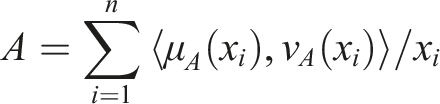
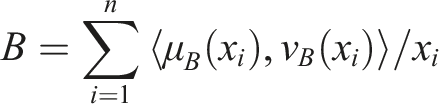
In order to more accurately measure the similarity between intuitionistic fuzzy values, literature 11 proposed a measurement method for allocating the support degree and opposition degree of the hesitation degree based on the herd mentality. Based on this, this paper improves the similarity of intuitionistic fuzzy sets and gives the following definitions:

Let Then the similarity between the Vague sets This section proposes an improved similarity measurement method for intuitionistic fuzzy sets, which can more comprehensively reflect the similarity between intuitionistic fuzzy values. This method combines the differences in support and opposition degrees, providing theoretical support for subsequent project cost prediction.

Prediction based on similarity
Prediction based on similarity is an effective method in the field of engineering cost estimation. Its core lies in accurately identifying the key characteristic elements for building project evaluation. The cost of a building project is comprehensively affected by various complex factors, such as foundation type, structural design, floor height, door and window configuration, indoor and outdoor decoration standards, and public facility supporting. Through in-depth analysis of historical project data and combined with the rich experience of experts, a feature matrix that can comprehensively reflect the core characteristics of the project is constructed. This matrix not only integrates quantitative data but also incorporates qualitative analysis, providing a solid foundation for the quantification of project characteristics. This paper further explores how to efficiently select reference projects that are highly similar to the characteristics of the proposed project, providing scientific basis and operational guidelines for cost estimation based on similarity, and ensuring the accuracy and reliability of cost estimation.
Determining the characteristic elements for valuation
In project cost estimation, the reasonable selection of indicators that can reflect the core characteristics of the project is the key. This paper selects
Since there are no completely identical building project examples in reality, the feature set
F = {Floor height, Foundation form, Door and window type, Interior and exterior wall decoration, Floor decoration}
This feature set can effectively characterize the core attributes of a building project and provide a reliable basis for project cost estimation. Through the feature set
Selecting reference projects
In the field of project cost prediction, although there are no two completely identical engineering projects, through in-depth analysis of completed construction projects, it is usually possible to screen out projects with similar characteristics to the proposed project. Such projects are called reference projects. Reference projects should have significant similarities with the proposed project in terms of material selection, structural design, construction specifications, and methods. Based on this, the unit cost data of reference projects can be used to reasonably predict the cost of the proposed project.
Specifically, select
Construct the feature matrix of reference projects
Suppose there is an engineering set composed of

CV represents the feature element value, SP represents the sub-project, MP represents the main project, UP represents the comprehensive unit price, and w represents the weight.

For reference project
Convert to intuitionistic fuzzy matrix
Generally, the proportion of sub-projects in the sub-division project is a definite value designed by the design unit. However, the unit price of sub-projects has certain uncertainties due to seasonal, construction location, and market factors. Upper and lower limits can be set to deal with the above situation, that is, a unit price interval number. Let the maximum value be

After establishing the intuitionistic fuzzy set matrix
Project cost prediction
Let the unit cost of the reference project with the maximum similarity value be
Application case analysis
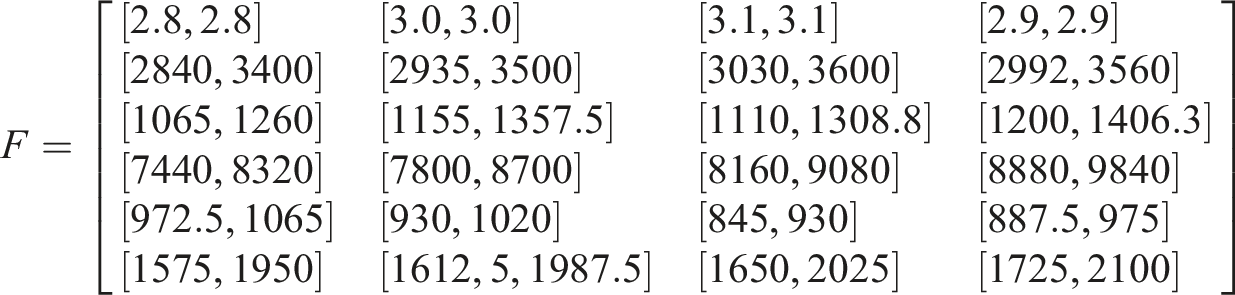
Characteristic data of a commercial-residential building percentage of each sub-project in the sub-division project/%.

The proposed methodology can be operationalized through two distinct approaches: utilizing Microsoft Excel for smaller data volumes or employing Python programming for extensive datasets requiring scalable computation. Researchers or practitioners seeking access to the source code are invited to contact the corresponding author directly, who will provide the implementation scripts upon formal request.

Minimum and maximum values of characteristic data.
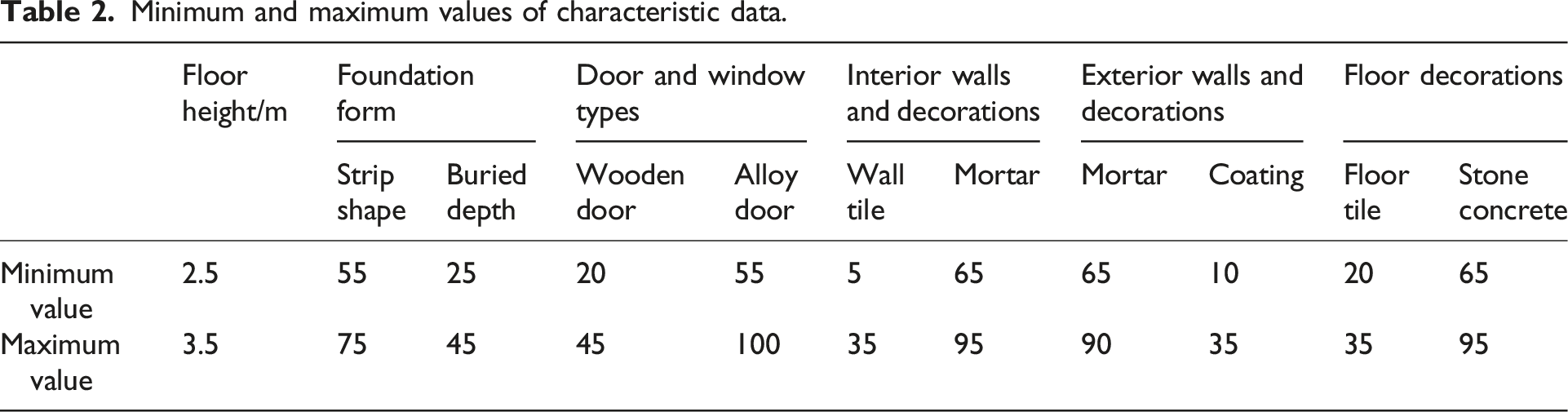
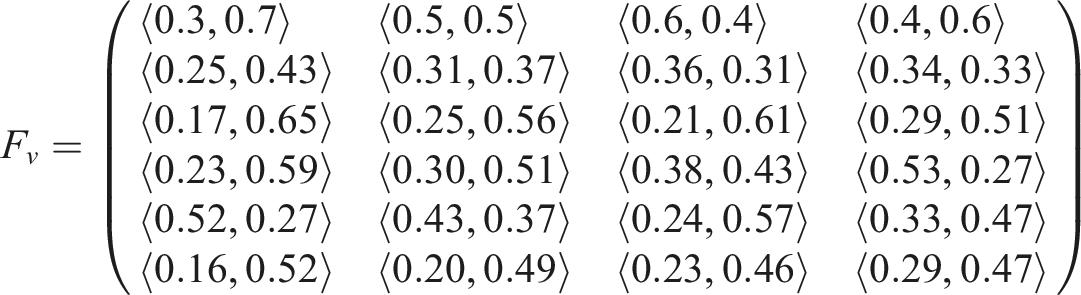
The intuitionistic fuzzy value of the proposed project is:
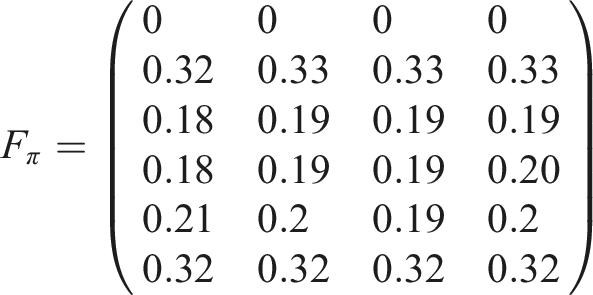
The hesitation degree value of the proposed project is:
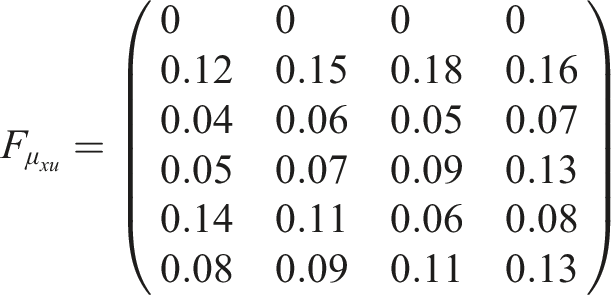
Calculate the value of the hesitation degree value of the proposed project assigned to the true membership degree as follows:
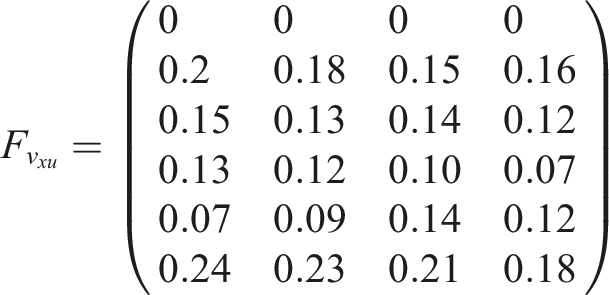
Calculate the value of the hesitation degree value of the proposed project assigned to the false membership degree as follows:
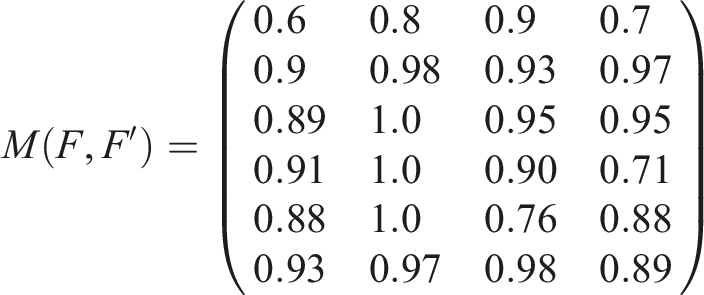
The similarity between each reference project and the proposed project is: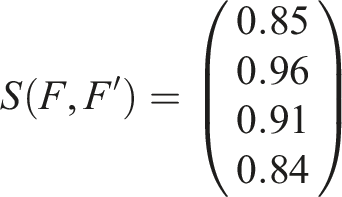
That is, the similarity between the reference project
Conclusion
This study addresses the demand for rapid cost estimation in construction engineering by developing an innovative prediction model based on interval-valued Vague set transformation and intuitionistic fuzzy set similarity measurement. The model achieves multi-dimensional uncertainty representation and intelligent matching of engineering features. By introducing a dual uncertainty theoretical framework, this research effectively overcomes the subjective limitations of traditional empirical prediction paradigms, providing a solution with both theoretical depth and practical value for cost prediction in complex engineering environments. Empirical results demonstrate the model’s significant predictive advantages in rapid-response scenarios, offering critical technical support for the intelligent upgrade of engineering decision support systems.
Despite achieving phased results, several improvement areas remain: First, the current case database primarily covers regional conventional projects, with limited representation capabilities for complex scenarios such as special geological conditions and super high-rise buildings. Second, feature extraction dimensions mainly focus on static attributes, lacking real-time mapping mechanisms for dynamic factors like market price fluctuations and policy adjustments. Third, the similarity measurement algorithm requires further optimization of dynamic weight allocation mechanisms during heterogeneous data fusion processing.
Future research directions plan to expand in three dimensions: First, construct a multi-source heterogeneous case database integrating BIM digital twin technology to enable dynamic updates and multi-dimensional extensions of case features. Second, develop adaptive feature learning algorithms introducing deep learning frameworks to achieve intelligent coupling of feature extraction and weight allocation. Third, explore group decision support mechanisms by integrating expert experience with data-driven models to build hybrid reasoning systems. Through continuous interaction between theoretical innovation and engineering practice, it is expected to promote the evolution of construction cost prediction toward greater precision, intelligence, and generalization, contributing new theoretical paradigms and technical momentum to the development of building industrialization and intelligent construction.
Footnotes

Funding
The authors disclosed receipt of the following financial support for the research, authorship, and/or publication of this article: This study is supported by related work which was supported by crosswise tasks of Fu Zhou Polytechnic (LX-2019-HX-001).
Declaration of conflicting interests
The authors declared no potential conflicts of interest with respect to the research, authorship, and/or publication of this article.