



Abstract
This mixed-methods, exploratory study investigates the gambling activities of street youth in Mumbai, India. Data from surveys and brief interviews of 70 youth aged 12–24, two focus groups, and ethnographic observations offer descriptive snapshots of the gambling behavior of participants. The article includes details about games played, popular venues, initiation patterns, time spent gambling, and interactions with the police.
Street youth gamble for social benefits, such as group membership and fun; it is also a leisure activity enabling time to go by quickly. Individual benefits include intermittent rewards and a high after winning or being referred to as a gambler. The inability to save, the lack of recreation options, living in groups, and the environment of the streets structure and sustain gambling. This study discusses the group and social dimension of gambling among street youth, and how this dimension makes their participation different from adolescent gambling in general and General Addictions Theory. It contributes to the literature by emphasizing that for street youth the social/group aspects of gambling predominate the psychological. The paper concludes with a discussion of the implications for practice, highlighting the need to develop recreational, income-saving, and educational awareness programs.
The focus of this mixed-methods, exploratory study is the gambling behavior of street youth in Mumbai. The substantive body of literature on youth homelessness concentrates “almost exclusively on trajectories into youth homelessness and adversity in street contexts” (Kidd et al., 2016: 207), but gambling is not investigated. We propose that a better knowledge of gambling in homeless youth will inform not only an understanding of the behavior in relation to addictions theory, but also will help develop educational, recreational, and income-saving programs.
Street youth, a global phenomenon
Youth homelessness is a major global phenomenon (UNESCO, 2016). Although estimates of homeless youth fluctuate, it is likely that the numbers continue to grow because of different factors. While these factors vary between developed and developing nations, both posit similar determinants of youth homelessness, including child maltreatment, poverty, and mental health; a stark difference in developing countries is the presence of younger street children. But overall, the average outcomes for all homeless youth are poor given the exposure to physical and mental illness, victimization, and other risks associated with living on the streets (Kombarakaran, 2004; Webster, 2011; YUVA, 2010).
To survive on the streets and escape victimization, street children cannot live alone. They must make friends and gain entry into a group (Rane, 2004; Webster, 2011), often acquiring habits such as smoking, drinking, and using drugs (Beazley, 2003; Gaidhane et al., 2008). But although many studies highlight drug and alcohol abuse, unique income-generating activities such as rag picking and other stresses and coping strategies associated with living on the streets (D’Souza, 2012; Gaidhane et al., 2008; Kombarakaran, 2004; Raghavan and Nair, 2013), to date no study highlights the gambling behavior of street children. Our research questions are “What are the patterns of gambling on the streets? What circumstances promote gambling among street children? How do street children perceive their gambling activities?” We were also interested in how our findings compare with what is known about adolescent gambling in general. This study was conducted in Mumbai, formerly known as Bombay, India’s economic powerhouse, driven by its railway network. Considered the “city of dreams,” its ever-expanding population is currently 21 million—about 314,000 of whom are street children (ChildLine, 2010).
Literature review
The literature reviewed for this study offered background information and a theoretical framework on adolescent gambling. Youth involvement in gambling is not new, and in North America it is a popular pastime for adolescents (Gupta and Derevensky, 1996; Valentine, 2008). Approximately 80% of adolescents in North America participate in some form of gambling (National Research Council, 1999; Peters et al., 2015; Shaffer et al., 1999; Valentine, 2008) through formal and informal avenues, including lotteries, casinos, sports betting, raffles, video games, the Internet, cards, bingo, and board games.
An overwhelming majority of young people have been introduced to gambling by parents and other adults (Jacobs, 2000), but as they grow older they gamble independently or with friends (Derevensky et al., 1995; Gupta and Derevensky, 1996). Although being known as a gambler or risk-taker leads to social recognition and higher status among peers (Jacobs, 2000, 2004; Salaam, 2014), individual personality factors play a huge role in adolescent gambling. But empirical research on the development of this relationship is in its beginning stages (Gupta and Derevensky, 1998a; Jacobs, 2000; Thomas et al., 2013; Valentine, 2008).
General Addictions Theory and adolescent gambling
In the literature, there is no conclusive model to understand the development of gambling as an addiction, but Jacobs’ (1986) general theory of addictions and Blaszczynski and Nower’s (2002) pathways model are widely accepted. Jacobs’ theory supports the position that all addictive behavior, including pathological gambling, results from a person’s directly chosen path to escape highly stressful internal and external reality conditions to an altered, much more pleasant state of consciousness through an addictive activity. Blaszczynski and Nower’s model tends to cluster subjects into homogenous but discrete addiction architypes based on aetiology, personality, gender, or forms of gambling. We favored Jacobs’ (1986) theory as it aligns with this study’s adolescent population.
Jacobs’ theory lends support to the idea that addictive behaviors not only enable an individual to escape painful realities, but also foster a sense of being highly successful, admired, and invincible (Jacobs, 2000, 2004). Jacobs (2000) cautions that the adolescent developmental period, because of numerous psychological stressors and physical changes, is a time of heightened vulnerability for serious addictions. Gambling offers adolescents opportunities for risk taking and sensation seeking.
The comorbidity of youth gambling with other addictions
Addictions research points out that adolescents who gamble are also known to have higher rates of participation in other addictive behaviors (Gupta and Derevensky, 1998a; Peters et al., 2015; Wood et al., 2004). They are more likely to smoke, drink, and consume illicit drugs (Gaidhane et al., 2008; Gupta and Derevensky, 1998a; Wynne et al., 1996). Adolescent alcohol and drug abuse is associated with low self-esteem, psychological distress, learning difficulties, anxiety, impulsiveness, antisocial behavior, suicide ideation, and childhood abuse (Gupta and Derevensky, 1998a; Volberg et al., 2010). Involvement in gambling is not just similar to other addictions, but excessive gambling is conclusively linked to developing other addictive behaviors and vice versa (Barnes et al., 2009; Gupta and Derevensky, 2011; Jacobs, 2000; MacCallum and Blaszczynski, 2002).
An earlier age of onset (before 12 years) consistently distinguishes youth with serious gambling-related problems from those without (Jacobs, 2000, 2004). It can also precede the expected age for using cigarettes, hard liquor, and marijuana (Gupta and Derevensky, 1998a) and is associated with more severe gambling-related problems (Winters et al., 2002). Throughout the literature the proclivity for males to gamble is evident. Boys dominate the ranks of juveniles with serious gambling-related problems by ratios ranging from 3 to 1, to extremes as large as 5 to 1 (Gupta and Derevensky, 1998a; Hardoon and Derevensky, 2001; Jacobs, 2000; Salaam, 2014).
The changing landscape of gambling because of the increased availability of technology and the popularity of social gaming is of significant concern (Derevensky and Gainsbury, 2016; Griffiths and Parke, 2010; McBride and Derevensky, 2009; Thomas et al., 2013; Valentine, 2008). Technological options, such as the Internet, online venues, electronic gaming machines, and mobile devices capitalize on youths’ perceived skill and familiarity with technology and their love for gaming, which introduces them to gambling. But research struggles to keep pace with assessing the effects of technological advances on gambling behavior (Valentine, 2008; Wood et al., 2004). Even age restrictions have not been deterrents at commercial gambling venues (Derevensky and Gainsbury, 2016), and so preventing underage gambling is challenging.
Overall, there is a paucity of empirical research on adolescent gambling. Although the literature reviewed was not specifically focused on the region and group we studied, it offered background information to understand gambling in adolescence, the developmental period we were interested in, albeit for a different group—those living on the streets. It also offered a theoretical framework for the study.
Stresses from living on the streets and group subculture
A study on gambling must be understood in the context of the streets. Street youth face many stresses. Survival is a constant and everyday concern, and finding work, income-yielding activities, food and a place to sleep assume priority. Street youth lack sleep and adequate nutrition as they depend on leftover food or that obtained from scavenging; they have almost no access to clothing, bathing and toilet facilities; certain weather conditions such as the monsoons are harsh and force them to be on the move; and, they have no access to medical care when seriously ill or suffering from cuts, bruises and burns from work (Kombarakaran, 2004; YUVA, 2010). They are vulnerable not only to substance and physical abuse but also sexual abuse and are at increased risk for HIV/AIDs and other STIs (Gaidhane et al., 2008; Towe et al., 2009). In their attempts to escape deprivation, violence, and obtain money, they are caught up in drugs, criminal activities, and sexual exchange (MacDonald and Terblanche, 2011; Towe et al., 2009). All street youth, but particularly children younger than 15, are susceptible to physical violence and abuse, and often the police are included among the perpetrators (Srivastava and Shareef, 2016). Faced with the daily stresses that accompany street life, street youth use several coping strategies to survive and to make life enjoyable for themselves (Kombarakaran, 2004).
The street group represents the most pervasive social influence street youth have access to (Rane, 2004). It is against the backdrop of the group that they construct a new, collective street identity, assimilating group attitudes, values, perspectives, and street etiquette (Mathur, 2009; Rane, 2004; Webster, 2011). Although the collective group behavior includes not only smoking, drinking and drugs but also gambling, only a single study was found to directly mention gambling. A study by Mathur (2009) mapping the socioeconomic realities of 200 street children aged 5–16 in Jaipur, India reveals that watching films and television, smoking, drinking, taking drugs, and gambling are common modes of entertainment and recreation. Such cursory references to gambling among street youth were at variance with what outreach workers observe—groups of street youth frequently engaged in gambling. Since this behavior is largely unexplored in the literature, we decided to study it.
Method
This study was carried out by a nongovernmental organization (NGO) providing services for street youth including outreach, shelter, education, health clinics, addiction programs, and a monthly mela, the colloquial term used for festival (see Gaidhane et al., 2008). The NGO has drop-in centers in various locations including the railway terminals of CST, Dadar and Wadala (see Gaidhane et al., 2008; Kombarakaran, 2004). The primary investigators were two executive staff with significant direct experience and academic training, one with a doctoral degree from the UK and the other trained in research at the Tata Institute of Social Sciences. Research assistants (RAs) were selected from outreach staff and then trained and supervised on research methods, including interviewing, observation, note taking, and focus group interviewing. Recruitment and data collection were primary responsibilities of the RAs; their experience of strategic street locations, street terms, group hangouts, and familiarity with street and group subculture was invaluable. The lead author provided consultation in preparation for the study and direct support during data collection. The primary investigators and author together completed the analysis of the study, checking and relying on the experience of the RAs for street terms, group happenings, interpretations and emerging meanings, thus introducing an alternate form of “member checking” where assistants are also study participants thus augmenting trustworthiness, credibility and quality of research findings (Denzin, 1978; Kombarakaran, 2004).
The mixed methods study design emerged from a review of the literature and reflecting on experiences as service providers (Van Maanen, 2011). Based on feedback from a pilot study in which a survey was tested, other data-gathering procedures were included in this study—informal interviews, focus groups, and ethnographic observations (see, Saldanha et al., 2017). Given that street youth are highly transient and hard to reach (Gaidhane et al., 2008; Mathur, 2009; Webster, 2011) and the limited availability of the agency’s resources, the surveys were completed in a short time frame.
Participants and recruiting methods
The present study surveyed 70 street youth, ages 12–24. All participants were males, following general visibility patterns of street youth in Mumbai and elsewhere (Beazley, 2003; Salaam, 2014; Webster, 2011). Gambling, for study purposes, was defined as engaging in any games or activities where money was at stake. A purposive but convenient sample of youth who were actively gambling when outreach was conducted was recruited from the locations where street youth abound: three major railway terminals, over/under flyover bridges, a popular public beach, an open playground, and a drop-in center. The sample included participants for whom the street was a home as well as a source of livelihood; that is, these children and youth were not slum dwellers or street families, both of whom live and use the streets to supplement their income (Gaidhane et al., 2008; Raghavan and Nair, 2013; Webster, 2011). All participants were well entrenched in street culture, having lived an average of 6 years on the streets.
RAs explained the study to participants, obtained informed consent, and found comfortable places where privacy could be maintained while administering the survey. The survey was designed in two languages—English and Hindi, the language commonly spoken by street youth in Mumbai. Interviewers were familiar with both languages. A total of 24 questions were asked about age, street involvement, daily/monthly earnings, perceptions of gambling, games played, reasons for gambling, time and money spent, and how winnings were disposed. Responses were orally gathered and simultaneously scribed; no audio recordings were made as audio equipment not only makes participants uneasy but also makes other group members suspicious and on edge. Following the survey, brief informal interviews were conducted with all participants. Each survey and informal interview took an average of 45 minutes to be completed. A few of the interviews were conducted at night while gambling games were in progress. Ethnographic field observations were a part of data-gathering procedures. RAs observed the gambling behavior of individuals and groups, discreetly recording field notes. Field notes did not include many direct quotes, except for a few sayings commonly mentioned by multiple youth, but they offered insights into participation patterns and behaviors and were thus useful to augment the data from survey interviews.
Gathering data in public places is extremely difficult and must be negotiated; curiosity and interference from police and bystanders is common (Mathur, 2009). Gambling being clandestine and illegal, conducting surveys on the streets cannot be construed as innocent activities—after an interview, a participant may be called to report what transpired. On the other hand, younger participants tend to boast they are gamblers and sometimes even want to demonstrate a sleight of hand trick with cards, marbles, or coins. During one such instance during the study, a police officer showed up from nowhere, snatched the street youth and beat him up. Such incidents happen quickly and can drastically alter the course of events, putting participants and researchers in trouble. In this instance, the street youth while still recovering from the beating, turned to the researcher and said, “Are you happy I went through all of this because of you?”
Following the surveys and interviews, two focus groups with key informants were conducted: five respondents aged 12–17 were in one group, and four respondents between 18 and 24 composed the other. Focus groups were designed to gather collective data (Auberbach and Silverstein, 2003), particularly the social realities and common perceptions of gambling. With these ends in mind, focus groups took on a loose, open-ended format with semi-structured probes. Once again, RAs were involved in simultaneous note taking. Since focus groups were conducted after surveys were completed and tabulated, aggregate survey data were presented for confirmation and further insight, as well as to initiate a discussion (for example, what is the most popular game of cards that all know and play, what other forms of gambling take place, why street children like to gamble, and is gambling a game of luck or skill).
Analysis
Data for the analysis of the study included surveys, notes from individual interviews, focus groups, ethnographic observations, and the field notes and insights of RAs. Because of limited prior research, we selected a social constructivist approach (Crotty, 1998) whereby we integrated data from multiple sources to construct a panoramic picture of gambling, continuously using the insights of RAs at all stages. We initially analyzed the surveys and individual interviews. These findings were further developed by integrating field notes and RA input. Some of these findings were presented to the focus groups to enhance our understanding of gambling through group perspectives. Focus group responses were then integrated into the analysis. Thus using multiple methods we were able to triangulate, compare and integrate the various sources and improve the quality of the research results (Denzin, 1978). In general, the input of RAs was vital to the analysis as it provided contextual and other additional details to the findings.
Findings
The descriptive snapshots emerging from the study are organized into three main themes. The first summarizes participants by age and other characteristics, offering a description of gambling in terms of initiation, games played, popular venues, and the average time spent, answering the first research question about gambling patterns on the streets. The next theme highlights how group and street cultures influence gambling, offering information about the second research question. The third theme adopts a more long-term view of how participants perceive gambling, describing some negative aspects, including efforts to quit, the milieu of the streets, and contact with the police.
An introduction to gambling and various games played
Age, time, and money spent in gambling.
Gambling is an activity commonly engaged in on the streets, most participants mentioned being introduced at an early age. Field notes mentioned that street youth participate initially as onlookers but over time are more actively involved. Research assistants observed that games and participation vary by age—younger children watch, and occasionally participate in short games with small stakes. Older youth tend to gamble continuously or until their money runs out. Age influences the transition from covert participation to overt gambling. Money wagered and risks taken also increase with age. We observed that younger children were cautious and fearful of being seen directly engaged in gambling. For the older ones, gambling had become an acceptable way to spend their time; they openly played and boasted about their winnings. Field observations specifically revealed that gambling is a part of the daily routine of street children. Just as they begin their day looking for work and food, during some part of the day they gather and settle down to play cards and gamble.
Card playing is the most popular form of gambling among street children. Games include rummy, teenpatta, jodpatta, and mendicot. 1 Rummy is the most popular and commonly played game. Besides card games, youth also mentioned participating in games of skill (such as carom, marbles), video games, sports/cricket betting, and purchasing of lottery and Play Win tickets. Younger children also played coin games such as “heads and tails” or board games such as “snakes and ladders.” Focus group participants confirmed that most street children gamble by playing cards. While this keen interest in card games is similar to other adolescents (see National Gambling Impact Study Commission, 1999), it is the visibility of groups of street youth playing cards in public spaces that makes them stand out.
Venues where street children gamble
The settings where street children hang out are the same venues where they gamble. In India, many street children migrate from other parts of the country to Mumbai, arriving at one of the four major railway terminals. The terminal becomes a portal to a strange and bustling city that they initially know nothing about. Faced with a new and unknown environment upon arrival and having no idea of where to stay or how to earn an income, children continue to hang out in and around these busy terminals. They offer shelter from the rain and heat, a somewhat safe environment, an anonymity among scores of commuters/travelers, and the potential to earn quick money through begging, shining shoes, selling trinkets, or hustling. Children settle in rather quickly, first by making a new friend, and often this friend introduces them to some street group. They find sporadic work lasting at the most for a few hours each day. Work is seasonal; the monsoon is the most difficult season to find steady work. In the absence of a structured work routine, with huge amounts of time to spare, they look for some activity to escape boredom and occupy their time. At first, they may explore parts of the city they previously heard about and go to movies if they have money. They may also cluster around durgas (religious shrines) or other locations where free food is regularly served to the poor. Eventually they participate in playing coin games like “heads and tails” or some card games; over time this playing for fun and to occupy time leads to gambling.
Eighty percent of the respondents cited gambling venues connected to railway stations: playing on the platform during off-peak times or at night, and playing away from the platform but still at the railway station, on the roof tops or some corners. Local trains are the life lines of the city, during peak hours serving 5.5 million commuters daily. Street children are closely connected to trains and stations. Besides the different nooks and spaces of railway stations, the other venues mentioned by study respondents included pavements/sidewalks, street corners, bridges, public parks, open playgrounds, beaches, parked taxis or train compartments, and parking garages. On some levels, though not entirely, these venues can be construed as unregulated spaces, as long as one escapes from the police or local thugs.
Participation in group activities
Making strategic friendships and belonging to a group are necessary to survive on the streets. When it comes to gambling, leaders and older group members initiate newcomers to gambling. Our field notes made mention of how this took place. Younger children initially learn the ropes just by observing older youth play. Over time they are invited to join a game of cards when the group is missing a player. Notes also mentioned newcomers being given the role of an apprentice to older youth, sitting behind them, collecting earnings, and listening to lengthy explanations about game strategies. On the streets there exists a distinct pecking order and a social learning component, and consequently many behaviors including gambling are learned through imitation of older bullies and assimilating group behaviors. When specifically asked who their partners were, survey respondents mentioned friends or older street youth, indicative of the strong influence of these members on newcomers and younger children. Loyalty is extremely important, and initial friendships and relationships are never forgotten.
Groups on the street develop an identity and distinct subculture of their own. To belong to a group and be accorded full status requires participation in all its activities, including gambling. Street children proudly embrace the identity of the group, which in turn assists in the construction of a new self-image and street persona—different from when they first arrive and are shy and compliant. To this end they easily accept the group’s culture and participate in gambling as well as other facets of this street subculture, including cigarette smoking, drinking, vagrancy, and prostitution. Once the rules and patterns of the group have been adopted, it becomes extremely difficult to break free of them. Furthermore, if individuals are rejected by the group or move away, they risk losing status, acceptance, identity, and security, all of which they worked hard to establish.
Participants also mentioned individual benefits, such as having fun and excitement when gambling. The various sources of data in this study highlight that gambling makes street youth feel good—the time goes by quickly and a high or buzz is experienced after each win. Continuously being on a winning streak leads other members to refer to a youth as a gambler, or jugari, a colloquial title in the local language, which is much sought after. It not only includes overtones of being a gambler, gangster, or risk-taker, but has much street lore, mythical narratives, and references to popular Bollywood characters attached to it. As Munaf, a respondent in the study said, “When people refer to me as a gambler or a risk taker, I feel proud and [feel] a sense of social recognition.” Another youth, Vinod, remarked, “Once you win, then everyone comes after you and you become the leader.”
Our study probed the reactions of youth when they lost and had no money left to play. While 40% reported that they borrowed money and continued to play even after losing, there were some (20%) who mentioned that they had to run away after a series of continuous losses. At such times, some seek the anonymity of other streets of this large metropolis, attempting to join another group, while others seek the protection of a group home or institution. But in general there exist certain unwritten street norms, such as gambling debts have to be honored. The debts had to be settled as soon as money became available, even before buying food. Even younger youth were required to follow these norms. In addition, when players were caught cheating or being disloyal, the group immediately ostracized them, and they could never rejoin the group. In a culture of intense loyalty, individual loyalty then conflicts with group loyalty. But it is also true that many attempts are then made to undo the banishment and rejoin the group, as it is hard to survive alone on the streets. Shyam, a 20-year-old respondent said, “Once I witnessed a fight when an older boy was trying to rejoin our group. The leader was determined to keep him out as he had cheated during a game, but the boy was desperate to rejoin and none of the others would even admit him.” According to focus group participants, the two main reasons why street youth gamble are recreation, which they specifically called a “pastime” or “timepass” in the vernacular, and the social dimension or the opportunity to strengthen bonds among group members.
The financial aspects and time spent in gambling activities
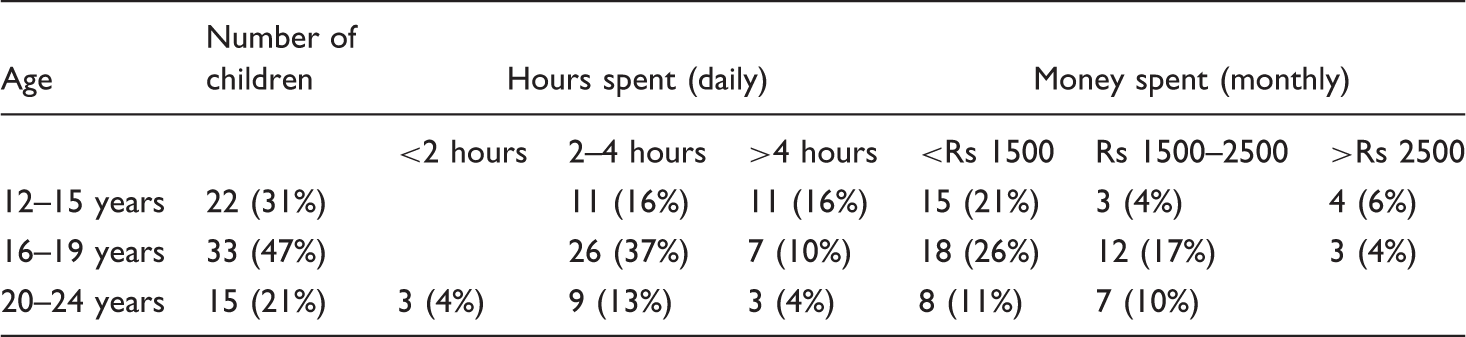
While gambling can be a way to acquire money quickly, large amounts of money are also spent daily on it. Table 1 depicts an age-wise distribution of the amount of time (daily) and money (monthly) spent on gambling. How much money is spent on other activities similar to gambling was not gathered in this study.
Although our observations revealed younger children participate by observing more than playing, half the survey participants aged 12–15 indicated they gambled for 2–4 hours daily; the other half for more than 4 hours. With limited recreational options for younger children on the streets, after working or begging, the rest of their time is spent with the group, mostly engaging in what other members are doing, like gambling. On the other hand, older youth are able to make themselves scarce and disappear, perhaps engaging in prostitution, gambling at other clandestine adult venues, or using more serious drugs. For a young adolescent, spending more than 4 hours daily in gambling has the potential to turn into problem gambling (see Wood et al., 2004). In general, the duration of gambling depends on money, time, being on a winning streak, and the proximity of the police.
In terms of money, close to 60% of the youth reported spending between Rupees 2 (Rs.) 1000 to Rupees 1500 a month on gambling. About 31% of participants spent between Rs. 1500 to 2500, half their monthly income. Some study participants mentioned budgeting the day’s wages—spending on food and a daily quota of cigarettes—before using the rest to gamble. Daily amounts spent on gambling varied between Rs. 50 and Rs. 400, with the possibility of winning up to Rs. 4000 from a single card game. The words of 19-year-old Suraj expressed an awareness of the cyclical and addictive nature of how events unfold once money is invested: “Once you put in Rs. 100 in a game, you stubbornly refuse to quit until you win back Rs. 200. So, you continue to play, and you start losing.”
Positive and negative returns from gambling
Participants highlighted certain non-financial rewards of gambling: getting a rush or thrill, a boost in self-esteem, and praise/acceptance from peers/group. In addition, they were able to escape boredom and cope with the long stretches of time available. The idea of the potential monetary gains, the thrill of winning as well as almost winning, have been reported elsewhere as motivations reinforcing gambling (Hardoon and Derevensky, 2002; Wood and Griffiths, 2002). In this study, 30% of the respondents mentioned money, drugs, and respect from peers as reinforcers of gambling. Several participants quoted these same words, “Ten rupees can turn to one hundred rupees in a few minutes!” When focus group participants were asked to enumerate the advantages of gambling, they highlighted quick money, skill improvement, new friends, group participation, entertainment, and recreation.
Street children are aware of the negative aspects of gambling. According to participants, gambling is associated with greed and constantly wanting to make money quickly. Participants also alluded to the fact that money acquired from gambling is not considered “good” money (not earned through hard work). Other negative consequences included losing all the money that a youth had worked hard to earn, being remanded into police custody, becoming a victim of cheating and fraud, increasing stress from needing to constantly be successful and maintain their pecking order, fighting with peers, and realizing that losing means losing time and money, as well as having to go hungry until they were able to earn again.
The urge to quit
Survey participants were asked about giving up gambling. Thirty percent revealed that their efforts to quit were fueled from continuously losing money and having to go hungry. Another reason was because they had to struggle to find work, and then work under very difficult conditions, only to quickly lose their earnings in gambling. As for obstacles to quitting, participants mentioned peer influence and the environment of the street. Shafiq, a 17-year-old respondent, indicated that the social dimension is a major obstacle: “I have lost a lot of money to gambling, but what can I do? It has become a habit, and if I think of giving it up, I will lose all my friends.”
Most participants mentioned making some attempts to quit, even if only sporadic and largely unsuccessful. A few respondents also indicated that even though they were aware gambling was wrong, it had become a habit and they just couldn’t stop. Successful attempts to quit were cited mostly in terms of some examples of other street youth (and not themselves) who were successful. The motivations to give up included starting a family of their own, reestablishing regular contact with their family of origin, and heeding the advice of an outreach worker or NGO staff person.
Inability to save on the streets, a risk factor for gambling
Both survey and focus group participants indicated that it is not just their peer group, but the very environment of the streets and limited options to save that constitute the biggest risk factors for gambling. Respondents in this study, who had lived an average of 6 years on the streets, stated that once on the streets, despite the types of work they find, any money earned must be disposed of immediately as it was liable to be stolen or snatched from them. Research assistants noted that a number of youth kept their money with the betel leaf kiosk owners from whom cigarettes or betel leaf products are purchased, or with scrap merchants to whom they sell scrap metal. While these shop keepers assured them of the safety and security of their money, participants also told many stories of how this money was withheld, of constant disputes over the correct amounts of money deposited, or becoming trapped in a cycle of substance use because the betel leaf kiosk owners often offered them addictive substances in exchange for their deposits. These circumstances fuel the urgency to spend money immediately.
Lack of knowledge of the need to save coupled with the lack of any options to save money on the street means that street youth need to immediately spend what they earn. Hence, after food is taken care of, street children tend to gamble with the rest of their money or spend it on going to the movies, visiting sex workers, or acquiring drugs. Living on the streets makes gambling both a way to earn money quickly and a channel to dispose of it immediately.
Gambling, a game of chance or skill?
When mentioning gambling, participants made constant references to luck and skill (Saldanha et al., 2017). About 56% of the respondents aged 12–15 believed that luck was important in gambling. Ramu’s words echoed those many others: “If you are lucky on a particular day, you can instantly win a lot of money. But if you are not so lucky, it could take the entire day and you might still not win.” Gambling for younger children was in many ways thought of as a game of chance, the outcome determined by luck. On the other hand, about 22% of the respondents in the 17–24 age group were convinced that skill was required to master the game and to avoid constant losses. In addition, many participants also mentioned that a good memory is needed to be successful. However, the most common phrase heard from participants was “It’s only a game of chance.” When pressed further, participants indicated that gambling is only a game and one takes chances—sometimes you might be lucky and win, at other times you lose. But overall we found that survey respondents had difficulty differentiating between luck, chance, skill, and fate, using these terms interchangeably.
Street children believe in superstition and luck. We observed some superstitious rituals associated with gambling. Groups had designated spaces to play, and physically guarded them from others. Even in these spaces, certain spots were considered lucky, everyone wanting to occupy them. When questioned, youth said that they “felt lucky” in these areas and the likelihood of winning seemed much higher. A few younger children, observing the games from a distance, described how they tried to get as close as they could to the winner, in the hope that his luck would rub off on them.
Conflict with the police
Although participants perceive gambling to be a leisure activity, respondents were aware that it is illegal. Gambling is a facet of the street lifestyle that brings youth into conflict with the police. If street children are caught gambling they are beaten, locked up overnight, or sent to juvenile homes. Children are often required to pay hafta, or protection money, to the police to continue playing and not be arrested. Similarly, these children are required to pay money to get around the minimum age requirements to obtain a porter’s license or be engaged in other work at railway stations.
In this study, much fear related to gambling came from the fact that this activity constantly brought children into contact with the police. According to 15-year-old Milind, “Often the police catch us while we are gambling, force us to pay them money, and still lock us up in jail.” Brutal violence from the police is known to be a core theme underpinning the lives of street children, shaping their experiences in public spaces and influencing their invisibility (Human Rights Watch, 2009). Interacting with the police is extremely stressful and keeping away from them is an integral street survival skill.
Discussion
Gambling is common among street children, their favorite pastime. They gamble daily, mostly through card playing. According to 80% of study participants, the most popular venues are train stations and their vicinity.
The group/social dimension of gambling
In regard to the research question exploring the circumstances promoting gambling on the streets, what stands out is the all-encompassing group dimension of living. It is within a group that gambling is learned from one’s friends, with older members having strong influences over new and younger members, often responsible for their initiation. To fully participate in a group, newer members must join in all its activities, including gambling. On some levels, this appears to be no different from other behaviors a newcomer is socialized to on the streets such as smoking, drinking, and vagrancy. However, in this study, gambling emerges as primarily group-based rather than individual, as compared to smoking and drinking. Although previous DSM versions classified gambling as more a compulsion than an addiction, primarily motivated by the need to relieve anxiety rather than a craving for intense pleasure, in the DSM-5 pathological gambling has been moved to the addictions chapter due to accompanying psychological and neurological aspects similar to addictions (DSM-5, 2013). Furthermore, research on the similarities and differences between gambling and substance abuse disorders is mostly focused on neurocognitive tasks, brain functions, and neurochemistry, especially as it relates to impulsivity and compulsivity (Leeman and Potenza, 2012). Thus considerations for the group and social dimensions of gambling are nonexistent; this study presents an opportunity to emphasize them.
In Mumbai, groups of street youth gambling are visible to anyone with a trained street eye who can spot them gathered together, covertly using money as stakes, engrossed and having fun in a game of cards at the corners of railway stations, on the rafters, the roofs, or below pedestrian bridges. It is such groups that form the focus of this study, and observing them clearly revealed the social dimensions of gambling. As participants gambled they experienced fun and enjoyment, and group bonds were strengthened. It is in this regard that participants were reluctant to give up gambling as it means giving up the group and their friends. An additional dimension of gambling highlighted in this study is best described by participants’ use of a colloquial term, timepass, indicative of the fact that gambling helps street-time go by quickly. On the streets, besides work, which is mostly part time and seasonal, there is not much else to do; gambling helps pass the time.
Individual and financial aspects of gambling
This study also revealed the individual aspects of gambling. They are not entirely discrete from the group dimension in that it is individuals who experience enjoyment, fun, group acceptance, and have time pass quickly, making street children feel good. It is this feeling, the buzz after each win, and the according of status such as being known as a gambler by one’s peers, that makes individual participants feel proud of their identity as gamblers and risk-takers. Participants referred to themselves as a jugari, a colloquial word promoting myths, street lore, and “rags to riches” narratives. Although in other studies very few youth refer to themselves as gamblers and prefer to be called players, gamers, or punters (Thomas et al., 2013), it was clearly different in this study where it was an honor to be referred to as a gambler.
Excessive and high-frequency gambling among adolescents is often pointed out as indicative of serious problems and a definite path to higher participation in other addictive behaviors (Wood et al., 2004). High frequency in the literature refers to playing at least five times a week for a minimum of 1.5 hours per session. When comparing study participants to these measures, they could be classified as high-frequency gamblers. Half the younger survey participants, aged 12–15, gambled for 2–4 hours daily, and others for more than 4 hours. However, these time blocks must be understood in the context of the streets where no alternative activities are available.
There are financial aspects attached to gambling as every player seeks to make money quickly. Even though participants were aware that such an urge often leads to a cyclical chain of events, where more money lost fuels a greater interest to continue playing in order to win back their losses, participants were less aware of the negative and addictive aspects of gambling. On some levels they felt helpless as not only had gambling become habitual, but they also did not want to lose friends or the affinity for their group. It is here that the study points out how gambling among street children is distinct from the general population, since the group dimension strongly influences their behavior. Participants perceived gambling as just a game of chance, something temporary with no long-term effects.
The context of the streets and general addictions theory
Both survey and focus group participants indicated that although it is the group that motivates gambling, their behavior is also reinforced by the environment on the streets—with no identity, permanent address, or viable saving options they must immediately dispose of any money earned on food, friends, and gambling. From our study observations, as well as prior experience as service providers, there is a dearth of recreational opportunities for street children. An inability to participate in leisure activities that are skill based, enabling street children to have fun and pass the time, leads to greater immersion in the only recreational activity available to them, gambling. It is these two aspects—lack of income-saving and recreational options—that call for specific interventions for street children.
While there are many addictive components of street children’s gambling behavior, we are still left pondering as to whether such behavior can be conclusively classified as an addiction. According to Jacobs’ General Theory of Addictions (1986, 2000, 2004), the relationship/association between an individual and their addictive behavior is anchored in a need to increase or decrease arousal levels and relieve depressive states through participation in a chosen activity, or consumption of a particular substance to escape painful situations. In this regard, any activity that has the capacity to be arousing and/or relaxing, and can allow persons to be distracted from daily stresses, is likely to elicit high participation by some individuals. While gambling in the general population fits conclusively as such an activity (Gupta and Derevensky, 1998b), with regard to street children this is different. More than individual psychological relief and escape from painful situations through involvement in a relaxing/arousing activity, it is the aspects of group participation and a need to occupy their vacant time in the absence of other options which motivates street children’s gambling behavior. Although childhood trauma and victimization are a part of their psychological make-up, and they do disassociate from such memories, it is the social/group dimension and the environment of the streets that sustains and perpetuates their gambling. We conclude then that the General Addictions Theory does not fully explain the circumstances and motivations of the gambling behavior of street children.
Limitations
Each of the different methods used in this study include some intrinsic limitations. Our claims to knowledge and truth using social constructivism make us cognizant that although as service providers we are familiar with street contexts and the lives of youth participants in this study, at best our claims to be insiders are limited as we will always be outsiders. Along similar lines, this study’s claim to including multiple methods and an overall praxis-oriented direction are also limitations. For example, using methods such as surveys and focus group interviews with street youth participants does not distinguish between the heterogeneity of participants, their street individual/group contexts, and intra group differences. Because gambling is clandestine and illegal, during focus groups, some participants may have been somewhat inhibited in their replies, providing socially appropriate responses. Furthermore, recruitment for focus groups is challenging as youth are afraid to show their direct ties to an activity such as gambling, even while on other levels they consider it an honor to be called a gambler. On the other hand, socially appropriate responses during surveys conducted with younger participants can lead them to embellish personal stories and familiarity with gambling.
This study is based on self-reports of participants and focused on common public venues where cards, board games, and some other forms of gambling take place. Although video parlors and online gambling options have now become widespread, these forms or venues of gambling were not accessed. With more time and resources, a study highlighting the influence of different forms of gambling and various other details of the subcultures of these groups would provide supplementary and interesting details of the behavior of members and the relation of gambling to alcohol and drug use.
Although it seemed practical to complete the study within a short time frame, the short time frame and events leading to a change in policing constitute significant limitations alongside the small sample size. In the wake of recent terrorist attacks and bomb blasts in Mumbai, there now exists a very visible local and state police presence at railway terminals/stations that actively prevents loitering at what could previously be considered unregulated public spaces, making it almost impossible for street youth to go about without being stopped and questioned or even taken into custody. Therefore, gambling at such venues is becoming clandestine, and many street children have been forced to move to alternate locations; not studying these locations constitutes a limitation.
Practice and policy implications
We embarked on this study because our experiences did not match the lack of published research about this activity. Although participants tended to look at their involvement in gambling as a game of chance, a leisure activity to pass their time, the social and environmental conditions of street/group living can easily lead to this behavior becoming addictive, resulting in serious gambling-related problems. Because gambling is very common among street children, interventions specifically tailored to this activity must be designed.
There is a need for educational programs to increase an awareness of the addictive nature of gambling and its long-term implications. Since life skills training and instruction are presently offered to street youth on substance use, hygiene, and medical and sexual health (Gaidhane et al., 2008; Greene et al., 1997; YUVA, 2010), such initiatives should also include components targeting the effects of gambling. Given the inescapable group dimensions of street living and the absence of recreational options to pass their time, recreational programs should be created. NGOs providing services to street children must facilitate the obtaining of “Aadhaar” or identity cards and other legal status documents to help them get access to schools, government health services, and open and operate bank accounts. The steps taken by NGOs to create kiosks at important railway terminals and bus stations in collaboration with police and railway authorities to ensure children are repatriated, taken into care, or redirected to shelters are steps in the right direction (Kombarakaran, 2004; YUVA, 2010).
Although street youth are more focused on the here and now and surviving the daily stresses associated with street living, participants also mentioned being in regular contact with family members or heeding the advice of outreach workers as successful strategies to end gambling. There is thus a role for practitioners to offer counselling and initiate referrals for these youth, as well as to develop preventive awareness programs. An understanding of Jacobs’ theory (1986; see also, Jacobs, 2000, 2004) highlighting the predisposing factors leading to serious gambling-related problems may offer counselors, psychologists, social workers, outreach workers, and other professionals engaged with this group a deeper understanding about why adolescents engage in addictive behaviors, not just gambling.
Most government programs dealing with street children involve placing children in orphanages, juvenile homes or correctional institutions which are only temporary solutions tackling neither the source nor extent of the problem (YUVA, 2010). While the implications arising from this study differ, and do not discuss the structural conditions that lead to many street children with multiple disadvantages arriving at cities, they are nevertheless a part of the broader policy and practice recommendations which continuously highlight the need for interventions in rural areas to reduce migration of young children to urban areas (Bhaskaran and Mehta, 2011; Mathur, 2009). There are also calls to improve the literacy of street children through implementing the Government Right to Education Act and establishing early childhood education centers through Integrated Child Development Schemes (Raghavan and Nair, 2013). More recently, following a Supreme Court Judgment, there have been numerous calls to set up shelters for homeless families and children, as well as state-level inter-departmental committees on vulnerable children to review and monitor laws, policies and programs pertaining to (street) children (Bhaskaran and Mehta, 2011; Raghavan and Nair, 2013). All in all, it is time to focus more on gambling among street children in cities like Mumbai and develop research and interventions for this vulnerable but astute, intelligent, and mature group of individuals.
Footnotes
Declaration of conflicting interests
The author(s) declared no potential conflicts of interest with respect to the research, authorship, and/or publication of this article.
Funding
The author(s) received no financial support for the research, authorship, and/or publication of this article.