



Abstract
Jets at higher Reynolds numbers have a high concentration of energy in small scales in the nozzle vicinity. This is challenging for large-eddy simulation, potentially placing severe demands on grid density. To circumvent this, we propose a novel procedure based on well-known Reynolds number (Re) independent of jets. We reduce the jet Re while rescaling the boundary layer properties to maintain incoming boundary layer thickness consistent with high Re jet. The simulations are carried out using hybrid large-eddy simulation type of approach which is incorporated by using near-wall turbulence model with modified properties. No subgrid scale model is used in these simulations. Hence, they effectively become numerical large-eddy simulation with Reynolds-averaged Navier–Stokes covering the full boundary layer region. The noise post-processing is carried out using the Ffowcs-Williams-Hawking approach. The simulations are made for Mach numbers (M) of 0.75 and 0.875 (cold and hot). The results for the overall sound pressure level are observed to be within 2–3% of the measurements, and directivity of sound is also captured accurately for both the cases. Hence, the low Re simulations can be more beneficial in saving time and cost while providing reasonably accurate results.
Introduction
Aircraft noise is a critical issue for people living in the vicinity of airports and has adverse effects on healthy living. Jet noise is the second largest contributor in total engine noise after fan noise. One of the three new targets of Advisory Council of Aeronautical Research in Europe, to be achieved for clean engine by 2020, is noise reduction by 10 dB.
1
Therefore, it is a critical issue for engine manufacturers to be able to predict noise levels using economical methods that allow testing of noise reduction techniques. Various research groups are focused on addressing this issue. Some are inclined on doing what is called in DeBonis,
2
the rigorous large-eddy simulation (LES). This is good for development of methods and understanding flow physics at a deep level. This paper on the other hand focuses on practical LES. It involves validating LES for industrial flows in realistic configurations. The goal is to come up with a robust technique which is economical and can be used confidently by the industries without having to think about different dependency factors while gaining reasonably accurate solutions. The hybrid RANS–NLES technique has been used in past by Eastwood and Tucker.
3
Through the use of a RANS layer, it has been shown to reduce the high-density grid requirements near surfaces, eliminating non-physical separation from convex nozzle surfaces. The NLES component reduces excessive dissipation when using robust industrial solvers through subgrid scale model omission. Most studies into jet noise tend to be at lower Re.4–6 As we move towards more engine realistic jets, the Re increases. A few researchers have tried running jets at higher Re7,8 but have not successfully validated their approach. Noise levels are clearly over-predicted in Fayard et al.
8
Although Andersson et al.
9
report data comparison for a case run on lower Re than that of experiments, they do not mention anything about the boundary layer state at nozzle exit. Jets are Re independent beyond the boundary layer region above a threshold value of order 105.10,11 However, with increasing Re, more energy will be contained in small scales. This will impact LES solution in following ways:
For a fixed filter, the numerics will become more stressed due to more energy interacting at the filter scale; The LES subgrid scale model will need to model a greater fraction of turbulent energy.
Since, for a jet, the size of large scales increases downstream for a fixed filter width, moving downstream the characterization of energy in the smaller scales becomes less of an issue. For example, DNS of a jet reports that the ratio of the energy in the small to large scales is 42%, 12% and 5% for Re-sensitivity zones in various regions of jet flow.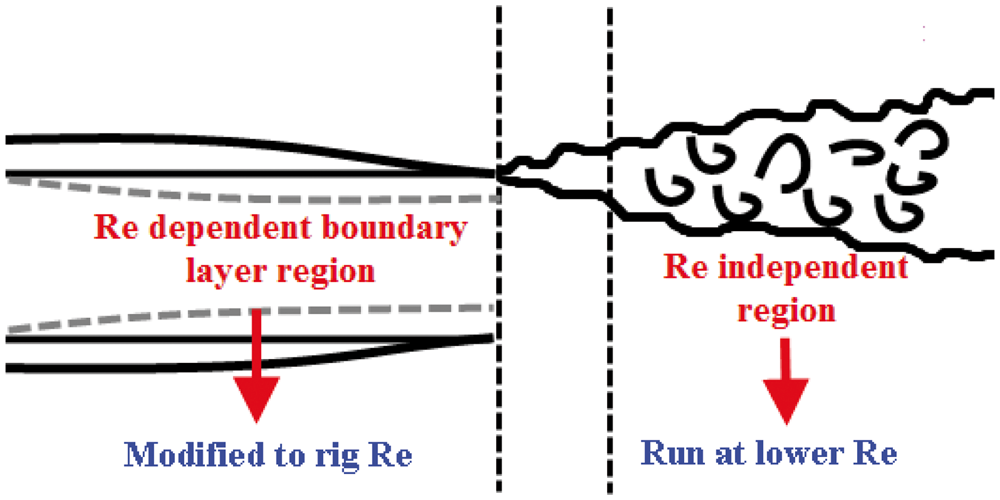


This paper is set out as follows. First the numerical methods are discussed. The case setups are given. The application of the approach is then demonstrated for cold jets at two Mach numbers. Also, some hot jet results are presented.
Computational method
Main computation
The solver is second order accurate in space and time. Although sophisticated higher order schemes will be more accurate, second order-centered schemes are known to give sufficiently accurate results. There is also the relative ease of implementing them in a CFD code to be considered. The solver used is node-centered control volume based. The second order central difference for flux calculation is represented by the equation below

The second term is a smoothing term. This can be approximated as
Blending between RANS and NLES zone through wall distance function. Smoothing control parameter(ɛ) distribution in domain.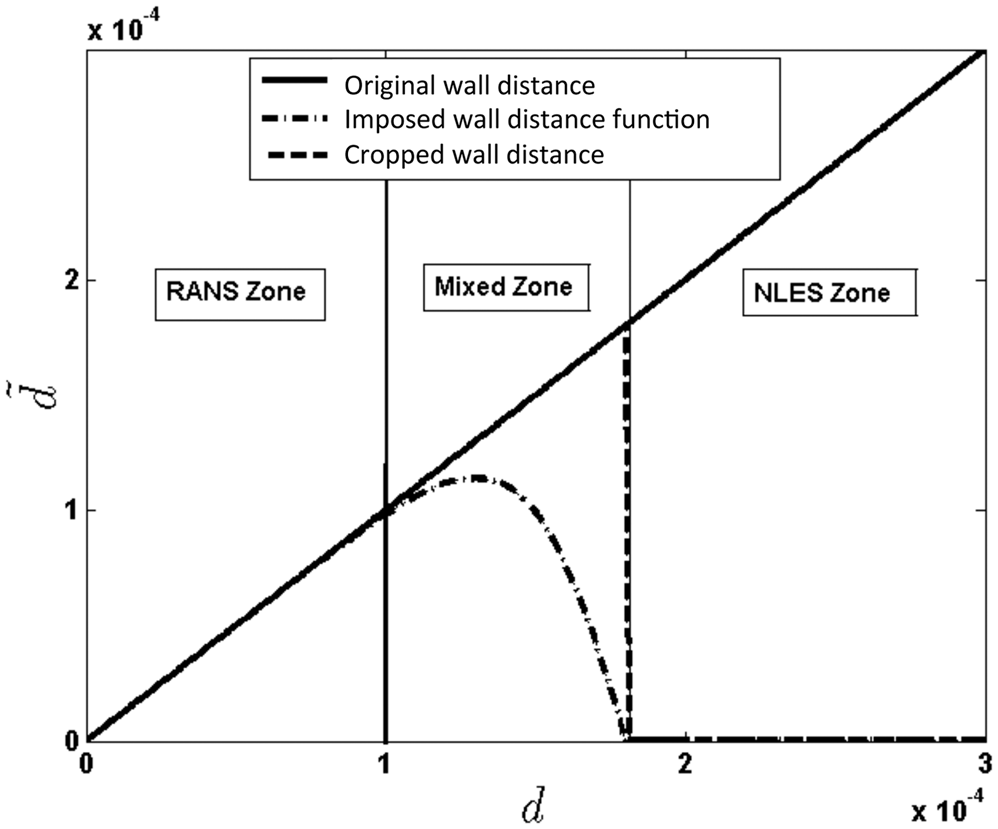


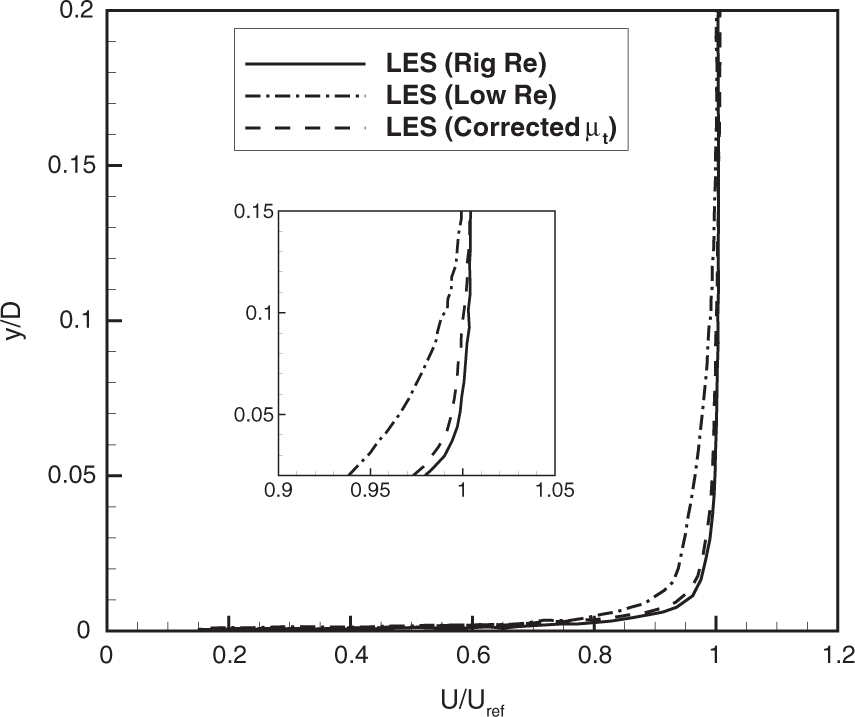
The boundary layer region uses the Spalart Allmaras (SA) RANS model. The eddy viscosity μt yielded from this is scaled down to keep Re consistent with actual jet conditions in the boundary layer region. Figure 9 shows a boundary layer velocity profile comparison. This is explained later in Results and discussion section. However, the key point is that the expected rig scale velocity profile is matched in the lower Re LES. >
The hybrid RANS–NLES scheme is incorporated by simply modifying the wall distance using Hamilton-Jacobi (HJ) equation.
16
This gives smooth blending between the RANS and NLES regions. The HJ equation is given below


The function f(
The RANS layer thickness is such that it covers the boundary layer region. Note that the RANS layer is ultimately used in a frozen state. This saves wasted computational effort, solving an additional transport equation through a lengthy LES run.
Acoustic post-processing
The Ffowcs Williams-Hawkings (FW-H) approach is used to evaluate farfield noise. The acoustic post-processing is done on instantaneous flow data stored at points on a surface enclosing the noise sources (but outside them). In jets, the main sources of noise lie in the shear layer. Hence, we need to enclose the region of fluctuating quantities inside our surface. The relation for acoustic pressure,


Case setup
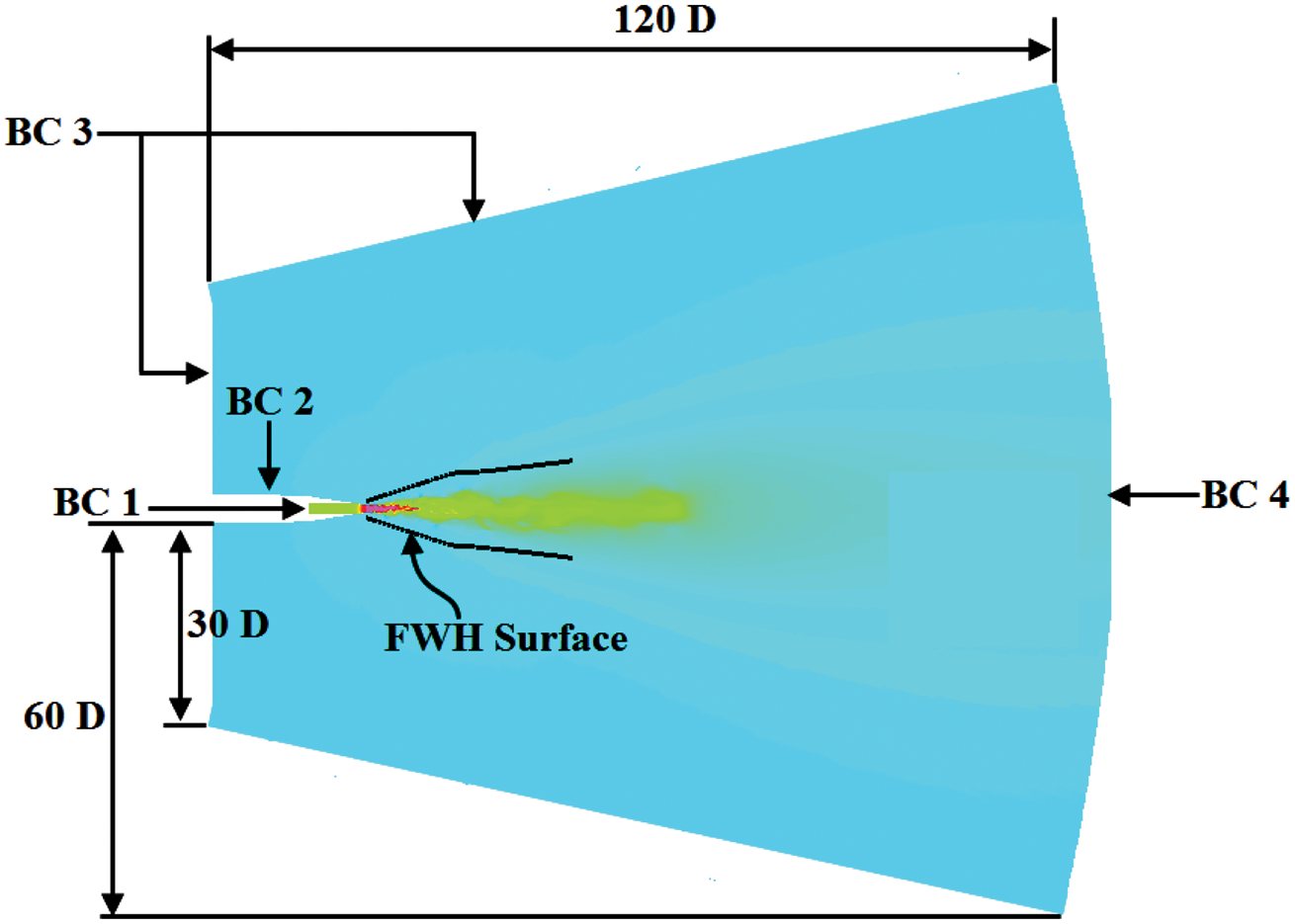
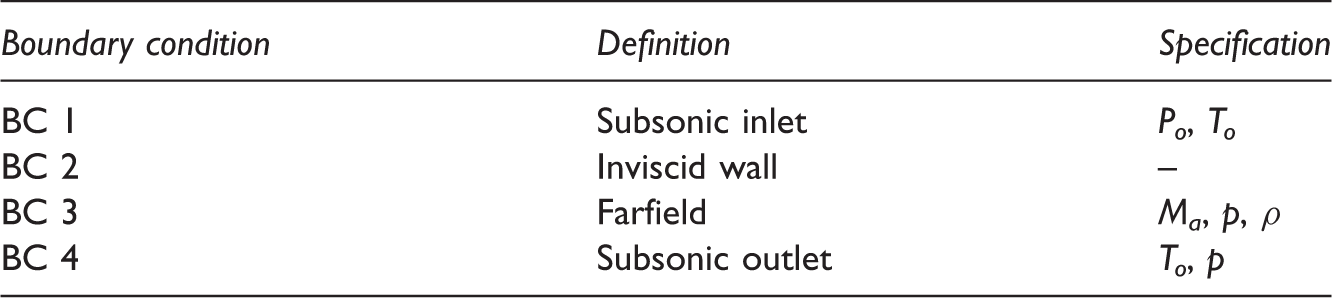
A round converging nozzle is used for all simulations. Figure 4 shows images of the geometry. The nozzle diameter, D, is 0.106 m. Figure 5 shows the overall domain size and labels the boundaries used. Table 1 summarizes various boundary conditions. The domain has radial extent of 60D and axial length of 120D. The domain is designed to make it suitable for noise calculation so as to avoid any reflection from the boundaries.
Geometry of nozzle. Domain, dimension, boundary conditions and position of FW-H surface. Boundary conditions for Figure 5.
Structured hexahedral meshes are the most suitable for LES.
17
A key grid requirement is to resolve the jet shear layer and capture the initial turbulent structures. The strategy used for meshing is thus an O-mesh around the H-mesh block at the jet centreline. Figure 6 shows mesh cut planes at the jet exit. Moving from left to right, the images represent views zoomed in closer to the jet axis. The high shear layer resolution at the nozzle’s the edge is evident. Figure 7 shows the three-dimensional views of the mesh topology again showing the mesh following shear azimuthally as well as axially. Grid densities of 18 and 50 million cell meshes are generated. The 18 million cell mesh has 120 azimuthal nodes with YZ-plane mesh at jet exit. 3D mesh.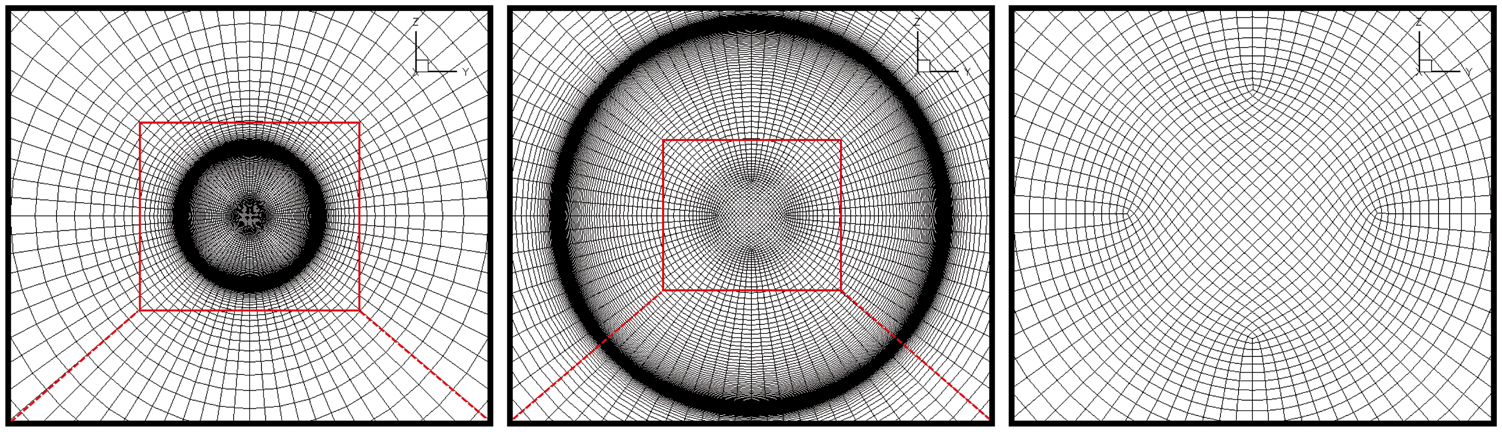

Test conditions.

To capture the directivity of noise, the OASPL and the FW-H surface used can be expressed using the equations below

Note that no closing disk is used. A full exploration on optimal surface locations can be found in Naqavi et al. 14
The points at which the OASPL is calculated can be seen in Figure 8. Each observer location is placed along an arc with the center at the jet exit plane. The arc radius is equal to 120D and data on the arc is stored at 10° increments from centerline.
Location of points where OASPL is calculated with respect to the jet exit. Boundary layer profiles demonstrating correction effect.
Results and discussion
The higher rig Re boundary layer properties are conserved while running the simulation at low Re. The boundary layer profiles are shown in Figure 9. The solid black line represents rig Re boundary layer state at the nozzle exit. The dot-dashed black line shows the LES at the lower Re. The dashed black line shows the boundary layer adjusted to match that in the rig through scaling μt.
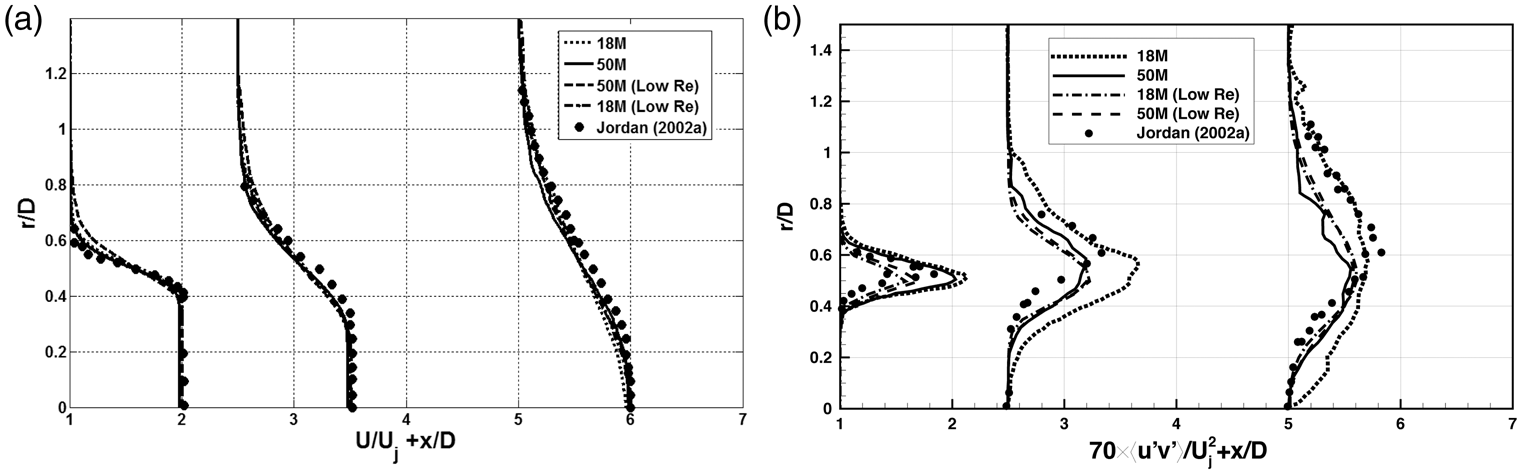
Figures 10 and 11 compare the simulations with measurements in Andersson et al.
18
(Note: The measurements reported are from Jordan 2002a – Internal project report) and Bridges and Wernet.
19
Figure 10(a) shows the centerline (U) velocity and Figure 10(b) stream wise fluctuating ( Centerline average velocity distributions for different mesh densities – case 2. (a) Mean velocity and (b) streamwise fluctuating velocity. Radial profiles for different mesh densities – Case 2. (a) Mean axial velocity and (b) Reynolds shear stress.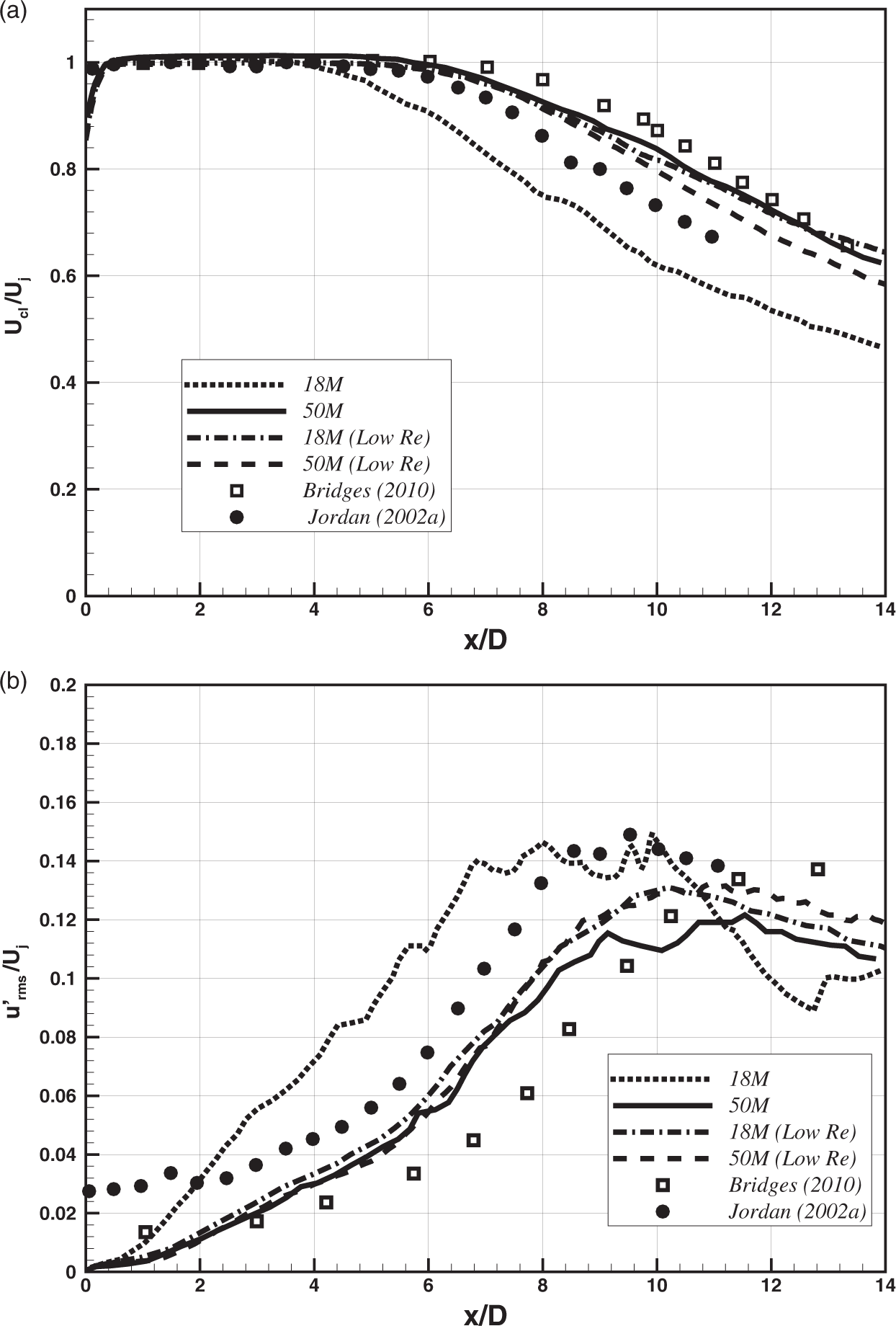
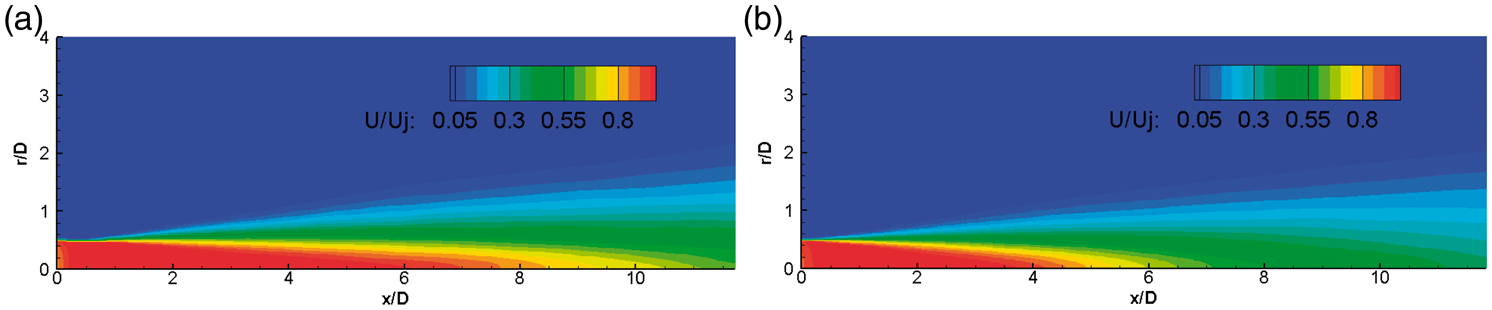
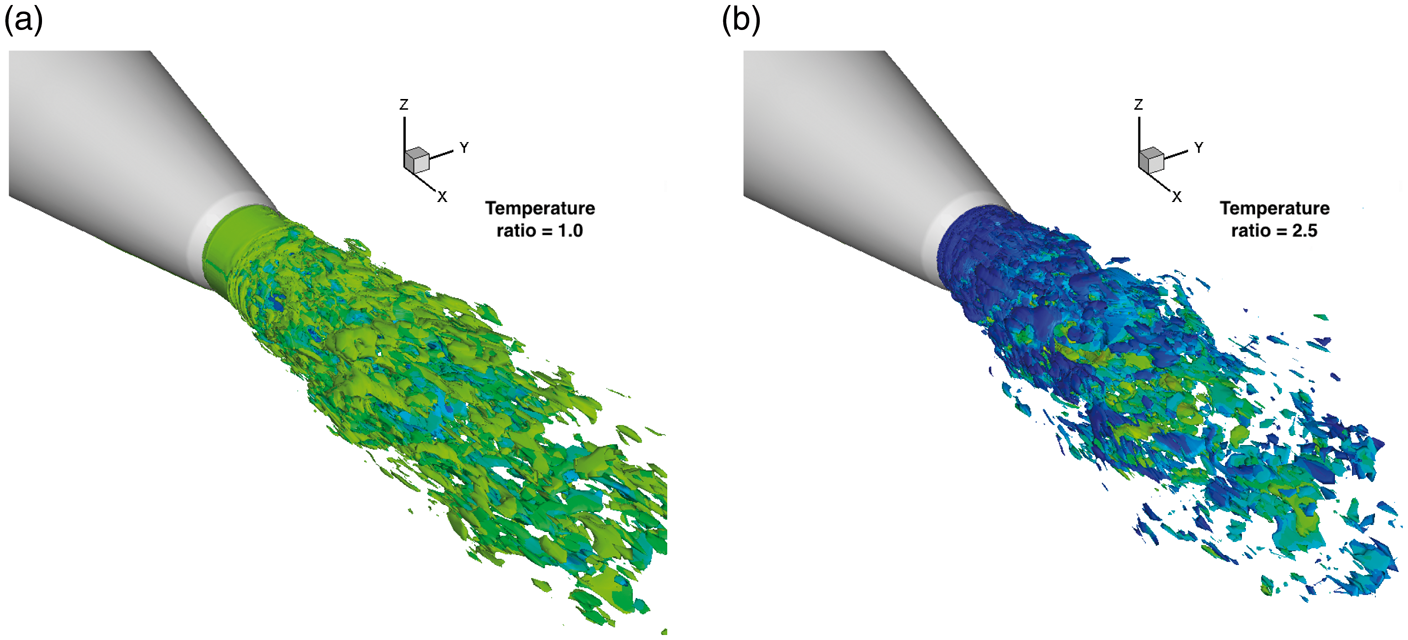
Instantaneous and time average flow pictures are show in Figures 12 and 13, respectively. The frames are non-dimensionalized axis with respect to jet diameter, D. Figure 12 contrasts instantaneous velocity contours for cases 2 and 3. Both frames compare the jet development for different temperature ratios. Figure 13 shows the averaged contours for both the cases. As would be expected, the potential core for hot jet is much shorter than the cold jet. This demonstrates fast mixing of a lower density hot jet with the ambient air. Vorticity iso-surfaces for the cases are shown in Figure 14. The iso-surfaces are flooded with temperature. This gives an idea about the temperature ratio of the jet to ambient air.
Instantaneous velocity contours: (a) case 2 and (b) case 3. Average velocity contours: (a) case 2 and (b) case 3. 3D Vorticity iso-surfaces flooded by temperature: (a) case 2 and (b) case 3.
OASPL at various observer locations as described in Figure 8 were calculated and the results are compared with measurements of Andersson et al.
18
(Note: The measurements reported are from Jordan 2002b – Internal project report.) and Tanna
20
(for M = 0.875). The noise data are scaled to 100D in Figure 15(a) to (c). The results show encouraging agreement being within 2–3% of the experimental data. However, as shown in Shur et al.,
21
the results can be sensitive to the FW-H surface location. Figure 15(d) shows that the current process can capture the influence of Mach number and temperature. This combines current results for M = 0.875 with a high Re simulation of Farfield OASPL directivity at R=100D for: (a) case 1, (b) case 2, (c) case 3 and (d) cases 2 and 3 compared other jet simulations.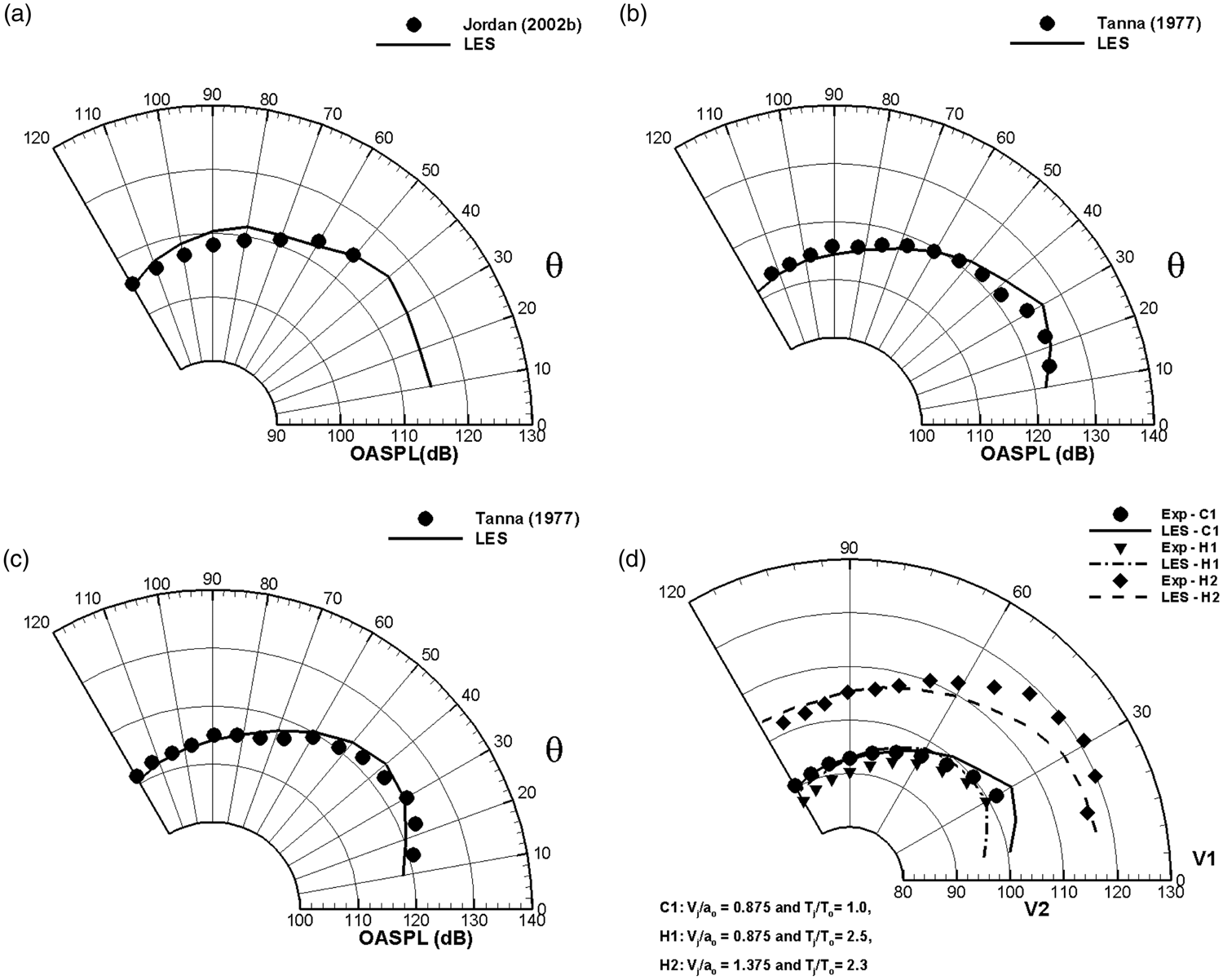
Figure 16 shows the sound pressure level (SPL) spectra for case 2 at Sound pressure level (SPL) spectra for case 2 at R=100D, at (a) 30°, (b) 60° and (c) 90°.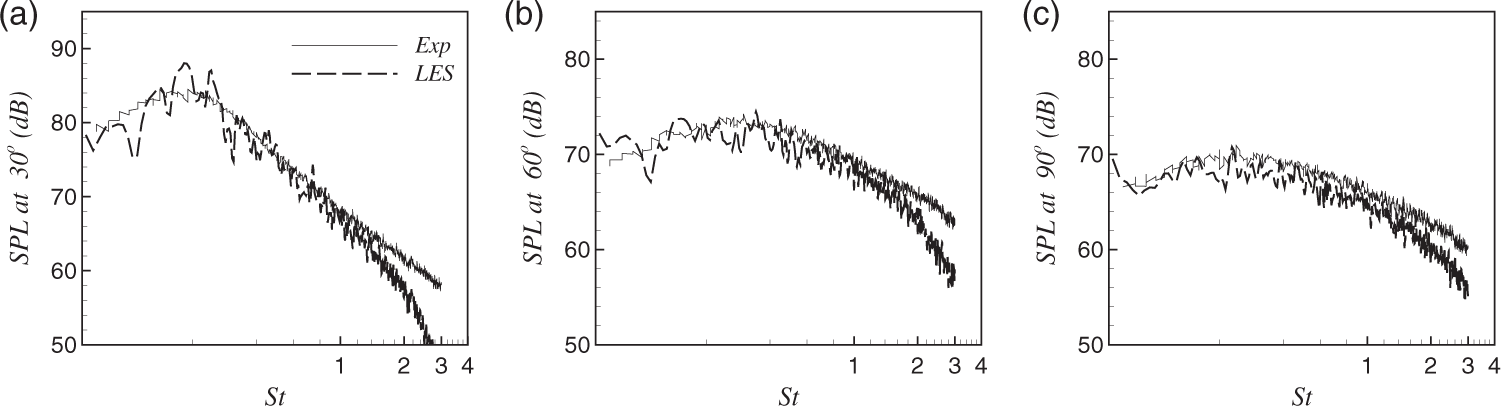
Conclusion
To validate a new simulation strategy, simulations were run for two different Mach numbers and also for two different mesh densities. Simulations for both cases were run at a Re lower than the rig Re, while maintaining the boundary layer state at the nozzle exit. A RANS layer was used over the full boundary layer thickness allowing tuning to rig conditions. The scaling of μt in the RANS model has successfully shown to conserve the rig Re for the Re dependent boundary layer region. The technique promises reliability for industrial scale simulations. The flow computation is able to predict peak turbulence levels reasonably well, thus showing the effectiveness of the scheme. The proposed method also eliminates the grid dependence of the solution. The farfield noise directivity gave encouraging match with measurements. This demonstrated usefulness of the proposed technique for noise computations.
Footnotes
Acknowledgements
We would to like thank Engineering and Physical Sciences Research Council (EPSRC) and United Kingdom turbulence consortium (UKTC) for the computational resources used for this study, on UK supercomputing facilities, ARCHER and HECToR under EPSRC grant EP/L000261/1. Some of the computations were also performed under PRACE award on HERMIT.
Declaration of conflicting interests
The author(s) declared no potential conflicts of interest with respect to the research, authorship, and/or publication of this article.
Funding
The author(s) disclosed receipt of the following financial support for the research, authorship, and/or publication of this article: The first author was supported by Dr Manmohan Singh Scholarship. Some of the work was funded in HARMONY and SILOET projects under the UK government TSB.