



Abstract
Collaboration within Building Information Modeling process is mainly based on the manual transfer of document files in either vendor-specific formats or neutral format using Industry Foundation Classes. However, since the web enables Cloud-based Building Information Modeling services, it provides an opportunity to exchange data with web technologies. Alternative data sharing solutions include the federation of Building Information Modeling models and an interchange hub for data exchange in real time. These solutions face several challenges, are vendor locked, and integrate Building Information Modeling applications to a third new system. The main objective of this article is to investigate current limitations as well as opportunities of Cloud interoperability to outline a framework for a loosely coupled network-based Building Information Modeling data interoperability. This study explains that Cloud-Building Information Modeling data exchange needs to deploy major components of Cloud interoperability such as Cloud application programming interfaces, data transfer protocols, data formats, and standardization to redefine Building Information Modeling data flow in Cloud-based applications and to reshape collaboration process.
Introduction
As defined by the US National BIM Standard (NBIMS-US), 1 “a basic premise of Building Information Modeling (BIM) is collaboration by different stakeholders at different phases of the life-cycle of a facility”; thus, a BIM emerges from transdisciplinary thinking contexts and integrates expertise and knowledge from different domains. Most importantly, data exchange is a central aspect and problematic of collaboration in the building design and delivery process in architecture, engineering, and construction (AEC) industry. To date, collaborative processes have relied principally on the exchange of “documents.” Over the past 20 years, the nature of this document exchange has evolved significantly. Up to the 21st century, physical paper document exchange was the primary vehicle for the collaborative exchange of data, and indeed the use of this medium still exists although in rarer circumstances.
More pervasive has been the exchange of project information as “document files.” While the medium has evolved from analog paper to digital, the granularity of data exchanged between collaborating parties has remained unaffected by this change in medium. The evolution from computer-aided design (CAD) to BIM has opened the promise of data-based AEC information exchange at the building object level. To date, this promise remains unrealized. Contemporary BIM applications both store and allow transfer of BIM object collections as files.2,3 These products typically store and operate on BIM objects using proprietary file formats and support the exchange of data via the transfer for files in either vendor-specific data files or neutral format using Industry Foundation Classes (IFC) 2 as an open BIM standard. 4
Cloud-BIM represents a new data storage, exchange, and collaboration paradigm that is potentially large departure from this existing industry practices. Cloud-BIM is believed to be the second generation of BIM development and studies suggest that it will produce major changes across the industry. 5 The technology is still relatively new 5 and the supporting collaborative practices remain unresolved at many levels. Cloud-BIM suggests new directions in BIM implementation and development to support BIM data generation and consumption among members of the project. 6 Studies suggest that by applying Cloud Computing in BIM services, BIM can potentially achieve a higher performance with a relatively low cost. 2 Cloud-BIM technology is believed to lead to higher levels of information interaction and can provide an effective cross-disciplinary collaboration.5,7
Data exchange is critical for successful implementation of BIM, 7 and data interoperability among Cloud services will be a key enabler of Cloud-BIM collaboration. 5 However, data exchange among Cloud-based applications suffers many of the same interoperability challenges as conventional application exchanges since the Cloud-BIM services have been developed by different vendors based on proprietary and often legacy data formats. 8
The opportunities and challenges of Cloud-BIM data integration and interoperability are the motivation for this study. Since the World Wide Web—with its underlying data structures and transfer mechanisms—enables Cloud-based services, these technical advances and the migration of current generation BIM interoperability paradigm to support these advances will be a critical driver of the success of Cloud-BIM collaboration. Most critically, the web has been a phenomenal facilitator of data sharing and interoperability in other sectors of the global economy, 9 and we can expect similar results for BIM process if the underlying data exchange issues can be addressed. Cloud offers the potential for software packages to be transformed into web-connected services, 10 allowing these services to manage information communication in a different way 8 than the conventional file-based system.
This study highlights that currently there is a gap in research regarding the identification of alternative technologies that can assist Cloud-BIM interoperability solutions. Thus, this research investigates emerging Cloud-based BIM data exchange paradigms in order to study how web technology approaches and techniques can assist with improving Cloud-BIM data transmission in network-based data exchanges to support collaborative workflow. Hence, this research underlines recent developments and opportunities to address fundamental challenges of BIM data exchange.
This study first outlines the features and issues of current Cloud-BIM solutions focusing on data exchange approaches. The IFC data model and its data representations as the effort for standardization of building information interoperability are presented. Advances in Cloud data transmission and interoperability components that can be deployed to address current Cloud-BIM data exchange challenges will be presented. This article also investigates different collaboration architectures that can support Cloud-based BIM data sharing and eventually suggests recommendations for an effective Cloud-BIM data exchange architecture. This data exchange framework is specified as an underlying basis for Cloud-BIM interoperability. Moreover, the study describes necessary future works and points out a potential direction to BIM data interoperability in Cloud that future research will most likely undertake.
Cloud-BIM development and challenges
Cloud computing, as defined by the US National Institute of Standards and Technology (NIST), 11 “is a model for enabling ubiquitous, convenient, on-demand access to a shared pool of configurable computing resources.” Cloud computing relocates the computing process and data from desktop to large data centers, 12 making a better use of distributed resources and combining them to achieve higher performance so that large-scale computation can be managed.12,13
Because of the potential advantages of Cloud computing, BIM applications are steadily moving to the Cloud and Cloud-BIM services and apps are gradually gaining increased popularity.3,6,14 Some examples of the Cloud-based BIM solutions are GRAPHISOFT BIM Explorer (BIMx), Autodesk BIM360, BIMServer.org developed by TNO and the University of Eindhoven, ONUMA System,5,6,15 and Trimble Connect. With few exceptions, these Cloud-based solutions are being developed independently by the different associated vendors. There is a need to reconsider the approach to interoperability of these Cloud-BIM services; otherwise, they will suffer from the same issues as interoperability challenges in conventional desktop-based applications. 9
Previous work by Afsari et al. 16 studied current Cloud-based BIM interoperability and categorized current Cloud-BIM interoperability approaches in three categories of data flow architecture which are summarized as follows:
Manual file transfer that is currently a common way of exchanging BIM data across applications. Project data can be exported and shared in the form of vendor-specific formats or neutral format using IFC standard. 2
BIM server technologies in which server-based BIM solutions known as model collaboration systems 3 have provided a central BIM service with a single-sourced data server accessible for project partners.2,15 These model server technologies utilize information directly from the models and are intended to improve multidisciplinary collaboration. 3 The issue with BIM server technologies is that their implementations are still limited, 3 and thus have faced scalability issues. 6
Data interchange hubs such as Flux 17 project that can automate data flow between certain applications. This type of solution currently has a very limited implementation and supports very few design applications to be connected via the hub. Moreover, in this approach, the inter-connection of applications relies on the hub solution and its capabilities although supported software packages can exchange data directly.
This previous study by Afsari et al. 16 showed that existing Cloud-BIM data exchange solutions face interoperability challenges and have not fully utilized the potential of Cloud computing that could be afforded by implementing a standardized network-based data transmission process.
Standards for BIM data exchange
In today’s collaborative BIM-based process, project parties such as architects, engineers, construction team, and fabricators rely on different several software applications to generate separate BIM models. Therefore, BIM models need to be shared and integrated into the parties’ specific work process during the development of the project. Information sharing is the starting point of collaboration and it requires applications to be able to exchange data regardless of vendors and data formats. To support this, the IFC specification was developed to provide a neutral data format that could facilitate cross-platform BIM interoperability.4,18 IFC data model describes building data and provides a means to define building components and processes in a publicly available open standard-based data schema. 18 IFC data schema was developed using the EXPRESS schema and data encoding. 19 EXPRESS is an information model specification language based on ISO standard, specified as part of the STEP standard for product model data exchange 20 and deployed using a file-based data structure.
IFC data have subsequently been represented in XSD schema specification using the eXtensible Markup Language (XML) document structure (i.e. ifcXML). The specification of ifcXML ensures to handle the same data as represented in EXPRESS specification of IFC data model. 4 The ifcXML file structure with “ifcXML” or “ifx” or “.xml” extension is the XML document structure and can be used as a data format in web-based systems.
IFC and model view definitions
Model view definitions (MVDs) were proposed by the NBIMS-US to assist BIM data exchange 1 in cross-platform data transfer. The goal of an MVD is to map exchange requirements for one or multiple model exchanges to a data schema, like the IFC schema. 21 Domain experts should review the MVD specification both from the sender and receiver point of view to ensure the MVD contains all the information needed for the BIM exchange. 18 The MVD documentation provides information needed for the exchange of BIM model referencing the IFC standard. 1 An IFC MVD or an IFC view definition specifies a subset of the IFC schema that is needed to satisfy one or many exchange requirements of the AEC industry. 21
MVD includes one or multiple exchange requirements which must be provided by the sender of data to support work in the receiving application. If the IFC model is generated using a specific MVD, it means the IFC model contains the data required for that specific exchange purpose. Example exchange purposes supported by defined MVDs include conceptual model coordination, structural analysis, and clash detection. Typical workflow in using MVD is shown in Figure 1:
The sender generates the BIM model in one application and wants to export the BIM model for specific use in another application. The sender, as illustrated in Figure 1, uses an MVD to export the BIM model to an IFC file.
The sender passes the IFC file to the receiver of data.
Upon receiving the exported IFC model in an IFC file format, the receiver of data imports the model in the receiving application—typically a different software application than the one used to generate the file. The receiving application uses an IFC importer module to translate the IFC file to a native binding.

Current process of BIM data exchange using IFC MVD.
By combining the transmission of IFC with MVD in this manner, the interoperability between sending and receiving applications with different software architecture and data structures can be managed. A given MVD specification must be implemented by at least two software applications (the sending and receiving applications) to make it usable for the end users. 21 Validation of imported models remains a major challenge in this development. 16 In fact, after the MVD implementation, it is required to complete third party testing and certification of these software applications to ensure data exchange reliability for the end users. However, this certification testing for import is very complex because it relies on the evaluation of how the exchanged model is being interpreted and used in the importing application, that is, receiving application. 21 Therefore, testing and validation of imported model has been an issue.
Data transmission in Cloud
Cloud technology is an Internet-based computing. Cloud services provide architectural principles and software specifications to connect computers using standardized Internet Protocols (IPs). 22 The Internet is populated by several computers that are either clients, that is, terminals to access resources or servers, that is, provide data. It is illustrated in Figure 2. Different operating systems can exchange data over the Internet because they all use a set of rules and a common language known as Transmission Control Protocol (TCP)/IP. For data transmission between client and server computers connected to Internet, a set of rules or protocols defined by TCP/IP is used. 23
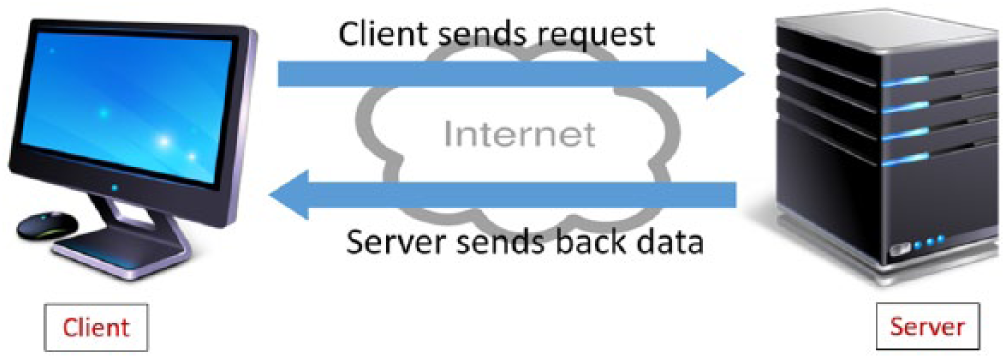
The client–server model.
Cloud computing is based on TCP/IP and in fact, it could not be achieved without standard interconnected protocols. TCP/IP provides Cloud computing with reliable delivery of data between remote applications with a connection-based service. 24 To exchange data, TCP/IP subdivides data in packets before it transmits the data; thus, the information should be split and packaged to be sent and received. 23
Cloud interoperability features
In considering the data exchange and interoperability requirements of BIM in the Cloud, it is helpful to first understand the interoperability support provided by the Cloud services architecture itself.
There are several categories of Cloud services such as infrastructure, platform, and application. Among those most frequently discussed are Infrastructure as a Service or IaaS, Platform as a Service or PaaS, and Software as a Service or SaaS.12,13,24,25 Figure 3 illustrates these distinct layers of Cloud architecture: 12
The end user client includes computer software and hardware for application delivery;
The Cloud application is delivered as a SaaS;
The PaaS supports the computing platform;
The platform uses the Cloud infrastructure provided by IaaS;
Servers host computer software and hardware for the delivery of Cloud services.
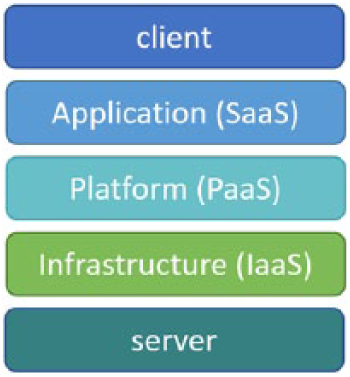
Layers of Cloud architecture.
In Cloud computing, the term “interoperability” sometimes refers to “portability”: the ability to move a system from one Cloud platform to another.13,25 The AEC interoperability discussed in this research focuses on abilities for data exchange and integration. Here, interoperability deals with what is known as “enabling products/software components to work with or integrate with each other seamlessly to achieve a desired result.” 10 Currently, each Cloud provider incorporates a self-contained set of conventions, data formats, and application programming interfaces (APIs). Interoperability among Cloud services will necessarily involve interoperability among these components. 26 Therefore, this article highlights four key features of Cloud interoperability: API, Data Format, Data Transfer Protocol, and Standards.
Cloud APIs
Cloud services are represented through interfaces which can be accessed through APIs. “Cloud APIs specify how software applications interact with a Cloud-based platform where these applications can be deployed.” 27 These APIs define how applications can request information from the platforms and how to use their facilities. Cloud APIs can be in the form of web services, for example, based on Representational State Transfer (REST) or Simple Object Access Protocol (SOAP)—application-dependent protocols, high-level programming languages, or remote calls—for example, Java Remote Method Invocation (RMI), Action Message Format (AMF).22,25,27,28 If a common set of APIs with agreed terminologies are supported by different Cloud applications, these applications can interoperate. 29 However, Cloud services that are developed separately by different vendors have different APIs and this makes the interoperability difficult. 22 Such differences require human intervention to connect the distinct APIs and allow interaction among Cloud services.
To ensure Cloud interoperability, two major aspects need to be considered when dealing with Cloud APIs: first, the APIs need to be designed and accessed with minimizing coupling in mind 30 because conventional approaches that build tightly coupled systems have faced many challenges. 31 Second, each Cloud provider has its own Cloud API which causes inconsistencies; so, Cloud services should use a common standard to harmonize their APIs.22,27
Data transfer protocols
At its core, Cloud computing is based on TCP/IP and standard protocols. 24 Several higher-level protocols developed on TCP/IP are similarly relied on by Cloud and Internet-based applications. These protocols include the following: 32
Hypertext Transfer Protocol (HTTP), a protocol designed to allow the transfer of Hypertext Markup Language (HTML) documents;
File Transfer Protocol (FTP) for high-speed disk-to-disk file transfers;
Simple Mail Transfer Protocol (SMTP) as an Internet mailing system.
FTP deals with the transmission of files between computers, but HTTP is based on request–response activity. World Wide Web traffic mostly uses the HTTP protocol because HTTP uses the most bandwidth across the Internet. 32 As illustrated in Figure 4, HTTP takes care of the communication between a web server and a web browser. It first establishes a secure connection between a server and a browser. Then, a client that is running an application on the web browser can send requests to the connected server and upon request, the server sends data that reside on a repository or a data-store to the client. 24
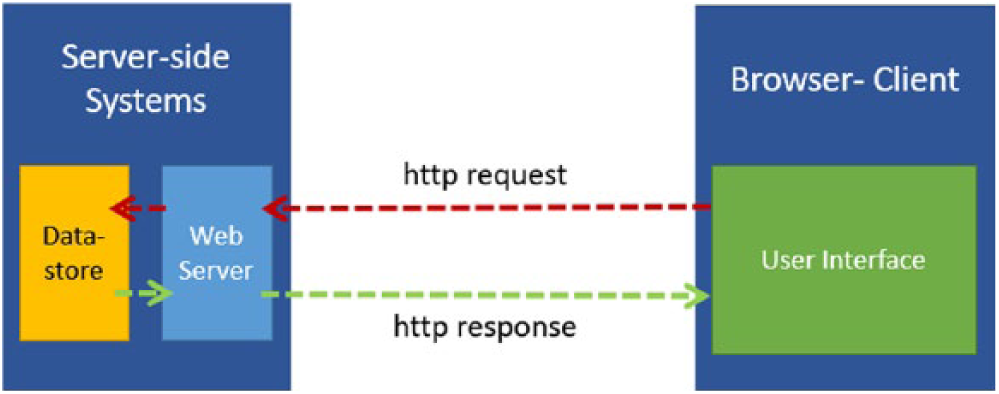
HTTP request/response model.
Data formats
Access through the Cloud APIs is supported by several data formats. Choosing the proper data serialization format is critical due to the increase in data exchange over the Internet. Data format is even more significant in mobile devices because these devices use limited resources and are bandwidth limited. 33 Two most common text-based approaches of data serialization are XML and JavaScript Object Notation (JSON) that have been used widely in web applications for data transmission.33,34 XML and JSON have different features. XML has a prescriptive grammar and stores all data in the closed tag with the data indexed by labels. JSON, on the other hand, is a lightweight data exchange format that uses a text format independent of the language and has higher parsing efficiency than XML. 34 More recently, binary data serialization formats are emerging such as Google’s Protocol Buffers (ProtoBuf), Thrift developed by Facebook, 33 and Apache Avro developed as a Hadoop subproject. 35 These binary data encodings are extremely lightweight, fast to serialize/deserialize,33,35 and offer better data size than XML or JSON-based serialization. 35
Standards
Standardization is an effective solution to address the interoperability issue of the Cloud services.22,27 There are many Cloud standardization projects such as Open Cloud Computing Interface (OCCI) and Open Cloud Manifesto.27,28 Some of these efforts address standardizing parts of a Cloud computing solution such as data access, and others deal with standardizing how parts of a solution should work together. 25 Although these initiatives offer the promise of Cloud interoperability, different levels of system interoperability should be carefully considered including the following:
Technical interoperability that deals with exchanging data;
Semantic interoperability that deals with exchanging meaningful data;
Organizational interoperability that deals with participating in multi-organizational business processes.
Existing data standards can address technical interoperability but might not be able to guarantee semantic or organizational interoperability. 25 To address semantic and organizational interoperability, domain knowledge based on established schema and use cases are required. In this regard, the main target for semantic level interoperability is the API, since a standardized Cloud API created and supported by the Cloud vendors can provide a common abstraction layer that can mediate compatibility conflicts among Cloud services.22,25,29 Thus, the main step of managing interactions of Cloud resources and services is establishing a standardized API. In addition, a common Cloud data model should be used as the basis to describe Cloud systems components such as resources, services, and APIs.28,29
Cloud collaborations
Collaboration and data sharing among multiple Cloud applications is based on the type of the collaborative environment.36,37 Cloud collaborations can be categorized into three different types:
Federated collaboration supports a long-term interoperation and needs the collaborating Cloud applications to have mutual dependence and trust.36,37 This architecture sets a global policy framework consistent with local policies of each collaborating Cloud. 36
Loosely coupled collaboration is a Cloud architecture that is based on autonomy in access policies and resource management. 36 Interactions among collaborating Cloud applications are guided by local policies.36,37 Resources in each Cloud can be created virtually and authorized for autonomous sharing among collaborating Clouds.
Ad hoc collaboration deals with the service needs at the time of deployment. 37 Since the service requirements might not be available at the beginning, access to the resources might be denied. Therefore, to support dynamic interoperation, specific implementation of authentication and authorization mechanism is required and secured collaboration needs to be developed on a user basis. 36
To evaluate these types of collaboration, four major metrics can be used: (1) degree of interoperation which is the level of service and resource sharing among collaborating Cloud applications, (2) autonomy which is the ability of each Cloud application to perform its local operations with no interference from collaborating Cloud applications, (3) degree of privacy which quantifies to what extent a Cloud application should disclose its local policies, constraints, and rules, and (4) verification complexity which specifies how complex the verification of the correctness of all the constraints is in the integration.36,37 The work of Almutairi et al. 36 analyses federated, loosely coupled, and ad hoc collaborations based on these four metrics. Figure 5 illustrates the tradeoffs based on the analysis in Almutairi et al. 36
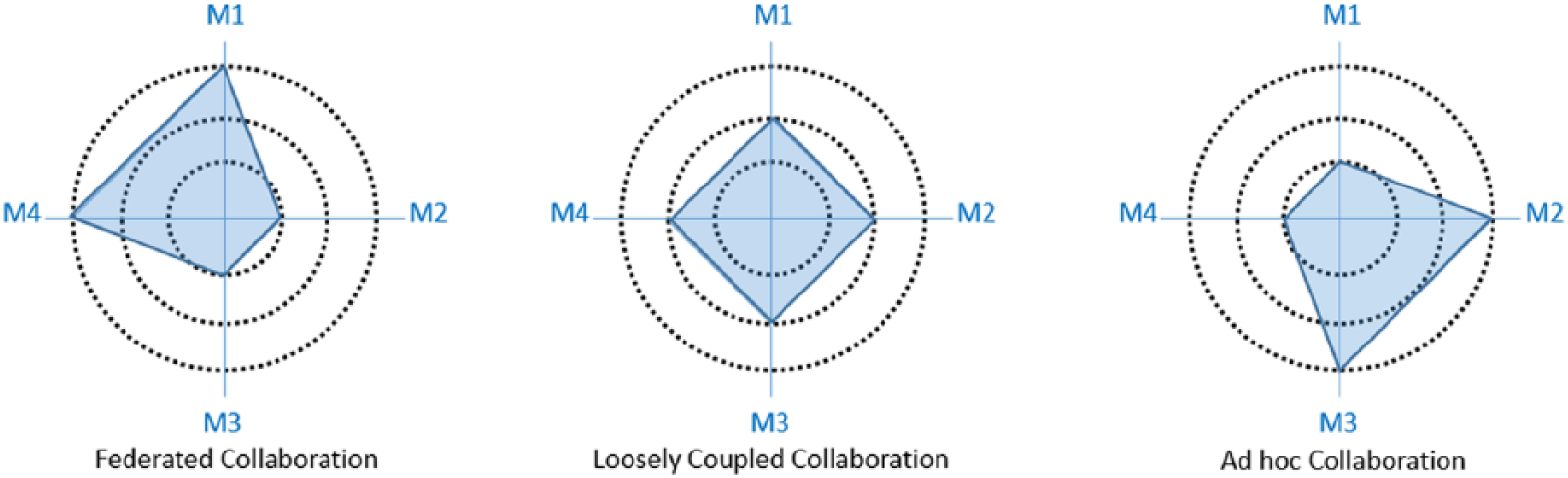
Tradeoffs for Cloud collaboration types considering evaluation metrics analyzed in Almutairi et al. 36 (M1 = degree of interoperation, M2 = autonomy, M3 = degree of privacy, M4 = verification complexity).
Cloud systems that are based on loosely coupled collaboration are consistent with federated collaborations and ad hoc collaboration. But federated Cloud collaborations can be loosely, partially, or tightly coupled. Federated collaborations can result in high complexity because of the need for generating a global policy framework out of many heterogeneous and sometimes conflicting policies, so scalability is difficult. 36 Ad hoc collaboration supports a high level of privacy, but does not federate credentials and has the least level of interoperation among all. 36
Overall, the architecture for loosely coupled collaboration reduces dependencies between Cloud applications as well as components of the applications, so data exchange can be significantly simplified. Loosely coupled collaboration provides a reasonable degree of autonomy and privacy with reasonable verification complexity. In a loosely coupled collaboration, components of any Cloud applications can change without affecting other collaborating applications; thus, resource sharing will be intact while collaborating Clouds follow the same resource management. This suggests that the architecture of loosely coupled Cloud collaboration is appropriate to support Cloud-BIM data interoperability.
Limitations of Cloud integration solutions
As mentioned, Cloud-BIM data interoperability has faced several challenges and have not fully utilized the potentials of Cloud computing by implementing a network-based data transmission process. However, other domains have applied alternative methodologies of Cloud-based data integration. So, in this section, the study investigates Cloud integration solutions from other domains with potential applicability to Cloud-BIM.
Data interoperability among Cloud applications has been an ongoing challenge. 38 Several Cloud integration solutions provide integration services across the interfaces of collaborating applications. These services can provide data integration among both Cloud applications and on premise. They also offer the capabilities for designing data integration to support custom integration in Cloud 39 in ad hoc collaborations. Examples of Cloud integration solutions include WebSphere Cast Iron Cloud Integration (IBM Cast Iron), Dell Boomi by AtomSphere, and MuleSoft.
WebSphere Cast Iron provides mapping among different data structures stored on different database systems. It allows integration to be executed on its Cloud service or on premise solutions and devices. 38 Its integration approach follows a direct and pair-wise federation with data synchronization and it does not support data sharing within a loosely coupled collaboration. 8 On top of its platform, it deploys and configures plug-ins. The plug-ins for ad hoc collaborations can also be developed by integration specialists.
Dell Boomi provides consolidation services to utilize capabilities of Cloud. It connects Cloud and on premise applications without the need for any appliances, software, or coding. 39 It also supports data exchange and mapping of different data structures that are in different formats such as XML and Electronic Data Interchange (EDI). 38
MuleSoft has an integration package that provides integration solutions for Cloud and on premise applications for developers to connect applications to exchange data. To manage the API, it supports many data transfer protocols as well as data delivery style. 39 It can integrate applications that are based on different technologies and allow developers to create customized Cloud connectors.
A few similar solutions such as Autodesk Quantum are underway for the AEC industry to address data integration among web services. Most likely, this type of Cloud integration solution will be largely developed as third party integration applications in near future for the AEC industry.
In addition, using a trigger-action (if-then) model such as If This Then That (IFTTT) has become an active research area. The trigger-action model can offer automated integration among web services and it performs as the glue between web services.40,41 It uses a concept called recipes while many of the recipes take advantage of web APIs. Despite its wide use, the trigger-action model faces major challenges specifically in defining recipes. These approaches are currently limited by their lack of a sense of history; thus, the actual usability is very limited. Most importantly, recipes “can suffer from ambiguity or temporal uncertainty” since recipes can fail to complete because of network failures. 40
In general, current Cloud integration solutions structure the integration of two or more application as a new system and do not allow for a loosely coupled collaboration. 38 These solutions are tightly coupled and if any of the applications change their data format or interface requirements, this can cause interaction failure requiring the data integration system to be updated. These Cloud interoperability solutions suffer from vendor lock-in and several problems with resource management and data sharing while each one uses their own interoperability framework and data schema. 27 These integration solutions follow a configuration approach rather than programmatic interoperability. 38 Thus, these systems only identify the options available for data sharing while a programmatic interoperability approach deals with a comprehensive understanding of collaborating applications and data transfer protocols for data sharing.
As a matter of fact, data integration and interoperability have traditionally seen several challenges of inconsistencies. While Cloud computing is believed to resolve limitations of conventional services, it has not been very effective in current data integration solutions. Data integration must expect data to conform to a common schema to address interoperability challenges.
A framework for Cloud-BIM interoperability
The current challenges in Cloud-BIM data exchange highlight the need for new frameworks to support interoperability. The above discussion points out main aspects of Cloud collaboration and interoperability needed to realize the potential of the Cloud-BIM interoperability in cross-platform network-based data transmission.
As discussed and shown in Figure 6, current file-based BIM data exchange is based on using the MVD in the sending application to generate an exchange model file, typically in IFC format. This file is then passed to the receiving application which uses an IFC import translator to interpret and resolve the imported model into the receiving native environment.

Manual file-based BIM data exchange process.
Using an MVD to generate the exchange model facilitates the exchange by defining the data requirements expectations. The use of an open standard data schema following an IFC MVD enables data interoperability in cross-platform collaborations. However, in this process, the request for data happens outside of the BIM model, usually through emails, agreements for project check-ins, or other methods of correspondence. The receiving party who needs the BIM model requests specific BIM data from the sender based on a specific MVD exchange. For instance, the structural engineering team may request the architectural model from the architect based on the MVD for conceptual design. In this process, the data receiver needs to wait until the sender exports the BIM model as a file and passes it to the receiving party, resulting in inherent latency and temporal disconnects in the process.
In the previous study, the authors discuss the shortcomings of existing cross-platform BIM data transfer methods. 16 To address these issues, new approaches will need to incorporate the four major features of loosely coupled Cloud collaboration discussed above. This study proposes the implementation of a framework as shown in Figure 7 including a Cloud API based on standards with proper profile of data format and protocols.
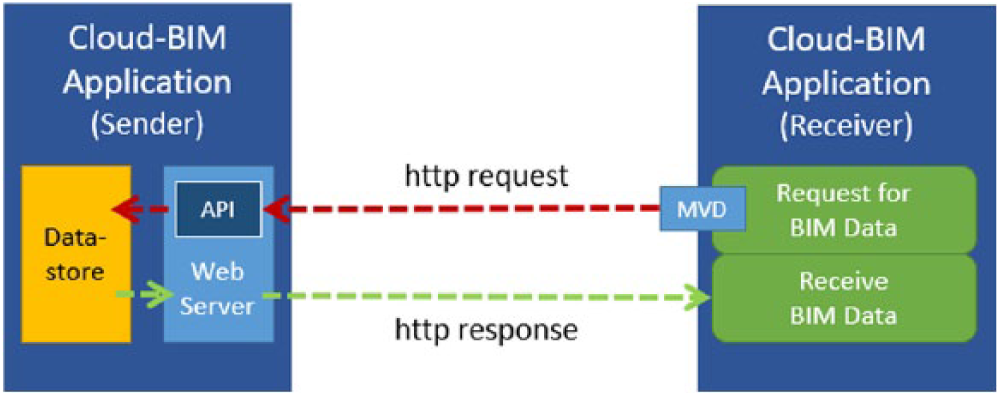
The proposed framework and its components.
However, Cloud APIs provided by Cloud-BIM vendors have not been standardized yet. BIMSie project 14 has worked toward introducing a standardized Service Interface (i.e. API) for Cloud-BIM solutions. This standard Service Interface is intended to automate interaction between Cloud-BIM applications by introducing API for Cloud-BIM applications with standardized methods. 14 The BIMSie project is an important step toward facilitating Cloud-BIM interoperability by standardizing and connecting Cloud APIs. However, in the BIMSie initiative, the data exchange through these standardized APIs remains file-based using IFC files, so the data interoperability and collaboration methods remain largely document centric, limiting its applicability to support the full potential of Cloud technology for AEC collaboration.
In order to take advantage of the opportunities inherent in web technologies and Cloud computing to support Cloud-BIM interoperability, an alternative architecture is proposed, shown in Figure 7. In this framework, data for Cloud collaboration are stored in a data-store within an application and accessed through an API with a standard set of methods and terminologies. The data can be interpreted by other applications through this shared API. The API provides an on-demand access to the pool of data stored in the transmitting application. Accordingly, data request happens only in receiving application that becomes the client for the sending application and uses a data exchange requirements (i.e. MVD) to request BIM data. In this proposed process, the data exchange requirement follows the rules defined in the MVD specification. Major components of this framework are as follows:
The API. This framework suggests that each application of API implements a set of standardized resources stored in a data-store with an appropriate data serialization format that are retrievable over HTTP. This API needs to follow a common data model. This study suggests using IFC specification as industry-wide standard data model to address semantic interoperability.
Data Transfer Protocol. This framework defines a data flow for exchanging model-based data between Cloud-BIM applications that is different from the conventional methods such as manual file transfer. This approach uses HTTP calls for cross-platform communication. It is based on a simple request/response mechanism. Thus, in this framework, the receiver of data directly requests data instead of waiting for the sender to export data in the form of files. This framework would support real-time data exchange through loosely coupled collaboration, and not tie applications to an integration system like a BIM server or a data interchange hub.
Data Format. In this framework, the data-store serves as a repository for persisting BIM data. The data should be serialized in an efficient compatible format based on common agreements and terminologies. Since IFC is the common standard for open BIM, IFC specification can provide the basis for capturing domain knowledge as well as a common data schema. Currently, ifcXML is the only certified IFC data representation that is compatible with Web technologies. However, limitations of XML-based documents should be considered. Web applications are typically represented in the form of Asynchronous JavaScript and XML (AJAX) and web services. Unlike traditional web services, AJAX applications are aimed at enhancing the user experience where data transmission speed is very important. 34 When AJAX was first introduced, XML was used widely but XML showed inadequacies because of its data structure with redundant tags, larger size, and the low efficiency of its analysis in serializing and deserializing data.34,35 Data serialization approaches such as JSON and binary encodings should be considered to achieve higher efficiency especially in the applications of AJAX technology. Previous study by Afsari et al. 42 has outlined the implementation of ifcJSON, a JSON serialization of IFC data model for web-based data transfer.
Improved collaborative process
Current BIM collaboration and data exchange processes remain largely based on manually initiated file transfers. In this process, data requests by the recipient happen outside of the automated process with no direct control on interacting with required data. Most importantly, there is a major issue in the conventional file export/import process since data exchange implements the MVD in the sending application only. While there are methods to validate the exported model against the initial exchange requirements of the MVD, there is no methodology or tool to validate the model against this exchange requirement after import. Therefore, the importing application can wind up with vague and incomplete data.
Today, BIM data exchanges may provide data integration solutions that address model federation in a centralized platform/server. BIM collaboration might also follow another type of Cloud integration by interconnecting a limited number of design applications on premise through an interchange hub with the help of plug-ins. These two approaches face major problems: (1) BIM server technologies and data interchange hubs can support interoperability among only a limited data formats and corresponding applications. Collaboration with other applications that are not supported by these systems will again rely on exporting/importing BIM models in the form of files and a file-based data transfer causes a disconnected system and data inconsistencies. (2) In BIM server technologies and data interchange hubs, if any changes occur in one of the collaborating applications, the BIM integration solution will need to be updated to avoid data exchange failure.
On the other hand, standards provide a common language and set of expectations that enable interoperability between systems. Similarly, data exchange schema and interoperability standards allow data to be shared between applications regardless of the application or application vendor. The proposed framework with its standardized API and data structure that follows IFC specification provides a common understanding of BIM data, resource management, and data request/response in the Cloud. The proposed framework also integrates MVD as a subset of IFC schema to address domain-specific exchange requirements. Thus, using the proposed framework, collaborating applications can exchange BIM-based data in the Cloud within a network-based data transmission regardless of native data formats. Besides, the proposed framework suggests establishing a loosely coupled integration to reduce dependencies between Cloud applications where BIM data request can happen directly in the receiving application. Loosely coupled systems can operate independently from one another and can communicate with each other dynamically. The advantage of the loosely coupled framework proposed in this study is that collaborating BIM applications can reside on different Cloud platforms or can update their systems independently and there is no need for the interoperability solution based on the proposed framework to be updated and this makes the interoperability robust. In fact, the web-based data exchange methodology specified in this study redefines the information flow: using BIM data exchanges enabled by dynamic web-based data transfer protocols, establishing a loosely coupled integration to reduce dependencies between Cloud applications, and supporting the true potential of the Cloud application collaboration.
In the conventional BIM data flow, if a project collaborator such as a structural engineer needs to request specific information from another discipline such as architectural design team, the recipient, that is, the structural engineer needs to ask the sender, that is, the architect to export a model containing required data from their native application and pass the file to the engineer. Then, the engineer can import the file in the receiving application to get access to the required data. Using the framework proposed in this article, when all project parties are using Cloud-based BIM applications, the receiver of the data, that is, structural engineer who uses receiving application only needs to connect to the API of the sending application that the architect is using. Then, all the engineer needs to do is to directly request for BIM data within the receiving application and the engineer will immediately receive data represented in web compatible formats. In this way, in order to retrieve the required data, the receiver of the data interacts directly with the actual BIM model available in the data-store that resides on the sending application. Also, the receiver of the BIM data has the responsibility to review and approve that the correct set of inputs have been used. Thus, this dataflow could address liability challenges too. This approach will reshape BIM collaboration process by introducing a new, more user centric data flow.
In this proposed Cloud-BIM data interoperability framework, the MVD implementation will become an effort in the receiver side and not in the sender side. This means that while data are available on the sender side, the data request is managed on the receiver side and will be directed based on the exchange requirements of the downstream application. This approach provides the receiving application and receiving project parties with more control over BIM data exchange. In addition, by considering the MVD on the receiver side, data validity focus will be in the receiving application. This capability can only be achieved through using network-based BIM data transmission.
Conclusion and recommendations
This study indicates that Cloud-BIM data exchange needs to deploy a framework with major components of Cloud interoperability including the APIs, data transfer protocols, data formats, and standardization to redefine BIM data flow in Cloud-based BIM applications and to reshape BIM collaboration process. It specifies a data flow for Cloud-BIM that utilizes true potentials of the web technologies and can perform as an enabler for a collaborative process allowing Cloud-BIM services communicate through their standardized APIs. This data flow can provide a fundamental basis for a common framework of Cloud-BIM interoperability. With this core framework in place, future study will be directed toward implementation details and evaluation of the proposed methodology through AEC-specific use cases. This research contributes to introducing a standardized network-based BIM interoperability solution within a loosely coupled collaboration in the Cloud to reduce dependencies among collaborating BIM applications.
Cloud-BIM interoperability research and its standardization effort are still in its infancy, and the body of knowledge in the area has not been well defined yet. If Cloud-BIM services are designed and implemented with no standardization in mind they are subject to the same data interoperability problems as current challenges with desktop-based BIM applications. This study highlights the need for standardization of Cloud-BIM APIs, using Cloud interoperability components as well as IFC data model and its established industry schema as the basis for Cloud collaboration. IFC specification can ensure semantic interoperability of building data in the Cloud and future research will investigate how the IFC data model can be integrated in the standardization of Cloud-BIM APIs. In addition, compatible and efficient BIM data representation in Cloud is another critical aspect in Cloud-BIM interoperability. Future study will also investigate how different data serialization methods used in the data flow specified in this article affect the efficiency of network-based Cloud-BIM data exchange. In a previous study, 42 the authors have outlined the JSON encoding of IFC specification as a potential candidate for this component of the framework and the study of encoding IFC specification in other data serialization techniques suitable for web-based data interchange is a future step.
Footnotes
Declaration of conflicting interests
The author(s) declared no potential conflicts of interest with respect to the research, authorship, and/or publication of this article.
Funding
The author(s) received no financial support for the research, authorship, and/or publication of this article.