



Abstract
The digital transformation of the construction industry and the lack of integration of digital technologies in design and construction processes are the motivation for this research. BIM solutions enable new levels of design processes and provide platforms for computational design and novel approaches in the AEC industry. In computational design parametric, generative or algorithmic procedures are utilized to support, optimize, or replace manual processes. The combination of BIM and generative, parametric or algorithmic design forms a hybrid that aims to combine the advantages of both concepts and allows for generative design processes with the creation of BIM objects containing metadata. Along with the digital transformation and novel approaches in the AEC industry, modular construction aims to shift from mass production to mass customization and maximize opportunities for cost-effective, economical, and sustainable buildings. This paper addresses the approach of generating building information models using algorithm-aided design combined with BIM at an early design stage for modular multi-story residential buildings that are affordable and sustainable. In this study, we present the framework of an algorithm-aided BIM approach, from the concept of the generative algorithm to the evaluation approach and the proof of concept as the test of the framework.
Keywords
Introduction
The design process and the finding of solutions for design problems can usually only be managed by the comparison of multiple design variants and is often highly extensive. Computer-aided processes enable individualization and mass customization, but also require additional effort in the planning phase. 1 The use of computer-aided work processes can be observed in all areas of the AEC industry (Architecture, Engineering, and Construction). Building Information Modeling (BIM) provides the industry with a tool that enables comprehensive analysis, simulation, and evaluation of a construction project and can accompany a building as a modeled digital twin throughout its entire life cycle. In the early design stage, this concept presents a particular challenge. In this phase, which has the greatest impact on the project and its economic viability, exist a multitude of variables that have to be evaluated in order to make the project a viable undertaking. Thus, numerous variants are to be developed and tested. In order to optimize such processes, generative, parametric, or algorithmic procedures can be utilized to support or replace manual processes. The combination of BIM and generative, parametric or algorithmic design forms a hybrid that aims to combine the advantages of both concepts in a more efficient tool. It combines generative design processes with the creation of BIM objects with metadata. 2 In combination, the advantages of content generation through algorithmic scripts can be used and, together with the advantages of a BIM model, lead to a more efficient creation of variants of multiple BIM models. We hypothesize, that the application of Algorithmic Design (AD) and Building Information Modeling (BIM) in the early phase of a project offers the possibility to generate and evaluate designs in a time- and resource-efficient manner and to identify a suitable (near optimum) variant of the Building Information Model. The requirements and the resulting parameters of individual construction tasks vary depending on the use of the building. Certain building types allow a higher degree of process optimization than others. In addition to office buildings and industrial structures, multi-storey residential buildings are a particularly suitable building type for the semi-automation of the generation and evaluation of building information models during the early design phase due to their recurring elements.
Addressing the point of departure, our study presents an extension of research conducted within the research project “Housing 4.0.” In the research project, “Housing 4.0,” a framework for a digital platform for modular housing is being developed. The focus of the research project lies on developing and using BIM object libraries for modular off-site production in multi-storey residential planning and construction. The platform couples a knowledge base and two digital components: the first addressing the construction and production companies and the second addressing users, designers, and developers. 3
In this paper, we aim to answer the research question of to what extent the digital platform can be extended by a third component that enables a semi-automated generation and evaluation of information models using a BIM-based and algorithm-aided approach on modular housing. Our aim is to determine how the framework of such algorithm-based BIM approach needs to be designed, what parameters need to be identified for modular housing, and how an evaluation of sustainability and affordability needs to be carried out in early design stages. The innovative contribution is therefore the algorithmic components that semi-automate the process of generating and evaluating BIM model variants in an early design stage, which are developed specifically for modular multi-storey residential buildings as a key point unique to this research.
BIM for modular construction and mass customization
With regard to the problem that computer-aided processes require additional effort in the planning phase but enable individualization and mass customization, the literature indicates that continuous exchange of data, at a process-bound level, facilitates communication, avoids multiple entries and is considered crucial to the success of industrial construction and time savings are achieved primarily through the repetitive modules in terms of functionality and design.1,4 On a people-bound level, however, more efficient and qualitative work can also be achieved through a continuous flow of information between all stakeholders involved, such as users, architects, production companies, transport and assembly companies. 5 The exchange of information between planners and producers is supported by a compatible and consistent data system. Such a data system should ensure fast and simple data exchange, facilitate communication, reconcile data to avoid additional data entry and enable cost estimation and calculation. Building Information Modeling is a comprehensive and innovative tool that attempts to encompass the life cycle of a building, from design and planning, through execution and production, to maintenance and deconstruction. BIM can be defined either as a digital model, concerning the respective model itself, or as modelling process. 6 BIM tools also provide optimized platforms for parametric modelling that enable new levels of spatial visualization, building behaviour simulation and effective project management to work economically.4,7,8 The construction industry sees BIM as the key to faster and more efficient construction of sustainable buildings. 5 Since planning during construction is only possible to a limited extent and the planning phase is condensed, all details, design decisions and planning must be determined before production begins, ideally in the early design stage. In practice, early cooperation between architects, planners and modular construction companies is always sought but hardly executed. Thereafter, BIM is intended to support the integral planning process and off-site production offers the possibility to also reduce life cycle ressources.9,10 BIM is therefore a promising method for “off-site construction” to address process and people-related challenges - therefore we propose the application of BIM methods of our framework for a semi-automated generation and evaluation of information models.
Computational design for modular construction and mass customization
Although BIM provides the industry with a tool that enables comprehensive analysis, simulation and evaluation of a construction project, the application is challenging in the early design stage. In this, for the life-cycle performance crucial stage, a large number of variables need to be evaluated in order to ensure the viability of the project. To optimise such elaborate processes, computational design offers generative, parametric or algorithmic methods that can support or replace manual processes. In our study, we thus extend the BIM approach to include the methodology of algorithm aided design. When referring to computational design in the AEC industry, stakeholders adopted different terminologies to address similar approaches, and the majority of terms are used interchangeably and inconsistently. To differentiate between computational design terms Caetano et al. propose an improved and sound taxonomy. 11 Since our framework presented in this paper utilizes algorithms with parameters it is a parametric design instance and due to the facts, that algorithmic design is a subset of generative design, the algorithm can be considered generative. However, the approach in our study should be considered as algorithmic design, since the explicit correlation between the algorithm and the generated design is traceable. The framework described in this paper is referred to as algorithmic design combined with BIM, algorithm-aided BIM (AA-BIM) according to the proposed taxonomy. Research related to the scope of this paper, on the one hand, addresses environmental complexity using parametric and generative design methods. It demonstrates that stylistic responsiveness is achieved beyond geometric explorations and how the incorporation of skills and knowledge acquired effectively informs everyday design and planning. 12 Research on the customization process in housing introduces the concept an analytical grammar of form that describes the changes made to support design procedures for mass customization and the creation of appropriate housing units for current and future lifestyles. 13 In terms of performance-based design, a range of performance simulations are possible in computer-aided design environments, and therefore offers different possibilities considering qualitative and quantitative feedback. This study tests data analysis techniques for early problem definition to query, modify, relate, transform, and automatically generate design variables for architectural investigations. 14 As for our study we adopted the concepts of generative design beyond geometric exploration, design procedures considering mass customization (modularity) in housing and to semi-automatically generate an evaluate designs or investigations. A scientific review and analysis by BuHamdan et al. present trends, collaborations, and applications of generative systems in architecture, engineering, and industry to highlight existing shortcomings and potential advances that balance theory development and application needs. The study provides an overview of the state of generative system research in the AEC industry over the past decade. Architecture, structural engineering, and concrete engineering have been shown to lead other disciplines in the AEC industry in the use of generative systems to support their design efforts. Within these disciplines, facade design, shape generation, and layout generation were the most common applications. 15 In order to further elaborate these most common applications, we are exploring the creation of the entire system under the unification of the individual aspects in our proposed framework. To address the approach beyond geometric exploration, our framework further includes not only the generation of models but also the evaluation of models in early design stage. Relating thereto a study on flexible architectural, engineering and construction design and production explores principles of modularity from the fields of manufacturing to contribute to a stronger definition of architectural, engineering and construction software processes that use materials and resources more efficiently and sustainably. This research confirms that tools and methods already exist that can support the AEC design and production process by replacing tacit workflows with holistic solutions that capture design knowledge. 16 In the context of BIM and prefabrication for housing, which is our main focus in this paper besides algorithmic design, a study by Ostrowska-Wawryniuk on the design of sustainable homes presents a prototype tool that supports the design of small-scale timber prefabricated DIY homes using Revit and Dynamo scripts. 17 Further, in terms of decision support for building design, research has been conducted on generative design, optimization, and life cycle performance. 18 Research on adaptable modular building systems and multicriteria optimization strategies for mass customized housing presents an adaptable modular building system and a multicriteria optimization workflow. 19 To determine how an evaluation of sustainability and affordability needs to be carried out, we therefore adapt these concepts of modular housing and generative approaches for the early design stage. Research related to affordable housing combined with computer-aided design relates to the problem of designing building mass for affordable single-family housing but not for modular multi-storey housing as in our research. Here, a visual scripting environment is used to create a semi-automatic design environment that allows the user to edit one feature-based 3D model of a design alternative at a time. 20 Further research questions the compliance of digital design and architectural computing concluding that these methods must also be combined with an appropriate balance between automation and human intervention to achieve design freedom. This study by Chaszar and Joyce (2016) on human intervention concludes that despite the opportunities that parametric approaches offer for exploring vast regions of design space, their specific limitations inherent properties of the systems such as variable domains, value types, element linkages, and logics typically lead to real limitations on fluidity, flexibility, and ambiguity in design. 21 This was adopted in our research through the semi- instead of fully-automated model generation and evaluation approach.
Algorithm-aided BIM
In order to evaluate variants and identify the near optimum a vast number of variables need to be assessed in early design stage, for which BIM tools are not agile enough. Parametric design integrated in its basic form into common BIM tools offers large potential for evaluation of variants, through possibility of the parametrisation of the elements. Parametric objects are defined by the fact that they contain parameters such as distances, angles, and geometric rules and dependencies. 22 The values of the parameters are modifiable and produce different results when changed. 23 We propose that in combination, the advantages of fast content generation through algorithmic scripts can be used and, together with the advantages of a BIM model, lead to a more efficient creation of variants of multiple BIM models. A unified term for the linked form of these two design methods is still lacking. Aish (2013) defines it as "Parametric BIM", Caetano et al. as "algorithmic-aided BIM" and Humppi and Österlundt as "Algorithm-Aided BIM".2,24,25 An algorithm is a specific and finite number of steps leading to a problem solution. It contains unambiguous instructions and a clearly defined input and thus produces a clearly defined output. 26 Thus, algorithms, if followed correctly, can generate a large number of variants from which the near optimum one can be identified. Generative design occurs as a rule-based but open-ended process, thus leading to the further development of typologies by resolving issues of structure formation, e.g., through form/shape grammars. 27–30 Generative design "[...] can be described as a design method in which the generation of form is based on rules or algorithms often derived from computer tools such as Processing, Rhinoceros, Grasshopper, and other scripting platforms." 31 We propose, that the application of Algorithmic Design (AD) and Building Information Modeling (BIM) in the early phase of a project offers the possibility to generate and evaluate designs in a time- and resource-efficient manner and to identify a suitable (near optimum) variant of the Building Information Model. Here, various programming languages can be used to implement such algorithmic design processes. A distinction is made between visual programming languages (VPL), which enable interactive customization through a two-dimensional representation of individual elements, and textual programming languages (TPL), in which a linear sequence of characters enables programming. While neither form has significant advantages over the other, a VPL offers an easier entry point, especially for beginners, by providing a two-dimensional graphical representation of the program sequences.32,33 VPL inside Dynamo thus has been the programming language utilized for the algorithmic components that semi-automate the process of generating and evaluating BIM model variants in this study. This paper hereby focuses on the innovative contribution of a framework to generate and evaluate information-rich building designs using algorithm-aided methods in combination with BIM, developed for modular multi-storey residential buildings in an early design stage.
Methodology
In this section, we present the overall methodology of the development and testing of the algorithm-aided BIM framework. The methodology of the framework is shown in Figure 1. The objectives of the algorithm-aided BIM framework aim to address the overall problem of housing shortage, enabling configurable architecture and digitalization, and assessing and enabling sustainability (area efficiency, flexibility, and energy efficiency) and affordability (cost). The methodology is based on a set of secondary data of the research project “Housing 4.0,” such as geometric parameters and parameters that underlie modular residential buildings. To obtain the design parameters, we conducted a literature and media-based content analysis as well as an analysis of a multi-storey residential pilot use case. Derived from the predefined secondary data, the design parameters were identified and translated as qualitative and numeric value input as a basis for the scripting of the algorithm. Based on these parameters, the framework for the generative algorithm was evaluated and scripted. The generative algorithm itself was developed in Dynamo
34
software and contains the elements of modular housing. The evaluation of the resulting BIM model is based on previously analyzed evaluation systems and approaches whose components were used and modified for the evaluation of this approach. Via a qualitative analysis of evaluation systems, guidelines, and catalogs, we have formed four modified criteria (area efficiency, energy efficiency, flexibility, and cost). The selected criteria are intended to show the possibility that an even broader spectrum of criteria can be directly assessed by means of an algorithm-aided approach. The generation of the building information model is conducted through Dynamo’s internal interface to Revit
35
and the evaluation of the model is conducted through Dynamo to Excel. Visual programming tools offer the possibility of designing via visual scripts. By means of code building blocks (nodes), algorithmic design processes can be created. In Graphical Algorithm Editors, like Dynamo, this visually programmed code can be linked to BIM tools, such as Revit, and linked to spreadsheet tools, like Excel, and thus enables object-oriented modeling and evaluation via algorithm-aided design methods. In order to test the framework, a proof of concept was performed, based on the pilot project of the research project and re-generating an already realized modular residential building in a Viennese context. The objective was to replicate and evaluate the real built residential building utilizing the algorithm-aided BIM framework. Methodology of the conceptualization and testing via POC of the AA-BIM framework. Framework of the algorithm-aided BIM approach.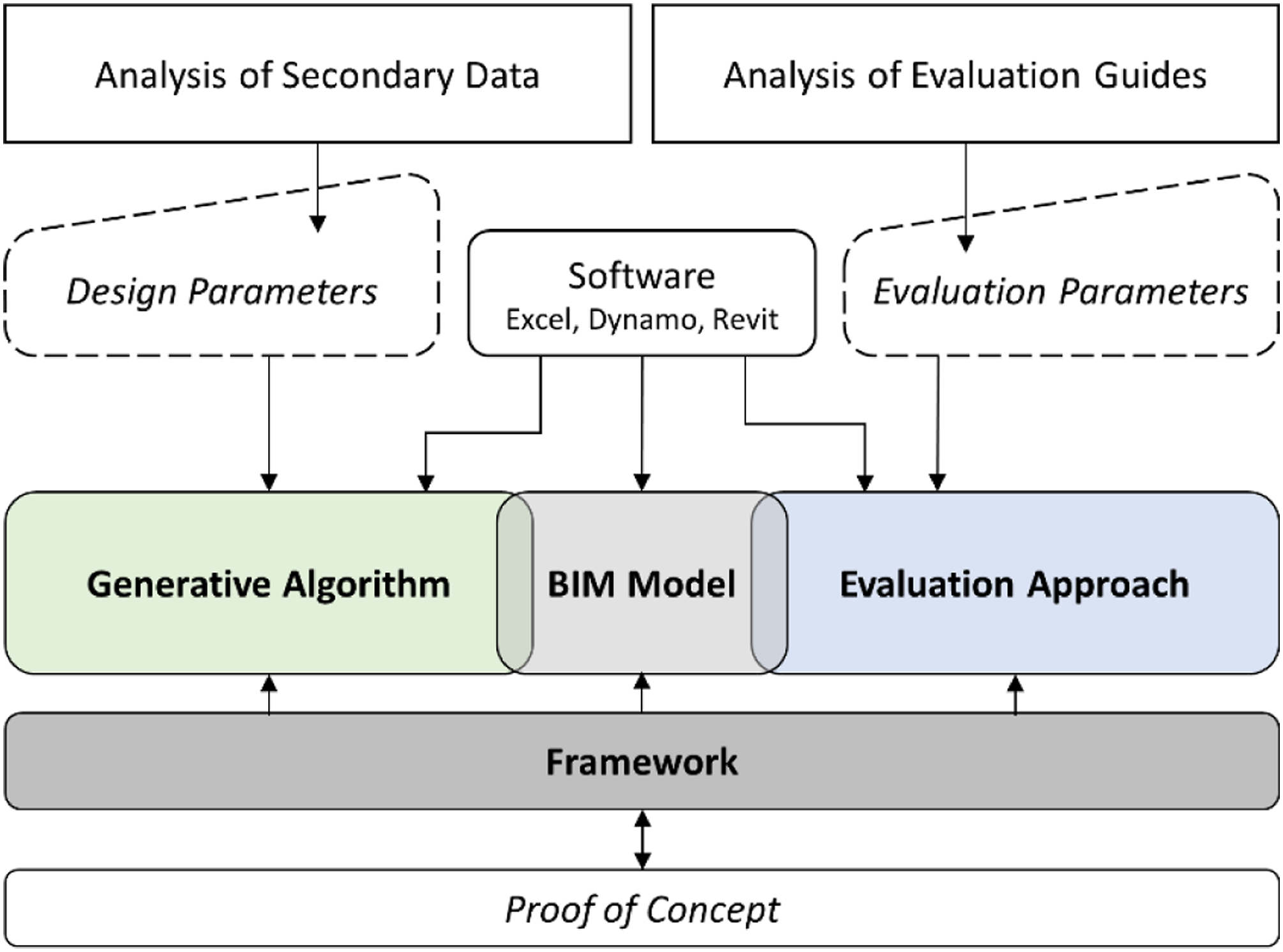
In this section, the developed algorithm-aided BIM framework is presented. The framework shown in Figure 2 illustrates the semi-automated approach. The developed framework is a conceptualization of an algorithm-aided BIM approach composed of a generative algorithm with an interface to BIM and an evaluation approach. In the following sections, we elaborate the framework approach, from the concept of the generative algorithm to the evaluation approach. Algorithm-aided BIM framework.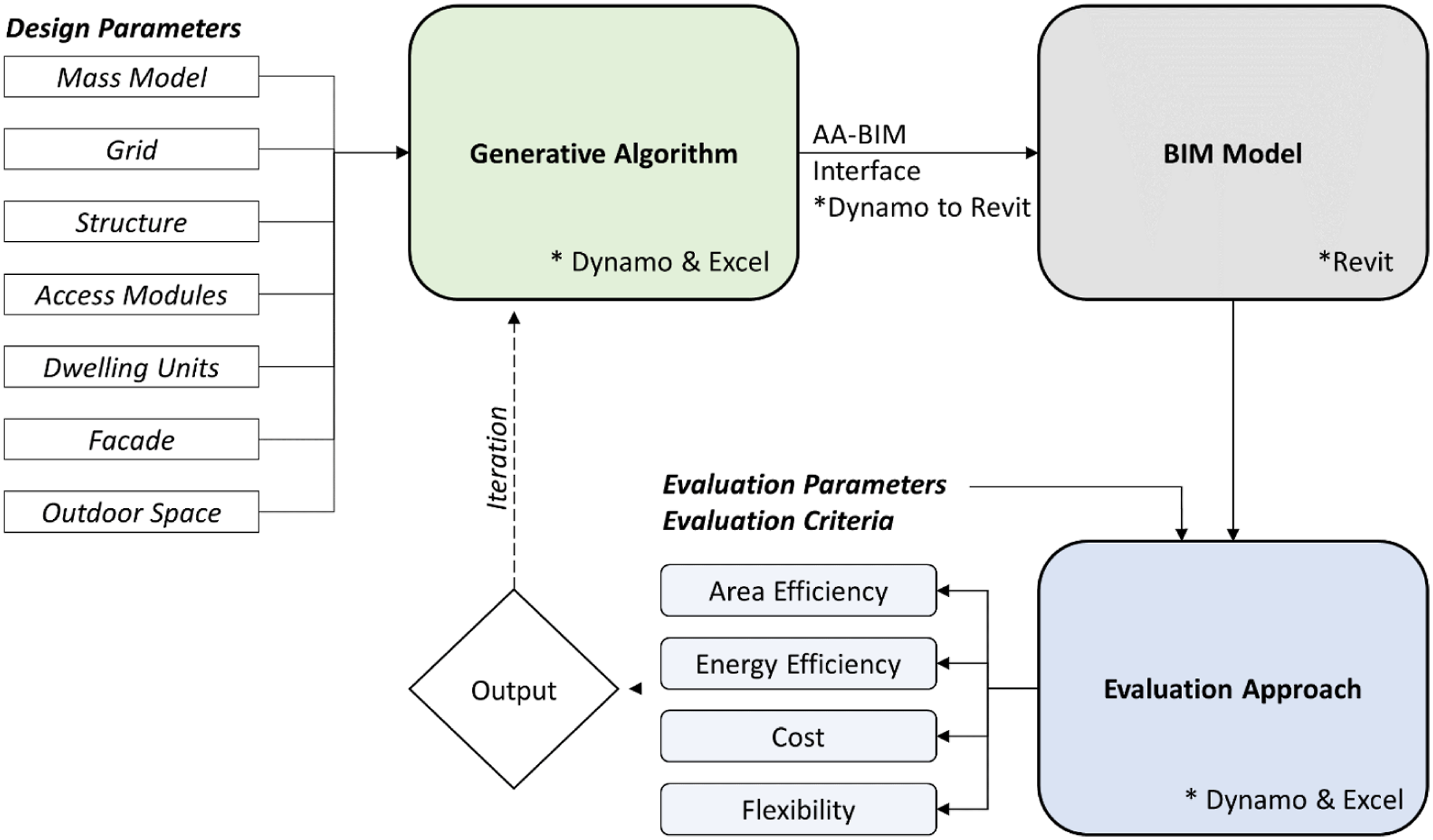
The framework consists of two components. The first is the algorithm-based generation of the BIM model, the second is the evaluation of the model. Via visual programming in Dynamo, the algorithm has been scripted, Revit was used to visualize and store the BIM model, and Excel as a database, input tool, and interface. To ensure traceability of the input data and the individual steps of the model creation, the input of the parameters is done with Microsoft Excel. The workflow for generating the model follows the following pattern: Input (parameters in Excel)—Generation (algorithm in Dynamo)—Output (BIM model in Revit). The set values of parameters and linked Revit objects finally generate the Revit-based BIM model as an early design stage variant. For the evaluation, the process is reversed: model (Revit)—export (Dynamo)—data for evaluation (Excel). The evaluation of energy efficiency is conducted via the tool Archiphysik, 36 which is a software for standard-compliant building physics reports and verifications for heat, sound, vapor diffusion, energy performance certificates, and ecology for single- and multi-zone residential and non-residential buildings and provides information on summer overheating and takes into account housing subsidies and building regulations. The evaluation of area efficiency has been conducted within Excel based on ÖNORM 1800, 37 the evaluation of cost based on the German construction cost indices—Building Cost Information Centre of German Chambers of Architects (BKI, German: Baukostenindex) 38 and ÖNORM B 1801, 39 and the evaluation of flexibility based on the Total Quality Building, TQB tool. 40 As this approach is intended as a framework for exploring the data and methods required for a fully automated tool, we are proceeding with the iterative process of generating BIM models in a semi-automated approach. At this early stage of the approach, we did not aim for fully automatic layout generation or multicriteria optimization. We focus on semi-automatic generation and the iteration is repeated until the designer is content with the result.
Generative algorithm
In this section, we elaborate the process scheme of the generative algorithms’ components and its modular thus configurable approach based on the architectural elements of modular multi-storey residential buildings. The process of generating the model is based on the individual elements and parameters of residential buildings. The sub steps of the generative process of model generation are shown as process scheme. The input of the parameters is divided into a grid, which serves as a basis for all further elements. Within this generated three-dimensional system of grid and levels, the elements of the supporting structure, the access, and the dwelling units can be located and generated. The balconies and the facades are ultimately positioned depending on the dwelling unit units. In the following sub-sections, we define the algorithms components and process scheme: the mass model, grid, structure, access modules, dwelling unit modules, façade, and balconies.
Mass model and grid
In Revit, a mass model and a plane are created as point of departure of the process shown in Figure 3. The mass model is cuboid-shaped and has the parameters for width, length, and height. Mass families can be created in Revit with any basic shapes and parameters. The mass model from Revit is linked in Dynamo and the file path to the Excel file is specified. A grid is used to locate the individual elements within the mass model. In Dynamo, the mass model, its dimensions as well as the grid and the floor heights are adjusted dynamically and in real time. This method is especially useful in an early design phase when investigating the volume dimensions at the building site and favorable spans of the grid. By entering the exact dimensions and grid spacing in the Excel spreadsheet, individual adjustments can also be made to individual grid lines. Algorithm component: Process scheme mass model and grid.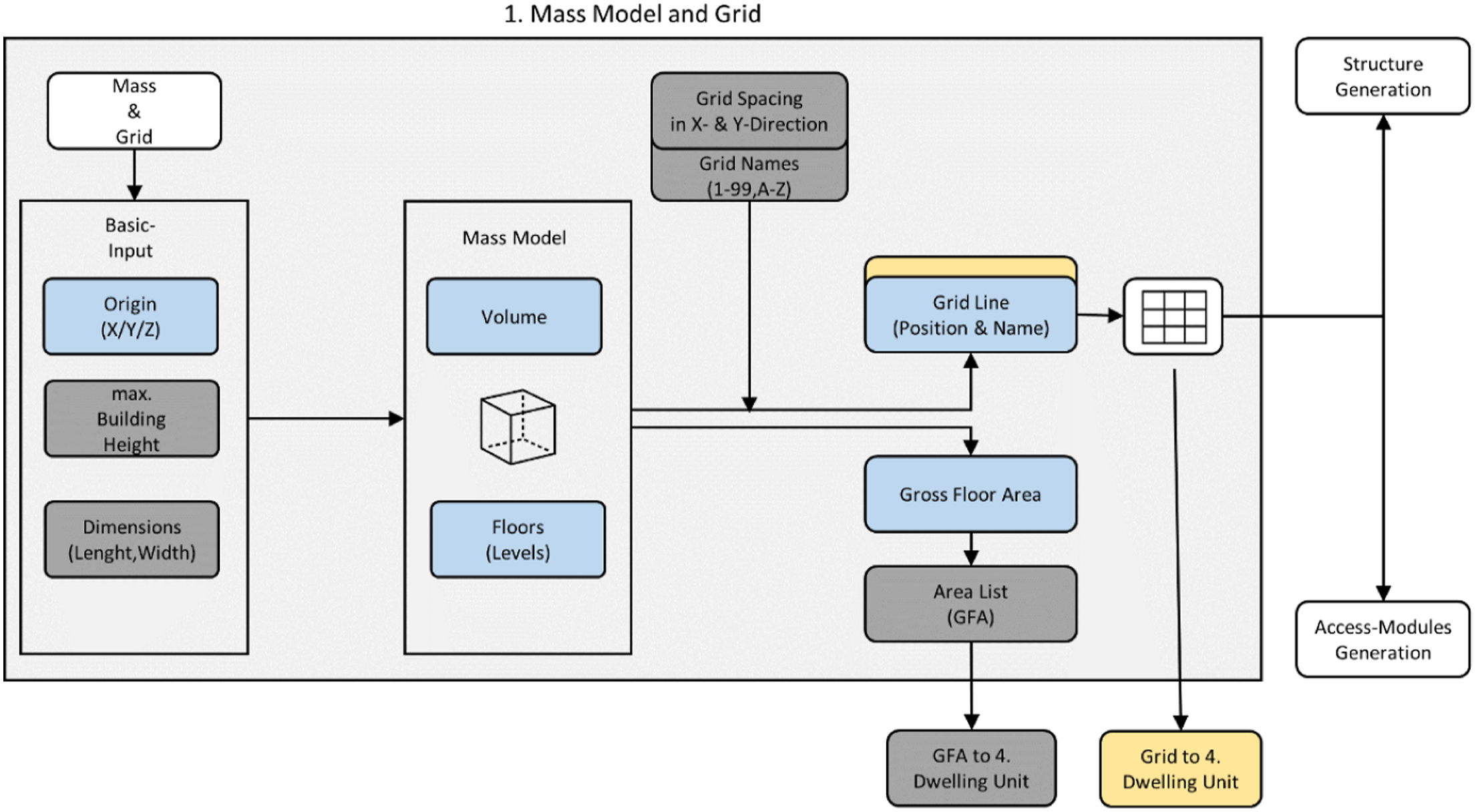
Structure
After the grid has been generated, the first elements to be generated algorithmically are those of the supporting structure. The table inside Excel can be used to create individual support structure types in order to allow for floor-by-floor variations. The core also has a load-bearing and bracing function, but should not be created until the next step—access—because the affiliation of the individual elements depends on the configuration of the core. In this process, shown in Figure 4, the grid structure is used to locate the individual elements. Since the grid is also the construction grid, the input does not allow any deviations from the grid lines. Algorithm component: Process scheme structure.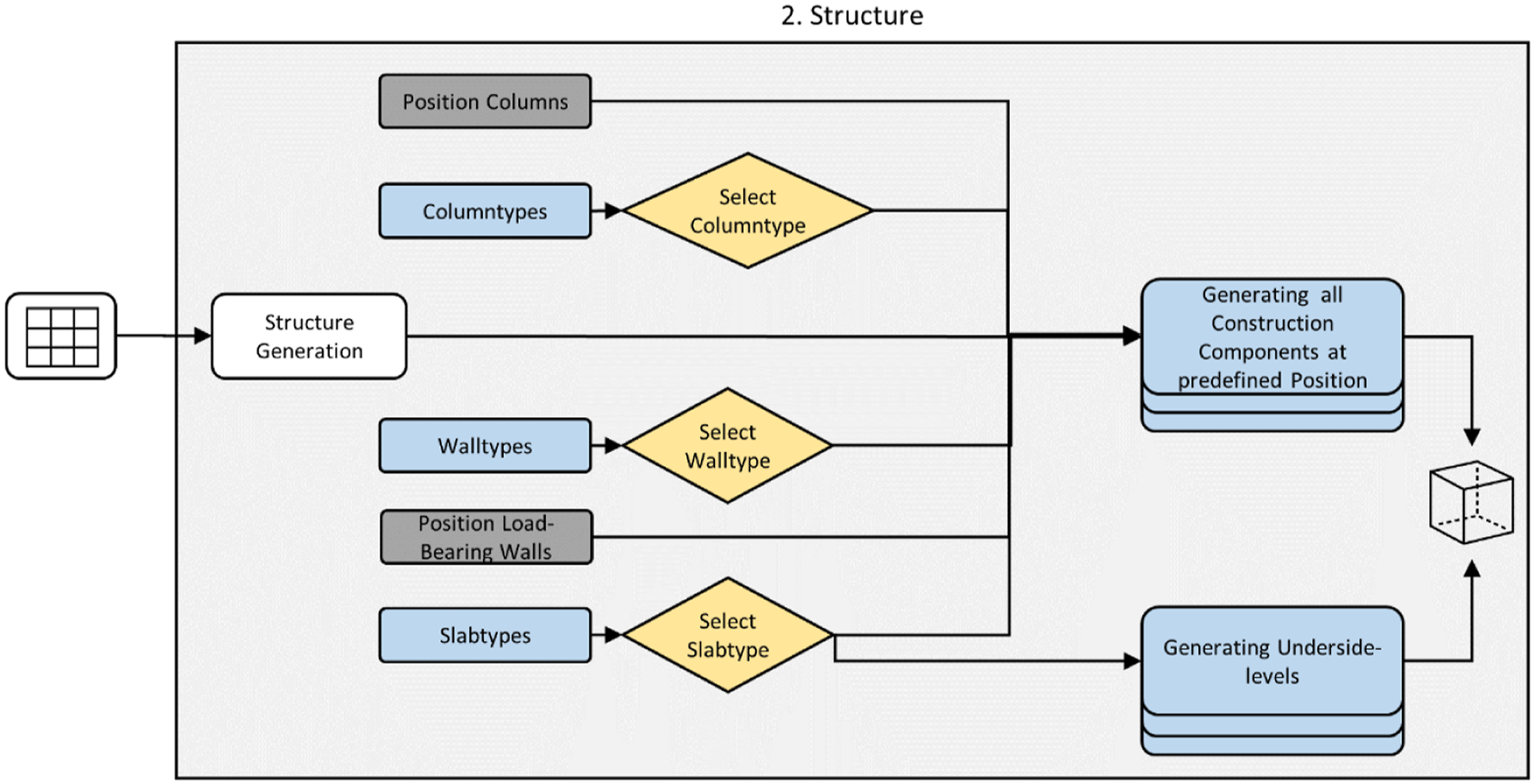
Access modules
Figure 5 shows the process of access modules generation inside Dynamo and Excel. In order to be able to generate access modules that are as individual as possible, the first step is to create the different access modules in Revit. This allows all Revit elements of the element library to be available and connectable to Dynamo and the access modules can be modeled in any level of detail. The grid and the levels serve as a coordinate system to position the access modules. Algorithm component: Process scheme access modules.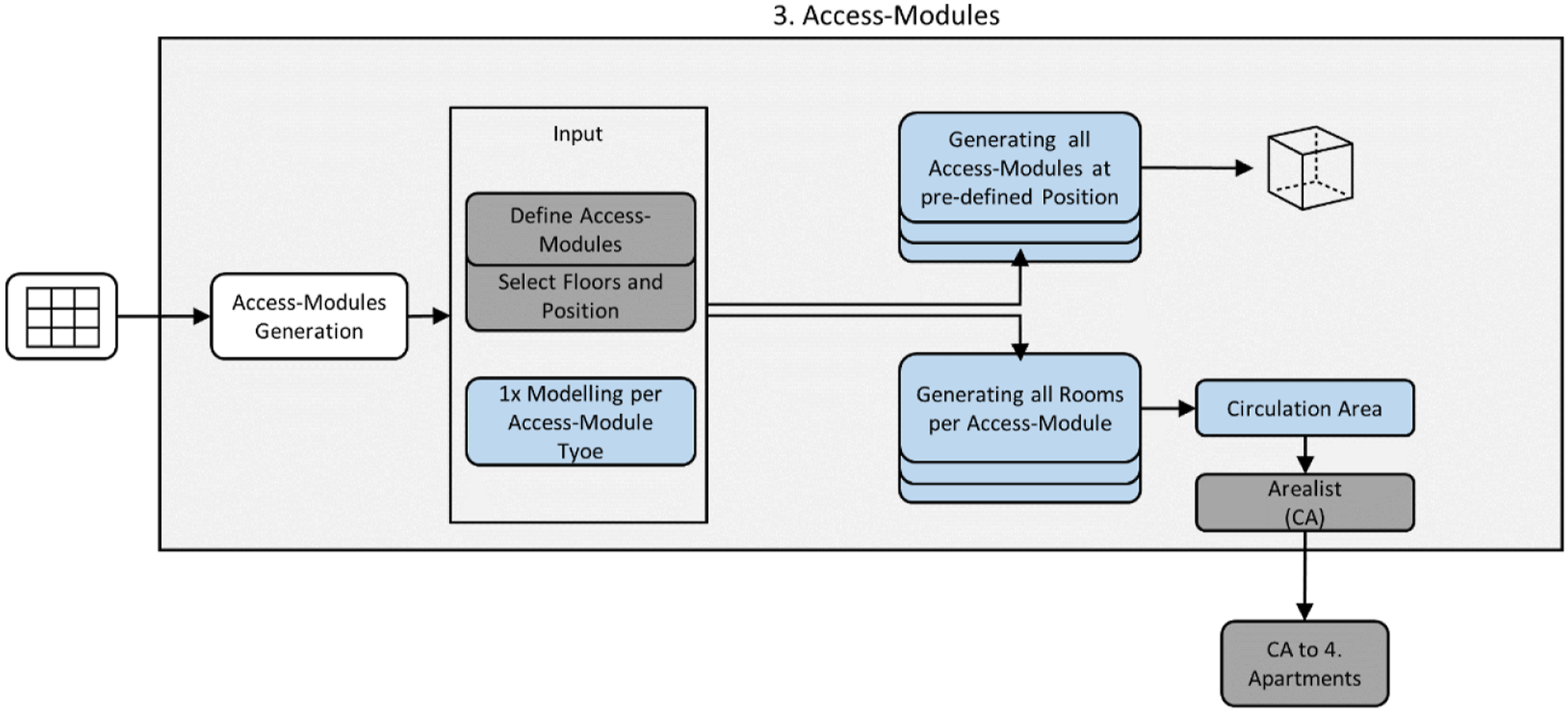
Dwelling unit modules
Figure 6 shows the process of dwelling unit generation inside Dynamo and Excel. The dwelling unit modules and housing mix are determined using Excel. The dwelling unit sizes or the minimum and maximum area per dwelling unit type are defined as well as the number of dwelling units (as a percentage or number). The floor plans of the dwelling units are previously created as modules inside Revit since we do not aim at this approach to be an automated layout generation tool. A simplified system of lines is used for the creation and generation of the dwelling unit modules. This system serves as a reference for the façade and the balconies that directly relate to the individual dwelling units. Each dwelling unit is bounded by walls: a partition wall with an entrance door toward the access area, a partition wall toward the adjacent dwelling units, and a façade wall with openings for lighting and ventilation (windows) or for access to the private balconies (façade door) toward the balconies. Consequently, the floor plans can be reduced to three different walls delimiting the apartment, as well as windows, doors, and an entrance door. Algorithm component: Process scheme dwelling units.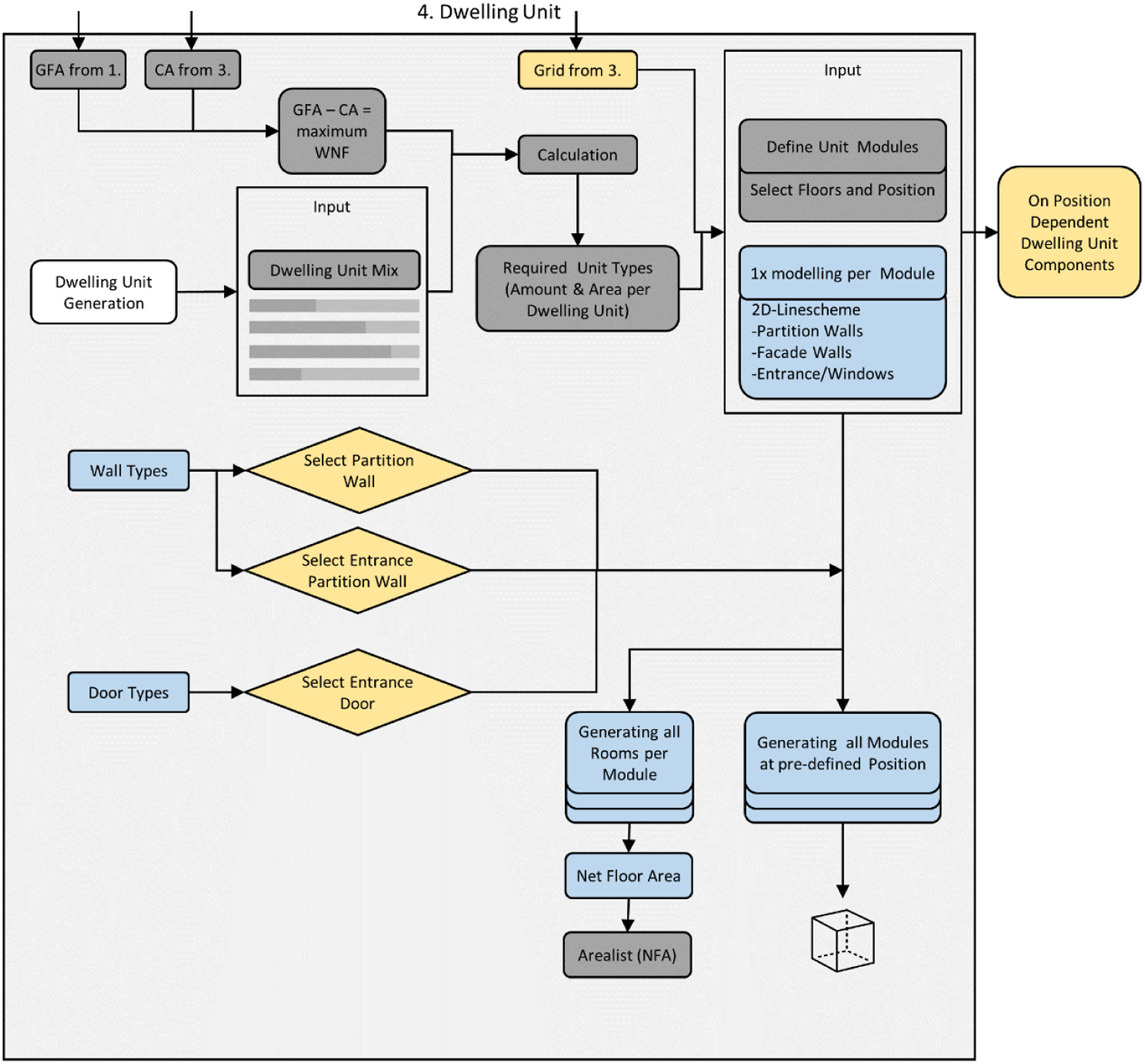
Outdoor space
When creating the floor plans of the dwelling units, the position of the doors is already defined as access points for the balconies. A balcony is generated if the opening is directly on the outer shell, a terrace if the dwelling unit is on the first floor, and a loggia if the door is inside the volume. The threshold value for when the algorithm distinguishes between a balcony and a loggia is given here as 50 cm from the wall, to provide a tolerance for the thickness of the facade wall and the installation depth of the doors. For the creation of the balconies, the dimension of the balconies is first required, which can be specified via the table inside Excel. Figure 7 shows the process of generation inside Dynamo and Excel. Algorithm component: Process scheme outdoor space per dwelling unit.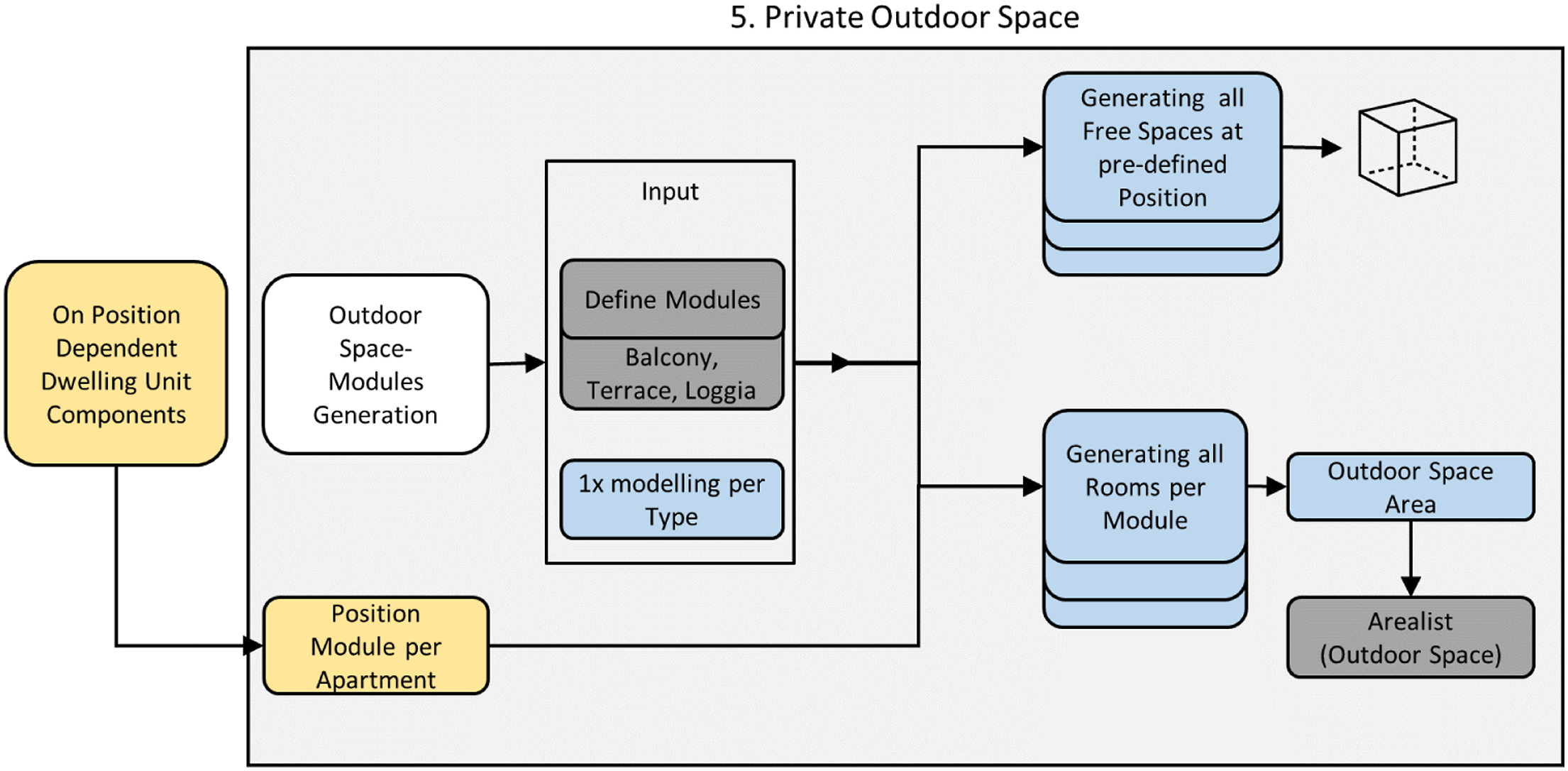
Façade
The generation of facade, especially with complex shapes, can be made possible by means of a specially designed algorithm. However, the aim of this work and this algorithm is to generate a residential model of an early design phase and to generate the elements. Therefore, the generation of the façade is limited to the wall or façade elements and openings, using only the wall and window families from Revit. The positions of the facade walls result from the previously generated and positioned lines of the residential modules. By default, the openings are positioned in the center of each wall element. Figure 8 shows the process of façade generation inside Dynamo and Excel. Algorithm component: Process scheme facade.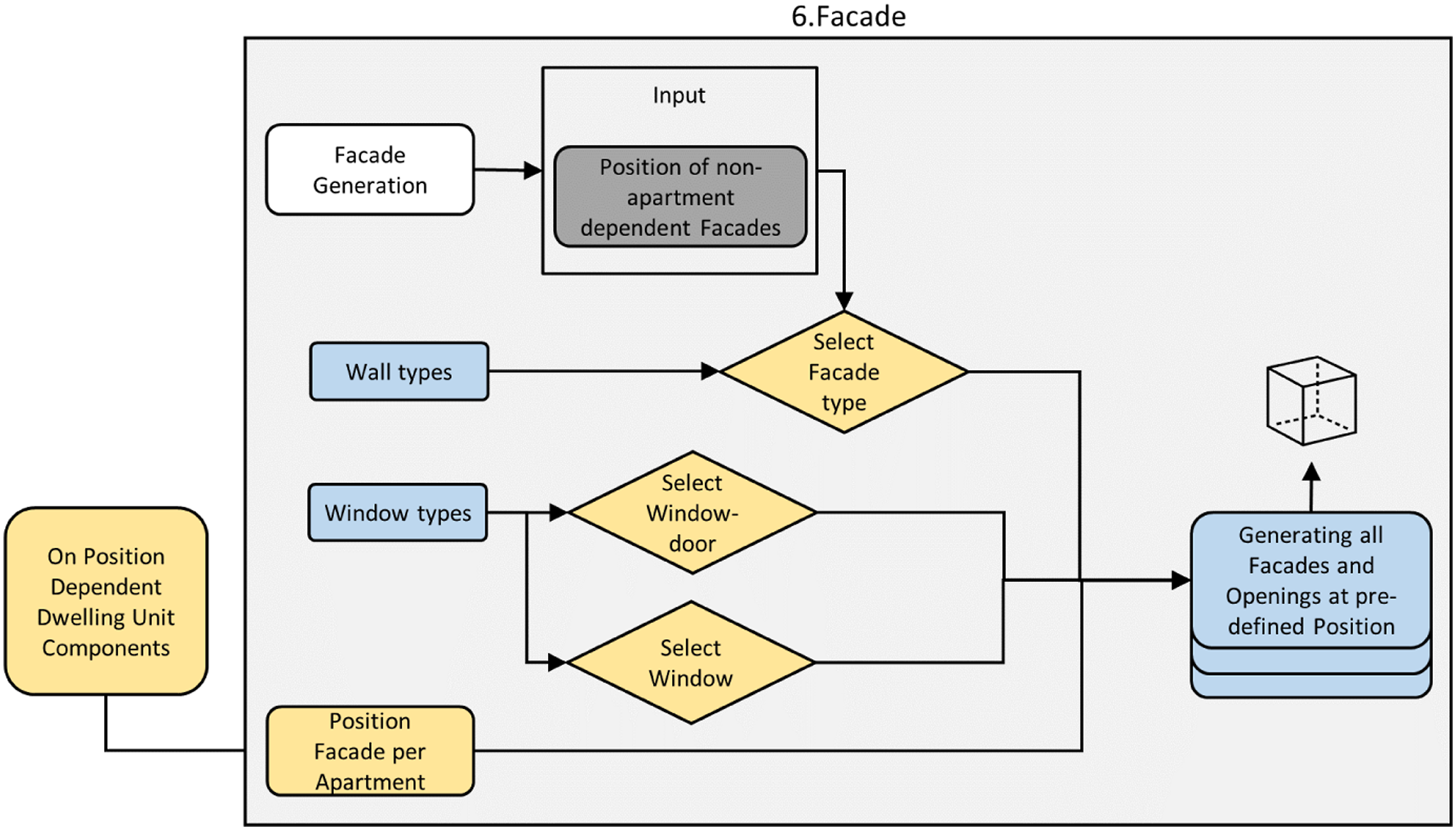
Evaluation approach
The evaluation (Figure 9) approach is based on the modified evaluation systems: ÖNORM 1800 (area efficiency),
37
Energy Certificate based on the Archiphysik software (energy efficiency),
36
Total Quality Building Tool (flexibility)
40
and ÖNORM B 1801,
39
and Building Cost Information Centre of German Chambers of Architects (BKI, German: Baukostenindex)
38
for cost evaluation. We adapted the evaluation criteria according to the early design stage phase which the framework is proposed for. The criteria by which a project should be evaluated depend on the interests and priorities of the stakeholders. Nevertheless, there are certain factors that prevail. Various institutions have developed evaluation guides or criteria guides to structure assessment factors and allow different housing projects for comparison. On the basis of the existing evaluation systems, the criteria emerge, which can be assessed directly on the early design stage model. However, other factors should not be disregarded and are to be integrated in future research. This paper presented aspects that are intended to demonstrate the possibility that a broad spectrum of criteria can be directly evaluated by means of an algorithm-supported design. Evaluation approach components and process schemes.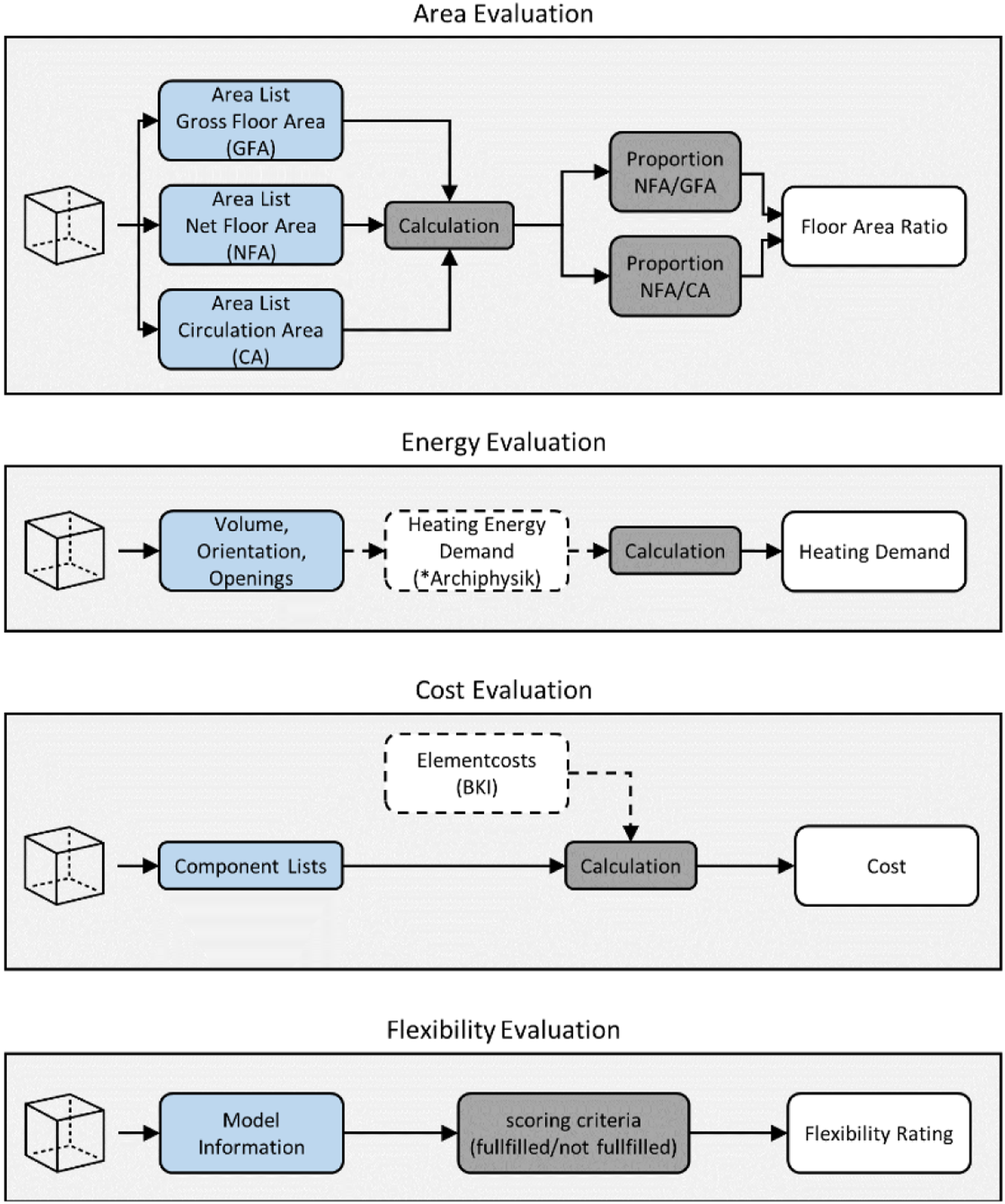
During the evaluation, the information generated in the BIM model is assessed in a semi-automated evaluation process shown in Figure 9. The evaluation is carried out according to the following criteria: The area efficiency evaluation measures the ratio between the net floor area and the gross floor area as well as the circulation area. The higher the proportion of residential floor space, the better the utilization of the building in terms of floor space. For the energy evaluation, the 3D data is available for calculation of the heating energy demand within an energy certificate. The calculation is done outside the algorithm inside the tool Archiphysik, as there is currently no digital interface to a calculation programme. However, the results of the calculation are inserted back into the evaluation to be part of the overall assessment. For the cost evaluation, component and quantity lists are generated, which are linked with the estimated element costs and evaluated in relation to reference costs from BKI benchmarks. Finally, flexibility is evaluated based on the adapted TQB evaluation system.
Evaluation of area efficiency
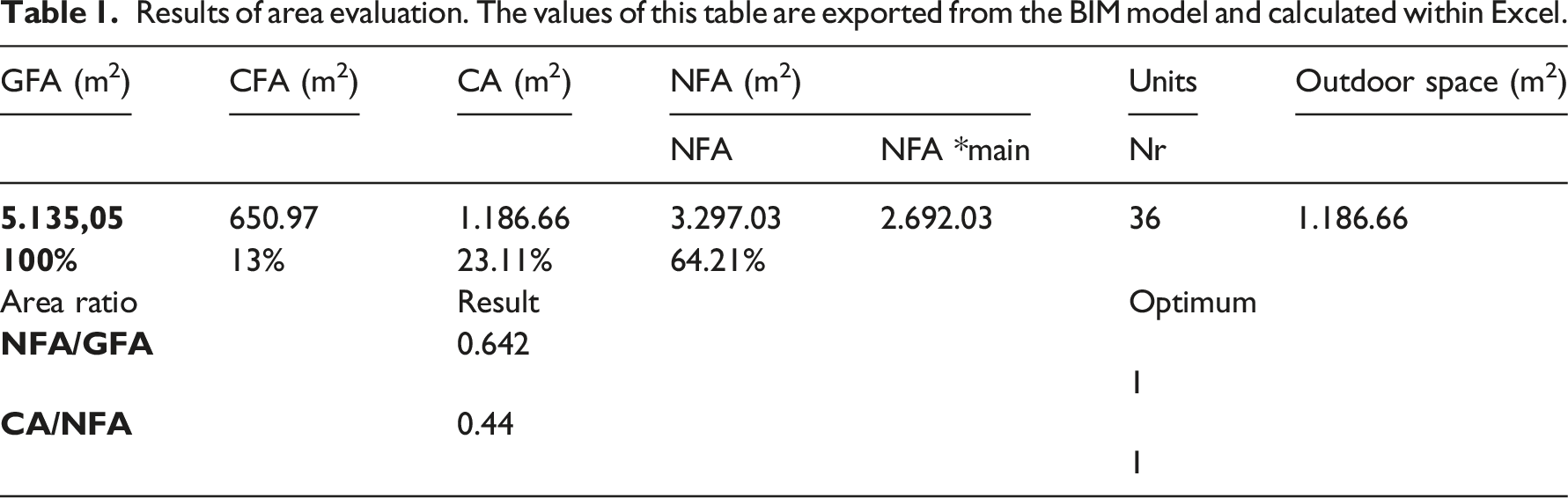
Floor area efficiency is calculated based on ÖNORM 1800 using the ratio of net floor area to gross floor area and the ratio of net floor area to circulation area. The more closely the calculated value is to the value of number 1, the more efficient it is classified. Gross floor area (GFA) is the sum of the floor areas of all levels of a structure. It is divided into net floor area (NFA) and construction floor area (CFA). NFA is the sum of the floor area of all levels located between the building components. CFA is the area of the building components. Circulation area (CA) is used for access and exit from usable (NFA) and functional areas (such as technical facilities or circulation between these areas such as core or corridor). The smaller the building area is in relation to the net floor area, the more economical the floor plan is, since proportionally more usable and living space is created and fewer building elements are used for this purpose. However, this relationship is always in reasonable proportion to the resulting spans of the supporting structure.
Evaluation energy efficiency
Of course, energy efficiency cannot be assessed in detail at this early stage of the design. However, initial important data such as the building envelope, orientation of the façades, and openings are already available and can be included in a calculation. According to the OIB guidelines, 41 the heating energy demand (HED) indicates how much energy must be supplied to the conditioned rooms in order to maintain their specified setpoint temperature. This value is given in kWh/m2 per year and thus enables comparability of individual buildings or design variants. According to OIB Guideline 6, 41 the HED for newly constructed residential buildings should comply with the following formula: HEDmin <12*(1+3/lc,OIB), whereby the maximum heating demand should be less than 54.4 kWh/m2.a. Furthermore, the calculated HED can be divided into individual classes (A++ to G). Since new buildings are allowed to reach a maximum of 54.4 kWh/m2.a, the assessment of these projects can be limited to the energy classes B (50–100 kWh/m2.a), A (25–50 kWh/m2.a), A+ (15–25 kWh/m2.a) and A++ (10–15 kWh/m2.a). The HED by no means fully describes the energy efficiency. Since the basic elements such as location and orientation, thermal envelope, heating and cooling systems, ventilation and insulation properties of the building components used are included in the calculation, this criteria nevertheless serve as a preliminary guide.
Evaluation of cost
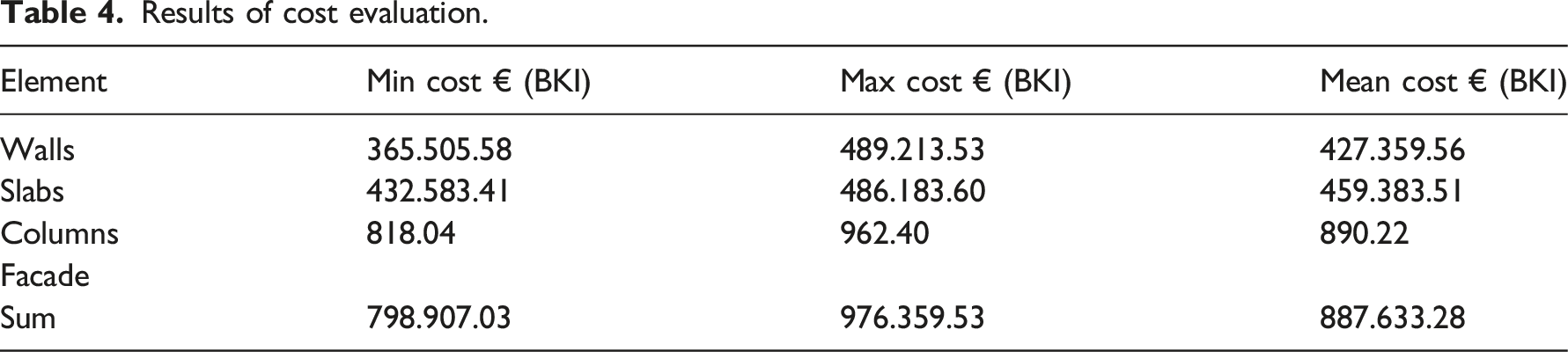
In order to be able to evaluate cost, all generated elements are to be compared with reference values (benchmarks). Since both the element costs of the design and the reference costs represent a variable, both groups of values must be adjustable. The reference costs are calculated price ranges of several similar construction projects. Data is used from construction cost databases, such as those offered by the Building Cost Information Centre of German Chambers of Architects (BKI, German: Baukostenindex). 38 The reference data specify a cost range with minimum, maximum, and mean values in which the costs of the planned element should be located. Depending on the boundary values, each individual element receives a valuation. Multiplied by the respective quantity, the sum of all generated elements results in a total sum for the cost evaluation. The evaluation of the project is always dependent on the reference costs. The sum of the element costs provides an important parameter that can be helpful for comparing generated variants of a project. For the cost estimation according to ÖN B1801, 39 the automatically calculated sums of the element costs inside Excel are utilized.
Evaluation of flexibility
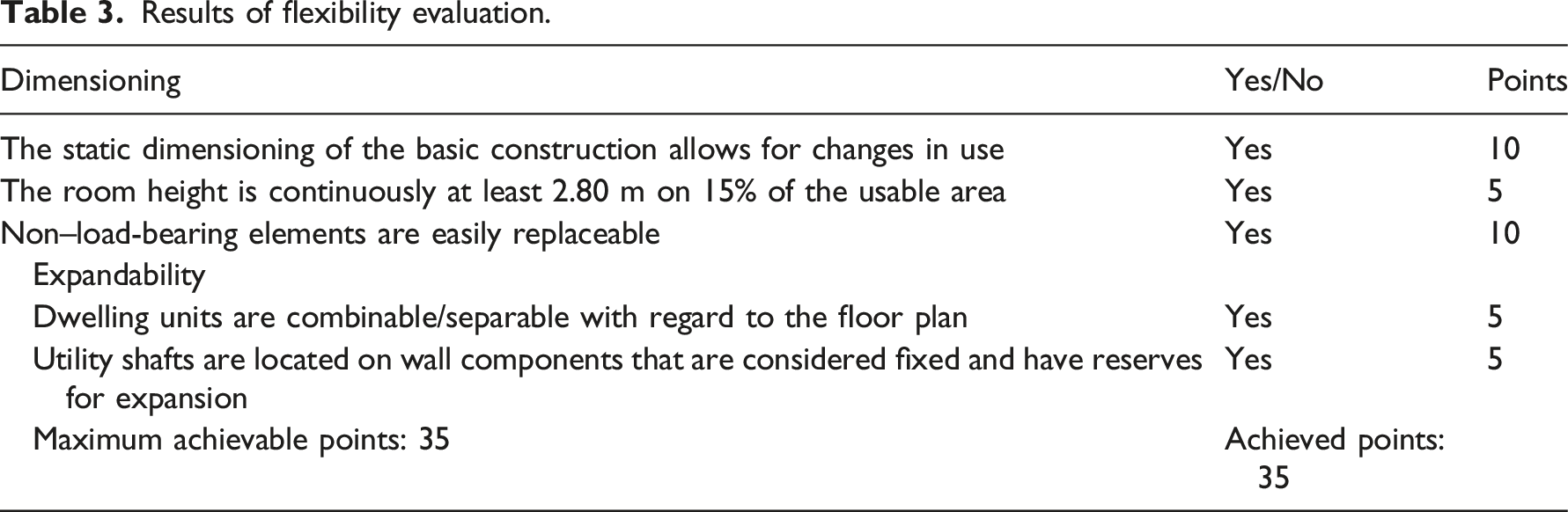
The measurement of flexibility is only possible with the help of a list of criteria, which must be weighted according to their respective relevance and receive points accordingly when fulfilled. The TQB assessment tool 40 awards points for flexible dimensioning of the construction elements and evaluates expandability. The criteria of the TQB assessment tool are adopted. In this study, we utilize a modified version of the TQB tool inside Excel.
Proof of concept
The algorithm-aided BIM framework is applied to generate and evaluate a case study as proof of concept to test the framework. A pilot use case serves as the basis of information. To create the model via the framework, floor plans of the main floors (ground floor, residential floors, and top floor) and a cross-section of the completed project were analyzed as input data. In this process of analysis, we translated descriptive documents (secondary data) to qualitative and numeric values input directly as parameters. The generation and evaluation of the use case follows the scheme of the developed framework. The pilot use case to be re-generated and evaluated is a real built modular multi-storey residential building in Vienna. The purpose of this proof of concept is to test the framework and thus regenerate the pilot use case with the least manual effort and to test the proposed evaluation approach.
As point of departure, a set of Revit objects, which are linked to Dynamo, has been generated which represent the real built elements of the pilot use case. The documents available have been utilized as input data for the parameters inside the algorithm and to set their values. The generation of the BIM model has been executed according to the framework presented in section Framework. The resulting BIM model has been assessed on similarity to the initial pilot use case and further on has been adapted manually. For the evaluation, the algorithm is linked bi-directionally between Dynamo, Excel, and Revit. The evaluation of the BIM model data has been executed following the framework component of evaluation presented in section Framework.
Generation of algorithm-aided BIM model
In the generation of the case study, the main focus lies on the modular residential floors (1st–4th floor). The generation of the use case follows the scheme of the developed framework and is presented in the following sub-sections (Figure 10). POC—resulting algorithm-aided BIM model.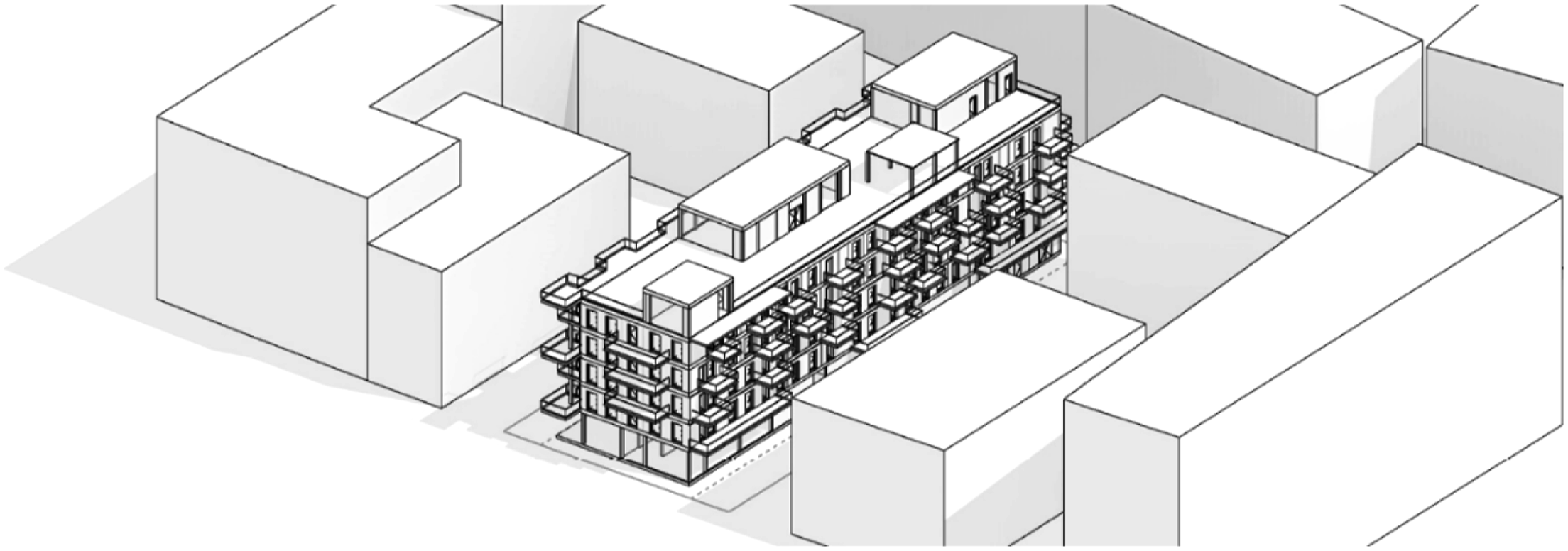
Mass model and grid
The setup of the working environment, consisting of the linking of the mass model in Revit and the Excel tables with Dynamo, is done according to the framework presented. The basic structure, consisting of grid and floor levels, is generated either via Dynamo or the Excel spreadsheet (Figure 11). POC—mass model and grid generated via Dynamo (l) or Excel (r).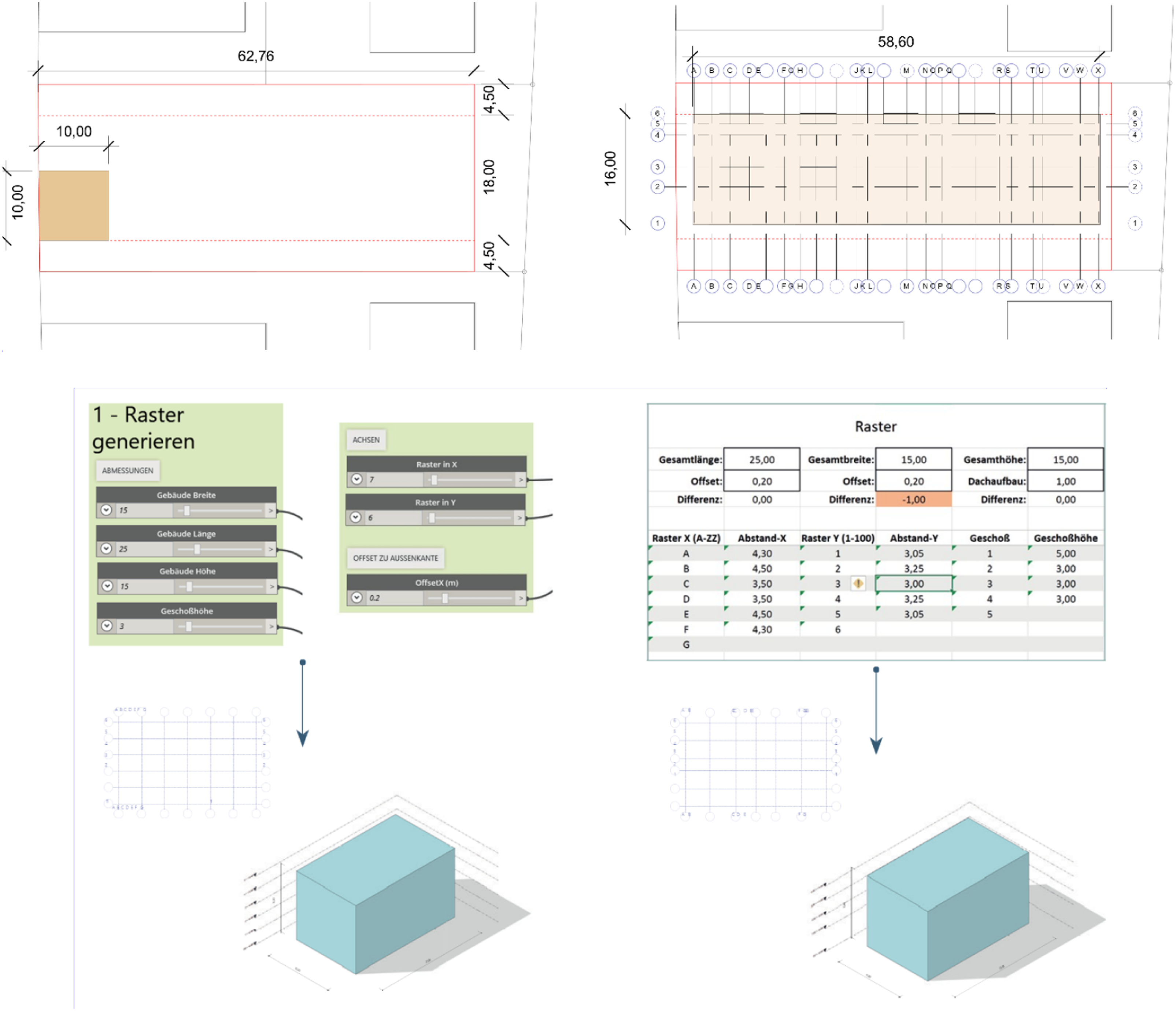
Structure
To generate the individual load-bearing elements, all vertical elements (columns and walls) are entered in Excel. In this step, it becomes clear that the input via grid points inside Excel is less intuitive and therefore also error-prone, since the result is not directly visible. In each plane already created, horizontal elements are automatically generated (Figure 12). POC—load-bearing structure.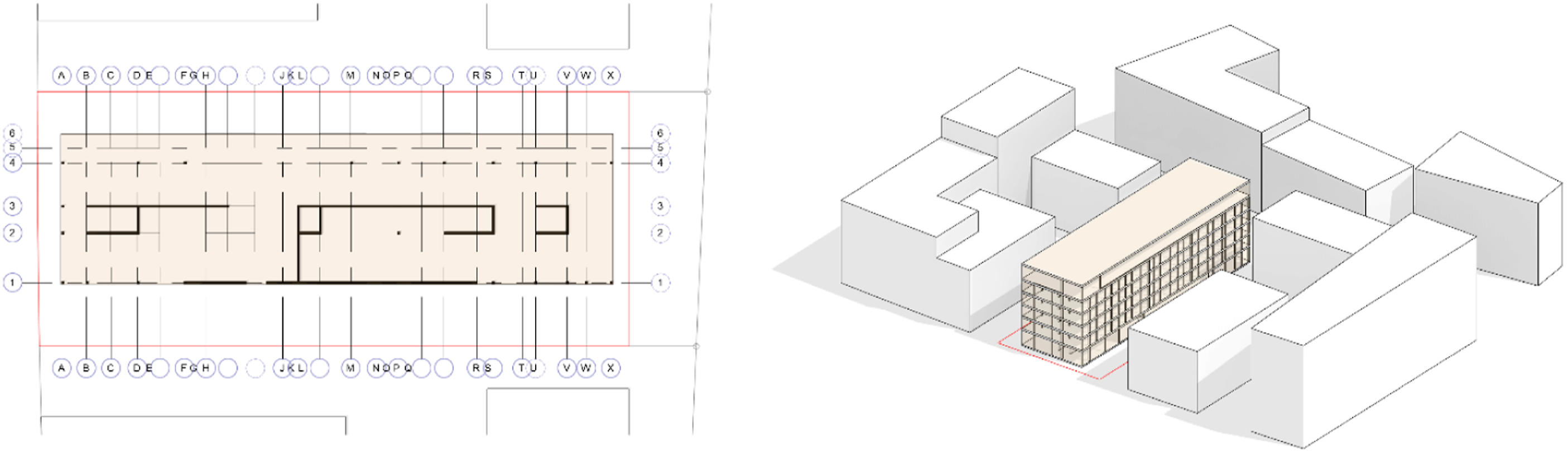
Access modules
The access modules (Figure 13) consist, on the one hand of the elevator core, and, on the other hand, of an arcade. The arcade structure has two variants, characterized by different width. For this purpose, two types of arcades are created and grouped inside Revit, which are created alternately. POC—access modules.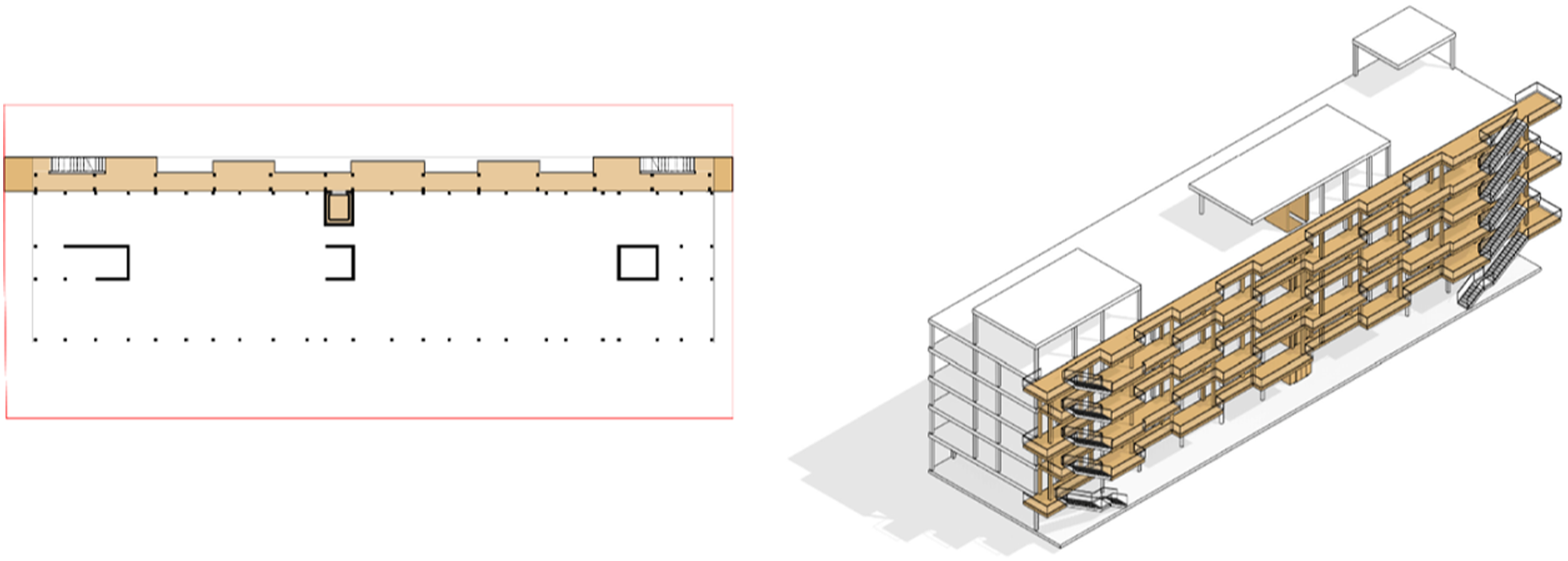
Dwelling units
The dwelling unit types are initially drawn as line floor plans. The interior structure with interior walls, interior doors, and furniture can be adjusted after the execution of the script. The types are generated at their positions based on the data entered in the Excel spreadsheet (Figure 14, left). When the script is executed, all 3D elements are created at the designated positions (Figure 14, right). POC—schematic dwelling units and algorithmically generated dwelling units of the model.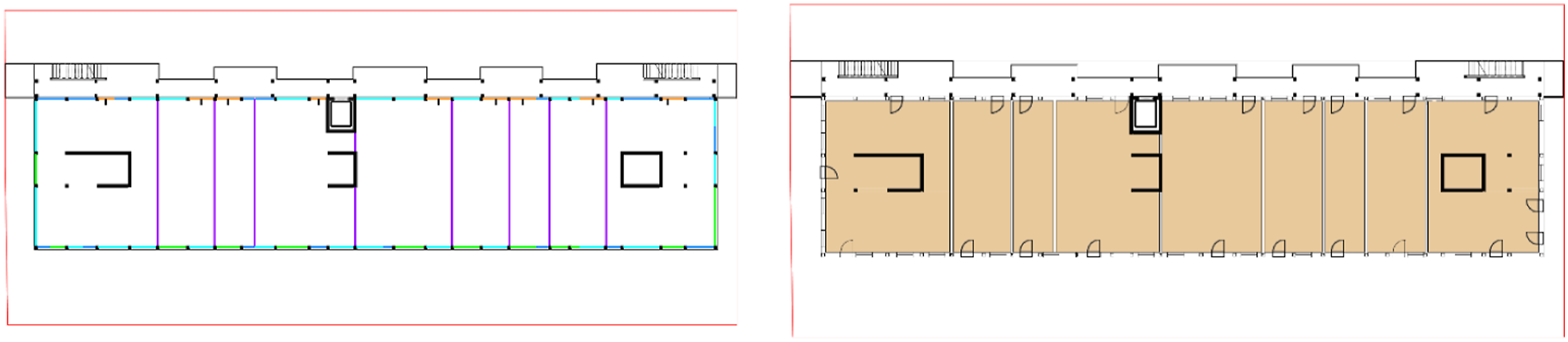
Facade
The majority of the façade (Figure 15, left) has been generated in the course of generating the dwelling unit. The facade elements on the ground floor and the first floor are completed together with the manual additions. POC—facade and balconies (outdoor space).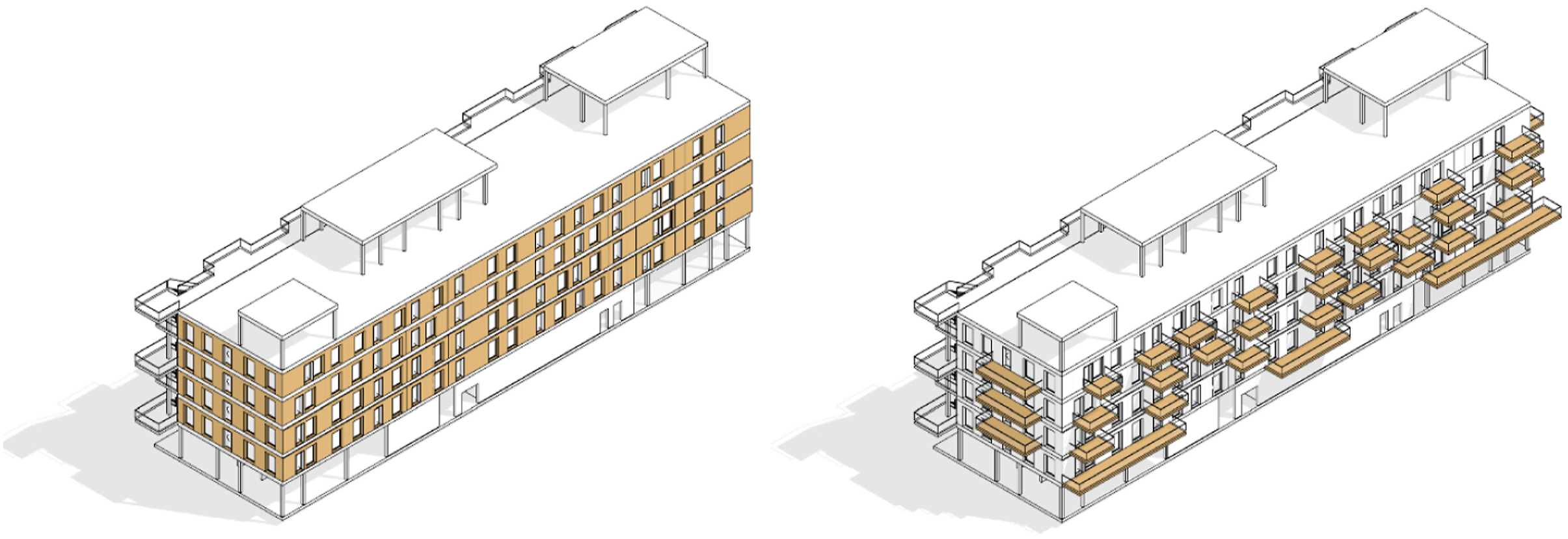
Outdoor space (Balconies)
The balcony elements are generated via the script. However, adjustments have to be made to individual elements. Finally, all private open spaces around the building are modeled algorithmically (Figure 15, right).
Manual additions
Subsequently, the BIM model is supplemented with the manually modeled elements needed to be able to perform the evaluation. In particular, the missing rooms have to be placed inside Revit. on the ground floor, individual walls are added to separate the non-residential areas of the design. On the top floor, the common areas are modeled and the roof terrace is defined accordingly as an open space. In addition, there are two cantilevered ceiling slabs on this floor, which are placed above the balcony elements on the southeast facade. This completes the entire BIM model of the POC (Figure 16). POC—manual additions of components and resulting BIM model.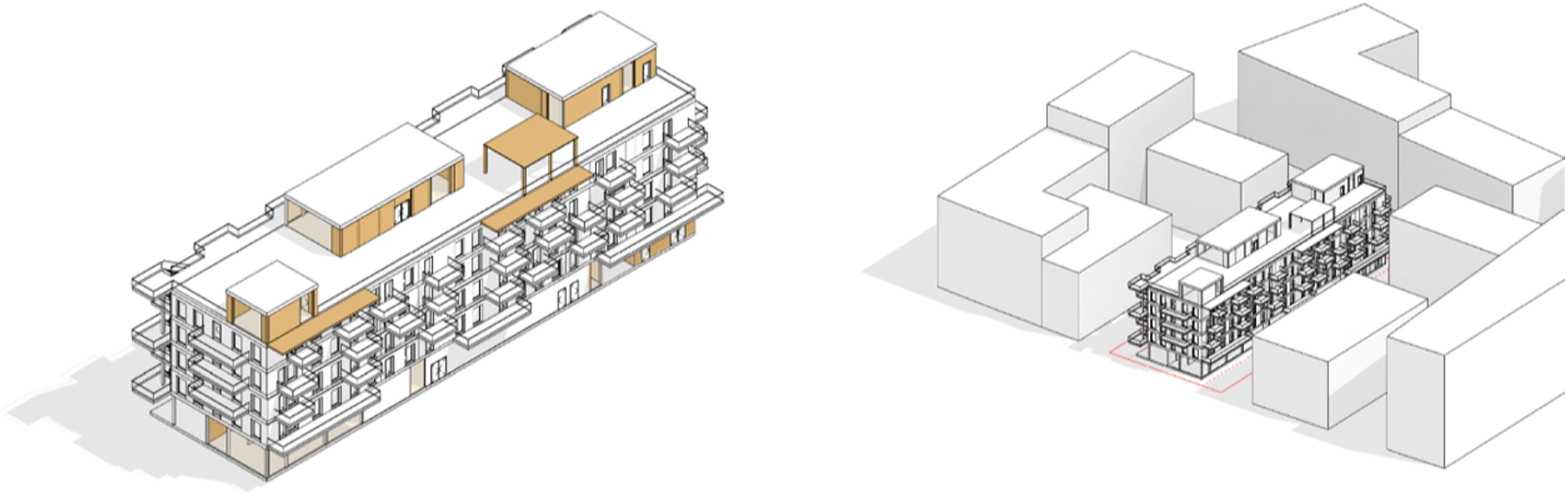
Evaluation of algorithm-aided BIM model
The evaluation during the POC is presented in this section, due to the evaluation criteria area efficiency, energy efficiency, flexibility, and cost, we explore the possibilities of an algorithm-aided evaluation approach within this framework.
Area efficiency
Results of area evaluation. The values of this table are exported from the BIM model and calculated within Excel.
Results of energy evaluation. By calculation, the heating energy demand via the software Archiphysik, the energy classification, and HED are assessed.

Results of flexibility evaluation.
Results of cost evaluation.
Energy efficiency
The energy evaluation has been conducted via an external program (Archiphysik 36 ) for the creation of an energy certificate. This process is not part of the algorithm inside Dynamo or Excel since no direct interface has been available. Within the energy certificate, a value of 12 kWh/m2.a for the heating energy demand is evaluated. This value corresponds to the energy class of A+.
Flexibility
The evaluation of the flexibility is determined via the questionnaire adapted from the TQB system. All questions can be answered positively for this use case. The continuous room height of 2.80 m in 15% of the area could be fulfilled via the usable area on the ground floor and the first floors. The first floor meets the required room height and occupies 13% of the usable area. Together with the usable space on the regular floors (two to four), 22% is achieved. The static dimensioning of the basic construction allows for changes in use. Due to the modular construction non–load-bearing elements are determined as easily replaceable. In terms of expandability, the design of dwelling units is determined as combinable and separable during the life cycle and utility shafts are located on fixed wall components and have reserves for expansion. The evaluation of flexibility achieved 35 out of 35 achievable points.
Costs
The costs are evaluated on the basis of the component lists of the load-bearing structure such as slabs, walls, and columns, which are automatically imported into Excel lists via the evaluation component of the algorithm. The cost group and the expected cost range (min., max. and mean) are to be entered via input fields inside Excel. For the evaluation, values were derived from the BKI 2019. The selected elements correspond to benchmark values.
Discussion
The development of the framework was accompanied by a continuous balancing process between algorithmic generation of elements and manual creation of these elements in Revit. Thereby, the optimization in the design process by algorithmic functions should not represent a limitation of the design possibilities. The housing and development modules are such components that are created in a combination of algorithmic and manual modeling. Due to the various additional functions in the project that need to be performed in addition to the core structure of the apartments and their entrances, an algorithmic process cannot and should not be integrated for them. The percentage of manually created elements in a project should not be so high that an algorithmic design tool becomes obsolete. The optimization of the design process by a tool like the presented framework only yields if the design concept itself contains a modular structure that makes up a large part of the project and in which automation can take place. In the course of the generative process, potentials for optimizing the framework could be identified in various steps. The script created in the course of this research represents a core framework that supports the design process of modular housing and can be extended with additional algorithmic functions for each application.
Reflection
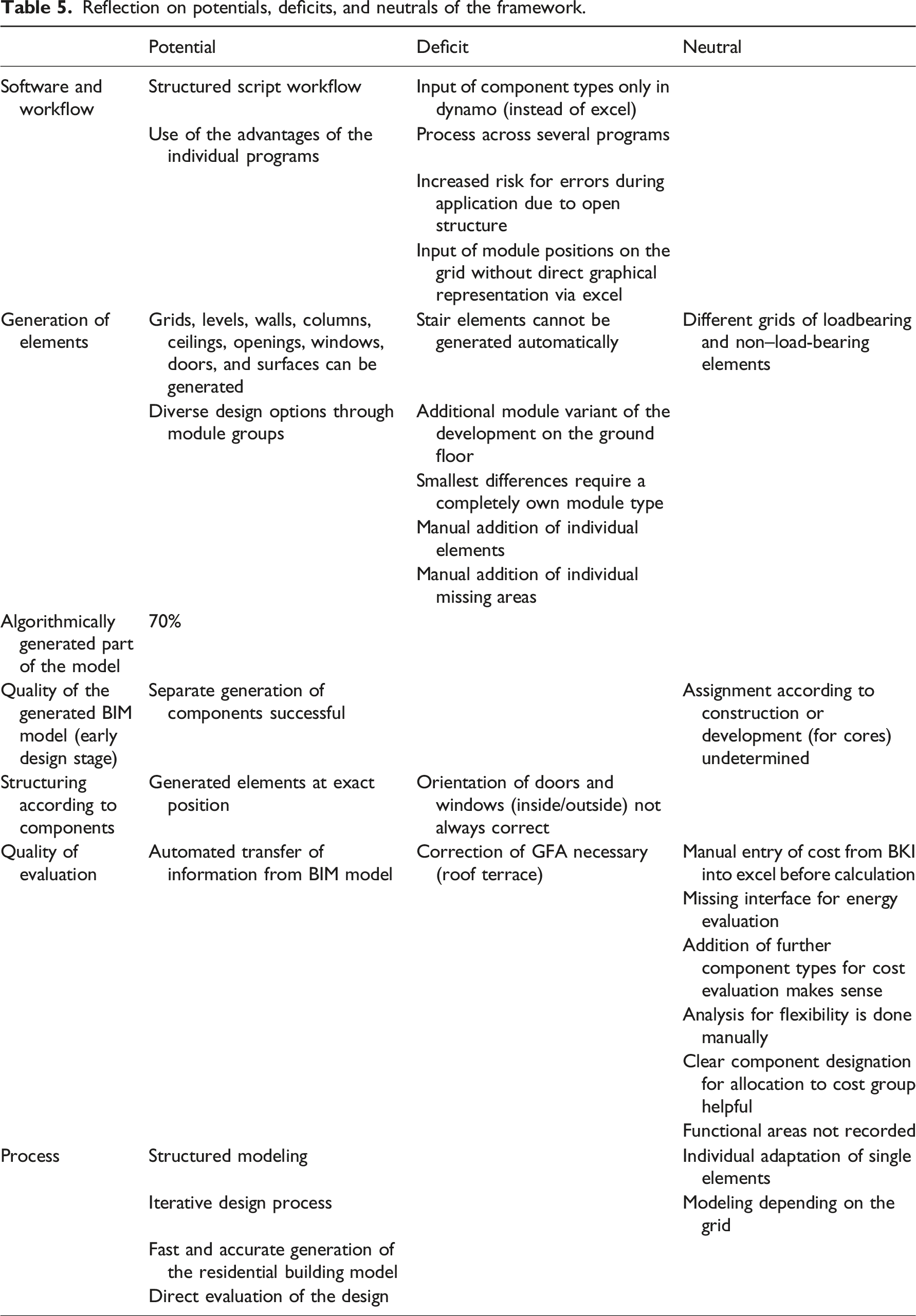
Reflection on potentials, deficits, and neutrals of the framework.
The possible basic shapes that can be created with the framework are limited to cuboid and cube-shaped volumes. The concept could be transferred to other basic shapes as the next step of this study. Instead of the cuboid as the basic volume, other shapes could then also be created. Due to the program structure of Revit, the mass model can be provided with the necessary parameters to adapt the shape and transformed via the script. New basic shapes would also imply new grid shapes that would have to be added accordingly. All processes in the script that depend on the shape of the mass model would be extended by the same process. These shape grammars would allow more extensive use of the framework and increase the design options for the design process.
The manual additions were mainly limited to the non-residential and non-modular floors (ground floor and top floor). The residential floors and the elements of the development could be generated entirely algorithmically. An increased degree of repetition of elements and modules allows for an all the more generative part of the project. In the proof of concept, the design could be generated to a greater extent due to its consistent grid-oriented structure and a higher number of identical elements. In addition, the subdivision of the elements according to the components of the residential building provided a clear advantage in the generation of the model. The order of subdivision allowed the focus to be placed on the load-bearing elements of the building first, and these were later supplemented by more flexible elements. Overall, it was possible to generate a complete BIM model that did not cause any incorrect overlapping of components in the building model due to the exact algorithmic positioning of the individual elements. Only individual balcony modules had to be subsequently moved. Due to the correct modeling of the components, all component and area lists were also correctly and automatically included in the evaluation. A correction of the areas became necessary due to the roof terrace, which is located within the Revit volume but should not be counted toward the GFA. The algorithmic design process thus allowed for structured modeling. By testing the framework, it became apparent that the entire process depends on the basic framework of planes and grids. Therefore, the correct choice of spacing therein is one of the most important decisions in the algorithmic process and in the early design phase of modular designs.
Conclusion
In this paper, we aimed to answer the research question of to what extent the digital platform can be extended by a third component that enables a semi-automated generation and evaluation of information models using a BIM-based and algorithm-aided approach on modular housing. The innovative contribution of this study is the algorithmic components that semi-automate the process of generating and evaluating BIM model variants in an early design stage for modular multi-storey residential buildings. The development of this algorithm-based BIM script, the investigation of the possibilities of algorithmic design in residential construction, and the concrete verification in the context of a proof of concept as a case study allow various conclusions to be drawn about the feasibility of optimizing the design process. In the following, we first summarize the result of the feasibility of AA-BIM with modular residential construction and conclude by presenting the extent to which residential construction can be generated parametrically and algorithmically. Then, a summary of the software and workflow used is given. Is the chosen workflow purposeful? Is the linking of the three programs (Revit, Dynamo and Excel) suitable? Finally, the question of the postulated design process and its limitations is raised and whether the measures taken by AA-BIM lead to a viable design and evaluation process and to what extent this will be explored further in future research.
Algorithm-aided BIM and modular housing
The use of algorithmic procedures in the design of configurable architecture often leads to a discussion about the thereby supposedly limited design variety and architectural qualities. The basic structure, consisting of grid, supporting structure, development, apartments, facade, and open space, is included in every project and can therefore be used as a superordinate set of parameters. It was shown that the developed script can generate a multi-storey residential building from individual modules. These modules can consist of manual configurations (access from drawn modules), be generated by a simplified manual input (apartments from row floor plans), or be completely defined by parameter values (grid, structure, facade, and balconies).
Workflow and software
The combination of Revit, Dynamo, and Excel as a software environment enables a clearly structured flow of all process steps. The linking of Revit and Dynamo fulfills, not least due to the native interface, a seamless data exchange. Code modules, which are available specifically for Revit elements, enable effective intervention in the BIM elements. However, since the position and alignment of the elements are located in a deeper level of Revit, they can only be accessed via the so-called Revit API. In Dynamo, however, it is possible to access and manipulate this content via specially created scripts written in the Python or C# programming language. In Dynamo itself, however, there were frequent errors in the execution of the script, which can be attributed to software that is not fully mature. The import and export modules for Excel available in Dynamo required a new link to the target file before each execution in order to apply the current state. By outsourcing the input fields, the execution of the algorithmic processes can take place in the background while the focus is on Revit and Excel.
Future outlook
Could the integration of AA-BIM into the design process of a modular residential building lead to more efficient design execution? Within the scope of the work, the possibilities of algorithmic design were explained. The evaluation of the design based on the defined criteria enables a direct assessment of the preliminary efficiency and allows comparison of individual variants and with other projects. In an iterative design process, the variables of the parameters are iterated repeatedly, which enables a systematic improvement of the results. The decision to generate certain elements of the design through manual modeling has proven useful in order to be able to implement different concepts and design ideas. The framework also shows that the repetition of elements in the design is not only in the sense of later serial prefabrication, but can also optimize the planning and execution process. Concluding, it should be emphasized that the presented framework represents an exploratory approach for the algorithmic design of BIM-based residential building design. Some of the deficits listed in Table 5 have been studied in a similar context by researchers and providers in the market. As the framework presented in this study is the starting point for our research, we plan to address these deficits in future research and incorporate existing knowledge. Further, in future research, we aim to couple the algorithm-aided framework with an information-rich BIM object library, a property library with building components including superstructures and component-layers, costs and ecological-indicators/life cycle data. Subsequently, this framework will be developed into a comprehensive planning tool through additions and extensions in future research, both in its creation and in its evaluation.
Footnotes
Declaration of conflicting interests
The author(s) declared no potential conflicts of interest with respect to the research, authorship, and/or publication of this article.
Funding
The author(s) disclosed receipt of the following financial support for the research, authorship, and/or publication of this article: Austrian Research Promotion Agency (FFG); 873523.
