



Abstract
This article presents the results of a social marketing campaign to encourage individuals to compost at a university dining facility. Downstream efforts were less effective than desired in changing behavior and instead, changes to patron’s environmental surroundings were instituted, leading to greater impacts. Patrons were first surveyed on their knowledge, attitudes, and stated behaviors and barriers. Cluster analysis revealed three distinct types of composters: “engaged,” “needing assistance,” and “uninterested.” Subsequent interventions were developed, primarily targeting the cluster, needing assistance. Downstream efforts to reach individuals such as modeling the desired behavior and educational interventions were not significantly beneficial. While education showed some encouraging results, a potential diminishing effect overtime was observed. Efforts to change the patrons’ environment were then implemented with changes to the systems of the facility, an individual to ask patrons to compost. A significant increase in behavior was observed. Return on investment and increased public relations were used to leverage this institutional change. Additionally, this campaign created opportunities for securing grants to improve technological infrastructure, further encouraging behavior through additional environmental changes aiming to alleviate barriers of inconvenience. Recommendations for similar campaigns aiming to transition “upward” are provided.
Due to the planet’s limited resource supply, some have argued society’s consumption-based growth is unsustainable (Steffen et al., 2015). According to many scholars, the most effective method of mediating the opposing interests of consumeristic societies and global sustainability is through adequate waste and resource management techniques (Jegatheesan, Liow, Shu, Kim, & Visvanathan, 2009; Legarth, 1996; Ngoc & Schnitzer, 2009; Pasqual & Souto, 2003). Further, human behavior is the driver of most of these environmental issues (DuNann, Winter, & Rogers, 2004; Gardener & Stern, 2002; Steg & Vlek, 2009). It is therefore vital to efforts of global sustainability that researchers and practitioners continue to investigate opportunities for changing human behavior which promote effective waste and resource management techniques.
One area of research receiving increased attention is composting of organic matter. According to the Environmental Protection Agency (2007), the act of composting and using compost has many benefits, specifically enriching soil, retaining moisture, and suppressing plant diseases and pests; decreasing the need for chemical fertilizers; creating humus, a rich nutrient-filled material, by encouraging the growth of beneficial bacteria and fungi which break down organic matter; and reducing methane emissions within landfills, lowering gas production responsible for climate change. Promoting composting behavior has been studied extensively within the household (e.g., Edgerton, McKechnie, & Dunleavy, 2009; Park, Lamons, & Roberts, 2002; Shearer, Gatersleben, Morse, Smyth, & Hunt, 2016; Taylor & Todd, 1995). However, research into promoting composting behavior within a commercial setting has been limited (Hottle, Bilec, Brown, & Landis, 2015). One study relevant to the current research was conducted by Sussman, Greeno, Gifford, and Scannell (2013), investigating the application of behavioral insights on promoting composting at a cafeteria. They report physically modeling the behavior for patrons and providing signage significantly increased composting rates.
Colleges and universities have been leading advocates for composting and other sustainability initiatives (Martin & Samuels, 2012). University campuses have been commonly used as “living laboratories” for behavior change studies. Many of these studies have found convenience to be a major barrier to behavior. For example, Horhota, Asman, Stratton, and Halfacre (2014) report convenience to be a major barrier to college students’ general proenvironmental behaviors. In 2003, Pike et al. discovered giving students recycling bins in their room significantly increased recycling behavior. Some of these studies have applied social marketing insights. One such study by Cole and Fieselman (2013) found convenience of recycling bins increased staff and faculty participation at a U.S.-based university prompted by a community-based social marketing campaign.
However, one important question surrounding influencing proenvironmental behavior at universities is the effectiveness of targeting individuals compared to changing structures and environmental changes. Hastings (2007) uses the metaphor of a river to describe this differentiation where upstream, midstream, or downstream describe where efforts are targeted. Andreasen (2012) defines downstream targeting as focusing on individuals with a “problem behavior.” Midstream interventions target those individuals close to and directly affecting the downstream audience (Lee & Kotler, 2011). For Niblett (2005), upstream “addresses how we change the policies, laws, regulations, and physical environments that can marginalize or render worthless our best efforts at getting individuals to change their behavior if there are too many marketplace or environmental barriers” (p. 14). Importantly, these terms refer to who is being targeted by the social marketer and not the group that will eventually have their behavior changed. To highlight this point, Lee and Kotler (2011) offer the example of social marketers targeting the parents of young adults in an effort to have the parents educate their children on HIV/AIDs prevention. While ultimately the effort is to change risky sexual behavior by teens, the campaign explicitly targets the parents. Since the parent can directly affect the young person’s behavior, and importantly, the parent is targeted and not the teen, Lee and Kotler (2011) considered this a midstream effort. Adding complexity to the understanding of these terms, Newton, Newton, and Rep (2016) find that flows of behavioral influence between “upstream” and “downstream” actors are bidirectional, interactive, and distinctive. They argue for a fluid understanding of how these efforts interact. Additionally, Hall (2016) has argued that effective social marketing campaigns aim to target downstream, midstream, and upstream actors simultaneously.
The current research presents findings from a social marketing campaign aiming to increase composting behavior at a university dining hall with an already established composting program. Through two stages of empirical research, this campaign established that downstream efforts would not be sufficient in reaching program goals and instead a shift toward changing the environments in which patron dine was needed. This article investigates how this process evolved and concludes by providing recommendations for how transitioning could be implemented in other campaigns of similar nature.
Method
Research was conducted in two stages: a survey of patrons and subsequent experimental interventions. As identified by Carins, Rundle-Thiele, and Fidock (2016) and Borden, Coles, and Shaw (2017), social marketing campaigns which rely solely on survey data may be more prone to social desirability bias and the well-documented attitude–behavior gap (Kollmuss & Agyeman, 2002). Social desirability bias refers to the phenomenon of participants responding to a surveyor in a manner in which they believe the researcher would desire. The attitude–behavior gap is the acknowledgment that attitudes do not necessarily lead to actions and therefore stated behavior in surveys is commonly different from actual behavior. To offset these concerns, surveys were used only to direct experiments and not to make concrete conclusions or recommendations for the project.
Data were collected at a university dining hall, which was justified since observations of composting behavior were easily recorded and participants did not know their behavior was being chronicled. The location had an established composting program, though no efforts had been made to promote composting behavior outside of bright and easily viewable signs at the site of collection, informing participants on why and how to compost. The goal of the campaign was to increase the amount of individuals, with compostable materials on their plates, physically putting their leftover food in a bin prior to placing their plates in the cleaning area. Due to a desire to compare results and build upon previous findings, methods from the previously reviewed study by Sussman et al. (2013) were used to inform the current research.
Stage 1: Patron Survey
Surveys were administered to patrons at a university dining hall over a weeklong period. Prior, a small pilot survey (n = 20) was completed to ensure questions clearly conveyed the researchers intentions. The instrument measured demographic information, attitudes toward composting, knowledge of compostable materials in the cafeteria, stated frequency of composting behavior, and stated barriers to said behavior. For consistency, patrons were surveyed during lunch operating hours and selected at random based upon their seat being preselected. A total of 200 surveys were completed; however, after eliminating surveys with missing data points, a final count of 151 were used for analysis. Data were analyzed using SPSS version 22. Data were generally linear, but nonparametric tests were determined to be most appropriate.
French, Blair-Stevens, McVey, and Merritt (2010) acknowledge that segmenting the audience is important in social marketing to better understand and then effectively target specific groups. Cluster analysis is a commonly used statistical method in marketing (Hair, Black, Babin, & Anderson, 2010) and social marketing (Borden, Coles, & Shaw, 2017), which places individuals together into “heterogeneous groups consisting of homogenous elements” (Franke, Resinger, & Hope, 2009, p. 273).
As recommended by Dolnicar, Grün, Leish, and Schmidt (2013), a ratio of 70:1, sample size to number of clustering variables, was applied. Hair, Black, Babin, and Anderson (2010) recommend exploratory cluster analysis prior to determining final protocol. Following their recommendations, through trial and error and those of Dolnicar et al. (2013), two variables were selected. Similar to the efforts by Shaw, Barr, and Wooler (2013) and Dolnicar and Grün (2009), cluster analysis was conducted using attitudes and stated frequency of behavior. Specifically, these questions were measured on 5-point Likert-type scales and asked: “How important is it that this facility compost?” and “When you have left over food, how often do you compost it in this facility each week?”
A two-step procedure was applied in the final analysis where hierarchal cluster analysis determined the number of clusters and nonhierarchal cluster analysis (K-means clustering) placed individuals within the amount of clusters previously determined. This two-step procedure is recommended for discovering clusters with greater parity in membership (Hair et al., 2010; Mazzocchi, 2008). During hierarchal clustering, Ward’s method was used as applied in similar research (i.e., Barr, Shaw, Coles, & Prillwitz, 2010; Borden et al., 2017; Coles, Zschiegner, & Dinan, 2014). As recommended for Ward’s method by Hair et al. (2010), Squared Euclidean distance was applied as the measurement between observations. A dendrogram and the percentage change in heterogeneity were used to determine the number of clusters as recommended by Mazzocchi (2008). The percentage change in heterogeneity revealed clusters were stable as described by Hair et al. (2010). Both clustering variables were significantly different between all three clusters.
Stage 2: Experimental Interventions
Findings from Stage 1 were used to inform Stage 2. Specifically, since researchers determined that Cluster 2 needed assistance, modeling has been shown in previous research (Sussman et al., 2013) to be an effective tool in motivating those with low behavior but moderate attitudes. Since the cluster stated their greatest barrier was “too much of a hurry,” ideas for reducing effort were created with an individual assisting and engaging them being considered a suitable intervention. Further, only a small fraction (5.6%) of those surveyed in Stage 1 could identify compostable material, efforts to educate patrons were chosen as an intervention. This was particularly true of the target audience, Cluster 2. Finally, since patrons stated that a full compost bin was a deterrent, the bin was emptied prior to observational periods to ensure the amount of compost was not an issue and did not affect results.
Composting behavior was observed over a continuous 5-week period from an inconspicuous location to avoid being seen by subjects and potentially altering behavior. Behavior was separated into three main categories (composted, did not compost, and was unable to compost) and the percentage of those composting who were able to do so was determined for each surveying event. Events occurred during operating lunch hours on Monday through Friday to standardize observations. Only two research observers were used for these events, and they spent several days comparing observations to reduce observer bias prior to collecting data.
During the first week, behavior was observed, with no interventions, as a control. During the second week, a researcher in common clothing attempted to model the desired behavior. To do this, the researcher would rise from their table and compost in front of a patron with compostable food on their plate. To reduce variation in this intervention between modeling events, this individual practiced prior to intervening and had a set of rigorous protocol for their actions (e.g., following methods used by Sussman et al., 2013, to the best of their ability, not speaking or making sounds, timing the intervention as similarly as possible in front of the individual[s], not standing in subject’s way to avoid inhibiting their behavior). Despite these efforts, the researchers acknowledge that variations in this intervention may have occurred. Specifically, some subjects may not have seen the intervention and, as such, the researchers acknowledge that this is a limitation to the current experiment. Nonetheless, the intervention was performed with the rigorous protocol for a full week, and composting behavior was observed to compare results with those of Sussman et al. (2013).
For the third week, an educational program was created. During this intervention, brightly colored neon-green trifolds (see Appendix A) were placed on each table. To target Cluster 2, trifolds explained what was compostable (this cluster stated a lack of knowledge as a barrier significantly higher than other clusters); why composting was important (again, this cluster stated composting was not important significantly more than other clusters) and how to compost (aiming to reduce the timing and energy of composting as this cluster stated “too much of a hurry” was their greatest barrier). However, again, the researcher acknowledges this could have been a limitation to the current research. While trifolds were pretested on a small pilot group (15), placed in the middle of small tables, printed on neon-colored paper, and patrons were seen reading them, it is impossible to know to what extent they were read and understood. Despite such limitations, composting behavior was then observed during the week as done in prior experimental events.
In Week 4, an individual was placed at the composting area and directly asked individuals to compost. To standardize this interaction, a guide was provided to the interventionist (see Appendix B). Specifically, this intervention targeted Cluster 2 by directly explaining where, what, and how to compost (all previously identified needs for motivating this cluster). To accomplish this, a change in the operations of the dining hall was required. Researchers were able to work with, and convince, the dining hall to implement a system where an individual is provided a free meal to sit and ask other patrons to participate. This was achieved by presenting managerial staff with calculations of the space that food waste would occupy in the dumpsters and the price of waste management savings from diverting said food waste to a composter. Increased public relations and marketing around sustainability were also attractive propositions for making this change to the facility’s operations. Additionally, researchers needed to establish set communication protocol for “compost ambassadors” to best influencing patrons.
The final week, again, acted as a control where no interventions were implemented. This was done to understand any influence on behavior beyond those observed in real time. Additionally, data obtained in this study were used to apply for grants to buy a new composter which includes a greater diversity of foods (i.e., sauces, bread, meat). However, data have not yet been collected to determine the impact of this change and are therefore not presented herein.
Results
Stage 1: Patron Survey
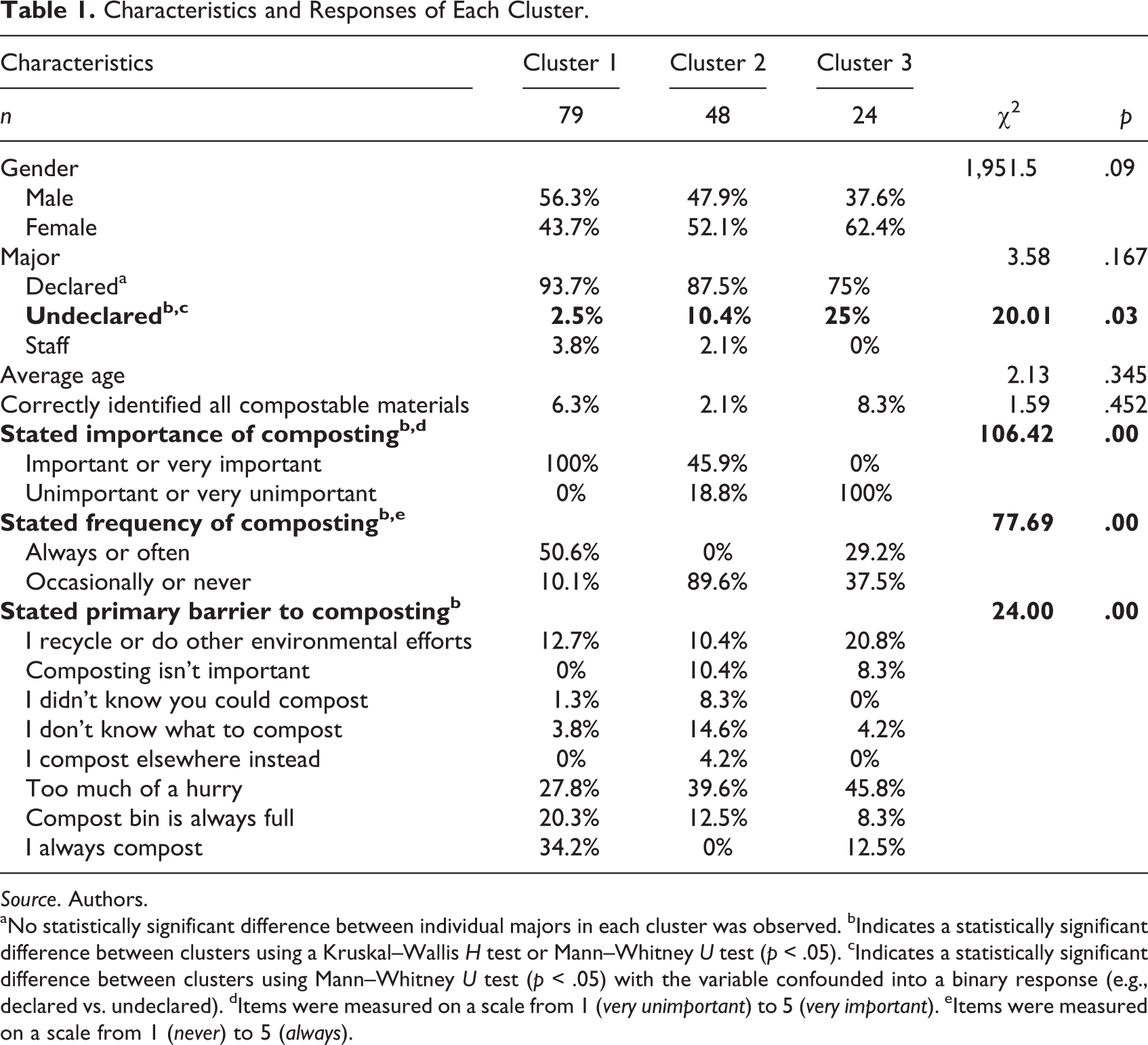
Cluster analysis was performed with three clusters identified (Table 1). Summarizing the largest cluster, Cluster 1 (n = 79) included the lowest amount of students who were “undeclared” in their major, the highest percentage of individuals stating that composting is important or very important (100%) and highest amount of individuals stating they always or often compost (50.6%). This cluster may represent the “most active” individuals, needing only minor prompting to follow out the desired behavior. However, the difference between Clusters 2 and 3 is most interesting. The second largest cluster, Cluster 2 (n = 48), contained the second highest amount of individuals stating composting is important or very important (45.9%); however, it contained the lowest amount of individuals stating they often or always compost (0%) and highest amount of individuals stating they never or occasionally compost (89.6%). Since individuals in this cluster stated a moderate level of importance to composting but very low levels of the behavior, they may be considered most “needing assistance” in completing the desired behavior yet some level of willingness to comply. In contrast, the smallest cluster, Cluster 3 (n = 24), contained the highest percentage of individuals who were undeclared in their major, lowest stated importance of composting (100% stated unimportant or very unimportant), and, relative to other clusters, a moderate level of stated composting behavior (29.2% always or often and 37.5% occasional or never). This extreme level of low stated interest in compost may indicate that this cluster was “apathetic” and therefore the hardest to target. Cluster 2 was determined to be the target audience for the campaign due to their potential willingness to comply and low current stated levels of the behavior. Barriers receiving the highest scores for this cluster were being in a hurry and knowledge of what is compostable. Efforts in the next stage, experimental interventions, therefore aimed to reduce these two concerns.
Characteristics and Responses of Each Cluster.
Source. Authors.
aNo statistically significant difference between individual majors in each cluster was observed. bIndicates a statistically significant difference between clusters using a Kruskal–Wallis H test or Mann–Whitney U test (p < .05). cIndicates a statistically significant difference between clusters using Mann–Whitney U test (p < .05) with the variable confounded into a binary response (e.g., declared vs. undeclared). dItems were measured on a scale from 1 (very unimportant) to 5 (very important). eItems were measured on a scale from 1 (never) to 5 (always).
Stage 2: Experimental Interventions
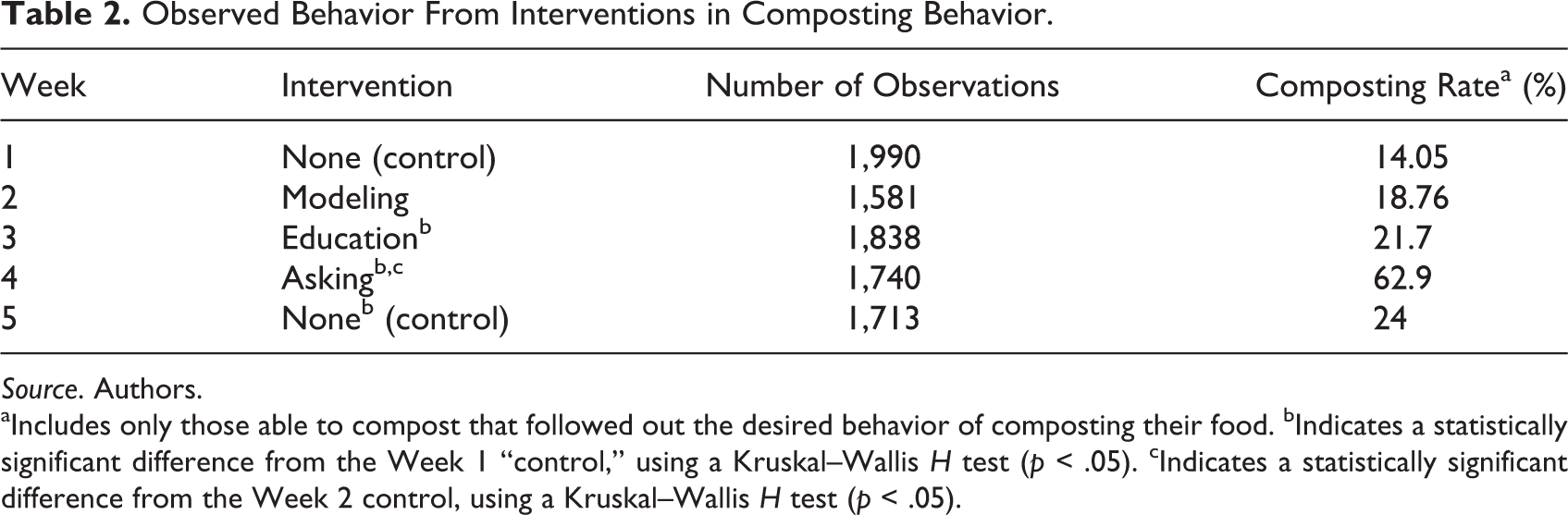
Over the 5 weeks of surveying, a total of 8,862 observations were recorded. Results of each week are presented in Table 2. During the first week of observation, with no interventions, a composting rate of 14.05% was recorded. This participation rate represents a “control” and baseline for comparing other interventions. During the second week, where modeling of the behavior was conducted as an intervention, a composting rate of 18.76% was observed (an increase of 4.71%). However, this was not a statistically significant increase (t = 2.064, p = .108). Week 3, with an educational intervention, yielded a composting rate of 21.7%. This represented an increase of 7.65% from the control and 2.94% increase from the modeling intervention. Interestingly, this increase was statistically significantly greater than the control (t = 4.24, p = .013), however, not statistically significantly greater than the previous modeling intervention (t = 0.383, p = .979). Since the education intervention was not significantly higher than the modeling intervention, it is possible that participation was due to a compounding effect and therefore it is unclear whether education, independently, leads to significantly higher rates than the control. Additionally, as the week progressed with the educational intervention, composting participation decreased on each subsequent day (Monday = 25%, Tuesday = 24.16%, Wednesday = 21.45%, Thursday = 20.65%, and Friday = 17.17%), indicating that the intervention may have had a diminishing return. It is believed that a longer period of observation would be needed to confirm such a reduced effect over time.
Observed Behavior From Interventions in Composting Behavior.
Source. Authors.
aIncludes only those able to compost that followed out the desired behavior of composting their food. bIndicates a statistically significant difference from the Week 1 “control,” using a Kruskal–Wallis H test (p < .05). cIndicates a statistically significant difference from the Week 2 control, using a Kruskal–Wallis H test (p < .05).
The last intervention, an individual asking patrons to compost during Week 4, yielded a composting rate of 62.9%. Note that only 0.2% of the 1,713 observations during this week declined after being asked directly to compost. The lower participation rate, compared to the high willingness to participate if asked (99.8%), was due to an inability to communicate with every individual resulting from the large volume of patrons passing the bin at some points. Therefore, it is likely that these numbers are an underestimation of the potential of this intervention to increase the behavior. Regardless, this composting rate was significantly higher than the control (t = 0.629, p = .01) and rate observed during the educational intervention (t = 0.217, p = .02) and therefore was considered to have a statistically significant rise in composting behavior.
During the final week, a second control with no interventions, a composting rate of 24%, was observed. This was significantly less than the previous intervention of someone asking to participate (t = 3.59, p = .02) and significantly more than the first control (t = 5.02, p = .01). This indicates a need for continuing this intervention (asking patrons to compost each day) to ensure rates remain high. However, it also indicates that the efforts of the campaign had some effect a week after intervening was completed. Finally, it is also important to note that the amount of composting incorrect items was recorded and that no changes between weeks were observed.
Discussion
This campaign aimed to substantially raise composting rates. However, the rates and concerns over potential diminishing returns on modeling behavior and education suggest downstream efforts, solely targeting the individual patrons, were not sufficient in reaching the project goals. While Sussman et al. (2013) reported a significant increase in composting rates from modeling and signage, note this was different from the education efforts applied in this research justified as education was determined as a barrier in Stage 1; here, we found no significant increase in composting rates from these interventions. Instead, we found that an individual was needed to sit at the composting bin and ask patrons to participate. Although we would also agree with Hall (2014) that successful campaigns interact with their target audience through multiple efforts. It may therefore be prudent to try modeling, education, asking, and other untested efforts to increase the likelihood of positive outcomes.
Here, the researchers consider adding an individual near the compost bin and securing grants for purchasing new technologies, “upward” transitions because they require changes to the systems of the facility though targeting a new audience. As the campaign transitioned, out of necessity, to change the environment in which patrons behaved, it became essential to target managerial decisions and compost ambassadors. Lee and Kotler (2011) identify midstream agents include those individuals close to and directly affecting the downstream audience. While these efforts still target downstream agents (e.g., patrons at the cafeteria), they shifted to also include working with and messaging to midstream agents (e.g., managers of the cafeteria and compost ambassadors). Newton et al. (2016) argue that these are not mutually exclusive efforts and are instead interconnected. We concur and, as such, consider these transitions as moving upward along a continuum with downstream and upstream at opposite ends of the spectrum.
These upward efforts aim to reduce the barriers identified in Stage 1, specifically, increasing convenience. Our results suggest that by adding an individual to answer questions about what is and is not compostable and asking for compliance, composting rates will rise substantially and campaign goals will be met. This supports findings by Sussman et al. (2013) that prompts are effective in encouraging this behavior. While no data have yet been collected on the results of implementing new technology in this dining facility, due to the new composter only recently being secured, researchers believe that its addition and subsequent alleviation of the barrier of convenience will be successful. Said another way, increasing convenience to promote proenvironmental behavior in home composting programs (i.e., Taylor & Todd, 1995; Park et al., 2002; Edgerton et al., 2009; Shearer et al., 2016) and at universities (i.e., Pike et al., 2003; Cole & Fieselman, 2013; Horhota, Asman, Stratton, & Halfacre, 2014) has been consistently recommended and appears to be a productive intervention here.
As a result of these findings, it is recommended that campaigns of similar nature, needing to transition upward, concentrate on similar strategies for leveraging midstream agents. However, it is also recommended to first evaluate the success of downstream efforts to ensure such a shift is necessary. If downstream efforts are determined to be insufficient, opportunities for cost savings, technological implementations, and increased public relations for third-party partners are areas for leveraging upward opportunities when pursuing larger structural and environmental changes. Each campaign will have unique circumstances and opportunities for shifting upward. This project is meant to provide an example of opportunities within its unique situation and may not be applicable in other contexts. Further research is needed to explore the nuances to such transitions. Such research should concentrate on different behaviors and locations to add to the overall understanding of this type of transition.
Conclusion
Downstream efforts in this campaign (modeling and educational trifolds) resulted in modest increases in composting behavior which did not reach project goals. When changes to the systems of the dining hall were implemented, the addition of an individual to ask for participation, a significant increase in composting rates was observed. Previous estimations of the savings realized through reducing food waste to enter the waste stream were used to institutionalize an individual to ask patrons to compost. Additionally, data from this research have been used for a grant to purchase a composter which accepts a wider range of food, reducing barriers of convenience and reducing time needed to compost which would alleviate the highly reported barrier of being in a hurry. Researchers considered these upward transitions, as they change the systems and environment in which individuals behave and need messaging to midstream agents. It is recommended that campaigns, of similar nature, needing to transition upward, first examine data on the effectiveness of downstream efforts to ensure whether such an evolution is needed and prudent. If they are judged to be insufficient, concentrating on opportunities for cost savings, technological implementations, and increased public relations for third-party partners are areas for consideration.
Footnotes
Appendix A
Appendix B
Acknowledgment
The authors wish to thank Western State Colorado University students Collin Burger and Jake Wener for their technical support.
Declaration of Conflicting Interests
The author(s) declared no potential conflicts of interest with respect to the research, authorship, and/or publication of this article.
Funding
The author(s) received no financial support for the research, authorship, and/or publication of this article.
