



Abstract
While there is increasing attention on sexual violence in the military, the focus has been primarily on women. There is very little information regarding the effects of and treatment for men who experience military sexual trauma (MST). The aim of this article is to consolidate the known information about men with MST including prevalence rates, factors that affect those rates, gender differences, medical and psychiatric sequelae, and finally a review of two experimental studies. Implications for future research, practice, and policy are also discussed.
Sexual violence in the military is receiving increased attention within academic, research, and clinical circles, yet there remains an enormous amount of work to be done in regard to understanding sexual trauma perpetrated against men; most of the published research focuses on women. Pinpointing the prevalence of male military sexual trauma (MST) is difficult due to many factors including stigma and underreporting. Dissimilarity among research methods and different definitions of MST also contribute to the lack of clarity in prevalence (Suris & Lind, 2008). There is also very little information available about the psychiatric consequences of MST in men. While there is a growing body of research regarding women with MST, studies on men with MST remain sparse.
The purpose of this article is to provide a review of the available information on male veterans who have experienced MST. First, definitions of MST are explored along with the effect of different assessment methodologies on outcomes. For comparison purposes, civilian and military prevalence rates of sexual trauma are then presented. Gender differences related to sexual trauma are explored including some clinical observations about veterans with MST. The literature on medical and psychiatric sequelae specific to men with MST is reviewed, and finally two noncorrelational studies are reviewed in more depth. Of note, civilian information on sexual trauma in men is also presented when relevant.
Defining Sexual Assault and MST
The terms “rape,” “sexual assault,” “sexual trauma,” and “sexual harassment” are often used interchangeably in the literature and frequently not differentiated or defined, causing confusion. The reader does not know, for example, whether terms like “trauma” and “victimization” include physical violation or harassment only. Lack of uniformity is not just limited to literature. In a report by the Naval Inspector General (2004), the findings describe how Naval personnel display considerable confusion between the terms “sexual harassment” and “sexual abuse.” This ambiguity can lead to reduced accuracy of prevalence rates of MST. Indeed, Suris and Smith (2011), recommend that the Veterans Affairs (VA) itself better refine its own MST screening process to report rates of harassment and sexual assault separately instead of combining them.
Adding to the problem is that over the years, the definitions of “rape,” “sexual assault,” “sexual trauma,” and “sexual harassment” have changed. Some of the more commonly and currently used definitions for these terms follow. According to the National Women’s Study by Resick (1993), sexual assault is defined as any type of sexual conduct, including vagina, anal, or oral sex achieved or attempted without the person’s consent and with the use of threat or force. Resick also defines sexual harassment as uninvited and unwanted sexual advances, physical contact, verbal comments, and/or similar behavior of a sexual nature, for example, jokes or references to body parts. As of January 6, 2012, Attorney General Eric Holder provided a new definition of rape, which is “the penetration, no matter how slight, of the vagina or anus with a body part or object, or oral penetration by a sex organ of another person, without the consent of the victim” (Federal Bureau of Investigation, 2012, January 6), which will be added to the Uniform Crime Reports for 2012 (Federal Bureau of Investigation, 2012).
According to the Department of Veterans Affairs (2004), MST is defined as “sexual harassment that is threatening in character or physical assault of a sexual nature that occurred while the victim was in the military, regardless of geographic location of the trauma, gender of victim, or the relationship to the perpetrator.” Sexual activity against one’s will as well as ongoing, threatening harassment are both part of their definition of MST. This definition also includes being coerced or pressured into sexual acts. Perpetrators can be male or female, known or unknown, superior or subordinate, or military or civilian. According to Hyun, Pavao, and Kimmerling (2009), sexual assault and sexual harassment are classified together under the same rubric because MST is thought of as an occupational hazard. For purposes of this article, MST refers to unwanted physical or verbal contact of a sexual nature that occurred in a military setting; sexual trauma is defined as any attempted or completed sexual assault.
Of note, MST by definition is sexual trauma that occurs while on active duty. Thus, MST can be examined in a veteran population who has already been discharged as well as an active duty population. Therefore, the traumatic event of interest does not change; the actual time when it is assessed is what varies—while on active duty or after active duty (veteran).
Civilian and Military Prevalence of Sexual Trauma
Issues With Prevalence Estimates
Precise estimates of the rates of sexual assaults of military men are hard to pinpoint with certainty for many reasons. Inconsistency in how MST is defined and assessed, lack of uniformity in how samples were selected, low rates of reporting, and unique characteristics of the military environment all contribute to inconsistency in reported prevalence rates.
First, the rates differ from study to study depending on various methodological issues, most notably, how sexual assault is defined and assessed (Suris & Lind, 2008; Elliott, Mok, & Briere, 2004). For example, in some studies, sexual assault includes verbal harassment as well as physical violation. In other studies, sexual assault is defined as physical violation exclusively. Suris and Lind (2008) and Hoyt, Rielage, and Williams (2011) outline various articles reporting on the prevalence of MST and identify the considerable variance in MST definitions and incidence.
Second, divergent methods for selecting subjects across studies due to the purpose of the study also contribute to variations in estimates of prevalence (Hyun, Pavao, & Kimmerling, 2009). For example, Lipari, Cook, Rock, and Maton (2008) reported on active duty men (1.8% reporting unwanted sexual contact), while Murdoch, Polusny, Hodges, and Cowper (2006) reported on those male veterans who sought disability at the VA (4% reporting in-service sexual assault). Not only are these rates quite different but not all veterans seek medical care at VAs which may be one reason for the differences in the prevalence rates. Relatedly, the only two noncorrelational peer-reviewed studies on male MST focused on different samples, treatment-seeking veterans versus active duty recruits at boot camp, leading to differences in reported rates (O’Brien, Gaher, Pope, & Smiley, 2008; Shipherd, Pineles, Gradus, & Resick, 2009). See Suris and Lind (2008) and Hoyt et al. (2011) for a comprehensive review of issues affecting MST prevalence rates.
In addition, low rates of reporting a sexual assault may contribute to the problem of discerning exact numbers. Because it is estimated that only 16% of rapes that occur in the United States are officially reported, it is probable that there are many more military male victims than is known (Department of Veterans Affairs, 2005). According to Rock, Lipari, Cook, and Hale (2010), 85% of military men who reported having unwanted sexual contact did not make any official report at all. The majority of men (43%) stated that they did not want anyone to know about it. In addition, some men reported that they did not think their report would remain confidential (36%), while others stated that they feared retaliation (27%). For both genders, and for military and civilian populations, shame, fear, and embarrassment inhibit reporting (Tewksbury, 2007; Valente & Wright, 2007). However, research has demonstrated that men have additional concerns that hinder reporting of these experiences. Kakhnovets and Holohan (2007) indicated that the firmly established masculine stereotypes such as “men should be able to protect themselves,” “male rape only happens in prison,” and “only homosexual men are raped,” can decrease the likelihood of reporting the assault. The authors also suggested these myths may be even more common in the military. The data provided by the Office of Naval Inspector General (2004, p. 29) reported that all-male crews believed that sexual assault awareness programs were not needed because “things like that do not happen in an all male crew.” Furthermore, this report emphasized that military men believe they will not be viewed as traditional, strong men if they were to report a sexual attack because they perceive a male assault victim as weak or vulnerable. These perceptions do not sit well with the hypermasculine environment of the military where males are expected to be strong, valiant warriors.
Among the general public, there are differing views of male victims of sexual assault (Davies, 2002). Less sympathy is generally attributed to males; and many see rape as less severe for men. Davies (2002) suggests that fear of these negative reactions may prevent males from coming forward.
Additional unique issues surrounding the military environment may also contribute to low reporting rates. For example, unit cohesion may prevent military personnel from reporting MST (Kimmerling, Gima, Smith, Street, & Frayne 2007; Suris & Lind, 2008). This may be due to the fact that he may be seen as betraying his unit if he reports who assaulted him and they are in the same unit. In addition, unlike civilians who experience sexual assault, military personnel may be forced to continue working with perpetrators, who may be coworkers or supervisors. Transfer to other jobs may not be a readily available option for those in the military. Additionally, there is a fear that one’s military career would be negatively impacted by any type of sexual assault report (Naval Inspector General, 2004). A combination of these issues most likely contributes to potentially low reporting rates in the military (Frayne et al., 1999; Kimmerling et al., 2007; Suris & Lind, 2008). Indeed, it has been suggested that roughly 66% of MST incidents are not officially reported (Office of Naval Inspector General, 2004).
Furthermore, Frayne et al. (1999) describe some additional idiosyncratic characteristics of the military that might decrease the likelihood that women will report MST, such as the assailant’s access to firearms and the military’s unique legal system. These issues that can lessen reporting of MST in the military also contribute to increased severity of symptoms and limited support for military personnel (Frayne et al., 1999). While specifically reported as mediators of MST reporting in females, it is reasonable to expect that these concerns could also apply to male victims of MST.
Estimated Prevalence Rates
Even though there are shortcomings related to the reported prevalence rates, estimates can provide valuable information. For example, a national report on violence estimates that roughly 1 in 33 civilian men (3%) in the United States has been the victim of an attempted or completed sexual assault at some time in his life (Tjaden & Thoennes, 2000). Tewksbury (2007) provides estimates that from 3% to 8% of civilian men in the United States have suffered trauma as a result of sexual assault. Regarding military men, recent reports focus on either active duty personnel or veterans seeking VA compensation for MST. In the 2006 Gender Relations Survey of Active Duty Service Members, Lipari et al. (2008) reported that the annual prevalence of sexual assault of active duty men was 1.8%. In this survey, 66% experienced unwanted sexual touching; 26% experienced attempted oral sex, anal sex, or object penetration; and 12% of the men experienced completed oral sex, anal sex, or object penetration. The 2010 Gender Relations Survey of Active Duty Members (Rock, Lipari, Cook, & Hale, 2010) reported that 0.9% of men experienced unwanted sexual contact. Of the men in this survey, 31% reported that the most deleterious experience was unwanted sexual touching; 11% reported that they experienced attempted sexual intercourse, anal sex, or oral sex. Within the VA, Murdoch et al. (2006) found the rate of MST in male veterans seeking VA disability benefits for posttraumatic stress disorder (PTSD) to be 4%.
A formal screening process for MST within the VA system was instituted in 2002. By the end of the fiscal year 2009, 6.8 million veterans had been screened. This included veterans attending appointments at VA Medical Centers as well as veterans attending appointments at VA Community-Based Outpatient Clinics (CBOC; Department of Veterans Affairs, MST Screening Report, 2010). Specifically, the rates of veterans endorsing MST at VA Medical Centers were 2.3% (100,095) with 21.9% (53,295) of women endorsing MST and 1.1% (46,800) of males endorsing MST. These rates include newly screened veterans for the fiscal year 2010 in addition to veterans screened between the years 2002 and 2010. The CBOC rates were comparable, with an overall MST rate of 2.1% (47,858). Among women, 21.5% (24,454) endorsed MST, and among men, 1/1% (23,404) endorsed MST. Because there are 20 times more men than women in the VA system, there are approximately equal numbers of men and women who screen positive for MST (Department of Veterans Affairs, 2010). However, these rates include both harassment and assault. Thus, the actual rates of sexual assault in men who access care at the VA are not known (Suris & Smith, 2011).
Gender Differences
While the information provided below is not a thorough comparison of gender differences, it is intended to underscore some of the unique aspects of male MST. There are similarities and differences in how civilian males and females respond to sexual assault that can inform our understanding of men with MST as well. For instance, among civilians, females and males who are sexually assaulted tend to have difficulty trusting others (Kakhnovets & Holohan, 2007). Both men and women experience increased feelings of shame and vulnerability (Calderwood, 1987; Kakhnovets & Holohan, 2007). In addition, sleep patterns and interpersonal relationships are both disrupted (Kaufman, DiVasto, Jackson, Voorhees, & Christy, 1980). However, for civilian men, there tends to be a higher rate of psychiatric symptoms (41.2% vs. 11.3% for women), psychiatric hospitalizations (51.7% vs. 17.9% for women; Kimmerling, Rellini, Kelly, Judson, & Learman, 2002), and reported distress (Elliott et al., 2004; Tewksbury, 2007). Among civilians, men with sexual assault histories tend to be more likely than women to report alcohol abuse (Burnam et al., 1988; Coxell, King, Mezey, & Gordon, 2000; Ratner et al., 2003). Although these findings describe nonmilitary populations, they may help increase our understanding of how men in the military may respond to sexual assault.
Masculine stereotypes that may limit reporting of sexual assault have been shown to impact the subjective experiences of shame. It is hypothesized that while both men and women may feel shocked, horrified, and disgusted after a sexual assault, men may feel increased shame, shock, and humiliation related to their belief that rape can only happen to women (Kakhnovets & Holohan, 2007). Davies (2002) reports that negative attributions occur in male victims that exceed those expected for most other victims of sexual assault. Specifically, the traditional view of males is one of power and sexual assertiveness or domination; thus, most men never even consider that they can be raped.
Also, after an assault, most men blame themselves intensely and wonder why they could not have overpowered the assailant and prevented the assault. Civilian men, unlike women, tend to question their sexual identity after a sexual assault, wondering if their masculinity has been impacted (Davies, 2002; Kakhnovets & Holohan, 2007; Tewksbury, 2007). Shame and fear of potential homosexuality, along with questions about manliness, are concerns unique to males (Davies, 2002; Tewksbury, 2007). Kakhnovets and Holohan (2007) also explain that some men report ejaculation during a sexual assault (which can be a common physiological response), adding additional layers of confusion and disgust.
In addition, men tend not to report and thus they tend to be more isolated from sources of help and support than females in the aftermath of sexual assault (Kakhnovets & Holohan, 2007; Scarce, 1997; Tewksbury, 2007). Relatedly, Foa, Zinbarg, and Rothbaum (1992) reported that more detrimental sequelae are associated with stress that is unpredictable and uncontrollable. As such, the impact of MST on men’s health may thus be greater (Shipherd et al., 2009).
Research data suggest that, as compared to women, civilian men are more likely to have had multiple assailants or to have been assaulted by an authority figure (Kakhnovets & Holohan, 2007; Kaufman et al., 1980; McLean, Balding, & White, 2005). In order to survive such attacks, the need to remain submissive or frozen may be lifesaving. This may be particularly difficult for men to grapple with later, as they expect to be able to defend themselves in any situation through use of force or raw strength (Rentoul & Appleboom, 1997). It has been discussed previously that there is an importance of physical strength and power in the military; thus, MST may be particularly damaging to military men, leading to intensified effects of sexual assault (O’Brien et al., 2008).
Medical and Psychiatric Sequelae of MST in Men
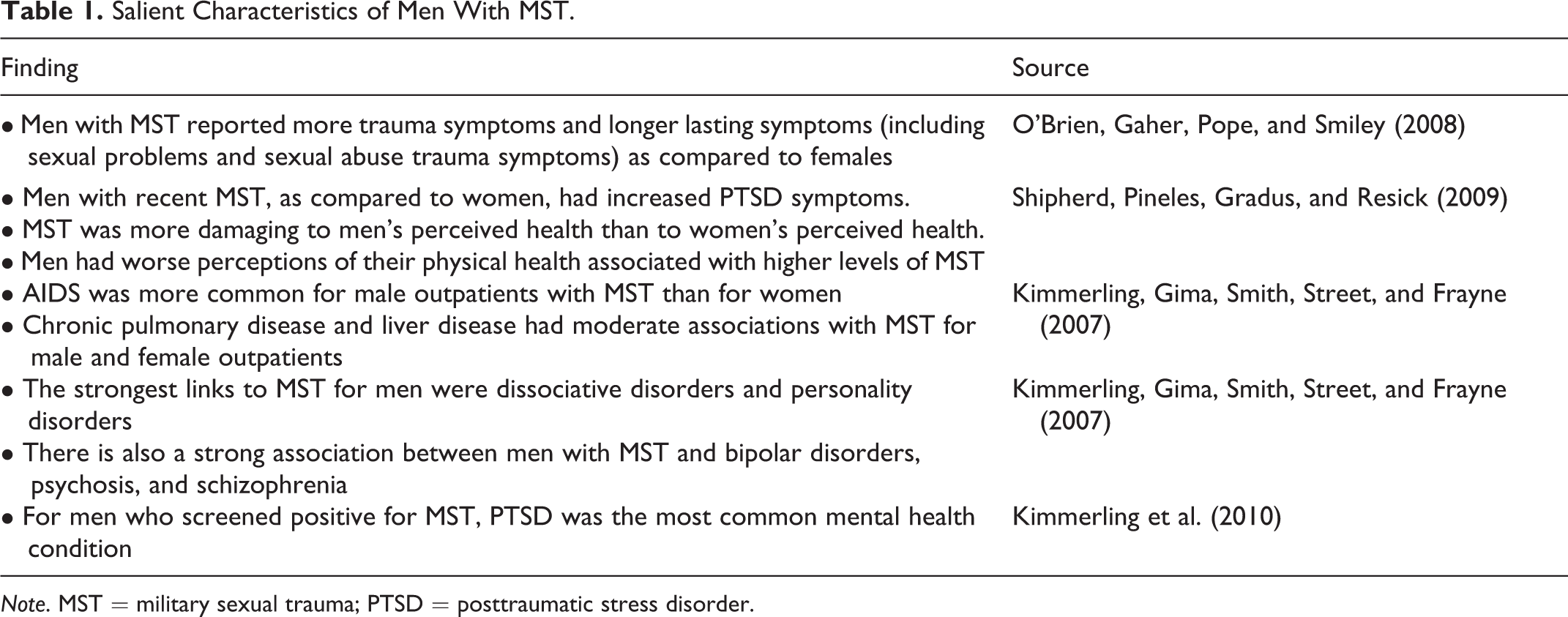
Research indicates that there are both medical and psychiatric consequences related to MST; however, there is very little data available specifically regarding men. For example, medical conditions such as chronic pulmonary disease and liver disease have both been shown to have moderate associations with MST for male and female outpatients who screened positive for MST (Kimmerling et al., 2007). In addition, AIDS was more common for male outpatients with MST than for women (Kimmerling et al., 2007). Most recently, Turchik et al. (2012) reported that, as compared to men without MST, men with MST were more likely to have certain sexually transmitted infections (e.g., syphilis and herpes, as well as HIV/AIDS) and sexual dysfunction disorders (e.g., sexual desire disorder and sexual arousal disorder). Further research is needed in this area to more fully delineate the associations among specific health conditions and MST, as this research is correlational in nature and therefore limited in its usefulness.
Other correlational studies have found that as compared to individuals without MST, individuals with MST have a 2–3 times greater likelihood to have a mental health diagnosis, with the most common being PTSD (Kimmerling et al., 2007; Kimmerling et al., 2010). Kimmerling et al. (2007) indicated the conditions with the strongest associations to MST for men were dissociative disorders and personality disorders. Additionally, for male veterans, there was a significantly stronger association between MST and bipolar disorders, psychosis, and schizophrenia, than in females with MST. Among veterans returning from Iraq and Afghanistan specifically, Kimmerling et al. (2010) reported that for men who screened positive for MST, PTSD was the most common mental health condition (52.5%), followed by depressive disorders (46.6%). However, no information is provided regarding experienced traumas while deployed, which could include combat. Therefore, causality cannot be inferred from this study. There are very few studies examining the psychiatric consequences of MST in male veterans specifically. Those that are available are correlational and thus limited in their usefulness.
Review of Male MST Experimental Studies
To date, there have only been two known peer-reviewed studies that provide noncorrelational information on (and insight into) men with MST. See Table 1. The first, by O’Brien, Gaher, Pope, and Smiley (2008), examined alexithymia and its relation to persistent trauma symptomatology among male and female veterans with MST in a residential treatment program. Alexithymia is defined as inability to label, understand, and process feelings. Since the ability to process trauma-related emotions is essential in exposure-based PTSD treatments, any difficulties identifying and describing emotions is thought to have deleterious effect on treatment. The researchers specifically examined what impact alexithymia had on treatment outcomes, including Trauma Symptom Checklist-40 (TSC-40). The TSC-40 is a 40-item self-report instrument that measures six aspects of posttraumatic stress and other symptoms found in some traumatized individuals: Anxiety, Depression, Dissociation, Sexual Abuse Trauma Index (SATI), Sexual Problems, and Sleep Disturbance. Several pertinent findings were delineated. First, men with MST reported more trauma symptoms than women at baseline. These trauma symptoms included sexual problems (such as low sex drive or not enjoying sex) and Sexual Abuse Trauma Index symptoms (such as fear of men or bad thoughts during sex). Second, men exhibited longer lasting symptoms (including sexual problems and sexual abuse trauma symptoms) as compared to females. Third, O’Brien et al. (2008) also reported that men and women did not differ significantly on scales that measured alexithymia, suggesting that this condition may be specifically related to the trauma and not a preexisting circumstance.
Salient Characteristics of Men With MST.
Note. MST = military sexual trauma; PTSD = posttraumatic stress disorder.
Shipherd, Pineles, Gradus, and Resick (2009) examined surveys that were mailed to male and female Marines with recent MST (previous 6 months). Data for this research were gathered from a larger study of 1,847 Marine recruits who arrived at boot camp in 1997. Marines (317 total: 226 women and 91 men) who identified themselves as experiencing MST in the last 6 months were included as participants. The sample was then reevaluated 21 months later with a mailed survey. The primary measure utilized was the Sexual Experiences Questionnaire-Department of Defense (DoD) (Fitzgerald, Magley, Drasgow, & Waldo, 1999), which was administered upon arrival at boot camp and then again 21 months later. This instrument was used to designate four types of MST: gender harassment sexist hostility, gender harassment sexual hostility, unwanted sexual attention, and sexual coercion, creating an MST index score. While both men and women had declines in their perceived physical health after MST, men had worse perceptions of their physical health associated with higher levels of MST. See Table 2 for a comparison of these two experimental studies.
Comparison of Experimental Studies.

Note. MST = military sexual trauma; VA = Veterans Affairs.
Of note, as described above, the divergent ways in which MST is measured and defined may cause inconsistencies when interpreting and comparing findings. In the Shipherd et al. (2009) study, participants with MST included those who experienced sexual coercion as well as those who experienced harassment, such as being “whistled” at. In the O’Brien et al. (2008) study, participants with MST were defined as those who had admitted MST, had current PTSD symptoms, and were about to enter a specialized residential treatment program for PTSD secondary to MST; it is unclear if they included sexual harassment and/or sexual assault in their definition. Lack of uniformity across subject samples makes generalization of these findings problematic. In addition, these two noncorrelational studies did not use a gold standard instrument (e.g., Clinician-Administered PTSD Scale (CAPS)) for diagnosing and assessing frequency and severity of PTSD symptoms, thus presenting another obstacle to comparing PTSD symptom severity between studies.
Conclusion
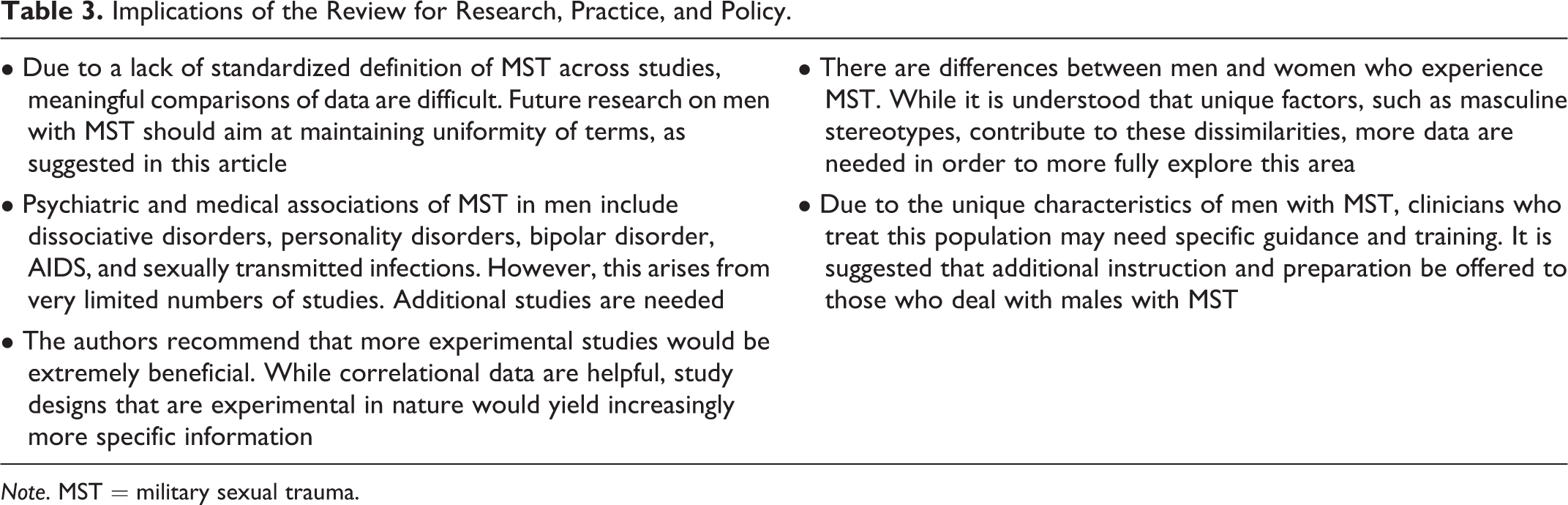
The VA system has recognized the need to address MST and as such has implemented screening processes and treatment options. According to VA data and a recent review by Hoyt et al. (2011), approximately the same number of men and women report experiencing MST while on active duty, yet most of the published literature on MST is focused on women. The authors examined multiple articles and studies for this article which examined various important issues surrounding men and MST. A summary of these issues along with recommendations follow below. Implications of this review for research, practice, and policy are outlined in Table 3.
Implications of the Review for Research, Practice, and Policy.
Note. MST = military sexual trauma.
Problems defining sexual assault, sexual trauma, and MST were reviewed. There is lack of uniformity among all of these terms, which makes comparing results across studies problematic. Imprecise definitions of MST lead to problems in accurately identifying prevalence rates. Additional issues contributing to unclear prevalence rates include assessing different populations (active duty, treatment seeking, veteran, recruits), low rates of reporting MST, and unique military factors. The authors suggest that in the future, utilizing standard terminology to define MST, such as the definition used in this article, will allow for not only more precise measurements of the estimates of MST but also for informative comparisons of results across studies. The recommended definition of MST is “unwanted physical contact of a sexual nature or repeated, threatening verbal contact of a sexual nature that occurred in a military setting that is traumatizing.”
It is well established that sexual trauma, including MST, leads to medical and psychiatric sequelae. However, there is limited research on consequences of MST in men, and most of the available data are correlational in nature. In the two noncorrelational peer-reviewed studies addressing male MST, findings describe ways in which men are affected differently. They report stronger symptoms at the start of a treatment program and also report longer lasting symptoms. It was determined that as compared to female, males perceive their health as more damaged. While these findings are interesting, their generalizability and usefulness are limited. More epidemiological and experimental research is urgently needed for this population. Furthermore, there may be additional differences between how males and females respond to MST. As such, the authors suggest future studies comparing these two groups would be informative.
The available literature provides a basis for modifying or designing treatment specifically for men with MST. For example, because males with MST report stronger symptoms initially, have longer lasting symptoms, and perceive that their health is more damaged, these issues should be addressed in treatment. The VA and clinicians who treat men with MST need to be aware of these concerns at the outset of treatment so as to better respond to men’s specific needs.
Footnotes
Declaration of Conflicting Interests
The author(s) declared no potential conflicts of interest with respect to the research, authorship, and/or publication of this article.
Funding
The author(s) disclosed receipt of the following financial support for the research, authorship, and/or publication of this article: This work was supported by the Veterans Affairs Rehabilitation Research and Development (Grant number D4445R).