



Abstract
Numerous meta-analyses and reviews have been conducted on the effectiveness of psychological treatment of sexual offenders in reducing recidivism, but no meta-analysis has been done on sexual offenders against children (SOAC) specifically. A moderate treatment effect has been shown in several evaluations of general sexual offenders, while many scholars maintain that the question remains unanswered until an adequate number of effectiveness studies with a strong research design have been carried out. In this meta-analysis, we evaluated 14 studies selected and coded according to Collaborative Outcome Data Committee (CODC) criteria. They included 1,421 adult offenders in psychotherapy and 1,509 nontreated controls, with a minimum average follow-up period of 3 years, published in peer-reviewed journals in 1980 or later. Recidivism was defined as rearrest or reconviction. Study quality was classified into strong, good, weak or rejected. The analysis revealed a treatment effect size of r = .03 for nine studies evaluated as Good or Weak, while all studies yielded an effect size of r = .08, including five studies classified as Rejected. The results show that the available research cannot establish any effect of treatment on SOAC. Despite a large amount of research, only a tiny fraction of studies meet a minimum of scientific standards, and even fewer provide sensible and useful data from which it is possible to draw conclusions.
Keywords
The effectiveness of psychological treatment in reducing recidivism in sex offenders has been evaluated and debated over the last four decades without any clear consensus. Since 1989, numerous meta-analyses, systematic reviews, and narrative reviews of selected studies have been published in order to establish whether treatment of sexual offenders in general reduces recidivism or not. Despite the large number of contributions, the debate still goes on and there is no agreement on the effects of treatment. Several authors conclude that treatment reduces recidivism, at least to some extent (Abracen & Looman, 2004; Alexander, 1999; Aos, Phipps, Barnoski, & Lieb, 2001; Chung, O’Leary, & Hand, 2006; Gallagher, Wilson, Hirschfield, Coggeshall, & MacKenzie, 1999; Gelb, 2007; Grossman, Martis, & Fichtner, 1999; Hall, 1995; Hanson, Bourgon, Helmus, & Hodgson, 2009; Hanson et al., 2002; Kongstad, 2006; Lievore, 2004; Lösel & Schmucker, 2005; Macgregor, 2008; Marshall, Jones, Ward, Johnston, & Barbaree, 1991; Marshall & Pithers, 1994; Perkins, Hammond, Coles, & Bishopp, 1998; Polizzi, MacKenzie, & Hickman, 1999; Reitzel & Carbonell, 2006; Statens beredning för medicinsk utvärdering [SBU], 2011; Walker, McGovern, Poey, & Otis, 2004). Others maintain that there is not enough evidence from original studies with adequate methodological quality to provide a convincing case that treatment works (Ashman & Duggan, 2009; Bilby, Brooks-Gordon, & Wells, 2006; Brooks-Gordon, Bilby, & Wells, 2006; Craig, Browne, & Stringer, 2003; Doren & Yates, 2008; Fortune & Lambie, 2006; Furby, Weinrott, & Blackshaw, 1989; Kenworthy, Adams, Bilby, Brooks-Gordon, & Fenton, 2003; Kongstad, 2007; Quinsey, Harris, Rice, & Lalumière, 1993; Rice & Harris, 2003; White, Bradley, Ferriter, & Hatzipetrou, 1998). Finally, an evaluation of nine reviews that passed the authors’ strict criteria for quality (Corabian, Ospina, & Harsta, 2010) concludes that there is a slight reduction in reconviction rates among adult male sex offenders treated in cognitive–behavioral programs that adhere to the risk, need, and responsivity principles (see Andrews & Bonta, 1994). Corabian and colleagues remind us, however, that this result must be tempered because it is based on primary studies that are mostly poor in quality (Corabian et al., 2010).
The history of evaluation of treatment programs for offenders reflects a wider political and academic context. In the 1970s, research results indicating that treatment has no effect were welcomed by policy makers leaning toward a punitive criminal justice system. Many academic scholars were also more interested in the role of economic and societal factors in understanding crime than in psychological factors or in treating individual offenders. At an empirical level, the debate over whether treatment works or not lies in how to draw conclusions from a vast amount of research. The emergence of meta-analyses has played a crucial role in this debate (Hollin, 1999). Unfortunately, no clear answer has been reached, as several reviews and meta-analyses on the effects of the treatment of sexual offenders in general have nourished evidence supporting the views of both treatment optimists (Alexander, 1999; Hanson et al., 2009; e.g. Lösel & Schmucker, 2005) and treatment skeptics (Bilby et al., 2006; Lambie & Stewart, 2012; e.g. Rice & Harris, 2003).
The need for more specific knowledge on treatment effectiveness in certain subgroups of sexual offenders has been called for in sex offender treatment literature (Marshall & Pithers, 1994; Reid, Wilson, & Boer, 2011), both for rapists and for child molesters. Many original studies do not differentiate offender categories, as Lösel and Schmucker (2005) note. Still, some indicative results have been reported. Furby, Weinrott, and Blackshaw (1989) presented a weak indication of pedophiles recidivating less often than other sex offenders. Alexander’s (1999) review showed 14.4% recidivism when sexual offenders against children (SOAC), were treated and 25.8% when they were untreated. However, the author summarized recidivism figures of treated and untreated offenders across different studies (Alexander, 1999; Hanson et al., 2002). As a result of this methodological failure, the reported group difference is a mixture of possible treatment effect hidden within numerous other effects, thus making it impossible to draw any conclusions on treatment effect. Prentky, Lee, Knight, and Cerce (1997) found that although SOAC showed a lower recidivism rate than rapists, the difference disappeared over longer follow-up periods. Lösel and Schmucker’s (2005) meta-analysis found a treatment effect for all the other offender categories except for intrafamilial child molesters, probably due to a low base rate of incest offending. A governmental report in Swedish, focusing solely on the treatment effectiveness for SOAC, concluded that there are not enough high-quality studies on adult offenders to draw any conclusions from, but there is some evidence that multisystemic therapy reduces recidivism in adolescent sexual offenders (SBU, 2011, published as Långström et al., 2013).
Meta-analyses and systematic reviews show that treatment effects have been criticized for methodological inadequacies, in the original studies, in the review itself, or both. Rice and Harris (2003) argued that the positive conclusion on treatment effectiveness by Hanson and colleagues (Hanson et al., 2002) is not warranted at all. The studies in Hanson and colleagues’ meta-analysis, which applied a random controlled trial design, showed no treatment effect, while the positive result was yielded by several other studies that applied other, much weaker study designs. Rice and Harris maintained that in these studies, control groups included possible dropouts and refusers, thus making treatment and control groups incomparable and the results of treatment effects uncertain. Treatment dropouts and refusers have a higher recidivism than treatment completers (Hanson & Bussière, 1998), and a failure to apply an intention-to-treat (ITT) analysis as a study design is one of the most severe methodological faults which violates validity (e.g. Collaborative Outcome Data Committee, 2007a, 2007b; Reitzel & Carbonell, 2006). In an ITT analysis, offenders who were first placed in the treatment group and offered treatment but refused or failed to complete must remain in the treatment group when calculating final results. Removing these individuals from the study group or placing them in the control group produces a bias where recidivism of the treatment group is artificially lower. Although many critics strongly argue for random controlled design as the only valid methodology (e.g. Quinsey et al., 1993; Rice & Harris, 2003), it does not help if randomized controlled trial (RCT) studies are inadequately executed. In terms of methodological rigor, for example, a Cochrane evaluation of nine RCT studies on sex offender treatment outcome concluded that insufficient reporting of how the randomization actually was achieved makes the results uncertain (Kenworthy et al., 2003).
The Collaborative Outcome Data Committee (CODC) was formed in order to define criteria for evaluating outcome studies on the basis of potential threats to validity. The committee devised a quality scoring system, serving both as a scoring manual for study inclusion in systematic reviews and as guidelines for planning research. The aim was to strengthen the methodological quality of treatment effectiveness studies in the future and to help produce valid knowledge which can inform policy makers (Collaborative Outcome Data Committee, 2007a, 2007b). A major issue in the manual is the assessment of study design. Several authors have pointed out that an RCT design in a criminal justice setting is far from an easy solution (e.g. Alexander, 1999; Brooks-Gordon et al., 2006; Furby et al., 1989; Hollin, 2008; Marshall & Marshall, 2007, 2008; Seto et al., 2008). RCT design demands that a group of offenders willing to receive treatment is denied it, which creates numerous ethical and practical problems. Others maintain that there is no ethical dilemma as long as there is no evidence that treatment works (McConaghy, 1995; White et al., 1998). From another perspective, Marshall and Pithers (1994) argue that there is enough evidence to conclude that treatment reduces recidivism in the case of some sex offenders, even though there is not enough knowledge to identify those who benefit from treatment and those who do not. Therefore, treatment providers have a moral obligation to offer treatment to as many as possible, given the devastating consequences of sexual offending to the victims. The CODC guidelines are not restricted to just one study design but provide tools to evaluate the validity of several possible designs, from RCT to risk band and cohort designs.
Our meta-analytic study focuses on the effects of treatment for SOAC. The initiative for this study arose from the need for more systematic information on the treatment effect on SOAC within forensic psychiatry and legal practice in Norway. Heightened awareness of the topic, as well as a recent trial of an offender with numerous victims over the course of many years, which was the subject of broad public discussion, raised the question of effectiveness of treatment. Since the majority of earlier reviews do not present results for SOAC separately, we wanted to examine this question to provide a systematic scientific evaluation that can be useful for forensic psychiatric experts, legal decision makers such as the courts, prison rehabilitation programs, therapists, and social policy makers.
Method
Literature Search
We utilized three sources of information to locate studies. The first comprised studies included in previously published meta-analytic reviews and systematic reviews on treatment efficacy of SOAC or the whole group of sexual offenders. We defined a systematic review as one based on a systematic literature search, either global or local (as in the case of e.g. Chung et al., 2006; Gelb, 2007; Lievore, 2004; Macgregor, 2008, which focused on research concerning Australia and New Zealand), and which presented a clear count and definition of included studies. These works provide carefully executed searches of the literature on sex offender treatment performed repeatedly over the years, thus producing a cumulative overview. This search, based on our previous knowledge of the literature, resulted in 7 systematic reviews, 8 meta-analytic reviews, and 15 other reviews (see Table 1). We also examined lists of excluded studies when published or available up on request in these reviews (Aos et al., 2001; Hanson et al., 2002; Kenworthy et al., 2003; SBU, 2011; White et al., 1998). From these, we searched for relevant titles and initially found 156 references for further inspection.
Meta-Analyses and Reviews of Sexual Offender Treatment in Descending Chronological Order.
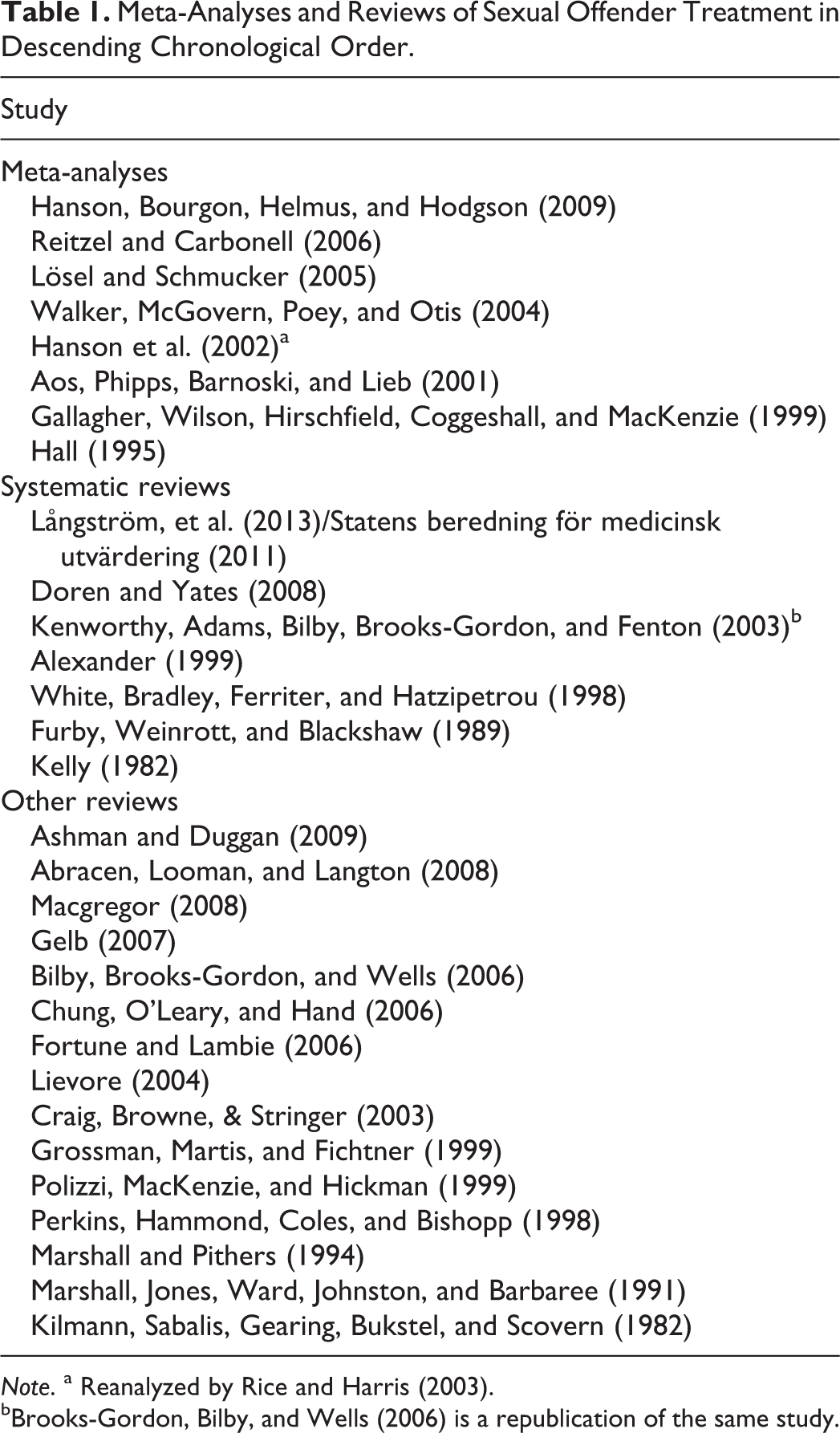
Note. a Reanalyzed by Rice and Harris (2003). b Brooks-Gordon, Bilby, and Wells (2006) is a republication of the same study.
Our second source of studies was a systematic search in PubMed and PsycInfo using the same search terms as the SBU report (SBU, 2011), but limited from 2010, when the SBU search ended, to the present (October 2012). The search resulted in 87 additional references. Our third source was a “gray literature” search from reference lists, from webpages, Google Scholar, National Criminal Justice Reference Service, bibliographies throughout our search process, even some references found accidentally when retrieving another reference. This proved invaluable, as many studies we located were not included in our first or second source even though they should both be designed to detect all possibly relevant studies. We found 94 studies in this manner, and we will discuss this unexpected finding in more detail later.
Our final set consisted of 337 references that were examined closely. Five references turned out to be impossible to retrieve despite several attempts. The remaining studies were examined according to the following criteria: publication year, publication type, follow-up length, outcome measure, study sample, and study type. Only studies published in 1980 or later were included, since pioneering treatments that are no longer offered have shown not to reduce recidivism (Hanson et al., 2002, 2009). Only peer-reviewed journal articles and edited book chapters were included (peer-review status was determined through the local university library service, “Exlibris Metalib,” 2012). This decision was made in order to ensure the highest possible scientific rigor of the included studies. Contrary to many earlier meta-analyses, unpublished manuscripts were not included for the following reasons: unpublished works are most often not included in literature databases; access to them is limited and unsystematic, thus creating a study retrieval bias; the quality of unpublished manuscripts also varies substantially as they are in different phases of the writing and correcting process. Earlier meta-analyses in this field underline the importance of including unpublished studies (e.g. Walker et al., 2004) in order to avoid publication bias, since studies yielding no differences between groups in general tend not to be published. In Hanson and colleagues’ (2002) meta-analysis, the unpublished studies showed a larger treatment effect than the published studies, which underlines our concern. In the field of sex offender treatment effectiveness research, the unsatisfying methodological quality of the studies is a major problem. The problems of including works that have not been carefully prepared and peer reviewed, such as evaluation reports, conference proceedings, unpublished manuscripts, and even raw data, are in our view more serious than the possible bias of published versus unpublished studies. Since treatment effectiveness studies have been criticized for reporting positive results without sufficient scientific backing, we argue that including unpublished works is not the correct way to avoid the file drawer problem. On the contrary, we run the risk of including a high number of low-quality studies, which might seriously affect the validity of our results.
Following the guidelines from CODC, we excluded studies with a follow-up shorter than 3 years. Only studies with rearrest or reconviction as the outcome measure were included. There is a consensus that official recidivism data underestimate actual offending (see e.g., Craig et al., 2003), but rearrest data may also be overestimated because known sex offenders are likely to be questioned regarding unresolved sex crimes. We only included groups of adults or adolescents without learning disabilities or intellectual impairments who had received a sentence for a sexual offense against children. Some studies could have included participants with impairments without reporting it, but given that this group is usually treated separately, we assumed they were excluded. In studies where the treatment sample consisted of several categories of sexual offenders, we only included the study if data for the SOAC subgroup was presented separately. If subgroup data on recidivism was not reported, we only included studies where a minimum of 75% of the whole sample were SOAC.
We included only psychotherapeutic intervention studies, thereby excluding drug-based treatments. We included only studies that primarily or secondarily, but explicitly, were categorized as treatment effectiveness studies by the authors themselves, thus excluding studies where effectiveness data possibly could have been retrieved even though the study explicitly aimed at examining something else, for example risk factors. This decision was made to ensure the highest possible validity. Contrary to many earlier meta-analyses, we decided to exclude studies that compare two different types of treatment (e.g., Borduin, Schaeffer, & Heiblum, 2009). In our judgment, this kind of study design does not inform about treatment effectiveness, only the possible superiority of one treatment over another.
Although two studies in German were initially included in our study sample, our level of German comprehension was not sufficient to deal with the complexity of the CODC coding, and they were therefore excluded. Finally, 14 studies based on 19 references met all our criteria for inclusion. The full list of 313 excluded studies is available in Soilevuo Grønnerød, Grønnerød, and Grøndahl (2013) or from the first author.
Coding
The first and second author coded the 14 studies according to the coding criteria presented in Appendix. The coding variables included publication year, publication type, study origin, sample age, proportion of SOAC in sample, and treatment location, type, and length (referred to as study coding). We also coded study quality according to the CODC coding manual (Collaborative Outcome Data Committee, 2007a, 2007b), which included coding of sample sizes, dropouts, attrition, follow-up period, and so on (quality coding). The CODC guidelines consist of 21 items, summarizing evaluations of bias and confidence and finally ending in a total evaluation where studies are rated as either strong, good, weak, or rejected. The guidelines focus on detailed evaluations of the amount and direction of possible bias in the results caused by the researcher’s decisions made during the study and the procedures regarding how data gathering and analysis were done. Interestingly, the guidelines proved to produce reliable coding results when conducted by trained “naïve raters” but failed completely when 12 experts in the field tested the coding manual. The authors conclude that the guidelines were “insufficient to change strongly held beliefs about the appropriate methodology to use in sexual offender outcome research” (Collaborative Outcome Data Committee, 2007b, p. 9). We are closer to being “naïve” than to possessing any strong beliefs on sexual offender treatment, and our relative unfamiliarity with the field of sexual offender treatment outcome research should therefore be an advantage.
The following variables were excluded because they either showed no variance or were mostly not possible to code due to missing information: proportion of sample diagnosed with pedophilia, proportion of sample with psychiatric diagnosis, proportion of sample who achieved treatment goals (other than recidivism, e.g., short-term changes in attitudes, coping, etc.), and proportion of sample on medication. We initially intended to code subtypes of SOAC, such as intra- versus extrafamiliar offenders, offenders against girls versus boys, and so on, but only a fraction of the studies reported such information.
Joint training on CODC coding was first conducted on five excluded studies, and the first and second authors then coded all the variables on all the 14 studies independently. We used the CODC coding results from the Hanson et al’s. (2009) meta-analysis for four studies that we also included but reviewed this coding and decided to change one study coding according to the purpose of our study (McGrath, Hoke, & Vojtisek, 1998 was changed from good to rejected because the study authors compared treated offenders with refusers). Table 2 shows the interrater agreement for the coding, along with the number of actual disagreements. Average agreement across kappa (κ) and intra-class correlation (ICC[2,1]) values was .79, which was satisfactory. Treatment type was low (κ = .36) but all disagreements were caused by disagreements regarding whether to code CBT (Cognitive Behavioral Therapy) only or CBT with relapse prevention. Study design was also low (κ = .53) which was caused by difficulties in finding the necessary information needed to separate need, volunteer, and risk design from other concurrent group design. All disagreements were subsequently discussed in order to reach a unanimous coding decision.
Interrater Reliability for Study Coding.
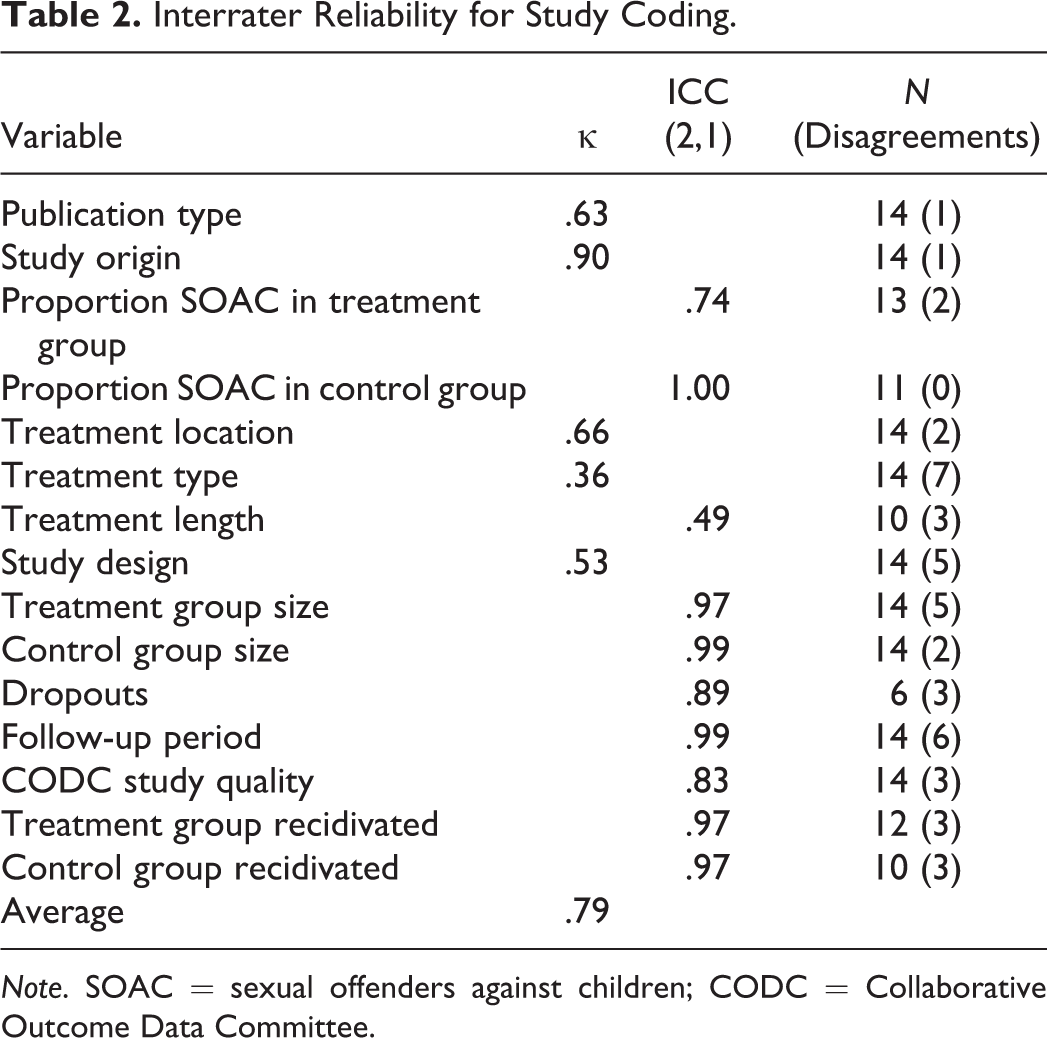
Note. SOAC = sexual offenders against children; CODC = Collaborative Outcome Data Committee.
Analyses
We coded all variables in a spreadsheet and then transferred the data to SPSS 18 for interrater reliability calculations and to Comprehensive Meta-analysis Version 2 (CMA; Borenstein, Hedges, Higgins, & Rothstein, 2005) for meta-analytic calculations and linear regression analyses of moderator effects. We applied a fixed model rather than a random model, since all studies targeted a particular characteristic, namely, sexual interest toward children, and we are not interested in generalizing the result to other populations. The low number of studies also warrant a fixed-effect model since between-study variance estimates will be less accurate. We nonetheless report random model effect sizes as well for comparison. Studies with more than one effect size were combined using a random model, which is the default choice in CMA. We used the correlation coefficient as our main effect size measure, interpreted according to Hemphill’s (2003) guidelines, but also report the corresponding risk ratios. Correlations were chosen to facilitate comparisons with psychotherapy research effect sizes.
Results
Table 3 shows the calculated effect sizes for the 14 included studies published between 1988 and 2011, along with moderators and outcome data. All studies were published as articles in peer-reviewed journals. Three studies used more than one control group, and one study reported data for two subgroups. The 14 studies were based on 1,421 adult offenders in psychotherapy and 1,509 nontreated controls. The average treatment length was 48 weeks (k = 10), maximum treatment length was 2 years and the average follow-up period was 6.8 years. Average dropout rate was 18% (k = 8). Average recidivism rate was 18% in the treatment groups, and 20% in the control groups.
Included Studies With Moderators, Outcome Data, and Effect Sizes.
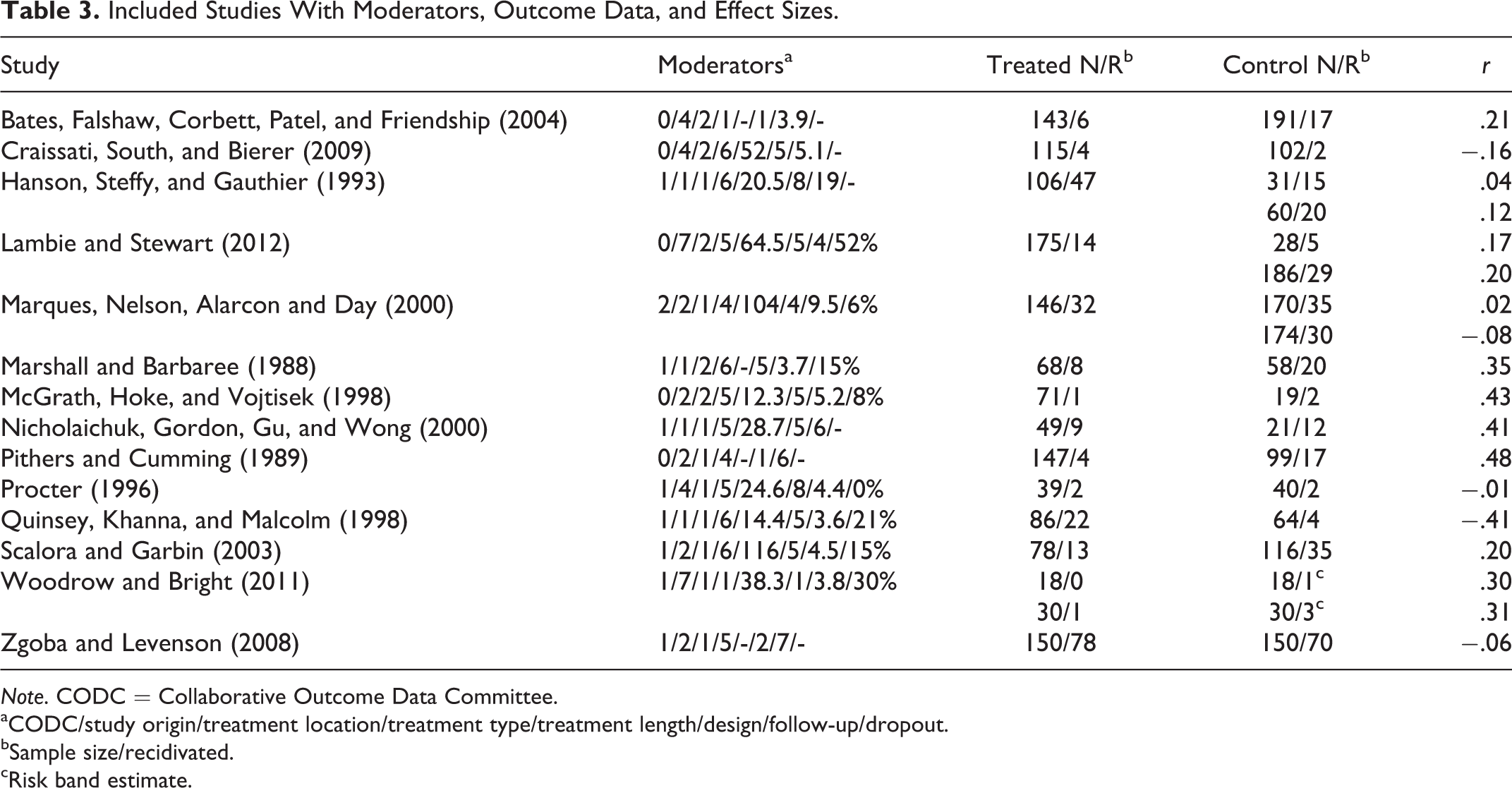
Note. CODC = Collaborative Outcome Data Committee. aCODC/study origin/treatment location/treatment type/treatment length/design/follow-up/dropout. bSample size/recidivated. cRisk band estimate.
We coded 9 of the 14 included studies as weak or good (only Marques, Nelson, Alarcon, & Day, 2000), according to the CODC guidelines. By excluding the other five studies coded as rejected, we found a fixed model weighted effect size of r = .03 (k = 9, confidence interval [CI] = [−.04, .10], random model r = .06, risk ratio = 0.96). Study quality is paramount in this area, and we regard this finding as our main result. The effect size for all 14 studies was r = .08 (k = 14, CI = [.02, .14], random model r = .12, risk ratio = 0.88). The five studies that were rejected had a combined effect size of r = .25, which again underlines the importance of study quality. Fail-safe N for the total sample was 48 studies (Z = −3.39, one-tailed test), showing that the result is sturdy even when quality is disregarded.
We found significant heterogeneity in the study sample, Q(13) = 53.60, k = 14, p < .000, I 2 = 79.38, and a moderator analysis was therefore appropriate. We found significant effects for CODC quality coding as a moderator (β = −.16, standard error [SE] = 0.049, p = .001), showing decreasing treatment effect with increasing quality. We also found a decreasing treatment effect in more recent studies (β = −.009, SE = 0.004, p = .047) and with longer follow-up periods (β = −.016, SE = 0.007, p = .016). Interestingly, eight of the nine quality selected studies were conducted in institutions, and only one community study passed the quality selection. Although the five community studies (four of which were rejected) showed a positive effect (r = .23), it is impossible to know whether this is a real effect or because of low quality.
Discussion
The debate on the effectiveness of sexual offender treatment has been running for about four decades without any clear conclusion. Despite numerous reviews and meta-analyses, the question as to whether sexual offender treatment reduces recidivism in general still lacks a clear and definite answer. We have tried to provide an answer by focusing on a particular subgroup of sexual offenders and what we find is discouraging. The available research on treatment effectiveness for SOAC is not able to show that treatment reduces recidivism. The finding is disappointing but nonetheless in line with those previous evaluations that have had strict methodological criteria for study inclusion. Earlier reviews with less focus on the quality of original studies tend to find a treatment effect, while reviews with stringent criteria tend not to find any effect.
The selection of original studies is indeed crucial in systematic reviews and meta-analyses. Surprisingly, we found a low overlap of studies included in the earlier systematic reviews. Most studies were included in only one to three reviews, showing that inclusion criteria varied substantially across reviews. Even thorough search strategies empolying well-known databases, such as the one applied in SBU (2011), missed a number of studies that were included in other reviews.
Another rather astounding feature in several earlier reviews was the inclusion of nonpublished documents (in common meta-analytic terms) such as governmental reports, non–peer-reviewed journal articles, unpublished manuscripts, newspaper articles, conference paper presentations, and even raw data. We find this fact worrying. The trustworthiness of scientific knowledge rests heavily on the peer-review process. Even if we disregard inclusion of raw data, unpublished manuscripts, and newspaper articles, it seems necessary to give a reminder that government reports and conference papers do not undergo thorough peer reviews. These types of publications may contain serious problems that need to be rectified before the conclusions can be trusted.
It is possible to speculate that treatment is or can become effective in the future even though our evaluation was unable to identify this. Despite our special efforts to find published results of certain new and well-known treatment programs, for example, Good Lives Model (e.g. Willis & Ward, 2011) and Circles of Support and Accountability (e.g. Wilson, McWhinnie, Picheca, Prinzo, & Cortoni, 2007), as well as recent contributions on the effects of release planning (e.g. Willis & Johnston, 2012), we were unable to find studies on these treatments and measures that would have fulfilled our criteria for inclusion. These and other emerging measures may, however, produce promising results in the future.
On the other hand, we do not find it plausible to say that there is a treatment effect in the real world, it merely escapes our study. So why does sex offender treatment not work? A recent report on treatment programs in the United States and Canada show that many of them are delivered less than optimally (McGrath, Cumming, Burchard, Zeoli, & Ellerby, 2010). In general psychotherapy research, practitioner effects have been recognized as the prime source of variance, and given the great variety of treatment programs over the last 30 years, this could be a contributing factor (see, e.g., W. L. Marshall et al., 2002; Ware, 2011). We may also need to ask whether an average treatment length of 48 weeks is enough to change sexual arousal patterns. None of the programs in our sample lasted more than just over 2 years; perhaps individual, more long-term, and intensive psychotherapies would be more effective. Another explanation may lie in the etiology of the phenomenon of sexual interest in children, which is debated (e.g. Green, 2002; Malón, 2012; Ó Ciardha, 2011; O’Donohue, Regev, & Hagstrom, 2000; Seto, 2012). It is hard to develop effective treatment without a strong theory on the etiology of sexual interest in children and on sexual offending against children.
However, Hollin (2008) maintains that the answer to the question of “what works?” in offender treatment may already be available in the evidence base of numerous evaluations and that we should learn from them instead of relying on illusions of a grand design that will reveal the ultimate truth in the future (see also William L Marshall & Marshall, 2010). Indeed, if we accept the conclusion presented in several earlier evaluations, nothing definite can be said until we have a sufficient number of high-quality RCT studies. Given the practical problems of conducting RCT studies within the context of correctional institutions, given the need to gather information on thousands of subjects in order to reach satisfactory statistical power because of the low base rate of sexual offending, and given the need for long follow-up periods, it may take a hundred years before we can have an answer (see also Collaborative Outcome Data Committee, 2007a).
We would therefore suggest a change of focus. Instead of trying to prove treatment effects globally, perhaps we should concentrate on developing and studying local but comprehensive child sexual victimization prevention programs that employ several areas of prevention as a joint effort by several authorities and volunteer groups. These measures could include treatment of incarcerated offenders, community measures for released offenders, prevention measures for the general public, measures for self-identified sexual offenders, and longitudinal, comprehensive methods of follow-up and evaluation. The aim would thus be a reduction in detected sexual offending and in reports to children’s services in a certain geographical area. There are reports on recent reduction in cases of child sexual abuse in the United States (Finkelhor, Jones, & Shattuck, 2008), in certain areas of Canada (Collin-Vézina, Hélie, & Trocmé, 2010), and in Finland (Laaksonen et al., 2011), and factors behind these changes are not fully known.
Critical Findings
First, we found that published research with acceptable quality cannot support the claim that psychological treatment of convicted SOAC reduces recidivism.
Second, we found a large discrepancy between the substantial number of publications in the field and the very small number of studies with acceptable quality.
Third, low-quality treatment effect studies in the field may show high treatment effects, which underline the need for high-quality studies.
Implications for Practice, Policy, and Research
First, we suggest that treatment programs should only be undertaken in the context of large-scale, high-quality, and long-term research projects following methodological principles designed for sexual offender treatment studies such as the CODC recommendations and that results should be published as journal articles instead of reports to ensure quality control.
Second, other strategies to prevent sexual offenses against children need to complement offender treatment, such as community integration programs and low-threshold mental health services for persons at risk of becoming offenders.
Third, the studies included in our analysis evaluated the effectiveness of short-term CBT programs. More research is needed that addresses newer treatment developments, such as the Good Lives Model and Circles of Support and Accountability model as well as more long-term, individual treatment programs.
Footnotes
Appendix
Declaration of Conflicting Interests
The author(s) declared no potential conflicts of interest with respect to the research, authorship, and/or publication of this article.
Funding
The author(s) disclosed receipt of the following financial support for the research, authorship, and/or publication of this article: Funded by the Norwegian Health Directorate.