



Abstract
Intimate partner violence (IPV) is a major, global public health concern with significant impacts, particularly for women, worldwide. There is an immediate need to develop comprehensive understandings of the complex drivers of this multifaceted issue in diverse cultural and social contexts. This scoping review used a systematic approach to gather a broad scope of peer-reviewed, publisher-controlled, and gray literature investigating IPV in Polynesia, a region of the Pacific experiencing high rates of IPV. A total of 181 articles were identified through a comprehensive search that included five cross-disciplinary databases; government, intergovernmental, and nongovernment websites; and consultation with community organizations. Thirty-three articles met the inclusion criteria related to IPV in a Polynesian country or community abroad and were included in this review. Narrative synthesis, which included summarizing and sorting key findings into common themes, was conducted to provide an overview of what is currently known about IPV in Polynesia and Polynesian communities living aboard. Key themes, which arose from the data analysis included: high prevalence of IPV, attitudes supporting IPV, urbanization and migration, traditional protective factors, and formal leadership and laws. The paucity of rigorous literature highlights an immediate need for IPV prevention research and intervention within Polynesian communities. This review includes a discussion of the limitations of this small body of literature and makes recommendations for future research, policy, and program development to include intersectionality in order to deepen understandings and enhance inclusive and meaningful intervention and policy implementation.
Keywords
Intimate partner violence (IPV) is an important public health issue associated with significant, lifelong, and intergenerational negative health (World Health Organization [WHO], 2013). Globally, an estimated 30% of women experience physical and/or sexual IPV with rates increasing when experiences of emotional abuse and controlling behaviors are included (Jewkes, 2010; WHO, 2013). The Pacific Island region reports some of the highest rates of IPV in the world, with up to 68% of women reporting physical and/or sexual IPV (United Nations [UN] Women, 2013). The Pacific Island region includes three subregions, Polynesia, Melanesia, and Micronesia, each holding different traditional ways of life and understandings of health, embedded within distinct cultural practices and diverse experiences of colonization and globalization of each nation (Lewis, 1998). The diversity of the region and high rates of IPV indicate an urgent need to advance knowledge and understand of the drivers of IPV within these distinct culture contexts to inform and direct prevention strategies (Ministry of Social Development, 2012a; Schluter, Paterson, & Feehan, 2007).
Prevention requires comprehensive understanding of key drivers of IPV at the individual, interpersonal, community, and societal levels (Heise, 2011). Over the past four decades distinct, though often overlapping approaches have contributed to understanding the multifaceted nature of IPV: Feminist perspectives highlight patriarchy as a key driver of gender inequality, human rights approaches foreground government obligations to prevent discrimination and violence against women, the criminal justice system responds to incidences of IPV through law enforcement and punishment of perpetrators, and public health focuses on prevention at a population level (WHO, 2010). There is increasing recognition of disparities in experiences and consequences of IPV across population groups (Bent-Goodley, 2007; Sokoloff & Dupont, 2005). Intersectionality extends current approaches, highlighting the need for culturally relevant, localized understandings of violence and the way violence is mediated through social, cultural, and political systems of power to inform inclusive and meaningful prevention (Bent-Goodley, 2007; Bowleg, 2012; Goodman, Smyth, Borges, & Singer, 2009; Sokoloff & Dupont, 2005). An intersectionality-informed approach encourages researchers and practitioners to uncover, acknowledge, and respond to the implications of complex interactions between individuals’ multiple and simultaneous identities (including but not limited to age, gender, sexuality, culture, ethnicity/race, and religion) and social systems of power (Bowleg, 2012; Sokoloff & Dupont, 2005). Intersectionality provides a useful approach for understanding IPV in diverse cultural and social contexts, such as Polynesia, where 38–60% of women experience physical, sexual, and/or emotional IPV (Cook Islands Ministry of Health, 2014; Government of Samoa, 2017; Jansen, Johansson-Fua, Hafoka-Blake, & ‘Ilolahia, 2012; Secretariat of the Pacific Community [SPC], 2006, 2009).
The following scoping review systematically examines literature on IPV in Polynesia and Polynesian communities to develop a synthesized understanding of current knowledge and to identify key gaps. Reflecting on the findings, this article draws on intersectionality to discuss how current knowledge related to IPV within Polynesia can be used to guide policy development and inform prevention strategies and to make key recommendations to enhance future research.
Method
Given the limited and exploratory nature of available literature, this scoping review aimed to systematically gather articles from a broad range of sources to synthesize key concepts, map evidence, and identify gaps in knowledge (Arksey & O’Malley, 2005). A systematic approach, in line with preferred reporting items for systematic reviews and meta-analyses guidelines, was undertaken and recommended methods for conducting scoping reviews guided the process to ensure an in-depth, rigorous, and transparent review of the literature (Arksey & O’Malley, 2005; Levac, Colquhoun, & O’Brian, 2010; Liberati et al., 2009).
Database searches were conducted using CINAHL, Embase, Scopus, PubMed, and Web of Sciences. These databases were chosen for their cross-disciplinary scope and inclusion of peer-reviewed, publisher-controlled, and gray literature. The key term “Polynesia” was searched with Boolean codes “OR” individual country names and “AND” cross-disciplinary terms relating to IPV (see Figure 1). No limits were applied at any stage. Key authors were identified from the initial search strategy, their names were searched in the same databases, and they were contacted for any further publications. Reference lists and key journals were hand searched, and relevant community and intergovernmental organizations were consulted (Arksey & O’Malley, 2005). Websites of Polynesian country and key intergovernmental and nongovernment organizations working in the region were also searched to further capture gray literature. This review includes papers and reports published up to July 2017; the earliest identified paper was published in 1999.
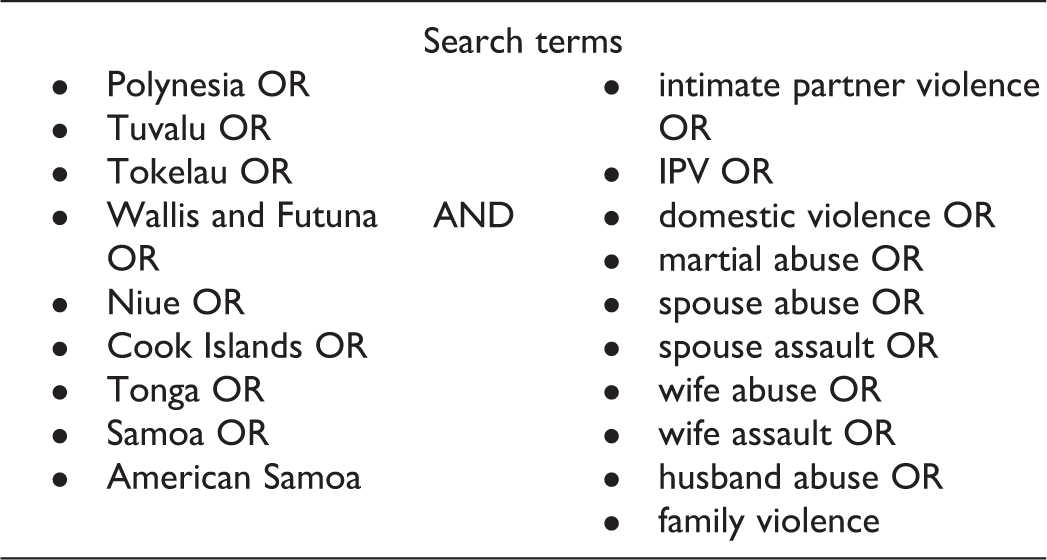
Search terms.
Searches yielded 181 articles. After duplicate removal and initial screening, 49 articles remained and were reviewed against inclusion criteria: articles written in English and related to IPV in a Polynesian country or a Polynesian population living in another country. Articles using primary data collection as well as reviews and dissertations were included. Excluded articles focused on child abuse (unrelated to later victimization or perpetration of IPV), incest, sexual abuse (other than by an intimate partner), or sexual health with no reference to IPV (see Figure 2). While the Maori of New Zealand and the Indigenous Hawai’ian populations are also connected to Polynesia; these groups are generally considered separately due to distinct histories of colonization and levels of development and were thus excluded from this review (Lewis, 1998; Rallu, Rogers, & Reay-Jones, 2010). Two authors independently reviewed the abstracts against the inclusion criteria; where disagreements arose, a third member of the team was consulted and final inclusion was determined once a consensus was reached (Levac et al., 2010). The broader research team met at the beginning, midpoint, and final stages of the study selection process, supporting interrater reliability, validity, and transparency (Arksey & O’Malley, 2005; Levac et al., 2010). Thirty-three articles were included for review: 15 peer-reviewed manuscripts, 16 reports, and 2 PhD dissertations (see Figure 3).
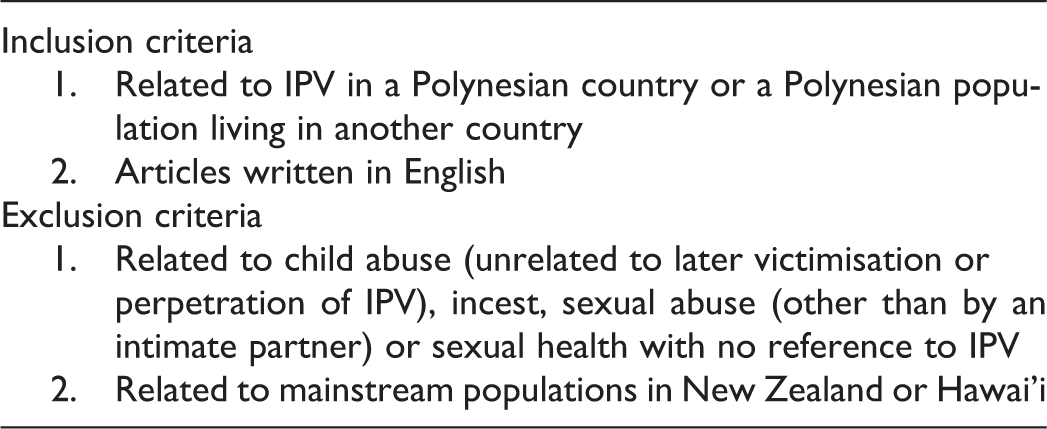
Inclusion and exclusion criteria.

Search strategy.
Narrative synthesis, which included summarizing and sorting key findings into common themes, was conducted to provide an overview of what is currently known about IPV in Polynesia and Polynesian communities living aboard; outcomes were then considered within the broader context of IPV research and practice (Levac et al., 2010). The lead researcher conducted initial analysis with two other researchers reviewing the literature and confirming the themes to support interrater reliability (Liberati et al., 2009).
Results
Description of Studies
Eight studies were conducted in Samoa, with a further eight in New Zealand. Seven studies were conducted in the United States, five in Tonga, three in the Cook Islands, and one in Tuvalu. One study was conducted across two countries (Cribb & Barnett, 1999), and another two did not include primary data collection (Crichton-Hill, 2001; Jivan & Forster, 2009). Articles were published between 1999 (Cribb & Barnett, 1999) and 2017 (Government of Samoa, 2017) with the majority (46%) published between 2006 and 2010. The release of the WHO’s (2005) Multi-country Study of Domestic Violence and Women’s Health appeared to spearhead national prevalence studies during these years. Of the 33 articles included in this review, seven were government and intergovernmental reports detailing prevalence in the Cook Islands, Samoa, Tuvalu, and Tonga. Methods used in this research drew on the methodology developed by the WHO’s (2005) Multi-country Study on Women’s Health and Domestic Violence Against Women and the Demographic Health Survey methodology. A further five studies presented findings from smaller, community samples to detail prevalence among Polynesian communities living in the United States and New Zealand. Ten articles discussed qualitative, community-based studies conducted in Samoa, New Zealand, and the United States; nine were reports from government, intergovernmental, or community organizations exploring understandings and experiences of IPV within Polynesian communities; and the final two articles reviewed specific approaches to IPV prevention within the Polynesian context (see Table 1 in Online Appendix). Beyond descriptions of prevalence rates, key themes arising from the narrative synthesis included attitudes supporting IPV, the role of urbanization and migration in IPV, traditional protective factors, and formal leadership and laws.
Prevalence
Across the studies, there was considerable variation in prevalence. Overall, rates of one or more forms of IPV experienced by women ranged from 60% in Samoa to 39% in the Cook Islands (Cook Islands Ministry of Health, 2014; Government of Samoa, 2017). Specifically, data collected from household surveys conducted with nationally representative samples showed that 19–38% of women reported physical IPV, 5–24% reported sexual IPV, 19–78% reported emotional IPV, and 31–87% of women reported controlling behaviors from their husband or partner (Cook Islands Ministry of Health, 2014; Government of Samoa, 2017; Jansen et al., 2012; SPC, 2006, 2009). Smaller studies conducted in New Zealand and the United States also indicated high prevalence within Polynesian communities living abroad. The Pacific Island Families study included a consecutive sample of over 900 mothers and their partners, largely of Polynesian heritage, recruited from a hospital in Auckland, New Zealand in 2000 (Paterson et al., 2006). The study was conducted using the Conflict Tactics Scale during household interviews and reported 28% of mothers (and 8% of fathers) experienced physical IPV, and over 86% of mothers (and 87% fathers) reported being victims of verbal aggression (Schluter et al., 2007). Notably, agreement between mothers’ response to vicitmaization and fathers’ response to perpetration was low: of the mothers who reported physical victimization, only 21% of their partners reported perpetrating this violence (Schluter et al., 2007). Other findings from the Pacific Island Families study identified links between maternal experiences of IPV and unplanned pregnancies and revealed an association between being physically abused as a child and severe physical perpetration and victimization of IPV for mothers (Gao, Paterson, Carter, & Iusitini, 2008; Paterson, Fairbairn-Dunlop, Cowley-Malcolm, & Schluter, 2007).
A school-based survey exploring emotional IPV with 247 Filipino, Samoan, and Indigenous Hawai’ian students from three high schools in Hawai’i found that over half the participants (58%) reported experiencing emotional IPV and 43% reported experiencing controlling behaviors from an intimate partner (Chesney-Lind, Hishinuma, Nishimura, & Choi-Misailidis, 2008). A small community survey (179 participants from three districts in California) investigated associations between experiences of IPV and HIV knowledge and testing among a convenience sample of Polynesian and Micronesian residents (Takahashi et al., 2011). This study indicated that up to 50% of participants had experienced physical or emotional IPV; while specific IPV data by ethnicity was not reported, the article indicated Polynesian participants reported higher rates of IPV than participants from Micronesian communities (Takahashi et al., 2011).
Attitudes Supporting IPV
Population-based surveys using face-to-face household questionnaires with nationally representative samples, conducted in the Cook Islands, Tonga, Samoa, and Tuvalu indicated between 37–70% of women across the region agreed with at least one justification for wife beating (e.g., neglecting children, infidelity) and 27–83% of women agreed with statements supporting male control (e.g., a wife should obey her husband even if she disagrees with him; Cook Islands Ministry of Health, 2014; Jansen et al., 2012; Samoa Bureau of Statistics, 2015; SPC, 2006, 2009; Tonga Ministry of Health, 2014). The Cook Islands reported some of the lowest acceptance of wife beating by women (11%), with Tuvalu reporting some of the highest rates (70%). In some instances, there were large variances within countries. For example, the National Study of Domestic Violence Against Women in Tonga (Jansen et al., 2012) showed that 7% of women agreed a husband is justified to beat his wife if she does not complete the housework, while 56% of women agreed that infidelity justified physical IPV. Acceptance of physical IPV was commonly lower among men across the different countries surveyed, for example, 18% of men and 29% of women in Tonga agree with at least one justification for wife beating (Tonga Ministry of Health, 2014).
The three national surveys also investigated measures of empowerment of women and identified that while women do contribute to decision-making within the household, few married women make autonomous decisions regarding their health care (28–37%) and visits to their family (10–36%; Samoa Bureau of Statistics, 2015; SPC, 2009; Tonga Ministry of Health, 2014). Findings further indicated 20–40% of employed, married women were the main decision makers regarding how their income was spent (Samoa Bureau of Statistics, 2015; SPC, 2009; Tonga Ministry of Health, 2014); while qualitative outcomes from the National Study of Domestic Violence Against Women in Tonga suggested husbands maintain control of the income earned by their wives (Jansen et al., 2012).
Broad social norms identifying men as heads of households and the main decision makers within families were highlighted across qualitative and quantitative studies, regardless of wider social contexts and geographic locations (Cribb & Barnett, 1999; Gravitas Research and Strategy Ltd and Partners, 2006; Kingi & Roguski, 2011; Magnussen, Shoultz, Hansen, Sapolu, & Samifua, 2008; Ministry of Social Development, 2012b; Roguski & Kingi, 2011a, 2011b). Strict gender roles that place women in domestic positions were commonly highlighted across the studies with a focus on women’s roles within Church systems being defined largely as “wives” and “mothers” (Cribb & Barnett, 1999; Jansen et al., 2012; Tauasosi, 2010; Turk et al., 2013). The Samoan Family Safety Study recently published by the Government of Samoa (2017) included a preamble describing the “guardianship” of a sister by her brother being transferred to her husband after marriage, where women are generally assumed to serve the family through domestic duties (p. 11).
Migration and Urbanization
Qualitative studies conducted with Polynesian women in Samoa, Tonga, and New Zealand drew attention to the impacts of both urbanization and migration on experiences of IPV for Polynesian women. A qualitative study conducted with 90 Samoan women in urban Samoa, rural Samoa, and New Zealand suggested that in a rural Polynesian context, participation in employment may have a negative impact on experiences of IPV as women withdraw from communal structures that traditionally provide protection (Cribb & Barnett, 1999). Further, qualitative outcomes from diverse studies conducted in Samoa, New Zealand, and Tonga suggested changes in the economy and modernization in Polynesia has led to urbanization, which fragments communities, isolating women and creating new pressures within families causing stress, and confusion regarding gender roles and economic contributions (Cribb & Barnett, 1999; Gravitas, 2006; Jansen et al., 2012; Ministry of Social Development, 2012b; Ministry for Women, 2015).
Migration may pose a risk of IPV as protective factors traditionally found in Polynesian communities (discussed in detail below) are rarely present outside home countries and tensions are created as families navigate new understandings and expectations of gender roles within complex social contexts (Cribb & Barnett, 1999; Crichton-Hill, 2001; Magnussen et al., 2008; Ministry of Social Development, 2012b; Oneha, Magnussen, & Shoultz, 2009). Further, migration affects families who are divided when one partner (often the husband) must travel for extended periods for work or education. Qualitative outcomes from the National Study of Domestic Violence Against Women in Tonga highlighted conflicts related to relationship tensions and economic pressures, which increase women’s risk of IPV when their husband returns from migration for work or education (Jansen et al., 2012).
Protective Factors
The identified literature highlighted a number of culturally significant protective factors for IPV across Polynesian communities. Traditionally, women in Polynesia are accorded high social status and are integral for upholding the reputation and esteem of a family—a defining characteristic that separates Polynesia from other subregions in the Pacific (Lewis, 1998). While this traditionally high social standing is highlighted as a protective factor in some of the identified literature (Cribb & Barnett, 1999; Crichton-Hill, 2001; Ministry of Social Development, 2012b), its role in protecting against IPV in complex social contexts is unclear, with articles suggesting men maintain control within households and women are not accorded full adult status in some families (Cribb & Barnett, 1999; SPC, 2006; Tauasosi, 2010).
The covenant between sisters and brothers traditionally found in Polynesian cultures was identified in four articles, which used qualitative methods with community samples, as a protective factor against intimate partner and family violence (Crichton-Hill, 2001; Ministry of Social Development, 2012b; Ministry for Women, 2015; Rankine et al., 2017). Founded on respect, this relationship prohibits close physical contact and discussion of intimate topics between sisters and brothers and accords some power to women in their role as sisters (Cribb & Barnett, 1999; Lewis, 1998). The role of the covenant as a protective factor for IPV in changing social contexts is unclear. For example, participants in the qualitative study conducted by Rankine and collegues (2017) highlighted the importance of the covenant in promoting mutual respect between women and men and suggested IPV and sexual violence was a result of a fracture in this relationship. However, investigating the role of the covenant and its relation to IPV in Samoa, Tauasosi (2010) found that although some protection may be accorded through this kinship, it was not always translated into husband–wife relationships. Other articles indicated that in modernized contexts the covenant was (mis)interpreted and expressed in ways that place women at risk of violence by supporting strict gender roles and relationship expectations which conflict with new, modern economic, and social environments (Ministry of Social Development, 2012b; Ministry for Women, 2015).
Finally, the current literature highlighted traditional village structures including communal living and open housing, as important protective factors. Research conducted with Samoan women living in New Zealand and Hawai’i showed women experiencing IPV were isolated by nuclear family structures and closed living spaces which limited opportunities for community intervention (Cribb & Barnett, 1999; Crichton-Hill, 2001; Magnussen et al., 2008). These articles suggested that without the village structure, Samoan communities living abroad lacked the traditional social controls and sanctions that protect women through social support and by reprimanding violent behavior (Cribb & Barnett, 1999; Crichton-Hill, 2001).
Formal Leadership and Laws
Identified literature highlighted the limited participation of women in formal leadership roles in Polynesian countries as a key challenge for addressing IPV and violence against women more broadly (Jivan & Forester, 2009; Kingi & Roguski, 2011; Roguski & Kingi, 2011a, 2011b). In the Cook Islands, only seven women have ever been elected to parliament and while Samoa has recently enacted a mandatory 10% representation of women, participation remains low (Kingi & Roguski, 2011; Samoa Bureau of Statistics, 2015). The Cook Islands, Samoa, and Tuvalu are signatories of the UN Convention on the Elimination of all forms of Discrimination Against Women (CEDAW), with Niue, Tokelau, Wallis and Futuna, and French Polynesia becoming parties to the convention through ratification by their protectorate or colonial powers (Jivan & Forster, 2009). Jivan and Forester (2009) highlighted low compliance with the obligations under this convention due to outdated legislative frameworks related to histories of colonization, the prioritization of “traditional” practices over gender discrimination and violence, limited representation of women in politics and leadership roles, and weak CEDAW reporting systems. Further, reports highlighted the need for IPV laws to be strengthened and expanded (Kingi & Roguski, 2011; Roguski & Kingi, 2011a, 2011b). Notably, Samoa has recently criminalized marital rape and introduced protection orders for victims of family violence (Samoa Bureau of Statistics, 2015).
Discussion
This review aimed to synthesize the current literature related to IPV in Polynesia and Polynesian communities to inform policy and prevention strategies and uncover gaps in knowledge. While the current literature indicates a high prevalence of IPV across the region, the paucity of rigorous prevalence data in Polynesia is concerning. Challenges related to collecting reliable and valid data measuring IPV prevalence are well-documented and include issues defining terms and scope of IPV; high nonresponse rates due to taboos, shame, and guilt surrounding experience of IPV; structured, quantitative methods that do not consider the wider social and cultural mechanisms affecting IPV nor the motivations behind IPV; and recall bias (Campbell, Martin, Moracco, & Macy, 2006; Ellsberg & Heise, 2005; Ruiz-Pérez, Plazaola-Castaño, & Vives-Cases, 2007). These challenges are exacerbated in diverse cultural contexts, and the current prevalence data must be considered with regard to these limitations as well as culturally specific challenges including differing thresholds for violence, issues with reporting due to culturally prescribed gender roles (including the gender of the researcher), and invasive research approaches which may affect response rates (Ellsberg & Heise, 2005; Schluter et al., 2007; Vaioleti, 2006). It will be important for future research exploring IPV in Polynesia to engage communities in research design, implementation, and dissemination, including exploring innovative methods of data collection and meaningful ways to co-construct knowledge to ensure vaild and reliable outcomes that are useful and relevant to the local context (Ellsberg & Heise, 2005; Vaioleti, 2006).
The use of methodologies based on the WHO’s (2005) Multi-country Study on Women’s Health and Domestic Violence Against Women and the Demographic Health Survey ensures some validity of measures used in prevalence studies and provides data that are comparable. However, limited reporting of data collection and analysis methods and minimal discussion of local contextual factors and adaption of methodologies to suit local needs, make it difficult to assess internal validity across some of the prevalence studies. These challenges are illustrated by conflicting outcomes reported in some of the identified studies. For example, the Samoa Health and Safety Study (SPC, 2006) conducted in collaboration with the Secretariat of Pacific Communitites used the recommended methodology developed by the WHO (2005) with a nationally representative sample of 2,310 women and men aged 15–49 and reported overall prevalence of IPV at 46%. The Government of Samoa (2017) recently published a follow-up study conducted with a smaller sample of 878 women and men aged 21 years and older suggesting 60% overall prevalence with markedly different outcomes, including a decrease in physical IPV from 36% to 19% and an increase in emotional IPV from 19% to 78%. The limited reporting of rigorous data collection and analysis methods and lack of discussion surrounding the conflicting and vastly different results, suggest the outcomes of the Government of Samoa (2017) study must be interpreted with careful consideration of these limitations and highlight the need to advance the validity and transparency of IPV data collection in Polynesia in order to develop a comprehensive picture of the extent and scope of experiences of abuse.
Some of the identified national prevalence studies also included a qualitative component; these reports routinely lacked clear and transparent data analysis and presentation of qualitative findings, limiting the ability to draw insights from these data (Cook Islands Ministry of Health, 2014; Government of Samoa, 2017; Jansen et al., 2012; SPC, 2006). Further, discordance between partners’ reporting of victimization and perpetration of IPV reported by Schluter and collegues (2007) highlights potential challenges of using standardized, quantitative measures. There is a need to work with communities to develop innovative and culturally relevant research approaches for investigating of the experiences of abuse within Polynesian communities.
Moving beyond the challenges associated with identifying reliable prevalence rates, this review also identified a number of key themes that can contribute to understandings of IPV within Polynesia. Attitudes that support and condone IPV appear pervasive, with both quantitative and qualitative studies across countries indicating support for male control and dominance within families. The large variances across specific attitudes and beliefs that condone IPV, both within and across countries, suggest complex associations between certain beliefs and experiences of violence. For example, 7% of women in Tonga agreed a husband is justified to beat his wife if she does not complete the housework, yet 56% of women agreed that infidelity is an acceptable justification (Jansen et al., 2012). Acceptance of wife beating by women in the Cook Islands is low in comparison with Tuvalu, which reported some of the highest rates; yet these countries reported similar overall experiences of one or more forms of IPV (39% and 41%, respectively; Cook Islands Ministry of Health, 2014; SPC, 2009). It is also notable that in Samoa and Tonga the acceptance of wife beating is reported higher among women than men (Samoa Bureau of Statistics, 2015; Tonga Ministry of Health, 2014). While attitudes supporting IPV and adherence to strict gender roles are important sociocultural factors to consider within IPV prevention (Heise, 2011; Waltermaurer, 2012), the current literature highlights the complexity of these relationships, suggesting nonlinear associations between high prevalence of certain attitudes and rates IPV. Further, the identified literature cautions against understanding culturally prescribed gender roles as the sole reason for IPV and suggests, for example, that perpetrators may take advantage of their dominant position within the family and use culture as an excuse for violence (Kingi & Roguski, 2011; Rankine et al., 2017; Tauasosi, 2010). There is a clear need for research that uses an intersectionality lens to explore these complex relationships between individual- and community-level beliefs, attitudes and experiences, and the macrolevel institutions, systems of power and laws that support these.
Current approaches addressing IPV in Polynesia, and the Pacific region more widely, provide some important insights using an integrated ecological model highlighting risk factors for victimization and perpetration at sociocultural, community, family, and individual levels (UN Women, 2015; WHO, 2005, 2010). This approach can be enhanced by an intersectionality lens which acknowledges and explores the intersecting and reinforcing oppressions, which women within the region are experiencing (UN Women, 2015). Intersectionality supports a human rights approach for understanding IPV, creating spaces to acknowledge and investigate unique experiences of women across cultures, socioeconomic status, and other diverse social locations by highlighting the social context within which systems of power intersect to create oppression (Bent-Goodley, 2007; Sokoloff & Dupont, 2005). The current body of literature points to some key intersections and complex relationships between social and cultural factors and experiences of IPV within Polynesian communities, including ways gender, age, and social and economic status intersect with social, cultural, and religious traditional and changing institutions (Baker & Helm, 2010; Cribb & Barnett, 1999; Crichton-Hill, 2001; Jansen et al., 2012; Magnussen et al., 2008; Oneha et al., 2009; Rankine et al., 2017; Turk et al., 2013). Specifically, the current literature touches on ways social structures including the Church and modern economies interact with and influence gender role expectations and IPV in Polynesia (Cribb & Barnett, 1999; Jansen et al., 2012; Tauasosi, 2010; Turk et al., 2013). Deepening this analysis using an intersectional approach which investigates how understandings of violence are influenced by these structures (and others) and the impact of this on the diverse lived experiences of women with multiple and intersecting social locations will allow researchers and practitioners to develop effective, inclusive, and meaningful IPV interventions that address the complex and diverse needs of Polynesian women (Bowleg, 2012; Sokoloff & Dupont, 2005).
The current literature provides some insights that can inform IPV prevention strategies within the region. It is clear that primary prevention addressing the root causes of violence, including beliefs in strict gender roles and male control, at community and societal levels is essential (Heise, 2011). Current literature draws attention to potentially protective traditional factors, but the role and influence of these in increasingly modern and complex social contexts is unclear (Cribb & Barnett, 1999; Magnussen et al., 2008, 2011; Oneha et al., 2009). Further research exploring how these factors currently play out and how they can be strengthened in changing and complex social contexts is warranted.
This scoping review highlights the need for policy and intervention addressing IPV in Polynesia to acknowledge the intersecting and interconnected ways that social locations and social, cultural, and political contexts shape individuals’ understandings, experiences, and practices (Bowleg, 2012). Implementing inclusive and effective policies and interventions that can protect against and prevent IPV requires meaningful consideration of Polynesian social and cultural contexts (Schoeffel, Percival, & Boodoosingh, 2016). Using an intersectionality lens to policy analysis and exploring innovative health promotion interventions which consider individuals’ multiple and intersecting identities and social locations, while situating experiences within broader social, cultural, and political contexts is essential for effective action to address IPV within Polynesian communities.
Strengths and Limitations
This scoping review must be considered within the context of a number of limitations. Individual, cultural, and societal drivers of IPV in Polynesian countries and cultures are largely under theorized (Ministry of Social Development, 2012a), and this article contributes to understandings of IPV, making recommendations as a starting point for addressing IPV in Polynesian communities. However, the authors acknowledge that while Polynesia is a distinct subregion of the Pacific, it too is diverse and each country holds its own culturally and ethnically specific understandings, beliefs, and knowledges. Researchers and practitioners working in the field are encouraged to explore culturally and ethnically specific factors contributing to IPV within specific countries and communities. It is important to acknowledge that database searches are not 100% accurate (Greenhalgh, 1997). This review also included hand searches of reference lists, key author searches, and exploration of gray literature; however, some studies may be been missed (Greenhalgh, 1997). The limited and exploratory nature of current literature required a scoping methodology to capture a wide breadth of articles. This review highlights key concerns related to data collection and analysis methods in identified articles; as this body of literature grows, a systematic review including a quality appraisal process may be useful for determining effective intervention strategies within specific cultural and social contexts.
Critical Findings
Polynesia is a distinct Pacific Island subregion reporting high rates of IPV, requiring immediate research and action to support culturally relevant and appropriate prevention. Current literature is hindered by limited data collection and analysis methods, and there is a need to develop innovative and rigorous research methods to adequately explore the complex and multifaceted nature of IPV within this culturally distinct region.
Implications for Practice, Policy, and Research
Experiences of IPV for women across Polynesian countries are shaped by complex and changing social and cultural contexts. Prevention needs to consider the consequences of intersections between multiple identities (including gender, age, religion, economic, and social status) with social, cultural, and political systems of power to develop meaningful and inclusive intervention strategies. Exploring ways culturally protective factors can be strengthen in new and complex social contexts and adapting laws and conventions to ensure they are culturally appropriate and meaningful is essential to support all levels of IPV prevention. Using an intersectionality approach to research, intervention and policy development will allow researchers and practitioners to develop effective, meaningful, and inclusive action to address IPV within Polynesian communities.
Supplemental Material
Supplemental Material, TVA-18-050.R1_revision-table-literature-summary-scoping-review-ipv-polynesia - Exploring Intimate Partner Violence in Polynesia: A Scoping Review
Supplemental Material, TVA-18-050.R1_revision-table-literature-summary-scoping-review-ipv-polynesia for Exploring Intimate Partner Violence in Polynesia: A Scoping Review by Emma Heard, Lisa Fitzgerald, Maxine Whittaker, Sina Va’ai and Allyson Mutch in Trauma, Violence, & Abuse
Footnotes
Declaration of Conflicting Interests
The author(s) declared no potential conflicts of interest with respect to the research, authorship, and/or publication of this article.
Funding
The author(s) received no financial support for the research, authorship, and/or publication of this article.
Supplemental Material
Supplemental material for this article is available online.
References
Supplementary Material
Please find the following supplemental material available below.
For Open Access articles published under a Creative Commons License, all supplemental material carries the same license as the article it is associated with.
For non-Open Access articles published, all supplemental material carries a non-exclusive license, and permission requests for re-use of supplemental material or any part of supplemental material shall be sent directly to the copyright owner as specified in the copyright notice associated with the article.
