




Abstract
Intimate partner violence (IPV) is a worldwide issue that, although often thought of as a very gendered and heteronormative crime (male perpetrators and female victims within heterosexual relationships), occurs in all kinds of relationships. The purpose of this study is to examine and raise awareness of how IPV operates within female same-gender relationships. Researchers utilized a narrative inquiry framework, as well as thematic analysis, in order to conduct a qualitative synthesis of articles that examined IPV in female same-gender relationships. Articles were identified through database searches for studies published between 2000 and 2019 using key search terms. Studies were included if they were qualitative in nature (including direct quotes from participants), examined IPV within female same-gender relationships, and were written in English. A total of 19 studies were included in the qualitative synthesis. Findings were categorized as barriers to help and support, themes within experiences of IPV, or recommendations for helping professionals. Themes within categories included, among others, a lack of framework to identify abuse; mistrust of law enforcement; power dynamics related to parenthood, race, and gender presentation; and fears of contributing to heterosexism. Findings from this study can serve to better inform helping professionals about considerations to keep in mind when working within lesbian, gay, bisexual, transgender, plus various additional sexual minorities’ communities and survivors of female same-gender violence.
Intimate partner violence (IPV), defined as “any behavior within an intimate relationship that causes physical, psychological, or sexual harm to those in the relationship” (Heise et al., 2002, p. 89), is a serious issue throughout the world that has profound impacts on all those who experience it in their lives. According to the World Health Organization (WHO, 2013), almost one third of the global population of women has experienced some form of IPV in their lifetime. A U.S.-based study analyzing data from 2011 found that over 20% of women and 14% of men experienced severe physical IPV in their lifetimes, and over 15% of women and 9% of men have experienced sexual IPV in their lives (Breiding, 2014). Although IPV is thought of as a largely gendered crime and the majority of perpetrators are men, it is clear that both men and women perpetrate and are victimized by IPV. A study that examined sexual orientation and overall rates of IPV (including physical, sexual, and psychological) found that 43.8% of lesbian women, 61.1% of bisexual women, and over 35% of heterosexual women had experienced some form of IPV in their lifetimes (Breiding et al., 2014).
A note on language: Throughout this article, relationships in which women experience IPV by female perpetrators will be referred to as queer relationships or female same-gender relationships, and the community in which these women are included in as the queer or lesbian, gay, bisexual, transgender, plus various additional sexual minorities (LGBT+) community. Queer is used as a descriptor in this article because it is more encompassing of different sexual identities than using words like gay or lesbian. Since many of the studies in this article included women who identified in various ways in terms of sexuality, using queer as an identifier felt to be the most inclusive language choice available. Similarly, many of the studies included participants who identified as transgender women, so the word trans will also be used throughout this article to speak to the additional difficulties that trans women who experience IPV in the same-gender relationships may experience when compared to their cisgender counterparts. When speaking about both queer and trans individuals, LGBT+ or queer and trans will be used to make clear who is being discussed. All of that being said, sexual and gender identities are fluid (Fontanella et al., 2013), and it is impossible to know whether or not each participant in the data used in this study would currently identify within these terms. Some included participants may have different understandings of or reasons for identifying in particular ways. Labels are used in this article as a method for categorizing and understanding unique needs of different communities but should not be taken as permanent or fixed.
A review of the existing literature completed in 2015 found that queer individuals experience equal or higher rates of IPV than heterosexual counterparts (Edwards et al., 2015). IPV victimization is associated with negative life outcomes including physical and mental health difficulties, financial stress, employment instability, and fear of/actualized loss of custody of children as a result of experiencing abuse (Adams et al., 2012; Black et al., 2011; Logan & Walker, 2004; Spencer, Cafferky, & Stith, 2019). With such a huge impact on people’s well-being, it is vital that researchers and clinicians learn all they can about IPV, so that they are best equipped to meet the needs of those affected by violence.
While numerous articles exist that focus on IPV in opposite-gender couples, in comparison, much less research exists that focuses on IPV in queer relationships. Additionally, most IPV research, whether conducted with individuals in heterosexual or queer relationships, has been quantitative (e.g., Kimmes et al., 2019; Spencer, Stith, & Cafferky, 2020). With such a small amount of literature that focuses on IPV in queer relationships, using a qualitative study enables us to gain rich data that will help us to have a better understanding of IPV in queer populations. Previous qualitative research on IPV in queer relationships has explored survivors’ experiences, help-seeking behaviors, intersectionality with race, intersectionality with gender, and a lack of framework to explain the same-gender violence (Barnes, 2011; Kanuha, 2013; Ristock, 2003). With such a small sample of qualitative articles focused on female same-gender relationships, there is still much to learn about the intricacies of IPV in female same-gender relationships. It is extremely important to learn more about these survivor’s experiences, especially because IPV can also lead to intimate partner homicide (Campbell et al., 2007), which is a worldwide issue. Conducting a qualitative synthesis as a means of understanding the experiences of queer women who have either been victims or perpetrators of IPV in this context will better enable helping professionals to advocate for and serve those at risk.
The purpose of the current study is to add to the current knowledge regarding IPV in female same-gender relationships. This study aims to identify findings throughout the current research and draw attention to any findings that do not fit within current understandings or speak to a need for further research. This study aims to answer the following questions: What prominent themes are found in qualitative research focused on IPV in female same-gender relationships? What are barriers to accessing help in this community? What is important for helping professionals to know to be able to best help members of this community who experience IPV?
Background
LGBT+ Discrimination
While IPV affects all kinds of women, women who hold additional marginalized identities such as intersections with sexuality, gender, race, and class are likely to be at a higher risk of victimization. In the United States, 28 states currently have no statewide antidiscrimination laws for LGBT+ people (Freedom for All Americans, 2019). Worldwide, there are 73 countries where homosexual activity is illegal (interestingly, of those, 45 apply the law to women and men; International Lesbian, Gay, Bisexual, Trans and Intersex Association; ILGA, 2017). In eight countries, homosexuality is still punishable by death (ILGA, 2017). A recent U.S.-based poll found that 48% of queer and trans people have experienced slurs based on sexual orientation and 24% experienced the same based on gender identity (NPR, 2017). The same study found that 32% of queer and trans people felt unwelcome in a particular neighborhood/living community because of their sexual and/or gender identity (NPR, 2017). The top five specific situations in which LGBT+ people reported discrimination included pay/promotion equality, housing, applying for jobs, applying for college, and interacting with police (NPR, 2017).
In terms of gender identity, only 21 states in the United States have laws that prohibit discrimination based on gender identity (Freedom for All Americans, 2019). A study that looked at young transgender women found that the prevalence rate for experiencing IPV was 42% (Garthe et al., 2018). An additional study found that transgender people, compared to cisgender people, are more likely to experience IPV (Langenderfer-Magruder et al., 2016). Transgender people also report higher levels of negative interactions with police than cisgender individuals (NPR, 2017).
Nationwide discrimination and lack of visibility, social support, and compassion may work together to make it harder for LGBT+ survivors of IPV to escape dangerous situations and recover from the trauma they experienced. A difficulty with the current prevalence rates of IPV among LGBT+ women is that many queer and trans women have also engaged in relationships with men at some point in their lives, meaning that statistics on queer women and IPV are not necessarily exclusive to female perpetrators. For example, one study found that only two third of lesbian women reported perpetrators of IPV to have been female only (Walters et al., 2013).While that means not all IPV reported by queer women are perpetrated by female partners, a significant amount is, and for that reason, it is important to continue to study further. These findings are counter to the commonly held belief that only men perpetrate IPV and show that IPV does happen in female same-gender relationships and point to a need for further research and education about this form of IPV.
Race
LGBT+ people of color reported significantly higher rates of discrimination related to applying for jobs and interactions with police than White LGBT+ people (NPR, 2017). There is a lack of research focusing on racial differences in the rates of women experiencing IPV in female same-gender relationships. One study looked at women who had experienced IPV (not specifically same-gender IPV) combined African American and White women and compared them to Latina women and found that Latina women experienced significantly more severe IPV (Clark et al., 2016). Additionally, African American women are more likely to experience IPV compared to white women (Catalano et al., 2009). Another study that examined IPV in LGBT+ populations found that being female, as well as being African American, increased risk of victimization (Reuter et al., 2017). While there is a lack of research examining the intersection between IPV, LGBT+, and racial minority status, it is clear nonetheless that queer and trans folks who are also people of color will experience additional difficulties and barriers in help-seeking compared to LGBT+ people who are White.
Class
Class is intricately tied to gender and race. According to the U.S. Transgender Survey from 2015, transgender individuals were more than twice as likely as the overall U.S. population to be living in poverty (James et al., 2016). Transgender people who were also people of color were 3 times as likely to be living in poverty (James et al., 2016). Additionally, transgender people of color were 4 times likelier than the overall U.S. population to report unemployment (James et al., 2016). Participants in this study who identified as undocumented or who had a disability also reported more economic hardship than those who did not hold those identities (James et al., 2016).
Many studies have found a connection between poverty and IPV. One study found that women with income below US$10,000/year were more likely to experience IPV than women with higher incomes (Bachman & Saltzman, 1995). Another found that couples living in more impoverished neighborhoods had an increased risk of partner violence than those who did not, which was found for both Black and White couples (Cunradi et al., 2000). Those without financial resources may be more likely to stay in violent relationships due to a lack of resources allowing them to leave the relationship. Although studies have not examined IPV in queer women in poverty in depth, there is a clear link between poverty and IPV in the general population.
Reporting and Reliance on Law Enforcement to Protect
Historically, the relationship between law enforcement throughout the world and the queer and trans community has not been a beneficial or helpful one (Mallory et al., 2015). In the United States, queer and trans people have been harassed and abused by the people sworn to protect them for decades. Due to the historical mistreatment of the LGBT+ community by law enforcement, it is not surprising that a study that looked at LGBT+ individuals’ perceptions of police and compared them to non-LGBT+ people found that LGBT+ people held significantly more negative perceptions of law enforcement (Owen et al., 2018). An additional study that looked at queer and transgender youth’s experiences with police in Australia found that many of them encountered police who used derogatory language or who they felt treated them differently than someone who presented as hetero and cis-normative (Dwyer, 2011).
This distrust of law enforcement, while understandable, is problematic in many ways. One way is that queer and transgender people may be even less likely than their cisgender, heterosexual counterparts to report crimes like IPV to the police, which is already an underreported crime. One study found only 33% of queer and transgender folks experiencing IPV made a formal report to law enforcement (National Coalition of Anti-Violence Programs, 2016). Many queer women who did report abuse to police found that police officers either did not take the IPV seriously or decided who was perpetrator and who was the victim based on gender presentation and stereotypes (Bornstein et al., 2006; Hardesty et al., 2011; Hassouneh & Glass, 2008).
Impact on Quality of Life
In terms of the impact of IPV on quality of life, one study found that of the women who experience IPV, 42% have reported experiencing injuries as a result of the violence (WHO, 2013). In 1995 alone, economic costs of female IPV perpetration were estimated at 5.8 billion dollars (Max et al., 2004). Research has also shown that experiencing physical IPV is correlated with mental health issues such as depression, substance abuse, and chronic illnesses for both male and female victims (Coker et al., 2002). It is also associated with physical health difficulties such as headaches and sexually transmitted diseases (Campbell at el., 2002). Queer women already experience significant impacts on mental health and well-being simply because they identify as queer in some way. To add being a victim of IPV to an already marginalized identity (that could be further marginalized if the individual also holds other oppressed identities), further impacts quality of life in negative ways.
Theory
Multiple theories exist to explain IPV; however, many of them focus on instances of IPV where men are perpetrators and women are victims. Some common theories, lenses, or frameworks researchers often use to look at IPV include feminist theory (Dobash & Dobash, 2003), self-defense theory (Serran & Firestone, 2004), and social learning theory (Mihalic & Elliott, 1997). However, all of these models were created with a gendered understanding of IPV. In order to understand IPV within female same-gender relationships, it is necessary to access theories that are either gender-neutral or specific to IPV within queer communities. Minority stress theory (Meyer, 2003) and disempowerment theory (Archer, 1994) were evaluated for this synthesis to provide a gender-neutral framework for violence.
Minority Stress Theory
One potential theory that can aid in conceptualizing women in the same-gender relationships as both perpetrators and victims of IPV is minority stress theory (Meyer, 2003). Minority stress theory can be applied to various minority groups, including queer and trans individuals. When considering a minority group, this theory takes into account the stigma, discrimination, and lack of supports people in minority populations often experience. It also considers the clash many individuals in minority populations may experience culturally, “The minority person is likely to be subject to such conflicts because dominant culture, social structures, and norms do not typically reflect those of the minority group” (Meyer, 2013, p. 4). With this theory in mind, the researchers will pay particular attention to accounts of discrimination or lack of support participants may report as a result of their sexual orientation. This will help us to get a better understanding of the unique stressors queer people may experience within the context of IPV.
Disempowerment Theory
An additional theory that applies to female-only IPV is disempowerment theory (Archer, 1994). Disempowerment theory, as described by Archer (1994), argues that people who feel like they are lacking power may seek it out in other ways, such as violence. While Archer writes about male violence, this theory is not rooted in gender differences; therefore, it could also apply to perpetrators of IPV that are not men because it points to cultural influences instead of gender as potential motivators or causes for individuals to perpetrate violence against others. Archer suggests that for some, if they feel inadequate or lacking in privilege, they may attempt to regain the power they feel they have lost by using violence. Although men have significant power over women in many different societies, gender is not the only contributing factor to power differentials. Keeping this theory in mind, the researchers will also pay particular attention to any mention of power dynamics related to violence and the role that societal privilege plays in survivor’s experiences.
Method
Theoretical Framework, Approach, and Fit
Two primary design choices were made for this study: first, that it be qualitative in nature, and second, that the theoretical framework utilized would be narrative inquiry (Patton, 2015). Narrative inquiry is utilized because the main objective for this research is to gain an understanding of women’s perceptions of IPV. Narrative inquiry focuses on stories, and looking through the 19 articles included, it appears that many, if not all, were conducted in a way that allowed women to share their personal experiences and stories. The core questions of narrative inquiry include asking about how the story can “be interpreted to understand and illuminate the life and culture that created it?” (Patton, 2015, p. 128). Additionally, “What does this narrative or story reveal about the person and world from which it came?” (Patton, 2015, p. 128). These core questions of narrative inquiry work well with the research questions and connect to the purposes of this study.
Both of these design choices help to ensure that the stories of women will be shared in a way that celebrated context and did not diminish any part of their experience. Learning about the stories of these women informs further research and treatment of women who experience or perpetrate violence in the same-gender relationships. The use of narrative inquiry and speaking to generalizability will help the larger scientific community to pay more attention to this particular issue, as it has been relatively unaddressed for far too long.
Sample
Inclusion criteria were as follows: (1) published between 2000 and 2019, (2) examined IPV in female same-gender relationships, (3) employed qualitative or mixed methods, (4) included direct quotes from participants, and (5) were written in English. Databases searched included ProQuest, ERIC, PsychInfo, ScienceDirect, and Sociological Abstracts, and the search for studies took place throughout June 2019. Search terms included lesbian, female same-sex, intimate partner, woman-to-woman; intimate partner violence, partner abuse, violence, domestic violence; and qualitative, mixed methods, and interviews.
The initial search yielded 1,154 potential articles. The first round of screening excluded 1,108 articles, as they clearly did not fit inclusion criteria, leaving 46 studies remaining for the second, more intensive round of screening. During the second round of screening, eight studies were removed because they did not include participants’ quotes, eight studies were removed because they were dissertations, six were removed because they were quantitative, four studies were removed because they were duplicates, and one study was removed because it was not written in English (see Figure 1). The decision to exclude dissertations was made by researchers after discussing the appropriateness of comparing dissertations that were hundreds of pages with journal articles that were usually 15–30 pages, and deciding it was unfair and unrealistic to compare and discuss findings from each interchangeably. The final 19 identified met all inclusion criteria and consisted of peer-reviewed journal articles.
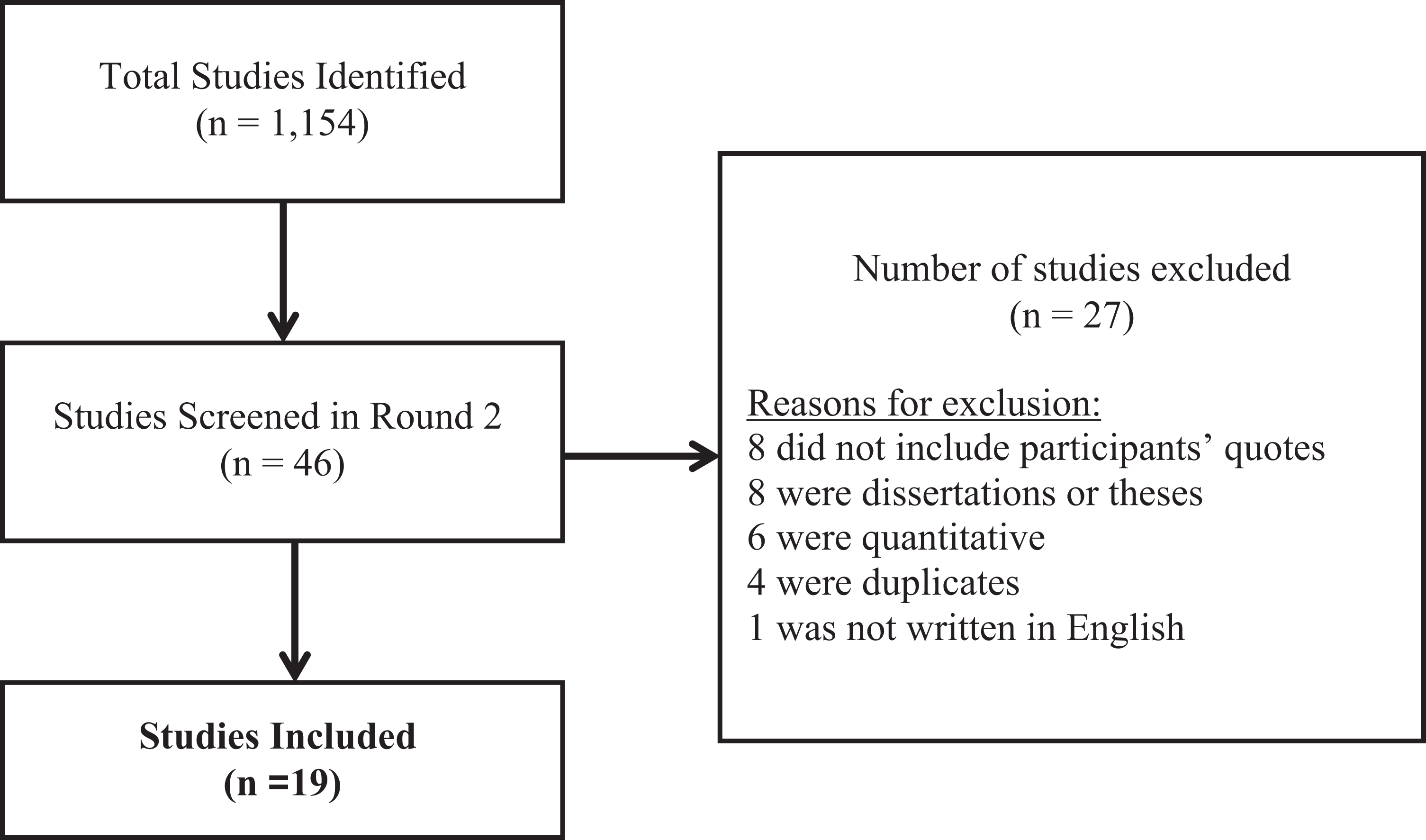
Flowchart of article selection process.
Analysis
Thematic analysis was used to examine the data. Thematic analysis is a way of coding and interpreting narratives that goes deeper than just counting how often a specific word or phrase is used (Guest et al., 2011). The model relies on critical reading and coding as the main method for interpreting data, whether that be from interviews or from secondary sources like police reports and other research (Guest et al., 2011). By using thematic analysis, the researchers hope to be able to paint a clearer picture of the phenomenon they are studying and preserve some of that contextual understanding that is so crucial to qualitative research.
The findings were identified in six stages identified by Braun and Clark (2006). First, two independent researchers read through the data in order to gain familiarity with the data. Next, initial codes were identified through the utilization of a code sheet. Once initial codes were generated by the two researchers, initial themes found within the data were identified. Once the initial themes were identified, the next stages of the analysis consisted of finalizing themes, including reviewing, naming, and defining themes. The final stage of the analysis included disseminating the results through summarizing findings for this article (Braun & Clark, 2006). Using thematic analysis instead of a simpler coding method was another method decision made to ensure that these women’s stories would be seen in as much context as possible and that their experiences would really be honored through being shown in an honest and thoughtful way that included nuance, complexity, and compassion.
Results and Discussion
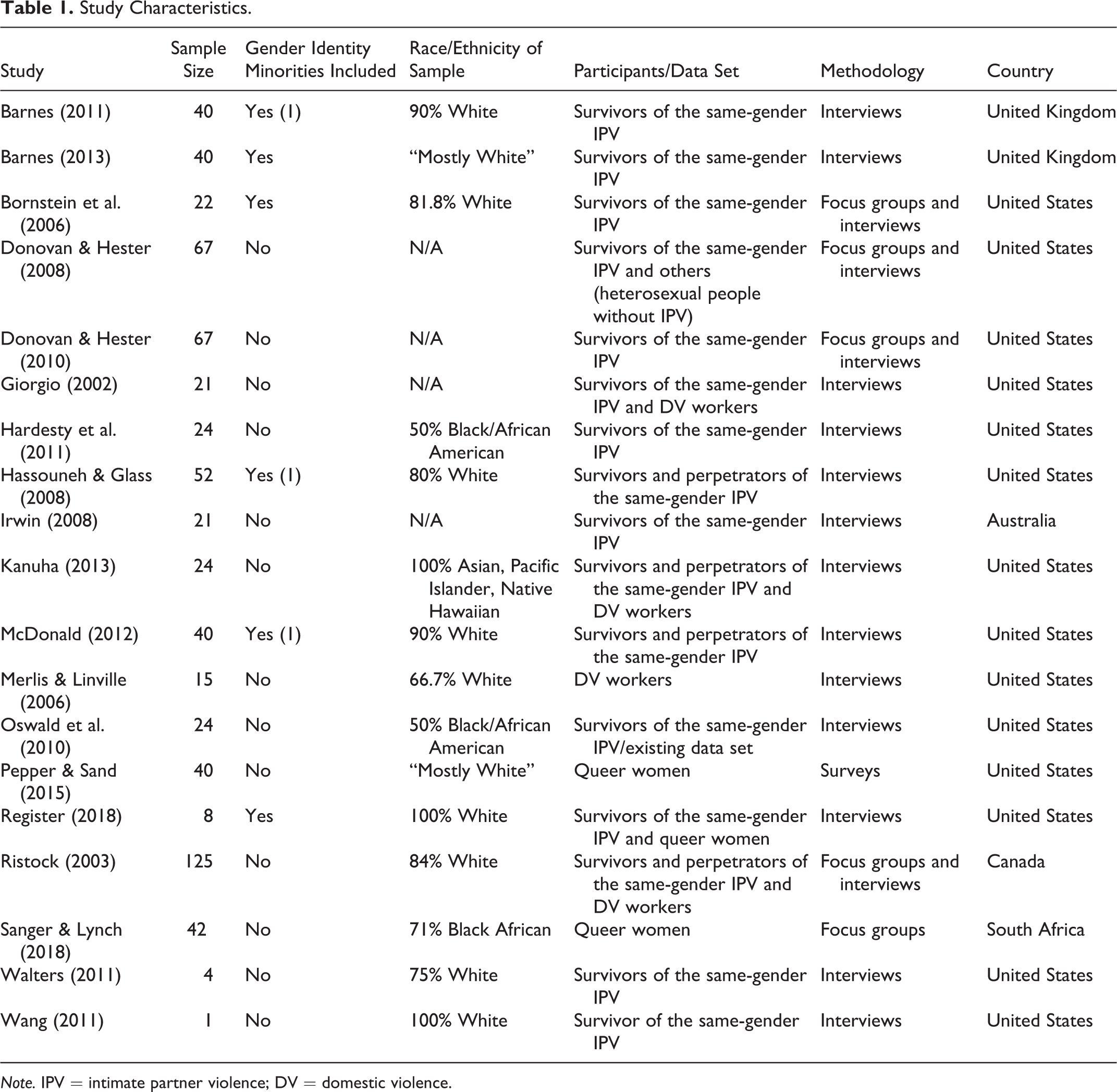
A total of 19 studies were included in the qualitative synthesis (see Table 1). Throughout coding of the data, three categories of observations were created: barriers to help and support, themes within experiences of IPV, and recommendations for helping professionals. Minority stress theory and disempowerment theory help explain some of the unique aspects of IPV found for women in the same-gender relationships. For example, in line with disempowerment theory, many of the themes identified looked at how IPV was used as a way to exert or maintain power in a relationship.
Study Characteristics.
Note. IPV = intimate partner violence; DV = domestic violence.
Barriers to Help and Support
This category refers to findings that were related in some way to difficulties victims faced in relation to help-seeking and seeking support services. These included a fear of contributing to heterosexism (which included the fear or experience of not being believed, accepted, or experiencing heterosexist responses by those outside of community), the experience of the “lesbian utopia” (which included the fear or experience of not being believed or accepted by those within the queer community), a lack of positive interaction with law enforcement, and a fear of or experience of unsafe survivor spaces. This major theme within the results highlights minority stress, as many barriers were specific to marginalized populations (Meyer, 2003). One participant phrased the difficulty of a lesbian seeking help and support quite bluntly by saying: “Politically, it might be easier to get money to cure lesbianism than to get money to support battered lesbians” (Merlis & Linville, 2006, p. 114).
Fear of contributing to heterosexism
Many women within the studies reported a fear of contributing to negative views society has toward lesbians by talking about abuse. These women have already experienced heterosexism and do not want to give anyone else any more negative aspects of queer people to highlight. One survivor described it as, “I think that people are very afraid to add to the stigma of being queer by saying…not only are we queer, but we also have violence in our relationships and in our community” (Bornstein et al., 2006, p. 169). Another survivor explained the challenge of experiencing abuse in a time when they are simultaneously trying to present queer people in the best light possible: We are not all perfect, and when you have to try to get recognition and put your best self forward, you don’t want to give out anybody any kind of chink in the armor by starting to talk about violence. (Merlis & Linville, 2006, p. 120)
Closer to home, some participants discussed a fear of reaching out to family who had already been judgmental and unaccepting for similar reasons: “You know we are already looked at sometimes by our parents and the people closest to us as being sinful or wrong or devious. How can we tell them that we are in a situation with domestic violence?” (Merlis & Linville, 2006, p. 111). This highlights how the fear of making their own community look bad to outsiders may create a barrier for women experiencing the same-gender IPV to reach out for help.
Lesbian utopia
When participants in the studies reported on sharing their experience of abuse within the queer community, many spoke to the frustration they felt when other queer women either did not believe them or did not want to engage in the conversation at all. Many brought up the myth of the “lesbian utopia” as a reason for why other women did not want them to share their stories. The myth of the lesbian utopia can be defined as the idea that lesbian communities are much safer than heterosexual communities because the absence of men means the absence of oppression and domination (Barnes, 2011). Because of the belief in the myth of a lesbian utopia, people within the community receive the message from other queer women that they cannot be actually experiencing violence, and if they do, they need to keep it secret. One participant described it as follows: Who can you trust? You think you can trust your lesbian sisters. Then you find you can’t. What’s left? That’s very hard. And then the anger about the whole utopia—lesbian community—which I think is important, but—women have wanted to hold onto it, without critically engaging with it at all. That’s my concern. I couldn’t critically engage with it, and it was destroying my capacity to feel good about myself. (Irwin, 2006, p. 32)
This message within the community of not putting language to violence greatly harms survivors and enables perpetrators to continue enacting harm with little to no negative repercussions. It is a unique situation because you have a marginalized population further marginalizing some members by not allowing them to seek help or speak their truth. Within this message is also an implicit permission given to perpetrators that somehow labels their behavior as less toxic than abusive men’s simply because of their gender. One participant explained it as: “The queer community as an oppressed positionality, members are…labeled as less bad than white men, even when they partake in the exact same predatory behaviors” (Register, 2018, p. 18).
Considering the determination of many within the female queer community to avoid addressing violence, it is no surprise that many queer women find themselves without any social support when trying to seek help. In response to the myth of a “lesbian utopia,” one woman said, “I think it happens just as much as it does in the heterosexual world, because we’re the same people. I mean just because we’re gay doesn’t mean that we’re not—that there’s not violent people in our community” (Walters, 2011, p. 258).
Lack of positive interaction with law enforcement
Many survivors explained how law enforcement was not a viable option for help. One individual reported, [Law Enforcement] won’t take it that this is serious stuff; a lesbian is being beat up—especially a lesbian as big and as handsome as me [stands up]. I mean, I look like the perpetrator. My girlfriend is really good at—she’s sharp at putting it all back on me by the time the police show up. (Hassouneh & Glass, 2008, p. 322)
Because of the way this woman presented, she knew she would not be believed if she claimed to be a victim because police were likely to use size and a more masculine appearance to mean that she must have been the perpetrator. Law enforcement officers are likely to assume the partner that is physically larger or more masculine presenting is the primary aggressor, whether or not that is necessarily true. One survivor explained: “Size, sex…it’s really hard to figure e out what power dynamic is at work” (Bornstein et al., 2006, p. 169). One participant discussing law enforcement and gender presentation explained: “It’s almost like there’s this belief that domestic violence can only happen if there is physical power; there’s a physical power difference…which isn’t the case” (Register, 2018, p. 258).
Another survivor explained her experience seeking help from law enforcement: They (police) be thinking this is joking…you can hear them with their like smart remarks and different things like that…I still call them though because it’s their job to come out! You’re getting paid to come out. I’m having a problem, getting my ass kicked. You are supposed to be here. (Hardesty et al., 2011, p. 36)
While the lack of support did not stop her from reaching out to police, it clearly did not have the effect she had hoped for. She was not alone—many participants spoke to the fact that police seemed unwilling to take woman-to-woman violence seriously. Another woman said, “The police came out three or four times…They would just tell us to behave and that, you know, we needed to act like ladies. They didn’t even ask for an explanation” (Register, 2018, p. 261). It is important to highlight that the negative experiences these women may have had or may anticipate having, with law enforcement personnel may decrease the likelihood that these women will report their abuse.
Unsafe survivor spaces
One unique aspect of female same-gender IPV is that the many shelters, groups, and supports society has for women who have been abused are targeted toward opposite-gender relationships and are not used to having to screen out female perpetrators. Many participants in this study talked about the fear that their abusive partner would infiltrate these survivor spaces, making them very unsafe. A few women talked about how their abusive partners would show up to IPV groups and even go to the same shelters they were in, pretending to be victims themselves. One participant who experienced this said: “If it was a guy you wouldn’t have access to all of the places she was able to have access to. There was just no shaking her” (Bornstein et al., 2006, p. 170). This speaks to the importance of shelters, groups, and supports for female victims of IPV being aware of the gender of the perpetrator and ensuring that the perpetrator cannot infiltrate these safe spaces. This could help to ensure that these supports can remain a safe space for women who experience same-gender IPV.
Themes Within Experiences of IPV
Lack of knowledge
One of the more prevalent themes noted throughout the articles was that many women experienced abuse in their first queer relationship and reported a lack of knowledge about what queer relationships were supposed to look like and a lack of additional support services in place. This appeared to make some women more vulnerable toward experiencing abuse because they were not sure what was acceptable and what was not.
One survivor reported this experience, explaining: “I thought, well, I just thought that it was fine because we were girls, like, and girls don’t hurt each other like that. So I just thought that it was the way it was supposed to be” (Hassouneh & Glass, 2008, p. 317). Many other participants within the studies said similar things, including: “I just thought this is how relationships are, this is how it is and you have to give up this for the relationship…” (Donovan & Hester, 2008, p. 282), and “I was too young and insecure about the relationship…Anybody could have walked all over me” (Ristock, 2003, p. 335). Many felt they could not reach out to family for similar reasons, such as they were not accepting of their sexual identity or that they would not believe women could perpetrate IPV (Hassouneh & Glass, 2008; McDonald, 2012).
Lack of framework to identify abuse
Another commonly discussed theme that was highly connected with a lack of knowledge was that many women who were experiencing violence perpetrated by a woman found it difficult to see it as IPV, as it did not fit any framework they had been given by society. One woman described the lack of language around female same-gender IPV by saying: “…I don’t think anyone believed that one woman could do that to another woman—there was just no, no sense of reality around that at all” (Barnes, 2011, p. 236). Another explained that: “There is something about someone of your own gender violating you. There is also a different message about boys fighting and girls fighting. I mean it’s just not something girls do” (Merlis & Linville, 2006, p. 106).
Many other women reported that they had been taught that only men perpetrated violence against their partners, which made it harder for them to recognize their own abusive experiences. One woman explained that: “I didn’t know any better. I would have never accepted that from a man, but from a woman it seemed different…I didn’t know any other lesbian to know the difference” (McDonald, 2012, p. 639). Another survivor who had previously worked in a domestic violence (DV) shelter explained how she had a difficult time identifying her own experience as IPV or DV: I worked in a domestic violence shelter for two summers, when I was in college. And so—and I’m a social worker now so I know that I know intellectually and everything what I’m supposed to know. But at the time I don’t think it would have made a difference. It just didn’t seem like—girls didn’t have domestic violence issues with each other. (Hassouneh & Glass, 2008, p. 316)
Many women in these studies talked about losing connections to friends and family once they started being open about their sexual orientation. Because of this, many felt that it was very important they remain a part of their queer community and maintain the idea that women do not hurt other women. As their only source of support, it was a huge risk for many to disclose that they had experienced abuse by another queer woman, especially because in some cases, the perpetrators were well-known and respected within their community. One woman explained the pressure to accept the violence because her partner was her connection to the whole queer community, saying: She was the first one I had ever been with, I didn’t really know what to expect, and I really didn’t know that many gay people. I didn’t know gay people in relationships…so she was, like, my whole gay world, you know? (McDonald, 2012, p. 639)
This desire to keep ties to the community was seen by the researcher as both a common theme in women’s narratives and a barrier to help-seeking.
Lack of support systems
Along with many survivors experiencing abuse lacking the framework or knowledge to recognize the abuse, many were also still not out or open about their sexuality to friends and family at the time they experienced abuse. One study noted specifically that, “Often, the process of coming out reaches one kind of conclusion when the person enters their first same-sex relationship” (Donovan & Hester, 2008, p. 282). This situation makes reporting abuse even more difficult because these women were not able to share about their relationship at all and were still trying to forge a connection to the queer community, often through their partner. One participant who was not out to family or friends said it left her in a position where she and her partner were: “The only people we could talk to about our own problems” (Kanuha, 2013, p. 1187). This theme speaks to a need for more openness and education around queer issues, so that people are better prepared to seek out healthy, happy relationships once they do begin dating. Reflecting on her family’s lack of acceptance, one participant explained: I wonder also because you have a whole other layer of oppression from being a victim of domestic violence in a lesbian relationship if your family has turned—like turns against you…I don’t think I would have stayed as long had I had the support of my family. (Register, 2018, p. 266)
Power dynamics
In all relationships, power dynamics shape interactions. For most female victims of IPV, their partners are male and therefore have more societal power and (usually) more physical power. Power differentials also occur within the same-gender relationships, and according to disempowerment theory, violence can be used in order for individuals to gain power when they feel as though they lack power in society or relationships (Archer, 1994). Size differences impact the ability of a person to harm another with physical violence. Between two women, gender presentation, race, income, and many other variables affect who is perceived to have the most power and therefore who is the abuser and who the victim is. Once participant summed this up beautifully by saying: The imbalance of power between a man and a woman is constant just because a man has privilege in a society. And so there’s always going to be that, whether he’s going to choose to work on it or not. Different factors may change some aspects of power but that power will remain constant. Whereas with two women, I think that the power fluctuates more…there’s more variables involved that can change. (Ristock, 2003, p. 335)
Another participant discussed the difficulty in outsiders recognizing power dynamics and recognizing them within the relationship: “It’s a dance between two people of submission and dominance” (Ristock, 2003, p. 335). Due to the difficulty identifying power imbalances, some participants even reported a confusion about whether or not they were the abuser or abused. One survivor reported that: “She would attack me, and I would fend her off, and she would end up with scratches or something, and she would be like, ‘See! She’s abusing me’” (Bornstein et al., 2006, p. 169). Undoubtedly, examining power dynamics is necessary when examining IPV in female same-gender relationships, which includes gender presentation, race, parenthood, and LGBT+ identity itself.
Power and gender presentation
Gender presentation further complicated things for victims of IPV. For some participants who were physically larger than their abusive partners, it was difficult to comprehend that they were being abused. Another participant who was the physically larger partner discussed it by saying: “I was always stronger than her, and I always felt I could be in control of the situation. I never felt afraid of her until she choked me and I almost passed out” (Kanuha, 2013, p. 1188). Another woman who did not typically present as feminine felt that she had to change her appearance at a court hearing in order to have a chance. She explained: “I was already coming in at a disadvantage, being a lesbian, and I had to appear feminine to appear normal, like I had to appear like I was heterosexual” (Register, 2018, p. 17). It is clear that women in the same-gender relationships experiencing IPV have found that their own gender presentation has impacted the way they were viewed or believed as victims of IPV.
Power and race
Race is another intersection that makes the experience of experiencing and reporting IPV more complicated due to survivors having multiple marginalized identities. Racial differences within the relationship can also impact the power dynamics. One client reported that: “I think racism is another thing we don’t talk about—the ways white women might use power over their partner who is a woman of color—there is power and control there” (Ristock, 2003, p. 337). An additional aspect of race intersecting with queer IPV is that LGBT+ identities are often less acceptable within different racial communities, which greatly impacts a survivor’s support system and opportunities for help if they are being abused. One client described their experience as being a person of color and a queer person by saying: “When I became a lesbian, I had to stop being Indian, and I stopped being whole” (Kanuha, 2013, p. 1186). This finding highlights the importance of considering race when examining power differentials that may impact a woman’s ability to seek help or resources when experiencing IPV in a same-gender relationship.
Power and parenthood
Parenthood also rendered some women with less ability to leave and/or report the abuse they were experiencing by their partners. Many felt that if either law enforcement or co-parents found out about the abuse, they would lose custody of their children. One woman reported that: “My children are everything to me. Everything. And if I even have a notion that, you know, it was possible to lose them, then I hid everything from him” (Hardesty et al., 2011, p. 39). Another echoed a similar fear by saying: “I didn’t want to do nothing to have my children removed from my household” (Hardesty et al., 2011, p. 36). This theme identified within the study mirrors IPV research examining opposite-gender couples, which suggest that parenthood can be a deterrent to reporting abuse or leaving an abusive situation. It is important to also examine this as a barrier when working with women in the same-gender relationships.
Power and LGBT+ identity
A unique aspect of power and psychological abuse that came up related to queer and trans identities was that abusive partners would criticize or invalidate a victim’s LGBT+ identity. Invalidating their partner’s LGBT+ identity seemed to serve as a way to maintain control and power over their partner’s behaviors and as way to hurt feelings. One participant explained how this happened them by saying: “With my case it was trans stuff. Like, ‘Oh, this person’s more trans than you…’ Pressure that way” (Bornstein et al., 2006, p. 171). Another participant said that if they did not want to engage in sex with their partner, she would take that as a reason to tell her she was not actually a lesbian by saying things like: “Well, why don’t you want to have sex? Hello, you must not really be a lesbian if you don’t want to have sex or this kind of sex” (Bornstein et al., 2006, p. 171). This finding highlights a specific type of power dynamic that may only be seen when working with or studying women experiencing IPV in the same-gender relationships.
Recommendations for Helping Professionals
The main recommendation found for helping professionals is to be aware of violence within the queer community and actively work to correct any heterosexist views of IPV we may be holding onto and perpetrating in our own work. Survivors need to be believed, regardless of who they say the perpetrator is or how the victim identifies in terms of sexual orientation or gender presentation. As was evident in the quotes related to barriers to help and support, it is clear that when helping professionals rely on stereotypes, it damages victims who do not fit traditional “victim norms” of being the more feminine presenting or physically smaller partner. Helping professionals should also work to avoid the misconception that violence does not or cannot exist in female same-gender relationships.
It is also important for helping professionals to recognize, or be aware of, the potential experiences individuals they are working with may have faced, such as negative interactions with law enforcement, barriers to accessing safe survivor spaces, or a history of not being believed within or outside of their community. It is also important to be aware of power dynamics in queer relationships and how being multiply marginalized may impact help-seeking behaviors. Helping professionals may need to critically evaluate the resources they provide to heterosexual individuals who have experienced IPV when working with queer women, as not all of these resources may be as beneficial to this population.
Another recommendation for helping professionals is that queer female victims of IPV need places to talk about their experiences, places where they will not feel judged or invalidated. One participant in a study, who originally spoke to the fact that she did not need any help and did not need to talk about her experience, later reported, “It’s interesting to talk about it. It’s kind of got me thinking about…yeah, yeah, it’s got me thinking…maybe it is good to talk about it” (Barnes, 2013, p. 388). This quote goes to show that even when some survivors feel as if they have moved on completely, it can still be beneficial to process the experience with another empathetic person. A summary of research findings can be found in Table 2.
Summary of Research Findings.

Note. IPV = intimate partner violence; LGBT+ = lesbian, gay, bisexual, transgender, plus various additional sexual minorities.
Limitations and Future Research
A potential limitation of this research comes from the fact that the authors did not collect data themselves and instead are using secondary data. Although this increases generalizability and can help identify recurring themes through the current body of work, it also creates a lack of deeper contextual information when interpreting the findings in this qualitative synthesis. Another limitation is that research on this subject at this point in history has some significant gaps that are concerning, such as a lack of studies that center the experiences of racial, ethnic, and gender minorities. There were very few transgender participants in the studies included for review, and while four studies (see Table 1) had more racially diverse samples (50% or more ethnic/racial minorities), the majority of participants were White. These gaps in the larger literature limited the conclusions that could be drawn about these underserved groups, and future research should be focused on how IPV may be different for people who are multiply marginalized. Despite these limitations, this synthesis points to several areas where future research could expand on what we know.
Future research would benefit from looking into alternative ways to explore, understand, and assess power dynamics in queer relationships. While some theories and gender-neutral assessments are helpful in this area, it would be beneficial for researchers, as well as clinicians and other helping professionals, to have access to theories and information created with the specific intention of speaking to violence in queer relationships. It would also be beneficial for future research to examine the experiences of individuals with multiple marginalized identities to increase understanding of the diversity of lived experiences with IPV. Specifically, future research should examine intersections of race, class, culture, and gender in relation to queer individual’s experiences of IPV. Another important area for future research is queer relationship education. A common theme throughout the studies reviewed was a lack of education about violence looks like and how to seek help when in a violent situation. Young queer people need comprehensive education on healthy relationship patterns as much as straight, cisgender youth. Inclusive, comprehensive education that covers power and healthy conflict resolution might be a way to prevent violence as well by teaching skills to manage conflict and differences in relationships without resorting to violence.
Conclusion
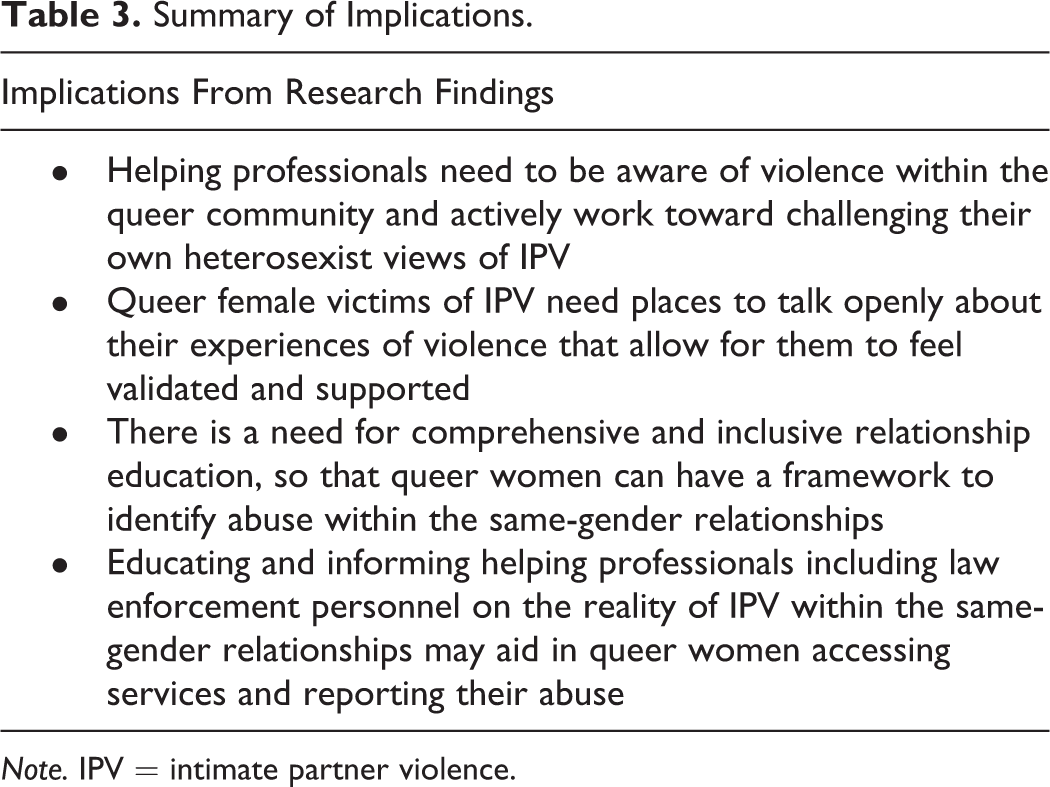
This research sought to synthesize what is currently known about IPV in female same-gender relationships, identify themes related to barriers and experiences of women in violent same-gender relationships, and draw attention to any findings that speak to a need for future research and/or exploration. Throughout this study, researchers used thematic analysis and narrative inquiry to look at all studies included in this qualitative synthesis, and findings included barriers to help, themes related to women’s experiences, and recommendations for helping professionals. Findings related to barriers to help, particularly the lack of frameworks to identify abuse, as well as unsafe survivor spaces, are of particular importance for helping professionals to be aware of, so that we can shift the way we create spaces or engage in psychoeducation, so that it is more appropriate and inclusive. Similarly, findings related to experiences with power are extremely important to increase awareness of, so that helping professionals can ensure that they are addressing power dynamics and accounting for how multiple intersecting identities can influence and further complicate women’s experiences of IPV and help-seeking behaviors. A summary of implications can be found in Table 3.
Summary of Implications.
Note. IPV = intimate partner violence.
Footnotes
Declaration of Conflicting Interests
The author(s) declared no potential conflicts of interest with respect to the research, authorship, and/or publication of this article.
Funding
The author(s) received no financial support for the research, authorship, and/or publication of this article.
