



Abstract
The aim of this review is to assess empirical studies from the last 2 decades that have examined the association between cumulative stressors and adolescent substance use. Cumulative stressors were measured in these studies with adverse childhood experiences or adolescent stressful life events inventories. The 109 articles meeting the eligibility criteria that emerged from the review demonstrated a consistent, yet modest, association between cumulative stressors and adolescent substance use. Of note, several studies found that the associations were moderated or mediated by genetic factors related to cortisol regulation, intrapersonal factors such as low self-control, or interpersonal factors such as peer substance use. The review’s findings thus suggest that efforts to reduce the effects of cumulative stressors on substance use could gainfully identify and target these risk moderators and mediators.
The prevalence of some types of adolescent substance use, particularly tobacco use, has diminished over the past several decades, but marijuana and new forms of nicotine use, such as vaping, have increased (Kraus et al., 2018; Miech et al., 2019). According to data from Monitoring the Future, an annual survey of youth in the United States, the percentage of 12th-grade students reporting past-year marijuana use increased from 23% in 1990 to 36% in 2019. The corresponding upturn among 10th-grade students was from 16% to 29% (Miech et al., 2020). Research on this topic, therefore, continues to draw attention from various disciplines including psychology, public health, public policy, sociology, and social work.
Youth initiate and escalate substance use for a variety of reasons, but one commonly studied precursor is stressful or adverse life events, which involve incidents such as death or serious illness of loved ones, family dissolution, or other untoward events, that tend to create negative emotions or threaten an adolescent’s self-esteem, identity, social status, or physical or emotional health (Cohen et al., 2019; Hyman & Sinha, 2009). Adverse childhood experiences (ACEs)—which involve stress-inducing experiences early in the life course, such as physical or emotional abuse or neglect, parental mental illness or behavioral problems, or family dissolution (Felitti et al., 1998)—have been similarly linked to substance use (Shiffler et al., 2020; Somaini et al., 2011).
Considerable research has addressed the association between adverse experiences and tobacco, alcohol, marijuana, and other forms of substance use (Chassin et al., 2013; Grunberg et al., 2011; Shiffler et al., 2020). Some studies have examined whether discrete events, such as victimization, natural disasters, or parental divorce, affect substance use. Other research has assessed whether the accumulation of adverse incidents—experiencing a number of events over a finite time frame—has particular effects on substance use. A few reviews have summarized research on the association between specific adverse experiences and substance use among adolescents (Arcadepani et al., 2019; Danielson et al., 2017; Edalati & Krank, 2016; Heerde & Hemphill, 2016), but careful assessments of the implications of an accumulation of experiences, what we term cumulative stressors, are rare.
The goal of this article is to provide a methodical review of research on cumulative stressors and adolescent substance use published in the past 20 years. The reviewed studies stem from two research literatures that rarely overlap: the adolescent life events literature and the ACEs literature. The results of our review of more than 100 articles indicate a consistent association between cumulative stressors and substance use, but one that is moderated or mediated by genetic/neurological, intrapersonal, and interpersonal characteristics.
Background
Substance use, which is defined as the ingestion of psychoactive substances deemed illegal by an authoritative governing body or of licit substances in a way inconsistent with medical standards (World Health Organization, 2018), is a common behavior among young people in large parts of the world. Some observers see it as a rite of passage, with the use of cigarettes, alcohol, or marijuana viewed as a normative life course milestone among young people (Bonino et al., 2005). Use of these and other substances during adolescence, however, has social, psychological, and physiological consequences, including a higher risk of conduct disorders and other maladaptive behaviors, attention deficits, neurocognitive and frontal cortex response impairments, anisotropic differences in white matter, physical and mental health problems (e.g., high blood pressure, depressive symptoms), diminished educational attainment, and substance use disorders (SUDs; Bava & Tapert, 2010; Lev-Ran et al., 2014; Macleod et al., 2004; McCambridge et al., 2011; Salmanzadeh et al., 2020). Youth substance use also has societal costs that are estimated to be several billion dollars per year in the United States alone (Miller, 2004). Understanding the key antecedents of substance use is thus an important endeavor.
Stressors and Substance Use
Research has identified myriad factors that affect adolescent substance use, including a family history of use or SUDs, poor family relationships, peer associations, childhood behavioral problems, low self-control, and risk-taking propensities (Chassin et al., 2013; Gray & Squeglia, 2018; Hoffmann, 2020; Leung et al., 2014; Van Ryzin et al., 2012). An antecedent that has been explored for several decades is stressful or adverse experiences—also referred to as stressors—which produce reactions that disrupt one’s homeostasis, resulting in physical and psychological adaptions (Majewska et al., 2002). Whereas stress is an individual’s physiological and emotional response to pressures from the environment (Selye, 1976), stressors are specific types of pressures that are believed to increase stress. Short-term reactions to stressors, such as the fight or flight response, are designed to relieve stress and facilitate a return to homeostasis. According to several studies, one reaction or adaptation to stressors among adolescents is substance use (Chassin et al., 2013; Shiffler et al., 2020).
Much of the research on adverse experiences addresses them singly or in a limited manner. For instance, studies have documented the effects of natural disasters, family disruption, unemployment, victimization, discrimination, parental maltreatment and neglect, or living in poverty or conflict-ridden communities on substance use (e.g., Arkes, 2013; Cambron et al., 2020; Danielson et al., 2017; Wright et al., 2013). But the accumulation of these experiences—cumulative stressors—especially in a limited time frame, can be especially detrimental as one’s ability to adapt and return to a state of homeostasis is hindered, resulting in maladaptive responses such as social withdrawal, physical illness, or mental health disorders (Kort-Butler, 2020; McEwen, 2004; Shiffler et al., 2020). Under these circumstances, substance use furnishes a way to assuage the effects of stressful experiences.
The most common explanation for the link between stressors and substance use is the self-medication hypothesis, which posits that substance use provides a way to diminish the physical and emotional toll of stressful or painful experiences (Grunberg et al., 2011). In particular, substance use alleviates the negative emotions caused by cumulative stressors (Wills et al., 2017). Generally, intoxicating substances furnish short-term relief from stressors. Some intoxicating substances may also boost “extinction learning” and help one forget negative experiences (Grunberg et al., 2011, p. 294).
Cumulative stressors also affect neurological pathways. Exposure to stressors, for example, disturbs cortisol regulation, striatal functioning, DNA methylation, limbic system activation, and other neurological functions, which, in turn, are linked to hostility, impulsivity, and substance use during adolescence and adulthood (Enoch, 2011; Gordon, 2002; Somaini et al., 2011; Tervo-Clemens et al., 2020; Walters & Kosten, 2019). Moreover, if substance use transitions into a SUD, additional stressors may increase emotional distress, resulting in a reciprocal association between stressors and substance use (Brady & Sinha, 2005). Stressors may also increase anhedonia, the inability to feel pleasure, thus leading individuals to seek pleasurable sensations through intoxication (Sussman & Leventhal, 2014). Finally, cumulative stressors are related to cognitive impairments in general, which are associated with a higher risk of substance use and SUDs (Edalati & Krank, 2016).
The neurological impairment model focuses on the indirect effects of cumulative stressors on substance use. Other approaches emphasize conditional effects. The stress process, general strain, or stress-buffering model, for instance, asserts that adverse experiences lead to substance use when conventional coping resources are weak or nonexistent (Agnew & Brezina, 2019; Pearlin & Bierman, 2013). When, say, family relations or social support systems are poor, those who experience cumulative stressors are likely to turn to substances to alleviate their negative psychological states. But, when coping resources are strong, one’s ability to adapt positively to adverse circumstances is enhanced. Similarly, cognitive resources, such as high self-control and emotional maturity, or certain genotypes might attenuate the effects of cumulative stressors on substance use (Blomeyer et al., 2008; Wills et al., 2011).
Cumulative Stressors in Childhood and Adolescence
Experiencing cumulative stressors early in the life course is especially detrimental and may increase the likelihood of substance use and SUDs in adolescence and adulthood (Gordon, 2002). Two research literatures support this assertion. First, studies have demonstrated a link between ACEs and substance use in adolescence (Benjet et al., 2013; Shiffler et al., 2020). Second, research that has administered stressful life events inventories to adolescents suggests a positive association with the prevalence and frequency of substance use and SUDs (e.g., Hyman & Sinha, 2009; Roberts et al., 2018). Some studies have also identified a step function, with youth increasingly likely to report substance use as they experience more events or as stressors accumulate (e.g., Cisler et al., 2011; Dube et al., 2006). Many empirical studies and a few summary chapters outlining these associations exist, but a careful review of the literature on cumulative stressors and adolescent substance use has not yet been conducted. Similarly, even though studies have examined factors that moderate or mediate the effects of cumulative stressors on adolescent substance use (e.g., Cooke et al., 2015; Wills et al., 2013), there has been no effort to systematize these factors.
Our objectives in this article are therefore to (1) summarize the literature on cumulative stressors and substance use to determine the consistency of the association across studies; (2) review and organize factors that moderate or mediate the effects of cumulative stressors; and, based on limitations in the literature (3) recommend a path forward for researchers studying the impact of cumulative stressors on adolescent substance use.
Method
Search Procedures
Because we were interested in two often distinct literatures—ACEs and adolescent life events—we used a two-pronged approach to search the research literature for relevant publications. The search terms that guided the review were based on previous assessments of adolescent substance use, ACEs, life events, and cumulative stressors (Arcadepani et al., 2019; Hatch & Dohrenwend, 2007; Heerde & Hemphill, 2016; Schwarzer & Luszczynska, 2013) as well as the research team’s experience investigating these topics (e.g., Hoffmann, 2016; Jones & Pierce, 2020). We employed the search terms and databases listed in Table 1 to explore the two bodies of literature and assessed the reference sections of included studies and narrative reviews to identify additional publications. Google Scholar’s “Cited by” function was also utilized to pinpoint relevant studies that may not have been listed in the searches.
Literature Search Strategy: Keywords and Databases (2000–2020).

Note. ACE = adverse childhood experience.
We limited the publications using the following criteria that are consistent with the aims of our review and with commonly accepted practices for narrative and systematic reviews (Rodgers et al., 2009; Templier & Paré, 2015): The study’s results were published between 2000 and 2020. The research appeared in a peer-reviewed journal. Research published in theses, dissertations, or reports were excluded. Qualitative studies, case studies, meta-analyses, and literature reviews were also not considered. The study used data from a clearly defined community, secondary school(s), or general adolescent sample. Adolescence was defined as roughly between the ages of 12 and 18 (National Research Council, 2011). Given the uncertainty in defining college students as adolescents, studies using college samples were excluded, as well as those that used data solely from an institutional setting, such as a mental health, substance abuse treatment, or juvenile justice facility. The study used quantitative methods and reported some type of effect size (e.g., linear regression coefficient, odds ratio; Kelley & Preacher, 2012). The study included as an explanatory variable a count or frequency measure of ACEs or adverse/stressful/negative life events during childhood or adolescence. We excluded studies that examined only single events (e.g., parental divorce), compared single events (e.g., parents divorced vs. a parent died), or collapsed events into binary indicators (e.g., zero ACEs vs. one or more ACEs during childhood). Studies were excluded if the count of events focused only on exposure to violence, bullying, childhood abuse or neglect, perceived discrimination, acculturation stress, poor relations with parents, peers, or teachers, or only perceptual or volitional events. The study included as an outcome variable at least one type of substance use or SUD during adolescence. Studies that assessed substance use or SUDs during adulthood only were excluded.
We did not deliberately omit experimental studies, though the review did not turn up any that were within the outlined parameters. The search was completed in May 2020.
Results
Article Selection
Figure 1 depicts the results of the database searches and the article reviews. One member of the research team was responsible for the review of the adolescent life events literature and initially identified 3,605 articles. After screening the titles and abstracts of each, 3,032 were excluded, leaving 573 for a full-text review. Each article was then vetted by the team member using the eligibility criteria, which resulted in 90 publications selected for inclusion in the final review. After forward and backward selection based on the reference lists of these articles, four additional articles were identified, yielding a final list of 94 articles. The second member of the research team utilized the same process to assess the ACEs literature, initially identifying 2,872 articles. After screening the titles and abstracts of each, 2,742 articles were excluded, leaving 130 for full-text review. Once each article was evaluated using the eligibility criteria, 15 publications were selected for inclusion in the final review. Forward and backward selection did not identify any additional publications. The team member who was initially responsible for the life events review then independently assessed the ACEs articles, and the team member who was initially responsible for the ACEs review independently evaluated a random subset (n = 25) of the life events articles. No discrepancies were identified. The analysis of the data was guided by Rodgers et al.’s (2009) recommendations regarding narrative syntheses. A complete list of the final set of articles is available in the Online Appendix.
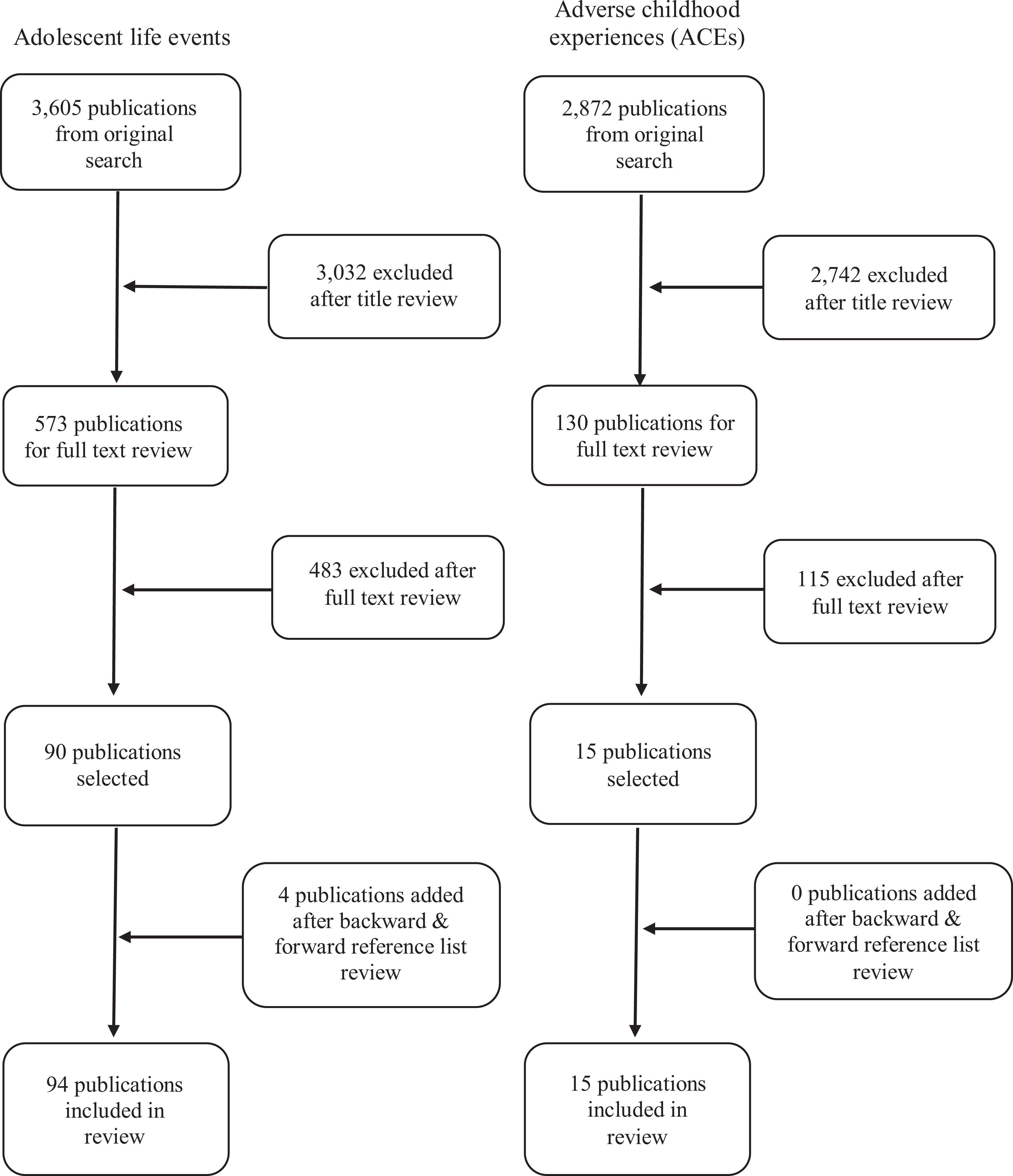
Literature search flowchart: Article selection procedures.
The corpus of studies utilized 80 distinct samples mostly from the United States but also from Australia (one), Brazil (one), Canada (three), China (three), western Europe (two), Finland (one), Germany (two), Iceland (one), Israel (one), Italy (one), Mexico (three), the Netherlands (one), New Zealand (one), the Russian Federation (one), South Africa (one), Spain (one), and Turkey (one). Four of the studies were not in English, with three in Spanish and one in Chinese. These were translated into English using transcription software. All of the studies used cross-sectional or prospective longitudinal data, with none relying solely on retrospective data regarding substance use.
Summary information from the final group of studies appears in Table 2, along with a sample of references. Forty-one studies analyzed cross-sectional data and 68 longitudinal data. Seventy-five studies took place in the United States, 32 outside the United States, and two included a sample of the United States and Canadian youth. Fourteen studies used nationally representative data from the United States (12) or Italy (two). The remainder relied on school (48) or community (47) samples. Two of the school samples and five of the community samples were from American Indian communities in the United States or Canada.
Summary Information From the Reviewed Studies.
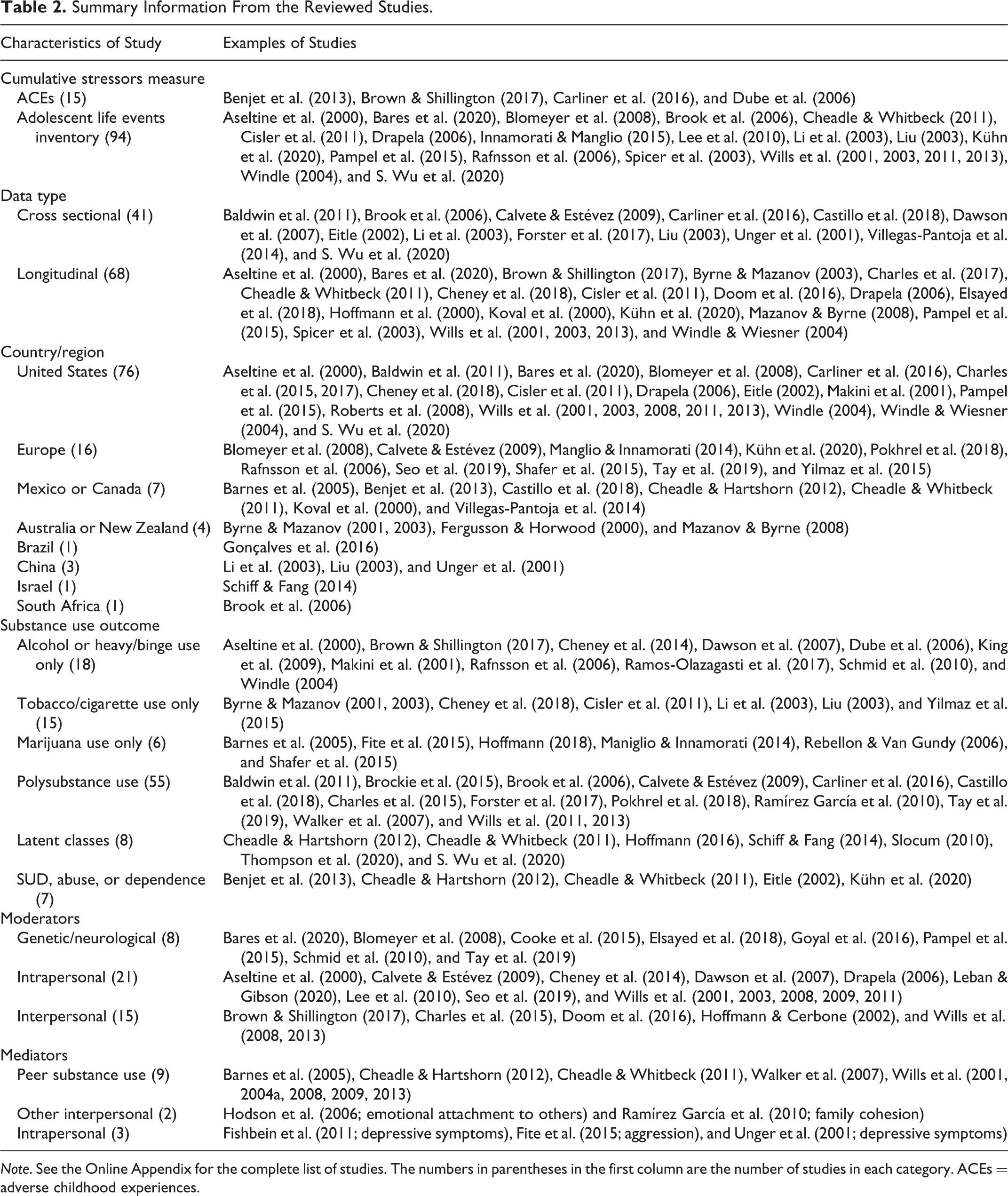
Note. See the Online Appendix for the complete list of studies. The numbers in parentheses in the first column are the number of studies in each category. ACEs = adverse childhood experiences.
General Findings
The 109 studies reported 263 specific results that examined the association between cumulative stressors and adolescent substance use. Most models were estimated with linear regression (95) or binary logistic or probit regression (111). The remainder were assessed using analysis of variance, multinomial logistic, count, growth curve, survival, or regression tree models. The most frequent outcome was a measure of alcohol use, with 55 specific results, followed by marijuana use (29), cigarette use (23), and binge or heavy alcohol use (12). The others were measures that aggregated substances, such as alcohol and marijuana. About 84% of the results met the authors’ criteria for statistical significance (typically p < 0.05), whereas 16% did not.
Standardized regression coefficients were reported in about 15 studies, with a range of approximately .10 and .20 for additive frequency outcomes but between .20 and .35 for outcomes estimated as latent variables. For example, Baldwin et al. (2011) estimated the standardized slope of life events on a latent measure of alcohol, marijuana, and problem use to be .32, after adjusting for a host of covariates (see also Schiff & Fang, 2014; Slocum, 2010).
The models that examined binary outcomes, such as any report of marijuana or other substances in the past month or year, revealed odds ratios that ranged from about 1.02 to 1.86. There was no clear pattern regarding the type of substance examined, though.
The effects of cumulative stressors on substance use differed in cross-sectional and longitudinal models. The median linear regression coefficient in the cross-sectional models was .23, whereas it was .13 in the longitudinal models, which is not surprising given the more distal nature of the association in the latter models. The median sizes of the odds ratios were 1.26 in cross-sectional models and 1.20 in longitudinal models.
Eight studies estimated latent classes of substance use, usually of a longitudinal nature, and examined whether cumulative stressors predicted membership among adolescents. Of the 33 latent classes identified across the studies, 24 were predicted by cumulative stressors and nine were not. S. Wu et al. (2020), for example, determined that the odds of membership in a serious or a moderate substance-using group was 45% or 37% higher with each unit increase in cumulative stressors. On the contrary, Cheadle and Whitbeck (2011) found that cumulative stressors failed to predict membership in an early or mid-adolescent alcohol trajectory group once feelings of anger or friends’ delinquency was included in the model.
Multiple studies, especially in the ACEs literature, provided evidence of a dose–response relationship (e.g., Benjet et al., 2013; Duke, 2018). Duke (2018) determined, for example, that, compared to youth who reported zero ACEs, those reporting two ACEs were about twice as likely, but those reporting four more ACEs were about four times as likely to initiate alcohol or marijuana use.
Substance Use Problems
Seven studies assessed the risk of a SUD, abuse, or dependence. Of these, six reported statistically significant associations between cumulative stressors and one of these problem measures. For instance, Hoffmann and Cerbone (2002) utilized the Composite International Diagnostic Interview to identify youth from a community sample with a drug abuse disorder. They determined that each one-unit increase in stressful life events (range 0–13) was associated with a 4% increase in the risk of drug abuse. The one study that reported a null effect used a conditional inference tree and found that a measure of life events did not discriminate youth with and without an alcohol use disorder. Instead, gender, early sexual experiences, and disorderliness (e.g., low self-control, dishonesty) were the most accurate predictors of a disorder (Kühn et al., 2020).
Null Findings
As mentioned earlier, about 16% of the results failed to show a statistically significant association between cumulative stressors and substance use. Null findings were rarer in models that examined polysubstance use (6%) than in those that analyzed alcohol, tobacco, or marijuana separately (about 20% each). But nonsignificant results were more likely in studies that used data from outside the United States (28%) than from the United States (11%). As discussed in the next section, the associations reported in several studies were diminished with the introduction of variables, such as friends’ substance use, that operated as mediators.
Moderators and Mediators
The neurological impairment and stress process models posit that the effects of cumulative stressors on adolescent substance use are moderated or mediated by genetic/neurological, intrapersonal, and interpersonal factors (Gordon, 2002; Pearlin & Bierman, 2013). Consistent with these perspectives, several of the reviewed articles examined moderators or mediators that fit into each area.
Moderators
Genetic/neurological factors
Eight articles investigated whether genetic or neurological functioning affected the association between cumulative stressors and adolescent substance use. Three studies, two of which used the same data set (the Mannheim Study of Children at Risk), examined genes related to corticotropin or glucocorticoid functioning, which play a key role in physical stress reaction (Blomeyer et al., 2008; Goyal et al., 2016). The association between cumulative stressors and substance use was moderated in all three studies by variations in these genotypes, although the mechanism by which they affected the association was not described. Studies have shown, however, that both too much and too little cortisol release in humans—which leads to either heightened or diminished stress sensitivity—may be associated with maladaptive behaviors such as substance use (Milivojevic & Sinha, 2018).
The other five studies also showed conditional effects, with cumulative stressors affecting substance use only among boys with a particular allele in a serotonin transporter gene (5-HTTLPR) associated with negative emotionality (Pampel et al., 2015) or with alleles associated with a higher risk of alcohol dependence (Bares et al., 2020). In the most sophisticated study to date, Tay et al. (2019) determined that epigenetic DNA methylation in the erythroblast transformation-specific (ETS) transcription factor gene and reduced gray matter volume in the right cuneus portion of the brain (which is involved in memory and reward processing) were associated with a higher risk of binge drinking among those reporting more cumulative stressors. A key contribution of this study was its examination of an epigenetic outcome that is affected by early stressors, thus suggesting a moderated-mediation effect, with early stressors affecting DNA methylation, which then moderates the ensuing association between cumulative stressors and substance use.
Intrapersonal factors
The review also identified a number of demographic and intrapersonal factors implicated in cumulative stressors and adolescent substance use. Several studies, for example, determined that the association is more robust among younger adolescents and females (e.g., Aseltine et al., 2000; Leban & Gibson, 2020; Lee et al., 2012; but see Drapela, 2006). For instance, though contrary to their expectation that stressors motivate externalizing behaviors among boys, Leban and Gibson (2020) determined that ACEs were associated with a higher risk of substance use among girls but not among boys.
Using longitudinal data from adolescents attending New York City schools, Wills et al. (2008, 2011) have shown that cumulative stressors affect substance use primarily among those with low behavioral self-control, which is similar to impulsiveness. Wills et al. (2003) also found that religiosity—the importance of belief in God, prayer, and being guided by one’s religious beliefs—buffered the effects of cumulative stressors on the frequency of alcohol, tobacco, and marijuana use.
Interpersonal factors
Most of the research on interpersonal moderators has addressed parent substance use or the strength of parent–child relationships. Charles et al. (2015), for instance, determined that the association between cumulative stressors and substance use was magnified when parents had a SUD. Brown and Shillington (2017) found that more ACEs were related to a higher risk of alcohol and illicit drug use mainly when supportive adult relationships were weak (see also Hoffmann & Cerbone, 2002).
Mediators
Relatively few studies have examined factors that might mediate the association between cumulative stressors and substance use. The most commonly studied mediator is peer substance use, a well-known proximate correlate of substance use (Leung et al., 2014). Four of the reviewed studies showed that peers either partially or wholly mediated the effects of cumulative stressors on substance use among adolescents (Barnes et al., 2005; Wills et al., 2009, 2013), though no theoretical explanations were provided.
In addition to the effects of peers, Barnes et al. (2005) determined that an “addiction-prone personality”—which included high novelty seeking and low self-regulation—mediated much of the effect of cumulative stressors on heavy marijuana use. Similarly, intrapersonal factors such as depressive symptoms and aggressive tendencies might also partially mediate the effects of cumulative stressors on substance use (e.g., Fishbein et al., 2011; Fite et al., 2015). Again, though, researchers have not offered clear theoretical explanations for these patterns.
Discussion
The objective of this article was to identify and review empirical studies of the association between cumulative stressors and adolescent substance use. The review was guided by two distinct literatures: studies of ACEs and substance use, which usually focus on childhood experiences, and studies of stressful life events inventories and substance use, which tend to emphasize adolescent experiences. Although the assessment revealed several null findings, the overall tenor of the review was that cumulative stressors, whether they occur in childhood or adolescence, raise the risk of several forms of substance use, including initiation, prevalence, frequency, and changes in use (e.g., Benjet et al., 2013; Fite et al., 2015; Slocum, 2010).
Critical Findings From the Review.

Note. SUD = substance use disorder.
The magnitude of the association varied, but in most studies, it was modest. This depended on how substance use was measured, though, with latent substance use variables manifesting the largest associations with cumulative stressors. Measurement error in substance use variables may therefore have attenuated the effect sizes of cumulative stressors in several studies. Yet it is clear that cumulative stressors are only one in an extensive list of antecedents to adolescent substance use and may not even be among the most consequential. In fact, although this review was not designed to compare the relative weight of factors that predict substance use, variables such as parental monitoring, peer relations, and attitudes toward substance use tended to have stronger influences than cumulative stressors in several studies (Ramírez García et al., 2010; Windle & Mason, 2004, S. Wu et al., 2020; see, more generally, Chassin et al., 2013).
An important result of this review was that the impact of cumulative stressors is most significant when certain intrapersonal and interpersonal conditions are present. Research considering moderators demonstrated that adverse events are associated with substance use primarily among females or when youth have low self-control, are the offspring of parents with SUDs, or possess genetic risk factors related to stress sensitivity (e.g., Brown & Shillington, 2017; Charles et al., 2015; Lee et al., 2012; Tay et al., 2019; Wills et al., 2009, 2011, 2013).
A provocative finding was that peer substance use mediated the association between cumulative stressors and adolescent substance use in studies that utilized four distinct samples (e.g., Barnes et al., 2005; Wills et al., 2009, 2013). The reason this pathway exists is not well developed nor was the role of peers examined in detail in the studies. Some researchers have sensibly posited, however, that heightened stress is not automatically channeled into certain activities but rather requires opportunity and a socialization environment conducive to a specific behavior (Agnew & Brezina, 2019; Shadur & Hussong, 2014). If one’s friends use substances such as alcohol or marijuana, perhaps in response to stressors in their lives, then a youth experiencing cumulative stressors is likely to adopt similar behaviors.
Study Limitations
Limitations of the literature review
The review was limited to studies that reported quantitative results and were published in peer-reviewed journals. Yet this fails to compensate for the “file drawer problem,” wherein null results are less likely to be submitted to or published in peer-reviewed outlets. Although the review assessed a large body of studies, it remains feasible that the inclusion of null results from unpublished research might alter some of our conclusions. Moreover, qualitative research is useful for understanding why and in what ways stressors affect substance use (Leonard et al., 2015). Future reviews should thus broaden the search parameters to identify conference presentations and papers that appear outside of academic journals, as well as adopt an integrative review approach by including qualitative research reports on stressors and substance use.
Limitations of the reviewed studies
Most of the studies in the review were based on self-reports of life events and substance use. Yet research on adverse experiences has suggested that mental health disorders, memory problems, and scoping effects influence the reliability and validity of measurement (Schwarzer & Luszczynska, 2013). The psychometric properties of ACEs measures also require additional scrutiny to determine their validity and reliability (Holden et al., 2020). What remains unclear, moreover, is whether the actual experience of a stressor or the perception of the experience is most germane for influencing outcomes such as substance use. Studies have also identified biases in adolescent reports of substance use (e.g., Brener et al., 2003). The studies reviewed, although there were many, may not have provided accurate results if biases are consistent across samples and, therefore, our general conclusions may be suspect.
A key limitation of research on cumulative stressors and adolescent substance use is the lack of attention to theory building and testing. Researchers have developed several conceptual models of the stressors–substance use association (Agnew & Brezina, 2019; Gordon, 2002; Grunberg et al., 2011; Kort-Butler, 2020), including those that consider genetic, psychological, and social factors. A substantial majority of the studies examined in the review, though, either (1) focused on the association between cumulative stressors and substance use with little explanation of why they should be related or (2) considered cumulative stressors as one predictor among several without considering the broader theoretical context of the empirical model. A general exception is research by Wills and colleagues: They have tested several pathways to and from stressful experiences and substance use. Their models are based on dual-process theory and have considered both moderated and mediated effects involving not only stressors but also parent–child relations, emotional regulation, academic competence, religiosity, risk-taking propensities, and peer substance use (e.g., Wills et al., 2009, 2013).
Even the most well-conceived social and psychological models have not yet considered the role of genetic and neurological factors, however. Some studies combined genetic information with social factors (Pampel et al., 2015), but there has been little effort to build theoretical models that account for the interplay between genetically informed social and behavioral processes that affect cumulative stressors and adolescent substance use (cf. Goosby et al., 2018).
Another limitation involves the way that cumulative stressors are normally measured. First, stressors tend to be counted as discrete events; it is rare to find studies that focus on the type of stressor versus the variety of stressors as they accumulate. Yet children experiencing repeated physical abuse by their parents may react differently than adolescents who face several different stressors over time. In general, stressors may be qualitatively different and thus affect substance use in diverse ways. Second, stressful experiences appear to have their most influential effects not only when they accumulate but also when they are uncontrollable and unexpected (Schwarzer & Luszczynska, 2013). Yet many studies of cumulative stressors, especially among adolescents, combine volitional and uncontrollable experiences into a single inventory. For example, victimization, poor parent–child relations, and the death of a family member are often combined in life events inventories. Research indicates, though, that adolescent victims are often perpetrators (Reingle, 2014), so victimization may have a volitional element. Furthermore, conflict relations between parents and their adolescent children, as well as the behaviors they influence, are reciprocally based and thus combining them with uncontrollable stressors is a dubitable measurement strategy (Keijsers et al., 2011).
Similarly, as shown in this review, cumulative stressors are implicated in both life events inventories among adolescents and ACEs in childhood, but there has been little attention to the continuity of stress experiences from childhood into adolescence and its consequences for substance use. Few substance use researchers have linked the childhood ACEs literature to the adolescent life events literature, even though this would provide a more complete view of cumulative stressors across a critical period of the life course.
Finally, studies have not adequately considered sex/gender and race/ethnicity in tests of the cumulative stressors—substance use relationship. A few studies examined differences between females and males (e.g., Leban & Gibson, 2020), and some considered ethnic differences between American Indian or African American and White youth (e.g., Baldwin et al., 2011; Fagan & Novak, 2018). But comparisons of various racial/ethnic groups are lacking, even though certain minority groups tend to experience more adverse events than others (Hatch & Dohrenwend, 2007).
Directions for Future Research
The limitations discussed in the last section provide guidance for future research (see Table 4). First, studies of cumulative stressors should attend more carefully to the measurement of adverse experiences. Some studies attempted to gauge how distressing experiences actually are by (1) asking respondents their perceptions of events or (b) requesting that “experts” rate the severity of events. But this may not solve the problem of many inventories that combine volitional and nonvolitional events. Additional research is needed to create theoretically appropriate event inventories to administer to adolescents. The ACEs inquiries tend to furnish a clearer focus on events outside of the control of the target children and thus may provide guidance for research with adolescents.
Implications for Research and Practice.
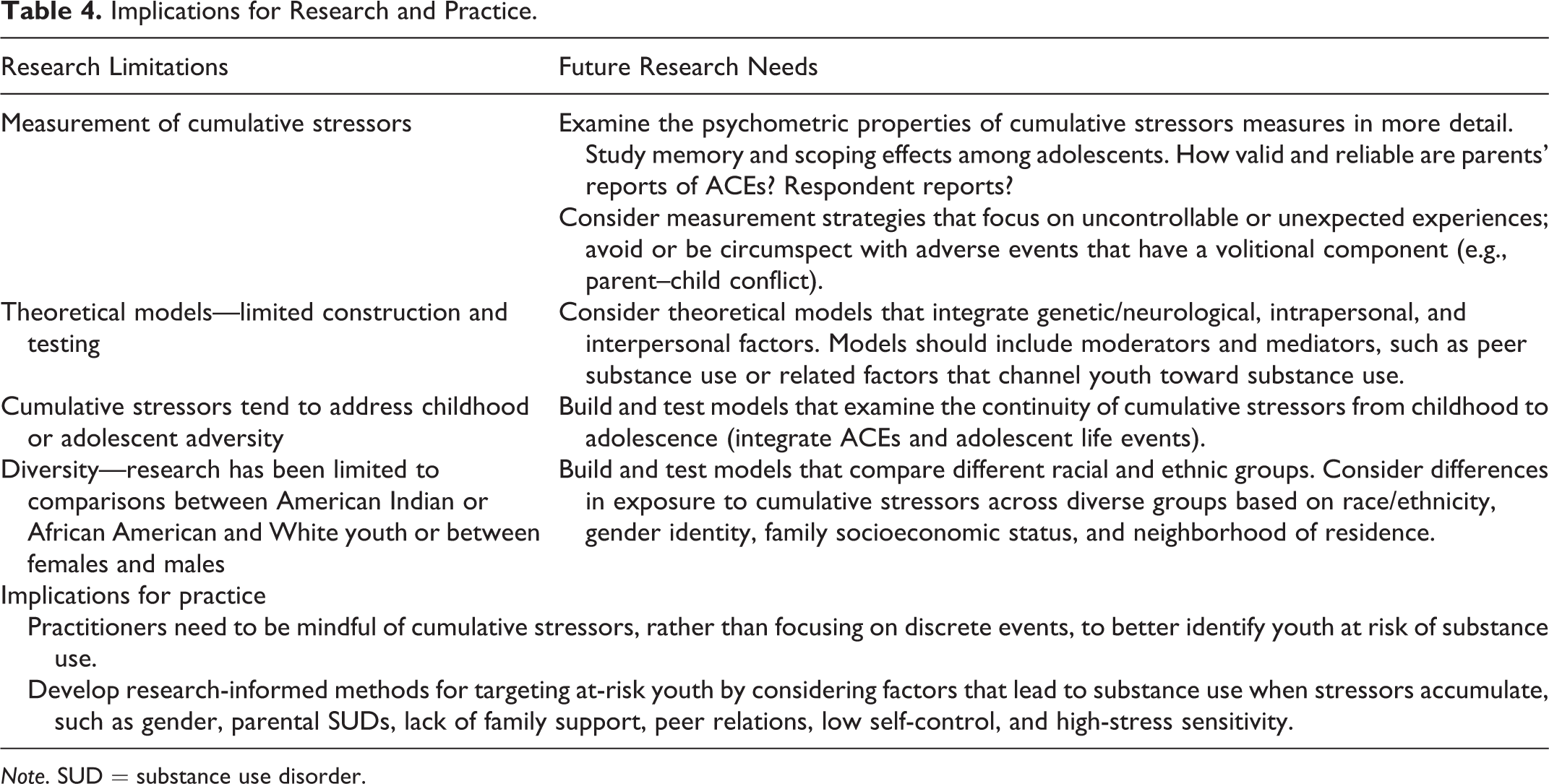
Note. SUD = substance use disorder.
Second, research should be guided by theories of the stress process and integrate genetic, psychological, and social factors as well as examine cumulative stressors from childhood through adolescence. Most studies that address genetic or neurological factors, though they often include demographic control variables, have not considered in a conceptual manner interpersonal and environmental conditions. Research has also not attended to the possible reciprocal effects of substance use and physiological reactions to the stressful experiences (Brady & Sinha, 2005). We have a rich knowledge base of the myriad factors that play a role in the cumulative stressors—adolescent substance use relationship, but there have been too few efforts to construct a conceptual model out of these building blocks. Future efforts to understand adolescent substance use should develop and test models that integrate genetic, intrapersonal, and interpersonal factors and consider the continuity from childhood to adolescence in the cumulative stressors process.
Third, besides a few comparisons between American Indian and White youth, there has been little comparative research on cumulative stressors among other racial and ethnic groups. Many studies have compared substance use among White, African American, Latinx, and Asian youth in general (e.g., Terry-McElrath & Patrick, 2020; L. T. Wu et al., 2011), so it is important that researchers investigate whether the effects of cumulative stressors differ across these groups.
In conclusion, the studies examined in this review demonstrated a consistent, though modest, association between cumulative stressors and adolescent substance use. But the association appeared stronger when certain genetic, intrapersonal, and interpersonal conditions were present. Peer substance use also mediated the effects of cumulative stressors, which implies a socialization mechanism that warrants additional exploration by stress and substance use researchers. By understanding the pathways that lead to cumulative stressors and that link them to substance use and other risk behaviors, responsible adults will have better information to guide prevention and intervention programs designed to help youth lead healthy lifestyles.
Implications for Policy and Practice
Most youth experience tangible stressful events during their childhood and adolescent years (Merrick et al., 2018), yet these experiences can accumulate and affect substance use and SUDs.
Intervention programs and policies should target youth who experience multiple adverse experiences and provide social resources – such professional or peer counseling, family therapy, or mindfulness training – to help them cope with their hardships (see also Berger, 2015).
Intervention is particularly important for youth at high risk of substance use due to parental substance use problems, low self-control, or high stress sensitivity.
Programs should also pay attention to friends’ substance use since it may channel those experiencing cumulative stressors toward engagement with alcohol, marijuana, and other substances.
Supplemental Material
Supplemental Material, sj-pdf-1-tva-10.1177_1524838020979674 - Cumulative Stressors and Adolescent Substance Use: A Review of 21st-Century Literature
Supplemental Material, sj-pdf-1-tva-10.1177_1524838020979674 for Cumulative Stressors and Adolescent Substance Use: A Review of 21st-Century Literature by John P. Hoffmann and Melissa S. Jones in Trauma, Violence, & Abuse
Footnotes
Declaration of Conflicting Interests
The author(s) declared no potential conflicts of interest with respect to the research, authorship, and/or publication of this article.
Funding
The author(s) received no financial support for the research, authorship, and/or publication of this article.

Supplemental Material
Supplemental material for this article is available online.
References
Supplementary Material
Please find the following supplemental material available below.
For Open Access articles published under a Creative Commons License, all supplemental material carries the same license as the article it is associated with.
For non-Open Access articles published, all supplemental material carries a non-exclusive license, and permission requests for re-use of supplemental material or any part of supplemental material shall be sent directly to the copyright owner as specified in the copyright notice associated with the article.
