



Abstract
Violence against children (VAC) is a pervasive, global issue with both short- and long-term health, social, and economic consequences. This systematic review sought to identify best practices for designing and implementing social and behavior change communication (SBCC) programs targeting VAC in and around schools. Combinations of key search terms within five domains were entered into four databases: PubMed Central, Google Scholar, Sociological Abstracts, and EBSCOhost. Results were screened according to the inclusion and exclusion criteria. Namely, articles had to be published in English, be published after March 2014, focus on VAC in and around schools, focus on children, and use SBCC approaches. The searches produced 892,271 results. Of these, 63,183 were screened and 54 articles were selected. These articles were combined with 16 articles, gathered from a previous systematic review using the same databases and search domains conducted by the same research team, for a total of 70 articles. Articles were quantitatively analyzed using a coding guide in STATA and qualitatively analyzed using Nvivo. Results showed that most programs addressed bullying, were implemented in high-income countries, and included children aged 10 and older. Best practices in program design were using theory, conducting formative research, and involving program beneficiaries. Best practices in implementation were combining whole-school and targeted approaches, including special and hidden populations, involving secondary and tertiary audiences, using nonclassroom settings, using peer leader/mentor and cascade training models, and conducting process monitoring. Implications and avenues for future planning and implementation of SBCC interventions to address VAC in and around schools are discussed.
Keywords
Background
Violence against children (VAC) encompasses “all forms of physical or mental violence, injury and abuse, neglect or negligent treatment, maltreatment or exploitation, including sexual abuse” (United Nations, 1989). Some of the most prevalent types of VAC are sexual violence (Barth et al., 2013), bullying (Vreeman & Carroll, 2007), cyberbullying (Nocentini et al., 2015), and violent discipline (Gershoff, 2017). VAC can have both immediate and long-term physical, social, and/or emotional repercussions, including mental health issues like depression and anxiety (Vreeman & Carroll, 2007). A global issue, VAC affects both boys and girls and can occur in both private spaces, such as the home, and public spaces, such as schools.
Schools are intended to be safe, nurturing places in order for learning to take place. However, for many students around the globe, schools are a violent place. A 2016 report by the Office of the Special Representative of the UN Secretary-General on Violence Against Children describes four main forms of violence in schools: harassment, physical violence, psychological violence, and violence that includes a dimension outside the school and is related to the culture of the gangs. Data on different types of violence in and around schools reveal that roughly half of students 13–15 years old around the world have faced peer-to-peer violence in and around schools, including bullying and physical fighting (United Nations Children’s Fund [UNICEF], 2018). An estimated 1 in 10 children have been victims of cyberbullying, and as use of information communication technologies (ICTs) increases, so too does the rate of cyberbullying (United Nations Educational, Scientific, and Cultural Organization [UNESCO], 2019). Half of children (732 million) around the world live in a country where corporal punishment is not fully prohibited by law (UNICEF, 2017b). In one study of 63 countries, including 29 where corporal punishment is not legally banned, nine countries had rates of over 90%, 11 countries had rates of 70%–89%, and 43 countries had rates of 13%–69% (UNESCO, 2019). Global data on the prevalence of sexual violence in and around schools are limited; however, 9 million girls around the world aged 15–19 reported being forced into some type of sexual act in 2017 (UNICEF, 2017b).
The negative physical and psychological consequences of VAC in and around schools can have harmful effects on the healthy brain development of children, which can in turn affect learning and socio-emotional development (UNICEF, 2017a, 2018). Antisocial, aggressive, and risky behavior that develops as a result of VAC can impact the ability to form healthy, supportive social relationships (UNICEF, 2014, 2018). Students who experience VAC in and around schools can have lower attendance rates, lower achievement scores, and higher drop-out rates (UNICEF, 2017b, 2018). The impact of these consequences is far reaching; research shows that children who experience violence have lower employment rates, earn less money, and have fewer assets as adults compared to those who did not face violence as children (UNICEF, 2017b, 2018). Children exposed to violence are also more likely to become perpetrators and/or future victims, resulting in a cycle of violence that endures across generations (UNICEF, 2014, 2018).
As clearly delineated environments designed to help children learn, grow, and thrive, schools present an ideal place to implement programming to address VAC (UNICEF, 2018). While several systematic reviews have focused on different types of VAC (Guedes et al., 2016; Hillberg et al., 2011; Hillis, Mercy, Amobi, & Kress, 2016), few describe best practices for social and behavior change communication (SBCC) efforts aimed at reducing VAC when working specifically in and around schools. Therefore, the goal of this systematic review was to determine best practices for planning and implementing SBCC interventions for reducing VAC in and around schools using individual and social norms-based approaches.
Method
This article is based on 70 articles from 2000 to 2019, by combining two reviews. First, a systematic review of peer-reviewed literature published between 2014 and 2019 was conducted by two graduate research assistants using four comprehensive data bases: PubMed Central (including Medline), Google Scholar, Sociological Abstracts, and EBSCOhost (which compiles multiple databases). Five domains were created to capture any communication programs working with children and adolescents in and around schools: “Communication Approach,” “Population,” “Type of VAC,” “Setting,” and “Type of Action” (i.e., program, intervention, etc.). Each domain contained a variety of key search terms as shown in Table 1.
Key Search Terms by Domain.
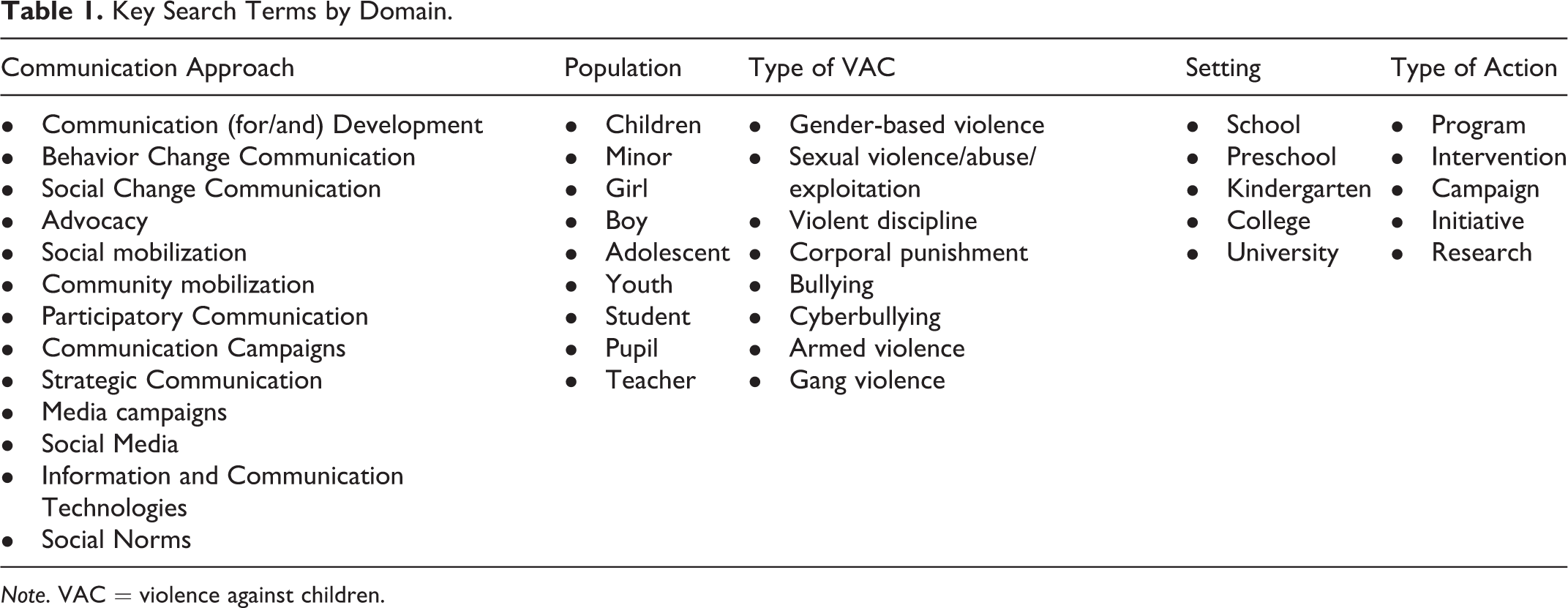
Note. VAC = violence against children.
Using Preferred Reporting Items for Systematic Reviews and Meta-Analyses (PRISMA) guidelines (Moher et al., 2009), combinations of key search terms were created across domains with Boolean operators as follows: one term was selected from the “Communication Approach” domain, all terms from the “Population” domain were included using “or,” one “Type of VAC” was selected, all “Settings” were included using “or,” and one “Type of Action” was selected. This was repeated until all possible combinations were created and searched. Two examples are presented below:
“social norms” AND (children OR minors OR girls OR boys OR adolescents OR youth OR students OR pupil or teacher) AND “bullying” AND (school OR preschool OR kindergarten OR college OR university) AND “research”
“communication and development” AND (“teacher OR pupil OR children OR minors OR girls OR boys OR adolescents OR youth OR students”) AND “bullying” AND (“school OR preschool OR kindergarten OR college OR university”) AND “intervention”
Search results were examined according to the inclusion and exclusion criteria (shown in Table 2). Articles had to be written in English after March of 2014, discuss a program or intervention that focused on children (who were defined as per the WHO guidelines as anyone aged 18 years old or younger), address one of the key VAC issues (see Table 1), use SBCC approaches, and focus on VAC in and around schools.
Inclusion and Exclusion Criteria.
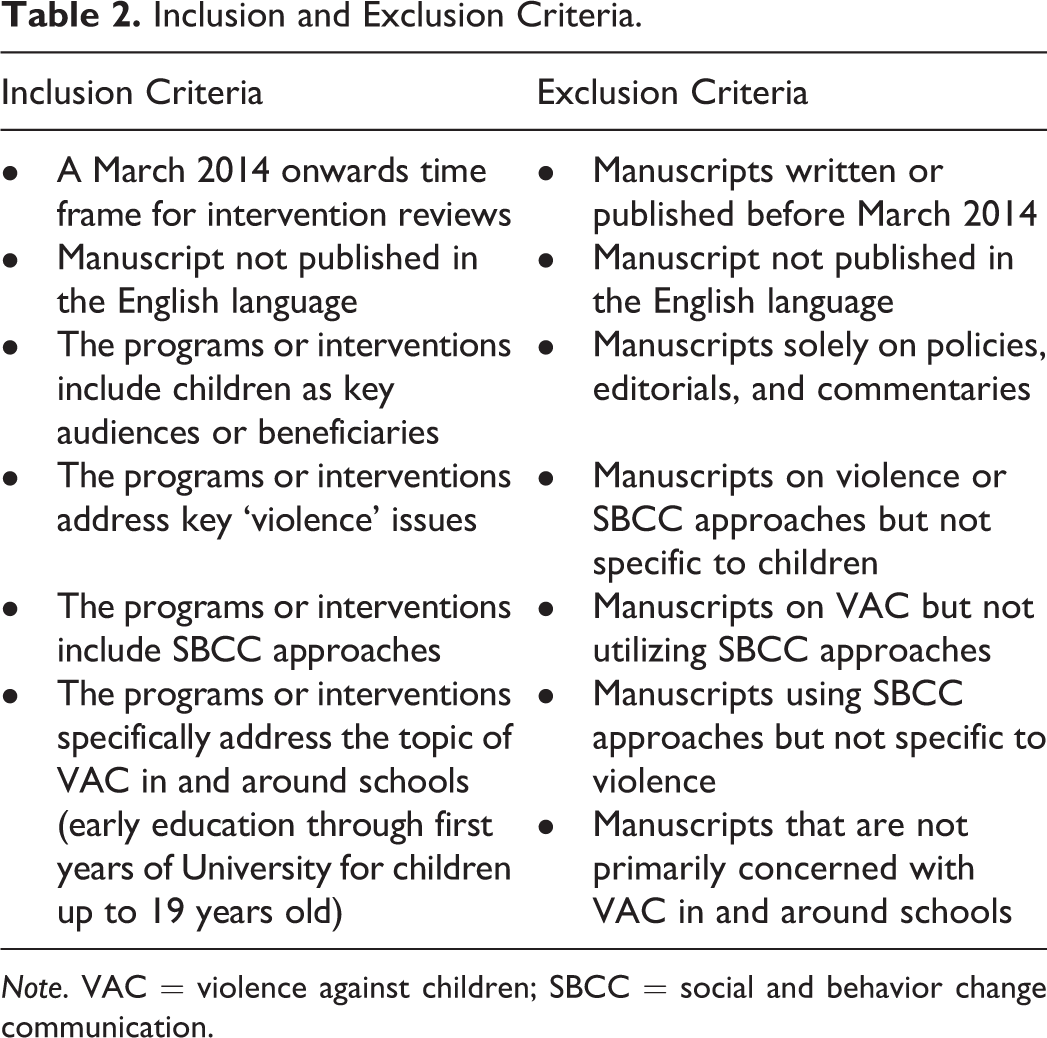
Note. VAC = violence against children; SBCC = social and behavior change communication.
A total of 848 searches were conducted. These searches produced 892,271 results. The titles of these results were reviewed until no related titles were found on 10 subsequent pages of results. In total, n = 63,183 article titles were screened and examined for relevancy. Articles deemed irrelevant by their title were excluded (n = 60,516). The remaining articles (n = 2,667) went through an abstract review. Articles that did not meet the inclusion criteria as described in their abstract were dropped (n = 2,308). The remaining articles (n = 359) went through a full-text review. Of those, 302 were excluded because they did not meet the specific population inclusion criteria or did not include information on the intervention and/or evaluation leaving a total of 54 articles included in this review.
Second, to extend the date range to the year 2000, the authors incorporated articles from an earlier systematic review (2000–2014), done by the same team, using the same databases and search term domains but covering literature on VAC as a whole, not specific to in and around schools. The articles from the previous review were examined according to current inclusion and exclusion criteria for relevancy. This yielded 16 articles specific to VAC in and around schools from the previous systematic review, making the final sample size 70 articles published between 2000 and 2019. The PRISMA diagram (Moher et al., 2009) demonstrates the systematic review and selection process (see Figure 1).
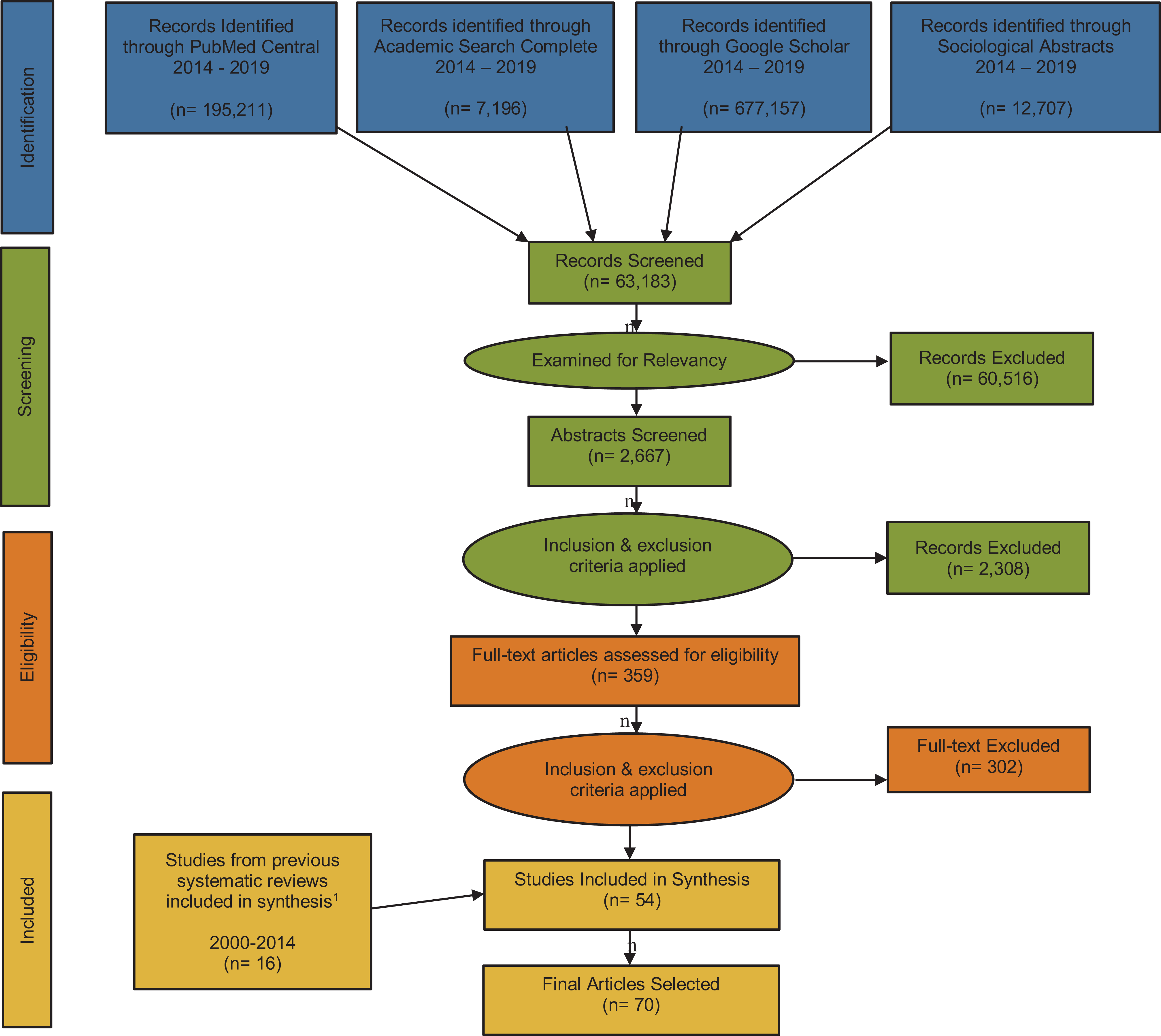
Preferred Reporting Items for Systematic Reviews and Meta-Analyses diagram of systematic review process.
Coding Process
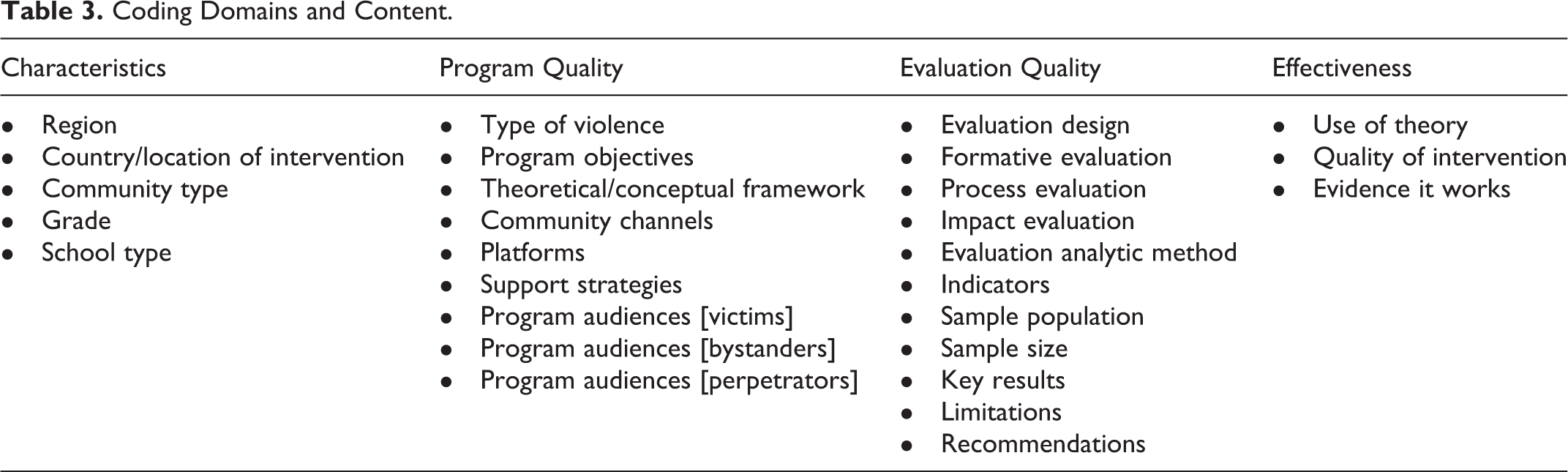
The interventions presented in the 70 articles were coded across four domains corresponding to “Program Characteristics,” “Program Description,” “Evaluation Description,” and “Effectiveness Information.” Twenty-eight subdomains (listed in Table 3) were developed to further explore program elements. Numeric codes were entered into Excel for each subdomain. The three subdomains of “Effectiveness Information” were qualitatively examined because the diversity of program activities, types of evaluations, and indicators inhibited the ability to compare information quantitatively.
Coding Domains and Content.
Analysis Process
Two student graduate research assistants each coded 35 of the 70 articles. The students reached out to a research coordinator for specific questions and clarifications. The research coordinator also cross-checked a random sample of each coders work. Inter-rater reliability was conducted by the principal investigator on a randomly selected sample of 10% of the final manuscripts. The threshold for substantial agreement is 84% (according to Landis & Koch, 1977, a value of 0.61–0.80 can be considered as substantial agreement). Inter-rater reliability for both the qualitative and quantitative coding combined was 89%, indicating substantial agreement.
Univariate analyses were conducted by two graduate research assistants and the principal investigator using STATA/IC 15.1. Simple descriptive statistics were generated for the “Characteristics,” “Program Description,” and “Evaluation Description” subdomains to highlight components of programs that appeared frequently across articles. The “Strengths,” “Recommendations,” and “Limitations” subdomains were coded both quantitatively and using free text, which was analyzed thematically. Thematic analysis was done by the research coordinator and a PhD student using Nvivo12.
Results
Results are organized by coding domain. Findings from the entirety of subdomains are beyond the scope of this article. Instead, key findings are presented.
Characteristics
Of the 70 articles, 71.4% (n = 50) of programs were implemented in high-income countries. The United States was the most represented country, with 26 articles. Of low- and middle-income countries, the region of eastern and southern Africa was the most common, referenced in eight articles (11.4%). Most of the interventions were in urban settings (n = 48 articles vs. n = 37 articles; some addressed both urban and rural settings). The majority of interventions took place in secondary schools, implying that interventions were mostly delivered to children ages 10 and older.
Program Description
Bullying was the form of violence most commonly addressed by the programs (n = 32), followed by sexual violence (n = 27), gender-based violence (n = 20), cyberbullying (n = 11), violent discipline (n = 6), psychological/emotional violence (n = 6), gang violence (n = 4), and armed violence (n = 3).
Out of the 70 articles, 30% made no mention of a conceptual framework, theory, or model. Of those that did, the Social Ecological Model was most frequently used, mentioned in 41% of the articles.
The most common communication approaches reported were interpersonal (95.7%; n = 67), followed by capacity building (71.4%, n = 50). Nineteen articles (27.1%) applied a bystander approach and an additional 16 (22.9%) focused on positive youth engagement/development. Other approaches such as mass media, entertainment–education, and public–private partnerships were each reported less than 10% of the time.
The top three communication channels employed were counselling by experts and by peers (94.3%; n = 66), print (47.1%; n = 33), and film (25.7%; n = 18). The internet, social media, or ICTs were used in 24.3% (n = 17) articles. All other channels including TV, radio, and local media were each mentioned by less than 10% of the articles.
Evaluation Description
A number of different evaluation designs were used in the articles. A total of 21 evaluations used a randomized control trial (30%). A pre- and posttest design was used in over half (51.4%, n = 36), while 30 evaluations (42.9%) used a case–control design. Qualitative designs were also common (27.1%, n = 19). Quantitative designs without a pre- and posttest or control group were less common (8.6%, n = 6), and none used participatory research approaches. Twelve of the 70 (17%) programs employed two evaluation designs simultaneously (e.g., pre- and posttest and case control).
Effectiveness
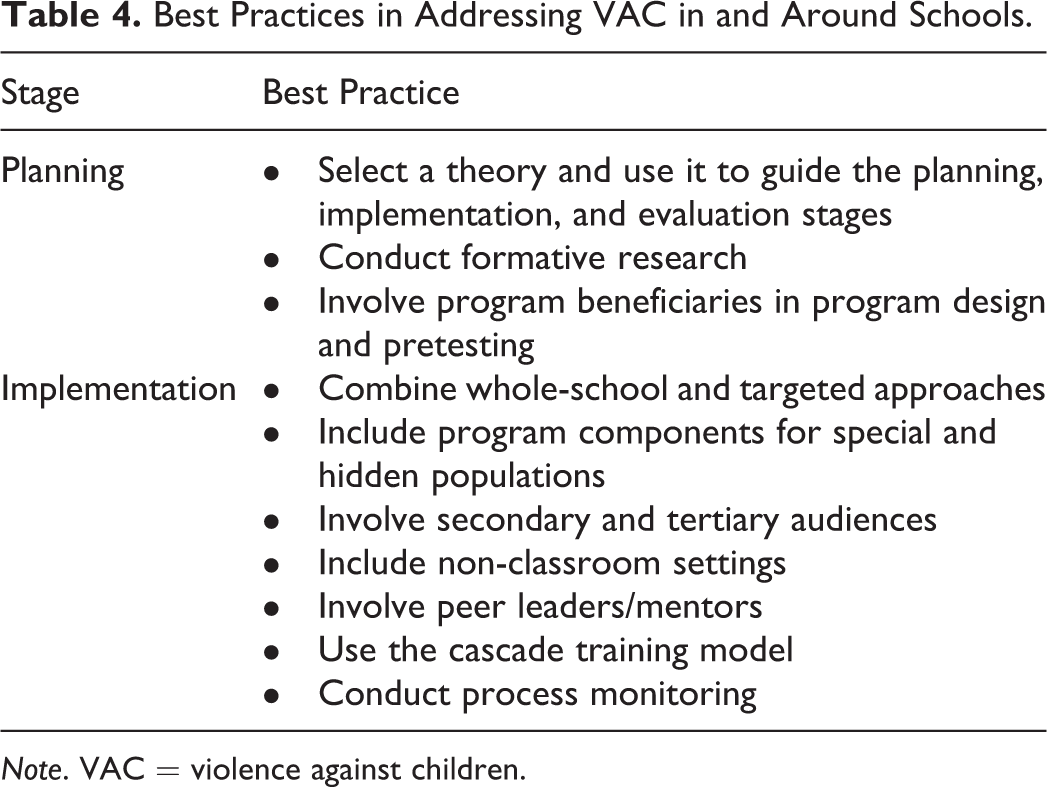
Strategically designed SBCC interventions follow some core steps. Program planning and implementation typically requires: a situation and audience analysis; formulating a theory of change; selecting measurable objectives and indicators; formulating measurable short-, medium- and long-term results; design and pretesting of messages and materials; conducting process monitoring including implementation fidelity; and including an evaluation component to measure effectiveness (Abraham & Denford, 2020; Cassidy et al., 2016; Fagan & Catalano, 2013; Schiavo, 2013; Tobin & Sprague, 2000; Van Acker, 2007). Based on the qualitative analysis of the recommendations, limitations, and strengths of the shortlisted manuscripts, we identified a series of best practices exemplified in the articles associated with the core steps identified from the literature. These are summarized in Table 4 and discussed below.
Best Practices in Addressing VAC in and Around Schools.
Note. VAC = violence against children.
Best practices in planning
Using a theory of change to guide all stages of program development, implementation, and evaluation is a best practice for program planning (Breuer et al., 2015; Ghate, 2018; McKee et al., 2014; Schiavo, 2013). A total of 12.8% of programs utilized theory in all three stages (planning, implementation, and evaluation). Of programs that did use theory, the majority used it in the planning stage (61.4%), followed by the implementation stage (55.7%), and the evaluation stage (44.3%). About 21.4% of programs were not guided by (or did not mention) the use of any theory of change.
Of the 70 articles, 29 (41.4%) mentioned conducting situation and audience analysis as part of their formative research to inform program design and implementation. Using formative research emerged as a best practice for illustrating what the problem is, how it is affecting the intended program beneficiaries, and how the problem might best be addressed (Forthofer & Bryant, 2000; Thakur et al., 2017). In our review, for example, the Go Girls! Initiative implemented in Malawi, Botswana, and Mozambique included several elements of formative research, including a literature review and 35 focus group discussions with adolescents, adults, and community leaders to understand why adolescent girls have three to four times the rate of HIV/AIDS versus boys (Schwandt & Underwood, 2016). While younger girls identified schools as safe spaces, older girls did not because of teachers demanding sex in exchange for better grades (Schwandt & Underwood, 2016). This finding informed the development of a multifaceted initiative that included a 14-session training program for teachers (Schwandt & Underwood, 2016).
Inclusion of the intended audience in the program design and pretesting processes is considered to be another best practice in the planning stage (Forthofer & Bryant, 2000). The review found that allowing beneficiaries to share their own experiences and needs exemplifies empowerment, which in turn increases the programs’ relevance and success. For example, a program on gender-based violence in Nairobi, Kenya, consulted groups of adolescent boys from the community during the formative phase (Keller et al., 2017). The consultation findings informed the development of the Your Moment of Truth curriculum, which was then piloted with the adolescent boys (Keller et al., 2017). Subsequently, the boys provided feedback and worked with programmers to refine and finalize the curriculum (Keller et al., 2017). The authors concluded that obtaining beneficiary feedback and working collaboratively with the boys was critical to ensuring the program was culturally appropriate (Keller et al., 2017).
Best practices in implementation
The combination of whole-school approaches with targeted intervention components emerged as a successful program model in this review. Whole-school approaches involve all school-based populations, along with caregivers and the community on some level (Goldberg et al., 2018). Targeted approaches are those designed for specific audience groups. One example of this successful combined modality is the True Love program on dating violence implemented in Mexico City (Sosa-Rubi et al., 2017). The whole-school component included a workshop for all teachers and staff and “school-yard activities,” a variety of media-based activities designed and implemented by select students and program facilitators (Sosa-Rubi et al., 2017). Additionally, a targeted curriculum on topics such as gender roles and stereotypes, skills to cope with sexual violence, and sexual rights was administered to all 15- to 16-year-old students (Sosa-Rubi et al., 2017). Preliminary evaluation results showed that while exposure to just the school-wide campaign was effective, students exposed to both the school-wide campaign and the targeted curriculum had significantly greater levels of participation in community activities to prevent dating violence; more knowledge of institutions/places that provide support on dating violence; and lower levels of justification of violence, acceptance of sexist attitudes, and experienced and perpetrated psychological violence (among males only) (Sosa-Rubi et al., 2017).
Another best practice identified in this review is designing and implementing components for special and hidden populations in and around schools, such as ethnic and sexual minorities, children with disabilities, religious minorities, refugees and migrants, children experiencing homelessness, and past perpetrators of VAC. The Fourth R program, aimed at preventing and addressing violence, substance abuse, and risky sexual behavior among students, demonstrates this best practice (Crooks et al., 2008). The core program was adapted and modified into a version designed specifically for aboriginal students (Crooks et al., 2008). To modify the core program, a cultural identity framework was used that emphasized involvement of aboriginal community elders and peer mentorship components led by First Nations Counsellors (Crooks et al., 2008).
To address the interrelated connection between VAC in and around schools and VAC in the larger community, another best practice is involving secondary and tertiary audiences in programmatic activities linked to schools. Some community-based audiences identified in this review of VAC programs in and around schools include key influentials, community leaders, nongovernmental organizations, law enforcement, health care providers, religious leaders, and policy makers. Help the Afghan Children implemented a school-based peace education program for students aimed at eliminating peer-to-peer aggression, violent discipline, and sexual and gender-based violence along with several components for secondary and tertiary audiences including: (1) conflict resolution, peace building, and women’s rights training with parents, and community and religious leaders; (2) capacity building with government officials and representatives of civil society organizations; (3) formation of peace committees with members from existing shuras (community development councils); and (4) a radio campaign (Corboz et al., 2019). The combination of in-school peace education and the elements involving the secondary and tertiary audiences was key to reducing levels of VAC in and outside of school, as well as shifting attitudes and social norms on multiple socioecological levels (Corboz et al., 2019).
Programs that rely on in-class only activities face issues of teachers not having enough time, motivation, and/or resources to actually implement the program as intended (Salmivalli et al., 2005). Using contexts outside, or in addition to, the classroom is a best practice because it can avoid these issues, along with providing access to out-of-school child populations. For example, the Parivartan program in the slums of Mumbai, India, included sexual violence programming as part of cricket team coaching (Das et al., 2015). Leveraging the influence of coaches as role models, as well as the sense of solidarity, inclusion, and belonging between team members, was a major strength of the Parivartan program, which lead to changes in the attitudes and behaviors of the players (Das et al., 2015). Furthermore, the use of the informal cricket teams as the setting of the program provided crucial access to a particularly vulnerable and underrepresented population, as boys in Mumbai slums often did not regularly attend schools or went to schools without formal sports teams (Das et al., 2015).
Using the peer leader/mentor model (also called “popular opinion leader model,” “peer support,” and “peer-learning”), in which peers of program participants are trained to implement some or all components of a program, is another notable best practice because it capitalizes on the intrinsic power peers have as role models on attitudes, behaviors, and social norms. While the exact roles differ, this model includes the training of a select group of peers to equip them with the skills needed for their role. Some examples of roles are tutoring students, leading group discussions, training peers, mediation, providing social and emotional support, acting as mentors, and implementing program activities (Cowie, 2011; Cowie & Hutson, 2005). Adults may play a supervisory role but do not directly intervene with peer leaders/mentors as they fulfill their role (Cowie, 2011; Cowie & Olafsson, 2000).
In the Mentors in Violence Prevention program implemented in Scotland, 15- to 18-year-old students were trained to act as mentors and facilitate the curriculum for 11- to 14-year-old students (Williams & Neville, 2017). The young participants were more receptive to the information coming from the peer mentors versus adults, felt that they could talk to the peer mentors more freely, and reported higher engagement with the program because of the involvement of peer mentors (Williams & Neville, 2017). Mentees also reported contacting the peer mentors outside of the program sessions, seeing them as a resource for discussing gender-based violence because they saw them as more credible, felt more comfortable talking to them, saw them as a source of social support, and did not feel the same stigma of “snitching” as compared to talking to adults (Williams & Neville, 2017).
Another effective and sustainable implementation approach is the cascade training model. In this model, participants are trained by experts to facilitate the program. These trained facilitators then provide the training to others. This process is repeated as needed. In the My Body, My Boundaries program in Hawaii, educators (teachers, counsellors, social workers, and other professionals working with youth) were trained using a multi-session training program taught by experts from the Sex Abuse Treatment Center (Baker et al., 2012). The trained educators then taught the My Body, My Boundaries curriculum to third- to fifth-grade students (Baker et al., 2012). Issues with fidelity of information can arise when this model is used because the program implementers have less control. However, these issues can be avoided by having regular check-ins with the trained facilitators, continued training sessions, and testing the trainees to determine whether they have acquired the knowledge and skills needed.
For example, the trained educators in the My Body, My Boundaries program took pre- and postknowledge tests and mock-taught each lesson to one another to have their performance evaluated by their fellow trainees and the instructors (Baker et al., 2012). An advantage of the cascade training model is that the trained facilitators receive an in-depth version of the program, which positions them as agents of change and can increase buy-in for the program. Likewise, it is an opportunity to train them to respond to VAC in and around schools better. For example, the trained educators in My Body, My Boundaries program had a greater degree of competency to address child abuse because of their role as trained facilitators (Baker et al., 2012).
Finally, regular process monitoring is a best practice for implementation because it identifies whether and to what degree the program is being implemented as intended and allows for the resolution of issues as and when they arise (Hill & Erickson, 2019; Schultes et al., 2015). A total of 39 of the 70 articles (56%) in this review reported conducting process monitoring. Some methods they utilized were field observations, focus group discussions, interviews, surveys, audio and video recordings of program activities, and debriefings. In a randomized control trial of the Green Dot bystander-based sexual violence prevention program in Kentucky, the program developer and research staff reviewed audio recordings of the bystander training sessions facilitated by trained Rape Crisis Center educators to high school students to examine fidelity (Coker et al., 2019). The recordings were scored based on consistency with the Green Dot curriculum, use of time, and presentation quality (Coker et al., 2019). Based upon their performance, the trained Rape Crisis Center educators received feedback and suggestions (Coker et al., 2019). Remedial training was provided if their performance was below standard (Coker et al., 2019). Those who continued to have issues after the remedial training were replaced (Coker et al., 2019). While such rigorous process monitoring, remedial training, and educator replacement resulted in high turn-over rates, this practice ensured a high level of fidelity in the implementation of the Green Dot curriculum (Coker et al., 2019).
Discussion
This section discusses the implications of the findings of this review. The majority of programs in this review were located in high-income countries. Previous systematic reviews on VAC have found similar programmatic distribution (Ellsberg et al., 2015; Higginson et al., 2013; Mikton & Butchart, 2009). This finding mirrors the overall disparity in global health research known as the 10/90 gap, where only 10% of research funding goes to health issues affecting low-income countries despite them bearing 90% of the burden of those issues (Vidyasagar, 2006). VAC in and around schools is a global problem, not just an issue in high-income countries. For example, the prevalence of bullying ranges from 23% in Central America to 48% in sub-Saharan Africa, with all other regions falling somewhere in between (UNESCO, 2019). Although prevalence may vary with the type of violence, such as higher rates of cyberbullying in high-income countries and higher rates of corporal punishment in low-income countries, children in all areas of the world are affected (UNESCO, 2019). More resources must be allocated to implement programs in low- and middle-income countries if the elimination of VAC in and around schools is to be fully achieved.
This review also found that most programs were designed and delivered to children 10 years of age and older. There is a need for programming targeting younger children because avoiding the trauma of VAC from earlier ages can have lifelong benefits for the health and well-being of children and also supports emotional, mental, and social development during these formative years. Programming for younger children, starting at the preschool level, has the potential to affect future VAC rates as children age. For example, one review of school-based bullying and cyberbullying programs found that implementing programming in the last grades of primary school reduced future incidents of bullying in middle and high school (Cantone et al., 2015).
As previous research and qualitative assessment of the results showcase, addressing VAC in and around schools when based on a theory of change is more effective compared to programs that are not conceptually guided (Earnshaw et al., 2018; Glanz & Bishop, 2010; Glanz et al., 2008). While most programs included in this review used theory in the planning stage, few programs used theory throughout the planning, implementation, and evaluation stages. Future programs should focus on devising a theory of change during the planning stages of a project and use it as a blueprint for the subsequent implementation and evaluation stages (Glanz & Bishop, 2010).
Research shows that rigorous formative research with a sample population similar to those for whom the program is being designed is key to creating programs that are relevant, culturally appropriate, and locally acceptable in an effort to increase effectiveness (Khalid & Ahmed, 2014; Scott et al., 2018). In this context, it is important to point out that less than half of the programs mentioned any formative research. Beyond formative research, beneficiaries can be involved in the actual program design process, pretesting, and evaluation. A majority of the articles in the review limited participation of intended audiences by treating them merely as respondents or test subjects, instead of soliciting their active participation. Such participation has proven to be beneficial in previous research. For example, one systematic review on school-based domestic abuse programs found that involvement of program beneficiaries in the design and delivery of the program was impactful because it increased the sense of authenticity and was found to be important to those who the program is intended to benefit (Stanley et al., 2015).
Unsurprisingly, this review found that, in a school-based setting, interpersonal approaches were most common with counseling being the most used channel. Few school-based programs included comprehensive approaches that worked on more than one socioecological level and used a variety of communication channels. As VAC is a result of the interaction of a complex set of interpersonal, social, and political factors, programs can have greater effects if they include approaches that work on multiple levels of the social ecological model (Blaya & Debarbieux, 2008; Garner, 2014; Matjasko et al., 2012). Programs targeting VAC that include approaches such as community mobilization (Hillis, Mercy, Saul, et al., 2016; Semahegn et al., 2019; Yount et al., 2017), policy development and reform (Garner, 2014; Lee et al., 2013; Stanley et al., 2015; Ttofi & Farrington, 2010), advocacy (Ellsberg et al., 2015; Hillis, Mercy, Saul, et al., 2016; Semahegn et al., 2019), and capacity building (Garrard & Lipsey, 2007; Semahegn et al., 2019) in conjunction with school-based efforts have demonstrated effectiveness in several systematic reviews and meta-analyses. Likewise, interactive and engaging program materials and activities have been shown to be more effective than didactic methods alone (Clinton-Sherrod et al., 2009). The use of ICTs in particular present a promising, yet underutilized, channel with which youth are already interacting a great deal (Cronin et al., 2017; Nocentini et al., 2015).
Previous research and systematic reviews have highlighted the effectiveness of whole-school approaches (Cantone et al., 2015; Garner, 2014; Shackleton et al., 2016; Ttofi & Farrington, 2010). Inclusion of both targeted and whole-school approaches is effective because it benefits from both social norms and school-climate change, stemming from the whole-school approach, as well as social development, attitudinal, and behavior change from the targeted in-school approaches. Since whole-school approaches are widespread, the degree to which participants actually interact with the program varies. Inclusion of targeted approaches in schools therefore allows programmers to ensure greater participation. Likewise, it facilitates the design of specific components for hard to reach and vulnerable audiences. Interestingly, this review did not provide adequate information to determine whether specific SBCC approaches were more effective for different types of VAC. These findings mirror those of a systematic review by Rapee et al. (2020) which also found that no specific conditions (whole-school only, targeted only, and combined) had a significant impact versus one another. On the other hand, after the creation and implementation of a whole-school program combined with tailored messages for special and hidden populations including, for example, children with disabilities and socially and economically disenfranchised children who face an increased risk, is suggested in our review.
Our review shows that, schools are an ideal setting to implement SBCC programs targeting VAC because youth are inherently a captive audience (Humphreys et al., 2008; Stevens et al., 2001). However, using alternative settings capitalizes on preexisting social relationships to influence attitudes, behaviors, practices, and social norms. This review found that nonclassroom settings, when used, generally increased effectiveness for a multitude of reasons, which varied by the type of setting. Reviews including setting as a factor in effectiveness for programs targeting VAC in and around schools are scarce, but Clinton-Sherrod et al. (2009) looked at small group versus classroom settings by gender (mixed or boys and girls separately) for programs focused on sexual violence. They found that programs focused on increasing knowledge worked well in both small group and classroom settings, while programs focused on attitudes and behaviors were more effective in small groups, likely due to the impact of peer pressure and other external influences (Clinton-Sherrod et al., 2009). They also found that for mixed-gender groups, the classroom setting resulted in greater effects compared to small groups (Clinton-Sherrod et al., 2009). More research is needed on the impact of hosting programs in non-classroom-based and non-school-based settings, as well as nuances like gender and other sociodemographic characteristics of the group.
A majority of school-based interventions, while acknowledging this as a limitation, work only within the school setting. There is wide-spread agreement on the importance of involving secondary and tertiary audiences to reduce VAC not just in but also around schools. Both family involvement and community engagement have been shown to increase in-school program effectiveness (Garner, 2014). Family involvement works because of the influence family connectedness has on VAC; violence is less likely to occur in families where youth feel more loved and cared for (Garner, 2014). Fostering a home-school connection when addressing VAC in and around schools has been found to have greater effect sizes versus programs without family components (Matjasko et al., 2012). Other systematic reviews have found that when addressing VAC in and around schools, programs that also merge community-based components are more effective than those that do not (De Koker et al., 2014; Semahegn et al., 2019). Implementation of community-based components in addition to in-school programming also has the benefit of reaching children and adolescents who do not attend school so they too can benefit from VAC programming.
Our results corresponded with, findings from multiple studies in demonstrating that the involvement of peer leaders/mentors is effective in reducing VAC in and around schools (Cowie, 2011; Cowie & Hutson, 2005; Cowie & Olafsson, 2000; Garner, 2014). One reason is that the peer leader/mentor model is empowering for those students who fulfill this role and can improve their self-esteem (Cowie & Olafsson, 2000; Naylor & Cowie, 1999). Implementation of this model can also have overall positive effects on the school climate leading to both social- and individual-level change (Cowie & Olafsson, 2000; Sharp et al., 1994). Further, program messages and activities are often better received by children when they come from peers as opposed to adults.
The cascade training model also emerged as a positive intervention in this review. Skills training and/or capacity building, which are inherent in this model, have been shown to be effective approaches to address VAC in and around schools in general (Ellsberg et al., 2015; Farrington & Ttofi, 2009; Lee et al., 2013). Perhaps another reason why this is an effective practice is it can increase the feasibility of implementing programs by saving resources (P. K. Smith, 2018). In general, if the program is more feasible to implement, fidelity can increase; however, fidelity issues arise with the cascade training model unless trainees are monitored and regularly trained and tested.
Process monitoring has been identified in past reviews of school-based VAC programs as a key factor in effective programming (J. D. Smith et al., 2004). This is likely because level of fidelity has such a great impact on effectiveness (Rapee et al., 2020; P. K. Smith, 2018), and monitoring allows implementers to make adjustments to increase fidelity in real time. Inclusion of behavioral monitoring can also signify when and to what degree the program is taking effect and which components are most effective. These can then be emphasized while ineffective components can be dropped.
Finally, despite our expectations, this review identified best practices to address a variety of types of VAC. The findings presented here were overarching in spite of the type of VAC, target audiences, and setting. Most existing systematic reviews and meta-analyses have focused on effectiveness of programs around a specific type of VAC. We argue that it is critical to uncover and implement best practices in SBCC programs to eliminate VAC as a whole in order to truly achieve peaceful societies. This is because VAC happens in numerous ways at multiple levels, which can interact and mitigate one another. Adopting programs with a more universal approach focused on creating safe schools and communities can synergistically eliminate VAC in all of its forms ultimately resulting in better health and social outcomes.
Limitations
This systematic review naturally had several limitations. First, the ability to code and analyze the programs was wholly dependent on the information presented in the articles. Due to a number of factors, such as publication word constraints, the articles may not present all information about the program in its entirety, leading to missing information which was coded as being absent. Second, the researchers were limited in the ability to quantitatively assess effectiveness of the programs due to the inclusion of a variety of types of VAC and programmatic approaches, and the resulting heterogeneity of outcomes examined in the articles. Third, this review added a title review as a selection criterion. This decision was made because it was not feasible to review over 60,000 articles. It is possible that this decision erroneously led to the exclusion of some potentially relevant manuscripts due to poorly articulated titles. Fourth, the selected search terms were purposefully broad in order to cast a wide net and gather information on a diverse set of programs covering different types of VAC in and around schools. This eliminated the ability to calculate effect sizes or otherwise quantitatively examine and compare the articles for effectiveness. Further, the published literature did not cover certain types of VAC, such as armed conflict and gang violence, to the degree that others were covered. This limits our ability to make claims about these relatively neglected forms of violence in and around schools. Fifth, the large number of results necessitated stopping the review of titles after 10 pages of nonrelevant results which may have eliminated relevant articles. Sixth, the date range was limited to January 2000 to March 2019 and to English language articles, both of which may have held excluded pertinent information. Seventh, while interrater reliability was high, variations in coding still existed. Eighth, many of the selected manuscripts were from high income countries. This could be a flaw in the search criteria but is likely based on the fact that peer-reviewed journals are noticeably skewed in favor of research in developed countries. Likewise, there is ample evidence from around the globe that children suffering from multiple deprivations, such as poverty, war, and migration are more likely to be subject to violence. This presents a greater need for research and programming around VAC. Given the diversity of cultures, resources, and social norms around the world, it is likely that our findings cannot be applied to low- and middle-income contexts without adaptation. More research and programming is needed to ultimately eliminate this disparity.
Conclusion
VAC has short- and long-term negative psychological and physical repercussions for individuals, as well as social and economic consequences for societies. Victims of VAC are more likely to either become perpetrators of violence or be victimized in the future, resulting in a perpetual cycle of violence. Researchers, public health professionals, educators, and policy makers all have the obligation to protect the health and human rights of children, ensuring a better future for the generations to come. Unfortunately, all too often schools which are supposed to be a safe space for children turn out to be the opposite. Addressing VAC in and around schools is therefore crucial.
The search was kept deliberately broad in order to provide discrete information on strategies that work best with specific types of VAC. The findings of this systematic review supported several best practices around design and implementation of SBCC interventions to address VAC. These best practices cut across different types of violence. It is likely our findings are broad enough to apply to interventions that seek to change individual and social behavior across multiple issues. However, the fact that these were mentioned as strengths, recommendations, and limitations within existing literature allows us to conclude that program design and implementation continues to lag behind evaluation recommendations.
Underlying the majority of these best practices is empowerment of children and other intended beneficiaries by allowing their voices to be heard and working together to design and deliver the program. Future programs should strive to include more participatory activities, which empower participants to take a greater role in program design and delivery, in turn increasing program effectiveness towards eliminating VAC.
Implications for Future Research and Programming
Although rates of VAC in and around schools are high worldwide, low- and middle-income countries face disparities in programming to end VAC. More resources must be allocated to research and implement VAC in and around schools in low- and middle-income countries.
Programs targeting VAC in and around schools should be designed and delivered to more children under 10 years of age in order to have long-term health and social benefits as well as reducing future VAC.
More programs should strive to use diverse channels and approaches, especially those which engage community members and use ICTs.
Program design should be based upon a theory of change utilizing one or more social and behavior change theories. These theories should then be used throughout the planning, implementation, and evaluation stages.
Conducting formative research is critical to design programs which are relevant, culturally appropriate, and locally acceptable.
Involvement of program beneficiaries in the program design process is an empowering practice that helps further ensure programs are relevant, culturally appropriate, and locally acceptable.
Whole-school and targeted approaches should be used in tandem to reap the individual and social-level benefits of both designs.
Program components should be designed for underrepresented groups, including children with disabilities and socially and economically disenfranchised children, as these populations already face greater risk of VAC in and around schools.
Families and community members should be involved in VAC in and around schools programming to increase effectiveness.
Programs should not be limited to the classroom setting only; inclusion of other settings has numerous benefits including leveraging existing social relationships and reaching children who do not regularly attend school.
Youth should be involved as mentors and leaders in facilitation of program activities because it is an effective best practice that is also empowering in nature.
Utilizing the cascade training model can increase program effectiveness and is a sustainable model that is ideal to use in low-resource settings.
Programs targeting VAC in and around schools that use process monitoring have been shown to be more effective than those that do not. Programmers should always use process monitoring to ensure the program is implemented as intended and make adjustments in implementation as needed.
Supplemental Material
Supplemental Material, sj-pdf-1-tva-10.1177_1524838021998309 - What Works to Address Violence Against Children (VAC) in and Around Schools
Supplemental Material, sj-pdf-1-tva-10.1177_1524838021998309 for What Works to Address Violence Against Children (VAC) in and Around Schools by Suruchi Sood, Kelli Kostizak, Nicole Mertz, Sarah Stevens, Farren Rodrigues and Michael Hauer in Trauma, Violence, & Abuse
Footnotes
Acknowledgments
The author wish to thank UNICEF for sponsoring this research and to Sarah Wasser for her help conducting the searches.
Declaration of Conflicting Interests
The author(s) declared no potential conflicts of interest with respect to the research, authorship, and/or publication of this article.
Funding
The author(s) disclosed receipt of the following financial support for the research, authorship, and/or publication of this article: This research was funded by UNICEF Headquarters Communication for Development and Child Protection Sections as part of contract number 43279709. The contract was awarded under a Global Long-Term Arrangement for Services, number 42106677, for Category 3: Curriculum and Capacity Development and System Strengthening.

Supplemental Material
The supplemental material for this article is available online.
References
Supplementary Material
Please find the following supplemental material available below.
For Open Access articles published under a Creative Commons License, all supplemental material carries the same license as the article it is associated with.
For non-Open Access articles published, all supplemental material carries a non-exclusive license, and permission requests for re-use of supplemental material or any part of supplemental material shall be sent directly to the copyright owner as specified in the copyright notice associated with the article.
