



Abstract
Background. The aims of this study were to describe the development of and investigate the feasibility and acceptability of a pilot randomized controlled physical activity intervention based on social cognitive theory that used a dog walking strategy. Method. Participants (n = 49) were randomized into an intervention or control group. Overall, participants were middle-aged (M = 45.7 ± 13.4 years), Caucasian, and on average considered obese with a mean body mass index of 30.0 ± 5.5. Descriptive statistics were used to summarize participant characteristics and analyze the feasibility and acceptability data. Regression models were used to (a) examine significant differences between intervention and control groups across time (baseline to post-intervention) and (b) examine if changes in theoretical constructs from baseline to post-intervention resulted in changes in dog walking in both the intervention and control group. Results. Participants agreed that the intervention e-mails were easy to read and understand (M = 4.3 ± 0.7). Participants reported that the frequency of e-mails was adequate (M = 4.3 ± 0.8), but there was lower agreement that the e-mails encouraged an increase in dog walking (M = 3.6 ± 1.2). Post-intervention, the control group increased weekly dog walking to 19.4 ± 4.9 minutes, whereas the intervention group increased it to 79.3 ± 11.2 minutes. Conclusions. Preliminary results suggest that this pilot intervention is an acceptable and feasible strategy for promoting dog walking among dog owners.
Introduction
The proportion of U.S. adults who meet physical activity guidelines remains low (Centers for Disease Control and Prevention [CDC], 2013). Promotion of moderate-intensity physical activity, such as walking, is becoming common, and a promising strategy to promote walking is via dog walking. Promotion of dog walking can be an effective population-level public health approach to increase walking since it is estimated that more than 40% of U.S. households own a dog (American Pet Products Association, 2013) and up to 70% of dog owners do not walk their dog enough to achieve health benefits (Christian et al., 2013; Reeves, Rafferty, Miller, & Lyon-Callo, 2011). Lack of adherence to physical activity has been attributed to feelings of nonpurposeful activity, lack of enjoyment, and lack of an exercise partner (Dishman, Heath, & Lee, 2013). Dog walking can address these barriers because it is a purposeful activity, and the dog can be viewed as an “exercise partner.”
Several cross-sectional studies suggest that dog walking is positively associated with meeting physical activity recommendations (Christian et al., 2013; Hoerster et al., 2011; Lentino, Visek, McDonnell, & DiPietro, 2012; Reeves et al., 2011; Richards, McDonough, Edwards, Lyle, & Troped, 2013b); however, studies also suggest that many dog owners do not walk their dogs at a level sufficient to achieve health benefits (Bauman, Russell, Furber, & Dobson, 2001; Cutt, Giles-Corti, & Knuiman, 2008; Reeves et al., 2011). Cross-sectional research supports that perceived motivation, feelings of obligation to the dog, self-efficacy, and social support for walking provided by the dog are important correlates of dog walking (Brown & Rhodes, 2006; Hoerster et al., 2011; Richards et al., 2013b).
Given the high rates of dog ownership in the United States and other industrialized counties and the evidence from cross-sectional studies that conclude that dog owners have the potential to walk more, interventional research is now warranted. To this date, only three dog walking intervention studies have been published (Johnson & Meadows, 2010; Kushner, Blatner, Jewell, & Rudloff, 2006; Rhodes, Murray, Temple, Tuokko, & Higgins, 2012).
The People and Pets Exercising Together study was a 1-year controlled weight loss study that recruited overweight people with overweight dogs (Kushner et al., 2006). This intervention used a nonrandomized design, was logistically complex, and required a significant amount of time for both researchers and participants. Participants met weekly for the first 16 weeks, then once a month at Months 5, 6, 9, and 12. Meetings were led by a registered dietitian who instructed participants in recognizing and adopting healthy eating, exercise, and coping patterns. Both the dog owners (n = 36) and the non–dog owners (n = 56) significantly increased their physical activity at the end of 1 year, and there was no significant difference in weight loss between groups, making it difficult to distinguish what the mediating factor was for this intervention.
The second study (n = 26) used “loaner” therapy dogs to examine walking adherence in low-income residents of a subsidized housing unit (Johnson & Meadows, 2010). This study was successful in reducing dog walker weight and increasing physical activity in these adults. However, this study has limited external validity because of the very specific population studied and was logistically complex as it involved the use of therapy “loaner” dogs who each had a volunteer handler during each dog walk.
A recent pilot intervention study (n = 58) showed that providing education about the health benefits of dog walking resulted in significant increases in dog walking (Rhodes et al., 2012). While this study used a randomized controlled trial (RCT) design, it followed participants for only 12 weeks post-intervention, so the long-term effectiveness cannot be established. Furthermore, both the intervention group and control group significantly increased their physical activity, making it difficult to distinguish the effectiveness of the intervention. In addition, this pilot was not informed by a health behavior theory that could substantially increase the effectiveness of physical activity interventions.
The purpose of the current study is to describe the development of a 3-month social cognitive theory (SCT)–based, RCT, pilot intervention designed to increase dog walking among dog owners and to evaluate the feasibility and acceptability of this intervention.
Method
Intervention Development
Dogs, Physical Activity, and Walking is a pilot RCT intervention designed to increase dog walking among dog owners. Dogs, Physical Activity, and Walking was developed to be in-line with Bandura’s (1998) SCT, which states that health behavior is affected through the interactions between the person, his or her behavior, and the social and physical environment. The central SCT construct, self-efficacy, refers to an individual’s confidence in the ability to perform a behavior, overcome barriers to that behavior, and exert control over the behavior through self-regulation and goal setting. In SCT, the environment is broadly defined to include social environmental factors such as social support. Outcome expectations are the consequences an individual anticipates from taking behavioral action, and outcome expectancies are the value an individual places on those particular outcomes. It is believed that self-efficacy has a direct influence on physical activity and also acts as a mediator of other SCT constructs such as social support (Maddux, 1995). Self-efficacy is also thought to influence outcome expectations and expectancies, which then directly influence health behavior (Bandura, 1998; Maddux, 1995). Reinforcements and barriers are also important constructs in SCT that can increase or decrease the occurrence of health behavior.
This pilot intervention was also developed based on the psychosocial correlates of dog walking found in two previous studies (Brown & Rhodes, 2006; Richards et al., 2013b). One study found that a feeling of obligation to the dog was a strong correlate of dog walking (Brown & Rhodes, 2006). In a second study, self-efficacy for dog walking, dog-related outcome expectancies, family social support, dog social support, and neighborhood walking environment were associated with a 1.5 to 3.9 greater odds of being a dog walker (Richards et al., 2013b).
Based on these previous findings, a pilot intervention was developed in order to implement strategies to influence theoretical constructs of self-efficacy, self-regulation, outcome expectations and expectancies, and social support. This intervention used e-mail contacts to provide motivational cues to promote dog walking. The literature supports that periodic e-mail messages enhance the effectiveness of health promotion interventions (Fry & Neff, 2009). The e-mails were designed to influence self-efficacy through a variety of mechanisms: educating dog owners about the health benefits of dog walking for themselves and their dogs (outcome expectations), explaining how participants could gain a sense of control over their behavior through goal setting (self-regulation), providing a dog walking log sheet to help keep track of dog walks and assess goal attainment, discussing the role of the dog as a motivator for dog walking (a mechanism for social support and encouragement), encouraging participants to walk the dog with friends and family (social support), promoting known reinforcements of dog walking (i.e., improved dog behavior, sense of accomplishment, socialization), and teaching how to overcome barriers to dog walking (i.e., time constraints and poor dog walking behaviors; Table 1). The intervention e-mails also attempted to create a sense of obligation to walk the dog by including general dog walking information such as a chart indicating how much walking specific dog breeds need, leash walking strategies, and general dog walking tips. Participants assigned to the intervention group received twice weekly e-mail messages for the first 4 weeks of the intervention followed by weekly e-mail messages for the next 8 weeks. Participants in the control group received one baseline e-mail that requested them to not change their current dog walking behavior.
Content of Intervention e-Mails

NOTE: SCT = social cognitive theory.
Measures
Participants completed a survey of sociodemographic information that included age, gender, race, ethnicity, highest level of education, marital status, and annual household income. Body mass index (BMI) was calculated based on self-reported height and weight using the following formula: weight (lb)/[height (in)]2 × 703 (CDC, 2011). Participants were classified as overweight if BMI was 25.0 to 29.9 and obese if BMI was ≥30.0.
Participants also completed the Dogs and Walking Survey (DAWGS) tool at baseline and post-intervention (Richards, McDonough, Edwards, Lyle, & Troped, 2013a). The DAWGS is a psychometrically sound instrument that examines individual and interpersonal correlates of dog walking. The development and psychometric testing of the DAWGS has been previously reported (Richards et al., 2013a). The DAWGS includes items to assess dog walking behaviors, self-efficacy for dog walking, outcome expectations and outcome expectancies of dog walking, and social support for dog walking from friends, family, and the dog(s).
The self-efficacy for dog walking measure consisted of two factors of Likert-type scale items: making time (five items; e.g., walked the dog even in the dark; got up early to walk the dog) and resisting relapse (four items; e.g., walk the dog when you have social obligations; walk the dog when family is asking for more time from you). Outcome expectation items were used to assess the benefits participants believe they derive from walking their dog(s). Outcome expectancy items were used to assess the value placed on each specific outcome. The outcome expectation and expectancy measures each consisted of two factors: owner-specific outcomes (five Likert-type scale items; e.g., improve health, improve mood, companionship) and dog-specific outcomes (two Likert-type scale items; e.g., improve dog behavior and have a happy dog). The social support for dog walking items measured social interactions and activities aimed at supporting dog walking behavior that the individuals perceived to be receiving from their dog(s), family, and friends. This measure consisted of Likert-type scale items and comprised three factors: dog social support (three items; e.g., having my dog makes me walk more; my dog provides support for me to go on walks), family social support (four items; e.g., family change their schedule to walk the dog with me; family plan activities with me that include dog walking), and friend social support (four items; e.g., friends walk the dog with me; friends encourage me to walk).
To assess the perceptions of acceptability of the intervention, participants were asked ten5-point Likert-type scale questions (1 = strongly disagree, 5 = strongly agree). Questions were on the following: the e-mails were easy to read; the frequency of the e-mails was adequate; and the advice appeared to be credible. Participants were also asked how often he/she read the e-mails (never, rarely, sometimes, quite often, always). In addition, three open-ended questions were asked to determine what aspects of the intervention e-mails were helpful or seemed unnecessary and if they would recommend this intervention to a fellow dog owner.
Participants and Recruitment
To ensure sufficient statistical power (power = 0.80, when α = .05) 19 dog owner pairs were needed in each group for a total sample size of 38. To account for potential study dropout, our goal was to recruit at least 21 pairs per group for a total sample size of 42.
Pet dogs and their owners were recruited through e-mail contacts, veterinary contacts, social media, and flyers. Inclusion criteria were dog owners 18 years of age and older who reported little (<20 minutes a week) or no dog walking in a typical week. Participants also needed to have easy access and report regular use of e-mail. Exclusion criteria for owners included cardiac or pulmonary disease, joint instability, pregnancy, and known thyroid disease. Seventy-nine participants expressed interested in the study. After screening participants for eligibility, 49 participants signed informed consent (see Figure 1). Participants were then randomly assigned to the intervention or control group. As an incentive, all participants, regardless of group assignment, received a health screening at the beginning of the study and would receive an additional screening at completion of the study. The health screening was conducted by a registered nurse and included a lifestyle questionnaire, height, weight, blood pressure, pulse, total cholesterol, high-density lipoprotein, and blood glucose counts. This registered nurse had no knowledge of who was in the intervention or control group. Procedures were approved by the Purdue University Committee on the Use of Human Research Subjects.
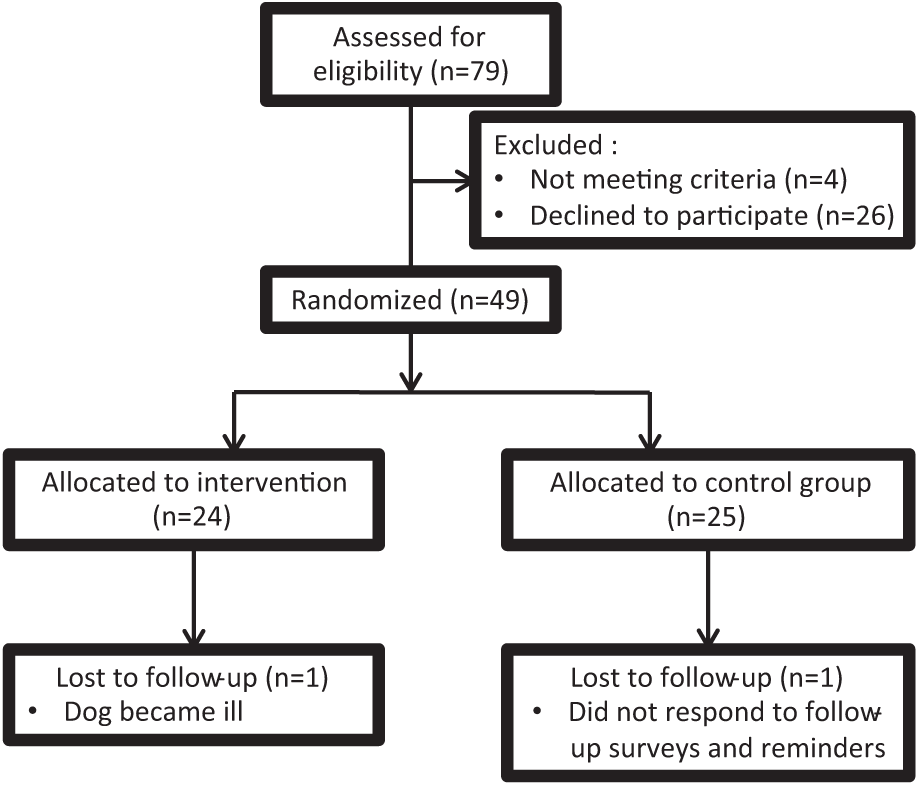
Participant and Procedure Flow Diagram
Despite randomization, there was a significant age difference between the intervention and control group (see Table 2). Other than age, there were no other significant differences between the intervention and control group in demographics, physical activity, or theoretical constructs at baseline. Participants were middle-aged (M = 45.7 ± 13.4 years), and all were Caucasian. On average, participants were considered overweight with an average BMI of 30.0 ± 5.5.
Sociodemographic and Physical Activity Characteristics of Participants

NOTE: PA = physical activity.
t test p value.
χ2 p value.
Data Analysis
Descriptive statistics were used to summarize participant characteristics and analyze the feasibility and usability data. Means and standard errors were calculated for continuous variables and frequencies and percentages for categorical variables. Chi-square and two-sample t tests were used to assess differences between the intervention and control group at baseline and between baseline and post-intervention. Data were analyzed using SAS 9.3 (SAS Institute Inc, 2009). Statistical significance was set at p < .05.
Data were examined, and assumptions of normality, constant variance, and independence were met. To assess for significant differences from baseline to post-intervention in weekly minutes of dog walking between both the intervention and control group, a mixed linear model in which subjects were assumed to have an unstructured covariance matrix across time was used.
To examine if changes in theoretical constructs from baseline to post-intervention resulted in changes in dog walking in both the intervention group and control group, a linear regression model was used in conjunction with ridge regression to deal with multicollinearity issues between several of the theoretical constructs.
Results
On average, participants agreed that the intervention e-mails were easy to read (M = 4.2 ± 0.8) and understand (M = 4.3 ± 0.7; see supplementary table online). In addition, participants reported that the frequency of e-mails was adequate (M = 4.3 ± 0.8). There was lower agreement that the e-mails encouraged an increase in dog walking (M = 3.6 ± 1.2). Furthermore, participants reported slightly more agreement that the benefits for their dog (M = 3.7 ± 1.1) encouraged increased dog walking than their own benefits (M = 3.5 ± 1.0). Fifty percent of participants in the intervention group reported always reading the intervention e-mails, 23% reported reading the e-mails quite often, 14% reported reading the e-mails sometimes, and 14% reported rarely reading the e-mails.
When asked what aspects of the intervention e-mails participants felt were helpful, three participants stated that the e-mails themselves provided encouragement to increase dog walking. Participants also reported that the general dog walking information such as the needed frequency of dog walking and the health outcomes for themselves and their dogs was motivation to increase their walking. When asked about what could be improved in the e-mails, three participants stated that the e-mails could be made more personal by including participant names. In addition, two participants stated it would be helpful to ask them to specifically track their dog walks and report back to the research team weekly about their progress. All participants indicated that they would recommend the intervention to a fellow dog owner.
At baseline all participants walked their dog less than 10 minutes per week. Post-intervention, the control group increased dog walking to 19.4 ± 4.9 minutes, whereas the intervention group increased weekly minutes of dog walking to 79.3 ± 11.2 minutes. When examining differences between groups (intervention and control) and time (baseline to post-intervention), there was a significant difference between group and time (p < .01). Specifically, there was a significant interaction between the intervention group at Time 1 (baseline) compared to the intervention group at Time 2 (post-intervention; β = −70.0 ± 8.1; p < .01). There was not a significant interaction between the control group at Time 1 compared to Time 2 (β = −11.8 ± 7.8; p < .44).
There were no significant changes in the theoretical constructs from baseline to post-intervention in the control group (see Table 3). In the intervention group, only dog social support significantly increased from baseline to post-intervention. In the linear regression model, changes in theoretical constructs in the control group did not significantly affect changes in weekly minutes of dog walking. However, in the intervention group, changes in both family social support (β = 24.9 ± 9.9; p = .02) and self-efficacy resisting relapse (β = 27.1 ± 9.5; p < .01) significantly positively affected changes in weekly minutes of dog walking.
Means and Standard Errors of the Theoretical Constructs at Baseline and Post-intervention

Significant difference between baseline and post-intervention (p < .05).
Discussion
In line with a recent call to advance dog walking research methods (Christian et al., 2013), the present study sought to develop and implement a randomized, controlled intervention in order to increase dog walking among dog owners. Based on prior findings that obligation to the dog (Brown & Rhodes, 2006), dog-related social support, dog-specific outcomes, and self-efficacy were strong correlates of dog walking (Richards et al., 2013b), this pilot intervention attempted to influence these constructs using e-mails in an ultimate attempt to increase dog walking among dog owners who currently were not regularly walking their dog. The current study examined the feasibility and acceptability of this intervention and examined changes in theoretical constructs and dog walking immediately post-intervention. Although participants in both the intervention and control group increased their dog walking, only the intervention group had a significant interaction between baseline and post-intervention. In the intervention group, the increase in dog walking could be considered a large effect size (e.g., >60 minutes per week). These preliminary results support that physical activity can be increased using dog walking as an intervention strategy.
When examining the changes in theoretical constructs from baseline to post-intervention, there were no significant changes in the control group. In the intervention group, only dog social support significantly increased from baseline to post-intervention. Previous research has shown that dog support is a strong correlate for dog walking (Christian, Giles-Corti, & Knuiman, 2010; Hoerster et al., 2011; Richards et al., 2013b). For example, one cross-sectional study showed that when dog support increased by one unit there was an increase in weekly dog walking of 42 minutes (Richards et al., 2013b).
When examining the impact that changes in theoretical constructs from baseline to post-intervention had on changes in weekly minutes of dog walking, there were no significant findings in the control group. However, in the intervention group, changes in both family social support and self-efficacy resisting relapse significantly positively affected changes in weekly minutes of dog walking. Overall, these findings are in line with Bandura’s (1998) SCT and indicate that self-efficacy and a supportive social environment are positively related to increases in dog walking behaviors. In addition, these findings align well with Task Force on Community Preventive Services’ (2002) recommendations for social support interventions to increase physical activity as dogs specifically can provide social support by being a companion for physical activity (Epping, 2011).
Generally speaking, the data showed that this pilot intervention is a feasible and acceptable strategy to increase dog walking among dog owners. Most participants reported that the intervention e-mails were easy to read and understand. In addition, participants reported that the dog walking advice was credible and useful. However, there was slightly lower agreement that the intervention e-mails encouraged participants to increase dog walking even though, on average, participants agreed that e-mail was a good delivery mode for this intervention and the intervention group did significantly increase dog walking post-intervention. Although the e-mails themselves may not have initially been viewed as encouraging, they may have been a catalyst to increase dog walking, which led to increased perceptions of social support and self-efficacy. Future studies will examine this hypothesis in a mediation model. Furthermore, increasing the personalization of the e-mails was suggested by participants and may enhance feelings of accountability to the intervention, which could lead to further increases in dog walking.
A major strength of this study was the use of a health behavior theory, SCT, in the development of this pilot intervention. To the authors’ knowledge, this is the first theory-based dog walking intervention to be developed and tested. It is also important to note some of the limitations of this study. This pilot study had a relatively small sample, and therefore, replication is warranted in a larger trial with more diverse populations. In addition, this study relied on self-report for dog walking and overall physical activity, which is prone to recall and social desirability bias. Objective assessments of physical activity during dog walking with the use of pedometers or accelerometers should be considered in future research. However, the survey items measuring dog walking and the theoretical constructs have previously been tested and were shown to be reliable and valid measures. Importantly, the results presented here are only immediately post-intervention. Future studies will follow participants for 1 year and will further examine longitudinal changes in theoretical constructs and dog walking.
Conclusions
The preliminary results of this study support that this pilot intervention is an acceptable and feasible strategy for increasing dog walking among dog owners. Future studies will follow these participants for 1 year and assess longer term changes in dog walking behavior. Results suggest that increasing self-efficacy for dog walking by fostering social support and providing education on the benefits of dog walking for both the owner and the dog can promote increases in dog walking, which can ultimately result in increased overall physical activity.
The results of this study are specific to dog walking; however, findings also support the role of SCT constructs to walking behaviors in general. Family social support, dog social support, and self-efficacy were shown to be important correlates of increased dog walking behavior. Correlates of social support and self-efficacy have also been shown to affect walking and other forms of physical activity (Dishman et al., 2013). The role of social support from the dog also supports the idea that motivation in the form of obligation to someone or something else may be a catalyst for physical activity. A sense of this obligation could be fostered by providing information on the expected outcomes or benefits of physical activity for this other person or dog. By further exploring and attempting to influence the factors that motivate dog owners to walk their dog, this knowledge could be used to help understand and increase walking behaviors in general. Future studies will assess the contribution of dog walking on total walking and overall physical activity.
In conclusion, using a dog walking strategy for physical activity promotion has the potential to facilitate long-term behavior change as people who own dogs typically sustain dog ownership for many years. This strategy also has the potential for wide public health reach since 40% of U.S. households own at least one dog with a majority not being regularly walked (American Pet Products Association, 2013). Health care providers and health promotion professionals can promote physical activity among their patients by recommending dog walking as a purposeful and enjoyable form of regular physical activity.
Footnotes

References
Supplementary Material
Please find the following supplemental material available below.
For Open Access articles published under a Creative Commons License, all supplemental material carries the same license as the article it is associated with.
For non-Open Access articles published, all supplemental material carries a non-exclusive license, and permission requests for re-use of supplemental material or any part of supplemental material shall be sent directly to the copyright owner as specified in the copyright notice associated with the article.
