



Abstract
Legislative committees rely on the expertise and experience of their members, but instability in committee systems threatens the enhancements in productivity associated with specialization. This can occur in two ways, both of which are more common in state legislative committees than they are in Congress. First, membership retention on committees is generally lower, even after accounting for differing levels of legislative turnover across legislatures. Second, many state legislative committee systems undergo reorganization between sessions, changing the policy jurisdictions, and, therefore, the applicability of members’ previously developed expertise. In this article, I examine the consequences of these two sources of committee instability on legislative output in 14 state legislatures. I find that both membership retention and jurisdictional reorganization significantly affect the number of bills processed through committees and the number of bills ultimately enacted. These linkages are also conditioned on several committee and institutional factors, particularly legislative turnover. Last, I find a weaker but discernible effect of membership retention on committees’ propensity to perform their gatekeeping role.
Keywords
Specialization has long been viewed as crucial to legislative production, and committees are, in turn, indispensable to legislative specialization (Cooper 1970). Even as competing theories (e.g., Gilligan and Krehbiel 1990; Shepsle 1978) have debated the central purpose of committee organization, few would argue with the idea that committee systems give rise to specialization, with comparative research giving credence to the idea that it is an almost universal tendency (Kim and Patterson 1998). In state legislatures, where evidence regarding committee preference distributions largely supports the informational theory of committees (e.g., Battista 2004; 2006; Overby and Kazee 2000; Overby, Kazee, and Prince 2004), specialization is also largely treated as a given.
When it comes to the linkage between specialization and productivity, however, the crucial factor is the stability of committee membership. Although professional experience and industry connections are used as a valuable shortcut to producing well-informed committees (Battista 2012; Hamm, Hedlund, and Post 2011), much of the specialized knowledge on committees undoubtedly comes from experience gained in the legislature (Padró i Miquel and Snyder 2006), especially in time serving on the committee. When a legislature rotates committee memberships dramatically across legislative sessions, it defeats the purpose of specialization, which is why it is no surprise that, for example, 84% of committee assignments in the U.S. House were unchanged for members who served in both the 113th and 114th Congresses.
In state legislatures, however, the stability of committee memberships is highly variant across states and is undermined by several factors that are largely irrelevant in Congress. Membership retention on committees is generally lower than it is in Congress, even after accounting for differing levels of legislative turnover. In addition, committee memberships may be shuffled because committee identities and jurisdictions themselves are more frequently reorganized (Freeman and Hedlund 1993; Makse 2014), severing linkages between individual members and their areas of specialization when committees are created, eliminated, combined, split, or reorganized. With higher levels of legislative turnover, and less stability in the identity of committees themselves, there are substantial losses in expertise that may hamper the production of legislation.
In this article, I examine the consequences of these sources of instability in terms of legislative productivity. I find that both membership change on committees and jurisdictional reorganization of committees decrease productivity. Specifically, I find that committees with stable memberships both receive more bill referrals and pass more bills than their less stable counterparts, and that reorganized committees are less productive by both metrics. Last, I find a weaker but discernible effect of membership retention (but not jurisdiction change) on a committee’s propensity to perform its gatekeeping role by exercising selectivity in the bills it chooses to report from committee.
The article proceeds as follows. First, I examine how productivity has been measured in the study of state legislatures and legislatures more generally, at both the aggregate level and from the perspective of individual legislators. Second, I note that an intermediate level of analysis—productivity at the committee level—has largely been ignored despite the crucial role committees play in the legislative process, and I elaborate on the argument that stability plays a key role in analyzing productivity at the committee level. Third, I analyze the relationship between committee stability and productivity in 14 state legislatures over a 10-year period, focusing on both the direct impacts of instability and the extent to which those impacts differ across legislatures. I conclude by discussing the implications for our understanding of specialization, legislative productivity, and state legislative institutions.
Output in State Legislatures
Measuring productivity, or perhaps more neutrally, “output,” in state legislatures first requires decisions as to what constitutes genuine legislative production. At one extreme, the introduction of legislation may be viewed as effort by credit-claiming legislators, rather than productivity per se, while at the other extreme, looking at enactment of bills may lead to an underestimation of the productivity because of the many hurdles to bill enactment.
Nonetheless, three measures frequently have been used to examine legislative productivity. The first is the total number of bills introduced or considered in the chamber or the legislature (Gray and Lowery 1995; Rosenthal and Forth 1978). The second is the number of bills enacted by the legislature (Gray and Lowery 1995; Hicks 2015; Rogers 2005; Rosenthal and Forth 1978). The third, often referred to as “efficiency,” calculates the proportion of introduced bills that are ultimately enacted (Gray and Lowery 1995; Lin 2015; Squire 1998).
By any metric, the amount of total legislative output varies dramatically across the 50 state legislatures. The interquartile range for bills introduced in the 2005–2006 biennium was between 1,450 and 5,299, while for bills enacted, it was between 458 and 973 (Squire and Moncrief 2010, 162–63). In terms of efficiency, seven states passed more than half of the legislation introduced while 20 passed less than 20% (Squire and Moncrief 2010, 163).
The explanations for this variance across states do not always jell with intuitions about state legislative institutions and political contexts. For example, two of the most important institutional factors in the state legislative politics literature, legislative professionalism and legislative turnover, are not straightforwardly related to legislative output. While Rogers (2005) finds the expectedly positive relationship between legislative professionalism (especially staff size and session length) and enactments, Gray and Lowery (1995) only find a linkage between staffing and bill introductions. Hicks (2015) also finds no linkage between professionalism and enactments, while Squire (1998) finds that professionalism is associated with lower levels of efficiency. Squire (1998) finds no linkage between legislative turnover and efficiency, while Rogers (2005) finds that legislative turnover decreases the number of enactments.
Divided government has also often been considered as a hindrance to productivity, but here, too, the evidence is mixed, and the relationship appears quite conditional. For example, Rogers (2005) finds that divided government within the legislative branch matters, while divided government across the branches of government does not. Hicks (2015) further refines these findings by illustrating the importance of party seat shares, concluding that divided government can help or harm productivity depending on the composition of the legislature.
Productivity is also affected by institutional rules, particularly those related to leadership and the prerogatives of majority and minority party members. Mooney (2013), for example, finds that most legislators believe that leaders are highly influential in determining outcomes, especially in highly professionalized states and in states with high turnover. And while Mooney finds no linkage between the procedural powers of leaders and perceived influence over outcomes, Clark (2015) finds that minority party members struggle to pass legislation in legislatures where majority party leaders have substantial procedural rights (e.g., appointment powers and control of the legislative calendar.)
Among other factors, multiple studies (Gray and Lowery 1995; Hicks 2015; Rogers 2005) have found a relationship between population size and legislative output, particularly in terms of the number of bill enactments. This, in turn, may also explain the inconsistent results regarding professionalism and output, insofar as population size and professionalism are themselves highly correlated. Gray and Lowery (1995) also find that the interest group ecology of a state has an impact on introductions, enactments, and efficiency. Randolph (2010) finds that direct democracy leads to more enactments, particularly in states with fewer requirements for getting on the ballot and in states that use direct democracy more often.
Last, Squire and Moncrief (2010) also cite several more idiosyncratic reasons for variance across states, including particularities of legislative calendars, the ability for citizens to introduce bills, the presence of local bills, the disaggregation of the appropriations process, and the carrying over of bills between legislative sessions.
Beyond explanations for collective productivity in the legislature, productivity has also been examined at the individual level. A literature dating back to Matthews (1960) has argued that some individual legislators are more “effective” than others, a concept that has been quantified both by looking at the percentage of sponsored bills passed into law (e.g., Frantzich 1979), or, alternatively, by the sheer number of sponsored bills enacted (e.g., Anderson, Box-Steffensmeier, and Sinclair-Chapman 2003). More recently, Volden and Wiseman (2014) provide a comprehensive metric for legislative effectiveness that measures achievement at five different stages of the legislative process and weights bills based on the importance of the legislation. A handful of studies of state legislatures has also considered the idea of legislative effectiveness. For example, Padró i Miquel and Snyder (2006) find that legislative effectiveness is associated with electoral success, and Kousser (2005) finds that term limits make legislators less effective at enacting bills.
Very few of these explanations, however, address productivity from an important intermediate perspective: legislative committees. At the congressional level, Volden and Wiseman (2017) demonstrate that committee productivity is enhanced by having a chair with a high level of legislative effectiveness. In addition, because committee chairs are especially likely to become more effective legislators during their time in that position, term limits on committee chairs can reduce productivity. However, these conclusions are framed in terms of the individual legislator (the committee or subcommittee chair).
In the states, studies using the committee as the unit of analysis are also rare. For example, while Bowling and Ferguson (2001) disaggregate bill passage patterns by policy domains, the level of analysis is still the legislature. Lin (2015) finds that the existence of a more informative committee system decreases the number of introductions at the legislature level but improves the legislature’s efficiency in passing bills. However, as with the studies cited above, this analysis is performed at the legislature level and does not consider variance across committees within a legislature. One exception is Jenkins (2016), who focuses on how several committee- and legislature-level factors affect the reporting rates of committees, but not the quantity of legislation processed.
Committee Membership Retention and Legislative Output
Given the ubiquity of metaphors that place committees at the heart of the legislative process, it is surprising that such little attention has been given to variance in output at the committee level. For example, the corollary of two of the previously cited studies may be that committees in more conflictual policy areas or committees with more preference outliers may be different in terms of productivity relative to other committees in the same legislature. Factors such as committee size and partisan stacking may also affect output, as may policy-specific considerations such as a policy sphere’s relevance to the majority party’s agenda or to the contemporaneous policy agenda more generally.
However, the most important reason to consider legislative output at the committee level is that while lawmaking writ large is a collective decision-making process, specialization is an individual-level phenomenon. If the purpose of committees is to foster specialization, the composition of individual committees cannot be neglected as an explanation for productivity. More specifically, committee productivity may vary based on two traits of a committee: the number of members who served on the same committee in a previous legislative session, and whether the committee’s substantive policy jurisdiction is the same as in the previous session. If many of a committee’s members are new or if the committee’s jurisdiction has changed, the committee will not have as much expertise collectively as a committee with an unchanged membership and unchanged jurisdiction.
Committee membership retention is the first factor likely to influence the amount of committee output, and this concern is especially important in state legislatures. In Congress, where chamber-level turnover is low and most continuing members retain committee assignments from one session to the next, changes to committee composition are unlikely to have drastic effects on specialization or productivity. However, in state legislatures, committee memberships are much more likely to be juggled, above and beyond that which is needed to replace outgoing members of the legislature.
One way to approximate the magnitude of this difference is to calculate the difference between the amount of committee turnover and the amount of legislative turnover. A value of zero would indicate that new members were plugged into vacant committee positions held by outgoing members and that all continuing members held their committee positions. Of course, there are many reasons a legislature would never do precisely this, but the quantity (committee turnover minus membership turnover) should still serve as a valid representation of the amount of “unforced” committee turnover. For the U.S. House in the 2003–2012 period, that number was 15.8%. For the 14 states examined in this article, the average was 24.5%.
The logic linking committee membership retention and productivity loss is intuitive. Members placed onto new committees lose some of the expertise and experience gained in their previous committees. Even if a member is put on a new committee where they have relevant experience from their professional background, they still lose the learning-by-doing expertise gained from previous service on the committee. Thus, committees with more new members will have less collective specialized policy knowledge and less of a history of collaboration among their members. For these reasons, I expect a negative relationship between the proportion of new members and the level of legislative output:
The second aspect of committee composition that is likely to undermine specialization and reduce productivity is the reorganization of committee jurisdictions. While membership retention in committees can undermine specialization even if committees themselves are stable, many state legislatures also reorganize the identities and jurisdictions of standing committees. State legislative committee jurisdictions are not governed by the system of precedents that exists in Congress (King 1994), and, thus, many of them lack the enormously high level of stability that exists in Congress (Adler 2002). While only a few states regularly overhaul committee jurisdictions substantially, smaller, adaptive changes are more common, particularly in more professional legislatures (Freeman and Hedlund 1993) and when new majority parties take control of the legislature (Makse 2014).
Changing the jurisdiction of a committee undermines specialization, regardless of the specific type of reorganization. Adding policy jurisdictions to a committee means that there will be new policy areas in which few committee members have developed an expertise. Transferring policy jurisdictions to another committee means that some of the developed expertise is now wasted. Committees that have taken on or shed policy jurisdictions may not function as smoothly early in the legislative session and have steeper learning curves than committees who are merely integrating new members. Reorganized committees may also impact the assignment of the legislative staff, depriving the committee of another source of institutional knowledge. Moreover, the actor in charge of bill referrals may refer fewer bills to reorganized committees, due to their newness, lack of clout, or uncertainty over the precise policy portfolios of reorganized committees. Thus, I anticipate that, all things equal, reorganized committees will be less productive than unchanged committees.
Although the focus of this article is on measures of legislative productivity, it is worth acknowledging that the shift in the level of analysis from the legislature to the committee raises one additional consideration. According to many theories of legislative organization, committees are not designed to maximize legislative output; an important part of state legislative committee power is the ability to block legislation (Rosenthal 1974). While one can make an analogous argument at the legislature level (i.e., that majority parties care about negative agenda-setting more than they care about maximizing legislative output), this question may require somewhat more attention with respect to committee output as the legislative agenda is winnowed far more substantially at the committee stage than at the floor stage. I return to this question after addressing the article’s central hypotheses.
Data and Method
To test the above hypotheses, I examine state legislative committees in 14 states 1 during the period from 2003 to 2012. 2 The states were selected primarily based on the ability to easily identify bills referred to and referred out of specific committees. While no sample of 14 states is perfectly representative of all 50 states, the states in question are statistically indistinguishable from the remaining 36 in terms of racial composition, per capita income, population size, the 2008 vote for President Obama, citizen and government ideology (Berry et al. 1998), state legislative professionalism (Squire 2007), legislative turnover, legislature size, state speaker power (Clucas 2001), and executive power (Beyle 2007).
Within these chambers, I limit the analyses to committees whose policy jurisdictions fell within one of the 10 policy areas 3 with the largest number of committees across legislatures: criminal justice (167 committees, including those that covered more than one of these areas), business (144), education (134), environment (128), transportation (111), health (105), agriculture (97), labor (85), human services (85), and energy (70). Committees were only included if they had a direct policymaking jurisdiction—committees on rules, ethics, and appointments were excluded, as were committees on committees, audit committees, and oversight committees. I also excluded committees whose functions are nondiscretionary (and, hence, unlikely to be eliminated, merged, or otherwise reorganized), such as appropriations, budget, and taxation committees. This yields a sample of 872 committees across 105 chamber sessions. 4
In keeping with the previous literature, I focus on two metrics of legislative productivity: the number of bills referred to each committee, and the number of enacted bills that emerged out of each committee. The first measure, bills referred, counts the number of pieces of legislation referred to a given committee in the legislative session. Across all committees, the mean number of referrals is 122 bills. Committees in the Minnesota House have the largest average number of referrals (264), while Vermont Senate committees have the fewest (45).
The second measure, bills passed, counts the number of pieces of legislation that were referred out of a committee and ultimately signed into law. On average, the committees in this dataset produced approximately 38 such pieces of legislation per session. Colorado Senate committees were the most productive on average (97 bills passed), 5 while Missouri House committees were the least productive (10 bills). Figure 1 illustrates the average number of bills referred and passed for all chambers in the dataset.
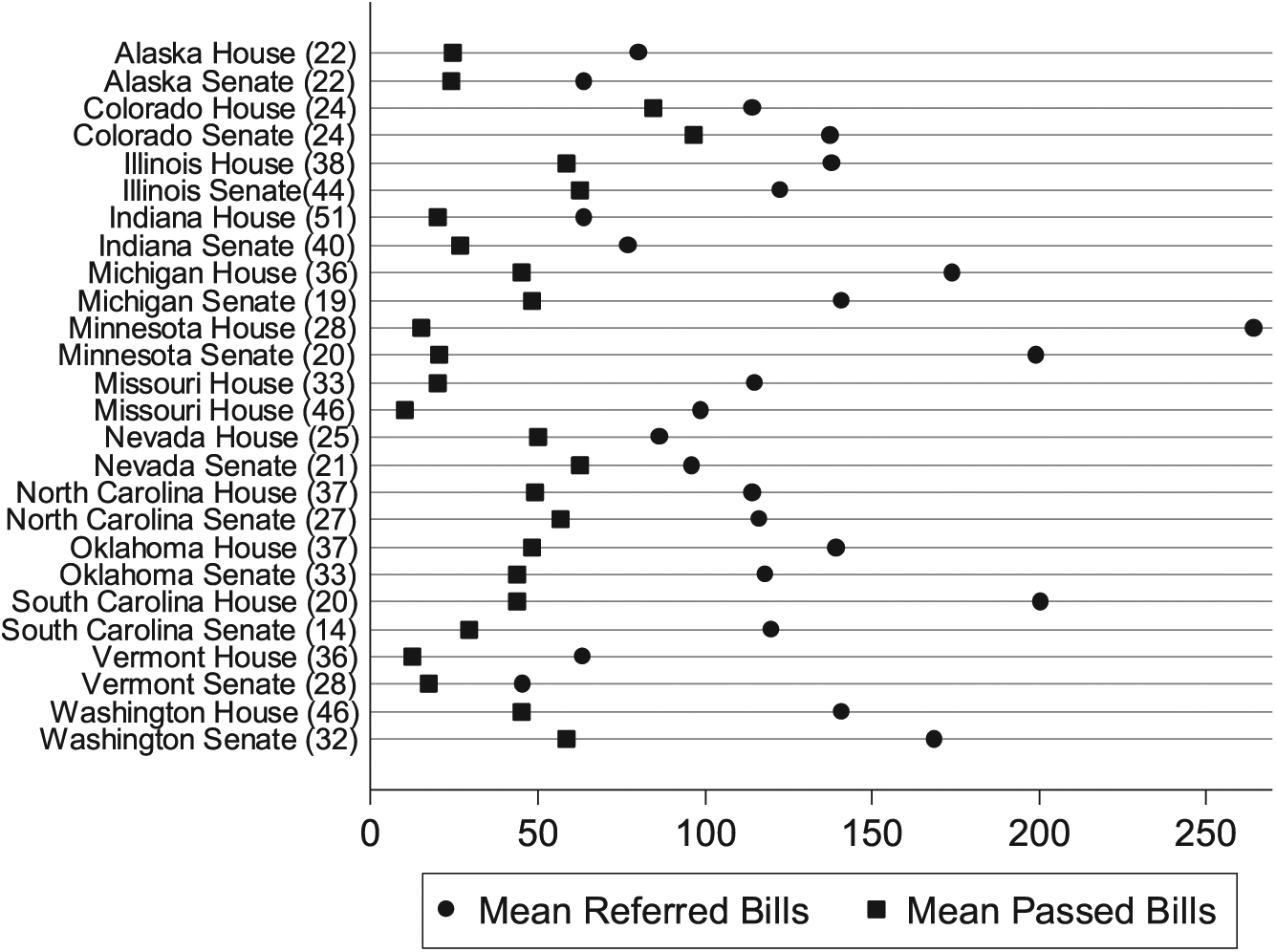
Average bills referred and passed, by chamber.
To operationalize the key independent variables, I first create a dummy variable, jurisdiction change, indicating whether a committee has undergone substantive changes to its policy jurisdiction since the previous legislative session. Substantive changes include the addition or subtraction of policy areas, the merging of two or more committees into one, the splitting of one committee into multiple committees, or the reorganization of policy areas across multiple committees. These do not include changes that are cosmetic or semantic in nature (e.g., a change from “Banking Committee” to “Financial Services Committee”). The most common types of substantive jurisdiction changes are illustrated in Table 1.
Measuring Retention, by Committee Reorganization Type.

Across the dataset, 15.5% of all committees underwent jurisdiction changes, although this varies substantially across chambers (ranging from more than 35% in the Minnesota House and Oklahoma House to no changes in either chamber in South Carolina or in the Pennsylvania Senate or Vermont Senate).
Next, I create the variable committee retention percentage by calculating, for each committee, the percentage of its members in legislative session t who were members of either the same committee, or a committee with overlapping jurisdictions, in session t–1. In the case of committees whose jurisdictions were reorganized, this requires first identifying all committees in the prior session that had overlapping jurisdictions with the current committee. This is done by (1) identifying which of the 10 policy areas is within the committee’s jurisdiction at time t, (2) identifying any committees in session t–1 that had jurisdiction over any of the policy areas identified in step (1). Figure 2 illustrates how this is done for each type of committee reorganization. The resulting variable has an average value of 51.8% across all committees in the sample, indicating that retention is quite low in many committees. The committees that underwent changes had a significantly lower retention of their members (42.7%) compared with those that underwent no jurisdiction changes (53.4%).

Marginal effects of committee retention on bill referrals, by legislature type.
To test H1, the model includes the committee retention percentage as a covariate, with the expectation that committees that retain more members from the previous session will be referred more bills and will be responsible for more bills that are signed into law. Likewise, I include jurisdiction change as a covariate because H2 argues that a change in committee jurisdiction will have a negative effect on each of these outcomes. 6
I also control for additional institutional-, contextual-, and committee-level factors that may influence the productivity of a given committee. Committees in chambers with a new majority party may be more productive if they reflect a pent-up demand for legislation that accrued while the party was in the minority. In keeping with Hicks (2015), I also control for the majority size in the legislature. Moreover, despite the inconsistent support for such claims in the literature, we might expect lower legislative turnover (operationalized as the average turnover across the years of the study) and legislative professionalism (Squire 2007) to be associated with higher outputs. The model also controls for chamber size, which may increase the number of bill introductions but slow down the overall passage of legislation. 7 Finally, in the bill passage models, I account for whether the state had unified government. 8
Because institutional rules also affect the operation of committees and their autonomy (Martorano 2006), I also control for the level of committee autonomy that committees enjoy in a legislature, following Jenkins’ measure (Jenkins 2016, 78), which creates a 5-point scale based on five rules regarding committee referrals, consideration of bills, and reporting of bills. 9
In addition, I account for the overall level of committee reorganization in the chamber, insofar as reorganization may have cascading effects beyond the committees that are most substantially reorganized. The variable aggregate change in chamber committees measures the percentage of committees in the chamber that underwent substantive jurisdictional changes, and has a mean of 14.7% across all sessions. Assuming committee reorganization is purposeful, the aggregate change in chamber committees may be associated with increases in legislative outputs, if it helps committee organization better match legislative priorities.
I also account for several factors that operate at the committee level. Because committees under new leadership may operate differently from their predecessors, I control for whether the committee has a new committee chair. I account for committee size, as larger committees may receive more referrals and produce more enacted legislation. I also calculate the median Shor-McCarty ideology scores for both the individual committee (Shor and McCarty 2011) and the whole chamber, and I include the committee-floor ideological distance in the models, because committees that are unrepresentative of the chamber may receive fewer referrals and may be less likely to report bills that can ultimately garner majority support. 10
Last, I include two cross-level interactions that allow the effects of committee membership retention to differ by institutional context. An interactive relationship between committee retention and legislative professionalism may exist if committee organization has the greatest effect on legislative outputs in the states that have the resources to translate advantageous committee organization into action. Likewise, an interaction between committee retention and legislative turnover captures the intuition that committee turnover is expected in springboard legislatures, and, thus, may not be particularly disruptive to the legislative process, while in career legislatures, the impact of committee retention may be greater. 11 Descriptive statistics for all variables can be found in Table 2.
Descriptive Statistics.
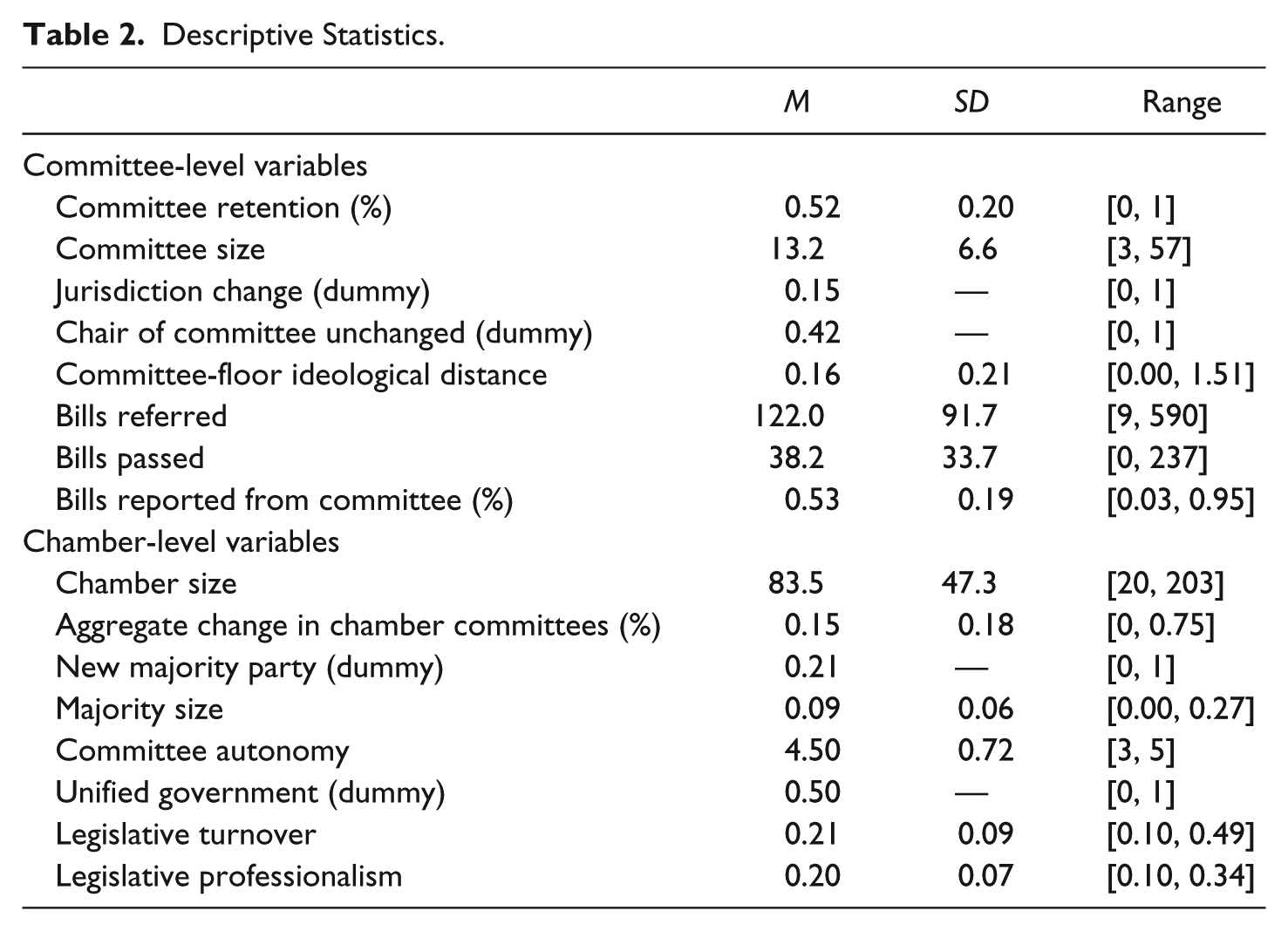
The large amount of variance at the chamber-session level calls for a multilevel modeling structure, with committees nested within chambers. This means that even if there are unmeasured factors at the chamber level, this variance will be captured by the random intercept and will not bias estimates of the key committee-level factors: membership retention and jurisdiction change. To test the cross-level interactions, I also include a random slope term allowing the effect of committee membership retention to vary across chambers. The interactions and their constituent terms are also mean-centered for ease of interpretation. As both dependent variables are count variables with overdispersion, I utilize multilevel negative binomial regression models.
The first column of Table 3 presents the results from two models in which the dependent variable is the number of bills referred to a given committee. Model 1, which presents all the individual covariates without the inclusion of interactions, supports H1, as it finds a statistically significant relationship between committee membership stability and the number of bill referrals. Substantively, a change from one standard deviation below the mean (32% retained committee members) to one standard deviation above the mean (72% retained committee members) is associated with an increase from 110 predicted referrals to 139 predicted referrals, an increase of 27%.
Multilevel Negative Binomial Models of Committee Bill Referrals.
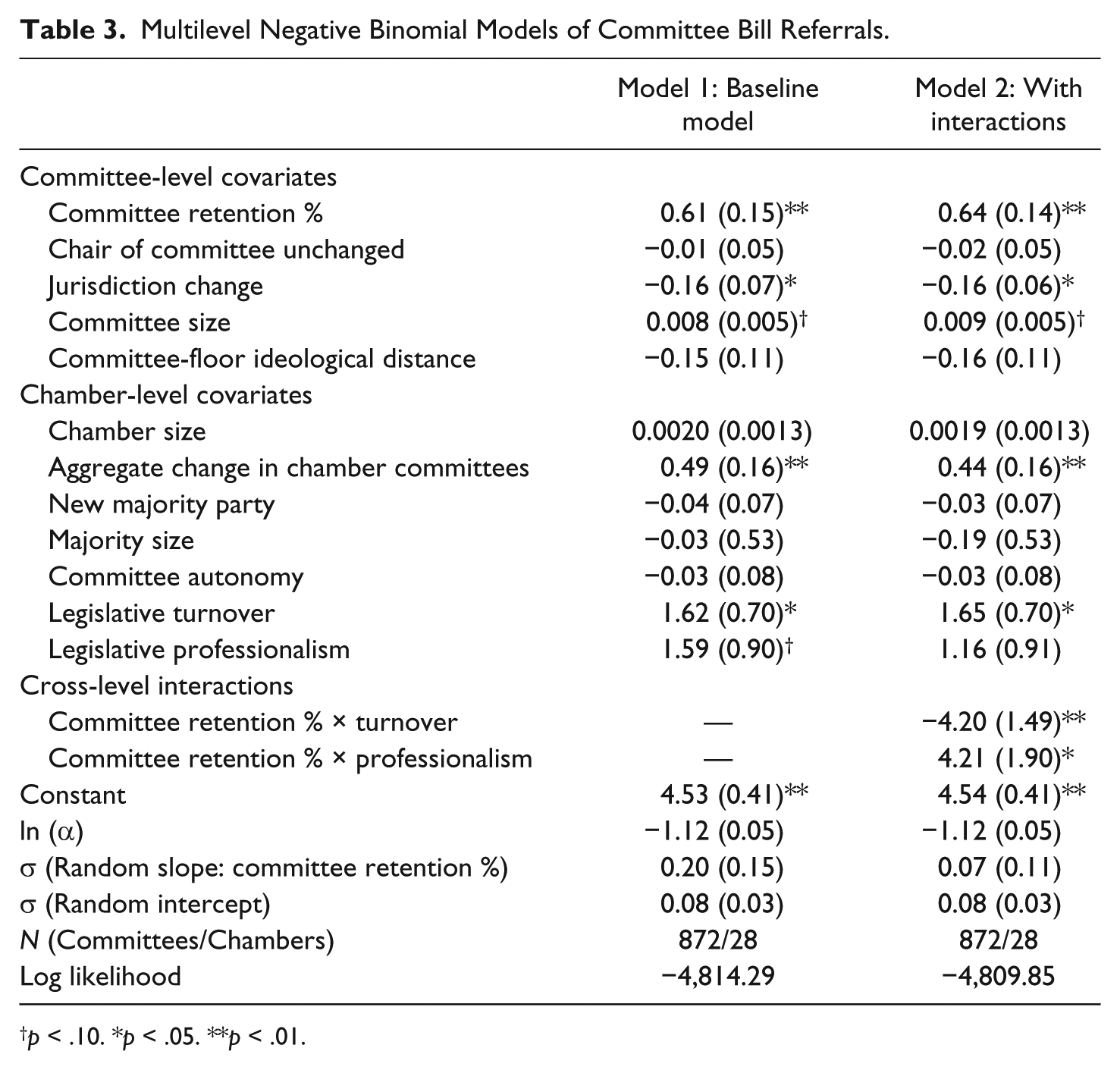
p < .10. *p < .05. **p < .01.
Model 1 also offers strong support for H2, as there is a negative and statistically significant effect of jurisdiction change on the number of bills referred to a committee. The effect is substantively quite large as well. Holding all other variables at their means, the model predicts that an average of 108 bills will be referred to a committee with a reorganized jurisdiction, compared with 126 bills referred to a committee with an unchanged organization, a difference of 15%.
Among control variables in the model, only two have significant effects on the number of bill referrals: committee size and the aggregate level of committee reorganization in the chamber. An increase in committee size from seven members to 20 is associated with an 11% increase in bill referrals, while increasing the percentage of reorganized committees from zero to one third produces an 18% increase in the number of bill referrals.
The second column of Table 3 presents a model that is identical but also includes the interaction terms. These results reveal that the relationship between committee retention and bill referrals is conditional on the two institutional factors: professionalism and turnover.
Because the coefficients from interaction terms cannot be interpreted unconditionally, Figure 2 illustrates the marginal effects of committee retention for legislatures with different levels of professionalism and turnover. I calculate the marginal effects of committee retention in legislatures with different levels of professionalism (panel A) and turnover (panel B). In general, the effect of committee retention is statistically significant in highly professionalized and low turnover legislatures, but not significant in less professionalized and high turnover legislatures. More specifically, the effect of committee retention ceases to be significantly different from zero at levels of professionalism below 0.16 (four of the 14 states in the data) and at levels of turnover higher than 28% (six of the 28 chambers in the data).
Next, I present similarly specified models in which the dependent variable is the number of bills reported from a committee that were ultimately enacted. Table 4 once again presents two models: one with just the unconditional effects of committee retention (Model 3), and a second with the interactions included (Model 4).
Multilevel Negative Binomial Models of Committee Bills Passed.
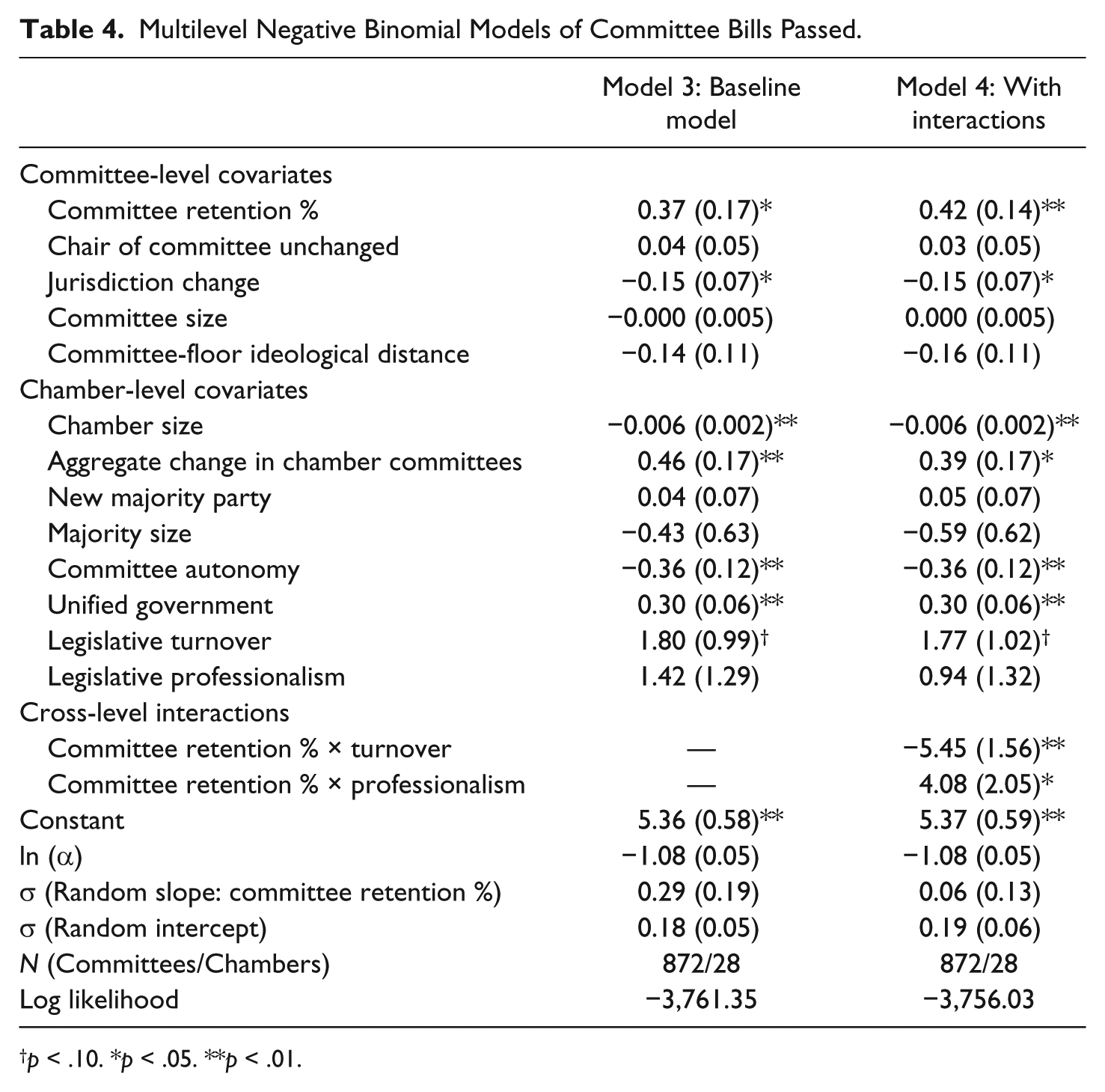
p < .10. *p < .05. **p < .01.
Model 3 supports H1’s prediction that committee retention will affect the production of successful legislation. A change in retention from one standard deviation below the mean to one standard deviation above the mean is associated with an increase from 35 predicted enactments to 39 predicted enactments, an increase of 16%. The model also indicates support for H2, as there is a negative and statistically significant effect of jurisdiction change on the number of bills passed. Relative to committees with unchanged jurisdictions (predicted output of 38 bills), reorganized committees are estimated to produce 14% less enacted legislation (33 bills).
As in the models of bill referrals, Model 4 also offers evidence that the effects of committee retention vary across different types of legislatures. Figure 3 once again examines how the marginal effect of committee retention differs across legislatures with different levels of professionalism (panel A) and turnover (panel B). With respect to professionalism, the marginal effect of committee retention is only significantly greater than zero in legislatures with values of professionalism greater than 0.19, which represents half of the 14 legislatures in the dataset. Likewise, the marginal effect of committee retention is only positive and significant when legislative turnover is less than 24%, which represents around 64% of the legislative chambers in the dataset.
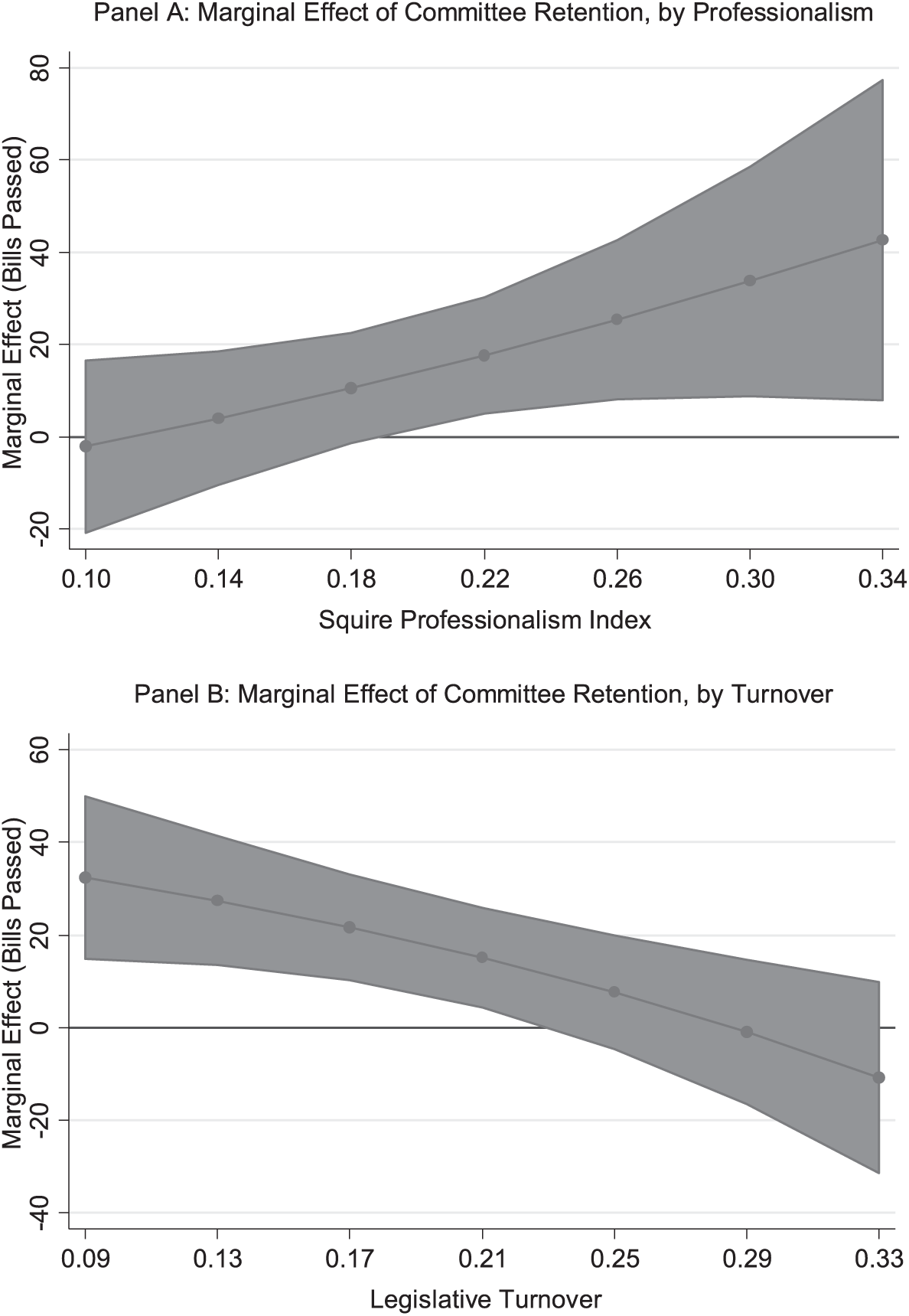
Marginal effects of committee retention on bill enactments, by legislature type.
Turning to the control variables in the model, four other covariates predict the number of bills passed. Committees in states with unified government produced 35% more passed legislation than states with divided government, while committees in the largest chambers passed 6% less legislation than committees in the smallest chambers. Chambers with the most autonomous committee rules passed 52% less legislation than those with the lowest levels of autonomy. Last, committees in chambers with high levels of aggregate committee reorganization produced 14% more legislation than those with no reorganized committees.
Overall, then, the models provide convincing evidence of a link between committee stability and legislative output. H1 is supported overall, although analysis of the interactive models places a couple of caveats regarding the impact of membership retention. In the bill referral models, the effect does not extend to legislatures with the lowest levels of professionalism or the highest levels of turnover. In the models of bill passage, committee retention impacts output in more professional legislatures and legislatures in the bottom two thirds in terms of legislative turnover rates. All the models support H2 in illustrating a direct link between the change in a committee’s jurisdiction and both the number of bills referred to that committee, and the number of passed bills that were reported out of that committee.
The Negative Power of Committees
As previously noted, defining productivity in committees the same way we define productivity in legislatures overlooks the perspective that views committees primarily in terms of their ability to prevent legislation from reaching the floor. For example, Rosenthal (1974) asserts that committees are performing their job optimally when they fail to report a large proportion of the bills referred to them. Thus, although my primary focus is on the production of legislation, it is also worth examining how the retention or loss of committee expertise affects committees’ propensity to use their gatekeeping powers. If committees that suffer a loss of expertise are also less likely to provide the floor with workable legislation, the ramifications of membership retention and jurisdiction reorganization may be even greater than the effects implied in the previous section. Conversely, if the loss of expertise leads committees to be more selective in the processing of legislation, the quantitative loss in productivity may be offset.
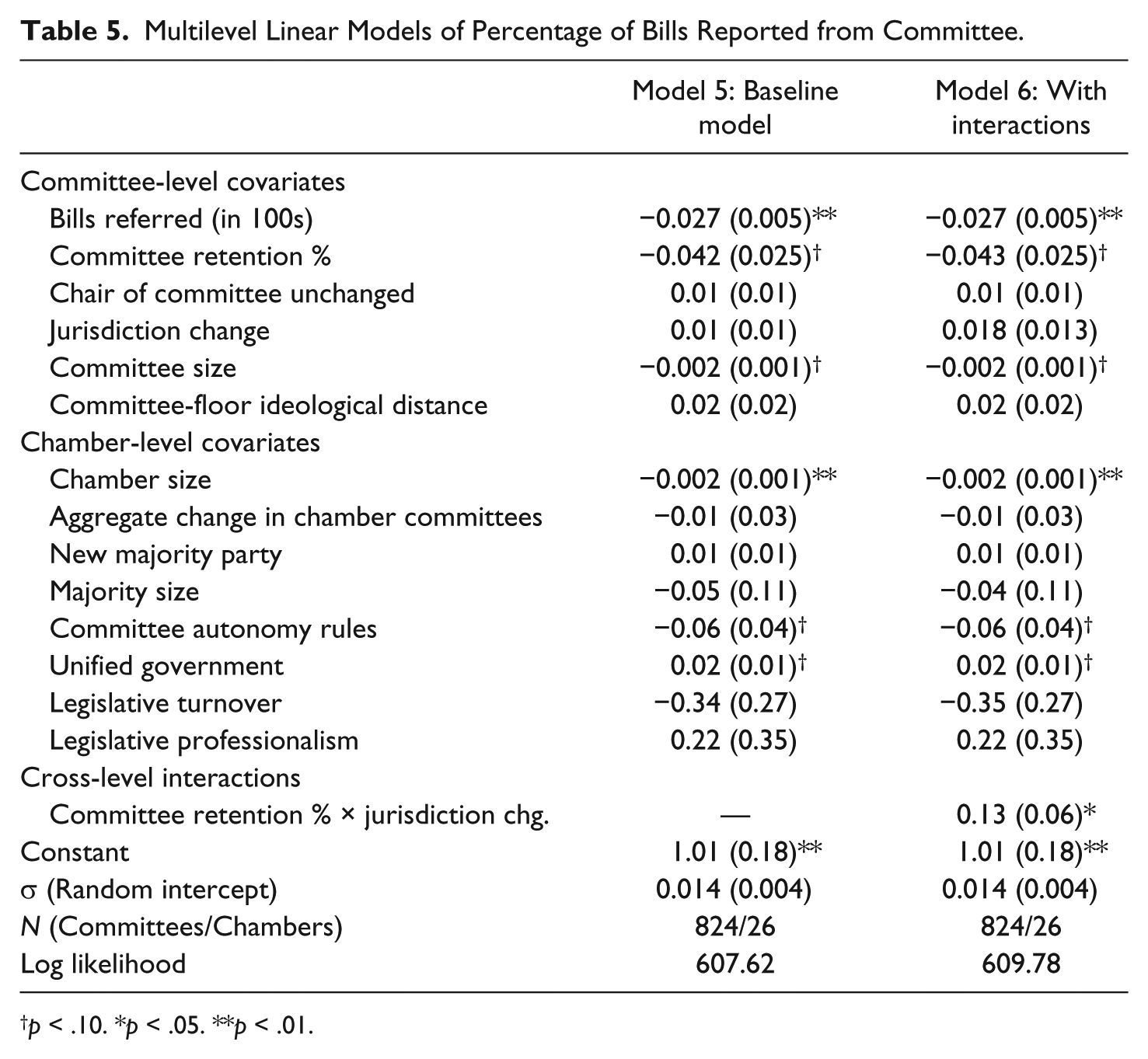
To assess whether the loss of expertise is correlated with the performance of gatekeeping, Table 5 presents two additional regression models in which the dependent variable is the percentage of referred bills that are reported out of committee. Although some state legislatures have rules that compel committees to report all legislation out of committee, only one of the states in this sample (Colorado) has such rules. Thus, these models only examine the remaining 13 states.
Multilevel Linear Models of Percentage of Bills Reported from Committee.
p < .10. *p < .05. **p < .01.
Because the dependent variable here is continuous, these models are multilevel linear models rather than the count models in the prior section. 12 Model fit statistics indicate that a random slope term is not called for in this model, as the effects of member retention do not appear to vary meaningfully across legislative chambers. Thus, I do not include interactions with legislative turnover and legislative professionalism, but I do examine whether there is an interactive effect between membership retention and jurisdiction change. The covariates included in these models are similar to those in the previous models, with one exception. Because committees who are referred more legislation may be less likely to report a high percentage of legislation, I also control for the number of bills referred to a committee.
Table 5 presents the results from these analyses. In Model 5, we can see that jurisdiction changes have no direct impact on the proportion of bills reported from committee, and the effect of membership retention is small and only marginally significant. Instead, the factors that most substantially influence bill reporting rates are institutional factors: committees report a higher proportion of bills under unified government, and a lower proportion of bills in larger chambers, in larger committees, and in legislatures where committees are more autonomous. As predicted, the number of bills reported to a committee is also negatively associated with the reporting rate, although this, too, may be viewed as an institutional-level factor, insofar as much of the variance in bill referrals is at the chamber level.
Model 6, which adds the interaction term, offers very similar results, except that we can now observe an interactive effect between membership retention and jurisdiction change. That is, the effect of membership retention on reporting rate is more positive when the committee has been reorganized than when the committee’s jurisdiction remains the same. In short, the relationship between expertise and bill reporting rates is much weaker than the relationships we observed with respect to productivity.
Discussion
If committee reorganization reduces legislative output, as the above models demonstrate, a natural question to ask is why parties reorganize committees in this manner. One possibility is that the loss in productivity is not viewed as harmful. A second possibility is that there may be reasons for committee reorganization that are in the interest of the entire chamber or majority party caucus. While some of those reasons may be idiosyncratic (e.g., the preferences of leaders or committee chairs, the desire to use politically contemporary nomenclature), the models above suggest there is a systematic element as well. For example, the aggregate change in committee organization has a positive effect on both bills referred and bills passed, suggesting that negative effects at the committee level are partially counteracted by productivity increases at the chamber level.
Another possibility is that committee reorganization is motivated, in part, by factors related to one of the central questions in the literature on legislative organization literature: the distribution of preferences on committees. Although the literature on state legislatures has overwhelmingly failed to find a prevalence of high-demand, outlier committees (Battista 2004; 2006; 2009; Lin 2015; Overby and Kazee 2000; Overby, Kazee, and Prince 2004), it is possible that jurisdiction reorganization, which is itself relatively rare, is motivated in part by the desire to either create or dismantle outlier committees.
Conclusion
In this article, I show that decisions to reorganize state legislative committees have significant effects on legislative productivity. New legislative majorities may often prefer to reorganize the committee system, but those decisions produce predictable reductions in legislative output. Reorganizing committees necessarily displaces many individual members from their previous committee assignments, which may disrupt the linkages between specialization and legislative output. These effects are particularly disruptive for low turnover legislatures, which may be accustomed to more stability in committees and committee assignments. High turnover legislatures, for which committee turnover is an inevitable by-product of overall membership turnover, are more immune to these effects.
By disaggregating the measurement of legislative output to the committee level, this article also offers a new perspective to the literature on state legislative productivity. The partition of variance in the above models shows that only a modest proportion of the variance in bills referred and bills enacted is attributable to the legislative chamber. Understanding committees’ roles in the production process, then, is not only valuable on its own terms, but may also help to clarify or resolve some of the inconsistent findings regarding institutional factors at the legislative level.
Future work should continue to consider how turnover, both at the legislative level and at the committee level, impacts legislative processes and productivity. For example, the burgeoning literature on legislative networks demands attention to the ways in which turnover influences not only specialization at the individual level, but also working relationships among legislators and within committees. In light of evidence that legislative networks are dynamic (e.g., Kirkland and Gross 2014), does this suggest that they will adapt to changes, even substantial changes, to committee organization and composition? Moreover, can committee turnover produce denser networks, and how do such changes affect overall productivity?
It is also worth studying the linkages between specialization and output as a dynamic process. While this article and most other work on legislative productivity treats the year or session as the unit of analysis, shorter- and longer-term perspectives may offer additional insights. For example, how long does it take within a session for a newly organized or highly reconstituted committee to get up to speed? In legislatures that only meet for 60 or 90 days per biennium, this may be a particularly pressing question. Put another way, how long do losses in productivity last? While springboard and term-limited legislatures cannot prevent committee churn or its aftereffects and, hence, will be less affected by reorganization, career legislatures may value knowledge of whether the long-term effects of reorganization counteract any short-term declines in productivity.
Beyond its findings regarding committee reorganization, the article’s findings serve as a reminder that specialization in legislatures is a question of human capital and does not happen automatically. Even in chambers with highly stable committee jurisdictions, productivity can be enhanced by optimizing committee assignments in a way that minimizes disruption and maximizes retention, even if those goals must be balanced against other partisan, personal, and electoral considerations. To the extent that committee turnover is unavoidable, losses in productivity may at least be minimized if the reassigned members are those with the least background knowledge, the least experience, or the least constituency demand in that policy sphere.
Footnotes
Acknowledgements
The author thanks Chris Mooney, Thad Kousser, Mike Rivera, and three anonymous reviewers for helpful comments.
Declaration of Conflicting Interests
The author(s) declared no potential conflicts of interest with respect to the research, authorship, and/or publication of this article.
Funding
The author(s) received no financial support for the research, authorship, and/or publication of this article.