



Abstract
Severe party conflict, not a high-minded suspension of politics, now prevails “at the water’s edge.” Democrats and Republicans fight pitched battles over foreign affairs. But are the two parties polarized in their substantive preferences on foreign policy, or mainly jockeying for partisan advantage? Are they polarized on foreign policy less sharply than on domestic policy? What are the sources of party polarization over foreign policy? Using a new measure of senatorial foreign-policy preferences from 1945-2010, we explore party polarization over foreign policy. We find that foreign-policy preferences have had varying relationships with party politics and general ideology. Since the 1960s, however, the parties have become increasingly polarized on foreign policy. Using a multilevel analysis, we show that foreign-policy polarization has developed in response to partisan electoral rivalry, foreign-policy events, and general ideological polarization. The analysis indicates an increasing influence of domestic politics on foreign policy.
Keywords
Political parties are polarized in Congress. Democrats and Republicans disagree on almost all major economic and social policies. On foreign policy, partisan conflict is increasingly severe and sometimes manifestly destructive. While the Obama administration was negotiating with Iran to prevent its development of nuclear weapons in 2015, for example, 47 Republican senators published an open letter to Iranian leaders, warning that any deal might be nullified by the next president. More generally, a number of studies have shown that bipartisanship in foreign policy has broken down since the Vietnam War and even more since the end of the Cold War (Kupchan & Trubowitz, 2007; McCormick & Wittkopf, 1990; Meernik, 1993; Prins & Marshall, 2001).
This article aims to go beyond these studies, first, by measuring the degree of party difference in foreign-policy preferences; second, by comparing the degrees of polarization between domestic and foreign policies; and, finally, by providing a systematic analysis of the sources of foreign-policy polarization. Despite the scholarly consensus on the breakdown of bipartisanship on foreign policy, scholars have not examined how much the political parties have been substantively polarized on foreign policy (see Beinart, 2007). Indeed, in contrast with the extensive work on general ideological polarization, we have not had a reliable measure of Congress members’ or congressional parties’ foreign-policy positions.
We present a systematic analysis of party polarization on foreign policy in the Post–World War II period. Focusing on the Senate, we develop a new measure of senators’ foreign-policy preferences, using all votes on foreign policy (including defense issues) from 1945-2010. We use this measure to address three major questions: First, do senators have foreign-policy ideologies? That is, do their votes on foreign policy reflect relatively stable preferences on an underlying foreign-policy dimension? Second, are the parties polarized in their foreign-policy positions? If so, how does the degree of party polarization on foreign policy compare with that on general ideology? Finally, what influences have driven party polarization on foreign policy? In particular, have increases in polarization resulted from events and conditions in foreign policy, such as the Vietnam War, the Iraq War, or the end of the Cold War? Have they resulted from partisan electoral rivalry? Or has foreign-policy polarization largely reflected general ideological polarization?
In answering these questions, we present a range of new findings. We find that Senate votes on foreign policy have been consistently structured by a single dimension, enabling us to measure foreign-policy ideology on a one-dimensional scale, similar to the liberal–conservative general-ideology scale. However, the policy positions reflected in the measure have changed with the evolving issues in foreign policy. The development of party positions on foreign-policy ideology has been eventful. With historic changes in the international and political context, the Democratic and Republican parties converged and actually reversed their relative positions on the scale in the early postwar years. They then moved further apart, constantly though at varying rates, after the 1960s. By the 2000s, foreign-policy polarization had matched and exceeded the level of general ideological polarization. Among other implications, these findings permit us to discount suggestions in the literature that increasing party conflict on foreign policy has mostly reflected mere partisan electoral rivalry as opposed to fundamental policy differences (Kriner, 2010; Lee, 2009).
Our central findings concern the forces that drive this polarization in foreign policy. In some preliminary analyses, we show that regional realignment, population sorting, and any other sources of increasing divergence between states have played only modest roles. Most of the polarization in foreign policy has occurred within states, not between them. We then use multilevel regression analysis to identify the factors that have played major roles in foreign-policy polarization. We find that certain foreign-policy events and conditions of party politics have had significant effects. In addition, however, foreign-policy polarization appears to be a long-term effect of general ideological polarization.
Ideological Polarization Over Foreign Policy
The burgeoning literature on the development of congressional party polarization has focused entirely on general ideology. The Poole and Rosenthal NOMINATE data set has provided the individual Congress-member ideology scores for tracking party differences over time—a measure that, while including foreign-policy votes, is dominated by domestic policy. 1 Several causes of general ideological polarization are well understood: the regional realignment of party support largely eliminated most conservative Southern Democrats and liberal Northern Republicans who accounted for the ideological overlap between the parties in Congress. Through population change, some formerly competitive states have become heavily Democratic or Republican, reducing electoral incentives for moderation (Jacobson, 2000). These developments produce greater ideological divergence between states. In addition, scholars have explored factors that may explain general ideological polarization within states: in particular, party activists in the nomination process (e.g., Layman, Carsey, Green, Herrera, & Cooperman, 2010); the ideological fragmentation of media markets (e.g., Levendusky, 2013); and institutional and procedural changes in Congress (e.g., Theriault, 2008), among others.
In contrast, we have lacked systematic analysis of party polarization on foreign policy. To begin with, we have not had estimates of Congress members’ underlying preferences, ideal points, or ideologies on foreign policy. Because foreign-policy issues, such as arms control, defense alliances, and immigration, have only complex or indirect connections with the issues and interests at stake in domestic policy, we need an independent measure of foreign-policy preferences to analyze party polarization over foreign policy. 2 Indeed, existing studies (Cronin & Fordham, 1999; Karol, 2009; Trubowitz, 1998) document that the Democratic and Republican parties have switched positions on some foreign-policy issues, especially trade and defense, while maintaining consistent positions on domestic policy.
The lack of a measure of foreign-policy preferences is important, among other reasons, because there are grounds for alternative expectations about the degree of foreign-policy polarization. First, some accounts suggest that foreign policy has been prone to more consensus or agreement and less party conflict than domestic policy. Foreign policymaking in the mid-20th century was often portrayed by reference to Senator Arthur Vandenberg’s high-minded slogan, “politics stops at the water’s edge.” On this view, serious threats to national security, such as the Soviet Union’s Cold-War expansionism, induced Congress members to give bipartisan support for policies designed to protect national interests. A related, though more modest notion is that of “two presidencies,” suggesting that Congress defers to the president more readily on foreign policy than on domestic policy (Wildavsky, 1966). On this view, Congress members recognize that in foreign policy, the president has broader legal authority, privileged access to information, and superior capabilities for policymaking. At the same time, the members encounter fewer competing demands from interest groups and electoral constituencies. So they more willingly follow the president’s lead. Both the more categorical water’s-edge claim and the more nuanced two-presidencies thesis expect reduced party polarization on foreign policy.
Empirical support for these notions has been mixed. In their favor, some studies have found that even in recent decades, presidents have had more success in Congress on foreign policy than on domestic policy (e.g., Canes-Wrone, Howell, & Lewis, 2007). More broadly, Chaudoin, Milner, and Tingley (2010), examining roll call votes and bill sponsorship in the House, argue that bipartisanship still characterizes foreign policymaking. “Bipartisanship has not changed much over the years,” they conclude, “and presidents can still construct bipartisan coalitions in support of their preferred foreign policies, if they so desire” (p. 78). On the other hand, some empirical studies have failed to support a presidential advantage on foreign policy (e.g., Sigelman, 1979). Numerous studies have found increasing party conflict and opposition-party resistance to presidential leadership on foreign policy after the early 1970s (Kupchan & Trubowitz, 2007; McCormick & Wittkopf, 1990; Meernik, 1993; Prins & Marshall, 2001). Further complicating matters, although party conflict on legislation and party polarization in substantive policy preferences are undoubtedly related, they are not the same thing. Parties may disagree for merely partisan reasons (Lee, 2008, 2009) Thus, despite the increased party conflict since the Vietnam War, there has been no clear evidence on the degree of party polarization on foreign policy, nor on how it changed over the years.
Our main concern, however, is with systematic causes of polarization: To the extent that parties are polarized over foreign policy, what forces or processes have moved them apart? To some extent, as with general ideological polarization, foreign-policy polarization should result from party realignment and population sorting, reflected in increased divergence in foreign policy positions between states. We thus expect that since the 1960s, senators from certain states have moved in one direction on foreign policy while those from other states have moved in the opposite direction. Just as with general ideological polarization, however, we presume that other factors will also be involved—and senators from most states will move in one direction or the other depending on the senator’s party. We focus in particular on three categories of explanation.
First, we expect party polarization on foreign policy to result in part from major events or developments in foreign policy that induce or intensify partisan conflict. A partisan battle over one foreign-policy issue may crystallize and harden differences that affect other foreign-policy issues. The end of a period of threat that induced consensus and cooperation may allow underlying differences to emerge. Existing studies have identified three major relevant events. (a) The decline and eventual end of the Cold War should have promoted foreign-policy polarization by eliminating the perceived common interest in blocking Soviet expansionism (Kupchan & Trubowitz, 2007; Prins & Marshall, 2001; Scott & Carter, 2002). The chronology of this effect, however, is not straightforward. We will argue later that the consensus-inducing phase of the Cold War ended, long before the 1990 collapse of the Soviet Union, in the later years of the Vietnam War. (b) According to Beinart (2007, pp. 154-155; see also Meernik, 1993; Kupchan & Trubowitz, 2007), the Vietnam War helped break down the bipartisan consensus of the early Cold War and stimulated party polarization. The two parties drew conflicting lessons from the war. Democrats sought to moderate the emphasis on containment of communism and accommodate left-wing nationalism in Third World countries; Republicans redoubled their commitment to containment, with frequent resort to military intervention. (c) Finally, some studies also identify the Iraq War as promoting polarization (Beinart, 2007; Bonica, 2014). Although the 9-11 attacks initially produced bipartisan responses, the George W. Bush administration’s invasion of Iraq divided the parties, much as the Vietnam War had done by the late 1960s (Beinart, 2007). We would thus expect the end of the intense phase of the Cold War, the Vietnam War, and the Iraq War to increase party polarization on foreign policy.
Second, we expect that foreign-policy polarization has been driven partly by partisan electoral rivalry. Howell and Pevehouse (2007) and Kriner (2010) show that partisanship plays a significant role in congress-president relations on foreign-policy issues. The logic is straightforward: Members of each party assume that, other things being equal, the policy successes of a copartisan president will enhance their own prospects for reelection (Lee, 2008, 2009) and thus are more likely to support a copartisan president. Conflict motivated by partisan electoral interests will create or intensify policy differences. This effect should be stronger when party control of the respective chamber is closely contested (Dion, 1997). In fact, Lowry and Shipan (2002) found that when the majority party has a slim seat margin, the parties are more polarized on domestic policy. We would expect the same pattern to emerge on foreign policy.
Finally, we expect that foreign-policy polarization has been driven by general—that is, mainly domestic—ideological polarization. Most foreign-policy issues do not implicate domestic ideological concerns—taxes, social spending, inflation, unemployment, environmental regulation, and so on—in a strong or direct way. Nor, however, do most domestic issues implicate most other domestic issues in strong or direct ways. Yet, most domestic issues, no matter how logically distinct, tend to become merged into the liberal–conservative dimension.
We propose that some of the same mechanisms that induce consistency across the substantively diverse array of domestic issues will also induce consistency between domestic and foreign-policy issues and thus promote foreign-policy polarization. A variety of specific mechanisms are likely involved—with some operating mainly through elites, some mainly through ordinary citizens, and some through both (see Layman et al., 2006; Quirk, 2013, for a review). Some of the main causal factors include mutual influence among party activists (Layman et al., 2010); individual-level cognitive consistency (Nincic & Ramos, 2010); ideological segmentation of media markets (Levendusky, 2013); and the parties’ pursuit of signaling efficiency and coalition coherence (Grynavisk, 2010), among others. We do not attempt to assess the relative importance of these or other mechanisms of general ideological polarization. We merely suggest that the forces that push citizens and elites toward consistency, coherence, and single-dimensional conflict on domestic issues will also act on foreign-policy issues.
The influence of general ideology on foreign-policy preference has been suggested by existing studies (Holsti & Rosenau, 1996; McCormick & Wittkopf, 1990; Nincic & Ramos, 2010). For instance, McCormick and Wittkopf found that “Republicans appear to have become the conservative party in foreign as well as domestic policy, and Democrats the liberal party” (McCormick & Wittkopf, 1990, p. 1094). This effect has two implications. As partisan polarization on domestic ideology increases, it will drive foreign-policy polarization to higher levels. Moreover, in the aftermath of events that disrupt or destabilize the relation between domestic- and foreign-policy preferences, that relation will gradually reemerge.
A New Measure of Foreign-Policy Preferences
In this section, we introduce a new measure of the foreign-policy preferences of senators that enables us to explore the issues about foreign-policy polarization. An article-length account of the measure, with full methodological details, is in Jeong (2016). In this section, we summarize the main features.
We focus on the Senate rather than the House for two reasons. First, the Senate’s power of advice and consent—treaty ratification and appointments—has allowed the Senate to exercise more influence than the House on foreign policy. Second, we can estimate senators’ foreign-policy preferences more precisely than those of House members. Because agenda setting in the House prevents nearly all roll calls that would result in defeat for the majority party (Cox & McCubbins, 2006), House members’ policy preferences are less fully revealed. Because the minority party has more leverage over agenda setting in the Senate, the Senate votes on a less constrained set of measures, revealing senators’ positions more fully.
We estimate policy preferences of senators using all Senate votes on foreign policy—including foreign relations, national defense, immigration, and foreign trade—from 1945 to 2010. To be consistent with the existing literature, we include votes on immigration. However, we exclude votes on legalization of undocumented immigrants, as they are more related to domestic policy. 3 In addition, because some studies have found that Congress is less deferential to the president on foreign economic policy (Milner & Tingley, 2015; Prins & Marshall, 2001), we check the sensitivity of our measure to the selection of votes by reestimating senators’ positions excluding, first, all trade and immigration votes, and second, all trade, immigration, and defense spending votes. Because results did not change significantly (see the online appendix), we present the results based on all foreign-policy votes.
We employ a dynamic ideal-point estimation technique developed by Martin and Quinn (2002). As a dynamic version of Bayesian ideal point estimation (Clinton, Jackman, & Rivers, 2004), it produces ideal points that are comparable over the period of the study—as are DW-NOMINATE scores for general ideology (Poole & Rosenthal, 1997). Because software for generating DW-NOMINATE scores is not publicly available, we cannot produce foreign-policy positions that are strictly comparable to DW-NOMINATE scores. Fortunately, however, the two methods produce highly similar results in analyses using the same data (Carroll, Lo, Lewis, Poole, & Rosenthal, 2009; Clinton & Jackman, 2009). Finally, we standardize both sets of scores over the study period prior to analysis. Although the methods are not identical, therefore, our measures of senators’ preferences on foreign policy and general ideology should be highly comparable.
Our method estimates foreign-policy ideal points on a single dimension. 4 Because the currently available software does not accommodate multiple dimensions, we cannot directly test for additional dimensions using the same method. Nevertheless, for several reasons, we have considerable confidence that our measure accounts for most of the systematic differences in senators’ foreign-policy preferences over the period. First, more than 90% of the roll calls have statistically significant discrimination parameters, indicating that the single dimension accounts for substantial variance on nearly all of our foreign-policy votes (see the online appendix for details). Second, when we inspect the relatively few roll calls that do not have significant parameters, we find no coherent substantive content. They concern a wide array of unrelated topics. Third, as we described above, when we eliminated votes on trade, immigration, and defense spending—in our view the most plausible candidates for second- or third-dimension issues—the results did not change. 5 It is possible that future work will identify one or more secondary dimensions of foreign-policy conflict. But judging from the available evidence, foreign-policy preferences are effectively captured by a one-dimensional model. 6
However, because foreign-policy conflicts and coalitions have evolved over time, the substantive interpretation of the measure is not entirely straightforward. The top panel of Figure 1 plots the mean general-ideology and foreign-policy preferences of each party. In a striking feature, the two parties reversed their relative positions on the foreign-policy measure in the early 1960s, with no such change on general ideology. The party trend lines for the foreign-policy measure cross.
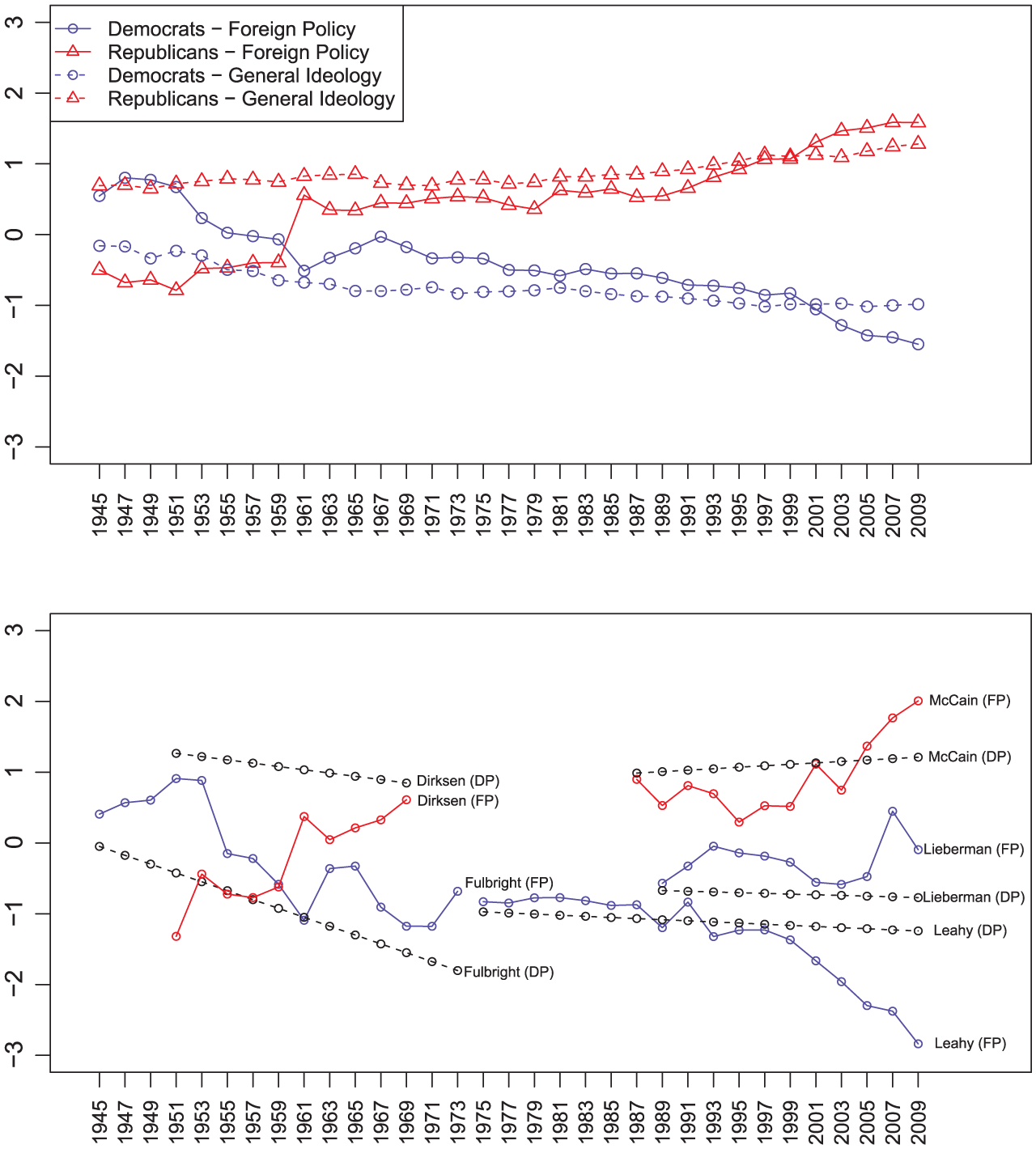
Illustration of foreign and domestic policy positions of political parties and some key senators.
The reversal reflects real developments, but not drastic shifts in the parties’ central values or constituencies on foreign policy. There were significant changes in the substantive and political contexts of certain major foreign-policy issues. From the immediate postwar-years to the early 1960s, the main substantive focus of military engagements and resources shifted from postwar collective security and the Korean War to suppressing procommunist or leftwing national-liberation movements in the Third World. Republicans turned from mostly opposing military power to mostly supporting it, and Democrats moved in the opposite direction. During roughly the same period, a similar party switch occurred on trade issues. Reflecting changes in the positions of their respective business and labor constituencies, Republicans became free traders and Democrats protectionists. On some other issues, such as foreign economic aid and support for international organizations, however, no such change occurred.
This evolution preserved the one-dimensional structure (see Cronin & Fordham, 1999; Karol, 2009). Driven by the data and the optimization procedures, the measure assigns positive scores to most votes in favor of military spending or engagements and negative scores to most votes against them in all periods—despite the crucial change in the political context and substantive effects of such votes. It also assigns positive scores to votes in favor of trade, and negative scores to votes against it, in most periods. But it reverses the scoring between the early and later periods on such issues as foreign economic aid and support for the United Nations (UN). These choices are entirely data-driven. Nevertheless, under somewhat different circumstances, the measure might have reversed the scoring on military and trade issues, maintained consistent scoring on foreign aid and the UN, and shown no switch in the direction of party differences. The change in direction is thus not in itself a substantively important finding; the central observation is instead the convergence and then re-separation of party positions.
Because military issues provide the most consistent interpretation of the scores, we focus on those issues for purposes of labeling the poles of the scale—calling them hawk-dove, rather than conservative-liberal, right-left, or internationalist-nationalist. 7 To interpret the measure, however, one must keep in mind the changes in the context of the military issues and the measure’s reversal of direction on some other issues. In the 1940s and 1950s, then, hawks were mostly Democrats, they supported military power to defeat fascism and promote collective security, and among their other positions, they also supported foreign aid and the UN. Doves were mostly Republicans; they generally opposed military power, a result of their isolationism; and they opposed foreign aid and the UN. After the early 1960s, hawks (now mostly Republican) supported military interventions to suppress Third-World revolutions and later Islamic terrorism. But these hawks now opposed foreign economic aid and the UN. Post-1960s doves, mostly Democrats, were anti-war, opposing Third-World and Middle East interventions. In this period, doves supported foreign economic aid and the UN.
For further illustration, Figure 1 also tracks the positions of five prominent individual senators (bottom panel). The trajectories of these members’ scores appear to reflect the broad outlines of their foreign-policy careers. Senator Everett Dirksen (R-IL), a prominent Republican in the 1960s, reflects his party in moving from dove to hawk on foreign policy while remaining solidly conservative on domestic ideology. Senator J. William Fulbright (D-AR) looks like other Democrats in moving from hawk to dove on foreign policy, famously turning against the Vietnam War and Cold-War interventionism; he also became more liberal and representative of his party on domestic policy. In recent decades, Senators Patrick Leahy (D-VT) and John McCain (R-AZ), both major figures in their respective party’s foreign-policy leadership, have led the increasing polarization. Besides opposing military interventions, Leahy has been a strong advocate for foreign economic aid and human rights—for example, proposing amendments to block military assistance to countries that violate human rights. In contrast to such party stalwarts, Senator Joseph Lieberman (D-CT), a Democratic maverick, broke toward the hawks on foreign policy, especially during the Iraq War. He ended up in a foreign-policy centrist no-man’s land, eventually dropping his party affiliation and serving in two Congresses as an “independent Democrat,” before retiring.
Although the direction of voting on military issues is the foreign-policy scale’s main consistent feature over time, this does not imply that hawks support all military ventures or that doves oppose all of them. In recent decades, hawks and doves have been prone to reverse directions when it comes to military interventions in humanitarian crises (e.g., Somalia, Haiti, Bosnia, and Kosovo). The hawkish McCain, for example, opposed military interventions in Lebanon (as a member of the House), Somalia, Bosnia, and Haiti. In terms of the opposing foreign-policy tendencies, humanitarian military intervention has been a dovish pursuit; because the direction of each vote is determined independently in the estimation procedure, votes for humanitarian military interventions thus push a senator toward the dove end of the foreign-policy scale.
For our purposes in this article, we do not need a detailed account of the policy positions that have been associated with hawk versus dove scores on the foreign-policy scale and how they developed. It is sufficient that the scale provides a workable measure of senators’ foreign-policy preferences—permitting generally valid comparisons, both of its own scores over time and with the general ideology measure (DW-NOMINATE). In what follows, we use the scale to assess and explain the degree of foreign-policy polarization between the Democratic and Republican parties.
The Development of Foreign-Policy Polarization
To what extent, then, are the parties polarized on the foreign-policy scale, and how did their differences develop? Following McCarty, Poole, and Rosenthal’s (2006) treatment of general ideology, we measure foreign-policy polarization as the difference between the respective means of the ideal points of Democratic and Republican senators. For comparison, we plot the parties’ general ideological polarization using the first dimension of DW-NOMINATE. To ensure comparability, we standardize the DW-NOMINATE scores and estimated foreign-policy positions before we compute the polarization indices. The top panel of Figure 2 presents the polarization indices on both the general ideology and foreign-policy dimensions. For most of the period from 1945-2010, foreign policy has exhibited significant partisan differences.
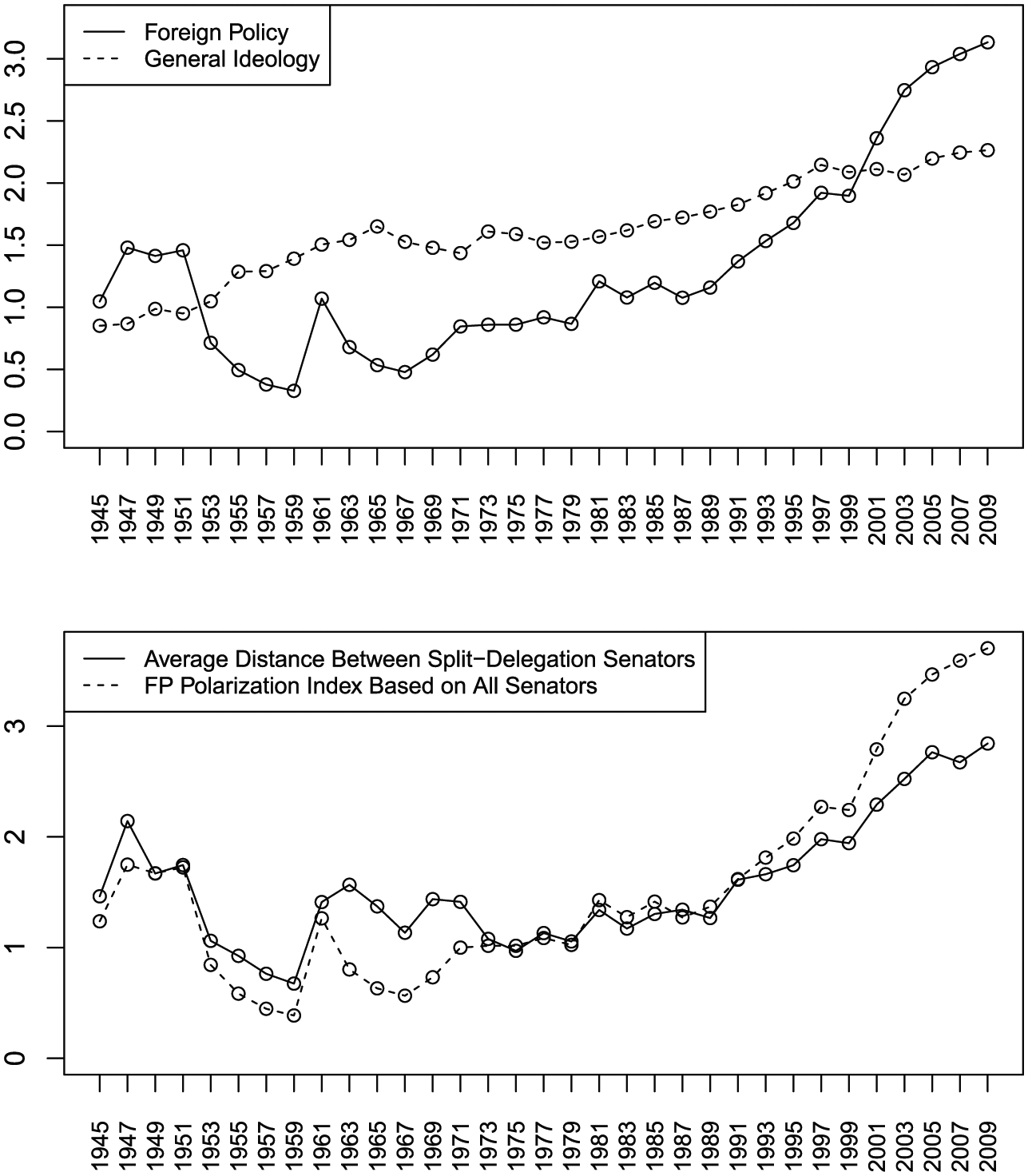
Senate polarization indices.
Looking at the historical development more closely, the political parties were already polarized on foreign policy—more sharply than on domestic policy—in the immediate aftermath of World War II, from 1945-1952. Salient and divisive foreign-policy issues included the British loan debate in 1946, Truman’s decision to station U.S. troops in Europe, McCarthyism, and the Bricker amendment (which would have limited the president’s treaty-making power). But partisan conflict subsided when Republican President Dwight Eisenhower adopted many of Democratic President Harry Truman’s foreign policies. Eisenhower’s two terms thus were a period of modest party differences on foreign policy, the main inspiration for the “water’s-edge” hypothesis. His main opposition came from isolationist-dove Republicans; Democrats, including Senate Majority Leader Lyndon Johnson, generally supported him (Reichard, 1975).
However, this bipartisan period was exceptional. Foreign-policy polarization jumped sharply at the outset of the Kennedy administration; subsided during the early phases of the Vietnam War; and then, when the war became intensely controversial in 1967-1968, began a four decades-long, fairly steady increase—with Democrats becoming more dovish and Republicans more hawkish. Subsequent events, such as the Reagan administration’s defense buildup and intervention in Nicaragua, and the collapse of the Soviet Union in the early 1990s, appear to have accelerated the polarization. Even so, foreign policy remained less polarized than domestic policy throughout the 1980s and 1990s. Judging from the trends, however, the most polarizing foreign-policy event has been the Iraq War. The trends suggest that, even before the invasion in 2003, the drumbeat of impending war sharpened differences on foreign policy. Thus, beginning with 2001-2002, the parties’ positions have diverged even more sharply on foreign policy than on domestic policy—a return to the situation of the late 1940s.
In sum, the relation between foreign-policy positions and domestic ideology has been quite variable. We find more moderation and less severe party differences in foreign-policy positions than in domestic ideology during most of the Postwar era. But the much wider foreign-policy differences at both the beginning and end of the period belie any fundamental tendency toward agreement or cooperation “at the water’s edge.” The two series have moved together for long periods—especially during the steady increase in polarization from the 1970s to the present. But in the most recent Congresses, foreign-policy polarization has met and exceeded the level of domestic policy polarization. We now turn to examine the sources of foreign-policy polarization.
Sources of Foreign-Policy Polarization
The previous section demonstrates that the two parties have developed distinct positions on foreign policy and, in the end, have polarized on these issues even more sharply than they have on general ideology. This section investigates the forces that have driven foreign-policy polarization.
Cross-State Divergence: Realignment and Sorting
We set the stage for our main analysis by examining whether foreign-policy polarization has been driven by ideological divergence between states—that is, increased tendencies of some states to elect more extreme conservative Republicans and of other states to elect more extreme liberal Democrats. The most widely recognized source of domestic-policy polarization has been regional realignment (Aldrich, 1995; Jacobson, 2000). By making the affected states’ partisan and ideological tendencies mutually reinforcing, realignment has increased the number of states that reliably elect conservative Republicans (in the South) or liberal Democrats (in the Northeast). Another source of cross-state divergence is population sorting—the movement of people to states with whose existing populations they are politically compatible (Levendusky, 2009). These mechanisms lead some states to elect more extreme liberal Democrats and others to elect more extreme conservative Republicans.
To check how much these diverging-state-electorate explanations account for foreign-policy polarization, we compare the data reported in the top panel of Figure 2 to the data on senators from states with split-party Senate delegations. For each Congress, we compute the distance between the foreign-policy positions of the Democratic and the Republican senator in each split-delegation state, and compute the mean distance over all such states—an index of split-delegation foreign-policy polarization. Because the two senators in each such pair represent the same state, we in effect hold constant the overall ideological location of the entire state.
The bottom panel of Figure 2 plots this split-delegation foreign-policy polarization index along with the comparable full-Senate index from the top panel. The two trends are very similar, indicating that senators of opposing parties from the same state have polarized nearly as much as all senators. Thus foreign-policy polarization is not mainly driven by increasing differences between states, or therefore by regional realignment of the parties, but rather by processes that push the two parties further apart within each state. 8
Events, Partisan Electoral Rivalry, and General Ideology: A Multilevel Analysis
Having ruled out regional realignment and population sorting as a major source of foreign-policy polarization, we examine the three potential sources of foreign-policy polarization that we presented above, each of which could produce differences between the two parties’ senators, even within a given state: first, the three polarizing foreign-policy events—the end of the Cold War, the Vietnam War, and the Iraq War; second, increased partisan rivalry due to increased electoral competitiveness; and finally, general or domestic ideological polarization. To assess and compare the effects of major events, partisan electoral rivalry, and domestic polarization, we employ a multilevel analysis.
Our model is designed to accommodate the complex structure of the hypothesized causal relationships. Foreign-policy events and electoral conditions are expected to affect all senators over a period of one or more Congresses. For the effect of domestic polarization, each senator’s general ideological position in a given Congress is expected to influence her foreign-policy position in the same Congress.
Measures
To measure foreign-policy polarization at the individual level in each Congress, we use the difference between the senator’s position and the Senate mean on foreign policy—signed positively if the senator’s deviation is in the same direction as that of her party mean, and signed negatively if in the opposite direction. 9 After the early 1960s, for example, a Democratic dove has a positive polarization score; a Democratic hawk a negative one.
To capture the effect of general ideological polarization, we need a measure of individual senators’ ideological extremity—expected to induce extreme positions on foreign policy. To deal with a potentially important specification problem, however, we capture this ideological extremity in two different ways.
First, and most simply, we measure each senator’s ideological extremity in each Congress using her appropriately signed distance from the floor mean DW-NOMINATE score. That is, conservative Republicans and liberal Democrats have positive ideological extremity scores; conservative Democrats and liberal Republicans have negative ones. (To accomplish this, Democratic differences from the floor mean are multiplied by −1.) Thus, senators who deviate from the floor mean in the direction of the other party’s mean have negative extremity scores and reduce the Senate’s ideological polarization.
While the use of this measure is straightforward, it entails problems of collinearity with the measures of foreign-policy events, discussed below, that we will also use. The impact of an event, such as the Vietnam War, on foreign-policy polarization can occur in two ways. The event can directly affect foreign-policy positions, increasing foreign-policy polarization. In addition, however, it can directly affect general ideological extremity, as the Iraq War evidently has contributed to ideological polarization in the Senate (Bonica, 2014), and that in turn can affect foreign-policy polarization. But if the model includes a measure of general ideological extremity, the indirect effect of the event may be absorbed by the ideological extremity coefficient. Although we will present the results of this straightforward approach, we note that the estimated effects of the event variables may fail to reflect potentially significant indirect effects.
Second, we can capture the effect of general ideology by using one or more proxy variables. By using proxies that are exogenous to the foreign-policy events, we can avoid conflating the influences of the foreign-policy events and ideological extremity. For this purpose, we use membership in certain ideologically distinctive party groups within each party—namely, Southern Democrats and so-called Gingrich senators (or Gingrich Republicans). Although Southern Democrats have some common tendencies on foreign policy (Schulman, 1991), they are most distinctive from other Democrats in, and selected mainly for, conservative positions on domestic policy, especially on racial and social issues. Membership in this group is obviously not affected by foreign-policy events, and the ideological conservatism of the members is independent of—in most cases, prior to—the foreign-policy events that we examine. As demonstrated in the analysis of polarization between split-delegation senators (see the bottom panel of Figure 2), we can rule out regional realignment as the key source of party polarization on foreign policy. Further, the regional differences on foreign policy (see Figure A.1 of online appendix) have significantly decreased since the 1970s. Thus, an indicator variable for Southern Democrats can capture the influence of ideology and the effect of domestic ideology without absorbing the effects of foreign-policy events.
Gingrich senators are Republicans who served in the House after 1978, when Rep. Newt Gingrich, first as Minority Leader and later as Speaker, began to reshape the Republican caucus into a combative and ambitious conservative force, focusing primarily on domestic issues. As Theriault and Rohde (2011) show, these senators—influenced by their experience with Gingrich’s leadership—are responsible for a substantial amount of the ideological polarization in the Senate. Again, therefore, membership in the group is not affected by foreign-policy events, and the members’ general ideological conservatism is independent of foreign-policy events. If polarization of general ideology affects foreign-policy polarization, we expect both Southern Democrats and Gingrich Republicans to be more hawkish on foreign policy, apart from any influence of foreign-policy events.
To assess the effects of the three major foreign-policy events, we use two sets of measures. First, we create indicator variables at the Congress level that are intended to match as well as possible the starting and ending points of politically distinct periods; for various reasons, the periods they encompass are not necessarily coterminous with generally recognized historical events. Specifically, these variables identify the early Cold War, with a value of 1 for the Congresses from 1945-1968; the Vietnam protest era, 1969-1974; and the Iraq War, 2005-2008. 10 A few of these coding decisions call for explanation. For the first several years of the Vietnam War, the conflict largely reinforced the Cold War consensus on containment policy. But the war gradually became controversial, with a major turning point at the Tet Offensive in 1968. For purposes of our analysis, we mark 1968 as the end of the Cold-War period and designate 1969-1974 as the Vietnam War, referring to the period of protest and domestic conflict. And although the Iraq War began in 2003, Democrats vigorously opposed the war and demanded an end to the military operation primarily after the 2004 elections. 11 However, as the indicator variables may not capture the subtle changes in the controversies surrounding these wars, we alternatively measure the effects of the Vietnam War and the Iraq War using the cumulative number of casualties (logged).
We capture the effects of partisan electoral incentives using the majority party’s seat margin (%). As we discussed, Lowry and Shipan (2002) found that a minority party is more prone to differentiate itself from the majority party when the difference between their numbers of seats is small. To capture this effect, we use the seat margin of the Senate majority party in each Senate. We may also expect foreign-policy polarization to depend on whether party control of government is unified or divided. In this case, however, the direction of the effect is less clear. On one hand, under divided government the congressional majority may have a stronger electoral incentive to oppose the president, which would tend to increase polarization. On the other hand, the president in that situation may have greater incentive to accommodate the congressional opposition party, which would tend to reduce foreign-policy polarization. Given the plausible alternative effects, we include a measure of divided government—an indicator variable that takes a value of 1 when the majority party of the Senate is different from the president’s party—without positing an expected direction for the effect.
Finally, we include control variables at the individual-senator level. In the model that uses DW-NOMINATE to measures ideological extremity, we include senator-fixed effects to account for the panel nature of the data. In the model with party-group variables, we cannot include these fixed effects because the group variables are time invariant; but we account for some senator-level factors by including the senators’ memberships on the Foreign Relations Committee (SFRC) and the Armed Services Committee (SASC). Members of these committees are likely to have strong positions on foreign policy (Fenno, 1973; McCormick, 1985).
Combining the senator-level and Congress-level factors, we use two somewhat different models.
The multilevel model with ideology scores
In the first model, we use the individual-level measure of ideological extremity to capture the effect of general ideological polarization. We thus account for foreign-policy polarization as follows:


where N is the total number of senators. αl[i] represents senator-fixed effects. Extremity i is the measure of ideological extremity, as we discussed above. Note that the coefficient for this variable is modeled as a varying-slope because the effects of ideological extremism on foreign-policy polarization can change from one Congress to the next. This is similar to interacting ideological extremity with a dummy variable for each Congress. To fully specify the model, we used diffuse prior for βj. Thus, β j ~ N(0, 102), for j = 1, …, M, where M is the total number of Congresses from the 79th through 111th Congresses.
The effects of Congress-level variables enter the model through the Congress intercept


The estimate of this varying-slope and varying-intercept model is presented in Table 1 and Figure 3. Presented in the top panel of Figure 3, the varying slopes of ideological extremity (β j ) are consistent with the expectation that general ideological polarization affects foreign-policy polarization. 12 The positive slopes indicate that senators with more extreme ideology were more extreme in their foreign-policy positions, except when the parties were switching positions in the second half of the 1950s. Moreover, the increasing size of these coefficients indicates that the association between ideological extremity and foreign-policy polarization has increased from earlier Congresses to later ones.
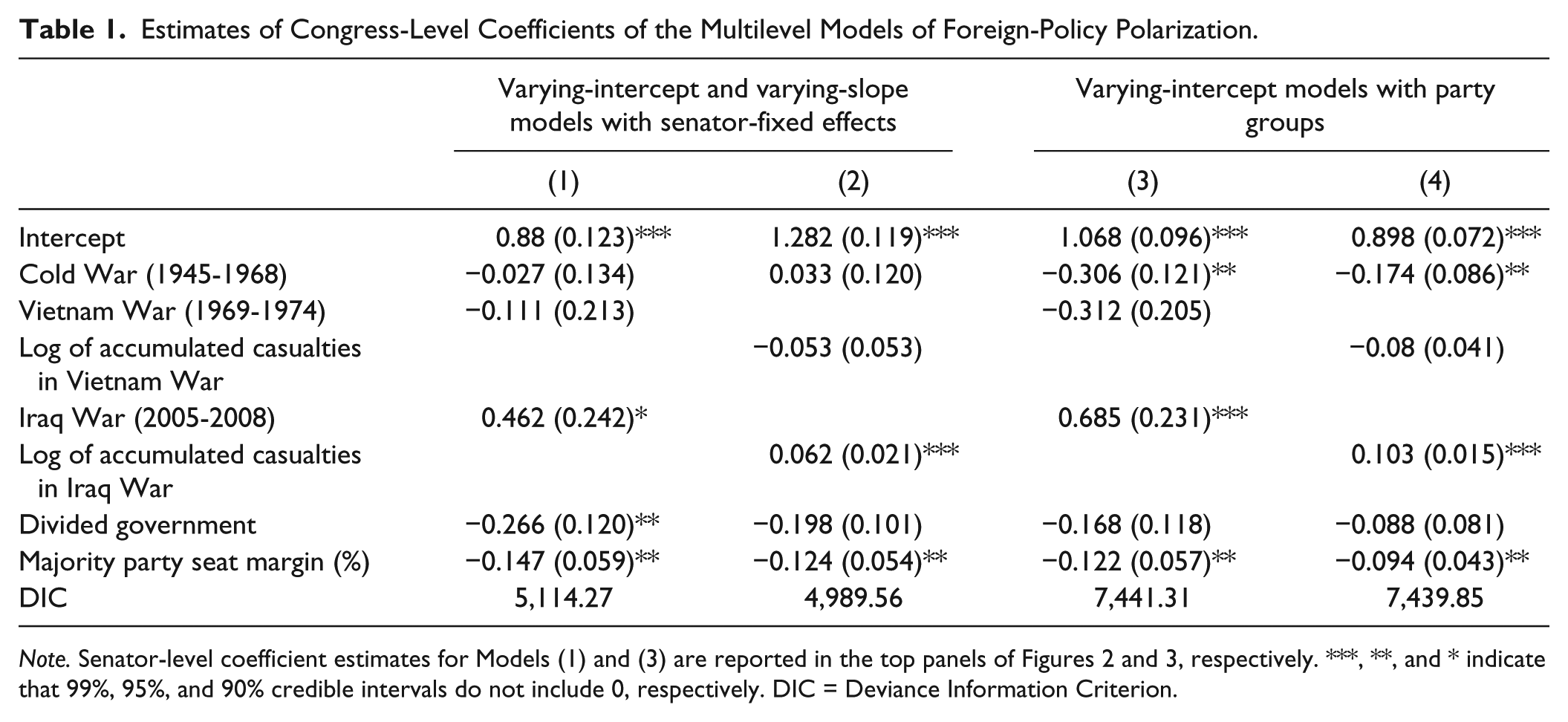
Estimates of Congress-Level Coefficients of the Multilevel Models of Foreign-Policy Polarization.
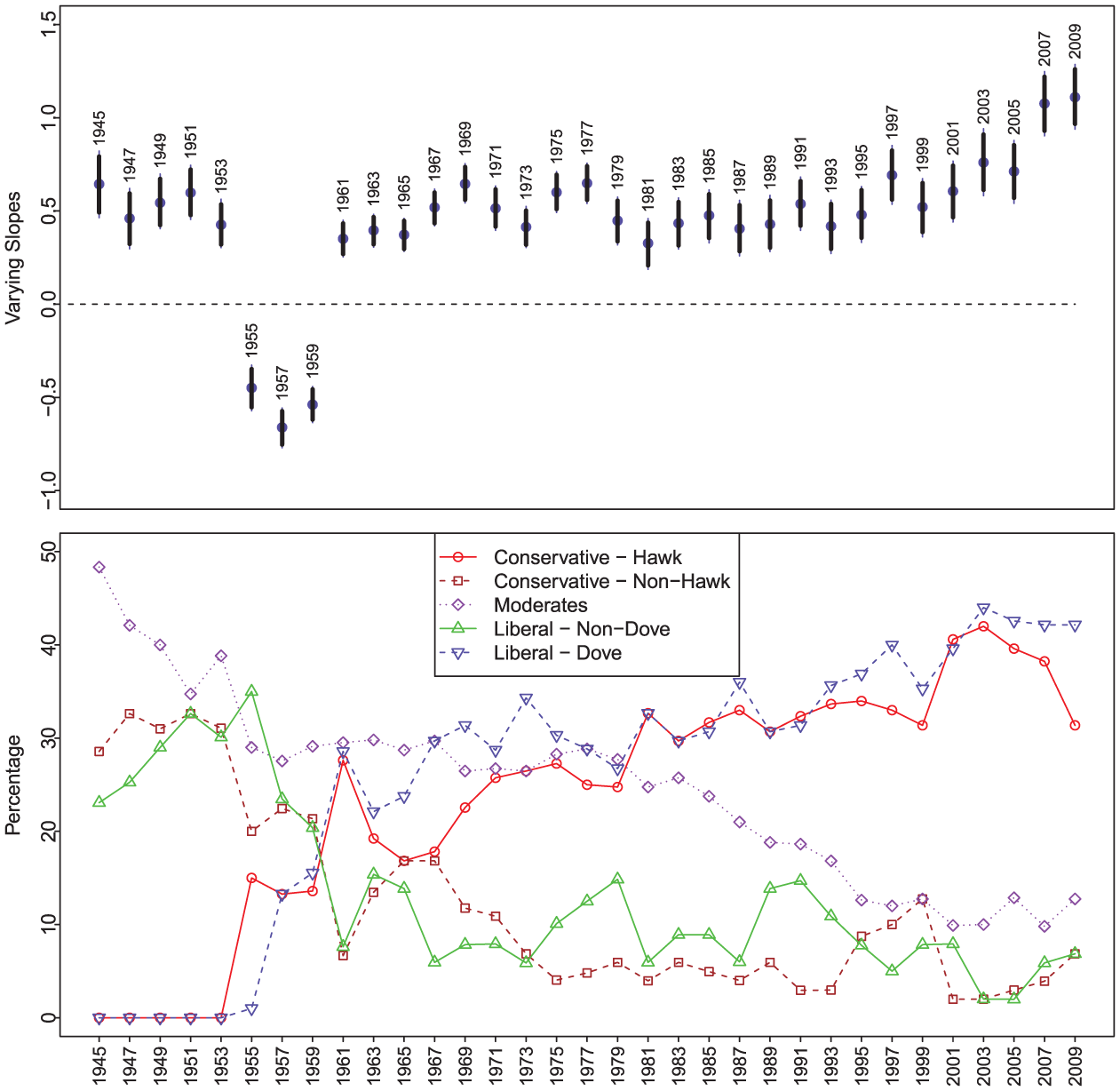
Convergence of general ideology and foreign-policy position of senators.
In the bottom panel of Figure 3, we show that this effect has divided most senators into two distinct groups, each with compatible general ideology and foreign-policy positions. We define conservatives as those whose ideology scores (DW-NOMINATE) in the given Congress are more than 0.5 standard deviations above the mean score of the Congress; liberals are those the same distance below the mean; and moderates are those within the band between those points (see McCormick & Wittkopf, 1990). We define foreign-policy hawks, doves, and moderates using the same cut-points on the foreign-policy measure. As the figure shows, senators’ general ideology and foreign-policy position have converged dramatically over time. In the period after the foreign-policy partisan realignment in the 1950s, two groups of senators—those who were conservative ideologically and hawkish in foreign policy (denoted Conservative-Hawk) and those who were liberal and dovish (Liberal-Dove)—have gradually come to dominate the chamber. This sorting into two groups, and the strong convergence of general ideology and foreign-policy positions, point to a central role of general ideological polarization in foreign-policy polarization.
The estimated coefficients of the Congress-level variables are reported in the first two columns of Table 1. Model (1) uses indicator variables for the Vietnam War and the Iraq War, whereas Model (2) uses the cumulative number of casualties (logged) of each of these wars. The results show that the Iraq War has significantly contributed to foreign-policy polarization, whether it is measured by an indicator variable or the number of casualties. The Cold War and the Vietnam War are not significantly related to foreign-policy polarization. On the other hand, the partisan electoral incentive is found to have a significant association with foreign-policy polarization. The significant and negative coefficient of the majority party’s seat margin indicates that, when the majority party’s seat margin gets smaller, the parties are more likely to disagree on foreign-policy voting. Divided government is negatively related to foreign-policy polarization. But it is significant in the first model only.
Thus the results in this section show that all three factors—foreign-policy events (Iraq War), partisan electoral incentives (majority party’s seat margin), and general ideological polarization (varying slopes of general ideology)—have contributed to foreign-policy polarization. However, it is possible that ideological extremity coefficients are capturing the indirect effects of foreign-policy events and making their coefficients estimates less reliable.
The multilevel model with party groups
To capture the effects of foreign-policy events more accurately, the second model uses the exogenous party group variables instead of ideological extremism measures. In place of equation (2) above, we write,

where Gingrich Republican i , Non-Gingrich Republican i , and Southern Democrat i are indicator variables that take 1 for members of each of the groups. k is 1 for Democrats and 2 for Republicans.
The estimate of this model is presented in the top panel of Figure 4 and the third and fourth columns of Table 1. For the senator-level coefficients (in the top panel of Figure 4), the baseline category is non-Southern Democrats. The coefficients represent the mean difference in foreign-policy polarization between the respective group and this baseline. We find that Gingrich Republicans are highly polarizing on foreign policy. Accordingly, as we see in the bottom panel of Figure 4, the increasing numbers of Gingrich Republicans have boosted the level of foreign-policy polarization. This effect is not only a matter of their increasing numbers. The middle panel of Figure 4 shows that Gingrich Republicans as a group have become increasingly extreme on foreign policy.
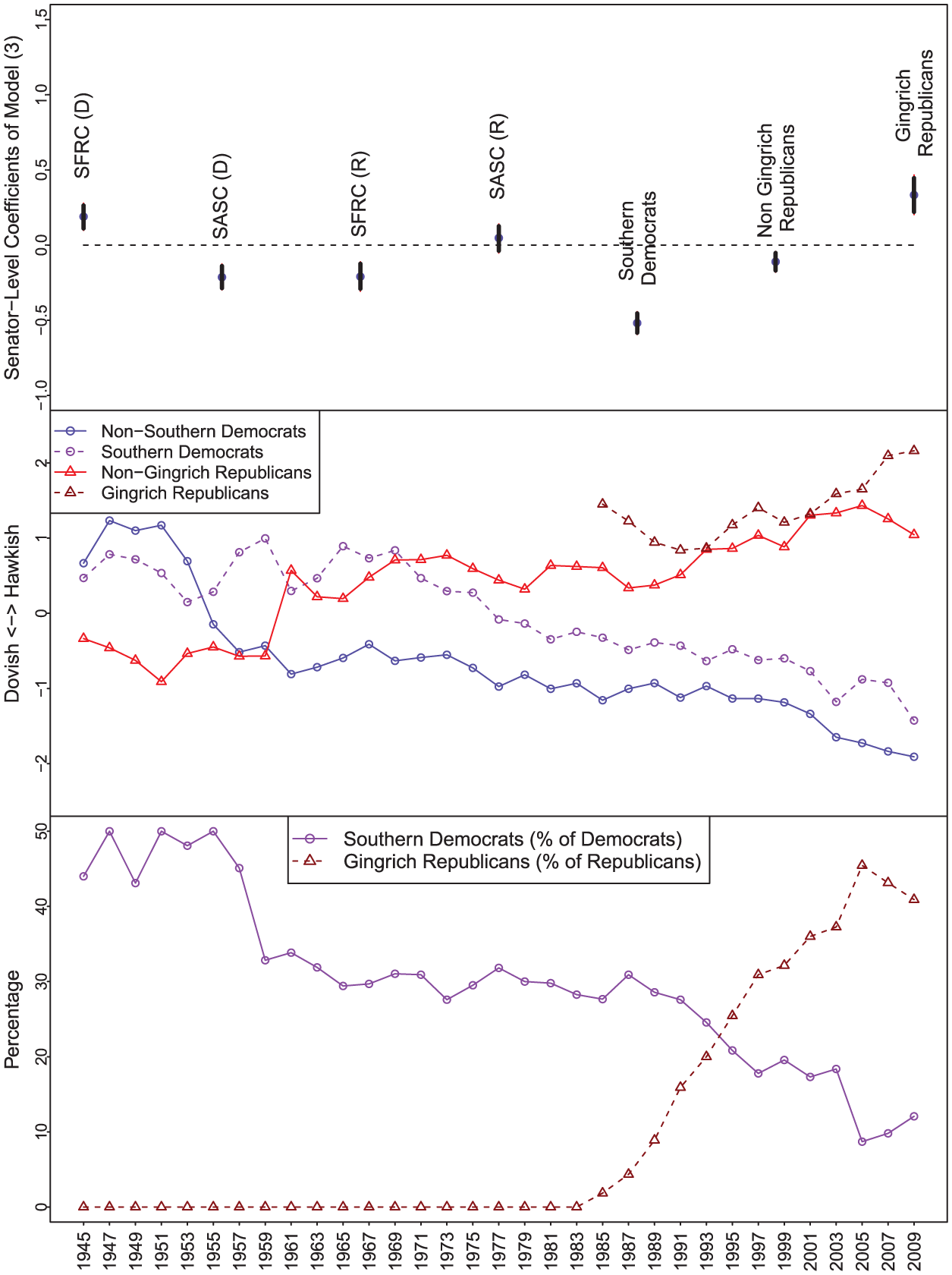
A varying-incepts model of foreign-policy polarization and party groups.
On the Democratic side, Southern Democrats are significantly more hawkish than non-Southern Democrats. Consistent with the expectation on the influence of general-ideology polarization, Southern Democrats’ hawkish positions correspond with their conservative ideology. However, because non-Southern Democrats are generally foreign-policy doves, Southern Democrats contributed to moderation rather than polarization—pulling the Democratic Party toward the center. Thus, in contrast with the Gingrich Republicans, increased foreign-policy polarization has reflected the declining number of Southern Democrats. As shown in the bottom panel of Figure 4, Southerners declined from almost 50% of Democratic senators during the 1950s to about 10% by 2005. At the same time, the middle panel of Figure 4 shows that, consistent with the domestic-policy polarization hypothesis, the difference between Southern Democrats and non-Southern Democrats in their foreign-policy positions has also diminished. Both the falling number of Southern Democrats and the convergence of their positions with those of mainstream Democrats have contributed to the increase in foreign-policy polarization.
Membership on the Foreign Relations and the Armed Services committees affect foreign-policy polarization in different ways. Foreign Relations members in both parties take more dovish positions. The committee members thus increase polarization for Democrats but reduce it for Republicans. The effect of Armed Services membership differs between the parties: Democratic members are more hawkish than other Democrats, reducing overall polarization; but Republican members do not differ significantly on foreign policy from other Republicans. That Foreign Relations members are more dovish than Armed Services members in the Senate is consistent with work on support for the president’s foreign policy in the counterpart committees in the House (Fenno, 1973; McCormick, 1985).
How do foreign-policy events and partisan electoral contexts perform when the potentially confounding ideological extremism variable is removed? In the third and fourth column of Table 1, our Cold War indicator (1945-1968) is significant in the expected direction. The coefficient suggests that the Cold War reduced polarization scores (or the end of the Cold War increased them). The Vietnam War indicator (coded as 1969-1974) is insignificant in both models; but rather than defining a distinct period, the intense partisan conflict over Vietnam appears to have permanently ended the Cold War anticommunist consensus and helped forge an enduring link between general ideology and foreign policy. On the other hand, the Iraq War is found to be significant, regardless of the way it is measured. This consistent finding increases our confidence that the Iraq War made Democrats more dovish and Republicans more hawkish—widening the partisan divide over foreign policy (Beinart, 2007).
Finally, we find partisan electoral rivalry to be a significant source of foreign-policy polarization. Although the coefficient is not as large as the Iraq War, 13 the significant and negative coefficient indicates that the parties are more polarized when the majority party had only a slim seat margin and thus created a strong incentive for the minority party to obstruct the majority party’s agenda.
Summary of multilevel model findings
Taking the two multilevel models of foreign-policy polarization together, we have some consistent results on the effects of foreign-policy events and partisanship. The Iraq War and the majority party’s seat margin are consistently found to be significant. But the Vietnam War was never found to be significant. The Cold War is significant in the model that uses party groups as proxies for senators’ ideology. According to the results of this model, the end of the early Cold War (superseded by Vietnam-era partisan conflict) permanently raised the level of polarization. The Iraq War raised it further.
Both approaches confirm the effect of general ideology on foreign-policy polarization. In the early 1960s, when the two parties switched directions on the foreign-policy dimension, the effect of general ideology was essentially reset to zero. Since the early 1970s, it has increasingly become a powerful determinant of foreign-policy positions. By the early 2000s, the domestic and foreign-policy dimensions had become equally polarized.
Discussion and Conclusion
In this article, we have addressed a number of major issues about the nature and development of party polarization over foreign policy. We have reached several important findings. First, using a new measure of senators’ foreign-policy preferences, we find that Senate voting on foreign policy (like voting on domestic policy in most periods) has a one-dimensional structure: Senators’ votes largely reflect preferences on a single dimension that distinguishes, in the simplest terms, hawks versus doves. However, the foreign-policy dimension is clearly distinct from general liberalism–conservatism. In fact, from the late 1940s to the Vietnam era, the parties’ positions on the foreign-policy measure converged and then diverged again—with no comparable development in their positions on domestic ideology. In the aftermath, foreign policy remained less polarized than domestic policy for three decades.
Second, from the early 1970s to the present, the two Senate parties have increasingly polarized on the foreign-policy dimension. We do not directly model foreign-policy legislative or issue conflict between the parties—for example, party-line votes, partisan blocking of presidential initiatives, hostile congressional investigations, or the like. Nevertheless, we can strongly discount any notion that the increasing observed conflict over foreign policy is mostly purely partisan—a reflection merely of the presidential-opposition party’s incentives to reduce the president’s policy success (e.g., Kriner, 2010; Lee, 2009). In fact, there have been ever widening party differences in substantive policy positions, or increased foreign-policy polarization. In a word, the two parties have sharply opposing visions of the country’s foreign affairs. By the 2000s, foreign-policy polarization had become fully comparable in severity to the polarization on general ideology. Despite the two-presidencies thesis (e.g., Canes-Wrone et al., 2007), Congress is just as polarized on foreign policy as it is on domestic policy.
Finally, we have shown that foreign-policy polarization is the product of several distinct causes. Party realignment has played a role—replacing moderate or conservative Southern Democrats with even more conservative Republicans. But we find that most foreign-policy polarization represents increased differences between the typical Democratic and Republican senators from a given state. What drives this more fundamental and pervasive form of polarization? We find evidence for three major factors.
First, we have found moderately strong evidence that the events of foreign policy—in particular, the end of the early Cold War and the occurrence of the Iraq War—have played significant roles. The mechanism for this effect is easily described. Partisan conflicts over one issue—say, a resolution calling for withdrawal of troops from Iraq—carry over into other, related, though previously less conflicted issues—say, defense spending or military aid to another country in the Middle East. If events and this mechanism were the main story of foreign-policy polarization, we would expect that levels of polarization would fluctuate with the frequency of highly divisive foreign-policy issues. A ratchet effect—with increases in polarization enduring indefinitely or for long periods—would be logically possible but not very likely.
A second cause has been partisan electoral rivalry. We measure this effect using the size of the Senate majority party’s seat margin over the minority party. The narrower the margin of seats, the greater the intensity of the electoral rivalry, and—we find—the more rapid the parties’ polarization over foreign policy. In short, although we can reasonably discount the notion that mere party electoral rivalry is behind most party conflict on foreign policy, it does contribute to the development of the substantive policy differences that drive such conflict.
Finally, we have found compelling evidence that foreign-policy polarization results in large part from the polarization of domestic ideology. A major change in the nature of the issues in foreign policy can thoroughly disrupt the connection between foreign- and domestic-policy preferences. But in most periods, senators drift toward foreign-policy positions that are increasingly consistent with their positions on domestic issues. In recent decades, domestic conservatives increasingly became foreign-policy hawks; domestic liberals increasingly became foreign-policy doves. This absorption of foreign policy into domestic policy has not been a rapid process. From the time when Republicans began to move toward hawkish positions and Democrats toward dovish ones in the late 1950s, it took 40 years for foreign-policy polarization to match the level of polarization in general ideology. Consistent with our findings, studies of more recent elite opinion (Holsti & Rosenau, 1996 and Nincic & Ramos, 2010) find that foreign-policy opinions are shaped by the same liberal or conservative ideological beliefs that structure positions on domestic policy. Indeed, by the 2000s, foreign policy was even more polarized than domestic ideology—suggesting that there are more cross-cutting issues in domestic policy than in foreign policy. Considering the indirect and generally weak effects of foreign-policy decisions on domestic interests, the strength of this impetus toward convergence is notable. To borrow a phrase, foreign policy is largely domestic politics by other means.
Footnotes
Acknowledgements
James McCormick provided comments on an earlier version of this paper. We thank the editor and anonymous reviewers for their comments.
Declaration of Conflicting Interests
The author(s) declared no potential conflicts of interest with respect to the research, authorship, and/or publication of this article.
Funding
The author(s) received no financial support for the research, authorship, and/or publication of this article.
Supplemental Material
Supplemental material is available for this article online.
Notes
Author Biographies
References
Supplementary Material
Please find the following supplemental material available below.
For Open Access articles published under a Creative Commons License, all supplemental material carries the same license as the article it is associated with.
For non-Open Access articles published, all supplemental material carries a non-exclusive license, and permission requests for re-use of supplemental material or any part of supplemental material shall be sent directly to the copyright owner as specified in the copyright notice associated with the article.
