



Abstract
Previous research has noted the transformation of the American parties since the 1970s, as exhibited in their increased ideological polarization and transformation on social issues like civil rights, abortion, and the environment. We contribute to the literature on party change by theoretically stressing the decentralized and individualistic nature of American parties, while using a measure of party change that is based on legislative behavior beyond roll call voting. Our paper uses social network analysis to analyze the parties from the 93rd to 110th Congresses, utilizing bill cosponsorship to define connections between members. Our analysis illustrates how the core of the party, that is, who are most central in the cosponsorship network, has changed over time. We find evidence that party centrality influenced retirement decisions, thereby reinforcing and contributing to party change.
Introduction
One of the most prominent patterns in contemporary American politics is the transformation of the major parties in the U.S. Congress since the 1970s, as exhibited in their increased ideological polarization (McCarty et al., 2008), transformation on social issues like civil rights, abortion, and the environment (Adams, 1997; Carmines & Stimson, 1989; Shipan & Lowry, 2001), and increased polarization on a wider range of issues (Layman & Carsey, 2002). Several works have assessed what factors have contributed to the transformation of the parties, including the impact of social groups, party activists, gerrymandering, campaign money, and the exercise of institutional powers by party leadership (e.g., Cox & McCubbins, 2005; Karol, 2009; McCarty et al., 2008; Theriault, 2006). Closely related to our paper, Thomsen (2017) analyzes how the strategic career choices of party members have contributed to an increasingly polarized U.S. House. She finds that ideological fit with the party impacts career decisions, as increasingly polarized parties in the House contributes to the disappearance of moderates—that is, fewer moderate candidates and more moderates retiring from Congress.
Our paper uses a different approach to assess the central tendency of the party and analyzes the impact of party fit on retirement decisions that contribute to and reinforce party change in the U.S. House. 1 In short, as the centrality of the party shifts over time, members decide whether to remain in office or retire depending on whether they are toward the core of the party. Those career decisions therefore reinforce and contribute to changes in the parties. Our paper makes several significant contributions. We analyze bill cosponsorship behavior in the U.S. House from the 93rd to 110th Congresses and view the party as a social network in which members are connected if they both cosponsor the same bill, which has both theoretical and empirical benefits that we discuss below. Only briefly stating two benefits here, analyzing cosponsorship (a) provides a more thorough picture of interactions among party members, which we take as “defining the party” and indicating who are most central in the party, and (b) constructs an empirical measure of party fit that accounts for the individual choices of members and how the party is an aggregation of those choices.
Our paper has two main goals. First, we descriptively show how the cosponsorship networks of the parties in the U.S. House have changed since the 1970s. Our analysis shows that cosponsorship behavior can indeed provide a useful metric to describe the party, as it is related to but distinct from roll call voting behavior and (revealed) ideology. Second, we analyze the impact network centrality has on member retirement from office, showing that low centrality contributes to retirement and consequently the transformation of the American parties. Observing cosponsoring behavior provides a more nuanced picture of intra-party politics, as it has an independent effect that goes beyond ideology and roll call voting.
Parties as the Collection of Its Individuals
Parties in the U.S. are weak and decentralized relative to their counterparts in other advanced democracies. Particularly with direct primaries in a candidate-centered era of campaigning, parties can only play an indirect role in influencing party membership in government (Cohen et al., 2008). The prisoner’s dilemma has been used to illustrate the potential problems for the ability of parties to act in any sort of coordinated manner in the legislature, given the individual incentives of party members. Existing research stresses the role of party leadership in solving this dilemma and enforcing a cooperative equilibrium (Cox & McCubbins, 1993, 2005; Rohde, 1991).
But what about instances of party change? Although existing theories can explain the stability in a given equilibrium (cooperating in the prisoner’s dilemma), those theories do not straightforwardly explain change, that is, shift to some new equilibrium (Lee & Brady, 2020). Imagine two players (party members) getting a payoff of 1 from their current coordination on option A. They have the possibility of receiving payoffs of 2 if they successfully coordinate on a switch to option B, but they risk a decrease in payoffs to 0 if they choose opposing options. Although coordination on option B is Pareto-optimal, a shift to that outcome is not trivial, particularly given the potential costs from unsuccessful coordination. 2
In order to understand party change, we focus on changes in the composition of the party caucus. Party leaders perhaps could use agenda-setting and other institutional powers to shift the party to new issue commitments, that is, some new policy equilibrium (B in our example). Conditional Party Government, however, reminds us that leadership’s enforcement of such a shift might be conditional upon the acquiescence of rank-and-file members (Rohde, 1991, 2013). That is, although leadership plays a central role in theories of party stability (e.g., enforcing cooperation in a prisoner’s dilemma), we believe that instances of party change cannot take the acquiescence of rank-and-file members for granted. Thus, analyzing the dynamics of change in the composition of the party caucus is an important first step, and we therefore also want to use a measure of party centrality (i.e., what is “the party”) that is based on the aggregated actions of all members of the party caucus.
We do not intend to discount the importance of other players that influence the American parties, particularly the role of interest groups (Bawn et al., 2012; Karol, 2009; Schlozman, 2015), which is a point we revisit in our conclusion. 3 But considering the idealized case and parsimonious theoretical framework of individualistic party members (but whose preferences might be induced, in part, by the demands of organized groups) and conceiving of the party as the sum of its legislative members provides theoretical and empirical insights that merit attention and could also potentially apply to the group-based theories of parties. It is also important to analyze the dynamics of relationships among party members in the legislature, since one might ultimately be interested in understanding the impact of organized groups on policy outputs. Our paper is therefore a crucial piece to the larger puzzle.
Our paper considers parties as a network of individual members interacting through bill cosponsorship. There has been a rise in the use of social network analysis in the study of parties and Congress, using cosponsorship (Cho & Fowler, 2010; Fowler, 2006a, 2006b; Kirkland, 2011; Zhang et al., 2008), roll call voting (Waugh et al., 2012), caucus membership (Victor & Ringe, 2009), and transfers of campaign donor information between political organizations (Koger et al., 2010). Analyzing relationships between party members based on legislative actions before roll call voting provides a unique picture of the evolution of the parties since the 1970s, moving beyond the well-known patterns of increasing intra-party ideological homogeneity and party polarization.
We also analyze one specific factor that contributes to party change, which also stresses the substantive importance of the cosponsorship network. We argue that a member’s fit within the party network impacts their decision to leave office (see also Thomsen, 2014, 2017). Party fit can influence that decision through factors external (electoral) and internal (legislative) to the chamber. Externally, a member’s fit within the party could influence their perceived chances of getting reelected (Sniderman & Stiglitz, 2012). Internally, a member’s marginalization within the party impacts their ability to effectively influence the legislative process, which is an effect that could be magnified by the actions of party leadership if they actively are promoting the party’s central agenda. In terms of ambition and the calculus of candidacy (Rohde, 1979), the (perceived) probability of winning office and the benefits of holding office are lower for those who are on the outskirts of their party. 4 This is especially true when partisanship in the chamber is strong with an increased emphasis on party loyalty, which describes part of the time frame of our study.
The decision to use cosponsorship data rather than roll-call votes is based on both theoretical and methodological considerations. First, rather than compare a member to some point-estimate of “the party” to measure fit, such as the ideology of the party median or leadership (Cox & McCubbins, 1993, 2005; Rohde, 1991; Thomsen, 2017), we define fit in a broader sense that accounts for an array of relationships within the party. A measure of party fit that explicitly accounts for the interaction of choices of individual members conceptualizes a definition of party in a way that follows the insights of game-theoretic models of individuals within parties (e.g., Aldrich, 2011; Cox & McCubbins, 1993; Grynaviski, 2010; Lee & Brady, 2020; Snyder & Ting, 2002). 5 That is, if we theoretically think of parties as an aggregation of individuals and their choices, we should also consider empirical measures that also account for their interdependence, for example, conceptualize as a network. Furthermore, although party leadership may play an important role in shaping the parties, it is important to understand changes in the party caucuses, since the preferences of the caucus arguably precede the goals and actions of party leaders (Aldrich, 2011; Rohde, 1991), which further justifies our individualistic (caucus-centered) conception of the parties in our study. 6
Second, only observing one legislative activity, roll call voting, may provide an overly simplistic description of the relationship among party members. 7 By looking beyond voting, we can empirically uncover more complex relationships between members. For instance, Harbridge (2015) shows that bipartisanship did not decrease to the same degree for bill cosponsorship as it did for roll call voting since the 1970s (see also Cho & Fowler, 2010). Thus, although an analysis of roll call voting may lead one to believe bipartisanship is dead in the House, cosponsorship activity suggests such a conclusion may be overstated. This additional variation by observing cosponsoring activity is particularly important for our study of party change. Lee and Brady (2020) theoretically analyze party change as an evolutionary process, whereby the composition of the population (party caucus) evolves over time, and they note that compromising behavior is an important aspect of change. That is, new incoming members who prefer change will need to make compromises with members supporting the status quo, as opposed to simply running roughshod over those who oppose change. 8 Cosponsorship is a legislative activity that offers opportunities to make such compromises and efforts toward collegiality among party members, even when they are at odds with one another.
Third, cosponsorships offer a broader and clearer view of a legislator’s underlying preferences that is independent of party leadership effects, at least more so compared to roll call votes (Harbridge, 2015; Kessler & Krehbiel, 1996; Krehbiel, 1995). Since we focus on change within the party caucus as a building block for party change, it is vital for us to assess preferences that are independent of the influence of party leadership. A measure of preferences derived from roll call votes is filtered through agenda control, which is exercised by majority party leadership through negative agenda control and perhaps increasingly through positive agenda control during more partisan eras (Cox & McCubbins, 2005; Rohde, 2013). On the other hand, “Cosponsorship offers a less censored view of preferences than do roll call votes. . . cosponsorships are not so restrictive that a member’s position within the institution will hamper his or her ability to express a policy preference” (Swers, 2005, p. 409). Furthermore, member behavior is likely less constrained by party leadership at this early stage of the legislative process, as party leadership likely weighs votes more heavily than cosponsorships when gauging a member’s party loyalty. 9 Harbridge (2015) suggests how leadership may in fact allow members to use cosponsorship as a way to balance between constituency (reelection) and party (brand name) interests.
Finally, cosponsorship offers a useful proxy for legislative influence (Campbell, 1982; Kessler & Krehbiel, 1996). Using cosponsorships in social network analysis can therefore present a meaningful picture of the central tendencies and trajectories of the parties. The substantive importance of this legislative action is highlighted in other studies that analyze cosponsorship networks in Congress (e.g., Cho & Fowler, 2010; Fowler, 2006a, 2006b).
It is important to note that cosponsoring legislation is not simply meaningless cheap talk—that is, an easy way to take a stand on an issue without the potential cost of an unpopular vote. Some have argued that the act of cosponsorship can provide valuable information and is a means of position-taking to enhance reelection prospects (Campbell, 1982; Cho & Fowler, 2010; Fenno, 1978; Koger, 2003; Mayhew, 1974). More recent empirical work further supports the claim that members are deliberate by weighing costs and benefits in deciding what bills to cosponsor. Sulkin (2011) and Bernhard and Sulkin (2013) show that cosponsorship is not simply a costless action and is therefore used by members to meaningfully express their preferences (see also Harbridge, 2015).
On the other hand, we do not argue that cosponsorship is necessarily the most important legislative activity either, in terms of defining the party. That is, holding a central position in the cosponsorship network is not necessarily more important than being located ideologically close to the party median or leadership. Rather we argue that it is an additional, useful metric to assess the composition and direction of change in the parties. As our analysis shows, our measures give a new perspective of the relationships between party members, which adds nuance to earlier research. Additionally, our member retirement analysis demonstrates the substantive significance the party cosponsorship network by showing the independent effect of network centrality on the decision to leave office (beyond ideology), which influences the composition of the party caucus and consequently has far-reaching effects on legislative politics in the U.S. House (Aldrich, 2011; Rohde, 1991).
Parties As a Social Network
Our analysis includes three parts. First, we analyze whether a party’s social network is made up of distinct subgroups. Each party may have factions that either support or oppose the adoption of some position or agenda for the party. Second, we introduce a measure of network centrality and assess how the parties (i.e., who is most central in the cosponsorship network) have evolved over the past few decades. Lastly, we consider how those changes influence members’ decisions to retire from the House, which can reinforce and contribute to changes in the party in the House.
We utilize cosponsorship data for the U.S. House from the 93rd to 110th Congresses (1973 to 2008), which covers the period of significant transformation of the American parties that has received the attention of previous work on party polarization and change (e.g., Carmines & Stimson, 1989; Karol, 2009; McCarty et al., 2008; Theriault, 2006; Thomsen, 2017). These data are collected and discussed in more detail by Fowler (2006a) and (2006b). 10 For each Congress, we construct an N × N adjacency matrix, where N is the number of House members. Cell i, j records the number of bills that legislators i and j both (co)sponsored (i.e., counts the number of connections). Each member is a node (i.e., nodes i and j), and each connection (link between two nodes) is an edge. For this paper, we treat this as an undirected graph (i.e., we simply look at whether members are at all connected on a bill through (co)sponsorship, rather than distinguish between sponsors vs. cosponsors). 11 This graph is also weighted (i.e., the edges are weighted) in that shared cosponsorship between members i and j on more bills means a stronger relationship between i and j. We analyze the two parties as two separate social networks. We therefore analyze the two subgraphs, which give us two adjacency matrices: ND × ND and NR × NR, where Nk denotes the number of members in party k.
Communities within Each Party
Although the U.S. is limited to two major parties, that number belies the diversity of interests that are represented by the two parties. Often these coalitions among disparate groups can lead to conflict and disagreement over the focus and direction of the party. Hence a significant task for the parties is striking a careful balance in managing their coalitions (Karol, 2009). But at times, there are coalitions of like-minded members that try to change the direction of their party, perhaps to the objection of others in their own party. For instance, the persistence of the Democratic Study Group and with the influx of new liberal Democrats, particularly the Class of 1974, contributed to the Democratic Party adopting a more explicitly liberal platform (Rohde, 1991). Likewise, the Republican Revolution class of 1994 pushed that party to adopt a more cohesively conservative platform.
Other research has shown that there was greater division within the parties during the earlier Congresses in our data, which was an era of lower party loyalty scores and a significant number of conservative Democrats and liberal Republicans (i.e., greater ideological heterogeneity). We expect that cosponsorship networks reflect similar patterns in intra-party divisions. We also predict, however, that even during an era of less cohesive parties, intra-party divisions were somewhat muted. That is, cooperation between dissimilar party members via cosponsorship was still common. Cho and Fowler (2010) for instance show that cosponsorship networks in the House and Senate are dense and are examples of “small-world networks” over the same time period we examine. Harbridge (2015) similarly shows that bipartisan cosponsorship has also still been quite common. Zhang et al. (2008), however, show increased party polarization based on their own measures of polarization that utilize cosponsorship data, which shows that there is indeed a partisan element to cosponsorship. We therefore want to assess the variation in intra-party conflicts within the broader, chamber-wide cosponsorship patterns noted by Cho and Fowler (2010) and Harbridge (2015).
To consider this first question, we use a community-detection algorithm to observe whether each party is composed of separate partitions (communities). 12 As for many concepts in social network analysis, there are several alternative measures that can be used. Deciding whether a candidate partition is better or worse than another relies on a measure of “modularity,” which essentially captures how cohesive the candidate partitions are. Higher modularity reflects strong connections between nodes within that community, but sparse connections across separate communities. Different algorithms vary in how they go through candidate partitions. We present results here that use the “fast-greedy” approach (Clauset et al., 2004). 13
Table 1 presents the number of members in each community, along with a few other summary statistics to give some substantive meaning to the party subgroups. We include community averages for a few variables in order to make some general comparisons—eigenvector centrality (discussed in the next section), number of congresses served (terms), and ideology (NOMINATE score). Terms in office and ideology are two prominent variables in any analysis of party change: change likely comes from newer members (i.e., member replacement), and previous work has focused on ideology as a primary indicator of party change (see for instance Theriault, 2006). We also include for each community the number of southern representatives for the Democratic party and the number of party leaders for each party. 14 For now, we just note that the parties had more detected communities (like 3 or 4) during earlier Congress but fewer (2) during later Congresses, which appears to fit with previous research that notes greater heterogeneity within the parties during the 1970s but a decrease since then. And even though the parties are quite homogeneous today, the community-detection analysis finds 2 (sometimes 3) communities in each party during recent Congresses. Thus, although the parties are densely connected networks and are currently quite homogeneous by measures of party unity scores and ideology, cosponsoring behavior shows evidence of communities within each party.
Communities Within Each Party.

We can visualize these groups by observing their ideological distributions. Figure 1 gives a couple illustrative cases for each party, the 95th an 105th Congresses. We see that they do to some extent reflect ideological differences within each party. The peaks of each communities’ ideological distributions within each party in a given Congress are somewhat different. However, cosponsorship behavior is also somewhat distinct from roll call voting behavior, as the ideological distributions for each community show significant overlap. Considering cosponsoring may therefore uncover patterns of cooperation that are otherwise masked by ideological differences, that is, party members also cosponsor with ideologically-distant members to some extent. 15 And although the figures seem to suggest slight polarization of communities within the parties over time (comparing the 95th to 105th Congresses), further analysis shows that not to be the case.
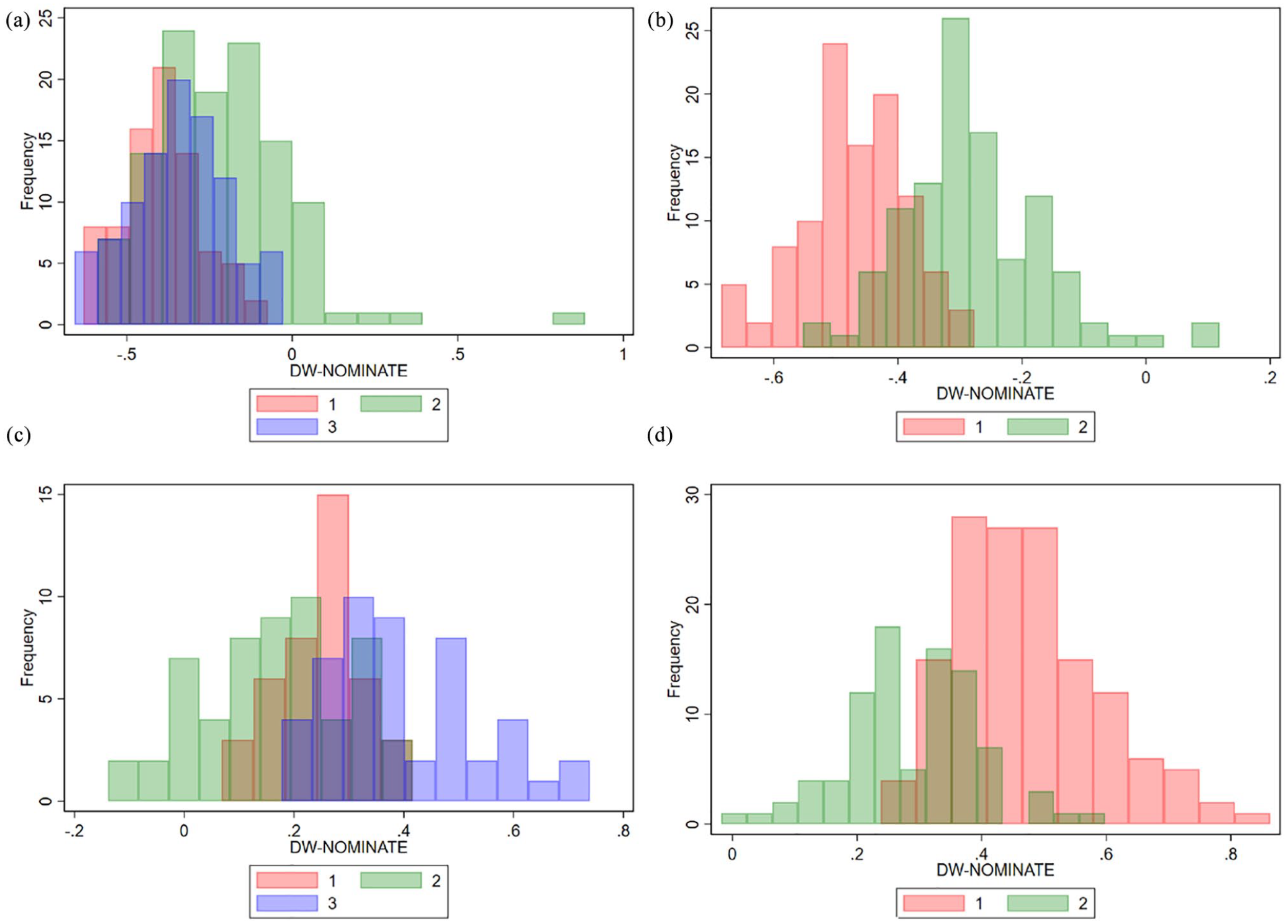
Distribution of ideology by community: (a) Democrats: 95th Congress, (b) Democrats: 105th Congress, (c) Republicans: 95th Congress, and (d) Republicans: 105th Congress.
To quantify the strength of each community within the parties, Figure 2 reports the modularity scores for each party’s cosponsorship network in each Congress (which give the communities noted in Table 1). Higher values denote stronger connections among members within a community and weaker connections across communities. That is, higher modularity is indicative of greater intra-party division (for a good discussion on modularity, see Waugh et al., 2012). We see a decrease in modularity over the first few Congresses in the time series—that is, intra-party communities have become less divided since the 1970s. That pattern is consistent with a decrease in the variance of party NOMINATE scores, which is a measure commonly used to quantify party heterogeneity or division. A caveat is that some of the decrease in modularity scores may be due to the change in the rule regarding the number of cosponsors allowed for each bill. The 25-cosponsor limit up through the 95th Congress may have led to more selective cosponsoring decisions, given the constraint, which perhaps led to greater modularity. However, focusing on the Democratic party, which is of particular interest given its majority status and focus in the literature covering that era, its decrease in the modularity score continued for several Congress after the 95th, which suggests that pattern is not simply an artifact of the rule change.

Modularity for each party.
Referring back to Figure 1, notice that it appears that groups within the parties may have polarized over time, even though modularity scores have decreased. That pattern suggests that although party members might be increasingly sorted ideologically into subgroups, they are increasingly willing to work with each other via cosponsorship despite their ideological differences. This further suggests that cosponsorship behavior is related to but still distinct from roll call voting behavior, which again justifies our focus on cosponsorship.
The modularity scores shown in Figure 2 are relatively low, even during the early Congresses, which shows that although divided, the communities within each party were by no means strongly polarized from one another. 16 The score could range in [–1,1], and is in the positive end when indicating some presence of community structure. As a comparison, Waugh et al. (2012) calculate modularity for the entire House as defined by roll call votes (network as members connected by similar positions on votes, essentially estimating polarization between the Democratic and Republican parties) and find values from just over 0.1 (low polarization during 1970s) to around 0.6 (high polarization during the early 2000s). 17
Party Member Centrality
For each party member, we can calculate a centrality measure, which quantifies how central she is in the party’s overall network—larger values equate to higher centrality. As for community-detection, there are several alternative measures. We use eigenvector centrality to capture a member’s closeness to others in the party. Recall that our graph is weighted (by the number of bills (co)sponsored); hence, more shared cosponsorships equates to a closer relationship. We favor using eigenvector centrality over alternative measures, as it accounts for the centrality of the members with which a member is connected to. 18 All else equal, a member connected to more central members will have a higher eigenvector centrality measure than a member connected to less central members—that is, connections to members within the core of the party matter more than connections to members at the periphery. As such, this measure of closeness better captures centrality in the overall, global structure of the party network and better accounts for the interdependence of all party members’ actions, compared to a simpler measure (see also Häge & Ringe, 2019). 19
In our study of party change, we can observe shifts in the party by observing shifts in the party’s network, that is, who are the most central members. We make some general hypotheses. Particularly during our time series, during which time we already know the parties changed significantly, we hypothesize that older members were increasingly marginalized, as newer members shifted their party toward new issue commitments. We also hypothesize that the centers of the parties shifted toward the ideological extremes in both parties over the past couple of decades.
We can refer back to Table 1 to make some initial assessments of general patterns. First, as evidence of the changing of the guard within the Democratic party, the more central community tends to be the newer members (fewer terms served) up until around the 104th Congress. This fits pattern fits with previous work on changes in the Democratic party during the post-reform Congress. The more central communities in the Democratic party also tend to be more ideologically liberal and from the non-South. Thus we observe how the composition of the Democratic caucus was ripe for the changes of the reform era. We also see that party leadership during the early Congresses were somewhat scattered across communities or largely within a less central community, despite ideologically leaning slightly toward the liberal side of the party according to their NOMINATE scores. 20 This is consistent with party leadership balancing between the interests of more senior, moderate members with the more zealous newer, liberal members early on during the reform era (see for instance Lawrence, 2018). 21 This example highlights how assessing cosponsorship can provide empirical measures to assess nuanced aspects of intra-party politics. It was not until the 101st Congress where we see Democratic leadership disproportionately lie within the most central partition.
The patterns are not as clear within the Republican party. Before the 104th Congress, as members within the minority party, there were perhaps weaker incentives for Republican members to cosponsor with particular colleagues—that is, there were fewer incentives for a particular faction within the party to push a specific agenda, given the party’s minority status. We see, however, in the 104th and 105th Congresses that the newer and more conservative Republican members were slightly more central in the party, which again fits with previous studies on rising polarization in the Republican party, particularly during the post-Republican Revolution House (Hacker & Pierson, 2005; Mann & Ornstein, 2012). In terms of party leadership, we observe that party leadership is almost exclusively found among the most central party subgroup once the party gained majority status. Democratic leadership shows a similar pattern, as leadership is a bit more scattered when in the minority during the latter Congresses. It therefore appears that for both parties, leadership shows particularly strong partisan cosponsoring behavior when they are the party in power, which is consistent with the focus of the party literature on importance of partisanship especially within the majority party (Aldrich & Rohde, 2000; Carson et al., 2011; Cox & McCubbins, 2005; Rohde, 1991).
We can also assess the correlations at the individual-level. Given social network centrality measures are not suitable for the usual regression model when included as the dependent variable, we simply report pairwise correlations from each Congress to descriptively illustrate the general patterns in centrality, which is sufficient for our purposes (we are ultimately more interested in its causal impact on member retirement behavior) (Cranmer et al., 2016; Scott, 2012; Victor & Ringe, 2009). 22 Figures 3 and 4, which report Pearson’s correlations for each Congress, show that the previous patterns hold at the individual-level. Centrality is negatively correlated with length of tenure and positively correlated with ideological extremism (coded as the DW-NOMINATE score for Republicans and –1 × DW-NOMINATE score for Democrats), although there is some variation year-to-year and between parties.

Correlation between eigenvector centrality and number of terms in office, by Congress: (a) Democrats and (b) Republicans.
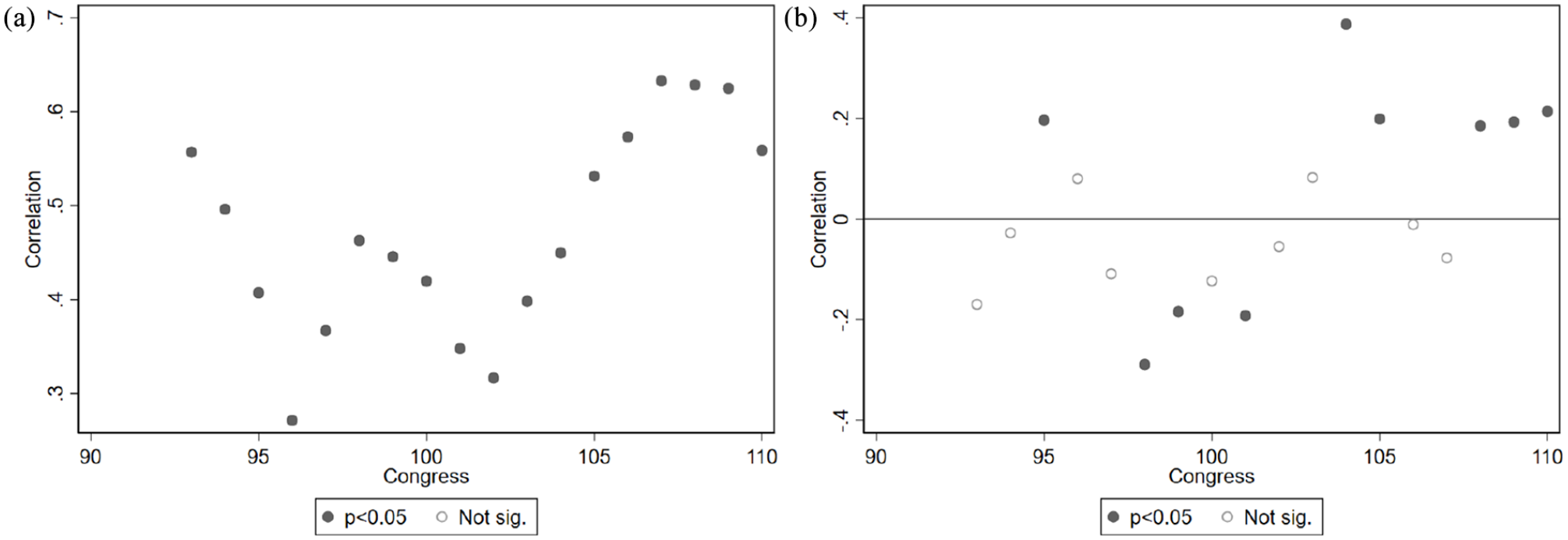
Correlation between eigenvector centrality and ideological extremism, by Congress: (a) Democrats and (b) Republicans.
Notice that the positive correlation with extremism is strong even for the early Congresses for the Democratic party. That is, although there were significant disagreements and conflict within the party and older, more conservative party members still held many of the institutional positions of power, the party caucus was already moving toward the left in terms cosponsorship behavior. We can also see this pattern by observing the correlation with terms in office, where we see that more senior Democrats were less central in the early Congresses. By the 104th Congress, however, turnover in the Democratic Party stabilized to the point that the differences across House seniority diminished.
Again the patterns for the Republican party somewhat differ. The correlation between terms in office and centrality is consistently negative and statistically significant for Republicans beginning with the 104th Congress, while it loses statistical significance for Democrats during that period. Thus, comparing the parties in Figure 3, we see that change from turnover (newer members) for the Democratic party largely occurred around the (post-)reform era of the House (Rohde, 1991), while the Republican party in the House underwent significant transformation with its rise to power during the 1990s. 23
The correlation between extremism and centrality for Republicans in Figure 4 is not statistically significant or negative for nearly all Congresses before the 104th Congress, which again is likely due to the fact that they were the perpetual minority party during that time. 24 Interestingly, a negative correlation between centrality and extremism is statistically significantly in three out of five terms during the 1980s. Although the presidency was controlled by a Republican during those years (of the statistically significant congressional terms, Reagan in the 98th and 99th, and Bush in the 101st), the moderate wing of the party was more central in terms of cosponsorship. This pattern is consistent with findings by Harbridge (2015), who stresses in her analysis of bill cosponsorship that bipartisanship was still evident at early stages of the legislative process, even after the rise of the conservative wing of the party. Furthermore, the tough realities of divided government stressed the need of Republicans to appeal to some (conservative) Democrats to win any legislative battles for their Republican president. Figure 4, however, extends Harbridge (2015) by revealing a clear shift in the party that started with the Republican Revolution in the 104th Congress. Gaining majority power in the House for the first time in decades increased the stakes for the party in terms of its ideological direction and party unity, since the party now had to opportunity to implement its (non-median) agenda as the majority party (Aldrich & Rohde, 2000; Rohde, 1991). With the rise of the party, continued competitive partisan balance, and accelerated ideological polarization during the 1990s, particularly in terms of roll call voting behavior (McCarty et al., 2008), the correlation between cosponsorship network centrality and ideological extremism is positive in 5 of 7 Congresses beginning with the 104th, which shows the rightward shift of the party network.
Retirement
Our analysis thus far has applied social network analysis to describe the central tendencies of the parties and tracked their changes over time. Now that we have a clearer understanding of the cosponsorship networks, we turn to testing one specific mechanism that contributes to party change and continuity, which also highlights the substantive importance of the cosponsorship network we have analyzed. To what extent does party fit impact retirement decisions? Thomsen (2014) finds that ideological fit influenced retirement decisions, thereby contributing to an increasingly polarized U.S. House. We argue that cosponsorship, as another legislative behavior, also indicates the level of fit within the party. We have two hypotheses: (1) Members who are less central in the cosponsorship network are more likely to retire from office, and (2) Members who are becoming less central in the party are more likely to retire.
Our dependent variable is retirement, coded as 1 when the member voluntarily leaves public office and 0 otherwise. We estimate a Cox proportional hazard model, where retirement denotes a “failure” (Box-Steffensmeier & Jones, 2004; Kerby & Blidook, 2011). 25 Following previous work on retirement, we include a few controls (Evans & Swain, 2012; Hibbing, 1982; Kiewiet & Zeng, 1993; Theriault, 1998; Thomsen, 2017). Extremism is the DW-NOMINATE score for Republican and –1 × DW-NOMINATE score for Democratic members, and moderation is expected to contribute to retirement. Age, hostile redistricting, and scandal are all expected to contribute to retirement. 26 Vote share in the last election is expected to be negatively related to retirement. We also include a Democrat dummy to account for party differences in the likelihood of retirement. 27
We use a couple alternative operationalizations of member centrality to test our two hypotheses. Since eigenvector centrality scores are not comparable across Congresses, which were each estimated as separate networks, we rely on the percentile of a member’s eigenvector centrality in their party during that Congress. Instead coding centrality in terms of quintiles or other groupings of eigenvector centrality produces similar results. Simply using the percentile gives a straightforward substantive interpretation. Those who are less central (lower percentile) are more likely to retire. We also hypothesize the dynamic effect that members who are moving toward the outskirts of the party are more likely to retire. The change in percentile (current minus previous) captures a member’s movement, whereby negative values denote a member who is becoming a less central member in the party.
The results in Table 2, which report the estimated coefficients and hazard ratios, support our hypotheses that centrality influences member retirement. 28 The negative coefficients for both centrality measures (and hazard ratios below 1) demonstrate that lower and decreasing centrality both contribute to the retirement of members. The controls all also have their expected effects
Proportional Hazard Model of Retirement.
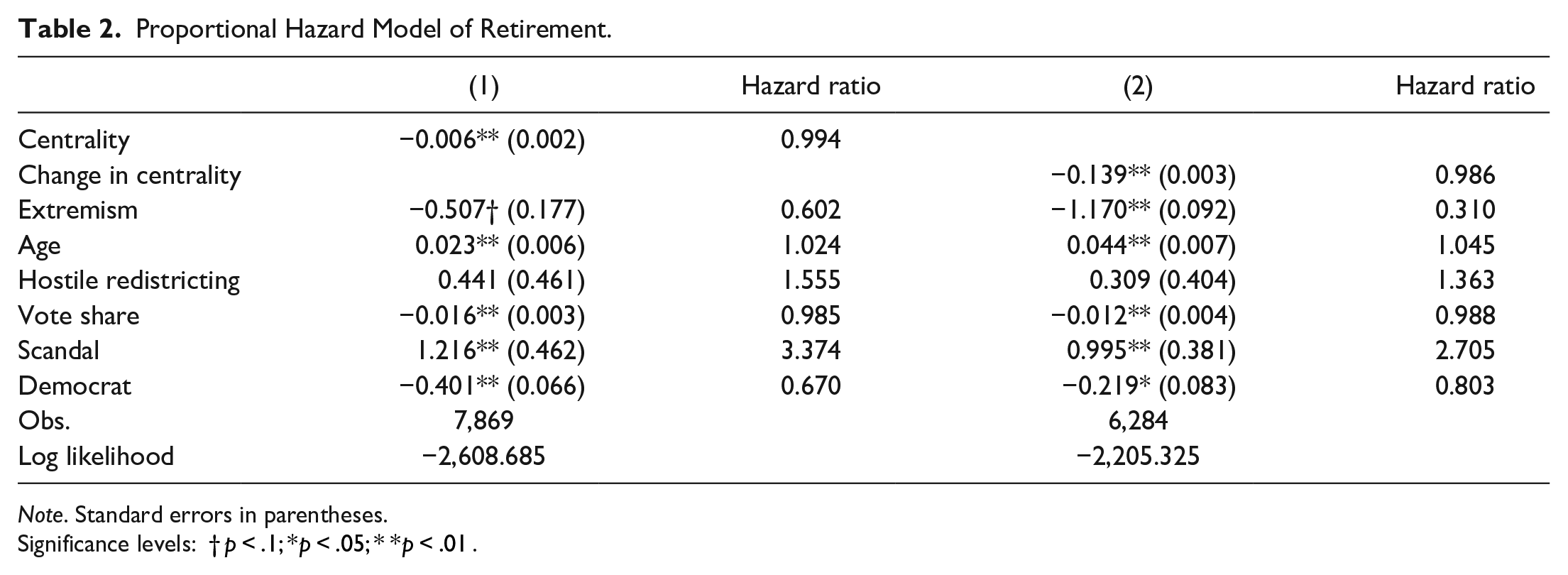
Note. Standard errors in parentheses.
Significance levels:
The effect of network centrality is substantively large as well. In order to compare substantive effects, we need to account for the scales of the independent variables. Ideological extremism varies from –0.88 to 0.955 with a standard deviation of 0.17. The percentile centrality varies from 0.34 to 100 with a standard deviation of 29, and the change in centrality percentile varies from –97 to 89 with a standard deviation of 18. We can compare the effect on the probability of retirement for a one standard deviation change in each variable. The negative impact of extremity on the hazard (retirement) is between 7% and 12% (for models 2 and 1, respectively). The negative impact of centrality is 25%, and the negative impact of change in centrality is 17%. Notably, these effects are independent of ideological, as measured by NOMINATE. Thus, as much as the parties literature has focused on roll call voting and ideology, cosponsorship (and likely other legislative behaviors) can also define the party and thereby influence career decisions.
Discussion and Concluding Remarks
Using cosponsorship decisions of House members, we analyzed the transformation of the American parties since the 1970s as an evolving social network. Our empirical focus on the relationships across individual members is rooted in our theoretical view of American political parties as an aggregated collection of individual members. We were able to observe how the centers of the party (i.e., who are most central) can change. During this era of increased polarization, social network analysis shows that the parties’ networks were shifting toward their more extreme and newer members, although importantly ideological extremism does not fully capture the characteristics of the parties. We analyzed the impact party network centrality has on member retirement decisions. We found that members who are less central or becoming less central in the party are more likely to retire, which demonstrates how individual decisions of party members contributes to party change.
Our paper makes a few notable contributions. Although researchers have tended to focus on partisan polarization in roll call voting to describe party change, we suggest that analyzing other types of legislative behaviors can provide a more thorough understanding of the American parties. Our analysis shows that although voting correlates with cosponsorship, they are still somewhat distinct behaviors. Furthermore, they capture distinct characteristics of the parties that both independently influence retirement decisions of House members, which stresses the importance in analyzing aspects of legislative behavior besides roll call voting to developing a comprehensive understanding of the American parties and how they evolve over time.
Theoretically we also stress an individual-centered perspective of the political parties, which motivated our empirical approach and hypotheses. Although certain factors can justify assuming something akin to a unified actor assumption to explain party change, such as the role of presidential politics, party platforms, and party leaders, considering a party as a collection of its individual members captures important aspects to American party politics. That motivated our use of social network centrality to define the party (i.e., its centrality) and hence party fit. That is, whether a member fits within the party depends on the legislative behaviors of all the other members, and that can ultimately influence that member’s decision of whether to remain in office or not.
Our individual-centered focus is not intended to discount recent work on parties that stresses the role of groups (e.g., Bawn et al., 2012; Karol, 2009; Noel, 2012, 2013). For our current purposes, however, we believe that simplifying our analysis to the individual legislator helps us to specifically highlight the importance of the interdependence of political actors in shaping the party—in our case the interdependence of legislators and its impact on their retirement decisions. In our framework, groups are one factor than induces the preferences of party members and hence their cosponsorship behavior. Ultimately, however, we would like to more explicitly consider the role of groups, which is particularly fitting given that Koger et al. (2009) argue that parties are extended networks of groups and present evidence of cooperation among groups within a party network (see also Nyhan & Montgomery, 2015). Thus, our paper focuses on the network of party members in the House, while Koger et al. (2009) focuses on the network of groups. Future work should consider the connections between these two levels of networks. Perhaps one potential avenue is to apply our insights about network centrality to see if there are similar effects on groups within the extended party network that can help explain changes in that network—in that case, decisions related to a group’s political activity, rather than legislator retirement decisions.
Although our paper shows the contribution of party fit to changes in the party caucus via retirement, future work will consider in more detail precisely why and how party fit impacts retirement decisions. Earlier we alluded to internal and external factors that might be impacted by party fit and consequently influence retirement decisions. For instance, perhaps members on the outskirts of the party are concerned about the possibility of a primary election challenge or difficulty in raising campaign funds, which contributes to their decision to retire. Preliminary analyses do not suggest that either of these two factors play a role, but future work will consider these and other possible mechanisms in more detail. 29
There are several other avenues for future research. Although our paper illustrates one underlying mechanism that contributes to party change, we might still wonder why the party changes in one specific direction rather than another. That is, suppose there are multiple new equilibria of policy commitments that a party could conceivably move toward. What determines whether a party shifts toward one equilibrium over another? For example, one potential pathway is through primary elections, in which some interested group attempts to move the party in one direction through influencing who wins a primary or attempting to alter an incumbent’s position through a primary challenge. But previous work has shown only mixed evidence of the impact of primaries (Boatright, 2013; Hirano & Snyder, 2019). Perhaps accounting for the interdependence of actions across party members, congressional districts, interest groups, and primary elections can help clarify when and how primaries contribute to party change.
Footnotes
Declaration of Conflicting Interests
The author(s) declared no potential conflicts of interest with respect to the research, authorship, and/or publication of this article.
Funding
The author(s) received no financial support for the research, authorship, and/or publication of this article.
