



Abstract
Previous scholarship on juvenile case dispositions has suggested a complex relationship between legal and extra-legal factors. Previous studies, however, have suffered from methodological limitations of cross-sectional data that potentially overstated the salience of extra-legal factors. This study addressed that limitation using longitudinal case-management system data from a large southern state. The findings suggested a distinction between the first referral and subsequent referrals. Extra-legal factors, such as age, gender, and race contributed to formal case disposition in the first referral, but waned in referrals two through six. Legal factors significantly and robustly predicted formal case disposition in the first and subsequent referrals. Felony offense significantly increased the likelihood of a formal disposition across all referrals and previous case disposition significantly increased the likelihood of formal disposition in subsequent referrals. Concluding remarks focus on implications and future research.
Introduction
From inception, the juvenile court’s vision differed from the criminal courts as it viewed juveniles with diminished culpability and in need of individualized attention. While a driving philosophy within the juvenile justice system, juvenile crime and the system’s response to such crime over the past 20 years has guided this vision toward more punitive measures (Hinton, Sims, Adams, & West, 2007). The crime spike and subsequent downturn in the United States encouraged researchers to explore juvenile court decisions in an attempt to identify the factors associated with court disposition.
From 2001 to 2010, the United States experienced a 13% decrease in both violent and property crime, with juvenile arrests decreasing by just over 23% for total offenses (United States Department of Justice, Federal Bureau of Investigation, 2011). National-level official reports suggest formal petition for juvenile court action followed a similar trend. While overall delinquency petitions spiked in 1997, there was a 20% decline by 2009. Nonetheless, dissection of petition for juvenile court action by offense typology presents a contrasting picture. During 1997 through 2009, juvenile court petitions for person and drug offenses decreased 13% and 12%, respectively, petitions for property offenses dropped substantially (35%) while public order offense petitions increased (Puzzanchera, Adams, & Hockenberry, 2012). These fluctuations suggest a refocus from property crimes to public order offenses within the juvenile justice system, with more formal system responses applied to public order offenses. During 1985 through 2009, the caseload for formal court proceedings increased 30%, indicating a decrease in the use of informal disposition. Within this period, the likelihood of formal processing increased from 48% to 57% for public order cases (Puzzanchera et al., 2012). Further, increased reliance on formal juvenile disposition increased across all demographic categories reported by the Office of Juvenile Justice and Delinquency Prevention (Puzzanchera et al., 2012). National-level data suggest legal variables influence juvenile court dispositions.
Petitions for juvenile court action increased the most for drug offense cases, followed by public order and person offense cases from 1985 to 2009 (Puzzanchera et al., 2012). This increased reliance on formal disposition suggests legal factors have been instrumental in the decision to involve youth in the formal court process, yet scholars have suggested that extra-legal factors also influence formal case disposition (for example, see Leiber & Peck, 2012; Ray & Alarid, 2004; Sieverdes, Shoemaker, & Cunningham, 1979). This represents conflicting perspectives of the juvenile justice system and, thus, is an opportunity to further explore the influence of legal and extra-legal determinants of formal case disposition.
This study presents longitudinal data for juveniles referred for the gamut of offenses and offense severity over multiple referrals. By following a cohort of juvenile offenders referred for their first offense at a young age during 2000–2002, this research provides a unique view of factors associated with juvenile court dispositions. Namely, this study extends the knowledge on the pathways of formal disposition by stratifying the sample by referral number and considering cumulative and previous case dispositions.
Literature Review
Determinants of Juvenile Court Processing
Diversions from formal case processing are a natural extension of the juvenile justice philosophy to reduce labeling effects on youth involved in the system. While the guiding principles of informal dispositions may appear evident, some research suggests these processes fail to achieve what they set out to accomplish. Some diversionary programs, while aimed at reducing formal processing, have a record of being just as formal as formal programs (Frazier & Cochran, 1986), more process intensive than traditional case processing (Bohnstedt, 1978), and decreased academic advancement in student participants (Sweeten, 2006). Although scholars found diversionary programs to be more efficient than formal court processing (Patrick & Marsh, 2005), efficiency does not achieve program success (see Diamond, Morris, & Caudill, 2011).
Scholars have suggested also that the more involved youth are with the formal juvenile justice system, the more likely they are to associate with deviant peers and persist in delinquency (Cauffman et al., 2007; DeLisi, Hochstetler, Jones-Johnson, Caudill, & Marquart, 2011; McAra & McVie, 2007; Mears, Cochran, Greenman, Bhati, & Greenwald, 2011; Shook, Vaughn, Goodkind, & Johnson, 2011). Furthermore, scholars have also demonstrated that arrest in and of itself may increase the likelihood of future of arrest for higher risk youth (Morris & Piquero, 2012). Collectively, these findings highlight the importance of understanding the determinants case disposition outcomes.
Intake is an opportune juncture for diversion from formal processing and is typically the first exposure youth have to the juvenile justice system. While opportune, researchers found the processes associated with diverting youth from the formal justice process were obscure. Moreover, limited resources led intake officers to focus on traditional court processing (Mears & Kelly, 1999). Although typically separated in research, legislative directives mandate juvenile services personnel make a detention decision during the intake process, unless the youth is referred to juvenile services in custody. This suggests that intake diversion and the detention decision are actually a single process in many cases.
Research suggests the initial detention decision focuses on legal and extra-legal factors. While Frazier and Bishop (1985) found that the severity of offense, prior record, and age were not significantly associated with detention, Armstrong and Rodriquez (2005) suggested that minority youth were not only significantly more likely to be detained, but also the community’s racial heterogeneity composition significantly influenced detention decisions. This contradicts Ray and Alarid’s (2004) findings that juvenile services were more likely to detain older and African-American youth. Opposing findings suggest little uniformity across research on differing samples of youths and leave the literature without clear direction as to the predictive validity of extra-legal factors (cf., Bishop, Leiber, & Johnson, 2010; Brubaker & Fox, 2010; McCoy, Walker, & Rodney, 2012; Moore & Padavic, 2010; Peguero & Popp, 2012).
As with research on intake and initial detention decisions, current literature on the factors associated with formal juvenile justice disposition fits well into a dichotomy of legal and extra-legal factors. Previous research found that extra-legal factors influence the juvenile court’s decision to dispose formally of referral cases. Minor, Hartmann, and Terry (1997) found that the juvenile court was significantly less likely to formally dispose of younger youth. Barrett, Katsiyannis, and Zhang (2006) also found a significant relationship between age at first referral and subsequent referrals. Ethnicity continued to influence system penetration at the formal disposition stage, yet research findings conflicted with the detention decision literature. Some studies found that Caucasian youth were significantly more likely to face formal disposition than the African-American youth (Barrett, Katsiyannis, & Zhang, 2006; Bishop et al., 2010; Ruback & Vardaman, 1997), but Ruback and Vardaman’s (1997) findings suggested an interaction between community-level factors and ethnicity.
In addition to the extra-legal factors associated with intake diversion and detention decisions, researchers identified several other extra-legal factors associated with formal disposition. Mental health factors and the juvenile’s home environment have, in previous studies, influenced formal disposition (Campbell & Schmidt, 2000; Sullivan, Veysey, Hamilton, & Gillo, 2007; Tarter, Kirisci, Mezzich, & Patton, 2011; Tripodi & Bender, 2011).
Similar to the shift from demographic factors to treatment-related indicators in extra-legal variables, research findings presented more reliance on legal factors for formal disposition. Minor et al. (1997), Ruback and Vardaman (1997), and Campbell and Schmidt (2000) revealed the referral’s legal factors significantly influenced the court’s reliance on formal disposition. Minor et al. (1997) also found that previous formal referral dispositions significantly increased the likelihood of a formal disposition. Furthermore, Campbell and Schmidt’s research found that youth detained during the pretrial process received shorter probation sentences. These findings suggest that while extra-legal factors influence formal disposition outcomes, juvenile case disposition outcomes potentially represent a broader scope of formal disposition determinants.
Stakeholders’ Perspectives
Research on factors that affect diversion decisions and diversion effects tells a portion of the story, but research focusing on the stakeholders’ perspectives provides more insight into the decision to divert youth from formal processing. As expected, prosecutors reported legal factors as the most important variable in their decision to divert youth, with offense severity and the youth’s prior record as the most important of these (Potter & Kakar, 2002). In an experiment, researchers found that judges, like prosecutors, focused on legal factors associated with the referral. For judges, the most influential factors were offense severity, number of prior offenses, and number of delinquent years (Sieverdes et al., 1979). Additionally, qualitative observation lends support to this perspective, with judges uninfluenced by demographics, courtroom presence, or dress (Mann, 1980).
Whereas prosecutors and judges rely on legal factors in case processing, intake caseworkers reported a somewhat different perspective when making a diversion decision. Intake caseworkers reported a wider range of contributing factors, with severity and prior record reported as the most important factors in diversion decision making (Potter & Kakar, 2002). Although intake caseworkers reported legal characteristics as the most prevalent factors associated with diversion, Sieverdes, Shoemaker, and Cunningham (1979) found discrepancies in this position. According to their research, probation officers’ decisions were influenced by race and age, along with offense severity and length of delinquent career. These findings suggest extra-legal factors influence the initial decision (intake) to divert youth from formal processing, but the final and official decision (court personnel, e.g., judges and prosecutors) was based on the legal factors associated with the case.
These findings suggest complex interactions with extra-legal and legal factors associated with formal disposition, shadowed by inconsistent findings across the literature. Longitudinal data analysis may provide insight into the relationships across time that cross-sectional data analyses are unable to observe. Studies have suggested that previous criminal histories increase the likelihood of future offending (Caudill, 2010; Trulson, DeLisi, Caudill, Belshaw, & Marquart, 2010) and more serious case outcomes (Caudill, Trulson, Marquart, & DeLisi, in press), yet the influence of referral’s cumulative effects on other disposition determinants remains unclear. This study stratified the sample by the number of previous referrals and focused on other determinants of formal case dispositions to better clarify the influence of previous criminal histories in case dispositions.
Methods
Data Description
This study used data collected at the local jurisdiction level and forwarded to a southern state’s juvenile oversight agency. These data were entered by local juvenile probation officers, case managers, detention officers, program specialist, juvenile court officers, and various other authorized personnel working with youth through the county juvenile probation departments. As the origins of these data are a case management program, juvenile probation personnel use this platform to track and assess youth’s progress, needs, and supervisions on an individual level. The data maintained in this case management program consisted of official records (offenses, arrests, petitions, adjudications, and dispositions) and self-reported (social histories, intake interviews, and meetings) data. These data elements complemented one another by providing context to situations and circumstances. For example, social history reports may identify family physical abuse in the case of a juvenile that has an extensive history of running away from home.
Juvenile records were verified through juvenile code standards and triangulation of self-reported data. Juvenile probation staff collected self-reported data through various processes, such as intake interviews, and social history interviews. Additionally, probation staff interviewed family members, school administrators, counselors, and anyone else the officer perceived to have useful information.
Although the case manager program allowed local departments to specify certain variables for local use (e.g., county specific diversionary program), the majority of these variables were consistent across counties within the state, therefore, facilitating data collection at the state level. The state juvenile agency used these data to assess programming and procedures to meet state standards and implement training based on the needs of the local departments.
For this study, the researchers identified a cohort of youth referred for their first offense during 2001–2002 and between the ages of 10 and 12. After identifying these youth, the researchers observed the official data to follow these youth through their juvenile justice experience, including subsequent referrals, adjudications, and dispositions. This sample consisted of 8,325 subjects referred to a juvenile probation department for at least one offense. Approximately 60% (n = 4,961) of the cohort experienced a second referral, 43% (n= 3,584) were referred for a third time, 34% (n = 2,818) were referred for a fourth time, 27% (n = 2,227) experienced a fifth referral, and 21% (n = 1,783) were referred for a sixth time.
Measures
Extra-legal factors
A series of covariates can be considered extra-legal factors. These include sociodemographic characteristics of the juvenile, as well as situational attributes. The data included information on the youth’s gender (male= 1, female = 0), race (dummy variables of White, African American, Hispanic = reference, and other), and age. Age was assessed as a continuous variable (in years) and represents age at the time of the referral. We also included an indicator of the difference in age between the previous referral (if applicable), to account for any effect for the time between referrals, which may affect disposition decisions. Other extra-legal variables include gang membership (nongang = 0, gang = 1, as confirmed by probation and detention officers), an indicator of household status (i.e., whether the youth lived with both parents, a single parent, or otherwise) at the time of referral, and whether they were specified as having a history of abuse (an additive model including emotional, physical, and sexual abuse if present).
Legal factors
The data included several indicators of legal characteristics, representing the offense as well as with the juvenile justice experience. Here, we accounted for whether the referral was a noncustody referral (1 = noncustody, 0 = otherwise), offense type via a series of dummy variables (felony, public order, or misdemeanor referral), the number of days in detention (continuous variable), and whether the referral involved a weapon (no weapon = 0, weapon = 1). We also controlled for detention stay through a continuous variable and the referral outcome (informal disposition = 0, formal disposition = 1) for the previous referral in models assessing the second referral and beyond.
Dependent Variable
Case disposition was the dependent variable in this study. The data categorized naturally into a binary variable representing informal or formal dispositions (informal = 0, formal = 1). Informal disposition represented new offense referrals to the juvenile court that did not result in a juvenile court petition for charges. Informal case dispositions typically involved some agreement between the juvenile court, the juvenile probation department, and the responding juvenile and their guardian. Conversely, formal disposition required a juvenile court petition to “formalize” the referral with court legal action. For the first referral, approximately 19% (n = 1,281) of the sample experienced a formal case disposition and the formal disposition rate increased as the subjects progressed through additional referrals.
Analytic Procedure
To assess the above noted research focus, we estimated six logistic regression models; one for each referral up to a maximum of six. In each model, the outcome measure was a binary indicator representing whether a juvenile received an informal or formal disposition (0 = informal, 1 = formal). The modeling strategy was progressive (i.e., based on the number of referrals) for all juveniles in the cohort. In other words, this study explores multiple disposition times at each respective instance of referral (e.g., at Referral 1, Referral 2, Referral 3, etc., respectively). In the first model (i.e., Referral Number 1), the independent variables predicted whether the juvenile received a formal disposition for his or her first referral. Each subsequent model (Models 2 [i.e., Referral Number 2] through 6 [i.e., Referral Number 6]) may be considered longitudinal and represents all cohort members who were referred in the state from two to six times prior to reaching adult status, respectively. As an illustration, all cohort members who were referred at least 5 times are represented in each of the Models 1–5, but only those who were referred 6 times, or more, are represented in Model 6. In this sense, each model stratified the sample by the number of previous referrals to observe determinants of formal case disposition, respectively. This approach allowed us to explore the role of model predictors for varying points of contact (based on referrals) between the juvenile justice system and juvenile offenders. In other words, we address whether predictors impact a formal disposition, or not, at specific stages of juveniles’ contact with the system (i.e., as contact progresses, if at all). The results of our analyses are presented in the following section.
Results
Table 1 presents the descriptive statistics for the extra-legal variables by referral groups and Table 2 presents the descriptive statistics for the legal variables. It is worth noting that at each referral the probability of receiving a formal disposition was consistently higher for juveniles from single parent homes compared to two parent homes. Furthermore, at each referral, Hispanic juveniles represented the majority ethnicity. As shown, most juveniles were not gang affiliated; however, there were miniscule increases in gang affiliation with each referral increase.
Extra-Legal Variables by Referral.

Note. aIncludes emotional, physical, and sexual abuse.
Legal Variables by Referral.
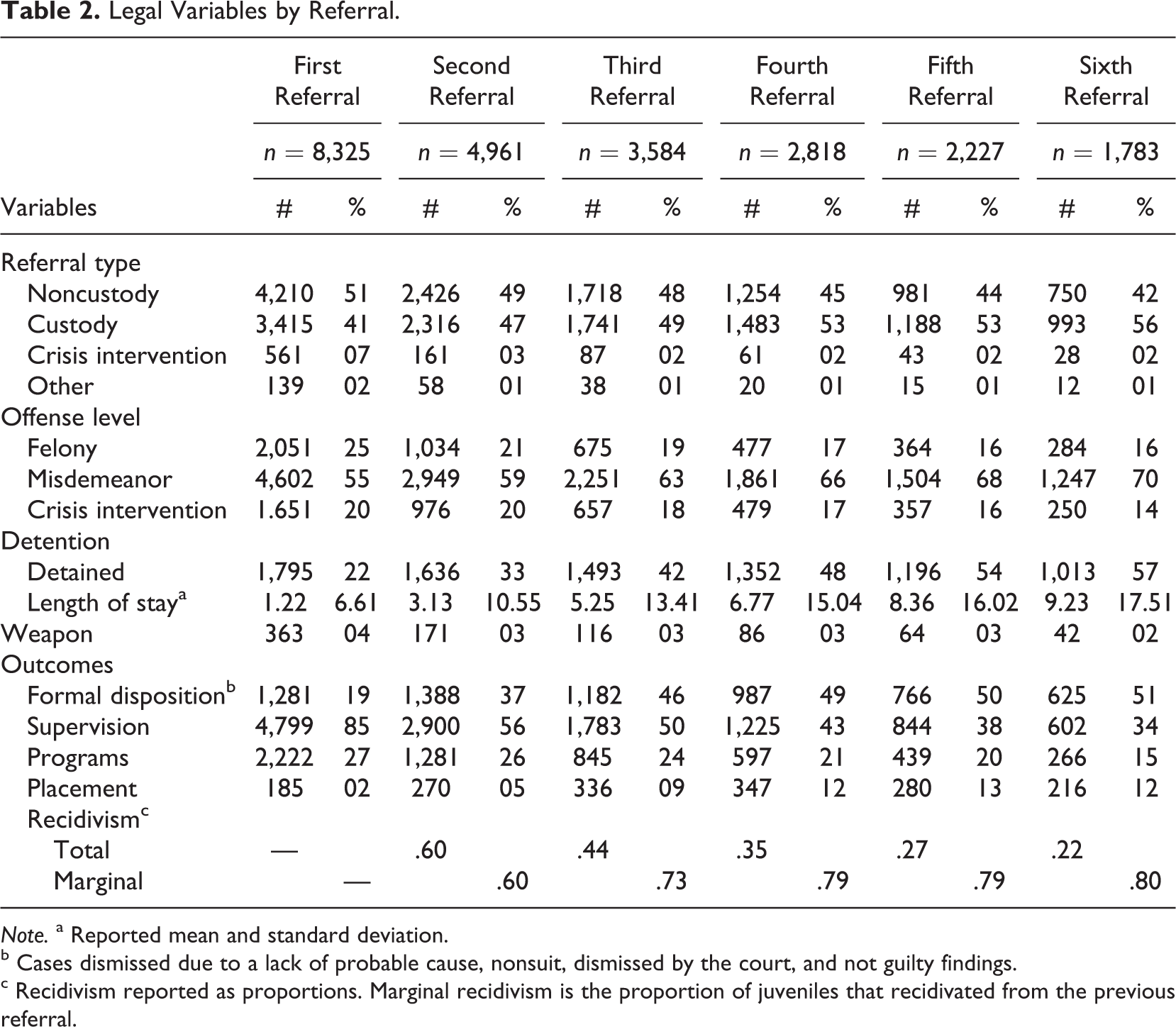
Note. aReported mean and standard deviation.
b Cases dismissed due to a lack of probable cause, nonsuit, dismissed by the court, and not guilty findings.
c Recidivism reported as proportions. Marginal recidivism is the proportion of juveniles that recidivated from the previous referral.
While this information is useful, it does not provide any detail regarding the factors associated with this trend or with whether a juvenile was formally disposed. To assess such differences, while controlling for potentially confounding legal and situational factors in whether a juvenile was formally disposed after a referral, we developed a series of panel regression models.
In examining the six models, several noteworthy findings emerged that suggest some consistencies with regard to what predicts a formal disposition or not. However, other factors vary in impact across referrals. The model results are reported in Table 3. The model predicting a formal disposition for first referrals on record suggested that eight variables were statistically significant in predicting a formal disposition, though the findings vary in effect size. Being male (85% increase in the odds of formal disposition), African American (26% increase in odds, in comparison to Hispanic), older when the offense occurred (31% increase in odds for each additional year), exposed to childhood abuse (39% increase in odds), a noncustody referral (34% increase), a felony offender (1,019% increase), and detained for the offense (20% increase in odds for each day of incapacitation) each increase the odds of a formal disposition, all else constant. Living with two parents (in comparison to living with a single parent) decreased the odds of a formal disposition by 28%.
Logistic Regression: Formal Disposition Regressed on Legal and Extra-Legal Variables.
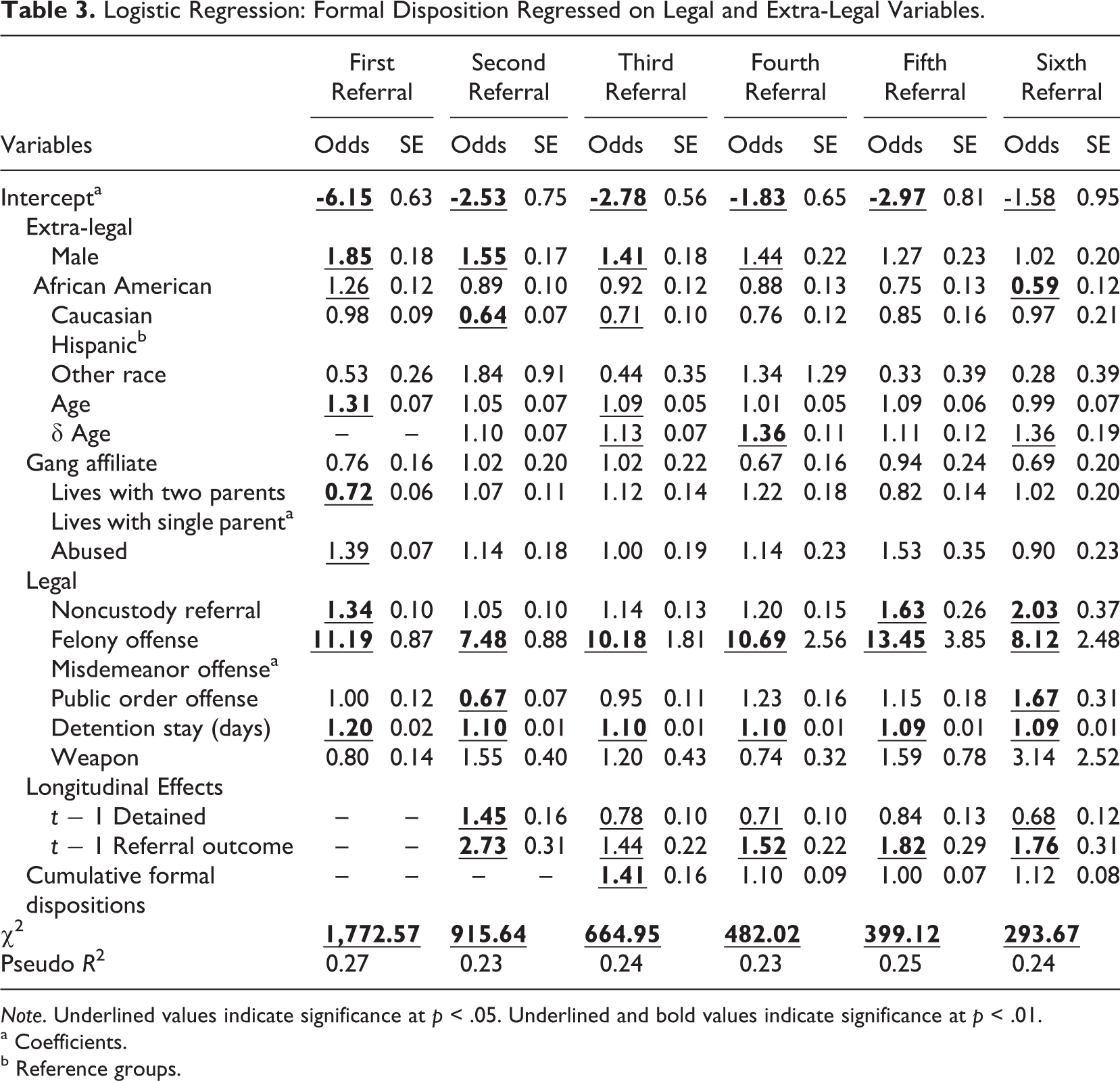
Note. Underlined values indicate significance at p< .05. Underlined and bold values indicate significance at p< .01.
a Coefficients.
b Reference groups.
For subsequent referrals, males were significantly more likely to receive a formal disposition in the first three referrals. The findings for race in predicting a formal disposition were compelling and differed somewhat depending on the reference category and the referral number. Compared to Hispanic juveniles in this sample, White juveniles were less likely to receive a formal disposition at all referral levels; however, these findings were statistically significant only at the second and third referrals. African-American juveniles, however, in comparison to Hispanics, were more likely to receive a formal disposition but this effect occurs exclusively at the first referral only.
To assess the impact from race more completely, equivalent models were estimated using each possible combination of reference category for race (numerical results excluded to save space). At least one minority group (African Americans, Hispanics, or both) was more likely to receive a formal disposition compared to White juveniles at each stage of contact (i.e., when White was used as the reference category). Both Hispanic and African-American juveniles were more likely to be formally disposed at referral two compared to Whites. For Models 3 and 4, Hispanics were more likely to receive a referral compared to Whites, and for Models 5 and 6, both Hispanic and African American juveniles were more likely to receive a formal disposition, all else constant. It is important to note while race did appear to play a role in formal disposition, net of other determinants, the effects were inconsistent and modest.
Regarding age at the time of offense, the odds of a formal disposition increased by 31% on average for each year increase in age for the first referral only. The effect of age was not significant from the second referral onward. Age as a nonlinear function was significant in predicting a formal disposition for juveniles at the first referral; however, the impact from the effect was trivial. Additionally, the difference in age from the previous referral appeared to significantly impact whether a formal disposition was received for the fourth referral only. Interestingly, gang affiliation was the only extra-legal factor that did not affect formal disposition.
The legal factors explored presented a more consistent perspective. The impact from having committed a felony offense, being detained for the referral, and a previous formal disposition were consistently the most influential predictors of a formal disposition. Juveniles who experienced one (or all) of these factors were more likely to receive a formal disposition, regardless of the number of referrals and in spite of the many control variables included in our assessment. For instance, whether the previous referral resulted in a formal disposition significantly and substantively increased the odds of receiving a formal disposition for a current referral. In addition, a noncustody referral significantly increased the odds of receiving a formal disposition for the first, fifth, and sixth referral and increased in effect size for later referrals. As expected, compared to misdemeanor infractions, the odds of formal disposition were dramatically higher for any referral stemming from a felony offense. Indeed, felony offense was associated with between a 648% and 1,245% increased likelihood of a formal disposition. Further, public order offenses, in comparison to other offenses, lowered the odds of a formal disposition for the second referral, but increased the odds for the sixth. The length of detention stay, if any, also increased the odds of a formal disposition for any referral by a margin between 9% and 20% for each additional day of detention.
Discussion and Conclusion
This study revealed interesting and also comprehensive findings regarding predictors of juvenile justice formal dispositions. This longitudinal research tends to explain why many previous cross-sectional studies on the same issue produced such mixed and confusing findings. The findings of previous studies at best suggested an inclination of complex and ambiguous interactions with extra-legal and legal factors associated with formal disposition and indeed showed inconsistent results across the literature. Indeed, the mixed results of previous scholarship may be the consequences of collapsing previous criminal history into a count variable. This longitudinal study sheds light on such trends by considering the impact of legal and extra-legal determinants of case disposition through referral number stratification. By identifying how previously established determinants of case disposition behave within each court referral, this study clarifies the influence of previous criminal history on case dispositions.
According to the findings, there is a certain division between first referral and all other referrals (second to sixth referrals). Overall, the impact of legal factors, most importantly current felony offense and days in detention, endured through all referral stages and thus these legal factors significantly influence the dependent variable, formal case disposition, for both first referral and all other referrals. However, the impact of extra-legal factors tends to show a different story. These factors were only statistically significant for the first referral and their impact disappeared or, at best, was inconsistent and minimal for all other referrals. In the first referral model, both legal and extra-legal factors were considered as equally significant variables. Yet, from the second referral forward, extra-legal variables lost their impact and legal factors consistently predicted formal case disposition.
Although this study cannot speak to the decision-making processes, the findings suggest consistent interactions between referral number, legal factors, and formal disposition. Perhaps, juvenile justice stakeholders (e.g., probation officers) were more willing to attribute first referrals to a novice offender who should deserve a second chance and thus pay more attention to extra-legal factors. By contrast, the same stakeholders appear to treat subsequent referrals as more chronic behaviors by experienced offenders and, thus, pay stricter attention to legal factors. In fact, Giles and Mullineux (2000) discovered significant cumulative effects of previous criminal record on probation officers’ case decisions. The findings of this study, however, also suggest that previous stakeholders’ decisions significantly influenced how they processed the current referral.
Inconsistent and complex findings of the previous studies may result from their cross-sectional nature. The findings of the current study comprehensively explains such findings and show both stories can be supported. For instance, several investigators (Campbell & Schmidt, 2000; McCoy et al., 2012; Minor, Hartmann, & Terry 1997; Ruback &Vardaman, 1997) found extra-legal factors influenced the juvenile court’s decision to formal disposition, while at the same time those studies found legal factors were associated with current referral significantly influenced the court’s reliance on formal disposition. Those previous findings are consistent with the current study’s findings at first referral, which mimics cross-sectional research designs. However, the longitudinal nature of the current study uncovers another story for all other referrals.
There were several significant relationships of particular concern in predicting formal case disposition. For legal factors, both felony offense and detention stay significantly impacted formal disposition across all referrals. Yet, other legal factors such as referral source and public order offenses inconsistently impacted formal disposition. For extra-legal factors, there appear somewhat consistent gender effects. However, race, age, an indicator of the difference in age between the previous referral, and an indicator of household status provided inconsistent effects on formal case disposition across referrals.
The longitudinal effects of this study are a substantial contribution to the juvenile case disposition literature. Gender and race functioned as important predictors in the earlier referrals, but their effects waned as referral number increased. This suggests that stakeholders in juvenile justice rely less on race and gender differences for habitual juvenile offenders (Tracy, 2002). Supporting this perspective, the current findings show the significance of previous detention decisions and previous case dispositions on subsequent legal outcomes. While the influence of race is complex (e.g., see Armstrong & Rodriquez, 2005) this study’s findings suggest that considering the number of previous referrals and previous case disposition unmasks race’s inconsistent influence on case dispositions. Of course, these findings beg for future empirical inquiries.
The current study has limitations and generalizing beyond this sample and methodologies requires caution. For example, this study excluded stakeholders’ decision-making processes and, thus, contextualizing the inconsistent effects of previously suggested determinants of formal disposition (e.g., race) is beyond this scope. There may be other, undefined variables (such as the characteristics of stakeholders and/or contingency factors), to contextualize these findings. It may be that an interplay of the identity of offender (extra-legal factors), the nature of offense (legal factors), the characteristics of stakeholders who make a referral decision, and other contingency factors produce formal disposition outcomes.
The current study included the first two factors in its analysis model. According to previous literature, these two other factors significantly affect to the calculation of formal disposition. Potter and Kakar (2002) and Sieverdes et al. (1979) found that judges and prosecutors have a tendency to focus more on legal factors associated with the referral, while they are uninfluenced by extra-legal factors such as demographics, courtroom presence, or dress. By contrast, intake caseworkers consider a wide range of contributing factors (Potter & Kakar, 2002) and probation officers’ decisions were influenced by race and age, along with offense severity and length of delinquent career (Sieverdes et al., 1979). It is possible that the characteristics of decision makers for the current referral may impact the outcome. Possibly, stakeholders’ extra-legal factors, such as gender, race, political identity, age, and career and so on, may unduly distort the outcome of the analysis for the current study. It is uncertain that all stakeholders, including prosecutors and judges, uniformly focus on legal factors and downplay extra-legal factors. Contingency factors may also influence formal disposition. According to Minor et al. (1997), a general trend in a particular period, such as a period of just deserts, may influence stakeholders’ decisions and, thus, distort the case outcomes.
Refocusing on the scope of this study, however, suggests considering previous criminal history and previous case dispositions clarifies the other legal and extra-legal determinants of formal case disposition. Overall, the analyses suggested legal factors as being the most consistent predictors of formal case disposition, but it also suggested the previous case disposition mattered to the current case disposition outcome. This finding—previous case disposition significantly predicts current case disposition—revealed consistency across multiple decision points in the juvenile justice system. This suggests a narrower pathway for more habitual and serious offenders, where the cumulative consequences of their previous interactions with the juvenile justice system restrict their future potential outcomes.
This study has a certain merit as a rare longitudinal study of formal juvenile justice dispositions. It clearly showed that legal and longitudinal factors sustained across all referrals while extra-legal factors significantly impact on the first referral and then their impacts disappeared or weakened across successive referrals. Collectively, these findings suggest a distinctive pathway through the juvenile justice system, where extra-legal factors significantly influence the first case disposition but legal characteristics and previous case dispositions drive subsequent case dispositions.
Footnotes
Declaration of Conflicting Interests
The author(s) declared no potential conflicts of interest with respect to the research, authorship, and/or publication of this article.
Funding
The author(s) received no financial support for the research, authorship, and/or publication of this article.