




Abstract
This study extended research on transformational service learning by examining the impact that a community placement context can have on college students’ transformational processes. Kiely’s Transformational Service-Learning Process Model was used as a framework to better understand how context, dissonance, and student reactions are interrelated. Using the consensual qualitative research method of qualitative analysis, we examined 43 essays written by students in a service-learning course that focused on the development and maintenance of poverty in the United States. The essays described an experience the students found to be “eye-opening.” Our findings suggest that context of the community placement (i.e., job responsibilities and service location) shapes the types of disorienting dilemmas students identify and the reactions they report; working inside (e.g., shelter) and outside of a community placement may produce different transformational paths. These findings have implications for educators and researchers and highlight several different potential pathways of transformation within Kiely’s general framework.
Transformational service learning is one pathway that leads to social justice oriented attitudes and behaviors in college students. The service-learning approach to education requires students to engage in their community as well as the classroom, while educators facilitate students’ reflection on their experiences in both environments (Cress, Collier, & Reitenauer, 2005; Giles & Eyler, 1994; Kiely, 2005). Structured involvement in the community and accompanying course work can transform students’ thinking and can lead to increased investment in the people and organizations that make up a student’s community. In fact, a range of positive outcomes have been associated with service learning, including changes in both attitudes and behaviors (e.g., Celio, Durklak, & Dymnicki, 2011; Eyler & Giles, 1999; Novak, Markey, & Allen, 2007).
Several evidence-based theories suggest nonsequential learning processes, or stages, occur during social justice oriented or “critical” service learning (Mitchell, 2008). It is apparent that students may be changed during service learning, but it is less clear whether different types of transformational experiences are related to particular emotional and cognitive processes. Such information would be concretely useful in guiding educators’ efforts. This study aims to fill that gap by exploring the relationships between the critical incidents and intrapersonal processes that antecede positive outcomes. Before describing the study, we review existing literature about how and why service learning affects students. Relevant literature comes from a number of different arenas such as education, psychology, social work, and social justice, where scholars use varied nomenclature to describe similar phenomena. In our review, we draw upon work related to transformative learning, experiential learning, service learning, civic engagement, and identity development.
How Service Learning Impacts Students
Service-learning courses have been linked with attitude changes about oneself and others. In a convincing example, a meta-analysis on the impact of service learning found that students reported increases in attitudes about themselves, including greater self-esteem, better self-concept, and more highly internalized moral standards (Celio et al., 2011). Increases in self-efficacy have also been associated with service learning (Astin, Vogelgesang, Ikeda, & Yee, 2000). Related to perceptions of others, research assessing students before and after service-learning courses have found that engagement in their community improves students’ awareness of diversity and politics (Conway, Amel, & Gerwien, 2009; Simons & Cleary, 2006) and increases sense of community (Albanesi, Cicognani, & Zani, 2007). Additionally, studies have found that service learning impacts student’ attitudes about their engagement in the community. A 10-year longitudinal study, for example, found that students who engaged in service learning reported greater commitment to activism and promoting racial understanding (Astin et al., 2006).
Along with changes in attitudes, service-learning courses have been found to impact behavior and behavioral intentions. Improved academic and professional performance has repeatedly been associated with service learning: Astin and colleagues (2006) found service learning led to higher grade point average, better writing and critical thinking skills, and influenced service-related career plans. Celio, Durklak, and Dymnicki’s (2011) meta-analysis also found that academic performance and attitudes towards learning were positively associated with service learning, and an additional meta-analysis found evidence that service learning improved academic understanding of the topic in the service-learning course and students’ ability to apply their knowledge to complex social issues (Novak et al., 2007). Multiple studies have also found associations between service learning and changes in interpersonal and community-level behaviors. This research indicates a positive relationship between service learning and general interpersonal skills, intention to participate in further service after college (Astin et al., 2006; Conway et al., 2009), leadership activities (Astin et al., 2006; Conway et al., 2009; Simons & Cleary, 2006), social skills, cultural competence, and social problem-solving (Simons & Cleary, 2006). Similarly, Celio and colleagues’ (2011) meta-analysis revealed an increase in civic engagement as well as social skills that included leadership skills, cultural competence, and social problem-solving.
Why Service Learning Has an Impact on Students—Models of Transformational Learning
Beyond the empirical work that has demonstrated the impact of service learning, researchers have proposed a number of theoretical frameworks to describe the mechanics of change. A shared theme among these theories is that through community service, students have experiences that are somehow inconsistent with their existing way of thinking about themselves, others, or the world around them. These experiences are referred to as disorienting dilemmas (Mezirow, 2000), triggering events (Dunlap, Scoggin, Green, & Davi, 2007), concrete experiences (Kolb, 1985), or the dissonance resulting from contextual border crossings (Kiely, 2005). These models outline different conceptualizations of what follows a critical experience. However, they adhere to a basic structure in which a critical experience generates a level of discomfort that requires a form of resolution.
For example, Dunlap, Scoggin, Green, and Davi (2007) propose a theoretical model that aims to describe White students’ process of understanding socioeconomic privilege. Building upon previous salient identity development models (e.g., Tatum, 1992), this model begins when the student is exposed to a triggering event, then experiences disequilibrium, and eventually resolves the disequilibrium by either accommodating or assimilating the novel information to which they were exposed. Assimilation refers to the process of changing how people interpret new information to fit their existing belief system—in this case, there is no lasting change in the student. In contrast, the process of accommodation involves people modifying their belief system to integrate new information. In order for an experience to be transformational, then, individuals need to be exposed to new information that is inconsistent with a preexisting conceptualization and then undergo a process by which they work to change their beliefs and accommodate this experience. However, accommodating new information is not likely to be either a swift or a linear process.
The process of accommodation
The transformational learning model (Mezirow, 2000) is a foundational theory that outlines the process of accommodation, and how that transformation leads to attitudinal and behavioral changes. It is comprised of 10 nonsequential learning processes that begins with a disorienting dilemma, encompasses self-examination of feelings and critical assumptions, potential new ways of thinking, and the skills and actions needed to integrate the new perspective into one’s life (Mezirow, 2000, p. 22). Mezirow’s work proposes a general and long-term model that is the basis of much of the literature about transformational experiences.
Richard Kiely builds upon Mezirow’s model in his multicategory Transformational Service-Learning Process Model, which more particularly details how service learning can lead to change. This model was based on Kiely’s (2005) longitudinal research on a service-learning course that emphasized global citizenship and critical analysis of social injustice, and it articulates the process as including “contextual border crossing, dissonance, personalizing, processing, and connecting” (p. 9).
Contextual border crossing encompasses the circumstantial elements (i.e., personal, structural, programmatic, and historical) that influence how students will experience service learning. These contextual factors represent key components in understanding the service-learning framework that can enhance or inhibit students’ transformation (Kiely, 2005, p. 9). Within the context of service learning, students may be confronted with situations that challenge their preexisting beliefs and lead to dissonance. Kiely elaborates upon this incongruence and describes differences in dissonance type (e.g., historical, environmental, and spiritual), intensity, and duration. In the models outlined above, these experiences correspond with a triggering event or a disorienting dilemma. With this model, then, it is assumed that dissonance is the results of being exposed to something unfamiliar during contextual border crossing; by crossing a border between the familiar and unfamiliar, students experience a meaningful discomfort that creates dissonance.
Kiely describes students’ intense and visceral affective reactions to dissonance as personalizing. Once students personalize and engage with what they are experiencing, they begin to try and cognitively and emotionally make sense of the new information with which they are presented. Kiely describes processing and connecting as the means by which students use reflective and nonreflective learning, respectively. In differentiating these types of learning, he emphasizes the importance of students critically exploring both their thoughts and their feelings about their service-learning experiences. This exploration may happen within the classroom and through coursework, or independently.
Research illustrates that service learning can set students on a path of transformation. The theories on transformation and experiential learning delineate that path and identify key components that both contribute to and facilitate it. Kiely’s model in particular implies that the characteristics of the community placement may impact the critical incident that leads to dissonance, and experiences of dissonance can generate different types of cognitive and emotional reactions. However, it is less clear whether certain types of critical incidents are associated with particular cognitive and affective reactions. This more fine-grained analysis is important, as educators are able to choose where students complete their service learning in the community, as well as what pedagogies to incorporate into the course materials.
How Educators Can Facilitate Service Learning
Multiple meta-analyses have been conducted on the relationship between classroom exercises and service-learning outcomes, yielding a relatively clear picture of best practices. Activities such as reflection assignments and linking service learning to academic and program curriculum have been found to increase students’ feelings of connectedness (Eyler & Giles, 1999) and subsequently increase the likelihood of desired changes (Celio et al., 2011; Yorio & Ye, 2011). Educators play a vital role in preparing students for disorienting dilemmas, being a bridge between academia and community, and helping students make sense of their experiences. However, the disorienting dilemma is most likely going to occur at the community placement.
Research on the relationship between community placement factors and positive student outcomes is more mixed. For example, Conway, Amel, and Gerwien (2009) reviewed existing literature and identified intensity and duration of service learning as potential moderators for positive outcomes in students. However, their meta-analysis on the relationship between these placement factors and academic, personal, social, and citizenship outcomes did not yield conclusive findings. While their findings may indicate that there is no relationship between these contextual factors and student outcomes, the results may reflect the difficulty in measuring factors across such a variety of community placements.
The meta-analysis described above highlights a gap in what is known about how community placements shape student outcomes. One reason why there may not have been clear findings about placement moderators is that different community placement contexts set students down different paths that lead to different types of transformation and the contexts of the service placements were not included in the analyses—aggregating across these different settings may have masked effects. This study aims to explore how specific contextual factors at the placement relate to other key phases in the transformational process of service learning, such as dissonance, processing, and connecting, that may then lead to different student outcomes. To better gauge how community placements impact pathways of transformation we assess (1) what types of disorienting dilemmas do students identify in different community placement contexts, (2) how are students cognitively and emotionally affected by these experiences, and (3) are different types of disorienting dilemmas associated with different cognitive and emotional reactions?
Method
Participants
This study examines data collected from two cohorts of students (n = 43) at a large university in the mid-Atlantic region of the United States. All students were enrolled in a semester-long undergraduate course entitled “Community Engagement for Social Change” during either the fall (n = 20) or spring (n = 23) semesters. The majority of the students were working towards their bachelor of science or bachelor of arts in psychology and reported that they enrolled in the class to fulfill a degree requirement. While we did not collect demographic data for this study, students who are psychology majors at this university are racially and ethnically diverse, primarily women, and almost exclusively between 18 and 24 years old.
Course Description
The class that is the focus of this study explores influences on social problems and approaches to addressing them by drawing from the perspectives of multiple disciplines. By definition, a social problem is a problem that affects many people, but such issues are often viewed primarily as individual-level problems that require individual-level solutions. In this class, students learn to understand social problems and approaches to addressing them at both the individual and the social levels. The class uses a semester-long case example of poverty to explore these concepts, utilizing students’ service, readings, class exercises, and course assignments to facilitate reflection and develop critical analysis of social problems.
Community Partners
Students enrolled in this community engagement course were required to arrange 20 hr of community service with one of the five local community partners established by the course instructor. Participating community agencies included three shelters and two after-school tutoring programs. One agency provided services exclusively for children, one agency had separate volunteer programming for children and adults, and three agencies provided volunteer opportunities to interact with children, adults, and families living in poverty. All students had direct contact with clients at their community placements and engaged in a variety of tasks at their placements, although typical positions included tutoring youth or assisting staff at a homeless shelter. An on-site supervisor provided by the community partner supervised students and provided feedback to the course instructor regarding students’ performance.
Procedure
Students wrote several reflection papers in this course, the last of which prompted them to “describe an interaction with a client that has been eye-opening for you in some way.” Students wrote and submitted this article after about 3 months of course instruction and community service. Two essays were discarded as a result of students not answering the prompt and identifying an eye-opening experience. The research team then analyzed the remaining 41 essays using consensual qualitative research (CQR) methods (Hill, Thompson, & Williams, 1997), a multiphase method that requires members of the research team to code the essays individually during each step of the process, and then come to an agreement regarding the final coding. In the first phase, essays are broken into domains or topic areas. We established domains that reflected broad topics addressed in the reflection papers: the context in which an eye-opening experience took place (i.e., location and job responsibilities), a description of the experience that the student found eye-opening (disorienting dilemma), and the ways in which the student reacted to the event (dissonance). During the second phase, we identified core ideas within each domain by briefly summarizing the content of a sentence or paragraph without interpretation. The third and final phase of the CQR method is cross analysis. During this phase, we identify and agree upon recurring themes among the core ideas within each domain. These themes are the final set of results in the qualitative analysis, as they describe the data set as a whole. We used IBM SPSS 19 to compute a frequency for each theme and to assess how frequently certain types of eye-opening experiences related to different reactions.
Results
Here we present the themes that emerged from our analyses to answer each of our research questions. The tables provide information on the frequency in which these themes occurred, and following the recommendations of Hill and colleagues (2005) we only report themes that occurred more than once.
The Placement Contexts in Which Students Experience a Disorienting Dilemma
We were interested in exploring whether students in different community placements identified different types of disorienting dilemmas. As Keily outlines in his Transformational Service-Learning Process Model, context plays a substantial role in how students experience service learning. While Keily describes a variety of contextual elements, we examined the programmatic elements of contextual border crossing that educators have the ability to impact in a service-learning course: the location and the job responsibilities of the service experience rather than elements of students’ personal history. In describing their eye-opening experience, most students described both the location of the event and what their job responsibilities were (see Table 1). Students reported that eye-opening experiences took place at a homeless shelter, at a community center, or outside of the placement facility (e.g., client home, library, and community garden). The two most common tasks were working with children and completing administrative duties. Some students reported multiple job locations or responsibilities.
Context of Disorienting Dilemmas: Location and Job Responsibilities.
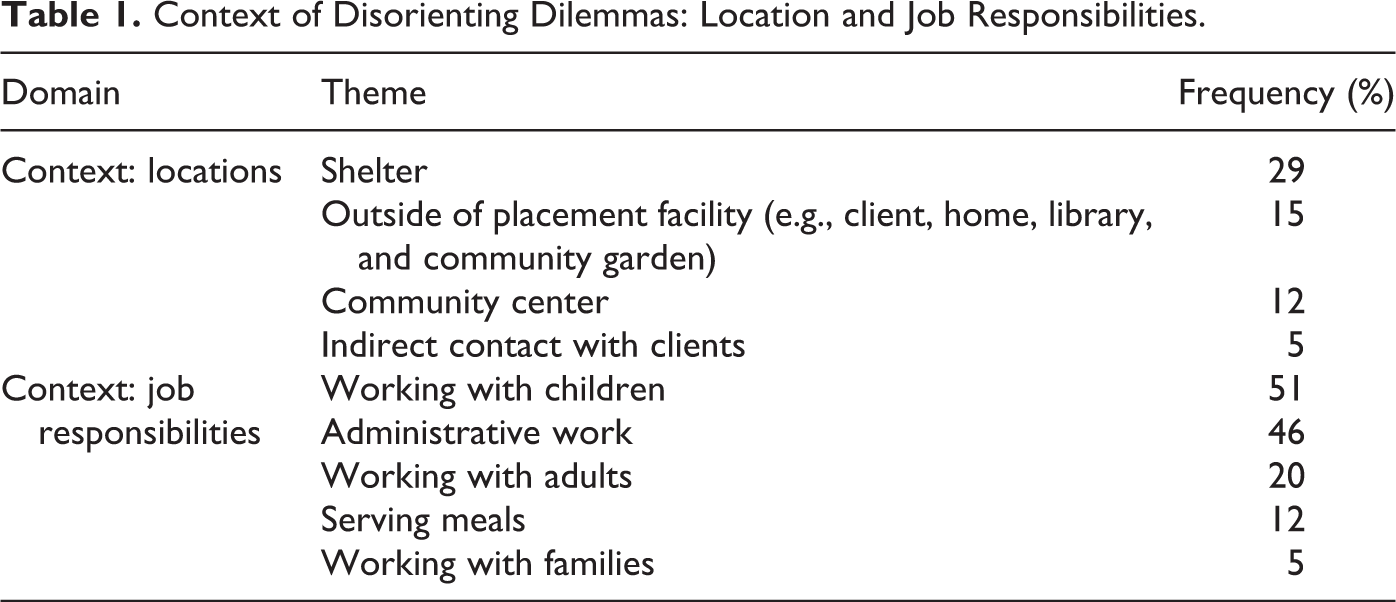
In describing their disorienting dilemma, many students also provided additional information about programmatic elements of the context. The majority (72%) of disorienting experiences reported by students occurred during a single interaction with a client. Additionally, students reported more than 3 times as many disorienting dilemmas occurred with people that they had never met before, as opposed to with client that they had ongoing relationships with.
Disorienting Dilemmas
We identified six different themes in how students described a disorienting dilemma that was eye-opening in some way (see Table 2). Most often, student’s comments referenced something difficult in a client’s life. Some students reported interactions in which the clients personally shared stories about the trauma they experienced, about their struggles to support their family, the discrimination that they face by individuals or systems, or the barriers they face in trying to make a better life for themselves. Students described in detail stories that had been relayed to them by residents of homeless shelters and other people utilizing community services: for example, a homeless man finding a safe place to sleep in woods, a third-grade student who can’t read Winnie the Pooh books, and families separated by immigration policy. Other students reported learning about clients’ difficult lives from staff and other volunteers; often these stories featured mental illness and trauma.
Disorienting Dilemma and Reactions.

The second most common way in which students commented on their disorienting dilemmas was to convey that they “truly felt a connection” with a client. For example, one student noted that she felt “accepted into [the clients’] community” after exchanging jokes and stories, while another student reported that she has “become very close with” the client. A third student described a stimulating conversation with a homeless man that defied the assumptions that student had made, which led the student to “realize how I had stereotyped and stigmatized the homeless by never thinking I could…relate to them.”
Student Reactions: Processing and Connecting
We were also interested in how experiences at the community placement affected students’ cognitions and emotions. Students described 11 themes, or reactions, to their disorienting dilemmas (see Table 2). These reactions reflect they ways in which students were trying to make sense of their experiences but does not speak to whether students assimilated or accommodated what they learned in service learning. The most common reactions to a disorienting dilemma were making judgments or assumptions about the client(s) (73%), reflection on what they interaction meant for the student (59%), and being emotionally affected by the interaction with a client (59%). Consistent with Kiely’s model, these reactions reflect students’ exploration of both their thoughts and feelings to make sense of their experiences. Less frequently, though, students also reported several behavioral reactions (i.e., changing behaviors to help clients) or behavioral intention (i.e., intentions to take prosocial action).
The judgments students made about clients were either negative and positive assumptions regarding a client’s character, life circumstance or what the student believes a client is thinking or feeling. For example, one student noted that a client’s behavior was troubling, while another found a client to be very polite. Most judgments were made about clients, such as a student who asserted that “[The client] is so full of life, quick and cunning, far older than her years and yet she is so little and young.”
Some students also reflected on what the interaction meant for them. For many students, these reflections related to how the interaction impacted their thinking about themselves or their family and helped them to remember to “appreciate what you have because you never know what the future holds.” One student noted, for example, “I actually started to feel happy about myself and appreciate what I have and thank God that my family is fine and healthy.”
Many students also reported how the interaction made them feel about themselves or others. Students reported a range of emotions including feeling inept, appreciative, disappointed, or that the interaction “touches my heart.” While students reported many positive emotions (e.g., surprised, happy, and inspired), the majority of emotions were negative (e.g., sad and angry). They often described being upset on other’s behalf, or discomforted by what was going on for them during their experience.
Relationship Between Context and Disorienting Dilemma
As stated in our third research question, we were interested not only in the frequency of events and reactions but also in how contextual elements and disorienting dilemmas relate to each other. When we compared frequencies across domains, we found evidence to suggest that there were different pathways for student experiences. Table 3 presents how frequently students reported different disorienting dilemmas when working at homeless shelter, relative to students who worked outside of a placement facility.
Frequency of Disorienting Dilemmas in Different Contexts.

Our findings suggest that working inside and outside of a community placement (e.g., a homeless shelter) produces different types of disorienting dilemmas. Students who engaged in service learning at a homeless shelter, for example, learned more about client’s current or past life difficulties. One student wrote, A middle school girl was telling me how her 19 years old sister died giving birth to her baby, and how her three brothers died in war. Her parents and her three younger siblings came to United States 7 years ago. Her parents left three kids back in Somalia because they couldn’t afford to take the other kids with them. To me this was an eye-opening moment as I got to make a connection with someone I never thought I would have. I did not realize how I had stereotyped and stigmatized the homeless by never thinking I could indeed have a stimulating conversation with them or relate to them. I failed to see them as regular people who have gone through tremendous difficulties in their lives.
Frequency of Reactions to Disorienting Dilemmas.
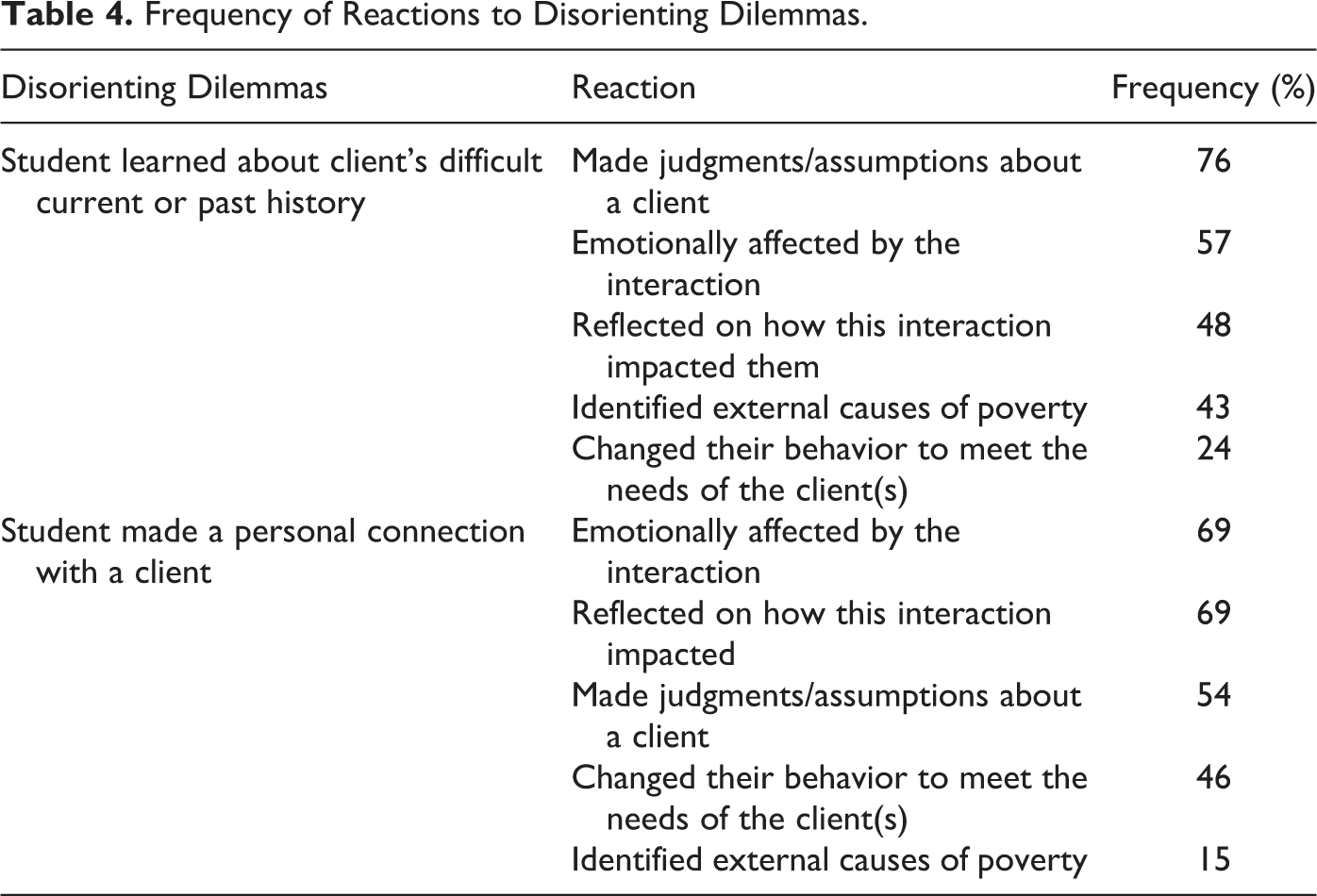
Students whose disorienting dilemma was making a personal connection with a client were more likely to report being emotionally affected by their interaction and reflect on how the interaction has impacted them. These students were also more likely to report changing their behavior in some way to meet the needs of the client (e.g., volunteering more hours, making an effort to gain the respect of client, and talking to client about resume building). Some of these students immediately changed their behavior with the client by “tailor[ing] my use of [resources] to the needs I perceive in the children I am charged with.” Others took action in an effort to help that client in the future, or people in similar situations, by asking a case manager about how to access resources or arranging additional time for a client to “come in and…help him study.”
Discussion
Pathways of Transformation
This qualitative study examined the relationship between several themes outlined in Richard Kiely’s Transformational Service-Learning Process Model. While substantial research indicates that context provides critical components of transformation (e.g., contextual border crossing), we took a closer look at how specific contextual factors (i.e., service location and job responsibilities) impact disorienting dilemmas. We explored (1) whether different disorienting dilemmas were identified by students in different types of community placements, (2) how experiences emotionally and cognitively impacted students, and (3) whether different types of disorienting dilemmas were associated with different student reactions. Our findings suggest that the ways in which contextual elements relate together can promote different pathways of transformation. We investigated the transformational process for students during a service-learning class that focuses on the systemic causes of social problems, with a focus on poverty.
Students reported a range of reactions to their service-learning experiences, and concurrent with prior scholarship, we observed that the majority of students experienced some disorienting dilemma during their work in the community. A number of relationships between the contextual components of service learning, disorienting dilemmas, and student reactions emerged as students described their experiences. In fact, our findings indicate that the location of students’ experiential learning, and their job responsibilities while there, could have a substantial impact on what students take away from a service-learning course.
A striking example of this relationship is the prevalence of different types of disorienting dilemmas for students who work at homeless shelter relative to those who work outside of a community placement. Students who worked at a shelter were more likely to have a disorienting dilemma in which they learned information about a client. Most often, this was a result of the client offering information directly to the student in conversation. Conversely, students who engaged in activities with clients somewhere other than their placement’s building tended to identify making a personal connection with the client as impactful. One explanation for this contrast is that students and clients have different role expectations in the different settings. In a shelter, students are typically assigned administrative work and have rigidly defined job responsibilities: for example, they provide resources, open locked doors, answer phones, or tutor. Within the shelter context, students have a clear position of power relative to clients, many times with the physical barrier of a desk or table separating them. These physical and psychological barriers keep them somewhat removed from clients and put them in a position to observe others. Outside of the placement facility, though, role expectations may be less clear, and students and clients may have more opportunity to interact as individuals rather than as helper and client. These findings suggest that different contextual components may therefore expose students to different types of experiences, which potentially facilitate different pathways towards transformation.
In both service-learning contexts, and consistent with Keily’s model, we found that students reported a range of cognitive and emotional reactions when trying to make sense of their disorienting dilemma. Students either focused on what the disorienting dilemma led them to realize about himself or herself (self-focused), or about another person, place, or system (other focused). With the exception of making judgments or assumptions about clients, the most frequent reactions were self-focused. This may suggest that focusing on oneself is more typical when one’s thinking is disrupted, or it may have more to do with the developmental stage of the students in our courses. As emerging adults, they are focused on identity development and understanding who they are in relation to others and the world around them. This fact is the reason that many scholars highlight the transformative potential of service learning during college (Colby, Beaumont, Ehrlich, & Corngold, 2007; Finlay, Wray-Lake, & Flanagan, 2010). Self-focused reactions are not inherently more or less desirable, they are simply representative of how college students tend to navigate the process of dissonance.
Looking at the frequency of student-focused and other-focused reactions also makes it clear that overwhelmingly, students were reporting cognitive and emotional responses and not behavioral responses. Only three reactions emerged during the CQR process that involved a behavior, and two of these reactions occurred in low frequency. Overall, students were more likely to change their behavior in some way to meet the needs of a client than they were to seek out information about a client or report prosocial intentions, but none of these behaviors requires much effort beyond what they are already doing for the course.
Implications and Future directions
The relationships between contextual components, disorienting dilemma, and student reactions have several implications for educators and researchers. Kiely presents the themes in his conceptual framework as both iterative and sequential in leading students to experience transformation. An important distinction, though, is that our findings indicate that contextual programmatic factors may place students on different paths of transformations. In fact, contextual factors may not only play a role in facilitating disorienting dilemmas but more intimately shape the types of dissonance that students experience.
These findings have the potential to allow educators to customize service-learning experiences for students. For example, better understanding of how contextual programmatic factors shape transformation could inform educators’ decision to either vary the context of the placement itself (through establishing new partnerships or inquiring about different responsibilities for students) or may adjust course content to anticipate what students are experiencing. Educators may choose to foster specific community partnerships that emphasize home-based service rather than working at a shelter, knowing that interactions in and outside of an organization’s physical location may lead to qualitatively different experiences. Alternatively, students may be matched with sites based on their previous experiences (e.g., work in a context they have never worked before), be encouraged to work at multiple sites, or educators may cultivate working relationships with organizations that offer activities for students both within and outside their facility. As permitted by the community partner, students may also be encouraged to vary their role even within a particular context, like getting out from behind a reception desk to interact with clients.
These findings also have implications for the in-class activities assigned by educators. The present study did not allow us to examine if students’ were assimilating or accommodating disorienting dilemmas. Future research might elicit student attitudes prior to service-learning experiences and have them refer back their initial attitudes throughout the course. This would better enable educators to assess if and how students were challenging previous conceptualizations, it would allow students to more concretely compare how their attitudes have changed or been reinforced.
Our findings also highlight that discomfort can be an important component of transformative processes, and educators are in a prime position to both support students and prepare them for experiences that may be disorienting. In fact, student discomfort can be valuable in this context. Educators should be prepared to respond to, and help students reflect on, that discomfort. For example, educators might alert students to discomfort and guide them in observing what they do with that unease—do they change their sense of how the world works? Educators are in a key position to enable students to reflect on whether students are accommodating or assimilating their service-learning experience and discuss the implications about how either process may influence their thinking, emotions, and behaviors. Educators can also tailor reflection activities based on student placement. For example, students placed at a homeless shelter might closely examine the difficult life history of residents, and students placed outside of a facility may be encouraged to consider the ways they connect with clients. Educators can also design discussion questions around these topics for small groups at similar placements in class, asking students to observe whether classmates assimilate or accommodate.
Presently, research on the transformational possibilities of service learning has focused on characteristics of individuals, of the placement organization, and of the triggering events students’ experience. This study suggests that a more detailed consideration of what students are doing in their placements is worthwhile. Earlier we considered how role expectations in different settings might impact how students and clients interact, and quantitative research could explore this possibility.
While role expectations may play a significant role in the quality of interactions they have with clients, it is also possible that differences across contexts were the result of the individual characteristics of the students who chose to work at different placements. To test that hypothesis, future research could randomize students to their community partners, instead of allowing them to choose an organization from a list of community placements. Randomizing students to community partners would allow researchers to ascertain if eliminating the self-selection process impacted the types of triggering events students are likely to identify in different contexts and their subsequent reactions. Additional research could also match students to community partners based on individual characteristics to determine if different pairings produced different types of triggering events and different reactions to disequilibrium. More extensive study of the relationship between the themes in Kiely’s model might provide further insight into how community placements impact (1) the process of transformation and (2) could subsequently shape positive outcomes.
Limitations
This study was qualitative and retrospective. Although the three domains analyzed through the CQR process reflect details of students’ experiences before, during, and after a disorienting dilemma, students wrote these essays at a single time point at the end of the semester. As a result, the themes represent students’ thinking about the entirety of their experience, rather than the way that it evolved over the semester. The connection between disorienting dilemma and students’ reaction may indicate that people who are inclined to think and feel a certain way are more likely to identify certain interactions as disorienting, rather than the reverse. Furthermore, because we are not comparing these essays to data collected before the semester, we cannot determine how much their thinking has changed; we can only assess whether their attitudes and behaviors are consistent with course aims. Quantitative and longitudinal research is necessary to explore change and to tease apart the array of influences on student report. As with most qualitative studies, the sample size was limited and a greater number of students need to be assessed to allow the findings to be more generalized. Finally, students were prompted to discuss an eye-opening experience in a graded assignment. While student essays that did not report an eye-opening experience were excluded from this study, it is possible that some students reported an interaction that was not impactful to them simply to answer the prompt.
Conclusion
The results of this study add to educators and researchers’ knowledge about students’ transformational process during service learning. Substantial research has demonstrated that students experience certain similar themes during transformational processes (e.g., Kiely’s Transformation Service-Learning Process Model). This study adds to this rich literature by illustrating how these processes interact, impacting how students make sense of their experiences. It is our hope that this analysis provides a starting point for targeted longitudinal research which will further examine the relationship between student’s experiences of the themes in Kiely’s model and provides clear and practically relevant information about the nature of the change process educators aim to facilitate.
Footnotes
Declaration of Conflicting Interests
The author(s) declared no potential conflicts of interest with respect to the research, authorship, and/or publication of this article.
Funding
The author(s) received no financial support for the research, authorship, and/or publication of this article.