



Abstract
Video games can have a variety of intended and unintended effects on players, making the impacts of games and the role that individual design elements play in causing those impacts a valuable area of research. This study explored the social and cognitive effects on players of two “art games” (Depression Quest and Actual Sunlight) by analyzing player-generated discussion board posts, focusing on (1) what real-life social and cognitive effects the games had on players and (2) what elements of the games made the players consider them “good” or “bad” games. Players reported or demonstrated that the games led to understanding and empathy, self-evaluation, lessons learned, clinical discussion of depression, encouragement to others, a sense of community, and opening dialogue with friends and family. Discussions of game quality centered on realism, game endings and message, and player agency.
Technological advances are lowering the barriers of entry to video game development, allowing more and more individuals and small studios to create and distribute their own games. A developer with relatively little technical expertise can create simple games using programs like Twine (Klimas, 2009) or RPGMaker (Degica Co., 2016) and distribute them on their own or through platforms like Steam (Valve Corporation, 2016b). Free from the pressure major studios face to make commercially safe bets, individuals can use video games to creatively express a range of perspectives from the highly political to the highly personal, often creating games that are smaller but more diverse, controversial, or experimental than the mainstream fare (Lipkin, 2012; Pearce, 2015). Sometimes, the results are “art games”—games that are primarily intended to “provide the player an experience of reflection outside the gameplay” (Díaz & Tungtjitcharoen, 2015, p. 4).
There has been relatively little research into this “experience of reflection” or the effect art games can have on players. Research on the effects of video games often focus more on acts or experiences that occur during gameplay and less on what effects those experiences have outside of the game context, such as much of the body of literature around “immersion” and “flow” (McMahan, 2003; Norman, 2010; Soutter & Hitchens, 2016), or on the use of games as instructional tools (Backlund & Hendrix, 2013; Dickey, 2005, 2006). The influences games can have on thoughts, attitudes, and behavior outside of a specific context are more difficult to capture and measure and are less frequently studied. However, an analysis of literature conducted by Romero, Usart, and Ott (2015) suggests that games can be used for more than simply teaching facts or basic skills. Their analysis showed that game characteristics like collaboration and strategy can help players develop “21st-century skills” like teamwork and critical thinking that are transferable to everyday life.
There is also little research regarding the social effects of games. For example, studies of diversity and representation in games often focus on the presence of diversity or the nature of the representation, not explicitly examining how those elements affect players or their behavior (Friman, 2015; Šisler, 2008; Williams, Martins, Consalvo, & Ivory, 2009).
Given these gaps, our understanding of the role art games can and will play in society is limited. For the designers of art games, there is little guidance on how to effectively communicate an idea or attitude through the mechanics and narrative of a video game. This study begins to address both needs, exploring both the cognitive and social effects of two independently developed games and the specific game mechanics that led to those effects by analyzing player-generated discussion board posts about the two games. The posts were also analyzed for indications of what made the games “good” or “bad” in the eyes of players. These findings have implications not only for game developers, who want their creations to have a particular impact on players, but also for researchers interested in the influence of games on society and culture.
Background
Two Depression-Themed Art Games
Art games are video games that are designed to “provide an experience of reflection” (Díaz & Tungtjitcharoen, 2015, p. 4) or “to tackle the human condition and to stir up emotions” (Marinescu-Nenciu, 2015, p. 196). Like other forms of art, such as literature, film, or painting, they are highly personal to the artist and are frequently vehicles for the communication of a message or the “transmission of feelings” to their audience (Díaz & Tungtjitcharoen, 2015, p. 5). Art games like the two discussed in this study can have a variety of effects on players (Díaz & Tungtjitcharoen, 2015; Marinescu-Nenciu & Rughiniş, 2015).
I chose two art games, Depression Quest (Quinn, Lindsay, & Schankler, 2014) and Actual Sunlight (O’Neill, 2014), for this study. Both are small, independent projects that were developed and released at about the same time. Both went through the Steam Greenlight process (Caoili, 2012), and both deal with the topic of depression. They differ in two key ways: the genre and the endgame. Zoe Quinn’s Depression Quest is a text-based adventure game with five endings, while Will O’Neill’s Actual Sunlight is a retro, top-down role-playing game with a single, inevitable ending.
The experience of depression is at the center of both games. The American Psychiatric Association (APA, 2013) identifies several types of depressive disorders, of which the most common is major depressive disorder (MDD). MDD is characterized by depressed mood, lack of interest in pleasurable activities, and in some cases, suicidal ideation. According to the APA, the prevalence of MDD in the United States is about 7% and is highest in the 18- to 29-year-old age range. Treatment, when sought, usually involves medication, psychotherapy, or a combination of both (Anxiety and Depression Association of America, 2017).
Games and Affordances
The ways that video games affect how we think, feel, or act can be discussed in terms of affordances or “opportunities for action” (Cardona-Rivera & Young, 2013). The concept of affordances originated with Gibson (1979) who used the term to mean what an object offers, provides, or furnishes to a particular individual. For instance, a knee-high rock “affords sitting on” to humans, as does a chair. Likewise, my laptop “affords sitting on” to my cat but not to me. Mateas (2001) describes the relationship between artist and audience as a conversation mediated by the art object (in this case, a game; in Mateas’s work, an expressive AI system), with the artist “structuring the interpretive affordances” of the work to enable the audience (or player) to derive meaning from it.
Most discussions of games and affordances focus on affordances within the gameplay itself (Cardona-Rivera & Young, 2013; Linderoth, 2012; Mateas, 2001). However, this study looks beyond the immediate gameplay experience for two types of affordances, such as cognitive affordances and social affordances. A cognitive affordance is “a design feature that helps, aids, supports, facilitates, or enables thinking and/or knowing about something” (Hartson, 2003). The Cognitive Affordances of Technology Scale, developed by Dabbagh and Dass (2013; Dabbagh, 2010), describes seven categories of cognitive affordances that may be present in learning technologies: experiential learning, discourse/dialogue, supportive, learn by doing, critical thinking, conceptual change, and self-regulated learning. However, these affordances can also be observed in games that are not specifically meant to be instructional in nature (Checa-Romero, 2016).
A social affordance is “the relationship between the properties of an object and the social characteristics of a given group that enable particular kinds of interaction among members of that group” (Bradner, 2001, p. 2). In information studies and interaction design, discussion of social affordances usually centers on technology-mediated communication (Dabbagh & Dass, 2013), but it is possible that the content and messages of a game can afford social interactions as well. As Bogost (2011, p. 5) puts it, partially quoting media scholar Marshall McLuhan, “the medium is the message, but the message is the message, too.” For video games, the most prominent social affordance is the ability to interact with others in many games. For instance, a multiplayer game can afford interaction among friends (Nardi & Harris, 2006; Szentgyorgyi, Terry, & Lank, 2008), and the social features of the mobile game Trivia Crack can afford seniors the ability to keep in touch with grandchildren (Osmanovic & Pecchioni, 2016). The restriction of social features in Nintendo’s Pokémon games means that franchise does not afford abuse or harassment of other players (Ochsner & Saucerman, 2015).
In order to understand the real-life effects that the personal and reflective genre of art games can have on players' thoughts and attitudes, as well as their interactions with other people, the first research question asked by this study is:
Game Quality
Just because a developer intends for a game to have particular affordances or to have a certain impact on the player does not mean that the player will perceive or take advantage of those affordances or indeed that anyone will even play the game. Unlike pedagogical games that may have a captive audience, art games like Actual Sunlight and Depression Quest must entice people to buy them (in the case of Actual Sunlight), download them, play them, and hopefully spread positive word about them to encourage other people to do the same. Kallio, Mäyrä, and Kaipainen (2011) uncovered “at least” nine player motivations for games, such as killing time, having fun, and socializing with friends. In order for serious games to be played voluntarily by a wide audience—that is, without being assigned by an authority figure like a teacher or employer—they must appeal to the common motivations for game playing. In other words, they must be “good games.”
Of course, what precisely makes a game good is a matter of debate. There is general agreement that a good game is one that gives players a sense of flow—that is, “the feeling of complete and energized focus in an activity” (Chen, 2007, p. 31), but the aspects of a game that trigger that feeling may differ from person to person depending on player styles, experience, and individual preferences. For some gamers, a good game is one with an engaging story; others look for an immersive experience driven by graphics and sound, game mechanics that are unique and different from most other games, or deep world-building (Bond & Beale, 2009; Martin, 2014; McMahan, 2003).
The second research question seeks to identify how the design choices made by the games' developers affect how players evaluate the quality of the games:
Method
Context
Steam (Valve Corporation, 2016b) is a publishing and distribution platform that provides access to over 3,500 games, allowing players to purchase blockbuster titles like The Elder Scrolls V: Skyrim (Bethesda Game Studios, 2011) or to download small independently developed games like Emily Is Away (Seeley, 2015) for free. The Steam website and downloadable client also provide access to an enormous community of gamers—there are over 100,000,000 registered player accounts and millions of people are logged onto the platform at any given time (Valve Corporation, 2016c). This community is made apparent in the form of “Community Hubs” for each game on the platform. Community Hubs can include a variety of user-created content like reviews, discussion boards, mods, gameplay videos, screenshots, and fan art. The Steam Greenlight process is an avenue for independent developers to have their games distributed via the Steam platform. Developers submit trailers, screenshots, and descriptions of their games for review and registered Steam users vote on whether or not the games should be accepted for distribution in a process called “greenlighting.” Both Depression Quest and Actual Sunlight were greenlighted and are available on Steam.
Depression Quest
Developers Zoe Quinn, Patrick Lindsay, and Isaac Schankler created Depression Quest in February 2013 as a browser-based game. When the game did well online, Quinn decided to submit it to Steam Greenlight, initially withdrawing the game after encountering harassment, then resubmitting it later. The Steam Greenlight community approved Depression Quest for distribution on Steam and it was released on August 11, 2014.
Depression Quest’s simplicity was intended to make it as accessible as possible, both physically and intellectually. It was designed to be inclusive of people without much familiarity with games (Stuart, 2014). Although it has a simple soundtrack and minimalist graphics, the bulk of the game is textual in the style of interactive fiction. Players read short vignettes describing a situation the main character is in. Some words or phrases in the vignette might be hyperlinked to supplementary content—for example, clicking “day job” will lead to a short description of the protagonist’s job and coworkers. At the end of the vignette, the player is presented with a few options on how to proceed, but not all options are playable. For instance, near the beginning of the game, the protagonist’s girlfriend asks the player to go to a party. There are three options presented: going to the party and having a good time, going reluctantly, or staying at home. The first option, going to the party, is displayed in red and is crossed out and not selectable (see Figure 1). Depending on the choices the player makes, as the game progresses, they may find more and more options are not selectable, emulating what some commenters called the “downward spiral” of depression.

A screenshot from Depression Quest, illustrating enabled and disabled options.
The story is told in second person—“you”—encouraging the player to identify with the main character. Additionally, the main character is never identified by name or gender, meaning the player can assume they are playing a straight man, a lesbian or bisexual woman, or another gender/orientation combination. (This nuance was largely lost on the Steam commenters, who overwhelmingly made the assumption that the main character is a straight male.)
Depression Quest begins with a short introduction from the developers, first warning players that it is “not meant to be a fun or lighthearted experiences” and that if they are suffering from depression, they may wish to avoid playing the game. The introduction also describes the two goals of the game: To help people without depression understand what the experience is like and to let people who do suffer from depression know that they are not alone. The game can end with the main character barely functional and in deep and untreated depression, or under treatment (therapy, medication, or both) that manages the condition and allows the character to have a healthy relationship and relatively happy life, or somewhere in between. An epilogue from the developers explains that there is no “tidy ending” to the game, just as there is no real cure for depression.
Actual Sunlight
Will O’Neill developed Actual Sunlight in 2012 and offered it as a free download in early 2013. It was revised, enhanced, and submitted to Steam Greenlight, where it was approved and released on April 3, 2014 (O’Neill, 2014, 2016). Actual Sunlight is a retro-style role-playing game, with the top-down look and feel of many classic video games of the 1980s. It was created using the game development software RPG Maker VX Ace, which allows users to easily create role-playing games (Degica Co., 2016). The main character is Evan, a deeply depressed gamer who works in a generic cubicle farm. The player interacts with objects that reveal Evan’s inner thoughts and narratives, which are often in the form of journal entries or fantasy conversations. There are no story-based choices in the game—the player can choose the order in which they interact with objects, but nothing they do will change the course of the game, or the inevitable ending with Evan standing on the edge of a roof (see Figure 2).

A screenshot near the end of Actual Sunlight.
Although there is sardonic humor in the game, Actual Sunlight is extremely dark. For example, the game begins with the observation, “Why kill yourself today when you can masturbate tomorrow?” At one point, the game warns players who are under the age of 30 that they still have time to change their lives for the better, and they should not identify too strongly with Evan. Disquietingly, there is no advice for players who are over 30 years.
Data
The data for this study come from the Steam community discussion boards for Depression Quest and Actual Sunlight. All discussion threads and comments on the Depression Quest board that were in existence on April 23, 2016, and all on the Actual Sunlight board that were in existence on April 25, 2016, were included in the study. This included 28 threads for Actual Sunlight, with the oldest post from April 3, 2014, and 67 threads for Depression Quest (a total of 95 threads), with the oldest post from August 8, 2014. Most threads contain multiple comments from multiple players.
Because the data were collected 2 years after the games were first released, and because Steam discussions are moderated, this does not represent all posts that were ever made on these two boards. Discussions can be deleted (and posters banned) for topics and behavior as varied as “threats of violence or harassment, even as a joke” and “religious, political, and other ‘prone to huge arguments’ threads” (Valve Corporation, 2016a). Many threads for Depression Quest in particular are likely to be missing, since it was the game that instigated the GamerGate controversy (Dewey, 2014). There is no indication of how many threads or comments were deleted, but several of the existing Depression Quest threads refer to other threads or comments that had been removed. Additionally, Steam redacts obscene language automatically by replacing the words with a series of heart shapes.
Although all the threads and comments are publicly available on Steam, and people’s identities are hidden behind usernames, I have chosen not to cite usernames. Given the sensitive nature of mental health issues that many people discussed, and one of the games’ history with GamerGate abuse, I believe that leaving usernames out of publication is the most ethical way to proceed. For the same reasons, I am extremely conservative in my use of direct quotes, relying on paraphrase and aggregation whenever mental health issues are under discussion. I use the pronouns “they/their/them” to refer to most of the commenters in an additional effort to protect their privacy and to reflect the fact that in most cases, it is impossible to know how a commenter identifies their gender.
Coding
I coded the discussion threads in Dedoose ver. 7, an online program for conducting qualitative analysis (SocioCultural Research Consultants, 2016). To begin with, I read through each thread and made notes of possible codes that emerged from my reading. Next, I coded several of the longest threads with this first set of codes and others that seemed useful or necessary during the coding process. Revisiting the research questions and revising the list based on the trial applications resulted in the codes listed in Table 1, for a total of 11 codes.
Codebook.
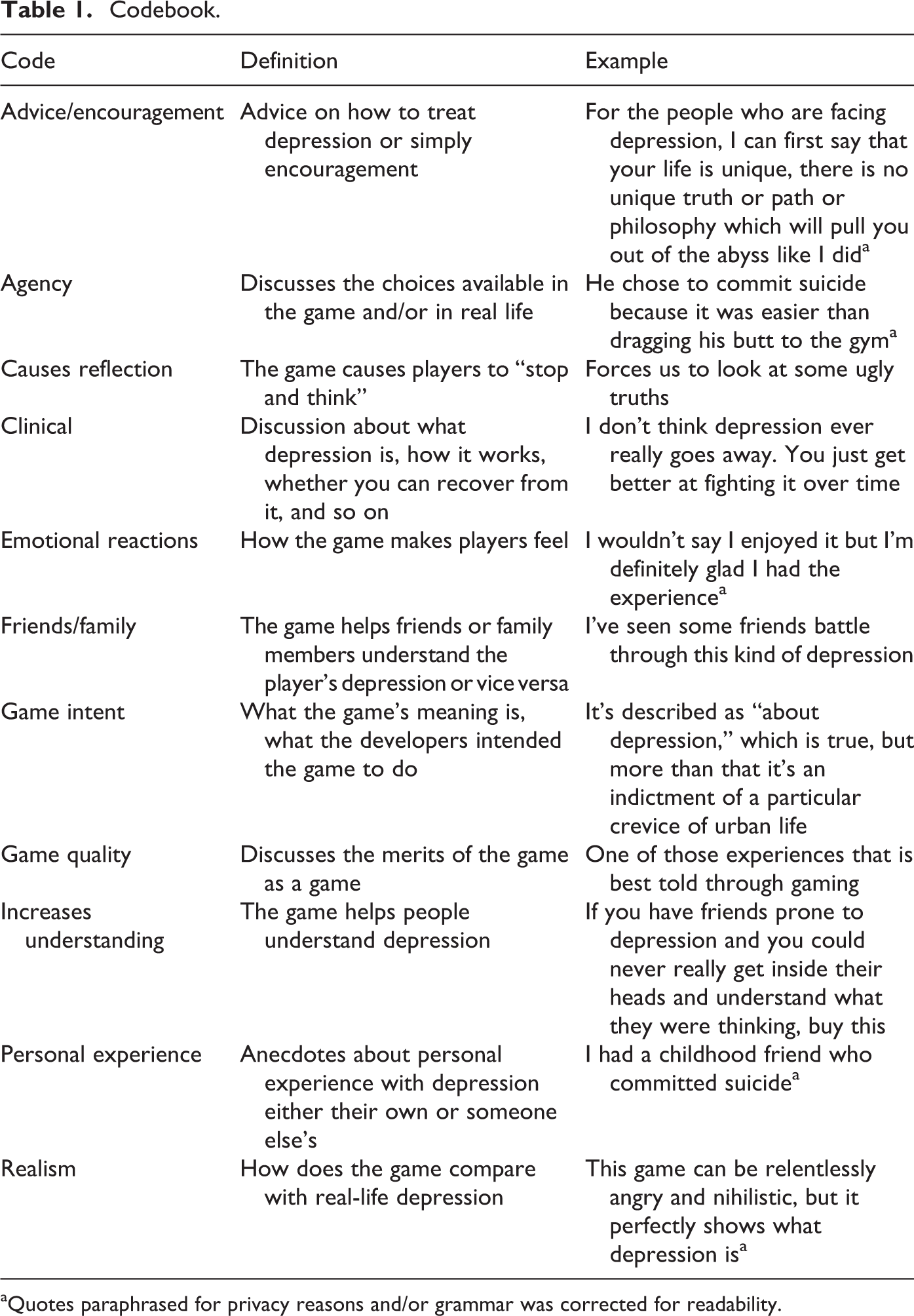
aQuotes paraphrased for privacy reasons and/or grammar was corrected for readability.
I purposefully did not code some types of comments—for example, questions about the game’s content by someone who hadn’t played it (although I coded answers to those questions), technical information (such as bug reports, translations, or the software used to develop the game), or the history of the game on the Steam store. In all, 70 discussion threads were given one or more codes. See Table 2 for the number of threads that were assigned with each code.
Number of Threads Referencing Each Code.

Analysis
Analysis of the Steam discussion threads provided insight into the social and cognitive affordances of the two games as well as the reasons players thought they were or were not good games.
Cognitive Affordances
Many players said that both games gave rise to reflection, using phrases like “made me think” and “makes you stop and contemplate,” “provocative.”
Understanding and empathy
A common observation for both games (though more so for Depression Quest) was that they “help you understand” depression even for people who do not suffer from it themselves. In particular, several people pointed out that while it is good to understand the experience of depression, it is not desirable to get it from firsthand experience. One user said, “it’s nice that people can understand without having gone through it themselves.” Some players who did not report experiencing depression themselves expressed surprise at the insights they gained from playing. “Wow,” said another player, “this game really is an eye opener to how people may actually feel as opposed to how they may act.” Someone else shared that they had friends who had committed suicide or practiced self-injury and explained that although they never “got it” before, now they “finally understand” and will be more compassionate toward others in the future.
Self-evaluation
Both games made people reflect extensively on their own personal experiences with depression, but Depression Quest seemed to elicit more evaluative reflection. Six Depression Quest commenters said the game made them recognize symptoms in their own lives that might indicate that they are depressed, and some even said they reached out for treatment as a direct result of the game. Other players of both games indicated that they felt that their feelings were validated as a result of playing.
Players of both games indicated that playing through the depiction of depression in the games made them realize how much their condition had improved—how far they had come. One young person said they had cried for the first time in years, not out of sadness but out of pride and joy that they had worked through the hardest parts of their life without committing suicide. Another simply noted that they hadn’t realized how much better their life was now.
Lessons learned
Players from both games took lessons away from the game, focusing mostly on how to deal with their own depression. However, the nature of those lessons differed slightly between the games. Players treated Actual Sunlight as a cautionary tale—as an extreme example of what not to do. As one commenter said, “This game is just one depressing fact after another, but behind it all is that you should do something before your life goes to….” Another put it more simply, “the moral of the story is to not be this guy.” Other Actual Sunlight players zeroed in on specific lessons, particularly regarding self-control and self-pity. One player said that Evan should have stopped complaining about being fat “while he eats pizza and burgers”; another pointed out that he didn’t take action to solve his problems or “move his fat…to lose weight.”
Depression Quest players treated the lessons much more personally. Several people drew parallels between the game choices and the choices they made in their own lives. One described having decided not to go out with friends right before playing the game, then changing their mind because the similar situation in the game made them realize that staying in would only make them feel worse. Another lesson that seemed to be learned only from Depression Quest was simply one of hope—the realization that making the “right” choices would lead, not immediately but eventually, to a better life.
Other players also believed the games could teach lessons but were concerned about what those lessons were. A Depression Quest player expressed concern that cognitive behavioral therapy was not presented in an adequately positive light. One Actual Sunlight player, who had struggled with suicidal thoughts in the past, felt that the game was too hopeless and expressed Evan’s relief at choosing to end his life in a way that could dangerously affect someone in a similar situation. Another Actual Sunlight player summed it up this way: You can argue all you want about it being social commentary, or an example of “how not to be,” but is that really how somebody who was seriously depressed is going to see this? OR are they going to be drawn deeper into hopelessness and despair?
Social Affordances
Both games afford extensive discussion of themselves. Beyond that obvious statement, however, the discussion boards are full of examples and accounts of social interactions facilitated or instigated by the games.
Clinical discussion and sharing personal experience
An exploration of gamers’ perceptions of depression, based on the comments from this data set, could form an entirely separate paper, and fortunately, a detailed examination of those beliefs is outside the scope of this study. Suffice it to say, the commenters cover a range of clinical topics, from the symptoms of depression, how depression affects the sufferer’s ability to choose to seek treatment or make other healthy choices, whether or not depression can ever be fully cured, the effectiveness of cognitive behavioral therapy, and even some arguments that some people who say they are depressed are merely being trendy. The clinical discussions are frequently intertwined with the sharing personal experiences with depression, both their own and that of their friends or family members—for instance, sharing the fact that Lexapro helped their symptoms more than Prozac.
Many of the clinical and personal discussions also involved giving advice to people with depression. These run the gamut from telling people to seek out the help of a therapist or to make positive changes in their life, to suggesting that people channel all their negative emotions into anger, or to simply “stop being sad.”
Encouraging
There are also numerous examples of people sharing encouragement for those suffering from depression. Some posts were directed generally at anyone who might read it and were longer and more emotional and poetic. For instance, No matter how small or trivial you feel like you are, you aren’t. You are unique and worthy of respect/life, not from what you can accomplish, but by the connections you make with others and the joy you bring by existing.
There is evidence in the comments that the moderators had to delete at least a few threads and comments because people were mocking or harassing players who had shared their stories. A few flippant comments still remain, such as “RIP [rest in peace] bro” and “Wuss” in response to someone who had shared their personal experience. There are also comments chastising those people—“come on man, don’t insult someone for having depression.”
Opening dialogue with friends and family
Many people mentioned that both games would be useful for understanding and empathizing with friends or family members who have depression. Several offered concrete examples of the ways they used Depression Quest (but not Actual Sunlight) to start or enhance dialogues with the people close to them. One described Depression Quest as a “tool” to help their friends understand them. Another explained, It helped my spouse realize that my sickness isn’t their fault…. It helped start a dialogue about depression and helped me explain that while treatment helps, it doesn’t solve the problem entirely and I can still have bad days. (Paraphrased)
Sense of community
A few players of both games said that playing made them realize they were “not alone” or “not the only one” who experienced the feelings described in the games. A Depression Quest player encouraged people to support the game because it’s important to be together and fight against the stigma. An Actual Sunlight player said they found it comforting to know that there were others who felt the same way. On the other hand, one Actual Sunlight player said, it was “depressing” to realize that so many other people were going through the same painful experiences.
Game Quality
Realism
A common theme on both boards was whether or not the depiction of depression was realistic. This was a common trigger for people sharing personal experiences and launching into clinical discussions. Most people agreed that while both games were clearly depictions of one person’s individual experience, they were generalizable enough to be useful and relatable. Several times, players spoke in defense of both developers’ limited resources—“game is a $5 indie title, wtf are you expecting exactly?”
Others felt that the depiction of depression was simply wrong and offensive. One Actual Sunlight player said, This “game” is not a positive portrayal of mental illness. To portray depression or any other mental illness as being nothing more than a series of horrible character flaws, flights of narcissistic fancy, and selfishly destructive behavior negates, trivializes and demonizes the experiences of people who have genuinely struggled with this illness…. People who identify with the main character should not be applauding this portrayal. This game does not hold up “a hard hitting” mirror to depression, it is a love letter to narcissism.
Several people felt that both games were too simplified to be meaningful depictions of depression. “It’s too short to resemble a real life,” one commenter said about Actual Sunlight. A Depression Quest player expressed a wish for the game to explore the personal “idiosyncrasies” of depression. One person suggested that Depression Quest could “teach people through gameplay” through the addition of a “symptoms meter” that could be managed by developing coping mechanisms—some better (going to therapy) and some worse (drinking). However, another player felt that was taking the “game” analogy too far and reducing mental illness to a set of hit points.
Game endings and message
There was some discussion of the fact that suicide is not a presented option in Depression Quest. Commenters seemed to agree that while it is an important possible aspect of depression, it could be damaging or simply in “poor taste” to include. Others pointed out that just because you are depressed does not mean you will commit suicide, and not all people who commit suicide have a history of depression. Many people agreed that the “point” of the game was one of understanding, empathy, and hope.
Actual Sunlight, of course, always ends with Evan on the edge of a rooftop. This frustrated some players who wanted a successful ending to the game. “I was a bit disappointed at the end, I wanted more options. The gamer in me wanted to save the guy.” Others felt it was pointless—“Anyone depressed would already see and understand it, and anyone who ‘isn’t’ is just going to be brought down by it.”
People saw Actual Sunlight’s message to be a cautionary tale (as discussed above) or a social critique: “it’s an indictment of a particular crevice of urban life—where the labor you do to keep yourself alive drains you of the emotional and mental resources to connect with others or develop yourself. And no one cares.”
Agency
Player agency was a topic of debate for both games. Depression Quest offers the player some, but limited, options—the limitations being an important part of the game mechanics. Actual Sunlight presents the illusion of player agency—you can move Evan around at will and choose in which order you interact with the objects—but there are no narrative choices available to the player. Although almost everyone found the limited or nonexistent agency frustrating, some also understood and appreciated it. An Actual Sunlight player reported: I connected with the character, but then felt disconnected from him gradually as though he was slipping away and I couldn’t do anything about it. Seriously, ----ed with my head and made me really appreciate my friends and family. Great experience.
Discussion
Research Question 1: Affordances
Both Depression Quest and Actual Sunlight provide cognitive and social affordances made possible by specific narrative and mechanic elements chosen by the designers. This finding suggests that art games can have a significant impact on players’ beliefs, social interactions, and possibly even their health and the quality of life. Games that are not developed to fulfill an educational agenda can have a profound impact beyond teaching facts or skills.
The games prompted cognitive affordances such as self-evaluation, inspiring players to reflect on their own mental health and how their actions might affect their sense of well-being. Players were able to draw very personal lessons learned from the games that reportedly had a positive impact on the management of their condition, despite the lack of explicitly instructional or educational content. Just as significantly, some players who did not suffer from depression reported an increased sense of empathy and understanding for those who do.
Although social affordances are usually discussed in terms of communication technologies (Dabbagh & Dass, 2013), this study shows that a technology need not directly facilitate communication in order to influence it. The games helped foster a sense of community among players with depression, who reported feeling less alone after playing the games. The message board posts included people sharing their stories with each other and providing each other with encouragement. The games also sparked discussion about the clinical aspects of depression including symptoms and treatment options. Perhaps most surprisingly, players reported using Depression Quest as a springboard for discussing depression with their friends and family members. All these affordances indicate that even small art games can provide rich, nuanced experiences with complex and positive effects on players and the people close to them.
Research Question 2: Quality
Three major themes affected players’ experiences of the game and their perceptions of them as good or bad games—or indeed, to classify them as something other than games entirely. Realism was a common theme that often led to the clinical discussions mentioned above, surrounding what depression is, what the symptoms are, and what the best treatments are. There was a general consensus that a more realistic depiction was good and that a less realistic depiction could be harmful. The game endings and message were also a topic of debate among players; the perceived point or “intended message” of the games was treated as important considerations when judging the game’s merits.
Player character
The player character had a significant impact on players’ reactions to both games. This finding is in line with previous research. Díaz and Tungtjitcharoen (2015) found that the main character in an art game is a “catalyst for the player’s emotions.” The ability to “identify” with a character—to “forget ourselves and become the other”—is a key element in the way an audience reacts to media (Cohen, 2001); in video games, a player’s identification with a character is related to the experience of flow (Soutter & Hitchens, 2016).
The two games in this study had very different player characters. In Depression Quest, you are given almost a blank slate—a nameless, genderless character with a nondescript job and nondescript personal hobbies, presumably, to make it is easy for players to imagine themselves in the place of that character and to draw parallels between their lives and choices and those of the character in the game. On the other hand, Actual Sunlight is about a very specific character, with a name and age, who interacts with many named characters, lives in a specific apartment that you can explore, and so on. This specificity appeared to drive home the “don’t be that guy” message that players took from Actual Sunlight.
Player agency
Regarding their treatment of player agency, both games provided players with a “shock”—a design element that jolts a player out of experiencing a game as “real” (McMahan, 2003). Normally treated as design failures, in these two cases, the shock is an important part of the message being communicated by the designers, and many players recognized that. Depression Quest’s limited range of options is an important part of the story and enabled a great deal of learning and reflection on the part of the players, evident in their discussion of how the game made them think about their own real-life choices. And while Actual Sunlight players have no influence on the game’s outcome whatsoever, frustrating some players, other comments reflected tremendous emotional reactions to the game’s powerful, singular message.
Game message and tone
Depression Quest is sad and occasionally dark, but many players saw in it a message of hope and empowerment. No matter how poor your choices are, you are still alive and have some modicum of hope at the end. Actual Sunlight was seen as an “angry and nihilistic” cautionary tale that can only end in suicide. This makes Actual Sunlight’s message more powerful and leads to an even more emotional experience, but it does not make it a game that a player is likely to use as a tool to help their friends and family understand their experience.
Limitations
This study is admittedly limited in several aspects, though none detracts from the implications of the findings. First, the scope of the study could be expanded significantly. This study was limited to two games. Both games were of similar length (less than a few hours of gameplay) and were developed by a small, independent team (three people worked on Depression Quest; Actual Sunlight was a solo endeavor). More complex games with more sophisticated (or simply different) mechanics may have very different affordances. Likewise, both games focused singularly on the topic of depression. It is unlikely that the results reported here are entirely generalizable to games on other topics or to games that are purely entertainment-driven. Looking at discussions on more than a single platform (Steam) could lead to additional insights as well.
The unstructured nature of the data was both a strength and a drawback of the study. The conversations and comments on the boards were incredibly rich and deep as players expressed themselves in personal ways, allowing common themes to emerge organically. On the other hand, the commenters’ wide variety of topics and ways of expressing their thoughts made it difficult to make comparisons between the two games. This meant that only the strongest, most obvious similarities and differences could be meaningfully discussed in this article. Additionally, the nuance of whether a player was discussing the perceived intended impact of the game, or the actual impact the game had on the player, was sometimes difficult to ascertain. A more structured approach, using interviews or surveys, could capture the players’ thoughts more precisely.
Conclusion
This study set out to uncover what cognitive and social affordances are present in two depression-themed art games, Depression Quest and Actual Sunlight, and what elements of the games design make players describe them as good or bad games (or not games at all) by analyzing message board posts from players on the Steam website.
Both games stimulated reflection and thoughtfulness in players, leading to understanding and empathy, self-evaluation, and lessons learned. Socially, some players of both games were prompted to engage in clinical discussion of depression and sharing personal experience, encouraging fellow players with depression. They also reported feeling a sense of community with other people with depression after playing the games. Some players of Depression Quest used the game to open dialogue with friends and family to talk about depression. Players referenced realism, game endings and message, and player agency in discussions about the quality of the games. These findings suggest that game designers should consider what effects they want to achieve from the player character, player agency and game complexity, and the game message and tone when creating a game.
This study demonstrates that games are not just expressive vehicles for creators. They can also help players understand and express themselves, even in difficult situations such as explaining a mental health condition to loved ones. As shown by both titles, Depression Quest and Actual Sunlight, games can have an impact on behavior including mental health–related behavior. Video games should be treated as powerful potential tools for addressing social issues. Their potential is underscored even further by the fact that people sought out these two games and played them voluntarily for entertainment purposes—they were not assigned or prescribed. Video games can be a way to reach audiences that might not be otherwise accessible.
The findings in this study should inspire further research into the use of games to address social issues and health issues, both physical and mental. The use of art games or other games that are not specifically instructional or educational as part of treatment or education programs is a promising area of research. The effectiveness of these two small art games could have implications for the design of games that are to be used intentionally as therapy tools. Finally, future researchers should compare the relative strengths and weaknesses of issue-themed art games and specifically educational programs. This research has shown that art games are not “just” art. They are an evolving form of media that will only grow more powerful and relevant in modern society.
Footnotes
Declaration of Conflicting Interests
The author(s) declared no potential conflicts of interest with respect to the research, authorship, and/or publication of this article.
Funding
The author(s) received no financial support for the research, authorship, and/or publication of this article.