



Abstract
Dispositions are properties that can manifest under certain conditions. Their manifestations may create new conditions under which further dispositions can manifest. Thus, the manifestation and activation of dispositions have been described as making the world “tick,” like a clock. Representing dispositions is essential for modeling how their bearers change through time and, therefore, for representing events. However, dispositions rarely work alone: in many cases, the changes undergone by some entity are determined by many interacting dispositions. Nevertheless, dispositions are usually characterized by stimulus-manifestation pairs. This kind of definition provides little information regarding what happens when multiple dispositions manifest simultaneously. Even in cases that we can describe with mathematical models, we lack tools to connect the mathematical and ontological models. We propose a method to represent dispositions by associating them with vectors over quality dimensions. These vectors indicate the direction and intensity of the change that a quality will undergo when the disposition manifests. The interaction between distinct dispositions is a function of their vectors. Thus, we are able to connect mathematical modeling of phenomena to an ontology that supports reasoning using inference tools. Finally, we apply our proposal in modeling oil flow inside a reservoir in the petroleum production domain.
Introduction
A disposition is a property of an entity of behaving a certain way under determined circumstances. Examples of dispositions include properties such as fragility, solubility, flammability, and so on. As long as the required circumstances for their manifestations are not met, dispositions exist “dormant,” that is, unmanifested and undetected. This characteristic contrasts dispositional properties with categorical properties, which are always manifested, such as shape and color. Further, this distinction highlights the relation between dispositional properties and events: while categorical properties are manifested in static situations, dispositional properties manifest dynamically.
Our research seeks to provide tools to represent events in dispositional models by relying on the circumstances that lead to those events—circumstances that may be understood by the presence of dispositions and the obtaining of their stimulus conditions. This enables the prediction of events that may be triggered by a certain state of affairs. Further, we seek to aid in the forecasting of the changes that such an event may bring.
Both the prediction of events and the forecasting of changes are relevant tasks in engineering domains. Examples include the prediction of events associated with well drilling (Cheng et al., 2024) and petroleum production (Santos et al., 2024), the operation of autonomous driving systems (Xiao et al., 2023; Xue et al., 2018), and the detection of seismic and volcanic events (Falanga et al., 2022).
We aim to support tasks of event and change prediction in practical industry applications. An example of such an application is the monitoring and calibration of petroleum production plants based on simulation models. Those models usually rely on a set of simplifications to simulate very complex events, supported by a powerful abstraction of the domain. However, that abstraction is restricted to purely mathematical frameworks, and it is not explicit in conceptual models. Thus, the knowledge contained in the models remains inaccessible to those who are not familiar with the peculiarities of the mathematical formalism. We aim to bridge the semantic representation of the domain and its mathematical formalization. This would speed up and qualify the decision-making process in the monitoring scenario.
Current approaches to representing dispositions face key limitations in addressing these issues. Most significantly, they tend to reduce the representation of dispositions to simple stimulus-manifestation pairs. This kind of approach fails to capture finer details of dispositions, including their potential interactions with other dispositions, the gradations of intensity between distinct dispositions of the same kind, and the corresponding variations of their manifestations. This gap is especially problematic in engineering and scientific domains where quantitative precision is essential. Without a richer model that can account for both the interaction and gradation of dispositional effects, existing representations fall short in enabling reasoning about complex physical processes.
Therefore, we propose a novel approach to the representation of dispositions that seeks to overcome those limitations. To achieve this goal, we connect complementary views of events, respectively associated with dispositions and with qualities. Further, we ground our research on current approaches for representing qualities in geometric spaces (Borgo et al., 2022; Gärdenfors, 2004; Guizzardi & Zamborlini, 2014), as well as on frameworks of causal reasoning that represent dispositions with the aid of vectors (Gärdenfors, 2014; Mumford & Anjum, 2011a, 2011b; Wolff, 2007). Upon this theoretical structure, we formulate a framework to represent the contribution of a disposition toward a certain change over a quality as a vector that can be mapped to a translation of that quality’s value through the geometric space. Finally, we apply our approach to a case from the domain of petroleum engineering as proof of concept.
This paper is organized as follows. The remainder of Section 1 analyzes the limitations of current approaches for modeling dispositions and their relations with events (Section 1.1), and presents a brief outline of our approach (Section 1.2) and its scope (Section 1.3). Section 2 provides some background on fundamental concepts for our proposal, particularly qualities, dispositions, and events. Section 3 presents our vector-based approach for modeling dispositions. Section 4 provides a first-order formalization of entities and associated axioms. Section 5 presents a model for oil flow that implements our framework. Section 6 demonstrates an implementation of our approach and one type of intended application by modeling the oil flow model in a production plant. Section 7 gives an overview of the related work in conceptual modeling and ontological engineering. Finally, Section 8 offers some discussion and concluding remarks.
Limitations of Current Approaches
During the last decade, dispositions have attracted significant attention from the conceptual modeling and ontological engineering community. Dispositions have been used to model risks (Barton et al., 2017), value (Sales et al., 2018), capabilities (Miranda et al., 2016), beliefs (Barton et al., 2018a), desires and intentions (Toyoshima et al., 2020), vulnerabilities (Oliveira et al., 2022), prevention (Baratella et al., 2022), forces (Barton et al., 2014), velocity (Barton & Ethier, 2016), causation (Bird, 2020; Guizzardi & Wagner, 2013; Toyoshima, 2019b), and, rather prolifically, diseases (Babcock et al., 2021; Barton et al., 2018; Goldfain et al., 2010; He et al., 2021; Scheuermann et al., 2009; Toyoshima, 2019a).
However, current approaches to representing dispositions emphasize their characterization based almost exclusively on their stimuli and manifestations. The stimulus (or trigger) of a disposition is the situation, process, or set of conditions that lead to the activation of the disposition, while its manifestation (or realization) is the behavior of the disposition’s bearer in that situation or under those conditions. For example, fragility is frequently described as the disposition to break when struck. Thus, its stimulus is being struck, while its manifestation is breaking.
This type of disposition representation connects the disposition’s stimulus to its manifestation but goes no further in describing the disposition itself. Thus, when we need to compare two distinct dispositions, we usually find ourselves comparing the content of the stimuli or manifestations of the dispositions rather than the content of the dispositions themselves. If we say that a glass is less fragile than another because it only breaks after being struck harder, we are comparing the stimuli of the dispositions. However, the distinction between the behaviors of both glasses under the same conditions lies not in those conditions, but in the characteristics of the glasses themselves and their distinct dispositions. In order to properly represent that distinction, we must go beyond the stimulus-manifestation representation.
Another weakness of stimulus-manifestation descriptions comes from the issue of representing multi-track dispositions. A multi-track disposition is a disposition that may manifest under several distinct stimuli, in possibly distinct ways (Heil, 2003; Vetter, 2013; Williams, 2011). A multi-track view of fragility, for example, would include both the disposition of a piece of glass to break when struck and the disposition to crack when struck weakly. It is evident that defining multi-track dispositions in this manner requires a long list of stimulus-manifestation pairs that grows longer and longer with the increasing precision in the definition.
Going further, we may imagine an entity that bears multiple dispositions that manifest simultaneously. Stimulus-manifestation descriptions of these dispositions do not provide sufficient tools to represent their mutual interaction. That is, there is no way to define how the manifestations of a set of dispositions combine. Take, for example, a hot air balloon. It bears some compressibility, that is, the disposition to decrease in volume when external pressure increases. It also bears some thermal expandability, , the disposition to increase in volume when temperature increases. From these definitions alone, it is impossible to determine what happens when the balloon goes through a high-pressure zone while being heated by a burner. Will it increase, decrease, or remain the same size?
Philosophers concerned with the simultaneous interaction between dispositions that work toward distinct outcomes have developed the contribution combination view of dispositions. Although the ontology engineering literature provides formalizations for other ways of relating dispositions, such as stimulation and mutual manifestation, the contribution combination has not yet received the same treatment.
Proposal Outline
We propose an enriched approach to representing dispositions, as an evolution of our previous work on vector-based representation of dispositions (Antunes et al., 2024). We develop a framework that provides a suitable foundation for the formalization of the contribution combination and that is grounded on vector-based frameworks of causal reasoning. Our approach focuses on how dispositions influence specific qualities, allowing us to identify dispositions that affect the same qualities. Moreover, dispositions are related to vectors within quality domains, which we named “impetus,” analogous to qualities being related to points (qualia) within those domains. These vectors show the direction and strength of the disposition’s contribution to the change it would cause when and if it manifests.
The vector-based approach allows us to compare dispositions. We can see what kind of change they cause (based on direction) and how strong that change is (based on magnitude). For example, we may map the fragility of a piece of glass to a vector that points toward a region of the structural integrity dimension that represents a broken state. The glass breaks when its fragility vector is combined with other vectors, representing suitable manifestation partners such as some hardness and momentum, whose magnitude is sufficiently great so that the combination of both vectors crosses over to the broken region of the quality domain. A less fragile glass has a fragility vector of smaller magnitude, such that it needs a stronger manifestation partner (i.e., with a hardness vector or a momentum vector of greater magnitude) to reach the broken region. Furthermore, fragility might manifest even in the presence of a softer manifestation partner by reaching an intermediate cracked region in the structural integrity dimension.
This framework makes it possible to describe the interaction of distinct dispositions that manifest at the same time and influence a common quality as a function of the vectors corresponding to the contributing dispositions. Further, under this framework, the definition of a multi-track disposition depends solely on its mapping to a vector and on a domain-suitable function to describe its combination with the possible manifestation partners.
Those advantages rely on a precise characterization of the underlying quality domain. We realize that such a requirement is in no way trivial, and in many cases may prove to be a challenge. Nevertheless, some of the applications that stand to benefit the most from our approach already rely on thorough mathematical descriptions of the relevant quality domain. In those cases, it will usually be worthwhile to trade off the complexity of defining stimulus and manifestation types for the domain dispositions (particularly in continuous domains) for the complexity of defining the quality domain and a combination function for that domain.
Finally, our approach bridges three prominent distinct views on events and their nature: the transition view (events as transitions between situations), the manifestation view (events as manifestations of dispositions) and the qualitative view (events as (in)variances of qualities).
If we can represent a disposition as a vector of change over some qualities and an event is the manifestation of a disposition (per 1.2.), then it is clear that we may also represent the event as a change over those qualities (conforming to 1.2) and at the same time a transition between a situation where the disposition is present along the qualities with their old values and another situation where the qualities have new values (thus also agreeing to 1.2).
We shall discuss our proposal with a simple example from the petroleum industry. The petroleum production process depends on the flow of fluids (oil, gas, and water) through porous reservoir rock, into the well, and up to the surface. The planned level of oil production is achieved when the pressure of fluid inside the reservoir overcomes the resistance in the oil path.
Many influences affect the fluid flow, such as the pressure, the viscosity of oil, the effects of gravity, and the permeability of the rock. Some of them act to increase the flow rate, while others act to decrease it. Therefore, a proper conceptual model of petroleum production, able to complement mathematical simulation with reasoning tasks, must include the interaction between these influences. Expressing the semantic and cross-influence of the dynamic characteristics of a reservoir can help petroleum engineers in defining better simulation models, but it still represents a challenge for Knowledge Engineering. Our framework aims to contribute to clarifying how the distinct monitored variables in the production process affect each other and the whole behavior of the plant.
Our goal in this work is to improve the representation of dispositions within the field of applied ontology. The literature shows a diversity of kinds of dispositions. In this section, we delimit the coverage of our approach.
First and foremost, we are concerned with dispositions regarding material phenomena studied by the natural sciences. We leave open the question of the applicability of our framework to social or mental dispositions (such as beliefs, intentions, etc.).
Further, we shall restrict our discussion to sure-fire dispositions, that is, dispositions that will necessarily manifest when they are under circumstances that match their stimulus conditions. Thus, we will not discuss nondeterministic or probabilistic dispositions, such as the disposition of a fair coin to fall heads up. Nevertheless, we believe that once we have established our framework, it should be viable to enrich it (with the inclusion of probability values, for example) to cover such dispositions.
Due to the features of our approach, it can only be applied to dispositions whose manifestations are qualitative events, as designated by Guarino et al. (2022), that is, events that are determined by tracking the values of a set of qualities through time. Therefore, we shall not deal with dispositions that manifest in other kinds of events, such as mereological (loss or acquisition of parts) or existential events (i.e., creation and destruction). The relation (or lack of it) between our framework and those kinds of events is left for future work.
Finally, we wish our framework to be as ontologically neutral as possible. That is, we wish for it to be integrable with as many preexisting ontologies. Thus, we must maintain our ontological commitments to a minimum. Ideally, our framework would be such that it could be used by either pan-dispositionalist (according to which all properties are dispositional) or pan-categoricalist ontologies (according to which all properties are categorical, i.e., non-dispositional). While we do commit to the existence of both dispositions and qualities, we are agnostic as to which of them, if any, is the more fundamental type of entity or if one can be reduced to the other.
Ontological Foundations
This section introduces the basic concepts and definitions upon which we build our framework. In the following, and in the remainder of the paper, we shall utilize the notation
Qualities
Qualities are reified categorical properties, that is, properties that are exemplified by entities in virtue of their being in a certain way (Orilia & Paolini Paoletti, 2022). For example, a ball exemplifies “roundness” simply by being of a certain shape.
Top-level ontologies such as UFO (Guizzardi, 2005; Guizzardi et al., 2022), BFO (Arp et al., 2015; Otte et al., 2022), DOLCE (Borgo et al., 2022; Gangemi et al., 2002), and YAMATO (Mizoguchi, 2010; Mizoguchi & Borgo, 2022), usually define qualities as dependent entities that inhere in other entities. Further, those four ontologies take qualities to be entities that may undergo changes. In BFO, a quality changes by instantiating distinct quality types in distinct times—so, for example, the instance of color inhering in a banana changes from an instance of Green to an instance of Yellow (Otte et al., 2022). YAMATO, UFO, and DOLCE make an additional ontological distinction between a quality and its value, such that, at each moment in time, a quality instance is related to a particular value. Thus, an entity may present changes in its qualities by virtue of their relating to different values at different times.
In UFO and DOLCE, types of qualities are associated with one or more quality dimensions, abstract structures that determine the possible values that may be taken by their instances (Gärdenfors, 2004; Guizzardi, 2005; Guizzardi & Zamborlini, 2014). For example, the color quality type is commonly associated with a structure consisting of three dimensions: hue (an angular coordinate), brightness, and saturation (both isomorphic to a positive number line). In the following, we provide definitions and axioms for concepts related to qualities.

The following definitions are based on Gärdenfors (2004).
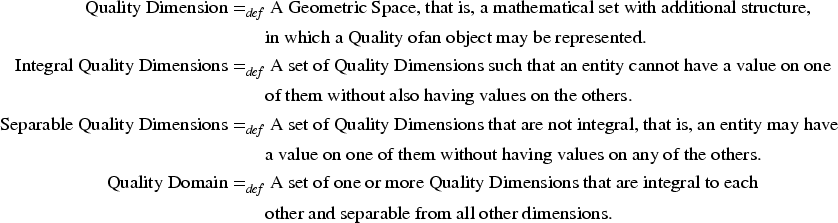
Every Quality Type is associated with at least one Quality Domain in which its value may be represented (Guizzardi, 2005). A Quality Type may be associated with several Quality Domains (Guizzardi & Zamborlini, 2014). The Color Quality Type, for example, may be associated with both an RGB Color Domain, where values have coordinates on the red, green, and blue dimensions, and with an HSB Color Domain, where values have coordinates on the hue, saturation, and brightness dimensions.
While Gärdenfors does not restrict in any way the structure acceptable for quality dimensions, the geometric primitives are taken to be points (i.e., the members of the selected set) and the relations betweenness between three points (e.g.,
Further, Gärdenfors goes on to highlight
The structure of a Quality Domain, that is, its geometry, is fundamental for Gärdenfors’s theory, and, consequently, for the representation of qualities in UFO and DOLCE. However, Gärdenfors does not provide a precise definition of geometry, and UFO and DOLCE do not formalize it. Thus, it is not clear how to relate a Quality Domain to its structure.
In UFO and DOLCE the value associated with a quality is called a quale, a particular point in the associated domain (Borgo et al., 2022; Gangemi et al., 2002; Guizzardi et al., 2022). The following definition and axioms are based on Guizzardi (2005) and Guizzardi and Zamborlini (2014).

The relation that holds between a Quale and a Quality to which it is associated is called
Although it seems reasonable to expect every member of a quality domain to be a quale, this is not required by the original formalization. For example, an entity that is member of two distinct quality domains does not violate Axiom 4, although it is not a quale. To prevent such unintended models, we introduce the following additional axiom.
Dispositions are reified dispositional properties (Choi & Fara, 2021), that is, properties that are exemplified by entities in virtue of their having the potential to display a specific behavior in determinate circumstances (Goodman, 1955; Prior et al., 1982). For example, a glass exemplifies “fragility” by being disposed to break when subjected to a shock.
Sometimes, dispositions are equated with powers. Friend and Kimpton-Nye (2023), however, distinguishes them, and states that “powers are properties that necessitate dispositions” (p. 46), a view shared by other authors (e.g., Bird, 2016; Buckareff, 2022). Thus, powers are necessarily related to their dispositional character. However, even theories that do not accept necessary relations between (fundamental) properties and causal roles may accept dispositions, as predicatory properties. We are concerned mainly with the representational aspects of dispositions, and not with the status of dispositions as fundamental properties or not. Thus, we will refrain from discussing “powers” and aim for a framework that is applicable to ontologies with either commitment.
Both UFO and BFO define dispositions as dependent entities that may be manifested (or realized, in BFO terms) in certain events (processes) in which their bearers participate (Guizzardi et al., 2013; Röhl & Jansen, 2011; Smith et al., 2015). However, other top-level ontologies, such as DOLCE and YAMATO, do not provide formalization for dispositions. In the case of DOLCE, Guarino (2017, p. 14) argues that dispositions should not be introduced as an ontological category because the distinction between dispositional and categorical properties is “not reflected, at the ontological level, in a distinction among specifically dependent continuants of different kinds. [
Canonical and Conventional Disposition Ascriptions
The analysis of dispositions usually starts by pinpointing their stimuli and manifestations. However, everyday language makes use of a rich vocabulary of dispositional terms that lack explicit reference to the underlying triggering conditions and corresponding manifestations. Examples include terms such as fragility, solubility, compressibility, and so on. Although convenient for everyday communication, these conventional words offer limited utility for in-depth analysis of dispositions (Barton et al., 2018b).
To address this limitation, researchers distinguish between two modes of disposition ascription. Conventional disposition ascriptions, prevalent in everyday language, utilize dispositional terms without directly mentioning the associated stimuli or manifestations. For instance, we might say that a glass is fragile without explicitly stating that it breaks when dropped. In contrast, canonical disposition ascriptions explicitly detail the triggering situation and the characteristic manifestation of the disposition. Examples include the disposition to dissolve when placed in water and the disposition to shrink under pressure.
Therefore, we may understand the analysis of dispositions as being constituted of two aspects: the development of conceptual frameworks to thoroughly investigate canonical disposition ascriptions, and the search for manners to describe conventional disposition ascriptions in terms of canonical ascriptions (Choi & Fara, 2021).
The most common approach for the second aspect is to map a conventional disposition ascription to one or more canonical ascriptions. A disposition that cannot be properly described by a single canonical ascription is denominated a multi-track disposition.
Arguably, it is difficult to provide a truly comprehensive account of conventional dispositions following this method, as we may often find unexpected stimulus-manifestation pairs that correspond to well-known conventional dispositions. The present work seeks to contribute toward an alternative method of analysis of dispositions, less reliant on the canonical ascriptions.
Baltimore (2019) identifies three distinct manners in which dispositions might be related:
We shall use the example of the fragility of a glass to discuss the difference between the three views of dispositions. We note that, although we use the same word (i.e., “fragility”) to describe a disposition under each view, we may actually be referring to distinct entities, depending on how dispositions are individuated—particularly, if the identity of a disposition is defined by stimulus and manifestation types.
Under the
Of course, within those distinct views on dispositions, there is room for some diversity. For example, Williams (2019) promotes a particular kind of mutual manifestation, where not only a disposition can bring about distinct manifestations when combined with distinct manifestation partners, but distinct manifestations may arise from the same set of partners when differently arranged. Due to the focus on the arrangement of the dispositions, the state of affairs that produces the joint manifestation is called a constellation.
Since both the As illustrated by the examples: under the mutual manifestation view, the hardness and momentum of the bat cannot be manifested without striking something, while the fragility of the glass cannot be manifested without being struck by something, or more accurately, something with a complementary disposition. On the other hand, under the contribution combination view, the shock absorption capacity of the bubble wrap could manifest even if it is not encasing anything, just as the fragility could manifest in the absence of the bubble wrap. The hardness and momentum of the bat and the fragility of the glass all work toward an event of breaking. On the other hand, the shock absorption capacity of the bubble wrap works toward an event of not-breaking (or maintaining structural integrity), while the fragility works toward an event of breaking.
The aspect of congruence of manifestation types introduces another way of looking at the distinction between mutual manifestation and contribution combination that regards the dispositional masking. The notion of dispositional masking has been utilized to challenge certain analyses of dispositions in terms of conditionals. If we say that a glass is fragile if and only if it would break if it were struck, a counterexample can be made by describing a situation where the glass is struck but does not break because it is encased in bubble wrap—thus, the glass is not fragile according to the proposed definition. In this example, the bubble wrap masks the fragility of the glass. Therefore, we say that a disposition is masked when it does not manifest even though its stimulus conditions are met.
Hence, we may associate the mutual manifestation of dispositions to non-masking interactions between those dispositions: all related dispositions fully manifest, since they share a common manifestation type. On the other hand, we may associate the contribution combination of dispositions to masking interactions between those dispositions: one (or both) of the dispositions does not fully manifest since they have conflicting manifestation types.
We have discreetly introduced the word “fully” in the previous sentence—the reason for this inclusion is that most authors that take the contribution combination view of dispositions, such as Molnar (2003) and Mumford and Anjum (2011a), make a distinction between a disposition’s manifestation and the effect that conventionally follows from that manifestation. Without this distinction, we would be forced to say that the disposition of the glass to break when struck and the disposition of the same glass to crack when struck weakly are two completely distinct dispositions. By distinguishing the manifestation of the disposition and the resulting effect, we are able to say that the same disposition (i.e., fragility) manifests in the glass breaking or cracking, and arguably even in the case where the glass emerges unscathed, even though those are distinct types of events. Under this view, if we want to use the notion of dispositional mask, we must soften it to take into account that the masked disposition does manifest, although without its characteristic effect.
Vetter (2015) takes a distinct approach to deal with this conundrum. She argues that disposition ascriptions are fundamentally context-dependent (e.g., even a diamond can be deemed fragile in certain contexts) and takes the discussion to a kind of property that she calls potentialities. Potentialities come in degrees, and only entities that have a potentiality above a certain degree can be considered to have the corresponding disposition. Thus, a diamond has the potentiality to break, but it does not have the disposition to break (in usual contexts). Further, Vetter introduces the notion of joint potentialities. In the glass and bubble wrap example, the glass potentiality to break is distinct and significantly greater than the glass-and-bubble-wrap’s joint potentiality for the glass to break. The joint potentialities are grounded in the individual potentialities of their possessors. Thus, joint potentialities are similar to interacting dispositions, both in cases of mutual manifestation and of contribution combination.
As a final note, we find several approaches to formalizing the mutual manifestation view. The relation between mutually manifesting dispositions has been discussed under the names “complementary” (Goldfain et al., 2010), “reciprocal dependence” (Arp et al., 2015; Smith et al., 2015), “reciprocity” (Toyoshima et al., 2022), and “mutual activation partnership” (Baratella et al., 2022). The common trait of all those approaches is to observe those complementary or reciprocal dispositions as manifesting jointly in the same class of processes. Baratella et al. (2022) and Toyoshima et al. (2022) go further and state that the partner dispositions must also share their stimuli, although for Baratella et al. this means being present in the same activating situation, while Toyoshima et al. assert that the dispositions must participate in the same triggering process. That is, they take distinct stances on the ontological nature of disposition stimuli—the latter takes stimuli to be events, while the former takes stimuli to be states of affairs, which are neither events nor endurants.
On the other hand, to the best of our knowledge, the contribution combination view remains to be formalized. Our work provides a step toward that goal.
In a survey of frameworks of causal reasoning, Waldmann and Mayrhofer (2016) list three distinct dispositional frameworks: the vector model by Mumford & Anjum (2011a, 2011b), the two-vector model by Gärdenfors (2014, 2020, 2022), and the force dynamics model by Wolff (2007; see also Wolff & Thorstad, 2017). Although each model draws inspiration from a distinct field (philosophy, linguistics, and psychology), they have in common the interpretation of dispositions as having directions and magnitudes and, therefore, being able to be represented as geometrical objects with those properties, vectors. From the vector representation, the result of the interaction of multiple dispositions may be understood as a function of the vectors of the contributing dispositions. This is why Baltimore (2019) cites the vector model as nicely equipped to represent the contribution combination view of dispositions.
There are three main divergences between the Mumford–Anjum model and the other two models:
Regarding vector composition (2.2.3) and threshold phenomena (2.2.3), we side with Mumford and Anjum. In the first case, we agree that simple vector addition is not expressive enough to account for many relevant cases of the combination of dispositions. As for the second, we wish to model the influence of dispositions over discrete domains, which becomes possible using thresholds. In the example of the glass fragility, not all situations where the glass is struck result in a breaking event—if it is struck too weakly, for example. In this case, the resulting vector would not be large enough to cross over the relevant threshold. Thus, the use of thresholds enables us to describe cases where there is no change even in the presence of manifestation partners of the appropriate types (but not of appropriate intensity).
On the other hand, we take the agent–patient distinction (2.2.3) to be of relevance to clarifying the coordination of dispositions inhering in distinct bearers. When we look at disposition pairs such as the ones inhering in a hammer and a nail, in a key and a lock, in a pen and a piece of paper, it seems clear that each disposition in the pair plays a remarkably distinct role, and the agent-patient classification aids in elucidating that distinction.
Baltimore (2019) proposed two extensions to the Mumford–Anjum model in order to accommodate, besides the contribution combination view of dispositions, also the stimulation and the mutual manifestation views. In the first case, he expands the model by adding boxes at the tail of vectors to represent a trigger that stimulates the corresponding disposition. In the second case, he expands the model by including shared vectors that represent multiple dispositions that are reciprocal manifestation partners. Those extensions also enable the model to integrate the distinct views of dispositions, such as by representing a “stimulated contribution combination,” for example.
Events are entities that happen in time (sometimes called occurrents or perdurants), in opposition to entities that exist in time (called continuants or endurants) (Casati & Varzi, 2023).
We observe three main view on events in the literature (see Rodrigues, 2023, for an in-depth discussion):
The transition view of events understands an event as a passage from a certain configuration of entities in reality to another, distinct, configuration. Those configurations may be called situations (Almeida et al., 2018; Barwise & Perry, 1981) or states (Benevides & Masolo, 2014). Thus, events may be seen as trajectories across situations or as the motion from one situation to the next. In this view, the event of a glass breaking is a transition from a situation with a whole glass to a situation with a glass in pieces.
The manifestation view of events understands an event as the realization of one or more dispositions (Guizzardi et al., 2016; Guizzardi & Wagner, 2013). Thus, events are dependent on dispositions and their bearers, 2 and an entity participates in an event by bearing a disposition that is manifested in it (Almeida et al., 2019a; Guizzardi & Wagner, 2013). Under the manifestation view, the event of a glass breaking is the manifestation of the glass fragility.
Finally, the qualitative view understands events as “exemplifications by substances of properties at a time” (Kim, 1976) or as “whatever happens to a suitably selected set of individual qualities” (Guarino & Guizzardi, 2016). Therefore, watching an event unfold is the same as tracking the variation of qualia of the qualities inhering in one or more entities (Guarino et al., 2022, 2018). Thus, an event is determined by a spatiotemporal region and a set of qualities, which are called its focal qualities (Guarino & Guizzardi, 2016). Under this view, the event of a glass breaking is the variation of its structural integrity quality from whole to fragmented.
We note that some versions of both the transition view and the qualitative view accept events that do not involve changes. A transition between equivalent situations may be seen as an event under the transition view, and, similarly, the conservation of some value by a quality over time may be seen as an event under the qualitative view. This indicates the possibility of dispositions that manifest in an “unchanging” way. While we will not discuss this type of event in detail, we admit it in our framework.
A Vector-Based Representation of Dispositions
We have seen that an event may be described as a sum of changes undergone by qualities inhering in the event’s participants. Further, qualities have their values (qualia) as
Figure 1 exemplifies a three-dimensional quality domain, where each axis represents a distinct quality of an object. Within this space, a point denotes the specific value of a particular quality. For instance, an unripe banana’s color might be represented by a point located within the green region on the hue dimension of the color quality domain.
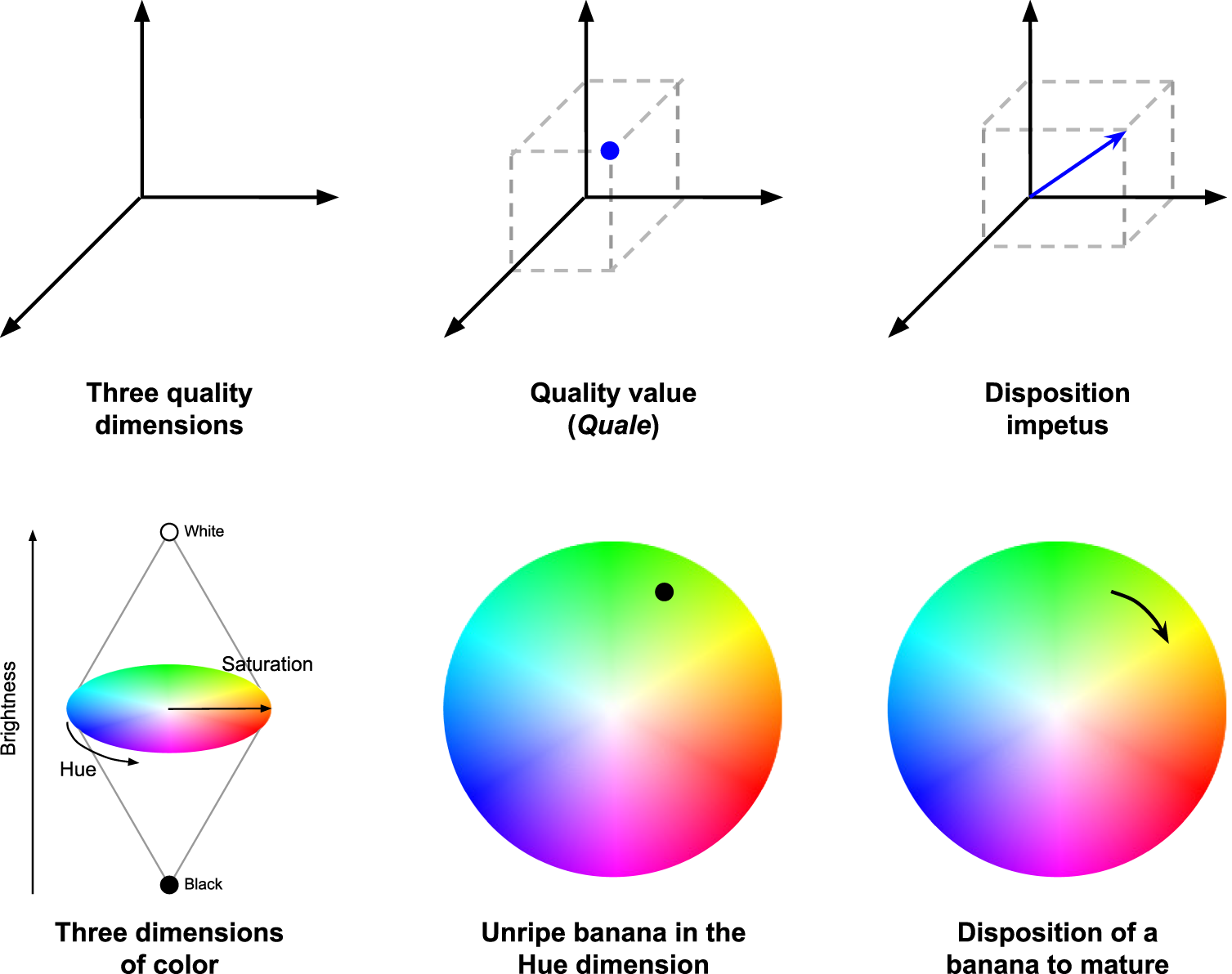
Representation of Qualities and Dispositions with Quality Domains.
Our approach to representing dispositions is illustrated by the inclusion of a vector within the same quality domain. This vector embodies the impetus for change associated with a disposition. The vector in the bottom right of Figure 1 represents the unripe banana’s disposition to mature, which manifests as a shift toward yellow in the hue dimension. The vector’s direction signifies the anticipated change (ripening), while its magnitude reflects the potential intensity of that change.
Naturally, the process of maturation extends beyond a mere alteration in hue. A comprehensive representation of the banana’s ripening disposition would require multiple vectors across various quality domains, encompassing all the transformations that occur during the ripening process.
Further, just as a quality may change by being related to distinct values (i.e., distinct points in the quality domain) in distinct times, dispositions can change by being related to distinct vectors in distinct times. Thus, we may state that the fragility of something became greater with time, for example.
Before formalizing our framework, we shall first introduce the mathematical objects we mentioned at the beginning of this section, that is,
This lack of information is not really an issue, since that information is actually contained in the additional geometric structure of a Quality Dimension (see Section 2.1). However, if we wish to maintain the comprehensive definition of Quality Dimension, which does not impose restrictions on what kinds of geometric structures are acceptable, we must be very careful not to expect particular behaviors from points in general.
On the other hand,
Affine Spaces are furnished with a notion of betweenness (from which the concepts of lines and segments are built) and the parallel axiom, which states that given a line
Taking into consideration the notion that qualities have their values as points in a geometric space, the lack of an addition operation does not seem so weird. After all, what is the meaning of adding the red value of an apple’s color to the yellow value of the color of a banana? Or adding together two distinct locations, such as the center of my backyard and the corner of my garage? What is the meaning of adding two temperatures, densities and so on? While those quality values may, in several frameworks, be represented as numbers that obviously may be added together, their sum would have no meaning.
On the other hand, there are questions that we may ask from those values that do provide meaningful answers. What color lies between red and yellow? What is the distance between my garage and my backyard? What is the difference between two temperatures? And so on.
One aspect of particular importance that we wish to represent is a change over a quality value. The color of a fruit may change as it ripens, or the color of some clothes may dull after washing; a person may grow taller or heavier; one may drive a car to get from point A to point B; etc. In the quality dimension framework, those changes amount to translations between distinct points.
Going back to affine spaces, we can find a unique translation
It is clear that the translations in an affine space make up a vector space, with the translations as members, translation composition as vector addition and the operation
What we wish to highlight is that the translations are not themselves members of the affine space. That means when we wish to talk about translations, displacements, or changes, we must not look for points in a quality dimension, but for vectors over that dimension. Further, we have seen that any quality dimension that has at least a notion of betweenness and of unique parallels may be furnished with a corresponding vector space.
Finally, all vector spaces have at least one basis, which is a subset
Combining Dispositions
We have put forward that the effect of the manifestation of a disposition over some quality can be understood as a vector that represents a translation between distinct points in the relevant quality domain. This view paints an accurate picture of the operation of isolated dispositions. Yet, we have also discussed how multiple dispositions may manifest together, either as mutual manifestation partners or through contributory manifestations to a broader effect. For those cases, it would be too restrictive to require each and every disposition to have an impetus vector precisely over the quality domain in which the quality has its value; it suffices that the resulting effect from the combination of all manifested dispositions may be represented over that domain.
This discussion is also related to the issue of measurement units. Many dispositions that influence the same qualities are associated with distinct units of measurement, and it seems misplaced to represent vectors with distinct units in the same vector space. Further, operating those vectors indiscriminately might produce inconsistent units. Thus, instead of representing all interacting dispositions as having their impetus in a single vector space (over the structural integrity quality dimension), we might place the impetus of each disposition in a distinct vector space, along with a combination function mapping all of them to the appropriate vector space over the quality dimension. We note, nevertheless, that it is not necessary that distinct dispositions have impetus vectors in distinct vector spaces.
We take inspiration from a mathematical formalization of dimensional analysis by Tao (2012). Dimensional analysis is the study of the relationships between different physical quantities by identifying their base quantities and units of measurement. According to this formalization, each base dimension
This formalization brings interesting consequences to our framework. First, it allows the addition of vectors in the same dimension, so we are able to represent the additive composition of dispositions—which is useful for dispositional accounts of forces, for example. At the same time, it prevents the addition of arbitrary vectors since that operation is not defined between distinct vector spaces. Further, we have dimensionally well-defined products.
A dimension of particular significance in regard to the changes undergone by some entity is that of time. Most changes in the real world are not instantaneous, they take up some amount of time to happen. In those cases, the magnitude of an impetus vector will not represent the magnitude of the total change, but the rate of change, i.e., the magnitude of change over a unit of time. Naturally, if something is changing at a given rate, we observe changes of different magnitudes over distinct time intervals. Thus, the change in color of a banana is determined by its disposition to ripen but also by the passage of time, as the color will be different after one day or one week.
Therefore, we may represent the change undergone by an endurant as a function of the impetus vectors of all manifested dispositions and time. The resulting change vector is given by a function
Equation (1) describes the resulting quale

The precise nature of the combination function is determined by the mutual relations between the dispositions and by their quality domain. In other words, the combination function is part of the geometry of the domain. Therefore, the method for combining the impetus of multiple dispositions is entirely domain-dependent. We do not aim to provide a general function to fit all domains and situations. Instead, we aim to aid modelers and domain specialists in bridging the mathematical formalization and the semantic representation of the domain. Our approach enables such reconciliation between mathematics and semantics by providing tools to relate the domain entities to the variables and quantities in mathematical equations through the relations between dispositions, qualities, and quality dimensions.
Finally, we wish to clarify the combination of dispositions operating on discrete quality dimensions. While the combination of dispositions upon continuous quality dimensions will usually be a continuous path on those dimensions, on discrete dimensions, the path is not continuous. Thus, we use the notion of thresholds introduced in Section 2.2.3. The contribution combination will result in a transition between two discrete values only when the combination function overcomes the threshold; otherwise, the current state will be maintained.
Representing the effect of the combination of dispositions as a function of the impetus of all involved dispositions provides a powerful tool for representing multi-track dispositions. Instead of defining multi-track dispositions as long lists of stimulus-manifestation pairs, a disposition’s many possible manifestations are given simply by applying the composition function over the disposition’s impetus along distinct sets of other dispositions influencing the same qualities.
Once we characterize an event applying the combination function, we may classify that event according to the resulting values and the geometry of the underlying quality domain. For example, an event could be classified according to which thresholds of the domain the quality crossed during its occurrence, or according to which neighborhood the resulting quale belongs to, or according to how was the motion of the quality on the domain, at what rate, and so on.
For example, the fragility of a glass manifests differently depending on whether it is combined with the hardness and the momentum of a bat or of an iron bar, or with the shock absorption capacity of a bubble wrap, or an assortment of them. If we are able to properly describe the glass behavior through a composition function, and if we define an event of cracking as crossing a particular threshold in the structural integrity dimension and an event of breaking as the crossing of another threshold at a greater distance, we do not need to explicitly define fragility as a sum of “the disposition to crack when hit with a bat while covered in bubble wrap,” “the disposition to break when hit strongly with an iron bar,” and so on, in order to include that information in our model. We just need to properly assert the relation between the fragility disposition and its impetus, and include a proper rule regarding the combination function.
We note that there is a difference between a situation where the contribution combination of several dispositions over a particular quality domain results in a null vector
Representing Triggers and the Distinct Views of Dispositions
Although the contribution combination view of dispositions played a significant role in the motivation of our research, our framework is not committed uniquely to this view. The vector-based representation of dispositions is also compatible with other views of dispositions and the distinct ways to understand their triggers. We shall discuss how each view of dispositions can be represented under our framework, and how our model may take the intensity of the trigger in consideration.
Stimulation View
We have stated that we may associate dispositions with vectors of change over quality domains. We do not take a disposition being related to a vector at all times to imply that the disposition must be manifesting at all times. The vector, while representing some direction and magnitude of change, may represent those characteristics of a potential change that is yet to be unleashed.
Thus, we may represent a disposition along a triggering event type (or, in general, a stimulus type) and an impetus vector. If the stimulus conditions are met, the entity changes, and we may represent that change as a translation in the relevant quality domain. The impetus vector gives us the direction and magnitude of that translation. This is, in some ways, akin to the approach of Baltimore (2019) to representing stimulation in the Mumford–Anjum vector model.
Therefore, we may represent dispositions that manifest always as a change of the same magnitude, but whose manifestation depends on the trigger being sufficiently intense. For example, we may take the manifestation of fragility to always be a displacement from the “whole” region of the structural integrity quality dimension to the “broken” region, but it is only triggered by some types of strike events (e.g., strong strike) and not by others (e.g., weak strike).
On the other hand, we may want to represent dispositions that manifest as changes of distinct magnitudes according to the intensity of the trigger. As we have stated, our framework enables us to represent changes over a disposition by relating it to distinct impetus vectors over time. Thus, an event that leads to the activation of a disposition might, as it unfolds, change (temporarily or permanently) the impetus of the relevant dispositions, such that it has greater magnitude, for example. In this case, the strength of the triggering event is reflected in the magnitude of the impetus vector, which will reflect in the magnitude of change, as previously described.
Mutual Manifestation View
Another way of looking at the triggering of dispositions is in the coming together of mutual manifestation partners. In this case, the triggering event is what happens to expose the partner dispositions to each other.
However, it would be confusing if, under this view, all the partner dispositions had vectors over the same quality dimension where the influenced quality has its value. First, it would seem to imply that the partners play the same type of causal role, which is not usually true—see the examples of agent and patient dispositions, for instance. Further, it also would seem that either partner could activate by itself if it had a sufficiently large impetus (e.g., if the lock’s disposition were sufficiently intense, there would be no need for a key).
To solve this issue, we place the impetus vector of each one of those dispositions in a distinct vector space. These individual impetus vectors are not yet change vectors over the appropriate quality domains. To produce that vector, the dispositions must be exposed to each other, and their impetus vectors must be composed by the combination function. The resulting vector, under this view, corresponds to the approach of Baltimore (2019) to representing mutual manifestation as shared vectors.
In the example of the glass, for simplicity, let’s assume that we have the following disposition partners: the fragility of the glass, the hardness of a solid object, and the momenta of both objects. Each of those dispositions has an impetus vector in its appropriate vector space and can only produce a resulting change vector over the structural integrity quality dimension when combined with the others, and the magnitude of change is given by the combination function. Thus, no matter how large the impetus of any one of those dispositions is, the disposition never manifests by itself. Therefore, we may look at the combination function as a “recipe” for the mutual manifestation: we only have all the “ingredients” when all arguments for the function have been filled by impetus from the appropriate vector spaces. Only then do the dispositions manifest.
We have said that the magnitude of change is a function of the impetus of the manifested dispositions. Nevertheless, one may argue that a single set of entities bearing the same dispositions may produce a distinct manifestation from different triggering events. A glass falling over a surface from a height of one centimeter does not produce a breaking event, while the same glass and the same surface do produce a breaking event if the height of the fall is one meter, for example. Or if it is struck by a baseball bat very weakly versus very strongly.
Similarly to the stimulation case, the triggering event might, besides exposing the mutual manifestation partners to each other, also change the intensity of one or more of the relevant dispositions. In the glass example, the triggering event increases the magnitude of the impetus of a momentum disposition. The glass is not broken by the fall or by the swing of the bat, but by coming in contact with a hard surface (such as the ground or the bat) with sufficiently high momentum.
Contribution Combination
Suppose that we have two (or more) distinct triggered dispositions that influence the same quality instance. It does not matter for us whether they were triggered through stimulation, mutual activation, or if they are always triggered. Those dispositions are manifesting independently, therefore they contribute with vectors that are already members of the vector space over the relevant quality dimension. That is, in the absence of other dispositions, either could fully manifest. What determines that they interact is simply their simultaneous influence over the same quality instance. As in the case of mutual manifestation, the composition of the impetus vectors is given by a combination function, with the peculiarity that, since the vectors belong to the same vector space, the combination function may be vector addition (although not necessarily).
Formalizing a Vector-Based Representation of Dispositions
In the following, we take the relation of set membership (denoted by

A disposition is associated with a determinate potential of change. This potential of change is represented by a vector, which we call the disposition’s impetus. The magnitude of the impetus vector represents the intensity of the disposition’s contribution toward change, while its direction indicates the manner in which it contributes (i.e., toward what kind of change). The relation between the magnitude and direction of the impetus vector and the actual change that takes place when the disposition manifests depends on the relation between the vector space to which the impetus vector belongs and the quality domain in which the quality’s value is represented, and on the influence of other dispositions.
The relation between a disposition and its impetus is called
However, to define the relation between dispositions and the qualities that they influence, we must look not only at the entities in our model at the level of instances but also at the level of types. The reason for this perspective is twofold.
First, if we were to classify dispositions under labels such as “fragility,” “solubility,” “flammability,” and so on, we expect all dispositions that fall under the same label to influence the same kinds of qualities. Thus, we expect all fragility dispositions to influence their bearers’ structural integrity, shape, and so on, but not their colors, for example. Therefore, we need to be able to represent the relation between the types of dispositions described by those labels and the types of the respective qualities they influence.
Secondly, we find dispositions that influence the qualities of distinct entities in different situations, such as a magnet that influences the position of any ferrous object in its vicinity; what unifies those distinct qualities is their type. In the following, we utilize a primitive functional

Further, if we associate a disposition to a potential of change represented as an impetus in a vector space, and dispositions of the same type are associated to similar potentials of change, then those dispositions must have their respective impetus in the same vector space. Therefore we introduce the relation
With this relation, we can properly define an impetus. We have said that an impetus is a vector. However, being a vector is not a sufficient condition to be an impetus, after all some vectors are not impetus. An impetus must, in addition to being a vector, be one such that may represent a disposition’s potential of change. Therefore, it must be a member of a vector space that is related to a disposition type.

The mapping between the impetus of a disposition and a vector of change over a quality domain is described mathematically as a function. Therefore, for a disposition to interact with a quality, there must be a function mapping the vector space to which the disposition’s impetus belongs to the vector space of the quality domain to which the quality’s value belongs. Since vector spaces and quality domains are associated respectively to disposition types and quality types, this function may map any disposition of a given type to a change over a specific type of quality.
Additionally, the role of combining the impetus of several dispositions into a change vector cannot be played by just any function. If that were the case, we would have to contend with strange or meaningless combination functions, such as a function
Thus, to formalize the relation between a disposition type and a quality type, we introduce the predicates

Roughly, a disposition type operates on a quality type if its instances are associated with potentials of change over qualities of that type, represented in the vector space of the associated quality domain. A disposition’s contribution to such change is expressed by its impetus vector, which is a member of the vector space related to its disposition type. This vector space, however, is not necessarily the appropriate vector space of the relevant quality domain (i.e., the vector space in which we may represent all vectors of change for that quality type). In some cases, the disposition’s impetus may represent a rate of change, in which case the time duration must also be taken into account. In other cases, other dispositions (of other disposition types) must also be present so that their impetus vectors can jointly combine into a resulting vector of change.
Thus, a disposition type operates on a certain quality type if we may find vectors of change in the vector space of that quality domain as a function of impetus vectors in the space related to the disposition type. The mapping function is determined by the geometry of the quality domain. If dispositions of that type manifest alone (that is, without manifestation partners or other contributing dispositions) and the resulting change is constant with respect to time, the disposition’s impetus is already a member of the quality domain’s vector space, and the function is simply identity. In other cases, the vector space in which the disposition type is represented must be mapped to the appropriate vector space by a function that also takes time or the impetus of other dispositions as arguments, or both, as discussed in Section 3.2.
We highlight that it is not necessary to explicitly represent the semantics for quality domains, vector spaces, functions, and their relations to each other and to dispositions and qualities. For most models, it will suffice to explicitly assert the operates on relation between disposition types and quality types and to represent qualia and impetus as values of datatypes. Yet, the formalization we have presented could be expanded to support further analysis, such as the verification of dimensional consistency. Conceivably, it could also enable the discovery of suitable manifestation partners for some disposition starting from the relations between the vector spaces in which each disposition has its impetus.
Moving on, to properly relate each particular disposition to the particular qualities it influences, the operates on relation between their types is a necessary but not sufficient condition. The fragility disposition of a glass influences a structural integrity quality, but not any structural integrity quality: only the one that inheres in the same glass as the fragility. A key disposition to open a lock does not influence the locked-quality/locked state of any lock, but only those that match the shape of the key, and still, among those, only the one in which the key is currently placed. Therefore, the disposition and the quality must be in some form of contact. What exactly it means for a disposition to be in contact with a quality depends, naturally, on the type of disposition and the type of quality under scrutiny. Thus, we use a general

We note that the relation of dispositional contact between a disposition and a quality is a novel addition to the ontology of dispositions. Thus, it should not be mistaken for the relation between a disposition and its categorical basis, i.e., a set of one or more qualities that inhere in the same bearer as the disposition and provide the casually operative conditions responsible for the manifestation of the disposition. On the other hand, dispositional contact holds between a disposition and a quality it is posed to influence, i.e., a quality that may undergo changes if that disposition manifests, regardless of whether it inheres in the same bearer or not.
We have given the example of the fragility of a glass that breaks when it comes into contact with the hardness and momentum of a bat. Thus, we said that all of those dispositions (the fragility, hardness, and momentum) influence an structural integrity quality. However, the dispositions do not influence all structural integrity qualities, only the ones with which they are in dispositional contact.
What does the dispositional contact mean, in this case? In the case of fragility, it can only possibly be in contact with a single instance of structural integrity, and must be so throughout its existence: the structural integrity of the glass in which it inheres. In the case of the dispositions that inhere in the bat, matters are not so simple. The bat might be stored in a rack, in which case they are not in contact with any fragility. On the other hand, the bat might be used to strike a number of other objects, such as a window or a clay pot. Thus, the conditions for the relational contact between a hardness disposition and a fragility quality start with the physical contact between their bearers.
In the case of the dispositions of a key and a lock, the lock’s disposition to be unlocked is always in contact with the lock’s quality of being open/closed (similarly to the fragility and structural integrity of the glass), while the key’s disposition to unlock only comes into dispositional contact with the relevant quality when the key is properly inserted into the lock, and only if the lock matches the shape of the key.
Additionally, the dispositional contact should not be confused with a trigger: we have just given examples of two dispositions (the fragility of the glass and the lock’s disposition to be unlocked) that are always in dispositional contact with the respective qualities, yet they are not always triggered. On the other hand, the triggering event must bring about the dispositional contact if it does not hold previously. The dispositional contact should also not be confused with the mutual activation between dispositions, since the dispositional contact holds between a disposition and a quality, while the mutual activation relation holds between two or more dispositions.
Figure 2 models a case of an oil portion
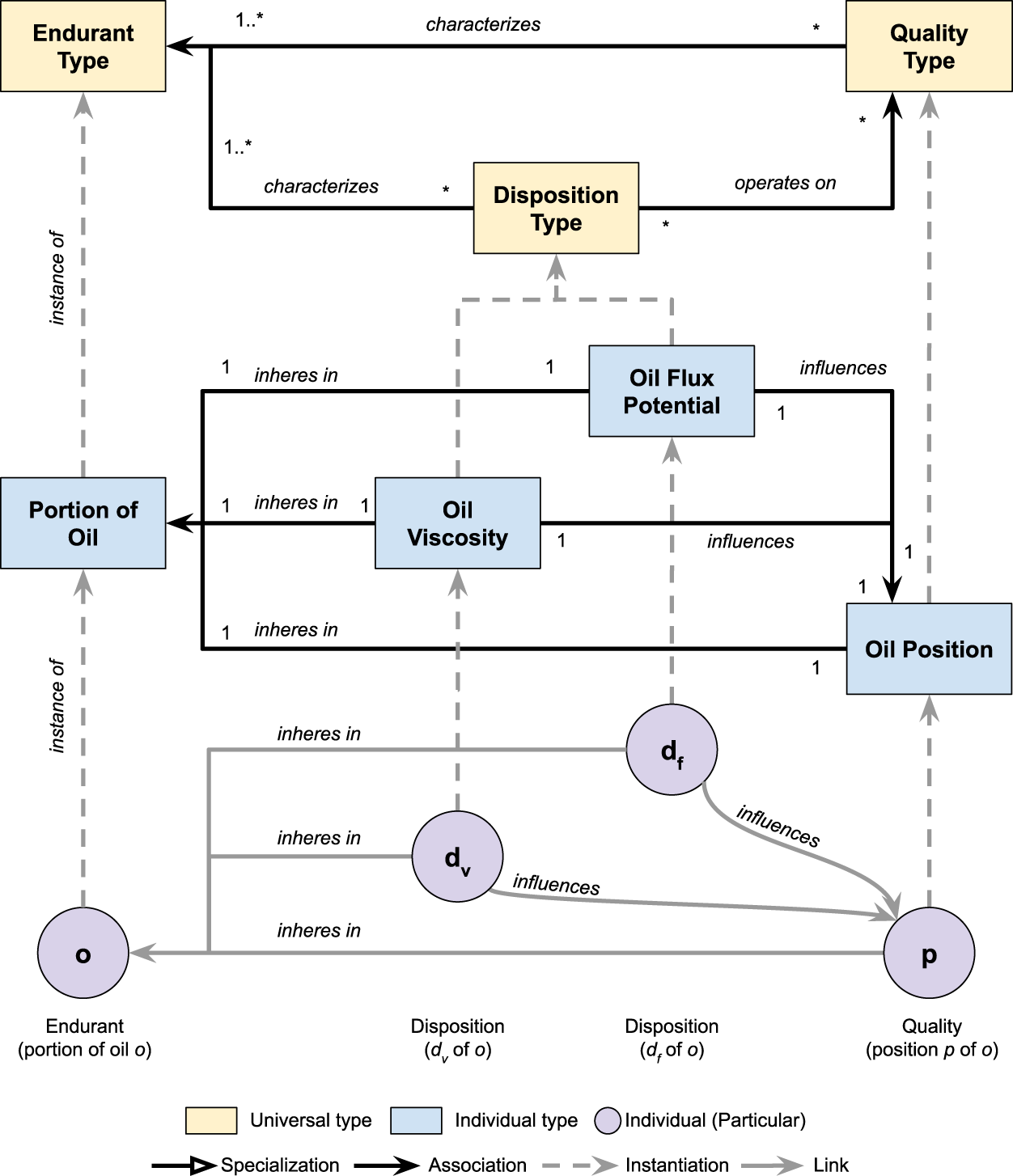
An Example Model of Dispositions Related to Oil Production.
We note that Figure 2 presents the types Oil Viscosity, Oil Flux Potential, and Oil Position, which specialize, respectively, Viscosity, Flux Potential, and Position. The latter types classify properties that inhere in distinct types of endurants: distinct types of object have positions, and distinct types of fluid have viscosities and flux potentials. For simplicity, Figure 2 shows only the types that classify moments that inhere in portions of oil, without depicting their respective generalizations.
Our approach also allows us to explore how dispositions themselves can change, such as by changing direction or magnitude. Thus, we may extend our oil flow model by relating changes in the oil’s temperature to changes in its viscosity. As the temperature increases, the viscosity decreases; therefore, the oil manifests smaller resistance to flow. Capturing and representing this relationship between temperature and viscosity is key for a more complete understanding of tertiary oil recovery methods (see Satter & Iqbal, 2015) that heat the oil to reduce its viscosity and make it easier to extract.
Besides representing the interrelations of dispositions with a common bearer, our framework allows the representation of a disposition along a mutual manifestation partner, i.e., its complementary disposition in a distinct endurant such that both dispositions manifest mutually when in contact. To better elucidate the relation between mutual activation partners, we make a further distinction between agent dispositions and patient dispositions.
Agent dispositions are dispositions to effect changes on other entities, while patient dispositions are dispositions to undergo changes. That is, patient dispositions inhere in the same bearer as the qualities they influence, while agent dispositions inhere in bearers that are distinct from the bearers of the influenced qualities.
Given that patient dispositions influence qualities that inhere in the same bearer and that a single entity cannot bear more than one quality of the same quality type (it would be preposterous to say that a person has two distinct heights at any one time, for example), then a patient disposition must always influence precisely the quality of the appropriate type that inheres in its bearer. In other words, the criteria for dispositional contact between a patient disposition and a quality is simply their inhering in the same entity.

From Axioms 13 and 14, we may derive the following theorem, expressing that the instances of a Patient Disposition Type are dispositions that influence qualities that share their bearers. We provide a step-by-step proof for this theorem in Appendix 8.

It is easy to see that most cases of mutual manifestation can be described by pairs of Agent and Patient Dispositions. Further, distinguishing Agent and Patient Dispositions in mutual activation partnerships helps in clarifying which of the involved entities undergoes change through the mutual manifestation. In the example of the reciprocal dispositions of a lock and a key, the key bears an Agent Disposition while the lock bears a Patient Disposition since both influence a quality that inheres in the lock.
The distinction between Agent and Patient Disposition Types is not a complete classification of all Disposition Types. A disposition type is a Patient Disposition Type if all its instances influence only qualities that share their bearers, while a disposition type is an Agent Disposition Type if all its instances influence only qualities that do not share their bearers. We may, however, conceive either of a disposition type of which some instances influence qualities that share their bearers and other instances influence qualities that do not share their bearers; or of a disposition type whose instances influence both qualities that share and qualities that do not share their bearers. A possible example would be the Magnetism disposition type, whose instances are dispositions to both attract/repel and be attracted to/repelled by other magnets. Thus, an instance of Magnetism influences both a quality of its bearer (its position) and a quality with a distinct bearer (the position of another magnet). Therefore, Magnetism can neither be classified as a Patient Disposition Type nor as an Agent Disposition Type.
In the example of oil production, we could, in addition to representing the interaction between flux potential and viscosity, represent their connections to the surrounding entities. Figure 3 presents the relation between the oil’s flux potential and the reservoir rock’s permeability as patient and agent dispositions, respectively, acting together to produce the oil flow. Through the notions of agent and patient dispositions and the distinct manners in which they relate to the influenced qualities, the nature of both dispositions becomes clearer.
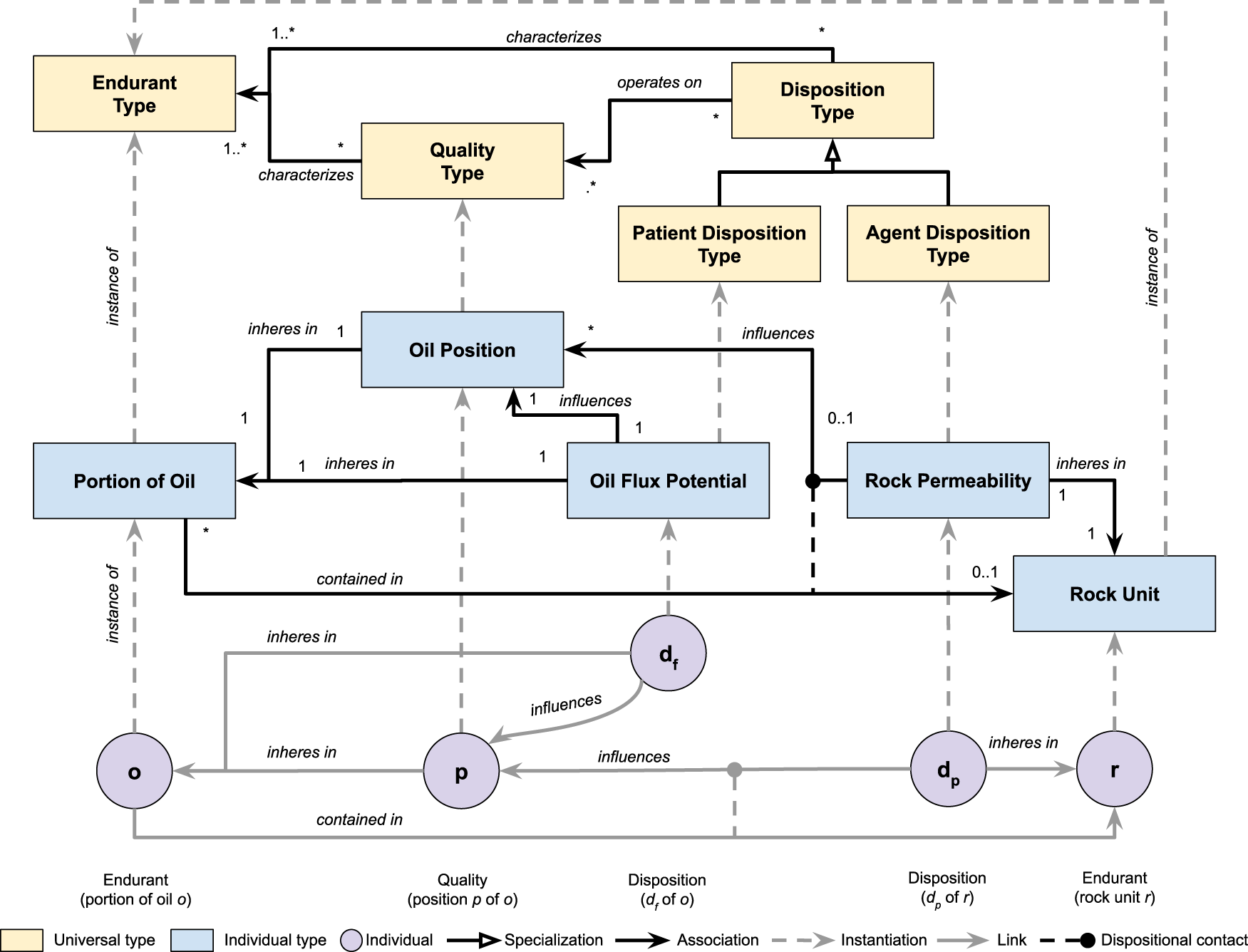
An Example Model of Agent and Patient Dispositions Related to Oil Production.
Permeability is the disposition of a porous rock to allow fluids to pass through it. When this disposition manifests, we consider that the rock itself undergoes no change—what changes is the fluid traversing the rock, whose change in position depends on the rock’s degree of permeability. On the other hand, the flux potential of the oil affects the oil itself, particularly its position. However, even with a great flux potential, the oil won’t flow if the rock is impermeable. Therefore, flux potential is a patient disposition, while permeability is an agent disposition, and both can only manifest in the presence of each other.
Further, the condition for the dispositional contact between a permeability disposition of a rock unit and the position quality of an oil portion is the existence of a containment relation between the rock unit and the oil portion. That is, a permeability disposition influences a position quality iff the bearer of the position quality is
The production of petroleum relies on a thorough study of the behavior of fluids within geological formations buried deep underground. Oil, gas, and water flow through the pores of large volumes of rock, which make up a vast network of minuscule capillary tubes. It is not feasible to model each of those capillary tubes separately. Instead, reservoir engineers rely on generalizing the behavior of large volumes of rock from the underlying geological properties. In this manner, they are able to create mathematical models to describe the flow of oil and other fluids within a certain volume of rock.
In this section, we shall look into an equation that describes the flow of fluid through porous media, founded on empirical work conducted by Henry Darcy, and thus aptly named Darcy’s law:

Darcy’s law and equations derived from it are widely used in reservoir simulation. It describes the relation between fluid velocity
We note that the equation focuses on the component of velocity over a single dimension, that is, the direction of the pressure gradient given by “Permeability in vertical direction is generally found to be lower than that of horizontal permeability, sometimes by an order of magnitude or more. This occurs as a result of the alignment of the grains of rock during deposition influenced by flow of water, wind, etc. [ (Satter & Iqbal, 2015, p. 43)
In turn, viscosity is a generalization of the intermolecular stresses that resist particle movement. In the broadest sense, viscosity is a relation between stress and strain rate (i.e., deformation rate) of a fluid. In the general case, stress is represented by a two-dimensional tensor 6 that associates a direction vector with a force vector that represents the stress across an imaginary surface perpendicular to that direction (Chicone, 2017, pp. 304–305); and the strain rate is represented by a two-dimensional tensor that relates a direction vector to the velocity gradient in that direction (Chicone, 2017, pp. 308–309). To relate the stress tensor and the strain-rate tensor, viscosity must be represented by a four-dimensional tensor.
For Newtonian fluids, the viscosity tensor has three independent components: bulk viscosity, which describes the fluid’s response to compression; dynamic viscosity, which describes resistance to shear; and rotational viscosity, which describes the interaction between the flow and individual particle rotations (Hamilton et al., 2018). We are interested in dynamic viscosity, that is, the resistance against the direction of the flow.
Therefore, to look into the change in the oil portion’s position in each of the three spatial dimensions, we may separate 2 into the following equations:

Thus, the variables in 2 directly match the dispositions we have discussed in the previous sections. By assigning to each disposition an impetus vector, our approach enables the mapping of each disposition to a value that is represented in 2 by the respective variable. Thus, we may associate the dispositions to the quantities in Darcy’s law.
Rock Unit Oil Portion Oil Portion
We shall now look into each of those dispositions and the vector spaces to which the respective impetus vectors belong. Then, we shall discuss the combination function that describes their interaction.
Permeability is the disposition to allow the passage of fluids. Permeability is measured in darcys (
A permeability of 1 darcy permits a flow velocity of
Viscosity
Viscosity is the disposition to resist deformation. Viscosity is measured in poises (
A viscosity of 10 poises imposes a resisting force of
Flux Potential
Flux potential is the disposition to flow toward areas of lower pressure. The magnitude of the flux potential is given by differential pressure over length (although the direction is reversed, as denoted by the minus sign). Thus, it is measured in pascal per meter (
Flux potential is related to the notion of energy-based disposition, defined by Stappel and Neuhaus (2024). According to Stappel & Neuhaus, an energy-based disposition is a disposition that manifests in processes of energy transfer or of energy transformation. Under that view, we may classify flux potential as an energy-based disposition that manifests as a transformation of elastic energy (from the increased pressure) into kinetic energy (as movement).
A Combination Function Founded on Darcy’s Law
The result from Darcy’s law is a measure of velocity, which is represented as a vector in three-dimensional space with dimension length over time. What is this velocity, ontologically? One possible answer is that it is a further disposition, derived from the previous dispositions by their combination. This answer raises the issue of why not give the same ontological status to other intermediate vectors that result from partial applications of the combination function. If we isolate some terms in 2 so that we find the combination of the Flux Potential and Viscosity, but without Permeability, for example, should we consider that the resulting vector is also the representation of some derivative disposition? In order not to get overwhelmed by such derivative dispositions, we chose a distinct answer to the nature of velocity, as a characteristic of the event of oil flow. We note, however, that the understanding of velocity as a disposition is not incompatible with our approach, and refer to Barton and Ethier (2016) for a deeper discussion on the two ontological faces of velocity.
One way or the other, velocity is a rate of change in position, and not yet itself a change in position. To find the resulting change vector for the event in which all those dispositions manifest, we must still take into account the passage of time. For simplicity, we will assume that the velocity remains constant, at least for a while, so we can multiply it by time to obtain the change vector. Therefore, the resulting change over the position of a portion of oil from the combination of the three dispositions (in an Oil Flow event) is given by a function

The function

Equipped with this equation, we can classify events of oil flow according to the resulting values. For example, we may state that an Oil Extraction event is any event that brings some oil portion from the subsurface to the surface. If we select a position quality domain such that the origin represents the surface and negative values represent positions below it, this definition has the same meaning as stating that an Oil Extraction event is any event for which an oil’s portion position values
Another significant classification to be made regarding oil flow events relates to the concept of critical production rate, i.e., the maximum rate at which the oil can be extracted from a certain well before undesirable material (such as water, gas, or sand) breaks into the well, with unfortunate consequences to production (Ahmed, 2010). The precise value for the critical rate depends on multiple factors and varies from well to well. However, it is crucial to determine whether the rate of production for specific parameters will be above or below that threshold. Given the critical rate for a particular well, we are able to classify an oil flow event as Subcritical or Supercritical by comparing the velocity of the flow to the value of the well’s critical rate.
Figure 4 depicts the types, vector spaces and quality domain related to oil flow. The disposition type Rock Permeability characterizes the endurant type Rock Unit, while the disposition types Oil Flux Potential and Oil Viscosity, and the quality type Oil Position characterize the endurant type Portion of Oil. Each disposition is represented in a certain vector space, while the quality type is associated with a quality domain. The combination function
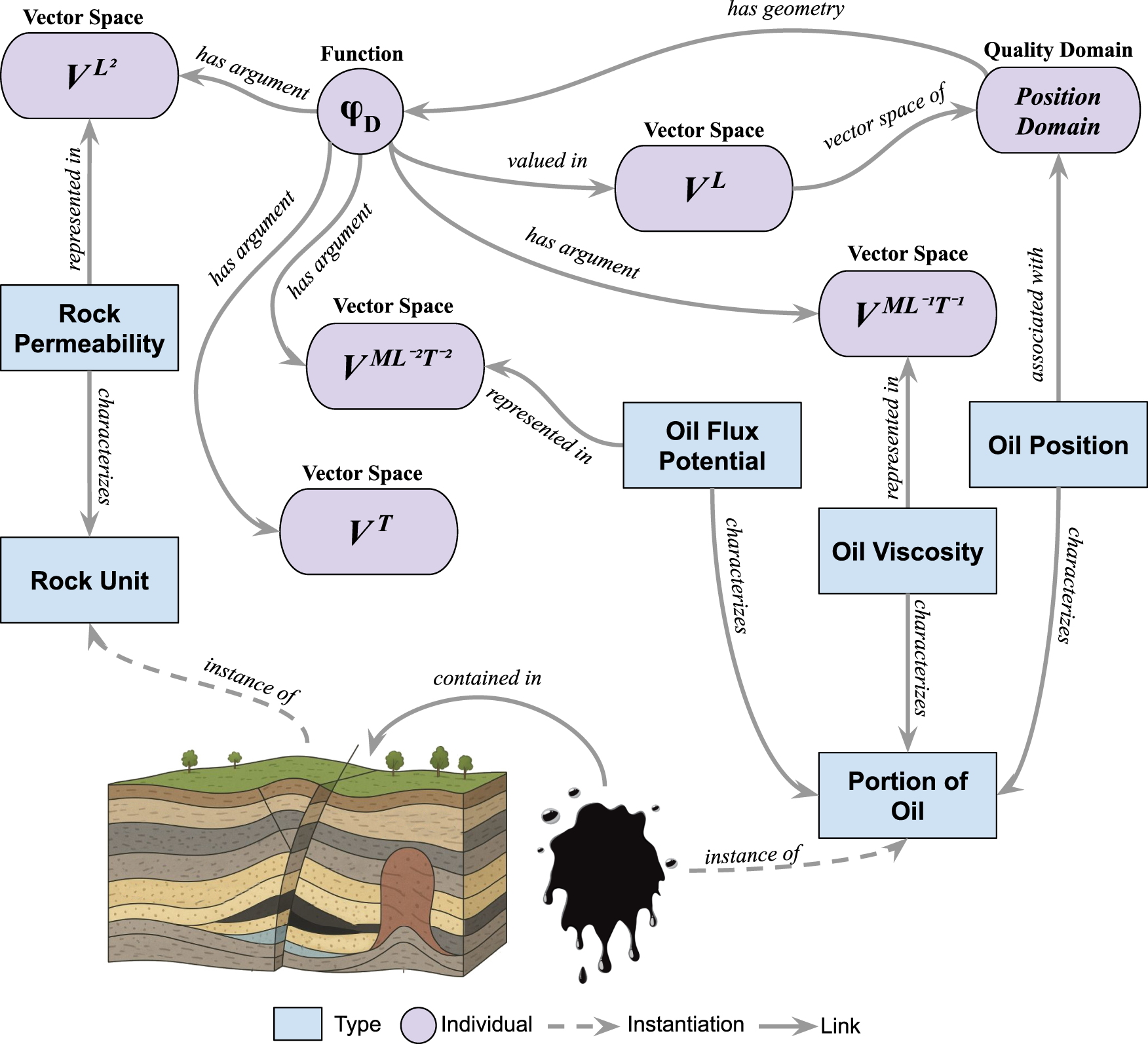
Types Related to Oil Flow.
We have implemented our framework 7 along with the oil flow example as an extension of gUFO, a lightweight OWL 2 implementation of the Unified Foundational Ontology (Almeida et al., 2019b). We start by defining the classes Disposition and Disposition Type, which are not included in gUFO, along with the subclasses of Disposition Type: Agent Disposition Type and Patient Disposition Type.
Since both qualia and impetus are represented as values in OWL datatypes, there is no implementation for the axioms that describe qualia, impetus, quality domains, vector spaces, and their mutual relations . We define the relation hasImpetus as a Data Property, and the relation operatesOn as an Object Property with the class of disposition types as domain and the class of quality types as range. The association between a disposition type and a quality type through this Object Property must be asserted in the domain model. We also defined ObjectProperties to represent the relations of instantiation (instanceOf), 8 ranging over the class of types, and dispositionalContact and influences, both having the class of dispositions as domain and the class of qualities as range.
We include Axiom 9 as an OWL class axiom over Disposition Types. Axioms 13 through 15 cannot be expressed as OWL class axioms, therefore we created the following SWRL rules to express their meaning. To recall, Axiom 13 states that a disposition influences a quality iff they are in dispositional contact and the disposition’s type operates on the quality’s type, Axiom 14 asserts that instances of a patient disposition type are in dispositional contact to the qualities that inhere in the same bearer, and Axiom 15 states that the bearer of an instance of an agent disposition type is different from the bearer of any quality it influences. SWRL rules have the form of an implication between an antecedent and a consequent, with the meaning that whenever the conditions specified in the antecedent hold, then the conditions specified in the consequent must also hold. Thus, the SWRL rules are weaker than the original axioms, which utilize biconditionals and cannot be fully expressed in SWRL due to the lack of quantifiers.



We chose to define the SWRL rules in a manner such that the relation of influence can be inferred from available assertions of dispositional contact and operates on relations, and that the dispositional contact between a patient disposition and a quality can be derived from the operates on relation between their types and their sharing of a bearer, and not the other way around (i.e., such that the dispositional contact could be inferred from the influence relation, and the sharing of a bearer could be inferred from the contact between a patient disposition and a quality).
While those alternative reasoning tasks could be supported by additional SWRL rules, the rules we have presented provide support for the reasoning tasks that we expect to be most commonly needed. While we expect most models to assert the inherence of all dispositions and qualities in their bearers (from which we may infer the dispositional contacts of patient dispositions), it does not seem reasonable to expect the explicit assertion of most dispositional contact relations.
Theorem 1 expresses that instances of a patient disposition type influence qualities with which they share a bearer and that instantiate a quality type which the patient disposition type operates on. Thus, given a operates on relation for a patient disposition type and the sharing of a bearer by an instance of that type and an instance of the appropriate quality type, it must be possible to infer the influence between that disposition and that quality. This inference is already ensured by the SWRL rules for Axioms 13 and 14 in conjunction. Thus, we do not provide any further implementation of Theorem 1.
Moving on, we defined classes for the concepts in our oil flow model: Rock Unit and Oil Portion as subclasses of Object (i.e., independent endurant), Position as a subclass of Quality, and Flux Potential, Viscosity and Permeability as subclasses of Disposition. We also defined punned individuals to represent those classes as types in instantiation relations. Thus, the individual Position has the type Quality Type, the individuals Flux Potential and Viscosity have the type Patient Disposition Type, and the individual Permeability has the type Agent Disposition Type. We asserted that all those disposition types operate on the Position quality type, and included class axioms in the format Class FluxPotential EquivalentTo (instanceOf value FluxPotential) for each of those types. We note that, in this axiom, the first occurrence of “FluxPotential” refers to the class, while the second refers to the punned individual.
We created the following SWRL rule to express the combination function










Line 1 checks that we have entities of all the relevant disposition types and the proper focal quality. Line 2 verifies that all the dispositions influence the same position quality, while Line 3 identifies their impetus. Line 4 uses the standsIn relation from gUFO to check that all dispositions are present in the same situation, and Line 5 checks that the position quality is also present, and the value attributed to it in that situation. Line 6 picks out the event that is triggered 9 by that situation and the situation that is brought about by that event. Line 7 verifies the velocity given by Darcy’s law from the impetus of the relevant dispositions, and Line 8 the final value for the oil portion’s position. Finally, Line 9 states the presence of the position quality in the situation brought about by the event and its value attribution, and Line 10 states that all relevant dispositions are manifested in that event.
We have also defined the event class Oil Flow, along two direct subclasses Oil Extraction and Oil Flow in Well, that is, a flow of oil that happens inside a well. The latter is specialized by two disjoint subclasses, Oil Flow at Supercritical Velocity and Oil Flow at Subcritical Velocity. Those are possible manifestation types of our dispositions—therefore, it is appropriate to call them multi-track. We define Oil Extraction with the following class axiom.

For the supercritical and subcritical flows, we introduced a new independent endurant class, Oil Well, which is characterized by a Critical Flow Velocity quality. Further, we defined a Data Property has flow velocity, which associates a flow velocity value (expressed by the combination function

Above, we reproduce the rule for Oil Flow at Supercritical Velocity. A similar rule was created for Oil Flow at Subcritical Velocity, with the difference that the last line changes to:

Upon our formalization in OWL 2 and SWRL, 10 the Pellet reasoner (Sirin et al., 2007) was able not only to find the correct values but also of correctly classifying the contribution combination events. We provided two example cases, with the main differences between them being the impetus of the flux potential disposition and the time duration of the oil flow event. In the first case, with a significantly longer duration and a slightly smaller flux-potential impetus, the event was classified as both an Oil Extraction and an Oil Flow at Subcritical Velocity. The second case, with a larger flux-potential impetus, was classified as an Oil Flow at Supercritical Velocity.
This was achieved without defining any class of situations to play the role of the stimulus of our three disposition types, but simply by defining a rule for any event in which the three types of dispositions are manifested. We defined this rule based on a suitable domain-specific combination function. As a result, we may infer the type of manifestation of those dispositions for any possible arrangement of values attributed to their impetus.
On the other hand, if we tried to achieve the same result by selecting one of our three dispositions, fixing its value, and defining the range of combinations of intensities for the other two for each of the possible manifestation types, we would need an unsuitably larger number of axioms and probably would still not be able to reach the same comprehensiveness. Therefore, our approach seems an effective instrument for representing multi-track dispositions.
This chapter describes the state of the art related to the representation of dispositions and quality measures in Ontology Engineering and allows us to position our contribution.
Representing Dispositions in Top-Level Ontologies
Two of the most widely used top-level ontologies, the Unified Foundational Ontology (UFO) (Guizzardi, 2005; Guizzardi et al., 2022, 2013) and the Basic Formal Ontology (BFO) (Arp et al., 2015; Otte et al., 2022; Smith et al., 2015), define types for representing dispositions. BFO defines dispositions as realizable entities. Realizable entities are dependent continuants that inhere in a bearer, and that can be realized in associated processes in which the bearer participates. In UFO, dispositions are existentially dependent endurants (in UFO terminology, tropes) (Guizzardi et al., 2013) that are only manifested in particular situations, through the occurrence of events. We shall look at how each of the distinct views on dispositions (see Subsection 2.2) appears in each of those ontologies.
The stimulation view is present in BFO’s definition of disposition, where a disposition type is associated with one or more characteristic manifestation process types and possibly with characteristic trigger process types (Arp et al., 2015). It is also present in UFO, where dispositions are properties that are only manifested in particular situations, and a situation triggers an event when it activates a disposition that is manifested by that event (Guizzardi et al., 2013).
The mutual manifestation view is also present in BFO through the notions of reciprocal dependence (Arp et al., 2015; Toyoshima et al., 2022) and of complementary and collective dispositions (Goldfain et al., 2010), and in UFO through the concept of mutual activation partners (Baratella et al., 2022), such that all mutual activation partners must be present at a situation in order to be activated.
The contribution combination view, on the other hand, does not find representatives in either top-level ontology. In both ontologies, when multiple dispositions are manifested at the same time, they both dispose towards one and the same manifestation, not distinct manifestations that interact. At the same time, both ontologies provide the tools to represent complex events that may have other events as parts. Thus, it is possible to represent an event that has the manifestation of many dispositions as parts.
However, this representation by itself does not capture the contribution combination view of dispositions, as it lacks a proper representation of the interaction of dispositions. For example, we could model a complex event where a person is looking through a window while a brick hits it and it breaks. There are (at least) two distinct parts of this event that are manifestations of dispositions: the person looking through the window, which is a manifestation of the window’s transparency, and the breaking of the window, which is a manifestation of the window’s fragility. However, those manifestations are not combining to create a joint effect, they are simply manifesting at the same time and place by coincidence. Thus, the representation must be enriched to include the interaction between the dispositions and differentiate it from events where many dispositions manifest but do not interact.
Further Ways of Relating Dispositions
Looking beyond top-level ontologies, we identify two classes of interactions between the manifestations of distinct dispositions: diachronic interactions and synchronic interactions. Diachronic interactions reflect how the manifestation of a disposition at some time
Among the diachronic interactions, we cite
There are also several relations between events that might represent diachronic relations, if we hold the view that events are manifestations of dispositions and extend the relations between the manifestations of dispositions to relations between the dispositions themselves. Rebboud et al. (2022) identified 25 distinct relations between events. Those relations were classified in temporal, that is, based on the beginning and endpoints of the events in time; mereological, that is, variations of “part of” relations; contingent, including causal and correlation relations; and comparative, relations based on the likeness of the events happening together. Temporal, mereological, and comparative relations do not represent an interaction that affects how either event unfolds and, therefore, are not of interest to us. Among the causal contingent relations, we list
Similarly, Galton (2012) defines five relations between events, processes, and states:
We note that all diachronic relations reviewed are only concerned with whether the affected manifestation will happen or not, and not how it happens. Therefore, we must look onward to synchronic interactions.
The Open Biological and Biomedical Ontology (OBO) Foundry provides one approach in its Relation Ontology (Consortium, 2010; Huntley et al., 2014; Mungall et al., 2023; Smith et al., 2005) with the relations
An example of pure synchronic interaction comes from Barton et al. (2014), where Newtonian forces are defined as dispositions with external existential conditions that are always triggered and which may be masked by other forces. Thus, if more than one force is acting over a body, the resulting force is a new disposition that is realized in lieu of the distinct component forces and whose basis is the sum of the basis of the underlying forces.
Those two types of synchronic interactions do, in fact, describe processes resulting from the interaction of distinct influences. Nevertheless, in both cases, it is not possible to represent, at the semantic level, how those influences precisely affect the resulting process. That is, if two dispositions on the same entity combine into a third, distinct disposition, we wish to be able to discuss how each disposition contributes to the result and in which direction the resulting disposition leads.
Finally, when it comes to representing multi-track dispositions, Barton and Jansen (2016) propose to model them as aggregates of single-track dispositions. This approach follows the same line of reasoning as representing multi-track dispositions as lists of stimulus-manifestation pairs and is correspondingly just as complex.
Units of Measure
In Section 3.2, we noted that the issue of representing the impetus of dispositions in distinct vector spaces relates to the issue of measurement units. Although there are many ontologies that aim to represent units of measurement, most do not define how units can be combined or manipulated. For now, we leave aside a deeper discussion on the distinct approaches to ontologies for units of measure, and we shall focus on the proposal of Aameri et al. (2020); Grüninger et al. (2018), which shares with our approach the trait of utilizing vector spaces to represent those units.
Grüninger et al. (2018) propose a set of ontologies for units of measure for basic units of time duration, mass, length, area, and volume, and for a derived unit of density. They argue that, due to the possible operations to combine and manipulate them, those units do not form fields but rather ordered vector spaces. That is, the result of adding time durations together is a time duration, and the product of a time duration and a scalar is also a time duration; however, the product of two time durations is not a time duration—the same is true for masses, lengths, areas, volumes and densities. This perspective agrees with our approach of representing the impetus of dispositions in vector spaces.
Further, Grüninger et al. (2018) discuss the mapping between pairs of time points and time durations. Previous approaches assumed that time durations formed a field and understood this mapping as a metric for time points. Since time durations actually form a vector space, the mapping must be a vector-valued function
The function
Grüninger et al. (2018) go on to discuss density as a unit derived from mass and volume. They argue that density should not be understood as a quotient, but rather as a mapping between masses and volumes. Thus, they claim the set of densities is isomorphic to the set of linear mappings between the set of masses and the set of volumes. Aameri et al. (2020) enrich the model with a similar approach for velocity as a mapping between length and time durations. This interpretation seems to be at odds with our modeling, described in Section 3.2, according to which we should rather understand the set of densities as the vector space
Nevertheless, a well-know theorem of tensor products states that, for any pair of vector spaces
Criticisms on Vector-Based Models of Dispositions
Some authors have been critical of the Mumford–Anjum vector model and presented objections that are, arguably, sufficiently broad to be considered as objections against vector-based models of dispositions in general (although we have not found the same kind of criticism regarding Wolff’s force theory or Gärdenfors’s two-vector model). We shall now look into the main arguments put forward by Glynn (2012), Bird (2016), Williams (2019), and Pechlivanidi and Psillos (2020), and present how our approach answers those concerns. In some cases, our answer will be general enough that it will serve as a defense both of our approach and of other vector models. In other cases, we will rely on features particular to our framework.
As a side note, since Mumford and Anjum use the terms “disposition” and “power” interchangeably, this trend is maintained in some quotes that we reproduce in this section. Since we are concerned only with representative aspects of the discussion, to which the debate on the modal-fixity of properties is tangential, we will read those statements as statements about dispositions.
Dispositions are Not Vectors
Pechlivanidi and Psillos (2020) start their criticism by arguing that dispositions are not vectors. We neither claim that dispositions are vectors nor believe that Mumford and Anjum (2011a) make that claim, 11 but their arguments allow us to demonstrate the distinction between a disposition and its impetus.
Their argument is, fundamentally, that dispositions are not vectors because: Distinct dispositions may have the same vector, and Distinct vectors may represent the same disposition.
Regarding 7.4.1, they state that “we cannot simply tell that two powers are the same iff they have the same direction and magnitude” (Pechlivanidi & Psillos, 2020, p. 141). This highlights that the phrase “both glasses have the same fragility” does not mean that the same fragility disposition inheres in both glasses, but that the fragility dispositions of both glasses have the same impetus vector. Therefore, it is necessary to distinguish between the disposition (a property that may manifest under certain conditions) and its impetus (a representation of that property’s intensity and direction).
Regarding 7.4.1, we find three distinct ways that a disposition may relate to two (or more) distinct vectors: A disposition has distinct vectors for the distinct quality types it operates on; A disposition has distinct vectors for the distinct bearers of qualities it influences; A disposition has distinct vectors at distinct times or in distinct situations.
The examples given by Pechlivanidi and Psillos (2020) fall into those classifications: Fragility, as described by Pechlivanidi and Psillos (2020, p. 141), is a disposition that operates on two distinct quality types, one for the integrity of the glass and the other its resistance. “The power of hand to be warmed can be represented as being directed to an increase of the temperature of the hand or to a decrease of temperature of the surroundings” (Pechlivanidi & Psillos, 2020, p. 141) is an example of disposition that influences qualities of distinct bearers. A disposition towards better health by ingesting vitamin B12 when in vitamin deficiency and towards deteriorating health when the vitamin levels are too high (Pechlivanidi & Psillos, 2020, p. 148) is an example of a disposition whose impetus changes over time.
When representing the interaction of many dispositions acting on a single causal situation, we are interested only in the dispositions that operate on the quality type of a specific focal quality; influence that specific quality, which inhere in a single bearer, regardless of qualities of other bearers that might also be influenced by the same dispositions; are active in that specific situation, i.e., at the same time (dispositions active in distinct times should be represented in distinct causal situations).
Thus, the disposition’s impetus towards an increase in the temperature of the hand must be represented separately from its impetus towards a decrease in the temperature of the surroundings. Similarly, the impetus towards better health when in vitamin deficiency must be represented in a separate situation from the impetus towards deteriorating health when vitamin levels are too high.
Therefore, there is no reason to worry about a disposition contributing to a causal situation with multiple vectors. If a disposition operates on multiple quality types, it may have distinct impetus vectors contributing to separate causal situations, however only one of them is mapped to each quality domain. The same is true for a disposition that influences qualities of more than one bearer; such influence must also be represented separately. If we wish to represent the contribution of a disposition in distinct moments in time, we must do so by taking into consideration only those dispositions that are active in those specific moments. Thus, each disposition is uniquely represented in each causal situation. In other words, each disposition provides a single argument for the combination function
Another argument against the idea that dispositions may be related to vectors is the claim that, unlike vectors, some dispositions cannot be measured—or at least not with anything akin to standard units of measurement.
First of all, this is an argument against the generality of vector models of dispositions, which we do not claim. We have restricted our framework to dispositions that operate on quality domains that have, at a minimum, a notion of betweenness and unique parallels upon which a vector space may be built. Thus, it is not necessary that all dispositions are representable by vectors, it is sufficient that some of them are.
At the same time, those arguments frequently confuse issues of ontology (i.e., what exists) with issues of epistemology (i.e., what we know to exist). Take the following statement, for example: “While, for instance, we can claim that given the same amount of pressure a glass object has a greater tendency to break than a similar ceramic object, there is no certain (or absolute) intensity associated with the manifestation of fragility.” (Pechlivanidi Psillos, 2020, p. 144)
We must ask whether there is no absolute intensity or we just have no knowledge about it. The first is a very strong claim, which warrants a strong proof or demonstration; the second is common sense, but does not speak about the objective existence of the intensity.
As a matter of fact, if given a certain pressure (which is measurable) certain objects break while others do not, we may find the equivalence class of all objects that break under a given pressure
Nevertheless, Bird (2016) claims that such a measure is not sufficient and that we need a unit of measure “that is the same in all relevant contexts” (p. 29). Other critics seem to agree. Glynn (2012) says that “the existence of a common metric is a prerequisite for their being representable by vectors in a common space” (p. 1103), and Pechlivanidi and Psillos (2020) state that “only the ascription of a unit can result in the representation of a power in terms of magnitude” (p. 144). There seems to be an expectation for vectors to have objective measures (what is called a “norm”). This expectation, nonetheless, does not match the mathematical definition of vector spaces, which does not require a norm. For vector spaces without norms, we may measure vectors only in comparison to other parallel vectors, according to how much we must scale the measuring vector to obtain the vector under measurement (e.g.,
However, it is still true that “we need to be able to say—which we cannot—that John is more irascible than Jane to exactly the same degree that Rachel is more irascible than Robert” (Bird, 2016, p. 29). Indeed, mental dispositions are subjective and difficult to measure—one of the reasons they have been left out of our present study. Nevertheless, we consider again whether our inability to compare the two pairs of dispositions comes from the nature of those dispositions or from our lack of knowledge. That is, can we not make such a statement because we do not know whether it is true or because it cannot conceivably be true due to the nature of the entities being compared? At first glance, there is nothing in the sentence that seems absurd to us—albeit with a remarkable feature of the difficulty in asserting its truthfulness.
Dispositions are Not Additive
A similar argument exists regarding the operation of vectors. The argument is that, unlike vectors, the effects of some dispositions cannot be added together—or at least not in a commutative manner.
We find two direct attempts at counterexamples for the commutativity of vector addition. Pechlivanidi and Psillos (2020) point out that “exercising first the power to wash clothes, and then the power to dry them has markedly different results from exercising first the power to dry clothes and then the power to wash them” (p. 139), while Bird (2016) states that “if a change in position were to change the underlying geometry, so that the order of the changes made a difference, then those changes, being non-commutative, could not be adequately represented as vectors” (p. 30). We argue that those examples are misguided, as they mistake a change on the order of operands with a change in the temporal ordering of distinct causal situations.
The commutativity of vector operations regards vectors that operate at the same time, which is not the case in the examples provided. In almost every case, “following” two vectors one after the other will result in a total journey longer than following the vector that results from their addition, with the exception of cases where the two vectors are collinear and cooriented. Thus, commutativity should not be mistaken for exchangeable temporal ordering.
On the other hand, the vector representation does not exclude the possibility of non-commutative combinations of vectors. If we need to combine vectors in such a manner, we may define (domain-appropriate) operations for the relevant vector spaces. One example of non-commutative vector operation is the cross-product.
While most authors agree that there are cases where the interaction of dispositions can be represented by vector addition, they argue that it is not sufficient for many other situations. According to Glynn (2012, p. 1104), “additive composition of causal factors seems to be the exception rather than the rule,” and to Bird (2016, p. 25), “vector addition only applies to causation in special cases.” Nevertheless, far from meaning that we should throw away vector addition, this observation indicates that we need to accept other, non-linear operations. Our approach not only allows the representation of more complex operations, it also assists in identifying the “special cases” in which vector addition applies. Vector addition is only possible if both vectors are members of the same vector space—thus, in order to be added, the dispositions must not only influence the same quality but also have impetus vectors in the same vector space. As an example, this restriction allows forces to be added to other forces while preventing the addition of forces to masses.
On the other hand, Williams (2019) argues against the additive interaction of dispositions from a very distinct position. Williams sustains a specific form of mutual manifestation view based on constellations (i.e., sets of dispositions arranged in particular ways). On his account, it is not the dispositions themselves that promote one or other manifestation but the constellation as a whole. Further, he states that “it is a brute fact about any constellation type that it produces the manifestation type it does, and that is the end of the story” (2019, p. 75), and “the manifestations produced by a constellation need not be traceable from the manifestations of the component powers taken individually.” (2019, p. 78) Thus, what bothers Williams is not that addition could describe the interaction between dispositions and their joint manifestation, but that such interaction could be described at all. Thus, it seems that we are expected to accept the unknowability of disposition interaction, a position we are not willing to take.
The Direction and Magnitude of (Multi-Dimensional) Vectors are Not Always Meaningful
Both Bird (2016) and Pechlivanidi and Psillos (2020) argue that if dimensions can be combined arbitrarily, we frequently find cases of multi-dimensional vectors whose magnitude and direction do not provide any significative meaning. In both cases the authors quote the two-dimensional temperature–humidity example from Mumford and Anjum (2011a, pp. 44–45), and argue that one of the reasons for the lack of meaning is the absence of a common unit across dimensions. Further, they conclude respectively that “there is nothing analogous to an angle in two- or higher-dimensional quality space” (Bird, 2016, p. 29) and “a multi-dimensional model for power-vectors is impossible” (Pechlivanidi Psillos, 2020, p. 143).
We wish to start by pointing out that there are, indeed, angles in higher-dimensional quality space. Those angles, however, are not necessarily meaningful. But in many cases, they are. For example, in the three-dimensional RGB color space, the vectors toward “redder,” “bluer,” and “greener” regions are all orthogonal to each other. Further, even in multi-dimensional quality spaces without a common unit across all dimensions, we may have meaningful angles. If we take a four-dimensional quality space consisting of three spatial dimensions (measured in meters) and one temporal dimension (measured in seconds), the angle between a displacement vector and the temporal dimension gives us the velocity.
On the other hand, while we may combine arbitrary quality dimensions (via a cartesian product), even going so far as representing all dispositions of some entity in an extremely high (possibly infinite) dimensionality, why should we expect the vectors represented over such a space to be meaningful, except maybe in an exceptionally abstract way?
To untangle this messy affair, we make use of the notion of integral and separable quality dimensions, introduced in Section 2.1. Two or more quality dimensions are integral if an entity cannot have a value on one of those dimensions without also having values on the remaining dimensions. Thus, we submit that dispositions that operate on a set of integral quality dimensions may be represented by a single multi-dimensional vector with meaningful direction and magnitude. On the other hand, dispositions that operate on a set of separable quality dimensions should be represented in each of the component dimensions in order to maintain expressiveness.
It is Just As Good to Represent Dispositions As Scalars
Finally, Bird (2016, p. 28) states that “you do not need vectors to model the one-dimensional case. Scalar quantities will do.” Similarly, Pechlivanidi and Psillos (2020, p. 140) contend briefly that temperature and energy are scalars and, thus, a heating disposition should not be represented by a vector. Nevertheless, scalars are defined as members of a
The argument could still stand if it held that dispositions could be represented by scalars despite their vectorial characteristics and not because of them. However, the reason scalars are considered a suitable alternative is precisely because they can be added together in the same way as vectors do. As a matter of fact, the restrictions on fields are greater than the restrictions on vector spaces—while every field is a vector space, not every vector space is a field. Thus, suggesting that dispositions can be represented with scalars is actually an argument in favor of their being representable with vectors and not against it.
Representing Probabilistic Dispositions
As a final note, we wish to comment on the issue of representing probabilistic dispositions and other kinds of nondeterministic dispositions under a vector-based framework. Mumford and Anjum (2011a, 2011b) provide a discussion on how to handle such dispositions within their framework. They argue that a probabilistic disposition and its complement (for example, the disposition of a coin to fall heads up and its disposition to fall tails up) must not be considered as two distinct dispositions but as a single multi-directed one. Further, they propose to represent a disposition of this kind as a double-headed vector, extending this notion to arbitrary numbers of distinct possible outcomes. The length of each “head” of the vector matches the probability of its corresponding outcome, and therefore the magnitudes of all “heads” must always add up to one. Although we disagree in calling such a multi-directed structure a “vector”—in our conception, each of the heads must be a vector in its own right—this notion may serve as a starting point to expand our model to include probabilistic dispositions.
Another approach would be to take inspiration from the proposal of Barton et al. (2012) of assigning probability values to triples
In the case of our vector-based framework, we take into account the disposition’s impetus. Thus, we must replace the realization type
Discussion
We put forward a proposal for the representation of dispositions founded on vector-based frameworks of causal reasoning. In our proposal, the effect of a disposition over an entity is represented as an impetus vector. This vector, in combination with the impetus vectors of other relevant dispositions, produces a change vector over one or more quality dimensions in which qualities of the entity are represented. The change vector describes the displacement of the quality values through the respective dimensions during the event in which those dispositions manifest. A combination function
Thus, we can represent the interactions between many dispositions without breaching the principle of ontological parsimony, which states that, all other things being equal, entities should not be multiplied beyond necessity (Baker, 2022). Other approaches may fail to comply with the parsimony principle, such as the ones where the interaction between dispositions produces a new disposition since a combinatorial explosion of new dispositions might “appear” in any situation where multiple dispositions interact depending on how they are grouped.
For similar concerns, the specification of dispositions should not be more complex than strictly necessary, even in the case of multi-track dispositions. We have seen that multi-track dispositions are usually defined on a case-by-case basis, i.e., by providing specifications for all distinct stimulus-manifestation pairs or for all mutual manifestation partners covered by the disposition, or as aggregates of single-track dispositions. Under our framework, the definition of a multi-track disposition relies simply on a domain-appropriate vector composition function and on the disposition’s impetus vector. Applying the composition function over the disposition’s impetus along distinct sets of other dispositions influencing the same qualities should result in the suitable manifestation for that particular configuration of stimuli.
Our framework also assists in overcoming the gap between semantic and mathematical models by enriching the semantic model with the concepts and entities to which mathematical variables and quantities may be mapped: impetus of dispositions, qualia of qualities, and the composition function that regulates the contribution combination. With this, our approach also allows us to understand and improve the semantics behind mathematical simulation models.
Finally, we wish to recall the three views on events: the the the What is an event? The occurrent through which one or more qualities leave a point (in a quality domain) at the base of a resulting vector and reaches the point it is directed to. Why does an event happen? Because the combination of the involved dispositions results in a significant change vector. How does an event happen? By the motion of a set of focal qualities, guided by the result vector, through a quality domain.
Those three views on events are not antagonistic. Rather, they are complementary. While the transition view answers the question of what is an event, the manifestation view answers why and the qualitative view answers how an event happened. Our vector representation of dispositions seeks to answer those three questions.
Thus, our framework reconciles these distinct views on events and enables models to take advantage of whichever view is useful for its intended domain.
Nevertheless, our framework still has significant room for improvement. As next steps in the development of our vector-based representation of dispositions, we intend to delve deeper into the relations between disposition types and the vector spaces in which the impetus of their instances may be represented, which should also elucidate the relation of each disposition to its own impetus. Further, we wish to investigate the representation of dispositions whose manifestation causes changes in other dispositions. For this, we need to consider combinations that result in mappings between vectors, which are called linear maps. The set of linear maps between two vector spaces is itself a vector space, so the inclusion of such dispositions seems to be a feasible evolution of our approach. Finally, we hope to explore ways in which our framework might relate to events other than qualitative changes, such as mereological and existential events.
Footnotes
Acknowledgements
We thank Eng. Nicolau O. Santos for the contributions on the modeling of petroleum production use case.
Funding
This work was funded by Brazilian agencies CAPES (Coordenação de Aperfeiçoamento de Pessoal de Nível Superior) code 001, and CNPq (Conselho Nacional de Desenvolvimento Científico e Tecnológico).
Conflicting Interests
The authors declared no potential conflicts of interest with respect to the research, authorship, and/or publication of this article.

Notes
Theorem proof
In the following, we provide a step-by-step proof of Theorem 1, introduced in Section 4.1 and restated below. We demonstrate that Theorem 1 can be derived from Axioms 13 and 14 (which appear, respectively, as steps 1 and 2 in the proof). Instances of a Patient Disposition Type are dispositions that influence qualities which share their bearers.