yamato sharply distinguishes itself from other existing upper ontologies in the following respects. (1) Most importantly, yamato is designed with both engineering and philosophical minds. (2) yamato is based on a sophisticated theory of roles, given that the world is full of roles. (3) yamato has a tenable theory of functions which helps to deal with artifacts effectively. (4) Information is a ‘content-bearing’ entity and it differs significantly from the entities that philosophers have traditionally discussed. Taking into account the modern society in which a flood of information occurs, yamato has a sophisticated theory of informational objects (representations). (5) Quality and quantity are carefully organized for the sake of greater interoperability of real-world data. (6) The philosophical contribution of yamato includes a theory of objects, processes, and events. Those features are illustrated with several case studies. These features lead to the intensive application of yamato in some domains such as biomedicine and learning engineering.
Upper ontology plays a key role in enhancing ontology development by giving developers a general guideline about how to view the target domain. There now exist several upper ontologies such as dolce (Borgo and Masolo, 2010), bfo (Arp, Smith and Spear, 2015), gfo (Herre, 2010), and ufo (Guizzardi and Wagner, 2010). Despite this, the upper ontology yamato (Yet Another More Advanced Top-level Ontology) has been proposed in order to provide an alternative view of theoretical and practical problems that might not be satisfactory in other upper ontologies (Mizoguchi, 2010). yamato is currently being formalized in First-Order Logic, the axiomatization of core parts is already available. yamato is implemented in OWL using the ontology editor Hozo.1
For documentation see: http://www.hozo.jp/. The Hozo and OWL files of yamato are freely available for use at: http://www.hozo.jp/onto_library/upperOnto.htm.
Each upper ontology accepts as a rationale of ontology design its own combination of ontological choices (Borgo and Masolo, 2010). For example, bfo takes a realist approach (Smith and Ceusters, 2010). Designed with both engineering and philosophical minds, yamato currently possesses more than 500 classes (among which 42 core types shown in Fig. 1 and about 480 examples or supplementary types), so that it will be conceptually rich enough to help effectively to build developers domain-specific ontologies. Although yamato has a large and complex structure, the way it is designed should not cause practical difficulties; and its users are simply recommended to employ the higher-level categories that suit their needs, ignoring the lower-level ones. yamato has the following distinguishing features:
yamato accepts fundamental distinctions such as continuant vs. occurrent, independent entity vs. dependent entity, and quality vs. quantity as well as several meta-level properties with which to define fundamental types of entities (e.g., integrity, unity, and dissectivity). For example, an object is elucidated as an integral, unitary, and non-dissective continuant. In the yamato hierarchy a strict single is-a inheritance is used. The is-a and instance-of relations are carefully defined in terms of set membership and the notion of essential property. Within its is-a hierarchy yamato separates the role hierarchy from the hierarchy of independent entities. It follows that the teacher class cannot be subclass of the person class.
To deal with engineering problems (especially interoperability of engineering data), yamato offers a careful treatment of properties and qualities, thereby preventing terminological confusions over them (Mizoguchi, 2010). Roughly speaking, a quality is defined as the value-free attribute that inheres in a particular object, process or event, and a property is a complex attribute that can be represented as a pair of quality and some value.2
The term ‘attribute’ here and henceforth is used as the most generic term for properties and qualities. Note that the term ‘essential property’ is exceptionally employed in the paper instead of ‘essential attribute’ in conformity with its conventional usage.
For instance, John’s height simpliciter is a quality (but not John’s height of 160 cm) and the attribute represented by ⟨height, 160cm⟩ is a property.
The notion of artifact is quite complex (Borgo et al., 2014), yamato deals with both organisms and artifacts on the basis of a deeply developed notion of function (Kitamura et al., 2006, Kitamura and Mizoguchi, 2013, Mizoguchi and Kitamura, 2009, Mizoguchi, 2010). Its idea of systemic function covers both biological and artifact functions in a single framework (Mizoguchi et al., 2016, Borgo et al., 2016). It strictly distinguishes behaving and functioning, since function is defined as a role played by a behavior in a context. In other words, whether a behavior can realize a function or not depends entirely on the context in which it is performed. For example, waving is said to be functioning only in the case where it is performed towards persons; otherwise, it is just moving your hand (mere behaving but not functioning). In sum, a behavior realizes the function by playing a functional role, and the object performs the function when the behavior occurs in an appropriate context.
yamato sharply distinguishes processes from events to capture the ‘unfolding’ process during a ‘completed’ event (Galton and Mizoguchi, 2009). An event is treated as a whole which extends in its full interval and is constituted by a process, whose occurrence models appropriately the ‘unfoldingness’ of an occurrent during the event. A sequence of events (e.g., a sequence of impulses) can form a process. A process is intrinsically progressive (ongoing) and hence it is ‘wholly present’ at any time at which it exists. Therefore, a process can change but no event can (See Section 2.4 for details).
From the yamato viewpoint, the world is better understood in terms of roles. For this reason, yamato provides a rich theory of roles which divides the traditional conception of role into a role (the object to be played) and a role-holder (the player playing the role), thus handling the problem of a vacant role, namely a role without a player. Interpreted from this perspective, any part of an object has some role with respect to the object as a whole which provides a context on which the role depends. Another type of context is given by an occurrent within which each participants has a role to play. yamato’s role theory is thus based on a principle of mutual dependences across parts, wholes, participants and occurrents. Furthermore, it distinguishes two types of parts: a genuine part and a replaceable part. For instance, a genuine part of a bike corresponds to the front wheel and its replaceable part to a wheel that is purchased at a bike shop. This distinction is of vital importance for a correct way of modeling objects (Mizoguchi and Borgo, 2017).
To deal with informational objects in the modern world, yamato elaborates a theory of representation according to which a representation is composed of a representation form and a content; and a representing thing is composed of a representation and a representation medium. Examples of representations include an algorithm, a procedure, a plan, a computer program, a musical score, a novel, a painting, data, a letter, and a sentence.
Regarding Features (I) and (IV), Section 2 explains fundamental distinctions in categories and attributes, meta-level attributes, is-a relations, top-level categories, and the distinction between objects, processes, and events. Section 3 presents part of the first-order formalization of yamato. Section 4 illustates mainly Features (II), (IV), (V), and (VI) with several case studies. Section 5 offers some application examples of yamato, a fair number of which pertain to Feature (III).
Principles and structures of YAMATO
Fundamental distinctions in categories and attributes
The following list includes basic distinctions in yamato categories and attributes:
Substrate vs. entity. Space and time are indispensable for the mode of existence of entities, i.e. the individuals that are said to exist in space and time. Taking into account engineering utility, yamato assumes Newtonian spacetime: three-dimensional Euclidean space and absolute time. Matter is less fundamental to reality than space and time, in the sense that matter presupposes the others. Examples of matter include oxygen and iron (represented by the chemical formulas ‘O2’ and ‘Fe’, respectively).
Independent entity vs. dependent entity. An entity is independent if its existence does not depend on other entities. Examples include a human, a car, and to walk. An entity is dependent if it depends existentially on another entity. Some dependent entities inhere in objects. Typical examples of dependent entities include qualities (e.g., a height), roles (e.g., a husband) and dispositions (e.g., fragility).
Basic type vs. role. Roles are entities that depend on a context and can be played by another entity (Mizoguchi, Sunagawa, Kozaki and Kitamura, 2007). yamato possesses a broad classification of roles (Mizoguchi, Galton, Kozaki and Kitamura, 2015). Some roles (e.g., a teacher) are object roles, i.e. roles played by objects, while others (e.g., a preparation) are occurrent roles, i.e. roles played by occurrents. Roles can also be divided into object-dependent roles (e.g., a wife) and occurrent-dependent roles (e.g., a murderer). Interestingly enough, the part-whole relation between objects and the participation relation between an object and an occurrent are interpretable in terms of the relation between a role and the context on which it depends. As to the part role in a whole, examples include the leg role of a table played by a rod, the employee role of a company, the front wheel role in a bike, etc. As to participants of an action, examples are the singer role in a singing action, the destination role played by a city in “John goes to New York”, the conclusion role played by a proposition in the context of a discussion, meeting, etc.
Within the class of occurrents yamato establishes an important distinction between processes and events, this distinction will be introduced in Section 2.4.
There is a long-standing debate between the object-centered (three-dimensionalist) view and the process-centered (four-dimensionalist) view of reality. Taking it that neither of them succeeds, yamato attaches equal importance to objects and occurrents and defines an object as ‘a unity which enacts its external process’ or as ‘an interface between its internal and external processes’ (Galton and Mizoguchi, 2009). See Section 2.4 for details.
Process vs. event. yamato sharply distinguishes between processes and events in accordance with language’s differentiation between processes (e.g., “Mary is walking.”) and events (e.g., “Mary walked a mile.”) in their natural language activity (Galton and Mizoguchi, 2009). A process is ‘wholly present’ at any time at which it exists and it can change; whereas, an event is to occupy a time interval as a whole and it cannot change. See Section 2.4 for details.
Object and quality (including property and attribute). No object can exist without having any attribute; and every physical object exemplifies at least several attributes (e.g., a color, a mass, and a size). At the same time, no attribute exists by itself since it needs an object as its bearer. Thus both an object and a quality (or property) intrinsically depend on each other and they are completely inseparable. The difference between a property and a quality is discussed in Section 3.3 and in Mizoguchi (2010).
Quality vs. quantity. It is tempting to think, as is supported by some upper ontologies, that quantity is an instance of quality because, e.g., the 15 cm length of my pencil seems to be an instance of length (quality). yamato nevertheless draws a marked distinction between quality and quantity. As a result, quantity is defined as a generically dependent continuant and, independently of quality, quantity has its own is-a hierarchy according to which there are four types of quantity based on Steven’s (1946) theory of scales of measurement: nominal, ordinal, interval, and ratio.
Physical and abstract. Independent entities fall into physical entities, semi-abstract entities, and abstract entities. A physical entity depends existentially on both space and time. Examples include continuants and occurrents. A semi-abstract entity depends only on time (but not on space). Examples include contents (e.g., propositions) and representations. An abstract entity depends neither on space nor on time. Examples include numbers, sets, and truth-values. A non-paradigmatic but interesting abstract entity may be a structure (e.g., a crystal structure).
Entity and relation. A relation holds between entities and is something ‘higher-order’ in this respect. Examples of relations include friendship, a marital relation, and the part-whole relation. Although it is intangible, a relation is not to be understood as abstract because it is time-depedent in the sense of coming into existence at a particular time in the world. One serious issue with relations is that formalistic thinking sometimes leads to the confusion between entities and relations. Actions and attributes are often misconceived as relations but they are existing entities, for example, because an action and an attribute can be formalized as a relation between an actor and an occurrent and as a relation between an object and a value, respectively. Examples include height(John, 1.8 m) for a height attribute of John, and hit(John, Tom) for a hitting action (“John hits Tom”).
Entity stacking. To address the problem of material coincidence, yamato adopts the entity stacking theory to allow two different entities (e.g., a vase and amount of clay) to occupy the same spatiotemporal region (Vieu, Borgo and Masolo, 2008).
Informational object (representation) vs. non-informational object. As compared to non-informational objects (e.g., objects, processes, attributes, and relations), examples of informational objects include music, novels, texts, and symbols. Less attention has been paid to informational objects in upper ontologies in general than to non-informational objects. yamato provides a theory of the former (Mizoguchi and Borgo, 2021) since a fine-grained model of the real (especially modern) world requires an in-depth discussion of representation, e.g., on what the instances of representations are like (including a computer program and an algorithm as well as what exists on the Web) (Mizoguchi, 2004).
Meta-level attributes
yamato employs the following six meta-level attributes in order to define fundamental types of entities:
Sortal. Sortal is a fundamental principle in yamato. Whether an entity is countable or uncountable is part of the nature of that entity. For instance, entities that are desks are countable but entities that are water are not. Following the principle that only sortals should guide the organization of an ontology, entities like yellow things do not form a category in yamato. Indeed, imagine a completely yellow table in a room. One may say that there is one yellow entity in the room. Another one may say that there are two (or more) yellow entities in the room: the table top and the leg (or legs). Being yellow is not a sortal predicate and so it should not be used to provide an ontological classification of entities.
Identity. Identity is crucial but mysterious. For the sake of practical ontological modeling, yamato exploits identity criterion of entities to determine the subsumption relation between two types of entities, although it is extremely difficult to specify identity criteria of most entities. At a domain-specific level, for instance, a group of people fails to subsume a company because a company preserves its identity despite a change in its group-of-people identity (e.g., in its employees).
Integrity. An entity is integral if its parts are identifiable. Examples of non-integral entities include 10 g of salt. 10 g of salt preserves its identity irrespective of the replacement of any grain thereof because reference to 10 g of salt (as compared to a pile of salt which is 10 g in weight on this particular table) does not identify which grain of salt is to belong to it.
Unity. An entity is unitary if the mereological sum of its parts are said to be a whole in virtue of the nature of those parts and the relations among them. Examples of non-unitary entities include arbitrary aggregations of entities (e.g., an aggregation consisting of the Moon and the number 3).
Dissectivity. An entity is dissective if its parts fall into the same type of that of the entity. Examples of dissective entities include a forest, a network, and a lump of butter.
Rigidity. A class is rigid if its instances belong to the class in virtue of their essential property (see Section 2.3) and a class is anti-rigid if there is no essential property in virtue of which any instance of the class belongs to it. A paradigmatic example of anti-rigid classes is given by ‘role classes’, e.g., a student class and a president class. Anti-rigid classes cannot appear in the is-a hierarchy of rigid classes.
The is-a relation and top-level categories
Strongly influenced by Guarino’s (1995) view of upper ontology, yamato adopts is-a single inheritance so that its taxonomic structure will be as simple as those of bfo and dolce (see Fig. 1). The basic assumption behind the set-theoretic formalization of is-a and instance-of relations in yamato is that each entity has its own essential property: a property in virtue of which the entity preserves its identity. A set X is a class if and only if for every element x of X, x has an essential property in common and this property satisfies the intension of X; and at the same time, x bears instance-of relation to (that is to say, x is an instance of) X. The is-a relation holds between a set X and a set Y if and only if X and Y are classes and the set of the instances of X is a subset of the set of the instances of Y.
The 42 core types of YAMATO.
The is-a relation in yamato implies inheritance of essence and an identity criterion by a certain class (X) from its superclass (Y). Thus, is-a multiple inheritances should be avoided because no entity can have multiple essential natures in theory. The problem of is-a multiple inheritance can be, for the most part, circumvented through a sharp distinction between is-a relation and role-playing relation (Mizoguchi, Sunagawa, Kozaki and Kitamura, 2007). Consider for instance “Apple class is-a Fruit class” and “Apple class is-a Goods class”. The latter is-a relation is incorrect because goods are to be conceptualized as a role. In a domain ontology, however, the simple use of is-a single inheritance may not be useful enough to encompass domain experts’ different viewpoints on the same entity. This practical issue is to be addressed with the application of the methodology of dynamic is-a hierarchy reorganization (or transformation) implemented in the Hozo ontology editor (Kozaki, Hihara and Mizoguchi, 2012). A typical example is the transformation of the is-a hierarchy of diseases, organized in terms of the pathological conditions, to the is-a hierarchy in terms of the anatomical (part-of) structure of organs where diseases occur.4
This is possible by identifying the is-a relation between parts: a part of the part of a whole is-a part of the whole.
Objects, processes and events
The conception of objects, processes, and events in yamato is owed to Galton and Mizoguchi (2009). The three-dimensionalist (3D) and four-dimensionalist (4D) views of reality say that objects are prior to processes and that processes are prior to objects, respectively. Taking it that neither of them is plausible, yamato takes objects and processes as mutually dependent. This worldview leads to the characterization of an object as ‘a unity which enacts its external process’ or as ‘an interface between its internal and external processes’. For instance, a river as an object has, as its external process, changing its course of water flowing (but not water flowing, which is its internal process).
In yamato, processes and events are occurrents and form two disjoint categories. Processes can change in time while events cannot. In particular, processes have no temporal parts and are similar to objects, they are wholly present at any instant in which they exist. That is, processes are just happening, exist in an instantaneous fashion and are intrinsically ongoing. In yamato an expression like “process x exists during ” is understood as meaning that the process exists at any instant t within the open interval with endpoints and .
In contrast, events have temporal parts (unless instantaneous) and are understood as completed entities. yamato’s notion of event is similarly to that adopted in dolce. An event necessarily forms a temporal whole, and one cannot talk about an event at some time t unless t is the temporal period spanned by the event itself. The only meaningful way to talk about time relatively to an event is to talk about their temporal period. Events have a temporal period at which they exist, this temporal period is essential to their identity; they simply do not exist in larger or smaller or anyhow different periods of time. Of course, non-instantaneous events have temporal parts, which are (sub-)events spanning smaller periods of time or, more generally, smaller portions of space-time.
Processes and events are mutually related via the constitution relationship. A walking process, for instance, constitutes a (unique) event, the whole walk. Thus, the process (walking) constitutes the event (a walk) whose participant is the object (a person) that enacts the process itself. Note that the constituted event spans the entire period of time at each instant in which the process exists. That is, the following informal relationship holds:
If a process is ongoing (exists at each temporal moment) from to , then it constitutes an event which spans the interval from to .
The above interval during which the process is ongoing is the open interval . This process constitutes the event which temporally spans the corresponding closed interval , i.e., the event constituted by the process includes an initial and a final instantaneous event. This can be problematic since some admit no genuinely instantaneous event in the real world. The departure event of a train might be considered an instantaneous event, a change of state, but many would argue that such instantaneous events do not exist ‘in reality’. To accomodate this view, one can think of an event as constituted by the time spanned by a process adding the process boundaries (as understood in the usual mereotopological view).
Further elucidation of the difference between processes and events is offered in terms of two kinds of parthood that occurrents may have in yamato: temporal part and causal part. A temporal part of an occurrent is analogous to the mereological part of an object. A causal part of an occurrent is the part which contributes functionally to the occurrent. Processes and events have causal parts, whereas only events (as said before) have temporal parts. Suppose for instance that John sneezes while he is walking. The alternate motion of John’s legs is a causal part of John’s walking process since John’s walking depends essentially on the motion of his legs; in contrast, John’s sneezing is not a causal part of John’s walking process. Neither the motion of John’s legs nor John’s sneezing is a temporal part of John’s walking process. In short, every temporal part of an occurrent is a causal part of the occurrent, but not vice versa.
The formalization of YAMATO in first-order logic
As of today yamato is only partially axiomatized: for instance, its process and event-related module (Borgo and Mizoguchi, 2014) and its role-related module (Mizoguchi, Galton, Kozaki and Kitamura, 2015) have been formalized. This section presents part of this formalization. Extracted from Borgo and Mizoguchi (2014), Table 1 and Table 2 show the relevant categories and the relations among them, respectively. Some of them are also shown graphically in Fig. 2. Future formal development of yamato includes to deepen the current axiomatization and to formalize the rest, e.g., regarding the categories of quality, quantity and representation so that, ontologically and formally, yamato will be closely comparable to other upper ontologies.
The parthood relation used in yamato has the axiomatization of Closed Extensional Mereology (; Casati and Varzi, 1999). It is binary on events and temporalized, thus ternary, on processes and objects. The other mereological relations and operators, like ( stands for “x and y overlap”), ( for “x is a proper part of y”), ( for “z is the sum of ”) and ( for “z is the product of ”), are defined as usual in (Casati and Varzi, 1999). When is applied to processes it is written and reads “process x is part of process y at instant t.” The temporal parameter must be a temporal instant since in yamato a process can be part of another only relatively to an instant.
Some yamato relations. Relations marked ∗ are defined
Relation
Description
Relation
Description
causally contributes
context
enacts
event spans time
event-kind
has internal process
has internal role
process playing an internal role
constitutes
overlap
part of
participates in
play
proper part
present at
process at time
process-kind
product
sum
yamato structure (partial).
(A1) says that is additive on the category of objects (as usual, we assume that free variables in formulas are universally quantified)
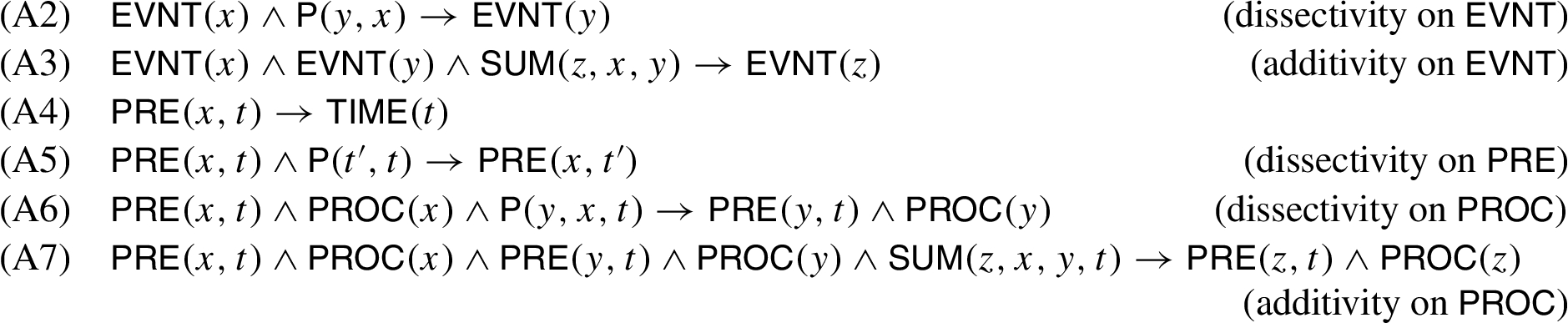
This holds as well on events and processes which are also additive. For processes, we need to introduce the binary relation ‘being present at’, written , which has as second argument a time, and is itself dissective:
We anticipate that , with processes, holds only if t is an instant, both exist at this instant t, and all the (active) participants in y are (active) participants in x.5
An active participant is a participant that is relevant for the given process like the person in a walking process and the shopfloor in a production process. This notion is not further characterized here.
Furthermore, the notion of enactor, which we can model logically as the sum of all the active participants, would suffice to define on processes.
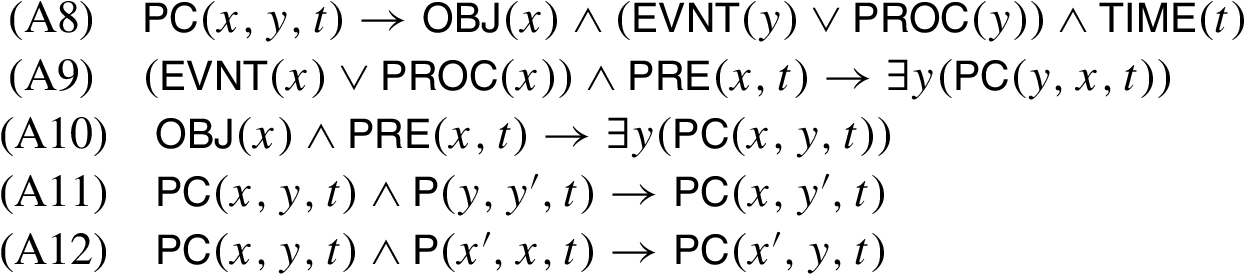
The relation of participation, (participates in), applies to an object and an event or process (A8); each event and process has at least one participant (A9); each object participates in some event or process (A10); a participant in an event or process is participant also in any larger event or process (A11); and any part of an object participates in the events and processes in which the object itself participates (A12). See also Borgo and Masolo (2010):
Finally, we assume that instants form a complete dense order. This is used in the formalization to model the special relationship between events and processes. Intervals could be reconstructed from instants as usual in knowledge representation (Tsang, 1987) but in practice here we consider both as primitives. In particular, we assume that a time is an instant or an interval but not both (A13) (the symbol stands for ‘disjunctive or’); an instant is a time with no proper part (A14); and an interval is a time that has a time as proper part (A15). We assume that time (intervals and instants) is modeled by the real line but this is not enforced by the axiomatization itself.
We write when t is the instant or interval spanned by the event x; and when the process x is ongoing at instant t.
We will write for and to mean that time t is before time . We use the relation < (or ⩽ to include identity) only over . We also use the notation to indicate an interval starting at t and ending at (included) where both t and are time instants. We write if t and are not included in the inverval (and analogously for and ).
Analysis and formalization in YAMATO
Case 1: Composition/constitution
“There is a four-legged table made of wood. Some time later, a leg of the table is replaced. Even later, the table is demolished so it ceases to exist although the wood is still there after the demolition.”
yamato characterizes composition and constitution of an object in terms of the role-based characterization of its parts (Mizoguchi and Borgo, 2017).6
Section 4.2 presents the yamato theory of roles on which the formalization of this case relies.
In yamato every physical object is made of some amount of matter (see point 10 of Section 2.1). If we exclude simple physical objects, like subatomic particles, all other objects have parts. A part is an entity which plays a role, more precisely a part-role, with respect to that object which is the context for the part-role. Thereby in yamato being a part means to be the role-holder of a part-role for some object.
The entity is a replaceable part if it can be substituted by another entity of the same kind (namely, this entity stops playing that part-role and another entity starts) without changing the essence of the object; furthermore, a part of the object is a genuine part since to play the part-role it must be spatiotemporally located according to the specification of the part-role under consideration. This distinction allows to answer some cross-temporal questions. An artifact comes to exist when it defines a set of part-roles and it persists in time if the specification given by its part-roles is satisfied. The object can undergo various changes, including the replacement of all its replaceable parts, without ceasing to exist. An object perishes when its specification (the presence of the mandatory parts) fails to be met. Clearly, the amount of matter that constitutes the object may still exist after the object came to an end but the failure of the implementation of the specification implies that the specification itself is no longer present and so there is no part-role to be played.7
It is assumed that ‘being a component of’ is a restricted relationship which occurs only in some appropriate situations. A full explanation is beyond the scope of this presentation.
The yamato categories that we use for the modeling of this case are: matter (), object (), role () and Time ().
We can now restate the case from the yamato viewpoint introducing the terms we will use in the formalization.
“There is a four-legged table (T) made of an amount of wood () at t. Some amounts of that wood play the roles of leg ( and ). At , a different amount of wood plays the role of one leg, say the 4-th one, . The table does not exist at when no amounts of wood satisfy the necessary requirements for that table’s part-roles.” (Here stand for “being in an appropriate position to satisfy the requirements for the i-th leg”.)
The constants we have introduced satisfy the following constraints:
The yamato relations that we use are: is present (), constitutes (), is context for (), plays role at (), mereological difference (−) and before (<).
Formula (2) states that: t is earlier than and is earlier than ; the table T is present at t and but not at ; T is constituted by at t and by at ; plays the leg role at t, and plays that very role at ; and, finally, and differ because and are different.
Stating the elements’ presence, constitution and role-playing:
Finally, note that the roles for which T is a context depend on the existence of T. Since at T does not exist, does not exist either. This means that no amount of matter can play the roles relative to T at that time.
yamato and these formulas suffice to model the example of this section.
The modeling discussed above is mainly focused on objects: the table as a whole and legs as its components according to the role theory of yamato. In this view occurrents, the events that “cause” the changes on the table, are kept implicit. In yamato one could introduce such occurrents, like the replacement occurrent and the demolition occurrent, explicitly. This second approach would make explicit the modeling of how and why the changes happen. Yet, the essential relations between the whole, its components and the material remain the same in both cases.
Another approach to modeling this case in yamato is via the introduction of the notion of functional parts presented in (Mizoguchi and Borgo, 2017). The identity of a table as an artifact depends on the functional specification of its part and components. The function of legs are to support the tabletop while keeping it horizontal. To realize such function, those four legs must be sufficiently robust for the weight of the tabletop and extra load due to objects put on it. Theoretically, the table persists during the time the specification is satisfied to some degree. The same argument applies to the legs, each leg being itself a whole made of wood. Functional parts are classified into four kinds such as genuine parts, persistent parts. replaceable parts and constituent parts, see details in (Mizoguchi and Borgo, 2017). Since legs are replaceable parts, substituting a leg does not affect the identity of the table and the table persists after the replacement. Note that the material (wood in our case), which is part of the table, looses its functional role when the table specification is not satisfied. Therefore, after the demolition, the table disappears since the specification is not applicable. The remaining pieces are pieces of wood but now they are not functional parts of a whole.
Case 2: Roles
“Mr. Potter is the teacher of class 2C at Shapism School and resigns at the beginning of the spring break. After the spring break, Mrs. Bumblebee replaces Mr. Potter as the teacher of 2C. Also, student Mary left the class at the beginning of the break and a new student, John, joins in when the break ends.”
In yamato, roles are anti-rigid, dynamic, and externally grounded (Masolo et al., 2004). The core of the yamato conception of roles can be summarized in the schema: “A potential player for a role is a role-holder when it actually plays the role.” Every role depends on a context, that is, on one or more entities relatively to which the role is defined. Hence a role is a dependent continuant. In the school example, the roles of student and of teacher are defined within a school system, which is the context.
A role is an entity to be played, a potential player is an entity that can play a role, and a potential player becomes a role-holder in playing a role. The sharp distinction between a role and a role-holder helps to conceptualize the change in players and the vacant roles, i.e. roles which at the moment are not played.
The yamato categories that we need for modeling this case are: physical object (), role () and Time ().
We can now restate the case from the yamato viewpoint introducing the terms we will use in the formalization.
“Mr. Potter (P) has been the teacher () of class 2C at Shapism School () for some time t. At time , Mr. Potter is not a teacher and Mary (M) is not a student () of the class. At time , Mrs. Bumblebee (B) is the teacher of 2C in substitution of Mr. Potter, and John (J) is a new student () of the class.”
The constants we have introduced satisfy the following constraints:
The yamato relations that we use are: is present (), is context for (), plays role at () and before (<).
Formula (4) states that: interval t is earlier than and is earlier than ; that roles and depend on the school which is present at all times; P plays role at t only; B plays role at only; M plays role at t only; J plays role at only; role and are vacant, i.e., there is no role-holder, in the other times.
Stating the elements’ presence, constitution and role-playing:
It is vital for an organization to establish the nature of the roles that it defines, i.e., for which the organization is the context. Technically speaking, in this example it means to distinguish the roles that are functional for the organization (Mizoguchi and Borgo, 2017).
Consider the persistence of the class 2C. On the one hand, the student roles ( and ) are not functional with respect to Shapism School, much less for 2C, because in the school context students are seen as operands (the objects of ‘input’ and ‘output’ operations in terms of school service) that merely receive (education) without providing functionality to the school system. The replacement of students is therefore irrelevant to the persistence of the class 2C. On the other hand, the teacher roles () are functional with respect to Shapism School, let alone class 2C, because teachers are functional for the school to perform its service. Thus the change of a teacher role may affect the persistence of the class 2C, instead the change of the teacher player does not.
Following our discussion of the first case, even in this case an alternative model can be obtained by applying the theory of functional parts (Mizoguchi and Borgo, 2017). In this view the Shapism school is considered a functional whole whose main functional parts are teachers and class rooms (and perhaps buildings) in which students are dealt with as input (informally, the target objects of education) and their output status would be that of people with a certain level of education. Persons who are hired as teachers are replaceable parts, and teachers working at the school are genuine parts of the school. Like for the legs of the table, replacing Mr. Potter with Mrs. Bumblebee does not influence the identity and the persistence of Shapism school as far as the latter is functionally equivalent to the former. Since students are not functional parts of the school, the introduction or removal of a student is not affecting the functional state of the school. The quality of the school is largely dependent on the functionality of teachers specified by the school.
Property change
a) “A flower is red in the summer. As time passes, the color changes. In autumn the flower is brown.”
The terms ‘property’ and ‘quality’ have a variety of meanings that depend on the discipline (e.g. philosophy, formal logic, computer science and linguistics) and within a discipline on the community of reference. To make clear its position, the yamato theory of qualities and properties is based on two central features and adopts its own terminology.8
The theory of qualities and properties presented here is primarily about qualities of actually measured objects, and not about the results (representations) of measurement of those objects.
In yamato quality and related concepts are characterized in terms of the role pattern already introduced to formalize components (case 1) and social roles (case 2). In this case, we can state it as follows: “A generic quality (a potential player) plays a quality role (a role) with respect to a specific measured object (the context), thereby becoming a quality role-holder (a role-holder).” A generic quality is the most general kind of quality and it represents basic physical parameters (e.g., length, mass, and temperature). A quality role is a role played by a generic quality, it includes height, weight, and body temperature. By playing a quality role, an instance of a quality becomes a quality role-holder exactly like a person P becomes a teacher role-holder when it plays the teacher role in a school context. What we call a quality is the instance of a quality role-holder that inheres in a particular object (or a process or an event) like John’s height, Mary’s weight, and Suzy’s body temperature.
Note that the quality must be distinguished from the value of the quality, see (Masolo et al., 2003) and (Borgo et al., 2022): John’s height is the quality of John, 1.75 cm on January 1st, 2020 is the value of that quality on that day. Thus, quality is sharply distinguished from quantity. As stated at point 7 of Section 2.1, Steven’s (1946) four types of scales of measurement (nominal, ordinal, interval, and ratio) are included in the yamato is-a hierarchy of quantity. Being a kind of quality value (e.g., 175 cm), a quantity consists of a number and a unit. A quality is said to have a quantity only when it is realized at a particular time. For instance, a nurse keeps track of Suzy’s body temperature since it exists at both times and ; and quality realizations at and of Suzy’s body temperature are occurrences of 36.5 and 36.6 degrees Celsius, respectively. Finally, in yamato a property is defined as the complex kind of attribute that can be represented as a pair of a quality and a quality value (e.g., ⟨height, 175cm⟩).
The yamato categories that we need for modeling this case are: physical object (), quality (), quality value () and time ().
We can now restate the case from the yamato viewpoint introducing the terms we will use in the formalization.
“A flower (F) is red (R) in the summer (t). The color of the flower () changes with the passage of time. In the autumn () the flower is brown (B).”
(Here R and B are specific tints of red and of brown, respectively.)
The constants we have introduced satisfy the following constraints:
The yamato relations that we use are: is present (), has value (), inheres in ) and before (<).
Formula (6) states that: t is earlier than ; that the flower and its color quality are present at both times; that the tint of red R is the flower’s color quality-holder in the summer and the tint of brown B is the flower’s color quality-holder in the autumn.
Stating the elements’ presence and other relationships:
3.b) “A man is walking when suddenly he starts walking faster and then breaks into a run.”
As stated earlier, yamato distinguishes between processes and events. An event is constituted by a process which can change while unfolding. The event, being the completion of the process during some period of time, cannot change. When talking about change of an event, in yamato this is understood as talking about a change in the process that constitutes the event (see Section 2.4). A process can change because it has qualities that take value at each point in time (since it is ‘wholly present’ at any time at which it is ongoing) and these qualities can change over time analogously to the change of object’s qualities over time (e.g. the change of the flower’s color in Case 3.a). By modeling these changes of the constituting process, yamato is able to represent why different parts of an event may show different ‘aspects’ or ‘modes’. It follows that to model the example we do not need to talk about the overall event, what we need is the comparison of the speed quality of the constituting process at different times.
The yamato categories that we need for modeling this case are: physical object (), quality (), quality value (, process () and time ().
We can now restate the case from the yamato viewpoint introducing the terms we will use in the formalization.
“A man (O) is walking () (at speed S) (at time t), when suddenly (at ) he (O) starts walking faster and then (at ) breaks into a run ().”
The constants we have introduced satisfy the following constraints:
The yamato relations that we use are: is present (), participation () has value (), inheres in ) and before (<, ⩽).
Formula (8) states that (we write for the range from to , and included, and for the same range with excluded): t is earlier than and this is earlier than ; that the process is present during the interval ; that the process is present at ; that O participates in the processes with speed S; that the value of speed quality S is always within the walking range in ; that S’s value increases in . Finally, we use a predicate to characterize speed values compatible with walking.
Stating the elements’ presence and relationships:
yamato is quite flexible in dealing with qualities and properties. As already discussed, the fundamental scheme is based on the ⟨entity, attribute, value⟩ triple, that is, an attribute inheres in an entity and its values undergoes change as time goes. In the case of John’s height, the recommended model is ⟨John, height, 170cm⟩ at time t where “height” persists while the value “170cm” may change as time goes. Although it is not recommended, yamato allows to model the change of a property as a change of ⟨attribute, value⟩ tuple. In this case, the pair ⟨attribute, value⟩ would inhere in John as a property. The problem of this modeling choice is that the property of the entity (John) would be continuously replaced by different properties (different pairs) while it undergoes change. For this reason, we reccommend to adopt the modeling presented earlier.
Event change
“A man is walking to the station, but before he gets there, he turns around and goes home.”
In yamato changes in happenings are modelled via interrelationships among processes, events, plans and their execution (whether complete or not). From Section 2.4, it is clear that a process does not have a goal9
This distinguishes process from action, the latter has a goal as well as an intention. Here the term “goal” should be interpreted as telicity, that is, as having a definite end.
while happenings towards a goal are classified as events. The point is that an event is the result of the changes brought about by a process which eventually achieves a goal of the event. This goal introduces a notion of completeness which is specific to events. In contrast, a process does not aim at a specific result and, in principle, can go on indefinitely. Indeed, in yamato ‘reading’ (what you are doing right now) is a process, ‘reading this paper’ (which is in part the result of what you are doing right now) is an event. In addition, goal-directedness, completion, and incompletion are related to the specification of a plan, the execution of the plan, and the abandonment (and thus the uncompleted execution) of the plan, respectively. (For an in-depth modeling of goal-directed activities, one should include an ontology of action as well as an ontology of mind, like the belief-desire-intention model of agency, which are not addressed here and are under development in yamato.)
A plan in yamato is the content of a representation, the latter specifies the sequence of actions to be made (possibly with allowed variations). A plan is executed when its content is realized, namely when a sequence of actions satisfying the plan is performed. A plan is abandoned when its content is no longer executed, namely when the plan is not completed and the next performed action does not satisfy the plan (or no further action is performed). The process which actually executes a plan constitutes an event when the plan is completed (fully executed). If the plan is abandoned, the performed process up to that point constitutes an event with the goal unachieved (the process itself may persist further or end).
The yamato categories that we need for modeling this case are: physical object (), process (), event (), information content () and time ().
We can now restate the case from the yamato viewpoint introducing the terms we will use in the formalization.
“A man (O) is walking (, at time t) with the plan () to reach the station and, before reaching the station, he turns around ( happening from time to , which determines an incomplete event, ) and then (after ) goes home (plan ).”
The constants we have introduced satisfy the following constraints:
The yamato relations that we use are: is present (), participates (), executes (), constitutes (), completes () and before (<, ⩽).
Formula (10) states that: and are distinct ordered times; that the process is present during the interval from t to (as before, we write for the temporal interval including initial and final temporal instants x and y); that O participates in the process ; that the process before is an execution of plan and it constitutes a uncompleted home-to-station event ; that from to constitutes a turning event ; that after is the execution of the plan to go home (as the modeling strategy is clear, we omit to model the corresponding going-home event).
Stating the elements’ presence, constitution and role-playing:
We do not suggest alternative ways to model process and event change using yamato because these rely on the most fundamental principles governing processes and events in our ontology. A process is essentially ongoing and the direction and the speed of the moving process are its inherent attributes. The event change is modelled by comparing plans and plan executions, this means that there are essentially two events one of which is incompletely executed.
Concept evolution
“5) A marriage is a contract that is regulated by civil and social constraints. These constraints can change but the meaning of marriage continues over time.”
The evolution of the meaning of marriage is handled according to the yamato theory of representation presented by Mizoguchi and Borgo (2021). The central idea is that a representation consists of a (representation) form, typically an expression in some language, and a content. A representing thing is composed of a representation and a representation medium (a support where the expression is cast). Generally speaking, the form and content of a representation can be realized in different media. For instance, a musical score (representation) consists of a sequence of musical notes (the representation form) and the specification of the sound sequence (the content); and a music book (the representing thing) is composed of some musical scores (representations) and some pieces of paper (representation media) where the musical scores is depicted. The form of a representation is realized on a physical continuant: e.g., a sequence of musical notes is realized when it is written on a piece of paper. The content of a representation is realized by some process (typically by an action) when it is a specification, i.e., a detailed description of how something is, or should be, designed or made. Examples of representations whose content is a specification include an algorithm, a recipe and a plan. To continue our previous example, a piece of music is realized when somebody plays it.
In the yamato representation theory, marriage is a specification which, when part of a social system, has a representation, i.e., the specification is encoded in a form (an expression in some language). The discontinuity of the meaning of marriage applies to the representation: the same form may encode different specifications at different times. The content of marriage (as representation) at some time is the socio-legal specification that a community has at that time about a particular relationship between two people. This specification is realised by two people when living according to the corresponding socio-legal rules (this usually requires also the establishment of a social-legal contract, e.g. via a speech act). When the socio-legal rules change, the representation entity changes its content accordingly while preserving the representation form.
The yamato categories that we need for modeling this case are: representation (), representation form (), representation content (), representation encoding method (), and time ().
We can now restate the case from the yamato viewpoint introducing the terms we will use in the formalization.
“A marriage (M) is a contract that is regulated by dedicated civil and social laws (). These laws () can change but the meaning of marriage continues over time.”
The constants we have introduced satisfy the following constraints:
The yamato relations that we use are: is present (), specifically depends on (), representation relation (), and proper part ().10
Note that can be a unary predicate or a 4-tuple relation, see (Mizoguchi and Borgo, 2021) for details.
From (Mizoguchi and Borgo, 2021) the relation stands for “x is a representation with form y and content z such that y encodes z via method m”.
Formula (12) states: that M (the marriage) and (the social and legal laws on marriage) are present during t; M has representation form and representation content with encoding method m; that has representation form and representation content with encoding method ; that the marriage content over time t is always dependent on the content of the social and legal laws.
Stating the elements’ presence and dependences:
Since social and legal laws can change over time, from the formula above the meaning (content) of marriage adapts as time passes to the changes of the content of the laws while the form remains the same.
Note that in yamato the only way to model concept change is via representations as shown above.
Ontology usage and community impact
Several application examples of yamato are found in biomedicine. First of all, a viable definition of disease is indispensable for the robust construction of disease ontologies. Built in compliance with the yamato conception of objects discussed in Section 2.4, the River Flow Model (RFM) of diseases was initially presented in Mizoguchi et al. (2011) and further developed by Rovetto and Mizoguchi (2015) and Toyoshima et al. (2017).11
http://rfm.hozo.jp/
The basic tenet of RFM is the analogy between a river and a disease. Just as a river enacts changing the course of water flowing as its external process, a disease enacts as its external process a process of, e.g., spreading and disappearing; and just as a river has water flowing as its internal process, a disease has as its internal process a number of causal chains of clinically abnormal states. In RFM, a disease is thus defined as a dependent continuant constituted of causal chains of abnormal states. RFM is theoretically comparable to the widely employed, dispositional model of disease given by the Ontology for General Medical Science (OGMS; Scheuermann et al., 2009, Toyoshima et al., 2017).
Second, and relatedly, diverse representations of abnormal states render exchanging medical data and information rather difficult. To address this issue, a unified representation model of abnormal states was proposed in accordance with the yamato theory of quality and quantity discussed in Section 3.3 (Yamagata et al., 2014). An abnormal state is described as a ‘property’, which can be decomposed into an ‘attribute’ and a ‘value’ in a qualitative representation, hence the ⟨Entity, Attribute, Value⟩ formalism. This model was extensively exploited in order to capture all causal relations among approximately 21,000 abnormal states from approximately 6,000 diseases.
Third, it was found on closer examination that, despite its widespread use as a common framework for representing genomic phenotypes, the Phenotypic Quality Ontology (PATO) has some problems with a qualitative representation owing to its use of the poorly expressive ⟨Entity, Property⟩ representation form. To solve them, PATO was enhanced by the yamato qualitative representation and expanded into PATO2YAMATO (Masuya et al., 2011).12
This indicates an effective way of integrating biological measurement data across various biological experiments.
Fourth, and finally, genes are fundamental to modern biomedical science. Certainly, Gene Ontology seeks to provide cross-species biological vocabularies that can be used by multiple databases to describe gene products (Gene Ontology Consortium, 2001).13
http://www.geneontology.org/
Nonetheless, as stated by Masuya and Mizoguchi (2012), no attempt has been made to fully represent various complex aspects of genes until the Genetics Ontology (GXO) was developed to provide a sound foundation for a semantic model that is applicable to various fields of life science (Masuya and Mizoguchi, 2012).14
In GXO, the multiple facets of bearers of genetic information (including genes and alleles) are accurately modelled with the help of the yamato theory of roles and representation. Included in GXO is, e.g., the world’s first ontological definition of DNA as the representing thing that is encoded by adenine (A), cytosine (C), guanine (G), and thymine (T).
Other application examples of yamato include increased usage of the method of function decomposition (Kitamura and Mizoguchi, 2003) according to which approximately 90 functional terms are used as a common vocabulary for representing the functional structure of any artifact and which was elaborated in conformity with the yamato notion of function (see point 3 in Section 2.1). The approach of function decomposition was well-advanced enough to be merchandized as a tool called “OntoloGear” which has been deployed in industry, e.g., to facilitate production systems in a factory.
The action decomposition method has been extensively employed in various domains. Examples include the modeling of nursing actions in hospitals (Nishimura et al., 2014); the development of an Ontology-based Obstacle, Prevention and Solution (OOPS) modeling framework which supports descriptions of activities and related knowledge of the users of mobile Internet services (Sasajima et al., 2008); and the building of an ontology of learning and instructional theories that is called ‘OMNIBUS’ (Mizoguchi and Bourdeau 2000; 2016, Hayashi et al., 2009) and an OMNIBUS-based theory-aware authoring tool named ‘SMARTIES’ that provides a modeling environment and guidelines for making theory-compliant learning and instructional scenarios (Mizoguchi et al., 2007).
Other applications of yamato include the proposal of an ontological definition of services based on the yamato theory of function (Sumita et al., 2012) and a theory of causation (Toyoshima et al., 2019, Mizoguchi, 2020). Projects in progress to apply yamato include (1) Structuring sustainable lifestyles in future society; (2) Reorganization of the grammar of English tense (Allard and Mizoguchi, 2021); (3) Task ontology building of demolition tasks of a nuclear power plant; (3) Ontology building of biomimetics; and (4) Building a know-how model of an expert of ferromagnetic materials. The yamato concepts mainly used in project are the process and event distinction, and the method of function and action decomposition, respectively.
Conclusions
The utility of upper ontologies is twofold. On the one hand there is their intrinsic capability to advance information interoperability. On the other hand, they are powerful systems for in-depth domain modeling. Although the former has attracted considerable attention to date, the authors believe that the value of the latter can be even more substantial and long-lasting, and deserves to be explored more in the future. To harvest this we need to develop an “engineering attitude” that builds on foundational theories.
As seen in Section 5, yamato is particularly oriented to the second type of utility. The river-flow model (RFM; Toyoshima et al., 2017) and the comprehensive model of abnormal states of diseases are good examples since they strongly relying on the theory of processes and qualities of yamato. Similarly, many industrial applications are based on the function decomposition tree which is needed to model the functional structure of any types of artifacts. This is supported by the rich yamato theories of functions and roles. The modeling of the five cases discussed in Section 4 further demonstrates how yamato deals with the ever-changing phenomena found in reality.
Footnotes
Acknowledgements
The authors would like to express their sincere thanks to Fumiaki Toyoshima, Antony Galton, Yoshinobu Kitamura, and Kouji Kozaki for their fruitful collaboration.
References
1.
Allard, D. & Mizoguchi, R. (2021). Dr. Mosaik: A holistic framework for understanding the English tense-aspect system based on ontology engineering. Research & Practice in Technology Enhanced Learning, 16, to appear.
2.
Arp, R., Smith, B. & Spear, A.D. (2015). Building Ontologies with Basic Formal Ontology. MIT Press.
3.
Borgo, S., Ferrario, R., Gangemi, A., Guarino, N., Masolo, C., Porello, D., Sanfilippo, E.M. & Vieu, L. (2022). DOLCE: A Descriptive Ontology for Linguistic and Cognitive Engineering. Applied Ontology, 17(1), 45–69. doi:10.3233/AO-210259.
4.
Borgo, S., Franssen, M., Garbacz, P., Kitamura, Y., Mizoguchi, R. & Vermaas, P.E. (2014). Technical artifacts: An integrated perspective. Applied Ontology, 9(3–4), 217–235. doi:10.3233/AO-140137.
5.
Borgo, S. & Masolo, C. (2010). Ontological foundations of DOLCE. In R.Poli, M.Healy and A.Kameas (Eds.), Theory and Applications of Ontology: Computer Applications (pp. 279–295). Springer. doi:10.1007/978-90-481-8847-5_13.
6.
Borgo, S. & Mizoguchi, R. (2014). A first-order formalization of event, object, process and role in YAMATO. In P.Garbacz and O.Kutz (Eds.), Proceedings of the 8th International Conference on Formal Ontology in Information Systems (FOIS2014), Rio de Janeiro, Brazil, September 22–26, 2014 (pp. 79–92).
7.
Borgo, S., Mizoguchi, R. & Kitamura, Y. (2016). Formalizing and adapting a general function module for foundational ontologies. In R.Ferrario and W.Kuhn (Eds.), Proceedings of the 9th International Conference on Formal Ontology in Information Systems (FOIS2016), Annecy, France, July 6–9, 2016 (pp. 241–254).
8.
Casati, R. & Varzi, A.C. (1999). Parts and Places. MIT Press.
9.
Galton, A. & Mizoguchi, R. (2009). The water falls but the waterfall does not fall – new perspectives on objects, processes and events. Applied Ontology, 4(2), 71–108. doi:10.3233/AO-2009-0067.
10.
Gene Ontology Consortium (2001). Creating the gene ontology resource: Design and implementation. Genome Research, 11, 1425–1433. doi:10.1101/gr.180801.
11.
Guarino, N. (1995). Formal ontology, conceptual analysis and knowledge representation. International Journal of Human and Computer Studies, 43(5/6), 625–640. doi:10.1006/ijhc.1995.1066.
12.
Guizzardi, G. & Wagner, G. (2010). Using the unified foundational ontology (UFO) as a foundation for general conceptual modeling languages. In R.Poli, M.J.Healy and A.D.Kameas (Eds.), Theory and Application of Ontology: Computer Applications (pp. 175–196). Springer. doi:10.1007/978-90-481-8847-5_8.
13.
Hayashi, Y., Bourdeau, J. & Mizoguchi, R. (2009). Strategy-centered modeling for better understanding of learning/instructional theories. International Journal of Knowledge and web Intelligence, 1(3–4), 187–208.
14.
Herre, H. (2010). General formal ontology (GFO): A foundational ontology for conceptual modelling. In R.Poli, M.J.Healy and A.D.Kameas (Eds.), Theory and Application of Ontology: Computer Applications (pp. 297–345). Springer. doi:10.1007/978-90-481-8847-5_14.
15.
Kitamura, Y., Koji, Y. & Mizoguchi, R. (2006). An ontological model of device function: Industrial deployment and lessons learned. Applied Ontology (Special issue on “Formal Ontology Meets Industry”), 1(3–4), 237–262.
16.
Kitamura, Y. & Mizoguchi, R. (2003). Organizing knowledge about functional decomposition. In Proceedings of the 14th International Conference on Engineering Design (ICED03), Stockholm, Sweden, August 19–21, 2003.
17.
Kitamura, Y. & Mizoguchi, R. (2013). Characterizing functions based on phase-and evolution-oriented models. Applied Ontology, 8(2), 73–94. doi:10.3233/AO-130123.
18.
Kozaki, K., Hihara, K. & Mizoguchi, R. (2012). Dynamic is-a hierarchy generation system based on user’s viewpoint. In Proceedings Joint International Semantic Technology Conference (JIST2011), Hangzhou, China, December 4–7, 2011 (pp. 96–111).
19.
Masolo, C., Borgo, S., Gangemi, A., Guarino, N. & Oltramari, A. (2003). WonderWeb Deliverable D18. Accessible at http://wonderweb.man.ac.uk/deliverables/D18.shtml.
20.
Masolo, C., Vieu, L., Bottazzi, E., Catenacci, C., Ferrario, R., Gangemi, A. & Guarino, N. (2004). Social roles and their descriptions. In D.Dubois, C.Welty and M.A.Williams (Eds.), Principles of Knowledge Representation and Reasoning. Proceedings of the Ninth International Conference (KR 2004), Whistler British Columbia, Canada, June 2–5, 2004.
21.
Masuya, H., et al. (2011). An advanced strategy for integration of biological measurement data. In Proceedings of the 2nd International Conference on Biomedical Ontology (ICBO2011), Buffalo, NY, USA, July 28–30, 2011 (pp. 79–86).
22.
Masuya, H. & Mizoguchi, R. (2012). An ontology of gene. In Proceedings of the 3rd International Conference on Biomedical Ontology (ICBO2012), Graz, Austria, July 21–25, 2012.
23.
Mizoguchi, R. (2004). Tutorial on ontological engineering – part 3: Advanced course of ontological engineering. New Generation Computing, 22(2), 198–220. doi:10.1007/BF03040960.
24.
Mizoguchi, R. (2010). YAMATO: Yet another more advanced top-level ontology. In Proceedings of the Sixth Australasian Ontology Workshop (pp. 1–16). Adelaide: Australia.
25.
Mizoguchi, R. (2020). Causation: Revisited. In Proceedings of the 4th Workshop on Foundational Ontology (FOUST IV), Co-Located with the Joint Ontology Workshops (JOWO 2020) and the Bolzano Summer of Knowledge (BOSK 2020), Italy, Aug. 31–Oct. 7, 2020 (Vol. 2708). CEUR-WS.org.
26.
Mizoguchi, R. & Borgo, S. (2017). A preliminary study of functional parts as roles. In Proceedings of the 2nd Workshop on Foundational Ontology (FOUST II), Co-Located with the 3rd Joint Ontology Workshop (JOWO 2017), Bozen-Bolzano, Italy, September 21–23, 2017 (Vol. 2050). CEUR-WS.org.
27.
Mizoguchi, R. & Borgo, S. (2021). Towards an ontology of representation. In Proceedings of the 12th International Conference on Formal Ontology in Information Systems (FOIS2021), Bozen-Bolzano, Italy, 13–16 September, 2021, to appear.
28.
Mizoguchi, R. & Bourdeau, J. (2000). Ontological engineering to overcome AI-ED problems. International Journal of Artificial Intelligence in Education, 11(2), 107–121.
29.
Mizoguchi, R. & Bourdeau, J. (2016). Using ontological engineering to overcome AI-ED problems: Contribution, impact and perspectives. International Journal of Artificial Intelligence in Education, 26(1), 91–106. doi:10.1007/s40593-015-0077-5.
30.
Mizoguchi, R., Galton, A., Kozaki, K. & Kitamura, Y. (2015). Families of roles: A new theory of occurrent-dependent roles. Applied Ontology10(3–4), 367–399. doi:10.3233/AO-150148.
31.
Mizoguchi, R. & Kitamura, Y. (2009). A functional ontology of artifacts. The Monist92(3), 387–402. doi:10.5840/monist200992322.
32.
Mizoguchi, R., Kitamura, Y. & Borgo, S. (2016). A unifying definition for artifact and biological functions. Applied Ontology, 11(2), 129–154. doi:10.3233/AO-160165.
33.
Mizoguchi, R., Kozaki, K., Kou, H., Yamagata, Y., Imai, T., Waki, K. & Ohe, K. (2011). River flow model of diseases. In Proceedings of 2nd International Conference on Biomedical Ontology (ICBO2011), Buffalo, NY, USA, July 28–30, 2011 (pp. 63–70).
34.
Mizoguchi, R., Sunagawa, E., Kozaki, K. & Kitamura, Y. (2007). A model of roles within an ontology development tool: Hozo. Applied Ontology, 2(2), 159–179.
35.
Nishimura, S., Kitamura, Y., Sasajima, M. & Mizoguchi, R. (2014). Systematic description of nursing actions based on goal realization model. In Proceednigs of the 15th European Conference on Knowledge Management (ECKM2014), Santarém, Portugal, September 4–5, 2014 (pp. 730–739).
36.
Rovetto, R.J. & Mizoguchi, R. (2015). Causality and the ontology of disease. Applied Ontology, 10(2), 79–105. doi:10.3233/AO-150147.
37.
Sasajima, M., Kitamura, Y., Naganuma, T., Fujii, K., Kurakake, S. & Mizoguchi, R. (2008). Obstacles reveal the needs of mobile Internet services – OOPS: Ontology-based obstacles, prevention and solution modeling framework. Journal of Web Engineering, 7(2), 133–157.
38.
Scheuermann, R.H., Ceusters, W. & Smith, B. (2009). Towards an ontological treatment of disease and diagnosis. In Summit on Translational Bioinformatics (pp. 116–120).
39.
Smith, B. & Ceusters, W. (2010). Ontological realism: A methodology for coordinated evolution of scientific ontologies. Applied Ontology, 5(3–4), 139–188. doi:10.3233/AO-2010-0079.
40.
Steven, S.S. (1946). On the theory of scales of measurement. Science, 103(2684), 677–680. doi:10.1126/science.103.2684.677.
41.
Sumita, K., Kitamura, Y., Sasajima, M. & Mizoguchi, R. (2012). Are services functions? In Proceedings of the Third International Conference on Exploring Services Science (IESS2012), Geneva, Switzerland, February 15–17, 2012 (pp. 58–72).
42.
Toyoshima, F., Mizoguchi, R. & Ikeda, M. (2017). Causation and the river flow model of diseases. In Proceedings of the 8th International Conference on Biomedical Ontology (ICBO2017), Newcastle upon Tyne, UK13–15 September, 2017 (pp. 13–15). Accepted.
43.
Toyoshima, F., Mizoguchi, R. & Ikeda, M. (2019). Causation: A functional perspective. Applied Ontology, 14(1), 43–78. doi:10.3233/AO-190206.
44.
Tsang, E.P.K. (1987). Time structures for AI. In Proceedings of 10th International Joint Conference on AI (IJCAI) (pp. 456–461).
45.
Yamagata, Y., Kozaki, K., Imai, T., Ohe, K. & Mizoguchi, R. (2014). An ontological modeling approach for abnormal states and its application in the medical domain. Journal of biomedical semantics, 5(1), 1–14. doi:10.1186/2041-1480-5-1.
46.
Vieu, L., Borgo, S. & Masolo, C. (2008). Artefacts and Roles: Modeling Strategies in a Multiplicative Ontology. In Proceedings of the 5th FOIS Conference, Amsterdam, (pp. 121–134). IOS Press.