



Abstract
Upper ontologies have traditionally arisen from the approach in which concepts that are common across a set of domains can be axiomatized at a general level. The rationale is that reuse across domains is to be supported through specialization of the general concepts from an upper ontology. Similarly, semantic integration between ontologies is to be achieved through the general concepts they specialize. The TUpper Ontology follows an alternative approach (referred to as the sideways approach) to the conventional upper ontology paradigm. Rather than think of an upper ontology as a monolithic axiomatization centred on a taxonomy, the sideways approach considers an upper ontology to be a modular ontology composed of generic ontologies that cover concepts including those related to time, process, and space. TUpper is therefore composed of a set of generic ontologies, and each generic ontology axiomatizes a particular set of generic concepts (e.g., the classes and relations relevant for time, process, and space). The TUpper Ontology is designed as a top-level ontology that contains modules from the ontologies within existing international standards.
Introduction
Upper ontologies arise from the approach in which concepts that are common across a set of domains can be axiomatized at a general level. The rationale is that reuse across domains is supported through specialization of the general concepts from an upper ontology. Similarly, semantic integration between ontologies is achieved through the general concepts they specialize. To this end, an upper ontology typically axiomatizes a single, fixed set of ontological commitments for the semantics of those concepts, which are universally applicable and other ontologies are meant to be a specialization (an extension) of the upper ontology.
Nevertheless, an upper ontology’s support for semantic integration is limited precisely because it forces the acceptance of a single set of ontological commitments. This design flaw has two consequences that can impede reuse and sharability. If two ontologies are both extending the same upper ontology, full semantic integration between the two extensions is impossible if one extension contains a single axiom that is inconsistent with another extension of the upper ontology. Second, any extension of an upper ontology forces the ontology designer to adhere to all ontological commitments of the upper ontology – it is not possible to selectively reuse modules of the upper ontology and extend those with additional ontological choices that are inconsistent with other assumptions of the upper ontology.
The TUpper Ontology Grüninger et al. (2017) is designed as a top-level ontology that contains modules from the ontologies within existing international standards, and that extends these modules so as to satisfy the criteria for top level ontologies in ISO/IEC 21838-1. The goal for TUpper is to support the ontological analysis of relevant existing standards and to integrate the ontologies within those standards, in particular:
Rather than being a monolithic axiomatization that builds upon a core taxonomy, TUpper adopts the Sideways Approach Chui (2014), in which an upper ontology is the union of a set of modules that are themselves generic ontologies that cover the concepts related to time, process, and space that are needed to address its overarching competency questions. The taxonomy of TUpper is the result of the combination of the taxonomies of the constituent ontologies, leading to broad rather than deep structure. In this sense, TUpper is a requirements-driven upper ontology – the axiomatization must be strong enough to interpret the intended semantics of the terminology of each of the participating standards.
The main purpose of this paper is to show how TUpper formalizes a set of use cases that span the conceptual range of upper ontologies. In particular, these use cases address the problem of the constitution and composition of physical objects, roles, property change, and event change. By demonstrating how TUpper can be applied to the representation of the background knowledge implicit in each of these use cases, we take the first step towards a complete formal characterization of the logical and ontological relationships among existing upper ontologies.
Although the design of TUpper was motivated by the existence of generic ontologies within existing standards, an alternative perspective to understand TUpper is that it can be characterized by the following two fundamental competency questions:
How does the physical world change? What generic ontologies are needed to axiomatize the intended semantics for different units of measure?
In response to these questions, different modules of TUpper characterize physical objects, their relationship to the spatial regions that they occupy, and the processes that change physical objects and their relationships over time.
Mereological pluralism
Approaches based on classical mereology (Simons, 1987) use a single parthood relation to specify various parthood relationships, an approach known as mereological monism. Although this approach is adopted by most upper ontologies, it is not viable approach if we are to support ontologies for units of measure related to notions as diverse as mass, length, area, and volume (each of which will have a distinct mereology) Aameri et al. (2012). TUpper therefore adopts mereological pluralism (Ru and Grüninger, 2017), which is based on the idea that there are indeed multiple distinct parthood relations for different classes of entities:

The mereologies on matter and spatial regions are complete extensional mereologies with complementation, as is the mereology of atomic (concurrent) activities. On the other hand, the mereology of complex activities is logically synonymous with the weakest mereology, and does not require the existence of sums or complements. The mereology on components and timeintervals entails Strong Supplementation, but only requires the existence of sums for connected elements, rather than for all underlapping elements (as with classical mereology).
Process and change
The Tupper module
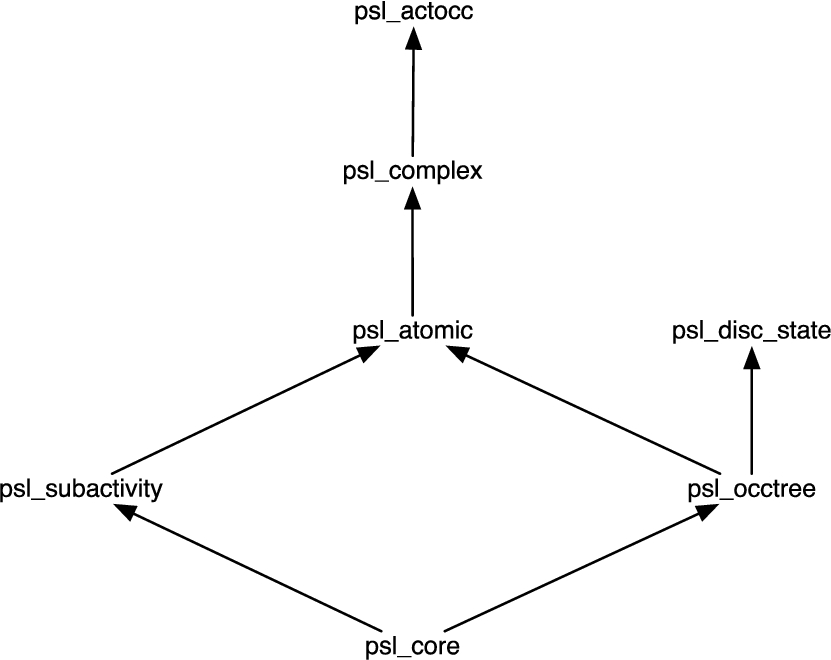
Modules of the PSL ontology. Arrows denote conservative extension.
Activities may have multiple occurrences, or there may exist activities which do not occur at all. TUpper is not committed to the existence of activities that never occur (equivalently, do not have any occurrences); it simply allows models in which an activity exists, yet no occurrences of the activity exist. In other words, the following sentence is independent of TUpper:
Time
Timepoints are linearly ordered, forwards into the future, and backwards into the past. Activity occurrences and objects are associated with unique timepoints that mark the begin and end of the occurrence or object. Each activity occurrence has a duration (via the module
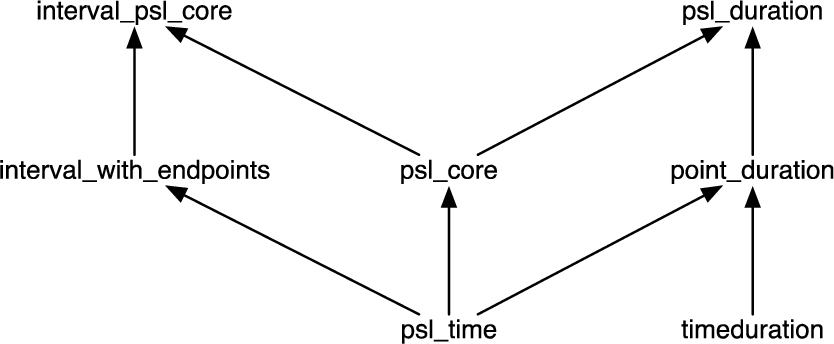
Modules for duration. Arrows denote conservative extension.
Activities can be composed together to construct complex activities. Occurrences of complex activities correspond to sets of occurrences of their subactivities. Different occurrences of complex activities may contain occurrences of different subactivities or different orderings on the same subactivity occurrences.
There are several different ordering relations on activity occurrences. The first of these orderings are formalized by the mathematical structure referred to as occurrence trees, which consist of all possible sequences of primitive activity occurrences (axiomatized in
Models of the module
Fluents and change
Properties in the domain that can change are called fluents. Similar to the representation of activities, fluents can also be denoted by terms within the language. For example,
A change in state is captured by the set of fluents that are either achieved or falsified by an activity occurrence. Fluents are considered to be states of affairs, insofar as they are said to obtain or not, while sentences (containing the
A fluent is changed by the occurrence of activities, and a fluent can only be changed by the occurrence of activities. In particular, a fluent is achieved by an activity occurrence iff it holds after the occurrence but was not prior to the occurrence, while the fluent is falsified by an activity occurrence iff it was prior to the occurrence but does not hold after:
If some fluent holds after an activity occurrence, but after an activity occurrence later along the branch of the occurrence tree it is false, then an activity must occur at some point between that changes the fluent. This also leads to the requirement that the fluent holding after an activity occurrence will be the same fluent holding prior to any immediately succeeding occurrence, since there cannot be an activity occurring between the two by definition.
State does not change during the occurrence of an atomic activity. Consequently, TUpper cannot represent phenomena in which some feature of the world is changing as some continuous function of time (hence the name “Discrete State” for the extension). If state changes during an activity occurrence, then it must be an occurrence of a complex activity.
Physical objects
From the perspective of
The module
While the combination of the modules
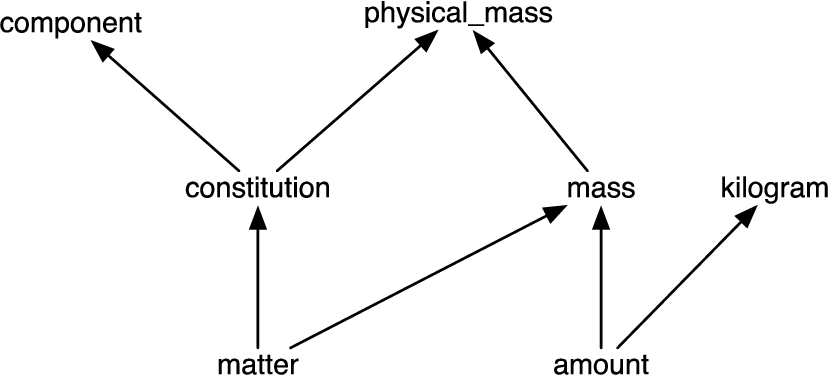
Modules for physical objects. Arrows denote conservative extension.
TUpper does not axiomatize a dependency relation on the set of objects.
The module
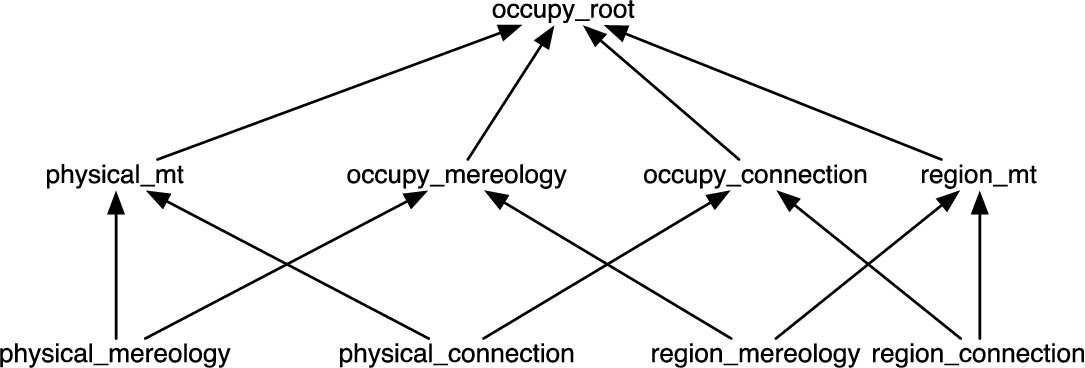
Modules for location of physical objects. Arrows denote conservative extension.
TUpper applies a pluralist approach that distinguishes the multidimensional mereotopology of spatial entities (e.g., points, curves, 2D regions and voluminal regions) and the multidimensional mereotopology of physical shapes (e.g., edges, surfaces, and boxes) Gruninger and Bouafoud (2011). They are linked via the multidimensional occupy ontology (see Fig. 5).
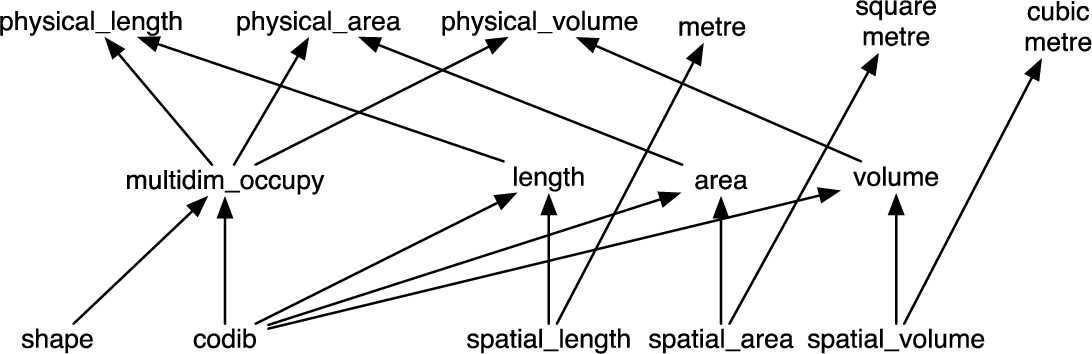
Modules for spatial ontologies. Arrows denote conservative extension.
To assist in the comparison with other upper ontologies, we can briefly summarize the ontological choices made by TUpper.
Continuant/endurant vs. occurrent/perdurant
The taxonomy of TUpper (see Fig. 6) includes the traditional distinction between perdurants/occurrents and endurants/continuants. Although both activity occurrences and objects are located in time (insofar as they have timepoints at which they begin and end), activity occurrences have temporal parts and hence are treated as perdurants, whereas for objects there are different classes of fluents that represent how properties of objects change as the result of activity occurrences, and hence are treated as endurants.
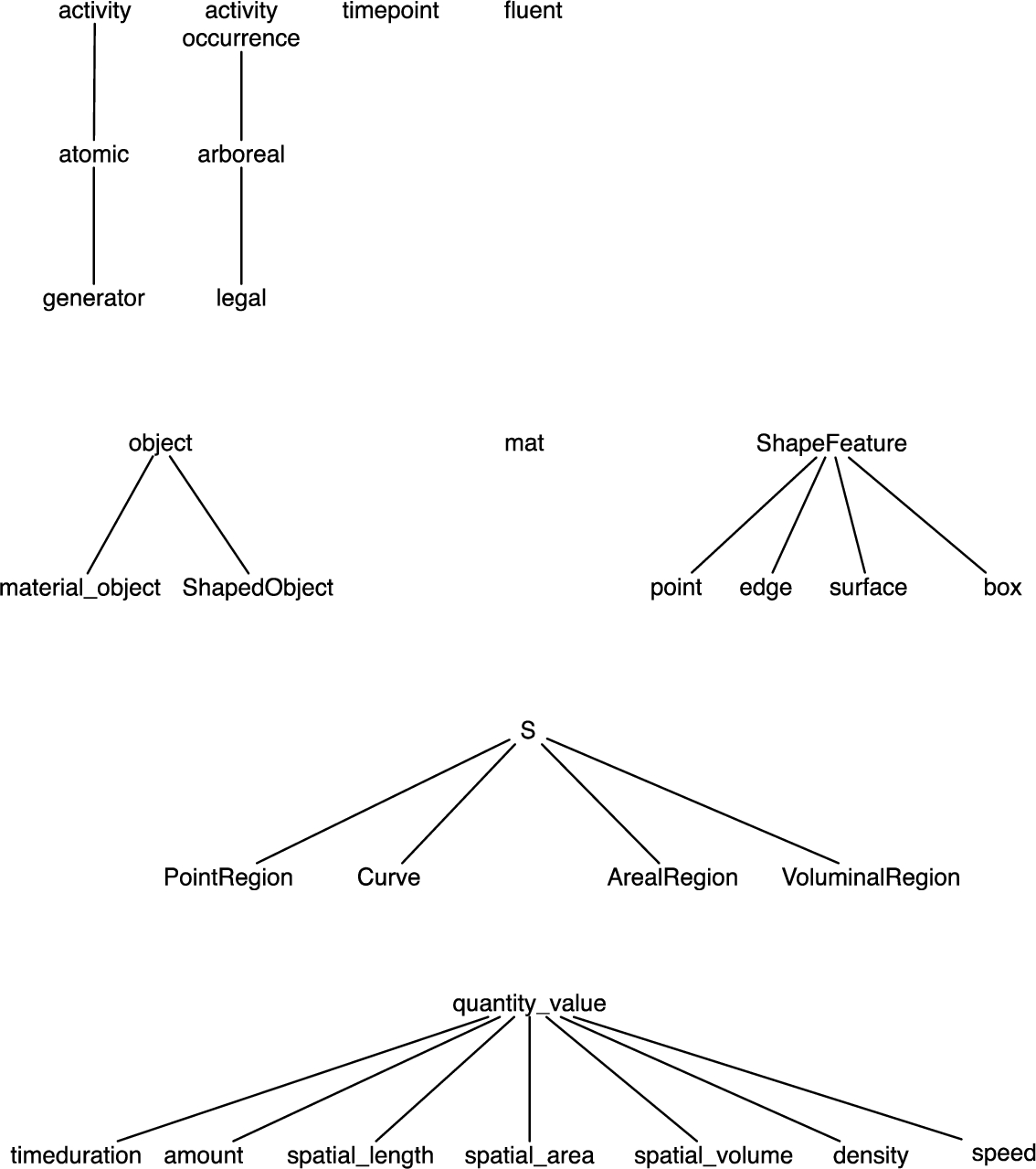
Taxonomy of TUpper.
TUpper does not axiomatize a single dependence relation among entities. As we have seen with mereology, TUpper takes a pluralistic approach by using multiple distinct relations that specify dependence between the relevant categories in the taxonomy. For example, the axiomatization of the
Processes vs. events
The axiomatization of TUpper allows one to specify alternative approaches to the distinction between processes and events that arise from the diverse ways in which these terms can be interpreted in natural language. In axiomatizing different senses of the term “event”, one can consider the following choices. it is up to the user to specify which one is being used in a particular implementation.
Does an event have a duration or is it considered to be instantaneous?
One could define an event to be an activity whose occurrences are instantaneous (i.e. have no duration) by the conservative definition
Is an event always a primitive activity, or does it allow decomposition?
One could define an event to be a primitive activity (i.e. does not have any proper subactivities) by the conservative definition
Is an event considered to be an activity that occurs externally to occurrences of the actor’s plan but during the occurrence of the plan, either facilitating the plan or interfering with the plan?
Does the term “event” to refer only to occurrences of activities rather than activities?
Qualities and quantities
Quantities are introduced in the Quantity Value modules of FOUnt (Aameri et al. (2012)) (see Figs 2, 3, and 5). These modules axiomatize how units of measure associated with the quantities can be combined and how they are related to other units. Whereas ontologies such as DOLCE treat notions such as location, length, area, volume and shape as qualities (i.e. elements in the domain), TUpper axiomatizes these as functions that map generic objects to their corresponding quantity values (axiomatized in the Quantity Kind modules).
Functions and roles
As will be seen below, TUpper does not reify roles (as in BFO), or treat them in a special way (as in DOLCE). Since roles typically change, they are represented in TUpper via fluents, with the exact axioms dependent upon the domain.
The formalization of TUpper in first-order logic
All of the use cases that will be analyzed within this paper revolve around the notion of change. The formalization of the use cases therefore involves the specification of logical theories for primitive and complex activities using the PSL Ontology (which is the generic process ontology module within TUpper).
Domain process ontologies for primitive activities
Addressing the fundamental competency question: How does the physical world change?
requires a sufficient axiomatization of both the entities in the physical world, but also an underlying process ontology which is able to specify the possible ways in which the world can change, Beginning with the generic process ontology of PSL, TUpper uses the methodology of Aameri (2012) to define classes of activities that formalizes dynamic behaviour with respect to the generic ontologies for physical objects that are the modules of TUpper.
The axioms of a generic ontology for physical objects are translated into state constraints in the signature of the PSL ontology such that each relation in the signature of the generic ontology is mapped to a fluent in the signature of the state constraints. The resulting set of axioms is referred to as the domain state ontology for the generic ontology. For example, the domain state ontology
As each state is associated with a model of the generic ontology, changing state is equivalent to a mapping from one model of the generic ontology to another. Since fluents can only be changed by primitive activity occurrences, the characterization of mappings between models of the generic ontology leads to a classification of activities with respect to their effects. The axiomatization of this classification is referred to as the domain process ontology.
Process descriptions for complex activities
Whereas the domain process ontology methodology leads to the axiomatization of the preconditions and effects of primitive activities, the specification of complex activities requires a different approach Gruninger (2009). The basic structure that characterizes occurrences of complex activities is the activity tree, which is a subtree of the legal occurrence tree that consists of all possible sequences of atomic subactivity occurrences beginning from a root subactivity occurrence. Each branch of an activity tree corresponds to a possible sequence of occurrences of subactivities of the complex activity.
One of the most common intuitions about processes is the notion of process flow, or the specification of some ordering over the subactivities of an activity, Different subactivities may occur on different branches of the activity tree – different occurrences of an activity may have different subactivity occurrences or different orderings on the same subactivity occurrences.
Iteration is captured by the class of repetitive activities, in which the activity tree can be decomposed into copies of some subtree (which intuitively corresponds to the activity tree of the subactivity that is being iterated). With temporal constraints, subactivities are not allowed to occur at arbitrary times during occurrences of the activity. Examples of such constraints include schedules, which specify the possible times at which the subactivities may occur:
Analysis and formalization in TUpper: Examples
The main purpose of this paper is to show how TUpper formalizes a set of use cases. However, it is not sufficient to simply display the formalization without any insight into why it is the right formalization of the use case. We want to show how the axiomatization of each use case arises from a linguistic analysis of the natural language sentences used to express the case, rather than impose a priori modelling assumptions (and possibly subjective criteria). A justification of why the axiomatization is the correct one for the use case and a methodology for generating axiomatizations from arbitrary use cases are essential.
Composition and constitution
“There is a four-legged table made of wood. Some time later, a leg of the table is replaced. Even later, the table is demolished so it ceases to exist although the wood is still there after the demolition.” 7
This example aims to show if and how the ontology models materials, objects, and components and the relationships among them. The focus is on the relationship between the wood and the table and the table’s parts over time.
There are several key ontological commitments that arise in this use case. First, the fact that we have a four-legged table indicates that we require an axiomatization of a component relation for physical objects such as a table. A three leg table as shown in Fig. 7(i) has a topological structure as seen in Fig. 7(ii). Table top a is connected to all the legs b, c, and d, while all the legs are disconnected from each other. Connected components (e.g., a and b) can have sums that correspond to subassemblies, while disconnected components (e.g., b and c) do not constitute subassemblies, and hence do not have sums. The complete set of subassemblies for the table and the mereology on these elements is shown in Fig. 7(iii). Classical mereology requires that the sum of any two elements must exist; however, it is easy to see from Fig. 7 that components do not satisfy the axioms of any classical mereology. In TUpper’s mereotopology for components (synonymous with the mereotopology introduced in Ru (2020) as
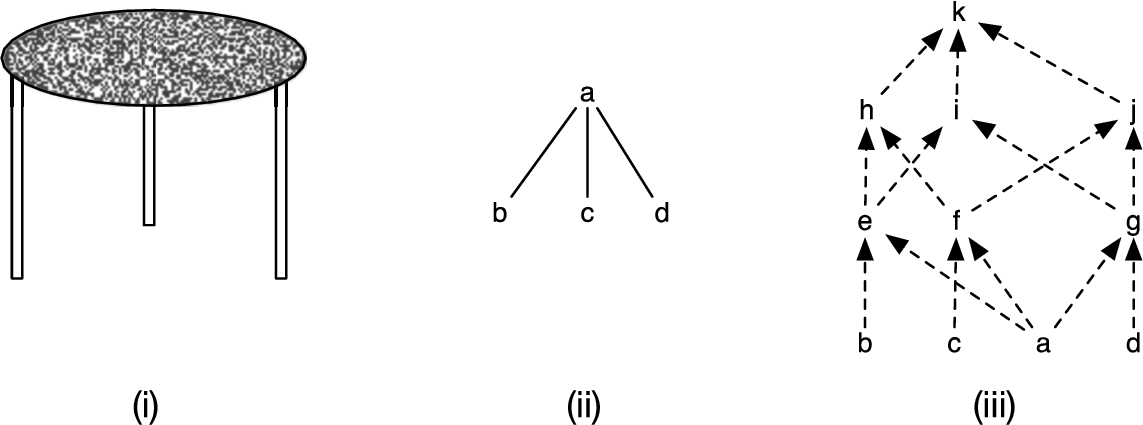
Composition and constitution use case: the table with three legs is shown in (i). The connection graph between the atomic components (denoted by
The second ontological commitment is denoted by the phrase “made of wood”. The TUpper module
We can use these modules of TUpper to specify the table in the use case:
The third ontological commitment arises from the verbs in the second and third sentences – “replaced” and “demolished”. In other words, we need to specify the domain state ontologies that correspond to the generic ontologies
The domain process ontology for components classifies activities with respect to how the
“Mr. Potter is the teacher of class 2C at Shapism School and resigns at the beginning of the spring break. After the spring break, Mrs. Bumblebee replaces Mr. Potter as the teacher of 2C. Also, student Mary left the class at the beginning of the break and a new student, John, joins in when the break ends.” 8
This example aims to show if and how the ontology models the relationships between roles, players and organizations. The focus is on the change of roles/players, the vacancy of the teaching position, and the persistence of the class while students come and go.
TUpper does not reify roles (as in BFO), or treat them in a special way (as in DOLCE). The focus in TUpper is to axiomatize the intended semantics of the relevant relations. Within TUpper, the generic ontologies for roles are synonymous with various theories of bipartite incidence structures. In this use case, there are two different role relations of concern; although they are not explicitly stated in the use case, let us refer to them as
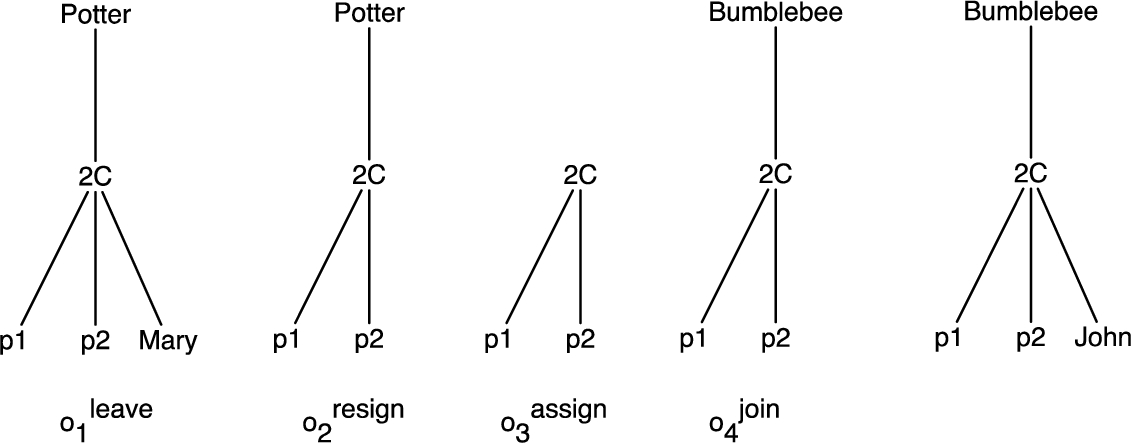
States corresponding to the effects of activity occurrences in the use case for roles.
This generic ontology corresponds to the following domain state ontology:
The specification of the domain process ontology can be surveyed from two vantage points. Linguistically, we can begin with the following verbs within the use case: resign, replace, leave, join. These verbs denote classes of activities within the domain process ontology. The axiomatization of these classes focuses on the relationships that are changed by occurrences of the activities, which leads us to the domain state ontology. In particular, resign and replace are both concerned with the relationship between a person filling the teacher role (e.g. Mr. Potter, Mrs. Bumblebee) and a classroom (e.g. 2C). On the other hand, leave and join are both concerned with the relationship between a person filling the student role (e.g. Mary, John) and a classroom (e.g. 2C). From a logical perspective, these verbs denote activities which are instances of the classes axiomatized by the domain process ontology that arises from the possible relationships among models of the generic ontologies. This paper does not provide a comprehensive analysis of the domain process ontologies for incidence structures, but we do wish to highlight the classes of activities relevant to the use case.
Activities are classified with respect to their effects. The specific classes of activities for this scenario (denoted by the verbs resign, replace, leave, and join) can be axiomatized as follows:
Property change in physical objects
“A flower is red in the summer. As time passes, the colour changes. In autumn the flower is brown.” 9
The example aims to show if and how the ontology models change in qualities/properties. The focus is the change of the colour of a flower.
Unlike DOLCE and BFO, TUpper does not reify qualities, nor does it bestow upon them any special ontological status. Within TUpper, fluents are used to represent properties and relationships that can possibly change. Since the colour of the flower changes, it must be represented by fluents, and we turn to the domain process ontology methodology to provide the axiomatization of the fluents and activities required to formalize the use case.
We begin with the following simple domain ontology:
The formula
We can also impose additional constraints on the possible ways in which activities occur.
“A man is walking when suddenly he starts walking faster and then breaks into a run.” 10
The example aims to show if and how the ontology models change during an event. The focus is the change in the speed and mode of locomotion.
Within TUpper, activities and activity occurrences do not change. Instead, there exist distinct parts of an activity occurrence that are occurrences of different activities, and hence conform to different constraints on behaviour.
The formalization of this use case is specified by a process description – the use case as a whole is describing an activity A performed by an actor, and each sentence describes how subactiviities of A occur. The verb in each sentence denotes a subactivity of A:
walk walk faster run
All three of these activities are motion activities, which in TUpper are axiomatized as activities that change the location of a physical object. However, the purpose of this particular use case lies not in the axiomatization of motion but in the representation of complex activities, so we omit the details related to motion. Nevertheless, we do need to consider how these three activities (walk, fast walk, and run) are distinguished from each other. What exactly is the activity of walking or running?
One approach is to consider all of these activities as consisting of sequences of primitive motion activities.11
The formalization of this use case could be further elaborated through the axiomatization of the primitive activities.
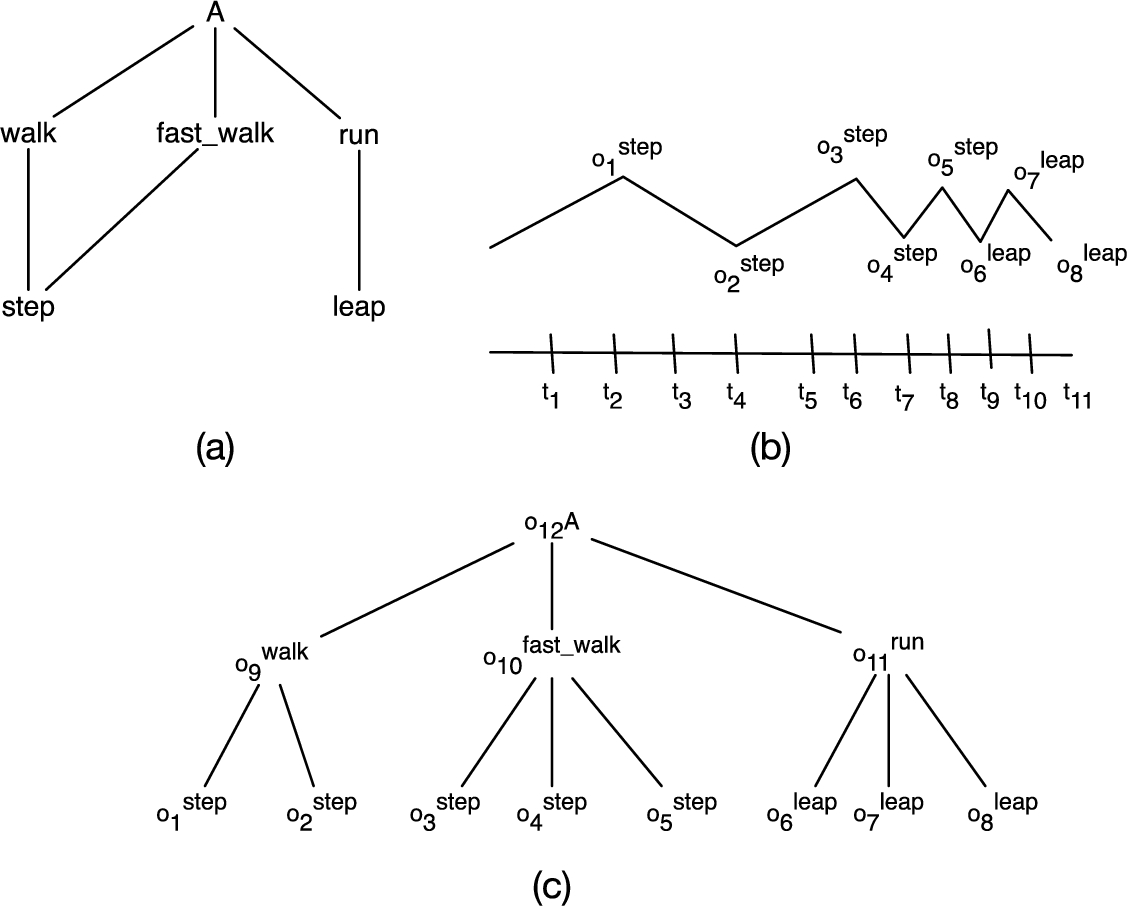
Depictions some of the substructures of a model of the process description for walking and running use case. (a) the mereology on subactivities; (b) one branch of the activity tree, consisting of a sequence of atomic activity occurrrences, together with the timeline; (c) mereology of subactivity occurrences.
The distinction between walking and walking faster is not to be found in the set of subactivities, but rather in another property of activity occurrences, namely, duration. Both walking and walking faster are iterations of steps; however, the duration of the occurrences of
All of this leads to the following process descriptions:
“A man is walking to the station, but before he gets there, he turns around and goes home.” 12
The example aims to show if and how the ontology models change in goal-directed activities. The focus is an activity/event is not completed and another activity/event is completed instead.
Within TUpper, there is no change in the event – we simply have a nondeterministic complex activity with two possible activity occurrences. In one activity occurrence, the man arrives at the station, while in the other activity occurrence the main arrives at his home. There is a common initial segment shared by both activity occurrences, in which the man is walking towards the station. The two occurrences are distinguished by the occurrence of turning around before arriving at the station.
The formalization of this use case is specified by a process description that axiomatizes the intended structures depicted in Fig. 10. Let
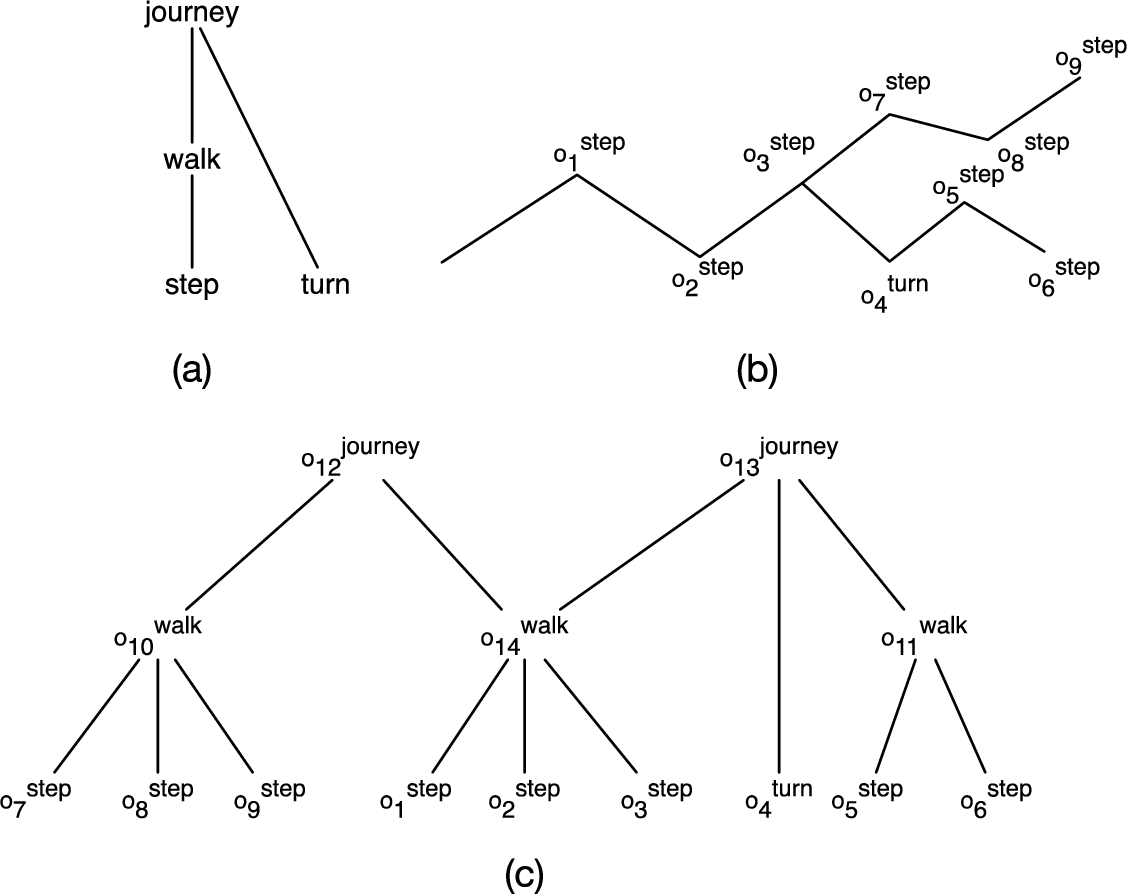
Depictions some of the substructures of a model of the process description for event change use case. (a) the mereology on subactivities; (b) two branches of the activity tree, consisting of a alternative sequences of atomic activity occurrrences, together with the timeline; (c) mereology of subactivity occurrences.
Next we specify the intended models via activity trees for the complex activity
The following process description axiomatizes these structures:
“A marriage is a contract that is regulated by civil and social constraints. These constraints can change but the meaning of marriage continues over time. In particular, marriage is a contract between two people that is present in most social and cultural systems and it can change in major (e.g. gender constraints) and minor (e.g. marriage breaking procedures) aspects.” 13
The example aims to show if and how the ontology models the evolution of the meaning of a term. Focus is on the continuity/discontinuity of the meaning of marriage in the presence of changing qualifications.
TUpper itself does not represent how axioms of the ontology change, since this is considered to be a metalevel problem for the ontology. Nevertheless, TUpper adopts an approach to this problem by considering ontology versioning to be a form of ontology reuse. As observed by Chui (2014), reusing and extending an upper ontology forces the ontology designer to adhere to all ontological commitments of the upper ontology. In other words, it is not possible to selectively reuse modules of the upper ontology and extend those with additional ontological choices that are inconsistent with other assumptions of the upper ontology – even when these assumptions arise from modules not reused. On the other hand, TUpper has been designed as a modular ontology, and this modularity supports the ability to tolerate different alternative axiomatizations of a class or relation.
There is no logical distinction between two ontologies with different axiomatizations in the same signature on the one hand, and saying that these are two different versions of the axiomatization of the same ontology. As we saw with activities, the axioms of the ontology do not change – we simply have different alternative ontologies with different axiomatizations. An ontology is identified with its axiomatization – if the axioms change, then the result is a different ontology.
In a sense, TUpper is potentially a family of ontologies. We can therefore consider a particular upper ontology to be a “cross-section” of the repository, selecting one generic ontology from each relevant hierarchy. This also means that alternative upper ontologies can be designed by selecting different generic ontologies from the same hierarchies. Alternative modules in TUpper are thus different theories within the same hierarchy of COLORE.14
Relationships among different axiomatizations are formally characterized by the notion of similarity and difference Chui (2014). which captures the joint ontological commitments and either the set of choices shared by two ontologies or the set of conflicting choices between the two ontologies.Although TUpper does not contain a module that axiomatizes the relationship of marriage, we can extend it with the Kinship Ontology Hierarchy of Chui et al. (2020) as the basis for the axiomatization of this use case. In particular, we can consider consanguinity constraints on spouses in a marriage. The weakest possible ontology does not constrain this relationship in any way. The strongest possible ontology prevents spouses from having any common ancestor:
All of the ontologies exist – it is up to the user to specify which one is being used in a particular implementation. Since any ontology can be reused, there is no evolution, in the sense of one ontology being temporally prior to another one.
TUpper was originally designed to be the explicit axiomatization of generic ontologies that appear within existing international standards. As such, it’s primary application was envisaged as supporting the original intent of the participating standards, namely semantic integration and automated reasoning. The additional benefit of TUpper is the combination of the ontologies from multiple standards that supports even broader problems. For example, the combination of PSL (from ISO 18629) and RCC8 (in ISO 19150) allows the axiomatization of classes spatiotemporal entities, something which neither ontology alone is able to represent.