



Abstract
Introduction
International Non-proprietary Name (INN) prescribing, also known as generic prescribing, is defined as prescribing the name of the active ingredient(s), or the generic name, instead of the brand name.1,2 The brand name drugs are made and manufactured by a single company and marketed under a trade name, whereas generic drugs name can be manufactured by a number of companies and sold under the names of active ingredients. 3 The INN system was introduced in 1950 by the World Health Organization and aims for the clear identification and communication of medication information among health professionals. INNs are explicitly placed in the public domain by WHO to make them universally available, hence their categorization as ‘nonproprietary’. 1
INN prescribing helps to improve medication safety. Drug brand names may differ significantly between countries, and the same drug sold by multiple pharmaceutical companies may have multiple brand names. INN prescribing allows to limit the risks of confusion between Lookalike/sound-alike (LA/SA) medication, which are medications that are similar when written or spoken, as each medication is designated by a unique name that is common worldwide. The healthcare personnel can relate to one name only, the INN, rather than many different brand names.4,5 In addition to reducing the confusion between LA/SA medications, INN prescribing lowers the possibility of prescribing, administering or dispensing more than one product with the same active ingredient.6,7
Another advantage to INN prescribing is that it improves the utilization of generic drugs. 8 INN prescribing leaves the choice of the drug to the dispensing pharmacist; thus, it usually results in the dispensing of a generic product. 9 Cost savings through switching from a brand product to a generic one has been documented in growing body of literature. In study conducted in a Chinese hospital, potential savings from switching originator 12 cardiovascular drugs to generics was 65%. 10 In another study in Austria, prescription costs for data from 8.3 million persons from 2009 to 2012 were analysed. Savings from substitution to generics in antihypertensive, lipid-lowering and diabetes medications, were estimated to account for 22.6%, 20.5% and 4.5%, respectively. 11 As a result of lowering the cost of medications, INN improves drug accessibility. Prescriptions for brand names rather than INN for pharmaceutical substances result in patients purchasing expensive brand medications rather than generics, limiting access to health care for low-income families. 12
Countries differ according to INN prescribing regulations. In Europe, countries as France, Greece, Italy and Portugal obligated the INN prescription. Other countries as United Kingdom, Switzerland, Turkey, Germany, Ireland, Norway and Netherland authorized INN prescription without obligation. 13 Russian Republic and Canada obligated INN prescription.13,14 Drug policies require all physicians in Latin American countries such as Argentina, Bolivia, Peru and Uruguay to prescribe using INN. 15 As for Middle East and North Africa region, only Jordan, Oman, Qatar and the UAE obligated INN prescription. Lebanon and Algeria have policies encouraging generic prescribing. Egypt has no explicit generic prescribing policy, however, there is a generics policy with the name of ‘generics box’. 16 The box system is followed for registration of pharmaceutical in Egypt. According to the ‘box’ policy, any dosage form (tablet, vial, syrup, suppositories, drops and so on) of any active pharmaceutical ingredient must be registered with not more than 12 similar products. The ‘Box’ is composed of one brand product, and 11 generic products. 17
INN prescribing rates exhibited wide variation between countries. The percentage of INN prescription was 29.5%, 32% 18.9%, 78.6% and 71.6% in France, 18 Canada, 19 Senegal, 20 Botswana and Pakistan,21,22 respectively. Few studies investigated generic prescription in Egypt with very wide variation in the percentage of INN prescribing. In 2014, 95.4% of drugs were prescribed by using INN in 100% prescribing encounters in primary healthcare units in Alexandria. 23 This percentage was only 1.2 in 532 in Suez Canal University Family medicine department. 24 No studies explored INN prescription in Egyptian hospital settings. The present study aimed to investigate INN prescription practice in a public Ministry of Health and Population (MOHP) hospital specialized in treating infectious diseases.
Methods
A retrospective chart review was conducted in a 280-bed specialized Ministry of Health Hospital in Alexandria, Egypt. The hospital provides services for the management of infectious diseases for the population of Alexandria and Western Delta. Assuming that the prevalence of INN prescribing is 50%, precision 5% (α = 0.05) and power 80%, the minimal required sample size would be 384 patients' medical records (rounded to 400). The sample size is calculated using Epi-info software. 25 Records were selected from various hospital inpatient departments using proportional allocation method. From each department records were selected using systematic random technique. A medication abstract form was used to record drugs’ name, amount and type of drug prescribing. Each medication name was classified as generic or brand based on the WHO Essential Medicines List (EML) classification system and the Egyptian National Formulary26,27 Out of the 400 medical records reviewed, 2279 drugs were prescribed.
Barriers to INN prescription were explored by a questionnaire composed of two sections. The first section is composed of socio-demographic and work characteristics of the physicians. This covered sex, age, qualifications, number of years in medical practice and in hospital, average number of prescriptions written per day, the attendance of medical training programs and the use of International Nonproprietary Name (INN). The second section is composed of a list of barriers to INN prescription based on literature review.18,28,29 All physicians with the prescribing authority were administered the questionnaire. Total number of physicians was 130. A total of 100 valid questionnaires were collected with a response rate of 76.9%.
Data analysis
The raw data was coded and entered into the computer by the researcher using the SPSS (Statistical Packages for Social Sciences) version 21 for windows. Description of the data using frequency distribution tables were carried out. Quantitative data such as age, experience in the profession and the hospital, were described by minimum, maximum, arithmetic mean.
Results
Total prescriptions were 2279 drugs. About a quarter (27.16%) of the prescribed medications were Anti-bacterials. About half of the prescribed medications were Liver support drugs, Vitamins and Minerals, Non-Steroidal Anti-Inflammatory Medicines, Electrolytes Solutions and Anti-Ulcer drugs (11.36%, 10.66%, 9.39%, 8.95% and 8.82%, respectively). The medications which were most frequently prescribed were Ceftriaxone 1gm vial (7.5%), Vitamin B complex tab (7%), Glucose 5% solution (3.86%), Benzyl penicillin 1 M. Vial (3.69%) and Lactulose syrup (3.16%).
Frequency of drug categories prescribed in INN.

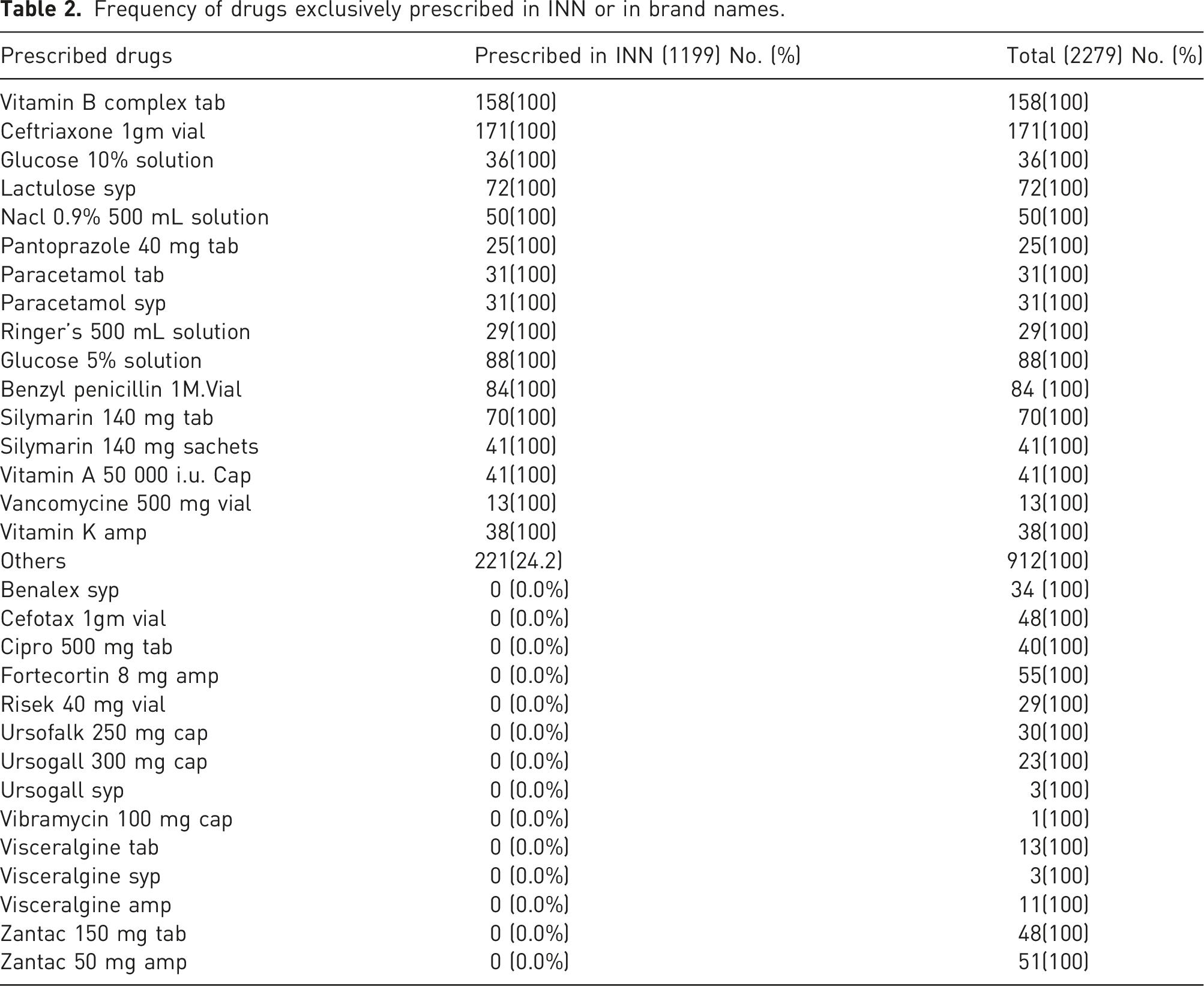
Frequency of drugs exclusively prescribed in INN or in brand names.
Socio-demographics and work characteristics of prescribing physicians.

Reasons of not prescribing in INN.

aMultiple responses are allowed.
Discussion
In the current study around half of the medications were prescribed in INN. This percentage is higher than that of studies conducted in France and Canada,18, 28 were only one third of physicians prescribed in INN but lower than that the prescription rates of INN in UK in which 83% of drugs were prescribed in INN. 30 This reflects the different policies in different countries. In country like France, INN prescription has been mandated since 2015. The rates of INN prescription increased from 12.0% in 2006 to 29.5% in 2015 and is expected to show more rise. 18 In the study conducted in Canada, the physicians had the choice of selecting either the generic or brand name. 28 In Egypt, there is no explicit policy mandating generic prescription. 16 Physicians in all MOHP hospitals are mandated to prescribe in INN, however there is no sanctions for non-adherents. This was similar to the policy followed in France where INN prescription was mandated for all prescribers but there was no sanctions in case of failure with the obligation. 18
Another factor that explains the relatively low INN prescription in the present study is unfamiliarity of some physicians with INN prescribing and the lack of educational programs for INN use (79% and 47%, respectively). Educational interventions in the form of face-to-face sessions, the use of control chart, personalized information about prescription behaviour has been proven to increase INN prescription from 2.7% to 17.63% among family physicians in a primary district in Spain. 31 However, in another educational program in a tertiary hospital in Malaysia, INN prescribing knowledge was significantly improved after the intervention, however, there was no improvement in practice. 32 In a third study in Germany, an educational intervention with audit and feedback increased INN prescriptions by only 0.75% among primary care physicians. 33 The modest effect of some educational interventions high-lightens the importance of the multifaceted approach to improving the INN prescription rates.
The higher rates for INN prescription in UK can be interpreted by the fact that the National Health Services (NHS) in UK uses multifaceted approach for increasing INN prescription. In addition to mandating INN prescription, medical schools teach generic prescription for medical students. This is coupled with financial incentives if physicians exceeded a target level for generic prescription and the use of information technology and decision support systems to support generic prescription.34,35 The beneficial effect of multifaceted intervention was illustrated in a systematic review were the five out of seven studies illustrated positive significant results with multicomponent interventions. The interventions were professional education, networking, feedback, physicians’ collaboration with pharmacists, electronic prescribing and financial incentives. 36
A considerable proportion of the study population considered confusion between generic and trade names and unavailability of a list of updated drug formulary written in INN as causes for not prescribing in INN (38.0% and 32.0%, respectively). Difficulty in remembering generic names and considering brand names easier and more memorable was reported in other studies.19,37,38 In addition, pharmaceutical companies succeeded in embedding drug brand names into the medical language and hence using them in prescription writing. 38 In the current study, one third of the respondents mentioned that trade names were used in designating medications in medical training. The use of brand names in medical training is one of the hidden curricula set by pharmaceutical companies. 19 In addition to being integrated in medical curricula, brand names are intensely promoted to physicians and pharmacists in Egypt and other countries.39–42 Visits from pharmaceutical sales representatives have been identified as the major source of drug information by some physicians.39,43 To counter the effect of commercial pharmaceutical industry, academic detailing, which is an educational non-commercial interactive outreach education session usually by a pharmacist, was shown to be effective. 44 In a study in a health centre in USA the generic prescription rate increased from 58% in 2010 to 87% in 2013 after pharmacist led academic detailing sessions. 45 In another study conducted in a primary care centre in Malaysia, brand name utilization rates dropped from 33.9% to 19.0% after group detailing sessions. 46 In addition, regulatory bodies should monitor, and audit drug information provided by pharmaceutical sales representatives since they are one of the major sources of drug information for physicians. 47
Prescriptions that are written in generic names mostly will lead to dispending generic drugs. Around half of the study population were sceptical about the safety and efficacy of generic drugs (52%). In a review comparing the views of physicians regarding generic medications in low versus high income countries, physicians in high income countries had more favourable views regarding safety and efficacy of generic medications. 48 In another review, 28.0% of physicians believed that generics are of inferior quality compared to brand medications. 49 This can be explained by the lack of physician awareness of the strict bioequivalence acceptability criteria for generic medications. 48 This was documented in a study conducted among physicians in Medical Syndicates Union in the Greater Cairo. 50 In a review, physicians' negative perceptions of generic medicines were caused by a lack of trust in the drug registration system, inadequate communication between drug regulatory authorities and prescribing physicians, and a lack of drug information, guidelines, and regulatory information that document bio and therapeutic equivalence of generic medications. 51 Egyptian Drug Authority (EDA) has strict rules for registering a new generic medication where the generic drug has to undergo bioequivalence test with its brand medicine prior to registration.17,52 This should be clearly communicated to the physicians in Egypt. In addition, generics should be promoted such as brands. 48
Anti-bacterials were the most frequently prescribed medication category. They represented around one third of prescribed medications. Three fifth of antibiotics were prescribed in INN. Some antibiotics as Cefotax and Ciprofloxacin were exclusively prescribed in brand names. This percentage is higher than generic prescription rates of antibiotics in Sudan and India,53,54 but lower than that reported in KSA and Pakistan.55,56 Higher rates than other countries can be explained by mandating generic prescription in Egyptian public hospitals and setting it as an accreditation standard in the Hospital Egyptian Accreditation Standards issued in May 2005. 57 The study hospital passed the first stage of accreditation, so physicians were trained on using the generic names in prescribing. Despite not being an accreditation standard in the subsequent accreditation standards for hospitals, 58 generic name prescription was still used by some physicians in the hospital. In addition, as mentioned previously, physicians in MOHP are mandated to write in INN although there are no sanctions for non-adherents. Other medications which were frequently prescribed and had suboptimal generic prescription were liver support medications, NSAIDs and anti-ulcer drugs. Being expansive medications, cost savings would be expected if those medications have been generically prescribed. Thus, potentials for cost savings if more drugs were prescribed using INN should be integrated with educational sessions for physicians. 59
Limitations
The study was limited to one MOHP hospital. Other hospital settings as private, University and Insurance hospitals may have completely different generic prescription rates than MOHP hospitals. In a study conducted in Tanta Governorate in Egypt, 0% of private hospital physicians prescribed using INNs. 60
Conclusion
The current study illustrates that the use of brand name for prescribing medications is still pervasive. Some drugs are exclusively written in generics. High proportion of study population do not use INNs in prescription. Unfamiliarity with generic name prescription, the believe of suboptimal quality and safety of generic medications and inadequate training for prescription using INNs were the most frequent reasons reported by study population for not prescribing in INNs.
Footnotes
Declaration of Conflicting Interests
The author(s) declared no potential conflicts of interest with respect to the research, authorship, and/or publication of this article.
Funding
The author(s) received no financial support for the research, authorship, and/or publication of this article.
Ethical considerations
Approval of Ethics Committee of the High Institute of Public Health was obtained. The official approval was obtained from the Ministry of Health and Population and the responsible administrative authorities in study Hospital.
