



Abstract
Pre-exposure prophylaxis (PrEP) prevents HIV infection through the daily administration of anti-HIV drugs, such as Truvada combination tablets (a combination of emtricitabine (FTC) and tenofovir disoproxil fumarate (TDF)). However, since PrEP is not approved in Japan, generic drugs sold overseas are imported and used by individuals. Then, the present study investigated the pharmaceutical equivalence of two generic drugs of Truvada (Generic A and Generic B). Tablet properties were examined by X-ray diffraction and differential scanning calorimetry. The dissolution behaviors and membrane permeabilities of FTC and TDF were assessed by the dissolution test using the paddle method and a membrane permeation experiment using Caco-2 cell monolayers, respectively. The dissolution behaviors of FTC and TDF differed between Truvada and its generic drugs. Furthermore, the membrane permeation rates of FTC and TDF in Generic B were slower than those in Truvada, and the AUC of FTC in Generic B was significantly smaller than that in Truvada. Differences were observed in the dissolution behaviors and membrane permeabilities of FTC and TDF in generic drugs (particularly Generic B) from those in Truvada. Since there are concerns regarding the clinical implications of these results, further studies, including in vivo experiments, are needed to ensure the safety of generic drugs.
Keywords
Introduction
At the 2015 United Nations Summit, 17 international goals were set with the deadline of 2030 as Sustainable Development Goals (SDGs) under the slogan of “leave no one behind”. 1 In section 3.3, there is a statement on the goal to eradicate human immunodeficiency virus (HIV) infection. As of the end of FY2020, there were 38.4 million HIV-infected patients worldwide and approximately 1.5 million new infections annually. 2 The number of new cases in Japan in the same year was 717, of which 602 were Japanese nationals. The most common route of infection was male homosexual sexual contact, accounting for 74.3% of the total. 3
In recent years, there have been attempts to prevent new HIV infections using pre-exposure prophylaxis (PrEP), which has led to a decrease in the number of new HIV infections. 4 PrEP prevents HIV infection through the daily administration of anti-HIV drugs, such as Truvada combination tablets (a combination of emtricitabine (FTC) and tenofovir disoproxil fumarate (TDF)) or Descovy combination tablets (a combination of FTC and tenofovir alafenamide fumarate). However, since PrEP is not approved in Japan, generic drugs sold overseas are imported and used by individuals or doctors prescribe the generics imported by individuals. Although these generic drugs have a proven track record of use worldwide, data on the bioequivalence of generic drugs in Japanese individuals and the excipients used in their formulations are not disclosed. Therefore, due to insufficient pharmaceutical equivalence data, the efficacy and safety of these drugs remain unclear and questionable.
Although the pharmaceutical excipients that form a pharmaceutical are generally considered to have no effect on the efficacy of a drug, our research group investigated the effects of more than 20 pharmaceutical excipients on the membrane permeation of some compounds and demonstrated that many excipients affected the membrane permeation of compounds through both paracellular and transcellular pathways, within the range of expected clinical doses.5–8 Furthermore, their effects on major drug transporters, such as P-glycoprotein (P-gp) and breast cancer resistance protein (BCRP), have been reported.9–11
Since the absorption ratio of FTC, which is the main component of Truvada, is as good as 92%, 12 it is considered to be less susceptible to various effects. Nevertheless, FTC is a substrate for equivalent nucleoside transporter 1, concentrated nucleoside transporter 1, organic cation/carnitine transporter 1, BCRP, and multidrug resistance-associated protein 1/2/3 (MRP1/2/3). 13 On the other hand, the absorption ratio of TDF is poor at 25%,12,14 tenofovir disoproxil is a substrate for P-gp and BCRP, 15 and tenofovir (TFV) is a substrate for organic anion transporter 1 (OAT1), OAT3, and MRP4.16,17 Therefore, absorbability and pharmacokinetics are markedly affected by pharmaceutical formulation differences, such as the different excipients used in generic drugs.
In the present study, the absorbability (dissolution behavior and membrane permeability) of generic drugs of Truvada used in Japan was analyzed in order to compare its pharmaceutical formulation characteristics with Truvada. The purpose of the present study is to enable the safe internal use of drugs and achieve one of the SDGs to reduce the number of new HIV infections and support many individuals, including those in the LGBT community.
Materials and Methods
Materials
Truvada combination tablets were purchased from Gilead Sciences, Inc. (CA, USA). Generic A and Generic B tablets were purchased from Roy Union Ltd. (Kowloon, Hong Kong). All other reagents were of analytical grade or higher.
Cell culture
Caco-2 cells were obtained from the Riken Cell Bank (Ibaraki, Japan) and kept in a humidified incubator at 37°C with 5% CO2. Caco-2 cells were maintained in DMEM-High glucose (Fujifilm Wako, Osaka, Japan) supplemented with 10% fetal bovine serum, 1% non-essential amino acids, 100 U/mL of penicillin, 100 μg/mL of streptomycin, and 250 ng/mL of amphotericin B between passages 12 - 19.
X-ray diffraction (XRD) measurements
XRD patterns were measured using SmartLab (Rigaku Corporation, Japan) at room temperature with a CuKα X-ray source at 40 kV and 50 mA. The measurement range (2θ) was 4 to 45°, and the scanning speed was 10°/min.
Differential scanning calorimetry
The crystalline state of APIs and the melting points of the major excipients in samples were measured by DSC Q-2000 (TA Instruments Japan Inc., Japan). Samples were crushed in a mortar, weighed (2-5 mg) in a T-zero aluminum sample pan, covered with a lid, and crimped. The temperature range of analysis for the DSC cell was between 30 and 280°C at a heating rate of 10°C/min, and N2 gas flowed in at 30 mL/min as the purge gas.
In vitro dissolution study
The in vitro dissolution test for anti-HIV drugs was conducted according to JP 17 using the paddle method with a dissolution tester (NTR-6200A, Toyama Sangyo Co., Ltd., Osaka, Japan). The dissolution test was performed in 900 mL of the 1st fluid for the dissolution test, pH 1.2 (hydrochloric acid: 0.30 weight %, sodium chloride: 0.20 weight %) and the 2nd fluid for the dissolution test, pH 6.8 (disodium hydrogen phosphate: 0.18 weight %, potassium dihydrogen phosphate 0.17 weight %). The paddle rotation speed was 50 rpm and the temperature was maintained at 37°C ± 0.5°C. One-milliliter aliquots of samples were withdrawn and replaced with fresh dissolution media at a predetermined interval. The eluate was sampled 6 times 5, 10, 15, 30, 45, and 60 min after the start of the test in the 1st fluid and 10 times 5, 10, 15, 30, 60, 90, 120, 180, 240, and 360 min after the start of the test in the 2nd fluid.
Membrane permeation experiments using transwell inserts
In accordance with our previous report, 18 the transport of anti-HIV drugs across Caco-2 cell monolayers was examined. Caco-2 cell monolayers (between passage numbers 12 - 19) were seeded onto transwell inserts (PET membrane, pore size of 0.4 μm) (Corning Inc., NY, USA). The integrity of cell monolayers was evaluated prior to the transport analysis by measuring transepithelial electrical resistance (TEER) with a Millicell ERS testing device (Millipore Corporation, MA, USA). Monolayers with >400 Ω*cm2 TEER were used for membrane permeation experiments. Monolayers were washed twice using the 2nd fluid for the dissolution test and then incubated in the 2nd fluid for the dissolution test for 10 min. The solution after the dissolution test of each anti-HIV drug in the 2nd fluid for the dissolution test was added on the apical side of the inserts (1.0 mL), and the 2nd fluid for the dissolution test was added to the basal side (2.0 mL). One hundred microliters was withdrawn from the basal side at 0, 15, 30, 45, 60, 90, and 120 min, and an equal volume of the pre-warmed 2nd fluid was then immediately added for the dissolution test.
Measurement and analysis methods for FTC and TDF
In accordance with previous findings, 19 the measurement and analysis methods for FTC and TDF were performed by HPLC as follows. Samples were rapidly cooled and stored at -80°C until analyzed. FTC and TDF were measured by reverse-phase HPLC using a Imtakt Cadenza 5CD-C18 column (150 × 4.0 mm, 5 μm) at 40°C. The analysis of FTC and TDF was performed at a wavelength of 265 nm. The mobile phase consisted of a mixture of 85% methanol and water containing 0.02 mol/L NaH2PO4・H2O at a flow rate of 1.5 mL/min.
Statistical analysis
Data were analyzed using the dissolution test for the similarity of dissolution profiles (f2 equation) previously proposed by Moore and Flanner.
20
To measure similarities in dissolution behaviors, the similarity factor f2 was calculated using the following equation (Equation (1)).

Ti and Ri represent the average dissolution ratios of the bland and generic drugs, respectively, and n represents the number of times sampling was performed. The U.S. Food and Drug Administration (FDA) defines two dissolution behaviors as equivalent when the f2 value is between 50 and 100. 21
All results are expressed as the mean ± standard deviation (S.D.). The significance of differences between groups was analyzed using Tukey’s test; p < .05 was considered to be significant. 22
Results
Dissolution behaviors of FTC and TDF from anti-HIV drugs in the 1st fluid for the dissolution test
The dissolution behaviors of generic drugs were initially evaluated. Dissolution behavior in the 1st fluid (pH 1.2) for the dissolution test is shown in Figure 1. The dissolution ratio of FTC in Truvada in the 1st fluid for the dissolution test was good and reached 100% within 20 minutes of the start of the test. The initial dissolution rates of FTC in Generic A and Generic B were faster than that in Truvada, particularly at 5 and 10 min, and the initial dissolution rate of FTC in Generic B was significantly faster than that in Truvada (Figure 1(a)). The dissolution ratios of FTC from each tablet at 60 min were 102.68 ± 1.85% for Truvada, 102.61 ± 1.41% for Generic A, and 93.13 ± 2.71% for Generic B, and the final dissolution ratio of FTC from Generic B was approximately 10% less than FTC in Truvada. Dissolution ratios of FTC (a) and TDF (b) in anti-HIV drugs in the 1st dissolution test fluid. Results represent means and S.D. (n = 6). *p < .05 significantly different from Truvada.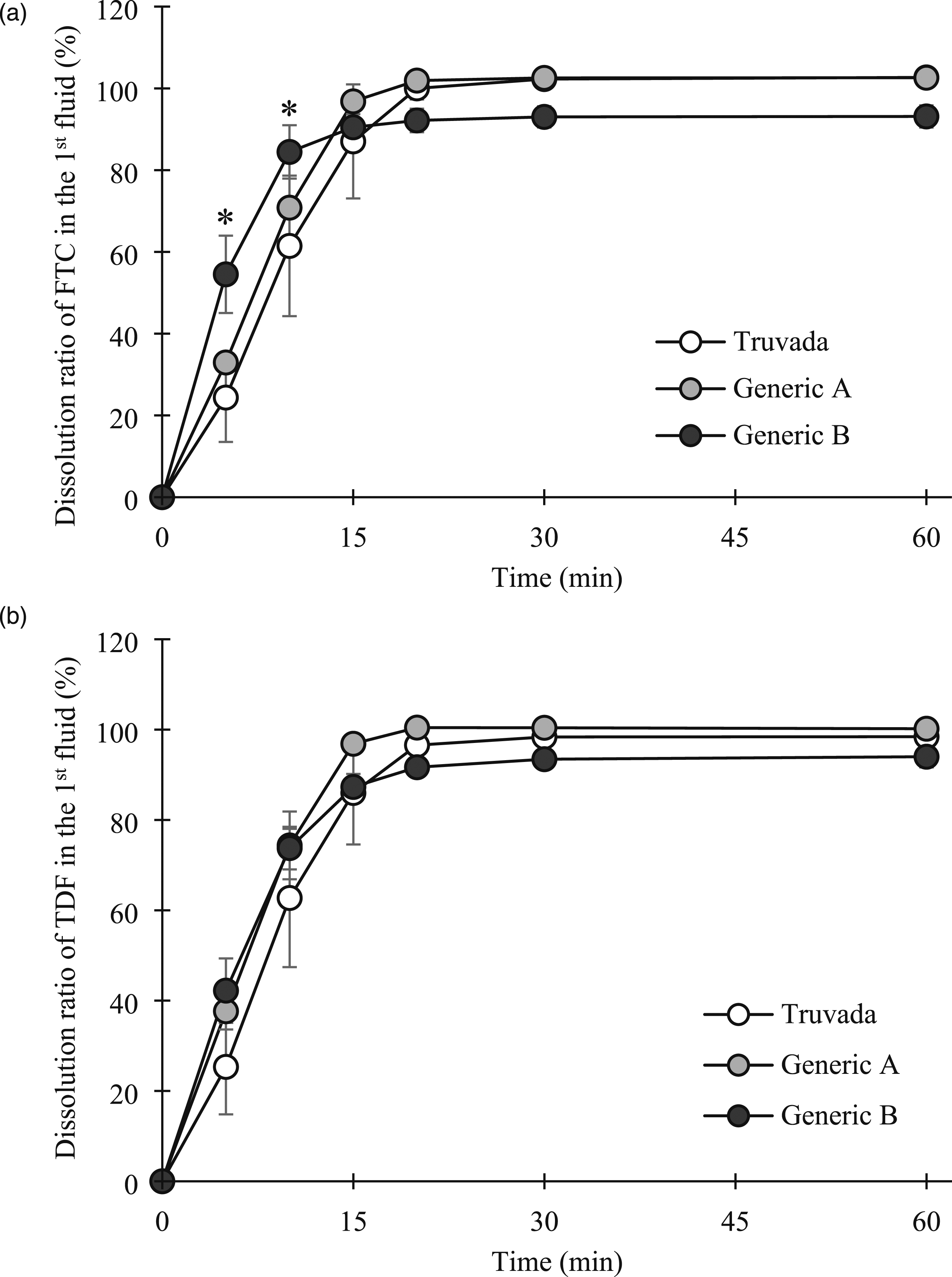
On the other hand, the dissolution ratio of TDF in Truvada in the 1st fluid for the dissolution test was also good and reached more than 95% within 20 minutes of the start of the test (Figure 1(b)). Moreover, as with the initial dissolution rate of FTC, the initial dissolution rates of TDF in Generic A and Generic B were significantly faster than that in Truvada. The dissolution ratios of TDF from each tablet at 60 min were 98.43 ± 1.67% for Truvada, 100.20 ± 1.35% for Generic A, and 94.00 ± 2.36% for Generic B, and differences between the tablets were smaller than for FTC.
Dissolution behaviors of FTC and TDF from anti-HIV drugs in the 2nd fluid for the dissolution test
Dissolution behaviors in the 2nd fluid (pH 6.8) for the dissolution test are shown in Figure 2. The initial dissolution rate of FTC in Truvada was slightly slower than that of the 1st fluid, reaching approximately 100% at 60 minutes (Figure 2(a)). As with the 1st fluid, the initial dissolution rates of FTC in Generic A and Generic B were faster than that in Truvada. The dissolution ratios of FTC from each tablet at 360 min were 105.31 ± 3.84% for Truvada, 103.85 ± 0.75% for Generic A, and 93.26 ± 5.98% for Generic B, and the dissolution ratio of FTC from Generic B was approximately 12% smaller than that from Truvada. Dissolution ratios of FTC (a) and TDF (b) in anti-HIV drugs in the 2nd dissolution test fluid. Results represent means and S.D. (n = 6).
The initial dissolution rate of TDF in Generic A was faster than that in Truvada; however, the initial dissolution rate of TDF in Generic B was slower than that in Truvada (Figure 2(b)). In Truvada and its generic drugs, not only did the dissolution rate of TDF not exceed 92%, but there was also a decrease in the concentration of TDF after 120 minutes. The dissolution ratios of TDF from each tablet at 360 min were 76.96 ± 3.62% for Truvada, 77.72 ± 0.73% for Generic A, and 76.11 ± 4.77% for Generic B.
Membrane permeation of FTC and TDF from anti-HIV drugs
The membrane permeation experiment was performed using Caco-2 monolayers and the 2nd fluid for the dissolution test after the dissolution test (360 min). The membrane permeation rate and permeated amounts of FTC from Generic A were similarly to those of Truvada; however, the membrane permeation amount of FTC from Generic B at 90 and 120 min was significantly lower than that from Truvada (Figure 3(a)). TDF and FTC showed the poor membrane permeability of Generic B, and its behavior (permeation rate and amount) slightly differed from that of Truvada and Generic A (Figure 3(b)). Permeated amounts of FTC (a) and TDF (b) in anti-HIV drugs via Caco-2 cell monolayers. Results represent means and S.D. (n = 7 - 10).
Characteristics of pharmaceutical formulations of anti-HIV drugs
Tablet properties and pharmaceutical formulation characteristics were investigated. The tablet weights of Truvada, Generic A, and Generic B were 1.05, 1.01, and 0.65 g, respectively. The sizes (diameter, short diameter, and thickness) of each tablet were 19.37, 8.75, and 7.14 mm for Truvada, 19.77, 8.43, and 6.54 mm for Generic A, and 17.17, 7.36, and 5.15 mm for Generic B. Truvada and Generic A were similar in size, and Generic B was smaller than Truvada and Generic A.
The powder XRD patterns of each formulation are shown in Figure 4(a). Differences in diffraction patterns between the products confirmed that they contained different components (Figure 4(a)). (a) X-ray diffraction (XRD) of anti-HIV drugs. XRD patterns were measured using SmartLab (Rigaku Corporation, Japan) at room temperature using a CuKα X-ray source at 40 kV and 50 mA. (b) Differential scanning calorimetry of anti-HIV drugs. The crystalline state of APIs and the melting points of major additives in samples were measured by DSC Q-2000 (TA Instruments Japan Inc., Japan).
The DSC curves of each formulation are shown in Figure 4(b). The DSC curve of Truvada showed a single peak, whereas those of Generic A and Generic B showed bimodal peaks. The behavior of DSC curves suggested that the components are similar in Truvada and Generic A, but clearly different in Generic B.
Discussion
To use oral formulation dosages safely and effectively, it is necessary to understand their dissolution behavior (dissolution rate) and the absorbability of its main drug. To assess the equivalence of generic drugs of Truvada (Generic A and Generic B) to Truvada, the dissolution behaviors of FTC and TDF, the main drugs of Truvada, were initially examined.
The initial dissolution rates of FTC in Generic A and Generic B in the 1st fluid for the dissolution test were faster than that in Truvada. The final dissolution ratio of FTC from Generic A was similar to that from Truvada, while that of Generic B was approximately 10% less than that of Truvada (Figure 1(a)). Similarly, the initial dissolution rates of TDF from Generic A and Generic B were significantly faster than that from Truvada (Figure 1(b)), and the differences between tablets were smaller than for FTC.
In the 2nd fluid for the dissolution test, the initial dissolution rates of FTC in Generic A and Generic B were faster than that in Truvada, similar to the 1st fluid. The final dissolution ratio of FTC from Generic A was similar to that from Truvada, whereas that from Generic B was approximately 12% less than that from Truvada (Figure 2(a)). Regarding the results of both test solutions, since the final dissolution ratio of FTC from Generic B was smaller than that from Truvada and Generic A, the content of FTC in Generic B may be less than 200 mg. Interestingly, the initial dissolution rate of TDF in Generic A was faster than that in Truvada in the 2nd fluid, whereas the initial dissolution rate of TDF in Generic B was slower than that in Truvada (Figure 2(b)). The dissolution rate of TDF did not exceed 92% in all tablets, and gradually decreased after 120 min. The degradation of TDF, a prodrug of TFV, may have occurred, converting it to tenofovir disoproxil and TFV.
Similarity Factors (f2) of anti-HIV Drug dissolution Behaviors in 1st and 2nd Fluids.

Permeation Rates and AUC of FTC and TDF in anti-HIV Drugs via Caco-2 Cell monolayers.

Results represent means and S.D. (n = 7 - 10). *p < .05 significantly different from Truvada.
Since differences in dissolution behaviors were observed in generic drugs, membrane permeation experiments were performed. As shown in Table 2, the membrane permeation rates of FTC and TDF in Generic A and Generic B did not significantly differ from those of Truvada. Moreover, when evaluated by AUC0-120, the AUC0-120 of FTC and TDF from Generic A were 97.4 and 90.9% of those for Truvada, respectively, with no significant differences. However, the AUC0-120 of FTC and TDF in Generic B were 75.7 and 74.7% of those of FTC and TDF in Truvada, respectively, which were significantly smaller than those in Truvada (Table 2).
The permeated amount and AUC0-120 of FTC were significantly smaller in Generic B than in Truvada, which may be due to the amount of FTC in the drug solution of Generic B being lower than that of Truvada and Generic A, as shown in Figure 4(a). However, a difference in the AUC0-120 of TDF was also observed, suggesting that different membrane permeabilities are due to causes other than the content of the main drug.
Although the definition of a pharmaceutical excipient is “not to affect the efficacy of the main drug”, pharmaceutical excipients may alter the membrane permeability of drugs.5–11 There are also in vivo examples showing that differences between the brand name drug and its generic drug, such as brotizolam, 23 triazolam, 23 and pravastatin, 24 affected the onset and duration of drug efficacy. Based on these findings, differences in the excipients contained in Generic B and Truvada may change the absorption of the main drug and affect therapeutic effects.
The results of the in vitro study showed significant differences between generic drugs and Truvada, suggesting that the use of the generic drugs alters bioavailability, particularly for TDF, and pharmacological effects.
The differences in dissolution behaviors and membrane permeabilities observed in the present study were evaluated based on pharmaceutical formulation properties. The tablet sizes of Truvada and Generic A were similar, whereas Generic B was one size smaller and weighed approximately 70% of Truvada. Truvada showed peaks around 8°, 17°, 21°, and 24° attributed to Form A. On the other hand, for Generic A and Generic B, in addition to the peak around 8° attributed to Form A, peaks around 5°, 10°, 20°, and 25° were observed that may be attributed to TDF Form I. This result indicates that the crystal form of TDF contained in each formulation was different as Sládková et al. characterized Form A and Form I for TDF from an analysis of powder XRD patterns. 25 Different crystalline forms of substances change dissolution rates, and even in the case of pharmaceuticals, differences in dissolution phenomena have been reported for prednisolone, 26 methylprednisolone, 27 and sulfathiazole. 28 Therefore, differences in dissolution behaviors may also occur for TDF in generic drugs.
On the other hand, the endothermic peak of the melting point for TDF in Truvada showed a single peak, whereas those of Generic A and Generic B showed bimodal peaks. In consideration of the results on XRD patterns, Forms A and I were mixed. The behaviors of DSC curves suggest that components are similar in Truvada and Generic A, whereas clearly different components are present in Generic B. Broad endothermic peaks at approximately 150 and 210°C that are common to Truvada and Generic A were attributed to dehydration transition and the melting point derived from lactose hydrates. 29 This result suggests that lactose hydrate was replaced by another excipient in Generic B.
Based on these results, Generic A and Generic B have different crystalline forms of TDF from Truvada and the excipients used may also differ. Therefore, pharmaceutical formulation properties differed. These pharmaceutical formulation characteristics may cause differences in the crystalline form that affect solubility, differences in excipients that the alter dissolution rate, and differences in excipients that may also change membrane permeability after dissolution.
Conclusion
The present study investigated the pharmaceutical formulation characteristics and absorption properties of Generic A and Generic B, which are generic drugs of Truvada. The possibility of different crystal forms of TDF in generic drugs and different excipients in Generic B were indicated, suggesting differences in the pharmaceutical formulation characteristics of the generic drugs from those of Truvada. Although the causal relationship between these differences remains unclear, differences in excipients may have a stronger influence on absorption properties than differences in the crystalline form, particularly because the differences observed in dissolution behaviors and membrane permeabilities were large in Generic B. However, the present study was performed in vitro, and it is unclear whether the present results correlate with actual pharmacological effects. Therefore, further studies, including in vivo experiments, are needed to ensure the safety of generic drugs.
Footnotes
Acknowledgements
The authors thank Mr. Masaya Uno, Miss Koume Yoda, and Miss Ryoka Nakamura for their technical assistance. The present study was supported in part by Nihon Pharmaceutical University Research Grant (2021).
Author contributions
Y.T. and T.F. designed the research. Y.T., N.K., J.O., and Y.A. performed the research. Y.T., Y.A., T.F., T.K., J.M. and T.N. analyzed data. Y.T., Y.A. and T.F. wrote the manuscript.
Declaration of conflicting interests
The author(s) declared no potential conflicts of interest with respect to the research, authorship, and/or publication of this article.
Funding
The author(s) received no financial support for the research, authorship, and/or publication of this article.
Ethical approval
This manuscript does not include any studies that require ethical approval.
