



Abstract
Keywords
Introduction
Non-communicable diseases are considered the leading cause of morbidity and mortality worldwide. Among these diseases, neoplasms, including cancer occupy the second place in terms of deaths and act as a barrier to improving life expectancy due to their prevalence and rapid increase among global populations. 1 According to the GLOBOCAN report in 2022, approximately 20 million new cancer cases and 9.7 million deaths were estimated worldwide. Lung cancer ranked first, followed by breast cancer and colorectal cancer. In terms of mortality, the top three places were occupied by lung, colorectal, and liver cancer. 2
Looking at the numbers reported in Colombia during 2022, GLOBOCAN reported 117,620 and 56,719 deaths. Among the newly reported cancer cases, breast, prostate, and colorectal cancer are the most common in the Colombian population. In terms of mortality, lung, colorectal, and liver cancer ranked highest 3
The entry of innovative therapies to treat cancer has generated improvements in survival rates and quality of life in affected patients. Nonetheless, these therapies generate a substantial financial burden on healthcare systems worldwide, creating barriers to access for many patients, especially those who live in emerging economies. This situation has generated an increasing need to develop strategies to reduce the cost derived from neoplasm treatment, making it affordable to healthcare system budgets. 4 , 5
One strategy devised to improve this situation is the introduction of generic cancer drugs, which are more affordable and accessible to a larger population. 6
Although it is recognized that generic drugs are identical to the approved brand-name drug in terms of dosage, form, safety, strength, route of administration, quality, and performance characteristics 7 ; unfavorable perceptions persist among healthcare professionals and patients, reducing their prescribing and use.8-10 This situation arises from the wide array of generics available for the same molecule and the lack of practical tools enabling healthcare professionals to determine the most suitable generic alternative for prescription.
In 2018, Garg et al. conducted a survey involving 53 of physicians (oncologists) from 15 countries to comprehend their perceptions and attitudes toward generic drugs and their prescribing to treat cancer. 11 The results highlighted some appreciations related to quality, price, safety, and effectiveness. Looking closer at cost appreciations, 75% of the oncologists reported that a higher cost of drugs limits the treatment access for patients, also 93.9% considered that generic drugs have lower prices compared to the original drug, and 81.3% would prescribe a generic drug based on lower prices. In terms of quality, effectiveness, and safety, 85.7% of the survey group considered the effect of the generic drug depends on the company and the quality varies compared to the original drug, 74.4%. 11
This survey laid the groundwork for the development of the Generic Drug Adoption Framework (GRAF) project, 12 which aimed to provide a structured tool to guide physicians and decision-makers to select generic oncological drugs based on specific key characteristics (quality, effectiveness, safety, and price). Until now, in Colombia Is not available a standardized tool that allows physicians (especially oncologist) and pharmacists to qualify and stablish the key aspects to choose and prescribe high quality generic drugs to treat cancer.
In this study, we aimed to adapt the GRAF tool for Colombia using an expert consensus methodology, which will allow the implementation in the Colombian context, facilitating decision-making at the time of prescribing generic drugs for oncological patients.
Methodology
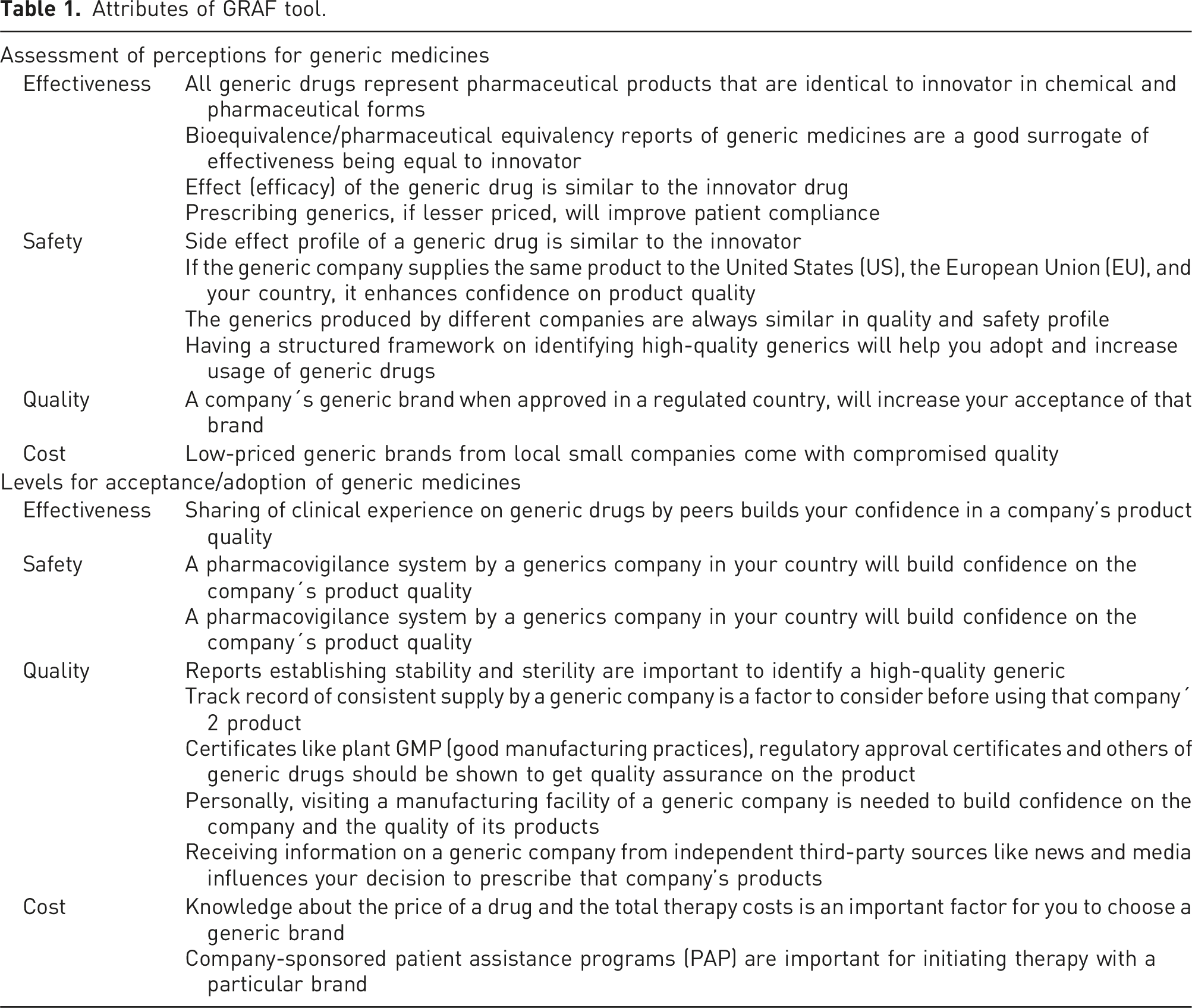
Attributes of GRAF tool.
GRAF tool
The original GRAF project is an international initiative aimed at assisting physicians, pharmacists, and decision-makers in transitioning from innovative drugs to high-quality generic drugs. The tool facilitates the evaluation of two key components in the process of adopting the use of generic drugs. The principal components that the tool analyzes are perceptions and acceptability indicators. 12
The GRAF tool is composed of 20 parameters or questions and utilizes a Likert Scale ranging from zero to ten, where zero represents “Never” (0 = Never) and ten represents “Always” (10 = Always). 12
Phase 1
The process began by administering the survey to a group of 62 healthcare workers in Colombia. The primary objective was to assess the perceptions and capacity to adapt generic drugs among healthcare workers using the GRAF tool. These professionals were selected based on their professional experience in clinical oncology, hematology, and pharmacy. The survey was conducted through a virtual platform (URL: https://www.accessgraf.org/) between November 2018 and April 2019. Participants were briefed on the study’s aim and provided consent for the use of the information provided for research purposes. The data obtained were anonymized.
The results obtained from the survey were classified into three principal groups according to the scores: • • •
Phase 2
Subsequently to the obtained information, the process of validation and implementation was developed using the steps recommended in the patent document. Firstly, a panel of experts convened during a face-to-face session in July 2019 to achieve consensus on defining the relevant questions to assess the attributes that compose the GRAF tool. This panel comprised different specialists in clinical sciences (oncologists, pharmacists, and hematologists). During this panel, the specialists had the freedom to determine the questions and attributes that they considered important according to the Colombian context, drawing from their knowledge and experience. Finally, those attributes that were considered relevant were included in the adaptation of the GRAF tool for Colombia.
Results
Phase 1
The survey was answered by 62 participants, of which 42 (67.7%) were physicians (oncologists and hematologists), 19 (30.6%) were pharmacists, and one person did not specify their profession. A closer examination of the results obtained from the GRAF tool indicated that 59.7% (n = 37) of the 62 participants reported high scores (average ≥ 8) in the acceptability indicator, followed by 46.8% (n = 29) who reported high scores (average ≥ 8) for the perception indicator.
According to the classification groups, 38.7% (n = 24) were classified as early adopters, 32.3% (n = 20) as late adopters, and 29% (n = 18) were categorized as part of the undecided group. In terms of professional profiles, 47% of pharmacists (n = 9) demonstrated a higher proportion classified as early adopters compared to 33% of physicians (n = 14).
Phase 2
Looking closer at phase two, the panel of experts was comprised of 11 experts, including three clinical oncologists, 6 hematologists, and two pharmacists. Subsequently, the revision of the questions that compose GRAF was under deliberation to evaluate their relevance according to the Colombian context. Finally, the panel selected 12 attributes which, in their opinion, were considered relevant and suitable for the Colombian scenario.
GRAF adopted for Colombian context.
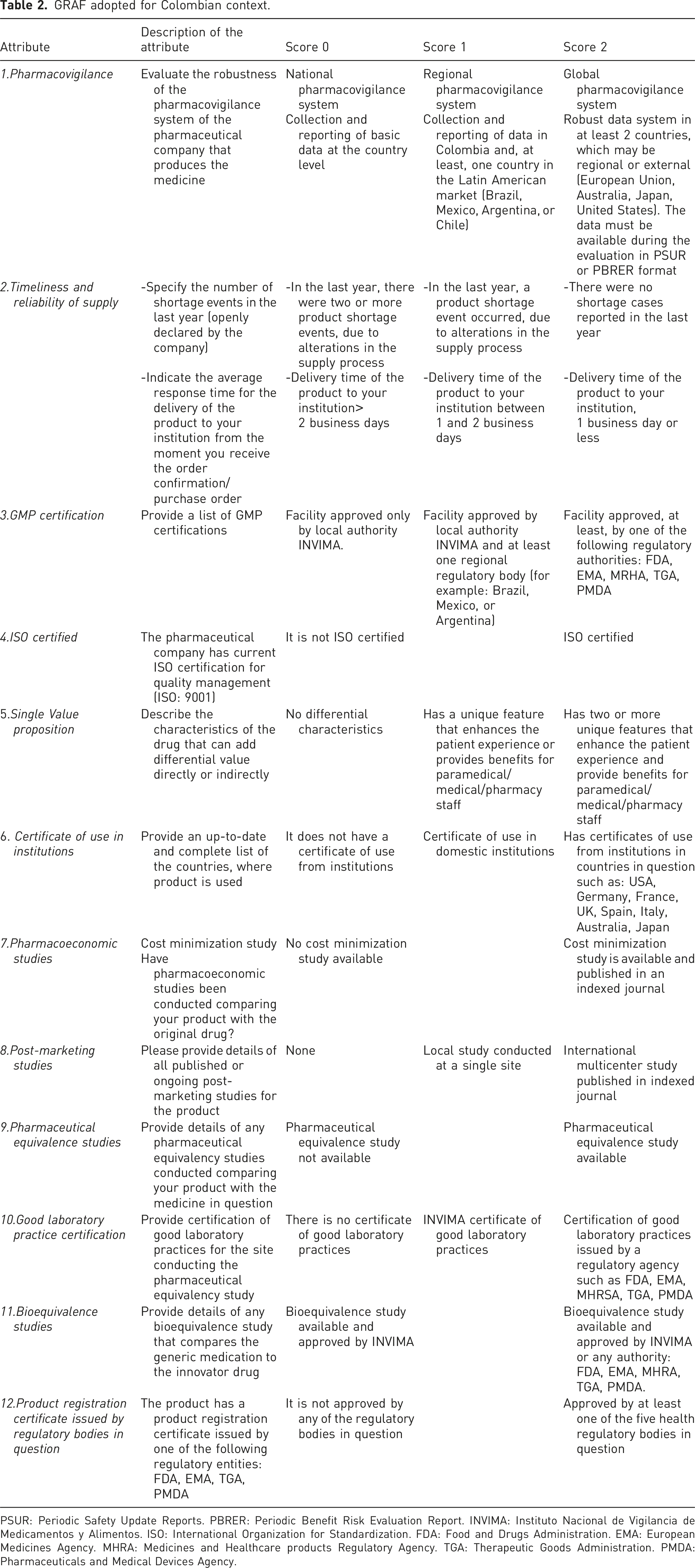
PSUR: Periodic Safety Update Reports. PBRER: Periodic Benefit Risk Evaluation Report. INVIMA: Instituto Nacional de Vigilancia de Medicamentos y Alimentos. ISO: International Organization for Standardization. FDA: Food and Drugs Administration. EMA: European Medicines Agency. MHRA: Medicines and Healthcare products Regulatory Agency. TGA: Therapeutic Goods Administration. PMDA: Pharmaceuticals and Medical Devices Agency.
Discussion
Access, availability, and prescribing generic drugs for oncology treatment serve as mitigation for the exorbitant cost of treatment for healthcare systems worldwide, increasing accessibility to these therapies for patients, especially in countries with emerging economies. Nonetheless, decision-makers and healthcare workers involved in the process of including and prescribing generic drugs require a standardized and rigorous process to select the best option based on high quality, efficacy, and safety.
First, we obtained the results from 62 surveys that were administered. The initial findings revealed differences among the adopter groups, especially within healthcare professions, where 47% of pharmacists were classified as early adopters compared to 33% of physicians. This finding aligns with the results reported in a systematic review conducted by Toverud et al. (2015), which also indicated differences in perceptions of generic drugs among various healthcare providers. 8 In their study, they found that perceptions regarding the quality of generic drugs were more positively supported by pharmacists than by physicians. These discrepancies in perception are related to differences in concepts regarding bioequivalence and the understanding of control routines, requirements, and manufacturer standards imposed by the company. 8
Similarly, Howard et al. (2017) found that specialists have a higher likelihood of prescribing brand-name drugs compared to general practitioners. 14 Although our study did not administer the survey to general physicians and was only applied to specialists, this finding is similar and supports our results, where only 33% of specialists were considered early adopters to prescribe generic drugs. This result is associated with various factors such as age, experience, and the type of health insurance under which the specialists work. 14 It is important to recognize that the lack of knowledge about the reasons and perceptions regarding generic drugs between general practitioners and specialists could suggest the need for further investigation in future projects.
Finally, this tool was adapted and validated for the Colombian context, assessing 12 attributes to facilitate the selection of the best generic drug, specifically for oncology treatments. Its implementation and dissemination will enable the identification of perceptions and misconceptions held by healthcare providers, decision-makers, and policymakers. The results obtained will guide interventions, such as education-based initiatives targeting healthcare providers, policymakers, decision-makers, and patients, aimed at changing perceptions of generic drugs, and increasing their utilization within the Colombian healthcare system. The increased prescribing of generic drugs could alleviate the economic burden on healthcare systems and improve access for numerous patients.
Conclusions
In conclusion, this study assessed the perceptions and attitudes of healthcare workers in Colombia regarding generic drugs in oncology clinical practice. However, the results revealed differences among health professionals in their perceptions of generic drugs. These findings necessitate different strategies, such as education-based interventions, to correct misconceptions and ultimately increase the prescription of generic drugs. Subsequently, the validation and dissemination of this tool will enable the selection of the best generic drug, considering attributes such as efficacy, safety, and cost.
Similarly, it is important to conduct new studies that explore the knowledge and perceptions of generic drugs among other medical specialties and healthcare providers. This will help to understand the reasons hindering the early adoption of generic drugs in the treatment of Colombian patients.
Footnotes
Declaration of conflicting interests
The author(s) declared the following potential conflicts of interest with respect to the research, authorship, and/or publication of this article: Dr. Jaime Gonzalez has received funding for article processing charges from Dr. Reddy’s Laboratories. Additionally, he received support from J&J Pharma to participate in the Prostate Cancer Meeting at MD Anderson Cancer Center. Dr. Virginia Abello has received funding for article processing charges from Dr. Reddy’s Laboratories. She has also participated in advisory board meetings and received funding for participation in lectures and submission of documents to INVIMA from various pharmaceutical companies, including AbbVie, Novartis, Janssen, Pfizer, and Sanofi. Dr. Oscar Cordoba has received funding for article processing charges from Dr. Reddy's Laboratories. Dr. Kenny Galvez has received funding for article processing charges from Dr. Reddy's Laboratories. Dr. Diego Gomez has received funding for article processing charges from Dr. Reddy's Laboratories. Dr. Rigoberto Gomez has received funding for article processing charges from Dr. Reddy's Laboratories. Dr. Vanessa Ospina has received funding to attend and participate in lectures, presentations, speaker engagements, manuscript writing, and educational events from Janssen, AstraZeneca, and Bristol Myers Squibb. Dr. Carlos Varon has received funding for article processing charges from Dr. Reddy's Laboratories.
Author’s Notes
Juan Pablo Molina at the time of the research was working for Dr Reddy's Laboratories.
Funding
The author(s) disclosed receipt of the following financial support for the research, authorship, and/or publication of this article: This work was supported by the Dr. Reddy’s Laboratories.
