




Abstract
The contemporary English policy discourse in higher education of ‘Putting Students at the Heart of the System’ has led to an increasing use of managing by performance ‘smart-data’ reinforcing a consumer-led representation of students as ‘partners’ in the ‘business of learning’ within the academy. This approach disguises ongoing fundamental changes to academic work by mixing an increased ‘market-driven’ transparency with ‘accountability’ in ‘institutional and organization management’, utilizing so-called research-led or evidence-informed practice. The policy discourse masks and limits any critique of such data production, or more particularly its purposes and uses, while perhaps yet more significantly, generating an associated ‘modernizing’ rhetoric impacting multiple levels of decision-making throughout the HE institution. Evidence from previous research into school sector reform as data-based decision-making became mainstreamed is used to support our prognosis for the future. Drawing upon documentary analysis of KIS (Key Information Sets) and other publicly available data, this article presents a critique of widespread institutional reform that is rapidly becoming reliant upon what we call ‘data-smart policy’. In conclusion, a series of emerging issues are identified as part of managing the way forward in meeting data access requirements, ensuring student satisfaction and consumer protection, while preserving intellectual values associated with substantive scholarship and sound academic leadership.
Neoliberalism, or unbridled free-market fundamentalism, employs modes of governance, discipline and regulation that are totalizing in their insistence that all aspects of social life be determined, shaped and weighted through market-driven measures (Giroux, 2012: 19).
The university experience
A ‘university education’ in recent English government policy discourse, and arguably in the wider setting of the ‘Global University’, is now advocated as the tool for realizing personal gain and national economic development; it is above all else charged with providing the skills base and knowledge required to drive the economy, creating better performing public services and enhanced private enterprise (Department of Business Innovation and Skills [DBIS], 2011a; Scottish Parliament Publications, 2012; Welsh Assembly, 2010). As policy is implemented, higher education (HE) institutions in the UK face leadership challenges associated with mass modernization and reform based on a neoliberal ideology and use of information technology driving ‘governance by numbers’ and ‘warrants of quality’ (see Ozga, 2008, 2009). Such challenges include: performance monitoring in areas associated with sustaining high standards of teaching and learning; requirements to enhance links with business and industry; and ensuring sustained improvements to access for those from disadvantaged groups by enabling diversification which promotes choice in an explicitly consumerized student-led quasi-marketplace.
The dangers associated with this modernizing policy invoke an intense sense of déjà vu, in the form of re-living past experiences of school workforce reform in England, and a politically inspired re-engineering of institutional forms of educational leadership and management. The changes required for this reform are moreover grounded in presumed irrefutable ‘data-based decision-making’ and so a virtually non-contested assumption of ways and means associated with the ‘managerialist’ mantra for assuring quality (mind) control in the academy. The opportunity to critique is actively constrained in a way that Apple (2004: 14) captures perfectly when stating that a ‘ conservative modernization both has altered common sense and has transformed the material and ideological conditions surrounding schooling’.
Earlier examples of this kind of re-modelling in education are reflected in workforce reform of the schools sector in England as identified by Rayner and Gunter (2005), Gunter and Rayner (2007a, 2007b), and globally, as critical theory presented by Apple (2004). Much of this critique has been formed by deep-seated concern for ‘educational’ rather than ‘other’ values, and a stated desire to safeguard educational purposes for the social good in a democratic society (Bates, 2008; Gunter and Forrester, 2010); these same values are clearly associated with notions of educational professionalism and social justice, which in turn, are seen as persistently displaced in the wake of a neoliberal policy driving a conservative model of global commerce, reinforced by the technocratic commodification of education (Ball, 2003, 2012; Bottery and Wright, 2000; Brown and Lauder, 2007). To this modernization agenda we now substitute ‘higher education’.
The Browne Review of Higher Education (2010) makes no apologies for creating a competitive market place for higher education: our proposals are designed to create genuine competition for students between HEIs’ allowing popular HEIs to expand … as students become better informed about the options available to them (DBIS, 2010: 8).
The higher education policy rhetoric of enabling student voice and engagement, for example, is ‘articulated’ in the construction of new ‘learning and teaching spaces’ in higher education, with students surveyed repeatedly as part of a choice-driven satisfaction evaluation in an assurance-based customer relationship with the institution. A less academic but crucial aspect in this development, and justified on the basis of improving the student experience has been the sweeping changes occurring to physical space on campus sites. In the last decade, there has been a wave of new build and renovation. The result: a steel, brick and glass makeover is immediately visible to the visitor at most university campuses in the UK with concern over the external institutional image producing a management focus on the physical ‘attractiveness’ of academia rather than the academic quality of the teaching and learning offered therein, and masking the not so visible market-driven reform of the student–lecturer relationship embodied in the description of ‘student experience’ and ‘academic attainment’ or ‘outcome’ of a university degree programme of study. We suggest that further reform, prompted by concern with external image and akin to that experienced in the school sector, will be apparent as public interest in the HE data, discussed later in this article, gains momentum.
Government and HE institutional policy focus on reputation disguises fundamental changes to academic work by mixing an increased ‘market-driven’ transparency with ‘accountability’ in ‘institutional and organization management’, utilizing so-called research-led or evidence-informed practice. The policy discourse both disguises its import, or impact, and limits any critique of such data production; in particular, its purposes and uses are deemed self-evident, while perhaps yet more significantly also generating an associated ‘modernizing’ rhetoric impacting multiple levels of decision-making throughout the HE institution. Drawing upon documentary analysis of KIS and other publicly available data, offered in representation of the data now made public to the student body, this article identifies emerging evidence of institutional reform that is becoming reliant upon what we call here ‘data-smart management’.
Higher education reform in England: data led?
Government policy in England is explicitly stated: it requires students, cast as users and consumers, to be placed at the centre of academia. This student role is tied to an increasingly active access to data and anticipated but unclear contribution to enacting quality management, change leadership and decision-making in the academic work associated with university committees, exam boards and academic management (see DBIS, 2011a; Quality Assurance Agency [QAA], 2008). The probity of the use and meaning of ‘quality’, the learning experience, customer choice and a continuing presumption of an award of a degree resting upon academic judgement begs the immediate question and a resultant tension between fair and impartial assessment and a consumerist approach where the student ‘customer’ expects a positive outcome as a result of the investment made with liability increasingly resting with the provider, and rights to trigger litigation on the part of the consumer.
The academic/student relationship in higher education is rapidly mutating as students expect improved services and personal success as part of the new arrangement for self-financing fee payment. In what was largely identified as an implied trend towards consumerism originally identified by Foskett et al. (2006), students are now ‘officially’ consumers with rights; they are paying higher fees and, as repeatedly described in government policy, are to be clearly identified as users purchasing a service, experience and result (DBIS, 2011a, 2011b); unsurprisingly, and perhaps worryingly, an immediate implication of this ‘change’ is how the market reputation of the university becomes a key quality indicator and its management a dominant marketing task for institutional management (Albert and Whetten, 2004).
To sum up: students are now encouraged to expect tangible evidence of the benefit associated with university attendance, creating increasing pressure for HE leaders to guarantee retail-type terms of service and experience, reinforced by good customer relations (student and parent) and learning as product (student outcomes). The tensions in the system, in our opinion, are palpable, as all participants experience immersion in a global market ethic, reflecting increasing HE managerial emphasis upon addressing greater competition, while at the same time adjusting to the newly formed official quasi-marketplace. All of this with providers increasingly squeezed by a new fee structure resulting in an overall reduction of the rate of student application to University.
Types and sources of smart-data
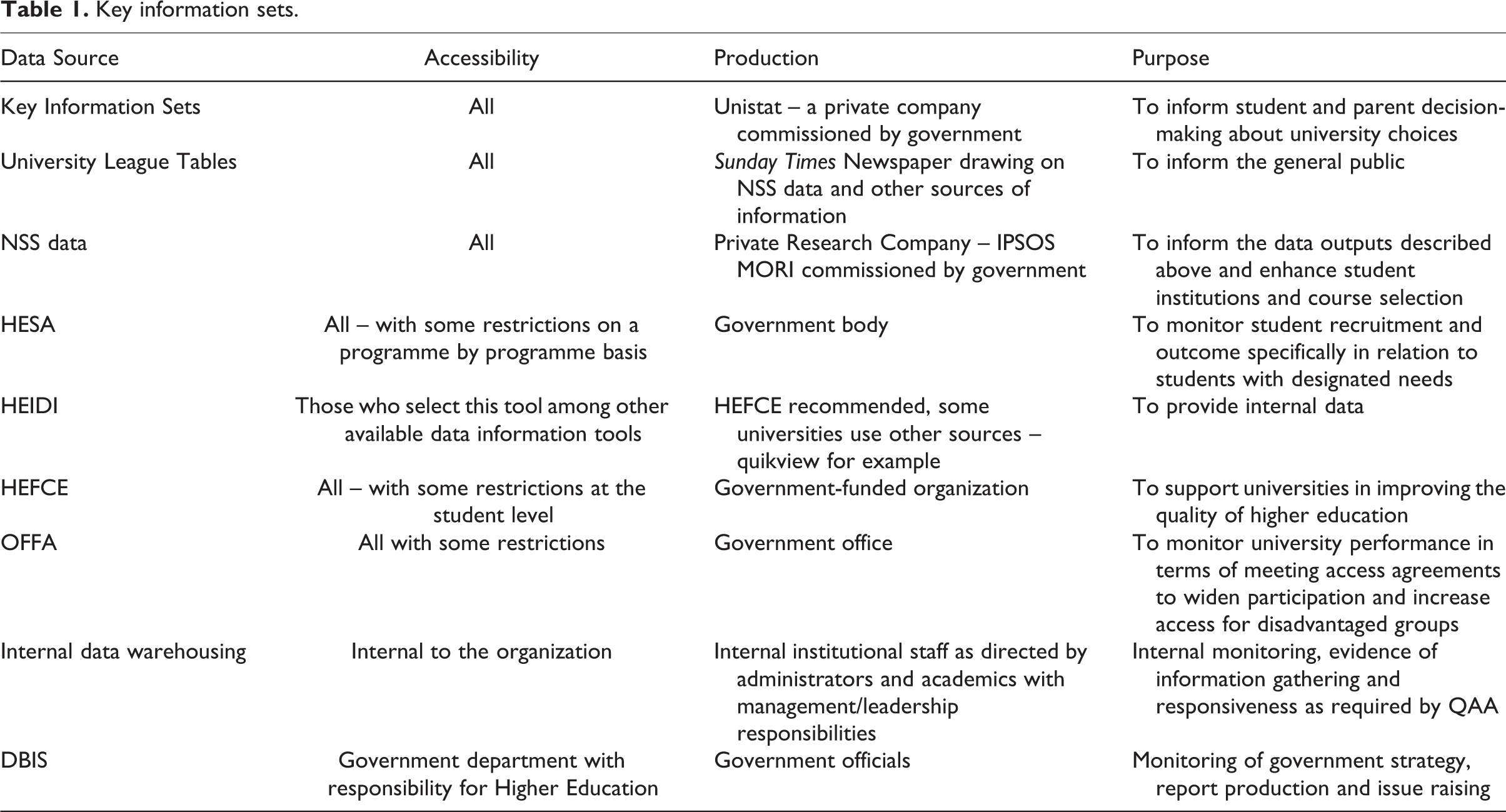
The Cooke Review (QAA, 2003) required that all higher education institutions in England should make publicly available information on: the institutional context; student admission, progression and completion; and internal procedures for assuring academic quality and standards. Since Cooke (QAA, 2003), further policy developments have demanded greater transparency in public statements concerning university performance and function. As of 2012, the data sources available to the student body are many and multifarious including: National League Tables, Key Information Set data, National Student Survey data, and incremental reports on confidence (or otherwise) in institutional capability as published by the QAA. Each of these leading data sets draws from similar sources, and is frequently reliant upon information provided by an individual institution, by the QAA or collated from a national survey of student opinion as conducted on an annual basis in the National Student Survey (NSS). The nature and scope of these sources of data are illustrated in Table 1.
Key information sets.
The administrative burden on universities to collate and publish data is considerable; it is in its own right fast becoming a distinctive information technology-based industry providing performance-related data associated with a particular kind of data-mining and monitoring evaluation. We identify this work as the result of a desire for hard evidence-based ‘smart-management’. It is rapidly growing both in kind and volume with inherent implications for added workload for university staff, at a time when the size of the administrative workforce in the university sector nationally has dramatically reduced (see Higher Education Statistical Agency [HESA], 2012). Moreover, data collecting requirements from HEFCE (the Higher Education Funding Council for England), from HESA, and also from the OFFA (Office for Fair Access), each in turn provide expanding ‘sets’ or ‘stockpiles’ of this same kind of evidence-based data, to exert yet further pressure such that many institutions have employed or are to employ data analysts, while creating virtual data warehouses to hold volumes of internal information generated on an annual basis. A recent search of the job website for higher education (www.jobs.ac.uk) revealed a range of advertised posts for data input technicians, data managers and data analysts (accessed 20 February 2013).
The UK Labour Force Surveys (LFS) have recently started to track student progress on a national scale from time in school through to university. The data are to be used by OFFA and the QAA to interrogate efficacy and value of provision at the point of the individual student. Further powers for auditors have been introduced in the Equality Act 2010, giving legislative support for criminal action against institutions that fail to offer equal access and opportunity to disadvantaged groups of learners (Action on Access [AoA], 2011). These recent arrangements linked to the university fee structure enhance an accountability linked to an external audit regime: universities in England are now required to make agreements with OFFA committing to widening university participation. University-led data submitted to HEFCE is repeatedly ‘mined’ as a metadata source to create a map of ‘performance’ trends and so model patterns specific to an individual institution. A potential fiscal penalty faces universities that do not meet OFFA requirements. Additional external pressure is placed upon leaders and managers as university leaders cope with the demands of external monitoring while also meeting the requirements of the Government Social Mobility Strategy (DBIS, 2011b). Political justification for data interrogation is provided in the guise of the Government Transparency Agenda (see www.data.gov.uk).
To address this widening approach to evidence-informed ‘smart management’, a number of universities have adopted HEIDI (Higher Education Information Database for Institutions), a HEFCE tool for collecting and analysing internal data, and intended as a basis for improved geo-demographic functionality, strategic management and further change (HEIDI Conference Presentations, 2009). The policy rhetoric for reform implies that administrative data planners are in a position to support senior staff across the university, and to target training where academics might be perceived to be deficient. Data-set information on gender, age, ethnicity, disability, nationality, sexual orientation (academic staff only), domicile (students only) and mode of study is used to map ‘equality’ in the sector.
This data-led approach is further reinforcing rapid change, with demands for smarter management making better use of add-on data by developing internal ‘e-quality indicators’ and ‘benchmarks’ to assist with institutional improvement. Managers from the University of Durham (Russell league pre-92 institution), for example, recently praised HEIDI benchmarking data as a powerful tool for engaging with groups across the university. Easily accessible data, benchmarked against performance and targets as set on an annual basis, provide at a glance information on ‘issues for praise’ and ‘issues for concern’ (HEIDI, 2009). These instrumental uses of data (uncontested and deemed reliable) are presented as incontrovertible output measures to be used for restructuring new ways of working without detailed discussion; this surely must be a cause for concern.
Seeing through smart management: theory, perspectives and values
To better understand the growing reliance on data and the pressure being exerted on universities to monitor, improve and publish their performance, we draw first on the work of Lyotard (1979). Second, we raise the issue of performativity in education, scholarly integrity and the question of what we mean (or ought to perhaps understand) by intellectual leadership and academic management; and how these terms and concepts increasingly and casually are being used to mean any kind of leadership activity in the HE sector – and so need to be more carefully defined (McRoy and Gibbs, 2009; Rayner, 2011; Macfarlane and Chan, 2012).
Lyotard’s thesis, commissioned to stimulate discussion around incorporating computers into higher education, identified a fundamentally different technicist understanding of knowledge and society. For Lyotard (1979), legitimation of knowledge creation is afforded by computer-generated data sets invoking an agreed performativity, substituting previously established ethics in explaining and valuing the activity of a social group; value is weighed, quantified and so defined by binary logic. Information technology, in turn, is presented as replacing emotional and/or impartial decision-making with new forms of legitimating numerical data (Jones-Devitt and Samiei, 2011); this approach has led to various forms of performativity, as coined by Lyotard (1979), together with increased demands for ‘smart-data’ to be used in higher education for securing choice and competition (so-called diversification) as the means for increasing levels of social mobility in society.
The previously described approach is reflected in the management model of new governance (Deem, 2004; Deem et al., 2007). There is arguably a stark juxtaposition between educationally defined leadership and management and evolving business-like models associated with ‘new governance and hybrid leadership’ (Bottery and Wright, 2000; Bolden et al., 2012; Macfarlane, 2012), which are deliberately ‘locally sited’ but are controlled by a national legislated policy, externalized accountability and increasingly characterized by a massive use of organizational ‘data-generation’, ‘data-mining’ and ‘data-smart management’. Gunter and Rayner (2007a) and Ball (2012) describe this new theory in management as having a prime function for engineering change and an associated political agenda for modernizing reform aimed at producing service-based commerce in a quasi-marketplace.
The approach in HE is in turn geared to a research function, that is, new knowledge generation, skills improvement and quality assurance combined as a means and an asset for profit. The approach is one in which from the outset learning is ‘costed’ as a service and/or as a discrete delivery of student experience. Such an approach is in turn fast shaping new forms of remote leadership and permutations on a type of centralized ‘command and control’ system of management with ‘flat structures of organization’, all linked to what Deem et al. (2007) and Whitchurch (2008) explain are the ‘new managerialism’ and ‘blended leadership/professional managers’ currently driving through reform and change in the university.
New leaders, academic reform and data management
Translated into practice, this promise of new management yields ways in which evaluative research can clearly demonstrate the correlation, in any demographic profile, between socioeconomic gradient and the probability of attending university (Yorke and Longden, 2008). Given a ‘policy-stated’ ambition for greater access, for increased mobility, and for a fairer and just society, the detailed analysis of data by implication, for example, offers profound insights into inequity, thus revealing foci for attention and direction for institutional managers to strategize ways in which to develop knowledge-based practices in their leadership approach. Such an approach (as a policy) offers powerful potential for any politician or organization interested in maximizing all aspects of its work and workforce; but it immediately invokes performativity- and efficiency-led reform as a dominant medium for change management. The notion of a quickening pace of change associated with such data and constant surveillance is a more targeted finely graded accountability; it is not far removed from an ‘Orwellian 1984’ society. A perfect example of these performance-related changes in day-to-day working practice in the university is the advent of TRAC (Time Resource Allocation Method) data collection, which records academic activity in terms of teaching, research, consultancy and administrative duties; this data matrix-based return requires all academics to frame (weigh, quantify) their working hour commitments as task-duties, rather than academic endeavours or scholarship (for a discussion of TRAC, see DBIS, 2011a: 23).
We maintain that, as with school reform over the last decade, the notion of an evolving model of ‘smart management’ dealing in ‘data-mining’ and ‘evidence-based’ accounts of self-evaluation and institutional performance now dominate leadership concerns in the academy. These data are now being generated and then recorded at every level of educational activity in the university, and framed as a purposeful re-production of data-mining, spin and marketing, all reflecting the further expansion of a managerialist, evidence-informed industry represented in a burgeoning technicist mantra of educational authentication and workforce accountability.
Performativity and accountability: a danse macabre?
A final twist in thinking through the performativity ‘looking glass’ as a ‘theoretical lens’ is to re-visit the useful work undertaken by Ball on school workforce reform in the English mainstream educational setting. Ball (2003) captured much that is deeply disturbing about the contemporary setting in mainstream education in England (now being reapplied in HE on what is a different but arguably much greater scale, in terms of its scope, size and implications for the future). Ball (2003: 215) uses the metaphors of ‘terror’ and the ‘soul’ of the teacher (educationist) to great effect in his commentary, describing how reliance upon performativity ‘requires individual practitioners to organize themselves as a response to targets, indicators and evaluations’. They are compelled to ‘set aside personal beliefs and commitments and live an existence of calculation’.
More worrying still are the insights presented into a ‘tyranny’ associated with a performativity-based culture; it is a culture, Ball argues, in which the practitioner is typically forced into the role of a promiscuous enterprising self, pressed for and preoccupied with continuously demonstrating standards of excellence. The struggle for soul (humanity) encompasses for the practitioner fear of the death of professional integrity, trust and autonomy, reflecting on the one hand an overwhelming need to evidence success, while on the other, struggling with deeper-seated inner conflicts, involving a constant press for inauthenticity and real or imagined resistance. The need to produce market-driven publicity, that is, the need to ‘spin’ performativity accounts and sell the institution’s worth to would-be users or consumers, leads to academics becoming enmeshed in data-mining and re-presenting information that generates deliberate but carefully calibrated opacity and enforced institutional introspection rather than open transparency; individuals and organizations, to take Ball literally, are forced to ‘take ever greater care in the construction and maintenance of fabrications’, echoing the more recent and widespread analysis provided by Ozga et al. (2011) in their research account of European-wide reforms of the past decade. It is clear that Ball’s prescient critique signals a range of worrying issues taken up by other commentators in the educational leadership field.
It is our deepening anxiety, moreover, that perceived in this light, educational reform takes on a movement akin to an institutional and sector-wide ‘danse macabre’. A sense of déjà vu, of policy reform grounded in an ever-expanding wave of performativity; with a mood music that is inescapably striking surrounding this ongoing reform. It brings with it an echoing reminder of the way this reform allows for no alternative; to resist or criticize is to be dated and foolish and wrong; the current vogue in ‘smart-data management’ invokes the politics of ‘one of us’ or ‘none at all’ and the thought lingers that reform policy involves at its heart an emperor dressed in the latest but meaningless smart-data set forming best business fashion, and with no leaders able to voice ‘other’ educational values/meaning because of the current zeitgeist, and the many who are not yet prepared to successfully point to a naked truth.
Documentary analysis of published smart-data
In providing evidence of the increased focus on public information with expanding ease of access to multiple sources of scientific ‘empirical’ data and ‘evidence’ (Elderman, 2012), focus is now given to the latest information source made available to the learner, namely KIS data. We offer this in illustration of the types of data available to the student body making their university applications for 2013 entry as the first cohort of applicants with access to KIS information. The availability of data set information to inform student course selection was first proposed in the Browne Review (DBIS, 2010).
The White Paper entitled ‘Putting Students at the Heart of the System’ (DBIS, 2011a) further delineates the English government’s ambition for data-informed publicity in higher education institutions, aimed at ensuring a greater opportunity for student choice, and to continuously improve the design and content of courses and the quality of students’ academic experience. The KIS data from ‘all full-time and part-time undergraduate courses planned for 2013 in Institutions which subscribe to the QAA’ (www.hefce/KIS). This comprises items of information that the students surveyed claim they find useful, with some items measuring student satisfaction from the NSS survey completed by more than 220,000, mainly final-year, students in England each year.
Other items are from the ‘Destination of Leavers from Higher Education’ (DLHE) that surveys students who gained a qualification from a university or college, six months after leaving. The DLHE survey asks whether they are employed, studying, both, or neither. In the KIS data the results are combined with those of a similar survey, the Long DLHE, which surveys a sample of those who responded to the DLHE some 40 months after leaving university or college. The KIS also contains information provided by participating institutions, including the number on a specified programme of study who are employed one year after graduation, with the average salary achieved. Through interrogating the KIS, a prospective student might discern how much time they would spend in lecturers, private study, seminars and tutorials on a weekly basis, the balance of assessment methods employed in their degree and whether their programme is accredited or approved by a professional body offering additional accreditation.
Illustrations of ‘smart’-data: the research
Our approach in this study drew upon documentary analysis: it involved establishing a sample of institutions by identifying all English universities participating in developing the KIS; we divided institutions into groups using the classification adopted by Bolden et al. (2012), as research intensive Russell Group ‘old universities’ with an establish research base, the 1994 ‘new universities’ (previously known as polytechnics but redefined in 1994) and ‘Alliance’ members who define as having a specific interest in business and innovation. A search was completed to identify similarly described degree programmes, and we selected one subject area from each of the following categories: a ‘traditional’ area of academic study (as studied in our longest established institutions), a vocation degree option, and a relatively recently awarded degree specialism. The actual number of potential combinations of universities from each of the three classified groups offering the same or similar subjects was limited (10 in total). The final selection, reduced to three disciplinary areas, was determined by the best fit in terms of the final award descriptor. This process resulted in the clear identification of three subject areas: Business Studies (vocational); Japanese (relatively recent area of graduate study); and History as a traditional area of academic interest. To further illustrate the data available to new intending students, we also presented the HESA monitoring data for the three universities represented in our sample. The implications of the available data for database-led decision management (DBDM) were then examined.
For ethical reasons we have not named the selected organizations and we record here our concerns that claims articulated in the framing of KIS data are presented as factual with no contextualization of source or influence that might have impacted on data response rates and/or outcomes. KIS data are presented as context-blind serving a prime function: the provision of information for consumerist purchasers in a ‘graduate marketplace’ with the potential university experience presented in a ‘go-compare’ option for would-be students. What amounts to comparative profiles required of the university front web-page are a shop-window providing the basis for retail competition, with information also available on institutional aspects of the organization such as financial viability and academic output (Jones-Devitt and Samiei, 2011: 86). These statements can only be described as ‘crude’ data sets, and following Giroux (2012), we illustrate how these lead to the conception of a ‘mode of pedagogy’ based on a set of ‘social assumptions’ to win consent and produce consumer-based notions of agency while simultaneously instrumentalizing knowledge.
Developing new portals of information: data management and evidence exploitation
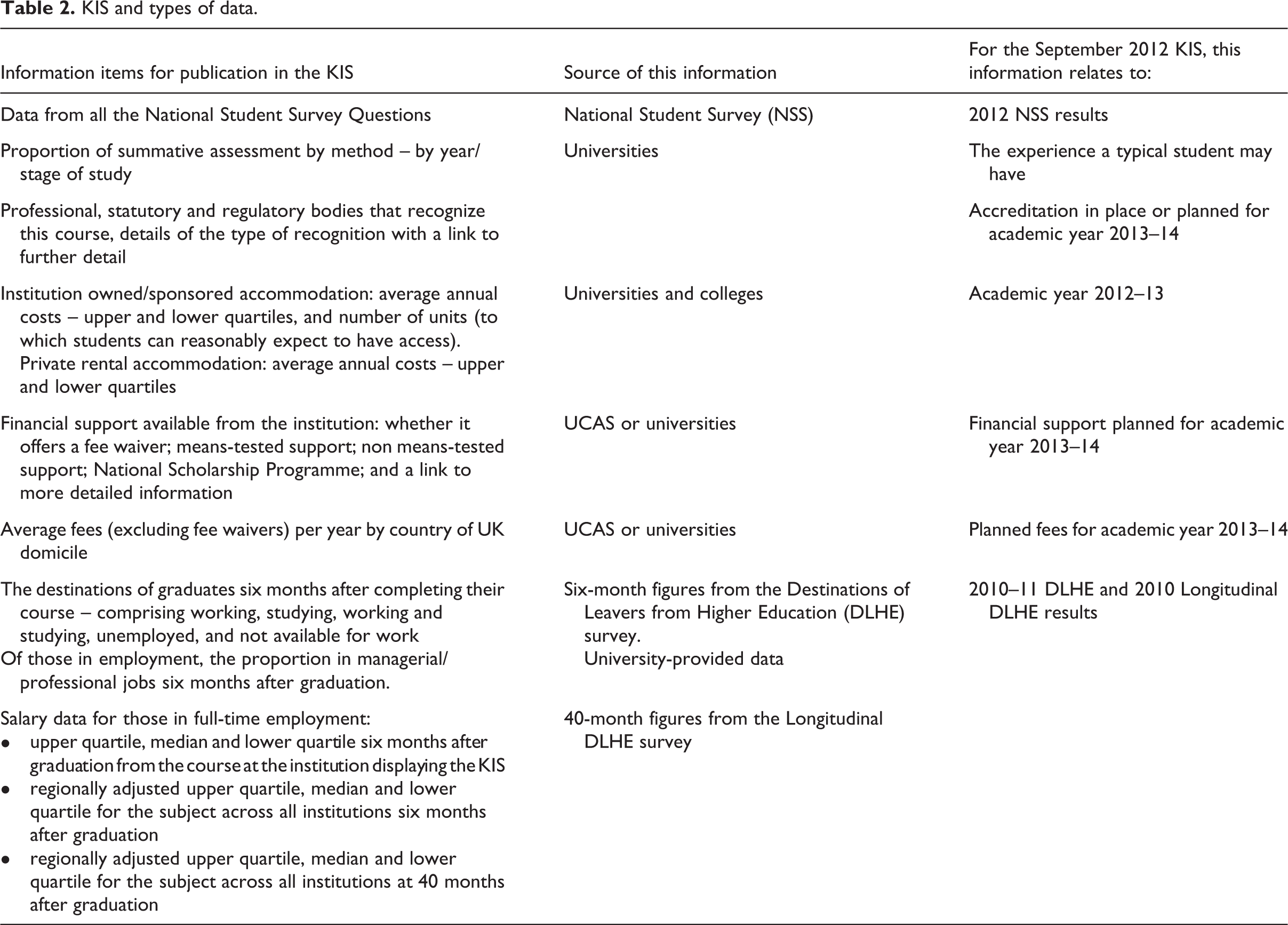
Table 2 illustrates the full scope of the information available from summary NSS data, the average fee costs, accommodation costs, predicted salary of graduates and destination six months or more after graduation.
KIS and types of data.
The three selected subject areas with the KIS data from the three chosen institutions are shown in Tables 3 to 6, with information from the 2012 NSS survey data given the greatest focus. Table 3 shows the available data for BSc Management courses selected on the sample basis as previously described.
KIS data for sample BSc management provision.
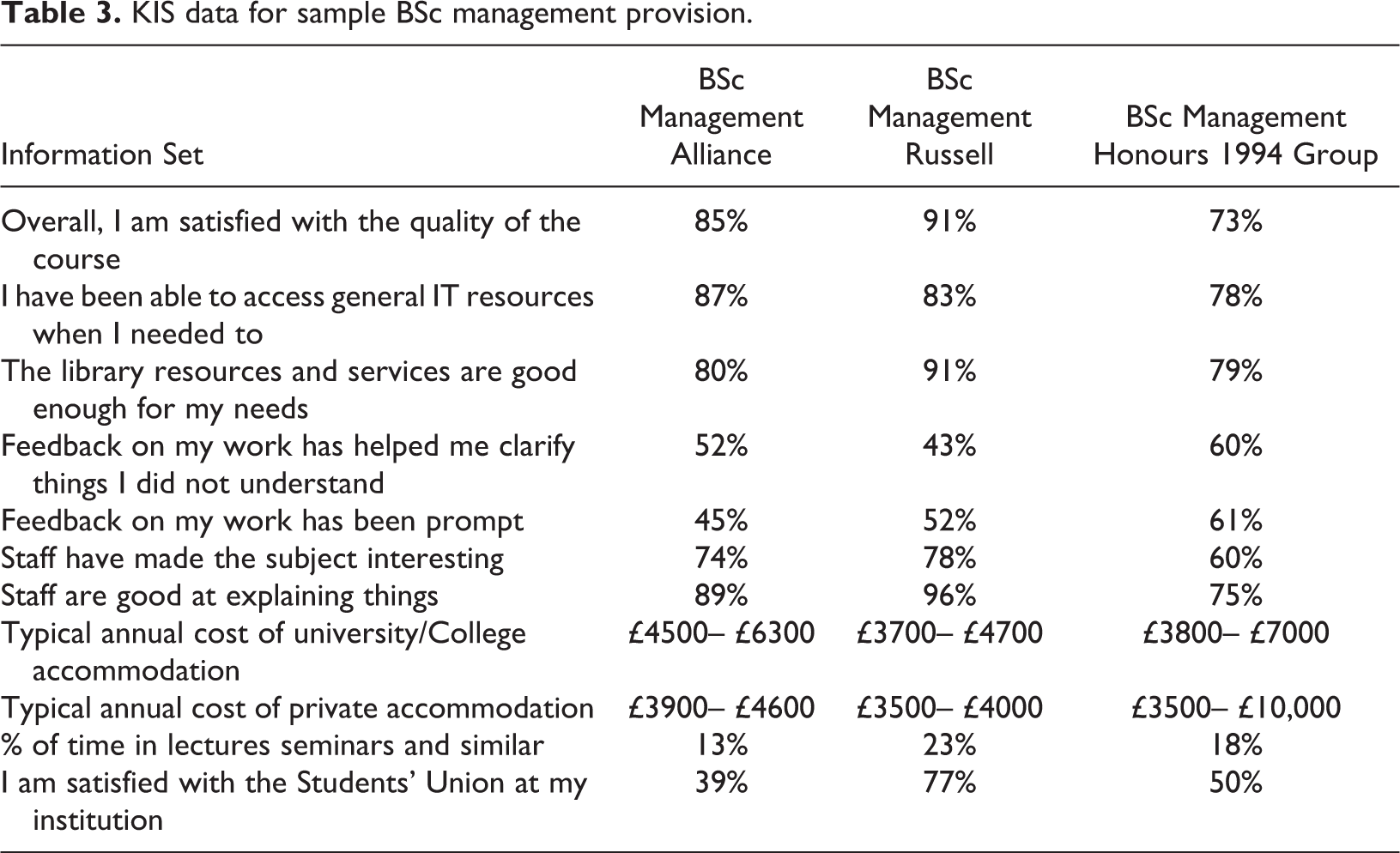
In what is addictive smart retail nous, based upon performance data, the student can exercise wise shopping behaviour and best choice in selecting a university. For example, from Table 3 we postulate that a prospective student faced with the data will deduct that Russell Group students are the most satisfied, Alliance students have the best access to IT facilities, with the library considered better by Russell Group students. Clarity of feedback scores a low 43 percent in the Russell university with the Alliance response also a cause for concern. The 1994 Group staff do not appear to offer learning that is interesting, while the Russell staff are rated highly at giving explanations. When the students look at finance, the Alliance university has the highest living costs, while students spend 13 percent of their time each week in lecturers. Furthermore, current students are not satisfied with the Students’ Union. We postulate that the discerning student will be faced with a complex decision-making process, having to weigh the value of living costs against available free time and an ineffective student union. In our view, the complexity of the data on the social aspects of study dwarfs the significance of the traditionally academic-related aspects of degree selection.
It is too early to postulate the impact of these data on student decision-making. There is no doubt, however, that university leaders responding to the open market created by the publication of these data in the current climate of competition will respond aggressively to self-evaluating data and establish monitoring to demand improvement in key areas of academic provision and performance. Further data, for the universities in our research, from the Office for Fair Access (OFFA) and available to the student who wants to find it is given below.
The informed student taking the OFFA data (see Table 4) at face value might well assess their options as follows: the 1994 University takes the largest number of students, offers the highest percentage of funding on bursaries and has spent the greatest amount of money on outreach work. The KIS also indicate that this university will provide the best feedback to help improve their work, so this university is more appropriate for their needs than the Russell or Alliance especially if they are in need of a bursary or are in the outreach category of learner as designated for additional bursary support. This snapshot analysis illustrates the potential impact of the data and leads us to postulate that the Alliance university could receive lower application rates in the future, particularly from learners in a defined access category who may well value additional support and feedback to help them succeed.
OFFA data.

A further example, using the same methodology for university selection, shows the data available to a prospective student interested in studying History. Here the first four categories of data are used (see Table 5).
KIS data for selected history courses.
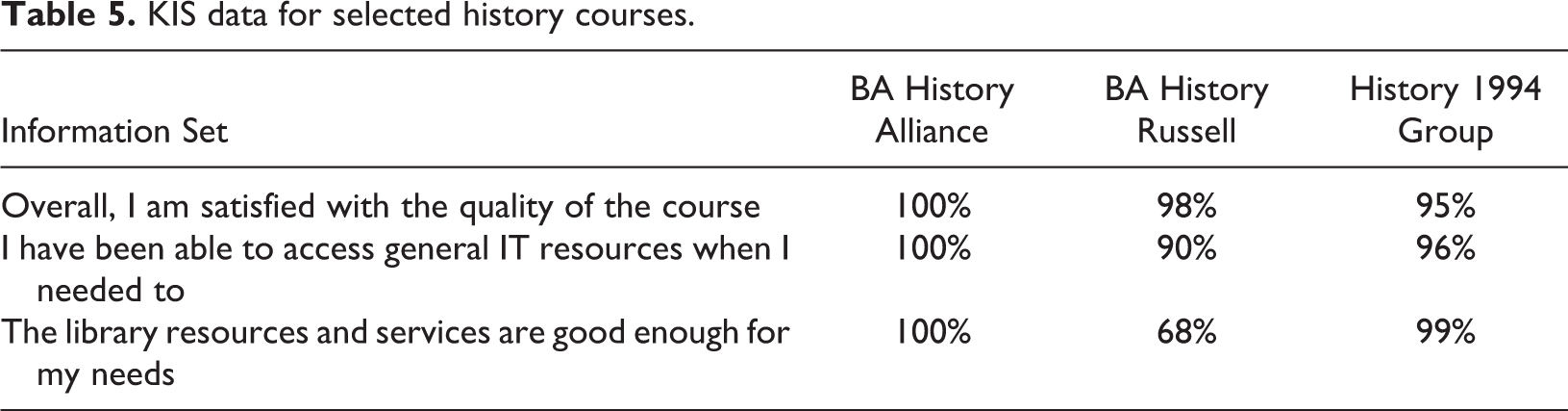
Given the KIS data above, a student may well select the Alliance University especially if feedback on work is considered important, which in the case of the Russell example appears only to have a 66 percent satisfaction rate. The IT services in the Alliance appear to be highly rated, as are the library services. The Russell Group institution, although achieving an acceptable performance for IT resources, only receives 68 percent for library services and 66 percent for ‘feedback that supports greater clarity’.
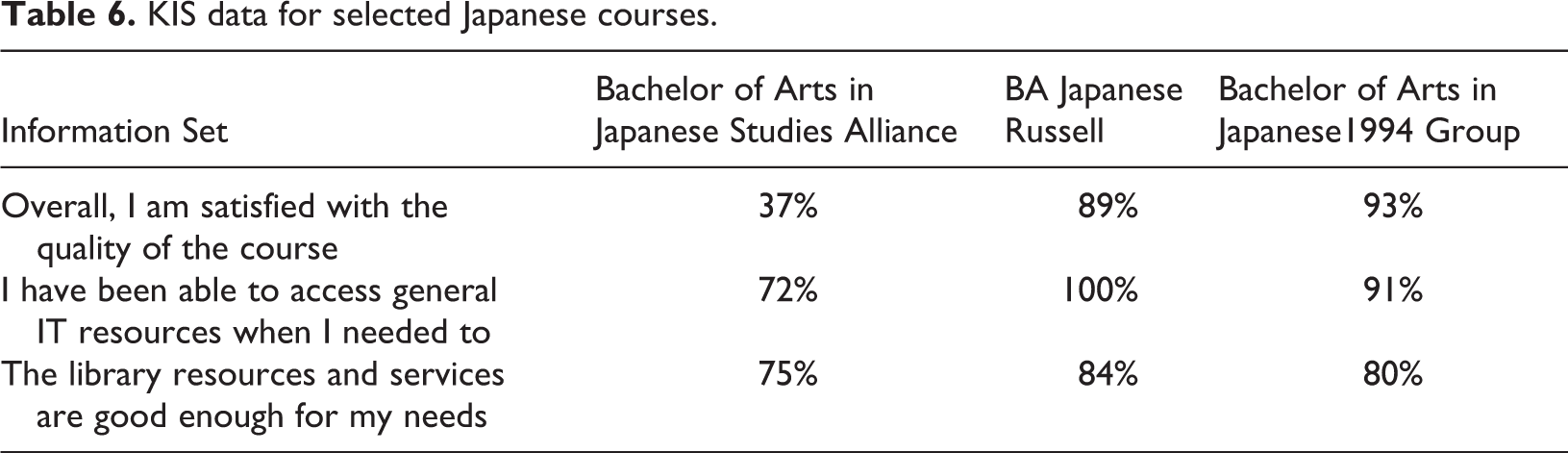
In the area of Japanese as a subject, just a cursory examination of the first four areas of the KIS data in Table 6 are enough to indicate that the Alliance university has a problem, given its extremely low student overall satisfaction score. The intending student interested in reputational factors and degree outcome is unlikely to apply to this institution. Low application rates in future years could inevitably lead to managed intervention and potential programme closure. It is further postulated that senior managers in this university will be demanding improved NSS scores in future years and/or closing this course.
KIS data for selected Japanese courses.
In presenting exemplar KIS data as recently published, our aim is to illustrate the ‘story told’ and postulate the likely impact on the learner and, respectively, on HE leadership approaches in the new competitive market place with evolving models of HE governance and management seeming to place heavy reliance on the cursory examination of publicly available data, already influencing the operation of our universities. Deem et al. (2007) have identified the changes under way not only as impacting at the structural level of university organization but also in cultural terms in the way academics perceive their working lives. This has been attributed to a perceived erosion of trust between staff members (Avis, 2003), and a sense of expanding surveillance and of being controlled (Ball, 2003). Intellectual and academic leadership, however this might be defined, is showing signs of strain and erosion as new challenges are presented in a managerialist methodology (Macfarlane et al., 2012).
The way forward: opportunities, threats, or just déjà vu?
Reflecting on research into the school sector, Ball (2003) identifies an impact of policy technologies of the market, managerialism and performativity diminishing the freedoms of the public sector. He proposes that the work of smart-data collection and quality assurance monitoring is synonymous with centralized management systems; reform is achieved again and again by increasing the power of central organizational management functions and disempowering the educationist who is nonetheless held to account for a set of metrics imposed upon the academic endeavour which can be observed, regulated and counted. In the context of such increased corporatization of the academy, we draw on the work of Giroux (2012) to emphasize the importance of education as a public good with academic freedom as an essential feature of a substantive democracy.
Our first concern is that a culture dominated by performativity will erode previously presumed freedoms and trust associated with professionality, as well as the potential for growth in human individuality in education; there is now a pervasive form of ‘fabricated governance’ embedded in the ‘smart management’ of publicly available data sets, predicated upon an individuality recast as consumerism, and used as evidence against academics where ‘excellence’ is perceived to be lacking. Management in these circumstances becomes interrogative, challenging and reactionary (Browne and Reid, 2012). It is easy to imagine the scenario in which professional managers increasingly adopt a ‘business-like’ role as ‘technicians of behaviour’ (Foucault, 1972: 294) based upon ‘command and control’, and are required to ‘utter’ another managerialist mantra, ‘improve or perish’.
There is therefore certainly scope for leadership researchers to explore bases for intervention in the changing leadership and a management construction of a ‘smart-data dominant culture’ before it becomes embedded in the academy. One example might well be to re-focus upon constructs such as intellectual leadership and academic management as educational endeavour as a form of ‘capital’ to be used in society as a public good and facilitation of civic engagement (Boyer, 1990; Glassick et al., 1997; Young, 2008). A second intervention might be to follow Apple’s call for strategic alliances with policy-makers, and the re-interrogation of what has become a too easily accepted educational common sense and orthodoxy. The aim should unreservedly be about interrupting a virtual hegemony of neoliberal policies and practices at the nexus of leadership praxis on ‘ground zero’ in the academy.
Our next concern leads to us to ask whether leadership for greater social justice is enhanced or inhibited by the increased availability of data. We can see opportunities for greater social justice in the monitoring of access, but we also offer warnings that the social justice agenda has the potential to be manipulated as government use the available data to demand greater control over and access to the university sector. One potential advantage to the availability of data on university and student performance is the potential it offers for better managing public inequalities in university resources, selection processes and by implication approaches to teaching and learning. On the other hand, the opacity afforded government through the interrogation of internal university data and demanded in the guise of social justice places the university sector under the watchful surveillance and steer of a government able to apply fiscal penalties to control the future of the academy.
Earlier we identified Lyotard’s predictions for greater data knowledge leading to improvements in social justice and, indeed, we have demonstrated that increased access to data has enabled government invention and monitoring of university achievement in a range of dimensions previously associated with disadvantage. Our interest in researching the impact of data awareness for social justice finds support from Morrison (2009: 182), who critiques the lack of attention in leadership research given to identifying unjust leadership practices. Lumley (2009) highlights the potential dangers of data-based decision-making in larger organizations where time-starved leaders and administrators respond quickly to data sets without thoroughly interrogating the information (2009: 34). Evidence to support the dangers of this approach can be found in research by Browne and Reid (2012), where reactionary responses from university leaders have resulted in rapid decision programme closures of some HE provision. We call for ethical leadership in the academy where managers think more carefully about change and resist the tendency to respond rapidly to new performance-bound data pictures, engaging in dialogue which explores the collective story from organizational agents and avoids swift data-led decision-making. With Brown and Reid (2008) we believe that leadership requiring discussion, exploration and acknowledgement of academic and pedagogic expertise has the potential to be an important social influencer in resisting the damaging impact of neoliberalism.
A third concern is to acknowledge the unintended consequence of change intervention. Change management within an HE environment is particularly complex (McRoy and Gibbs, 2009). This is further exacerbated by the complexity associated with seeking evidence of high levels of performance, increased quality in the student experience and the need to share more openly tacit knowledge pertaining to academic performance and effectiveness. It is further problematized when academic loyalty is perhaps first defined and so determined by a colleague’s discipline (McRoy and Gibbs, 2009). Re-positioning purposes and values for academic work involving constructing and re-constructing new accounts and warrants of quality as an intellectual task may not fit the use of ‘performative-data’ and/or ‘smart management’. Research has indicated that institution managers have more and more regard to government policy, with internal agents driven to address quality issues of value and efficacy while academic staff are beginning to react against attacks on their professional autonomy and freedom (McRoy and Gibbs, 2009: 691). In policy terms, the mechanisms of total implementation for the data-smart professional manager resemble a ‘mobius web’ as defined by Ozga et al. (2011), in which they lead the ‘global re-shaping of educational governance’ occurring from the top-down, bottom-up and sideways-on and all at the same time. The discourse and practices of New Public Management within an institution and, more widely within the sector, remain the language of change, adaptability and ultimately existence as the rhetoric of improvement and profit dominate the survival of the fittest in the competitive jungle that is an educational market.
Our final concern here is for the types of academic leadership likely to emerge as new forms of hybrid leadership that are ‘smart-data’ sensitive and perceived as vital to further access the ‘data-mart’; this will by its very nature transfer authority away from academics to professional managers focused upon learners as purchasers of a service in a market led economy. Writers in the Times Higher Education (Grove and Gibney, 2012) have recently criticized the potential of KIS and related data to unlock student choice. Furthermore, the publication of comparative data working as an equivalent to a ‘shoppers channel’ is creating additional pressure on academics, as they are now cast as the producers of a product, and charged with improving this product as portrayed in the smart-data, with increasing concern for competition cascading through our academic institutions. The dangers associated with database-led management, when the focus is largely directed to performance scoring rather than pedagogic-based notions of quality delivery of teaching and learning, are immense; when leaders focus on artificial performance scores, and academics collect and respond to increasing amounts of data to the detriment of inspiration, creativity and ultimately efficacy, as is helpfully explained by Sandberg and Targama (2007) in a similar analysis of data-led management in the world of business and management. The emphasis is drawn to the longer term and sustaining authentic change, via emphasizing the importance of understanding and meaning, as a crucial part in enhancing organization learning and transformative leadership in the organization.
As a way forward, we wish to state how important it is that academics hold close to a humane and moral sense of the academic endeavour and the freedoms associated with intellectual autonomy, scholarly integrity and the right to teach their subject with the conviction, motivation and individuality that first led them to a career in the academy. With Giroux (2012) we urge academics to become public intellectuals, willing to engage in creating a formative culture of learning that can nurture the ability to defend higher education freedoms as essential in a democratic society.
Conclusion
This research has mapped emerging ‘smart-data’ and postulated changing leadership approaches resulting from the demands for greater transparency in higher education. Using our research interest in data-driven reform in the school sector we set out to explore whether the developing focus on data in HE governance was likely to impact in similar ways to those observed in school and college leadership and management approaches. Supported by emerging evidence of market approaches and a developing culture of performativity, we have highlighted challenges emerging in the wake of government intervention in higher education. In asking questions about government intention we have identified that in the guise of the social justice agenda and in the declared interest of the student, cast now as a consumer of higher education, government has secured greater external access to the internal workings of our academic institutions. In addition we have identified the potential for a reduced focus on the rich academic experience offered to learners when academics are allowed the freedom to explore their subject and distil their love of learning to their students, free from a performativity associated with government and management intervention.
The next step in our own research is to monitor staff and student reactions to demands made upon them to generate, record and use smart-data, and record how these demands are changing organizational cultures and leadership approaches as data become more central to the management of our universities. It is postulated that new leadership models will quickly develop, articulated around ‘database-dependent and evidence-based’ leadership that becomes a quick-fire responsive series of marketing initiatives in a competitive marketplace. This has, for example, the potential to create a convergence in academic provision (a perverse irony given the stated aim of diversification within the sector), that will be ‘standarized’, ‘constrained’, and ‘limiting in student experience’, as management becomes increasingly concerned only with responding on an annual basis to simplistic statistical data (see Brown and Lauder, 2007, for an interesting explanation of this likelihood as a market phenomenon). This kind of future would see a student and staff learning experience in the university that is the stuff of nightmares; it is to be avoided at all costs as we strive to protect what is of ‘value’ in the academy.