



Abstract
The subject of teachers’ intentions to leave has recently captured the attention of researchers and practitioners. This paper reports on a study that examined the workplace predictors of teachers’ intentions to leave for teachers in different career stages. Structural equation modeling was used to assess the plausibility of a conceptual model specifying hypothesized linkages among secondary school teachers’ perceptions of workplace predictors, satisfaction and commitment, and teachers’ intent to leave. Using the USA Schools and Staffing Survey (SASS) data set, two mediational models were tested, one reflecting partial mediation and the second representing full mediation. Results indicated that the workplace variables had significant meaningful indirect effects on teachers’ intent to leave through three mediators: job satisfaction, work commitment, and career commitment. Furthermore, the effect of administrative support on work and career commitment was uniform and significant for teachers in the three career groups. Some differences across the three teacher career groups were discussed.
Keywords
Introduction
In recent years, the subject of teacher turnover has captured the attention of researchers and practitioners alike (Crossman and Harris, 2006; Ingersoll, 2001; Rinke, 2008; Skaalvik and Skaalvik, 2011; Smith and Rowley, 2005; Weiss, 1999). Teachers leave for a myriad of reasons; there is not a single model to explain why teachers leave their schools or the profession. However, 25% of USA teachers leave teaching before their third year (Skaalvik and Skaalvik, 2011: 1029). Indeed, some time ago, Ingersoll (2001: 501) characterized teaching as a ‘revolving door’ whereby ‘large numbers of teachers depart their jobs for reasons other than retirement’. Concerns about turnover are not unique to the USA. Crossman and Harris (2006: 29) observed, for example, that ‘low job satisfaction has been cited as a possible cause of the current poor recruitment and retention of teachers in the UK’. The teacher retention problem exists ‘worldwide’ (Rinke, 2008: 2), but there is wide variation among countries.
Although one theoretical perspective has attributed USA teacher shortages to demographic trends (e.g., increasing student enrollment and an aging teaching force), Ingersoll (2001) maintained that other factors, such as organizational conditions of workplaces and job sites, were highly consequential for teacher turnover. These workplace conditions included administrator support and student discipline problems. One area that has received rather scant attention, however, is the potential for differential effects from organizational conditions in school workplaces for teachers in different stages of their careers. As Rinke (2008: 11) observed, teachers’ careers exist along a continuum, with a number of ‘entry and departure points’. Research into the relationship between workplace conditions and teachers’ intentions to leave at different points in their careers may reveal how to increase the chances of retaining teachers in the profession over the course of their careers (Rosenholtz and Simpson, 1990).
In this study, we utilized a USA national data set to examine teacher intentions to leave within three career groups: novice, mid-career, and veteran. We specifically sought to examine whether several workplace condition variables (e.g., administrative support, teacher autonomy/discretion, and student disengagement) were predictive of teachers’ intentions to leave for secondary school teachers in different career stages. Building on previous research (Conley and You, 2009; Elangovan, 2001), we tested a conceptual model that posited job satisfaction and commitment as intervening in the workplace conditions–teacher intentions to leave relationship. If policy makers and administrators can discover the workplace variables that influence teachers’ turnover intentions in different stages of their careers, we may have a basis for altering the workplace to reduce intentions to leave over the life cycle (Huberman, 1989).
Teacher turnover: Organizational sources and mediating variables
Although research supports the idea that turnover may be viewed as neutral or even positive from an organization’s perspective, such as when an organization provides incentives for early retirement or seeks to terminate an employee, it is usually viewed as negative (Beehr, 1995; Ingersoll, 2001). School organizations, for example, must bear the costs of recruiting and training new personnel (Conley and Woosley, 2000a). Teacher turnover ‘brings significant financial costs, up to US $8000 for each teacher who leaves the profession (Ingersoll, 2003) and as much as 329 million to 2.9 billion dollars annually for just one US state (Texas State Board for Education Certification, 2000)’ (Rinke, 2008: 2). Furthermore, although departures may mean that a more coherent teacher group is left within a school, at some point turnover may become a source of group disintegration (Ingersoll, 2001).
Examining turnover from a negative organizational perspective, Ingersoll (2001) explored several organizational sources of low teacher retention among USA teachers he termed movers, those who departed to teaching jobs in other schools, and teachers termed leavers, those who left the teaching occupation. Ingersoll's (2001) analysis also considered both voluntary and involuntary turnover, where the latter included teachers who were involuntarily departing because of retirements, layoffs, terminations, or school closings. He used logistic regression analysis to conduct a series of regressions testing a set of turnover models, which incorporated teacher characteristics, school characteristics, and workplace conditions as predictors. Included among the findings were that among those teachers leaving voluntarily, there was a strong relationship of turnover with workplace conditions, after controlling for several characteristics of schools and teachers.
By contrast, other studies have focused not on actual turnover but on workplace predictors of teachers’ intentions to leave (Lachman and Diamant, 1987; Conley and You, 2009; Perrachione et al., 2008). Although intentions to leave may not materialize in actual quitting behavior, an examination of antecedents of a teacher’s intention to leave is considered important to improving understanding of the ‘psychological process of [employee] withdrawal’ (Lachman and Diamant, 1987: 220). Lachman and Diamant (1987), for example, examined workplace predictors of turnover intentions among 239 secondary school teachers in Israel. They posited several ‘withdrawal factors’ (Lachman and Diamant, 1987: 220), including school management, social relations, excessive workload, and intrinsic rewards. They additionally proposed that these withdrawal factors affected teachers’ intentions to leave indirectly through a mediating variable (i.e., teacher burnout), consistent with their conception of the formation of a psychological process underlying intention to leave.
Recently, we (Conley and You, 2009) posited that teachers’ intentions to leave include mediating or intervening variables between workplace conditions and teacher turnover intentions. Building on Lachman and Diamant (1987) and Elangovan (2001), we hypothesized job satisfaction and organizational commitment as the variables intervening between several workplace conditions and turnover intentions. In a study of secondary school teachers in three western USA districts, linkages were tested among teachers’ perceptions of role stressors (e.g., role ambiguity), organizational commitment, job satisfaction, and intentions to leave. Findings provided support for a causal path from workplace conditions to satisfaction and commitment and, in turn, teachers’ intentions to leave.
An examination of the causal ordering among workplace conditions, satisfaction, commitment, and teacher turnover intentions appears important because, as has been noted about research on employee turnover intentions generally (e.g., Elangovan, 2001), research has not satisfactorily assessed mediating characteristics that may intervene in the workplace conditions–intentions to leave relationship. Unless researchers consider mediational models, they may not identify workplace variables that have indirect effects (through other variables) on intentions to leave. The most frequently conceptualized intervening or mediating variables in this regard have been the attitudinal variables of job satisfaction and organizational commitment (Elangovan, 2001).
Whereas job satisfaction represents an affective response to specific aspects of the job, organizational commitment is an affective response to the entire organization (Porter et al., 1974; Williams and Hazer, 1986). Although satisfaction and commitment have been frequently conceptualized as mediators in this relationship between workplace conditions and turnover intentions, with some exceptions few studies have assessed both the antecedents of these mediators and how mediators affect intentions to leave. Put another way, studies have tended to not include both satisfaction and commitment in tested turnover models and/or have not adequately examined their antecedents (Elangovan, 2001; Williams and Hazer, 1986).
These omissions seem important in schools because as we have discussed elsewhere (Conley and You, 2009), satisfaction and commitment are key attitudinal variables in school organizations. Firestone (1996: 215) maintained that both satisfaction and commitment are critical because although satisfaction may ‘make teachers more compliant and easier to work with’, commitment taps, among other things, an ‘internalized motivation [or] a partisan attachment to the goals and values of an organization’ (see also Mueller et al., 1992). As organizational researchers (Elangovan, 2001) have observed, there is limited research examining turnover intentions that includes both satisfaction and commitment. Further, Sclan's (1993) examination of first-year elementary teachers using a USA data set differentiated between two commitment forms: work and career. Whereas work commitment reflected attachment to organizational goals and values, career commitment reflected attachment to the choice of teaching as a career. Sclan (1993) maintained that attachment to one's decision to enter teaching, as well as attachment to organizational goals, were forms of commitment that may be affected by workplace conditions and in turn influence intentions to stay or leave.
In the current study, following Ingersoll (2001), we used a generalized measure of intentions to leave, as opposed to focusing on a particular subset of turnover. As noted, in conceptualizing teacher turnover, Ingersoll (2001) distinguished between teacher movers and leavers. Most research has focused on teachers who leave the occupation of teaching altogether as opposed to those who move to other schools. In this study, consistent with Ingersoll (2001), we used a generalized measure of teacher intent to leave that encompassed both leaving and moving. As suggested by research on the financial costs of departing one’s school (Rinke, 2008), replacement costs for teachers are high, regardless of whether a teacher leaves the school or departs the profession as a whole. In addition, in attempting to track a psychological process of teacher withdrawal (Lachman and Diamant, 1987), we were most interested in assessing the influence of satisfaction and commitment on a generalized impression of intent to leave. Indeed, as this research suggested, previous models of the psychological process that leads to a person’s intention to leave have assumed ‘a sequence from the work environment, through employees’ affective reactions to it, to the decision to remain [with] or leave the organization’ (Elangovan, 2001; Lachman and Diamant, 1987: 219).
Teacher career stages
Researchers have suggested that the relative strength of workplace conditions to affect turnover intentions may depend on the teacher’s particular career stage. Rosenholtz and Simpson’s (1990) study tracking the ‘rise and decline’ of teacher commitment outlined a model of three stages of teachers’ careers. Their study of elementary teachers in a southeastern USA state further posited that the relative strength of several workplace or ‘organizational condition’ variables affecting commitment (e.g., principal buffering, task autonomy and discretion, management of student behavior) would depend on the teachers’ ‘career stages’ defined in terms of teachers’ years of experience within teaching.
Rosenholtz and Simpson (1990: 246) conceptualized novice teachers as those who were relatively new to the profession and would be ‘concerned primarily with survival issues and the immediacy of problematic situations’ such as dealing with the orderliness and attentiveness of students. More experienced teachers, they noted, included both mid-career and veteran teachers who were expected to feel more ‘secure with the rudimentary elements of survival … [and] show greater concern with the core task’ (Rosenholtz and Simpson, 1990: 247) of teaching; in particular, whether their instructional efforts were helping students learn. Drawing from this conceptualization of career stages, they predicted that teacher commitment among mid-career and veteran groups would be influenced more than that of novices by organizational conditions that were most closely linked to classroom instructional tasks.
Rosenholtz and Simpson (1990) made several predictions of the influence of workplace conditions on teacher commitment, in which the aspect of commitment examined included turnover intentions, that is, how often teachers considered leaving the school and profession. Among the findings in their comparison of career stages was that results differed depending upon the career stage examined. For example, for mid-career and veteran teachers, they reported the effect of workplace conditions related to core tasks (e.g., task discretion and autonomy) as greater than for novices, lending support to the notion that considerations of the relationships among workplace conditions, commitment, and turnover must consider the career stage of the teacher.
Study purpose
Using the Schools and Staffing Survey (SASS) data set, this study sought to examine teachers’ intentions to leave in three career groups/stages: novice, mid-career, and veteran. It specifically sought to examine whether particular workplace conditions (e.g., administrative support, teacher autonomy/discretion, and student disengagement) were predictive of teacher turnover for secondary school teachers in these career groupings. Therefore, the research questions to be answered in the study were: Which dimensions of perceived workplace conditions for secondary school teachers (e.g., administrative support, teacher autonomy/discretion, and student disengagement) have significant direct and/or indirect effects on teachers’ intent to leave? Are there group differences that exist across three career groups (i.e., novice, mid-career, and veteran)? Do teachers’ mediating or intervening variables (i.e., work commitment, career commitment, and job satisfaction) serve as important mediators between workplace conditions dimension(s) and teachers’ intent to leave? Are there group differences that exist across three career groups (i.e., novice, mid-career, and veteran)?
Method
The main question addressed in this study involves ascertaining the effects of different workplace condition variables on teachers’ intent to leave among secondary school teachers who are in different career stages (Conley and Woosley, 2000b). The method section is divided into four parts. Firstly, the sample choice is outlined and demographic information is provided about the samples. Secondly, the dependent variables (outcome variable and mediating variables) are discussed. Thirdly, a factor analysis is utilized to identify the independent variables. Finally, the fourth section presents the plan for analysis and hypothesized mediation models to be tested.
Sample
The data for this research came from the National Center for Education Statistics (NCES) national database of teachers included in the 2007–2008 SASS database. The SASS collects information about elementary and secondary schools and the staff who work in them. SASS is a coordinated set of questionnaires sent to a random sample of public and private schools, their principals, a subset of the teachers, school library staff, and the public schools’ districts. In selecting our sample, we refined the original data set, selected an initial sample, and then selected a sub-sample of three career groupings.
The data for this study consisted of a nationally representative sample of secondary public and private, full-time and part-time teachers derived from the 2007–2008 SASS database. The initial data set of more than 38,240 public school teachers was reduced to include only the full-time teachers who worked more than 10 hours a week. The group was further reduced to include only those teachers who taught (a) in a secondary level school and (b) in a regular program school. Secondary level school was defined as any graded school, which did not contain grades Pre-K through 6. This definition of secondary by the NCES meant that both junior high level and senior high level schools could be included in the sample. The school program type refers to the educational focus of the school, with possible programs including regular, vocational, alternative, and special education programs. Including only those teachers who indicated that their students were ‘secondary’ level made a final reduction. The resulting data set included 17,125 teachers.
For the present study, a smaller sub-sample was selected from this final set of 17,125 teachers. The larger sample was divided into three groups according to overall teaching experience, similar to Rosenholtz and Simpson’s (1990) operational definition of teacher career stages (i.e., novices, less than 5 years; mid-career, 5–10 years; and veterans, 11 or more years). The dividing point between the first and second career group was one year earlier than Rosenholtz and Simpson’s, because we wanted to capture in the first group teachers who were most clearly in the survival and discovery stage of their careers (Huberman, 1989). Our first career grouping is novice teachers who are encountering the survival theme of ‘reality-shock’ (Huberman, 1989: 33). These are teachers who may feel less than able to progress beyond their self-concerns about whether they are adequate to the teaching task (Rosenholtz and Simpson, 1990; Fuller, 1969). They may feel ‘uncertain, confused, and insecure [and] focus narrowly on what is necessary to get the job done’ (Rosenholtz and Simpson, 1990: 246). Further, these teachers are ‘confronting the complexity and simultaneity of instructional management’ including the ‘oscillation between intimacy and distance with one’s pupils’ (Huberman, 1989: 33). At the same time, they are likely to have substantial enthusiasm at having one’s own classroom and pupils, the ‘discovery … side of the ledger’ (Huberman, 1989: 33). Further, according to Fuller’s (1969) work on the career concerns of teachers, these teachers are in a phase of concern with self, concentrating on the need to implement basic instructional decisions and establish classroom order.
Teachers in mid-career are likely to have stabilized in their career path and be entering a phase of experimentation and/or activism (Huberman, 1989). This career phase may correspond to enhanced ‘commitment’ (Huberman, 1989: 33) to the profession reinforced by both the career choice process and an ‘administrative act’ (Huberman, 1989: 34): the granting of tenure. These teachers may be experimenting or tinkering with one’s subject matter, student groupings, and instruction in order to enhance their impact in the classroom. On the other side, experimentation may lead to self-doubts stemming from a heightened ‘awareness of the institutional barriers’ (Huberman, 1989: 34) that may be constraining this impact. According to Fuller (1969), teachers in this stage are concerned with subject matter or content, highlighting areas of planning and content transformation.
Finally, our third grouping of teachers, those with over 11 years of experience encompass Huberman’s (1989) career themes of experimentation/taking stock: self-doubts and for some (in later career) serenity or conservatism. On one hand, serenity is marked by more ‘mechanical’ but also more ‘relaxed, self-accepting’ (Huberman, 1989: 35) activity in the classroom. On the other hand, teachers may begin to ‘bemoan the new generations of pupils’, (Huberman, 1989: 36), adopting a fairly negative stance toward teaching (i.e., the conservatism career theme). Similarly, Fuller’s (1969) notion of career concerns indicates that teachers become concerned with students, focusing on addressing individual needs and evaluating students’ academic learning, classroom management, and individual adjustment.
A random sample of 3000 teachers was selected from each of these career groups: novice, mid-career, and veteran. Numbers and percentages of teachers in different demographic categories for both the entire sample of 17,125 teachers, and the three career group samples of 3000 teachers are shown in Table 1.
Demographic characteristics (in percentages) of four teacher samples – whole group and career groups.
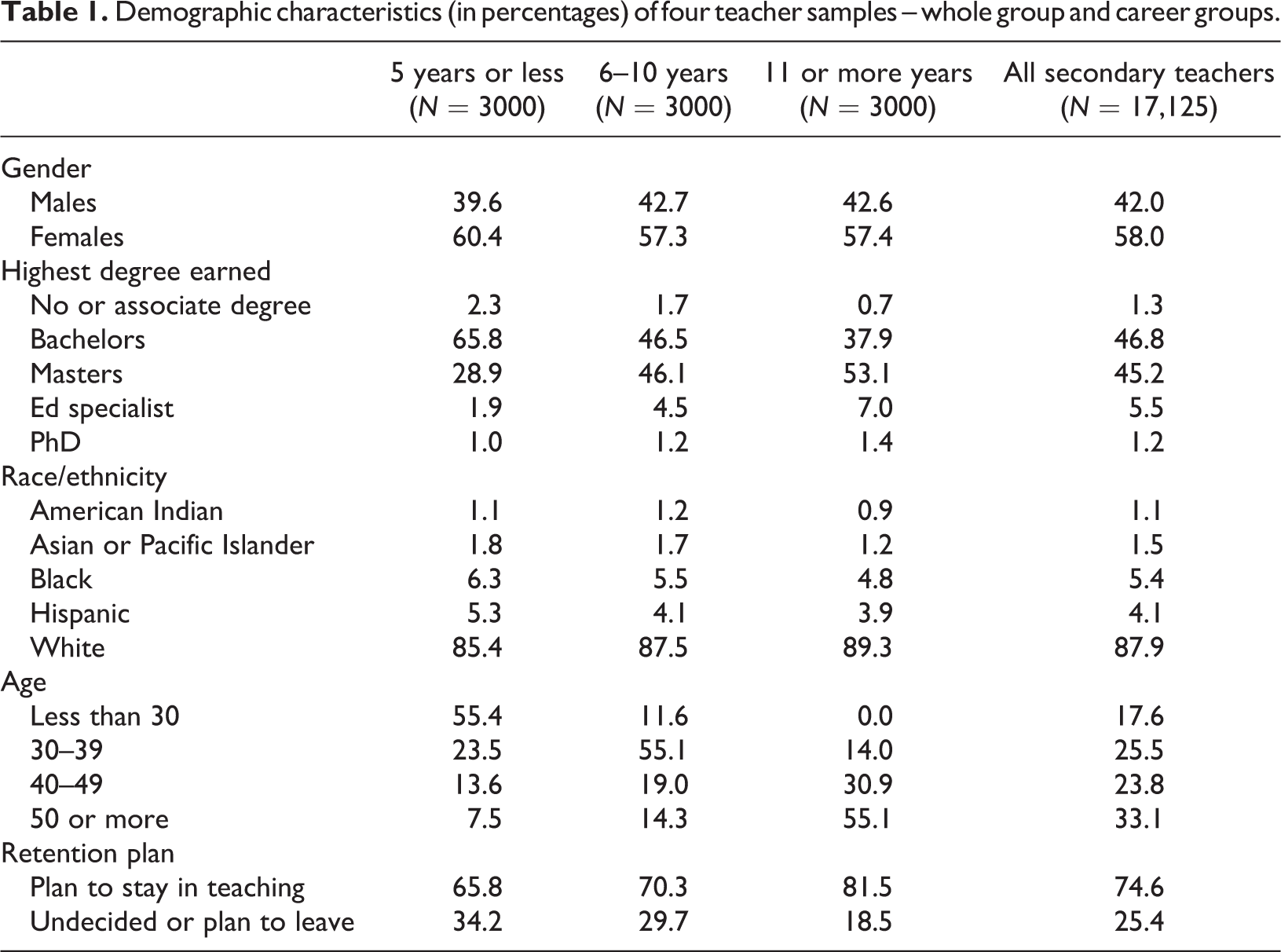
As Table 1 indicates, our three sub-samples appear comparable to the larger SASS sample of all secondary teachers (N = 17,125). Both have somewhat fewer males than females and the samples are similar in their large majorities of White respondents (87.9 and 89.1 for the sub-sample and all secondary teachers, respectively). In comparing the three sub-samples with differing years of experience, several observations are noteworthy. With regards to education, more teachers with 5 years or less experience than in the other two groups reported that their highest degree earned was a bachelor’s degree. However, even in the novice category, about one-third (28.9%) of teachers had a master’s degree. Also, not surprisingly, over one-half of novice teachers (55.4%) were less than 30 years of age. This can be contrasted to our veteran teacher category in which nearly one-third (30.9%) were between the ages of 40 and 49. Further, with regards to plans to stay in teaching, just under two-thirds (65.8%) of novices said that they planned to remain in teaching. This percentage increases slightly in the mid-career category (to 70.3%); and in later career over three-fourths of teachers said that they planned to remain in teaching (81.5%).
Measures: Outcome variable and mediating variables
The outcome variable in this study was intention to leave and the mediating variables were work commitment, career commitment, and job satisfaction.
Intention to leave
Consistent with Mueller et al.’s (1992) definition of an emotionally neutral ‘stay’ or ‘leave’ response, the intention to leave index includes indicators of a teacher's generalized impression of their plans to stay or to leave. As discussed earlier, we use a generalized intention to leave measure as opposed to a subset of turnover, focusing on leaving the job for another school or teaching as a whole. Intention to leave or turnover intention was measured by two items: If I could get a higher paying job I’d leave teaching as soon as possible. I think about transferring to another school.
Work commitment
Work commitment reflects whether ‘teachers feel it is worthwhile to try to do their best’ (Sclan, 1993: 65). This feeling of worthwhileness (or lack of worthwhileness) in doing one’s work in the organization appears consistent with Firestone (1996) and Mueller et al.’s (1992) notion of an affective, internalized response or attachment to one’s work (as opposed to a more neutral ‘stay or leave’ response). The feeling of worthwhileness also appears fairly parallel with Hackman and Oldham’s (1980) critical psychological state of experienced meaningfulness in one’s work. This psychological state is thought to directly influence ‘internal motivation’ to do one’s work, meaning that there is a close tie between one’s feelings and how well one performs the work (see also Firestone, 1996; Hall, 1976). Of these various antecedent conditions, Sclan (1993) suggested that work commitment is strongly related to effort. According to Sclan (1993), teachers’ willingness to expend effort in their work is likely related to their confidence in their teaching skills or ‘personal teaching efficacy’. She further maintained that the feeling that it is not worthwhile to do one’s best was a logical consequence of such workplace condition variables as low principal support. Sclan (1993: 65) noted that this feeling reflects ‘discouragement [teachers may have] … about their teaching skills’ and ‘obstacles to (immediate or long-term) success in their work environments’. Further, according to Sclan (1993: 65), secondary school teachers may be particularly sensitive to conditions in their work environment that thwart success with students leading to a decline in work commitment, such as ‘the fragmented structure of the school day [that] often prevents teachers from recognizing and responding to their students’ needs’.
The responses for work commitment include items that tap a sense that stress and disappointments of teaching are diminishing the worthwhileness of teaching, as well as teachers’ partisan attachment to the organization's goals and values (Firestone, 1996). The items were measured on a four-point Likert-type scale with responses ranging from 1 (strongly agree) to 4 (strongly disagree). These responses were re-coded so that high scores would reflect higher work commitment levels. Respondents were asked to indicate the accuracy of the following statements about their work experience: The stress and disappointments involved in teaching at this school aren’t really worth it. (Reverse scored) The teachers at this school like being here; I would describe us as a satisfied group. I like the way things are run at this school.
The reliability coefficient using Cronbach’s alpha coefficient for work commitment was .754.
Career commitment
Career commitment, as defined in this study, reflects a teacher’s retrospective decision that the teacher would again make the career choice to enter teaching (Sclan, 1993: 66). On one hand, it appears to reflect a fairly neutral evaluation (in retrospect) of one’s decision to ‘stay’ or ‘leave’ as opposed to a feeling of emotional attachment to the career (Mueller et al., 1992). On the other, a teacher’s sense, when looking back over his or her career, that he or she would again make the same career choice may tap a sense that the career (as opposed to work) has been worthwhile and rewarding. It may thus reflect a more emotionally laden response than the following variable, job satisfaction.
The responses for career commitment were measured on a five-point Likert-type scale (1 – Certainly would become a teacher; 2 – Probably would become a teacher; 3 – Chance about even for and against; 4 – Probably would not become a teacher; and 5 – Certainly would not become a teacher). These responses were reverse-coded so that high scores would reflect higher commitment levels.
Job satisfaction
Job satisfaction can be defined as an affective response of general satisfaction with the kind of work one does in one’s job (Hackman and Oldham, 1980; Porter et al., 1974; Williams and Hazer, 1986). It was measured by a single item: I am generally satisfied with being a teacher at this school. The item was scored from 1 (strongly agree) to 4 (strongly disagree) (reverse scored, such that higher values equal higher satisfaction). The item was consistent with previous measures of job satisfaction in which aspects not directly related to job satisfaction (e.g., satisfaction with salary, parents, and resources) were specifically excluded (Conley et al., 1989).
Measures: Independent variables
Based on previous research on teacher turnover using the SASS data set (Sclan, 1993), we initially identified five workplace conditions as independent variables: administrative support, teacher autonomy/discretion, social climate/student behavior, and teacher team efficacy. Sclan’s (1993) research was based on the 1987–1988 cycle of the SASS, while the present research uses the 2007–2008 cycle. The newer cycle (and the 1993–1994 cycle) had a slightly modified version of the survey. First, Sclan (1993) used questions regarding alternative remuneration plans. These questions were not included in the 1993–1994 and 2007–2008 cycles. Also, new questions had been added to the survey as of 1993–1994, including those referring to library resources, evaluating and grading students, determining homework, and sharing a school mission with colleagues. Therefore, a factor analysis was conducted to determine whether the items load on factors in a manner consistent with the theoretical constructs in the Sclan (1993) study.
The factor analysis was performed on the 17,125 full-time, public, secondary school teachers who taught in a regular program. The full sample of teachers was used for this procedure to help ensure its accuracy and statistical robustness. Five workplace factors emerged from maximum likelihood factor analysis with Direct Oblimin rotation. Item descriptions, response categories, factor loadings, and the internal consistency reliability coefficients of items created based on factor scores are reported in the Appendix.
Administrative support
An obvious aspect of the workplace that may enhance teachers’ commitment is the type of interaction the teacher has with his or her immediate school supervisor, the principal. Positive administrative support, our first factor (named ‘School Leadership and Culture’ by Sclan, 1993), implies a principal who exhibits appreciation, is encouraging of the teachers’ activities, provides helpful feedback, and lets teachers know what is expected of them. In the stress literature, lack of positive supervision has been found to be an especially critical stress stimulus for teachers (Bacharach et al., 1986). In the general organizational commitment literature, supervisor support has been conceptualized as ‘akin to mentoring’ (Aryee et al., 1994) and thus predictive of commitment. Thus, supportive supervision can be expected to affect teachers’ commitment positively. A sample item for this scale is: ‘The school administration's behavior toward staff is supportive and encouraging’ (see the Appendix).
Poor socioeconomic/human conditions
Another variable that seems important in the teachers’ workplace is the degree to which the teacher perceives the students as facing debilitating socioeconomic/human conditions. Unmet student needs stemming from poverty in the areas of health and nutrition can clearly be expected to hinder children’s performance at school. Although social and economic conditions originate outside the school, teachers sensing that students are experiencing these kinds of debilitating life conditions may lead to a sense of futility in the work environment that may reduce teachers’ commitment to their work (Louis et al., 1995). A sample item is: ‘To what extent is … [poverty] a problem in this school?’
Teacher autonomy/discretion
To lower intentions to leave, it appears important for teachers to feel they are able to have an effect on their work lives (Rosenholtz and Simpson, 1990). Like workers in other professions, if teachers become removed from the decision-making apparatus, a sense of powerlessness may be created in the workplace, reducing their attachment to their work and careers (Bacharach et al., 1986). One type of participation in decision making has to do with the amount of input teachers have into work-level (operational) decisions or those decisions made within the teacher’s classroom (Mohrman et al., 1978). A sample item is: ‘At this school how much control do you feel you have in your classroom over … evaluating and grading students?’.
Student disengagement
A desirable work environment for teachers would include both students and teachers being involved and engaged in the learning process. Teachers who work in schools where they perceive students as frequently late to or absent from class may feel unable to present a coherent instructional program. This feeling may lead them to question their involvement in and attachment to teaching in the school. A sample item is: ‘To what extent is … [student tardiness] a problem in this school?’
Teacher team efficacy
It is important for teachers to be in a workplace where they feel part of a team that works together well (Collinson and Cook, 2007; Crow and Pounder, 2000; Louis et al., 1995; Pounder, 1999). A teacher’s sense that he or she works with peers who share being part of a strong collectivity or community can enhance the teacher’s feeling that he/she (a) is able to clarify misunderstood role expectations as they occur and (b) has an informal support network. These feelings can be expected to lead to lower turnover intentions. A sample item is: ‘Most of my colleagues share my beliefs and values about what the central mission of the school should be’.
Statistical analysis
We used structural equation modeling (SEM) to assess the hypothesized structural relationships among latent variables. SEM was selected because it represents an appropriate analytic approach for dealing with issues of specifying directionality among variables of interest and generating flexibility with which to test causal relationships. Specifically, this study conducted an evaluation of the hypothesized model of the relationship between workplace predictors and teachers’ intentions to leave (Conley and You, 2009). In addition, two mediational models were tested as a comparison to derive the best model. Multi-group testing was conducted to investigate the significance of differences in coefficients across three career groups using the Wald test of parameter constraints available in Mplus (Muthen and Muthen, 2006).
We assessed the model fit based on several criteria. Specifically, we used standardized root-mean-square residual (SRMR) and root-mean-square error of approximation (RMSEA; Steiger and Lind, 1980). Values lower than .06 for the SRMR and lower than .08 for the RMSEA were used to determine a good-fitting model (Hu and Bentler, 1999). All analyses were conducted using Mplus 5.0. The approximate sample weight (TFNLWGT) was applied so the results generalize to the 2007–2008 public, secondary teacher sample.
Hypothesized model of workplace predictors, teachers’ mediating factors, and intent to leave
As seen in Figure 1, it is hypothesized that the relationships among workplace predictors would be significantly related to teachers’ intent to leave both direct and indirectly. In addition, it is hypothesized that workplace predictors affect teachers’ intent to leave through its influence on the mediating factors of satisfaction and commitment. The hypothesized model assumes all possible relationships among workplace predictors, teachers’ mediating factors, and teachers’ intent to leave.
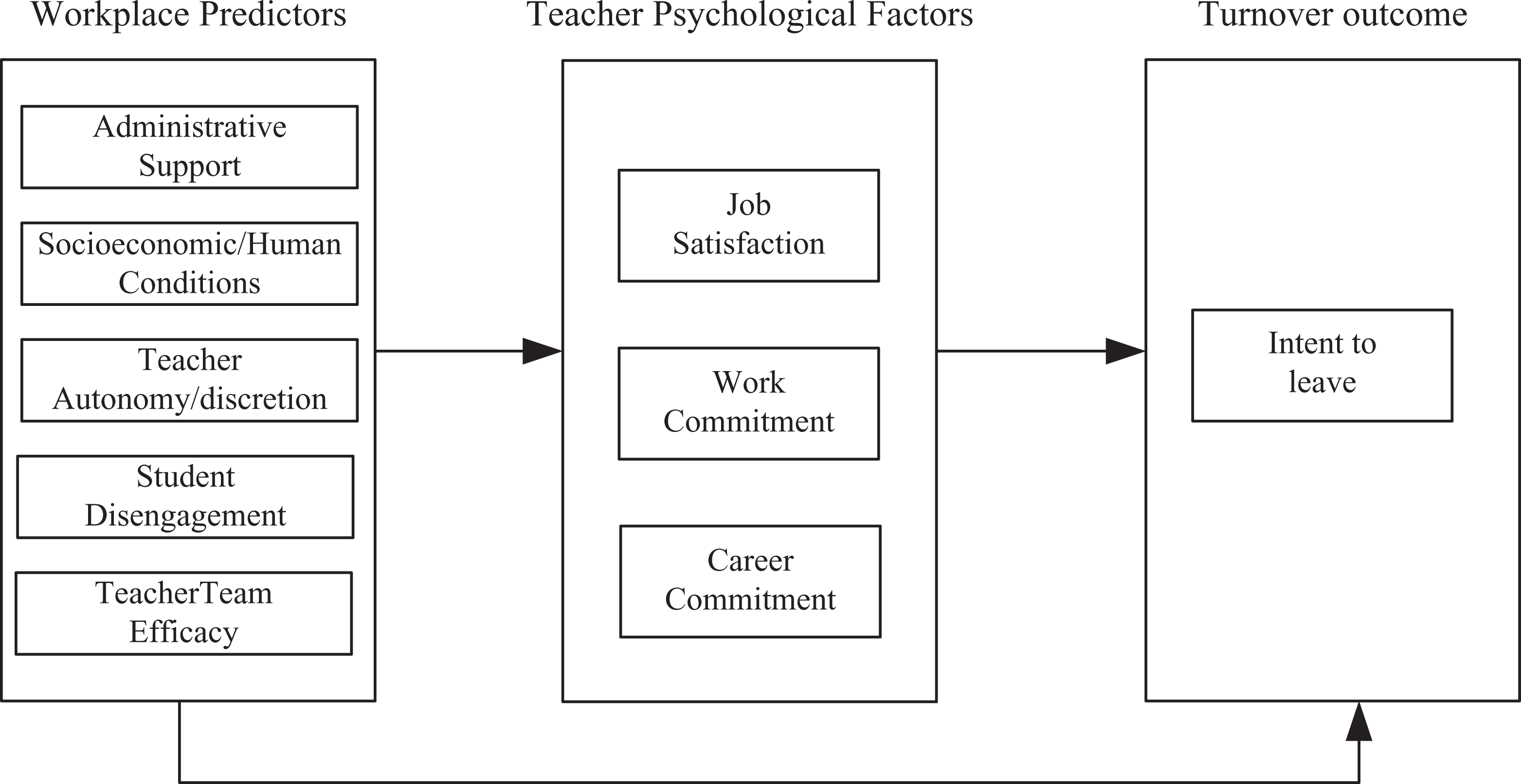
Hypothesized model of workplace predictors, teachers' mediating (psychological) factors.
Results
Initially, means and standard deviations were computed for the independent and dependent variables. As shown in Table 2, several observations can be made about the average responses to the items and scales. With regard to commitment, mean scores of career commitment were slightly higher than those of work commitment. Respondents, on average, are prone to ‘probably would become a teacher’ (value close to 4) with the statement, ‘If you could go back to your college days and start over again, would you become a teacher or not?’ Further, on average they ‘somewhat agree’ (value close to 3) that they have positive administrative support (e.g., such things as receiving recognition, having principals whose behavior toward staff is supportive). With regards to student disengagement, mean values (between 2 and 3) correspond to teachers’ views that these student issues are between a ‘minor’ (2) and ‘moderate’ (3) problem in the school. Further, they indicate, on average, that they ‘somewhat disagree’ (value of 2) that they have intent to leave (e.g., if they could get a higher paying job they’d leave teaching as soon as possible). There are apparent group mean differences in all variables that support our grouping of teacher based on career stages. For career commitment, the novice group showed significantly higher mean scores compared to both the mid-career and veteran groups. However, for job satisfaction, the veteran group showed significantly higher mean scores compared to both the novice and mid-career groups.
Means and standard deviations for independent and dependent variables in the teacher samples.
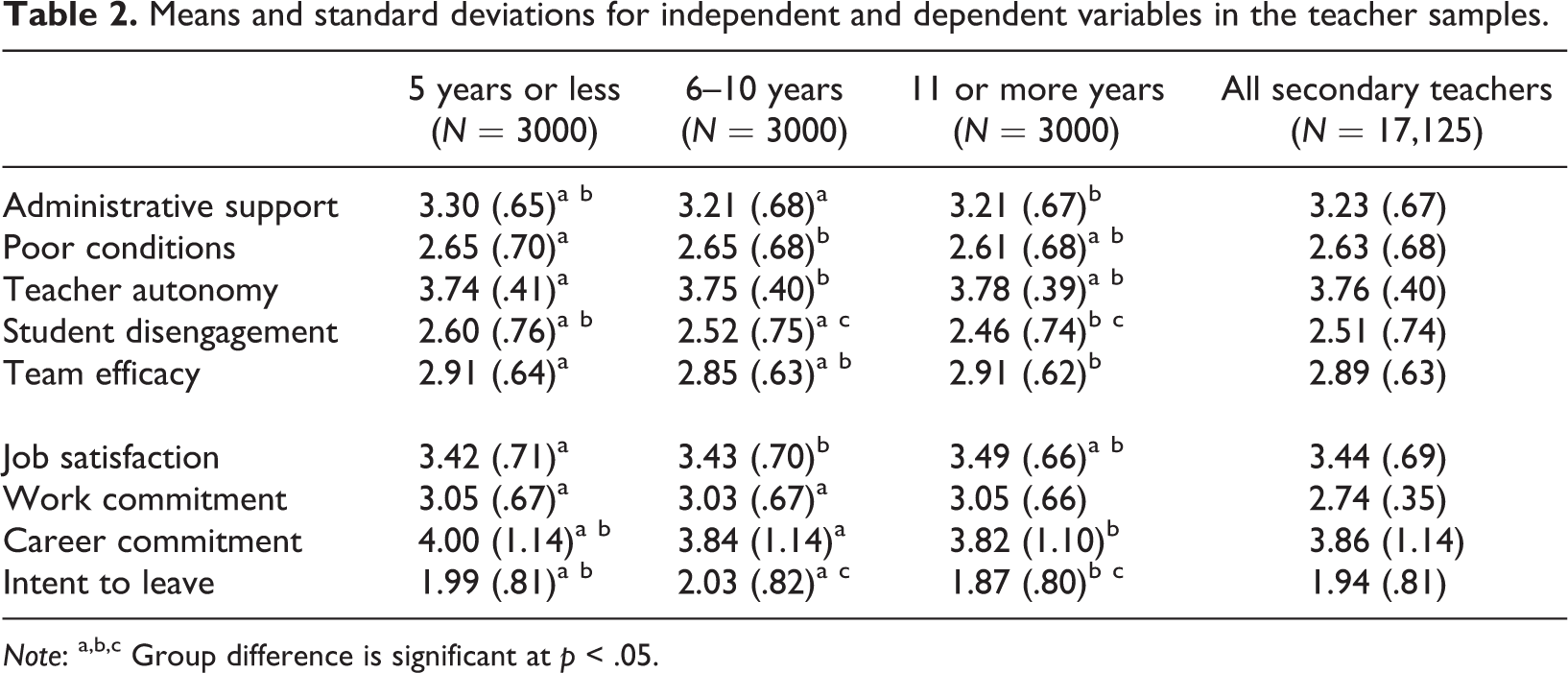
Note: a,b,c Group difference is significant at p < .05.
Structural analyses
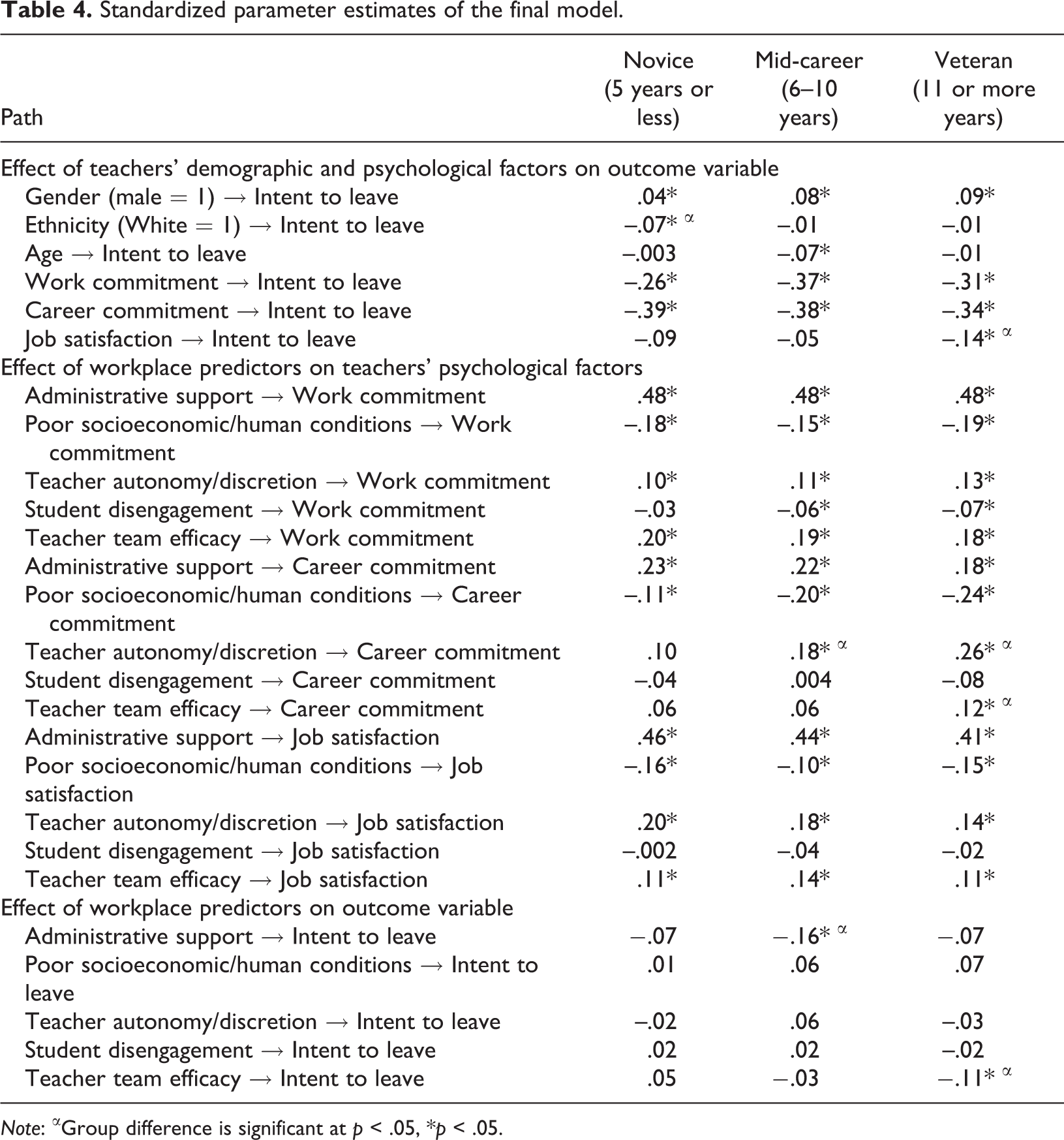
To assess the plausibility of the hypothesized model (previously introduced) that the relationship between workplace predictors and teachers’ intention to leave is mediated by teachers’ satisfaction and commitment (work and career), we tested two mediational models. The initial structural model (see Figure 1) reflecting partial mediation was specified with both direct and indirect paths from workplace predictors and teachers’ intent to leave via three mediators. The second structural model represented the full mediational model, which does not include direct effects of workplace predictors and teachers’ intent to leave on the initial model. Results indicated that both models showed a good fit for the three-group sample (see Table 3). A chi-square difference test was also conducted to decide better fitting model to the data. The χ2 difference and difference in degrees of freedom between the full mediation model and the partial mediation model determined the model selection. The comparison yielded χ2 difference values of 4.86, 13.86 and 12.81, for three groups respectively, with five degrees of freedom, which was statistically significant at the .05 probability level except group 1. In other words, a chi-square difference test supported the full mediational model for group 1, while the test supported the partial mediational model for groups 2 and 3. The standardized parameter estimates for final models are presented in Table 4. In Figure 2, the significant patterns across teacher subgroups were indicated for visual understanding.
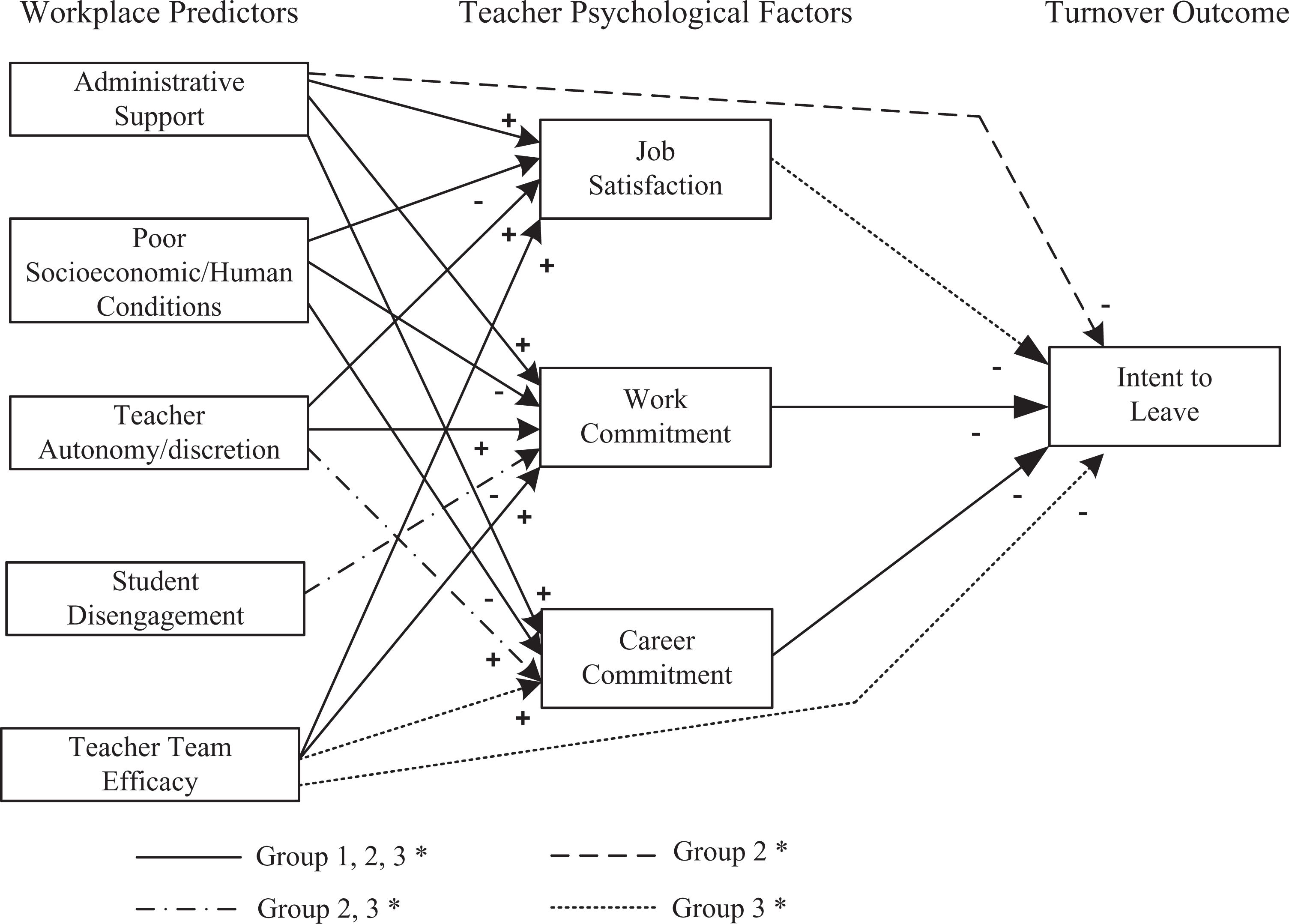
Significance patterns across the three teacher subgroups. Note: Group 1 = novice, group 2 = mid-career, group 3 = veteran teacher groups, respectively, +/− signs indicates positive/negative effects, *p < .05.
Summary of model fit statistics.

Note. S-B χ2= Satorra-Bentler scaled chi-square statistic; SRMR = standardized root-mean-square residual; *RMSEA = robust root-mean-square error of approximation.
Standardized parameter estimates of the final model.
Note: αGroup difference is significant at p < .05, *p < .05.
Regarding the effects of control variables, male teachers had higher intent to leave across all three subgroups. With regard to age, older teachers had lower intent to leave for mid-career and veteran teacher groups only. After controlling the demographic factors (gender, age, race/ethnicity), results for indirect effects indicated that workplace conditions had significant meaningful indirect effects on teachers’ intent to leave through the three mediators, work commitment, career commitment, and job satisfaction. Specifically, work commitment played a role as a significant mediator across all three teacher subgroups between four dimensions of workplace conditions (i.e., administrative support, poor conditions, teacher autonomy, and team efficacy) and intent to leave. Further, work commitment played a role as a significant mediator for mid-career and veteran teacher subgroups between student disengagement and intent to leave.
With regard to career commitment, this form of commitment was a significant mediator across all three teacher subgroups between two dimensions of workplace conditions (i.e., positive administrative support and poor conditions) and intent to leave. Further, career commitment was a significant mediator for mid-career and veteran teacher subgroups between teacher autonomy and intent to leave.
With regard to job satisfaction, job satisfaction was a significant mediator across all three teacher subgroups between four dimensions of workplace conditions (i.e., positive administrative support, poor conditions, teacher autonomy, and team efficacy) and intent to leave.
Regarding direct effects from workplace conditions to intent to leave, since full mediation was supported for the novice teacher group, none of the paths were significant. However, positive administrative support exerted a significant direct impact on teachers’ intent to leave for the mid-career teacher group, while teacher team efficacy exerted a significant direct impact on teachers’ intent to leave for the veteran teacher group.
Group differences
A notable group difference in our final model results is for novice teachers, where workplace predictors had no significant direct effect on intention to leave; instead, they had only an indirect effect on the outcome via two mediators (work and career commitment; see Table 4 and Figure 2). This finding has particular importance in understanding the underlying complex process of novice teachers’ intent to leave since unless utilizing the mediation model, no workplace predictors turned out to have immediate, direct effects for this group.
Other interesting findings are that only for veteran teachers, teacher team efficacy exerted a significant direct effect on the outcome of intention to leave and teacher team efficacy had a significant indirect effect via the mediator career commitment. Also, job satisfaction had a significant direct effect only for veteran teachers. Administrative support only had a significant direct effect for mid-career teachers.
Because the partial mediation model worked for both groups, configural invariance held across mid-career and veteran teacher groups. Further, we confirmed that metric invariance held across two groups before conducting Wald tests. Wald tests are conducted when the specific parameters are significant for both groups to see if there is significant group difference. The results of Wald tests did not show significant group differences for most parameters, except for the parameter Teacher autonomy/discretion → Career commitment. That is, teacher autonomy/discretion had a significant effect on career commitment for both mid-career and veteran teacher groups; however, the effect was stronger for the veteran teacher group than for the mid-career teacher group.
Discussion
This study focused on the different workplace predictors of teacher turnover intentions for teachers in different career stages. We attempted to explain these differences in light of previous literature on career stages. Our discussion of previous literature highlighted several important points: (a) there is concern about teachers’ intentions to leave; (b) there is a complex process in the workplace conditions–teacher turnover intentions relationship, including teachers’ satisfaction and commitment as intervening variables in that relationship; and (c) if we can discover the workplace variables that influence teacher turnover intentions for teachers in different career stages, we may have a basis for altering workplace conditions to reduce intentions to leave at different points in teachers’ careers.
In the career stages groups examined here, our findings seem to support the idea of distinct career stages. The relationships between work environment predictors and teacher turnover intentions varied for teachers in different career stages. If career stage was unimportant, we might expect a more uniform effect of work environment predictors across career stages.
Demographic variables were significant predictors of teacher turnover intentions for teachers in all career stages. Therefore, it is possible that life circumstances, such as gender, ethnicity, and age, influence a person's intention to leave his or her job. Males are more likely to have the intention to leave compared to female teachers in all career stages. Age has a negative effect for the mid-career group; however, for novice teachers, age does not have a significant effect on intent to leave. Both work commitment and career commitment have significant negative effects on intent to leave for teachers in all career stages. However, job satisfaction has a negative effect on intent to leave for only veteran teachers, suggesting that the job satisfaction a veteran teacher feels may affect his or her decision to leave. For novice teachers, ethnicity is also a significant predictor of teacher turnover intentions, with White teachers less likely to have an intention to leave.
Results showed that workplace condition variables (e.g., administrative support, teacher autonomy/discretion, and student disengagement) were found to have differential effects on turnover intentions for secondary school teachers in different career stages. The effect of administrative support on work and career commitment was uniform and significant for teachers in the three career groups. Therefore, teachers (in all career stages) who perceive supervision that includes supportive behavior, enforcement of rules for student conduct, a clear vision, and teacher recognition are more likely to feel that efforts to do their job well are satisfactory and worthwhile. Perceptions of less than positive supervision may create an environment that does not motivate teachers to work hard, regardless of the teachers’ career experience. Administrative support affected teachers’ intentions to leave via three mediating variables (i.e., work and career commitment, job satisfaction). Interestingly, administrative support did affect directly the intent to leave of mid-career teachers, suggesting that the influence of supervision does appear to make mid-career teachers rethink their decisions to enter teaching as a profession. For novice or veteran teachers, positive and supportive supervision may reinforce their work and career commitment and job satisfaction, although negative or ambiguous supervision may undermine work-related feelings. This difference may reinforce the inclusion of career stage as a factor in the work environment–turnover relationship.
Further differences among career stages emerged with regards to the importance of participation in decision making and student-related variables as predictors of intent to leave. Participation in classroom decisions was important for the career commitment of mid-career and veteran teachers. Further, the impact of teacher autonomy in classroom decisions was stronger for veteran teachers compared to mid-career teachers. Therefore, the extent to which veteran teachers have opportunities to control their classroom environment may affect their perceptions of their career choice. Student disengagement was also a significant predictor of work commitment for mid-career and veteran teachers. We suggested that this finding was consistent with Fuller’s (1969) notion that veteran teachers become preoccupied with students in later careers, diagnosing individual needs and adjusting their instruction.
As suggested earlier, the findings have implications for secondary school management and leadership. The findings reinforce the importance of principal support, preservation of teacher discretion, and collegial work relations. For example, to support collegial work relations principals could attend to such issues as providing discretionary time to learn and discretionary time to share ideas (Collinson and Cook, 2004). They could also take care to foster ‘meaningful participation in decision making [by the] individuals most closely involved with the issues at hand’ (Collinson and Cook, 2007: 143). Even given the effects of other demographic and work environment variables, the strongest predictor of intent to leave among mid-career teachers was administrative support. The scale that measured this variable emphasized the importance of the principal in providing clarity about work goals and objectives and recognition for work efforts. Mid-career teachers who do not receive strong positive principal supervision may question the importance of working hard in their job, may rethink their choice to enter teaching as a profession, and become uncertain about whether or not to remain in the profession. However, teachers in all career stages may question the worthwhileness of doing their best (work commitment), their career choice, and job satisfaction, which will eventually affect their intent to leave.
Teacher team efficacy was also a significant predictor of veteran teachers’ turnover intentions. Supportive and cooperative colleagues may encourage or assist veteran teachers’ plans to stay in their jobs. Again, these findings appear to emphasize the importance of considering career stages when investigating the effects of teacher team efficacy. In this context, we strongly recommend that administrators consider strategies that foster cooperative work efforts, particularly those involving veteran teachers. These strategies might include fostering teacher mentoring, peer assistance, and evaluation, and curriculum development meetings where novice and veteran teachers can work together (Collinson et al., 2009), as well as opportunities to lead at the school level and beyond (see Collinson, 2012). Huberman's (1989: 38) review of work on career phases in the research literature identified such activities as ‘working with two or three colleagues rather than twenty or thirty’ as a form of work engagement that is appealing to veteran teachers – and one that might replace earlier career engagement in ‘professional advancement in a material sense’.
Study limitations and directions for further studies
A cautionary note should be pointed out about our intention to leave measure. The two items selected that were available on the survey encompassed intention to leave teaching altogether and intention to transfer out of the school. Therefore, the two types of intention to leave were combined in this study. Future research might examine these concepts separately. It may be that a different set of predictors is relevant for the intention to leave altogether as opposed to transfer intentions. A cautionary note should also be made about the concept of career stages. Huberman (1989: 32) pointed out that career stages should not be viewed as necessarily ‘invariant’ or ‘universal’. That is, we cannot assume that career phases ‘always play out in the same progression’ or ‘that all members of a given professions will pass through them’ (Huberman, 1989: 32). He noted: ‘As Super has pointed out, some people stabilize early, others later, and some never’ (Huberman, 1989: 32). Although we have drawn on conceptions of career stages and phases to explain our results, the concept is still subject to considerable theoretical debate. More work is needed, for example, on the number of career stages that would appropriately be used in examining teaching. We used Rosenholtz and Simpson's (1990) conception of three career stages in teaching. Examining military employees, Jans (1989) conceptualized four different stages. Like military workers, teachers have lengthy careers spanning 20 years or more. Perhaps the possibility that more career stages exist in teaching could be explored in further research.
Footnotes
Appendix
Acknowledgment
This work was conducted with permission from the Institute of Education Sciences (IES) for use of the SASS data set. The authors take sole responsibility for the work presented.
Funding
This work was partially supported by the Hankuk University of Foreign Studies Research Fund.