




Abstract
Principal professional learning is shifting in many districts in the United States of America away from didactic, central office-managed workshops to include more peer-led learning opportunities. Yet researchers have largely failed to examine issues of positionality and authority in principal professional learning, despite international scholarship that demonstrates the influence of micropolitics on the enactment of change. Using event analysis of a critical case study in an urban district in the northeast USA, we examine three chains of events. Principals and central office administrators used a variety of tactics – cooperation, compromise, and co-optation – to navigate overt and covert conflict during implementation of peer-led principal professional learning. Principals and central office administrators encountered micropolitics as they determined authority over the learning agenda, negotiated a redefinition of a new principal role, and co-constructed official spaces for peer-led learning. Findings provide lessons for educational leaders and those responsible for professional learning in districts with middle manager roles in any context, as well as suggesting that future research on the micropolitics of principal professional learning is warranted.
Introduction
Principals are the second most influential school-based factor in students’ learning (Leithwood, Jantzi and McElheron-Hopkins, 2006). Providing robust learning opportunities for principals has the potential to improve their skills (Grissom and Harrington, 2010), which could lead to enhanced student learning (Seashore Louis, Dretzke and Wahlstrom, 2010). Trujillo (2013) found that the extant scholarship is overly reductive in its focus on student achievement in defining and assessing district improvement efforts. According to her literature review, the scholarship on districts largely oversimplifies district improvement and focuses too myopically on student outcomes, missing the political and normative contexts surrounding mechanisms to support district improvement, such as district support of principals’ professional learning.
The shift from traditional banking methods of teaching to acknowledging the role of student ownership in authentic learning has been normalized in scholarship concerning student learning (Freire, 1970; Stefanou et al., 2004); a parallel acknowledgement is largely absent in the research on the professional learning of educators. Yet the ways in which districts structure professional learning in the USA and globally provide varying opportunities for principals to take ownership over their own improvement (Anderson et al., 2008; Gurr and Drysdale, 2012; Hallinger, 2005). In recent years, some districts in the USA (Hill, Campbell and Gross, 2013; Mayer, Donaldson, LeChasseur, Welton, and Cobb, 2013), New Zealand (Retna, 2015), Norway (Wilkinson et al., 2010), and other nations have experimented with reforms that give principals greater discretion and control over their own professional learning as a means of school and district improvement.
This study examines how principals exercise their agency over their own learning in the context of new approaches to professional learning for school leaders. In this case, we explore principal peer networks as one model of professional learning that may afford principals greater agency. Drawing on three years of data, we examine how one urban district implemented professional learning networks for principals led by peer Principal Facilitators. Two research questions guide this paper: What were the converging and conflicting interests of the Principal Facilitators and the central administrators who designed and supported the role? How did Principal Facilitators respond to pressures from central administrators as they negotiated the function, authority, and boundaries of their new role? Thus, the paper examines the shifting contexts around principals’ opportunities to learn and their use of strategies to navigate these contexts, rather than focusing on the content or extent of their learning.
Literature review
Conflict is likely to surface when reforms introduce (a) new responsibilities for central office administrators, which may conflict with traditional approaches to central office management (Burch and Spillane, 2004); and (b) changes to the day-to-day duties of principals and central office administrators (Honig, 2012). The peer learning role of Principal Facilitators in this case study altered the responsibilities and roles of both central office administrators’ responsibilities and principals, thus raising the likelihood that this reform spawned conflict within Green Public Schools. At the same time, as Caldwell argues, the success of principal-centered learning, such as that featured in the Principal Facilitator role, hinges on “social climate, trust, open communication, and peer support for change” (p. 176). We hypothesize that there are moments when these conditions exist and, when they do, that parties are able to compromise and cooperate. We investigate using micropolitics in order to identify if the conditions exist and what actually facilitates successful compromise and cooperation.
Prior research outlines the broad contours of this conflict and how it may apply to this case of principal peer networks in Green Public Schools. As school leaders engage in learning networks such as communities of practice (Wenger, 1999; 2000), central office administrators sometimes struggle to relinquish authority over principals’ learning to allow principals greater control. For example, Burch and Spillane (2004) found that central office administrators in Chicago, Seattle, and Milwaukee Public Schools believed that offering principals greater autonomy would actually harm their professional development and unnecessarily complicate their work. Instead, they demanded compliance from principals because they believed a clear chain of command made principals’ work easier. The majority of mid-level central office administrators approached the communities of practice with an authoritative stance, monitoring or directing principals rather than working collaboratively with them.
Also studying communities of practice, Honig and Rainey (2014) found central office administrators dismissed principals’ questions for fear that they would prolong decision-making, thereby sacrificing principal learning. Similarly, Honig (2012) found that some executive-level central office administrators in Atlanta, New York, and Oakland Public Schools directed principals’ work even though they were supposed to model these tasks for principals. For example, Honig recounts that an Instructional Leadership Director reassigned a school-based coach rather than showing principals how to work with the employee “because it was more efficient to just make the change” (p. 752).
Taken together, these studies show how central office administrators tend to maintain a top-down, directive style with principals rather than cooperating or compromising with those whom they supervise. Often, central office administrators maintained this directive approach because they perceived it to be more efficient or to ease the principals’ workload. By acting in this manner, however, these administrators failed to recognize and support principals’ authority, which was a major aim of these learning opportunities. While these studies do not focus explicitly on conflict, they underscore the struggle between central office administrators and principals regarding authority and suggest that these issues are heightened when reforms increase the principals’ role in decision-making.
A small research base focuses more directly on conflict between principals and their supervisors. This research suggests that principals and central office administrators rely on different sets of tactics when faced with conflict. As might be predicted, principals draw more often on informal sources of power while central office administrators tend to leverage their authority to advance their agenda. Honig and Rainey (2014) found that principals used the tactic of persuasion by arguing that pressing management issues necessitated a change in the group’s agenda. In contrast, central office administrators used their formal authority to guide agenda-setting to suit their own priorities.
Research in micropolitics of education by Blasé (1991) highlights the conflicts spurred by education reform. Blasé finds that principals who are authoritarian experience more teacher resistance and collective action, which was often covert and indirect. Additionally, he finds that strategies like mutual agenda building, shared meetings, and clear role expectations help build trust and openness. Thus, Blasé (1991) concludes that authority and hierarchy play a major role in micropolitics as suggested by Burch and Spillane, Honig, and Honig and Rainey (2014) in their research on central office administrators and principals. These findings reflect Malen’s (1994) contention that “transactions center on tensions surrounding who has the legitimate right to make decisions in particular territorial (e.g. schoolwide, classroom bounded) and topic domains (e.g. budget, personnel, curriculum, instruction)” (p. 162). Thus, notions of authority and legitimacy run through conflict over decision-making in schools and school districts.
While the research highlights the broad micropolitics of principals’ professional learning, beyond the few studies noted above, little research examines the strategies that central office administrators and principals use to navigate power dynamics and resolve conflict. Principals’ use of cooperation and compromise has received little attention. Furthermore, researchers have focused primarily on overt conflict; there is little analysis of covert action and its implications. Therefore, our work extends and nuances the research from Burch and Spillane (2004), Honig (2012), and Honig and Rainey (2014) by using a longitudinal data set to capture the emergence of covert and overt conflict over role boundaries and content within a principal professional learning school change reform. We identify how those without positional authority negotiate power within a formal principal network reform using acts of cooperation and compromise to mitigate attempts at co-optation.
Theoretical framework
The enactment of expanded principal roles for facilitating professional learning occurs within an arena of struggle (Ball, 1987) as principals and others make sense of shifting boundaries of administrative authority (Grodzki, 2011; Spillane et al., 2002). As Malen (1994) summarized, “transactions center on tensions surrounding who has the legitimate right to make decisions in particular territorial (e.g. schoolwide, classroom bounded) and topic domains (e.g. budget, personnel, curriculum, instruction)” (p. 162). Considering the micropolitics of schools and educational leadership provides a set of conceptual tools for understanding these transactions and tensions.
Overt and covert conflict
We examine the ways in which principals and district leaders negotiate overt and covert conflict through public and private transactions (Malen and Cochran, 2008) as principals took on authority historically held by central office. Overt conflict and negotiation is observable in formal, official arenas as actors state their intentions and argue their case (Gronn, 2005). Whichever actors are able to exert the most power are able to enact their preferred course of action. Overt conflict is resolved when this enactment wins out over other potential courses of action.
Covert conflict and negotiation can occur in formal, official arenas as a refusal to participate in overt conflict; however, covert action can also occur “behind the scenes” when a group of actors who perceive that they are at a disadvantage in formal, official arenas “realizes it lacks the resources or the ‘numbers’ to carry the day” (Gronn, 2005: 48). Covert action is therefore also observable, but may occur in spaces that are difficult to identify and which may require substantial effort to gain access. Covert conflict is resolved as action is used to pre-empt overt conflict, negotiate alternatives to overt resolutions, or introduce new arenas for groups to work when they disagree with those in formal positions of power.
Tactics for navigating conflict and negotiating power
We understand the acquisition and enactment of power as a complex navigation of evolving relationships and shifting interests (Malen and Cochran, 2008). To do so, each party uses a set of tactics:
Cooperating
The foundation of cooperating is a group of people working together towards a collective goal. At best, cooperating makes achieving a goal more attainable as people consolidate their individual resources of persuasion and authority. Blasé (1991: 1) argued that micropolitics and power are often about cooperation in the face of conflict and “how people build support among themselves to achieve their ends.” At worst, however, cooperating can be a form of passively conceding to social pressure and existing authority to avoid negative consequences. Malen (1994) pointed out that those with the least authority often go along with authoritative actions to avoid sanctions. Cooperating is therefore not necessarily devoid of conflict; cooperating encapsulates situations in which a group of people agree to terms without revision and put the suggested course into action.
Compromising
Where cooperating creates internal cohesion when one or more individuals or groups agrees to unrevised terms, compromising entails devising a new, shared proposal which appeals to everyone, yet satisfies no one person’s or group’s original terms. The distinction can be subtle, yet is important for examining shifts in power. Expanding upon Oliver’s (1991) framework, Pache and Santos (2010) specify three types of compromise during organizational responses to institutional conflict: balancing competing expectations, pacifying resistors through conforming solely to minimal requirements, and bargaining for alterations to unwanted demands.
Co-opting
In an examination of participatory approaches to school reform, Herr describes co-optation as “channeling of the discourse for change into institutionalized structures” (1999: 236). Co-opting occurs when a group with informal power attempts to challenge the terms set by those occupying formal positions of authority; those with formal authority then subsume suggested new directions within their own course of action, thereby preventing the challengers from setting their own terms and, consequently, gaining power over the situation at hand. As a tactic, co-opting is therefore a form of manipulation that reifies existing power imbalances when deployed by those in authority (Pache and Santos, 2010).
In sum, we examine instances of overt and covert conflict between principals and central office administrations and pay particular attention to how cooperation, compromise, and co-opting may emerge over time. We used these conceptual tools to make methodological choices, such as collecting both self-report and observable data, designing a coding scheme for analysis, and interpreting principal actions in chains of events as they navigated shifting dynamics in district expectations and support of opportunities for professional learning.
Data sources and methods
This study employs a critical case study (Patton, 2002) of the micropolitics of professional learning networks for principals in Green Public Schools, a medium-sized urban district in a state in the northeast USA. We focus on the Principal Facilitator role – a peer-to-peer position held by principals who facilitated conversations about leadership challenges with principals from other schools in the district. We use event analysis (Olzak, 1989) to identify and examine critical moments of negotiation around this newly expanded principal role over the first three years of implementation.
Case context and actors
This case is bounded by the Green Public Schools district over the first three years of a federally funded initiative focused on educator professional learning as a mechanism for retaining high quality leaders within the district. Green Public Schools serves approximately 20,000 students in 40 schools. Mid-size urban districts account for slightly more public schools in the USA than large urban districts (Frankenberg, 2009). While schools in mid-size urban districts are less likely to be segregated, the demographics of mid-size urban districts have shifted to include more segregated minority schools (Frankenberg, 2009). Such contexts arguably provide similar leadership challenges on smaller scales, which may entail both fewer resources and more flexibility than large city districts.
Green Public Schools obtained a grant in 2012 to create expanded roles for school leaders to facilitate professional learning. This initiative mounts a potential challenge to traditional bureaucratic roles, thereby making Green’s implementation of this program a “promising case” (Creswell and Miller, 2000) in which to study micropolitics and the negotiation of authority. Central office hired a consultant in 2011 to coordinate the submission of a grant to fund a new system of incentives and leadership opportunities. The district was awarded more than US$50 million over five years to support professional development and compensation for new educational leadership roles at multiple levels. The superintendent contracted with this same consultant to provide support and strategic consulting as the district began implementation.
A former principal was hired into a new central office position to manage implementation of the new system. A former teacher was appointed to a newly created position that supported the new management position in implementing expanded roles for school leaders and teachers. Her position entailed identifying and developing professional learning opportunities for educators in the roles, tracking their work in the roles, and handling logistics.
Principals were invited to apply to one of three expanded roles in fall 2012, including the role of Principal Facilitator. The brief description provided with the application stated that Principal Facilitators would “provide educational leaders an opportunity to bring forward problems of practice and utilize the experience and expertise of colleagues to engage in collaborative problem solving.” In Year 1, seven principals applied to be Principal Facilitators; they were all accepted into the role.
A consultant with decades of experience as a school leader and professional development facilitator was hired to lead communities of practice for school leaders in each expanded role. In their community of practice meetings, Principal Facilitators gained access to new strategies, materials, and other tools. This became one of the settings in which the micropolitics of the Principal Facilitator role played out.
In addition to the district context and the community of practice, micropolitics also unfolded in the meetings in which Principal Facilitators led their peers in professional learning. These meetings included Superintendent’s Sessions, which bring together all principals and other school leaders (e.g. Assistant Principals) with the Superintendent once a month for several hours. Similarly, principals’ direct supervisors held monthly Supervisors’ Meetings for principals and other school leaders.
Participants
Participants included 28 individuals in a variety of roles: principals who served as Principal Facilitators, school leaders who participated in facilitated instructional rounds, central office administrators directly involved in the initiative, and an external consultant charged with leading the professional development of Principal Facilitators.
All principals who served as Principal Facilitators participated in the study, via interviews and observations (see Table 1). In Year 1 (2014–15), seven Principal Facilitators participated. There was some turnover in Year 2 (2015–16) and Year 3 (2016–17), with two Principal Facilitators resigning and a new principal stepping into the role each year. The Principal Facilitators represented approximately 10% of the building principals in the district each year. All of the Principal Facilitators had a minimum of three years of experience as school leaders in Green Public Schools.
Principal facilitator participants each year.

Note: X: participated in the role and in the study.
In Year 3, principals who opted into instructional rounds facilitated by Principal Facilitators were observed. All school leaders in Green were given the choice to select instructional rounds as one of the options for required professional development activities; 14 school leaders (30% of the district) opted into instructional rounds and were included in the study. These included principals and assistant principals, with assistant principals required to obtain written consent from their principal for involving the school in instructional rounds.
The district is large enough to support several central administrator roles with supervisory authority over principals. Four central administrators working with the Principal Facilitator role participated. One external consultant hired to facilitate professional development for Principal Facilitators was also included in the study.
Data sources
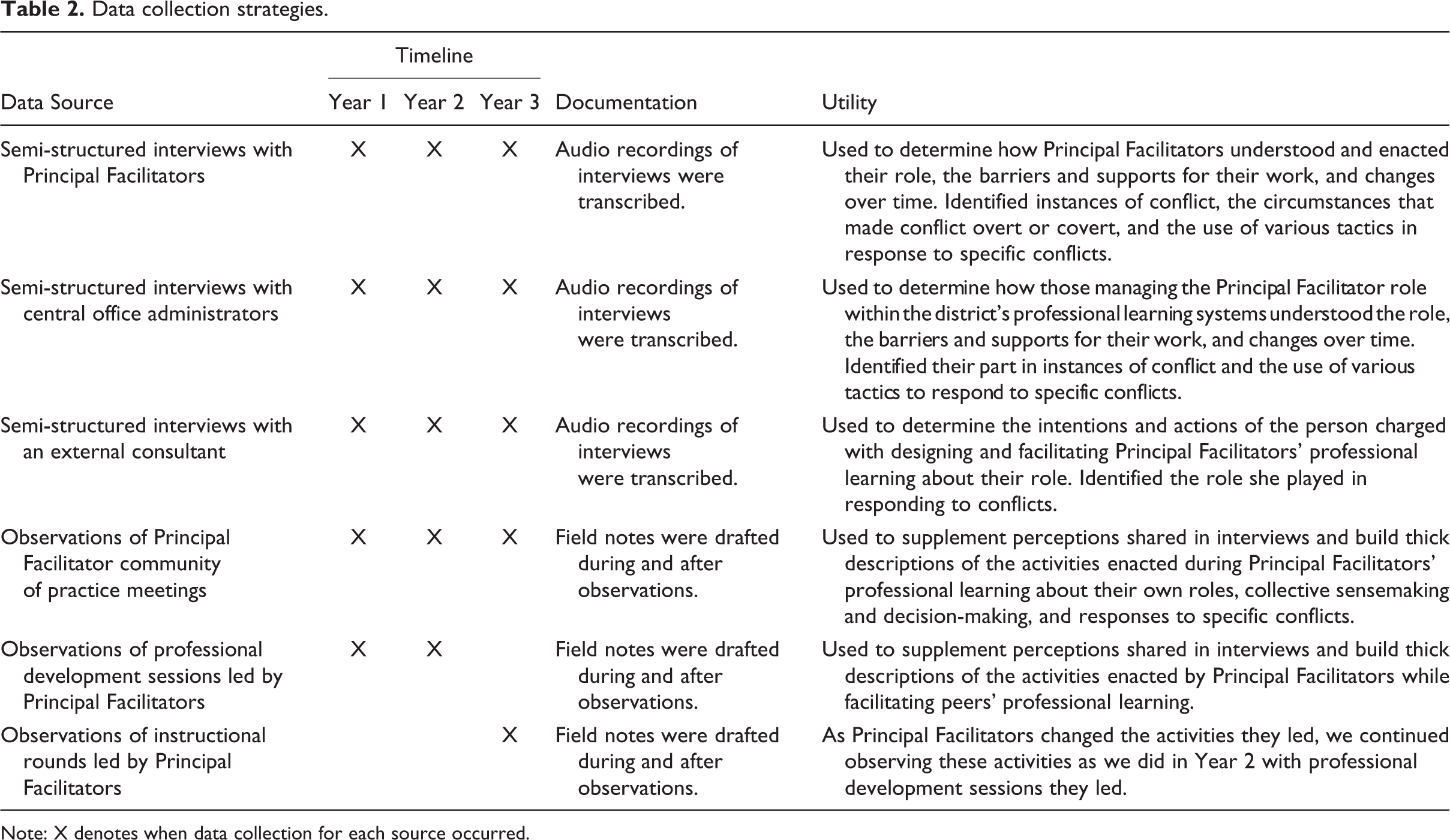
We collected data over three academic years between September 2014 and June 2017 (see Table 2).
Data collection strategies.
Note: X denotes when data collection for each source occurred.
Interviews
We conducted semi-structured interviews with Principal Facilitators in Year 1 (spring 2015), Year 2 (fall 2015 and spring 2016), and Year 3 (spring 2017). We asked Principal Facilitators to describe the purpose of the role, how they enacted the role, the barriers and supports for this work, and any changes in implementation. We also interviewed four central office administrators and an external consultant each year to learn about the design of the expanded principal roles, supports in place to assist principals, and the evolution of the roles over time. Interviews were conducted at the participants’ work sites or via phone, lasted 45–75 minutes, and were audio recorded for transcription.
Observations
In Year 1, we observed 25% of the monthly Principal Facilitator community of practice meetings and two sessions in which Principal Facilitators led professional development of approximately 50 peers. In Year 2, we observed 70% of the community of practice sessions. We also observed a district-wide leadership meeting facilitated by the Principal Facilitators with almost 300 school leaders and invited guests in attendance. In Year 3, we observed 50% of the community of practice sessions and the instructional rounds of two (of five) networks. To document observation data, we wrote field notes and analytic memos to capture initial questions and noteworthy events or activities for further probing.
Analysis
Interview transcripts, field notes, and analytic memos were organized in Dedoose and coded using open and axial techniques (Strauss and Corbin, 1990). The theoretical framework was used to generate a coding scheme which was applied to data during iterative rounds of coding beginning in Year 1 and following throughout data collection in subsequent years. In the first phase of analysis, we coded instances of overt and covert conflict, as well as the use of micropolitical tactics of cooperation, compromise, and co-optation. We then grouped excerpts by role to consider how principals and central office leaders made sense of instances of conflict and its connections to bureaucratic authority within the district system. During this process, we examined the diversity in espoused values and experiences to unpack micropolitical complexities, rather than identifying normative responses.
Next, we organized instances of conflict by date and used in vivo coding to identify the connections between them over time. This allowed chains of events to emerge as central office administrator and principal actions introduced conflict and as they reacted with various tactics. One author then wrote analytic memos capturing emergent themes related to role boundaries, sources of tension, resistance, sharing power, and brokering strategies. The other two authors served as peer debriefers as initial analyses were discussed, critiqued, extended, and modified.
Micropolitical tactics of expanding principal roles
Authority over principals’ opportunities shifted overtly and covertly between principals and central office administrators as they negotiated the boundaries and domains of the Principal Facilitator role. The actors deployed a variety of micropolitical tactics during three chains of events that fundamentally redefined the Principal Facilitator position. In Year 1, district co-optation of the role set the conditions for resistance by both Principal Facilitators and central office administrators. This first conflict was resolved when the new role was stripped of principals by central office administrators. This drove the micropolitics in Year 2 into the covert arena, where allies in boundary-spanning roles prompted compromise on both sides to reignite expansion in the new role. In Year 3, this compromise led to cooperation, which revisited the initial resolution by generating a new mechanism for Principal Facilitators to guide peer learning, which was approved by central office.
These chains of events illustrate how the micropolitical tactics chosen by principals and central administrators were shaped by conditions and contexts as they changed over time. Findings across all three chains of events also point to opportunities to disrupt conflict between central administrators and principals as the role of school leaders shifts. We conclude by discussing the patterns of power that emerged across the chains of events.
District Co-optation sparks resistance
In the first event chain, central office co-optation of the principals’ new peer-directed role set up overt conflict that was met with covert and overt resistance (see Figure 1).
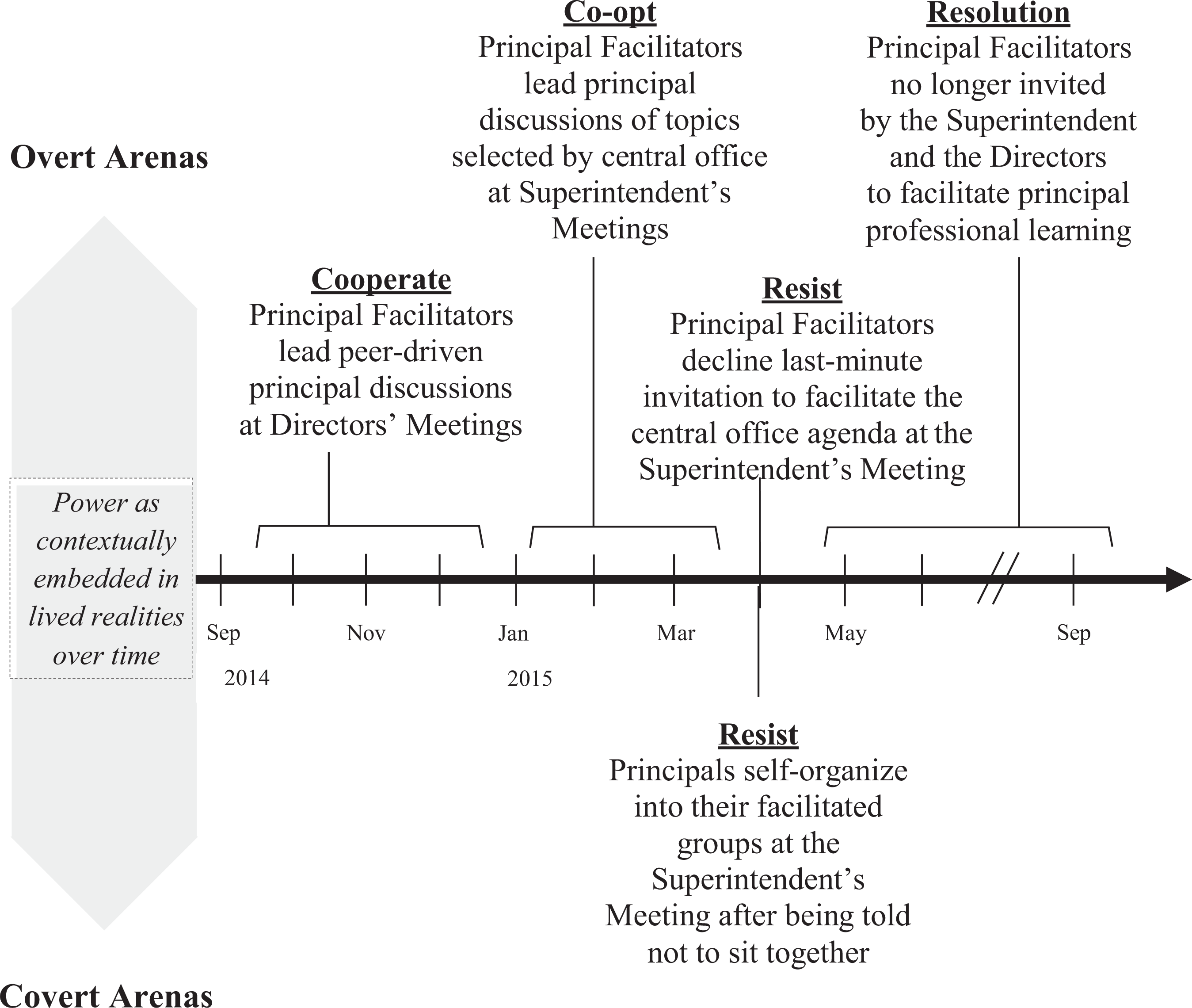
The micropolitics of determining authority over the learning agenda.
Initial cooperation
Implementation began with principals cooperating with district leaders’ vision for the role, which yielded authentic principal learning in peer learning groups. Principals were divided into groups of six or seven school leaders in semi-permanent learning groups. Principal Facilitators met with a group of peers during regularly scheduled district-wide Supervisors’ Meetings to discuss problems of practice. Principals brought problems of practice from their own schools and the Principal Facilitator led them through a protocol that elicited discussion about potential causes and solutions. Supervisors included an hour and a half to two hours for these conversations in the agenda each month.
Professional learning was authentic in that it was peer-driven, problem-based, and drew on multiple perspectives over time (Lombardi, 2007). Within their groups for the first three peer learning meetings, principals decided which issues to discuss and which solutions to consider together. All principals were taught how to use a set of three discussion protocols to ensure that the discussion focused on problem framing, examination of root causes, and exploration of possible routes forward to avoid devolving into conversation that would not advance principal learning. As one Principal Facilitator described the sessions, “We try to find best practices. We try to find what our leadership challenges are. And we try to address those.” As another Principal Facilitator described, “I act as a facilitator…so that my peers can discuss in a secure space problems of practice…and really open the lines of communication of what our responsibilities are, and what our trials and tribulations are, and how we can do our job better.” All of the Principal Facilitators described their role that year as centering on peer learning about problems of practice, which was the original theory of action communicated for the role in the grant proposal, application process for Principal Facilitators, and description of meetings given to principals (field notes and documents). The peer learning meetings received strong, positive feedback from participants in post-meeting satisfaction surveys.
Central office co-optation and initial cooperation of principal facilitators
After this initial success, central office leaders co-opted the new role and principals’ engagement in their peer learning groups to disseminate content district-wide. Central office administrators asked the Principal Facilitators to facilitate discussions at the February Superintendent’s Meeting on a topic identified by the Superintendent (field notes, January 2015). The Principal Facilitators reported that they were uncomfortable with this plan. One described, for example, that this plan positioned Principal Facilitators as “a mouthpiece for the Superintendent.” Others indicated that they worried about putting their own reputations on the line when facilitating issues selected by the Superintendent or the Supervisors. Despite their skepticism, the Principal Facilitators initially cooperated by agreeing to facilitate the meeting (field notes, February 2015).
Covert principal resistance to co-optation
In response to the co-optation of the newly expanded role by central office, Principal Facilitators resisted acting in ways that fell outside the original theory of action for the role in both covert and overt ways. The Superintendent invited the Principal Facilitators to lead another discussion on his agenda for the March meeting. As one Principal Facilitator shared, “about a week and a half ago we got another email [from central office] saying, ‘We want to talk about [your role] again, because we just received feedback [on a Superintendent-led meeting], and there wasn’t that high level of engagement as there was before when we had you guys serving as table facilitators.’”
In the covert realm of their community of practice, Principal Facilitators considered the shift from peer-directed learning to a central office-determined agenda within their principal groups (field notes, March 2015). They decided together to refuse to cooperate with this reversal in power and to resist what they perceived to be efforts by central office leaders to co-opt their authority to lead professional learning (field notes, March 2015). The week before the meeting, the Principal Facilitators declined to facilitate the central office agenda at the Superintendent’s Meeting, stating that they “will attend as building leaders, not in [their] expanded leadership roles” (email correspondence, March 2015).
At the meeting, the Superintendent announced to principals that they would not have facilitated discussions and should not sit in their groups. Principals engaged overt resistance as a tactic by ignoring the directive and sitting with the members of their facilitated groups (field notes, April 2015). The Learning Consultant describes this as a critical moment in cementing the Principal Facilitators’ commitment to peer-learning in the district: [The Principal Facilitators] realized, one, that their peers were actually looking for them to organize and people wanted to self-organize around their Principal Facilitator…For the facilitators, it was a lesson learned. Like, ‘Okay, we need to jump back in there…Clearly our peers value the order and the consciousness and the intentionality that we bring to these table conversations.’
Resolution by ending the expanded role
The initial resolution to this conflict was initiated by central office administrators as they ended the expanded role. Following the overt resistance of Principal Facilitators and the principals in their peer learning groups, central office administrators re-appropriated the time they had previously allocated to Principal Facilitators in monthly meetings. As the Principal Learning Manager explained, “there was this idea [in central office] of contracting out [to] this other group that was going to do this focus schools work based on identifying a goal, a focus for each school. So they took over all of their – they took back their Supervisors’ Meetings.” Given these competing interests, Supervisors stopped inviting the Principal Facilitators to facilitate principal professional learning.
Boundary spanning allies negotiate compromise
The second school year of the expanded principal role was funded by the grant, even while central office administrators had ended the opportunities for them to facilitate peer learning among principals. This prompted allies in boundary-spanning roles to negotiate compromise in covert arenas (see Figure 2).
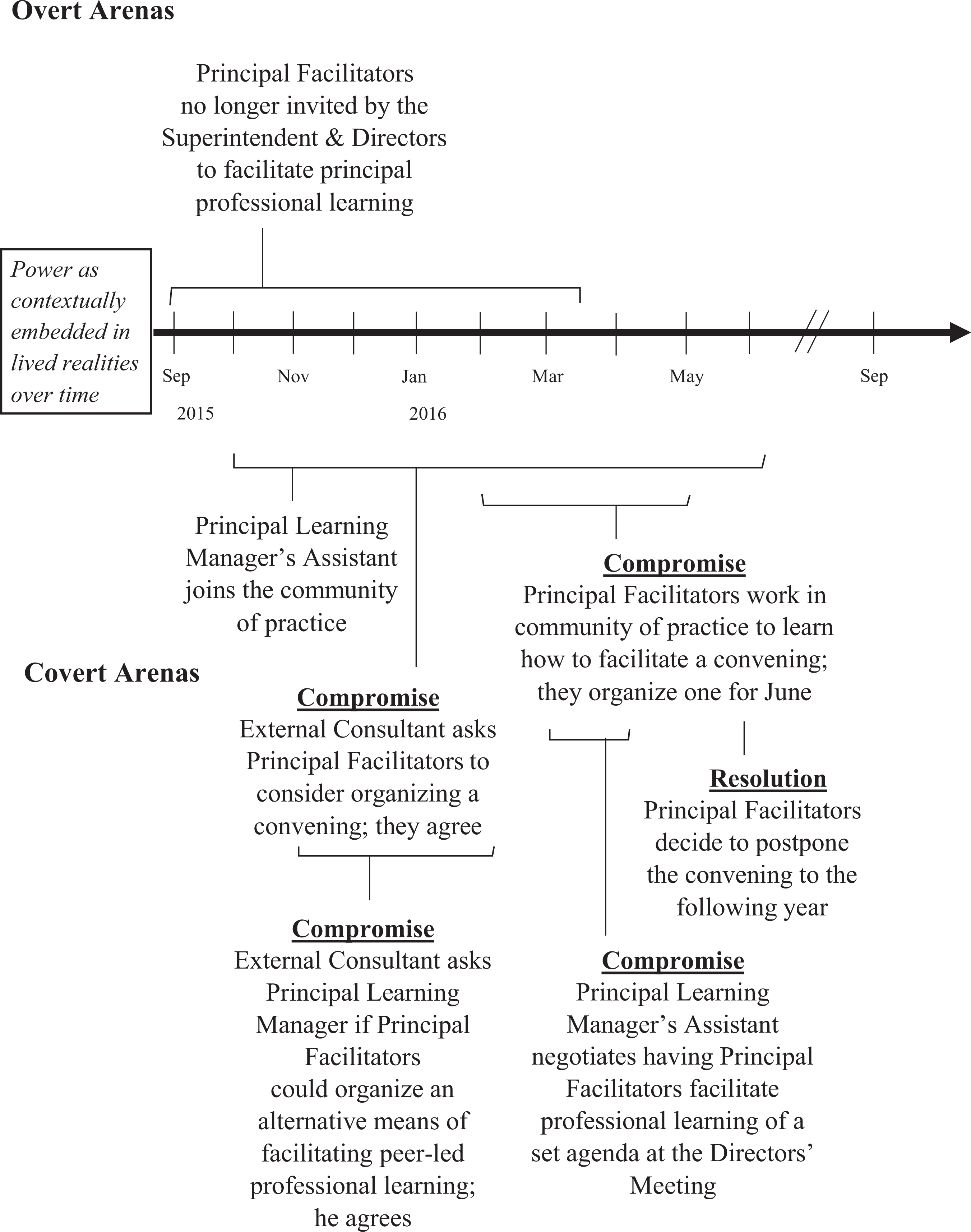
The micropolitics of negotiating a redefinition of the principal facilitator role.
Negotiating compromise by principal facilitators
The Learning Consultant hired to lead Principal Facilitators’ professional learning played a critical role in navigating this change. According to her, the Principal Facilitators were unlikely to be put back on the agenda for the Superintendent’s Meetings (field notes, November 2015). She recounted that this belief led her to have a series of conversations with the Principal Learning Manager about the possibility of compromising (field notes, February 2016). She asked him whether the Principal Facilitators might plan a convening of principals around an urgent issue. The Principal Learning Manager agreed, so the Learning Consultant brought it to the January community of practice meeting. So, I said, ‘Here’s the truth folks. You don’t really have a formal role. You are getting stipended at the end of the year. Let’s earn it. And – and are you game? And I have an idea and here’s the idea.’ And so they read about it and we talked about it and they were like, ‘Yep, we are on board.’
Enacting compromise in a covert arena
Initially, the Principal Facilitators acted on their compromise without revisiting their conflict with central office administrators over their role in an overt manner. Principal Facilitators spent their next three community of practice meetings learning how to plan a convening and making decisions. They considered the extent to which they needed to solicit input from their peers. As the Learning Consultant shared, “we had a healthy conversation about that and we decided, ‘let’s just do a survey because we can imagine we are not going to get time [at a Supervisors’ Meeting].’” The survey had a response rate of 54% of principals in the district; almost half (42%) of the respondents voted for the same topic – “utilizing teacher leaders and other systems and structures that directly impact student outcomes.”
Despite their resistance to serving central office’s agendas, the Principal Facilitators reported that they wanted to connect the learning within the convening to the district’s priorities. As one Principal Facilitator pointed out, they need “to have that ongoing district support so folks aren’t left hanging – knowing that their district will support them.” The Principal Facilitators discussed the need to gain buy-in – or at least approval – from the Supervisors for the convening. The Learning Consultant asked whether the Principal Facilitators would be comfortable with allowing Supervisors to choose the topic from the top three based on the principals’ survey. One of the choices involved a policy that “has felt very top down for many people,” as one principal noted, and “without support,” as another added. Rather than allow central office to choose this topic and thus co-opt their efforts, the Principal Facilitators decided to suggest only one topic, teacher leadership, and ask the Principal Learning Manager to advocate on their behalf with the Supervisors; he agreed to do so.
Negotiating compromise with central office administrators
Allies also used their boundary-spanning roles to negotiate new compromises in the use of the new role moving forward. As the Principal Learning Manager’s assistant witnessed the Supervisors struggling to allocate time to prepare learning activities for their monthly meetings, she saw an opportunity to leverage her own position to provide a solution for the Supervisors that re-opened the door for the Principal Facilitators. She described her tactic as being fairly opportunistic, “So I just kept saying, like, ‘So April [the date to set the agenda] is coming up – do you have a plan?’ ‘So April is coming up – I have a plan.’” And her plan was to use the Principal Facilitators.
The Principal Learning Manager negotiated the possibility of a convening of principals facilitated by the Principal Facilitators. The Superintendent was willing to serve as an official sponsor and the Supervisors were willing to attend and engage in the facilitated conversations (email correspondence with Principal Learning Manager). In both instances, these allies were able to negotiate compromise indirectly, bringing the conflicting parties back to the table.
Negotiating resolution in a covert arena
Rather than finalize a June convening, however, the Principal Facilitators decided together to postpone until the fall when they felt principals would “have the mental space” to engage deeply, as one Principal Facilitator described. Although they postponed the convening, they agreed to facilitate the Supervisors’ Meeting in May, as negotiated by the assistant to the Principal Learning Manager. Some of the Principal Facilitators were initially skeptical, but trusted her ability to organize support for them, as evidenced in the following exchange regarding the Supervisors’ buy-in to the topic selected via the principal survey:
And you’re sure once you set this no one is going to say, “Oh – no. We’re going to do this,” and change it?
I got [three Supervisors] on board.
Perfect! That’s great.
By leveraging the assistant’s advocacy with Supervisors, the Principal Facilitators were able to know that any compromises they ceded would be honored and accepted by a critical mass of central office administrators. These assurances mitigated the risk involved in compromising.
Compromise leads to cooperation and new resolution
In the third year of the grant, allies continued to support compromise by central office administrators and Principal Facilitators in the covert arena and shifted that compromise to the overt arena, allowing for overt compromise and renegotiation of a resolution that was mutually beneficial (see Figure 3).
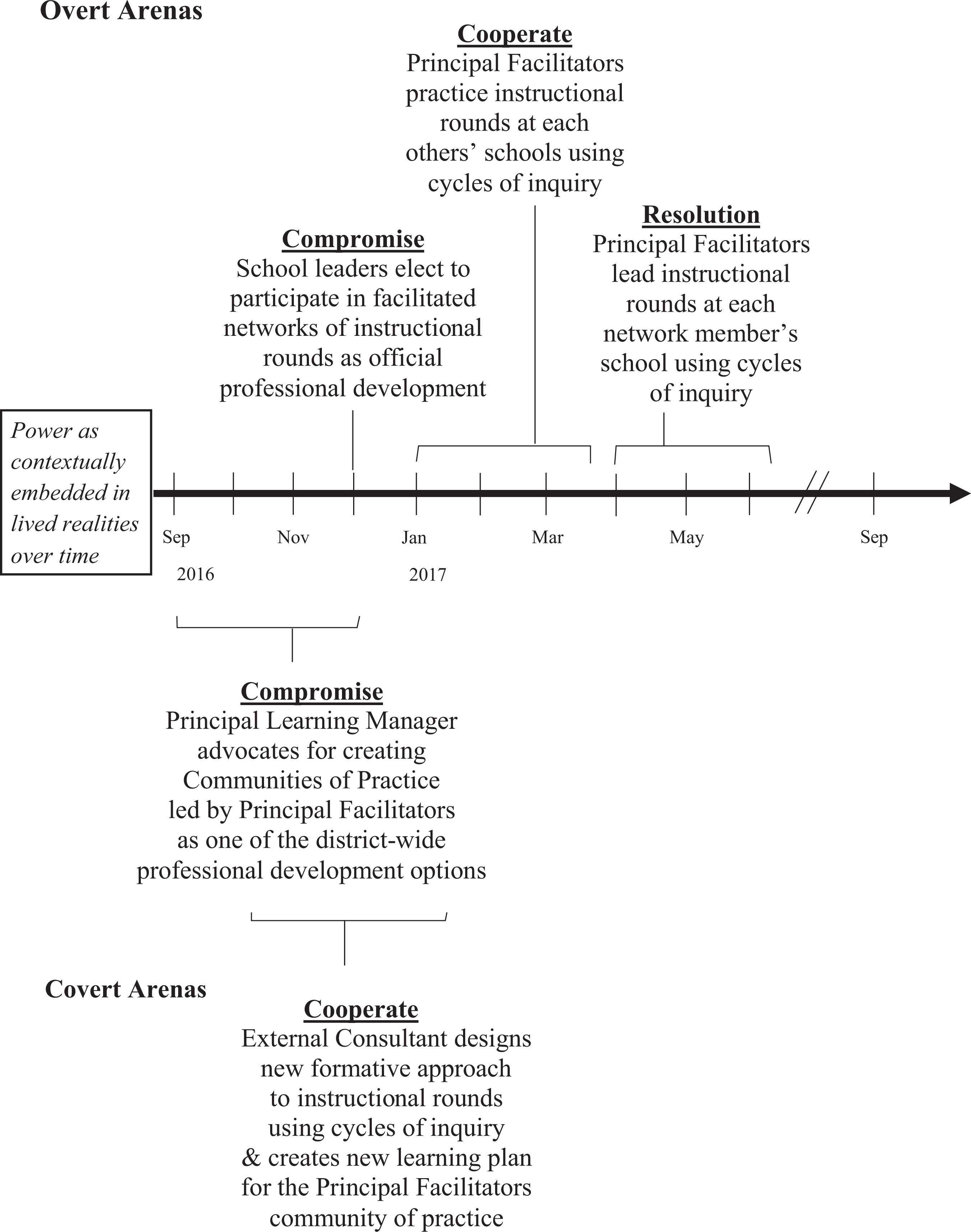
The micropolitics of co-constructing official spaces for peer-led learning.
Continued covert compromise shifts to overt compromise
At the start of the new academic year, the Principal Learning Manager decided to capitalize on his assistant’s movement with the Supervisors to reintroduce the idea of peer-led communities of practice to central office administrators. He approached the Supervisors to talk about the benefits of allowing principals to choose the area in which they and their schools would most benefit from professional learning. As one Supervisor shared, “there was this whole concept of wanting to provide administrators choice, so there will be more options and they can actually choose things that would meet their needs more personally.” This Supervisor summarized that “I think it was more, you know, ‘Let’s sell it.’ [by giving principals choice].’” The Principal Learning Manager described giving principals choice as being more “true to the original intent” of the expanded leadership roles.
The Supervisors agreed to give principals a menu of options for their mandatory professional development, which shifted the compromise from the covert arena of negotiations over email and behind closed office doors to the public, overt arena of district policy. Maria, who formerly served as a principal in the district and was a Principal Facilitator in Year 1 and Year 2, was hired as a Supervisor in Year 3. She agreed to manage instructional rounds through facilitated communities of practice as one of the options.
While the Supervisors were redesigning professional development for principals, the Principal Learning Manager contacted the Learning Consultant about the potential for using Principal Facilitators to lead instructional rounds. She initially found the idea to be problematic. The district had implemented instructional rounds in the past using a model that focused more on public accountability than on professional learning – “which, you know, can be at odds with one another. In one you’re pulling out the dog and pony show to show you’ve got it and in the other, you’re being really vulnerable,” as she described. However, the Learning Consultant was already under contract with the district to continue providing professional development to the Principal Facilitators. She compromised on her initial resistance to the model and began designing a new approach to instructional rounds. She spent two months “researching like crazy, reading – rereading – about the cycle of inquiry, trying to figure out how the pieces might fit together. Talking with [a colleague] and thinking, ‘I’ve got to have a plan in place next month for these principals!’” Mid-year, principals were asked to choose professional development tracks. Fourteen principals chose instructional rounds for their district-mandated professional development.
Overt compromise by leads to cooperation by principal facilitators
The Learning Consultant asked the Principal Facilitators to cooperate with the central office administrators’ new vision for the role by moving away from their plan to host a convening and to consider serving as facilitators of instructional rounds. The Principal Facilitators’ community of practice began meeting again. Instead of continuing to learn how to host a convening, the Learning Consultant reported that she taught a new set of skills, such as how to elicit a problem of practice, with leaders of the host school, help the host school educators map their current strategies to address their focal problem of practice, collect observational data that is targeted to the strategies indicated by the host team, frame observations using low-inference language, and emerge themes across observations that relate to the strategies selected by the host school (field notes, February 2017). Principal Facilitators practiced these skills by conducting instructional rounds in each others’ schools (field notes, February 2017, March 2017).
Mutually beneficial resolution
The shift to implementing instructional rounds in schools that selected this professional development track resolved the initial conflict between Principal Facilitators and central office administrators in a new, overt way. Groups of four or five principals worked with pairs of Principal Facilitators to conduct instructional rounds in each of their schools. Cooperating with the Supervisors’ vision for instructional rounds allowed the Principal Facilitators to return to what they perceived as the benefits of peer-to-peer professional development. One Principal Facilitator shared, I think that last year when we did our problem of practice and we vetted that through a group of our peers [at the final Superintendent’s Meeting], it was just very, very well received. And so I think that the instructional rounds was a natural outreach of that. I mean, I was thrilled with where we landed, personally, because from my small mini network it was really outstanding.
Themes across the chains of events
The findings illustrate the ways in which principals who challenged traditional lines of authority navigated district micropolitics. Principals’ maneuvering sometimes resulted in unintended consequences, but ultimately allowed them to engage in new and counter-cultural practices. Rather than being co-opted by central administration or cut off entirely from facilitating professional development, principals in this expanded role were able to negotiate new terms. Ultimately, they regained enough autonomy to continue serving in their expanded roles to facilitate peer-led principal professional learning, as originally intended.
Principals in expanded roles and central office administrators began by cooperating to implement plans for peer-led professional learning. Principals deployed covert tactics only after central office administrators co-opted the role to disseminate their own agenda. This drove principals to covert tactics that relied on compromise in order to continue to negotiate peer-led professional learning. Yet it was the covert practices of the allies in central office and the consultant leading the Principal Facilitators’ own professional development that convinced central office administrators to re-invest in peer-led professional learning in overt ways.
This paper thus illustrates the potential challenges involved with endeavoring to shift professional learning in school districts from top-down to peer-led models. The bureaucracy of schooling is notoriously calcified and resistant to even minor modifications (Huerta and Zuckerman, 2009; Lubienski, 2003; Tyack, 1974). We observed principals attempting to change the structure of authority and allocation of power within the district as it related to their own learning. Our analyses examine the conflicts over policy that emerged, which suggest that expanding principal roles entails more than the willingness to revise job descriptions and reconfigure professional development. Principals can actively shape how district policies affect leadership expectations not only through their local interpretation and implementation, but also through active resistance to central office demands (Björk and Blasé, 2009).
Our findings highlight how principals were able to challenge authoritative district structure and culture through negotiation and compromise, but also by enlisting key allies within central office, in the case of the Principal Learning Manager and his assistant, or alongside central office, in the case of the Learning Consultant. By gaining their support, the Principal Facilitators were able to access information to assist their own strategic decision-making. They also benefitted as allies in central office advocating on behalf of returning to facilitation of peer-driven professional learning.
It is noteworthy that these individuals held little positional authority to convince Supervisors to cede authority to principals. While the Principal Learning Manager, as the director of the team overseeing grant implementation, might arguably have some authority over Supervisors, his assistant, as a teacher, held none. The Learning Consultant held no positional authority. Instead of drawing on their authority, these individuals exercised informal influence to shift Supervisors’ viewpoints. This illustrates how important the work of boundary spanners such as the Learning Consultant and the Principal Learning Manager can be to supporting efforts that reconfigure bureaucratic authority (Honig, 2008).
Implications
This study suggests several implications for research and practice. Future research using a micropolitical lens could extend what we know about authority in educational systems, particularly around professional learning opportunities, policy implementation, and leadership hierarchies. The extant research tends to focus more on schools than on districts as the setting of micropolitics; while some of the barriers (and strategies for addressing them) might be analogous, we suspect there are unique experiences when school leaders, who serve in fairly isolated roles within their buildings, come together across the district. Given principals’ authority within their schools and lack of authority within the larger school district bureaucracy, micropolitics may come to the fore when principals assume some power at the district level. A micropolitical approach to understanding the relationships and negotiations between central office and principals might benefit from additional, careful consideration of the multiple ways in which principals create new resources for the district beyond their management of individual schools (Pfeffer and Salancik, 2003).
Our findings contribute to a growing body of evidence that external actors can influence policy implementation and district leadership practices. Much of the current literature focuses on external providers of goods and services in what Rowan (2002) described as a “school improvement industry.” Scott and DiMartino (2009) provide an updated typology of educational privatization that distinguishes external actors as partners and as managers from those serving as profit-seekers and rivals. Honig (2009) demonstrated the permeability of district boundaries as external organizations moved into internal roles in Oakland, California, and Chicago. Research might further examine the role of external actors, such as consultants, in district decision-making as principal roles and professional learning mechanisms are targeted in improvement efforts. As Yemini (2017) points out in her work in Israel, these implications extend to nonprofit intermediaries acting in the education arena. As Oyal and Yarm (2018) analyze within the Israeli context and Koranyi and Kolleck (2018) discuss within the German context, there are micropolitical tactics and potential pitfalls in relying on boundary spanners to negotiate across multiple actors in educational change. This deserves not only further examination, but greater theoretical development as local school governance confronts shifting expectations in multiple national settings.
Finally, collective action by principals, inside or outside the context of unions, is not well-documented. This case study suggests that principals have much to gain through organizing to create more productive learning opportunities for themselves. We find that when principals band together to pursue a goal that clearly benefits themselves and their colleagues, they can disrupt the traditional school district hierarchy, at least in part due to the relative value of the knowledge resources generated (see Salancik and Pfeffer, 1974). Our findings provide lessons to districts hoping to support the transition to peer-led principal professional learning. Principal Facilitators found peer-led learning so powerful that they were willing to challenge their supervisors to ensure its continuation. As district leaders consider how to facilitate opportunities for principals to lead their colleagues, they should expect that, once they provide these opportunities, principals may be reluctant to surrender their new-found authority.
Footnotes
Declaration of conflicting interests
The authors declared no potential conflicts of interest with respect to the research, authorship, and/or publication of this article.
Funding
The research on which this article is based was funded as the evaluation component of a Teacher Incentive Fund IV grant to Green Public Schools.
