



Abstract
Introduction
Doppler ultrasound is recommended by international societies for preoperative vascular mapping in vascular access surgery. Literature is scarce regarding data on Doppler ultrasound-associated errors.
Objectives
Our aim was to evaluate Doppler ultrasound precision for upper limb vascular mapping.
Methods
Fifty-two adult healthy volunteers were evaluated for superficial vein diameter, brachial artery flow and diameter in the lower third of non-dominant arm by a dedicated vascular access radiologist blinded for the identification of the participants. Each participant was scheduled for three evaluations one week apart. Friedman test and multivariate analysis of variance for repeated measures were used.
Results
There were no statistical differences within subjects across the three weeks except for brachial artery flow in participants who had basilic vein as the dominant vein.
Discussion
Repeated anatomical and haemodynamic parameters measured by Doppler ultrasound performed by an experienced medical sonographer, according to our protocol, did not show statistical differences within subjects, independently of age, gender and body mass index.
Introduction
Dysfunction or related vascular access complications account for 20–30% of hospital admissions and therefore are responsible for a high economic impact. 1 – 3
The role of Doppler ultrasound (DU) has been progressively established in the last decade as a complement to pre-operative assessment for vascular access surgery for hemodialysis and follow-up. 4 – 6 Prediction models based on clinical and color DU would be a simple, fast and affordable way to determine the best access for each patient, and would prevent unsuccessful surgical procedures and morbidity associated with progressive end-stage renal disease (ESRD) in patients with non-functional AVF.
The National Kidney Foundation – Kidney Disease Outcome Quality Initiative (NKF-KDOQI), Japanese Society for Dialysis Therapy (JSDT) and Vascular Access Society (VAS) guidelines recommend pre-operative DU vascular mapping4,7,8 with the rationale that it could overcome the gap that physical examination alone leaves in many patients. 9 However, the quality of evidence and level of recommendation are not perfect. A systematic review of the available randomised control trials failed to demonstrate higher patency rates when routine versus selective pre-operative DU was performed.6,8,10– 13
One disadvantage of DU always cited is related to the inter-observer variability according to the ultrasound technique and medical and non-medical sonographer expertise.
14
Many other factors must be kept in mind when measuring vessels diameter and blood flow:
the diameter of an artery may vary as much as 20% during the cardiac cycle; errors associated to the vessel area measurement may be as high as 20% for a 10 mm vessel and even higher for smaller vessels such as the brachial artery or the cephalic vein; volumetric flow is difficult, as it is frequently associated with errors from 20% to 100% due to pulsatile cardiac cycle; and complex heterogeneous patterns of velocity, namely near bifurcations such as in the brachial artery in the distal third of the upper arm, lead to inaccurate angle estimation.
15
–
19
Although pre-operative DU has been progressively established, the literature is scarce regarding accurate data on errors in clinical practice. The authors found no studies that specifically addressed the random error and intra-observer variability of DU vascular mapping. Since it is known that the variability is much dependent on the observer, it is of paramount importance to address these questions. Moreover, there is also a need for established protocols of DU vascular mapping. Addressing these matters will contribute to uniformise the clinical practice and to better understand the correlation between DU results and surgical findings, supporting the use of DU as a technique of vascular mapping in a pre-operative context.
Our aim was to evaluate intra-observer variability in upper limb vascular mapping by Doppler ultrasound in three consecutive weekly measures.
Material and methods
Study design – Prospective observational single center study of 52 healthy volunteers, conducted between September and December of 2016.
Inclusion criteria
Adult volunteers, with ages between 18 and 45 years old.
Exclusion criteria
Acute disease or decompensated chronic disease, namely cardiovascular disease, diabetes or peripheral arterial disease; anti-hypertensive therapy changes in the last six months before the first measurement; pregnancy; night shift in the day before evaluation. Participants were excluded from the study if at least one of these exclusion criteria occurred after the first evaluation.
Ethical considerations
This study was approved by the Institutional Review Board of the centre on 12 October 2016. All patients signed an informed consent.
Evaluation protocol
DU was performed in the ultrasonography department of our institution. All evaluations were performed by the same dedicated vascular access medical sonographer with 20 years' experience in DU and 6 years' experience in upper limb vascular mapping and vascular access follow-up. Room temperature was set between 22℃ and 24℃. In order to avoid interference due to vasodilation after walking to the department, before DU assessment, participants had a 10 minutes resting period in the waiting room.
DU was performed using an Ultrasound scanner Toshiba Applio Model SSA-700A, with a Doppler dedicated transducer PLT-704AT, 5-11 MHz, Canon Medical Systems Corporation, Shimoishigami Otawara-shi, Japan. When necessary, for the evaluation of the subclavian vessels, a convex transducer was used (PVT-375NT, 2.5–6 MHz).
The medical sonographer was blinded for the participant identification. The participants were placed by an assistant in supine position behind a curtain, leaving exposed to the medical sonographer only the upper limb selected for examination (Figure 1).
Study set up for Doppler ultrasound evaluation.
The methodology applied is an institutional protocol developed by a Vascular Access Multidisciplinary Team that includes surgeons, nephrologists, radiologists and interventional radiologists. A systematic approach was performed, encompassing the arteries, deep vein system and superficial vein system. Subclavian and axillary vessels were assessed for direct and indirect signs of central occlusion (vein) and anatomical variants (artery and vein). Afterwards, a tourniquet was placed in the proximal upper arm so that superficial veins flow was occluded, but not the brachial artery flow. Dominant superficial upper arm vein (the superficial vein of the arm with higher diameter), was assessed for patency and diameter (B-mode imaging) at the distal third of the upper arm. Brachial artery was subsequently assessed for anatomic variants (in case of high bifurcation brachial artery parameters were the measurements recorded), patent lumen diameter and blood flow in the distal third of the upper arm. The tourniquet was removed and dominant superficial vein diameter was assessed in the distal third of the upper arm. The diameter measurements were performed antero-posterior, inner to inner in the transverse section, after spherical shape optimisation, with a standard vascular ultrasound preset, unifocal focal guided to the area of interest and similar degree of magnification.
Variables measured
Anatomical and hemodynamic variables for upper limb vascular mapping (superficial dominant vein diameter with tourniquet, superficial dominant vein diameter without tourniquet, brachial artery diameter and blood flow) age, gender and body mass index (BMI) data were collected.
Statistical analysis
Shapiro–Wilk test was used to test variables for Gaussian distribution. Analysis of variance (ANOVA) for repeated measures or Friedman test were used (if non-Gaussian distribution). Multivariate analysis of variance (MANOVA) for repeated measures was performed to adjust for age, gender, superficial dominant vein and BMI. Greenhouse-Geisser method was used when sphericity could not be assumed (Mauchly's test). Paired-sample analysis (paired T-test if Gaussian distribution or Wilcoxon if non-parametric statistic) was performed to compare patients with at least two DU evaluations. p-Value < 0.05 was considered for the statistical significance.
Results
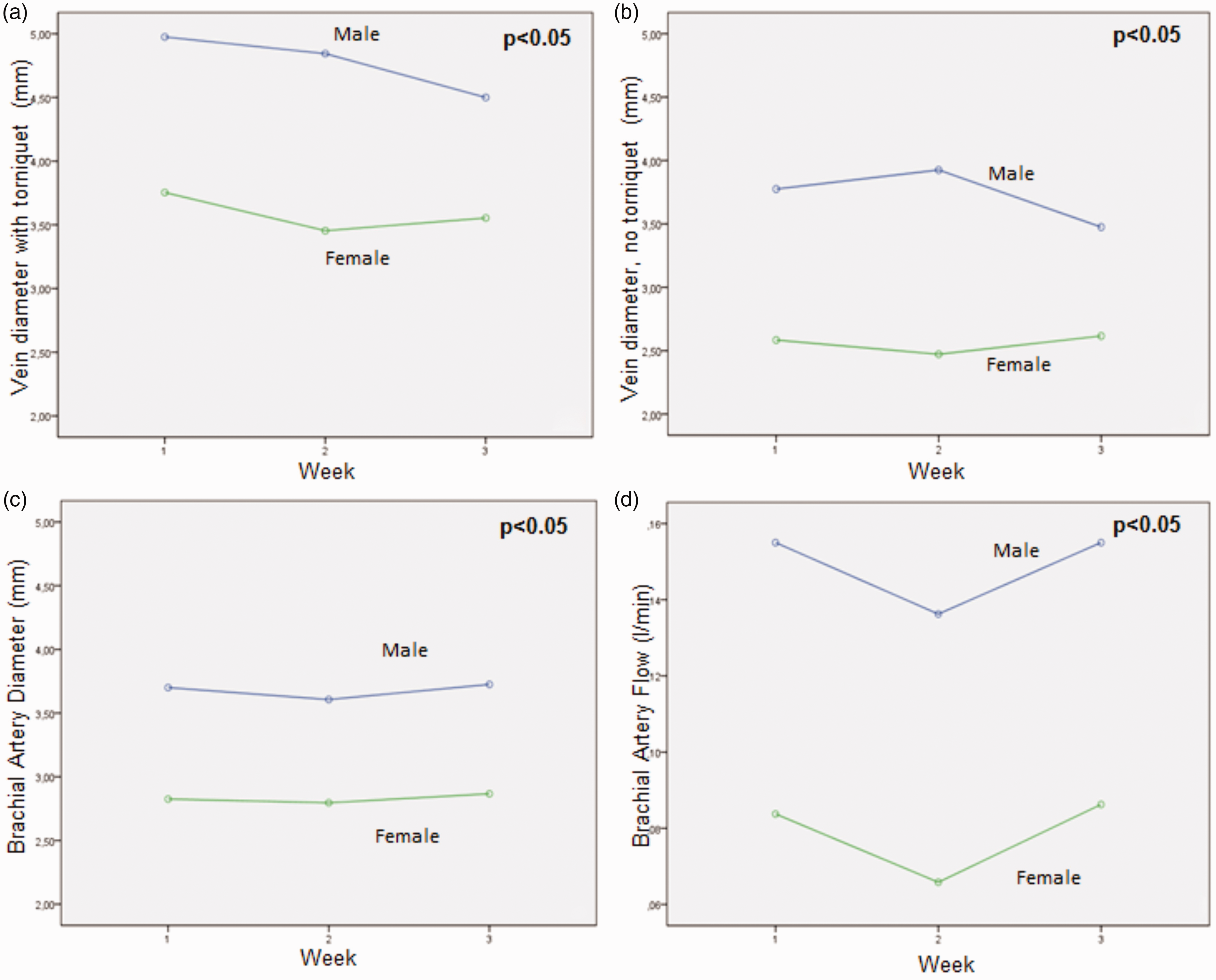
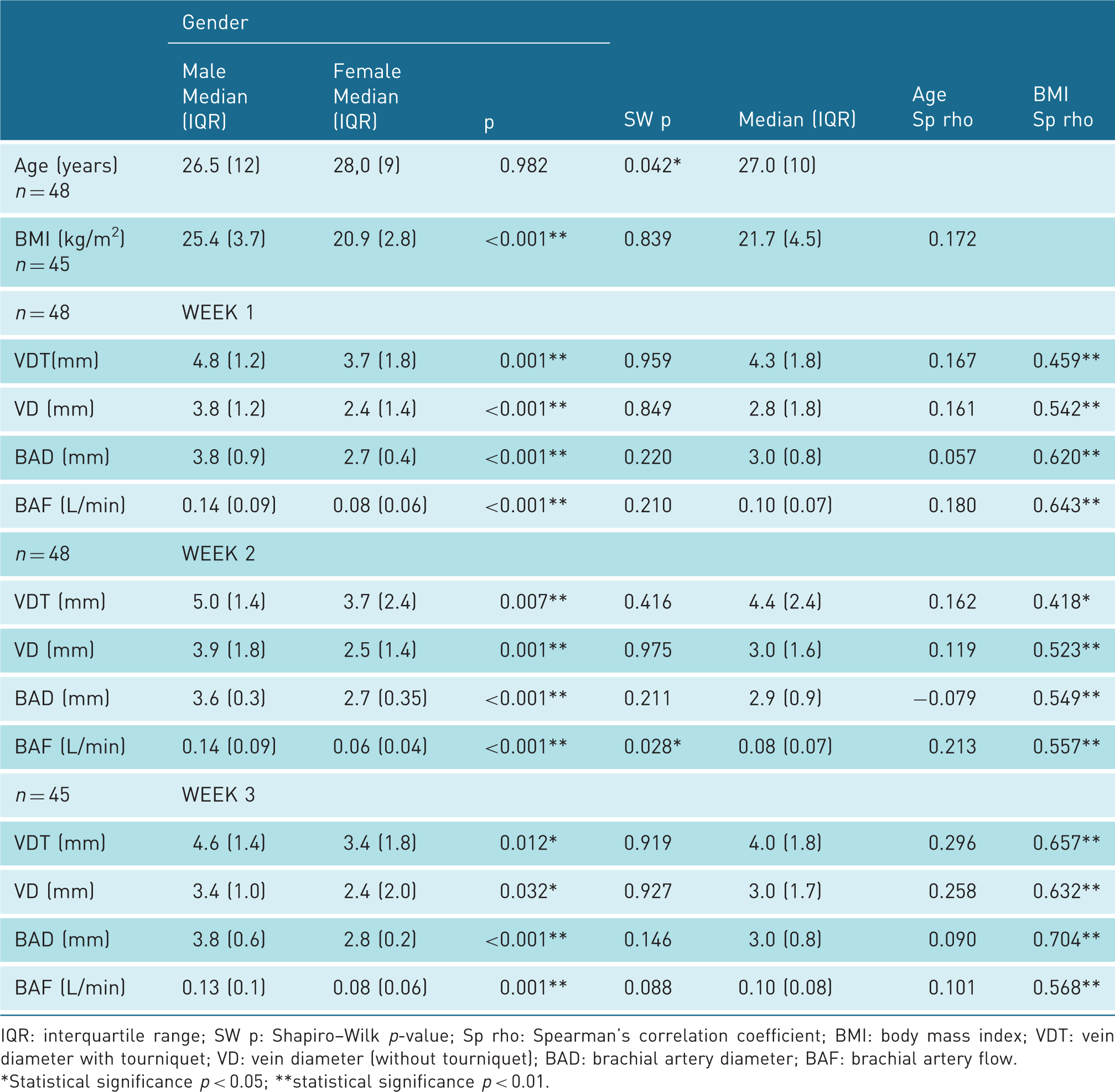
Fifty-two healthy volunteers were included in the study. Four participants were excluded due to only one DU evaluation, forty-eight participants had at least two evaluations and forty-two participants completed the three scheduled evaluations (Figure 2). Sixty-six percent of the included participants were female. All variables showed a Gaussian distribution except age and second evaluation of brachial flow (Table 1). No severe outliers were found for all continuous variables. Descriptive statistics are summarised in Table 1. Anatomic and hemodynamic parameters measured were independent of age (Table 1). Male gender was associated with higher venous diameter, brachial artery diameter and brachial artery flow (Table 1 and Figure 3). There was a significant low to moderate positive correlation between BMI and all the evaluated parameters independently of the time of evaluation (Table 1). Friedman test showed statistically significant differences only for brachial flow at week two, compared to week one and three (Table 2 and Figure 3(d)). The same was true when the first two evaluations of the 48 patients with at least two evaluations were compared (Wilcoxon test for paired samples, Table 2).
Study design (scheme). MANOVA: Multivariate analysis of variance. Anatomic and hemodynamic Doppler ultrasound parameters in the three evaluations by gender: (a) vein diameter with tourniquet; (b) vein diameter, no tourniquet; (c) brachial artery diameter; (d) Brachial artery flow. Descriptive and univariate analysis. IQR: interquartile range; SW p: Shapiro–Wilk p-value; Sp rho: Spearman's correlation coefficient; BMI: body mass index; VDT: vein diameter with tourniquet; VD: vein diameter (without tourniquet); BAD: brachial artery diameter; BAF: brachial artery flow. *Statistical significance p < 0.05; **statistical significance p < 0.01. Wilcoxon paired test (comparison between DU-derived parameters at week 1 and week two) and non-parametric repeated measures analysis (Friedman test). χ2: chi-square statistic; df: degrees of freedom; p: p-value; VDT: vein diameter with tourniquet; VD: vein diameter (without tourniquet); BAD: brachial artery diameter; BAF: brachial artery flow. Statistical significance p < 0.05.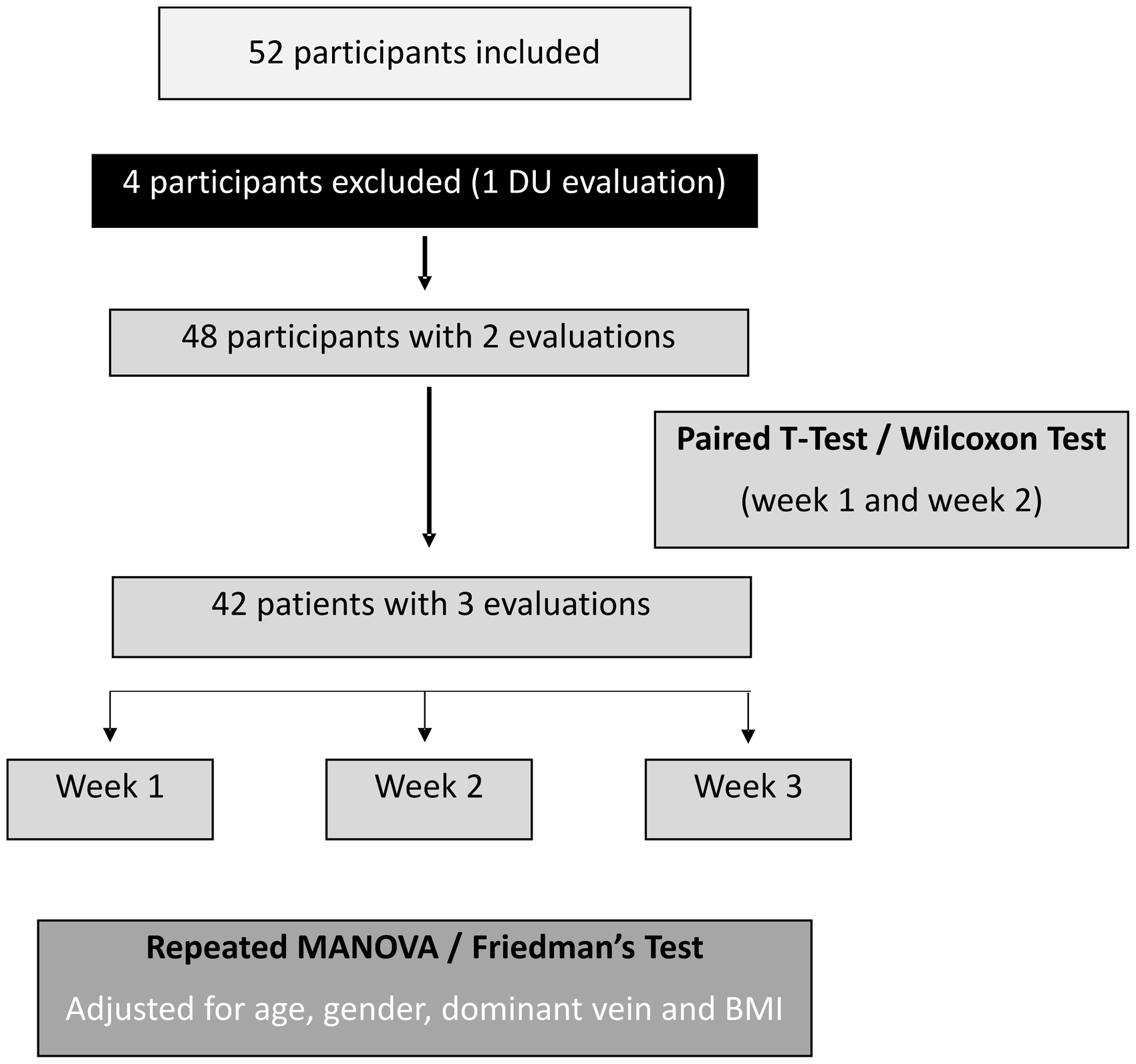

Multivariate repeated measures ANOVA adjusted for age and gender.
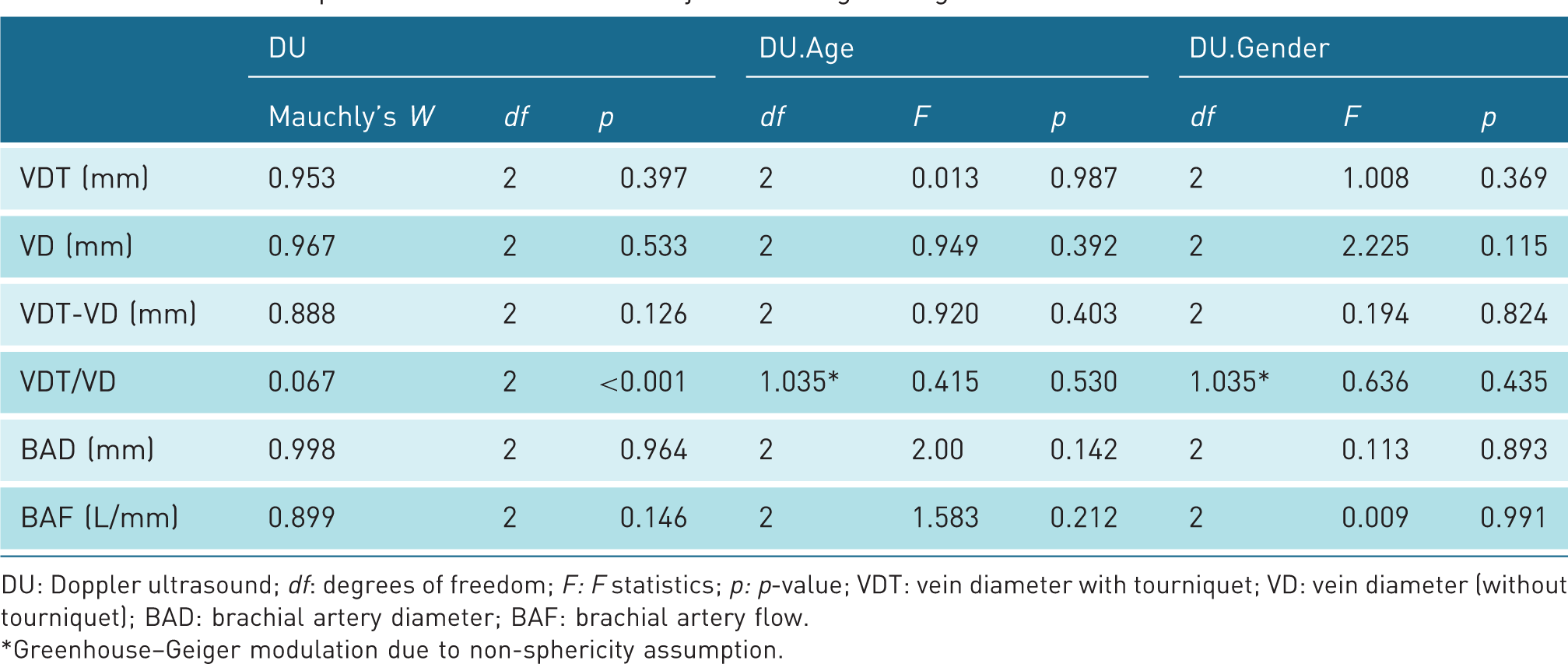
DU: Doppler ultrasound; df: degrees of freedom; F: F statistics; p: p-value; VDT: vein diameter with tourniquet; VD: vein diameter (without tourniquet); BAD: brachial artery diameter; BAF: brachial artery flow.
Greenhouse–Geiger modulation due to non-sphericity assumption.
Multivariate repeated measures ANOVA adjusted for dominant superficial vein and BMI.
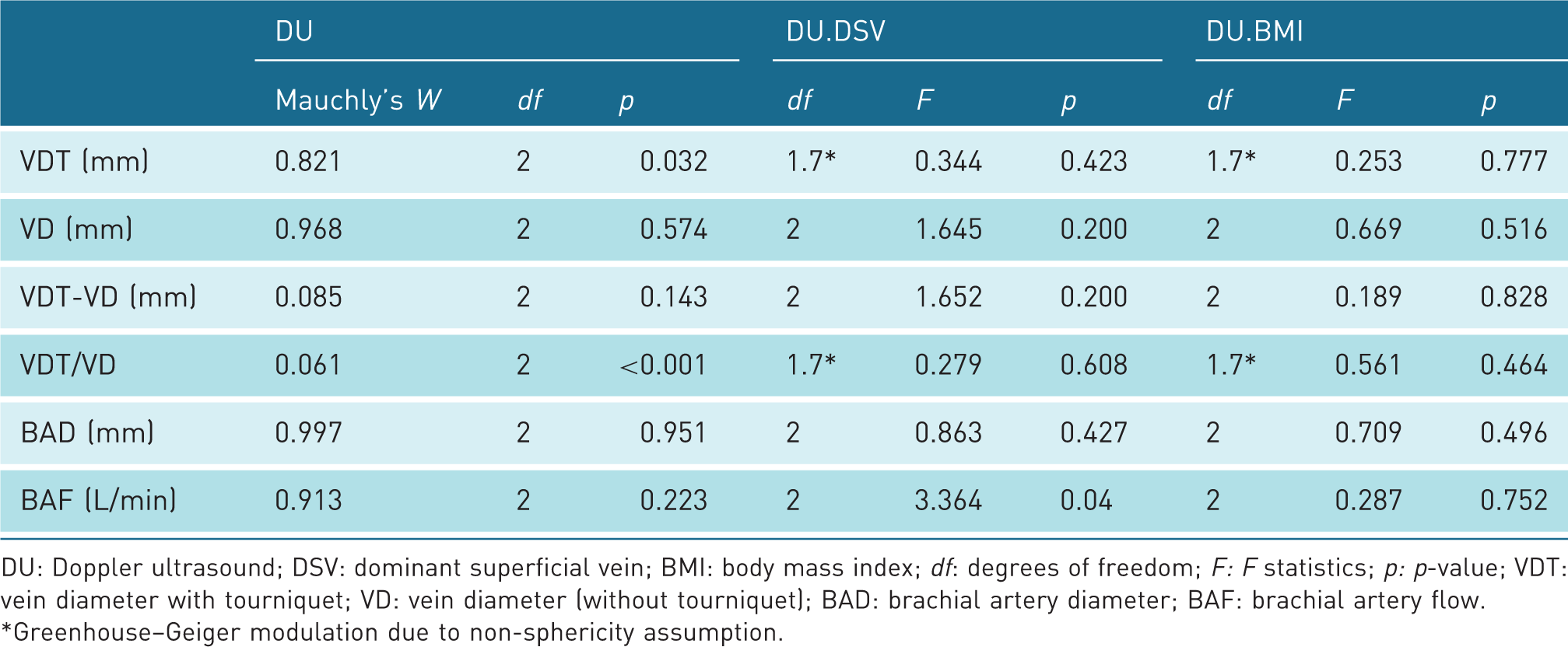
DU: Doppler ultrasound; DSV: dominant superficial vein; BMI: body mass index; df: degrees of freedom; F: F statistics; p: p-value; VDT: vein diameter with tourniquet; VD: vein diameter (without tourniquet); BAD: brachial artery diameter; BAF: brachial artery flow.
Greenhouse–Geiger modulation due to non-sphericity assumption.
Discussion
According to the international societies' recommendations, physical examination and preoperative DU is the standard of care for upper limb vascular mapping.4,7,8 However, scientific quality evidence is lacking regarding the real clinical impact of systematic preoperative DU. Clinical trials are not consistent in showing higher patency rates with preoperative DU vascular mapping.6,10– 13 On the other hand, its safety and availability make it very useful to characterise the upper limb arterial and venous beds. However, there is no clear cut-off to define which vein or artery is suitable for vascular access surgery. Even less is known regarding the error associated to DU measurement.
The authors performed systematically preoperative DU vascular mapping for all patients referred to definite vascular access construction for haemodialysis. However, the authors found no previous studies that specifically address the intra-observer variability of DU-derived parameters. The need for knowing the random error associated with DU vascular mapping raised our study question.
In accordance with previous studies, male gender and BMI were associated with higher vein diameter, brachial artery diameter and brachial artery flow (Table 1).20,21
Our results showed that, except for brachial artery flow in participants who had basilica vein has the dominant vein (Table 4), repeated DU performed by an experienced medical ultrasonographer did not show statistically significant differences (Table 2) in healthy volunteers. The restrictions in inclusion criteria and study setting raise concerns regarding external validity. It was not our aim to design a study that might change immediately our clinical practice. Our aim was to evaluate the error associated with the DU vascular mapping technique so that, all the differences in non-measurable conditions between evaluations (confounding) should be minimised. That's why participants with active comorbidities were excluded, to ensure that variability between measures was associated only with measurement methods and not with underlying active disease. Also, individuals who had a night shift in the day before evaluation were excluded, in order to minimise confounding with non-basal blood pressure or volemia (either by induced dehydration or water retention). 22 – 25 Choosing three consecutive measures one week apart was based only on clinical sense since we found no previous studies. Only brachial artery and cephalic or basilic vein at the third of the upper arm was measured, as these are greater calibre vessels and represent a major option in face of a distal AVF failure. Since anatomic and hemodynamic parameters are not simple functions of diameter and flow, repeated measures analysis should be performed at one specific anatomical location. Otherwise, non-measurable bias would be introduced. With the goal being to validate the quality of DU as a consistent result technique, only intra-observer variability was assessed.
Our results suggest that DU is a precise technique for upper arm vascular mapping. However, reproducibility in clinical practice should be cautious since we did not study DU precision in end stage kidney disease patients, whose vessel characteristics are likely more vulnerable to hemodynamic changes. Also, we did not study DU precision in cardiovascular comorbidities patients. The spectrum of age and BMI was narrow. We cannot assess the influence of age in participants/patients older than 40 years old and we only can conclude regarding BMI in non-overweight participants/patients.
In conclusion, although DU has been accepted as a systematic technique in vascular mapping before surgery for vascular access for haemodialysis, there is a need to establish protocols, know the variability intra-observer and the relation between DU and surgical findings. Nevertheless, there are no studies assessing these questions. Our study was the first one reporting a DU protocol, evaluated in different timepoints, that is precise – the values are reliable when performed in the same conditions strengthening its reliability for surgical decision making. However, it was only performed in healthy volunteers and there is a need for the assessment of DU precision in subgroups of clinical interest.
Footnotes
Acknowledgements
The authors thank Constança Coelho, PhD – Genetics Laboratory, Environmental Health Institute, Lisbon Medical School, University of Lisbon, Portugal, for all the assistance in study design, statistical planning and analysis and article review.
Contributors
APG and RM researched literature. APG, ASG and RM designed the study. ASG perform the radiologic assessment. APG and ASG collected the data. APG, MS and VN performed data analysis and wrote the article. All authors reviewed and approved the final version of the article.
Declaration of Conflicting Interests
The author(s) declared no potential conflicts of interest with respect to the research, authorship, and/or publication of this article.
Ethics approval
This work was approved by the Institutional Review Board of Hospital Prof. Dr Fernando da Fonseca on 12 October 2016.
Funding
The author(s) received no financial support for the research, authorship, and/or publication of this article.
Guarantor
APG.
Implications for patient care
Validating DU as a consistent technique in the preoperative evaluation of AVF creation.
Summary statement
Doppler ultrasound is a precise technique for the upper arm vascular mapping. However, reproducibility in clinical practice should be cautious since we did not study DU precision in end stage kidney disease patients.