



Abstract
The present study tests a model of moderated mediation in the relationship between transformational leadership and follower emotional strain. Based on the job demands-resources model, we suggest that transformational leaders may be able to decrease follower emotional strain by providing social support. It is also proposed that a protective effect of social support from a transformational leader will depend on the employees’ level of professional ambition. Mediation by social support may be stronger for ambitious employees, such that transformational leadership may be associated with less emotional strain for these employees (moderated mediation). A sample of 199 employees participated in a cross-sectional study in Germany. Results confirmed the hypothesized moderated mediation indicating a health-promoting effect of supervisory social support for ambitious employees (not found for low levels of ambition). The study suggests that the idea of a general positive effect of transformational leadership on followers’ emotional strain is not appropriate.
Keywords
Prior research on the relation between transformational leadership and followers’ well-being has mainly tended to concentrate on the question of whether transformational leaders promote followers’ well-being and on how transformational leaders achieve this, for example by providing social support (Nielsen and Daniels, 2012; Sosik and Godshalk, 2000) and enhancing work characteristics (Arnold et al., 2007; Nielsen et al., 2008). Less attention has been paid to moderating variables which determine when transformational leadership and followers’ well-being are more closely related (Franke and Felfe, 2011). The present study combines both perspectives in a moderated mediation model, suggesting supervisory social support as a mediator of the relationship between transformational leadership and follower emotional strain, but also investigating whether the strength of this mediation differs for employees with either high or low professional ambition.
Zhu et al. (2009) highlight the need to take into account followers’ characteristics in order to understand differential effects of leadership. Franke and Felfe (2011) demonstrated that organizational commitment is a moderator of the relationship between transformational leadership and follower strain, thereby providing original evidence of the importance of follower boundary conditions for this relationship. The present study focuses on the followers’ level of professional ambition, which is conceptualized as followers’ ‘persistent and generalized striving for success, attainment, and accomplishment’ (Judge and Kammeyer-Mueller, 2012: 759). In their recent article, Judge and Kammeyer-Mueller (2012) demonstrated that ambition is connected to life satisfaction through major life attainments. Based on these findings, they emphasize the utility of studying ambition as a construct within organizational behaviour research. The present study investigates follower ambition in the context of transformational leadership. We focus on social support as a connecting mechanism between transformational leadership and follower well-being, since social support has been proposed to relate to follower motivation (Bakker et al., 2008). Ambitious followers may appreciate their supervisor’s social support to a greater extent than those with less ambition because social support signals the supervisor’s appraisal (Frese, 1999), which is important for promotion (De Andrés et al., 2010), and therefore may be especially meaningful for ambitious followers. Thus, we hypothesize that social support by a transformational leader will result in lower strain levels for followers with high levels of professional ambition. Conversely, for followers with low levels of ambition, a supervisor’s support may not be as important.
As its theoretical basis, our study integrates transformational leadership (Burns, 1978) and the job demands-resources (JD-R) model (Bakker and Demerouti, 2007; Demerouti et al., 2001), suggesting that leaders can influence their subordinates’ emotional strain both by imposing job demands and providing job resources (Tims et al., 2011).
Transformational leadership and follower emotional strain
Transformational leaders guide their followers by giving them an idea of a higher purpose in their work, thereby stimulating their commitment to team goals (Bass and Riggio, 2006). Transformational leadership consists of the four sub-dimensions intellectual stimulation, idealized influence, inspirational motivation, and individual consideration. Most researchers have suggested that transformational leadership can promote follower well-being (see Skakon et al., 2010, for a review). A health-promoting effect of transformational leadership has not only been found in cross-sectional studies (Arnold et al., 2007) but also longitudinally (Nielsen et al., 2008). Even in an experimental setting transformational leadership resulted in lower ratings of followers’ negative affect than transactional leadership (Lyons and Schneider, 2009). By contrast, transformational leadership has also been suggested to potentially impair employees’ well-being (Franke and Felfe, 2011). Rowold and Heinitz (2008) found that transformational leadership resulted in elevated stress levels in a prospective study with a time lag of 6 months. Thus, transformational leadership may have negative consequences in the long run. Other studies have demonstrated that the transformational leadership component intellectual stimulation may relate to elevated burnout levels (Seltzer et al., 1989), while a different study by Stordeur et al. (2001) found that the total transformational leadership score was unrelated to burnout. Interestingly, these studies, which did not confirm a positive relation between transformational leadership and well-being, used negative indicators of follower well-being as opposed to positive indicators, as in other studies (Arnold et al., 2007; Nielsen et al., 2008). Since these results are not without contradiction, and the relation between transformational leadership and health outcomes varies across studies, a closer look at potential moderating variables seems advisable. Skakon and colleagues (2010) have encouraged investigating individual, situational, and relational factors which may account for the observed variance in correlations between leadership variables and followers’ well-being in different studies.
The JD-R model
Examining the relation between leadership and follower well-being, we build on the JD-R model (Bakker and Demerouti, 2007; Demerouti et al., 2001), an extension of the job-demand-control model (Karasek, 1979). According to the JD-R model job-strain results from a workplace situation characterized by high job demands and low job resources. The JD-R model conceptualizes job demands as ‘physical, psychological, social, and organizational aspects of the job that require sustained […] effort or skills and are therefore associated with certain physiological and/or psychological costs’ (Bakker and Demerouti, 2007: 312). Job resources refer to aspects of a job that reduce job demands and the associated physiological and psychological costs, facilitate goal achievement, and/or stimulate personal growth, learning, and development (Schaufeli and Bakker, 2004: 296). Job resources may be located at different organizational levels and include, for example, opportunities for development, feedback, support of one’s supervisor, role clarity, and task characteristics (Bakker and Demerouti, 2007).
The main propositions of the JD-R model suggest that job demands will result in elevated levels of strain and that job resources have a motivating effect (Bakker and Demerouti, 2007). Moreover, job resources have been proposed to buffer the relationship between job demands and job strain (Demerouti et al., 2001). Besides these well-known propositions of the JD-R model, Schaufeli and Bakker (2004) have suggested that poor job resources may also result in elevated strain levels. This effect of job resources on strain has received considerable empirical support (Schaufeli and Bakker, 2004; Schaufeli et al., 2009; Ten Brummelhuis et al., 2011). The present study investigates this link suggesting that social support may be related to lower levels of job strain.
The JD-R model in a leadership context
Leadership may be an important factor for followers’ well-being (Skakon et al., 2010) because leaders have significant influence on both job demands and job resources (Tims et al., 2011), both of which the JD-R model suggests will impact employees’ psychological health (Bakker and Demerouti, 2007). Transformational leadership behaviour explicitly includes the provision of resources (Bass and Riggio, 2006; Tims et al., 2011). Leaders may for example listen to their employees’ problems showing that they care for each of their subordinates (individual consideration). On the other hand, transformational leaders can also impose demands, in the form of high performance expectations towards their employees, for example (inspirational motivation).
Empirically, transformational leadership has been related to various job resources (Tims et al., 2011), which again may relate to reduced strain levels of followers (Schaufeli and Bakker, 2004). For example, positive relations have been found with social support (Nielsen and Daniels, 2012; Sosik and Godshalk, 2000), empowerment (Avolio et al., 2004), meaningful tasks (Arnold et al., 2007; Korek et al., 2010; Nielsen et al., 2008), a high level of job characteristics (Piccolo and Colquitt, 2006; Purvanova et al., 2006), role clarity, and opportunities for development (Nielsen et al., 2008).
The present study examines the effect of transformational leadership on follower emotional irritation (Mohr et al., 2006), a work-related indicator of emotional strain. Mohr and colleagues (2006) define irritation as a state of mental exhaustion. Previous research has found irritation to mediate the relation between stressors and impaired sleep (Berset et al., 2011), psychosomatic symptoms (Höge, 2009), and depression (Dormann and Zapf, 2002). These effects were found in both cross-sectional (Berset et al., 2011) and longitudinal studies (Dormann and Zapf, 2002). Irritation is a sensitive indicator of emotional strain, and therefore best suited to capturing slight deviances from normal well-being that may be more common in the average working population.
As Skakon et al. (2010) conclude, most studies suggest that transformational leadership relates to better well-being of followers (Arnold et al., 2007; Nielsen et al., 2008) because transformational leaders provide a high level of job resources such as good working conditions. Fewer studies have linked transformational leadership to higher stress levels (Rowold and Heinitz, 2008; Seltzer et al., 1989). Therefore, transformational leadership is hypothesized to relate negatively to follower emotional irritation. H1: Transformational leadership relates negatively to follower emotional irritation.
Supervisory social support as a mediator
The present study investigates supervisory social support as a connecting mechanism between transformational leadership and follower well-being. Social support from the supervisor involves directly helping subordinates, providing affective support and confirming the appropriateness of the subordinate’s actions (Frese, 1999). A negative relationship between social support and psychological health outcomes has been suggested theoretically (Schaufeli and Bakker, 2004) and could be empirically supported in various studies (for a meta-analysis see, Viswesvaran et al., 1999). Two different mechanisms have been suggested which may account for this link (Cohen and Wills, 1985). First, social support may have a direct effect on employee well-being (Van der Doef and Maes, 1999) which may be based on regular positive experiences in a social group. As these kinds of interactions provide reliable social relationships, positive affect and confirm employees’ self-worth, increased well-being is a likely consequence (Cohen and Wills, 1985). Second, social support may also function as a stress buffer alleviating the relation between stressors and strain (Cohen and Wills, 1985; Dormann and Zapf, 1999). This buffer hypothesis suggests that social support may decrease negative effects on individuals’ health, which may be triggered by stressors (Kahn and Byosiere, 1992).
It is important to note that these two mechanisms are not mutually exclusive (Häusser et al., 2010). Some studies supported the proposed mechanisms (Janssen and Nijhuis, 2004; Frese, 1999) but others did not (McClenahan et al., 2007). This variability indicates that third variables may moderate the relationship between social support by the supervisor and follower well-being (Häusser et al., 2010). The issue of moderators will be discussed in the next section.
We propose supervisory social support as a mediator of the relation between transformational leadership and followers’ emotional strain. Although social support has mainly been regarded as a moderator of the relation between job demands and follower strain (Bakker and Demerouti, 2007), our positioning of this variable is in line with previous research demonstrating direct effects of social support on follower well-being (Häusser et al., 2010). As defined by Bass and Riggio (2006), transformational leadership behaviour explicitly includes the provision of social support as it is an aspect of individual consideration. Empirically, transformational leadership was found to relate to higher perceived supervisory social support in an experimental study (Lyons and Schneider, 2009). Supervisory social support, in turn, has been found to lead to lower stress (Sosik and Godshalk, 2000) and a lower likelihood of burnout (Lee and Ashforth, 1996) among followers. The health-promoting effect of supervisory social support has also been found in a longitudinal study (Moyle, 1998) and for objective indicators of psychological dysfunction (Frese, 1999). Moreover, transformational leadership was found to relate to reduced levels of stress (Sosik and Godshalk, 2000) and burnout (Nielsen and Daniels, 2012) through social support. Based on the concept of transformational leadership as defined by Bass and Riggio (2006) and on previous research, transformational leadership is expected to impact follower well-being through social support. Consequently, we hypothesize: H2: Social support by the supervisor mediates the relation between transformational leadership and irritation.
The moderating role of professional ambition
The present study hypothesizes that transformational leadership may be more closely related to followers’ emotional strain through supervisory social support for employees with high levels of professional ambition. Previous research has demonstrated that subordinates differ with respect to their susceptibility to transformational leadership (Dvir and Shamir, 2003) as well as in regards to their reactions to social support (Beehr et al., 2010). Regarding transformational leadership, Zhu et al. (2009) found a stronger relationship with work engagement for employees who characterized themselves as innovative and willing to take risks. By contrast, Hetland and colleagues suggest that some followers may ‘experience increased stress due to the intense and emotionally charged interactions between leader and subordinates’ (Hetland et al., 2007: 68). Dvir and Shamir (2003) proposed that different receptiveness to transformational leaders may depend on followers’ motivation. For example, not everyone may be willing to go beyond the call of duty as demanded by transformational leaders. Therefore, follower motivation, more precisely professional ambition, is proposed to determine the strength of the mediation of supervisory social support in the relation between transformational leadership and followers’ emotional strain as the supervisor’s support may be of higher relevance for highly motivated followers.
Judge and Kammeyer-Mueller (2012) conceptualize ambition as a middle-level trait (Cantor, 1990), which tend not to be as stable as more distal traits, but also not as situational as goals, behavioural intentions or attitudes. Professional ambition is characterized by a strong motivational component which is also inherent in transformational leadership. Ambitious employees strive to attain work-related goals, and seek professional advancement and promotion (Kieschke and Schaarschmidt, 2008; Schaarschmidt and Fischer, 2003; Voltmer et al., 2011). Schaarschmidt and Fischer (2003) describe professional ambition as an indicator of psychological health, thus differentiating ambition from type A personality (Friedman and Rosenman, 1974). Professional ambition is related to organizational commitment (Allen and Meyer, 1990) and work engagement (Schaufeli et al., 2002) but can be differentiated conceptually. Unlike work engagement, professional ambition does not refer to actual energy and functioning in the workplace (Bakker et al., 2008). It also has a different focus since it is not directed at a specific organization in the way that organizational commitment is (Allen and Meyer, 1990) but rather, captures the individuals’ dedication to their career (Schaarschmidt and Fischer, 2003).
We propose that the extent to which the relationship between transformational leadership and follower emotional irritation is mediated by supervisory social support, may differ for followers with high versus low professional ambition (Figure 1). The moderator professional ambition can either affect path a (the relation between transformational leadership and social support) or path b (the relation between social support and strain), or both. We assume only a moderation of path b. We will first explain why an effect of professional ambition on the relationship between transformational leadership and social support is not expected.
Moderated mediation: The indirect effect of transformational leadership on emotional irritation through supervisory social support is conditional upon professional ambition.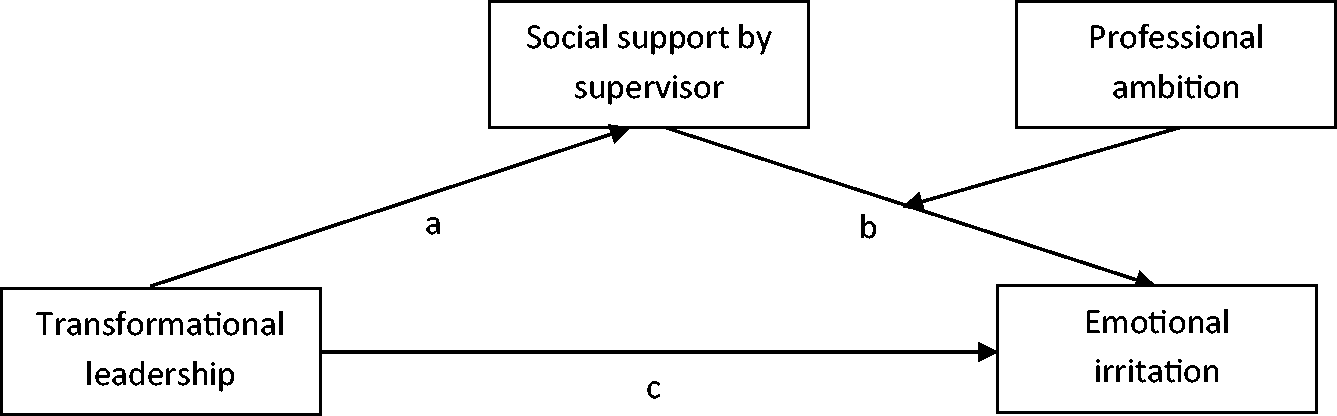
Transformational leadership is often addressed to the whole group (Korek et al., 2010; Nielsen and Daniels, 2012) by setting group goals, developing a specific group climate or fostering team spirit. It is one of the central tenets of transformational leadership to establish group cohesion, collective efficacy and identity (Shamir et al., 1993). Feinberg et al. (2005) even noted that building consensus is one of the main tasks of transformational leadership. This implies that transformational leaders will treat followers equally and not substantially differ in the amount of social support they give. Therefore, we do not expect path a to be dependent on the level of professional ambition of followers.
By contrast, the role of social support as a mediator between transformational leadership and emotional irritation is expected to differ for followers with high vs. low ambition. This refers to a moderation of path b. Followers with low and high levels of ambition may evaluate the supervisor’s social support differently. That is, individual appraisal processes may account for different relationships between supervisor support and follower strain. The degree to which the supervisor’s behaviour is considered valuable by a follower may depend on individual factors like professional ambition.
Previous research suggests that followers may benefit from transformational leadership to different degrees (Franke and Felfe, 2011; Zhu et al., 2009). We expect the health-promoting effects of transformational leadership to be most apparent for ambitious followers because the leader’s support may be considered more important to them. First, social support by the supervisor indicates that the subordinate is a valued member of the team (Sarason et al., 1996). This appreciation by the supervisor may be especially valued by ambitious followers. Second, as careers are very important to ambitious followers, and the leader has considerable influence on their professional advancement, the leader’s approval may also be more relevant for ambitious followers because it is a precondition of promotion (De Andrés et al., 2010). Moreover, ambitious employees may be especially receptive to transformational leaders because of high goal congruence with their leader (Bono and Judge, 2003). For example, followers reporting high performance orientation were found to evaluate transformational leadership more positively (Ehrhart and Klein, 2001) which might be associated with improved well-being. Being very performance-oriented, this should be true for ambitious followers as well. High importance attached to the leader’s social support in combination with high goal congruence and similarity between leader and follower is hypothesized to result in reduced strain levels for ambitious followers.
By contrast, for followers with low professional ambition the leader’s support may be less important and may thus have a smaller impact on the well-being of these followers. As less ambitious followers are not striving as much for professional advancement (Schaarschmidt and Fischer, 2003), they are less dependent on the leader’s goodwill and positive evaluation which is indicated by supervisory social support (Sarason et al., 1996). Moreover, social support may have detrimental effects under some conditions, for example, when the provision of help represents stressful working conditions (Beehr et al., 2010). We suggest that social support from a transformational leader may at least have less positive effects on less ambitious followers as it is associated with high performance expectations (Bass and Riggio, 2006), which may seem especially stressful to these followers. Furthermore, less ambitious followers may perceive the leader’s support as a means of pushing them to achieve improved performance, which is not their own goal. As a consequence, these followers may not regard the leader’s support as a resource. Thus, the leader’s support may affect follower well-being to a lesser extent.
Concluding, we hypothesize that the followers’ evaluation of the leader’s behaviour (but not the leader’s behaviour itself) may differ according to the followers’ level of professional ambition. Consequently, individual appraisal processes (path b, see Figure 1) but not differential leader behaviour (path a) are proposed to determine the degree to which the follower regards the leader’s support as a resource. We propose a moderated mediation model (Figure 1): H3: The mediation effect of social support in the relation between transformational leadership and irritation is contingent upon professional ambition. In the case of high ambition, we expect a stronger mediation effect of social support than in case of low ambition.
Method
Participants and procedure
A paper–pencil questionnaire was distributed to employees from financial and service sectors, and from real estate firms in a cross-sectional study in Germany. From a theoretical perspective, a study of professional ambition demands a careful sampling strategy to include both ambitious and less ambitious participants. Organizations practicing an up-or-out strategy, for example, would be inappropriate, as selection processes may be in effect in such organizations that could bias the study’s results. We therefore approached organizations which offer career opportunities but do not claim that their employees strive for professional advancement. In this regard, German public banks were deemed to be an ideal sample. Second, as leadership is the focus of the present study, frequent interaction between team and leader is important. Interactions on a regular basis may be necessary to develop the hypothesized effects of leadership characteristics on followers’ emotional strain. The health-promoting effect of supervisory social support especially demands close and frequent contact. We focused on financial institutions, the service sector, and real estate firms because employees in these fields typically have daily interactions with their leaders. Sixteen of the participating organizations were from the financial sector while three organizations were real estate firms and one organization was from the service sector. The participants were asked to fill in the questionnaire during their working hours. Participation was voluntary and anonymity assured. Small groups of up to 10 employees filled in the questionnaire at the same time in the presence of a researcher. Thus, all participants handed in a questionnaire. Two hundred and eleven questionnaires were returned, of which 199 questionnaires contained no missing values. Participants reported a mean age of 35.87 (SD = 9.96) years and a mean tenure of 116.11 (SD = 73.69) months. Sixty-one percent were female and 39% were male. Thirty-one percent had a university degree.
Measures
Transformational leadership
The present study used the German version (Felfe, 2006) of the Multifactor Leadership Questionnaire (Bass and Avolio, 1995) to measure transformational leadership. This scale consists of 20 items and assesses the four sub-dimensions of transformational leadership: Inspirational motivation, idealized influence (attributed and behaviour), intellectual stimulation, and individual consideration. Previous research has demonstrated these sub-dimensions to be highly interrelated (Judge and Piccolo, 2004). Consequently, they cannot be regarded as independent factors (Carless, 1998). In line with other research (Liaw et al., 2010), the present study therefore utilises the total score for the construct. The reliability figures indicate very good internal consistency (Cronbach’s α = 0.93). Responses were rated on a 5-point Likert scale ranging from 1 (never) to 5 (regularly, almost always).
Irritation
Emotional strain was measured by the emotional irritation scale (Mohr et al., 2005), which consists of five items. A sample item is ‘I get irritated easily, although I don’t want this to happen’. Regarding construct validity, irritation has been found to relate positively to stressors (Mohr et al., 2006). Moreover, irritation has also been demonstrated as an antecedent of depression (Dormann and Zapf, 2002), psychosomatic symptoms (Höge, 2009), and impaired sleep (Berset et al., 2011). The irritation scale displayed good reliability in the present sample (Cronbach’s α = 0.81). It was combined with a 7-point Likert scale ranging from 1 (not true at all) to 7 (almost completely true).
Social support by supervisor
Participants indicated the degree of work-related social support they receive from their supervisor. A scale by Frese (1989) was used consisting of five items. A sample item is ‘How much is your supervisor willing to listen to your work-related problems?’ The scale displayed good reliability in the present study (Cronbach’s α = 0.83). Participants rated the social support provided by their supervisor on a 4-point Likert scale ranging from 1 (not at all) to 4 (completely).
Professional ambition
The measure of professional ambition employed in the present study was taken from the AVEM (Schaarschmidt and Fischer, 2003), an instrument for the assessment of health-relevant behaviour and experiences in the workplace. High levels of ambition are related to psychological health and distinguished from the risk pattern known as type A personality (Friedman and Rosenman, 1974) which is associated with a lack of detachment from work and a susceptibility to risking depletion of resources. We used the four items with the highest item-total-correlations as reported by Schaarschmidt and Fischer (2003). A sample item is: ‘I want to achieve more in my career than most people I know’. Internal consistency indicated good reliability (Cronbach’s α = 0.87). Likert response categories ranged from 1 (not at all true) to 5 (completely true).
Control variables
In order to control for possible biases, demographic data were also collected which may impact followers’ emotional strain; the study controlled for the effects of sex, age, weekly working hours, and education. Sex was coded 0 for women and 1 for men. As men indicated significantly higher professional ambition than women in our sample, we included sex as a control variable in our analyses. Controlling for the effects of age was deemed appropriate in the context of health. We also controlled for weekly working hours as a proxy for work demands, which is mostly unable to be influenced by the leader. Finally, the study controlled for the effect of education since education may relate to professional ambition and followers’ emotional strain. Participants indicated their highest educational level. According to the tripartite German educational system, education was classified as follows: 1 = basic secondary school, 2 = secondary school, 3 = higher secondary school, 4 = vocational education, 5 = vocational academy, 6 = university.
Analyses
As transformational leadership and supervisory social support are conceptually related, a confirmatory factor analysis was computed using the software Amos 20.0 (Arbuckle, 2011) to ensure that they can be treated as two distinct concepts. We compared a one-factor model (χ2 (275) = 770.73, CFI = 0.79, RMSEA = .10) to a two-factor model which treated transformational leadership and social support by the supervisor as distinct but related constructs (χ2 (274) = 653.64, CFI = .84, RMSEA = 0.08). A chi-square difference test indicated that the two-factor model achieved a significantly better fit to the data than the more parsimonious one-factor model (Δχ2 (1) = 117.09, p < 0.001). Although the fit of the two-factor-model is not good, the results indicate that transformational leadership and supervisory support are distinct concepts. Moreover, as the most critical point is to demonstrate that individual consideration can be differentiated from supervisory social support, we additionally compared a one-factor model (χ2 (27) = 86.01, CFI = .91, RMSEA = .11) to a two-factor model (χ2 (26) = 51.26, CFI = .96, RMSEA = 0.07) in which items referring to individual consideration and items referring to supervisory support loaded on separate factors. The two-factor model displayed significantly better fit (Δχ2 (1) = 34.75, p < 0.001). Consequently, it can be concluded that both transformational leadership, as a compound measure, as well as individual consideration can be distinguished from supervisory support.
Statistical approach
All hypotheses were tested using regression analysis in combination with bootstrapping, a statistical re-sampling method. Bootstrapping involves the drawing of a large number of subsamples from the original sample, within all of which the analyses are performed. The number of re-samples was set to N = 5000 as suggested by Hayes (2009). Hypothesis 2 was tested by applying a macro for indirect effects by Preacher and Hayes (2008). Contrary to the classic causal step procedure (Baron and Kenny, 1986), the procedure by Preacher and Hayes (2008) can directly estimate indirect effects. Consequently, an indirect effect can be detected even when a direct effect is missing (Hayes, 2009). Confidence intervals for the true score of the indirect effect are specified and the null hypothesis is rejected if the confidence interval excludes zero. Since bootstrapping does not assume a normal distribution of the data, it has been demonstrated to result in more accurate confidence intervals of indirect effects compared to the classic stepwise procedure (MacKinnon et al., 2002). Hypothesis 3 proposed that the effect of transformational leadership on irritation would be mediated by social support and that this mediation effect would be moderated by professional ambition (moderated mediation, see Figure 1). Again a macro for SPSS (Preacher et al., 2007) was applied to estimate the moderated mediation involving a bootstrap procedure. In a moderated mediation either path a or path b or both may be moderated by a third variable. Significance of the conditional indirect effect is indicated by the bootstrap confidence interval.
Results
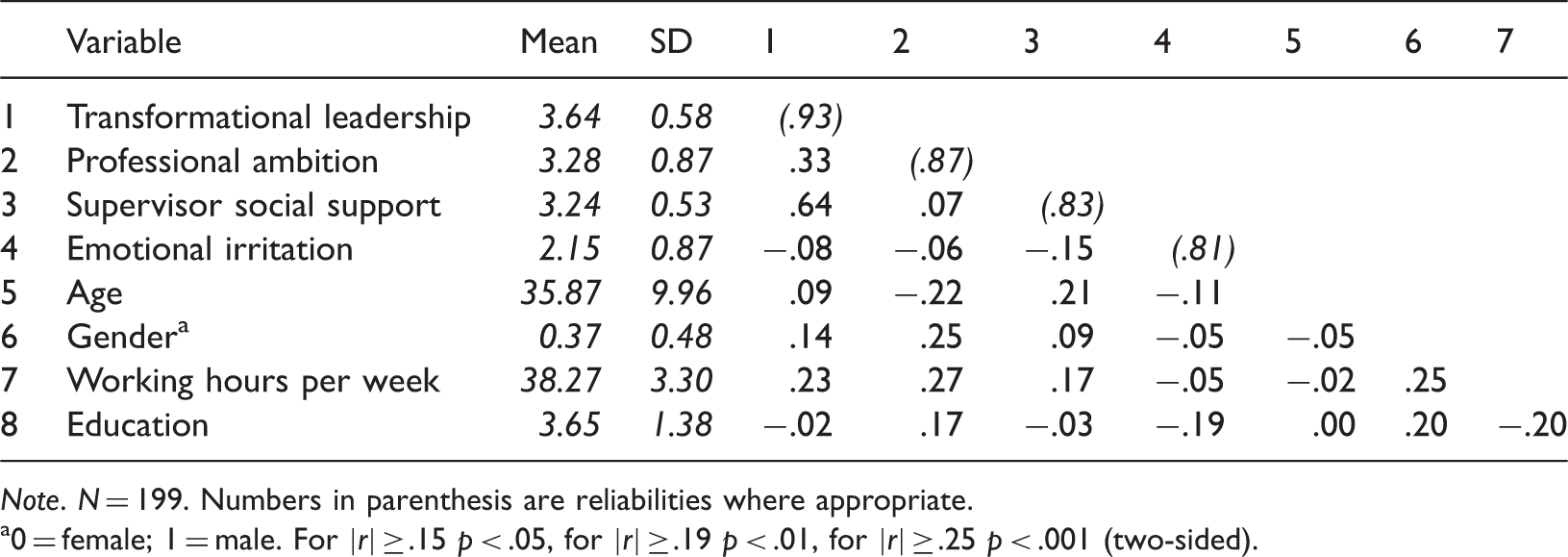
Means, standard deviations, correlations, and internal consistencies for all study variables.
Note. N = 199. Numbers in parenthesis are reliabilities where appropriate. a0 = female; 1 = male. For |r| ≥ .15 p < .05, for |r| ≥ .19 p < .01, for |r| ≥ .25 p < .001 (two-sided).
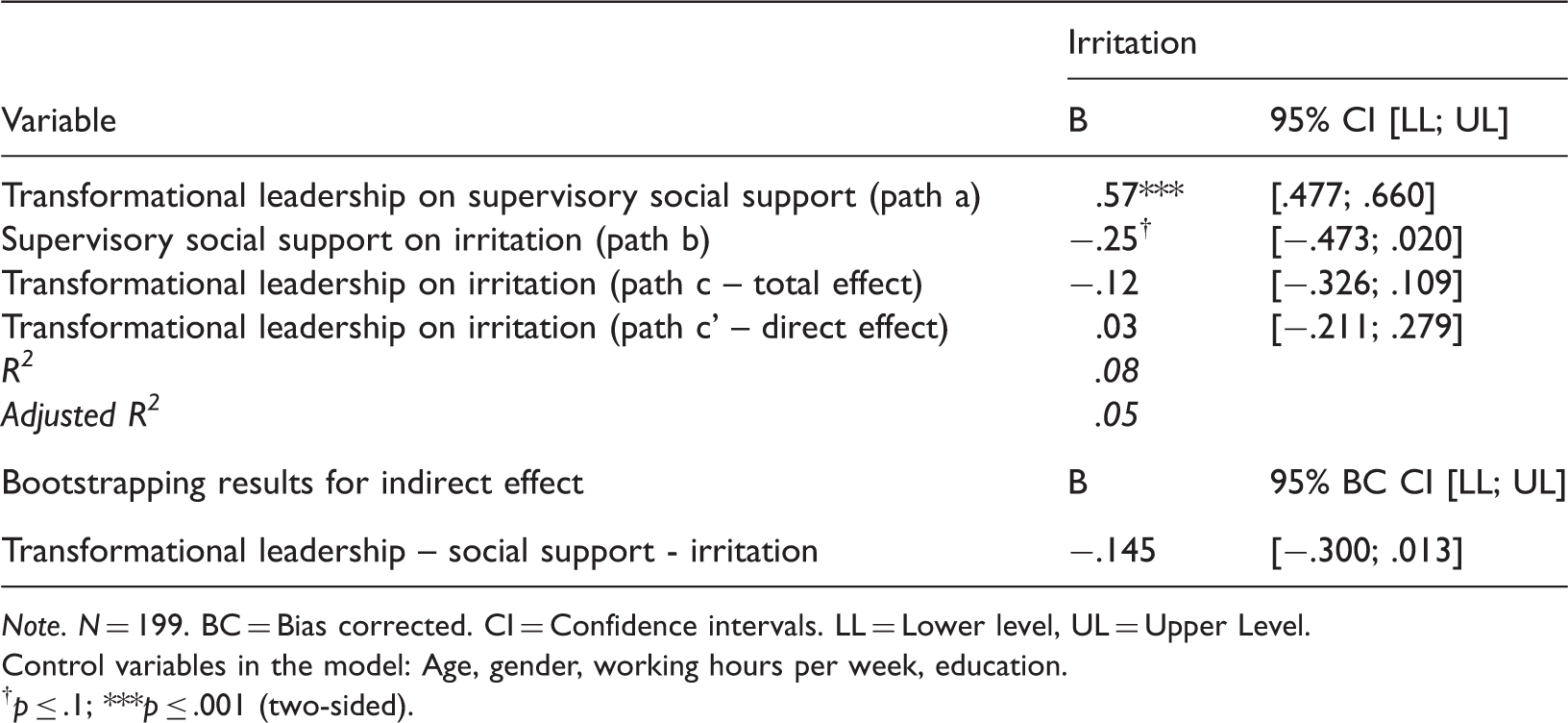
Regression results for mediation model.
Note. N = 199. BC = Bias corrected. CI = Confidence intervals. LL = Lower level, UL = Upper Level.
Control variables in the model: Age, gender, working hours per week, education. †p ≤ .1; ***p ≤ .001 (two-sided).
Second, it was proposed that supervisory social support would mediate the relation between transformational leadership and irritation. The hypothesis was assessed using a macro for indirect effects (Preacher and Hayes, 2008). As the confidence interval contained zero, mediation by supervisory social support was not supported. Though path a of the mediation model was significant (B = 0.57, p < 0.001), path b was not (B = -0.25, n.s.). As previously mentioned, a direct effect of transformational leadership on irritation (path c) was not found. Nevertheless, according to Preacher and Hayes (2008) a significant path c is not necessary to support mediation. Results are presented in Table 2.
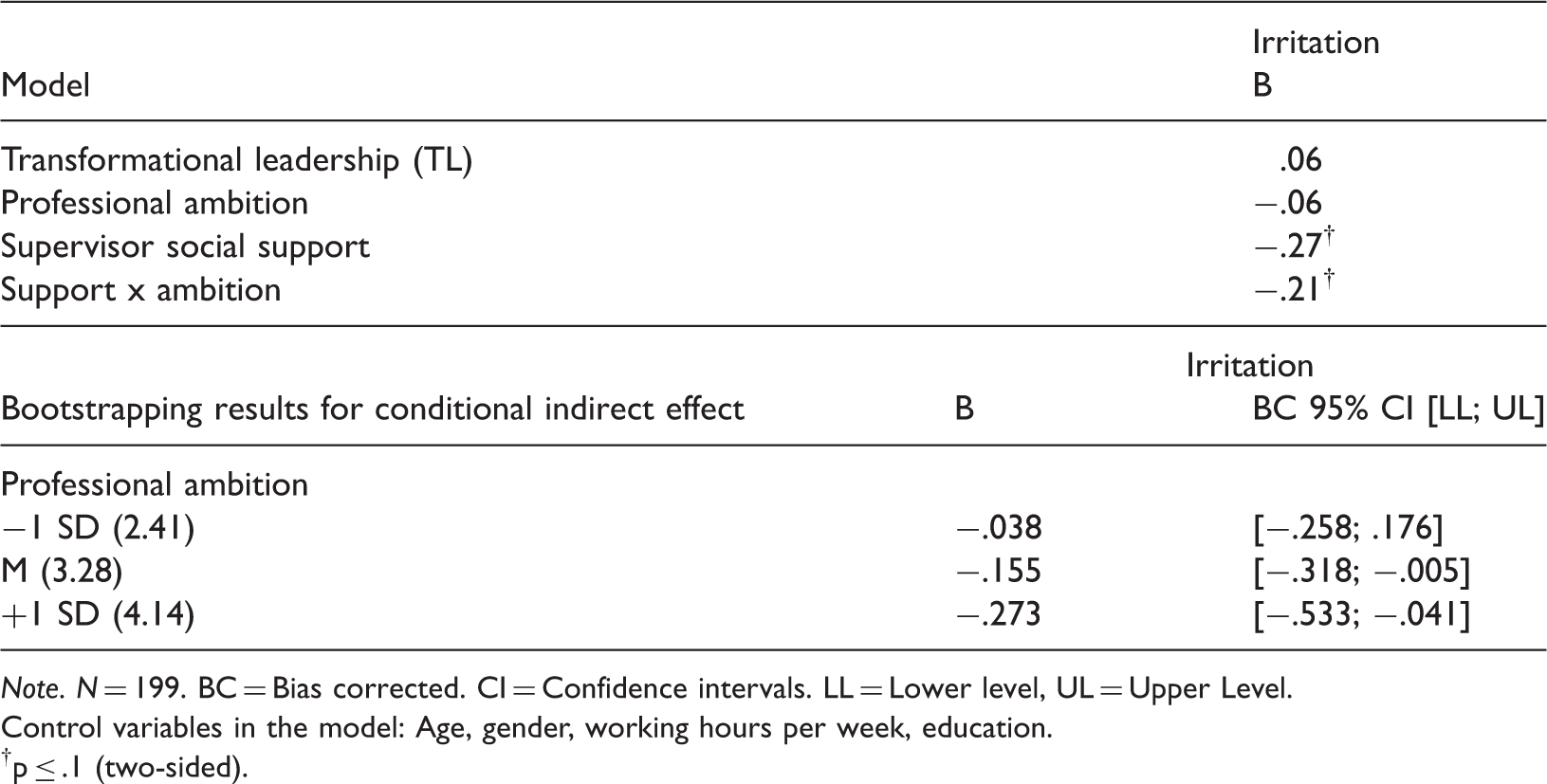
Thirdly, we hypothesized that the mediation by supervisory social support would be conditional upon professional ambition. Thus, for ambitious employees social support by a transformational leader is hypothesized to impact irritation to a greater degree. To test this hypothesis, a moderated mediation analysis was computed to estimate the conditional indirect effect of transformational leadership on irritation (Preacher et al., 2007). The conditional indirect effect determines whether different levels of professional ambition influence the strength of the mediation. High and low levels of professional ambition were operationalized as one standard deviation below and above the mean score as suggested by Preacher et al. (2007). First, we assessed path a of the mediation model (see Figure 1) as being conditional upon professional ambition to examine if – against our assumption – less ambitious employees feel less supported by their leader. We estimated the indirect effect using a bootstrap procedure. As expected, the indirect effect did not vary for different levels of professional ambition indicating that path a of the mediation model (see Figure 1) was not moderated by professional ambition. Thus, the procedure for a moderated mediation of path b (effect of supervisory social support on irritation) was applied. Results indicate a significant conditional indirect effect for high professional ambition (B = -0.27, p < 0.05). The bootstrap 95% confidence interval excluded zero when professional ambition was high ( + 1 SD) and when it was medium but not in the case of low ambition (- 1 SD). Thus the mediating effect of supervisory social support between transformational leadership and irritation applies only to employees with medium to high professional ambition (see Figure 2). Consequently, hypothesis 3 is supported. Estimates and significance levels are displayed in Table 3.
Interaction between supervisory social support and professional ambition. Regression results for conditional indirect model. Note. N = 199. BC = Bias corrected. CI = Confidence intervals. LL = Lower level, UL = Upper Level. Control variables in the model: Age, gender, working hours per week, education. p ≤ .1 (two-sided).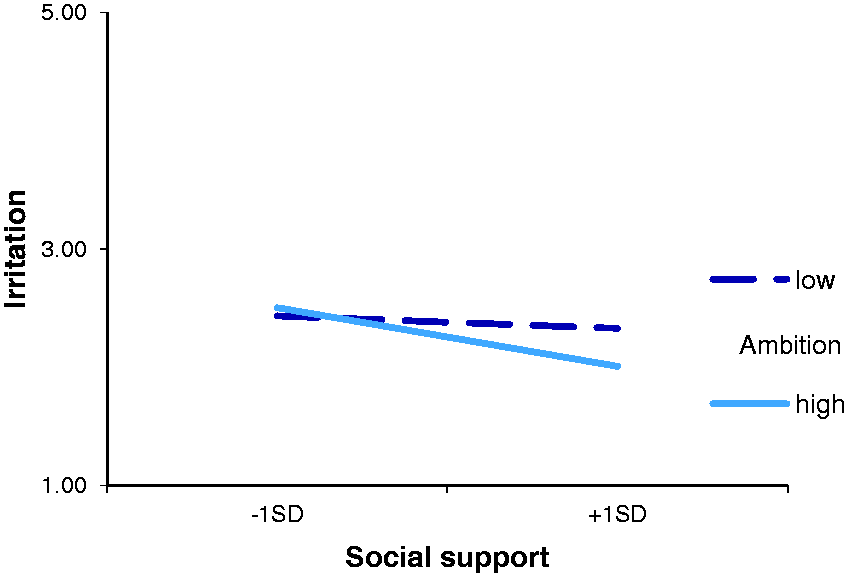
Discussion
The JD-R model suggests that leaders can impact their subordinates’ emotional strain by imposing job demands and providing job resources (Schaufeli and Bakker, 2004; Schaufeli et al., 2009; Ten Brummelhuis et al., 2011). Though both negative (Tepper, 2000; Pelletier, 2011) and positive effects (Nielsen et al., 2008) of a leader’s behaviour have been reported in the literature, transformational leadership has so far mainly been linked to positive effects on followers’ well-being (Skakon et al., 2010). Results from this study demonstrate a more detailed picture and indicate that transformational leadership is not necessarily positively related to follower well-being for all followers.
In line with previous research (Skakon et al., 2010), it was hypothesized that transformational leadership would be positively linked to follower well-being and thus negatively related to irritation, a work-related indicator of emotional strain (Mohr et al., 2006). After controlling for age, gender, education, and weekly working hours, transformational leadership and irritation were practically unrelated. Consequently, the first hypothesis was rejected. This result differs from findings of previous studies on the relationship between transformational leadership and follower well-being as reviewed by Skakon et al. (2010). It may be due to the operationalization of irritation as a negative indicator of follower well-being as opposed to the positive operationalizations in other studies (e.g. Arnold et al., 2007; Nielsen et al., 2008). Stordeur and colleagues (2001) also found, when they utilised a negative indicator of well-being, that transformational leadership was unrelated to organizational stress. Moreover, this result is not at odds with the implications of the JD-R model. It may depend on subjective evaluation as to whether subordinates mainly focus on the demands or the resources provided by a transformational leader. Thus, some variability in relationships can be expected.
Second, the present study examined supervisory social support as a mediator between transformational leadership and follower irritation. Transformational leadership explicitly involves the provision of social support (Bass and Riggio, 2006). In line with the JD-R model (Demerouti et al., 2001; Schaufeli and Bakker, 2004) and previous research (Nielsen and Daniels, 2012; Sosik and Godshalk, 2000), the present study hypothesized that transformational leaders may influence their followers’ emotional strain by providing social support. Results reveal that although transformational leadership was significantly related to supervisory social support, supervisory social support was unrelated to followers’ irritation. Thus, the hypothesized mediation of supervisory social support was not confirmed. Previous research on the relation between social support and follower well-being has revealed mixed results. A meta-analysis by Viswesvaran et al. (1999) only demonstrated a weak relation. Moreover, although a number of studies have found support for a main effect of social support on follower well-being, this effect has not been found in other studies (Van der Doef and Maes, 1999; Häusser et al., 2010). The ambiguity of empirical findings regarding the relationship between transformational leadership and follower well-being, as well as the hypothesized mediation by supervisory social support, call for research on moderators. Dvir and Shamir (2003) have suggested followers’ different receptiveness to transformational leaders may depend on motivational processes. Consequently, the present study investigated a moderator with a strong motivational component, professional ambition.
The third hypothesis proposed that the mediation by supervisory social support may depend on the extent of professional ambition. Two different processes may account for this moderated mediation: First, highly ambitious followers might perceive transformational leadership to be more supportive than less ambitious followers (path a in Figure 1). Second, the leader’s support may be differently evaluated by the followers, which means that individual appraisal processes may account for this outcome (path b in Figure 1).
We hypothesized that the latter process would be relevant in the context of professional ambition as transformational leaders are defined as supporting all followers (Bass and Riggio, 2006). Path a of the mediation model (Figure 1) was not found to be conditional upon professional ambition. Thus evidence of the first process was not found. However, a moderated mediation analysis of path b (Preacher et al., 2007) found support for the second process. The relation between transformational leadership and follower irritation was mediated by supervisory social support for medium and highly ambitious employees. However, this was not true for followers with low professional ambition (see Figure 2), thereby confirming hypothesis 3. The same pattern of results was revealed for all four facets of transformational leadership.
The moderation of path b of the mediation model indicates that individual evaluation or appraisal processes seemingly account for the effect leading to less irritation among highly ambitious employees. Professional ambition may determine the degree to which the supervisor’s supporting behaviour is perceived as a resource by the follower. Ambitious followers might perceive supervisory support as a helpful acknowledgement which emphasizes that the leader appreciates the follower. This positive effect may again result in lower levels of strain. Though the supervisor’s support was confirmed as a mediator for ambitious followers, it was not a full mediation indicating that other mediating variables may be existent.
Conversely, less ambitious subordinates may experience the supervisor’s support as less helpful, so that the leader’s behaviour may not be an equally important resource for them. Followers with low professional ambition may even feel pressured by their supervisor to produce superior performance. Moreover, it has been demonstrated that social support may have adverse effects, for example when help represents demanding working conditions (Beehr et al., 2010). Although no negative effects of supervisory social support were found in this study, the results indicate that social support is not always connected to increased well-being.
When comparing our results to the study by Franke and Felfe (2011), the results referring to the moderator apparently differ. While the present study found high professional ambition to amplify the mediation effect, Franke and Felfe (2011) found the opposite pattern when analyzing organizational commitment as a moderator between transformational leadership and strain. We argue that the different focus of the moderators (ambition focuses on career goals while organizational commitment focuses on the current employer) can account for this divergent finding: Highly ambitious employees can of course be almost uncommitted to their organization if they, for instance, perceive that their current employer does not offer opportunities to fulfil their professional goals. Differently, employees with low ambition can display strong organizational commitment when their career goals are fulfilled by their employer. Taken together, both constructs denote different work-related aspects and their effect in empirical studies can thoroughly differ.
Dvir and Shamir (2003) proposed that employees may be differentially receptive to transformational leadership. Zhu et al. (2009) found that innovative followers who were willing to take risks profited more from transformational leadership than other followers. The present study suggests that highly ambitious followers may also be especially well suited to transformational leadership, as they seem to appreciate leader’s social support more than less ambitious followers. It has previously been demonstrated that followers with high levels of extraversion, an internal locus of control, and low neuroticism report higher levels of social support (Chay, 1993; Swickert et al., 2010). Nevertheless, the present study did not reveal any differences with respect to the perceived level of supervisory social support for followers with high and low professional ambition. This is in line with theory suggesting that transformational leaders will value and support each of their followers (Bass and Riggio, 2006). Consequently, a different tendency to get support from the supervisor does not account for our results.
Moreover, the support for the moderation by professional ambition may partly explain the rejection of hypothesis 1 and 2, as a positive relation between transformational leadership and emotional strain as well as the proposed mediation by supervisory social support only holds true for a subsample but is different for other employees. It can be concluded that individual differences between subordinates, such as for example different levels of ambition, should be considered when applying the JD-R model in a leadership context.
Limitations and strengths
A number of limitations have to be taken into consideration when interpreting the results of this study. First, due to the cross-sectional design, causal inferences cannot be made from the present study. However, well-founded longitudinal research assessing relationships between job characteristics and well-being (De Jonge et al., 2001; Ter Doest and De Jonge, 2006) as well as between leadership variables and well-being (Nielsen et al., 2008) suggest that models of regular causation (i.e. leadership/job characteristics impact well-being) achieve a better fit than models of reverse or reciprocal causation. These studies support our interpretation. Likewise, causal interpretation of the mediation by supervisory social support based on cross-sectional data is not appropriate. Nevertheless, previous longitudinal research has found that follower stress can be reduced by the leader’s social support (Moyle, 1998).
Common method bias may also have affected the results of this study as only one method and one data source were employed. However, according to Chan (2009) self-reports may be the best way to assess private events. Likewise, the individual employees should be best suited to judge their own professional ambition because they know best about their future plans and goals. The same applies to emotional strain. Nevertheless, other measures of strain including physiological indicators could be considered an alternative measure, in future replications of these results. Transformational leadership and social support by the supervisor can be assessed by both leader and subordinate though typically judged by the subordinate. We chose to rely on the subordinates’ perspective of their leaders’ behaviour and social support because the subordinates’ individual perception is important for their emotional strain. Moreover, evaluation by the leader may be subject to demand characteristics which again may bias the study’s results. As recommended by Conway and Lance (2010) we used established scales with acceptable internal consistency for which construct validity has been demonstrated. Furthermore, confirmatory factor analysis indicated that transformational leadership and supervisory social support can be regarded as two distinct factors (see above).
Despite of these limitations, the present study lends initial support to professional ambition as a moderator of the relationship between transformational leadership and follower emotional strain. With respect to the sampling strategy, we focused on employees in banks, insurance, service and real estate firms because followers are likely to interact on an almost daily basis with their leaders in these occupational fields and frequent interaction makes the effects of leadership characteristics on follower emotional strain more likely. Second, we aimed to include organizations which are attractive for both ambitious and less ambitious employees to ensure sufficient variance in professional ambition. We therefore excluded organizations practicing an up-or-out strategy. As can be seen from Table 1, the variance of professional ambition was comparable to other scales not indicating restricted variance.
Implications
Over recent years, research has concentrated on global, positive effects of transformational leadership and on general mediating variables. The results of the present study suggest that there is need for a more individualistic view of the effects of transformational leadership. Characteristics of dyads of leaders and subordinates (Graen and Uhl-Bien, 1995) should be taken into account in considering effects of transformational leadership. Furthermore, as not all employees are equally affected by a transformational leader (Dvir and Shamir, 2003), it may also be worthwhile taking into account the individual characteristics of the subordinate, such as professional ambition. These individual characteristics may determine whether the transformational leader’s behaviour is perceived as a resource by the followers which in turn may account for different reactions to a transformational leader. The present study highlights that transformational leadership may not have positive effects on the emotional strain of all followers. Consequently, it seems important for leaders to consider carefully which leadership behaviour may be appropriate for which of their subordinates. For example, supervisory social support appears not to be an effective way to promote follower well-being for followers with low professional ambition.
In the present study transformational leadership and follower professional ambition were significantly correlated (r = .33, p < 0.01, see Table 1). This may reflect the tendency of ambitious employees to evaluate their leader as more transformational, or the tendency of leaders’ to put more effort into ambitious team members.
On the other hand, transformational leaders may also promote professional ambition. Shamir et al. (1993) have argued that transformational leaders stimulate their followers’ motivation. But while transformational leaders emphasize high moral standards, collectivism and a common purpose, high professional ambition includes a strong focus on individual professional advancement. Nevertheless, future research should try to disentangle the relationship between transformational leadership and professional ambition to find out if these constructs are causally related. Moreover, the stability of professional ambition deserves some attention (Judge and Kammeyer-Mueller, 2012). Both these issues call for longitudinal research. Future research may also focus on goal congruence between leader and subordinate and investigate the fit between follower and leader. The results of this study also indicate that there may be no general health-promoting mode of leadership. Rather, interventions for teaching health-promoting leadership should consider the individual motives of employees. As a consequence, training programs of health-promoting leadership should be tailored to each team and team member.
Footnotes
Funding
This research was supported by a grant from the Deutsche Forschungsgemeinschaft (DFG), grant number: Mo 440/4-1 (2).