



Abstract
The current scenario of management education in the UK is impressive, but its emergence has been a slow process. A time chart attempts to identify the events influencing this process. The chart is the result of a review of key publications, supplemented by a number of interviews. A model is proposed to account for the historical development found; it draws on the insights provided by cultural theories, force field theory and institutional theory. The implications for leadership research in the development of a functional area such as management education is touched on via the concept of ‘serial leadership’.
Keywords
Introduction
Formal management education today attracts more participants to UK universities than any other group of disciplines (ABS 2010/11) . A key event in this development is often identified as the publication of the Franks (1963) report on British business schools. But there were many events before and after this milestone that need to be identified before an acceptable historical picture can be painted of the emergence of management education in the UK. The purpose of this paper is to highlight what appear to be the critical events (Williams 2010). While a milestones chart is a useful way of tackling this, from an academic viewpoint the value comes when drawing on appropriate theories that help explain the findings. In attempting this the focus will be on the literature associated with field theory (Lewin 1951), institutional theory (DiMaggio and Powell 1983), organizational culture and leadership (Schein 1985).
There are four sections. First, a brief account will be given of the research approach used. Second, some of the main findings and generalizations will be outlined. Third, an ‘integrative’ dynamic model will be presented, which attempts to make sense of the accumulation of forces that have led to the present position of formal management education, particularly those aspects embodied in the ‘business school industry’. Fourth, appropriate literature on leadership, culture and change will be explored to make more sense of the proposed model. The conclusions will draw attention to a widened perspective on leadership, and to the research implications for ‘serial leadership’ in an institutional environment.
Methodology
The task of unravelling the history of a function such as management education is a complex challenge. Limiting the scope to the UK made it more manageable. The pathway followed in arriving at a list of chronological ‘events’ was to explore ‘consensus’ found in the literature, to examine new sources of information (e.g. from the internet), and to conduct interviews with a selection of individuals who have had an impact on recent history. One outcome of these interviews was to drop the original intention of including academic publications as examples of ‘events’; it soon became apparent that little consensus was likely to be obtained when naming key publications. While many publications are relevant in unravelling the emergence of management education, particularly useful sources of information included the publications of Child (1969), Brech (2002), and Wilson and Thomson (2006). These are highlighted because of their relevance to the objectives of this study as opposed to other scholarly works focusing on the historical purpose and effectiveness of business schools in the USA (Khurana 2007) and in the UK (Starkey and Tiratsoo 2007), and on the influence of the ‘American model’ in Europe (Engwell and Zamagni 1998; Locke 1989). Further details on methodology, particularly on individuals interviewed, can be found in two other publications (Williams 2007, 2010).
The qualitative nature of the research on which this paper is based means that the critical events identified reflect the judgements of the author and other scholars who have written about the formal developments of management education in the UK. The aim is not to arrive at new facts but to arrange the key events in their chronological sequence, and to use these findings as a basis for arriving at an explanatory model for the development of formal management development in the UK.
The milestones identified with this approach are presented in Figure 1. The next section will elucidate a selection of these events so that a linked narrative emerges of the function being studied. This narrative is intended to draw out some of the dominant driving forces, and is not designed to be a comprehensive literature survey (hence the use of the term ‘overview’). This task has been tackled with varying degrees of success in other publications (e.g. Brech 2002; Child 1969; Keeble 1992: Wilson and Thomson 2006).

Milestones in the development of business and management education in the UK (Williams 2010)
An overview of the findings
In the eighteenth and nineteenth centuries the pioneering institutions introducing an educational element among those occupying managerial positions were likely to have been categorized as learned bodies, engineering institutions and associations. Their main value from an educational point of view was for networking and for gathering information. Events and publications were launched that enabled individuals to exchange relevant knowledge and thus to promote informal learning from each other.
The idea that business and commerce had a knowledge base that could be taught, and that owners/leaders and their ‘managers’ could acquire this knowledge more effectively through formal learning courses, was not readily recognized. Influential beliefs contributing to these widespread attitudes included: good leaders in business are born and not made; technical knowledge in the professions such as mechanical engineering or accountancy can be taught, but knowledge relevant to more judgemental issues (e.g. strategy and human resource management) was only acquired by a combination of experience and inherited abilities. Moreover, few academics in the nineteenth and first half of the twentieth century saw business and management as sufficiently ‘academic’ to form the basis for a degree at a university.
From time to time those in positions of responsibility displayed leadership by initiating activities aimed at increasing productivity. The productivity criterion was a particularly powerful force for change during and after the First and Second World Wars. The complex forces created by war led to developments in knowledge, in the emergence of new institutions, and in government initiatives in management education. Thus Charles Myers, head of the Psychological Laboratory at Cambridge University, recognized the relevance of psychology-inspired research in the munition factories to industry and hence his formation of the National Institute of Industrial Psychology (NIIP) in 1921 (Myers 1933). Similarly, after the Second World War, the Tavistock Institute of Human Relations (TIHR) was formed as a result of the benefits achieved in applying the knowledge and skills of psychiatrists and social scientist to problems encountered in war.
One of the early promoters of management education in the UK was Colonel Lyndall Urwick (Brech et al. 2010). As a serving officer in the First World War he helped his superiors solve various organizational problems. In this context his attention was drawn to a publication of Taylor (1911) on scientific management. The importance of ‘evidence-based’ knowledge to improving productivity influenced much of his later thinking, as did his years of experience as an employee of the enlightened industrialist Seebohm Rowntree. In 1934 he foundered the Urwick–Orr partnership to provide the sort of management consultancy that he had been practising as an employee and adviser. His efforts to promote the principles of scientific management were reflected in the many lectures and courses he gave. His interest and reputation in management education led to the Department of Education inviting him to chair a committee on management education at the end of the Second World War. The outcome was a report that led to the establishment of the Diploma in Management (Urwick 1947). This was the first ‘standardized’ qualification relating to management education in the UK.
In the 1940s British universities were still reluctant to become involved in management education, despite the early initiatives of the London School of Economics (LSE) (Dahrendorf 1995), Manchester and Birmingham. One of the drawbacks was that there was no unified body to represent managers. Previous attempts in the 1920s by Elbourne had failed to make much impact (Brech 2002). The turning point came with the publication in 1945 of the Baillieu Report, which proposed the formation of the British Institute of Management (BIM) (Baillieu 1945). The educational influence of the BIM was slow to develop, but over the years it has progressed towards its goal of achieving professional status for managers. In 2000 it achieved chartered status and rebranded itself as the Chartered Management Institute.
In the 1950s and early 1960s there was a significant change taking place in the attitudes of key people in industry. Several of these had first-hand experience of American business schools, and others had been on visits organized by the British Productivity Council (Mace 1952). Also the Administrative Staff College at Henley, which had been set up by a group of forward-thinking industrialists to run formal courses for senior managers, was demonstrating the potential value of such programmes for industrial leaders (Rundle 2006). Meanwhile the polytechnics, with their work-based orientation, were receptive to the idea of management education; indeed many were running the Diploma in Management when the London Business School (LBS) and Manchester Business School (MBS) were formed, and as far back as the 1920s Regents Polytechnic made a pioneering attempt to introduce a management qualification.
For their part the universities needed further incentives to move in this direction. These incentives came when a group of industrialists formed a body in 1960 to collect and distribute money for the development of management education – the Foundation for Management Education (FME) (Nind 1985). About the same time several government initiatives resulted in the publication of reports sympathetic to state-supported management education (Crick 1964; NEDC 1963; Robbins 1963). But it was the work and publication of the unifying Franks (1963) report that lay the foundations for a clear pathway towards the establishment of British business schools along the lines of the famous American schools. ‘Unifying’ is used intentionally because the report succeeded in lessening the rift between two powerful groups of industrial leaders – those who supported the idea of having management education in the hands of academics and those who strongly opposed this development (the latter were named the ‘Savoy Group’ on 17 June 1963 by Michael Shanks of the Financial Times since this was the hotel where they met). The two major business schools of London and Manchester were established as recommended by Franks (1963), and their first cohorts of students were recruited in 1965/6.
By 1965/6 the management departments in the polytechnics were already well established, and as soon as they gained university status they began to compete with the two ‘model’ schools for students with the support of the FME and the University Grants Committee (UGC, the body through which the state financed universities). As this sector of higher education grew, so the need for greater cooperation surfaced. The ‘young’ management departments and business schools were often looked down upon by the rest of the academic community; they were all competing for the same limited resources and ‘management’ was not seen as being on a par with the already established academic disciplines of economics, psychology and sociology. Such a threatening environment for the newly emerging discipline created forces to bring together schools from different universities in order to share learning and to protect mutual interests. Informal cooperation became more formal when it became necessary to establish legal entities able to negotiate with industry and government in the interest of the new ‘business school industry’. Thus Council for University Management Schools (CUMS) evolved into the Association of Business Schools (ABS) in 1992 (Williams 2007); and the latter included the management education element of the newly created universities – i.e. the former polytechnics/colleges in the further education sector whose degrees were validated by the Council for National Academic Awards (CNAA). Other regulatory and representative bodies to emerge were the Association of MBAs (AMBA) and the European Foundation for Management Development (EFMD) and its quality assessment agency, the European Quality Improvement Scheme (EQUIS). Yet again an American model was exerting its influence on developments in the UK – the American Assembly of Collegiate Schools of Business (AACSB) was formed in 1919.
The success of any sector in higher education will rest heavily on the quality of their staff and their research. In the 1950s and before, there was little university-based research linked to management education. Any relevant research was associated with disciplines located in other departments such as Economics, Psychology and Sociology. Research was also located within independent institutions that relied for their survival on income from consultancy fees and grants from government departments or charitable foundations (e.g. Nuffield Foundation). The NIIP (Frisby 1970) and the TIHR (Trist 1963) were examples of such institutions.
In the early 1960s the formation of the Association of Teachers of Management (ATM) met a real need for the sharing of teaching syllabuses and learning methods, and for issues relating to quality research in management (Pugh 1966). It must be remembered that at this time few academics had experience of lecturing to managers, and even then it was only on short non-degree courses. Those active in the formation of this association also happened to be involved in the start of the first learned UK journal devoted to management issues (Journal of Management Studies), and in one of the first UK-based research programmes to make an impact on organizational studies (the Aston Studies carried out in the Administration Research Unit, and financed by the Social Science Research Council). When the Association of Management Educators and Developers (AMED, formerly the ATM) became more a vehicle for consultants, academics felt that their research interests were not being adequately met. The conditions were ripe for the emergence of a learned body devoted to management research (McKiernan and Masrani 2008). The British Academy of Management (BAM) was formed in 1986; again a very successful model already existed in the American Academy of Management (AAM), which was founded in 1936 – i.e. 50 years earlier.
The shortage of outlets for quality research papers in the UK led BAM to launch its own journal in 1990. Peer review journals are only one mechanism for improving the quality of research in business schools. Competition for research grants was another mechanism. Unfortunately research proposals from business school academics were relatively unsuccessful in the early years of the Economic and Social Research Council (ESRC) competitions compared to those from the basic disciplines underlying management. By opening up a debate on quality research, BAM was able to show that the problem was not quality as such but that inappropriate frames of reference were being applied by some referees. It was pressure from ABS and BAM that led to the setting up of the Commission for Management Research (CMR) in 1993 to consider the funding and impact of social science research in business and management (Bain 1994). An initiative that partly stemmed from the CMR’s recommendations was the establishment in 2002 of the Advanced Institute of Management Research (AIM) to increase the contribution of world-class UK management research. Appropriate ESRC/ Engineering and Physical Sciences Research Council funds were made available for AIM to carry out its agenda.
Two additional stimuli for enhancing management research in the UK should be mentioned. First, the Research Assessment Exercise (RAE) was introduced by the university-funding bodies for guiding the allocation of the research element of the state funds. The RAE was held at regular intervals, the first full one being administered in 1996. The ratings given to each discipline group within a university had consequences for the reputation and the financing of research for that group. Second, from the 1990s the national and international media started publishing rankings of business schools and some of their degrees so that potential students were able to make better-informed choices. Rankings were already an established feature of the American business school culture. The influence of the Financial Times rankings was particularly important in relation to student and staff recruitment. RAE ratings were part of the criteria used by these media rankings. Both these factors drove the schools to devote more resources to improve the quality of their research output.
Restructuring the chronological record
So far the development of management education in the UK has been represented by a chronological list of associated events (Figure 1). This is one way of facilitating understanding of the development of this function, but drawing useful generalizations from this descriptive structure is limited. The next step is to condense these observations into a few meaningful categories and to hypothesize some useful relationships between them. This has been done in Figure 2. The theoretical assumptions incorporated into this diagram include the complex interactions that take place between the different categories of events, and the roles of leadership and culture in the associated change processes. The following elaborations will clarify these points.
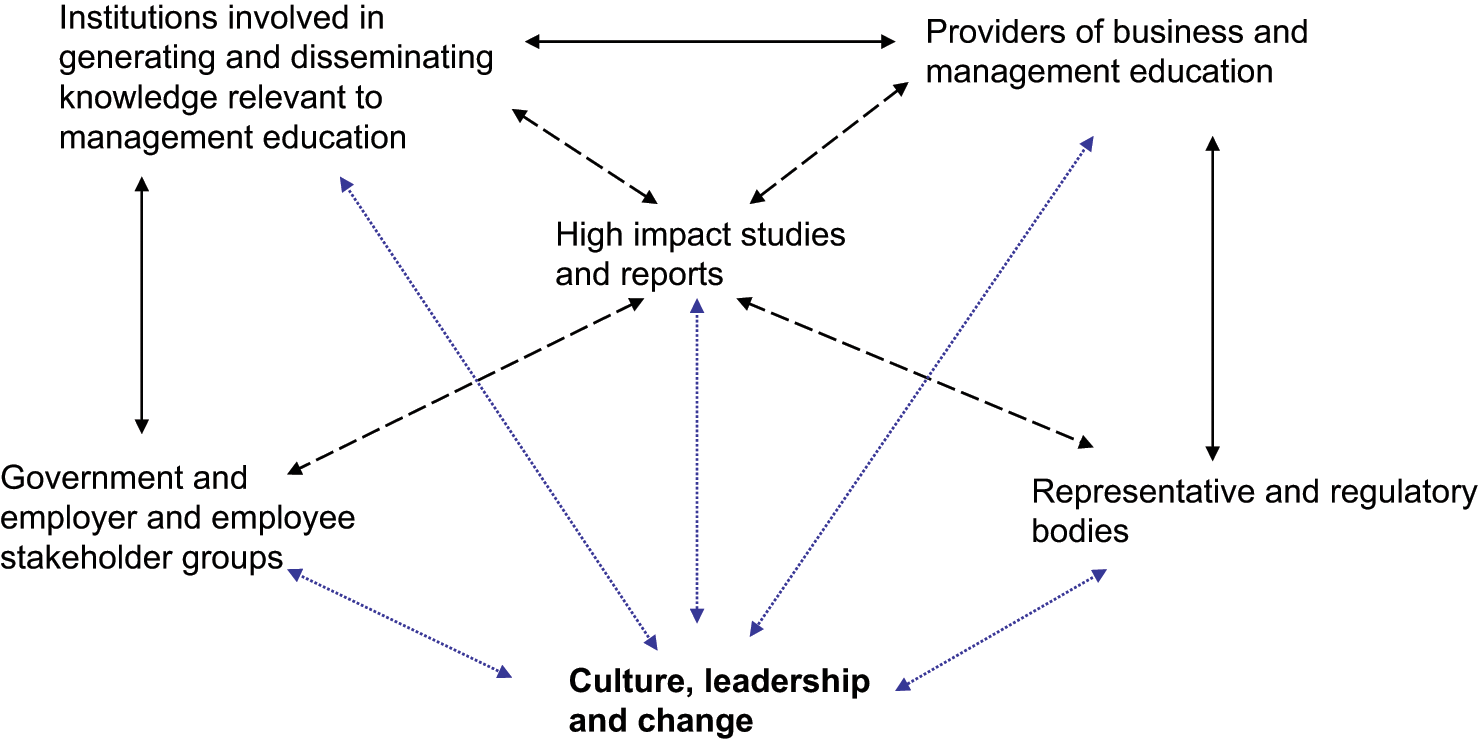
A dynamic model to account for the historical development of management education in the UK (after Williams 2010)
Institutions involved in generating and disseminating knowledge relevant to management education
In the eighteenth and nineteenth centuries it was mainly the professional institutions that contributed to the knowledge and skills that we would now associate with management. This knowledge was initially based on experience, but with time the conduct of scientific research fed into the knowledge pool and appropriate dissemination avenues multiplied and emerged. Thus we find that an early thought leader was the American Frederick Taylor (1911), an engineer, who packaged his ideas based on work experience in a publication on scientific management. In the UK Charles Myers (1920), who headed the psychological laboratory at Cambridge University, lectured and published on the contributions of psychology to work and management. In 1921 he was instrumental in forming the NIIP, a body that remained active in research and consultancy for 50 years (Blain 1970). The knowledge generated in the first half of the twentieth century, and which has subsequently influenced the content of management education, was mainly authored by American academics. This changed in the latter half of the twentieth century as more UK authors impacted the knowledge generation scene associated with management and business. The highly successful editions of Writers on Organisations reflect this trend (Pugh and Hickson 1997; Pugh, Hickson and Hinings 1964), as do the appearance of academic journals on marketing, management, operations research, finance, and so on, published in the UK (Williams 2010).
Providers of business and management education
As we have seen, UK academic institutions made a slow start in this area, but in the 1960s favourable conditions for growth were created with the publication of the Franks (1963) report, the financial support of industry via the FME, and the financial support of government via the FME and the UGC. Today students studying business and management in public and privately funded institutions constitute 15 per cent of the total complement of higher education students in the UK. Other providers such as the professional institutions and management consultancies continue to play their part.
Government, employer and employee stakeholder groups
The success of business and management education is of direct interest to government (given its responsibility for the economy and society), to employers (e.g. recruiting MBAs is expected to give a competitive edge) and to current and future employees (the possession of an MBA or equivalent is expected to increase career opportunities). Given the probable motives of these key stakeholders, it is not surprising to find that the demand for management education has been so high.
Representative and regulatory bodies
The belated (compared to the USA) but impressive growth of management education, has led to the emergence of the business school industry. Thus we find that informal pressure groups (e.g. CUMS) were transformed into legal bodies such as the ABS. Additional bodies were formed to protect and promote the quality standards for business school qualifications and research outputs – e.g. AMBA and BAM. This consolidation of the legitimacy of the business school industry was further facilitated by earlier and later developments on the international front – e.g. AACSB, AAM, EFMD and its accrediting arm EQUIS, the European Academies of Management (EURAM).
The last two elements in Figure 2 (‘High impact studies and reports’, ‘Culture, leadership and change’) are somewhat different from the others in that they do not refer to groups of institutions. However, they are key in understanding the developments we are exploring.
High-impact studies and reports
These ‘events’ are distributed throughout the list of milestones in Figure 1. Their importance is based on the forces for change that they generate. They are characterized by: bringing together representatives of different stakeholder groups; clarifying a problem facing these groups; supporting consultation and participation; and arriving at recommendations likely to be supported by the majority of interested parties. In other words they funnel a coalescence of forces by bringing together key stakeholders and relevant information. The impact of these ‘agents of change’ are illustrated by the events following the Franks (1963) and the Constable and McCormick (1987) reports.
Culture, leadership and change
There are many definitions of culture, but there are three aspects that most researchers highlight: ‘First, culture emerges in adaptive interaction between humans and environments. Second, culture consists of shared elements. Third, culture is transmitted across time periods and generations’ (Berry and Triandis 2006: 50).
‘Culture’ conveys the stable, routine and taken-for-granted beliefs of a social system (Schein 1985). This is the meaning of culture used in the present study, not only because it helps to explain the continuity feature of organizations, but also because it enables one to understand the differences between organizations and indeed between parts of the same organization. The quality of stability does not develop overnight; it emerges and is reinforced in various ways. Culture is an outcome of organizational learning, and at the same time it is an input into the learning process (Williams 2001). Thus in the early part of the last century management education could hardly be seen as part of UK culture, whereas in the latter half of the century it had become embedded in the culture of UK academia and society. Change in culture is a slow process, as witnessed in the attitudinal changes of managers and academics toward the value of management education (Keeble 1992; Wilson and Thomson 2006).
The ‘leadership’ element in this item will be elaborated below. Suffice it to say here that leaders are involved in the process of culture change. One name that rolls off the tongue in the context of the UK is Lyndall Urwick (Brech, Thomson and Wilson 2010), but there are many others including such people as Brech, Lupton, Pugh, Bain, Cooper, and so on. The criteria for attaching the label of ‘leader’ to an individual within the context of the model in Figure 2 will become clearer in the discussion below.
Theoretical frameworks
Force field theory
To better appreciate the processes of change, one can turn to the insights gained from force field theory (Lewin 1951). Lewin’s theory is one of the most influential theories in the change literature. He saw the current state of affairs in any social phenomenon as being the outcome of two sets of opposing forces; change comes about when this ‘force field equilibrium’ is disturbed. This happens when a re-balance of forces is brought about by changes in one or more key elements. The elements in the ‘force field’ that brought the above attitudinal changes in management education would have included: international competition; growth of knowledge based on research; the perceived cause–effect links of management education and productivity in the USA; the positive experiences of senior managers attending formal management courses (e.g. Harvard, Henley); the supportive actions of powerful individuals/leaders such as Lyndall Urwick; and so on. Force field diagrams are often used to highlight the driving and restraining forces affecting a given phenomenon at a particular time. Thus Wilson and Thomson (2006) used the model to help explain why the late nineteenth century British environment slowed down the emergence of managerial capitalism. Evolutionary (‘naturally’ occurring) and/or planned (leadership initiatives) interventions in the balance of opposing forces bring about changes in the phenomenon. Other examples of the use of field theory in the planned interventions to change organizational culture will be found in the social science literature (e.g. Williams, Dobson and Walters 1993).
Further insight into the relevance of the culture concept in the current context is given when we recognize the dual nature of culture. Culture is not only reflected in subjective phenomena such as beliefs, attitudes, values and norms, but also changes can be traced in terms of objective phenomena, such as the development of shared practices in the education of managers. So culture exists both:
outside the person (a set of practices shared by the group, and existing prior to any particular individual), and inside the person (influencing the person’s behaviour by providing interpretive perspectives for making sense of reality, as a result of enculturation). (Berry and Triandis 2006: 55)
Both the objective and the subjective features of culture help to ensure the development of management education independently of the activity of particular individuals or institutions. Over time the mix of activities of individuals and institutions affect the balance of forces in the holistic ‘force field’ and these are reflected in observed changes.
Institutional theory
Institutional theory is another framework that can provide additional insights into the emergence of formal management education in the UK. The theory highlights the mechanisms whereby management education and its associated structures establish their legitimacy in the UK culture. Initially, formal management education was carried out by a range of institutions characterized by more differences than similarities. Some were called management departments, others business schools; some were semi-autonomous within their parent university, others not; some had their MBA degrees accredited by external bodies, others not; and so on. While many differences still exist, reflecting different competitive strategies, an increase in shared beliefs and practices has taken place to justify the label of ‘a business school industry’. This process of organizations adopting similar forms is captured by the term ‘isomorphism’ in institutional theory (DiMaggio and Powell 1983). The theory provides an explanation whereby this process unfolds by identifying three forces or behaviours that reinforce isomorphism. First, organizations model themselves on successful others – mimetic processes (e.g. LBS modelling itself on American business schools). Second, coercive pressures from government or other powerful bodies push toward conformity (e.g. Higher Education Funding Council and the RAE). Third, normative pressures are generated from accrediting bodies such as the AMBA. The application of this theory has been elaborated further in a paper highlighting the role of ABS and BAM in the development of management education in the UK (Masrani, Williams and McKiernan 2011).
Leadership theories
Both culture and leadership are complex concepts, and this is reflected in the many definitions found in the social sciences literature. A readable account of the different perspectives from which one can view leadership is given by Smith and Peterson (1988). The authors argue that although there has been an enormous amount of research associated with leadership, the results from a research and practical point of view have been disappointing. The problem seems to lie in the different meanings given to the concept. It is therefore important to define the meaning in which one is using the concept. In this paper ‘leadership’ is viewed as the social process by which a given force field is disturbed with the intention of bringing about certain changes (e.g. a more positive attitude towards management education); hence factors perceived as affecting attitudes and behaviour towards management education become the targets for change. Leadership initiatives may come from representatives of a variety of bodies including governments, corporations, associations and teams. Viewed from this perspective, and within the context of the complex environmental system portrayed in Figure 2, leaders who are motivated to further the development of the management education function will find that gaining the support of other representative stakeholders is paramount. This is illustrated and reinforced by the interactive arrows between the stakeholder elements and the leadership element in Figure 2.
This perspective of leadership lays less emphasis on the personality characteristic of the leader and more on the perceived power of the leader as a player in the complex mix of interests and viewpoints. The influence of a leader is dependent upon the perceived power of those individuals and organizations associated with that individual. The main reason why the management education function in the UK was several years behind that in the USA was that the cohesion of forces in the first half of the twentieth century was too weak to trigger sustained support for that function. Thus we find that the pioneering efforts of Elbourne at Regent Street Polytechnic in the 1920s came to little because there was no strong institution supporting him (the IIA was a weak body at that time) (Brech 2002). In contrast, Lord Franks’s leadership efforts in the 1960s were richly rewarded because he had the support of individuals representing powerful organizations who had already embraced formal management education (e.g., John Bolton, Chair of BIM; Sir Norman Kipping, Director-General of the Federation of British Industries; Jim Platt, Chair of the FME) (Nind 1985). This perspective of leadership is different from the more conventional ones and may raise additional questions in relation to our understanding of the ‘power’ variable (Pfeffer 1992).
Figure 3 will help further in clarifying the relationship between culture, leadership and change and their contribution to the dynamic and integrative model presented in Figure 2. The concept of ‘leadership processes’ implies a time dimension.
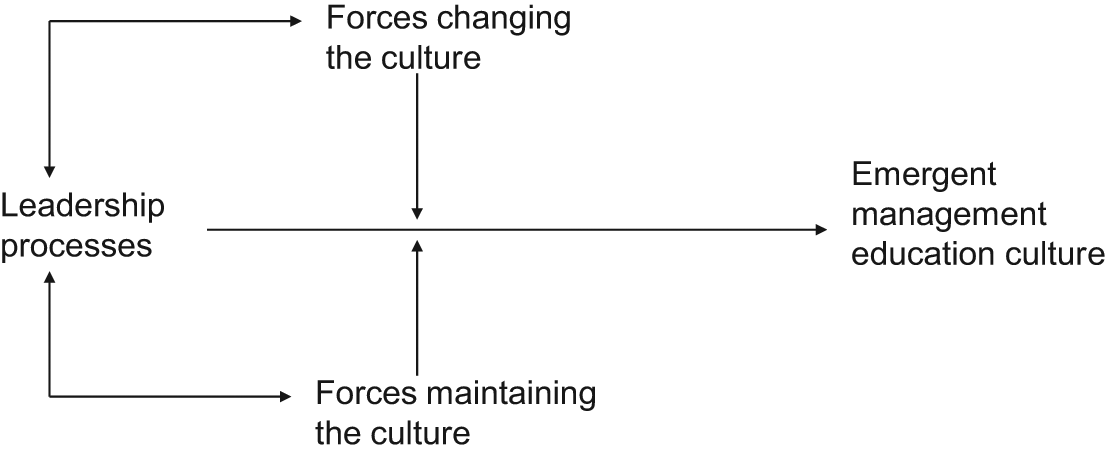
The relationship between culture, leadership and change in the historical development of management education
In a world of complexity and change, this dimension is critical. As we have seen through this historical study, the mix of forces affecting the emergence of formal management education are in constant flux. Note the interactive relationships between the five elements in Figure 2 and the ‘culture, leadership and change’ element, and the interactive relationships between the ‘leadership processes’ and the forces changing and maintaining the culture in Figure 3. There is no overarching and continuous ‘leader’ to manipulate the subjective and objective factors generating these forces. For cultural changes to take place across time requires ‘serial leadership’ – i.e. an historical succession of individuals contributing to the change process who may or may not be based in the same organization. This category of leadership is quite distinct from the concept of ‘shared leadership’, which is associated with a particular style of leadership at one point in time.
Conclusions
In the nineteenth and early twentieth century it would have been impossible to predict the emergence of the current management education scenario in the UK. To understand how this impressive growth in management education has come about, a chronological list of events can only provide limited insight. By restructuring the list and assigning events to sense-making categories (Weick 1995), it has been possible to arrive at a dynamic model (Figure 2) that highlights the complex interactions that occur in reality within institutional environments. To account for the findings of this historical study two further elements have been incorporated into the model: ‘high impact studies and reports’ and ‘culture, leadership and change’. The theories associated with these elements help one to account for the developmental profile of management education in the UK.
One of the most researched areas in the social sciences is that of leadership. The current research has widened this area by drawing attention to the need for a better understanding of the leadership processes occurring in the development of a function such as management education. Individuals displaying leadership in this context will still reflect the interaction of their personal characteristics and their context, but the new challenge relates to the inter-organizational context. How can individual representatives enhance their power in order to influence events? Networking and multiple membership of relevant structures will undoubtedly be important, as will the legitimacy of the organization(s) that one represents.
Historical studies are defined by the time dimension. The slow emergence of the management education function as part of the UK culture has been demonstrated by the current and other studies (Wilson and Thomson 2006). Inevitably this means that the leadership processes involved go beyond a given individual. Lyndall Urwick is regarded as a pioneer in management and management education, but his leadership contributions had to be supported by powerful organizations and supplemented and maintained by many others (several of whom are named in Figure 1). The concept of ‘leadership succession’ has been much researched within the selection and assessment literature (Anderson and Herriot 1997); perhaps social scientists should now devote more effort into researching the concept of ‘serial leadership’, particularly within the context of the historical development of a given functional area. Do we know enough about the processes involved when the objectives of one individual are adopted and pursued by others?
Given the complex systems in which the historical development of a functional area develops, it is a challenging task to describe and to account for the development of management education in the UK. The descriptive component of this task has been achieved by combining the efforts of others together with those of the author, in order to arrive at a credible database of key events (Figure 1). The qualitative nature of the empirical details of the research is unlikely to have affected the ‘groupings’ of elements portrayed in the proposed integrative model. This model, together with the associated theories discussed in the text, attempt to account for the developments taking place across time. Hopefully it will stimulate a lively debate.
