




Abstract
Purpose
While UEFA soccer pitches have an area per player (APP) of 325m², Small-Sided Games (SSG) are commonly designed with an APP of approximately 150m², thus lacking spatial representativeness. We hypothesize that sub-tasks scaled by a match-derived APP more accurately simulate spatial full-size match conditions compared to prototypical conventional strategies and evaluate this empirically.
Methods
Positional data was gathered using a crossover, controlled, trial-based methodology with a professional farm team of a German Bundesliga club to quantify spatial representativeness. A total of N = 60 trials contrasted two SSG-based designs (S5vs5 and S7vs7) and two representatively scaled designs (RP5vs5 and RP7vs7) and compared the inter-personal positioning (dyadic distances in attack and defense, Delaunay triangle area) to the spatial conditions of a referential 11vs11.
Results
Repeated measures ANOVA across the five conditions indicated that while the representative designs resembled full-size condition, the SSG-scaled designs differed significantly from full-sized condition (contrasts full-size 11vs11 against S5vs5; S7vs7: distance to nearest mate in attack and defense, p < .001; distance to nearest opponent, p < .001, and Delaunay Triangle Area in attack and defense, p < .001). Two elements enhanced spatial representativeness: increasing the APP, regardless of format, and involving more players in the format, both led to a closer resemblance to the full-sized 11vs11 condition.
Conclusion
The data suggest that a match-derived APP allows players to better explore spatial affordances in practice, preparing them for full-size matches. We encourage coaches to design practice formats with a stronger sensitivity to spatial task representativeness.
Introduction
A major challenge faced by soccer coaches is setting the pitch dimension in practice game formats. This decision of task design is influenced by multiple elements, including objectives of the training session, tactical considerations, practical considerations (e.g., availability of players or space), or desired intensity. In contemporary practice formats, coaches typically reduce pitch dimensions and player count to simulate match scenarios and increase action frequency per player, especially in sub-task practice formats such as 5vs5 designs (4vs4 plus goalkeepers). 1
These sub-task designs are commonly termed Small-Sided and Conditioned Games (SSCG) and use constraint manipulation to emphasize physical literacy or specific skill development. SSCG present a valuable tool for coaches to engage players in game-oriented movement tasks, rather than decontextualized drill activities 2 (e.g., “intercepted passes count as a point for the opponent”, to emphasize dribbling opportunities). In doing so, SSCG potentiate learners’ adaptive variability by challenging them to solve the same performance problem under varying conditions. 3 Consequently, players repeatedly explore and exploit the same performance problem across different practice scenarios, which promotes their ability to achieve the same task goal in different ways. These performance transactions are recognized as critical assumptions for effective learning, as they support learners’ ability to explore the redundancy of the movement system, thereby emphasizing their skillfulness. This design principle, framed as “repetition without repetition” as opposed to “repetition after repetition”, is paramount in SSCG, as such dynamic learning landscapes facilitate increased action frequencies, enabling players to explore a wide range of variability in search of functional movement solutions. 4
Subsequently, arguing from an ‘Ecological Dynamics’ perspective on decision-making in sport the present paper puts focus on the player-environment mutuality and reciprocity, emphasizing to analyze skilled behavior on an ecological scale. 5 Therefore, players’ actions emerge under continuous co-positioning (e.g., to teammates) and adjustments (e.g., to opponents) to achieve functional solutions to the given task constraints of the practice environment. Consequently, the effectiveness of individual and collective decision-making in soccer depends on the level of attunement to relevant information sources of the environment. Literally any constraint manipulation on action shapes the spatial boundaries of players’ behavior (e.g., skill acquisition). Thus, the present paper directs towards the availability of spatial constraints in soccer practice.
The pivotal difference between regular 11vs11 matches on full-sized pitches and common sub-task designs in training, such as SSCG, is the area per player (APP). In 11vs11 matches, the APP is 325 m² on pitches with standardized UEFA dimensions (105 m length times 68 m width divided by 22 players), and may on average vary around 300m² in semi-professional soccer due to culturally-dependent alterations. 6 In contrast, SSCG and related common practice formats in soccer are typically designed with an APP of approximately 150m² or even less.7,8 Although there is widespread engagement with SSCG both in practice and research, consensus on scaling pitch dimensions in soccer remains elusive. Olthof et al. 9 advocate for an increased focus on match-derived relative pitch APP which leads to larger pitch dimensions, where the physical demands are more likely to replicate those of actual matches. Additionally, from a tactical perspective, players would experience amounts of time and space similar to full-sized match situations. Acknowledging that these general measurements of space occupation tendencies per player are highly simplified. Player positioning is constrained by playing positions, the positioning of teammates and opponents, such as tactical concepts. As previous studies,9,10 we also assumed these values for the nature of the present experiment to discuss spatial constraints in contemporary training designs.
Underpinned by Ecological Dynamics, this emphasis on match-derived spatial conditions in practice aligns with the theoretical principle of task representativeness in sports training designs. According to Pinder et al., 11 a representative learning environment ensures functionality and action fidelity in interventions, as well as coaching, training, and learning. Therefore, practitioners should design dynamic learning landscapes that adequately replicate informational variables of the specific performance environments. By introducing representative information sources into training, coaches ensure that practice task constraints represent the competitive environment, and that learners can maintain the same perceptual-motor relations (provided by individuals and actions) within practice. 12 Consequently, the practice adaptation necessitates that the informational constraints presented during training sessions should closely represent those to be encountered in the performance context. This enables the development of perception-action couplings and thereby enhance the skill transfer from training to competition.
As a consequence, pitch dimensions are an essential factor in training design with far reaching consequences for training effectiveness. Yet, given the enormous differences in APP between match play and common training designs, this factor seems to be widely neglected in practice. Furthermore, empirical evidence concerning representativeness of different scaling strategies is lacking. It remains unclear whether a reduction in APP during sub-task design results in loss of representativeness or player behavior. This discrepancy between spatial conditions in practice tasks and full-size match conditions might be intensified because one critical consideration is often neglected in research: the comparison between the effects of manipulations in sub-task formats and their impact on the intended performance environment, the referential 11vs11 full-size match. Therefore, the challenge is to quantify representativeness across contexts. Does a SSCG setup lead to interpersonal behavior of the players that most closely represents the affordances of a referential 11vs11?
The present paper investigates whether common strategies for pitch dimension selection in sub-task design provide adequate preparation for actual full-size soccer matches with respect to spatial representativeness.10,13 To this end, we review current strategies for defining pitch dimensions in soccer and analyze how collective spatial behaviors change when the APP is either reduced, or kept equal to 11vs11 matches. Empirical data is presented by analyzing positional data and collective movement of a professional German Bundesliga farm team in selected subtask-designs. The results allow a robust quantitative assessment of scaling strategies, valuable for future discussions and investigations. Our analysis seeks to evaluate the representativeness of the interpersonal layout provided in contemporary sub-task practice designs in soccer training compared to that in official soccer matches. Enhancing the spatial representativeness in training should allow players to learn to utilize more effectively the affordances representative of official match dynamics.
Sociocultural background: the genesis of spatial constraints in soccer sub-task designs
This Sociocultural Background section provides context for understanding the genesis of spatial constraints in contemporary sub-task designs, without claiming completeness. Therefore, we aim to identify potential sociocultural constraints that shape coaches’ decisions on pitch dimension choices in contemporary practice designs, which contribute to observable discrepancies in APP between match and training scenarios. Here, we present common scaling strategies in practice task design, with an emphasis on spatial layout in training and representativeness.11,12 Additionally, we explore potential motivations of coaches for setting a specific APP within their practice format.
Caution is needed, as in official matches the offside rule is an inherent constraint on players’ and teams’ space exploration tendencies and strategies. In contrast studies on SSCG in the literature do not consistently apply or report the use of the offside rule. 14 This oversight may stem from an overemphasis on studies investigating the effects of various manipulations – such as the offside rule – on physical literacy in SSCG. 15 When SSCG incorporate the offside rule, designers tend to use more APP. 16 The offside rule reduces the effective playing space (e.g., dynamic pitch area), thereby limiting players’ ability to explore spatial options. 14 To enhance variability in training, removing the offside rule can be a valuable alternative to encourage greater spatial exploration in players’ forward movements. This adjustment might help achieve specific training goals in tactical decision-making by fostering broader degrees of freedom in directional play thereby supporting the development of creativity. 14 However, in the absence of the offside rule – an essential characteristic of full-sized matches – through-ball opportunities from both offensive and defensive perspectives do not provide official match affordances and clearly reduce the representativeness of SSCG scenarios. Since the effective playing space is naturally larger without the offside rule, the lack of attention to this rule in the SSCG literature might explain why SSCGs often use very small APP compared to full-sized match scenarios. In this paragraph, we present additional explanations for why APP in SSCG often differ from official match scenarios. From a coach's perspective, five distinct approaches to determining pitch dimensions within the chosen sub-task design a can be identified (Figure 1).
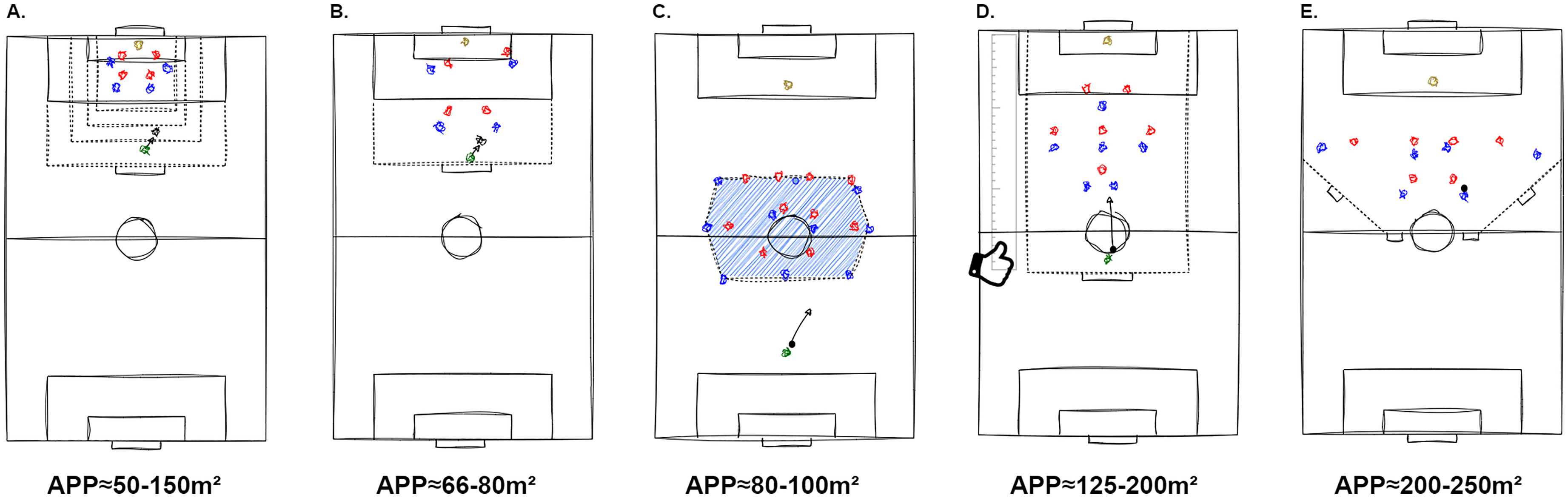
Coaches’ sketch of different scaling methods in sub-tasks and their corresponding APP: A. Small-Sided and Conditioned Games Approach: Employs smaller action spaces to develop physical, technical and tactical literacy, thereby increasing the frequency of actions, e.g., the number of duels 19 ; B. Convenience Approach: Involves doubling the penalty area (colloq., ‘box’), offering an easy setup that requires minimal space 8 ; C. Individual Playing Area: Utilized to extrapolate the pitch size for SSG from full-size matches, aiming to enhance training specificity for tactical proficiency development 20 ; D: Rule of Thumb Approach: Determines soccer pitch sizes based on the number of players, adding 10 meters in length and 5 meters in width per player 26 ; E. Tactical Approach: Defines the pitch size according to the tactical action space of the involved players in the official match.28,29
A: small-sided and conditioned games approach
Small-Sided Games (SSG) are considered smaller versions of the formal game, characterized by fewer players and a reduced pitch dimension to increase the action frequency per player. 1 With a maximum of 6 vs. 6 players, SSG are originally utilized to make more efficient use of training time, thus developing physiological and physical capabilities while adhering to the principle of specificity. 19 So, the SSG concept is generally attributed to developing physical literacy as an alternative to traditional running-based activities, whereas the extension to Small-Sided and Conditioned Games (SSCG) adds a decision-making focus, increases the tactical complexity, and allows players to gain more experience in specific tactical topics. 19
In the design of SSG and SSCG, the APP within these practice formats is significantly smaller than the actual game. 20 Previous studies have criticized the extensive training time spent in such small formats and claim that a larger, match-derived APP is necessary to mirror the physical demands encountered in official matches.10,13,21 A large APP also affords greater tactical variability, fostering opportunities for offensive strategies and defensive structuring. 10 Furthermore, Olthof et al. 9 claim that employing a match-derived APP ensures that the distances between players are more comparable to those observed in official matches, contrasting with the confined spaces of SSG. Therefore, it is questionable whether the highly frequent actions facilitated in SSG or SSCG accurately represent the affordances of full-size matches, and thus, provide action fidelity. b
B: Individual Playing Area
Primarily, the offside rule influences the space occupation tendencies of outfield players in a soccer match, who typically utilize only between 20 and 25% of the total pitch. 20 This so-called ‘effective playing space’ becomes a battleground where the attacking team seeks to penetrate the defensive collective. As SSCG were initially adopted to hone technical and tactical skills, 19 leading coaches to design them in a way that mirrors the spatial dynamics of full-size matches. To enhance tactical training specificity, Fradua et al. 20 suggest that extrapolating the individual playing area from full-size matches provides a valid representation of full-sized match tactical scenarios. However, this perspective often misses that the effective playing space dynamically emerges in response to the full-sized pitches affordances. The effective space highlighted by Fradua et al. and others23,24 represents merely a snapshot of outfield players’ positioning, overlooking the continuous movement dynamics across the field that characterizes actual gameplay. This space exploration among the players aims to exploit spaces behind the defensive lines for goal-scoring opportunities, while the unoccupied outer space inherently shapes the effective playing area, fluctuating with different phases of the game (transition, build-up, finishing phase) as noted by Fradua et al. 20 Consequently, in this paper, we argue that confining players to an extrapolated individual playing space may not truly represent the spatiotemporal dynamics encountered in a full-size match.
C: Convenience Approach
In urban or densely populated regions, further constrained by scheduling conflicts within soccer clubs due to afternoon school activities, space for soccer activities is at a premium. Consequently, teams may have access to only half a field (or even less) for their training sessions. This scarcity of space is undoubtedly one of the reasons why ‘doubling the penalty area’ (‘doubling the box’) has become a popular training design for practicing SSG and numerous rehearsal activities. 25 This approach allows existing lines to serve as sidelines, requiring only an extension of the 18-yard area. Given that this design notably reduces the space compared to an official match, double-box practice is usually accompanied by the removal of the offside rule to gain a certain amount of depth, thereby increasing the effective playing space. 14 These sociocultural constraints essentially eliminate the match-like space behind the defensive backline, raising questions about the action fidelity of attacking and defending affordances in double-box practices.
D: Rule of Thumb Approach
The rule of thumb approach meets practitioners’ need for a coach-friendly method in designing daily practice tasks. This method, popularized by Raymon Verheijen, dictates soccer pitch sizes based on participant numbers, scaling field dimensions linearly with player count (e.g., 10 meters in length and 5 meters in width per player). 26 Despite little evidence supporting it, this method has gained traction within sports science (e.g., see Zlojutro et al. 27 ) and soccer practice, particularly through Verhejn's promotion of his ‘football periodization’ license classes, which are recognized by several football federations. This approach is not without criticism, particularly due to a mathematical problem that emerges regarding the available APP, which paradoxically diminishes as player numbers decrease. This runs counter to the intuitive expectation that the APP should remain constant (representative) to mirror official match conditions. The crux lies in the quadratic scaling of area, since a rectangle's (the field's) area is determined by its length and width, the area scales quadratically, not linearly as the rule of thumb suggests. Applying the rule of thumb linearly means the total field area for each format (e.g., 8vs8, 5vs5) does not adjust in direct proportion to player numbers. With fewer players, the total area contracts more drastically than the reduction in player numbers, leading to a marked decrease in the APP.
To illustrate, consider the APP in two game formats using the rule of thumb: An 8vs8 game yields a field of 80 × 40 m, totaling 3200 m² and thus, an APP of 200 m². Conversely, a 5vs5 game on a 50 × 25 m field totals 1250 m², resulting in an APP of 125 m². This demonstrates a significant reduction in APP with fewer players, diverging from the idea of maintaining a consistent playing experience. 9 In contrast, a constant representative APP across different formats would remain around 325m², akin to full-size matches.
E: Tactical Approach
When coaches aim to simulate phases of the official game, including positional fidelity, they endeavor to replicate the players’ customary formation and their action spaces.28,29 For instance, in a scenario where two teams compete in a 4-4-2 formation, and a coach aims for guiding players to utilize relevant affordances in their attacking play, they might exclude the offensive line (two wingers and two strikers) along with the two central midfielders. The opposing defensive lineup that performs the pressing might then consist of the back four plus their two central defensive midfielders (Figure 1, E). The scaling of the practice format is derived from the full-sized game, where the back four are tasked with defending the full width of the field. Since the attacking team's defensive line is excluded, their build-up's action spaces are omitted. The tactical extract dictates that practices should be conducted on about half a field. For example, within the framework of the German Football Association, it is often recommended to cut the sides of the field obliquely (dashed line Figure 1, E) to increase representativeness within the practice format, and therefore restricting the offensive wingers’ action spaces with the sideline theoretically enhances action fidelity. 28 Consequently, unlike the other approaches outlined above, the Tactical Approach results in the largest APP among these methods (APP about 200–250m²). However, it still does not match the scale of an APP according to full-sized matches, as claimed by Olthof et al.9,10
Material and methods
Shall we double the box?
This study examines a more representative scaling strategy proposed by previous authors. 9 This strategy utilizes an APP derived from the full-pitch size of the team's competition field. We hypothesize that this match-derived APP will lead to a more representative spatial layout in sub-tasks than the current scaling approaches (Figure 1: A to E). In doing so, our analysis seeks to enrich the debate on scaling strategies by quantifying the spatial representativeness in practice designs via positional data. Hence, the present data introduces a critical consideration often neglected in research: the comparison between the effects of manipulations in sub-tasks and their impact on the intended performance environment, the referential 11vs11 full-size match. In doing so, we aim to help coaches foster the development of players’ skills that transfer to actual soccer matches, encouraging them to consider whether they “should double the box” or not.
Participants
We recruited 22 male football players (age: 23 ± 5 years) from a professional farm team of a German Bundesliga Club (4th division). Players trained five to six times and played one competitive match each week. All participants gave written consent after confirming their understanding of the study procedure. The study was approved by the Ethics Committee of the German Sport University Cologne (184/2022).
Study design
The research design was a crossover, controlled, trial-based approach, aimed at comparing performances in 11vs11 games across four distinct field sizes (Figure 2), and following previous studies by Low et al.30,31 The study was conducted on a natural grass pitch, adhering to the official laws of the game. Following a 20-min warm-up led by the team's conditioning coach, the head coach (UEFA Pro level) organized the players into two balanced teams based on their regular playing positions, derived from a 4-4-2 formation. Players were given no additional tactical instructions beyond scoring goals or preventing goal scoring, and their playing position. The head coach observed the players’ commitment and provided motivational feedback throughout the study. Players competed under five different field conditions (Figure 2), in the order from a. to e.: The initial setup replicated an official full-size pitch, utilizing the training pitch of the players academy (Figure 2, a.: OF11vs11, 296 m²). This was contrasted with two practice conditions scaled relative to the full-size pitch for 7vs7 and 5vs5 formats (Figure 2, b. RP7vs7, and d. RP5vs5, with an APP of 296 m²), and two small conditions that employed pitch sizes based on SSCG literature recommendations for 7vs7 and 5vs5 games (Figure 2, c. S7vs7, 184 m² APP, 32 and e. S5vs5 with 174 m² APP 32 ).
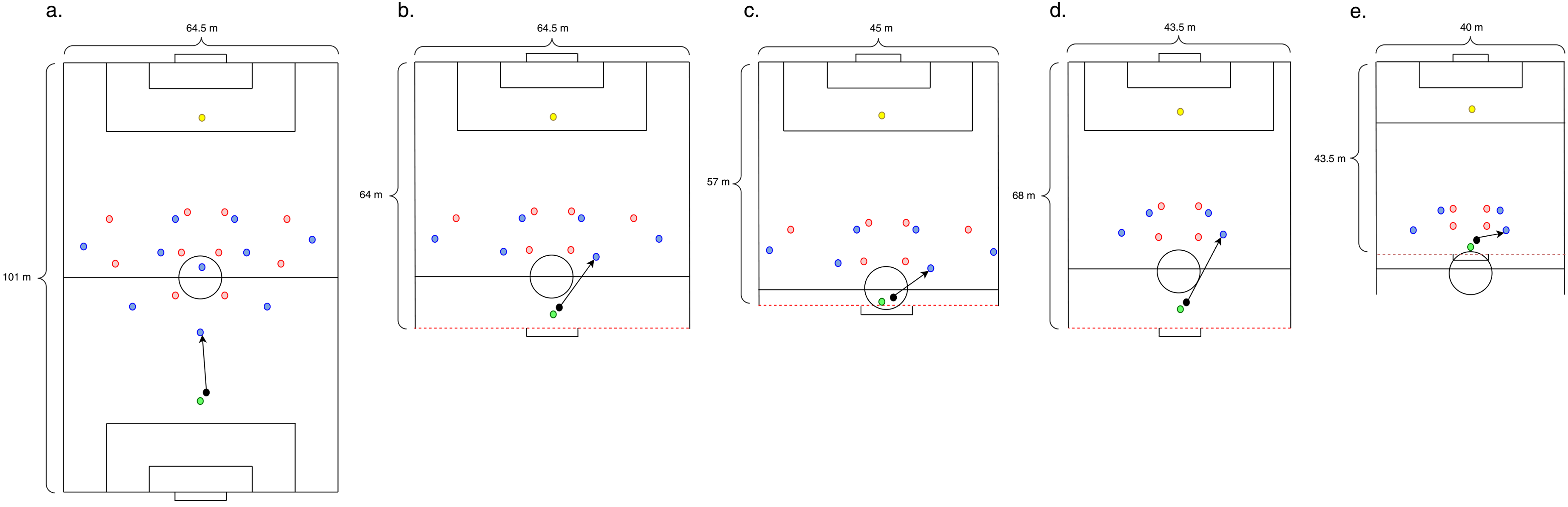
Scaled representation of the different field dimensions, a. OF11vs11, area per player (APP) of 296 m² indicates a scale equivalent to that of an official 11vs11 match. b. RP7vs7 and d. RP5vs5, both with an APP of 296 m², accurately representing the OF11vs11 APP. Two small conditions, c. S7vs7, features a reduced APP of 184 m², and e. S5vs5 offers an APP of 174 m², both based on SSCG literature. 32
Experimental units
Each team performed six offensive trials against the opposite team across conditions, totaling N = 60 trials (12 per condition),30,31 with each trial being independent and defined as an experimental unit. 33 Trials were initiated in a standardized way, with a pass from the goalkeeper and concluded either with a goal, change of possession, interruption in play (e.g., from offside, defensive fouls, or the ball going out of play). Defenders were allowed to initiate a counterattack to afford an authentic positioning of the attacking team as the attacking players always have to keep in mind that there might be a possible ball-loss, thereby guaranteeing realistic rest-defense positioning. Moreover, when the initially attacking team recovered the ball (e.g., after a successful “Gegenpressing”), they were allowed to finish the attack; however, these counterattack scenarios were not included in the experimental trials. When the defense intercepted the ball and started a possession oriented positional play, the trial was interrupted. After each attempt, players resumed their starting positions for the next trial. Following six trials and a break period, the roles of offense and defense were swapped between teams.30,31
Data collection
Player positions were tracked using the Catapult© global positioning system (GPS), which determines each player's global positioning via a tracking device, worn in the pocket of a lycra vest (proximal of cervical spine C7 i.e., ‘cervicothoracic junction’). The system recorded latitude and longitude at a frequency of 10 Hz with a coefficient of variation between 1.9% to 4.7% at lower intensity respectively. 34 Five missing values spanning less than two consecutive seconds were imputed via linear interpolation. Additionally, a GoPro Hero 6 Black© camera documented the entire pitch from an elevated perspective (height about 5 m), offering a 30 Hz video documentation to verify the GPS measurements. This allowed us to set an accurate starting and endpoint for the sampled trials.
Data processing
Based on the x-y coordinates, metrics reflecting collective inter-player behavior were calculated at an individual and (sub)team level (both in attack and defense): At the individual level, the distances to the nearest teammate (Distance to Nearest Mate) and opponent (Distance to Nearest Opponent) were calculated for each player and averaged for the attacking and defending team, respectively. 35 For each trial, mean values for Distance to Nearest Mate in Attack and Defense [m], and Distance to Nearest Opponent [m] were calculated as indicators of collective behavior. 35 Both metrics were chosen to emphasize spatial properties of dyadic interactions in attacking and defensive organization during analysis. They quantify how close players are positioned on average with respect to their teammates and to the player they are marking (or are being marked by). At the team level, we calculated the mean area of all triangles spanned by a Delaunay triangulation (Mean Delaunay Triangle Area in Attack and Defense [m²] 36 ) applied to the attacking and defending team, respectively. A triangulation is a geometric function that divides the convex hull of a set of points (i.e., in our case, the players of the attacking or defending team) into triangles. The Delaunay triangulation is a special and well-balanced triangulation which satisfies a range of mathematical conditions, e.g., maximal mean inradii of circles inscribed to triangles. 37 The Mean Delaunay Triangle Area then is equivalent to the area of the convex hull of a team divided by the number of triangles computed by a Delaunay triangulation. We argue that the Delaunay triangulation provides a more fine-grained approach to assess team-level spatial properties compared to previous approaches that only evaluate the area of the convex hull of a team.20,23 This is because the number of triangles can be interpreted as potential for combination-play affordances and increases with players moving from the boundary to the interior of the convex hull due to Euler's formula. 37 Thus, we use the mean area of these triangles as a measure for team compactness and spatial organization. In trial #8, five consecutive frames had missing GPS 10 Hz sensor data, and in trial #60, a total of 13 frames were missing data. In these cases, we excluded the spatiotemporal calculations for the entire frame to maintain accuracy. Additionally, since the missing data in trial #8 affected the defending players for more than two consecutive seconds, 31 we excluded the distance to the nearest mate (defensive) data for this trial. Positional data was processed using the Python programming language (version 3.12.2) with the SciPy 38 and floodlight 39 packages.
Statistical analysis
The dataset was tested for normality of distribution using the Shapiro-Wilk test and homogeneity of variances using the Levene test. A repeated-measures ANOVA was calculated for the trial values to assess differences between the five conditions. Due to a violation of the assumption of homogeneity of variances (Levene's test p < .05), Greenhouse-Geisser corrections were applied to adjust the degrees of freedom and p-values, ensuring accurate statistical inference. In case of statistical significance, pairwise post-hoc comparisons (Tukey's LSD) were conducted to assess differences between conditions of the independent variable. Effect size values were calculated using partial eta-squared (ηp²). Effect sizes were categorized as: small (η² < .06), moderate (.06 ≤ η² < .15), and large (η² ≥ .15). 40 All analyses were performed using RStudio (version 1.4.1564).
Results
Descriptive statistics and multiple comparison analysis (Tukey's LSD) are presented in Table 1, focusing on the comparison between the training conditions (RP7vs7, S7vs7, RP5vs5, S5vs5) and the reference condition (OF11vs11). Additionally, we contrasted the representative training conditions with the small conditions (RP7vs7 versus S7vs7, and RP5vs5 versus S5vs5). This visual analysis (Figure 3 and Figure 4) illustrates how closely the training conditions, regarding the given parameter, resemble the OF11vs11. Remarkably, across all parameters, RP7vs7 most closely mirrors the official match conditions.
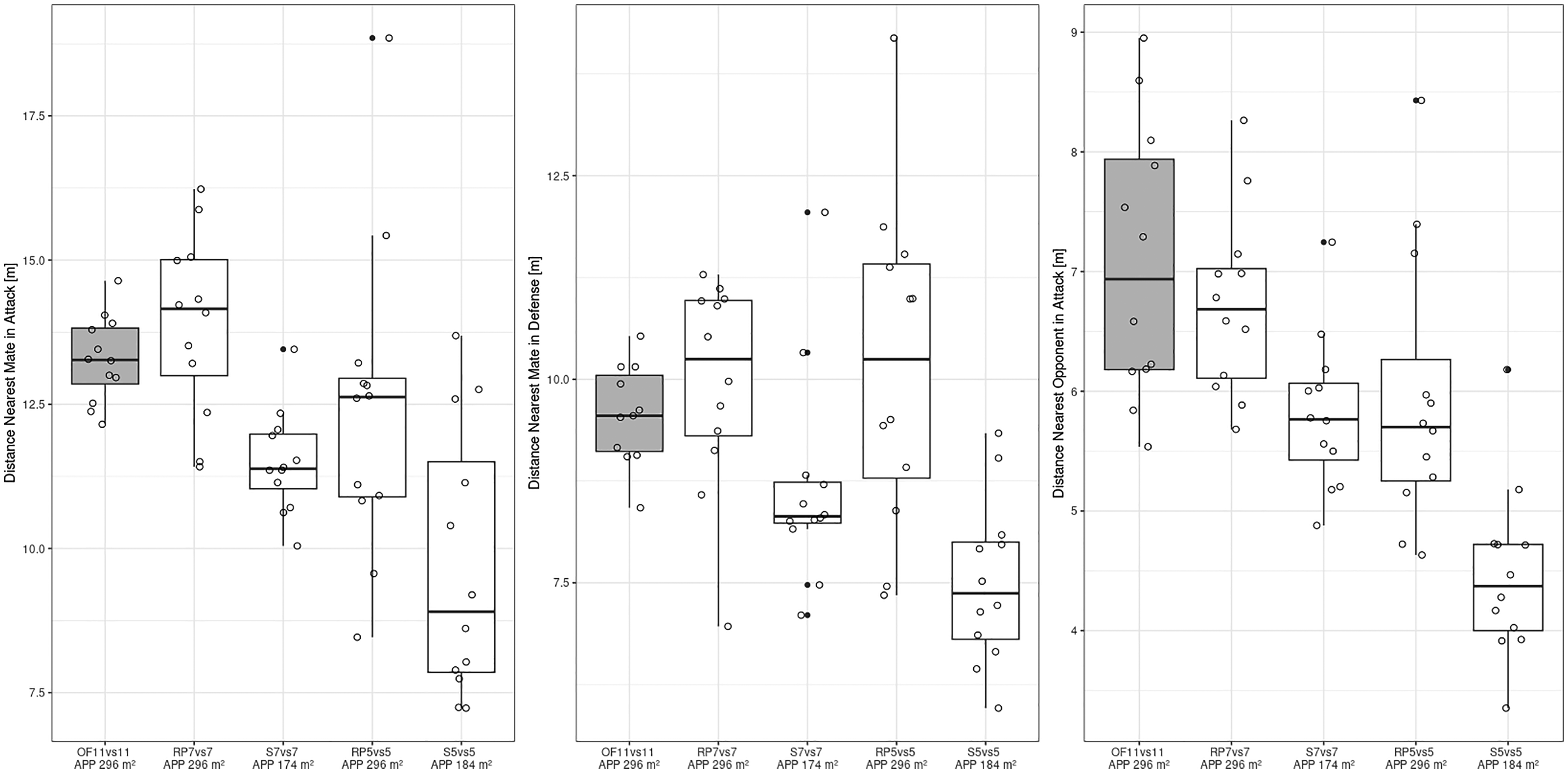
Analysis of player spacing, boxplots illustrating the Distance to the Nearest Mate in Attack; in Defense, and the Distance to the Nearest Opponent across all field conditions.

Boxplots showing the Mean Delaunay Triangle Area [m²] in Attack; in Defense across all field conditions.
Statistical analyses of Tukey's post-hoc pairwise comparisons. ‘Condition I’ as the reference is contrasted with ‘Condition II’.
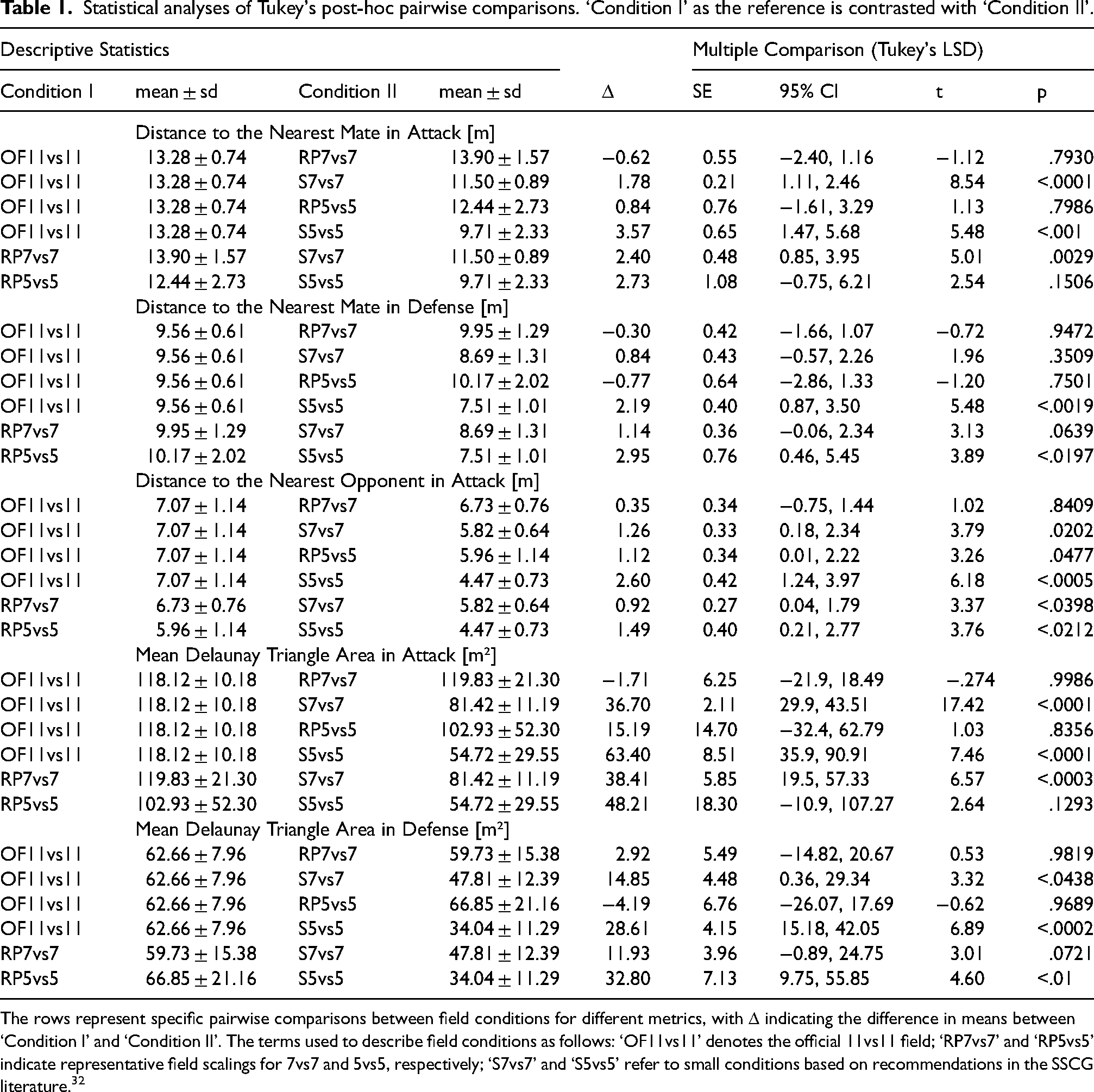
The rows represent specific pairwise comparisons between field conditions for different metrics, with Δ indicating the difference in means between ‘Condition I’ and ‘Condition II’. The terms used to describe field conditions as follows: ‘OF11vs11’ denotes the official 11vs11 field; ‘RP7vs7’ and ‘RP5vs5’ indicate representative field scalings for 7vs7 and 5vs5, respectively; ‘S7vs7’ and ‘S5vs5’ refer to small conditions based on recommendations in the SSCG literature. 32
Distance to the nearest Mate in attack
Repeated measures ANOVA reveals a significant main effect of conditions, F(2.45, 26.93) = 9.78, p < .001 (Greenhouse-Geisser corrected, ɛ = .613), ηp² = .47 (Large). Post-hoc pairwise comparisons (Table 1) indicates tighter player configurations in smaller field settings, while OF11vs11 and S5vs5 showing the most significant difference (Estimate = 3.57, SE = .65, p < .001). Thus, S5vs5, demonstrated the most substantial decrease in the distance to the nearest mate in attack, with a mean distance reduction to approximately 70% of that in the OF11vs11 condition, corresponding to an average distance of about 4.5 meters.
Distance to the nearest Mate in defense
The distance to the nearest mate demonstrates similar findings, with repeated measures ANOVA showing a significant main effect of conditions, F(2.51, 25.14) = 7.92, p < .001 (Greenhouse-Geisser corrected, ɛ = .627), ηp² = .44 (Large). Notably, the smallest field condition, S5vs5, exhibited a marked decrease in distance to the nearest mate in defense (Estimate = 2.189, SE = .399, p < .001), underscoring an effect of reduced playing areas on defensive configurations. Additionally, the contrast between RP5vs5 and S5vs5 revealed significant differences (Estimate = 2.954, SE = .759, p < .02).
Distance to the nearest opponent in attack
Repeated measures ANOVA for the distance to the nearest opponent in attack reveals a significant main effect of conditions, F(3.19, 35.10) = 16.24, p < .001 (Greenhouse-Geisser corrected, ɛ = .797), ηp² = .60 (Large). The transition from larger to smaller playing areas resulted in a consistent decrease in the distance to the nearest opponent, with S5vs5 showcasing a distance reduction to roughly 63% of the OF11vs11 condition, indicating intensified defensive pressure in smaller fields. Post-hoc pairwise comparisons further elucidated these dynamics, with significant reductions in opponent distance particularly pronounced in the transition to the smallest playing condition, S5vs5 (p < .001).
Mean Delaunay triangle area in attack
Repeated measures ANOVA of the mean Delaunay triangle area in attack shows a significant main effect of conditions, F(1.86, 20.43) = 10.22, p < .001 (Greenhouse-Geisser corrected, ɛ = .464), ηp² = .48 (Large). Post-hoc analysis indicates that, in comparison to the OF11vs11 condition, both smaller field conditions resulted in notably reduced Delaunay areas (Table 1). The S7vs7 showed a decrease with an estimate of 36.70 m² (SE = 2.11, p < .0001), and the S5vs5 exhibited an even more pronounced reduction, with an estimate of 63.40 m² (SE = 8.51, p < .0001). Additionally, these results are visually depicted in Figure 4.
Mean Delaunay triangle area in defense
Repeated measures ANOVA of the mean Delaunay area in defense indicates a significant main effect of conditions, F(2.66, 29.23) = 9.38, p < .001 (Greenhouse-Geisser corrected, ɛ = .664), ηp² = .46 (Large). Post-hoc comparisons (Table 1) shows significant differences between OF11vs11 and the two small conditions: S7vs7 (Estimate = 14.85, SE = 4.48, p < 0.04), and S5vs5 (Estimate = 28.61, SE = 4.15, p < .0002). Moreover, the visual representation of the mean Delaunay area in defense shows that the RP7vs7 condition resembles closest to the OF11vs11 (Figure 4).
Discussion
The present paper analyzes the suitability of pitch scaling strategies to help coaches in making better, evidence-based decisions when setting their spatial constraints in practice. This is done from the perspective of task representativeness, 11 which assumes that spatiotemporal conditions within practice tasks that are representative of those in official matches enhance skill transfer from training to competition. As demonstrated, current strategies for pitch size alterations in sub-task design do not afford an adequate preparation for actual full-size soccer matches.10,13 To provide empirical evidence, we utilized an alternative match-derived representative scaling strategy suggested by previous authors, 9 and gathered positional data in a crossover, controlled, trial-based methodology 30 with a professional farm team of a German Bundesliga Club. We examined whether match-derived APP, as claimed by previous authors, 9 will lead to more representative spatial conditions in sub-tasks compared to current SSG-based scaling approaches (see Figure 1 “A” to “E”). As a methodological novelty, our analysis introduces a critical consideration often neglected in research: the comparison between the effects of manipulations in sub-tasks and their impact on the intended performance environment, the referential 11vs11 full-size match. We contrasted two SSG literature-based sub-task designs (S5vs5 and S7vs7) 32 and two representative scaled designs (RP5vs5 and RP7vs7) to examine which spatial APP setup in sub-task practice leads to interpersonal positioning of the players that most closely represents the spatial conditions of a referential 11vs11. As existing approaches that may not be appropriate to contrast an 11vs11 layout against a sub-task practice design (e.g., 5vs5), we provide the Delaunay triangulation as a more fine-grained approach to assess team-level spatial properties. 36 This allowed us to contrast combination-play affordances between an 11vs11 setup and different sub-task formats.
Our results indicate that the examined representative field conditions (RP5vs5 and RP7vs7), in comparison to smaller, literature-recommended settings (S5vs5 and S7vs7), displayed a significant spatial resemblance to the full-size pitch (OF11vs11). According to our findings, two elements enhanced spatiotemporal representativeness: firstly, increasing the APP, regardless of the format, led to a closer resemblance to the full-pitch scenario. Secondly, the formats with more players involved (S7vs7 and RP7vs7), resembled the full-sized 11vs11 condition more closely than the two formats with fewer players (S5vs5 and RP5vs5). Consequently, diverging from contemporary scaling strategies in soccer, we confirm the assumption stated by previous authors that an APP derived from full-size 11vs11 conditions promotes more representative spatial conditions in sub-task practice. 9
Contrasts between sub-tasks and the referential full-sized 11vs11
The S5vs5 formats within our study, across all investigated interpersonal parameters, exhibited the most differing spatial conditions compared to the OF11vs11 (p < .0001). Interestingly, the RP5vs5 not only displayed the opposite, showing no significant differences from the OF11vs11 across any parameter, but it also differed significantly from the S5vs5 in every parameter (p < .01) (Table 1). Given that the 5vs5 format is one of the most prevalent game formats in training 10 and considering that in this study we adopted a very conservative APP (S5vs5 = 174 m²) to represent a broad range of scaling approaches, 32 the present data raises questions about the overall relevance of this format. Although there is so much focus on 5vs5 in daily practice with regard to task representativeness, a notable difference to the full-size 11vs11 format seems evident. There is a lack of field depth for space exploration and fewer options for player interactions, which prevents players from effectively picking up specific information to regulate interpersonal interactions with teammates and opponents. For instance, compared to the full-sized pitch, the nearest teammate was, on average, approximately 27% closer, the nearest opponent approximately 37% closer, and the average combination triangle area was reduced to 54% of that in the OF11vs11. A similar observation of player interactions, with players positioned closer together and a lower reported stretch index value compared to official match conditions, was documented by Couto et al., 41 aligning with the findings of the current study. In daily practice, the heavy emphasis on 5vs5 may stem from a strong belief in the importance of repetition in training, 2 leading to a high frequency of action in very small spaces but, as seen in the data, at the expense of action fidelity. Consequently, a match-derived scaling might offer an opportunity to enhance task representativeness while still adhering to the coach's intention of setting up a 5vs5 design.
The 7vs7 formats demonstrate both more representativeness than the 5vs5 formats do. Therefore, it is critical to note initially that even the APP for the S7vs7 condition (184 m²) is not as drastically different from the RP7vs7 condition (296 m²) as the APP in SSG typically differ from the full-sized pitch. We made this choice to more accurately reflect the reality of training, where, following quadratic scaling principles (e.g., see Figure 1 D Rule of Thumb approach), coaches often allocate disproportionately more space in numerically larger formats than in SSG.7,32 Nonetheless, in the S7vs7 condition, both the distance to the nearest opponent (p < .01) and the mean Delaunay Area (p < .02) display notable changes from the referential OF11vs11. However, other parameters in this condition do not exhibit significant changes (Table 1), suggesting that while the S7vs7 format's representativeness is reduced, it still more closely mirrors the spatio-temporal layout of a full-sized pitch than the S5vs5 does. In contrast, the RP7vs7 shows no significant deviations from the OF11vs11 at all, indicating that, under the conditions investigated, this training format most accurately represented the referential full-sized 11vs11. Additionally, the inclusion of more players seems to reduce the degrees of freedom and thereby the variability within both 7vs7 formats (Figure 3 and Figure 4). One plausible explanation is that with higher positional fidelity, players refer to one another and organize their grouping more similarly to competitive environments they are accustomed to. 41 Another reason for the larger format's greater stability might be that divergent behaviors by individual players do not impact the overall statistical outcome as significantly when more participants are involved. To sum up, among the four investigated sub-task designs, the match-derived RP7vs7 proves to be the best match-like simulation. Consequently, our findings particularly highlight those match-derived representative scaled conditions, RP5vs5 and RP7vs7, closely approximate the spatial conditions of the full-sized pitch. This supports the hypothesis that a match-derived manipulation of the APP cultivates a training environment representing the spatio-temporal demands of competitive full-size matches more truthfully than current scaling strategies.
Comparing apples and oranges
In the literature, several studies investigate the representativeness of sub-task designs such as SSCG. Many of these studies emphasize physical literacy, focusing on how different spatial configurations in SSCG can afford match-like running characteristics to address conditioning for official matches. However, they often fail to replicate match-like scenarios13,42,43 Additionally, from a technical-tactical perspective on player development, similar concerns have been raised regarding the representativeness of SSG. Couto et al. 41 noted that even when altering the width-to-length ratio, a 4vs4 SSG format demonstrates relatively poor representativeness in replicating the positional dynamics of an official game. Their methodological approach aligns with the present study, as they utilized spatiotemporal metrics to assess the representativeness of positional dynamics between SSG and full-sized game conditions. The study concluded that neither SSG configuration sufficiently offers representativeness of the positional dynamics seen in official games. Reduced pitch areas in SSG further limit their representativeness, a finding consistent with the present results. Consequently, the authors concluded that coaches must explore alternative solutions to enhance the representativeness of SSG. That said, representativeness is just one of several principles that facilitate the skill adaptation process. Despite their limitations, SSCG remain a valuable tool, offering a wide range of game-like affordances than isolated rehearsing drill activities. 2 Travassos et al. 44 demonstrated in foundational research that even a simple passing exercise can achieve greater representativeness by increasing the number of action possibilities, such as making more teammates available for receiving passes. Thus, while the correspondence between training tasks and competitive settings may lack specific elements (e.g., opponent pressure), players can still attune to other meaningful information, such as the movements of teammates. This highlights the broader utility of SSCG in fostering skill adaptation, even though some match-specific information may not be present.
Subsequently, the present study aims to build on previous work 41 by quantifying the representativeness of sub-task designs in terms of their spatiotemporal layout. Methodologically, comparing a full-size match with a sub-task design, such as 5vs5, presents challenges. Since APP and the number of players are manipulated simultaneously, it is challenging to select dependent parameters, as it is unclear which manipulation drives the observed changes. Parameters commonly used to evaluate spatial conditions in soccer, including mean dyadic distance and mean convex hull, 35 are directly influenced by the number of players. Given that ten outfield players create a disproportionately larger grid compared to four players, as illustrated in Figure 5, the spatial arrangement depends closely on the player count, which makes it even harder to assess the representativeness of sub-task designs. Similarly, metrics like total distance covered, or high-intensity runs are difficult to directly compare due to the substantial impact of player count. 13

Exemplary illustration of Delaunay triangles after 5 s played within the different field conditions, a. OF11vs11, b. RP7vs7, c. S7vs7, d. RP5vs5., and e. S5vs5.
To address these challenges, we focus on parameters such as the distance to the nearest mate and opponent (in Attack and Defense), which remain relevant across varying player counts. Additionally, we introduce Delaunay triangles, an underexplored parameter that allows to evaluate sub-team relationships across different conditions, facilitating the comparison of cooperative patterns regardless of player numbers. 36 In soccer, players strive to establish triangular cooperation patterns in attack and similarly employ triangular cooperation in defense to prevent goal scoring. Consequently, we recommend future research to adopt this approach for a comprehensive comparison of training designs from a spatial perspective.
Our data reveal that, notably, the RP7vs7 condition most closely reflects the spatial configurations of a full-sized 11vs11 match. This observation aligns with intuition, suggesting that involving more players better simulates the spatial dynamics of official matches. It might seem obvious that an 7vs7 format is more representative, with an 8vs8 being even closer to the official match, and so forth. However, one must consider factors such as limited player availability and varying objectives of the training session. While not always playing in an 11vs11 format for manifold reasons, the spatial configuration of training should align with the individual and/or collective skills intended to be developed.
For instance, a 5vs5, even when designed with spatial representativeness through an APP aligned with full-sized match conditions, does not facilitate the scanning behavior observed in actual games. 45 Extensive scans by a central defender during the build-up phase – to decide between a short pass to nearby teammates or a long through ball over the opponent's last defensive line when pressed – are only possible if the training design affords wide-ranging scans and positions the defensive line of the opponent further away. Therefore, a 5vs5 format is not a conducive design to realistically train the skill of the build-up phase. When focusing on build-up scenarios, it demands not only additional space but also realistic passing options, necessitating more players in depth. Conversely, when coaches aim to facilitate give-and-go opportunities, this skill adaptation process is already present in smaller sub-groups (e.g., a 5vs5 format) and should exhibit minimal variance from the spatial dynamics in a full-sized game. 44 Consequently, it is crucial to acknowledge that any training environment is inherently artificial and can never fully represent the conditions of an official league match. Besides spatial aspects, how could a training session imitate the motivation, pressure, and variability encountered in real matches against different opponents on different pitches every two weeks. 46 Comparing training and match scenarios can be likened to comparing apples with oranges. Therefore, the primary objective of effective soccer training should be to simulate competitive conditions as accurately as possible, enabling players to adapt to and exploit real-game (spatial) dynamics. As Stoffregen puts it, “the faithfulness of the user's behavior in the simulator to their behavior in the simulated" 22 is paramount for achieving performance transfer. In other words, successful actions in a training format should seamlessly transfer to successful behaviors in the performance environment. Consequently, designing representative practice tasks should be a coaches’ priority to ensure the generalization of skill acquisition and performance enhancement in sport.11,47
No, really, shall we double the box?
In practical terms, let us consider a sub-task game aimed at teaching attackers how to bypass defenders. When coaches design a double-box format, the limited space reduces the potential for exploiting gaps behind defenders. As a result, ‘through-ball opportunities’ become scarce, and defenders tend to closely mark attackers. This setting constrains attackers from assessing whether to dribble, performing a through ball, or attempt to shoot. Simultaneously, defenders face fewer decisions regarding covering their backline or engaging in active ball recovery. Thus, from an offensive standpoint, the environment restricts scanning for passes and force dribbling behaviors – due to the defensive marking strategy – in ways that do not represent the actual affordances encountered in a full-sized match. This scenario highlights a lack of spatial representativeness (i.e., nested affordances, see Rietveld & Kiverstein 48 for a discussion), which is essential for developing action readiness in skills such as outplaying a defender. Also, this exemplifies the importance of representative spatial conditions in training: they ensure that, upon returning to the performance environment, players have attuned their behavior to the information encountered in the given training design, allowing them to retrieve this information within the official match (i.e., optimal skill transfer). 49 Conversely, separation and isolation limit the availability of certain information, such as through marked spatial restrictions. 44 If players or teams are confined to situations offering only a single specific opportunity for action, they will not learn to recognize other vital actions. c Accordingly, to facilitate an effective skill adaptation process, we encourage coaches to design practice formats with a high sensitivity to spatial task representativeness. 11
However, the present paper does not argue for a “copy-and-paste” approach to performance preparation by incorporating match-derived APP field dimensions as an essential must-have component in practice. 18 This would lead to a misunderstanding of task representativeness, where practitioners could argue, “Why not maximize representativeness and play an 11-a-side, full-sized game as the ideal training scenario all the time?” As introduced earlier, several principles, such as action frequency (e.g., repetition without repetition) and adaptive variability through variable practice landscapes, are critical for the skill adaptation process. Thus, SSCG allow coaches to replicate specific demands and contexts to address individual needs within training groups. Therefore, the present data aim to emphasize the importance of coaches’ awareness of how functional problems arise during full-sized matches and encourage them to account for these spatial conditions when designing their practice setups to enhance task representativeness in performance preparation.
Accordingly, we suggest that when coaches want to provide their players with effective sub-task designs that allow them to pick up realistic, match-like information to regulate their actions, they should emphasize more match-derived APP scenarios (e.g., of around 300 m²). Additionally, coaches should avoid adhering strictly to fixed length-to-width ratios and instead focus on the space that the sub-group players will encounter in actual matches, adapting their behavior accordingly in the training format. For instance, in a 4vs4 design, when developing the organization of the back four, using the full pitch width is necessary because spatial attunement to cover each other across the entire width is crucial. However, when coordinating two central defenders and two center-backs, the focus should be more on central areas, making it sensible to cut off the wings and set up pitch dimensions with greater depth. The space in behind the central defenders is crucial to cover as it influences the distance they maintain from the attackers. When strikers are close to the goal, through-ball opportunities become scarce, while shooting opportunities become more prominent. Consequently, when designing training for the back four, a double box format becomes inadequate. However, when developing cooperative defensive skills in an attacking dyad (two strikers) versus a defending dyad (two central defenders), a double box format becomes a fertile ground. Therefore, coaches should be aware of what a double-box format can and cannot afford to the players. So, when asked, “Shall we double the box?”, the answer should be, “Well, it depends…”.
Limitations and future directions
The present study provides data on professional soccer players sampled during the in-season period. One primary limitation of this study is that the 60 sampled trials originate from only two competing groups within the same team, raising questions about the generalizability of these results to other teams. 33 Future studies may provide more evidence through larger and more diverse samples to avoid introducing bias into the data. In the present investigation, the players are mature, professional football players, train under professional conditions, and are in excellent physical shape. Additionally, due to the trial-based approach, the players were able to recover after each trial by returning to their starting positions. Thus, fatigue across conditions was minimal and did not impact the results, and the athletically conditioned were able to position themselves on the field and manage larger pitch dimensions. While these results might be representative of action capacities in senior football, the generalization to younger cohorts is questionable. Youth soccer is typically played on smaller pitches in official matches, suggesting that a match-derived APP for youth soccer should logically differ from that in senior soccer. Given the strong emphasis on physical literacy in the current SSG literature 32 it is crucial to explore which spatial constraints effectively allow players to pick up relevant information in training for skill development.
Additionally, future studies might consider randomizing the order, as conditions presented later might be influenced by the spatial configurations of previous conditions. The conditions in the present study were presented to players in the order shown in Figure 2 (a. to e.). However, due to the strong effect of the spatial differences across conditions, we conclude that learning within the 60 trials did not affect the results. However, investigating time-dependent changes in spatial constraints remains an interesting topic for future research.
Although the trial-based experimental approach allows us to standardize positional attacks, control fatigue, and regulate the number of trials per condition per team, it does not show the same game dynamics as continuous gameplay scenarios in terms of representativeness. To address this, the present methodology permitted counterattacks to ensure authentic rest-defense positioning. Moreover, when the initially attacking team recovered the ball (e.g., after a successful “Gegenpressing”), they were allowed to finish the attack, but these counterattacks and Gegenpressing scenarios were excluded from data processing. Future studies may consider facilitating continuous gameplay, acknowledging that it introduces greater variance in the data, which makes it harder to control fatigue across different scaled fields, recognizing that continuous gameplay also complicates the comparison of conditions from a spatiotemporal perspective.
Also the trial-based approach attempts to maximize representativeness within a standardized study design, we acknowledge that, like training, a study design can never fully replicate the conditions of an official match, 30 which introduces some further limitations to our intervention. Our official match pitch size was just an APP of 296 m² compared to the standard APP of 320 m² found in most professional matches. This reflects the variability encountered in real everyday soccer training, as this discrepancy in pitch size arose from the training pitch of the semi-professional players at the academy where the study was conducted. Despite these constraints, the investigated trials provide valuable insights into the spatial layout of positional attacks by standardizing situations and contrasting conditions. Therefore, it is important to note that our findings only offer a prescription of spatial configuration across conditions. Individuals and teams demonstrate high adaptability, suggesting that they might adjust to limiting spatial constraints rapidly. 47 Players may always achieve to transfer their skills from training to the performance environment to a certain degree – though training makes sense despite its inherent limitations. But, there is a need for intervention studies to further explore the advantages of representative layouts compared to small scaled sub-task designs. The present investigation challenges the reliance on canonical affordances, known as historically developed “social practices” in current scaling strategies. 50 Thereby, we encourage coaches and sports scientists to critically evaluate these current scaling strategies and develop a greater awareness when selecting spatial constraints in training.
From a sports science data analytics perspective, existing spatial (sub)team parameters may not be suitable for contrasting an 11vs11 layout against a sub-task practice design (e.g., 5vs5). This challenge is similar to comparing the properties of futsal and association football, acknowledging that smaller formats have completely different game dynamics (e.g., speed, changes of direction, and action frequencies) and, consequently, entirely different affordances. 51 In smaller formats, players are naturally closer to each other, reducing available space. However, the space required to achieve high speeds is also limited, meaning players tend to move more slowly. As a result, the probability of Player A tackling Player B depends not only on their distance at a given moment but also on their relative speed. In smaller formats, a player may have a nearby opponent but feel less “under pressure” due to the lower relative speed. 52 This makes it somewhat harder to choose adequate parameters when the player count varies. As metrics such as the convex hull, stretch index, and team length and width are highly dependent on the number of players involved in the format, 35 the present investigation relies on the distance to the nearest teammate and opponent (in attack and defense). While these parameters provide naïve insights into the inter-player layout despite varying player counts, it should be noted that the concept of space in football (e.g., modeling the reachability of spaces and dominant regions, such as opponent pressure) is far more complex than these simplified distance values. 52
Recently, spatiotemporal data on the role of space control in football have successfully modeled inter-team relationships in space using Voronoi diagrams. 53 Furthermore, Raabe et al. 54 point out that it might also be important to consider intra-team allocations to assess space-related outcomes. The authors concluded that successful attacks often involve individual players tying up more defenders, thus creating free teammates. Hence, the allocation of teams and space leads to a “dual problem of space”, 54 where spatial constraints operate at both inter- and intra-team levels. Given that we used a simplified model to assess the spatial layout across conditions, we encourage the collection of more space-related parameters across contexts to gain deeper insights into spatiotemporal conditions in training scenarios.
Thus, the current data introduce one possible parameter to gain more inter-player information: the Delaunay triangle area. Emphasizing the importance of building triangular formations in soccer, we propose the use of Delaunay triangulation as a more refined approach to assess team-level spatial properties. 36 This method warrants further exploration, as it provides a detailed description of combination-play affordances in both 11vs11 setups and various sub-task formats. Since space is a central theme in football tactics folklore, 54 and the analysis of spatiotemporal data is an emerging tool, further exploration of training data through performance analytics can benefit from concepts in ecological dynamics, such as representativeness, to enhance coaching and training environments. 51
Conclusion
This paper discusses the suitability of contemporary scaling strategies in training under the premise of spatial representativeness for actual full-size matches. We present a positional data-driven field study to examine whether a match-derived APP in practice, as opposed to commonly used small APP scaling strategies, leads to a more accurate simulation of the spatial conditions present in full-size matches. Our data indicates that smaller field scales and reduced player counts tend to diminish the representativeness of interpersonal conditions in practice tasks. Additionally, replicating the dyadic properties of official 11vs11 matches becomes increasingly challenging with fewer players. The data suggests that, to enhance skill transfer from training to matches, a match-derived APP offers a clear opportunity for players to explore more representative spatial affordances within their practice design.
When practice designs remove critical information sources that shape player actions (e.g., restricting space behind defenders), different, less authentic patterns of movement coordination emerge, making the design of practice more and more artificial. Therefore, coaches are encouraged to provide players with information sources in practice environments as they would locate them under real-match conditions. 11 Future research should focus on intervention-based evaluations of the potential for improved skill transfer through representative field scales. By questioning conventional wisdom, the current analysis urges a reassessment of traditional training methodologies. It advocates for a more nuanced incorporation of spatial constraints that align with the dynamics of full-sized soccer pitches, providing players with more relevant stimuli to better prepare them for the challenges they will face in official matches.
Footnotes
Acknowledgements
The authors would like to thank our scientific partner, 1. FC Köln, for generously providing the facilities and players of their academy, which were essential to our research.
Author contribution
JW was responsible for data collection and comprehensive analysis of the dataset. JJ guided the conceptualization of the study's methodology and facilitated the collaborative efforts between the university and the professional club's academy to which the players are affiliated. DR reviewed and clarified the scientific streamline of the manuscript, additionally providing extensive support in data analysis. Particularly, he introduced the concept of Delaunay triangulation into the analysis process. TV provided considerable revisions to the manuscript, contributing scientifically valuable insights and improvements. AD was pivotal in conceptualizing the study's idea, overseeing both data collection and analysis. AD also drafted the initial manuscript and coordinated the integration of feedback from co-authors.
Data availability statement
The data that support the findings of this study are available from the corresponding author, AD, upon reasonable request.
Declaration of interest statement
All authors declare no conflict of interest.
Funding
The authors received no financial support for the research, authorship, and/or publication of this article.
