




Abstract
This study examined turnover among athletic directors, assistant athletic directors, head coaches, and assistant coaches in Florida's middle and high schools over a three-year period. Population-level administrative data were analyzed to determine changes in turnover rates by position and sport. The findings revealed a rapid and significant increase in turnover across all personnel groups, with rates exceeding half of all positions by the end of the study period. Notably, football and baseball recorded the highest turnover and the greatest proportional growth, indicating particular instability in these sports. The upward trend in departures suggests a growing strain on the school sport workforce, which has implications for program continuity, administrative efficiency, and the developmental experiences of student-athletes. The results call for coordinated policy responses that address compensation, training and education, workload demands, and organizational support to enhance workforce stability and sustain the educational mission of school-based athletics.
Keywords
Coaches and athletic administrators play a crucial role in supporting student development, maintaining program continuity, and advancing the educational mission of school-based athletics.1,2 Despite this significance, concerns about sustained turnover among school sport personnel have increased in recent years. 3 High turnover has been associated with disruptions in organizational stability, reduced effectiveness in athlete development initiatives, and diminished cohesion within athletic departments. 4 Research from collegiate and professional sport contexts has demonstrated that coaching and leadership instability can negatively influence athlete experiences, operational efficiency, and program performance, suggesting that turnover is not only a workforce issue but also a concern for organizational effectiveness.5,6
Although school sport systems differ from collegiate and professional sports in terms of mission, resources, and personnel structures, the broader literature demonstrates that turnover, at all levels, has measurable implications for program quality and athlete well-being. 7 Therefore, concerted efforts to reduce this turnover can yield both organizational benefits (e.g., time, energy, and financial savings) and benefits for the student-athletes served through continuity and deeper relationships. 7
Existing research suggests that a complex interaction of occupational stressors, organizational conditions, and individual career trajectories shapes turnover among sports personnel. 8 For example, although much of the existing turnover literature has examined collegiate coaching environments rather than school-based sport, these studies have identified work-family conflict, limited advancement pathways, and insufficient organizational support as factors associated with coaches’ intentions to leave their positions or exit the profession entirely.9–11 These findings are consistent with longitudinal analyses that have described turnover as both organizational, referring to movement between institutions, and occupational, referring to exit from coaching altogether. 12 This distinction is important because high rates of occupational turnover may indicate broader concerns about the sustainability of coaching as a career pathway. Conversely, organizational turnover may reflect misalignment between personnel and the environment, ineffective hiring processes, or changes in administrative expectations. 13
Several studies have highlighted that coach turnover can affect athlete experiences, team dynamics, and organizational continuity, particularly when leadership changes disrupt established relationships and expectations. This issue is especially relevant in school sports because employee turnover can shape the athlete experience by disrupting coach-athlete relationships, team cohesion, communication norms, and program continuity. Several studies have highlighted the role of organizational culture and leadership in influencing employee turnover. For example, Shipherd et al. 4 found that coach turnover influenced student-athlete affective states and team dynamics, with adverse effects emerging when transitions lacked transparency or when athlete-coach relationships were disrupted. Conversely, positive outcomes occurred when new coaches improved program culture or introduced supportive interpersonal practices. This research aligns with evidence that person-organization fit, onboarding processes, and sustained professional development are effective retention strategies. 14 These findings emphasize the need for school systems to view retention as a proactive, strategic organizational responsibility rather than a reactive personnel management task.
Improving coach retention may enhance the athlete experience by providing greater relational, instructional, and cultural continuity within school sport programs. When coaches remain in their roles, student-athletes are more likely to experience consistent expectations, sustained mentorship, and stable coach-athlete relationships, all of which are important to the developmental purpose of youth sport.7,15 Greater continuity may also support team cohesion and program culture, whereas coach turnover has been associated with changes in student-athlete affective states and team dynamics.4,16 Retention also allows coaches to develop a deeper understanding of athletes’ needs, abilities, and circumstances over time, thereby strengthening communication, individual support, and program alignment. In this sense, retention should not be viewed solely as an administrative or workforce concern, but as a student-centered issue that directly affects the quality and consistency of the school sport experience.
Performance pressures (i.e., assessing winning as the most important outcome) also contribute to turnover patterns. 10 Although professional and collegiate sport systems differ from school-based athletics, research in these contexts has shown that unmet performance expectations can precipitate coach dismissals, even when structural factors may have constrained competitive outcomes. 5 Midseason replacements (e.g., coaching hires), although sometimes accompanied by temporary performance improvements, rarely lead to long-term changes in program success. 6 Although school sports are not usually driven by commercial goals, administrators and school communities may still place similar pressures on coaches, especially in prominent sports. Consequently, consistent turnover may occur in ways that reflect cultural rather than educational priorities, raising questions about the extent to which personnel decisions support the developmental goals of school sport.
The existing literature demonstrates that organizational culture, leadership practices, lack of training, and performance pressures all influence coach turnover. However, there is scant research on how these factors interact in school sport contexts where developmental (i.e., non-commercial) goals are intended to guide decision-making. Moreover, although prior studies have identified several possible contributors to turnover, the specific reasons sports professionals leave their positions remain insufficiently understood, particularly in relation to whether personnel move to another school, exit school sport, or leave coaching and athletic administration altogether. Future research may wish to address this gap by examining how schools can integrate cultural expectations, leadership support, and educational priorities into coherent retention frameworks that prevent turnover driven by non-developmental pressures.
Why turnover might exist in school sports leadership
Coaches and athletic directors in school sports are frequently underpaid and face unrealistic expectations.3,17,18 Recently, Ratts et al. 19 examined the responsibilities and challenges faced by high school athletic administrators through a large national survey of 680 athletic directors. They reported the role has expanded considerably, with administrators identifying workload demands, insufficient resources, and the complexity of administrative expectations as their most pressing issues. The authors concluded that without improved structural support, athletic directors are likely to continue experiencing strain that affects both job performance and retention.
Interestingly, while there is a wealth of research on high school coaches in general, there is a notable lack of research on their roles, responsibilities, and relationship to on turnover. Baghurst 17 noted that in Florida, anecdotal data suggested that only 8% of coaches remained in the same school-based coaching position after 3 years. Reasons for this turnover were speculative, but it was suggested that low pay for coaches may have contributed to retention challenges, particularly if coaches perceived the demands of the role as disproportionate to the compensation provided. Baghurst 3 further expanded on this line of inquiry by demonstrating that Florida coaches across all sports received an average annual stipend of $2583. This amount refers to compensation for serving as a school coach but does not include unpaid hours coaches may work, such as during off-season workouts. In Florida, school coaches are not required to be full-time district employees; community coaches may also serve in coaching roles, provided they meet state and district requirements (see Baghurst. 17 ) Therefore, the stipend should be understood as coaching-specific compensation rather than total employment income. The compensation issue was even more pronounced for assistant coaches, who received significantly lower stipends than head coaches yet held many roles and were instrumental to program success. 10 Low compensation is not limited to Florida 20 and can impact job longevity. 21
Why turnover might exist
Another possible contributor is the transient nature of coaching, where some personnel may leave not because they are exiting the profession, but because they are moving between institutions or pursuing different career opportunities. This distinction aligns with prior research differentiating organizational turnover, or movement between institutions, from occupational turnover, or exit from coaching altogether.9,12 Parent pressure and treatment of coaches may also contribute to turnover, particularly when parent expectations, criticism, conflict, or communication breakdowns add to the emotional and administrative demands of the role. Although this factor has received limited attention in school-based coaching turnover research, coach-parent interactions and relationships have been identified as important features of the youth sport environment that can shape athletes’ experiences, coach-parent conflict, and the broader conditions in which coaching occurs. 22
Despite the relevance of these studies, to date, there is no empirical research on workforce turnover in interscholastic (i.e., school) sports. National-level survey research has documented that school-based coaches often report substantial workloads, insufficient compensation, high cost for professional development, limited recognition, and inconsistent administrative support, all of which may contribute to turnover.7,15 Although these findings are drawn from collegiate rather than school-based coaching, qualitative investigations into former collegiate coaches suggest that demanding schedules and unclear career trajectories may contribute to decisions to leave the coaching profession entirely
Study purpose
The present study analyzed turnover trends among athletic directors, assistant athletic directors, head coaches, and assistant coaches in Florida's middle and high schools over three years. Understanding how turnover has evolved and whether patterns vary across positions and sports contexts is crucial for informing policy decisions on recruitment, retention, professional development, and organizational support structures. Moreover, given that turnover affects program continuity, athlete experiences, and institutional functioning, identifying the scope and nature of turnover in an extensive statewide school sport system provides critical insight into workforce stability and the pressures facing school sport personnel.
This study was guided by six research questions that examined changes in coach and athletic director turnover over a three-year period. Additionally, the study examined whether coaches were more likely than athletic directors to leave their positions after three years. Therefore, the following research questions were asked:
RQ1: How does turnover change for athletic directors over time? RQ2: How does turnover change for assistant athletic directors over time? RQ3: How does turnover change for head coaches over time? RQ4: How does turnover change for assistant coaches over time? RQ5: Is there a significant difference in turnover between years 1 and 3 based on the sport? RQ6: Are coaches, when combining head and assistant positions, more likely to leave their jobs after three years than athletic directors, when combining director and assistant director positions?
Method
Participants
Participants were coaches and athletic directors working in middle schools and high schools in the state of Florida. Although there is no definitive count, the Florida Interscholastic Athletic Administrators Association estimates there are more than 20,000 coaches and 850 athletic directors in Florida schools (personal communication, November 14, 2025). Participants in the present study comprised athletic directors (n = 807), assistant athletic directors (n = 210), head coaches (n = 6368) of seven sports, and assistant coaches (n = 93) of two sports.
Instrument and procedure
Data were acquired from Clell Wade Directory, Inc. The company is a directory service focused on the interscholastic athletics/education market, compiling demographic data on coaches and athletic directors in the United States. Data were extracted from the company's historical records by comparing names and positions across Florida schools over three years (2021–2024) and identifying any changes to positions.
Data analysis
Data were analyzed using a series of two-proportion z tests to determine whether turnover proportions differed significantly across the three consecutive years for each position category and sport. This statistical approach was appropriate because each comparison involved independent binomial proportions calculated from the total number of positions in each category, thereby allowing evaluation of changes in turnover rates between years. Specifically, turnover rates for athletic directors, assistant athletic directors, head coaches, and assistant coaches were compared between Years 1 and 2, Years 2 and 3, and Years 1 and 3. Meanwhile, sport-specific analyses compared turnover between Years 1 and 3 to identify which sports experienced the greatest change. All tests were two-tailed, with a significance level of α = .05. The test statistic was computed using the pooled standard error of the two proportions, and p-values less than .05 were interpreted as indicating statistically significant differences in turnover between years. Descriptive statistics, including turnover counts and proportions, were derived directly from the dataset provided for each year and role category.
Results
The purpose of this study was to examine turnover trends among athletic directors, assistant athletic directors, head coaches, and assistant coaches in Florida over a three-year period. Specifically, six research questions guided the analysis.
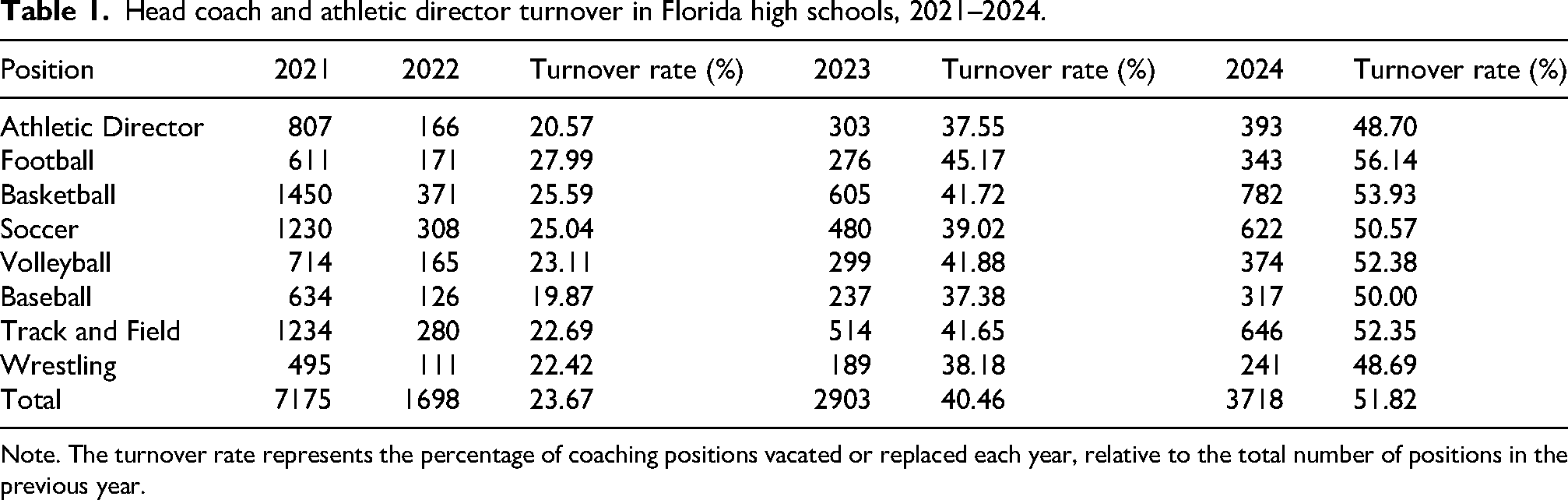
RQ1 examined changes in turnover among athletic directors between Years 1 and 2, 2 and 3, and 1 and 3 (Table 1). Two-proportion z-tests were used to assess differences in turnover proportions between pairs of years for each position category and sport. Results indicated that turnover among athletic directors increased significantly across all year comparisons. In Year 1, the turnover rate was 20.57%, which rose to 37.55% in Year 2 and 48.70% in Year 3. The difference between Years 1 and 2 was statistically significant, z = −7.51, p < .001, as was the difference between Years 2 and 3, z = −4.52, p < .001, and between Years 1 and 3, z = −11.88, p < .001.
Head coach and athletic director turnover in Florida high schools, 2021–2024.
Note. The turnover rate represents the percentage of coaching positions vacated or replaced each year, relative to the total number of positions in the previous year.
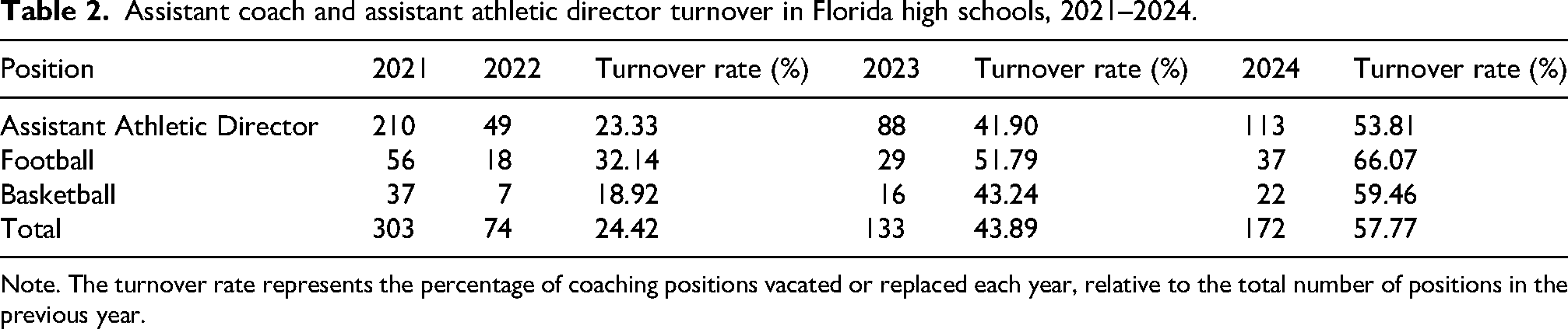
RQ2 investigated the turnover rate for assistant athletic directors (see Table 2). In Year 1, the turnover rate was 23.33%, which rose to 41.90% in Year 2 and 53.81% in Year 3. The difference between Years 1 and 2 was statistically significant, z = -4.06, p < .001, as was the difference between Years 2 and 3, z = -2.44, p = .015, and between Years 1 and 3, z = -6.42, p < .001.
Assistant coach and assistant athletic director turnover in Florida high schools, 2021–2024.
Note. The turnover rate represents the percentage of coaching positions vacated or replaced each year, relative to the total number of positions in the previous year.
RQ3 examined turnover among head coaches across all sports (Table 1). Head coaches across all sports followed a comparable trend, with turnover increasing from 23.67% in Year 1 to 40.46% in Year 2 (z = −21.55, p < .001) and 51.82% in Year 3 (z = −34.79, p < .001). Each pairwise comparison was significant, including between Years 1 and 3 (z = −32.71, p < .001).
RQ4 investigated the turnover among assistant coaches (Table 2). Turnover rates increased from 24.42% in Year 1 to 43.89% in Year 2 and to 56.77% in Year 3. The difference between Years 1 and 2 was statistically significant, z = −5.05, p <.001, as was the difference between Years 2 and 3, z = −3.17, p = .002, and Years 1 and 3, z = −8.11, p <.001.
RQ5 asked whether there was a significant difference in turnover between Years 1 and 3 based on sport when head and assistant coach data were combined, and if so, which sport demonstrated the greatest likelihood of turnover. Between Years 1 and 3, all sports displayed statistically significant increases (p < .001). Football exhibited the highest absolute turnover rate by Year 3 (56.97%), z = 12.45, p < .001 Basketball followed a similar pattern, increasing to 54.07%, z = 11.98, p < .001).
RQ 6 asked whether coaches, when combining head and assistant positions, were more likely to leave their jobs after three years than athletic directors, when combining director and assistant director positions. Athletic directors and assistant athletic directors had a combined turnover rate of 49.75%, compared to 52.38% for coaches, which was not statistically significant, z = 1.36, p = .12.
Discussion
The purpose of this study was to investigate the turnover rate among coaches and athletic directors in schools. Our findings provide compelling evidence of escalating turnover rates among athletic directors, assistant athletic directors, head coaches, and assistant coaches over a three-year period. These findings reveal a statistically significant increase in turnover across all roles and sports, with football exhibiting the highest absolute turnover rate and baseball the most substantial proportional increase.
Turnover rates in our study ranged from 18.92% to 32.14% in the first year, increasing to 48.69%-66.07% after three years. Although direct comparisons between collegiate and school-based coaching should be made cautiously, these numbers are notable when considered alongside LaVoi and Silva-Breen's 12 eight-year study of collegiate head coaches, which reported a 12.9% annual turnover rate. Therefore, it is likely that many school sports, student-athletes, and schools are being disrupted by organizational instability, which can hinder athlete development and compromise program effectiveness.4–6
Although the data clearly indicate that turnover in coaching is an issue, the underlying causes in the present population remain speculative. However, organizational and environmental pressures, such as inadequate compensation, excessive workload, and insufficient administrative support, may help explain declining retention among school-based sport personnel, as prior research has identified these factors as relevant to coach and athletic administrator stress, turnover intentions, and job longevity.3,10,17,19,20,25 Literature consistently highlights that coaches and athletic directors face unrealistic expectations and are frequently underpaid, which exacerbates occupational stress and turnover intentions.3,10,17,19,25 These findings are corroborated by national survey data and qualitative investigations, which document substantial workloads, limited recognition, and inconsistent support as pervasive challenges.23,24 In light of the above, further research is needed to clarify not only which organizational, cultural, and structural dynamics drive turnover in school-based athletics, but also the relative strength of their influence so that targeted, evidence-informed retention strategies can be developed and effectively implemented.
The distinction between organizational and occupational turnover is critical. While organizational turnover may reflect misalignment between personnel and institutional culture, occupational turnover signals broader concerns about the sustainability of coaching as a career pathway.9,12 The increasing rates observed in this study suggest that both forms of turnover are prevalent, with implications for workforce stability and the long-term viability of school sport programs.
High turnover rates have measurable consequences for program quality and athlete experience. However, these developmental benefits depend partly on continuity in the sport environment, including stable expectations, sustained coach-athlete relationships, and consistent program culture. Youth sports can serve as an integral venue for social and relationship development as well as leadership. 15 Disruptions in leadership can erode these experiences and negatively affect team cohesion, affective states, and overall program culture. 4 Conversely, improved coach retention may strengthen athlete experience by preserving trust, communication, and relational continuity across seasons. Effective onboarding and professional development have been shown to mitigate turnover and enhance retention. 14 However, these strategies are likely most effective when paired with broader retention efforts, including more competitive compensation, workload management, stronger administrative support, mentoring, and clearer advancement pathways. Prior research has identified compensation, workload, organizational support, recognition, and career sustainability as important factors related to coaching and athletic administrator retention.3,10,17,19,23,25
The present findings reinforce the need for school systems to view retention as a coordinated workforce issue rather than a problem that can be addressed solely through professional development. When professional development is used as part of a retention strategy, it should include practical role demands, such as role expectations, coach-athlete relationships, parent communication, conflict management, athlete safety, administrative responsibilities, and the educational purpose of school sport.
Performance pressures, particularly in high-profile sports, may also contribute to turnover patterns when administrators, parents, community members, fans, boosters, or athletes themselves treat winning as the primary measure of coaching effectiveness. The tendency to prioritize winning and competitive outcomes over educational and developmental goals may precipitate coach dismissals and undermine program stability.5,10 This phenomenon raises important questions about the alignment of personnel decisions with the broader mission of school-based athletics.
While the study focuses on Florida, the findings resonate with national trends in coach and athletic director turnover. Recent research indicates that low pay, high workload, and limited advancement opportunities are pervasive issues across sports in the United States.20,25 Additionally, the requirements, opportunities, and costs of professional development for coaches and athletic directors vary across the country.1,26 The consistency of these challenges suggests that the observed turnover is not unique to Florida but reflects systemic issues within the wider school sport workforce.
Limitations and future research
Several limitations should be acknowledged, which provide opportunities for further research. First, the study relies on administrative data from Clell Wade Directory, Inc., which, while comprehensive, may not capture all nuances of personnel changes, such as voluntary versus involuntary turnover or reasons for departure. Consequently, the data indicate whether turnover occurred but do not explain why personnel left, whether they moved to another school, or whether they exited coaching or athletic administration entirely. This is a clear need for future research. Second, the analysis is limited to middle and high schools in Florida, which restricts its generalizability to other states or educational contexts. Third, the study does not account for potential confounding variables, such as changes in school funding, policy shifts, or external events, including the COVID-19 pandemic, that may have influenced turnover rates. Finally, the lack of qualitative data limits the ability to explore the lived experiences and motivations of departing personnel.
Future research should address these limitations by incorporating mixed-methods approaches that combine quantitative turnover data with qualitative interviews or surveys. Longitudinal studies examining the impact of retention strategies, such as increased compensation, professional development, and organizational support, would provide valuable insights into effective interventions. Comparative analyses across states and educational systems could elucidate contextual factors influencing turnover. Additionally, research exploring the impact of turnover on athlete outcomes, program performance, and school culture would further advance understanding of the broader implications of workforce instability.
Conclusion and application
To be blunt, school principals and superintendents should expect to replace at least half of their athletic staff every three years. The resource implications of this, in terms of time and expense devoted to recruiting, hiring, and training replacements, are significant. Furthermore, other factors, such as community buy-in for teams and the impact on student-athletes and other staff, cannot be overstated. Our findings underscore a pressing need for policy interventions to mitigate turnover among school sport staff.
Given the systemic escalation in turnover rates, educational policymakers and school administrators must prioritize the development and implementation of comprehensive retention strategies to address this issue. These should include increasing salaries and stipends for coaches and athletic directors to reflect the demands and responsibilities of their roles, 3 implementing policies that address excessive workload and provide adequate support staff, establishing ongoing professional development that is applicable and affordable, 1 along with mentoring opportunities and clear career advancement pathways to enhance organizational commitment.10,17 Fostering a positive organizational culture that values and recognizes the contributions of sports personnel, including regular feedback, mentorship programs, and transparent communication, is also essential.27,28 Furthermore, performance expectations should align with the educational mission of school-based athletics rather than being solely focused on competitive outcomes.
Implementing these policy recommendations will not only enhance workforce stability but also yield substantial benefits for student-athletes. Reduced turnover fosters program continuity, strengthens athlete-coach relationships, and supports students’ holistic development through sustained mentorship and consistent leadership. Stable athletic programs contribute to positive athlete experiences, improved team cohesion, and the advancement of educational and developmental goals within school sport systems. 16
In summary, addressing the underlying causes of turnover through targeted policy interventions is crucial for sustaining high-quality school sports programs and maximizing the benefits for student-athletes. Future research should continue to evaluate the effectiveness of these strategies and explore additional approaches to support the professional well-being of sports personnel.
Footnotes

Ethical considerations
The Ethics Committee of Florida State University granted ethical approval.
Consent to participate
No consent was necessary, as this was aggregated data.
Consent for publication
No consent was necessary, as this was aggregated data.
Funding
The authors received no financial support for the research, authorship, and/or publication of this article.
Declaration of conflicting interests
The authors declared no potential conflicts of interest with respect to the research, authorship, and/or publication of this article.
Data availability
The data that support the findings of this study are available by request from the corresponding author.