




Abstract
Research on cultural capital has been very attentive to cultural participation. In numerous explorations of the social basis of participatory practices, a division between cultural engagement and disengagement has been frequently observed. In accordance with Bourdieu’s seminal work on taste, that divide has been predominantly associated with social class issues. But research has only weakly explored the rationale behind people’s behaviours in this regard. This article explores rationales for non-participation and reaches significant conclusions about these. First, non-participatory practices are very much spread across the social structure, and they are associated with different reasons (disliking, lack of time, money, information, habits, and access to venues). Second, the reasons provided by survey interviewees are affected differently by income levels, age and the size of the places people live in, amongst other important variables. Third, even though the effect of those variables on the reasons changes according to the legitimacy of the activities in which interviewees do not take part in, differences related to the status of the activities are less significant than similarities. I use data from Chile, collected in 2012, and the findings are linked to those of previous analyses undertaken in other countries.
Introductory notes
Research on cultural capital has been very attentive to issues of participatory practices and tastes. Many studies have focused on highbrowness (Bourdieu, 1979; Katz-Gerro, 2002; Kraaykamp and van Eijck, 2010; Nagel and Ganzeboom, 2002). Others have taken a broader view that incorporates more shared or popular cultural activities (Bennett et al., 2009; Peterson and Kern, 1996; terBogt et al., 2011; Warde and Gayo, 2009; Willekens and Lievens, 2014). In both the more focused and the broader perspectives, research on participatory patterns has very frequently found a divide between cultural engagement and disengagement across the various countries studied (Bennett et al., 2009; Bennett et al., 2013a; Gayo et al., 2009; Purhonen and Wright, 2013). On the whole, this stream of literature shows not only that upper social strata have distinctive tastes, but also that their members, characteristically well off and highly educated, were the social group more likely to take part in cultural activities. This literature therefore suggests that economic and cultural resources are central explanatory factors in accounting for cultural participation - that is, what explains the relation between class and culture (the homology thesis in Bourdieu) is the individual accumulation of capital of different kinds. And Bourdieu made that assumption stronger by giving descriptions of how economic and social expectations linked to positions in the social space matched individual decisions (Bourdieu, 1979, 1989, 2003).
However, a crucial difficulty with this line of interpretation is precisely the presence of an empirical association between disengagement and low levels of education, or lower social class. This makes it difficult to identify that there may be many people from the upper strata who also do not participate much in cultural activities (Glevarec, 2005; Glevarec and Pinet, 2009; Lahire, 2004; van Eijck and Knulst, 2005). 1 In other words, and counter to a somewhat mechanical reading of the engagement/disengagement divide, non-participatory patterns are very common in the whole social space, 2 including for people in the upper classes. This calls into question the sufficiency of capitals to account for patterns of cultural participation. This article explores this topic more deeply. Rather than relating positions to practices, as Bourdieu and many Bourdieusians have done over the years, it connects social positions to people’s rationales or justifications, in the form of the reasons they advance for not taking part in cultural activities. Thus the article shows that different people possessing the same amount of cultural and economic capital might choose to participate or not, and, where they do not, might also advance different reasons for non-participation.
The idea of cultural disengagement is rooted in Bourdieusian approaches that consider that any pattern of behaviour has to be evaluated in relative terms, or within the set of patterns that make a social space possible (Bennett et al., 2009; Bennett et al., 2013a; Purhonen and Wright, 2013). On the other hand, non-participation is a concept that seems to have been more attuned to scholarship that considers it as a phenomenon in itself (Alderson et al., 2007; Chan and Goldthorpe, 2007; Coulangeon, 2011; Katz-Gerro and Jaeger, 2011). Most of the authors writing in this way have usually used regression analysis, while Bourdieu-inspired authors have been more inclined to use multiple correspondence analysis. In this article, I try to bring together these two traditions. I am inspired by the work carried out by Bourdieu and his followers, but I also use measures which allow us to identify individuals with low levels of cultural involvement or no participation at all. Therefore cultural disengagement will not be understood in binary terms, as 1 and 0, but as a gradient that ends up in a state of complete inactivism or cultural non-participation.
Chile is an OECD country. 3 Its economy has been growing very quickly since the end of the 1980s. 4 This has had all sorts of consequences. There has been a significant increase in the population, reaching above 17 million people in 2014; this was around the time when the fieldwork of the survey analysed in this article took place. Life expectancy has also been improving very significantly, and it is nowadays about 80 years of age. Poverty has undergone a dramatic decline, being about 14% of the population (Ministerio de Desarollo Social, 2015). Gross domestic product (GDP) per capita has increased in a remarkable way, with Chile now being one of the wealthiest countries in Latin America according to this indicator 5 . GDP stood at US$13.383 in 2014, whilst Gross National Income reached US$20.804 (see Table 1). However, indicators also show great inequalities, much higher than those in Western European countries (see Gini coefficient in Table 1). 6
Sociodemographic characteristics of Chile and the United Kingdom.
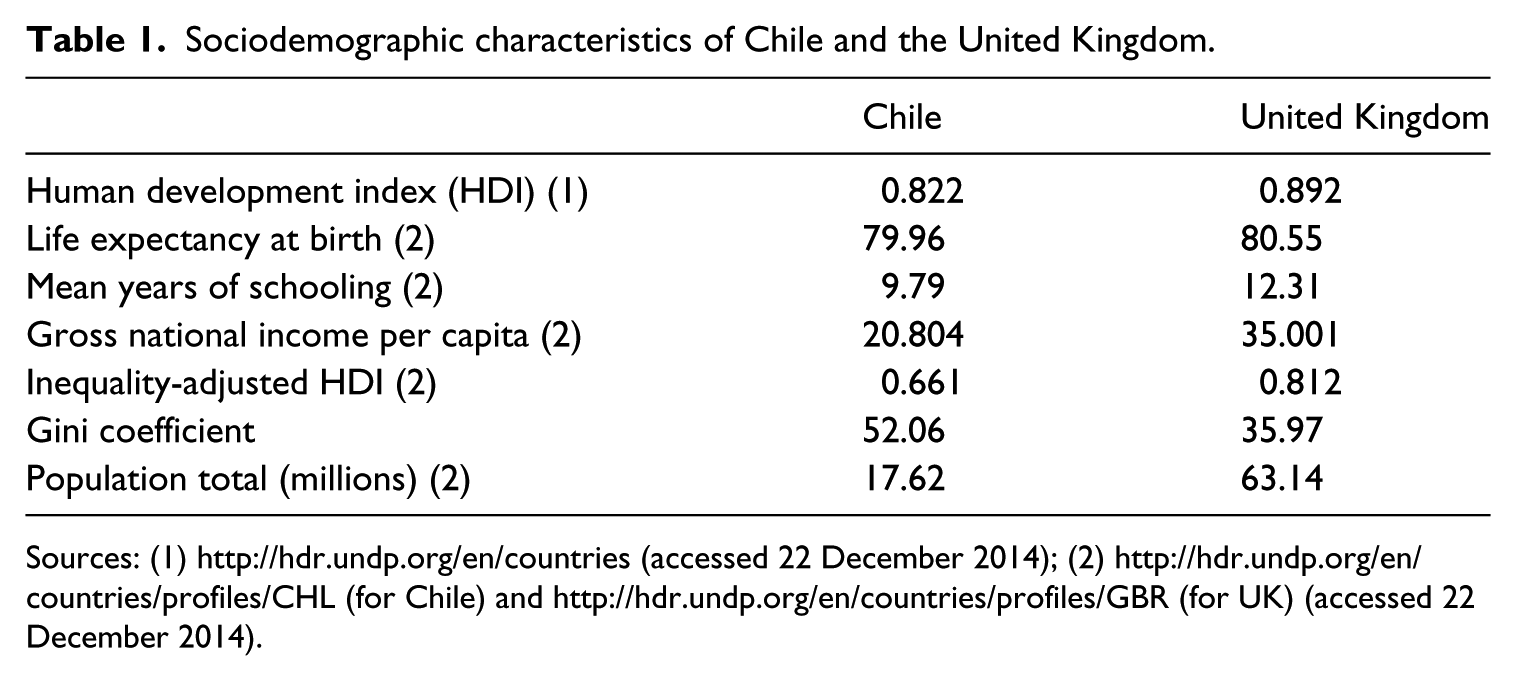
Sources: (1) http://hdr.undp.org/en/countries (accessed 22 December 2014); (2) http://hdr.undp.org/en/countries/profiles/CHL (for Chile) and http://hdr.undp.org/en/countries/profiles/GBR (for UK) (accessed 22 December 2014).
Cultural Disengagement in Recent Literature
To begin with, it is important to establish that the idea of ‘non-participation’ has been understood in different ways. While in the final analysis it describes a situation where some people do not take part in some activities, the details change from definition to definition. 7 As an example, for Zavisca, ‘nonreaders’ are those ‘who read rarely for pleasure’ (2005: 1238). That is, according to this conceptualization, nonreaders may, and are able to, read. In a study on ‘non-singers’, Whidden defines the prototypical individual as ‘one who self-designated as one who does not have the physical capability or coordination to succeed in the simplest of musical tasks’ (2010: 2). A less subjective definition is used by Allender et al. in a study about sport and physical activity: physical activity refers to ‘any bodily movement produced by skeleton muscles that results in energy expenditure’ (2006: 826). This would produce a gradient of participatory inclination, instead of a clear separation between participants and non-participants. In this study I use an objective definition, in the sense that I consider non-participants as those who answer in the survey that they do not take part in a set of particular cultural activities, similar to the way Chan and Goldthorpe (2007) and also Alderson et al. (2007) empirically define those they call ‘inactives’, and to those Katz-Gerro and Jaeger (2011) named ‘passive’ or ‘couch potatoes’. I then separate out the answers according to the reasons that interviewees provide for deciding not to be more engaged in cultural events. The fact that later on activities are grouped by their level of cultural legitimacy allows there to be a gradient or indicator of non-participation for every specific reason according to the cultural status of the activities considered. These measures or indicators will be treated as continuous variables in the data analysis.
In the studies I have reviewed, a variety of reasons are adduced that incline people in favour of non-participation. I attempt to organize them in a way that renders the whole picture comprehensible and allows me to connect it with my own results. First, there is a set of reasons which emphasizes the relevance of individual and collective economic conditions in improving the chances of people engaging in cultural activities (Allender et al., 2006; Mchunu and Le Roux, 2010; Miles and Sullivan, 2012; Whidden, 2010). Second, while education is found to be an essential starting point for promoting cultural engagement, this is not so much because education provides the cultural capital needed to participate, but above all because the ideas that people have about themselves as able to take actions are important and have an impact. Development of a self-image in relation to cultural participation is also very much connected with experiences at home during childhood and adolescence. Having been supported by family and teachers would significantly and positively affect people’s propensity towards cultural activities (Allender et al., 2006; Whidden, 2010). Third, access to cultural facilities is also very important (Allender et al., 2006; Mchunu and Le Roux, 2010). Fourth, time is a relevant factor, within which family and working hours have a strong influence (Miles and Sullivan, 2012). Fifth, according to Zavisca (2005), distaste or dislike is an important reason that should be taken into account. She shows how in Russia the social history of readership is very much connected with political history. The Soviet regime promoted Russian classical writers, and being a good reader was an essential part of being a cultured person, which used to be associated with social prestige. This has been changing dramatically with the political and economic transformations that took place throughout the 1990s. Nowadays being a good reader is not so important, and liking and knowing classical authors such as Pushkin and Tolstoy is not necessarily expected any more for people who occupy higher status positions. Finally, reasons for cultural disengagement change across age groups (Allender et al., 2006), and according to familial economic circumstances (Mchunu and Le Roux, 2010; Miles and Sullivan, 2012). 8
In many of the contributions previously mentioned, it is not always easy to differentiate social and economic variables from the rationales that might have influenced cultural behaviours. This article is an attempt to develop further our knowledge about determinants of cultural activism/inactivism, but it is also an opportunity to know more about the Bourdieusian connection between social positions (capitals) and dispositions (habitus, mis-match, social reproduction). Bringing into the analysis reasons given by survey respondents is a way to know their understandings of the situation, but it can also be interpreted as information provided about actual determinations of non-participation or obstacles against participation. This article was written in light of this ambivalence, but above all in the expectation of to shedd more light on the links between structural variables and individuals’ rationales. Otherwise we would not know much how capitals and social determinants operate. These are treated in detail in the next section.
Determinants of Participation
Existing work on the determinants of cultural participation clearly demonstrates that some social variables are crucial explanatory elements in accounting for cultural engagement or disengagement. There is a well-known line of studies showing associations between social and economic inequalities and cultural activism and taste. First, cultural practices and cultural reproduction prove to be essential to understanding how social inequalities manifest themselves and endure for long periods of time and across generations (Crook, 1997; Kraaykamp, 2003; Nagel, 2010; Willekens et al., 2014). Second, variables such as level of education, social class, social status, age and gender also prove to be relevant to explaining cultural engagement (Alderson et al., 2007; Bennett et al., 2013a; Bennett et al., 2009, 2013b; Chan and Goldthorpe, 2007; Gerhards et al., 2012; Katz-Gerro, 2002; Katz-Gerro and Jaeger, 2011; Nivón and Sánchez Bonilla, 2012; Purhonen and Wright, 2013; van Eijck and Knulst, 2005; van Hek and Kraaykamp, 2013; van Rees et al., 1999; Wright et al., 2013), though the relative influence attributed to each varies according to the particular study. In all of these analyses, people are classified or differentiated according to their level of involvement in cultural activities. On the whole, the findings and conclusions of this line of research suggest that cultural participation is more prevalent among upper social classes and people with high levels of education. At a very high level of generalization, then, we can say that non-participatory practices are most often the preserve of the working classes, or those who have a low level of accumulation of economic capital and are poorly educated.
This pattern also holds true for Chile. Research on Chile has been attentive to cultural inequalities for some time. Since the end of the1980s and during the 1990s, several studies have shown how culturally unequal Chilean society was (Catalán and Sunkel, 1990; Catalán and Torche, 2005; PNUD, 2002). Shaped by the development of the debates in the social sciences in Western Europe and the United States, those initial ideas and findings were followed by a set of studies built upon the same basis but more theoretically driven by Bourdieusian views and with greater technical and statistical sophistication. For example, Torche (2007) demonstrated that reading is very much influenced by education and income. In addition, Gayo et al. (2009, 2013, 2016) and Gayo (2013) showed that there is a clear and positive association between levels of education and socio-economic grouping, on the one hand, and cultural participation, on the other.
Taking those ideas about social determinations into account, my first hypothesis accordingly is that: H1: Reasons for non-participation are influenced by social and economic variables similar to those already mentioned in existing studies of cultural engagement (income, educational level, age, gender, geographic location), that is, the rationales of cultural inactivism suffer the same structural determinations as the behaviour itself.
Additionally, from a cultural distinction perspective regarding taste, it has been common to present working-class people as having a lower propensity to like certain cultural expressions, particularly those which are considered legitimate (Gayo et al., 2009, 2013; Le Roux et al., 2008; Warde and Gayo, 2009).
9
That means that distinction is not only about being more, or less, culturally involved: lower educational and social classes also engage with cultural activities which are considered less relevant, sophisticated or prestigious. A very significant result of these studies has been the emergence of the idea that individuals in higher and more educated social classes are heavily involved in high culture. There are nonetheless authors who react strongly against this assumption, highlighting that highbrowness is a minoritarian phenomenon even within high-status groups (Glevarec, 2005; Glevarec and Pinet, 2009; Lahire, 2004). From their findings, these scholars conclude that highbrowness is therefore no longer such an important marker of distinction as it previously seems to have been. For our purposes, and following these French authors, it is important to point out the fact that non-participatory practices are pervasive throughout the social structure, particularly where activities usually associated with high culture are concerned. Taking into account the idea of distinction, meaning that culture is practiced and appropriated by social groups in a different manner, and considering that non-participation also affects high-status strata, my second hypothesis goes as follows: H2: I expect to find that reasons for non-participation are influenced by the value or social status of the activity being researched. In other words, the motives for not taking part in legitimate cultural activities will be different from those that affect engagement with more popular cultural expressions.
In general, with all these contributions in mind, we are offered a very exhaustive treatment of many important social and economic variables that affect cultural activism, and therefore inactivism too. However, the rationales by which people take their decisions are much less known. It is in that area that much more systematic and extensive research is needed on non-participation in cultural activities, to which I hope this article will constitute a contribution. This should allow us to go beyond the current state of knowledge, in which researchers can be tempted to cover gaps with ‘reasonable’ speculation (Torche, 2007). 10 However, and bearing in mind the literature that was reviewed above, I do not claim that there is no existing research at all at this level, but rather that we have to go further down this line of research. Accordingly, in the section which follows, I present some reflections by Bourdieu which are at the core of understanding the relationship between class and culture, and are very closely connected with the idea of rationale.
Cultural Non-Participation: Choice or Necessity?
From a Bourdieusian perspective, we can understand that tastes and participation are the result of election or choice for the upper classes, but are a by-product of necessity for the lower classes (Bourdieu, 1979, 1989). This does not imply that people in dominated positions do not take decisions.
11
They obviously do, but in a social context that imposes on them many more limitations than those to which people in a dominant social position are subject.
12
Taking this observation to its logical extreme, Bourdieusian thinking would suggest that cultural inactivism is a matter of election when it occurs among the dominant upper-middle classes, but is dictated by social realities for dominated or working-class people. In other words, as long as people can choose what to do and like, they are free to decide to moderate their participation in cultural activities or not to take part in them at all. That would make taste more significant or recurrent as a reason for participation or non-participation among those in dominant positions in the social space, that is, those with a relatively high amount of capital. Developing Hypothesis 1 in this way leads us to Hypothesis 3: H3: People who occupy dominant positions in the social space (those with relatively high economic and cultural capital) are more inclined to choose ‘dislike’ as a reason for not taking part in cultural activities.
There is, however, another possible alternative: taste may not be a matter of freedom of choice, but the result of any position in the social space.
13
In that case, we have Hypothesis 4: H4: Everyone in society, regardless of their amount of capital (economic and educational), is equally inclined to manifest their likes and dislikes. That implies that freedom of choice is not only used by dominant classes in an ongoing process of distinction, but that it is also incorporated by popular classes when they have to take decisions and make differentiations. This opens up the possibility that these latter strata do not just accept cultural social hierarchies, but can also refuse them.
The fact, however, is that the dominated classes are constrained to the extent of not being able to exercise free decision making, given the limits placed upon them by material conditions of precariousness and the cultural subordination of their position within the society to which they belong. Therefore, an alternative development of H1 would hypothesize that: H5: People occupying dominant positions in the social space (relatively well off and highly educated) will be less prone than others to choose categories explaining non-participation that proceed from a lack of education (no information) or scarcity of economic resources (no money, no access/venue).
This divide regarding participation and rationale underlines the fact that dominant upper-middle classes and dominated working classes are different. It also establishes, however, that the differentiation between them has serious symbolic implications. In other words, the socially dominant strata command a publicly deployed cultural repertoire that contributes to justifying their social dominance (Bourdieu, 1979). The actual content of that repertoire is a set of practices that are recognized as prestigious or legitimate, taking into account the distinction between highbrow and popular activities. In hypothetical terms, developing H2, I accordingly expect that: H6: Reasons for not taking part in cultural activities will be affected by economic (income) and cultural (level of education) capitals, above all when it comes to involvement in expressions or events associated with high culture. In other words, the effect of these variables will change according to the social hierarchy of the activities, as than the effect of income and education is greater on involvement with highbrow activities.
Data
In Chile, a national survey on cultural participation was conducted in 2012, funded by the National Council for Culture and the Arts (Consejo Nacional de la Cultura y las Artes). 8200 people of 15 years of age or above participated in a face-to-face survey interview, the sampling error being 1.09% (CNCA, 2013). The questionnaire included questions on cultural participation and taste in several areas: visual arts (paintings, photography, video, sculpture), dance (ballet, modern dance, folk dance), circus, music, concerts, crafts, books, libraries, cinema, video, internet, new media (art and technology, video games), natural heritage, museums, and non-material heritage. In each domain, people who declared that they did not participate at all in that activity were asked to give their main reason for not taking part. Unfortunately, the range of alternative reasons was not always identical – indeed was sometimes not even similar – between activities. I therefore decided to limit myself to working with data for those areas (activities) where there was more similarity amongst the possible answers. This proved to be the majority (8 out of the 15 activities). The alternatives offered to interviewees in these 8 domains, and thus the ones included in this analysis, were the following: 1) dislike, 2) no time available, 3) no money, 4) no information, 5) no habit or custom, and 6) no venue nearby, or no access. Table 2 provides the frequencies of all these motives by cultural domain. It shows how common is non-participation. It is also remarkable that the distribution of reasons changes according to the domain, even though disliking and not having time are the most frequently mentioned answers.
Frequencies of reasons for not taking part by cultural domain.

Source: CNCA 2013.
Rather than carrying out the analysis using all survey respondents, I selected those who had responded ‘no’ in the (filtering) question about attendance or practice in the eight domains mentioned above. Therefore, the analysis was carried out with subjects who had shown some tendency to non-participation, given that the stated goal was precisely to make distinctions within that population. This was done in order to consider the whole range of possible intensities of non-involvement for particular reasons. If I had focused only on high non-participants, the sample would necessarily have been biased towards people possessing low capital: that is, it would basically represent lower social strata. A long tradition of previous studies has worked on separating participants from non-participants: here, on the other hand, I wanted to investigate the lesser-studied topic of the basis of underlying patterns within non-participation.
Exploring Associations Amongst Non-Participatory Practices
In order to reduce significantly the number of models, I explored whether reasons for not taking part could be common through all the cultural domains. Doing so that avoided having to deal with 48 logistic regression models (six reasons by eight domains), many of which had very similar results. Other alternatives were precluded. In particular, working on the correlations of reasons within the same domain was not a viable alternative, as interviewees could only pick up one of the set of answers for each activity in the questionnaire. In other words, instead of assuming that reasons offered by the same individual for non-participation in different cultural domains were independent of one another, I explored whether those reasons could be common for some sets of practices. To establish this I performed a principal component analysis (PCA) employing all eight cultural domains, separately, by every reason (frequencies available in Table 2). I knew whether interviewees’ decisions not to take part were or were not based on a particular reason. In terms of analysis, having this type of information available meant that the data was binary, 1/0, and for that reason the PCA was conducted using tetrachoric correlations. A synthesis of the results appears in Table 3.
Principal component analysis loadings of cultural practices by reasons of non-participation in cultural activities.

Notes: This analysis was based upon a matrix of tetrachoric correlations because engagement in cultural activities was coded as 1 or 0 for every single reason.
Numbers in bold are those strongly associated with a component.
C = component.
I found that people’s cultural practices were mostly consistently associated across the different reasons. On the one hand, there is a propensity for a person who does not visit the theatre also to abstain, for the same reason, from attending dance presentations, visual arts shows, and concerts. There is a similarly strong association at the level of the individual amongst reading (or not reading) books, going to the cinema, and watching movies on personal computers or DVD players. Circus-going lies somewhere in between these two groups of activities, but since in Chile the circus is usually regarded as much more lowbrow or popular than the other kinds of shows and concerts mentioned here (CNCA, 2013), I accordingly decided to group it with the second, more culturally lowbrow, set of activities.
Based mainly upon the results of the PCA, activities were divided into two groups. The first group is conceived of as representative of highbrow or legitimate culture, following studies that associated those activities with highly educated and well-off people (Brunner, 2005; Gayo et al., 2013; Morel, 2005; van Eijck and Knulst, 2005). The second group contains activities considered more popular or mass cultural. That division allowed me to create measures of intensity of disengagement for every single reason, separating out high culture practices from ‘lower’ ones. The following section develops this further, carrying out explanatory analysis of the two sets of measures. These indicators were created for every single reason, separately adding up all the activities for which an interviewee answered that s/he does not participate. Results are provided in Tables 4 and 5. This alternative was preferred as the results are more easily understood because of the use of a measure that can be easily interpreted. The scales provided by the PCA are more difficult to understand. Apart from that, on the whole, many of the factor loadings are relatively similar, which makes significant differences between the results of our procedure and those of the PCA unlikely.
Percentages of times a reason was given by interviewees for not taking part in high culture activities (theatre, visual arts, dance, and concerts).
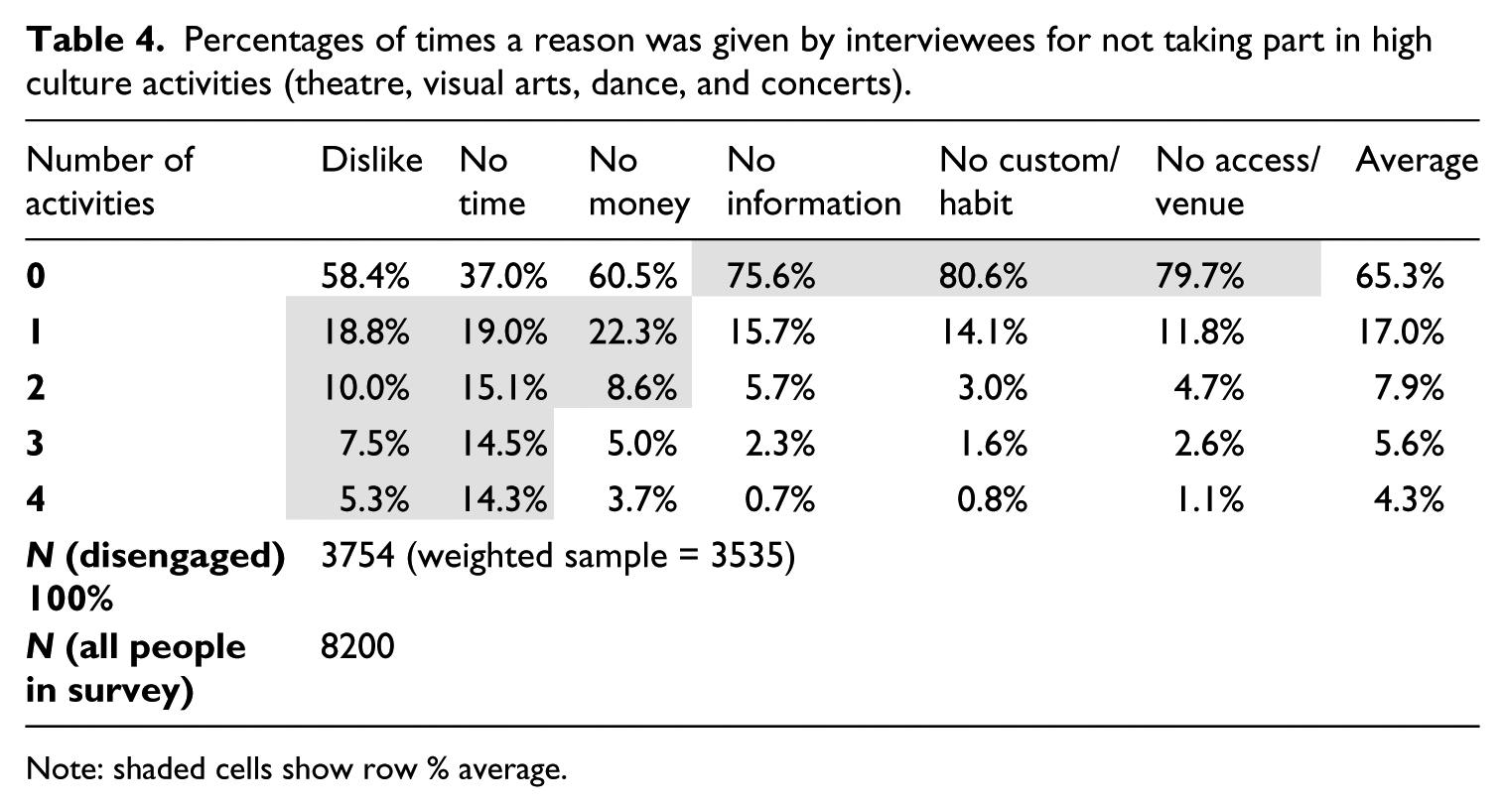
Note: shaded cells show row % average.
Percentages of times a reason was given by interviewees for not taking part in popular culture activities (books, films, cinema, and circus).

Note: shaded cells show row % average.
Explaining Reasons for Cultural Non-Participation
Having measured levels of disengagement by reason given means that the data does not distinguish between non-participation and rationales. In other words, bearing in mind that survey interviewees can only choose one of the reasons why they have not taken part, each given reason can be counted as one event of non-participation. A logical step forward was to explain the differences discovered. To this end, levels of disengagement were used as dependent variables. The measures were produced by adding up the activities identified through the principal component analysis, giving identical weight to each (see Tables 4 and 5). This gives us ‘count data’, for which use of the Poisson distribution is indicated. I accordingly carried out Poisson regression analysis, the results of which are reported in Table 5. The independent or explanatory variables in the models attempt to incorporate variables which have featured strongly in debates on taste and cultural participation in the sociology of culture over recent decades (Bennett et al., 2009; Bourdieu, 1979), namely: economic capital (income), cultural capital (educational level), age, gender, and – a less frequently mentioned variable – the size of the place where people live. The descriptives of these independent variables are provided in Table 6. In a couple of cases the numbers are too few, but I preferred to accept those limitations instead of creating very broad categories that would be difficult to interpret. In any case, the results based on only seven people for one of the income categories in M2 were dropped from the table of results (Table 7).
Descriptives of independent variables in regression models.

Note: CLP = Chilean Peso.
Source: CNCA, 2013.
Poisson regression models explaining levels of disengagement according to particular reason given.

Note: Robust standard error between brackets. Even though this is not an OLS regression model, ‘explained variance R2’ is included as it is additional information which, being consistent with other statistics, contributes a clearer understanding of the models reported here.
Reference categories of independent variables:
Less than 245.000 Chilean pesos per month (100.000 Chilean pesos is the equivalent of approximately US$200, at the December 2014 exchange rate);
men;
between 16 and 24 years of age;
big city; and
secondary education.
The constant of the model is the natural logarithm of the value (in the measure of disengagement) of any interviewee with all the characteristics of the reference categories. Then, in the dislike M1 model, exp (0.74) = 2.09 points in a scale of 5 points (see Tables 3 and 4). For any other interviewee, we have to add to the respective constant the coefficients of categories according to the characteristics of our interviewees.
M1 = highbrow cultural activities. M2 = popular cultural. CLP = Chilean Peso.
p < 0.05, ** p < 0.01.
If we start by looking at reasons people give for not engaging in high-culture activities, several notable findings emerge (see Table 7). It is clear that accounting for these motives requires use of different social variables. In some cases, when ‘no information’ and ‘no custom/habit’ are the reasons under analysis, the explanatory power of the models is pretty low, which indicates that choosing these two alternatives is not greatly a matter of economic, educational or socio-demographic differences. Additionally, disengagement from popular activities seems to be better explained than its equivalent among highbrow practices. This is surprising, as I would expect to find the strongest differences amongst this latter set of practices, in accordance with H6. In general, if we study reasons given by respondents for not taking part in high culture, we find important differences that can be summarized as follows: disliking high-culture activities is a reason provided above all by relatively poorly educated, older men living in big cities. Not having time is an answer given by high-income, well-educated, middle-aged people also living in big cities. Not surprisingly, the answer ‘lack of money’ is more often given by city dwellers who have a relatively low income and poor education. Lack of information about cultural activities is a problem more often mentioned by young women residing in medium-sized towns or cities. Lack of custom or habit is an answer more common among average or low-income, educated men living in medium-sized or large cities. Finally, the scarcity of venues available is essentially an obstacle for people living in medium-sized and small cities.
Regarding the reasons for not taking part in more popular cultural activities, the patterns are not totally dissimilar to those already described for highbrow expressions, which does not fully support H6, which had predicted an effect specific to highbrow expressions of culture. However, there are differences which are significant. On the one hand, the results regarding dislike make it difficult to make sense of the influence of variables. If we look at levels of statistical significance, one might contend that dislike is mostly an issue for poorly educated, very young people, but this is not completely clear. Otherwise, middle-aged, and relatively high-income people, with secondary or primary levels of education, mainly cite the effect of lack of time. Having no money is the principal obstacle for medium and low-income women, between 25 and 33 years of age, with secondary or primary levels of education. Lack of information is a reason mainly associated with medium and low-income groups, although the effect is small. Lack of custom does not show significant effects, which is coherent with the fact that popular culture is pervasive in everyday life. Finally, problems of access or venue are more likely to be mentioned by low-income groups living in medium-sized or small cities. In general terms, this description concurs with the findings for high culture activities, and, taken together, these two sets of observations demonstrate that reasons for non-participation are influenced by cultural and economic capital. While this confirms H1, the effect depends so strongly on the type of activity and the reasons given that we can conclude that the hypothesis is confirmed only partially.
Taking the above observations into consideration, when the various reasons given for not taking part in highbrow and popular cultural activities are explored, the social bases for engagement in each type of cultural expression demonstrate some differences but, above all, important similarities. Hypothesis 2 (H2) is therefore partially, but weakly, supported. A focus on the coincidences perhaps helps us to understand more clearly when particular reasons are especially important. To begin with, dislike is an argument which poorly educated people are more prone to use. In other words, it seems that highly educated people tend not to say that they dislike things. According to their answers, if people with high levels of education do not participate in certain activities, this is for reasons other than disinclination. This pattern has a range of explanations, including: that highly educated individuals possess a high level of tolerance, fear making mistakes or hurting other people’s feelings, or find themselves living in a culturally oppressive middle-class social environment. For our purposes, it is sufficient to make clear that the ability to express dislike for something is a disposition less common among the dominant classes than it is in groups from lower social strata. This finding, true for both high culture and popular culture activities, is a complete rebuttal of Hypothesis 3. While it is undeniably true that people with relatively high economic and cultural capital do in fact feel dislike for certain things, it seems very likely that ‘disliking’ is not part of their cultural repertoire in everyday life. This finding moreover also partially contradicts Hypothesis 4, since it seems that people with lower levels of education show a higher inclination to manifest their tastes in terms of the language of ‘dislike’. In any case, the effect of level of education is quite limited, while levels of economic capital do not seem to have any effect whatsoever. This leads us to state that H4 is partially confirmed.
In the case of lack of money as a reason, it is not a surprise that relatively poor or low-income people, with low levels of education, are those more prone to state that they do not do things because of a scarcity of economic resources. This is, of course, evidence for the Bourdieusian idea about choices and necessity among the classes populaires. In other words, people in dominated positions in the social space confront serious restrictions when they have to decide on the best way to spend their money. Cultural activities would probably not be the first preference when weighed against other, more urgent needs. This confirms Hypothesis 5.
Lack of time has a completely different social profile. Those who answer that time is scarce, or that they do not have enough of it to attend a particular show or event, are usually individuals with high incomes and in middle age (broadly defined). Those who are of working age have less time to spend in pastimes outside of working hours, while high incomes obviously usually come from occupying high-status occupations. There are different possible interpretations of this finding. On the one hand, it demonstrates that being in the upper-middle classes does not mean that one has the opportunity of enjoying a life without structural restrictions, where every choice is a product of free will. On the contrary, middle-class people suffer fundamental constraints in their everyday lives. These seem to be rooted in the availability of time, rather than of money, information or other possible constraints, something which is consistent with H5. Therefore dominant upper and middle classes share with the dominated working classes, to an extent, the trait of living in a realm of necessity, even if the limitations placed on the former are less burdensome than those experienced by the latter. On the other hand, offering lack of time as a reason for cultural disengagement could also be interpreted as a sort of refuge category, offered as a justification for cultural inactivism by members of a social class whose ethos contains a very strong mandate for cultural participation.
Finally, lack of venues for, or access to, cultural events is associated with living in medium-sized or small cities, where the cultural offering diminishes strongly in comparison with the activities that people have available to them in big cities. Territory, in other words, emerges as a relevant explanatory factor that should also be taken into account in developing a full account of cultural participation.
Discussion and Concluding Remarks
In this article, cultural disengagement has been understood as not taking part in cultural activities. In contrast to other studies, non-participation has been treated as a continuum or a gradient, rather than as a divide between the engaged and the disengaged (Bennett et al., 2009), or one exclusive or single category amongst others (Alderson et al., 2007; Chan and Goldthorpe, 2007). This article attempts to make progress in the demonstration that a complete understanding of non-participation cannot be obtained by considering social and economic variables in isolation. Instead, these must be combined with a study of the reasons associated with participatory behaviour. The finding that people with low economic capital are less involved in cultural activities is not an explanation in itself, but a partial account of a more complex phenomenon of engagement and disengagement.
On the one hand, this affects the homology thesis, that is, Bourdieu’s idea that taste and cultural practice mirror a structure of capitals. No doubt this hypothesis has been very helpful in creating accounts of the divide between participation and non-participation, but it is not so useful to understand the spread of cultural disengagement and the logic(s) behind it. Not taking part is due to different reasons, and those reasons do not clearly reflect a structure of capitals. As an illustration, working-class people are not unfamiliar with the idea of ‘dislike’, which suggests a significant development of their own tastes and aesthetics. Furthermore, these lower strata are not necessarily very inclined to choose not having the custom or habit as motives for not being involved in cultural activities, even though social reproduction has taken place (Crook, 1997; Nagel, 2010). In other words, it would be simplistic just to take for granted that capitals explain non-participation. They do to some extent, but there are other aspects that must be considered.
As scholars such as Lahire (2004) and Glevarec and Pinet (2009) have contended, non-participation clearly affects upper-middle-class groups, above all when we look at highbrow activities. However, instead of using this finding to debate with Bourdieu, as they did, the logical step forward would be to make an attempt to understand why this is so. This is not to say that those authors did not try to provide some answers to these questions, but to highlight that non-participation is not the end of the line, but a very generalized and plural phenomenon that should be explored further in order to improve our knowledge of participatory patterns. This article has aimed at opening that still relatively closed black box.
In research on cultural capital, socio-economics (capitals) and socio-demographics (age, gender, sex, spatial location, amongst others) factors have usually been the elements that build up the explanatory part of the equation (Katz-Gerro and Jaeger, 2011; Purhonen and Wright, 2013; van Rees et al., 1999). However, in all these analyses, a large percentage of the variance (regression models) and the inertia (multiple correspondence analysis) were not explained. If we look at my results, there is a significant but not very strong general relation between capitals and socio-demographics on the one hand, and rationales or reasons, on the other. For me, this does not signify an explanatory failure, but rather a possible explanatory route to be explored; one that might bring together capitals, socio-demographics and rationales into a more complete and fully-fledged account of cultural involvement.
With that in mind, it is important to acknowledge that some previous analyses have addressed the reasons people give for the difficulties they face with regard to cultural participation. In spite of that, exploration of the social conditions under which those motives usually work has, until now, been very limited. Some authors have contended that reasons for participation are affected by age and socio-economic circumstances (Allender et al., 2006; Miles and Sullivan, 2012). Others think that subjective characteristics, such as self-image, are crucial (Allender et al., 2006; Whidden, 2010). Factors such as time (Miles and Sullivan, 2012) and distaste (Zavisca, 2005) have also been considered important, while contributions exist which suggest that age (Allender et al., 2006) and familial economic wellbeing (Mchunu and Le Roux, 2010; Miles and Sullivan, 2012) significantly affect reasons for non-participation in cultural activities. This is in general a very dispersed literature, and I argue for the need to link together these heterogeneous and very often disconnected contributions as a point of departure for new work on cultural non-participation. This article goes somewhat in that direction.
The findings show that time is actually the primary obstacle hindering highly educated and well-off people from taking part in cultural activities. Money and taste are the major determinants of inclination towards cultural non-participation among lower income and poorly educated individuals. This suggests that, while all people suffer constraints, the nature of those constraints changes across the social structure. Emphasizing the significance of economic and cultural capital in relation to cultural engagement is very consistent with previous studies (Bennett et al., 2009; Bourdieu, 1979; Chan and Goldthorpe, 2007; Gayo et al., 2013; Torche, 2007). However, distinctions between people according to capital accumulated has a limited role in explaining the rationales behind cultural disengagement. It is also, as we have seen, of very restricted relevance for differentiating between participation in highbrow and lowbrow activities. Non-participation involves a diversity of motives, and the social circumstances under which each motive takes effect are different. This is not to say that all reasons are equally important, or that they are totally heterogeneous from a sociological point of view. In Chile, lack of time, dislike, and not having enough money are the most frequent answers given to justify non-participation, and in some cases they are strongly related. It is therefore crucial to understand when they are operative, in order to think in the future about solutions aimed at confronting the problems attendant upon cultural disengagement.
Footnotes
Funding
The author has disclosed receipt of funding from the following sources: The Government of Chile via FONDECYT projects no. 1130098 and 1140136, and CONICYT Centre FONDAP no. 15130009.