




Abstract
This study explores the degree to which cultural engagement contributes to older people’s lives using qualitative interview data with 40 participants aged 64–98 years. It makes an original contribution to the fields of cultural class analysis and policy-related literature on participation and ageing by unravelling how class – especially cultural capital acquired throughout the life course – shapes the meanings and contexts of cultural participation in later life. This article shows how ageing creates material, physical and relational barriers to cultural participation, particularly for older-old participants, and how these interact with inequalities of cultural capital and taste. Findings highlight how cultural participation both reflects and creates inequality of opportunity in older age, by revealing the influence of class, gender and ethnicity on the contexts and subsequent outcomes of engagement. The article examines the intellectual dimension of engagement in order to understand the experience of the aesthetic encounter specific to older populations. The patterns of participation and social contexts in which engagement occurs reinforce social hierarchies and define identities in older age.
Keywords
Introduction
This research makes an original contribution to debates in cultural class analysis and the policy-oriented literature on participation and ageing by building up a picture of patterns and contexts of cultural participation with wider implications for ageing. In using qualitative interviews to explore the experience of engagement, the research complements quantitative work around cultural and educational participation and the influence of class, gender and old age (Scherger et al., 2011). It considers how identities and social relationships are constructed through cultural participation and questions whether self-identification with cultural activities reinforces or undermines existing social inequalities in older age.
This research focuses on the ways older people themselves conceptualise the value of cultural engagement, expanding on the aesthetic dimension of engagement (Hanquinet, 2013). It applies Varriale’s (2016) theorisation of cultural evaluation as a social encounter between the dispositions of social actors and the aural, visual and narrative properties of cultural objects. In doing so, it furthers understanding of the meanings attached to cultural participation in later life. Crucially, this research advances emerging literature on class, culture and ageing (Formosa and Higgs, 2015; Twigg and Martin, 2015) by using empirical data to examine the experiences of those who participate and those who do not. It advances the field by including the views of participants from a range of ages and socioeconomic and ethnic backgrounds, as well as different gender status, levels of wellness and mobility.
Consumption literature in the field of cultural sociology has been criticised due to its focus on the ‘active’ subject, who ‘chooses’ to express their personal identity through lifestyle (Twigg and Martin, 2015). Empirical work has described the influence of class and age, gender and ethnicity on consumption (Bennett et al., 2009) as well as leisure and cultural participation (Scherger et al., 2011). Research has explored tourism (Hyde, 2015), volunteering (Warburton, 2015) and gardening (Milligan and Bingley, 2015) in old age. Whilst, for example, Dumas and Laberge (2005) examine physical activity in relation to class, there still remains a lack of research on older people with little agency for making leisure or lifestyle choices. This article addresses this bias by considering a broad range of experiences of cultural participation, from participants who are multiply engaged across art forms, to those who have rarely or never engaged with ‘official’ or ‘legitimate’ culture (Bennett et al., 2009). Crucially, this research examines the reasons why older people do not participate.
Research on participatory forms of cultural engagement across the life course is limited (Crossick and Kaszynska, 2016). Due to the changing social arenas that people negotiate as they age (Bottero, 2015) and the role of social participation in facilitating wider social networks (Litwin and Shiovitz-Ezra, 2011) it is important to investigate participatory forms of engagement in older populations. To build up a more complete understanding of the experience and significance of cultural engagement, this research provides detail on the precise context of cultural participation, for example, whether activities are formal or non-formal, whether they take place in public or private spheres, and the role of social interaction in the process.
Literature Review
The review is organised according to key areas of debate the study addresses: cultural class analysis; policy-oriented research on cultural participation, ageing and wellbeing; social contexts, networks and relationships. This study contributes to cultural class analysis through its exploration of meaning, ageing and older age. It advances policy literature by addressing class differences, particularly by including responses from those who are not considered ‘engaged’. Thirdly, the social context of participation is shown to be related to class and age-related issues.
Cultural Class Analysis
Lifestyle, cultural resources and social relationships have been argued to contribute towards class inequalities in contemporary, post-industrial societies (Bennett et al., 2009; Bottero, 2015). Bourdieu (1986) asserted that the social position of a person depended on their level of cultural, economic and social capital. Such resources can all be convertible into one another under certain circumstances. A university education (institutionalised cultural capital) together with a network of contacts (social capital) can increase economic productivity (economic capital) for both the individual and the collective. The interaction of capitals defines peoples’ lifestyles, which consist of practices, consumed products and tastes. Bourdieu uses the concept of habitus to explain the lifestyle, values, dispositions, and expectations of particular social groups that are acquired through the activities and experiences of everyday life (Bourdieu, 1996). The habitus is described as a set of bodily and cognitive dispositions which social actors use to interpret the social fields they engage with. The interaction of Bourdieu’s constructs of social and cultural capital represents a way of explaining human motivations and behaviours within unequal social environments, particularly relevant to this study’s participants given their different experiences of cultural participation.
Bourdieu’s work on lifestyle and habitus has been extended to older people as a specific sub-group (Formosa and Higgs, 2015). How patterns of cultural engagement vary according to educational, occupational and income status in working-age populations has been well documented (Bennett et al., 2009; Chan and Goldthorpe, 2007). To understand the relationship between class, age and cultural engagement further, we need to look at how people acquire and exchange different kinds of capital to gain and maintain social position in later life (Bottero, 2015). Crucially, Bottero asks whether social connections and networks as well as cultural knowledge carry more social value in later life (Bottero, 2015). This article will explore how these capitals are acquired and converted to negotiate life transitions associated with ageing. This research will take into account the different educational experiences of older cohorts and examine how cultural capital acquired throughout the life course is used in old age.
The cultural turn has emphasised the autonomy of cultural appreciation from sociological determinants of class and educational attainment (Marshall, 2011). Hanquinet (2013) reveals the familiar debates concerning the nature of highbrow taste and the cultural omnivore (Peterson and Simkus, 1992) to be overly simplistic. She uses multiple correspondence analysis to show that there is considerable heterogeneity in art gallery visitors’ tastes, cultural and leisure activities, which she argues cannot be straightforwardly reduced to class and education. This article takes both people’s social trajectories and the materiality of culture into account in order to to understand the aesthetic encounter. This research examines the experience and value of engagement as conceptualised by older people, which allows us to understand the meanings they attach to cultural engagement in later life.
Policy Literature on Cultural Participation, Ageing and Wellbeing
Quantitative data reveal how patterns of cultural consumption change with ageing. Keaney and Oskala (2007) analyse patterns of arts engagement among people aged over 55 years, finding that socio-demographic factors including gender, disability status and socioeconomic status emerge as important predictors of arts engagement. Their research identifies physical barriers to engagement including poor overall health, lack of social networks and transport. The Taking Part Survey shows that the engagement of adults aged 65–74 years in arts, museums and galleries increased between 2005/6 and 2014 (Department for Culture, Media and Sport, 2015). However, adults aged 75 years and over continue to have a lower arts engagement rate than any other age group. Longitudinal analysis of the English Longitudinal Study of Ageing 1 index of participation dataset found that social inequalities underlying cultural participation did not change with old age and retirement (Scherger et al., 2011). The very youngest old, who were better educated and healthier, were more active than older age groups. Importantly, the authors argue that, post retirement, participation in leisure activities replaces work for some groups. Therefore, unequal distribution in these forms of social participation is a crucial component of social inequality in old age.
Empirical work has explored the relationship between older people’s engagement with specific art forms and subjective wellbeing, for example, participatory theatre (Bernard et al., 2014), contemporary visual art (Newman et al., 2013) and reading groups (Bazalgette et al., 2011). However, in order to understand the significance of engagement to older people’s everyday lives, research is needed on the patterns and contexts of cultural participation as opposed to interventions created as part of a research project. Furthermore, much policy-driven research tends to conceptualise older people’s cultural engagement ‘through the prism of health and wellbeing’ (Twigg and Martin, 2015: 9), which limits the scope for exploring the broader meanings attached to engagement.
Social Contexts, Networks and Relationships
It is important to acknowledge that engaging in any type of activity has the potential to promote social interaction and the formation of friendships (Warburton, 2015). Investigation of the role social relationships play in facilitating participation is needed to understand how different capitals are acquired and converted to negotiate life transitions associated with ageing. Crucially, we need to explore how cultural engagement depends upon the changing social arenas that people negotiate as they age (Bottero, 2015). As part of this, we need to understand what social participation brings to the social encounter. Crossick and Kaszynska (2016) note that home is where most engagement occurs and argue that this is a social experience, shared with family and friends. Looking specifically at older populations, Scherger et al. (2011) call for further research on whether cultural activities are pursued alone or with other people.
Quantitative studies have hypothesised why certain forms of culture generate social relationships in working-age populations. Lizardo (2006) uses network analysis to argue that not only do network relations determine cultural tastes, but that cultural tastes are used to form and sustain those networks. Looking in more detail at the role of cultural participation in the development of social relationships in older age, Goulding (2012) found that facilitated discussion of contemporary art helped friendships develop between participants during life transitions such as moving into sheltered accommodation. Bernard et al. (2014) found that for widows, volunteering with a theatre group provided a sense of security and belonging which then enabled them to form friendships. Whilst data exists on the social capital generated from engagement, there is a lack of research on how social capital facilitates engagement, particularly of relevance to older participants whose social networks may have reduced (Litwin and Shiovitz-Ezra, 2011).
This study will explore what social contexts bring to the experience of participation and the extent to which social relationships facilitate engagement. Quantitative findings will be complemented by examining how different forms of cultural engagement provide the basis for the development of different types of social relationships. Importantly, qualitative data will illuminate the nature of those relationships and how the social context affects people’s experiences. Crucially, this study addresses how ageing creates material, physical and relational constraints to cultural participation, particularly for older and less-educated respondents and those experiencing social isolation.
Methods
This article uses qualitative data to complement the traditional sociological focus on socioeconomic variables as drivers of participation provided by existing survey data sets. To explore how cultural engagement functions across a range of older people’s lives, 40 people living in Tyne-and-Wear, North East England, were interviewed. Purposive sampling was used to recruit older people who had a range of experiences of engagement with non-formal activities such as reading, film or lifelong learning groups focused around the arts and ‘official’ or ‘legitimate’ culture, for example cinema, theatre/opera/classical music performances, museums and galleries (categories taken from ELSA). The sample included older people with very different levels of engagement, from those who participated frequently across a range of art forms, through to those who had only visited venues a couple of times at most, and only had done so when such visits had been facilitated by charities. Some participants had not visited venues at all. In line with the research aim, it was important to ensure that a range of ages and socioeconomic and ethnic backgrounds, as well as different gender status, levels of wellness and mobility, were represented in the sample. Participants were aged 64–98 years, the broad age range enabling an examination of both those newly retired and those much older. Whilst this article takes a cultural class analysis approach, it does not disregard the role of material factors in creating inequalities (Crompton, 2006). In building up an understanding of participants’ social class, the article takes into account people’s former occupations and education levels. However, it acknowledges the problems inherent in measuring social class from indicators related to occupation once a person has reached retirement age (Lopes, 2015).
Four charities were approached for access to participants. Men from two ‘Live at Home’ 2 schemes and a lunch club and men and women from a befriending charity for South Asian and Chinese communities were interviewed either in focus groups or individually. Similarly, organisers of a) a choir, b) a cinema group, c) a tutor-led reading group and d) a lifelong learning organisation were approached and facilitated contact with potential interviewees (see Table 1).
Groups/organisations/charities through which participants were recruited and number and type of interviews.
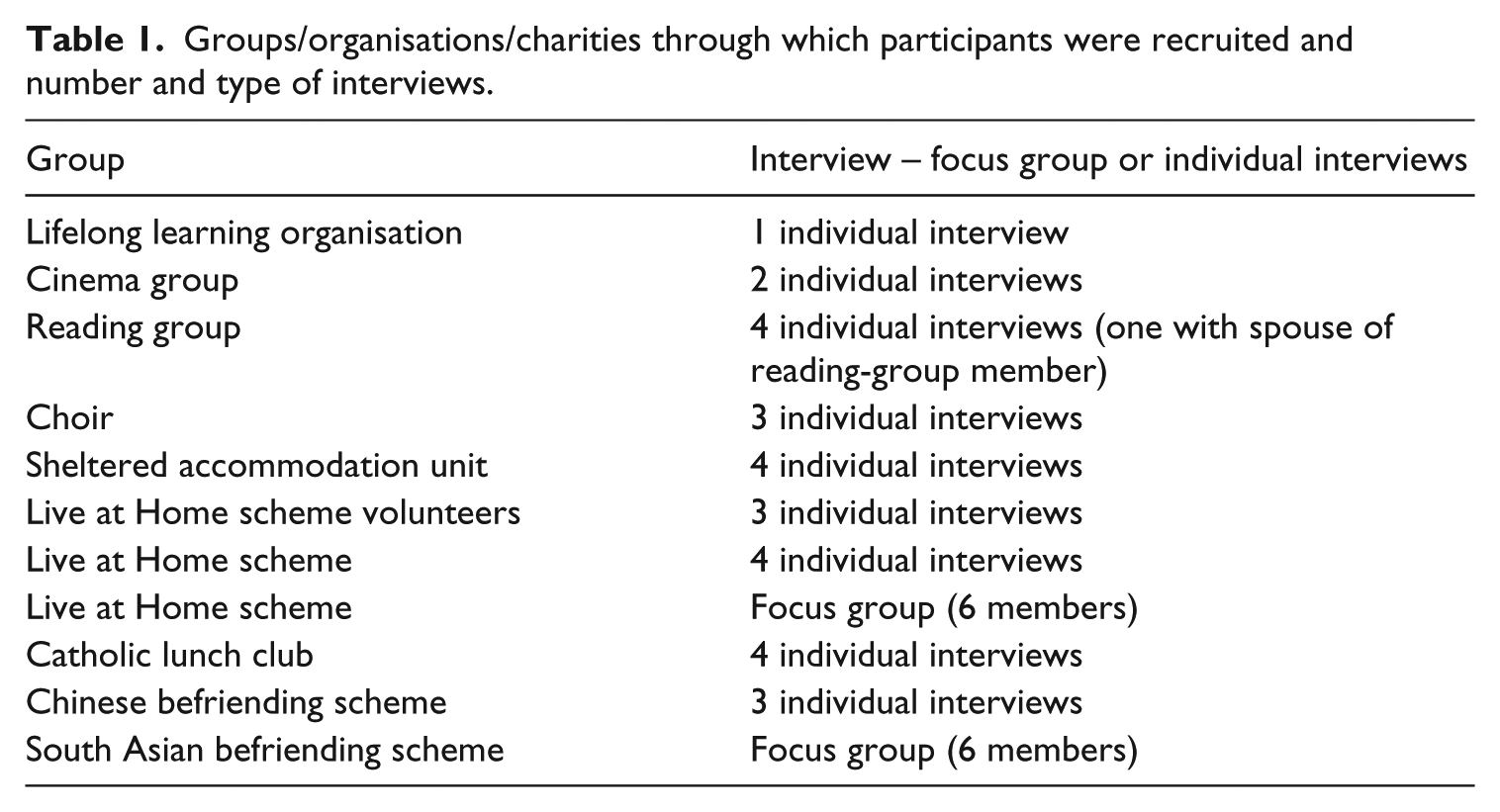
Individual interviews were offered to all participants, but after consultation with the charity organisers, focus-group interviews were conducted with one of the ‘Live at Home’ schemes and the South Asian befrienders group. Charity organisers felt participants would feel less intimidated and more confident being interviewed as part of a group with peers who they already knew. The interviews with Chinese, Bangladeshi, Indian and Pakistani participants were conducted through bilingual interpreters. As a result, some words, terms and culturally-specific meanings may have been lost or changed in translation. This also imposed some distance between the participants and the researcher. Interviews lasted approximately one hour and were audio-recorded and transcribed.
Semi-structured interview frameworks were used. Participants’ own conceptualisations of culture were gained through questions about what they did in their leisure time, before questions about cultural participation, other forms of social participation, and educational experiences. The interview questions are shown in Figures 1–4.
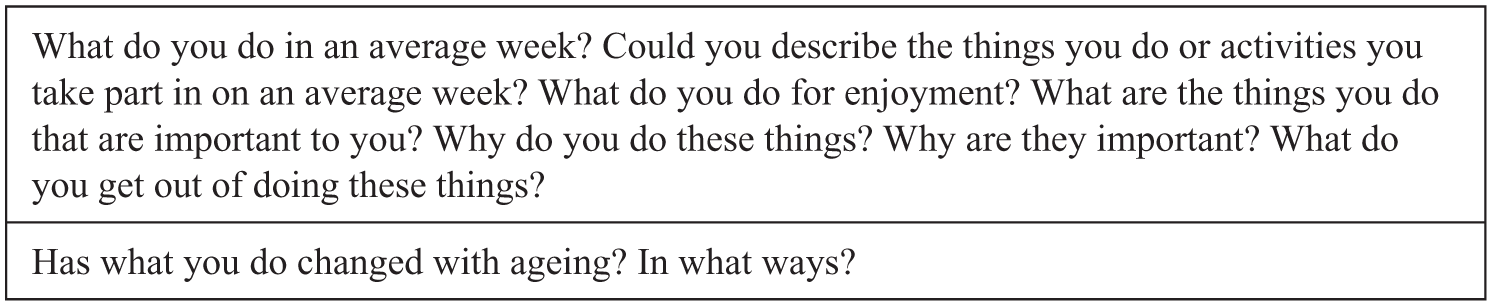
Interview questions related to forms of participation.
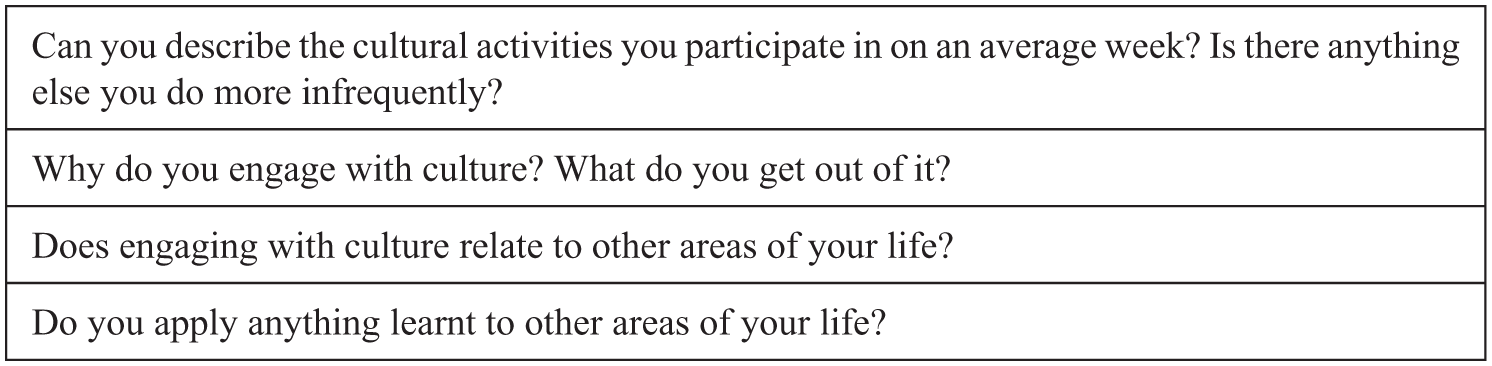
Interview questions related to cultural engagement.
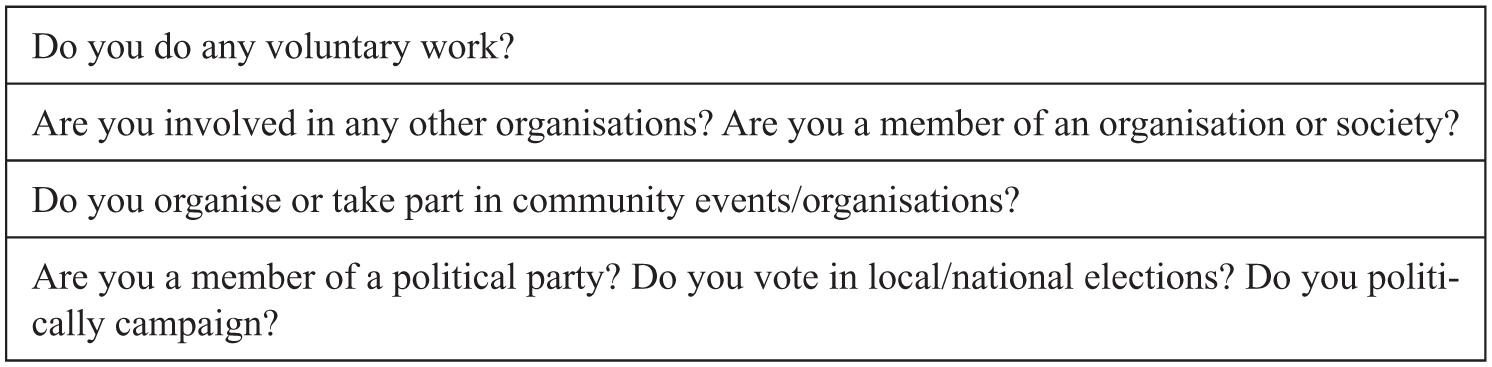
Interview questions related to other forms of social and civic participation.
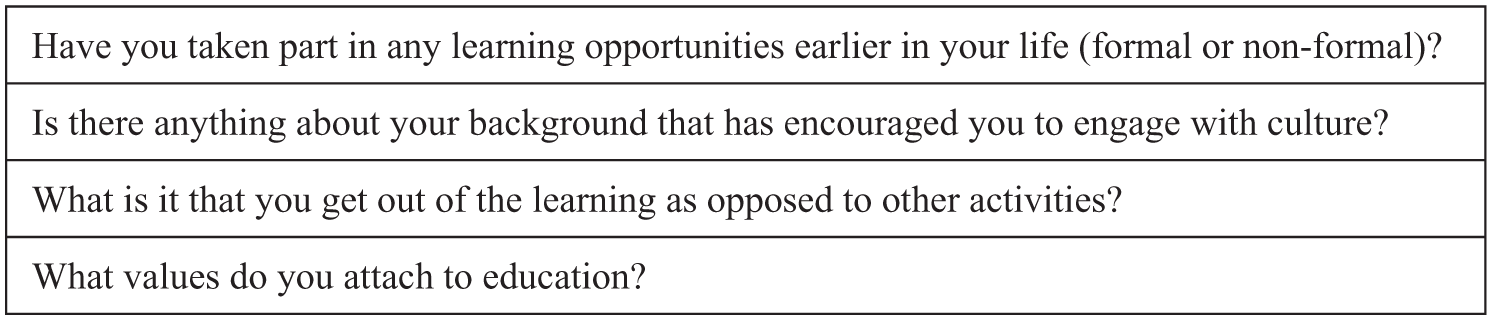
Interview questions related to educational experiences.
Data Analysis
A constant comparison process of analysis was adopted (Glaser and Strauss, 1967). To interpret the data, the researcher repeatedly read the interview transcripts, gradually identifying key categories and connections. A systematic method of analysis was adopted, which involved coding the data (Denscombe, 2003). At the initial phase of analysis, the categories were subject to a process of refinement. The categories were:
Forms of participation (civic, volunteering, exercise, other)
Forms of cultural engagement (including whether formal or non-formal)
Motivational pull of the art form (aesthetic/intellectual stimulation, relating content to lives, developing contextual knowledge and understanding)
Social context of participation (public and private, pursued alone or with other people)
Social relationships (friendships, acquaintances, spousal)
The role of participation in older age (the influence of retirement, widowhood, bereavement, deteriorating physical health, depression, social isolation)
An independent reviewer considered the validity of individual themes and how they connected to the data set.
Although not an originally anticipated way of organising data, the responses from different participants revealed three broad patterns of engagement. The analysis therefore evolved at this stage. The shared demographic characteristics were: education levels, occupations, and ages (younger-old or older-old). The shared contexts were the range of art forms mentioned, frequency of participation and whether engagement occurred in public or private spheres. Participants were then organised into three different groups to reflect these patterns. The three groups were: culturally omnivorous (Peterson and Simkus, 1992), n = 11; private participators, n = 4; facilitated contact, n = 25. All those recruited directly through cultural groups fell into the culturally omnivorous category.
The researcher then amalgamated the codes with the grouping which gave rise to four themes:
Continual investment in learning about the arts over the life course
Engagement and age
Literature facilitating meaning making
Contexts of participation
For example, contexts of participation included data from these particular codes: forms of cultural engagement; social context of participation; social relationships. Data from each of the three groups were then compared across the four themes.
Similarly, after this stage of analysis, an independent reviewer considered the validity of the organisation of participants into the three groups, and how their responses related to the themes.
It should be noted that the difference in participants’ linguistic/cultural capital significantly influenced the production of the data. There is an inherent challenge involved in analysing the meanings attached to cultural engagement when respondents do not have the linguistic/cultural resources to describe in detail their cultural engagement.
Findings
The Findings section first introduces the groups and then presents the themes integrated with the groupings.
Groups
Cultural Omnivores
Aged 64–77 years, participants in the cultural omnivores group were on the whole younger than in the other groups, with the majority aged below 68 years, and all identified as White British (see Table 2). Participants were all educated to postgraduate level, and had held professional-executive occupations. Participants were involved in an extensive range of cultural activities mainly in social contexts. Forms of cultural participation included: classes on history of art, literature or music; a non-formal reading group led by a tutor; a non-formal film group in an independent cinema; music classes as part of an older person’s programme at a centre for musical education; choirs; self-led reading groups taking place in members’ homes; reading or painting privately at home; independent visits to music concerts and art galleries. Participants took part in three to four different cultural activities a week and made independent cultural visits to art galleries or classical concerts about twice a month.
Demographic information and levels of participation – cultural omnivores (n = 11).

Private Participators
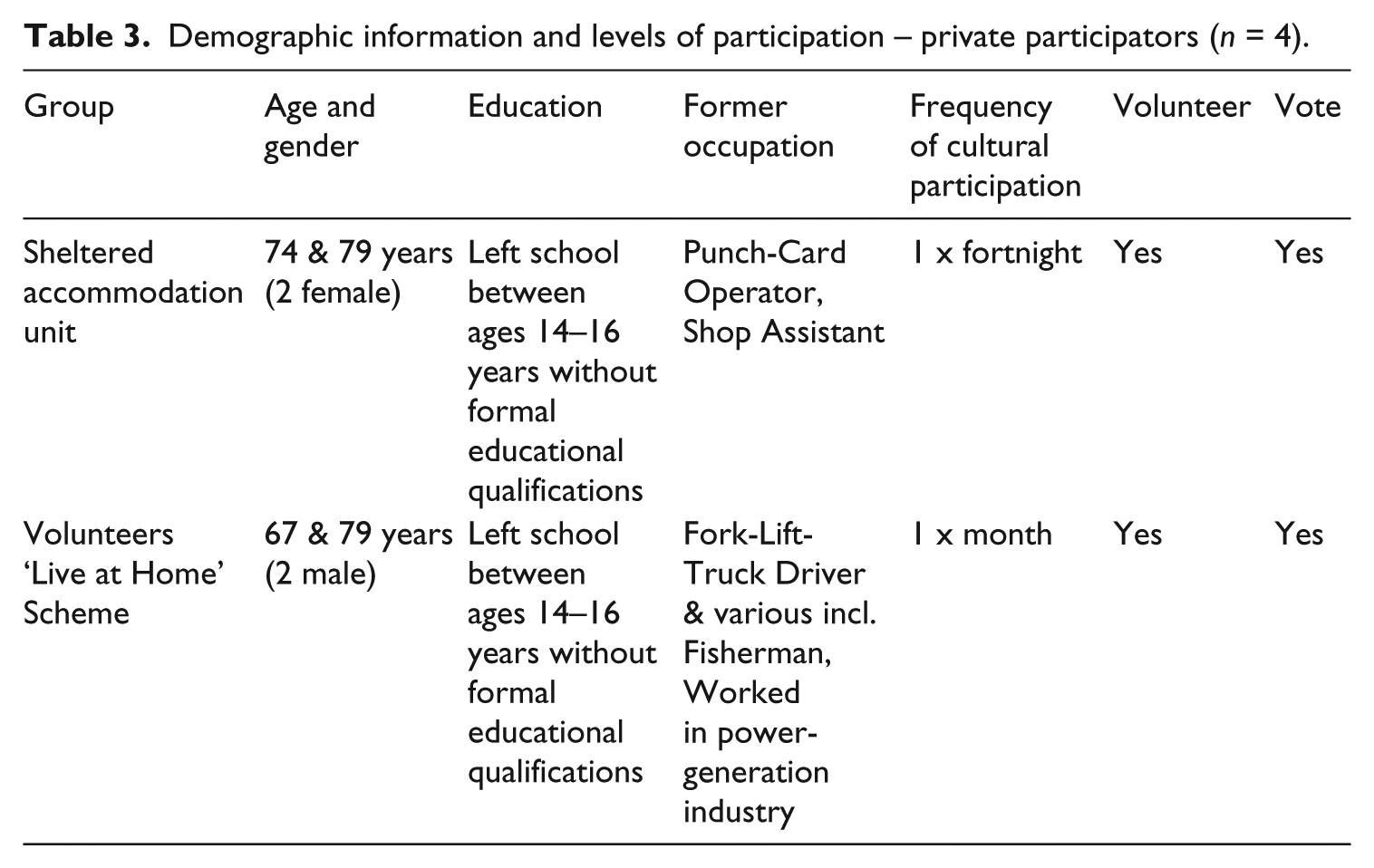
Private participators were aged 67–79 years (two male and two female) and drawn from White British groups (see Table 3). They left school between the ages 14–16 years without formal educational qualifications and had held working-class occupations (Bennett et al., 2009). Participants engaged in legitimate culture but did so at an individual level and less frequently. They visited the local art gallery about twice a year when they read about an exhibition that interested them in the local newspaper. They visited the local library once a fortnight and were avid readers. One participant took photographs and another knitted.
Demographic information and levels of participation – private participators (n = 4).
Facilitated Contact Group
Participants in the facilitated contact group (Table 4) were aged 60–98 years and were drawn from White British, Pakistani, Bangladeshi, Indian, and Chinese ethnic groups. Two participants had professional qualifications (one the equivalent of postgraduate) but the majority did not have any formal educational qualifications. The Chinese and South Asian participants had experienced only a few years at most of formal education in their native countries. Their former occupations were as follows: one professional-executive, nine intermediate, and 15 working-class occupations.
Demographic information and levels of participation – facilitated contact group (n = 25).

Two participants from the ‘Live at Home’ schemes and one Chinese participant were full-time carers to spouses. One respondent from the ‘Live at Home’ scheme was dependent on professional carers after having a stroke. Five participants had visited established cultural institutions when they were middle aged, 14 had only visited when facilitated by the charities and six had never engaged.
Continual Investment in Learning About the Arts Over the Life Course
Omnivores
The level of engagement across art forms by those with higher educational qualifications supports Peterson and Simkus’ (1992) definition of omnivorous cultural consumption. However, educational and career paths had not been straightforward. Six participants had benefitted from a grammar school education which led them down a more academic path, three had left school aged 16, one did a workplace apprenticeship after school, one had been educated in the US. Six of the participants, two of whom had left school at 16, gained their graduate or postgraduate qualifications through the Open University when they were already working or as a way of returning to work when their children were young. Therefore they had exhibited agency in terms of career development throughout the life course. In interviews, all participants spoke about how important pursuing learning had been throughout their lives. Seven had taken part in local-authority-funded evening classes as teenagers and young adults. They described how this emphasis on education had been part of their culture growing up, both in the home, at school and among people with whom they socialised.
Six participants gave an explanation for this continual investment in learning about the arts. It was important for them to build up understandings of the socio-historical contexts surrounding artistic movements and a sense of satisfaction was gained from developing a more complete picture across art forms. The following response articulates one participant’s learning trajectory. Claire, aged 64 years, noted the formal education levels needed to appreciate the reading matter in the literature class: It’s further education for educated people [that] is really what it is … one has to have a certain approach to learning … it’s not going to be an easy ride … that’s part of the pleasure … I know of other reading groups where … it’s a cosy chat, whereas this reading group is very structured – it has an agenda and you’re dealing outside the mainstream … It’s a combination of pursuing interests you have already and doing something new … always this feeling that you’re consolidating and pushing ahead.
Claire wants to read demanding literature, and is conscious of the level of intellectual engagement she is expecting. Consolidating her existing knowledge and continuing to learn is what motivates her. It is an investment in the art form over a lifetime that she argues enables people to recognise the established literary canon and their progression through it.
Engagement and Age
Omnivores
For all 11 omnivores, cultural engagement had increased post retirement. Engagement helped one woman adjust to bereavement, two women to widowhood and one woman to later-life divorce by facilitating friendships and providing a stimulating, structured routine. Robert, aged 68 years, noted that participating in lifelong learning classes provided a ‘great’ structure to replace the routine of work, which allows him to meet the open-endedness of retirement (Ekerdt and Koss, 2016). Robert and Alison, both aged 66 years, noted: … Seeing beautiful things is a very restorative type of experience – it’s energising, which is of value as you get older … so you maintain your interest in life … so you are keeping your intelligence … your mind is active. … Paintings by Whistler are stunningly beautiful and that’s very life - enhancing … the same with music … even though literature can take a dark turn it’s energising … because you feel these things with an intensity … it’s the intensity of the great writing and what you see in it that is energising …
They perceive psychological and physical benefits as they are ageing, which they ascribe to the quality of the art object and the emotional response the encounter elicits. Alison is confidently able to make value judgements regarding ‘great’ writing and ‘stunningly beautiful’ art, as she has honed her taste through continual engagement with the field. This description supports Varriale’s (2016) theorisation of cultural evaluation as a social encounter between the dispositions of social actors (i.e. their habitus) and the aural, visual and narrative properties of cultural objects.
Alison also noted how having time enabled her to revisit learning undertaken as part of her undergraduate degree. The combination of more free time and access to knowledgeable tutors and other learners has motivated her to engage more. She participates in anticipation of ageing: I hope that if there were … periods of infirmity … that now I’ve got so many things that I want to read and I have better tools … to understand them.
In the same way that she planned for retirement by moving to a city with cultural and learning activities, in the future she intends to draw on analytical skills she has developed through participation in the reading group.
Facilitated Contact
From the befriending scheme, Chyou, aged 72 years, is a full-time carer to her husband and cannot leave the house for long periods of time. She watches television to pass the time: Mostly it’ll be Chinese telly … I watch football because I don’t have to understand … it’s not something that makes me particularly happy … it’s more to do with passing the time, especially if I’m at home with my husband. My main concern is looking after him …
Asked further about her educational experiences, Chyou had only had four years of formal schooling in China. She noted that she used to take her children to art galleries and museums when they were younger but she feels as though she is too old to go back into education herself. Dandan, aged 86 years, noted that she would not mind going to cultural venues but that she cannot walk very far and does not know where they are.
A participant in the Live at Home scheme, Albert, aged 88 years, noted that he used to take photographs and go to photography exhibitions but that being a full-time carer to his wife has drastically altered his life: It was lovely doing it and then … my wife became ill. Your mind’s not on what you’re doing.
For Vera, aged 77 years, a resident in a sheltered accommodation unit, declining physical health has limited taking part in various activities. She noted how she used to love going out to musical concerts: I’d probably go with someone if one of the others were going … I just love music … I’d like to live the life I was living before it all happened, I had a good quality of life, we used to go out … I enjoyed going out.
It is not just cultural activities Vera misses, but it is significant that she says she would go to a concert if another resident went with her. This shows the influence of friends in terms of encouraging participation.
Literature Facilitating Meaning Making
Omnivores
Participants described literature as offering them insights on human nature and different perspectives on life. Alison described what she had gained from the books she had read and discussed as part of her reading class: Human relationships and interactions … gives you insight … great artists were all trying to work out the meaning of life … they’re a lot better equipped to do it than me so I’m trying to hear what they’ve found out … the really great writers have a bleak outlook on life … you can’t help but be convinced by what they show you … it feels very worthwhile … Conrad shows you how even people who start out well seem to lose their morality.
She notes that grappling with negative depictions is not comforting and despite the challenge this presents, she sees the pursuit as worthwhile. Developing knowledge of wider subjective experiences was used to aid personal reflection for others. Claire, aged 64 years, felt that gaining a greater understanding of other people’s lives in different historical periods and geo-political contexts made her less self-centred: … You have more awareness of complexities and different possibilities and imaginations so … you don’t get as self-centred because you are aware of so many lives.
The example of art stimulating reflection can be extended to participants using the content of literature to help construct their framework of values. Katherine, aged 67 years, noted that reading impacted on her, ‘morally and the way you view the world’. Claire discussed reading books about racial tension in her class: I wouldn’t have come across it otherwise … it brings up real challenges as to one’s knowledge about that time, what one was doing … but also ‘what do I feel about certain things?’
Reflecting on different perspectives on apartheid described in a novel enables Claire to practice her moral response to race segregation at a level of remove. She is reflecting on issues around race in general and in relation to her own life experiences. Participants saw cultural engagement as shaping significant aspects of their lives including morality, self-centredness, happiness and kindness. Reflecting on alternative subjectivities in relation to their own lives supported processes of self-actualisation and life review.
Private Participators
The private participators were avid readers. During the interview Janet, aged 79 years, produced a copy of a romantic novel she was reading and started describing the plot and characters with considerable excitement: I love her books. I read them all the time. Her first husband was a bad man … she met an American Air Force pilot and they’ve got friendly. I don’t know if they are going to get together …
There is a sense Janet identifies with the heroine and her excited account supports Radway’s (1983) analysis of romantic fiction as offering a ‘literal and figurative’ (1983: 58) escape from reality. Asked if she applies what she reads to her own life, she notes that the Second World War setting corresponds with her own early life experiences of being bombed: Me bed was all on the floor. I had a lovely doll that was smashed to bits.
She could be seen to be using the novel to engage in processes of life review.
Mary, aged 74 years, also described her interest in reading: I’m a great reader and I don’t get out very much now because I have a bit of a bad problem walking but four walls does not appeal to me at all … I like to have a wander round the library and I like to go in the reference library … I’m very inquisitive … if you don’t read and you don’t take an interest in things you just lose it and I don’t intend to lose it.
Despite having difficulty walking, Mary puts considerable effort into maintaining an active life. She is prepared to travel considerable distances, for example, taking a three-hour coach trip on her own to see a musical. She attaches great importance to being intellectually stimulated by the outside world and sees remaining interested as a way of staving off cognitive decline. Mary was asked if she would be interested in joining a reading group: I get letters from the library … but … it’s quite a hike.
Here, distance is cited as a reason for not engaging. However, because Mary shows considerable agency in visiting art galleries and the library every fortnight, this physical barrier she cites may be masking a psychosocial reason.
Facilitated Contact
All participants said they had enjoyed visiting art galleries and museums with the charity, for example, describing the behind-the-scenes tours as providing a privileged experience not available to the general public. They cited a glass-blowing demonstration as an interesting part of one visit. Harry liked, ‘trips … curiosity, to get out of the house’. Bill liked going on visits, ‘because I could bring my knowledge to add’. They did not expand further, perhaps reflecting difference in terms of linguistic capital between participants. From the befriending scheme, Chang, aged 81 years, enjoys listening to Cantonese songs and noted that he would be interested in taking part in cultural activities if opportunities were presented.
The Social Context of Engagement
Omnivores
All participants described engaging with other learners’ interpretations as enabling them to make conceptual leaps in their own knowledge. Learning with other people was cited as being integral to the process. Claire described how cultural pursuit as a retired person was a relaxing, privileged experience: Because you all feel you’re at the same point in your life experience and there’s a feeling of … a comfortable privileged club that you belong to … there’s an air of relaxation about people who are now no longer working whereas when you’re working … people tend to be more fraught by definition and I look back at myself and my fraught years.
Post retirement she has shed aspects of her career identity as a university tutor, which she feels was restrictive. Yet the privileged club she belongs to consists of people of similar former professional backgrounds and education levels. Katherine demonstrates the way social networks function to facilitate group membership. She jokingly described her literature group as the ‘mafia’ in terms of meeting people who then put her in the way of further cultural opportunities, noting that access to two of the groups is by way of personal introduction. This method operates to include and exclude.
Alison, Robert, Jane and Katherine described having formed friendships with people from their groups through a shared interest in the arts. They enjoy a mutually reinforcing circuit of social activities centred around the arts as the regularity of going to classes most days and seeing the same people at concerts or art galleries provides the opportunity to get to know each other. They discussed how shared cultural tastes and values dictated the friendships. They described sharing a left-wing political outlook with other people in their classes and noted that discussing political ideologies as presented in films or books was a way of foregrounding such values. These four participants feel a strong group identity based around a desire for learning and stated left-wing political values.
Retirement has marked an increase in participatory cultural engagement. It is the continual investment in learning and development of their knowledge and understanding of the field which is satisfying and enriching. Continual learning has developed their taste; they are confident in ascribing quality to certain artists and authors. Whilst the meaning-making facilitated through engagement with the reading group could be the same for other age groups, the more experience participants have of analysing cultural artefacts and practising such articulation in the public forums of non-formal classes, the more they draw from the experience.
Private Participators
When asked if she discusses what she reads with others, Janet noted that, ‘Nobody seems to read in here’. Janet comes across authors on her own by chance in the library – books are not recommended to her by anyone else, she does not read any reviews, and she is not following a course reading list. She was asked whether she would like to join a reading group: I don’t know if I would like it or not but I just think that’s me night-time hobby … I get bodily tired … at ten o’clock the telly goes off, me book comes out, me music goes on.
She had not considered joining a reading group, perhaps due to a lack of awareness and opportunity. After the interviews were completed participants were invited to take part in an accompanied visit to a local museum and to present at a seminar. The participants noted how they had dressed up for the day and that they attached status to being involved. They described being proud after making their presentation. Throughout the seminar series they made notes. They joined a reference group which was consulted about further research. When given the opportunity via personal contact these participants were highly motivated to engage.
Facilitated Contact
The South Asian women, who had only visited cultural institutions with the befriending scheme, did not express a preference for where they went on outings. The leader described how the group was formed out of the desire for opportunities to socialise, and on the realisation that classes in English at the local further education college had not been successful: Most of them won’t go anywhere by themselves because their boundaries are very small. Confidence is very little. When their husbands were alive … they were dependent on them … if they are illiterate in their own language learning a second language becomes even harder … So we had pen and article … people were a bit reluctant … saying, ‘We are not getting anywhere with this, we’d rather just socialise’.
Similarly, all the participants in the two ‘Live at Home’ schemes and the lunch club described their motivation for coming to the lunches for the social interaction. All participants had started coming to the lunches at the suggestion or insistence of family members. The social interaction was not necessarily comfortable for participants, one, aged 86 years, expressed ‘having to build up to it’. Bill, aged 91 years, craves social contact and he does not specify whether there needs to be a purpose beyond this: I’d like to have more contact with other people otherwise it gets very, very lonely. Ever since my wife died I’ve been tired, sad, depressed, weary and lonely … Sometimes wish I could get suicide pills on prescription.
Participants rely on these charities for facilitated social contact, reflecting how age-related effects including bereavement, ill health and caring responsibilities have made them socially isolated.
Discussion
The culturally omnivorous actively construct identities and social relationships through cultural participation. Developing understanding of the arts in a social context provides the White, educated participants with a stimulating and consoling bank of cultural and social resources. Post retirement, cultural engagement has become one of their prioritised daily practices that is both a choice for action and for being (Giddens, 1991: 81).
Findings highlight the aesthetic dimension of engagement, with participants negotiating their value frameworks and deriving universal reassurance from literature. Literary works offer them alternative perspectives, present unchanging aspects of human existence and give them a greater socio-historical contextual understanding of the world and their place in it. In reflecting on universal themes, participants are engaging in a process of meaning-making, highlighted as important for older populations (Westerhof et al., 2010). The use of literature to facilitate personal reflection, which some older adults find difficult to achieve (Westerhof et al., 2010), has implications for interventions aimed to encourage life review. However, Billington (2016) counters a policy-based focus on the instrumental benefits of medically prescribed reading groups. She advocates community reading groups in terms of the wider wellbeing benefits of engagement with narrative as opposed to ‘medicalizing the human condition’ (Billington, 2016: 2). Reading bleak depictions was not comforting, yet grappling with challenging ideas was seen as worthwhile. I argue that conceptualising the process in terms of narrow wellbeing terms is reductive.
Retirement has provided the opportunity to revisit earlier learning about the arts. Participants all held postgraduate qualifications and had pursued learning throughout the life course, both through non-formal evening classes and formal courses. This trajectory supports Chan and Goldthorpe’s (2007) speculation that the level of exposure to arts education, particularly at degree level, results in an increased ability to interpret arts experiences, further increasing motivation. What is significant about the data presented here is the fact that participants had gained qualifications throughout their lives, some whilst working or whilst their children were young. Therefore for this younger-old cohort, personal agency alongside structural opportunities has enabled professional progression. Post retirement they apply similar discipline and energies to cultural pursuit.
The social context, revolving around the content of the art form, is integral to the experience of cultural participation. Shared values are explicitly foregrounded through discussion, and tacitly understood. Friendships had developed through engagement, with shared cultural tastes and shared left-wing political values forming the basis for relationships. In contrast to other studies (Bennett et al., 2009), education and cultural knowledge are assets insofar as they provide access to friendships and further cultural opportunities, as opposed to personal advancement.
Whilst they engaged less frequently than the omnivorous participants, the private participators showed similar levels of personal agency. For this less-well-educated group, cultural participation was private, as opposed to something they had been socialised to participate in collectively. Cultural engagement was significant to their lives, supporting Varriale’s (2016) analysis that the meanings emerging from such encounters are not reducible to participants’ habitus. However, it is important to stress that structured educational and social class inequalities limited their access to public cultural engagement. These data counter Crossick and Kaszynska’s (2016) findings that engagement in the home is a social experience, as the participants did not discuss the books they read or the art gallery exhibitions they saw with anyone in their sheltered accommodation unit. When opportunities were offered through personal contact, this group was highly motivated to engage and attached status to such forms of participation. They did not feel excluded or intimidated by highbrow culture, but embraced opportunities to develop their knowledge.
Cultural engagement is not felt to be missing from the majority of participants’ lives, nor is it something that they feel excluded from. For seven participants, engagement with civic life in general has declined with ageing. Official culture may not be culturally relevant to this group. Also, with few years of formal educational experience, joining a reading group would be a considerable challenge. However, participants cited having enjoyed visits to cultural venues with the charities. The interest in participating, yet lack of knowledge about the location of cultural venues, suggests the need for culturally relevant experiences negotiated between cultural organisations and informal networks such as the Chinese lunch club or charities such as the befriending scheme.
Conclusions
This study advances the field of cultural class analysis by revealing how cultural participation plays a crucial role in contemporary social class divisions in older age. It has been argued that in the post-modern world, social structures are less relevant to people as they age and that diverse consumer lifestyle choices are more governed by individual agency and identity (Gilleard and Higgs, 2000). However, this article shows that major structural factors continue to influence the lives of older people (Twigg and Martin, 2015), with social class and cultural engagement being mutually reinforcing. Through the lens of cultural participation, this article reveals multiple experiences of ageing. Stark insights are provided into the extent of withdrawal from social activities due to age-related effects. Simultaneously, retirement marks an opportunity for the privileged to engage in a full timetable of enriching sociable activities. For the omnivorous, cultural knowledge carries greater social value in later life (Bottero, 2015). In terms of the equitable resourcing of cultural and lifelong learning activities, it is important to note that all the cultural groups were member-led and funded, and did not receive charitable or statutory funding. What is significant is how the educated middle classes collectively organise such opportunities.
Findings presented here also make an original contribution to the area of cultural class analysis by addressing meaning in relation to age and cultural capital. Cultural engagement is appreciatively different in older age to other stages of life, in that retirement marks an opportunity for the omnivorous to increase their uptake, consolidating and building on previous learning opportunities pursued throughout the life course. Importantly, the data reveal the range of participants’ educational trajectories, their accumulation of cultural capital, and how habitus interacts with the art form to co-produce the social encounter (Varriale, 2016). Learning about the arts in social contexts aids meaning-making processes and helps participants negotiate their framework of values. Discussing ideas presented in the arts helps co-construct understandings around fundamental aspects of human existence, supporting Hanquinet’s (2013) work on the aesthetic dimension of engagement. It is the challenge and exercise of analysing the art form that is the central motivation. Participants read challenging literature because a lifetime of engagement has provided a trajectory through the literary canon. Satisfaction is gained from placing the significance of artworks and movements within wider socio-historical contexts.
Furthermore, this article reveals greater complexity in terms of the correlation between education levels and engagement by showing the range of older people’s educational trajectories. Older cohorts of omnivores had gained qualifications at different points in their lives, with two participants having left school aged 16 years. This shows the importance of the availability of affordable lifelong learning opportunities throughout the life course.
Findings presented here have clear implications for cultural policy and academic literature on ageing and lifestyle. On the one hand, cultural and social capital are both acquired and converted to negotiate retirement, with non-formal classes providing a stimulating, energising, sociable and structured routine. On the other hand, this article highlights barriers to engagement specific to older populations including poor health, mobility, caring responsibilities and transport problems. Language, literacy and confidence as well as awareness of cultural opportunities were particular barriers for older South Asian and Chinese participants. As demonstrated by the literacy classes the South Asian women chose not to continue with, there is tension between an assumption by the educated that learning is desirable and the complicated range of psychosocial barriers or lack of interest on the part of the learner. Psychosocial barriers to engaging are not easily or quickly overcome, particularly for socially isolated older people who may have fixed habits and shrinking boundaries.
The data present some limitations as the groups varied greatly in size, and this has implications for conclusions. There is a distinct difference in the resources and opportunities available to these groups, which significantly influences their ability to participate in cultural activities. Also, not all adults aged 64+ are retired. Reasons for retirement and responsibilities differ significantly as well, for example, caregiving duties are likely to influence social participation. Therefore disentangling personal agency from equality of opportunity is problematic. However, it is important to note that the omnivorous experienced the same challenges associated with ageing as other groups, for example widowhood, late-life divorce, physical decline, depression, loneliness and lack of purpose post work. Despite attempts to recruit widowers, or single men, none were found in the cultural groups. This absence throws up important questions around social isolation amongst single men of all socioeconomic classes. Given that the majority of omnivores in the sample were younger than the other participants, it would be important for future research to explore to what extent they are able to retain their cultural privileges as they enter their 70s–80s.
Footnotes
Acknowledgements
I would like to thank the research participants and charity organisers. I would also like to thank Professor Deborah Price and Professor Christopher Phillipson for invaluable feedback on earlier drafts.
Ethical Considerations
The research obtained ethical approval from the Faculty of Humanities and Social Sciences, Newcastle University.
Funding
The research project ‘The role of creative interventions in fostering connectivity and resilience in older people’ (AH/L013274/1) was funded by the Art and Humanities Research Council.