




Abstract
In this article, we examine dark humour in Internet posts commenting on an online Italian newspaper report published by Il Fatto Quotidiano and devoted to the 2016 terrorist attack in Nice. The analysis focuses on the linguistic forms and socio-pragmatic functions of this dark humour in the wake of the tragedy. We argue that the creative humorous posts are meant to communicate Internet users’ ideologies conceptualised as their true beliefs about the sociopolitical situation and that they are oriented primarily towards criticising terrorism-related themes, notably: inept security enforcement, radical Islam, political and public reactions and integration policies. The humour in the Italian posts is used as a means of displaying Internet users’ wit and attracting other users’ attention.
Keywords
Introduction
There is increased academic interest in humour across different discourse genres and interactional or socio-pragmatic contexts. Psychologists, sociologists and linguists alike provide ample evidence for the numerous functions that humour can play in close relationships, political talk or medical settings, to name but a few. These functions are dependent not only on the discourse genre and context at hand but also on the diverse forms that humour can take.
In this article, we investigate one category of humour within a chosen discourse genre, namely, the dark humour of online comments in response to a terrorist attack. Specifically, we analyse the humour found in posts following an online Italian newspaper article about the terrorist attack that took place in Nice in 2016 in order to (1) identify the main linguistic strategies responsible for humour emergence and (2) understand the reasons for, and the functions behind, the production of humour in these online comments in the immediate aftermath of an Islamic terrorist attack.
Overall, this investigation into dark humour contributes to the growing body of research on the ideological functions of humour and its capacity to carry ‘serious’ messages (see, for example, Billig, 2005; Lockyer and Pickering, 2005, 2008; Simpson, 2003), shedding more light on the discursive strategies that serve the communication of ideologically loaded meanings. In addition, this article offers new insights relevant to the discursive sociological studies of Internet humour (e.g. Al Zidjaly, 2017; Malmqvist, 2015) and more specifically on the forms and functions of online dark humour produced in reply to Islamic terrorism (e.g. Kuipers, 2002, 2005, 2011) by addressing the under-investigated topic of conversational humour in public social media.
This article is organised as follows. The section entitled ‘Dark humour: Its forms and functions’ gives an introduction to the notion of dark humour, as well as a few closely related concepts, paying attention primarily to the application of dark humour with regard to Islamic terrorism. The section ‘Aim of this study on dark humour in posts on the Internet’ describes the central objectives of this article and the rationale behind it. In ‘Methodology’, we elaborate on the choice of the comments on the Il Fatto Quotidiano multi-modal article as our data source, and we explain the data selection method. The discourse analysis that follows in ‘Analysis of humorous online comments’ depicts the humorous comments as creative, interest-generating methods of communicating users’ true beliefs representing their ideologies on relevant issues. ‘Conclusion’ offers a number of general remarks.
Dark humour: Its forms and functions
The central topic of investigation in this article is a special category of humour that has received very little attention in linguistics, being more frequently discussed in literary and sociological research, as well as psychology. The concept in question is known as black humour or dark humour, and it may be regarded as overlapping with gallows humour. The term ‘gallows humour’ has been used primarily in reference to the humour constructed by an oppressed social group or an individual facing an immediate life threat (see, for example, Lewis, 1993; Obrdlik, 1942), which seems to be in line with the metaphorical-metonymic origin of the academic label itself. Gallows humour may have been originally produced by those sentenced to death and proceeding to the gallows. Dark/black humour, in turn, seems to be a broader phenomenon that encompasses gallows humour, as the recent discussions tacitly suggest. Dark humour may be said to aim at ‘making fun of situations usually regarded as tragic, such as death, sickness, disability, and extreme violence, or of the people involved or subject to them’ (Bucaria, 2008: 218–219).
For the purpose of this study, dark humour is defined more broadly as a type of humour that arises directly in response to precarious, dangerous and/or traumatic situations or incidents. Importantly, dark humour does not necessarily make fun of (i.e. ridicule or disparage) tragic situations, even if it is inspired by them and relevant to them (see Gournelos and Greene, 2011; Lewis, 1993). Therefore, not all dark humour is purposefully offensive and/or qualifies as the so-called ‘sick’ humour (e.g. Dundes, 1989; Kuipers, 2011), which merges a gruesome topic with an innocuous one (e.g. children’s games) or associates a dramatic event with a taboo topic (e.g. disability, disease, sex or religion). It is this inappropriateness that may cause outrage or amusement, or even both simultaneously, in the receivers of the humour (see Oring, 1987; cf. Aillaud and Piolat, 2012). Dark humour inspired by tragic events, such as terrorist attacks, does not need to make light of them, and it may directly address topics only tangential to them, which the data in this study will corroborate. 1
A wide spectrum of studies across disciplines (psychology, sociology, linguistics, to name but a few) have reported on the use of dark humour, and more specifically gallows humour, as a coping mechanism under oppressive regimes and in crisis situations. A lot of researchers adduce evidence that humour helps people to handle traumatic experiences and that people do resort to humour intuitively in response to dramatic and/or stressful events (e.g. Maxwell, 2003; Ostrower, 2014; see also Martin, 2007, for an overview of the functions of humour). Dundes (1989) claims that humour (specifically in the form of sick jokes) constitutes ‘a kind of collective mental hygienic defence mechanism that allows people to cope with the most dire of disasters’ (p. 73). Interestingly, recent experimental findings support a view that death reminders may facilitate creativity and humour production (see Long and Greenwood, 2013). It is also argued that jokes constructed and retold in grave circumstances promote in-group solidarity and in-group conflict resolution (Draitser, 2009). Canned jokes are also reported to communicate shared beliefs about the oppressor’s vices, as well as the victim’s virtues, overall testifying the solidarity and national spirit of the oppressed people (Stokker, 2006). This corresponds to the old adage that gallows humour is a testament to the oppressed people’s morale (Obrdlik, 1942) and that it has a liberating function if told by the oppressed themselves (Lewis, 1993).
The past few years have also seen a slow inflow of research on the use of humour in the age of terrorism, the research that is very much in line with the previous findings on humour in other crisis situations. The bulk of this scholarship has been inspired by the 9/11 tragedy. A few sociological, ethnographic and folkloristic works show how terrorism is presented through a humorous lens and what beneficial effects humour can exert. For instance, in his studies of Internet humour, Ellis (2001, 2002) examines Word Trade Centre joke cycles, both verbal and non-verbal. He proposes that this multifarious lore constitutes an important part of international community’s response to the 9/11 tragedy, being indicative of the stages of coping with the tragic events. It is also Kuipers (2002, 2005, 2011) who proposes that people come to terms with attacks and media rhetoric by constructing and circulating digital disaster joke cycles, which exhibit various forms and topics. Kuipers argues that verbal and non-verbal (sick) jokes are a natural indication of the ambivalent feelings induced in people by media coverage. She also makes an important point that coping is not necessarily the dominant function of post-attack humour, and the characteristics of each instance need to be judged in isolation in terms of the role(s) it performs.
Disaster jokes spread on the Internet are not the only humorous means of responding to the tragic events of 9/11. A whole gamut of comedy discourses in traditional media comment on this tragedy (see relevant chapters in Gournelos and Greene, 2011). For instance, Achter (2008) presents news parodies, epitomised by The Onion, as a means of contributing to the ongoing political discussion about pertinent topics (such as racism or terrorists’ motives). Focussing on African American stand-up shows, Jacobs (2011) explores the rhetoric of select comedians who seem to have been supportive of the victims but averse to the ‘us vs them’ divisions prevalent among the American society. Similar conclusions are drawn by Davey (2013), who addresses the use of puppets in media comedy shows. The ambivalent puppets act as mouthpieces of relevant messages about terrorism, the politics of fear and domestic policy, blurring the basic binary distinctions (us vs them or good vs evil) but simultaneously reinforcing stereotypes about the enemy. Finally, James (2015) considers late-night television shows and cartoon strips in the post-9/11 United States, presenting humour as an instrument of resistance to the dominant discourses, whose hypocrisy it debunks. Taken together, these works indicate that dark humour, which may take many different forms and guises, is a socio-pragmatic tool used for achieving socio-psychological goals and communicating relevant ideologies.
Aim of this study on dark humour in posts on the Internet
This study aims to contribute to the few different lines of research briefly depicted in the section ‘Dark humour: Its forms and functions’ by examining how language users respond humorously to tragic events in their comments on an online news report. While the studies so far have focussed on both traditional media humour (e.g. television comedy and newspaper cartoons) and new media humour (mainly disaster joke cycles and memes) circulated in social media and on humour websites, there does not seem to have been much research devoted to spontaneous verbal (dark) humour interwoven into essentially ‘serious’ Internet-mediated interactions (but see Demjén, 2016; Semino and Demjén, 2017). Also, discourse-oriented discussions on dark humour in response to terrorism seem to be lacking. While the previous studies report on general categories and genres of humour (e.g. stand-up comedy, parody or satire), the specific linguistic realisations of messages representing dark humour do not appear to have been explored. This article aims to address these gaps by examining humorous commentaries following an Internet article reporting on one of the most outrageous Islamic terrorist attacks.
The most recent studies on humour indicate the importance of computer-mediated communication and social media, which offer new platforms for humorous expression. Online humour, such as Internet memes (e.g. Al Zidjaly, 2017; Marcus and Singer, 2017), is then an important hallmark of participatory culture, with message receivers (e.g. readers of online newspapers) being granted participatory privileges on the production end (see, for example, Chovanec and Dynel, 2015, and references therein). Thus, ordinary Internet users become active producers of the online content, for instance, by contributing posts to be read and commented on by wide audiences, that is, other users.
The social implications of humour and its capacity to communicate ideologies have been widely discussed in sociocultural studies of humour in public discourse (e.g. Billig, 2001, 2005; Simpson, 2003; Lockyer and Pickering, 2005, 2008). As many authors have argued, humour is a vehicle for relevant observations on the current sociopolitical events, which helps to communicate meanings on thorny, sensitive topics (e.g. Davey, 2013; Tsakona, 2018). The contemporary epitome of such topics is terrorism attributed to radical Islamic fundamentalists.
Practically all types of humour can carry messages relevant to ‘serious’ topical interaction, communicating people’s true beliefs, and thus truthful meanings (see Dynel, 2017b), ascribed to them by receivers in a rational interpretation process. 2 Given the political nature of the comments examined here, the truthful meanings/genuine opinions that Internet users can be regarded as communicating (based on the available factual evidence) may be said to represent their ideology understood as a ‘set of ideas and beliefs that provides an organised and systematic representation of the world about which they can agree’ (Charteris-Black, 2011: 21–22). Even canned jokes can be ‘deliberately employed to communicate messages’ (Oring, 2003: 96; see, for example, Tsakona, 2018) and hence chosen ideologies. The observation that the speaker may aim to amuse the receiver(s) and simultaneously communicate non-humorous meanings has been most frequently made in pragmatics and discourse analysis with regard to (categories of) conversational humour (see, for example, Dynel, 2009), that is, various humorous units interwoven into an interaction, which may be otherwise non-humorous. In this article, we focus on the conversational humour in an online interaction comprised of Internet commentaries/comments/posts following an Internet article about an act of terrorism. These ideologically loaded commentaries, it will be argued, represent a few salient linguistic forms of humour and fulfil a few functions of humour in public (one-to-many) online communication.
Methodology
This article contributes to the growing literature on spontaneous humour in Internet interactions, focussing on the 2016 Nice attack, an event which does not seem to have attracted much sociolinguistic interest so far, let alone interest in humour studies. On the evening of 14 July 2016, a Renault Midlum cargo truck was purposefully driven into revellers celebrating Bastille Day on the Promenade des Anglais in Nice, France. This resulted in 86 deaths and 434 people injured. 3 The attack was conducted by a Tunisian resident of France. This audacious terrorist attack shocked the international community, being the first in a series of similar activities. 4 To date, the tragedy in Nice has remained to be the one with the gravest consequences, taking a heavy death toll that included children. Because of this, an investigation into the presence of dark humour produced immediately (within only a few days) in response to so tragic an event appears to be particularly pertinent.
We have decided to examine comments in an online newspaper article that objectively reported on this event and that was published immediately after the attack but came from a country with relatively little emotional involvement in the tragedy. Since the attack was conducted in France and since most of the victims were French, we assumed that the number of humorous comments to a French news article published immediately after the tragic events would have been much lower. The humour scholarship on 9/11 (see the section ‘Dark humour: Its forms and functions’) shows that while humour concerning past tragedies thrives years later, corroborating the well-known adage that humour is tragedy coupled with time, recent dramatic events are unlikely to foster humour production in the people directly affected by them. Humour arising in the wake of a tragedy is then more likely to come from Internet users from different countries. Given the nationality of one of the authors, Italian data seemed to be a natural choice. Our assumption was then that tragic events perceived as relatively far from Italian commentators facilitated their humour production since they did not regard them as threatening to themselves. This is in line with a prevalent assumption that humour production and reception occur in a state of cognitive safety (e.g. Martin, 2007), that is, when one is not under immediate threat. On the other hand, these prominent events, which took place close to the frontier with Italy, must have had such a great impact that they cannot be dismissed as spatially or cognitively distant, being more of innuendos of what might happen anywhere. What is also important is that Italy is one of the European countries that runs a relatively high risk of terrorist attacks. 5
Our choice of the particular online newspaper, namely, Il Fatto Quotidiano, 6 is determined by a few crucial factors, the basic one being the considerable number of comments that were posted in reference to the article at hand. A very high total of 3633 comments, which could be posted only within 72 hours after the publication of the news, may be due to the fact that Il Fatto Quotidiano merged all the updates and related news regarding the attack on one webpage, unlike other newspapers. 7 Accordingly, while some online sources of information enabled readers’ interaction through external platforms, such as Facebook and Twitter, Il Fatto Quotidiano used a third-party application (Disqus) to aggregate comments in one newspaper forum. Il Fatto Quotidiano has another distinct advantage over other news platforms as a data source; namely, it did not allow later comments that would have addressed the terrorist attack in retrospect as a historical event. The existing comments, including the humorous ones, are then Italian Internet users’ immediate reactions to the tragedy, which is precisely what we have wished to investigate.
The first part of the Il Fatto Quotidiano report concerning the 2016 Nice attack was posted a few minutes after the tragic event. Over the next 48 hours, the original text was enriched by a series of cumulative updates, breaking further news, namely, bare facts in the form of text, videos, tweets and pictures (see Figure 1).
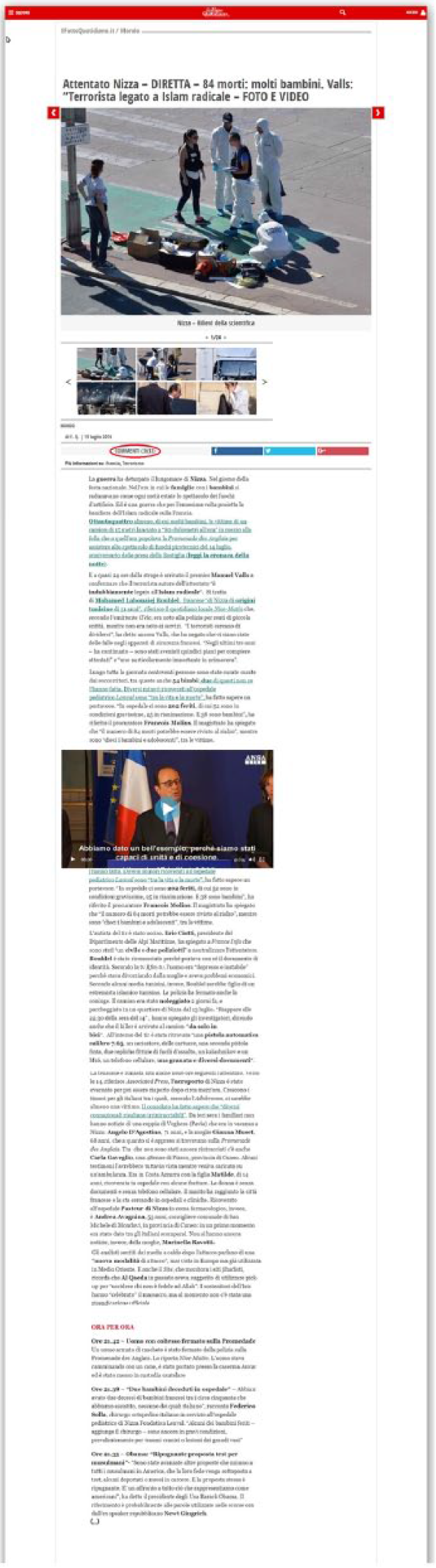
Organisation of the online article and comments.
The readers’ comments (targeting terrorism, Islam, antiterrorist politics, fear of terror, a dearth of safety measures and causes of the attack) that followed this multi-modal article were analysed individually by each of the two authors in a two-step process. First, the comments carrying humour, that is, some potential to amuse the receivers, were isolated. An important explanation is in order concerning the selection of humorous data. Humour researchers frequently pick their examples based on subjective evaluations of what humour, or its specific subtype, involves. The actual presence of humour (which does not necessarily need to correspond with its funniness, which is idiosyncratic) must be later objectively verified based on the characteristic features of humour taken as a whole (e.g. the mechanism of incongruity-resolution manifest in the stylistic and cognitive patterns underlying utterances) or its well-documented categories that are identified in the data. This is the strategy followed in this study. In ‘Analysis of humorous online comments’, all examples of conversational humour are examined primarily on the basis of their witty and creative linguistic form previously reported in the scholarship.
Second, the relevant humorous comments addressing the article, and hence tragic events, were separated from irrelevant posts (i.e. topically unrelated comments about previous comments). After the latter were discarded, the data amounted to 25 posts. This may be considered few, especially in the light of the total number of posts (3633), but this is still a substantial number given the circumstances and the context of occurrence. These data suffice for the qualitative study conducted here.
Analysis of humorous online comments
An overwhelming majority of the examples in the corpus appear to communicate users’ true beliefs and thus their ideologies, representing what Dynel (2017b) calls ‘speaker-meaning-telic humour’, a form of humour that aims both to amuse and to relay messages (p. 95). These messages, which display high creativity, can be conveyed either literally or implicitly, that is via implicature/implicating (Grice, 1989) and through the application of various categories of humour. Here is an interesting case of a creative canned joke constructed by an Internet user:
(1) -Polizia: scusi dove va lei?- -Terrorista: ehmmm avrei 3 tonnallate di gelato da distribuire col mezzo … -Polizia: ma non è un camion frigo! -Terrorista: appunto! mi faccia passare che il gelato si squaglia - Polizia: le autorizzazioni? a chi lo deve dare il gelato? -Terrorista: scusi, ma i bambini vogliono il gelato, hanno fame! -Polizia: ha ragione vada vada.
8
This canned joke presents a fictional dialogue between a terrorist and the police, whose aim is to ridicule the police’s inability to guarantee security. When interrogated, the terrorist in the joke presents flagrantly implausible explanations, thanks to which he successfully persuades the police to let him pass (and carry out an attack). This canned joke alludes to the real events and conveys the users’ critical evaluation of the local police’s actual failure to halt a suspicious truck they had indeed recognised before the tragedy.
As the characters’ utterances in this canned joke indicate, truthful meanings can originate in the absurd, which relies ‘on notions that fly in the face of reality, common sense or logic, and/or violate the universal rules of the world’ (Dynel, 2017b: 93). Here are two other instances of the absurd that communicates truthful meanings:
(2) Dovesse mai venirmi in mente di compiere un attentato userò un carro armato! Se polizia o carabinieri dovessero mai chiedermi: dove va con quel panzer? Risponderò: ‘lo porto in officina per la revisione biennale!! Hai visto mai, forse mi credono!!’
This comment represents a scenario in which the user describes his or her wish to conduct a terrorist attack. The absurd humour centres on the completely implausible explanation that the user would give to pass a security check while driving a vehicle that can hardly be found on the streets. Similar to Example (1), the French Police’s ability to enforce security is thereby disparaged:
(3) domani andrò al quirinale dicendo che devo portare dei gelati, mi porta una busta piena di winner taco
This post also presents a hypothetical scenario that depicts an absurd terrorist plan to be carried out in Italy, as a follow-up to the attack in France. The user nurtures the idea of bringing ice-cream to bypass the security of the Quirinale, one of the three official residences of the Italian President. Also in this case, the absurdity is used to criticise the inefficacy of the French police (and, through the reference extension, also the Italian police).
Rather than revolve around an absurd plan, the following example attributes an absurd thought to others in order to hyperbolise and ridicule their faulty reasoning:
(4) Secondo la Nato si è trattato di un autista supporter russo ubriaco (parole testuali ‘cercheremo di dimostrarlo anche se non è vero, come sempre’), chiede di mantenere le sanzioni alla Russia!
The absurd meaning is associated with a series of highly unlikely assumptions that North Atlantic Treaty Organization (NATO) appears to have aired with regard to the reasons for the terrorist attack. The absurd comment hyperbolises these attempts by referring to the irrelevant crisis Russia was experiencing on the European arena at the time of the attack. Thus, the authorities’ attempts at rationalising and desperately seeking an implausible cause of the tragedy are criticised.
Overall, the absurd can be perceived as a salient case of overt untruthfulness, involving utterances that are blatantly false or irrational on the literal reading. However, besides absurdity, which may sometimes overlap with the figure of hyperbole, overt untruthfulness carrying truthful meanings can take other salient forms, notably the figures of irony and metaphor, which are two standard sources of implicatures (Grice, 1989; see discussion in Dynel, 2016, forth and references therein) and can involve humour (see, for example, Dynel, 2014, 2018a, and references therein). Interestingly, irony can actually rest on the absurd (see Kapogianni, 2011, 2014) as the following example testifies:
(5) Il mandante è il mago di Oz, l’Islam non c’entra niente
The irony in this comment is based on the absurd attribution of the guilt for the attack to the wizard of Oz (a fictional literary character) and on overtly untruthfully denying any Islamic involvement. Thereby, the user criticises a series of explanations that excluded such involvement on an equally irrational basis. 9
The absurdity of a comment may not arise directly from an ironic expression but rather from the combination of two parts of an entire comment, as in Example (6):
(6) Marce, selfie tristi, candele, je suì nizzà, gessetti e pupazzini sul luogo della tragedia. Non l’avranno vinta facilmente!
This ironic, and hence overtly untruthful, statement that the terrorists will not win easily must be interpreted in connection with the preceding list of activities and objects used as tokens of support for the victims. The absurd suggestion that one can fight terrorists with all manner of sentimental paraphernalia and activities is meant to indicate that all these are pointless and to criticise lack of any actions to prevent future terrorism.
Here is a similar example involving irony that scopes over only part of a commentary:
(7) Quindi, gessetti colorati, bigliettini, e girotondi? Magari qualche peluches giusto per intimorirli un po’. Di questo passo, arricchiremo tutte le cartolerie.
The import of this comment is very similar to that in Example (6), but the ironic expression involves overtly untruthful suggestions about the remedial actions to be taken (lines 1 and 2). Thereby, the speaker dissociates himself or herself from this advice, implicitly criticising the uselessness of people’s consolation practices and lack of antiterrorist actions. The comment ends with a biting, but non-ironic, remark on the extent of these prevalent practices.
On the other hand, the following comment is ironic in its entirety:
(8) La colpa è solo nostra che non permettiamo a loro di integrarsi. Insomma, quello si voleva solo fare un giro vista mare con il camion e tutti quei poveri bambini a bloccargli la strada. Non mi pare giusto.
This comment is composed of three ironic statements, whereby the commenting person provides overtly untruthful (and absurd) explanations for the tragedy, feigning empathy for the terrorist, the ultimate goal being to implicitly criticise the various attempts at attributing the blame for the tragic events to parties other than the terrorist driver.
Interestingly, irony may mesh with metaphor (see Dynel, 2016, and references therein), as in Example (9):
(9) Valls ha la credibilità di un Renzi con la febbre a 39.8
This example is couched in a metaphorical comparison between the French Prime Minister and the former Italian Prime Minister (who has earned notoriety for his unreliability) suffering from a high fever, which affects his lucidity. Thereby, the speaker ironically implicates that the former politician has no credibility at all in his attempts to account for the tragic event.
Overt pretence (see Dynel, 2018b) coupled with backtracking on what one has said is another salient form of overt untruthfulness:
(10) La ricetta contro la xenofobia dilagante? Viaggiare. Ops scusate ho sbagliato notizia …
Reporting a pertinent ideological question, the user provides a reply only to deny it in the final part of the comment, based allegedly on some previous inadequate news. It is not the case that the commentator changes his or her opinion halfway through his or her contribution. Rather, he or she only overtly pretends to espouse the belief that travelling (in presupposition, to France) helps fight xenophobia and to have previously received wrong news. What the user aims to implicate is that travelling (to France) may actually promote xenophobic behaviours due to terrorist attacks like the one at hand.
While the examples so far have exhibited various forms of overt untruthfulness conducive to meanings arising as implicatures, truthful meanings may materialise based only on literal expressions, as is the case with the pun in Example (11):
(11) Se la polizia francese, non riesce a far ‘pulizia’, può darsi che qualche polizia ‘amica’, voglia la Francia ‘sporca’, così come l’Europa intera!
This punning critical comment about the French police is based on near homophony of two words (polizia = Police; pulizia = cleaning), as well as wordplay contingent on meaning opposition (‘clean up’ and ‘dirty’).
Also, a truthful implicature may originate from relevance seeking in what is absent from a metaphor-based punning statement:
(12) i francesi della regione di Bordeaux sono famosi per lo sterminio delle bottiglie di vino rosso, quelli dell’alsazia per le birre doppio malto e i francesi tutti per lo sterminio del camambert e del patè d’oca, ognuno ha i suoi target.
This example opens with a few observations concerning the passion of ‘real’ French people for some regional delicacies (i.e. red wine, malt beer, camembert and goose pâté), which is metaphorically conceptualised as ‘extermination’ of the food. This, in tandem with the statement that each region has its own target and the news about the Nice terrorist’s background, gives shape to the implicature that, in contrast to the ‘real’ French, the ‘fake’ French (i.e. Muslims with French passports epitomised by the Nice terrorist) like to exterminate (literally) people.
As Example (12) illustrates, humour can centre on cultural phenomena and allusions to previous events. Both can be conceived as intertextuality (see Tsakona, 2018, and references therein). Broadly understood, intertextuality encompasses a wide spectrum of allusions to ‘political/public events and discourses as well as beliefs, values, and stereotypes in wide circulation so as to capture the multiple areas of knowledge projected as possessed by potential addressees’ (Tsakona, 2018).
In this vein, the following example is based on a reference to a widely known cultural artefact, which is crucial for understanding the comment:
(13) Basta aver letto il corano. Mein kampf, in confronto, è un libro per signorine
In this comment, the Koran, the central religious text of Islam is contrasted with Hitler’s Mein Kampf, a book that inspired one of the most brutal tragedies in history. By stating that the latter is a ‘book for young ladies’, the speaker implicates that the former has even more abhorrent content and incites its readers to horrid activities.
Intertextuality can then rely on both cultural and historical references, as Example (14) also illustrates:
(14) La Francia aveva inventato uno strumento efficace per fare ‘rotolare certe teste’, forse dovrebbe ripristinarlo
This post is anchored in an implicit cultural-historical reference to the guillotine, a device popularly used in France especially during the French Revolution to carry out executions by beheading. The user jocularly suggests restoring it as a tool with which to fight terrorism. Essentially, the user seems to be genuinely supportive of capital punishment.
Another standard form of intertextuality is alluding to previous texts, such as a politician’s expressed views, albeit hyperbolically distorted for humorous effects:
(15) Papa Bergoglio ha detto che la colpa dell accaduto è dei trafficanti di camion e che occorrono leggi più severe sulle patenti
This comment refers to a series of antecedent statements by Bergoglio regarding terrorism, 10 hyperbolising, and hence ridiculing, his tendency to recognise no relationship between acts of terrorism and Islam.
While Example (15) alludes to the general line of reasoning of the politician in question, the following example capitalises on an absurd quotation (notice the inverted commas) attributed to a politician:
(16) Hollande: ‘Non cederemo al terrorismo, ma risponderemo duramente con giochi, lanterne cinesi, gessetti e quant’altro’.
The user mocks the French President’s vague political strategy 11 and criticises lack of any concrete action by putting in his mouth an internally contradictory utterance that juxtaposes an invitation of a warlike nature (‘we won’t surrender’) with a list of paraphernalia and commemorative rituals that are not (military or otherwise) countermeasures.
Overall, most posts discussed so far must have been inspired by the recent events (reflected in the online news), which serve as a frequent source of intertextuality, as evidenced also by the following example:
(17) Fonti ufficiali affermano che il camion si e` convertito all’ Islam solo 6 mesi fa.
This absurd comment (the truck being converted) alludes to, and criticises, the French intelligence’s inability to identify potential terrorist threat on the pretext of people’s recent conversions to Islam. 12
As is evident from the analysis so far, all the comments involve some kind of linguistic creativity and carry (truthful) negative evaluations. Thus, they qualify as humorous sarcasm (see, for example, Dynel, 2014, 2017a; Partington, 2006) whose aim is invariably to convey trenchant criticism while potentially amusing non-targeted message receivers. The linguistic creativity of sarcastic utterances is immense, which the examples above have shown. Here is another case that involves an internal contradiction as a source of a bitingly critical (i.e. sarcastic) implicit message:
(18) Tranquillo che Hollande non molla. E attento a mangiare il panino al prosciutto in pubblico.
Similar to Example (16), the French President’s inaction is wittily criticised – thanks to the internal contradiction arising incrementally in the comment. The President’s unwavering resistance to terrorism is reduced merely to his publicly eating a sandwich with prosciutto (dry-cured ham), his sole subversive strategy being that pork is forbidden by Islam.
Here are two more sarcastic, tongue-in-cheek comments. The first one resides in an overtly untruthful positive evaluation, while the other one draws an interesting parallel:
(19) i buonisti esultano: è stata raggiunta la piena integrazione. Gli attentati, prima riservati solo al mafiosi indigeni, adesso vengono fatte anche dalla risorse esterne
This critical comment on terrorism involves overtly untruthful positive evaluation. The commentator overtly pretends to consider the Nice attack something positive on the grounds that it testifies to the integration between local mafia criminals and Islamic terrorists. This post then echoes and ridicules immigrant integration policies endorsed by the government:
(20) Mah, se così fosse, da domani inizio ad aver paura del mio vicino di casa depresso, magari mi spara in ascensore!
This sarcastic post is a response to the allegations that the attacker was depressed. 13 The user implicitly frowns upon these implausible claims by comparing them to an equally unlikely scenario pertaining to his everyday life.
The next two examples of sarcasm involve literal means of expression but are based on punning lexical ambiguities:
(21) Di moderato l’Islam non ha neanche il clima.
The user observes that Islam is worshipped primarily in the countries with ‘extreme’ climatic conditions, tacitly indicating (see ‘even’) that the feature of ‘extremity’ applies to the religion itself. Thus, the author seems to claim that there is no such thing as moderate Islam:
(22) L’Islam moderato è quello i cui terroristi non fanno più di un paio di vittime al colpo.
This punning comment appears to suggest that radical Islam (the ideological base for Islamic terrorism) is comparable to moderate Islam, the only difference being not the intensity of the faith but the number of victims consequent upon the believers’ violence.
These two sarcastic puns in Examples (21) and (22) can be seen as one-liners, that is, one-line jokes, similar to Examples (23) to (25):
(23) [Dov’è Islam moderato?] Sono impegnati a festeggiare, dagli tempo
(24) i mussulmani moderati sono più falsi di una banconota da 23 euro.
(25) Gli islamici moderati sono atei
The three examples above seem to present meanings regarding moderate Muslims: their being pleased with the successful attack (Example (23)), their alleged falsehood (Example (24)), and lack of religious beliefs (Example (25)), all to the effect that all Muslims must be radicals.
A pending query is whether these last five instances, Examples (21) to (25), which come across as overtly racist, do display truthful beliefs or whether they merely represent autotelic humour, that is, humour for its own sake, which stands in contrast to speaker-meaning-telic humour (Dynel, 2017b) represented by the majority of examples here. These one-liners do not address any particular events, being based on racist generalisations about moderate Islam/Muslims. Presumably, if accused of racism, the anonymous authors could disavow any responsibility for truthfully communicating any racist meanings and claim purely humorous intent (see, for example, Dynel, 2017b; Haugh, 2016, and references therein). However, regardless of whether speakers sincerely nurture racist beliefs, humour like this causes conflicts and offence (Weaver, 2010) and spreads racist ideology (see Billig, 2001; Malmqvist, 2015). As Achter (2008) points out, since 9/11, Islam and Muslims have become the primary ethnic target of humour.
Conclusion
In this article, we have discussed the dark humour of Internet users’ comments following an Italian newspaper report on the 2016 terrorist attack in Nice. Rather than examining the previously studied traditional forms of post-terrorism (new) media humour, such as stand-up comedy, canned jokes or cartoons, we have focussed on spontaneous conversational humour online. The data display wittiness and humorous potential thanks to their stylistic and cognitive creativity, being based on various potentially coinciding mechanisms, notably intertextuality and different forms of overt untruthfulness (e.g. absurd, irony and overt pretence) that promote implicatures. Thus, most comments qualify as sarcasm, wittily and critically commenting on the sociopolitical situation at hand.
Our strictly discourse-oriented pragmatic study corroborates that creative comments may be regarded as communicating truthful speaker meanings, and thus ideologies. Users point out the senselessness of the ritual commemoration practices manifest in numerous tokens of compassion and mourning, as in Examples (6) and (7). More comments virulently criticise the local and national authorities’ inept security enforcement and promote more ruthless policies, as indicated by Examples (1), (2), (3), (11), (14), (17) and (20). Users also chastise politicians and political bodies for being in denial with regard to the reasons of the tragedy and for not taking any preventive measures, which Examples (4), (5), (9), (15), (16) and (18) show. In addition, as evidenced by Examples (8), (10), (12) and (19), the users express their scepticism, if not criticism of integration policies, potentially indicative of their xenophobia. Similarly, Examples (13) and (21) to (25), admittedly racist, seem to unjustly communicate criticism of (Radical) Islam as a religion promoting terrorism.
Overall, dark humorous commentaries communicate ideologies about the sociopolitical situation (see Tsakona and Popa, 2011) just like thousands of non-humorous commentaries, at the same time testifying to the users’ wit and stylistic/cognitive creativity (e.g. Goodchilds, 1972), which is in line with the interest principle (Leech, 1983). Different studies (e.g. on advertising discourse) report on the use of humour to boost a message’s attractiveness (e.g. Eisend, 2009; Madden and Weinberger, 1982 and references therein). A statement can be ventured that the same holds for anonymous humorous comments placed among thousands of non-humorous others. Our study then confirms that ‘for those more distant from the event’, rather than being a coping strategy, dark humour ‘might provide very different pleasures’ (Kuipers, 2002: 452).
Footnotes
Declaration of conflicting interests
The author(s) declared no potential conflicts of interest with respect to the research, authorship, and/or publication of this article.
Funding
The author(s) received no financial support for the research, authorship, and/or publication of this article.