



Abstract
Since the attacks of September 11 2001, there has been a marked decline in the number of military comedy films in American cinema. Films like Buffalo Soldiers, a film made prior to September 11 but released in 2003, show how this change first started. Whereas, prior to 2001, military comedies were generally accepted and even profitable, after 2001 the genre effectively disappeared and still to this day has not re-emerged despite military non-comedy films making a clear resurgence after 2008. In this article, the author explores how and why military comedies have declined over time by making comparisons of how popular both military comedy and non-comedy films were in prior periods and today. The purpose of this is to show how the decline of military comedies since 2001 is a symptom of a greater political trend within American political development, specifically the civil–military divide. As this divide has grown in the post-military draft period in the United States, an event like September 11 seems to have ruptured the general acceptability of laughing at the military, which remains improper in cinema to this day. Finally, he examines some of the political consequences of this lack of laughter at the military within the greater political and film studies literature, which include growing tacit support for the military and how the narratives within some of these films leave little room for American civilians to comedically view the military that defends them.
There really is no peace. There’s always some war, somewhere, with someone. And there are no winners or losers either. Just those who are still around to fight another day. (Private Ray Elwood, Joaquin Phoenix’s character from the 2001 film Buffalo Soldiers, dir. Gregor Jordan, 2001)
On 10 September 2001, Miramax Films bought the distribution rights to the film Buffalo Soldiers (dir. Gregor Jordan, 2001). The film itself was a dark comedy centered round a character in the US Army who was using his position and access to weapons and drugs to conduct illegal sales in order to enrich himself. Produced before 2001, its quality and approach to treating the military were well in line with the types of military films that had been released prior to and during the 1990s. However, a day after Miramax bought the distribution rights, the attacks on the World Trade Center and Pentagon occurred, and Miramax Films decided, rather appropriately given the political climate, to delay the film’s release. With the reinvigoration of American patriotic sentiment at the time in light of the attacks, the film’s content did not wholly fit the new paradigm through which American citizens saw their military personnel and the wars on which they were about to embark. In late 2001, the US invaded Afghanistan and, in March 2003, the US invaded Iraq. These military operations had support from the majority of Americans at the time, and patriotic sentiment seemed to be at a high. Miramax decided to release Buffalo Soldiers in July 2003, and while the film received positive reviews, it was chided for mocking military members and going against the fervent patriotic sentiment in the wake of the wars, with one incident where ‘one angry viewer threw a water bottle at the stage where the filmmakers had assembled to answer questions’ (Woodward, 2003). In the US domestic box office, the film only made some $300,000 on a $10 million budget, a clear indication that the film was highly disliked by American audiences or, at the very least, a film that Americans had no desire to see (Ebert, 2003).
What Buffalo Soldiers demonstrates is a clear rupture in American tastes vis-à-vis this type of film genre. The film had rather positive reviews, but audiences simply did not respond to it in a positive light. A comedy film on which the centrality of the plot focused on military characters, especially given that the characters were not acting or being portrayed in the nation’s best interests, could not thrive in a post-September 11 world, which inevitably caused the film to flop. Buffalo Soldiers’ failure demonstrates an intricate shift in geopolitics and acceptable cultural representations, and it seems that the genre of military comedies fell into disfavor. Laughing at the military or military situations became in some senses intolerable, and that intolerance still permeates both politics and culture in the US today.
This study will focus on this tangible shift in military comedies, and what this shift could indicate about not only American film tastes, but also about a possible widening of the divide between the American military and the greater civilian population. Military comedies today are not as popular as they once were, evolving now to a point where their acceptance by and profitability through consumers are no longer apparent, and this is likely linked to real or perceived political events experienced by the American population over the past two decades, with the most obvious being that war and military service have become all too real in the political landscape. As a result, the American public does not necessarily have an appetite for laughing at portrayals of service members, no matter what the circumstances or situations depicted. A lack of laughter could be at the very least a symptom of a greater respect and veneration for the military, which could be an indication of a widening civil–military divide as civilians create a culture of hero-worship or divination surrounding military members. Hypothetically, the military comedy genre can show a connection between the civilian and military populations. It is reasonable to assume that if the comedic value of an issue or a topic starts to disappear, then this is an indication that the general public has become unable to laugh at that particular subject due to the seriousness of the issues associated with it. It is for this reason that military comedies can serve as a corollary or an indicator of a cultural shift in the civil–military divide. If the military comedy genre itself is in decline, it may mean that issues associated with the military have become too serious for the general public to laugh at and may also mean an increase in veneration of the military, thus increasing the cultural civil–military divide.
To demonstrate this decline, the first half of this article will focus on data collected from military films, both comedy and non-comedy alike, to illustrate the gradual waning of military comedies themselves as well as the overall trends in military films. The second half will focus on how this data fits into the greater examination of film studies, the political and social consequences of what not being able to laugh at the military means, and what this means for the civil–military divide. The goal in presenting the data this way is to show how the data collected and the subsequent argument fit into the greater political debates taking place currently, and to show that the decline of military comedies could be an indicator of a political and cultural shift in American society.
Before proceeding further, it is important here to define what is a military film and, more specifically, a military comedy. This has never been an easy task as the number of films can be limitless if not scoped properly. As an example of this difficulty, Jeanine Basinger (1986: 9–14) attempted to scope American World War II military film down to a manageable size by eliminating films to which war was only a minor part of the film or foreign war films of the era. This study will use a model similar to Bassinger’s by defining the above-listed genres and including a fairly comprehensive and representative sample of these films to justify the associated claims.
For the sake of this study, military films are those films whose characters are predominantly military members or whose setting is principally a military setting. Films that have passing references to the military, but in which the military does not play a central role will not be included. Additionally, any reference to the term military is meant to imply only the US military, not foreign militaries. No foreign-military centric films will be included in the data. The reason for this is to see how American audiences relate to their own military, its traditions and its history. As for military comedies, these will be defined as those films that fit all of the above criteria, but whose principal aim is to make audiences laugh. While some military drama or action films may have comedic elements, their goal is not to make audiences laugh, and thus they will not be considered military comedies. Additionally, the films used in this study to demonstrate the decline of military comedies will primarily be major motion pictures with some direct-to-video/DVD films, premium-channel films, or streaming-service films to underline certain aspects of a particular era of military film.
Also, it is important to define two concepts that will be central to this study’s analysis: uncertainty and veneration. Uncertainty will primarily center around the lack of a definitive end in US conflicts, whether present or historical. For example, the war in Afghanistan continues to this day, sectarian violence continues in Iraq, and Syria and Libya both remain unstable after Western interventions, all of which have no real end in sight, unlike Vietnam and the Persian Gulf War, both of which had definitive historical ends that Americans more or less know. As for veneration, this will be defined as the respect paid to service members by the civilian populace. While uncertainty and veneration are difficult to measure quantitatively, they can both serve as ways of conceptually providing a possible framework to observe shifts within the civil–military divide. Theoretically, if military comedies have declined, one possible reason may be that both uncertainty about the current US conflicts and veneration for military members have simultaneously increased. As wars and conflicts become shouldered by a select few who volunteer to join the US military while the rest of the population remains isolated from the consequences of prolonged military conflict, a select strain of hero worship has likely grown within the public, arguing that service members can do no wrong. This in turn creates a paradigm where the military as well can do no wrong, and then the public becomes removed from the political decision-making matrix which controls American foreign intervention. While it is absolutely impossible to show a causal relationship between the decline of military comedies and a resulting shift in the civil–military divide, what can be shown is if this decline has occurred or accelerated since 2001, and what some of the possible reasons may be.
Methodology and data
Assessing the impact or resonance of a film or film genre within a particular time period can be a difficult task since finding consistent and germane data points over time may not always be possible. Additionally, one cannot simply study one aspect of film, such as critic scores, to get a comprehensive understanding of a film’s impact. Instead, what is needed is an accumulation of data points from each film studied, which together can serve to indicate certain trends within genres over time. Each specific data point may show one particular perspective on or aspect of the resonance of a film within American society. The following will lay out each data point selected with the goal of measuring one specific indicator of societal impact and resonance and, together, they will form the data analyzed for this study.
The first of these indicators is a movie’s box office numbers. While this does not necessarily indicate the quality of a film, it does indicate whether a film is popular enough to attract an audience. This can at least indicate whether a film has economic resonance in a particular marketplace at a particular time. As such, US box office numbers were collected for this study from the IMDb (IMDb, nd) and Box Office Mojo sites (Box Office Mojo, nd), and those box office numbers were compared to the budget of the film. It is important to note that only US box office numbers were collected, not total box office numbers worldwide. This is done on purpose to ensure that what is being measured is the resonance within American film culture. The comparison of the US box office to the overall budget of the film will be done in terms of real dollars to eliminate any need to adjust numbers for inflation. Profitability will be determined based on a percentage comparison of the US box office versus the budget of the film.
Profitability, however, does not measure quality in the eyes of specific audiences so, in order to see this, one must use other measures like film critic scores. For this, the Rotten Tomatoes Tomatometer® along with the Audience Score will be used to measure critic and audience judgments (Rotten Tomatoes, (nd, a)). The Tomatometer® is measured by regrouping the judgments of around 3000 certified movie reviewers on the site. While not every movie is reviewed by all of these critics, the judgments of these critics can be considered more reliable as they are certified critics. The Audience Score, however, is based on the assessment of anyone who goes on the Rotten Tomatoes site and critiques or remarks on a movie (Rotten Tomatoes, (nd, b)). While neither of these data points offers a fool-proof way of assessing a film’s quality, they do offer at least a scientific means of assessing the content in a rather consistent manner.
There is one point of concern with these critic scores, and that would be what role nostalgia plays in affecting these scores over time. As more critics and people see these films, the scores are likely to fluctuate as time passes. While one should be aware of nostalgia’s effect on these scores, this should not be a concern for this study because, as the data will demonstrate, nostalgia plays a strong role in how military films are made. The final data point will be a measure for nostalgia, which will be termed as distance-in-years. This specific measure will be the difference in dates between a film’s setting and its real-world release date. For instance, the film Pearl Harbor was released in 2001 while the actual attack on Pearl Harbor took place in 1941, so the film’s distance is 60 years. Hypothetically, the further a conflict is in the past, then the more idealized and nostalgic it would be. A film about a conflict long ago with a more contemporary release date could indicate a reminiscence about a particular era when national goals in war may have been clearer or more defined. Once again, using Pearl Harbor as an example, it is easy for Americans to look at that specific attack and see the chief American protagonists as righteous and virtuous while the Japanese antagonists are seen as malevolent, thus reinforcing a nostalgia about the period that is generally accepted. This sort of acceptance, however, may not always be true for films today as the wars of the past two decades persist to this day. While it may not provide the perfect lens for correcting nostalgia within critic scores, it will at least allow for a clearer analysis of what may be a generational retrospective reassessment of older military comedies.
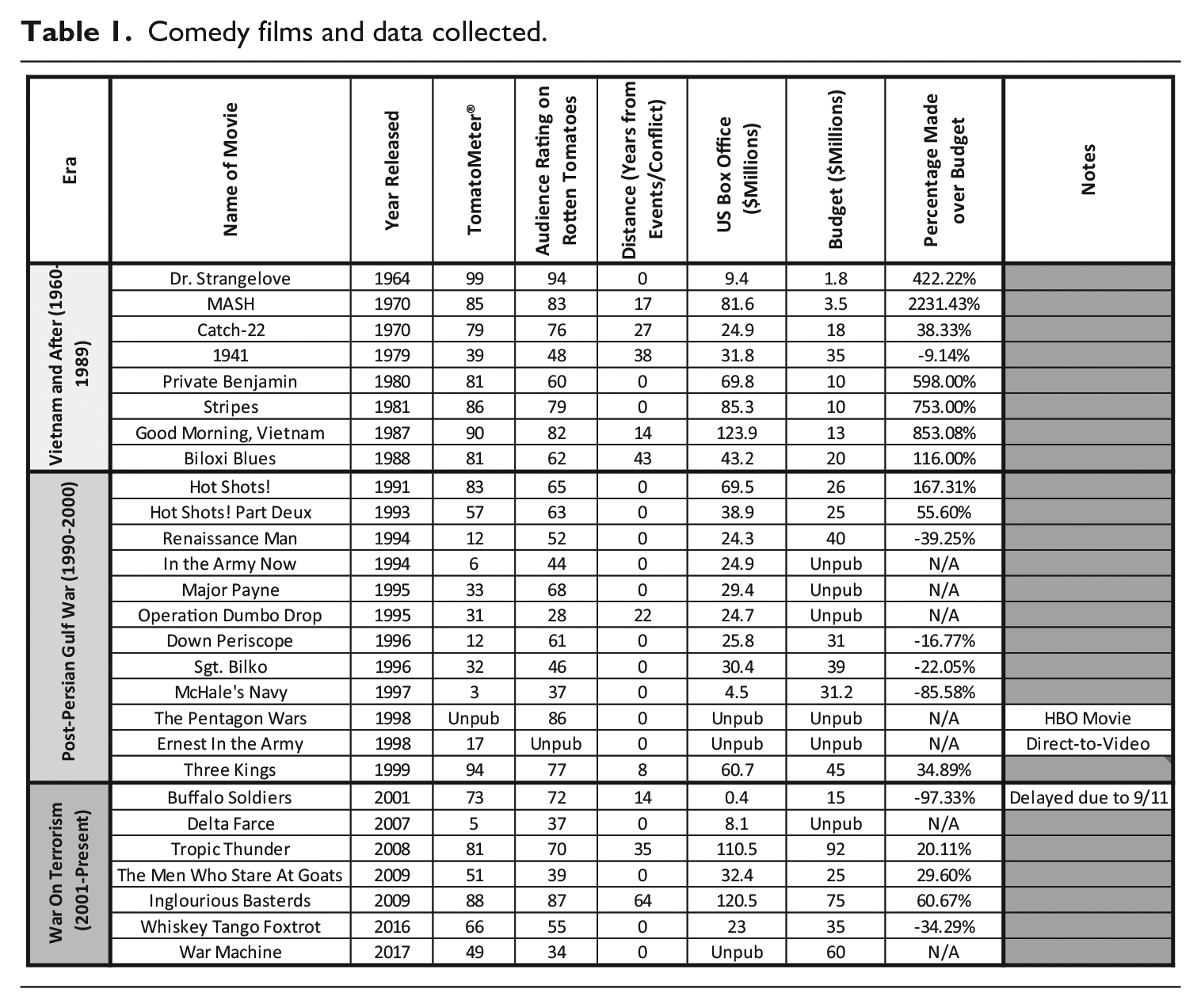
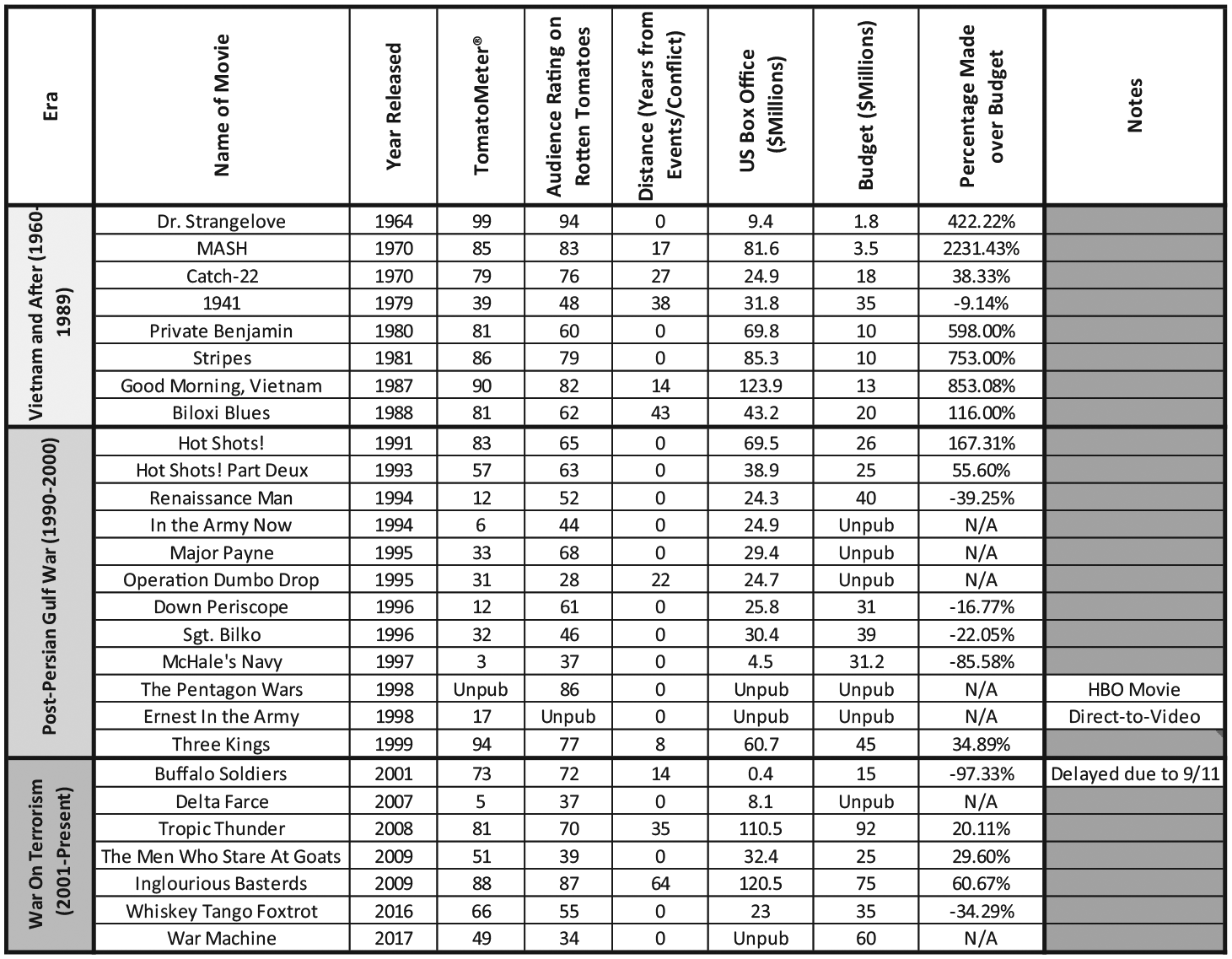
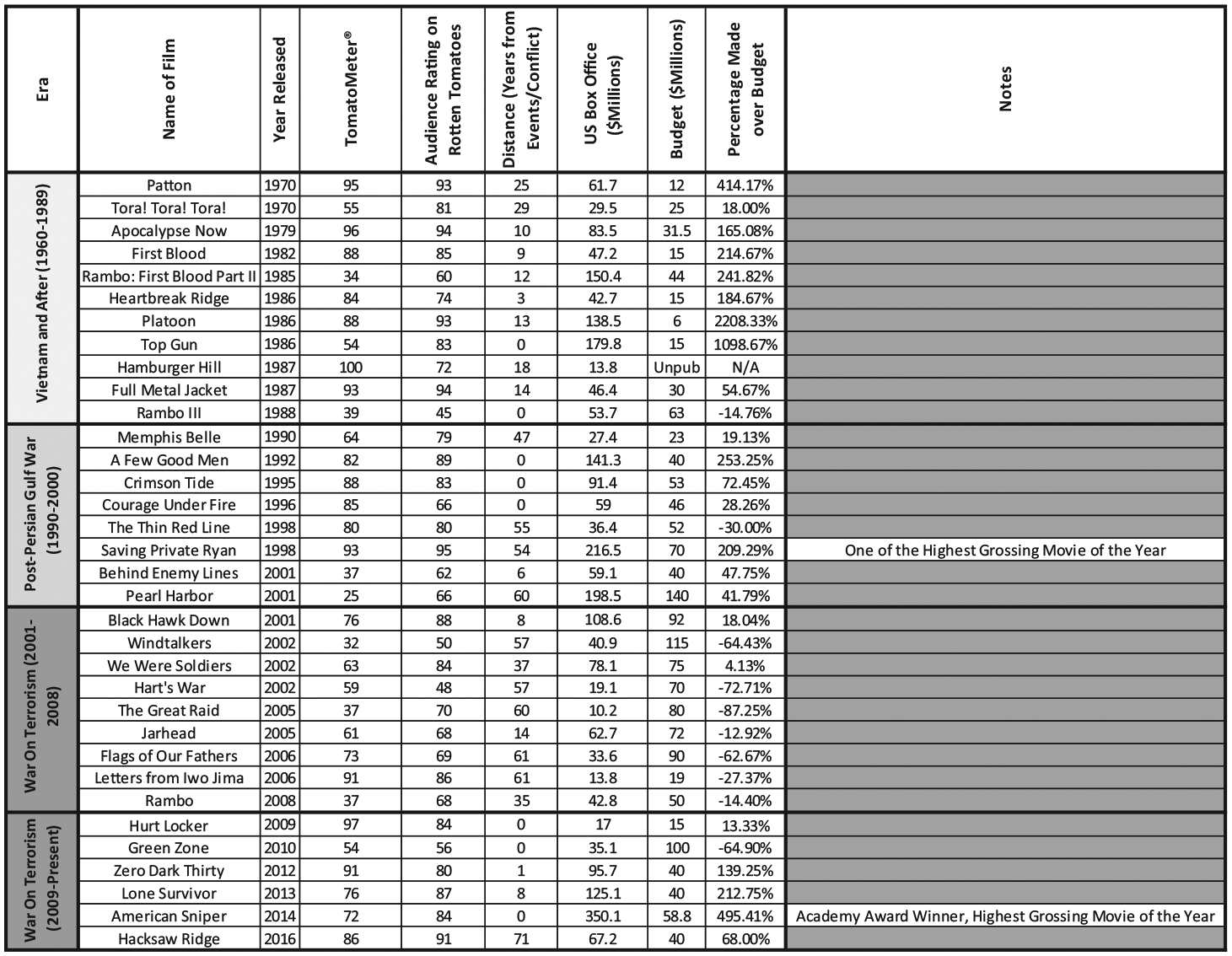
As for the films selected for the data set, there are 61 military films chosen from the Vietnam era forward, including 27 comedy films and 34 non-comedy films. Prior to 1960, there were a large number of US military comedies, but those will only be considered as a historical block beyond the scope of this study and can be referenced as a period when US military comedies were largely accepted. The films specifically chosen for this study show the varied trends in the treatment of the military in film over time as well as their popularity in American cinema. The comedies vary in quality and type, ranging from critical satire of military power with Dr. Strangelove (dir. Stanley Kubrick, 1964) to slapstick comedies like In the Army Now to satires of military movies with Hot Shots! (dir. Jim Abrahams, 1991). The non-comedies begin with non-fiction biographical dramas like Patton (dir. Franklin J Schaffner, 1970) and American Sniper (dir. Clint Eastwood, 2014) as well as fictional accounts of military action and drama movies such as A Few Good Men (dir. Rob Reiner, 1992) or Rambo: First Blood Part 2 (dir. George P Cosmatos, 1985). Tables 1 and 2 show both the comedy and non-comedy US military movies, respectively, along with each data point collected. Each movie is categorized into one of three specific eras, which include the Vietnam War and after period (1960–1989), the post-Persian Gulf War period (1990–2000), and the War on Terrorism era (2001–present), with a further division of non-comedy films in the War on Terrorism era into the periods of 2001–2008 and 2009–present due to the shifting trends during these two distinct periods. Each of these periods has distinct political characteristics that seem to have seeped into how the military is portrayed in film. Comparing the averages for the data points collected from both comedy and non-comedy military films will show general trends and differences in these types of films over time.
Comedy films and data collected.
Non-comedy films and data collected.

Results by time period
In this section, the data will be shown and explained by time period to establish some of the apparent shifts in the military film genre. Figures 1 through 4 depict the data collected for each of these periods. Figure 1 shows the average Tomatometer® rating for each period and each film type. Figure 2 shows the average audience score from Rotten Tomatoes via the same temporal parameters listed for the Tomatometer® figure. Figure 3 shows the average percentage made by taking the US box office and dividing it by the film budget. The final figure, Figure 4, shows the average distance in years from a film’s portrayed events to the film’s real-world release.
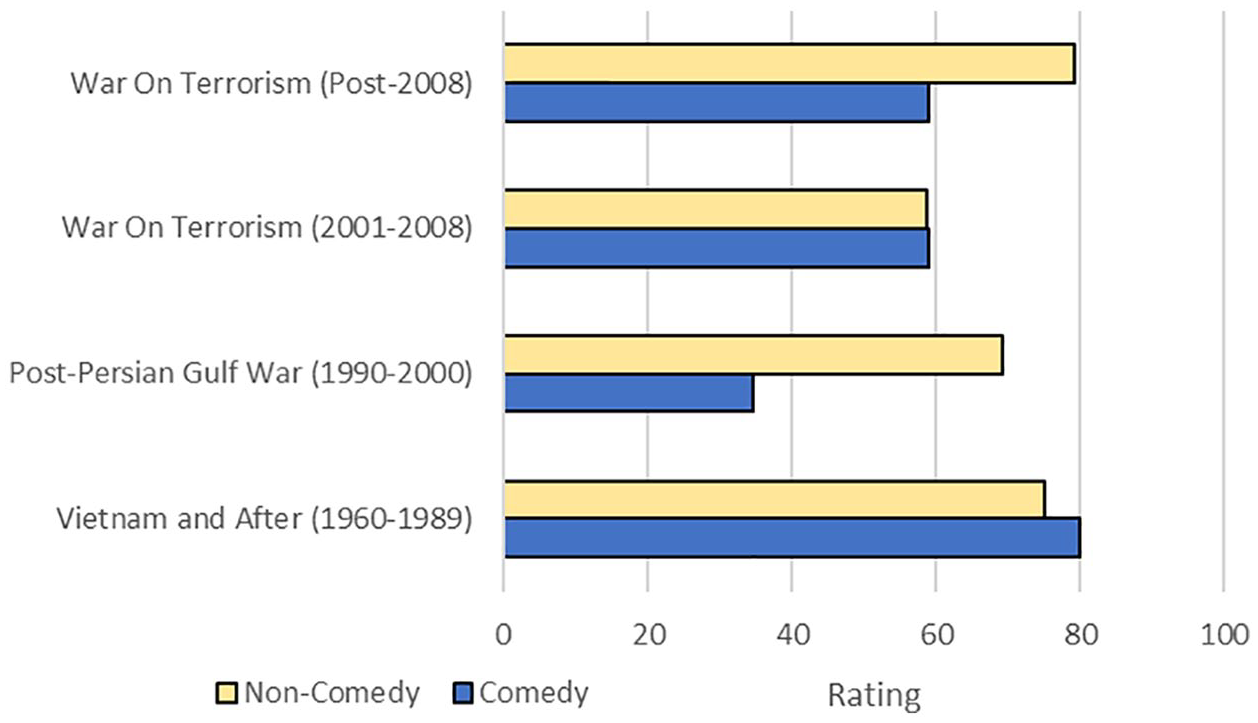
Average Tomatometer® rating by period and film type.

Average audience rating by period and film type.

Average percentage made (US box office over budget) by period and film type.
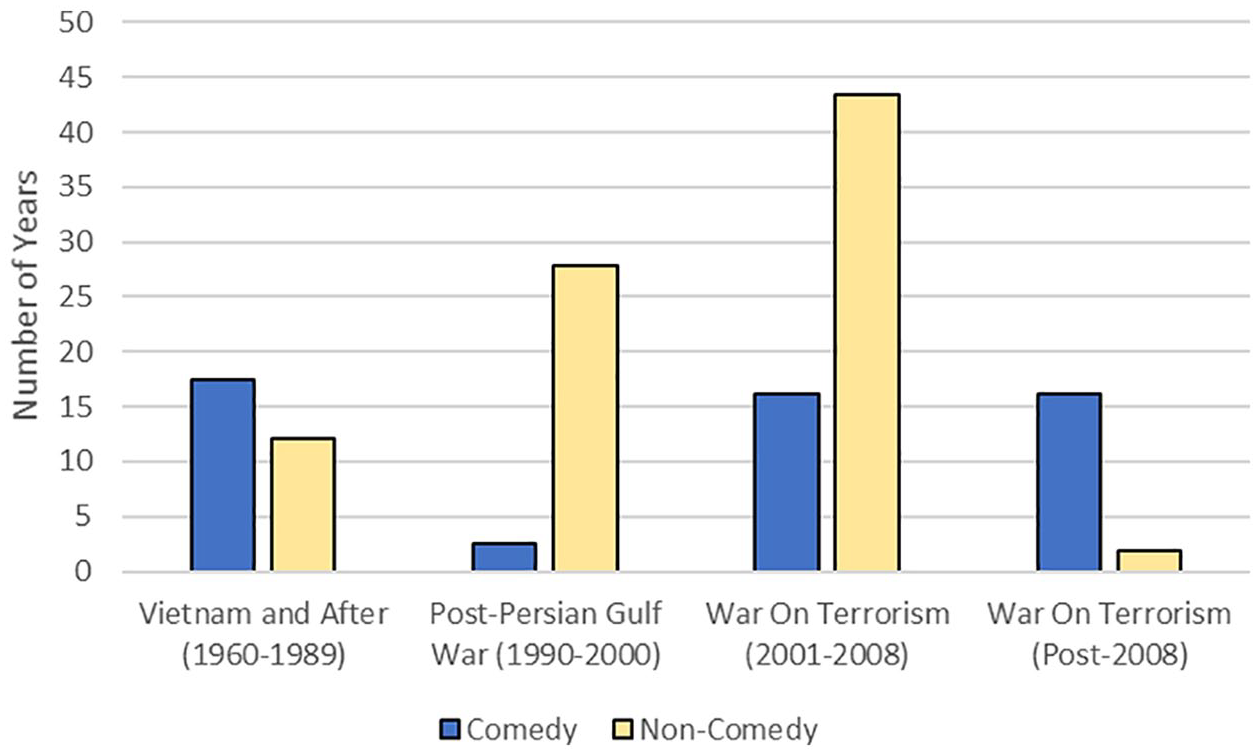
Average distance in years between film release and events portrayed by category.
It is important to note that the military comedy averages for each period during the War on Terrorism (both 2001–2008 and post 2008) across all four figures are the same. Due to the low number of military comedies to data-collect from during the post-2001 era, the numbers remain the same for both the 2001–2008 and the post 2008 periods, periods that were divided to show the vastly different changes between comedies and non-comedies in these shorter, but more current, periods of time. These figures and their associated data will be explained in the next sections.
Vietnam and after
In terms of military depictions in film, the Vietnam and post-Vietnam period saw a turn towards dealing with the national anxiety surrounding the US involvement in Vietnam. In the decades after Vietnam, films like Apocalypse Now (dir. Francis Coppola, 1979), First Blood (dir. Ted Kotcheff, 1982), and Platoon (dir. Oliver Stone, 1986) attempted to capture some of the societal sentiments associated with the loss. In general, Vietnam had a sobering effect on the political landscape, sowing doubt into the post-World War II society that had been built in the decades preceding the war. After the fall of Saigon, the US had arguably been handed its first substantial war defeat, the draft had become so controversial that the federal government transitioned the military to an all-volunteer force, and a general malaise and distrust had overtaken the public.
Despite the disruptions caused by the Vietnam War, military comedy films at the time did not necessarily deal with the subject of the war, but rather with other conflicts or more contemporary military affairs. The film MASH (dir. Robert Altman, 1970) was set during the Korean War, and films like Private Benjamin (dir. Howard Zieff, 1980) and Stripes (dir. Ivan Reitman, 1981) were more focused on out-of-place characters thrown into Cold-War military situations and their subsequent reactions. In one such case where Vietnam was dealt with in a comedic light, the film Good Morning, Vietnam (dir. Barry Levinson, 1987) focused on an individual attempting to add comedy to what would otherwise be a serious and non-comedic situation. Apart from this singular case, the military comedies during this period were not Vietnam-related. In terms of year distances from the events portrayed, non-comedy films averaged about 16 years while comedy films averaged 12 years, a difference that is rather negligible, thus indicating that a nostalgia factor is not really in play at this point. What is important to note about this period though is how military comedy films often did better than their non-comedy counterparts during this period. In terms of percentage made over budget, the comedy films of this period made an average of almost 40 percent more at the box office than non-comedies. Additionally, they often rated higher than non-comedies in terms of critic reviews and, while the audiences tended to rate non-comedies higher, the difference in audience reviews between both types of films is much smaller when compared to the other eras listed.
What seems to be occurring after Vietnam is a reckoning with the outcome of the conflict, where American culture is attempting to deal with the War’s after effects through film, but this internal strife never seems to shift into the military comedy realm. In fact, the example of Good Morning, Vietnam and its success shows that a military comedy film could succeed in spite of the setting and the historical hindsight that existed at the point of its production. The plot of the film involved directly injecting humor into a Vietnam War storyline, and it did so successfully and to critical acclaim, proving that a military comedy could succeed in a politically-sensitive setting. For all intents and purposes, the post-Vietnam War era was still a boom period for military comedies. Whether they dealt with Vietnam or not, they often outperformed their non-comedy equivalents. Part of this, however, could be related to the closure that the end of the Vietnam conflict provided, and it is here where uncertainty comes into play, or rather, for this period, does not come into play. Despite the war being generally considered a loss, the uncertainty about its outcome did not continue after the war’s end. The war was over and, despite the loss, American cinema could attempt to deal with the outcome as it did through non-comedy films, leaving military comedies as an acceptable genre separate from the mixed emotions associated with Vietnam. Uncertainty as a dampener to military comedies seemed not to occur at that time because Vietnam did have a definitive end, and films like Good Morning, Vietnam demonstrate this.
The Persian Gulf War and its effect
The 1990s saw a change in military film as a sizeable shift and divergence between military comedies and non-comedies seemed to occur just after Operation Desert Storm in 1991. In fact, this point in time saw a confluence of world events which created pertinent changes in the political landscape. The US and its allies managed to expel the Iraqi Army from Kuwait during a war which lasted four days on the ground. Within a year of that conflict, the Soviet Union collapsed, giving the US a powerful psychological victory and bringing an end to the Cold War. Popular culture began to reflect these changes, now seeing the US as the only unchallenged superpower. In terms of non-comedy films, there were 1990s-set films such as A Few Good Men or Crimson Tide (dir. Tony Scott, 1995), dealing with contemporary military issues in a dramatic setting, while simultaneously creating nostalgia-based action films such as Saving Private Ryan (dir. Steven Spielberg, 1998) or Pearl Harbor. Comedy films included reboots with McHale’s Navy (dir. Bryan Spicer, 1997) and Sgt. Bilko (dir. Jonathan Lynn, 1996), satires likes Hot Shots!, and other sitcom-like comedies such as Down Periscope (David S Ward, 1996) or In the Army Now.
In terms of the data, this period during the 1990s saw a drastic decline across the board in terms of acceptance and profitability for military comedies. The marked advantage that military comedies had had during the Vietnam era over non-comedies was effectively over. The average Tomatometer® rating for military comedies in the 1990s had a sharp drop to just under 35 percent, while non-comedies hovered around 70 percent. Audience scores also dropped to around 57 percent while non-comedies were at about 77.5 percent. Profitability also tanked; non-comedies were able to maintain an average of 80 percent profitability, while comedies dropped to just over 13 percent profitability. This drop alone is even more drastic when compared to the 600+ percent profitability of comedy films during the Vietnam era. In terms of distances in years, non-comedy films more than doubled when compared to the Vietnam era, but comedy films did the exact opposite. In fact, their distances were so low because most films were effectively using comedy to quip about the military directly during the 1990s.
What these numbers show is that military films in general saw declines during this period, but comedies fared much worse than non-comedies. A confluence of significant political changes was occurring at this time which may relate to these shifts in film. Some two decades post-Vietnam and post-military draft, individual military service obligations were no longer required and fewer people entered the military. Additionally, the 1990s saw a military drawdown after the end of the Cold War, thus further lessening the need for military personnel. Also, after the quick and stunning success of the Persian Gulf War, Americans were regaining the confidence in their military that was lost in the post-Vietnam era. The short duration of the 1990–1991 conflict and its overwhelming success truncated uncertainty in the nation’s armed forces.
Simultaneously, veneration for the military comes into play with the decline of military comedies and more success for non-comedy military films. Fewer total military personnel likely created a widening of the divide between civilians and the military, but no perceived threat had penetrated the confidence American society had in its military. As a result, Americans seemed comfortable with the existence of military comedies, but this did not necessarily mean they were going to see them. Military comedies declined in quality based on average review scores and made less at the box office. Meanwhile, non-comedy military films did rather well, remaining quite profitable and having higher review scores that were close to matching the post-Vietnam era, with even one film, Saving Private Ryan, being one of the highest grossing films of 1998. Veneration and respectability for the military seemed to grow during this period, and military comedies themselves tended to become cash-grabs for studios or relics from by-gone eras. However, with a strong certainty in the US position in the world and the lack of major conflicts, military comedies continued to be produced.
Post-September 11 and reminiscing
The attacks of September 11 2001, changed the political and cultural landscape of the US and, as the data shows, military films felt the brunt of this shift. With such a shock to the American system, military response became a fait accompli for the US. Within a year and a half of the attacks, the US had launched two major invasions in Afghanistan and Iraq under the guise of the Global War on Terrorism, setting the stage for the geopolitical instability which remains rampant throughout the Middle East, Central Asia, and Africa to this day.
Film-wise, this post-attack period is marked with numerous films that reminisce about old war periods. There were a number of non-comedy World War II-related films, including Windtalkers (dir. John Woo, 2002) and Flags of Our Fathers (dir. Clint Eastwood, 2006), along with films dealing with other US conflicts, such as Jarhead (dir. Sam Mendes, 2005) or We Were Soldiers (dir. Randall Wallace, 2002). After 2008, there were a number of films which began to deal with the Afghanistan and Iraq conflict, including The Hurt Locker (dir. Kathryn Bigelow, 2008), Lone Survivor (dir. Peter Berg, 2013), and American Sniper. Comedies, however, became fewer during this period, with some notable successful titles such as The Men Who Stare at Goats (dir. Grant Heslov, 2009) or Inglourious Basterds (dir. Quentin Tarantino, 2009) and some less notable titles like Delta Farce (dir. CB Harding, 2007) and Whiskey Tango Foxtrot (dir. Glenn Ficarra and John Requa, 2016).
The film data for this period is fairly clear; the immediate after effects of the 2001 attacks were severely detrimental to military films, both comedy and non-comedy alike. American audiences tended to avoid these films. During this short period from 2001 to 2008, non-comedy military films did worse monetarily when compared to comedy films. These non-comedy films were more reminiscent of times of a clear American moral superiority in wars and conflict. While films like Jarhead and Black Hawk Down (dir. Ridley Scott, 2001) portrayed a more contemporary war environment, World War II films dominated this period, with the average non-comedy military film averaging a distance between release date and events portrayed at 43 years. Part of this could be linked to the passage of time, as World War II became farther removed from contemporary society, but it does indicate a reminiscence or idealization of an era of clear national war goals, something that was lacking in the uncertainty of the time period right after September 11. Ratings-wise, non-comedy military films still had an edge over comedies with audiences, but their popularity dropped during this period.
Much of this changed after 2008 when non-comedy military films shifted back towards profitability. There was also more of a push to deal with complex topics associated with Afghanistan and Iraq in film which had been largely ignored culturally prior to 2008. Films like The Hurt Locker and Lone Survivor began to take on the grueling reality of what service members experienced during these conflicts, and American Sniper even engaged with what service member families have to experience while their loved ones are deployed. In 2011, two major events occurred which provided at least some sense of closure to the 2001 attacks: Osama bin Laden was killed in a US operation, subsequently portrayed in Zero Dark Thirty (dir. Kathryn Bigelow, 2012), and the Iraq War officially came to a close, at least for a short time. The average distance in years for non-comedy military films post-2008 was 1.8 years, meaning that non-comedy military films were not focusing on nostalgia, but rather on contemporary conflicts. When compared to the 43-year average distance in the 2001–2008 period, this notes a drastic shift in a short time period. What seems to be occurring after 2008 is a growing need to deal with both the positive and negative consequences associated with the War on Terrorism, and generally, American audiences seemed to respond positively to that.
On the other hand, the post-2001 era saw several attempts at creating military comedies within this changed political climate, but these attempts did not really have an impact. After 2009, military comedies practically disappear from the box office. Successful military comedy films from this period such as Tropic Thunder (dir. Ben Stiller, 2008) or Inglourious Basterds tended to focus on nostalgia and lampooned non-military targets like actors and Nazis, respectively, but not the military directly. Those that did, like Buffalo Soldiers or the 2007 film Delta Farce, were derided by critics and flopped at the box office. While these comedy films were far removed from critiquing or satirizing the ongoing conflicts, they simply did not seem to be acceptable to American audiences.
To summarize this period, the post-2001 period is marked by uncertainty and veneration towards the military. The US remains engaged in a number of conflicts around the world, and the lack of a definitive end leaves uncertainty about the future intact, unlike what occurred after Vietnam and the Persian Gulf War. Non-comedy military films have made substantial and worthy attempts at dealing with that uncertainty in film, but their attempts fit within the mold which holds the military in high esteem. Military comedies did not do this. Instead, they attempt to parody what American society has enshrined. Whereas military comedy films previously displayed the mundane to great comedic effect, the mythologization of the service member has changed this. The next section will explore how this shift fits into discussions associated with the civil–military divide.
Military comedy and the civil–military divide
First, it is important to note here that a decline in military comedy does not necessarily mean that American civil–military relations are deteriorating or that the gap between the military and civilians is widening. No one piece of evidence, especially associated with something as nebulous as the civil–military divide, can serve as the causal link for an occurrence or event. It can, however, demonstrate general trends which may be occurring, both from within and without the greater political systems, and that is why it is necessary to see military comedies as only one small piece in a larger puzzle.
It is perhaps best first to conceptualize what is meant by the civil–military divide, which can have a number of different layers and manifest in various ways. For example, Peter Feaver and Richard Kohn’s (2001) study focused on clarifying whether a civil–military gap exists or not, concluding that the gap exists in some form and manifests itself in a political divide between military officers and their civilian counterparts. However, they also dismiss any issues associated with the divide, and save for any real threat to the United States as a whole, the gap would not really create a crisis so long as civilians made efforts to keep the gap from growing too wide (pp. 462–473). The study was conducted with pre-September 11 data, thus indicating a line of thinking about the divide before 2001, a line that may have changed since the attacks and to which the film data above alludes. Another way to think of the divide is as a multi-disciplinary amalgamation of dimensions, which wax and wane over time based on public sentiment. In one instance, the civil–military divide has been described as having four different dimensions: cultural, demographic, policy preference, and institutional, all of which had a distinct individual effect on the overall civil–military divide (Rahbek-Clemmensen et al., 2012: 673). Such a conceptualization is unique since the divide may not necessarily manifest itself in all of these dimensions all at once, but may gradually be in flux in one or a number of these dimensions. Military films would fit a cultural dimension of this divide, but one could argue that changes within one dimension may fluctuate at a different rate than other dimensions.
More often than not, the perception of a growing civil–military divide or problems within the divide grow out of a lack of service requirements for American citizens dating back to the end of military conscription in the US. Beth Bailey (2009: 32–33) argued that at the height of the Vietnam War, as the military draft became controversial, political leaders pushed for a military service less based on ‘fairness and shared sacrifice,’ as the draft supposedly was, and more based on monetary incentives for those who joined. After the end of the draft, proactive political leaders shifted civil–military relations to meet their own political needs. As Andrew Bacevich (213: 107–108) points out, a major political shift occurred during the Reagan administration’s military build-up where ‘support for “the troops” – as opposed to actual service with them – [became] the new standard of civic responsibility.’ What both Bailey and Bacevich point to is a shift in the perception of military service in the US which took place gradually over time, but still persists to this day. No longer are civilians expected to serve, but they are simply expected to provide political, material, and even tacit support, despite any objections that they may have to war efforts or the military in general. It is in this sort of environment, where the personal links to the military are rarer and where veneration for the military can generally grow, that to not at least tacitly support the military is seen as an affront to the greater nation as a whole. This could be in part why military comedies are simply not as popular now as they once were. The political dynamics have shifted to where civilians are expected to respect the military, not question it or make fun of it.
It should be noted, however, that this is not simply a natural political shift based on the policy of political leaders or a natural progression in American society; the US military has also played an active part in its own portrayal in film, especially in military comedies. Military officials have historically offered equipment or other assistance to Hollywood film studios in exchange for positive portrayals in cinema (Wasson and Grieveson, 2018: 7). For example, Stripes was heavily edited to gain military approval for assistance, and In the Army Now was seen as a recruiting opportunity for the Army Reserve (Robb, 2004: 184–185, 194–195). These sorts of activities show an engagement on the part of the military to actively brand itself and create a positive self-portrayal, engendering itself to the civilian population which it is meant to protect and accelerating the sense of veneration.
After September 11, one can see this acceleration towards veneration in overdrive. American society in general became more reverent for the military post-attack, and this had an effect on films about the US conflicts. Martin Barker (2011: 124, 133) demonstrated the failures of films within the Iraq War genre, films that were deemed a ‘toxic genre’ up until 2009. Barker examined 23 films that he deemed fit into this genre, and consistently, they underperformed at the box office and were often not widely released (pp. 10–11). Films about the Iraq War were not well received in the first few years of the war, which is consistent with the data portrayed in the prior section. Additionally, Barker points to the 2009 release of The Hurt Locker as a film that seemed to break the mold on the toxicity of Iraq War films (p. 133). The data on films in the prior section confirms this, and even goes beyond, showing that non-comedy military films have thrived in the post-2009 era with American Sniper, Zero Dark Thirty, and Lone Survivor becoming popular war films of the period. These films embody the veneration that is key to respect for military personnel, and they fit neatly into the political paradigms of supporting the military and showing what service members have to deal with, something that a comedy likely would not have the ability to do.
None of these films, though, are popular in isolation. The post-2009 military films engender specific narratives that help Americans tell themselves about their place in the world. Melani McAlister contends that narratives that are born out of crises ‘are forged not by policy makers, but at the intersection of news accounts, policy developments, and cultural texts such as films, novels, and even video games’ (see Slocum, 2006: 325). September 11 was one of these crises which showed a marked shift in culture, particularly in the political narratives of military films away from comedy. In addition, Mark Lacy (2003: 634) stated in an article about military films, from Apocalypse Now Redux to Black Hawk Down, that ‘the dramas that unfold [in these films] provide moral security – the security that liberal democracies can bring justice and order to the world, affirming the sentiment that we are noble, responsible, and good.’ For Americans, it is clear that September 11 represented one of these ruptures for which audiences had to deal with these questions about their place in the world. Military comedies simply do not fit this mold, do not provide more security, nor do they affirm the good within us. They have not done so for close to two decades.
It is evident that military comedies are but one small piece of these greater debates, but seeing the decline of these films within the context of these greater deliberations shows that military comedies represent an indication of greater political trends at play in film and American culture. Their lack of presence in our current period, when their presence and profitability were apparent in prior decades, show us topics associated with the military are not meant for amusement, but rather should be taken seriously in all cases. When compared to prior periods, the decline of military comedy is but one small sign of a shift in the civil–military divide.
Conclusion
In short, military films in American culture have shifted and adapted over time to the political and historical paradigms in which they were made. The data presents here shows that non-comedy military films in general have rebounded from the post-September 11 slump, but military comedies have not. Examining military comedies as a genre in themselves separate from other military films offers some validation of the above trends that seem to be in play in American society. The decline is likely the result of a number of political shifts, both intentional and unintentional, based on efforts by military, political, and cultural figures, as well as general trends within American society. In a post-2001 world, the likelihood of military support for a military comedy film is small, unlike in decades past where support was contingent on positive portrayal. A military comedy in the current political climate is unlikely to provide that positive portrayal. Additionally, the non-comedy military films seem to have rebounded after 2009 while military comedies have not, which indicates an earnest attempt at reckoning about the wars in Iraq and Afghanistan from American audiences. On a final point, while it is impossible to see the exact state of the civil–military divide, the lack of military service from the majority of Americans, as well as the shift towards implicit support for the military, has likely created an environment where political and military leaders along with Hollywood executives and audiences in general see military comedies as a relic of the past rather than an a viable film genre today. The Buffalo Soldiers example represents the moment this change took place, and it is a change that has persisted up until this day.
Despite all of this, the US military remains an important component of American society, central to how Americans view themselves and their power and position in the world. By examining military comedies, one can see, at least in one aspect, how the public relates to its military. When military comedies disappear, it means that military situations are simply not funny anymore given the gravity of the geopolitical situation, whether that is related to the veneration for military personnel or the uncertainty surrounding the conflicts in which the United States is engaged. None of this is to say that this cannot change. Military comedies may very well see a resurgence in the future. However, their decline in the recent two decades shows how American audiences have lost something that was once acceptable. When it becomes impossible for us to laugh at the military, then it also becomes possible that we have lost our ability to relate to it or control it, a loss that seems unlikely to be regained for the foreseeable future.
Supplemental Material
Appendices – Supplemental material for Poking fun at heroes: American war and the death of the military comedy
Supplemental material, Appendices for Poking fun at heroes: American war and the death of the military comedy by Andrew C Sparks in Media, War & Conflict
Footnotes
Funding
The author received no financial support for the research, authorship, and publication of this article and there is no conflict of interest.

Supplemental Material
Supplemental material for this article is available online.
Author biography
References
Supplementary Material
Please find the following supplemental material available below.
For Open Access articles published under a Creative Commons License, all supplemental material carries the same license as the article it is associated with.
For non-Open Access articles published, all supplemental material carries a non-exclusive license, and permission requests for re-use of supplemental material or any part of supplemental material shall be sent directly to the copyright owner as specified in the copyright notice associated with the article.
